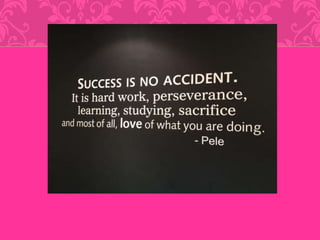
MOTIVATION
Psychological forces that determine the direction of a person’s behavior in an
organization, a person’s level of effort, and a person’s level of persistence
EFFORT
Refers to how hard people work
PERSISTENCE
Refers to whether, when faced with roadblocks
and obstacles, people keep trying or give up.
MOTIVATIONS AND PERFORMANCE
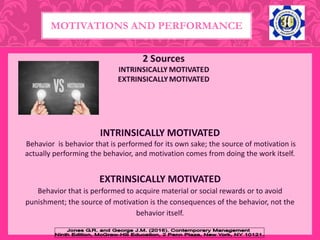
INTRINSICALLY MOTIVATED
Behavior is behavior that is performed for its own sake; the source of motivation is
actually performing the behavior, and motivation comes from doing the work itself.
MOTIVATIONS AND PERFORMANCE
EXTRINSICALLY MOTIVATED
Behavior that is performed to acquire material or social rewards or to avoid
punishment; the source of motivation is the consequences of the behavior, not the
behavior itself.
MOTIVATIONS AND PERFORMANCE
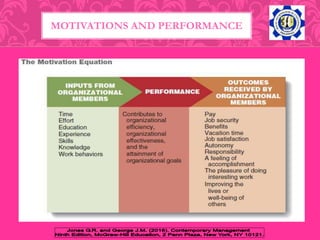
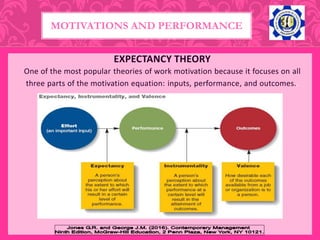
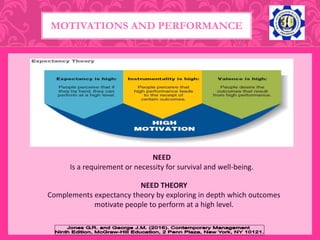
EXPECTANCY THEORY
One of the most popular theories of work motivation because it focuses on all
three parts of the motivation equation: inputs, performance, and outcomes..
MOTIVATIONS AND PERFORMANCE
NEED
Is a requirement or necessity for survival and well-being.
NEED THEORY
Complements expectancy theory by exploring in depth which outcomes
motivate people to perform at a high level.
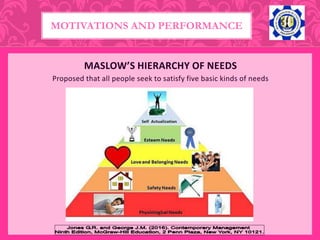
MASLOW’S HIERARCHY OF NEEDS
Proposed that all people seek to satisfy five basic kinds of needs
MOTIVATIONS AND PERFORMANCE
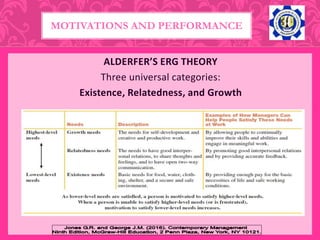
ALDERFER’S ERG THEORY
Three universal categories:
Existence, Relatedness, and Growth
MOTIVATIONS AND PERFORMANCE
HERZBERG’S MOTIVATOR-HYGIENE THEORY
MOTIVATOR NEEDS
Are related to the nature of the work itself and how challenging it is.
MOTIVATIONS AND PERFORMANCE
HYGIENE NEEDS
Are related to the physical and psychological context in which the work is performed.
MOTIVATIONS AND PERFORMANCE
NEED FOR ACHIEVEMENT
Is the extent to which an individual has a strong desire to perform challenging
tasks well and to meet personal standards for excellence.
NEED FOR AFFILIATION
Is the extent to which an individual is concerned about establishing and
maintaining good interpersonal relations.
NEED FOR POWER
is the extent to which an individual desires to control or influence others
EQUITY THEORY
Is a theory of motivation that concentrates on people’s perceptions of the fairness
of their work outcomes relative to, or in proportion to, their work inputs.
EQUITY
Exists when a person perceives his or
her own outcome–input ratio to be
equal to a referent’s outcome–input
ratio.
INEQUITY
Or lack of fairness, exists when a person’s
outcome–input ratio is not perceived to
be equal to a referent’s.
MOTIVATIONS AND PERFORMANCE
UNDERPAYMENT INEQUITY
Exists when a person’s own
outcome–input ratio is perceived
to be less than that of a referent
OVERPAYMENT INEQUITY
exists when a person perceives that
his or her own outcome–input ratio is
greater than that of a referent.
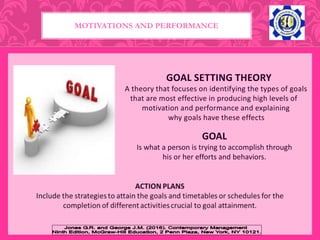
GOAL SETTING THEORY
A theory that focuses on identifying the types of goals
that are most effective in producing high levels of
motivation and performance and explaining
why goals have these effects
GOAL
Is what a person is trying to accomplish through
his or her efforts and behaviors.
MOTIVATIONS AND PERFORMANCE
LEARNING THEORIES
Focus on increasing employee motivation and performance by linking the outcomes that
employees receive to the performance of desired behaviors and the attainment of goals.
LEARNING
A relatively permanentchange in knowledgeor behavior that results
From practice or experience
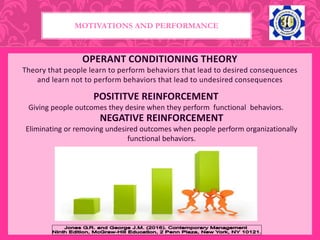
OPERANT CONDITIONING THEORY
Theory that people learn to perform behaviors that lead to desired consequences
and learn not to perform behaviors that lead to undesired consequences
POSITITVE REINFORCEMENT
Giving people outcomes they desire when they perform functional behaviors.
MOTIVATIONS AND PERFORMANCE
NEGATIVE REINFORCEMENT
Eliminating or removing undesired outcomes when people perform organizationally
functional behaviors.
MOTIVATIONS AND PERFORMANCE
EXTINCTION
Performance of dysfunctional behaviors by
eliminating whatever is reinforcing them.
PUNISHMENT
Administeringan undesired or negative
consequencewhen
Dysfunctionalbehavior occurs.
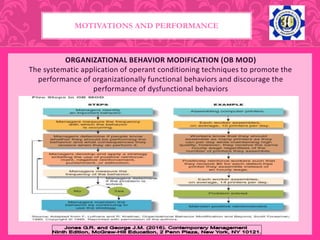
ORGANIZATIONAL BEHAVIOR MODIFICATION (OB MOD)
The systematic application of operant conditioning techniques to promote the
performance of organizationally functional behaviors and discourage the
performance of dysfunctional behaviors
MOTIVATIONS AND PERFORMANCE
SOCIAL LEARNING THEORY
A theory that takes into account how learning and motivation are influenced by
people’s thoughts and beliefs and their observations of other people’s behaviour
VICARIOUS LEARNING( OBSERVATIONAL LEARNING)
Learning that occurs when the learner becomes motivated to perform a behavior
by watching another person performing it and being reinforced for doing so
SELF- REINFORCER
Any desired or attractive outcome or reward that a person gives to himself or
herself for good performance.
MOTIVATIONS AND PERFORMANCE
SELF- EFFICACY
A person’s belief about his or her ability to perform a behavior successfully.
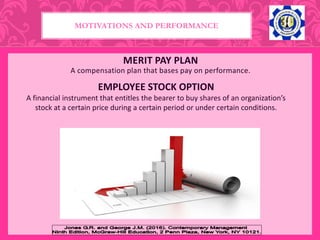
MERIT PAY PLAN
A compensation plan that bases pay on performance.
MOTIVATIONS AND PERFORMANCE
EMPLOYEE STOCK OPTION
A financial instrument that entitles the bearer to buy shares of an organization’s
stock at a certain price during a certain period or under certain conditions.
EXAMPLES OF MERIT PAY PLAN
MOTIVATIONS AND PERFORMANCE
PIECE-RATE PAY
An individual-based merit plan, which managers base employees’ pay on the
number of units each employee produces
COMISSION PAY
Another individual-based merit pay plan, managers base pay ona percentage of sales.
PROFIT SHARING
Employees receive a share of an
organization’s profits.
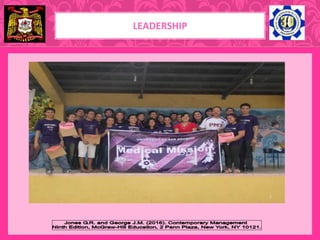
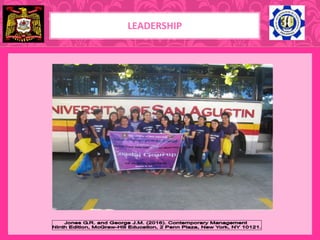
LEADERSHIP
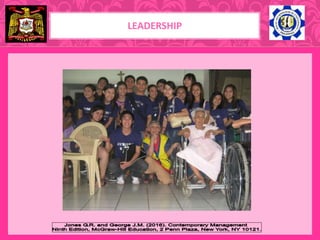
LEADERSHIP
The process by which an individual exerts influence over other people and
inspires, motivates, and directs their activities to help achieve group or
organizational goals.
LEADER
An individual who is able to exert influence over other people to help achieve
group or organizational goals.
LEADERSHIP
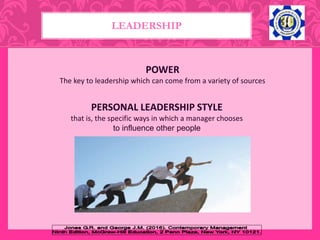
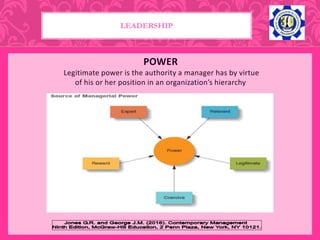
POWER
The key to leadership which can come from a variety of sources
LEADERSHIP
PERSONAL LEADERSHIP STYLE
that is, the specific ways in which a manager chooses
to influence other people
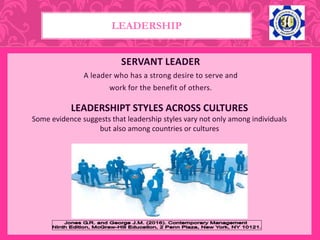
SERVANT LEADER
A leader who has a strong desire to serve and
work for the benefit of others.
LEADERSHIPT STYLES ACROSS CULTURES
Some evidence suggests that leadership styles vary not only among individuals
but also among countries or cultures
LEADERSHIP
LEADERSHIP
LEADERSHIP
LEADERSHIP
POWER
Legitimate power is the authority a manager has by virtue
of his or her position in an organization’s hierarchy
LEADERSHIP
REWARD POWER
Is the ability of a manager to give or withhold tangible
rewards (pay raises, bonuses, choice job assignments) and intangible rewards
(verbal praise, a pat on the back, respect)
MOTIVATIONS AND PERFORMANCE
COERCIVE POWER
Is the ability of a manager to punish others. Punishment
can range from verbal reprimands to reductions in pay
MOTIVATIONS AND PERFORMANCE
EXPERT POWER
Is based on the special knowledge, skills, and expertise
that a leader possesses. The nature of expert power varies, depending
on the leader’s level in the hierarchy.
MOTIVATIONS AND PERFORMANCE
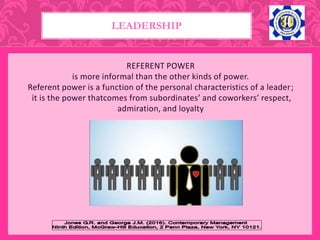
REFERENT POWER
is more informal than the other kinds of power.
Referent power is a function of the personal characteristics of a leader;
it is the power thatcomes from subordinates’ and coworkers’ respect,
admiration, and loyalty
LEADERSHIP
EMPOWERMENT
The process of giving employees at all levels the authority to make decisions,
be responsible for their outcomes, improve quality, and cut costs.
LEADERSHIP
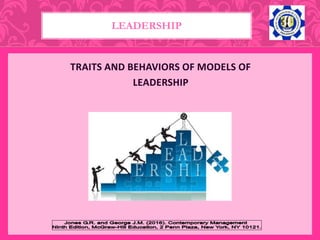
TRAITS AND BEHAVIORS OF MODELS OF
LEADERSHIP
LEADERSHIP
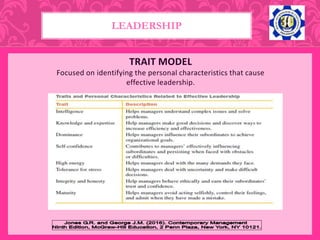
TRAIT MODEL
Focused on identifying the personal characteristics that cause
effective leadership.
LEADERSHIP
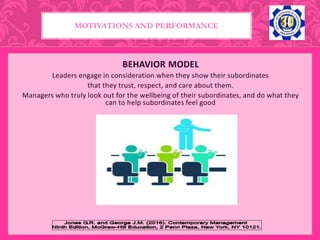
BEHAVIOR MODEL
Leaders engage in consideration when they show their subordinates
that they trust, respect, and care about them.
Managers who truly look out for the wellbeing of their subordinates, and do what they
can to help subordinates feel good
MOTIVATIONS AND PERFORMANCE
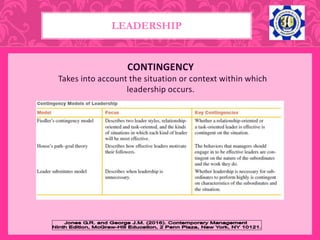
CONTINGENCY
Takes into account the situation or context within which
leadership occurs.
LEADERSHIP
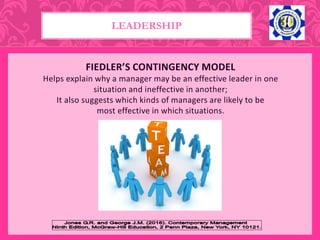
FIEDLER’S CONTINGENCY MODEL
Helps explain why a manager may be an effective leader in one
situation and ineffective in another;
It also suggests which kinds of managers are likely to be
most effective in which situations.
LEADERSHIP
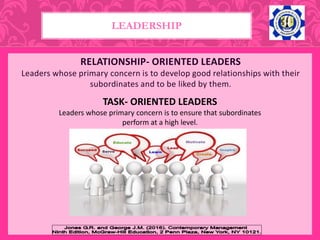
RELATIONSHIP- ORIENTED LEADERS
Leaders whose primary concern is to develop good relationships with their
subordinates and to be liked by them.
LEADERSHIP
TASK- ORIENTED LEADERS
Leaders whose primary concern is to ensure that subordinates
perform at a high level.
LEADER-MEMBER RELATIONS
The extent to which followers like, trust, and are loyal to their leader
LEADERSHIP
TASK STRUCTURE
The extent to which the work to be performed is clear-cut so that a
leader’s subordinates know what needs to be accomplished
and how to go about doing it;
POSITION POWER
The amount of legitimate, reward, and coercive power that a leader has by
virtue of his or her position in an organization;
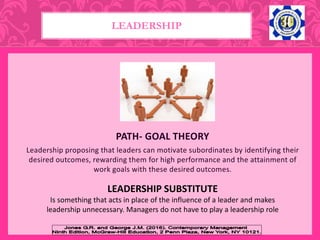
PATH- GOAL THEORY
Leadership proposing that leaders can motivate subordinates by identifying their
desired outcomes, rewarding them for high performance and the attainment of
work goals with these desired outcomes.
LEADERSHIP
LEADERSHIP SUBSTITUTE
Is something that acts in place of the influence of a leader and makes
leadership unnecessary. Managers do not have to play a leadership role
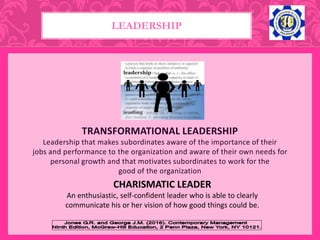
TRANSFORMATIONAL LEADERSHIP
Leadership that makes subordinates aware of the importance of their
jobs and performance to the organization and aware of their own needs for
personal growth and that motivates subordinates to work for the
good of the organization
LEADERSHIP
CHARISMATIC LEADER
An enthusiastic, self-confident leader who is able to clearly
communicate his or her vision of how good things could be.
INTELLECTUAL STIMULATION
Behavior a leader engages in to make followers aware of problems and
view these problems in new ways, consistent with the
leader’s vision.
LEADERSHIP
DEVELOPMENTAL CONSIDERATION
Behavior a leader engages in to support and
encourage followers and
help them develop and grow on the job.
TRANSACTIONAL LEADERSHIP
Leadership that motivates subordinates
by rewarding them for high
performance and reprimanding them
for low performance
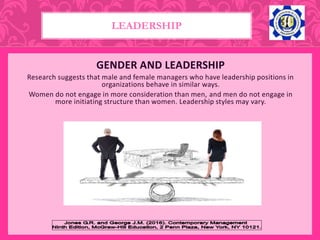
GENDER AND LEADERSHIP
Research suggests that male and female managers who have leadership positions in
organizations behave in similar ways.
Women do not engage in more consideration than men, and men do not engage in
more initiating structure than women. Leadership styles may vary.
LEADERSHIP
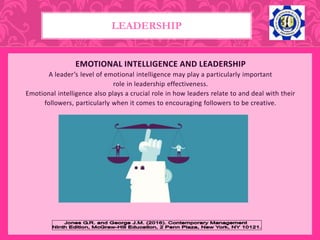
EMOTIONAL INTELLIGENCE AND LEADERSHIP
A leader’s level of emotional intelligence may play a particularly important
role in leadership effectiveness.
Emotional intelligence also plays a crucial role in how leaders relate to and deal with their
followers, particularly when it comes to encouraging followers to be creative.
LEADERSHIP
Motivations

Motivations

  • 3.
    MOTIVATION Psychological forces thatdetermine the direction of a person’s behavior in an organization, a person’s level of effort, and a person’s level of persistence EFFORT Refers to how hard people work PERSISTENCE Refers to whether, when faced with roadblocks and obstacles, people keep trying or give up. MOTIVATIONS AND PERFORMANCE
  • 4.
    INTRINSICALLY MOTIVATED Behavior isbehavior that is performed for its own sake; the source of motivation is actually performing the behavior, and motivation comes from doing the work itself. MOTIVATIONS AND PERFORMANCE EXTRINSICALLY MOTIVATED Behavior that is performed to acquire material or social rewards or to avoid punishment; the source of motivation is the consequences of the behavior, not the behavior itself.
  • 5.
  • 6.
    EXPECTANCY THEORY One ofthe most popular theories of work motivation because it focuses on all three parts of the motivation equation: inputs, performance, and outcomes.. MOTIVATIONS AND PERFORMANCE
  • 7.
    MOTIVATIONS AND PERFORMANCE NEED Isa requirement or necessity for survival and well-being. NEED THEORY Complements expectancy theory by exploring in depth which outcomes motivate people to perform at a high level.
  • 8.
    MASLOW’S HIERARCHY OFNEEDS Proposed that all people seek to satisfy five basic kinds of needs MOTIVATIONS AND PERFORMANCE
  • 9.
    ALDERFER’S ERG THEORY Threeuniversal categories: Existence, Relatedness, and Growth MOTIVATIONS AND PERFORMANCE
  • 10.
    HERZBERG’S MOTIVATOR-HYGIENE THEORY MOTIVATORNEEDS Are related to the nature of the work itself and how challenging it is. MOTIVATIONS AND PERFORMANCE HYGIENE NEEDS Are related to the physical and psychological context in which the work is performed.
  • 11.
    MOTIVATIONS AND PERFORMANCE NEEDFOR ACHIEVEMENT Is the extent to which an individual has a strong desire to perform challenging tasks well and to meet personal standards for excellence. NEED FOR AFFILIATION Is the extent to which an individual is concerned about establishing and maintaining good interpersonal relations. NEED FOR POWER is the extent to which an individual desires to control or influence others
  • 12.
    EQUITY THEORY Is atheory of motivation that concentrates on people’s perceptions of the fairness of their work outcomes relative to, or in proportion to, their work inputs. EQUITY Exists when a person perceives his or her own outcome–input ratio to be equal to a referent’s outcome–input ratio. INEQUITY Or lack of fairness, exists when a person’s outcome–input ratio is not perceived to be equal to a referent’s. MOTIVATIONS AND PERFORMANCE
  • 13.
    MOTIVATIONS AND PERFORMANCE UNDERPAYMENTINEQUITY Exists when a person’s own outcome–input ratio is perceived to be less than that of a referent OVERPAYMENT INEQUITY exists when a person perceives that his or her own outcome–input ratio is greater than that of a referent.
  • 14.
    GOAL SETTING THEORY Atheory that focuses on identifying the types of goals that are most effective in producing high levels of motivation and performance and explaining why goals have these effects GOAL Is what a person is trying to accomplish through his or her efforts and behaviors. MOTIVATIONS AND PERFORMANCE
  • 15.
    MOTIVATIONS AND PERFORMANCE LEARNINGTHEORIES Focus on increasing employee motivation and performance by linking the outcomes that employees receive to the performance of desired behaviors and the attainment of goals. LEARNING A relatively permanentchange in knowledgeor behavior that results From practice or experience
  • 16.
    OPERANT CONDITIONING THEORY Theorythat people learn to perform behaviors that lead to desired consequences and learn not to perform behaviors that lead to undesired consequences POSITITVE REINFORCEMENT Giving people outcomes they desire when they perform functional behaviors. MOTIVATIONS AND PERFORMANCE NEGATIVE REINFORCEMENT Eliminating or removing undesired outcomes when people perform organizationally functional behaviors.
  • 17.
    MOTIVATIONS AND PERFORMANCE EXTINCTION Performanceof dysfunctional behaviors by eliminating whatever is reinforcing them. PUNISHMENT Administeringan undesired or negative consequencewhen Dysfunctionalbehavior occurs.
  • 18.
    ORGANIZATIONAL BEHAVIOR MODIFICATION(OB MOD) The systematic application of operant conditioning techniques to promote the performance of organizationally functional behaviors and discourage the performance of dysfunctional behaviors MOTIVATIONS AND PERFORMANCE
  • 19.
    SOCIAL LEARNING THEORY Atheory that takes into account how learning and motivation are influenced by people’s thoughts and beliefs and their observations of other people’s behaviour VICARIOUS LEARNING( OBSERVATIONAL LEARNING) Learning that occurs when the learner becomes motivated to perform a behavior by watching another person performing it and being reinforced for doing so SELF- REINFORCER Any desired or attractive outcome or reward that a person gives to himself or herself for good performance. MOTIVATIONS AND PERFORMANCE SELF- EFFICACY A person’s belief about his or her ability to perform a behavior successfully.
  • 20.
    MERIT PAY PLAN Acompensation plan that bases pay on performance. MOTIVATIONS AND PERFORMANCE EMPLOYEE STOCK OPTION A financial instrument that entitles the bearer to buy shares of an organization’s stock at a certain price during a certain period or under certain conditions.
  • 21.
    EXAMPLES OF MERITPAY PLAN MOTIVATIONS AND PERFORMANCE PIECE-RATE PAY An individual-based merit plan, which managers base employees’ pay on the number of units each employee produces COMISSION PAY Another individual-based merit pay plan, managers base pay ona percentage of sales. PROFIT SHARING Employees receive a share of an organization’s profits.
  • 23.
  • 24.
    LEADERSHIP The process bywhich an individual exerts influence over other people and inspires, motivates, and directs their activities to help achieve group or organizational goals. LEADER An individual who is able to exert influence over other people to help achieve group or organizational goals. LEADERSHIP
  • 25.
    POWER The key toleadership which can come from a variety of sources LEADERSHIP PERSONAL LEADERSHIP STYLE that is, the specific ways in which a manager chooses to influence other people
  • 26.
    SERVANT LEADER A leaderwho has a strong desire to serve and work for the benefit of others. LEADERSHIPT STYLES ACROSS CULTURES Some evidence suggests that leadership styles vary not only among individuals but also among countries or cultures LEADERSHIP
  • 27.
  • 28.
  • 29.
  • 30.
    POWER Legitimate power isthe authority a manager has by virtue of his or her position in an organization’s hierarchy LEADERSHIP
  • 31.
    REWARD POWER Is theability of a manager to give or withhold tangible rewards (pay raises, bonuses, choice job assignments) and intangible rewards (verbal praise, a pat on the back, respect) MOTIVATIONS AND PERFORMANCE
  • 32.
    COERCIVE POWER Is theability of a manager to punish others. Punishment can range from verbal reprimands to reductions in pay MOTIVATIONS AND PERFORMANCE
  • 33.
    EXPERT POWER Is basedon the special knowledge, skills, and expertise that a leader possesses. The nature of expert power varies, depending on the leader’s level in the hierarchy. MOTIVATIONS AND PERFORMANCE
  • 34.
    REFERENT POWER is moreinformal than the other kinds of power. Referent power is a function of the personal characteristics of a leader; it is the power thatcomes from subordinates’ and coworkers’ respect, admiration, and loyalty LEADERSHIP
  • 35.
    EMPOWERMENT The process ofgiving employees at all levels the authority to make decisions, be responsible for their outcomes, improve quality, and cut costs. LEADERSHIP
  • 36.
    TRAITS AND BEHAVIORSOF MODELS OF LEADERSHIP LEADERSHIP
  • 37.
    TRAIT MODEL Focused onidentifying the personal characteristics that cause effective leadership. LEADERSHIP
  • 38.
    BEHAVIOR MODEL Leaders engagein consideration when they show their subordinates that they trust, respect, and care about them. Managers who truly look out for the wellbeing of their subordinates, and do what they can to help subordinates feel good MOTIVATIONS AND PERFORMANCE
  • 39.
    CONTINGENCY Takes into accountthe situation or context within which leadership occurs. LEADERSHIP
  • 40.
    FIEDLER’S CONTINGENCY MODEL Helpsexplain why a manager may be an effective leader in one situation and ineffective in another; It also suggests which kinds of managers are likely to be most effective in which situations. LEADERSHIP
  • 41.
    RELATIONSHIP- ORIENTED LEADERS Leaderswhose primary concern is to develop good relationships with their subordinates and to be liked by them. LEADERSHIP TASK- ORIENTED LEADERS Leaders whose primary concern is to ensure that subordinates perform at a high level.
  • 42.
    LEADER-MEMBER RELATIONS The extentto which followers like, trust, and are loyal to their leader LEADERSHIP TASK STRUCTURE The extent to which the work to be performed is clear-cut so that a leader’s subordinates know what needs to be accomplished and how to go about doing it; POSITION POWER The amount of legitimate, reward, and coercive power that a leader has by virtue of his or her position in an organization;
  • 43.
    PATH- GOAL THEORY Leadershipproposing that leaders can motivate subordinates by identifying their desired outcomes, rewarding them for high performance and the attainment of work goals with these desired outcomes. LEADERSHIP LEADERSHIP SUBSTITUTE Is something that acts in place of the influence of a leader and makes leadership unnecessary. Managers do not have to play a leadership role
  • 44.
    TRANSFORMATIONAL LEADERSHIP Leadership thatmakes subordinates aware of the importance of their jobs and performance to the organization and aware of their own needs for personal growth and that motivates subordinates to work for the good of the organization LEADERSHIP CHARISMATIC LEADER An enthusiastic, self-confident leader who is able to clearly communicate his or her vision of how good things could be.
  • 45.
    INTELLECTUAL STIMULATION Behavior aleader engages in to make followers aware of problems and view these problems in new ways, consistent with the leader’s vision. LEADERSHIP DEVELOPMENTAL CONSIDERATION Behavior a leader engages in to support and encourage followers and help them develop and grow on the job. TRANSACTIONAL LEADERSHIP Leadership that motivates subordinates by rewarding them for high performance and reprimanding them for low performance
  • 46.
    GENDER AND LEADERSHIP Researchsuggests that male and female managers who have leadership positions in organizations behave in similar ways. Women do not engage in more consideration than men, and men do not engage in more initiating structure than women. Leadership styles may vary. LEADERSHIP
  • 47.
    EMOTIONAL INTELLIGENCE ANDLEADERSHIP A leader’s level of emotional intelligence may play a particularly important role in leadership effectiveness. Emotional intelligence also plays a crucial role in how leaders relate to and deal with their followers, particularly when it comes to encouraging followers to be creative. LEADERSHIP