Organizational
Control and Change
McGraw-Hill/Irwin
Contemporary Management, 9/e
Copyright © 2016 The McGraw-Hill Companies, Inc. All rights reserved.
Rolando B. Acejo Jr.
- Presenter
11-2
Organizational Control
• Organizational Control
– Managers monitor and regulate how efficiently
and effectively an organization and its members
are performing the activities necessary to achieve
organizational goals
11-3
Organizational Control
Managers must monitor and evaluate:
– Is the firm efficiently converting inputs into outputs?
• Are units of inputs and outputs measured
accurately?
– Is product quality improving?
• Is the firm’s quality competitive with other firms?
– Are employees responsive to customers?
• Are customers satisfied with the services
offered?
– Are our managers innovative in outlook?
• Does the control system encourage risk-taking?
11-4
Control Systems
• Control Systems
– Formal, target-setting, monitoring, evaluation and
feedback systems that provide managers with
information about whether the organization’s
strategy and structure are working efficiently and
effectively.
A good control system should:
– be flexible so managers can respond as needed.
– provide accurate information about the
organization.
– provide information in a timely manner.
11-5
Three Types of Control
11-6
Types of Control
• Feedforward Controls
– Used to anticipate problems before they arise so
that problems do not occur later during the
conversion process
• Concurrent Controls
– Give managers immediate feedback on how
efficiently inputs are being transformed into outputs
• Feedback Controls
– Used to provide information at the output stage
about customers’ reactions to goods and services
so that corrective action can be taken if necessary
11-7
Control Process Steps
11-8
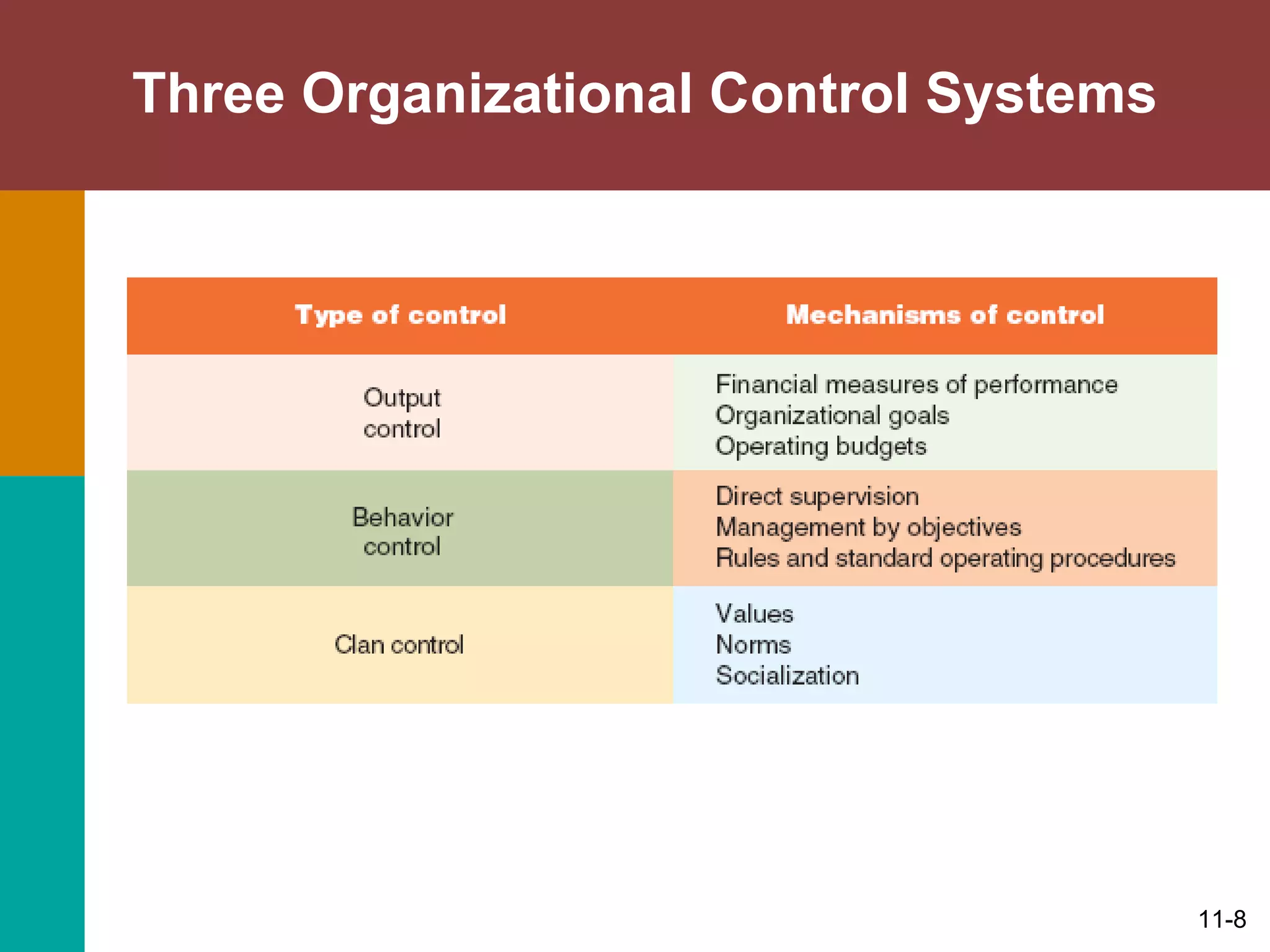
Three Organizational Control Systems
11-9
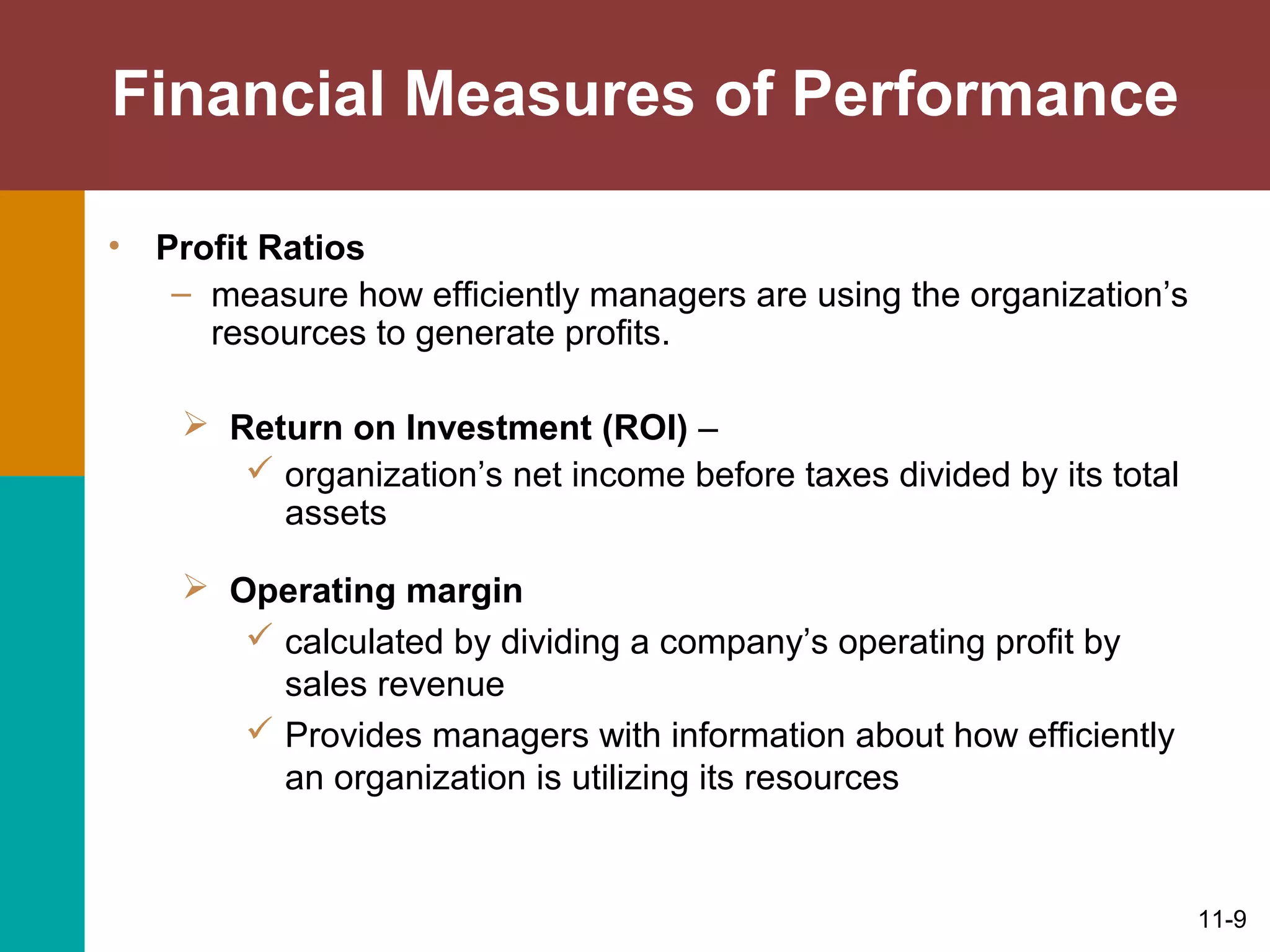
Financial Measures of Performance
• Profit Ratios
– measure how efficiently managers are using the organization’s
resources to generate profits.
 Return on Investment (ROI) –
 organization’s net income before taxes divided by its total
assets
 Operating margin
 calculated by dividing a company’s operating profit by
sales revenue
 Provides managers with information about how efficiently
an organization is utilizing its resources
11-10
Financial Measures of Performance
• Liquidity ratios
– measure how well managers have protected organizational
resources to be able to meet short-term obligations
• Leverage ratios
– measure the degree to which managers use debt or equity to
finance ongoing operations
• Activity ratios
– provide measures of how well managers are creating value
from organizational assets
11-11
Output Control
• Output Control
– To monitor output or performance, managers
choose goals or performance standards that they
think will best measure efficiency, quality,
innovation, and responsiveness to customers at the
corporate, divisional, departmental or functional,
and individual levels.
11-12
Output Control
• Organizational Goals
– Each division within the firm is given specific goals that must
be met in order to attain overall organizational goals.
– Goals should be set appropriately so that managers are
motivated to accomplish them
• Operating Budgets
– Blueprint that states how managers intend to use organizational
resources to achieve organizational goals efficiently.
– Each division is evaluated on its own budgets for cost, revenue
or profit.
– Managers are evaluated by how well they meet goals for
controlling costs, generating revenues, or maximizing profits
while staying within their budgets.
11-13
Output Control
• Organization-Wide Goal Setting
11-14
Output Control
Effective Output Control
1. Objective financial measures
2. Challenging goals and performance standards
3. Appropriate operating budgets
11-15
Output Control
Problems with Output Control
• Managers must create output standards that motivate
at all levels
• Should not cause managers to behave in
inappropriate ways to achieve organizational goals
11-16
Behavior Control
• Behavior Control
– In an attempt to shape behavior and induce
employees to work toward achieving organizational
goals, managers use direct supervision,
management by objectives, and bureaucratic control
by means of rules and standard operating
procedures.
11-17
Behavior Control
• Direct supervision
– managers who actively monitor and observe the behavior of
their subordinates
– Teach subordinates appropriate behaviors
– Intervene to take corrective action
– Most immediate and potent form of behavioral control
– Can be an effective way of motivating employees
• Problems with Direct Supervision
– Very expensive because a manager can personally manage
only a relatively small number of subordinates effectively
– Can demotivate subordinates if they feel that they are under
such close scrutiny that they are not free to make their own
decisions
11-18
Management by Objectives
• Management by Objectives (MBO)
– formal system of evaluating subordinates for their ability to
achieve specific organizational goals or performance
standards and to meet operating budgets.
Involves three specific steps
1. Specific goals and objectives are
established at each level of the
organization
2. Managers and their subordinates
together determine the subordinates’
goals
3. Managers and their subordinates
periodically review the subordinates’
progress toward meeting goals
11-19
Bureaucratic Control
• Bureaucratic Control
– Control through a system of rules and standard operating
procedures (SOPs) that shapes and regulates the behavior of
divisions, functions, and individuals.
• Problems with Bureaucratic Control
– Rules easier to make than than discarding them, leading to
bureaucratic “red tape” and slowing organizational reaction
times to problems.
– Firms become too standardized and lose flexibility to learn, to
create new ideas, and solve to new problems.
11-20
Clan Control
• Clan Control
– The control exerted on individuals and
groups in an organization by shared values,
norms, standards of behavior, and
expectations.
11-21
Organization Change
• Organization Change
– Movement of an organization away from its present
state and toward some desired future state to
increase its efficiency and effectiveness
11-22
Lewin’s Force-Field Theory of Change
• There are a wide variety of
forces arising from the way
an organization operates,
from its structure, culture,
and control systems that
make organizations
resistant to change
• To get an organization to
change, managers must find
a way to increase the forces
for change, reduce
resistance to change, or do
both simultaneously
11-23
Evolutionary and Revolutionary
Change
• Evolutionary change
– gradual, incremental, and narrowly focused
– constant attempt to improve, adapt, and adjust strategy and
structure incrementally to accommodate changes in the
environment
• Revolutionary change
– Rapid, dramatic, and broadly focused
– Involves a bold attempt to quickly find ways to be effective
– Likely to result in a radical shift in ways of doing things, new
goals, and a new structure for the organization
11-24
Steps in the Organizational Change
Process
11-25
Implementing the Change
• Top Down Change
– A fast, revolutionary approach to change in which top
managers identify what needs to be changed and then move
quickly to implement the changes throughout the
organization.
• Bottom-up change
– A gradual or evolutionary approach to change in which
managers at all levels work together to develop a detailed
plan for change.
11-26
Evaluating the Change
• Benchmarking
– The process of comparing one company’s
performance on specific dimensions with the
performance of other, high-performing
organizations.

Organizational Control and Change

  • 1.
    Organizational Control and Change McGraw-Hill/Irwin ContemporaryManagement, 9/e Copyright © 2016 The McGraw-Hill Companies, Inc. All rights reserved. Rolando B. Acejo Jr. - Presenter
  • 2.
    11-2 Organizational Control • OrganizationalControl – Managers monitor and regulate how efficiently and effectively an organization and its members are performing the activities necessary to achieve organizational goals
  • 3.
    11-3 Organizational Control Managers mustmonitor and evaluate: – Is the firm efficiently converting inputs into outputs? • Are units of inputs and outputs measured accurately? – Is product quality improving? • Is the firm’s quality competitive with other firms? – Are employees responsive to customers? • Are customers satisfied with the services offered? – Are our managers innovative in outlook? • Does the control system encourage risk-taking?
  • 4.
    11-4 Control Systems • ControlSystems – Formal, target-setting, monitoring, evaluation and feedback systems that provide managers with information about whether the organization’s strategy and structure are working efficiently and effectively. A good control system should: – be flexible so managers can respond as needed. – provide accurate information about the organization. – provide information in a timely manner.
  • 5.
  • 6.
    11-6 Types of Control •Feedforward Controls – Used to anticipate problems before they arise so that problems do not occur later during the conversion process • Concurrent Controls – Give managers immediate feedback on how efficiently inputs are being transformed into outputs • Feedback Controls – Used to provide information at the output stage about customers’ reactions to goods and services so that corrective action can be taken if necessary
  • 7.
  • 8.
  • 9.
    11-9 Financial Measures ofPerformance • Profit Ratios – measure how efficiently managers are using the organization’s resources to generate profits.  Return on Investment (ROI) –  organization’s net income before taxes divided by its total assets  Operating margin  calculated by dividing a company’s operating profit by sales revenue  Provides managers with information about how efficiently an organization is utilizing its resources
  • 10.
    11-10 Financial Measures ofPerformance • Liquidity ratios – measure how well managers have protected organizational resources to be able to meet short-term obligations • Leverage ratios – measure the degree to which managers use debt or equity to finance ongoing operations • Activity ratios – provide measures of how well managers are creating value from organizational assets
  • 11.
    11-11 Output Control • OutputControl – To monitor output or performance, managers choose goals or performance standards that they think will best measure efficiency, quality, innovation, and responsiveness to customers at the corporate, divisional, departmental or functional, and individual levels.
  • 12.
    11-12 Output Control • OrganizationalGoals – Each division within the firm is given specific goals that must be met in order to attain overall organizational goals. – Goals should be set appropriately so that managers are motivated to accomplish them • Operating Budgets – Blueprint that states how managers intend to use organizational resources to achieve organizational goals efficiently. – Each division is evaluated on its own budgets for cost, revenue or profit. – Managers are evaluated by how well they meet goals for controlling costs, generating revenues, or maximizing profits while staying within their budgets.
  • 13.
  • 14.
    11-14 Output Control Effective OutputControl 1. Objective financial measures 2. Challenging goals and performance standards 3. Appropriate operating budgets
  • 15.
    11-15 Output Control Problems withOutput Control • Managers must create output standards that motivate at all levels • Should not cause managers to behave in inappropriate ways to achieve organizational goals
  • 16.
    11-16 Behavior Control • BehaviorControl – In an attempt to shape behavior and induce employees to work toward achieving organizational goals, managers use direct supervision, management by objectives, and bureaucratic control by means of rules and standard operating procedures.
  • 17.
    11-17 Behavior Control • Directsupervision – managers who actively monitor and observe the behavior of their subordinates – Teach subordinates appropriate behaviors – Intervene to take corrective action – Most immediate and potent form of behavioral control – Can be an effective way of motivating employees • Problems with Direct Supervision – Very expensive because a manager can personally manage only a relatively small number of subordinates effectively – Can demotivate subordinates if they feel that they are under such close scrutiny that they are not free to make their own decisions
  • 18.
    11-18 Management by Objectives •Management by Objectives (MBO) – formal system of evaluating subordinates for their ability to achieve specific organizational goals or performance standards and to meet operating budgets. Involves three specific steps 1. Specific goals and objectives are established at each level of the organization 2. Managers and their subordinates together determine the subordinates’ goals 3. Managers and their subordinates periodically review the subordinates’ progress toward meeting goals
  • 19.
    11-19 Bureaucratic Control • BureaucraticControl – Control through a system of rules and standard operating procedures (SOPs) that shapes and regulates the behavior of divisions, functions, and individuals. • Problems with Bureaucratic Control – Rules easier to make than than discarding them, leading to bureaucratic “red tape” and slowing organizational reaction times to problems. – Firms become too standardized and lose flexibility to learn, to create new ideas, and solve to new problems.
  • 20.
    11-20 Clan Control • ClanControl – The control exerted on individuals and groups in an organization by shared values, norms, standards of behavior, and expectations.
  • 21.
    11-21 Organization Change • OrganizationChange – Movement of an organization away from its present state and toward some desired future state to increase its efficiency and effectiveness
  • 22.
    11-22 Lewin’s Force-Field Theoryof Change • There are a wide variety of forces arising from the way an organization operates, from its structure, culture, and control systems that make organizations resistant to change • To get an organization to change, managers must find a way to increase the forces for change, reduce resistance to change, or do both simultaneously
  • 23.
    11-23 Evolutionary and Revolutionary Change •Evolutionary change – gradual, incremental, and narrowly focused – constant attempt to improve, adapt, and adjust strategy and structure incrementally to accommodate changes in the environment • Revolutionary change – Rapid, dramatic, and broadly focused – Involves a bold attempt to quickly find ways to be effective – Likely to result in a radical shift in ways of doing things, new goals, and a new structure for the organization
  • 24.
    11-24 Steps in theOrganizational Change Process
  • 25.
    11-25 Implementing the Change •Top Down Change – A fast, revolutionary approach to change in which top managers identify what needs to be changed and then move quickly to implement the changes throughout the organization. • Bottom-up change – A gradual or evolutionary approach to change in which managers at all levels work together to develop a detailed plan for change.
  • 26.
    11-26 Evaluating the Change •Benchmarking – The process of comparing one company’s performance on specific dimensions with the performance of other, high-performing organizations.

Editor's Notes

  • #3 Keeping an organization on track, anticipating events, changing the organization to respond to opportunities and threats