The Manager
as a Planner
and Strategist
Copyright © 2014 by The McGraw-Hill Companies, Inc. All rights reserved.McGraw-Hill/Irwin
Jomari D. Eclarino
Presenter
August 6, 2016
Planning and Strategy
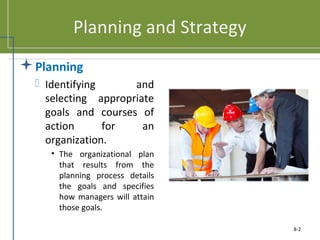
Planning
 Identifying and
selecting appropriate
goals and courses of
action for an
organization.
• The organizational plan
that results from the
planning process details
the goals and specifies
how managers will attain
those goals.
8-2
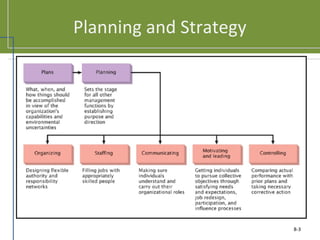
Planning and Strategy
8-3
Planning and Strategy
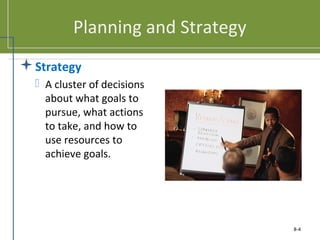
Strategy
 A cluster of decisions
about what goals to
pursue, what actions
to take, and how to
use resources to
achieve goals.
8-4
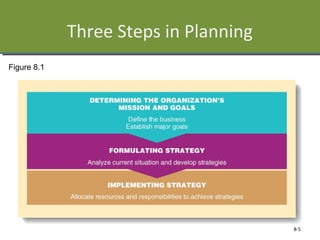
Three Steps in Planning
8-5
Figure 8.1
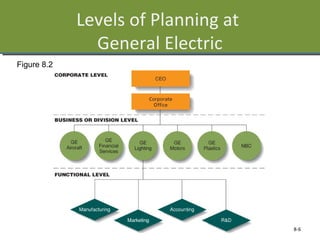
Levels of Planning at
General Electric
8-6
Figure 8.2
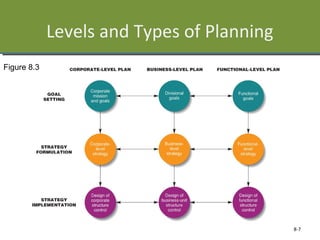
Levels and Types of Planning
8-7
Figure 8.3
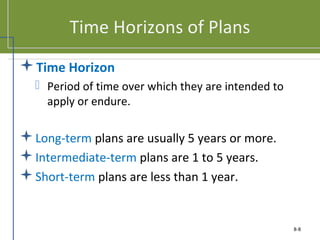
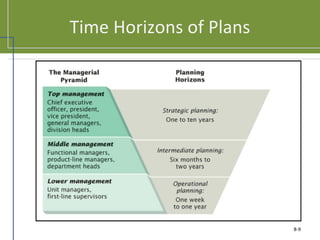
Time Horizons of Plans
Time Horizon
 Period of time over which they are intended to
apply or endure.
Long-term plans are usually 5 years or more.
Intermediate-term plans are 1 to 5 years.
Short-term plans are less than 1 year.
8-8
Time Horizons of Plans
8-9
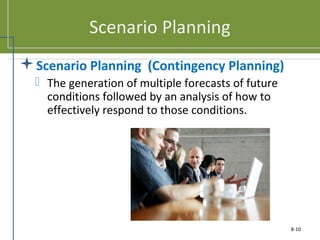
Scenario Planning
Scenario Planning (Contingency Planning)
 The generation of multiple forecasts of future
conditions followed by an analysis of how to
effectively respond to those conditions.
8-10
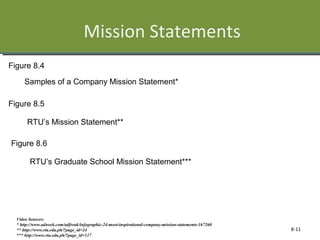
Mission Statements
8-11
Figure 8.4
Figure 8.5
Samples of a Company Mission Statement*
RTU’s Mission Statement**
Figure 8.6
RTU’s Graduate School Mission Statement***
Video Sources:
* http://www.adweek.com/adfreak/infographic-24-most-inspirational-company-mission-statements-167260
** http://www.rtu.edu.ph/?page_id=24
*** http://www.rtu.edu.ph/?page_id=117
Formulating Strategy
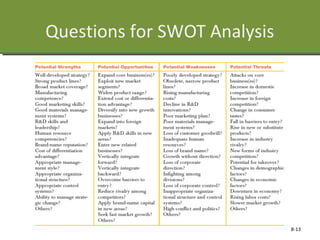
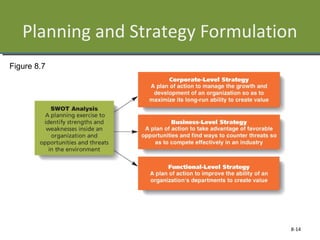
SWOT Analysis
 A planning exercise in which managers identify
organizational strengths (S) and weaknesses (W)
and environmental opportunities (O) and
threats (T).
8-12
Video Source:
https://www.youtube.com/watch?v=_YhEpBvlO2M
Questions for SWOT Analysis
8-13
Planning and Strategy Formulation
8-14
Figure 8.7
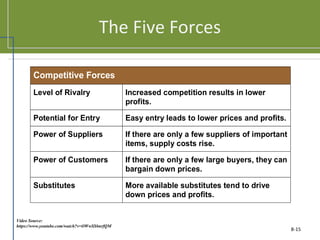
The Five Forces
8-15
Competitive Forces
Level of Rivalry Increased competition results in lower
profits.
Potential for Entry Easy entry leads to lower prices and profits.
Power of Suppliers If there are only a few suppliers of important
items, supply costs rise.
Power of Customers If there are only a few large buyers, they can
bargain down prices.
Substitutes More available substitutes tend to drive
down prices and profits.
Video Source:
https://www.youtube.com/watch?v=OWwSS6nrfQM
The Five Forces
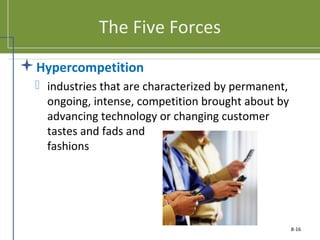
Hypercompetition
 industries that are characterized by permanent,
ongoing, intense, competition brought about by
advancing technology or changing customer
tastes and fads and
fashions
8-16
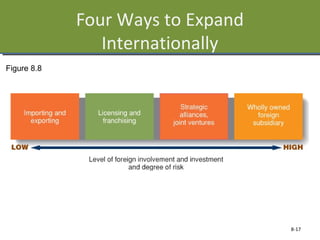
Four Ways to Expand
Internationally
8-17
Figure 8.8
8-18

Principles of Management Chapter 08

  • 1.
    The Manager as aPlanner and Strategist Copyright © 2014 by The McGraw-Hill Companies, Inc. All rights reserved.McGraw-Hill/Irwin Jomari D. Eclarino Presenter August 6, 2016
  • 2.
    Planning and Strategy Planning Identifying and selecting appropriate goals and courses of action for an organization. • The organizational plan that results from the planning process details the goals and specifies how managers will attain those goals. 8-2
  • 3.
  • 4.
    Planning and Strategy Strategy A cluster of decisions about what goals to pursue, what actions to take, and how to use resources to achieve goals. 8-4
  • 5.
    Three Steps inPlanning 8-5 Figure 8.1
  • 6.
    Levels of Planningat General Electric 8-6 Figure 8.2
  • 7.
    Levels and Typesof Planning 8-7 Figure 8.3
  • 8.
    Time Horizons ofPlans Time Horizon  Period of time over which they are intended to apply or endure. Long-term plans are usually 5 years or more. Intermediate-term plans are 1 to 5 years. Short-term plans are less than 1 year. 8-8
  • 9.
  • 10.
    Scenario Planning Scenario Planning(Contingency Planning)  The generation of multiple forecasts of future conditions followed by an analysis of how to effectively respond to those conditions. 8-10
  • 11.
    Mission Statements 8-11 Figure 8.4 Figure8.5 Samples of a Company Mission Statement* RTU’s Mission Statement** Figure 8.6 RTU’s Graduate School Mission Statement*** Video Sources: * http://www.adweek.com/adfreak/infographic-24-most-inspirational-company-mission-statements-167260 ** http://www.rtu.edu.ph/?page_id=24 *** http://www.rtu.edu.ph/?page_id=117
  • 12.
    Formulating Strategy SWOT Analysis A planning exercise in which managers identify organizational strengths (S) and weaknesses (W) and environmental opportunities (O) and threats (T). 8-12 Video Source: https://www.youtube.com/watch?v=_YhEpBvlO2M
  • 13.
    Questions for SWOTAnalysis 8-13
  • 14.
    Planning and StrategyFormulation 8-14 Figure 8.7
  • 15.
    The Five Forces 8-15 CompetitiveForces Level of Rivalry Increased competition results in lower profits. Potential for Entry Easy entry leads to lower prices and profits. Power of Suppliers If there are only a few suppliers of important items, supply costs rise. Power of Customers If there are only a few large buyers, they can bargain down prices. Substitutes More available substitutes tend to drive down prices and profits. Video Source: https://www.youtube.com/watch?v=OWwSS6nrfQM
  • 16.
    The Five Forces Hypercompetition industries that are characterized by permanent, ongoing, intense, competition brought about by advancing technology or changing customer tastes and fads and fashions 8-16
  • 17.
    Four Ways toExpand Internationally 8-17 Figure 8.8
  • 18.

Editor's Notes

  • #6 Determining the Organization’s Mission and Goals Defining the organization’s overriding purpose and its goals. Formulating strategy Managers analyze current situation and develop the strategies needed to achieve the mission. Implementing strategy Managers must decide how to allocate resources between groups to ensure the strategy is achieved.
  • #7 Division – business unit that has its own set of managers and departments and competes in a distinct industry Divisional managers – Managers who control the various divisions of an organization NBC national broadcasting company
  • #9 Corporate and business-level goals and strategies require long- and intermediate-term plans. Functional plans focus on short-to intermediate-term plans Most organizations have a rolling planning cycle to amend plans constantly.
  • #10 Corporate and business-level goals and strategies require long- and intermediate-term plans. Functional plans focus on short-to intermediate-term plans Most organizations have a rolling planning cycle to amend plans constantly.
  • #11 Planning seeks predict the future, but the future is unpredictable. By generating multiple possible “futures,” a firm can see how its plans might work in each and prepare for the possible outcomes. Scenario planning is a learning tool to improve strategic planning results.
  • #12 Mission Statement A broad declaration of an organization’s overriding purpose Identifies what is unique or important about its products Seeks to distinguish or differentiate the organization from its competitors Insurance company Unum collects 24 inspirational company mission statements in the infographic below, and they offer some interesting takes on the brands' self-perception. Many of them—Warby Parker, Nike, Google, Facebook, Ikea—are right on brand. Others, like Chevron, are a bit more peculiar. And a few—Coca-Cola and McDonald's jump right out—are way more aspirational than the products perhaps deserve. Unum doesn't put itself on the list, perhaps wisely. Its statement is: "Unum's mission is to be the leading provider of employee benefits products and services that help employers manage their businesses and employees protect their families and livelihoods."
  • #13 SWOT Analysis A planning exercise in which managers identify: Organizational strengths and weaknesses Strengths (e.g., superior marketing skills) Weaknesses (e.g., outdated production facilities) External opportunities and threats Opportunities (e.g., entry into new markets) Threats (increased competition)
  • #18 Exporting making products at home and selling them abroad Importing selling at home products that are made abroad Licensing allowing a foreign organization to take charge of manufacturing and distributing a product in its country in return for a negotiated fee Franchising selling to a foreign organization the rights to use a brand name and operating know-how in return for a lump-sum payment and a share of the profits Strategic alliance managers pool resources with those of a foreign company Organizations agree to share risk and reward Joint venture Wholly Owned Foreign Subsidiary managers invest in establishing production operations in a foreign country independent of any local direct involvement
  • #19 Exporting making products at home and selling them abroad Importing selling at home products that are made abroad Licensing allowing a foreign organization to take charge of manufacturing and distributing a product in its country in return for a negotiated fee Franchising selling to a foreign organization the rights to use a brand name and operating know-how in return for a lump-sum payment and a share of the profits Strategic alliance managers pool resources with those of a foreign company Organizations agree to share risk and reward Joint venture Wholly Owned Foreign Subsidiary managers invest in establishing production operations in a foreign country independent of any local direct involvement