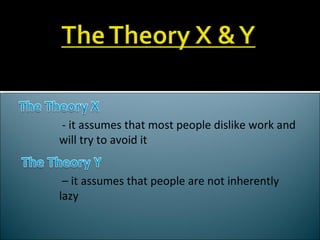
- it assumes that most people dislike work and will try to avoid it  –  it assumes that people are not inherently lazy
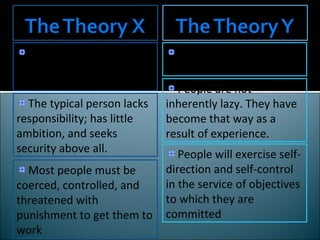
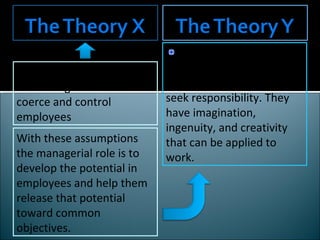
The typical person dislikes work and will avoid it if possible. The typical person lacks responsibility; has little ambition, and seeks security above all. Most people must be coerced, controlled, and threatened with punishment to get them to work Work is as natural, as play or rest. People are not inherently lazy. They have become that way as a result of experience. People will exercise self-direction and self-control in the service of objectives to which they are committed
With these assumptions the managerial role is to coerce and control employees People have potential. Under proper conditions they learn to accept and seek responsibility. They have imagination, ingenuity, and creativity that can be applied to work. With these assumptions the managerial role is to develop the potential in employees and help them release that potential toward common objectives.
Depends on power those who are in command must have the power to demand “you do this – or else - ”
depends on economic resources Caring for the security needs of workers
Had its origin in the “principle of supportive relationships” Depends on leadership instead of power or money Management provides a climate to help employees grow and accomplish in the interest of the organization the things of which they are capable
- A useful extension of the supportive model
An emerging model of organizational behavior. Strong search for higher meaning at work by many employees You want more than just a pay check and job security from the jobs.

Chapter 2 models of organizational behavior

  • 1.
  • 2.
    - it assumesthat most people dislike work and will try to avoid it – it assumes that people are not inherently lazy
  • 3.
    The typical persondislikes work and will avoid it if possible. The typical person lacks responsibility; has little ambition, and seeks security above all. Most people must be coerced, controlled, and threatened with punishment to get them to work Work is as natural, as play or rest. People are not inherently lazy. They have become that way as a result of experience. People will exercise self-direction and self-control in the service of objectives to which they are committed
  • 4.
    With these assumptionsthe managerial role is to coerce and control employees People have potential. Under proper conditions they learn to accept and seek responsibility. They have imagination, ingenuity, and creativity that can be applied to work. With these assumptions the managerial role is to develop the potential in employees and help them release that potential toward common objectives.
  • 5.
    Depends on powerthose who are in command must have the power to demand “you do this – or else - ”
  • 6.
    depends on economicresources Caring for the security needs of workers
  • 7.
    Had its originin the “principle of supportive relationships” Depends on leadership instead of power or money Management provides a climate to help employees grow and accomplish in the interest of the organization the things of which they are capable
  • 8.
    - A usefulextension of the supportive model
  • 9.
    An emerging modelof organizational behavior. Strong search for higher meaning at work by many employees You want more than just a pay check and job security from the jobs.