







Joseph Fredrick Mutupha (PhD)
The Commandant
Police College
Zomba - Malawi
 The ability to motivate others is as
fundamental leadership skill and has strong
connections to managerial incompetence.
 Variations in work output varies significantly
across leaders and followers
 Creating highly motivated and satisfied
followers, depends most of all, on
understanding others.
 Motivation – anything that provides direction,
intensity, and persistence to behaviour.
 Not directly observable; must be inferred from behaviour
 Performance – Pehaviours directed toward the
organisation’s mission or goals, or the products
and services resulting from those behaviours.
 Differs from effectiveness
 Job Satisfaction: How much one likes a
specific kind of job or work activity
 Related to organisational citizenship behaviour
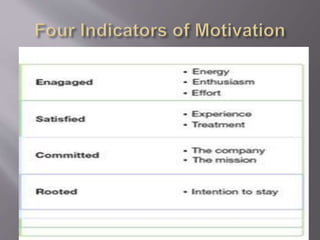
 Employee engagement An employee’s and
emotional commitment to his or her work
 employee engagement is a form of
productivity, as highly engaged
employees spend higher percentages of
time performing work activities and
disengaged employees will spend most of
their time devising ways to avoid work.
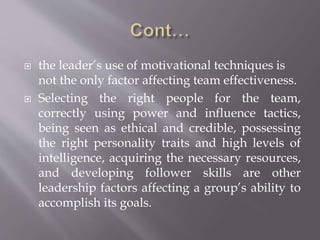
 the leader’s use of motivational techniques is
not the only factor affecting team effectiveness.
 Selecting the right people for the team,
correctly using power and influence tactics,
being seen as ethical and credible, possessing
the right personality traits and high levels of
intelligence, acquiring the necessary resources,
and developing follower skills are other
leadership factors affecting a group’s ability to
accomplish its goals.
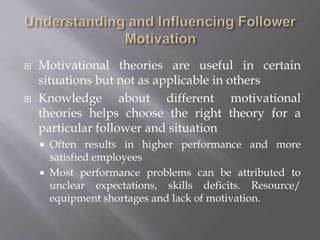
 Motivational theories are useful in certain
situations but not as applicable in others
 Knowledge about different motivational
theories helps choose the right theory for a
particular follower and situation
 Often results in higher performance and more
satisfied employees
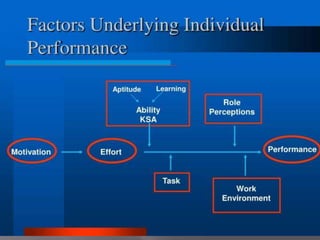
 Most performance problems can be attributed to
unclear expectations, skills deficits. Resource/
equipment shortages and lack of motivation.
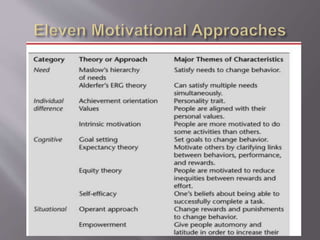
 Needs: Refer to internal states of tension or
arousal, or uncomfortable states of deficiency
people are motivated to change
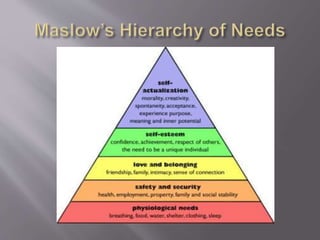
 Maslow hierarchy of needs Theory
 Alderfer’s Expectancy relatedness – Growth (ERG)
Theory
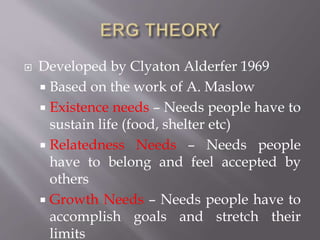
 Developed by Clyaton Alderfer 1969
 Based on the work of A. Maslow
 Existence needs – Needs people have to
sustain life (food, shelter etc)
 Relatedness Needs – Needs people
have to belong and feel accepted by
others
 Growth Needs – Needs people have to
accomplish goals and stretch their
limits
 Leaders should start by determining if
follower’s lower level needs are being satisfied
 These theories do not make specific predictions
about what an individual will do to satisfy
particular need
 Awareness of general nature of various sorts of
basic human needs seems fundamentally
useful to leaders
 Basic fundamental areas need to be addressed first
 Assumes people differ in key personality traits,
work values and the work they like to do.
 Concluding thoughts on individual differences in
motivation:
 Ensure that followers exert needed effort for task
accomplishment by selecting individuals already high in
these motives
 To determine what followers find to be intrinsically
motivating, simply ask them what they like to do
 By reassigning work according to values, and intrinsic
interests, leaders may be able to get higher quality work
and have more satisfied employees.
 Goal Setting: Goals are the most powerful
determinants of task behavior
 A motivational theory suggesting that setting goals
can be an effective way to motivate employees.
 Goals should be specific enough to give employees
clarity and focus
 Goals should be difficult enough to inspire
energetic and committed effort
 There should be clear ownership of goals so that
accountability can be established
 Individuals should have belief in their ability to
meet their goals
 Pygmalion effect: psychological phenomenon
in which higher expectations placed upon
individuals either by supervisors or the
individual themselves lead to improved
performance by the individual in a given area
 Golem effect: is a psychological phenomenon
in which lower expectations placed upon
individuals themselves lead to poorer
performance in a given area.
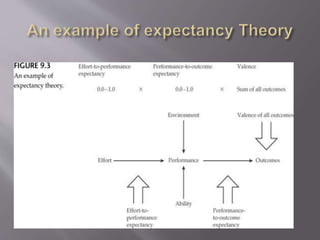
 Expectancy Theory: Assumes that people
act in ways that maximize their expectations of
attaining valued outcomes.
 Effort to performance expectancy
 Performance to outcome expectancy
 Valence
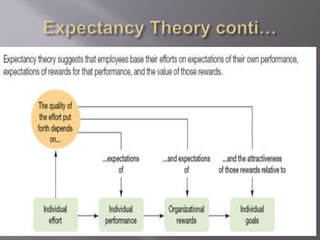
 The idea that the effort employees put
into their work depends on the
expectations about their own ability to
perform, expectations about likely
rewards and the attractiveness of those
rewards
 Equity Theory – Assumes that people value
fairness in leader – follower exchange
relationships
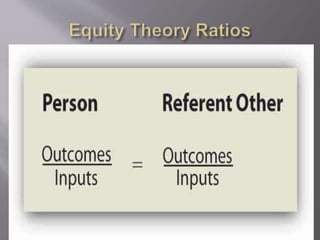
 The idea that employees/followers base their
level of satisfaction on the ratio of their inputs
to the job or the rewards they receive from it
 Self Efficacy – Concerns one’s core beliefs
about being able to successfully perform a
given task
 Positive self efficacy
 Negative self efficacy
 All four cognitive theories assume that
changing follower’s thoughts will help them
engage in particular tasks and activities
 Leaders can influence follower’s motivational
levels by:
 Clearly outlining expected outcomes
 Clarifying the links between efforts and rewards
 Providing training, coaching, and feedback to the
followers
 Cognitive theories place a string premium on
leader – follower communication.
 Operant approach
 Reward
 Punishment
 Contingent rewards or punishment
 No contingent rewards and punishment
 Extinction
 Clearly specify what behaviors are important
 Determine if those behaviors are currently being
punished, rewarded, or ignored.
 Find out what followers find rewarding and
punishing
 Be wary of creating perceptions of inequity when
administering individually tailored rewards
 Do not limit oneself organizationally sanctioned
rewards and punishments
 Administer rewards and punishment in a
contingent manner whenever possible.
 Empowerment
 Top – down approach to delegation
 Bottom up approach to delegation
 Macro – Psychological components
 Motivating
 Learning
 Stress
 Micro – Components of empowerment
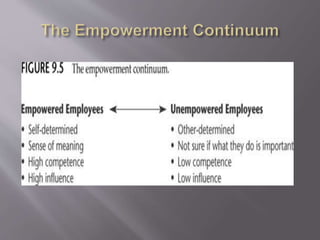
 Self – Determination
 Meaning
 Competence
 Influence
 Leaders naively assume it is easier to change an
individual than it is to change the situation
 Leaders can often see positive changes in
follower’s motivation levels by restructuring
work processes and procedures
 It can increase their latitude to make decisions and
add more meaning to work
 If properly designed and administered then in
many cases followers will successfully work
through their resistance.
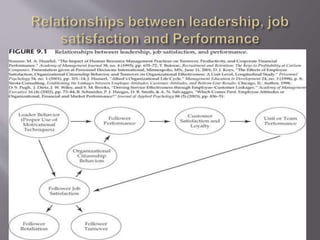
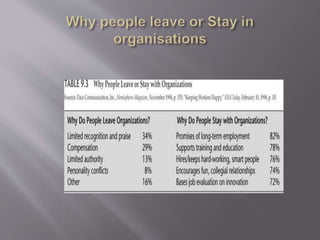
 Research has shown that satisfied workers are
more likely to continue working for an
organisation
 More likely to engage in organizational citizenship
behaviours
 Dissatisfied workers - more likely to be
adversarial in their relations with leadership
 May engage in diverse sorts of counterproductive
behaviours
 Employee Turnover –has the most immediate
impact on leadership practitioners
 Functional turnover
 Dysfunctional turnover
 Three different types of items are typically
found on a job satisfaction survey:
 Global Satisfaction
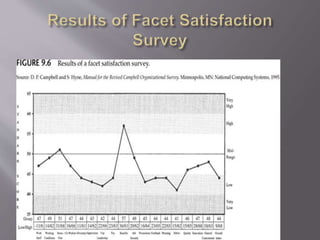
 Facet Satisfaction
 Life Satisfaction
 Other important findings include
 Hierarchy effect
 Life Satisfaction
 Survey results are most useful when they can
be compared with those from some reference
group
 Affectivity – Refers to one’s tendency to react
to stimuli in a consistent emotional manner
 Negative affectivity
 Positive affectivity
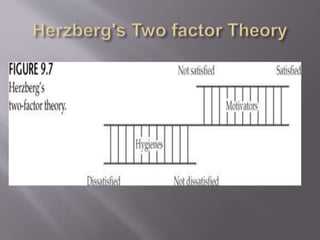
 Hezberg’s Two factor Theory
 Motivators
 Hygiene Factors
 Organizational Justice
 Interactional Justice
 Distributive Justice
 Procedural Justice
 Performance and Motivation are not the same
thing
 People often have varying levels of satisfaction for
different aspects of their jobs
 Many of the approaches to understanding
motivation have distinct implications for
increasing performance and satisfaction
 Followers as well as leaders are more likely to
have positive attitudes about work if they believe
that what they do is important and that the reward
and the disciplinary systems are fair and just

Motivation, satisfaction and performance

  • 1.
    Joseph Fredrick Mutupha(PhD) The Commandant Police College Zomba - Malawi
  • 2.
     The abilityto motivate others is as fundamental leadership skill and has strong connections to managerial incompetence.  Variations in work output varies significantly across leaders and followers  Creating highly motivated and satisfied followers, depends most of all, on understanding others.
  • 3.
     Motivation –anything that provides direction, intensity, and persistence to behaviour.  Not directly observable; must be inferred from behaviour  Performance – Pehaviours directed toward the organisation’s mission or goals, or the products and services resulting from those behaviours.  Differs from effectiveness  Job Satisfaction: How much one likes a specific kind of job or work activity  Related to organisational citizenship behaviour
  • 4.
     Employee engagementAn employee’s and emotional commitment to his or her work  employee engagement is a form of productivity, as highly engaged employees spend higher percentages of time performing work activities and disengaged employees will spend most of their time devising ways to avoid work.
  • 8.
     the leader’suse of motivational techniques is not the only factor affecting team effectiveness.  Selecting the right people for the team, correctly using power and influence tactics, being seen as ethical and credible, possessing the right personality traits and high levels of intelligence, acquiring the necessary resources, and developing follower skills are other leadership factors affecting a group’s ability to accomplish its goals.
  • 9.
     Motivational theoriesare useful in certain situations but not as applicable in others  Knowledge about different motivational theories helps choose the right theory for a particular follower and situation  Often results in higher performance and more satisfied employees  Most performance problems can be attributed to unclear expectations, skills deficits. Resource/ equipment shortages and lack of motivation.
  • 11.
     Needs: Referto internal states of tension or arousal, or uncomfortable states of deficiency people are motivated to change  Maslow hierarchy of needs Theory  Alderfer’s Expectancy relatedness – Growth (ERG) Theory
  • 13.
     Developed byClyaton Alderfer 1969  Based on the work of A. Maslow  Existence needs – Needs people have to sustain life (food, shelter etc)  Relatedness Needs – Needs people have to belong and feel accepted by others  Growth Needs – Needs people have to accomplish goals and stretch their limits
  • 14.
     Leaders shouldstart by determining if follower’s lower level needs are being satisfied  These theories do not make specific predictions about what an individual will do to satisfy particular need  Awareness of general nature of various sorts of basic human needs seems fundamentally useful to leaders  Basic fundamental areas need to be addressed first
  • 15.
     Assumes peoplediffer in key personality traits, work values and the work they like to do.  Concluding thoughts on individual differences in motivation:  Ensure that followers exert needed effort for task accomplishment by selecting individuals already high in these motives  To determine what followers find to be intrinsically motivating, simply ask them what they like to do  By reassigning work according to values, and intrinsic interests, leaders may be able to get higher quality work and have more satisfied employees.
  • 17.
     Goal Setting:Goals are the most powerful determinants of task behavior  A motivational theory suggesting that setting goals can be an effective way to motivate employees.  Goals should be specific enough to give employees clarity and focus  Goals should be difficult enough to inspire energetic and committed effort  There should be clear ownership of goals so that accountability can be established  Individuals should have belief in their ability to meet their goals
  • 18.
     Pygmalion effect:psychological phenomenon in which higher expectations placed upon individuals either by supervisors or the individual themselves lead to improved performance by the individual in a given area  Golem effect: is a psychological phenomenon in which lower expectations placed upon individuals themselves lead to poorer performance in a given area.
  • 19.
     Expectancy Theory:Assumes that people act in ways that maximize their expectations of attaining valued outcomes.  Effort to performance expectancy  Performance to outcome expectancy  Valence
  • 20.
     The ideathat the effort employees put into their work depends on the expectations about their own ability to perform, expectations about likely rewards and the attractiveness of those rewards
  • 23.
     Equity Theory– Assumes that people value fairness in leader – follower exchange relationships  The idea that employees/followers base their level of satisfaction on the ratio of their inputs to the job or the rewards they receive from it
  • 25.
     Self Efficacy– Concerns one’s core beliefs about being able to successfully perform a given task  Positive self efficacy  Negative self efficacy
  • 26.
     All fourcognitive theories assume that changing follower’s thoughts will help them engage in particular tasks and activities  Leaders can influence follower’s motivational levels by:  Clearly outlining expected outcomes  Clarifying the links between efforts and rewards  Providing training, coaching, and feedback to the followers  Cognitive theories place a string premium on leader – follower communication.
  • 27.
     Operant approach Reward  Punishment  Contingent rewards or punishment  No contingent rewards and punishment  Extinction
  • 28.
     Clearly specifywhat behaviors are important  Determine if those behaviors are currently being punished, rewarded, or ignored.  Find out what followers find rewarding and punishing  Be wary of creating perceptions of inequity when administering individually tailored rewards  Do not limit oneself organizationally sanctioned rewards and punishments  Administer rewards and punishment in a contingent manner whenever possible.
  • 29.
     Empowerment  Top– down approach to delegation  Bottom up approach to delegation  Macro – Psychological components  Motivating  Learning  Stress  Micro – Components of empowerment  Self – Determination  Meaning  Competence  Influence
  • 30.
     Leaders naivelyassume it is easier to change an individual than it is to change the situation  Leaders can often see positive changes in follower’s motivation levels by restructuring work processes and procedures  It can increase their latitude to make decisions and add more meaning to work  If properly designed and administered then in many cases followers will successfully work through their resistance.
  • 32.
     Research hasshown that satisfied workers are more likely to continue working for an organisation  More likely to engage in organizational citizenship behaviours  Dissatisfied workers - more likely to be adversarial in their relations with leadership  May engage in diverse sorts of counterproductive behaviours  Employee Turnover –has the most immediate impact on leadership practitioners  Functional turnover  Dysfunctional turnover
  • 34.
     Three differenttypes of items are typically found on a job satisfaction survey:  Global Satisfaction  Facet Satisfaction  Life Satisfaction  Other important findings include  Hierarchy effect  Life Satisfaction  Survey results are most useful when they can be compared with those from some reference group
  • 37.
     Affectivity –Refers to one’s tendency to react to stimuli in a consistent emotional manner  Negative affectivity  Positive affectivity  Hezberg’s Two factor Theory  Motivators  Hygiene Factors  Organizational Justice  Interactional Justice  Distributive Justice  Procedural Justice
  • 40.
     Performance andMotivation are not the same thing  People often have varying levels of satisfaction for different aspects of their jobs  Many of the approaches to understanding motivation have distinct implications for increasing performance and satisfaction  Followers as well as leaders are more likely to have positive attitudes about work if they believe that what they do is important and that the reward and the disciplinary systems are fair and just