

ORGANIZATIONA
L BEHAVIOUR
UNIT-2
PRESENTED BY
K.BALASRI PRASAD
B.Sc (KU), M.B.A (OU), NET (UGC), (PH.D) (MGU)
Unit-II
Motivation:
“A motive is an inner state that energizes,
activates or moves and directs or channels
behaviour goals.”
“Motivation refers to degree of readiness
of an individual to pursue some designated
goal and implies the determination of the
nature and locus of the forces, including
the degree of readiness.”
Importance of Motivation:
1. High Performance
2. Low employee turnover and
Absenteeism
3. Better Organizational image
4. Better Industrial relations
5. Acceptability to change
Theories of Motivation
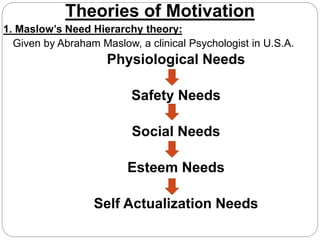
1. Maslow’s Need Hierarchy theory:
Given by Abraham Maslow, a clinical Psychologist in U.S.A.
Physiological Needs
Safety Needs
Social Needs
Esteem Needs
Self Actualization Needs
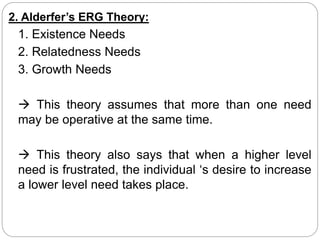
2. Alderfer’s ERG Theory:
1. Existence Needs
2. Relatedness Needs
3. Growth Needs
 This theory assumes that more than one need
may be operative at the same time.
 This theory also says that when a higher level
need is frustrated, the individual ‘s desire to increase
a lower level need takes place.
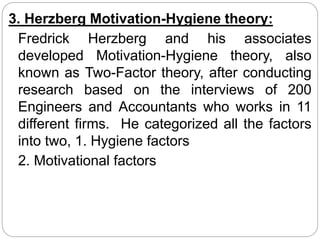
3. Herzberg Motivation-Hygiene theory:
Fredrick Herzberg and his associates
developed Motivation-Hygiene theory, also
known as Two-Factor theory, after conducting
research based on the interviews of 200
Engineers and Accountants who works in 11
different firms. He categorized all the factors
into two, 1. Hygiene factors
2. Motivational factors
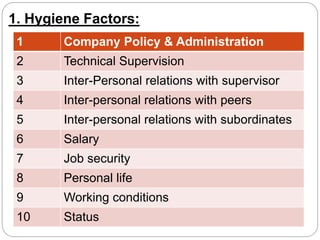
1. Hygiene Factors:
1 Company Policy & Administration
2 Technical Supervision
3 Inter-Personal relations with supervisor
4 Inter-personal relations with peers
5 Inter-personal relations with subordinates
6 Salary
7 Job security
8 Personal life
9 Working conditions
10 Status
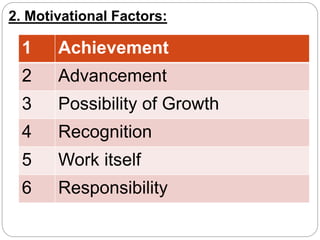
2. Motivational Factors:
1 Achievement
2 Advancement
3 Possibility of Growth
4 Recognition
5 Work itself
6 Responsibility
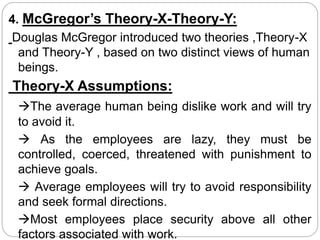
4. McGregor’s Theory-X-Theory-Y:
Douglas McGregor introduced two theories ,Theory-X
and Theory-Y , based on two distinct views of human
beings.
Theory-X Assumptions:
The average human being dislike work and will try
to avoid it.
 As the employees are lazy, they must be
controlled, coerced, threatened with punishment to
achieve goals.
 Average employees will try to avoid responsibility
and seek formal directions.
Most employees place security above all other
factors associated with work.
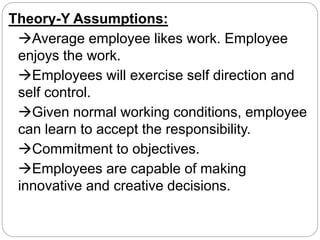
Theory-Y Assumptions:
Average employee likes work. Employee
enjoys the work.
Employees will exercise self direction and
self control.
Given normal working conditions, employee
can learn to accept the responsibility.
Commitment to objectives.
Employees are capable of making
innovative and creative decisions.
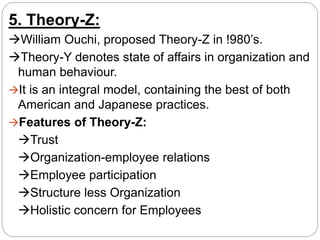
5. Theory-Z:
William Ouchi, proposed Theory-Z in !980’s.
Theory-Y denotes state of affairs in organization and
human behaviour.
It is an integral model, containing the best of both
American and Japanese practices.
Features of Theory-Z:
Trust
Organization-employee relations
Employee participation
Structure less Organization
Holistic concern for Employees
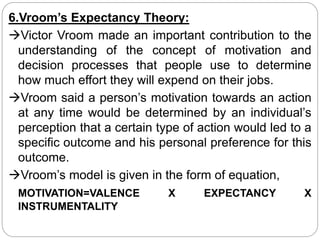
6.Vroom’s Expectancy Theory:
Victor Vroom made an important contribution to the
understanding of the concept of motivation and
decision processes that people use to determine
how much effort they will expend on their jobs.
Vroom said a person’s motivation towards an action
at any time would be determined by an individual’s
perception that a certain type of action would led to a
specific outcome and his personal preference for this
outcome.
Vroom’s model is given in the form of equation,
MOTIVATION=VALENCE X EXPECTANCY X
INSTRUMENTALITY
1. Valence:
 The attraction (or repulsion) of an outcome to the
individual.
 Whenever an individual has preference for a reward,
valence is the strength of that preference.
2. Expectancy:
 It is also referred to as the Effort-Performance
probability.
 The extent to which the person believes his efforts will
lead to the first level outcome i.ie., completion of the
task.
 If the individual feels that the probability of achieving
an outcome is zero, he/she will not even try. On the other
hand, if the probability is higher, he/she will put more
efforts to achieve the desired outcome.
3. Instrumentality (Performance-Reward Probability):
 It refers to the belief and expectation of a person that
his/her performance will lead to a particular desired
reward.
 Motivational force will be the highest when all the three
factors are high and the force will be reduced when any
one or more of valence, expectancy of instrumentality
approaches zero.
7. Porter’s and Lawler model of Motivation:
This is a multi variate model which explains the
relationship that exists between job attitudes and job
performance.
 This model is based on four basic assumptions about
human behaviour:
 Individual behaviour is determined by a combination
of factors in the individual and in the environment.
 Individuals are assumed to be rational human beings
who make conscious decisions about their behaviour in
the organizations.
Individuals have different needs, desires and goals.
 On the basis of their expectations, individuals decide
between alternate behaviours and such decided
behaviour will lead to a desired outcome.
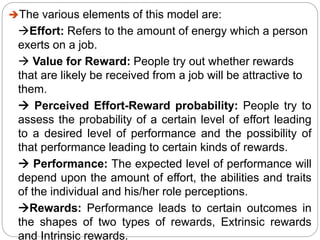
The various elements of this model are:
Effort: Refers to the amount of energy which a person
exerts on a job.
 Value for Reward: People try out whether rewards
that are likely be received from a job will be attractive to
them.
 Perceived Effort-Reward probability: People try to
assess the probability of a certain level of effort leading
to a desired level of performance and the possibility of
that performance leading to certain kinds of rewards.
 Performance: The expected level of performance will
depend upon the amount of effort, the abilities and traits
of the individual and his/her role perceptions.
Rewards: Performance leads to certain outcomes in
the shapes of two types of rewards, Extrinsic rewards
and Intrinsic rewards.
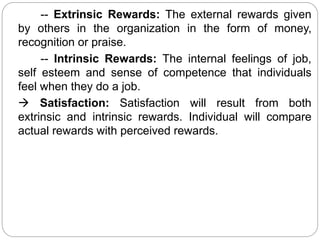
-- Extrinsic Rewards: The external rewards given
by others in the organization in the form of money,
recognition or praise.
-- Intrinsic Rewards: The internal feelings of job,
self esteem and sense of competence that individuals
feel when they do a job.
 Satisfaction: Satisfaction will result from both
extrinsic and intrinsic rewards. Individual will compare
actual rewards with perceived rewards.
Managerial Grid
 Blake and Moton –
A graphical representation of a 2 dimensional view of
leadership style.
Based on :-
1. ‘concern for people’
2. ‘concern for production’
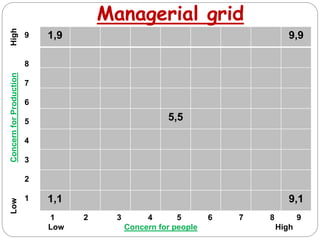
Grid identifies 5 basic styles of leadership.
1,9 9,9
5,5
1,1 9,1
LowConcernforProductionHigh
1 2 3 4 5 6 7 8 9
Low Concern for people High
9
8
7
6
5
4
3
2
1
Managerial grid
ORGANISATIONAL DEVELOPMENT-UNIT-2-BBA NOTES-OSMANIA UNIVERSITY

ORGANISATIONAL DEVELOPMENT-UNIT-2-BBA NOTES-OSMANIA UNIVERSITY

  • 1.
    ORGANIZATIONA L BEHAVIOUR UNIT-2 PRESENTED BY K.BALASRIPRASAD B.Sc (KU), M.B.A (OU), NET (UGC), (PH.D) (MGU)
  • 2.
    Unit-II Motivation: “A motive isan inner state that energizes, activates or moves and directs or channels behaviour goals.” “Motivation refers to degree of readiness of an individual to pursue some designated goal and implies the determination of the nature and locus of the forces, including the degree of readiness.”
  • 3.
    Importance of Motivation: 1.High Performance 2. Low employee turnover and Absenteeism 3. Better Organizational image 4. Better Industrial relations 5. Acceptability to change
  • 4.
    Theories of Motivation 1.Maslow’s Need Hierarchy theory: Given by Abraham Maslow, a clinical Psychologist in U.S.A. Physiological Needs Safety Needs Social Needs Esteem Needs Self Actualization Needs
  • 5.
    2. Alderfer’s ERGTheory: 1. Existence Needs 2. Relatedness Needs 3. Growth Needs  This theory assumes that more than one need may be operative at the same time.  This theory also says that when a higher level need is frustrated, the individual ‘s desire to increase a lower level need takes place.
  • 6.
    3. Herzberg Motivation-Hygienetheory: Fredrick Herzberg and his associates developed Motivation-Hygiene theory, also known as Two-Factor theory, after conducting research based on the interviews of 200 Engineers and Accountants who works in 11 different firms. He categorized all the factors into two, 1. Hygiene factors 2. Motivational factors
  • 7.
    1. Hygiene Factors: 1Company Policy & Administration 2 Technical Supervision 3 Inter-Personal relations with supervisor 4 Inter-personal relations with peers 5 Inter-personal relations with subordinates 6 Salary 7 Job security 8 Personal life 9 Working conditions 10 Status
  • 8.
    2. Motivational Factors: 1Achievement 2 Advancement 3 Possibility of Growth 4 Recognition 5 Work itself 6 Responsibility
  • 9.
    4. McGregor’s Theory-X-Theory-Y: DouglasMcGregor introduced two theories ,Theory-X and Theory-Y , based on two distinct views of human beings. Theory-X Assumptions: The average human being dislike work and will try to avoid it.  As the employees are lazy, they must be controlled, coerced, threatened with punishment to achieve goals.  Average employees will try to avoid responsibility and seek formal directions. Most employees place security above all other factors associated with work.
  • 10.
    Theory-Y Assumptions: Average employeelikes work. Employee enjoys the work. Employees will exercise self direction and self control. Given normal working conditions, employee can learn to accept the responsibility. Commitment to objectives. Employees are capable of making innovative and creative decisions.
  • 11.
    5. Theory-Z: William Ouchi,proposed Theory-Z in !980’s. Theory-Y denotes state of affairs in organization and human behaviour. It is an integral model, containing the best of both American and Japanese practices. Features of Theory-Z: Trust Organization-employee relations Employee participation Structure less Organization Holistic concern for Employees
  • 12.
    6.Vroom’s Expectancy Theory: VictorVroom made an important contribution to the understanding of the concept of motivation and decision processes that people use to determine how much effort they will expend on their jobs. Vroom said a person’s motivation towards an action at any time would be determined by an individual’s perception that a certain type of action would led to a specific outcome and his personal preference for this outcome. Vroom’s model is given in the form of equation, MOTIVATION=VALENCE X EXPECTANCY X INSTRUMENTALITY
  • 13.
    1. Valence:  Theattraction (or repulsion) of an outcome to the individual.  Whenever an individual has preference for a reward, valence is the strength of that preference. 2. Expectancy:  It is also referred to as the Effort-Performance probability.  The extent to which the person believes his efforts will lead to the first level outcome i.ie., completion of the task.  If the individual feels that the probability of achieving an outcome is zero, he/she will not even try. On the other hand, if the probability is higher, he/she will put more efforts to achieve the desired outcome.
  • 14.
    3. Instrumentality (Performance-RewardProbability):  It refers to the belief and expectation of a person that his/her performance will lead to a particular desired reward.  Motivational force will be the highest when all the three factors are high and the force will be reduced when any one or more of valence, expectancy of instrumentality approaches zero.
  • 15.
    7. Porter’s andLawler model of Motivation: This is a multi variate model which explains the relationship that exists between job attitudes and job performance.  This model is based on four basic assumptions about human behaviour:  Individual behaviour is determined by a combination of factors in the individual and in the environment.  Individuals are assumed to be rational human beings who make conscious decisions about their behaviour in the organizations. Individuals have different needs, desires and goals.  On the basis of their expectations, individuals decide between alternate behaviours and such decided behaviour will lead to a desired outcome.
  • 16.
    The various elementsof this model are: Effort: Refers to the amount of energy which a person exerts on a job.  Value for Reward: People try out whether rewards that are likely be received from a job will be attractive to them.  Perceived Effort-Reward probability: People try to assess the probability of a certain level of effort leading to a desired level of performance and the possibility of that performance leading to certain kinds of rewards.  Performance: The expected level of performance will depend upon the amount of effort, the abilities and traits of the individual and his/her role perceptions. Rewards: Performance leads to certain outcomes in the shapes of two types of rewards, Extrinsic rewards and Intrinsic rewards.
  • 17.
    -- Extrinsic Rewards:The external rewards given by others in the organization in the form of money, recognition or praise. -- Intrinsic Rewards: The internal feelings of job, self esteem and sense of competence that individuals feel when they do a job.  Satisfaction: Satisfaction will result from both extrinsic and intrinsic rewards. Individual will compare actual rewards with perceived rewards.
  • 18.
    Managerial Grid  Blakeand Moton – A graphical representation of a 2 dimensional view of leadership style. Based on :- 1. ‘concern for people’ 2. ‘concern for production’ Grid identifies 5 basic styles of leadership.
  • 19.
    1,9 9,9 5,5 1,1 9,1 LowConcernforProductionHigh 12 3 4 5 6 7 8 9 Low Concern for people High 9 8 7 6 5 4 3 2 1 Managerial grid