David L. Griscom
impactGlass research international
Mexico City Paris Tokyo Washington
Commissariat à l’Energie Atomique, Bruyères-le-Châtel, France
1 December 2005
An
Ideal Wedding
of a Mathematical Formalism
often written off as “just another method of curve fitting”
with a Remarkable Body of Data
which has defied simple mathematical description,
thus severely limiting its utility for its intended purposes
Acknowledgements
The Experimental data for the Ge-doped-silica fibers were
recorded at the Naval Research Laboratory by E.J. Friebele
with important assistance from M.E. Gingerich, M. Putnum,
G.M. Williams, and W.D. Mack.
A full account of this work has been published:
D.L. Griscom, Phys. Rev. B64, 174201 (2001)
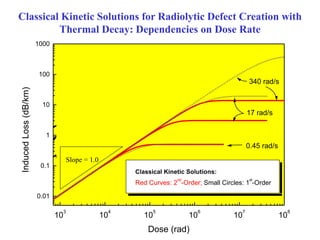
Classical Kinetic Solutions for Radiolytic Defect Creation with
Thermal Decay: Dependencies on Dose Rate
10
3
10
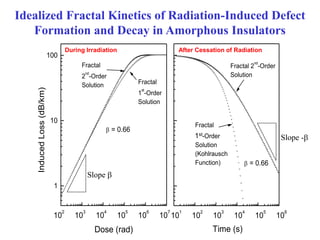
4
10
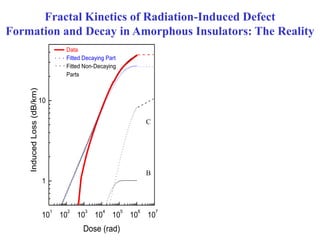
5
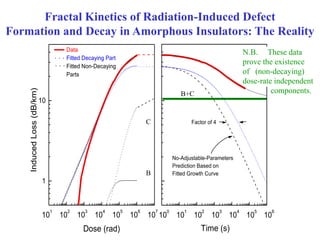
10
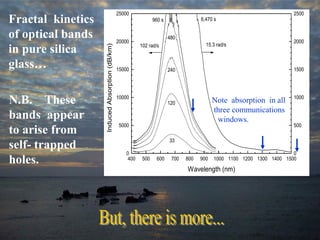
6
10
7
10
8
0.01
0.1
1
10
100
1000
Classical Kinetic Solutions:
Red Curves: 2
nd
-Order; Small Circles: 1
st
-Order
340 rad/s
17 rad/s
0.45 rad/s
Experimental Data:
17 rad/s
0.45 rad/s
340 rad/s
InducedLoss(dB/km)
Dose (rad)
Slope = 1.0
Radiation-Induced Absorption (1.3 m) in Ge-Doped-Silica-Core Optical Fibers:
Failure of Classical Kinetics to Fit Data as Functions of Dose Rate
10
3
10
4
10
5
10
6
10
7
10
8
0.01
0.1
1
10
100
1000
Classical Kinetic Solutions:
Red Curves: 2
nd
-Order; Small Circles: 1
st
-Order
340 rad/s
17 rad/s
0.45 rad/s
Experimental Data:
17 rad/s
0.45 rad/s
340 rad/s
InducedLoss(dB/km)
Dose (rad)
Slope = 1.0
It is Impossible to Fit
These Data with These Solutions!
•Gottfried von Leibnitz (1695): “Thus it follows that d½x will be equal to xdx:x,
… from which one day useful consequences will be drawn.”
What is Fractal (Fractional) Kinetics?
•I.M. Sokovov, J. Klafter, A. Blumen, Physics Today, November, 2002, p. 48:
“Equations built on fractional derivatives describe the anomalously slow diffusion
observed in systems with a broad distribution of relaxation times.”
•R. Kopelman, Science 241, 1620 (1988).
•Science 297, 1268 (2002): News article on “Tsallis entropy”.
(q  1)
Fractal Kinetics in Brief
Fractal spaces differ from Euclidian spaces by having fractal dimensions df
such that
df < d,
where d is the dimension of the Euclidian space in which the fractal is embedded.
Each fractal also possesses a spectral dimension ds (< df < d), defined by the
probability P of a random walker returning to its point of origin after a time t:
P(t)  t-ds/2.
The present work introduces a parameter, ds/2. Thus, for many amorphous
materials, values of 2/3 might be expected ...
– which
serves as a prototype for many amorphous materials.
It is known that ds  4/3 for the entire class of random fractals embedded in
Euclidian spaces of dimensions d  2 , including the percolation cluster
Supercomputer Simulations of Fractal Kinetics
Raoul Kopelman, Science 241, 1620 (1988)
A + B  AB
Sierpinski “gasket”: df =1.585, ds = 1.365 Percolation Cluster: df =1.896, ds = 1.333
First-order growth kinetics with thermally activated decay.
The classical rate equation for this situation can be written
dN(t)/dt = KDN* - RN,
and its solution is given by
N(t) = Nsat{1 - exp[-Rt]},
where K and R are constants, D is the dose rate, N* is a
number of unit value and dimensions of number density
(e.g., cm-3), and
Nsat = (KD/R)N*.
Rate Equations for Defect Creation under Irradiation
•
•
•
Result of Change in Dimensionless Variable kt  (kt)
First-order growth kinetics with thermally activated decay.
The fractal rate equation for this situation can be written
dN((kt))/d(kt) = (KD/R) N* - N
0 <  <1 k = R
with solution
N((kt)) = Nsat{1 - exp[-(kt)]},
where Nsat = (KD/R) N*.
•
•
Second-order growth kinetics with thermally activated decay.
The classical rate equation for this situation can be written
dN(t)/dt = KDN* - RN2/N*,
and its solution is given by
N(t) = Nsattanh(kt),
where Nsat = (KD/R)1/2N* and k = (KDR)1/2.
Rate Equations for Defect Creation under Irradiation
•
• •
Result of Change in Dimensionless Variable kt  (kt)
Second-order growth kinetics with thermally activated decay.
The fractal rate equation for this situation can be written
dN((kt))/d(kt) = (KD/R) /2N* - (R/KD) /2N2/N*
0 <  <1 k = (KDR)1/2
with solution
N((kt)) = Nsattanh[(kt)],
where Nsat = (KD/R) /2N*.
•
••
•
Three Fitting
Parameters
Experimental Curves Fitted by Fractal First-Order Solutions
Multi-Mode Ge-Doped-Silica-Core Fibers, =1300 nm
1000 10000 100000 1000000
0.1
1
10
100
0.0009 rad/s
=0.82
17 rad/s
=0.79
0.45 rad/s
=0.94
340 rad/s
=0.71
InducedLoss(dB/km)
Dose (rad)
(Reactor Irradiation)
γ
Irradiation
1E-3 0.01 0.1 1 10 100
10
100
(c)
Slope = 
Slope = /2
SaturationLoss(dB/km)
Dose Rate (rad/s)
1E-3 0.01 0.1 1 10 100
10
-8
10
-7
10
-6
10
-5
10
-4
10
-3
Linear!!!
(b)
Classical 1st-Order Kinetics
Classical 2nd-Order
Kinetics
RateCoefficient(s
-1
)
1E-3 0.01 0.1 1 10 100
0.7
0.8
0.9
(a)
Stretched 2nd Order Kinetics
Stretched 1st-Order Kinetics
Power-LawExponent
Fractal-Kinetic Fitting Parameters: Both Kinetic Orders
Multi-Mode Ge-Doped-Silica-Core Fibers, =1300 nm
Slope = 1
Classical 1st Order
Classical 2nd
Order Fractal 1st & 2nd Order (Slope = 1) Empirical!!!
Fractal 1st & 2nd Order
(Slope Variable)
Annoying Cusp
Annoying

k
Nsat
Dose Rate (rad/s)
Classical 1st Order
Slope = ½
Classical 2nd Order
1000 10000 100000 1000000
0.1
1
10
100
0.0009 rad/s
=1.0
17 rad/s
=0.70
0.45 rad/s
=1.00
340 rad/s
=0.62
InducedLoss(dB/km)
Dose (rad)
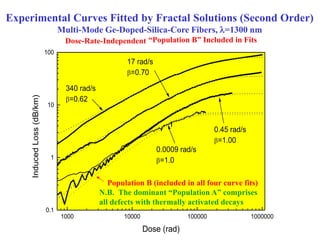
Experimental Curves Fitted by Fractal Solutions (Second Order)
Multi-Mode Ge-Doped-Silica-Core Fibers, =1300 nm
“Population B” Included in Fits
Population B (included in all four curve fits)
Dose-Rate-Independent
N.B. The dominant “Population A” comprises
all defects with thermally activated decays
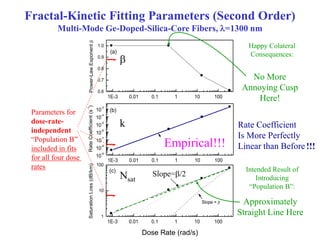
Fractal-Kinetic Fitting Parameters (Second Order)
Multi-Mode Ge-Doped-Silica-Core Fibers, =1300 nm
Parameters for
dose-rate-
independent
“Population B”
included in fits
for all four dose
rates
1E-3 0.01 0.1 1 10 100
1
10
100
(c)
Slope = 
Slope = /2
SaturationLoss(dB/km)
Dose Rate (rad/s)
1E-3 0.01 0.1 1 10 100
10
-9
10
-8
10
-7
10
-6
10
-5
10
-4
10
-3
Linear
(b)
RateCoefficient(s
-1
)
1E-3 0.01 0.1 1 10 100
0.6
0.7
0.8
0.9
1.0
(a)
Power-LawExponent
No More
Annoying Cusp
Here!
Approximately
Straight Line Here
Intended Result of
Introducing
“Population B”:
Rate Coefficient
Is More Perfectly
Linear than Before!!!

k
Nsat
Dose Rate (rad/s)
Slope=/2
Empirical!!!
Happy Colateral
Consequences:
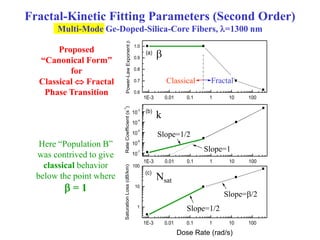
Fractal-Kinetic Fitting Parameters (Second Order)
Multi-Mode Ge-Doped-Silica-Core Fibers, =1300 nm
Proposed
“Canonical Form”
for
Classical  Fractal
Phase Transition
1E-3 0.01 0.1 1 10 100
1
10
100
Slope = 1/2
(c)
Slope = /2
SaturationLoss(dB/km)
Dose Rate (rad/s)
1E-3 0.01 0.1 1 10 100
10
-7
10
-6
10
-5
10
-4
10
-3
Slope = 1/2
(b)
Slope = 1
RateCoefficient(s
-1
)
1E-3 0.01 0.1 1 10 100
0.6
0.7
0.8
0.9
1.0
(a)
Classical Fractal
Power-LawExponent
Here “Population B”
was contrived to give
classical behavior
below the point where
 = 1

k
Nsat
Slope=/2
Slope=1
Slope=1/2
Slope=1/2
Classical Fractal
Dose Rate (rad/s)
1000 10000 100000 1000000
0.1
1
10
100
C ( = 0.66)
B
0.0009 rad/s
=1.0
17 rad/s
=0.61
0.45 rad/s
=0.94
340 rad/s
=0.46
InducedLoss(dB/km)
Dose (rad)
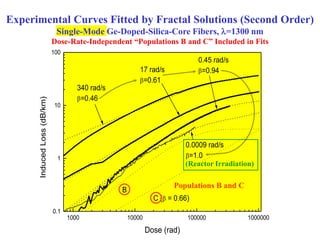
Experimental Curves Fitted by Fractal Solutions (Second Order)
Single-Mode Ge-Doped-Silica-Core Fibers, =1300 nm
Dose-Rate-Independent “Populations B and C” Included in Fits
(Reactor Irradiation)
Populations B and C
1E-3 0.01 0.1 1 10 100
0.1
1
10
Slope = 1/2
Slope = /2(c)
SaturationLoss(dB/km)
Dose Rate (rad/s)
1E-3 0.01 0.1 1 10 100
1E-8
1E-7
1E-6
1E-5
1E-4
1E-3
Slope = 1/2
Slope = 1(b)
RateCoefficient(1/s)
1E-3 0.01 0.1 1 10 100
0.5
0.6
0.7
0.8
0.9
1.0
Single-Population Fits
Fits Including Effects
of Populations B & C(a)
Exponent
Fractal-Kinetic Fitting Parameters (Second Order)
Single-Mode Ge-Doped-Silica-Core Fibers, =1300 nm
However…
All fits are constrained
by the (questionable)
assumption that the
dosimetry for reactor-
irradiation is equivalent
to that for γ irradiation
vis-à-vis the induced
optical absorption.
γ-Rays
Reactor
Irradiation Dose Rate (rad/s)

k
Nsat
Slope=1/2
Slope=1/2
Inclusion of Populations
B & C does not alter the
fundamental result:
There still seems to be a
classical  fractal
transition.
Experimental Curves Fitted by Fractal Solutions (Second Order)
Single-Mode Ge-Doped-Silica-Core Fibers, =1300 nm
Dose-Rate-Independent “Populations B and C” Included in Fits
1000 10000 100000 1000000
0.1
1
10
100
C
B
0.011 rad/s
=1.017 rad/s
=0.66
0.45 rad/s
=0.85
340 rad/s
=0.52
InducedLoss(dB/km)
Dose (rad)
( Irradiation)
Fractal-Kinetic Fitting Parameters (Second Order)
Single-Mode Ge-Doped-Silica-Core Fibers, =1300 nm
Now All Fits
Pertain to
γ-Irradiated
Fibers Only.
Classical  Fractal Transition
0.01 0.1 1 10 100
1
10
Slope = /2
(c)
SaturationLoss(dB/km)
Dose Rate (rad/s)
0.01 0.1 1 10 100
10
-8
10
-7
10
-6
10
-5
10
-4
10
-3
Slope = 1
(b)
RateCoefficient(1/s)
0.01 0.1 1 10 100
0.5
0.6
0.7
0.8
0.9
1.0
Fits Including Influences
of Populations B and C
Single-Population Fits
(a)
Exponent
No Data for Reactor-
Irradiated Fibers Are
Included.
Empirical Result
of Fractal Kinetics!
Slope=1
Slope=/2
Dose Rate (rad/s)

k
Nsat
But Caution:
 May Now Be
Asymptotic to 1.0
as the Dose Rate
Approaches Zero.
?
?
Fractal Kinetics of Defect Creation in Ge-Doped-Silica Glasses:
What Have We Learned by Simulation of the Growth Curves?
==========================================================
Parameters
__________________________________________________
First-Order Solution Second-Order Solution
==========================================================
Specified by k = R k = (KDR)½
New Formalisms
Nsat = (KD/R) Nsat = (KD/R) /2
______________________________________________________________
Empirically R  D R  D1/2
Inferred in This Work
K  D½ K  D1/2
==========================================================
Note:
In classical cases
(=1), both K and
R are constants.
In fractal cases
(0<<1), both K
and R are dose-
rate dependent.
•
••
• •
••
Empirically
Post-Irradiation Thermal Decay Curves and Fractal-Kinetic Fits
for γ-Irradiated Ge-Doped-Silica Core Fibers
1 10 100 1000 10000 100000 1000000
0
10
20
30
40
50
60
70
80
90
SM Fiber Data
MM Fiber Data
Naive Fractal Second-Order
Prediction from Growth-Curve Fit
(=0.62)
Fractal Second-Order
Best Fit (=0.51)
Fractal 1
st
-Order
Best Fit
(=0.44)
Fractal Secnd-Order
Best Fit (=0.54)
Naive Fractal
First-Order
Prediction from
Growth-Curve Fit
(=0.71)
InducedLoss(dB/km)
Time (s)
Non-Decaying Component
Fractal Second-Order
Best Fit (=0.54)
Fractal Second-Order
Best Fit (=0.51)
(Equal to
Cumulative
Populations
B and C
Used in
Fitting the
Growth
Curves!)
10
1
10
2
10
3
10
4
10
5
10
6
Time (s)
 = 0.66
Fractal 2
nd
-Order
Solution
Fractal
2
nd
-Order
Solution
(Kohlrausch
Function)
10
2
10
3
10
4
10
5
10
6
10
7
1
10
100
 = 0.66
Fractal
1
st
-Order
Solution
Fractal
2
nd
-Order
Solution
InducedLoss(dB/km)
Dose (rad)
Idealized Fractal Kinetics of Radiation-Induced Defect
Formation and Decay in Amorphous Insulators
During Irradiation After Cessation of Radiation
1st
10
1
10
2
10
3
10
4
10
5
10
6
Time (s)
 = 0.66
Fractal 2
nd
-Order
Solution
Fractal
2
nd
-Order
Solution
(Kohlrausch
Function)
10
2
10
3
10
4
10
5
10
6
10
7
1
10
100
 = 0.66
Fractal
1
st
-Order
Solution
Fractal
2
nd
-Order
Solution
InducedLoss(dB/km)
Dose (rad)
During Irradiation After Cessation of Radiation
1st
Slope 
Slope -
Idealized Fractal Kinetics of Radiation-Induced Defect
Formation and Decay in Amorphous Insulators
10
0
10
1
10
2
10
3
10
4
10
5
10
6
Factor of 4
No-Adjustable-Parameters
Prediction Based on
Fitted Growth Curve
Time (s)
10
1
10
2
10
3
10
4
10
5
10
6
10
7
1
10
Data
Fitted Decaying Part
Fitted Non-Decaying
Parts
InducedLoss(dB/km)
Dose (rad)
Fractal Kinetics of Radiation-Induced Defect
Formation and Decay in Amorphous Insulators: The Reality
C
B
B+C
10
0
10
1
10
2
10
3
10
4
10
5
10
6
Factor of 4
No-Adjustable-Parameters
Prediction Based on
Fitted Growth Curve
Time (s)
10
1
10
2
10
3
10
4
10
5
10
6
10
7
1
10
Data
Fitted Decaying Part
Fitted Non-Decaying
Parts
InducedLoss(dB/km)
Dose (rad)
C
B
B+C
N.B. These data
prove the existence
of (non-decaying)
dose-rate independent
components.
Fractal Kinetics of Radiation-Induced Defect
Formation and Decay in Amorphous Insulators: The Reality
Fractal kinetics
of optical bands
in pure silica
glass…
0
5000
10000
15000
20000
25000
6,470 s
102 rad/s 15.3 rad/s
33
120
240
480
960 s 0
InducedAbsorption(dB/km)
400 500 600 700 800 900 1000 1100 1200 1300 1400 1500
0
500
1000
1500
2000
2500
Wavelength (nm)
N.B. These
bands appear
to arise from
self- trapped
holes.
Note absorption in all
three communications
windows.
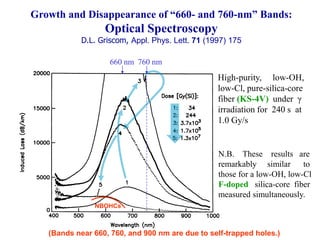
Growth and Disappearance of “660- and 760-nm” Bands:
Optical Spectroscopy
D.L. Griscom, Appl. Phys. Lett. 71 (1997) 175
High-purity, low-OH,
low-Cl, pure-silica-core
fiber (KS-4V) under γ
irradiation for 240 s at
1.0 Gy/s
NBOHCs
760 nm
N.B. These results are
remarkably similar to
those for a low-OH, low-Cl
F-doped silica-core fiber
measured simultaneously.
660 nm
(Bands near 660, 760, and 900 nm are due to self-trapped holes.)
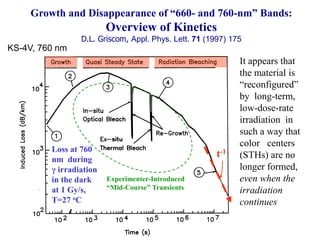
t-1
It appears that
the material is
“reconfigured”
by long-term,
low-dose-rate
irradiation in
such a way that
color centers
(STHs) are no
longer formed,
even when the
irradiation
continues
Loss at 760
nm during
γ irradiation
in the dark
at 1 Gy/s,
T=27 oC
Experimenter-Introduced
“Mid-Course” Transients
Growth and Disappearance of “660- and 760-nm” Bands:
Overview of Kinetics
D.L. Griscom, Appl. Phys. Lett. 71 (1997) 175
KS-4V, 760 nm
t-1
It appears that
the material is
“reconfigured”
by long-term,
low-dose-rate
irradiation in
such a way that
color centers
(STHs) are no
longer formed,
even when the
irradiation
continues – or
is repeated at a
later time.
Growth and Disappearance of “660- and 760-nm” Bands:
Overview of Kinetics
D.L. Griscom, Appl. Phys. Lett. 71 (1997) 175
Same Fiber Re-Irradiated
KS-4V, 760 nm
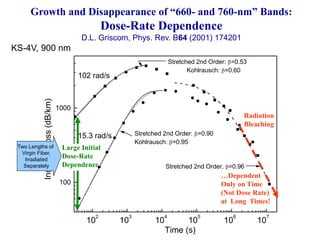
Growth and Disappearance of “660- and 760-nm” Bands:
Dose-Rate Dependence
D.L. Griscom, Phys. Rev. B64 (2001) 174201
100
1000
Stretched 2nd Order, =0.96
Stretched 2nd Order: =0.90
Kohlrausch: =0.95
Stretched 2nd Order: =0.53
Kohlrausch: =0.60
102 rad/s
15.3 rad/s
10
2
10
3
10
4
10
5
10
6
10
7
InducedLoss(dB/km)
Time (s)
…Dependent
Only on Time
(Not Dose Rate)
at Long Times!
Radiation
Bleaching
Large Initial
Dose-Rate
Dependence
Two Lengths of
Virgin Fiber,
Irradiated
Separately
KS-4V, 900 nm
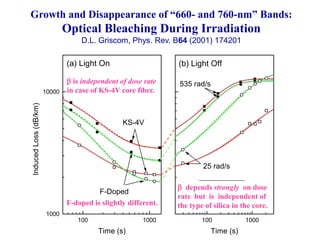
Growth and Disappearance of “660- and 760-nm” Bands:
Optical Bleaching During Irradiation
D.L. Griscom, Phys. Rev. B64 (2001) 174201
100 1000
1000
10000
(a) Light On
F-Doped
KS-4V
InducedLoss(dB/km)
Time (s)
100 1000
 = 670 nm
(b) Light Off
535 rad/s
25 rad/s
Time (s)
 is independent of dose rate
in case of KS-4V core fiber.
 depends strongly on dose
rate but is independent of
the type of silica in the core.F-doped is slightly different.
Growth and Disappearance of “660- and 760-nm” Bands:
Isothermal Fading (Radiation Interupted), Regrowth
D.L. Griscom, Phys. Rev. B64 (2001) 174201
100 1000 10000
1000
10000
(a)
Stretched 2nd Order, =0.71
Kohlrausch, =0.52
InducedLoss(dB/km)
Time after Irradiation (s)
100 1000
(b)
F-Doped-Silica-Core Fiber,
Dose Rate = 102 rad/s
760 nm
Best Fits:
Stretched 2nd Order: =0.45
Kohlrausch: =0.53
660 nm
Best Fits:
Stretched 2nd Order: =0.60
Kohlrausch: =0.69
Irradiation Time (s)
Data Points for
t=0 were Used
in Fitting These
Data.
Fitted Values of
 Are Independent
of Wavelength.
Fitted Values of
 Are Strongly
Dependent on
Wavelength.
Fading Regrowth
Fractal-Kinetic Fitting Parameters (Both Orders)
Multi-Mode Low-OH, Low-Cl Pure-Silica-Core Fibers During  Irradiation
Data due to
Nagasawa et al.
(1984) pertain to
a silicone-clad
pure-silica core
fiber.
Gaussian
resolutions were
performed to
extract intensities
of the 660- and
760-nm bands
separately.
My data for F-
doped-silica-clad
pure-silica-core
fiber with an Al
jacket.
Measurements
were made at
fixed wavelengths
of 670 and 900
nm (no Gaussian
resolutions)
The same fiber
was subjected to
the 3 different
dose rates in
progression
beginning with
the lowest.
10 100 1000
1000
10000
Slope=1/2
Polymer-Clad
Silica-Core
Fiber KS-4V Silica-Core
Fiber, Aluminum
Jacketed
Slope=/2
Slope=
(c)
SaturationLoss(dB/km)
Dose Rate (rad/s)
10 100 1000
10
-4
10
-3
10
-2
Weighted Contributions
of Overlapping Bands
660-nm Band
Only
760-nm Band
Only
Slope=0.78(b)
RateCoefficient(1/s)
10 100 1000
0.5
0.6
0.7
0.8
0.9
1.0
=670 nm
Initial
Response
Recovery from
Optical Bleaching
Initial Response, =900 nm(a)
Exponent
•
•
•
Slope=0.78

k
Nsat
ÇA TERMINE MA DEUX-HEURS-LONG
PRESENTATION. EST-CE QUE IL Y A
DES QUESTIONS ?
C’EST EXPRÉS QUE VOTRE
PRESENTATION ÊTRE
INCOMPERHENSIBLE?
OU EST-CE QUE VOUS AVEZ
UN ESPÈS DE INCAPACITÉ «POWER
POINT» ?
EST-CE QUE IL Y A DES
QUESTIONS SUR LE
CONTENU ?
IL FUT DE
CONTENU ?
Fractal Kinetics Bruyères-le-Châtel

Fractal Kinetics Bruyères-le-Châtel

  • 1.
    David L. Griscom impactGlassresearch international Mexico City Paris Tokyo Washington Commissariat à l’Energie Atomique, Bruyères-le-Châtel, France 1 December 2005
  • 2.
    An Ideal Wedding of aMathematical Formalism often written off as “just another method of curve fitting” with a Remarkable Body of Data which has defied simple mathematical description, thus severely limiting its utility for its intended purposes
  • 3.
    Acknowledgements The Experimental datafor the Ge-doped-silica fibers were recorded at the Naval Research Laboratory by E.J. Friebele with important assistance from M.E. Gingerich, M. Putnum, G.M. Williams, and W.D. Mack. A full account of this work has been published: D.L. Griscom, Phys. Rev. B64, 174201 (2001)
  • 4.
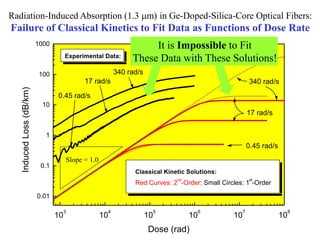
    Classical Kinetic Solutionsfor Radiolytic Defect Creation with Thermal Decay: Dependencies on Dose Rate 10 3 10 4 10 5 10 6 10 7 10 8 0.01 0.1 1 10 100 1000 Classical Kinetic Solutions: Red Curves: 2 nd -Order; Small Circles: 1 st -Order 340 rad/s 17 rad/s 0.45 rad/s Experimental Data: 17 rad/s 0.45 rad/s 340 rad/s InducedLoss(dB/km) Dose (rad) Slope = 1.0
  • 5.
    Radiation-Induced Absorption (1.3m) in Ge-Doped-Silica-Core Optical Fibers: Failure of Classical Kinetics to Fit Data as Functions of Dose Rate 10 3 10 4 10 5 10 6 10 7 10 8 0.01 0.1 1 10 100 1000 Classical Kinetic Solutions: Red Curves: 2 nd -Order; Small Circles: 1 st -Order 340 rad/s 17 rad/s 0.45 rad/s Experimental Data: 17 rad/s 0.45 rad/s 340 rad/s InducedLoss(dB/km) Dose (rad) Slope = 1.0 It is Impossible to Fit These Data with These Solutions!
  • 6.
    •Gottfried von Leibnitz(1695): “Thus it follows that d½x will be equal to xdx:x, … from which one day useful consequences will be drawn.” What is Fractal (Fractional) Kinetics? •I.M. Sokovov, J. Klafter, A. Blumen, Physics Today, November, 2002, p. 48: “Equations built on fractional derivatives describe the anomalously slow diffusion observed in systems with a broad distribution of relaxation times.” •R. Kopelman, Science 241, 1620 (1988). •Science 297, 1268 (2002): News article on “Tsallis entropy”. (q  1)
  • 7.
    Fractal Kinetics inBrief Fractal spaces differ from Euclidian spaces by having fractal dimensions df such that df < d, where d is the dimension of the Euclidian space in which the fractal is embedded. Each fractal also possesses a spectral dimension ds (< df < d), defined by the probability P of a random walker returning to its point of origin after a time t: P(t)  t-ds/2. The present work introduces a parameter, ds/2. Thus, for many amorphous materials, values of 2/3 might be expected ... – which serves as a prototype for many amorphous materials. It is known that ds  4/3 for the entire class of random fractals embedded in Euclidian spaces of dimensions d  2 , including the percolation cluster
  • 8.
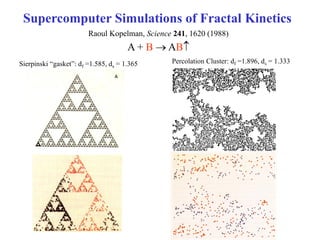
    Supercomputer Simulations ofFractal Kinetics Raoul Kopelman, Science 241, 1620 (1988) A + B  AB Sierpinski “gasket”: df =1.585, ds = 1.365 Percolation Cluster: df =1.896, ds = 1.333
  • 9.
    First-order growth kineticswith thermally activated decay. The classical rate equation for this situation can be written dN(t)/dt = KDN* - RN, and its solution is given by N(t) = Nsat{1 - exp[-Rt]}, where K and R are constants, D is the dose rate, N* is a number of unit value and dimensions of number density (e.g., cm-3), and Nsat = (KD/R)N*. Rate Equations for Defect Creation under Irradiation • • •
  • 10.
    Result of Changein Dimensionless Variable kt  (kt) First-order growth kinetics with thermally activated decay. The fractal rate equation for this situation can be written dN((kt))/d(kt) = (KD/R) N* - N 0 <  <1 k = R with solution N((kt)) = Nsat{1 - exp[-(kt)]}, where Nsat = (KD/R) N*. • •
  • 11.
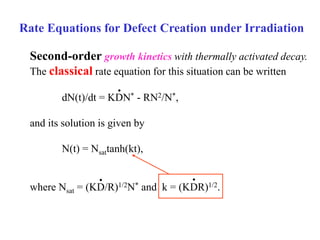
    Second-order growth kineticswith thermally activated decay. The classical rate equation for this situation can be written dN(t)/dt = KDN* - RN2/N*, and its solution is given by N(t) = Nsattanh(kt), where Nsat = (KD/R)1/2N* and k = (KDR)1/2. Rate Equations for Defect Creation under Irradiation • • •
  • 12.
    Result of Changein Dimensionless Variable kt  (kt) Second-order growth kinetics with thermally activated decay. The fractal rate equation for this situation can be written dN((kt))/d(kt) = (KD/R) /2N* - (R/KD) /2N2/N* 0 <  <1 k = (KDR)1/2 with solution N((kt)) = Nsattanh[(kt)], where Nsat = (KD/R) /2N*. • •• • Three Fitting Parameters
  • 13.
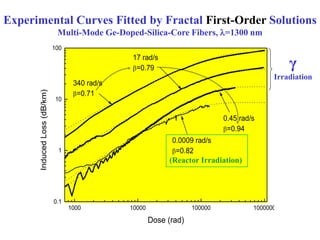
    Experimental Curves Fittedby Fractal First-Order Solutions Multi-Mode Ge-Doped-Silica-Core Fibers, =1300 nm 1000 10000 100000 1000000 0.1 1 10 100 0.0009 rad/s =0.82 17 rad/s =0.79 0.45 rad/s =0.94 340 rad/s =0.71 InducedLoss(dB/km) Dose (rad) (Reactor Irradiation) γ Irradiation
  • 14.
    1E-3 0.01 0.11 10 100 10 100 (c) Slope =  Slope = /2 SaturationLoss(dB/km) Dose Rate (rad/s) 1E-3 0.01 0.1 1 10 100 10 -8 10 -7 10 -6 10 -5 10 -4 10 -3 Linear!!! (b) Classical 1st-Order Kinetics Classical 2nd-Order Kinetics RateCoefficient(s -1 ) 1E-3 0.01 0.1 1 10 100 0.7 0.8 0.9 (a) Stretched 2nd Order Kinetics Stretched 1st-Order Kinetics Power-LawExponent Fractal-Kinetic Fitting Parameters: Both Kinetic Orders Multi-Mode Ge-Doped-Silica-Core Fibers, =1300 nm Slope = 1 Classical 1st Order Classical 2nd Order Fractal 1st & 2nd Order (Slope = 1) Empirical!!! Fractal 1st & 2nd Order (Slope Variable) Annoying Cusp Annoying  k Nsat Dose Rate (rad/s) Classical 1st Order Slope = ½ Classical 2nd Order
  • 15.
    1000 10000 1000001000000 0.1 1 10 100 0.0009 rad/s =1.0 17 rad/s =0.70 0.45 rad/s =1.00 340 rad/s =0.62 InducedLoss(dB/km) Dose (rad) Experimental Curves Fitted by Fractal Solutions (Second Order) Multi-Mode Ge-Doped-Silica-Core Fibers, =1300 nm “Population B” Included in Fits Population B (included in all four curve fits) Dose-Rate-Independent N.B. The dominant “Population A” comprises all defects with thermally activated decays
  • 16.
    Fractal-Kinetic Fitting Parameters(Second Order) Multi-Mode Ge-Doped-Silica-Core Fibers, =1300 nm Parameters for dose-rate- independent “Population B” included in fits for all four dose rates 1E-3 0.01 0.1 1 10 100 1 10 100 (c) Slope =  Slope = /2 SaturationLoss(dB/km) Dose Rate (rad/s) 1E-3 0.01 0.1 1 10 100 10 -9 10 -8 10 -7 10 -6 10 -5 10 -4 10 -3 Linear (b) RateCoefficient(s -1 ) 1E-3 0.01 0.1 1 10 100 0.6 0.7 0.8 0.9 1.0 (a) Power-LawExponent No More Annoying Cusp Here! Approximately Straight Line Here Intended Result of Introducing “Population B”: Rate Coefficient Is More Perfectly Linear than Before!!!  k Nsat Dose Rate (rad/s) Slope=/2 Empirical!!! Happy Colateral Consequences:
  • 17.
    Fractal-Kinetic Fitting Parameters(Second Order) Multi-Mode Ge-Doped-Silica-Core Fibers, =1300 nm Proposed “Canonical Form” for Classical  Fractal Phase Transition 1E-3 0.01 0.1 1 10 100 1 10 100 Slope = 1/2 (c) Slope = /2 SaturationLoss(dB/km) Dose Rate (rad/s) 1E-3 0.01 0.1 1 10 100 10 -7 10 -6 10 -5 10 -4 10 -3 Slope = 1/2 (b) Slope = 1 RateCoefficient(s -1 ) 1E-3 0.01 0.1 1 10 100 0.6 0.7 0.8 0.9 1.0 (a) Classical Fractal Power-LawExponent Here “Population B” was contrived to give classical behavior below the point where  = 1  k Nsat Slope=/2 Slope=1 Slope=1/2 Slope=1/2 Classical Fractal Dose Rate (rad/s)
  • 18.
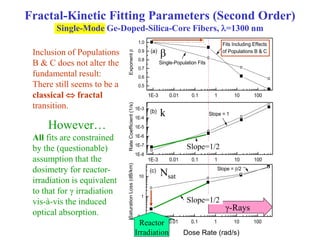
    1000 10000 1000001000000 0.1 1 10 100 C ( = 0.66) B 0.0009 rad/s =1.0 17 rad/s =0.61 0.45 rad/s =0.94 340 rad/s =0.46 InducedLoss(dB/km) Dose (rad) Experimental Curves Fitted by Fractal Solutions (Second Order) Single-Mode Ge-Doped-Silica-Core Fibers, =1300 nm Dose-Rate-Independent “Populations B and C” Included in Fits (Reactor Irradiation) Populations B and C
  • 19.
    1E-3 0.01 0.11 10 100 0.1 1 10 Slope = 1/2 Slope = /2(c) SaturationLoss(dB/km) Dose Rate (rad/s) 1E-3 0.01 0.1 1 10 100 1E-8 1E-7 1E-6 1E-5 1E-4 1E-3 Slope = 1/2 Slope = 1(b) RateCoefficient(1/s) 1E-3 0.01 0.1 1 10 100 0.5 0.6 0.7 0.8 0.9 1.0 Single-Population Fits Fits Including Effects of Populations B & C(a) Exponent Fractal-Kinetic Fitting Parameters (Second Order) Single-Mode Ge-Doped-Silica-Core Fibers, =1300 nm However… All fits are constrained by the (questionable) assumption that the dosimetry for reactor- irradiation is equivalent to that for γ irradiation vis-à-vis the induced optical absorption. γ-Rays Reactor Irradiation Dose Rate (rad/s)  k Nsat Slope=1/2 Slope=1/2 Inclusion of Populations B & C does not alter the fundamental result: There still seems to be a classical  fractal transition.
  • 20.
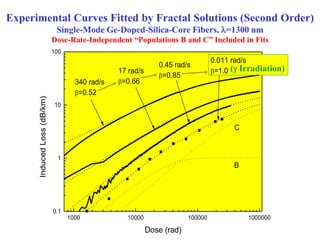
    Experimental Curves Fittedby Fractal Solutions (Second Order) Single-Mode Ge-Doped-Silica-Core Fibers, =1300 nm Dose-Rate-Independent “Populations B and C” Included in Fits 1000 10000 100000 1000000 0.1 1 10 100 C B 0.011 rad/s =1.017 rad/s =0.66 0.45 rad/s =0.85 340 rad/s =0.52 InducedLoss(dB/km) Dose (rad) ( Irradiation)
  • 21.
    Fractal-Kinetic Fitting Parameters(Second Order) Single-Mode Ge-Doped-Silica-Core Fibers, =1300 nm Now All Fits Pertain to γ-Irradiated Fibers Only. Classical  Fractal Transition 0.01 0.1 1 10 100 1 10 Slope = /2 (c) SaturationLoss(dB/km) Dose Rate (rad/s) 0.01 0.1 1 10 100 10 -8 10 -7 10 -6 10 -5 10 -4 10 -3 Slope = 1 (b) RateCoefficient(1/s) 0.01 0.1 1 10 100 0.5 0.6 0.7 0.8 0.9 1.0 Fits Including Influences of Populations B and C Single-Population Fits (a) Exponent No Data for Reactor- Irradiated Fibers Are Included. Empirical Result of Fractal Kinetics! Slope=1 Slope=/2 Dose Rate (rad/s)  k Nsat But Caution:  May Now Be Asymptotic to 1.0 as the Dose Rate Approaches Zero. ? ?
  • 22.
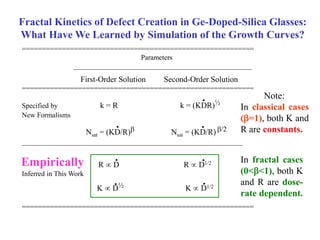
    Fractal Kinetics ofDefect Creation in Ge-Doped-Silica Glasses: What Have We Learned by Simulation of the Growth Curves? ========================================================== Parameters __________________________________________________ First-Order Solution Second-Order Solution ========================================================== Specified by k = R k = (KDR)½ New Formalisms Nsat = (KD/R) Nsat = (KD/R) /2 ______________________________________________________________ Empirically R  D R  D1/2 Inferred in This Work K  D½ K  D1/2 ========================================================== Note: In classical cases (=1), both K and R are constants. In fractal cases (0<<1), both K and R are dose- rate dependent. • •• • • •• Empirically
  • 23.
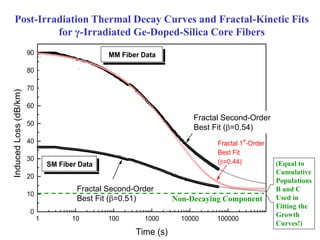
    Post-Irradiation Thermal DecayCurves and Fractal-Kinetic Fits for γ-Irradiated Ge-Doped-Silica Core Fibers 1 10 100 1000 10000 100000 1000000 0 10 20 30 40 50 60 70 80 90 SM Fiber Data MM Fiber Data Naive Fractal Second-Order Prediction from Growth-Curve Fit (=0.62) Fractal Second-Order Best Fit (=0.51) Fractal 1 st -Order Best Fit (=0.44) Fractal Secnd-Order Best Fit (=0.54) Naive Fractal First-Order Prediction from Growth-Curve Fit (=0.71) InducedLoss(dB/km) Time (s) Non-Decaying Component Fractal Second-Order Best Fit (=0.54) Fractal Second-Order Best Fit (=0.51) (Equal to Cumulative Populations B and C Used in Fitting the Growth Curves!)
  • 24.
    10 1 10 2 10 3 10 4 10 5 10 6 Time (s)  =0.66 Fractal 2 nd -Order Solution Fractal 2 nd -Order Solution (Kohlrausch Function) 10 2 10 3 10 4 10 5 10 6 10 7 1 10 100  = 0.66 Fractal 1 st -Order Solution Fractal 2 nd -Order Solution InducedLoss(dB/km) Dose (rad) Idealized Fractal Kinetics of Radiation-Induced Defect Formation and Decay in Amorphous Insulators During Irradiation After Cessation of Radiation 1st
  • 25.
    10 1 10 2 10 3 10 4 10 5 10 6 Time (s)  =0.66 Fractal 2 nd -Order Solution Fractal 2 nd -Order Solution (Kohlrausch Function) 10 2 10 3 10 4 10 5 10 6 10 7 1 10 100  = 0.66 Fractal 1 st -Order Solution Fractal 2 nd -Order Solution InducedLoss(dB/km) Dose (rad) During Irradiation After Cessation of Radiation 1st Slope  Slope - Idealized Fractal Kinetics of Radiation-Induced Defect Formation and Decay in Amorphous Insulators
  • 26.
    10 0 10 1 10 2 10 3 10 4 10 5 10 6 Factor of 4 No-Adjustable-Parameters PredictionBased on Fitted Growth Curve Time (s) 10 1 10 2 10 3 10 4 10 5 10 6 10 7 1 10 Data Fitted Decaying Part Fitted Non-Decaying Parts InducedLoss(dB/km) Dose (rad) Fractal Kinetics of Radiation-Induced Defect Formation and Decay in Amorphous Insulators: The Reality C B B+C
  • 27.
    10 0 10 1 10 2 10 3 10 4 10 5 10 6 Factor of 4 No-Adjustable-Parameters PredictionBased on Fitted Growth Curve Time (s) 10 1 10 2 10 3 10 4 10 5 10 6 10 7 1 10 Data Fitted Decaying Part Fitted Non-Decaying Parts InducedLoss(dB/km) Dose (rad) C B B+C N.B. These data prove the existence of (non-decaying) dose-rate independent components. Fractal Kinetics of Radiation-Induced Defect Formation and Decay in Amorphous Insulators: The Reality
  • 28.
    Fractal kinetics of opticalbands in pure silica glass… 0 5000 10000 15000 20000 25000 6,470 s 102 rad/s 15.3 rad/s 33 120 240 480 960 s 0 InducedAbsorption(dB/km) 400 500 600 700 800 900 1000 1100 1200 1300 1400 1500 0 500 1000 1500 2000 2500 Wavelength (nm) N.B. These bands appear to arise from self- trapped holes. Note absorption in all three communications windows.
  • 29.
    Growth and Disappearanceof “660- and 760-nm” Bands: Optical Spectroscopy D.L. Griscom, Appl. Phys. Lett. 71 (1997) 175 High-purity, low-OH, low-Cl, pure-silica-core fiber (KS-4V) under γ irradiation for 240 s at 1.0 Gy/s NBOHCs 760 nm N.B. These results are remarkably similar to those for a low-OH, low-Cl F-doped silica-core fiber measured simultaneously. 660 nm (Bands near 660, 760, and 900 nm are due to self-trapped holes.)
  • 30.
    t-1 It appears that thematerial is “reconfigured” by long-term, low-dose-rate irradiation in such a way that color centers (STHs) are no longer formed, even when the irradiation continues Loss at 760 nm during γ irradiation in the dark at 1 Gy/s, T=27 oC Experimenter-Introduced “Mid-Course” Transients Growth and Disappearance of “660- and 760-nm” Bands: Overview of Kinetics D.L. Griscom, Appl. Phys. Lett. 71 (1997) 175 KS-4V, 760 nm
  • 31.
    t-1 It appears that thematerial is “reconfigured” by long-term, low-dose-rate irradiation in such a way that color centers (STHs) are no longer formed, even when the irradiation continues – or is repeated at a later time. Growth and Disappearance of “660- and 760-nm” Bands: Overview of Kinetics D.L. Griscom, Appl. Phys. Lett. 71 (1997) 175 Same Fiber Re-Irradiated KS-4V, 760 nm
  • 32.
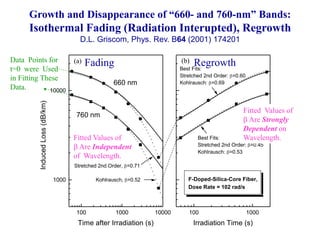
    Growth and Disappearanceof “660- and 760-nm” Bands: Dose-Rate Dependence D.L. Griscom, Phys. Rev. B64 (2001) 174201 100 1000 Stretched 2nd Order, =0.96 Stretched 2nd Order: =0.90 Kohlrausch: =0.95 Stretched 2nd Order: =0.53 Kohlrausch: =0.60 102 rad/s 15.3 rad/s 10 2 10 3 10 4 10 5 10 6 10 7 InducedLoss(dB/km) Time (s) …Dependent Only on Time (Not Dose Rate) at Long Times! Radiation Bleaching Large Initial Dose-Rate Dependence Two Lengths of Virgin Fiber, Irradiated Separately KS-4V, 900 nm
  • 33.
    Growth and Disappearanceof “660- and 760-nm” Bands: Optical Bleaching During Irradiation D.L. Griscom, Phys. Rev. B64 (2001) 174201 100 1000 1000 10000 (a) Light On F-Doped KS-4V InducedLoss(dB/km) Time (s) 100 1000  = 670 nm (b) Light Off 535 rad/s 25 rad/s Time (s)  is independent of dose rate in case of KS-4V core fiber.  depends strongly on dose rate but is independent of the type of silica in the core.F-doped is slightly different.
  • 34.
    Growth and Disappearanceof “660- and 760-nm” Bands: Isothermal Fading (Radiation Interupted), Regrowth D.L. Griscom, Phys. Rev. B64 (2001) 174201 100 1000 10000 1000 10000 (a) Stretched 2nd Order, =0.71 Kohlrausch, =0.52 InducedLoss(dB/km) Time after Irradiation (s) 100 1000 (b) F-Doped-Silica-Core Fiber, Dose Rate = 102 rad/s 760 nm Best Fits: Stretched 2nd Order: =0.45 Kohlrausch: =0.53 660 nm Best Fits: Stretched 2nd Order: =0.60 Kohlrausch: =0.69 Irradiation Time (s) Data Points for t=0 were Used in Fitting These Data. Fitted Values of  Are Independent of Wavelength. Fitted Values of  Are Strongly Dependent on Wavelength. Fading Regrowth
  • 35.
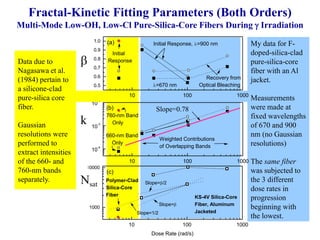
    Fractal-Kinetic Fitting Parameters(Both Orders) Multi-Mode Low-OH, Low-Cl Pure-Silica-Core Fibers During  Irradiation Data due to Nagasawa et al. (1984) pertain to a silicone-clad pure-silica core fiber. Gaussian resolutions were performed to extract intensities of the 660- and 760-nm bands separately. My data for F- doped-silica-clad pure-silica-core fiber with an Al jacket. Measurements were made at fixed wavelengths of 670 and 900 nm (no Gaussian resolutions) The same fiber was subjected to the 3 different dose rates in progression beginning with the lowest. 10 100 1000 1000 10000 Slope=1/2 Polymer-Clad Silica-Core Fiber KS-4V Silica-Core Fiber, Aluminum Jacketed Slope=/2 Slope= (c) SaturationLoss(dB/km) Dose Rate (rad/s) 10 100 1000 10 -4 10 -3 10 -2 Weighted Contributions of Overlapping Bands 660-nm Band Only 760-nm Band Only Slope=0.78(b) RateCoefficient(1/s) 10 100 1000 0.5 0.6 0.7 0.8 0.9 1.0 =670 nm Initial Response Recovery from Optical Bleaching Initial Response, =900 nm(a) Exponent • • • Slope=0.78  k Nsat
  • 37.
    ÇA TERMINE MADEUX-HEURS-LONG PRESENTATION. EST-CE QUE IL Y A DES QUESTIONS ? C’EST EXPRÉS QUE VOTRE PRESENTATION ÊTRE INCOMPERHENSIBLE? OU EST-CE QUE VOUS AVEZ UN ESPÈS DE INCAPACITÉ «POWER POINT» ? EST-CE QUE IL Y A DES QUESTIONS SUR LE CONTENU ? IL FUT DE CONTENU ?