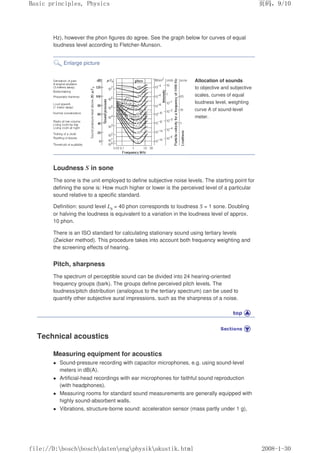
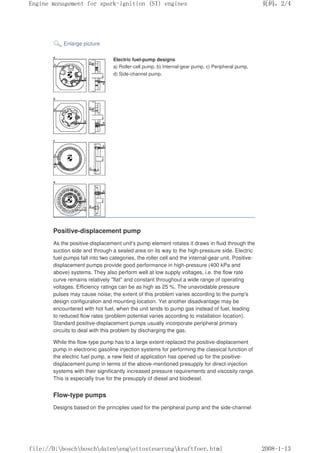
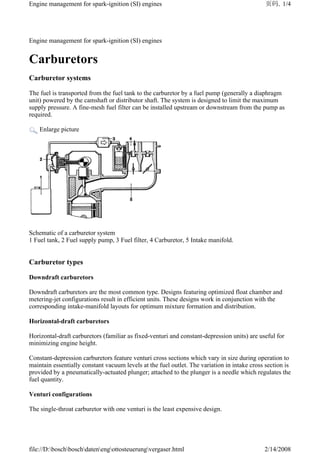
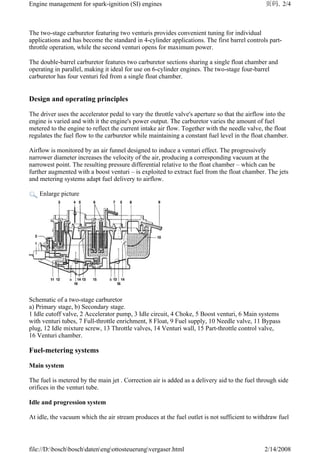
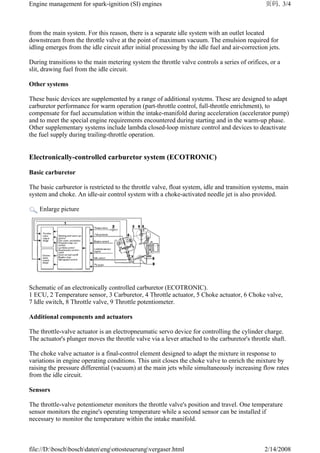
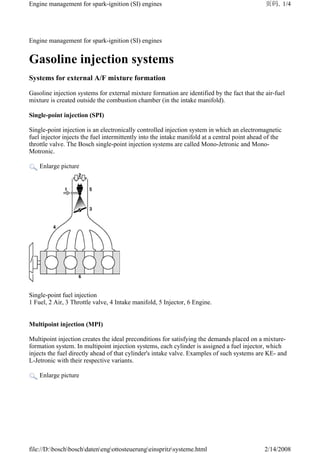
Electronic
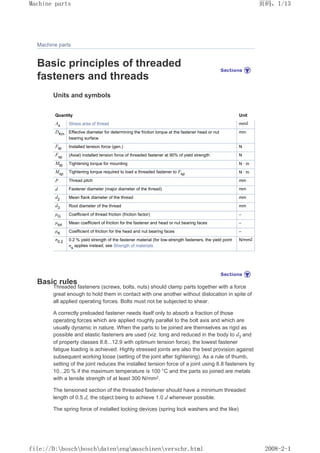
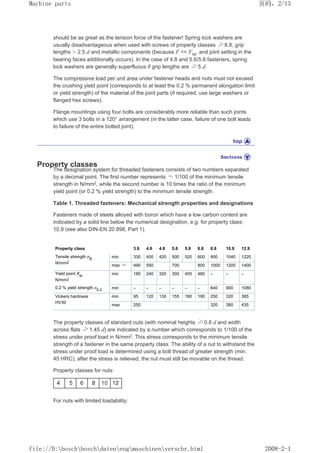
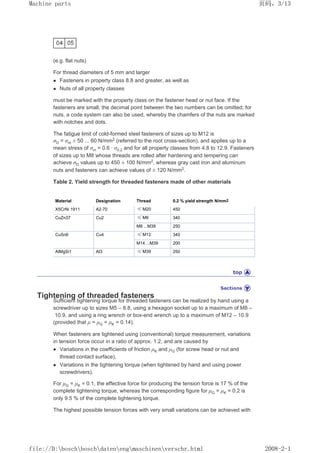
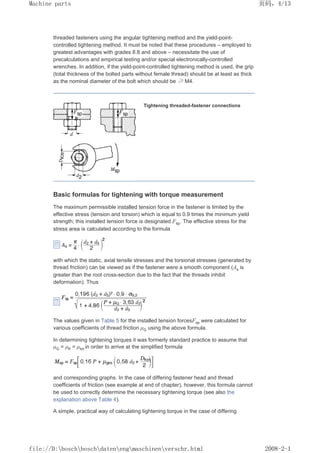
Automotive Handbook
1. Edition
© Robert Bosch GmbH, 2002
Choose a chapter in the table of contents
or start with the first page.
页码,1/1
Titelseite
2008-1-13
file://D:boschboschdatenengtitel.html
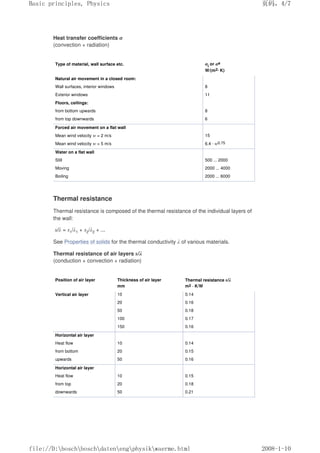
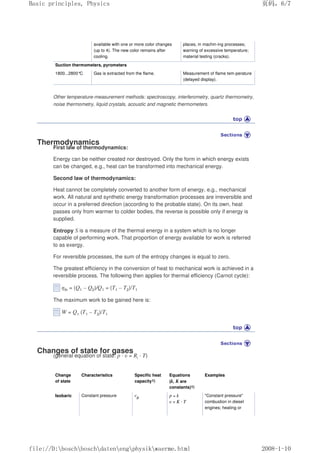
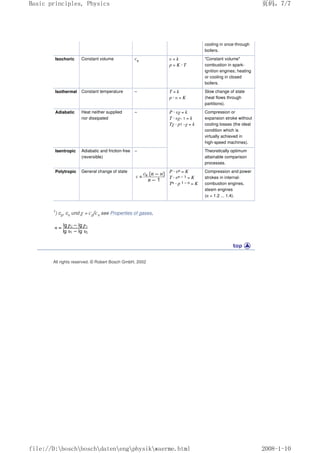
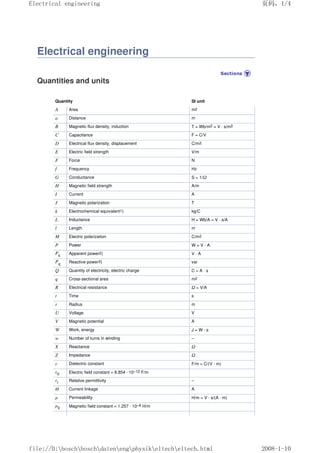
Basic principles, Physics
Quantities and units
SI units
SI denotes "Système International d'Unités" (International System of Units). The
system is laid down in ISO 31 and ISO 1000 (ISO: International Organization for
Standardization) and for Germany in DIN 1301 (DIN: Deutsches Institut für Normung
– German Institute for Standardization).
SI units comprise the seven base SI units and coherent units derived from these
base Sl units using a numerical factor of 1.
Base SI units
Base quantity and symbols Base SI unit
Name Symbol
Length l meter m
Mass m kilogram kg
Time t second s
Electric current I ampere A
Thermodynamic temperature T kelvin K
Amount of substance n mole mol
Luminous intensity I candela cd
All other quantities and units are derived from the base quantities and base units.
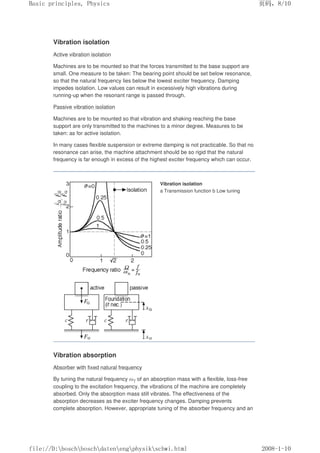
The international unit of force is thus obtained by applying Newton's Law:
force = mass x acceleration
where m = 1 kg and a = 1 m/s2, thus F = 1 kg · 1 m/s2 = 1 kg · m/s2 = 1 N (newton).
Definitions of the base Sl units
1 meter is defined as the distance which light travels in a vacuum in 1/299,792,458
seconds (17th CGPM, 19831). The meter is therefore defined using the speed of light
in a vacuum, c = 299,792,458 m/s, and no longer by the wavelength of the radiation
emitted by the krypton nuclide 86Kr. The meter was originally defined as the forty-
millionth part of a terrestrial meridian (standard meter, Paris, 1875).
1 kilogram is the mass of the international prototype kilogram (1st CGPM, 1889 and
3rd CGPM, 19011).
1 second is defined as the duration of 9,192,631,770 periods of the radiation
corresponding to the transition between the two hyperfine levels of the ground state
页码,1/9
Basic principles, Physics
2008-1-10
file://D:boschboschdatenengphysikgroessen.html
of atoms of the 133Cs nuclide (13th CGPM, 1967.1)
1 ampere is defined as that constant electric current which, if maintained in two
straight parallel conductors of infinite length, of negligible circular cross-sections,
and placed 1 meter apart in a vacuum will produce between these conductors a
force equal to 2 · 10–7 N per meter of length (9th CGPM, 1948.1)
1 kelvin is defined as the fraction 1/273.16 of the thermodynamic temperature of the
triple point2) of water (13th CGPM, 1967.1)
1 mole is defined as the amount of substance of a system which contains as many
elementary entities as there are atoms in 0.012 kilogram of the carbon nuclide 12C.
When the mole is used, the elementary entities must be specified and may be
atoms, molecules, ions, electrons, other particles, or specified groups of such
particles (14th CGPM1), 1971.
1 candela is the luminous intensity in a given direction of a source which emits
monochromatic radiation of frequency 540 x 1012 hertz and of which the radiant
intensity in that direction is 1/683 watt per steradian (16th CGPM, 1979.1)
1) CGPM: Conférence Générale des Poids et Mesures (General Conference on Weights and
Measures).
2) Fixed point on the international temperature scale. The triple point is the only point at which
all three phases of water (solid, liquid and gaseous) are in equilibrium (at a pressure of
1013.25 hPa). This temperature of 273.16 K is 0.01 K above the freezing point of water
(273.15 K).
Decimal multiples and fractions of Sl units
Decimal multiples and fractions of SI units are denoted by prefixes before the name
of the unit or prefix symbols before the unit symbol. The prefix symbol is placed
immediately in front of the unit symbol to form a coherent unit, such as the milligram
(mg). Multiple prefixes, such as microkilogram (µkg), may not be used.
Prefixes are not to be used before the units angular degree, minute and second, the
time units minute, hour, day and year, and the temperature unit degree Celsius.
Prefix Prefix symbol Power of ten Name
atto a 10–18 trillionth
femto f 10–15 thousand billionth
pico p 10–12 billionth
nano n 10–9 thousand millionth
micro µ 10–6 millionth
milli m 10–3 thousandth
centi c 10–2 hundredth
deci d 10–1 tenth
deca da 101 ten
hecto h 102 hundred
kilo k 103 thousand
mega M 106 million
giga G 109 milliard1)
页码,2/9
Basic principles, Physics
2008-1-10
file://D:boschboschdatenengphysikgroessen.html
tera T 1012 billion1)
peta P 1015 thousand billion
exa E 1018 trillion
1) In the USA: 109 = 1 billion, 1012 = 1 trillion.
Legal units
The Law on Units in Metrology of 2 July 1969 and the related implementing order of
26 June 1970 specify the use of "Legal units" in business and official transactions in
Germany.2)
Legal units are
 the SI units,
 decimal multiples and submultiples of the SI units,
 other permitted units; see the tables on the following pages.
Legal units are used in the Bosch Automotive Handbook. In many sections, values
are also given in units of the technical system of units (e.g. in parentheses) to the
extent considered necessary.
2) Also valid: Gesetz zur Änderung des Gesetzes über Einheiten im Meßwesen dated 6 July
1973; Verordnung zur Änderung der Ausführungsverordnung dated 27 November 1973;
Zweite Verordnung zur Änderung der Ausführungsverordnung dated 12 December 1977.
Systems of units not to be used
The physical system of units
Like the SI system of units, the physical system of units used the base quantities
length, mass and time. However, the base units used for these quantities were the
centimeter (cm), gram (g), and second (s) (CGS System).
The technical system of units
The technical system of units used the following base quantities and base units:
Base quantity Base unit
Name Symbol
Length meter m
Force kilopond kp
Time second s
Newton's Law,
页码,3/9
Basic principles, Physics
2008-1-10
file://D:boschboschdatenengphysikgroessen.html
provides the link between the international system of units and the technical system
of units, where force due to weight G is substituted for F and acceleration of free
fall g is substituted for a.
In contrast to mass, acceleration of free fall and therefore force due to weight
depend upon location. The standard value of acceleration of free fall is defined as
gn = 9.80665 m/s2 (DIN 1305). The approximate value
g = 9.81 m/s2 is generally acceptable in technical calculations.
1 kp is the force with which a mass of 1 kg exerts pressure on the surface beneath it
at a place on the earth. With
thus
1 kp = 1 kg · 9.81 m/s2 = 9.81 N.
Quantities and units
Overview (from DIN 1301)
The following table gives a survey of the most important physical quantities and their
standardized symbols, and includes a selection of the legal units specified for these
quantities. Additional legal units can be formed by adding prefixes (see SI units) For
this reason, the column other units only gives the decimal multiples and
submultiples of the Sl units which have their own names. Units which are not to be
used are given in the last column together with their conversion formulas. Page
numbers refer to conversion tables.
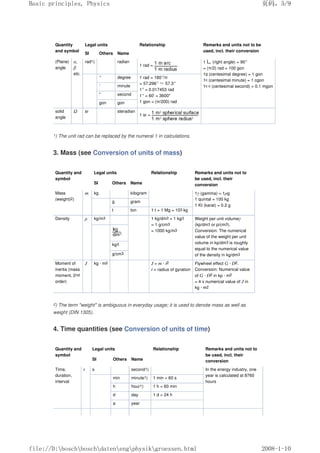
1. Length, area, volume (see Conversion of units of length)
Quantity
and
symbol
Legal units Relationship Remarks and units not to be
used, incl. their conversion
SI Others Name
Length l m meter 1 µ (micron) = 1 µm
1 Å (ångström) = 10–10 m
1 X.U. (X-unit) ≈10–13 m
1 p (typograph. point) = 0.376 mm
nm international
nautical mile
1 nm = 1852 m
Area A m2 square
meter
a are 1 a = 100 m2
ha hectare 1 ha = 100 a = 104 m2
Volume V m3 cubic meter
l, L liter 1 l = 1 L = 1 dm3
2. Angle (see Conversion of units of angle)
页码,4/9
Basic principles, Physics
2008-1-10
file://D:boschboschdatenengphysikgroessen.html
Quantity
and symbol
Legal units Relationship Remarks and units not to be
used, incl. their conversion
SI Others Name
(Plane)
angle
α,
β
etc.
rad1) radian
1 rad =
1 (right angle) = 90°
= (π/2) rad = 100 gon
1g (centesimal degree) = 1 gon
1c (centesimal minute) = 1 cgon
1c c (centesimal second) = 0.1 mgon
° degree 1 rad = 180°/π
= 57.296° ≈57.3°
1° = 0.017453 rad
1° = 60' = 3600
1 gon = (π/200) rad
' minute
 second
gon gon
solid
angle
Ω sr steradian
1 sr =
1) The unit rad can be replaced by the numeral 1 in calculations.
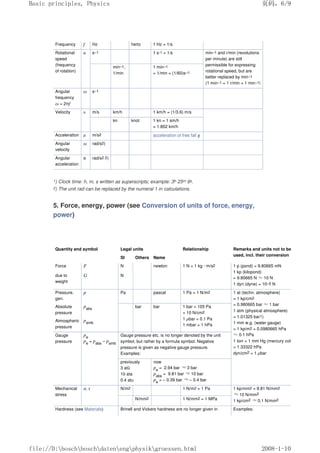
3. Mass (see Conversion of units of mass)
Quantity and
symbol
Legal units Relationship Remarks and units not to
be used, incl. their
conversion
SI Others Name
Mass
(weight)2)
m kg kilogram 1γ (gamma) = 1µg
1 quintal = 100 kg
1 Kt (karat) = 0.2 g
g gram
t ton 1 t = 1 Mg = 103 kg
Density ρ kg/m3 1 kg/dm3 = 1 kg/l
= 1 g/cm3
= 1000 kg/m3
Weight per unit volumeγ
(kp/dm3 or p/cm3).
Conversion: The numerical
value of the weight per unit
volume in kp/dm3 is roughly
equal to the numerical value
of the density in kg/dm3
kg/l
g/cm3
Moment of
inertia (mass
moment, 2nd
order)
J kg · m2 J = m · i2
i = radius of gyration
Flywheel effect G · D2.
Conversion: Numerical value
of G · D2 in kp · m2
= 4 x numerical value of J in
kg · m2
2) The term weight is ambiguous in everyday usage; it is used to denote mass as well as
weight (DIN 1305).
4. Time quantities (see Conversion of units of time)
Quantity and
symbol
Legal units Relationship Remarks and units not to
be used, incl. their
conversion
SI Others Name
Time,
duration,
interval
t s second1) In the energy industry, one
year is calculated at 8760
hours
min minute1) 1 min = 60 s
h hour1) 1 h = 60 min
d day 1 d = 24 h
a year
页码,5/9
Basic principles, Physics
2008-1-10
file://D:boschboschdatenengphysikgroessen.html
Frequency f Hz hertz 1 Hz = 1/s
Rotational
speed
(frequency
of rotation)
n s–1 1 s-1 = 1/s min–1 and r/min (revolutions
per minute) are still
permissible for expressing
rotational speed, but are
better replaced by min–1
(1 min–1 = 1 r/min = 1 min–1)
min–1,
1/min
1 min–1
= 1/min = (1/60)s–1
Angular
frequency
ω = 2πf
ω s–1
Velocity υ m/s km/h 1 km/h = (1/3.6) m/s
kn knot 1 kn = 1 sm/h
= 1.852 km/h
Acceleration a m/s2 acceleration of free fall g
Angular
velocity
ω rad/s2)
Angular
acceleration
α rad/s2 2)
1) Clock time: h, m, s written as superscripts; example: 3h 25m 6s.
2) The unit rad can be replaced by the numeral 1 in calculations.
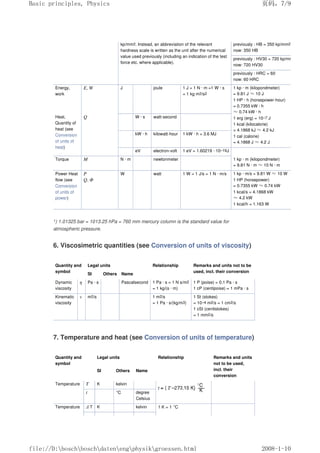
5. Force, energy, power (see Conversion of units of force, energy,
power)
Quantity and symbol Legal units Relationship Remarks and units not to be
used, incl. their conversion
SI Others Name
Force F N newton 1 N = 1 kg · m/s2 1 p (pond) = 9.80665 mN
1 kp (kilopond)
= 9.80665 N ≈10 N
1 dyn (dyne) = 10–5 N
due to
weight
G N
Pressure,
gen.
p Pa pascal 1 Pa = 1 N/m2 1 at (techn. atmosphere)
= 1 kp/cm2
= 0.980665 bar ≈1 bar
1 atm (physical atmosphere)
= 1.01325 bar1)
1 mm w.g. (water gauge)
= 1 kp/m2 = 0.0980665 hPa
≈0.1 hPa
1 torr = 1 mm Hg (mercury column)
= 1.33322 hPa
dyn/cm2 = 1 µbar
Absolute
pressure
pabs bar bar 1 bar = 105 Pa
= 10 N/cm2
1 µbar = 0.1 Pa
1 mbar = 1 hPa
Atmospheric
pressure
pamb
Gauge
pressure
pe
pe
= pabs
– pamb
Gauge pressure etc. is no longer denoted by the unit
symbol, but rather by a formula symbol. Negative
pressure is given as negative gauge pressure.
Examples:
previously
3 atü
10 ata
0.4 atu
now
pe
= 2.94 bar ≈3 bar
pabs
= 9.81 bar ≈10 bar
pe
= – 0.39 bar ≈– 0.4 bar
Mechanical
stress
σ, τ N/m2 1 N/m2 = 1 Pa 1 kp/mm2 = 9.81 N/mm2
≈10 N/mm2
1 kp/cm2 ≈0.1 N/mm2
N/mm2 1 N/mm2 = 1 MPa
Hardness (see Materials) Brinell and Vickers hardness are no longer given in Examples:
页码,6/9
Basic principles, Physics
2008-1-10
file://D:boschboschdatenengphysikgroessen.html
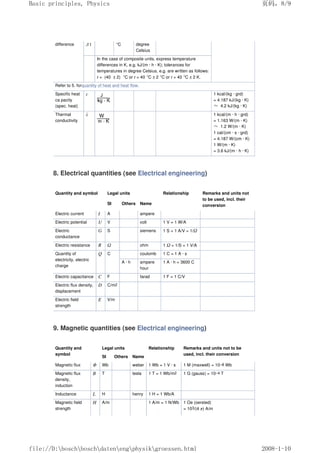
kp/mm2. Instead, an abbreviation of the relevant
hardness scale is written as the unit after the numerical
value used previously (including an indication of the test
force etc. where applicable).
previously : HB = 350 kp/mm2
now: 350 HB
previously : HV30 = 720 kp/mm
now: 720 HV30
previously : HRC = 60
now: 60 HRC
Energy,
work
E, W J joule 1 J = 1 N · m =1 W · s
= 1 kg m2/s2
1 kp · m (kilopondmeter)
= 9.81 J ≈10 J
1 HP · h (horsepower-hour)
= 0.7355 kW · h
≈0.74 kW · h
1 erg (erg) = 10–7 J
1 kcal (kilocalorie)
= 4.1868 kJ ≈4.2 kJ
1 cal (calorie)
= 4.1868 J ≈4.2 J
Heat,
Quantity of
heat (see
Conversion
of units of
heat)
Q W · s watt-second
kW · h kilowatt-hour 1 kW · h = 3.6 MJ
eV electron-volt 1 eV = 1.60219 · 10–19J
Torque M N · m newtonmeter 1 kp · m (kilopondmeter)
= 9.81 N · m ≈10 N · m
Power Heat
flow (see
Conversion
of units of
power)
P
Q, Φ
W watt 1 W = 1 J/s = 1 N · m/s 1 kp · m/s = 9.81 W ≈10 W
1 HP (horsepower)
= 0.7355 kW ≈0.74 kW
1 kcal/s = 4.1868 kW
≈4.2 kW
1 kcal/h = 1.163 W
1) 1.01325 bar = 1013.25 hPa = 760 mm mercury column is the standard value for
atmospheric pressure.
6. Viscosimetric quantities (see Conversion of units of viscosity)
Quantity and
symbol
Legal units Relationship Remarks and units not to be
used, incl. their conversion
SI Others Name
Dynamic
viscosity
η Pa · s Pascalsecond 1 Pa · s = 1 N s/m2
= 1 kg/(s · m)
1 P (poise) = 0.1 Pa · s
1 cP (centipoise) = 1 mPa · s
Kinematic
viscosity
ν m2/s 1 m2/s
= 1 Pa · s/(kg/m3)
1 St (stokes)
= 10–4 m2/s = 1 cm2/s
1 cSt (centistokes)
= 1 mm2/s
7. Temperature and heat (see Conversion of units of temperature)
Quantity and
symbol
Legal units Relationship Remarks and units
not to be used,
incl. their
conversion
SI Others Name
Temperature T K kelvin
t °C degree
Celsius
Temperature ∆ T K kelvin 1 K = 1 °C
页码,7/9
Basic principles, Physics
2008-1-10
file://D:boschboschdatenengphysikgroessen.html
difference ∆ t °C degree
Celsius
In the case of composite units, express temperature
differences in K, e.g. kJ/(m · h · K); tolerances for
temperatures in degree Celsius, e.g. are written as follows:
t = (40 ± 2) °C or t = 40 °C ± 2 °C or t = 40 °C ± 2 K.
Refer to 5. forquantity of heat and heat flow.
Specific heat
ca pacity
(spec. heat)
c 1 kcal/(kg · grd)
= 4.187 kJ/(kg · K)
≈ 4.2 kJ/(kg · K)
Thermal
conductivity
λ 1 kcal/(m · h · grd)
= 1.163 W/(m · K)
≈ 1.2 W/(m · K)
1 cal/(cm · s · grd)
= 4.187 W/(cm · K)
1 W/(m · K)
= 3.6 kJ/(m · h · K)
8. Electrical quantities (see Electrical engineering)
Quantity and symbol Legal units Relationship Remarks and units not
to be used, incl. their
conversion
SI Others Name
Electric current I A ampere
Electric potential U V volt 1 V = 1 W/A
Electric
conductance
G S siemens 1 S = 1 A/V = 1/Ω
Electric resistance R Ω ohm 1 Ω = 1/S = 1 V/A
Quantity of
electricity, electric
charge
Q C coulomb 1 C = 1 A · s
A · h ampere
hour
1 A · h = 3600 C
Electric capacitance C F farad 1 F = 1 C/V
Electric flux density,
displacement
D C/m2
Electric field
strength
E V/m
9. Magnetic quantities (see Electrical engineering)
Quantity and
symbol
Legal units Relationship Remarks and units not to be
used, incl. their conversion
SI Others Name
Magnetic flux Φ Wb weber 1 Wb = 1 V · s 1 M (maxwell) = 10–8 Wb
Magnetic flux
density,
induction
B T tesla 1 T = 1 Wb/m2 1 G (gauss) = 10–4 T
Inductance L H henry 1 H = 1 Wb/A
Magnetic field
strength
H A/m 1 A/m = 1 N/Wb 1 Oe (oersted)
= 103/(4 π) A/m
页码,8/9
Basic principles, Physics
2008-1-10
file://D:boschboschdatenengphysikgroessen.html
= 79.58 A/m
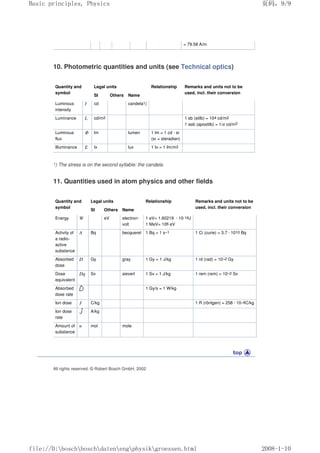
10. Photometric quantities and units (see Technical optics)
Quantity and
symbol
Legal units Relationship Remarks and units not to be
used, incl. their conversion
SI Others Name
Luminous
intensity
I cd candela1)
Luminance L cd/m2 1 sb (stilb) = 104 cd/m2
1 asb (apostilb) = 1/π cd/m2
Luminous
flux
Φ lm lumen 1 lm = 1 cd · sr
(sr = steradian)
Illuminance E Ix lux 1 Ix = 1 Im/m2
1) The stress is on the second syllable: the candela.
11. Quantities used in atom physics and other fields
Quantity and
symbol
Legal units Relationship Remarks and units not to be
used, incl. their conversion
SI Others Name
Energy W eV electron-
volt
1 eV= 1.60219 · 10-19J
1 MeV= 106 eV
Activity of
a radio-
active
substance
A Bq becquerel 1 Bq = 1 s–1 1 Ci (curie) = 3.7 · 1010 Bq
Absorbed
dose
D Gy gray 1 Gy = 1 J/kg 1 rd (rad) = 10–2 Gy
Dose
equivalent
Dq Sv sievert 1 Sv = 1 J/kg 1 rem (rem) = 10–2 Sv
Absorbed
dose rate
1 Gy/s = 1 W/kg
Ion dose J C/kg 1 R (röntgen) = 258 · 10–6C/kg
Ion dose
rate
A/kg
Amount of
substance
n mol mole
All rights reserved. © Robert Bosch GmbH, 2002
页码,9/9
Basic principles, Physics
2008-1-10
file://D:boschboschdatenengphysikgroessen.html
Basic principles, Physics
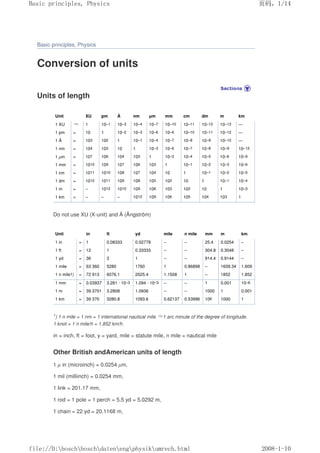
Conversion of units
Units of length
Unit XU pm Å nm µm mm cm dm m km
1 XU ≈ 1 10–1 10–3 10–4 10–7 10–10 10–11 10–12 10–13 —
1 pm = 10 1 10–2 10–3 10–6 10–9 10–10 10–11 10–12 —
1 Å = 103 102 1 10–1 10–4 10–7 10–8 10–9 10–10 —
1 nm = 104 103 10 1 10–3 10–6 10–7 10–8 10–9 10–12
1 µm = 107 106 104 103 1 10–3 10–4 10–5 10–6 10–9
1 mm = 1010 109 107 106 103 1 10–1 10–2 10–3 10–6
1 cm = 1011 1010 108 107 104 10 1 10–1 10–2 10–5
1 dm = 1012 1011 109 108 105 102 10 1 10–1 10–4
1 m = – 1012 1010 109 106 103 102 10 1 10–3
1 km = – – – 1012 109 106 105 104 103 1
Do not use XU (X-unit) and Å (Ångström)
Unit in ft yd mile n mile mm m km
1 in = 1 0.08333 0.02778 – – 25.4 0.0254 –
1 ft = 12 1 0.33333 – – 304.8 0.3048 –
1 yd = 36 3 1 – – 914.4 0.9144 –
1 mile = 63 360 5280 1760 1 0.86898 – 1609.34 1.609
1 n mile1) = 72 913 6076.1 2025.4 1.1508 1 – 1852 1.852
1 mm = 0.03937 3.281 · 10–3 1.094 · 10–3 – – 1 0.001 10–6
1 m = 39.3701 3.2808 1.0936 – – 1000 1 0.001
1 km = 39 370 3280.8 1093.6 0.62137 0.53996 106 1000 1
1
) 1 n mile = 1 nm = 1 international nautical mile ≈1 arc minute of the degree of longitude.
1 knot = 1 n mile/h = 1.852 km/h.
in = inch, ft = foot, y = yard, mile = statute mile, n mile = nautical mile
Other British andAmerican units of length
1 µ in (microinch) = 0.0254 µm,
1 mil (milliinch) = 0.0254 mm,
1 link = 201.17 mm,
1 rod = 1 pole = 1 perch = 5.5 yd = 5,0292 m,
1 chain = 22 yd = 20.1168 m,
页码,1/14
Basic principles, Physics
2008-1-10
file://D:boschboschdatenengphysikumrech.html
1 furlong = 220 yd = 201.168 m,
1 fathom = 2 yd = 1.8288 m.
Astronomical units
1 l.y. (light year) = 9.46053 · 1015 m (distance traveled by electromagnetic waves in
1 year),
1 AU (astronomical unit) = 1.496 · 1011 m (mean distance from earth to sun),
1 pc (parsec, parallax second) = 206 265 AU = 3,0857 · 1016 m (distance at which
the AU subtends an angle of one second of arc).
Do not use
1 line (watch  clock making) = 2.256 mm,
1 p (typographical point) = 0.376 mm,
1 German mile = 7500 m,
1 geographical mile = 7420.4 m (≈4 arc minutes of equator).
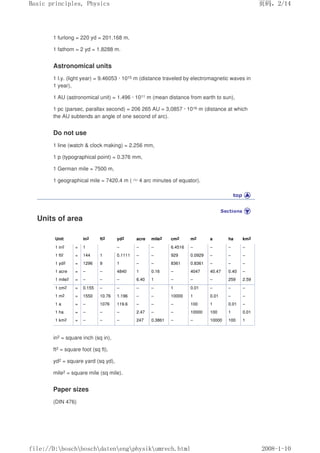
Units of area
Unit in2 ft2 yd2 acre mile2 cm2 m2 a ha km2
1 in2 = 1 – – – 6.4516 – – – –
1 ft2 = 144 1 0.1111 – – 929 0.0929 – – –
1 yd2 = 1296 9 1 – – 8361 0.8361 – – –
1 acre = – – 4840 1 0.16 – 4047 40.47 0.40 –
1 mile2 = – – – 6.40 1 – – – 259 2.59
1 cm2 = 0.155 – – – – 1 0.01 – – –
1 m2 = 1550 10.76 1.196 – – 10000 1 0.01 – –
1 a = – 1076 119.6 – – – 100 1 0.01 –
1 ha = – – – 2.47 – – 10000 100 1 0.01
1 km2 = – – – 247 0.3861 – – 10000 100 1
in2 = square inch (sq in),
ft2 = square foot (sq ft),
yd2 = square yard (sq yd),
mile2 = square mile (sq mile).
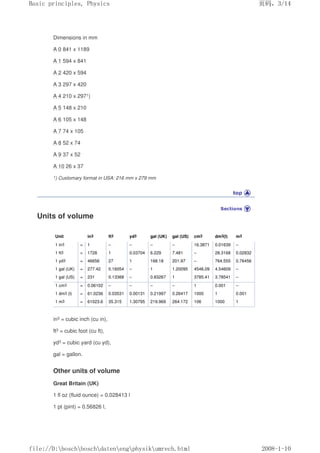
Paper sizes
(DIN 476)
页码,2/14
Basic principles, Physics
2008-1-10
file://D:boschboschdatenengphysikumrech.html
Dimensions in mm
A 0 841 x 1189
A 1 594 x 841
A 2 420 x 594
A 3 297 x 420
A 4 210 x 2971)
A 5 148 x 210
A 6 105 x 148
A 7 74 x 105
A 8 52 x 74
A 9 37 x 52
A 10 26 x 37
1) Customary format in USA: 216 mm x 279 mm
Units of volume
Unit in3 ft3 yd3 gal (UK) gal (US) cm3 dm3(l) m3
1 in3 = 1 – – – – 16.3871 0.01639 –
1 ft3 = 1728 1 0.03704 6.229 7.481 – 28.3168 0.02832
1 yd3 = 46656 27 1 168.18 201.97 – 764.555 0.76456
1 gal (UK) = 277.42 0.16054 – 1 1.20095 4546,09 4.54609 –
1 gal (US) = 231 0.13368 – 0.83267 1 3785.41 3.78541 –
1 cm3 = 0.06102 – – – – 1 0.001 –
1 dm3 (l) = 61.0236 0.03531 0.00131 0.21997 0.26417 1000 1 0.001
1 m3 = 61023.6 35.315 1.30795 219.969 264.172 106 1000 1
in3 = cubic inch (cu in),
ft3 = cubic foot (cu ft),
yd3 = cubic yard (cu yd),
gal = gallon.
Other units of volume
Great Britain (UK)
1 fl oz (fluid ounce) = 0.028413 l
1 pt (pint) = 0.56826 l,
页码,3/14
Basic principles, Physics
2008-1-10
file://D:boschboschdatenengphysikumrech.html
1 qt (quart) = 2 pt = 1.13652 l,
1 gal (gallon) = 4 qt = 4.5461 l,
1 bbl (barrel) = 36 gal = 163.6 l,
Units of dry measure:
1 bu (bushel) = 8 gal = 36.369 l.
United States (US)
1 fl oz (fluid ounce) = 0.029574 l
1 liq pt (liquid pint) = 0.47318 l
1 liq quart = 2 liq pt = 0.94635 l
1 gal (gallon) = 231 in3 = 4 liq quarts = 3.7854 l
1 liq bbl (liquid barrel) = 119.24 l
1 barrel petroleum1) = 42 gal = 158.99 l
Units of dry measure:
1 bushel = 35.239 dm3
1) For crude oil.
Volume of ships
1 RT (register ton) = 100 ft3 = 2.832 m3; GRT (gross RT) = total shipping space, net
register ton = cargo space of a ship.
GTI (gross tonnage index) = total volume of ship (shell) in m3.
1 ocean ton = 40 ft3 = 1.1327 m3.
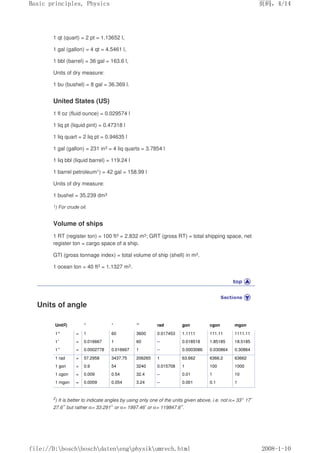
Units of angle
Unit2) ° '  rad gon cgon mgon
1° = 1 60 3600 0.017453 1.1111 111.11 1111.11
1' = 0.016667 1 60 – 0.018518 1.85185 18.5185
1'' = 0.0002778 0.016667 1 – 0.0003086 0.030864 0.30864
1 rad = 57.2958 3437.75 206265 1 63.662 6366.2 63662
1 gon = 0.9 54 3240 0.015708 1 100 1000
1 cgon = 0.009 0.54 32.4 – 0.01 1 10
1 mgon = 0.0009 0.054 3.24 – 0.001 0.1 1
2) It is better to indicate angles by using only one of the units given above, i.e. not α= 33° 17'
27.6 but rather α= 33.291° or α= 1997.46' or α= 119847.6.
页码,4/14
Basic principles, Physics
2008-1-10
file://D:boschboschdatenengphysikumrech.html
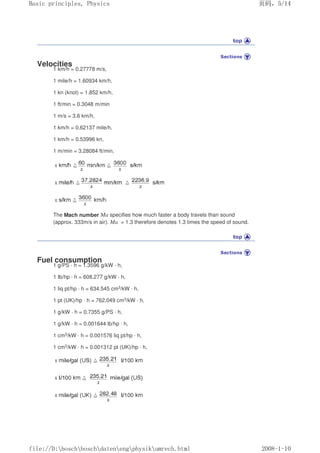
Velocities
1 km/h = 0.27778 m/s,
1 mile/h = 1.60934 km/h,
1 kn (knot) = 1.852 km/h,
1 ft/min = 0.3048 m/min
1 m/s = 3.6 km/h,
1 km/h = 0.62137 mile/h,
1 km/h = 0.53996 kn,
1 m/min = 3.28084 ft/min,
The Mach number Ma specifies how much faster a body travels than sound
(approx. 333m/s in air). Ma = 1.3 therefore denotes 1.3 times the speed of sound.
Fuel consumption
1 g/PS · h = 1.3596 g/kW · h,
1 Ib/hp · h = 608.277 g/kW · h,
1 liq pt/hp · h = 634.545 cm3/kW · h,
1 pt (UK)/hp · h = 762,049 cm3/kW · h,
1 g/kW · h = 0.7355 g/PS · h,
1 g/kW · h = 0.001644 lb/hp · h,
1 cm3/kW · h = 0.001576 liq pt/hp · h,
1 cm3/kW · h = 0.001312 pt (UK)/hp · h,
页码,5/14
Basic principles, Physics
2008-1-10
file://D:boschboschdatenengphysikumrech.html
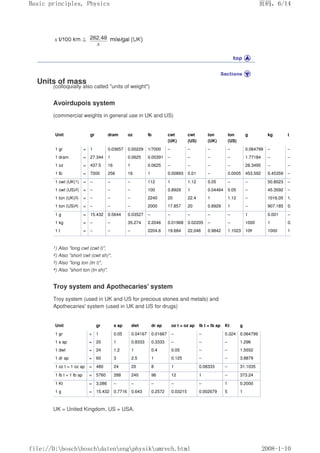
Units of mass
(colloquially also called units of weight)
Avoirdupois system
(commercial weights in general use in UK and US)
Unit gr dram oz lb cwt
(UK)
cwt
(US)
ton
(UK)
ton
(US)
g kg t
1 gr = 1 0.03657 0.00229 1/7000 – – – – 0.064799 – –
1 dram = 27.344 1 0.0625 0.00391 – – – – 1.77184 – –
1 oz = 437.5 16 1 0.0625 – – – – 28.3495 – –
1 lb = 7000 256 16 1 0.00893 0.01 – 0.0005 453.592 0.45359 –
1 cwt (UK)1) = – – – 112 1 1.12 0.05 – – 50.8023 –
1 cwt (US)2) = – – – 100 0.8929 1 0.04464 0.05 – 45.3592 –
1 ton (UK)3) = – – – 2240 20 22.4 1 1.12 – 1016,05 1.01605
1 ton (US)4) = – – – 2000 17.857 20 0.8929 1 – 907.185 0.90718
1 g = 15.432 0.5644 0.03527 – – – – – 1 0.001 –
1 kg = – – 35.274 2.2046 0.01968 0.02205 – – 1000 1 0.001
1 t = – – – 2204.6 19.684 22,046 0.9842 1.1023 106 1000 1
1) Also long cwt (cwt l),
2) Also short cwt (cwt sh),
3) Also long ton (tn l),
4) Also short ton (tn sh).
Troy system and Apothecaries' system
Troy system (used in UK and US for precious stones and metals) and
Apothecaries' system (used in UK and US for drugs)
Unit gr s ap dwt dr ap oz t = oz ap lb t = lb ap Kt g
1 gr = 1 0.05 0.04167 0.01667 – – 0.324 0.064799
1 s ap = 20 1 0.8333 0.3333 – – – 1.296
1 dwt = 24 1.2 1 0.4 0.05 – – 1.5552
1 dr ap = 60 3 2.5 1 0.125 – – 3.8879
1 oz t = 1 oz ap = 480 24 20 8 1 0.08333 – 31.1035
1 lb t = 1 lb ap = 5760 288 240 96 12 1 – 373.24
1 Kt = 3,086 – – – – – 1 0.2000
1 g = 15.432 0.7716 0.643 0.2572 0.03215 0.002679 5 1
UK = United Kingdom, US = USA.
页码,6/14
Basic principles, Physics
2008-1-10
file://D:boschboschdatenengphysikumrech.html
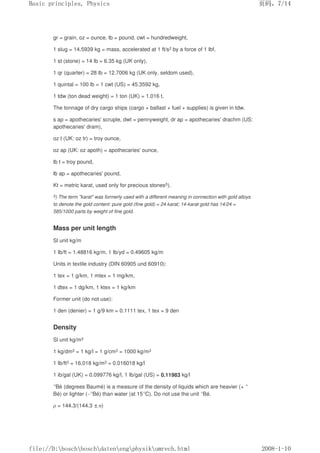
gr = grain, oz = ounce, lb = pound, cwt = hundredweight,
1 slug = 14.5939 kg = mass, accelerated at 1 ft/s2 by a force of 1 lbf,
1 st (stone) = 14 lb = 6.35 kg (UK only),
1 qr (quarter) = 28 lb = 12.7006 kg (UK only, seldom used),
1 quintal = 100 lb = 1 cwt (US) = 45.3592 kg,
1 tdw (ton dead weight) = 1 ton (UK) = 1.016 t.
The tonnage of dry cargo ships (cargo + ballast + fuel + supplies) is given in tdw.
s ap = apothecaries' scruple, dwt = pennyweight, dr ap = apothecaries' drachm (US:
apothecaries' dram),
oz t (UK: oz tr) = troy ounce,
oz ap (UK: oz apoth) = apothecaries' ounce,
lb t = troy pound,
lb ap = apothecaries' pound,
Kt = metric karat, used only for precious stones5).
5) The term karat was formerly used with a different meaning in connection with gold alloys
to denote the gold content: pure gold (fine gold) = 24 karat; 14-karat gold has 14/24 =
585/1000 parts by weight of fine gold.
Mass per unit length
Sl unit kg/m
1 Ib/ft = 1.48816 kg/m, 1 Ib/yd = 0.49605 kg/m
Units in textile industry (DIN 60905 und 60910):
1 tex = 1 g/km, 1 mtex = 1 mg/km,
1 dtex = 1 dg/km, 1 ktex = 1 kg/km
Former unit (do not use):
1 den (denier) = 1 g/9 km = 0.1111 tex, 1 tex = 9 den
Density
Sl unit kg/m3
1 kg/dm3 = 1 kg/l = 1 g/cm3 = 1000 kg/m3
1 Ib/ft3 = 16,018 kg/m3 = 0.016018 kg/l
1 ib/gal (UK) = 0.099776 kg/l, 1 Ib/gal (US) = 0.11983 kg/l
°Bé (degrees Baumé) is a measure of the density of liquids which are heavier (+ °
Bé) or lighter (–°Bé) than water (at 15°C). Do not use the unit °Bé.
ρ = 144.3/(144.3 ±n)
页码,7/14
Basic principles, Physics
2008-1-10
file://D:boschboschdatenengphysikumrech.html
ρ Density in kg/l, n hydrometer degrees in °Bé.
°API (American Petroleum Institute) is used in the USA to indicate the density of
fuels and oils.
ρ = 141.5/(131.5 +n)
ρ Density in kg/l, n hydrometer degrees in °API.
Examples:
–12 °Bé = 144.3/(144.3 + 12) kg/l = 0.923 kg/l
+34 °Bé = 144.3/(144.3 – 34) kg/l = 1.308 kg/l
28 °API = 141.5/(131.5 + 28) kg/l = 0.887 kg/l
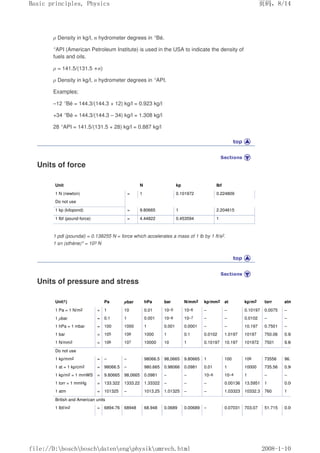
Units of force
Unit N kp Ibf
1 N (newton) = 1 0.101972 0.224809
Do not use
1 kp (kilopond) = 9.80665 1 2.204615
1 Ibf (pound-force) = 4.44822 0.453594 1
1 pdl (poundal) = 0.138255 N = force which accelerates a mass of 1 lb by 1 ft/s2.
1 sn (sthène)* = 103 N
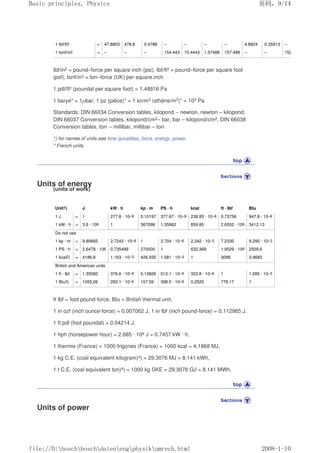
Units of pressure and stress
Unit1) Pa µbar hPa bar N/mm2 kp/mm2 at kp/m2 torr atm
1 Pa = 1 N/m2 = 1 10 0.01 10–5 10–6 – – 0.10197 0.0075 –
1 µbar = 0.1 1 0.001 10–6 10–7 – – 0.0102 – –
1 hPa = 1 mbar = 100 1000 1 0.001 0.0001 – – 10.197 0.7501 –
1 bar = 105 106 1000 1 0.1 0.0102 1.0197 10197 750.06 0.9869
1 N/mm2 = 106 107 10000 10 1 0.10197 10.197 101972 7501 9.8692
Do not use
1 kp/mm2 = – – 98066.5 98,0665 9.80665 1 100 106 73556 96.784
1 at = 1 kp/cm2 = 98066.5 – 980.665 0.98066 0.0981 0.01 1 10000 735.56 0.96784
1 kp/m2 = 1 mmWS = 9.80665 98,0665 0.0981 – – 10–6 10–4 1 – –
1 torr = 1 mmHg = 133.322 1333.22 1.33322 – – – 0.00136 13.5951 1 0.00132
1 atm = 101325 – 1013.25 1.01325 – – 1.03323 10332.3 760 1
British and American units
1 Ibf/in2 = 6894.76 68948 68.948 0.0689 0.00689 – 0.07031 703,07 51.715 0.06805
页码,8/14
Basic principles, Physics
2008-1-10
file://D:boschboschdatenengphysikumrech.html
1 Ibf/ft2 = 47.8803 478.8 0.4788 – – – – 4.8824 0.35913 –
1 tonf/in2 = – – – 154.443 15.4443 1.57488 157.488 – – 152.42
Ibf/in2 = pound–force per square inch (psi), Ibf/ft2 = pound–force per square foot
(psf), tonf/in2 = ton–force (UK) per square inch
1 pdl/ft2 (poundal per square foot) = 1.48816 Pa
1 barye* = 1µbar; 1 pz (pièce)* = 1 sn/m2 (sthène/m2)* = 103 Pa
Standards: DIN 66034 Conversion tables, kilopond – newton, newton – kilopond,
DIN 66037 Conversion tables, kilopond/cm2– bar, bar – kilopond/cm2, DIN 66038
Conversion tables, torr – millibar, millibar – torr
1) for names of units see time qunatities, force, energy, power.
* French units.
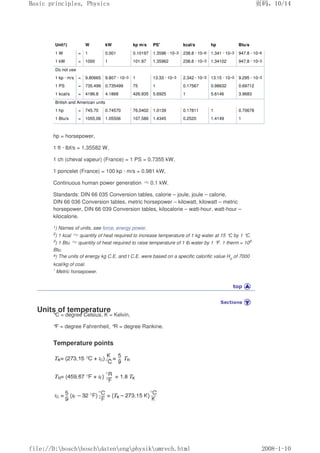
Units of energy
(units of work)
Unit1) J kW · h kp · m PS · h kcal ft · Ibf Btu
1 J = 1 277.8 · 10–9 0.10197 377.67 · 10–9 238.85 · 10–6 0.73756 947.8 · 10–6
1 kW · h = 3.6 · 106 1 367098 1.35962 859.85 2.6552 · 106 3412.13
Do not use
1 kp · m = 9.80665 2.7243 · 10–6 1 3.704 · 10–6 2.342 · 10–3 7.2330 9.295 · 10–3
1 PS · h = 2.6478 · 106 0.735499 270000 1 632.369 1.9529 · 106 2509.6
1 kcal2) = 4186.8 1.163 · 10–3 426.935 1.581 · 10–3 1 3088 3.9683
British and American units
1 ft · Ibf = 1.35582 376.6 · 10–9 0.13826 512.1 · 10–9 323.8 · 10–6 1 1.285 · 10–3
1 Btu3) = 1055,06 293.1 · 10–6 107.59 398.5 · 10–6 0.2520 778.17 1
ft Ibf = foot pound-force, Btu = British thermal unit,
1 in ozf (inch ounce-force) = 0.007062 J, 1 in Ibf (inch pound-force) = 0.112985 J,
1 ft pdl (foot poundal) = 0.04214 J,
1 hph (horsepower hour) = 2.685 · 106 J = 0.7457 kW · h,
1 thermie (France) = 1000 frigories (France) = 1000 kcal = 4.1868 MJ,
1 kg C.E. (coal equivalent kilogram)4) = 29.3076 MJ = 8.141 kWh,
1 t C.E. (coal equivalent ton)4) = 1000 kg SKE = 29.3076 GJ = 8.141 MWh.
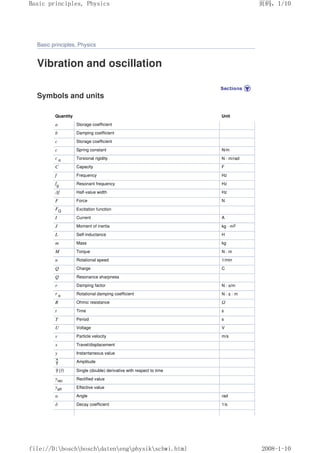
Units of power
页码,9/14
Basic principles, Physics
2008-1-10
file://D:boschboschdatenengphysikumrech.html
Unit1) W kW kp m/s PS* kcal/s hp Btu/s
1 W = 1 0.001 0.10197 1.3596 · 10–3 238.8 · 10–6 1.341 · 10–3 947.8 · 10–6
1 kW = 1000 1 101.97 1.35962 238.8 · 10–3 1.34102 947.8 · 10–3
Do not use
1 kp · m/s = 9.80665 9.807 · 10–3 1 13.33 · 10–3 2.342 · 10–3 13.15 · 10–3 9.295 · 10–3
1 PS = 735.499 0.735499 75 1 0.17567 0.98632 0.69712
1 kcal/s = 4186.8 4.1868 426.935 5.6925 1 5.6146 3.9683
British and American units
1 hp = 745.70 0.74570 76,0402 1.0139 0.17811 1 0.70678
1 Btu/s = 1055,06 1.05506 107.586 1.4345 0.2520 1.4149 1
hp = horsepower,
1 ft · Ibf/s = 1.35582 W,
1 ch (cheval vapeur) (France) = 1 PS = 0.7355 kW,
1 poncelet (France) = 100 kp · m/s = 0.981 kW,
Continuous human power generation ≈0.1 kW.
Standards: DIN 66 035 Conversion tables, calorie – joule, joule – calorie,
DIN 66 036 Conversion tables, metric horsepower – kilowatt, kilowatt – metric
horsepower, DIN 66 039 Conversion tables, kilocalorie – watt-hour, watt-hour –
kilocalorie.
1) Names of units, see force, energy power.
2) 1 kcal ≈quantity of heat required to increase temperature of 1 kg water at 15 °
C by 1 °
C.
3) 1 Btu ≈quantity of heat required to raise temperature of 1 lb water by 1 °
F. 1 therm = 105
Btu.
4) The units of energy kg C.E. and t C.E. were based on a specific calorific value Hu of 7000
kcal/kg of coal.
* Metric horsepower.
Units of temperature
°
C = degree Celsius, K = Kelvin,
°
F = degree Fahrenheit, °
R = degree Rankine.
Temperature points
页码,10/14
Basic principles, Physics
2008-1-10
file://D:boschboschdatenengphysikumrech.html
tC, tF, TK und TR denote the temperature points in °
C, °
F, K and °R.
Temperature difference
1 K = 1 °C = 1.8 °F = 1.8 °
R
Zero points: 0 °
C 32 °
F, 0 °
F –17.78 °C.
Absolute zero: 0K –273.15 °
C 0 °
R –459.67 °
F.
International practical temperature scale: Boiling point of oxygen –182.97 °
C,
triple point of water 0.01 °
C1), boiling point of water 100 °
C, boiling point of sulfur
(sulfur point) 444.6 °
C, setting point of silver (silver point) 960.8 °
C, setting point of
gold 1063 °C.
1) That temperature of pure water at which ice, water and water vapor occur together in
equilibrium (at 1013.25 hPa). See also SI Units (Footnote).
Enlarge picture
Units of viscosity
Legal units of kinematic viscosity v
1 m2/s = 1 Pa · s/(kg/m3) = 104cm2/s = 106 mm2/s.
British and American units:
页码,11/14
Basic principles, Physics
2008-1-10
file://D:boschboschdatenengphysikumrech.html
1 ft2/s = 0.092903 m2/s,
Rl seconds = efflux time from Redwood-I viscometer (UK),
SU seconds = efflux time from Saybolt-Universal viscometer (US).
Do not use:
St (stokes) = cm2/s, cSt = mm2/s.
Conventional units
E (Engler degree) = relative efflux time from Engler apparatus DIN 51560.
For v  60 mm2/s, 1 mm2/s = 0.132 E.
At values below 3 E, Engler degrees do not give a true indication of the variation of
viscosity; for example, a fluid with 2 E does not have twice the kinematic viscosity of
a fluid with 1 E, but rather 12 times that value.
A seconds = efflux time from flow cup DIN 53 211.
Enlarge picture
Units of time
Unit1) s min h d
1 s2) (second) = 1 0.01667 0.2778 · 10–3 11.574 · 10–6
1 min (minute) = 60 1 0.01667 0.6944 · 10–3
1 h (hour) = 3600 60 1 0.041667
1 d (day) = 86 400 1440 24 1
页码,12/14
Basic principles, Physics
2008-1-10
file://D:boschboschdatenengphysikumrech.html
1 civil year = 365 (or 366) days = 8760 (8784) hours (for calculation of interest in
banking, 1 year = 360 days),
1 solar year3) = 365.2422 mean solar days = 365 d 5 h 48 min 46 s,
1 sidereal year4) = 365.2564 mean solar days.
1) See also Time quantities.
2) Base SI unit, see SI Units for definition.
3) Time between two successive passages of the earth through the vernal equinox.
4) True time of revolution of the earth about the sun.
Clock times
The clock times listed for the following time zones are based on 12.00 CET (Central
European Time)5):
Clock
time
Time-zone
meridian
Countries (examples)
West longitude
1.00 150° Alaska.
3.00 120° West coast of Canada and USA.
4.00 105° Western central zone of Canada and USA.
5.00 90° Central zone of Canada and USA, Mexico, Central America.
6.00 75° Canada between 68°and 90°
, Eastern USA, Ecuador, Colombia, Panama,
Peru.
7.00 60° Canada east of 68°
, Bolivia, Chile, Venezuela.
8.00 45° Argentina, Brazil, Greenland, Paraguay, Uruguay.
11.00 0° Greenwich Mean Time (GMT)6): Canary Islands, Great Britain, Ireland,
Portugal, West Africa.
East longitude
12.00 15° Central European Time (CET): Austria, Belgium, Denmark, France,
Germany, Hungary, Italy, Luxembourg, Netherlands, Norway, Poland,
Sweden, Switzerland, Spain;
Algeria, Israel, Libya, Nigeria, Tunisia, Zaire.
13.00 30° Eastern European Time (EET): Bulgaria, Finland, Greece, Romania;
Egypt, Lebanon, Jordan, Sudan, South Africa, Syria.
14.00 45° Western Russia, Turkey, Iraq, Saudi Arabia, Eastern Africa.
14.30 52.5° Iran.
16.30 82.5° India, Sri Lanka.
18.00 105° Cambodia, Indonesia, Laos, Thailand, Vietnam.
19.00 120° Chinese coast, Philippines, Western Australia.
20.00 135° Japan, Korea.
20.30 142.5° North and South Australia.
21.00 150° Eastern Australia.
5) During the summer months in countries in which daylight saving time is observed, clocks
are set ahead by 1 hour (from approximately April to September north of the equator and
October to March south of the equator).
页码,13/14
Basic principles, Physics
2008-1-10
file://D:boschboschdatenengphysikumrech.html
6) = UT (Universal Time), mean solar time at the 0°meridian of Greenwich, or UTC
(Coordinated Universal Time), defined by the invariable second of the International System of
Units (see SI Units). Because the period of rotation of the earth about the sun is gradually
becoming longer, UTC is adjusted to UT from time to time by the addition of a leap second.
All rights reserved. © Robert Bosch GmbH, 2002
页码,14/14
Basic principles, Physics
2008-1-10
file://D:boschboschdatenengphysikumrech.html
Basic principles, Physics
Vibration and oscillation
Symbols and units
Quantity Unit
a Storage coefficient
b Damping coefficient
c Storage coefficient
c Spring constant N/m
c α Torsional rigidity N · m/rad
C Capacity F
f Frequency Hz
fg Resonant frequency Hz
∆f Half-value width Hz
F Force N
FQ Excitation function
I Current A
J Moment of inertia kg · m2
L Self-inductance H
m Mass kg
M Torque N · m
n Rotational speed 1/min
Q Charge C
Q Resonance sharpness
r Damping factor N · s/m
r α Rotational damping coefficient N · s · m
R Ohmic resistance Ω
t Time s
T Period s
U Voltage V
v Particle velocity m/s
x Travel/displacement
y Instantaneous value
Amplitude
(ÿ) Single (double) derivative with respect to time
yrec Rectified value
yeff Effective value
α Angle rad
δ Decay coefficient 1/s
页码,1/10
Basic principles, Physics
2008-1-10
file://D:boschboschdatenengphysikschwi.html
Λ Logarithmic decrement
ω Angular velocity rad/s
ω Angular frequency 1/s
Ω Exciter-circuit frequency 1/s
Damping ratio
opt Optimum damping ratio
Subscripts:
0: Undamped
d: Damped
T: Absorber
U: Base support
G: Machine
Terms
(see also DIN 1311)
Vibrations and oscillations
Vibrations and oscillations are the terms used to denote changes in a physical
quantity which repeat at more or less regular time intervals and whose direction
changes with similar regularity.
Period
The period is the time taken for one complete cycle of a single oscillation (period).
Amplitude
Amplitude is the maximum instantaneous value (peak value) of a sinusoidally
oscillating physical quantity.
Frequency
Frequency is the number of oscillations in one second, the reciprocal value of the
period of oscillation T.
Angular frequency
Angular frequency is 2π-times the frequency.
Particle velocity
Particle velocity is the instantaneous value of the alternating velocity of a vibrating
particle in its direction of vibration. It must not be confused with the velocity of
propagation of a traveling wave (e.g. the velocity of sound).
页码,2/10
Basic principles, Physics
2008-1-10
file://D:boschboschdatenengphysikschwi.html
Fourier series
Every periodic function, which is piece-wise monotonic and smooth, can be
expressed as the sum of sinusoidal harmonic components.
Beats
Beats occur when two sinusoidal oscilla-tions, whose frequencies do not differ
greatly, are superposed. They are periodic. Their basic frequency is the difference
between the frequencies of the superposed sinusoidal oscillations.
Natural oscillations
The frequency of natural oscillations (natural frequency) is dependent only on the
properties of the oscillating system.
Damping
Damping is a measure of the energy losses in an oscillatory system when one form
of energy is converted into another.
Logarithmic decrement
Natural logarithm of the relationship between two extreme values of a natural
oscillation which are separated by one period.
Damping ratio
Measure for the degree of damping.
Forced oscillations
Forced oscillations arise under the influence of an external physical force
(excitation), which does not change the properties of the oscillator. The frequency of
forced oscillations is determined by the frequency of the excitation.
Transfer function
The transfer function is the quotient of amplitude of the observed variable divided by
the amplitude of excitation, plotted against the exciter frequency.
Resonance
Resonance occurs when the transfer function produces very large values as the
exciter frequency approaches the natural frequency.
Resonant frequency
Resonant frequency is the exciter frequency at which the oscillator variable attains
its maximum value.
页码,3/10
Basic principles, Physics
2008-1-10
file://D:boschboschdatenengphysikschwi.html
Half-value width
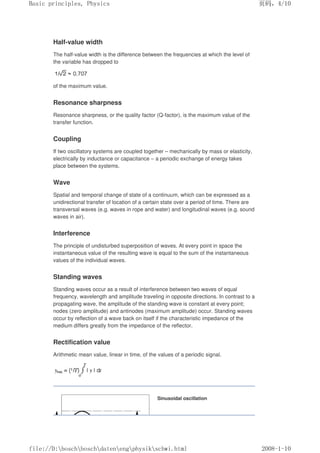
The half-value width is the difference between the frequencies at which the level of
the variable has dropped to
of the maximum value.
Resonance sharpness
Resonance sharpness, or the quality factor (Q-factor), is the maximum value of the
transfer function.
Coupling
If two oscillatory systems are coupled together – mechanically by mass or elasticity,
electrically by inductance or capacitance – a periodic exchange of energy takes
place between the systems.
Wave
Spatial and temporal change of state of a continuum, which can be expressed as a
unidirectional transfer of location of a certain state over a period of time. There are
transversal waves (e.g. waves in rope and water) and longitudinal waves (e.g. sound
waves in air).
Interference
The principle of undisturbed superposition of waves. At every point in space the
instantaneous value of the resulting wave is equal to the sum of the instantaneous
values of the individual waves.
Standing waves
Standing waves occur as a result of interference between two waves of equal
frequency, wavelength and amplitude traveling in opposite directions. In contrast to a
propagating wave, the amplitude of the standing wave is constant at every point;
nodes (zero amplitude) and antinodes (maximum amplitude) occur. Standing waves
occur by reflection of a wave back on itself if the characteristic impedance of the
medium differs greatly from the impedance of the reflector.
Rectification value
Arithmetic mean value, linear in time, of the values of a periodic signal.
Sinusoidal oscillation
页码,4/10
Basic principles, Physics
2008-1-10
file://D:boschboschdatenengphysikschwi.html
For a sine curve:
Effective value
Quadratic mean value in time of a periodic signal.
For a sine curve:
Form factor
= yeff/yrec
For a sine curve:
yeff/yrec ≈1,111.
Peak factor
= /yeff
For a sine curve:
Equations
The equations apply for the following simple oscillators if the general quantity
designations in the formulas are replaced by the relevant physical quantities.
页码,5/10
Basic principles, Physics
2008-1-10
file://D:boschboschdatenengphysikschwi.html
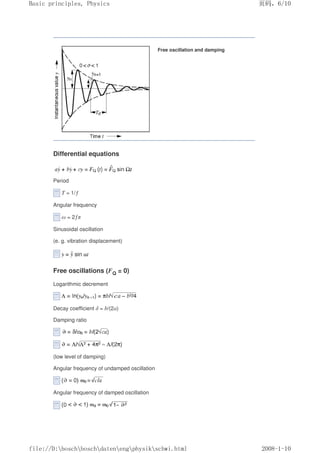
Free oscillation and damping
Differential equations
Period
T = 1/ƒ
Angular frequency
ω = 2ƒπ
Sinusoidal oscillation
(e. g. vibration displacement)
Free oscillations (FQ = 0)
Logarithmic decrement
Decay coefficient δ = b/(2a)
Damping ratio
(low level of damping)
Angular frequency of undamped oscillation
Angular frequency of damped oscillation
页码,6/10
Basic principles, Physics
2008-1-10
file://D:boschboschdatenengphysikschwi.html
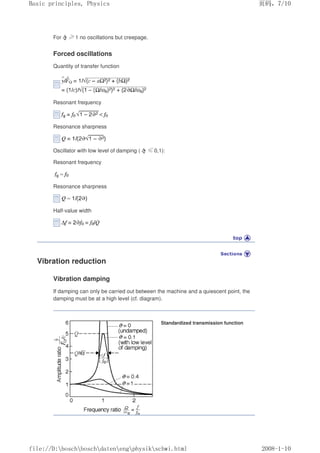
For ≥1 no oscillations but creepage.
Forced oscillations
Quantity of transfer function
Resonant frequency
Resonance sharpness
Oscillator with low level of damping ( ≤0,1):
Resonant frequency
Resonance sharpness
Half-value width
Vibration reduction
Vibration damping
If damping can only be carried out between the machine and a quiescent point, the
damping must be at a high level (cf. diagram).
Standardized transmission function
页码,7/10
Basic principles, Physics
2008-1-10
file://D:boschboschdatenengphysikschwi.html
Vibration isolation
Active vibration isolation
Machines are to be mounted so that the forces transmitted to the base support are
small. One measure to be taken: The bearing point should be set below resonance,
so that the natural frequency lies below the lowest exciter frequency. Damping
impedes isolation. Low values can result in excessively high vibrations during
running-up when the resonant range is passed through.
Passive vibration isolation
Machines are to be mounted so that vibration and shaking reaching the base
support are only transmitted to the machines to a minor degree. Measures to be
taken: as for active isolation.
In many cases flexible suspension or extreme damping is not practicable. So that no
resonance can arise, the machine attachment should be so rigid that the natural
frequency is far enough in excess of the highest exciter frequency which can occur.
Vibration isolation
a Transmission function b Low tuning
Vibration absorption
Absorber with fixed natural frequency
By tuning the natural frequency ωT of an absorption mass with a flexible, loss-free
coupling to the excitation frequency, the vibrations of the machine are completely
absorbed. Only the absorption mass still vibrates. The effectiveness of the
absorption decreases as the exciter frequency changes. Damping prevents
complete absorption. However, appropriate tuning of the absorber frequency and an
页码,8/10
Basic principles, Physics
2008-1-10
file://D:boschboschdatenengphysikschwi.html
optimum damping ratio produce broadband vibration reduction, which remains
effective when the exciter frequency changes.
Vibration absorption
a Transmission function of machine
b Structure of principle
Absorber with changeable natural frequency
Rotational oscillations with exciter frequencies proportional to the rotational speed
(e. B. orders of balancing in IC engines, see Crankshaft-assembly operation.) can be
absorbed by absorbers with natural frequencies proportional to the rotational speed
(pendulum in the centrifugal force field). The absorption is effective at all rotational
speeds.
Absorption is also possible for oscillators with several degrees of freedom and
interrelationships, as well as by the use of several absorption bodies.
Modal analysis
The dynamic behavior (oscillatory characteristics) of a mechanical structure can be
predicted with the aid of a mathematical model. The model parameters of the modal
model are determined by means of modal analysis. A time-invariant and linear-
elastic structure is an essential precondition. The oscillations are only observed at a
limited number of points in the possible oscillation directions (degrees of freedom)
and at defined frequency intervals. The continuous structure is then replaced in a
clearly-defined manner by a finite number of single-mass oscillators. Each single-
mass oscillator is comprehensively and clearly defined by a characteristic vector and
a characteristic value. The characteristic vector (mode form, natural oscillation form)
describes the relative amplitudes and phases of all degrees of freedom, the
characteristic value describes the behavior in terms of time (damped harmonic
oscillation). Every oscillation of the structure can be artificially recreated from the
characteristic vectors and values.
页码,9/10
Basic principles, Physics
2008-1-10
file://D:boschboschdatenengphysikschwi.html
The modal model not only describes the actual state but also forms the basis for
simulation calculations: In response calculation, the response of the structure to a
defined excitation, corresponding, for instance, to test laboratory conditions, is
calculated. By means of structure modifications (changes in mass, damping or
stiffness) the vibrational behavior can be optimized to the level required by operating
conditions. The substructure coupling process collates modal models of various
structures, for example, into one overall model. The modal model can be
constructed analytically. When the modal models produced by both processes are
compared with each other, the modal model resulting from an analytical modal
analysis is more accurate than that from an experimental modal analysis as a result
of the greater number of degrees of freedom in the analytical process. This applies
in particular to simulation calculations based on the model.
Analytical modal analysis
The geometry, material data and marginal conditions must be known. Multibody-
system or finite-element models provide characteristic values and vectors. Analytical
modal analysis requires no specimen sample, and can therefore be used at an early
stage of development. However, it is often the case that precise knowledge
concerning the structure's fundamental properties (damping, marginal conditions)
are lacking, which means that the modal model can be very inaccurate. As well as
this, the error is unidentified. A remedy can be to adjust the model to the results of
an experimental modal analysis.
Experimental modal analysis
Knowledge of the structure is not necessary, but a specimen is required. Analysis is
based on measurements of the transmission functions in the frequency range in
question from one excitation point to a number of response points, and vice versa.
The modal model is derived from the matrix of the transmission functions (which
defines the response model).
All rights reserved. © Robert Bosch GmbH, 2002
页码,10/10
Basic principles, Physics
2008-1-10
file://D:boschboschdatenengphysikschwi.html
Basic principles, Physics
Basic equations used in
mechanics
See Quantities and units for names of units.
Symbol Quantity SI unit
A Area m2
a Acceleration m/s2
acf Centrifugal acceleration m/s2
d Diameter m
E Energy J
Ek Kinetic energy J
Ep Potential energy J
F Force N
Fcf Centrifugal force N
G Weight N
g Acceleration of free fall
(g = 9.81 m/s2, see Quantities)
m/s2
h Height m
i Radius of gyration m
J Moment of inertia
(second-order moment of mass)
kg · m2
L Angular momentum N · s · m
l Length m
M Torque N · m
m Mass (weight) kg
n Rotational frequency s–1
P Power W
p Linear momentum N · s
r Radius m
s Length of path m
T Period, time of one revolution s
t Time s
V Volume m3
υ Velocity
υ1
Initial velocity
υ2
Final velocity
υm
Mean velocity
m/s
W Work, energy J
α Angular acceleration rad/s2 1)
ε Wrap angle rad1)
µ Coefficient of friction –
ρ Density kg/m3
页码,1/14
Basic principles, Physics
2008-1-10
file://D:boschboschdatenengphysikmechanik.html
φ Angle of rotation rad1)
ω Angular velocity rad/s1)
1) The unit rad (= m/m) can be replaced by the number 1.
Relationships between quantities, numbers
If not otherwise specified, the following relationships are relationships between
quantities, i.e. the quantities can be inserted using any units (e.g. the SI units given
above). The unit of the quantity to be calculated is obtained from the units chosen for
the terms of the equation.
In some cases, additional numerical relationships are given for customary units (e.g.
time in s, but speed in km/h). These relationships are identified by the term
numerical relationship, and are only valid if the units given for the relationship are
used.
Rectilinear motion
Uniform rectilinear motion
Velocity
υ = s/t
Uniform rectilinear acceleration
Mean velocity
υm = (υ1 + υ2)/2
Acceleration
a = (υ2–υ1)/t = (υ2
2–υ2
1)/(2s)
Numerical relationship:
a = (υ2–υ1)/(3.6 t)
a in m/s2, υ2 and υ1 in km/h, t in s
Distance covered after time t
Final velocity
Initial velocity
For uniformly retarded motion (υ2 smaller than υ1) a is negative.
页码,2/14
Basic principles, Physics
2008-1-10
file://D:boschboschdatenengphysikmechanik.html
For acceleration from rest, substitute υ1 = 0. For retardation to rest, substitute υ2 = 0.
Force
F = m · a
Work, energy
W = F · s = m · a · s = P · t
Potential energy
Ep = G · h = m · g · h
Kinetic energy
Ek = m · υ2
/2
Power
P = W/t = F · υ
Lifting power
P = m · g · υ
Linear momentum
p = m · υ
Rotary motion
Uniform rotary motion
Peripheral velocity
υ = r · ω
Numerical relationship:
υ = π · d · n/60
υ in m/s, d in m, n in min–1
υ = 6 · π · d · n/100
υ in km/h, d in m, n in min–1
Angular velocity
ω = φ/t = υ/r = 2π · n
Numerical relationship:
ω = π · n/30
ω in s–1, n in min–1
Uniform angular acceleration
页码,3/14
Basic principles, Physics
2008-1-10
file://D:boschboschdatenengphysikmechanik.html
Angular acceleration
α = (ω2 – ω1)/t
Numerical relationship:
α = π (n2 – n1)/(30t)
α in 1/s2, n1 und n2 in min–1, t in s
Final angular velocity
ω2 = ω1 + α · t
Initial angular velocity
ω1 = ω2 – α · t
For uniformly retarded rotary motion (ω2 is smaller than ω1) ist α is negative.
Centrifugal force
Fcf = m · r · ω2
= m · υ2
/r
Centrifugal acceleration
acf = r · ω2
Torque
M = F · r = P/ω
Numerical relationship:
M = 9550 · P/n
M in N · m, P in kW, n in min–1
Moment of inertia (see Moments of inertia)
J = m · i2
Work
W = M · φ = P · t
Power
P = M · ω = M · 2π · n
Numerical relationship:
P = M · n/9550
(see graph)
P in kW, M in N · m (= W · s),
n in min–1
Energy of rotation
页码,4/14
Basic principles, Physics
2008-1-10
file://D:boschboschdatenengphysikmechanik.html
Erot = J · ω2
/2 = J · 2π2
· n2
Numerical relationship:
Erot = J · n2
/182.4
Erot in J (= N · m), J in kg · m2, n in min–1
Angular momentum
L = J · ω = J · 2π · n
Numerical relationship:
L = J · π · n/30 = 0.1047 J · n
L in N · s · m, J in kg · m2, n in min–1
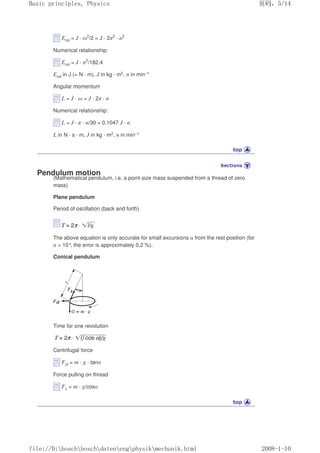
Pendulum motion
(Mathematical pendulum, i.e. a point-size mass suspended from a thread of zero
mass)
Plane pendulum
Period of oscillation (back and forth)
The above equation is only accurate for small excursions α from the rest position (for
α = 10°
, the error is approximately 0.2 %).
Conical pendulum
Time for one revolution
Centrifugal force
Fcf = m · g · tanα
Force pulling on thread
Fz = m · g/cosα
页码,5/14
Basic principles, Physics
2008-1-10
file://D:boschboschdatenengphysikmechanik.html
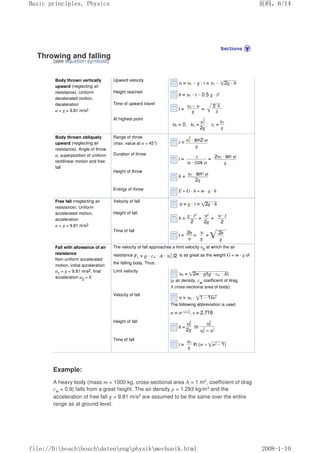
Throwing and falling
(see equation symbols)
Body thrown vertically
upward (neglecting air
resistance). Uniform
decelerated motion,
deceleration
a = g = 9.81 m/s2
Upward velocity
Height reached
Time of upward travel
At highest point
Body thrown obliquely
upward (neglecting air
resistance). Angle of throw
α; superposition of uniform
rectilinear motion and free
fall
Range of throw
(max. value at α = 45°
)
Duration of throw
Height of throw
Energy of throw E = G · h = m · g · h
Free fall (neglecting air
resistance). Uniform
accelerated motion,
acceleration
a = g = 9.81 m/s2
Velocity of fall
Height of fall
Time of fall
Fall with allowance of air
resistance
Non-uniform accelerated
motion, initial acceleration
a1
= g = 9.81 m/s2, final
acceleration a2
= 0
The velocity of fall approaches a limit velocity υ0
at which the air
resistance is as great as the weight G = m · g of
the falling body. Thus:
Limit velocity
(ρ air density, cw
coefficient of drag,
A cross-sectional area of body).
Velocity of fall
The following abbreviation is used
Height of fall
Time of fall
Example:
A heavy body (mass m = 1000 kg, cross-sectional area A = 1 m2, coefficient of drag
cw = 0.9) falls from a great height. The air density ρ = 1.293 kg/m3 and the
acceleration of free fall g = 9.81 m/s2 are assumed to be the same over the entire
range as at ground level.
页码,6/14
Basic principles, Physics
2008-1-10
file://D:boschboschdatenengphysikmechanik.html
Height
of fall
Neglecting air resistance, values at end of
fall from indicated height would be
Allowing for air resistance, values at end
of fall from indicated height are
Time of fall Velocity of fall Energy Time of fall Velocity of fall Energy
m s m/s kJ s m/s kJ
10 1.43 14.0 98 1.43 13.97 97
50 3.19 31.3 490 3.2 30.8 475
100 4.52 44.3 980 4.6 43 925
500 10.1 99 4900 10.6 86.2 3690
1000 14.3 140 9800 15.7 108 5850
5000 31.9 313 49 000 47.6 130 8410
10 000 45.2 443 98 000 86.1 130 8410
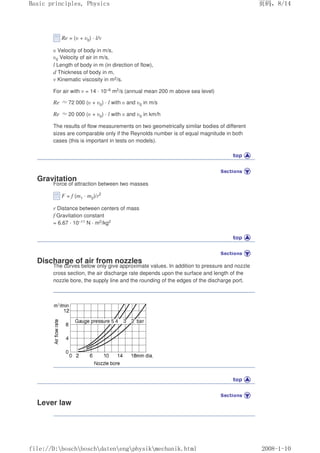
Drag coefficients cw
Reynolds number
页码,7/14
Basic principles, Physics
2008-1-10
file://D:boschboschdatenengphysikmechanik.html
Re = (υ + υ0) · l/ν
υ Velocity of body in m/s,
υ0 Velocity of air in m/s,
l Length of body in m (in direction of flow),
d Thickness of body in m,
ν Kinematic viscosity in m2/s.
For air with ν = 14 · 10–6 m2/s (annual mean 200 m above sea level)
Re ≈72 000 (υ + υ0) · l with υ and υ0 in m/s
Re ≈20 000 (υ + υ0) · l with υ and υ0 in km/h
The results of flow measurements on two geometrically similar bodies of different
sizes are comparable only if the Reynolds number is of equal magnitude in both
cases (this is important in tests on models).
Gravitation
Force of attraction between two masses
F = f (m1 · m2)/r2
r Distance between centers of mass
f Gravitation constant
= 6.67 · 10–11 N · m2/kg2
Discharge of air from nozzles
The curves below only give approximate values. In addition to pressure and nozzle
cross section, the air discharge rate depends upon the surface and length of the
nozzle bore, the supply line and the rounding of the edges of the discharge port.
Lever law
页码,8/14
Basic principles, Physics
2008-1-10
file://D:boschboschdatenengphysikmechanik.html
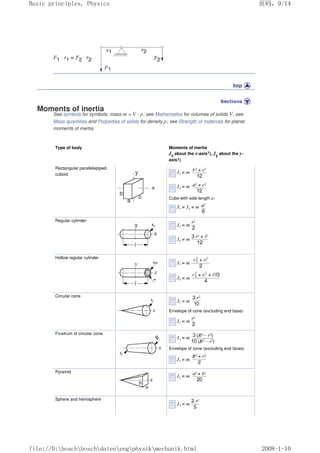
Moments of inertia
See symbols for symbols; mass m = V · ρ; see Mathematics for volumes of solids V; see
Mass quantities and Properties of solids for density ρ; see Strength of materials for planar
moments of inertia.
Type of body Moments of inertia
Jx about the x-axis1), Jy about the y-
axis1)
Rectangular parallelepiped,
cuboid
Cube with side length a:
Regular cylinder
Hollow regular cylinder
Circular cone
Envelope of cone (excluding end base)
Frustrum of circular cone
Envelope of cone (excluding end faces)
Pyramid
Sphere and hemisphere
页码,9/14
Basic principles, Physics
2008-1-10
file://D:boschboschdatenengphysikmechanik.html
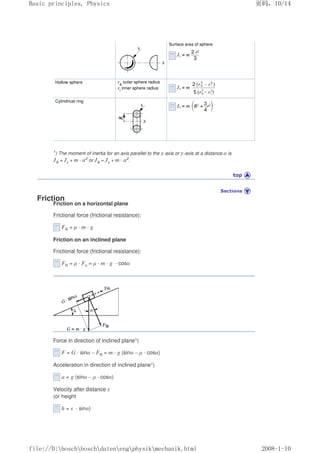
Surface area of sphere
Hollow sphere ra
outer sphere radius
ri
inner sphere radius
Cylindrical ring
1) The moment of inertia for an axis parallel to the x-axis or y-axis at a distance a is
JA = Jx + m · a2 or JA = Jy + m · a2.
Friction
Friction on a horizontal plane
Frictional force (frictional resistance):
FR = µ · m · g
Friction on an inclined plane
Frictional force (frictional resistance):
FR = µ · Fn = µ · m · g · cosα
Force in direction of inclined plane1)
F = G · sinα – FR = m · g (sinα – µ · cosα)
Acceleration in direction of inclined plane1)
a = g (sinα – µ · cosα)
Velocity after distance s
(or height
h = s · sinα)
页码,10/14
Basic principles, Physics
2008-1-10
file://D:boschboschdatenengphysikmechanik.html
1) The body remains at rest if (sinα–µ· cosα) is negative or zero.
Coefficient of friction
The coefficient of friction µ always denotes a system property and not a material
property. Coefficients of friction are among other things dependent on material
pairing, temperature, surface condition, sliding speed, surrounding medium (e.g.
water or CO2, which can be adsorbed by the surface) or the intermediate material
(e.g. lubricant). The coefficient of static friction is often greater than that of sliding
friction. In special cases, the friction coefficient can exceed 1 (e.g. with very smooth
surfaces where cohesion forces are predominant or with racing tires featuring an
adhesion or suction effect).
Belt-wrap friction
Tension forces:
F1 = F2 · eµε
Transmittable peripheral force:
Fu = F1 – F2 = F1 (1 – e–µε) = F2 (eµε– 1)
e = 2.718 (base of natural logarithms)
Power and torque
See Rotary motion for equations
Enlarge picture
页码,11/14
Basic principles, Physics
2008-1-10
file://D:boschboschdatenengphysikmechanik.html
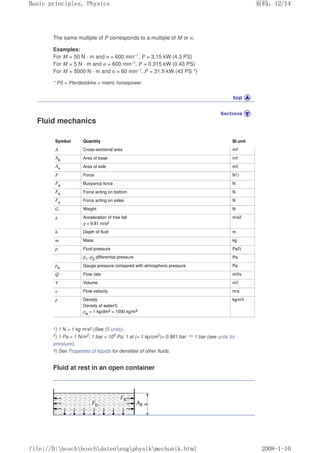
The same multiple of P corresponds to a multiple of M or n.
Examples:
For M = 50 N · m and n = 600 min–1, P = 3.15 kW (4.3 PS)
For M = 5 N · m and n = 600 min–1, P = 0.315 kW (0.43 PS)
For M = 5000 N · m and n = 60 min–1, P = 31.5 kW (43 PS *)
* PS = Pferdestärke = metric horsepower
Fluid mechanics
Symbol Quantity SI unit
A Cross-sectional area m2
Ab Area of base m2
As Area of side m2
F Force N1)
Fa Buoyancy force N
Fb Force acting on bottom N
Fs Force acting on sides N
G Weight N
g Acceleration of free fall
g = 9.81 m/s2
m/s2
h Depth of fluid m
m Mass kg
p Fluid pressure Pa2)
p1
–p2
differential pressure Pa
pe Gauge pressure compared with atmospheric pressure Pa
Q Flow rate m3/s
V Volume m3
υ Flow velocity m/s
ρ Density
Density of water3)
ρw
= 1 kg/dm3 = 1000 kg/m3
kg/m3
1) 1 N = 1 kg m/s2 (See SI units).
2) 1 Pa = 1 N/m2; 1 bar = 105 Pa; 1 at (= 1 kp/cm2)= 0.981 bar ≈1 bar (see units for
pressure).
3) See Properties of liquids for densities of other fluids.
Fluid at rest in an open container
页码,12/14
Basic principles, Physics
2008-1-10
file://D:boschboschdatenengphysikmechanik.html
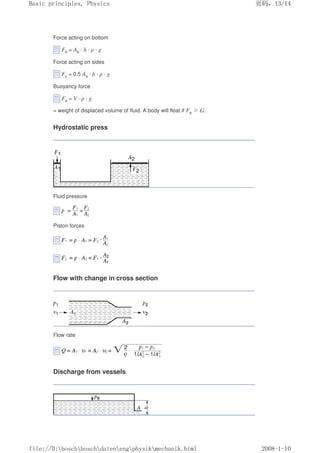
Force acting on bottom
Fb = Ab · h · ρ · g
Force acting on sides
Fs = 0.5 As · h · ρ · g
Buoyancy force
Fa = V · ρ · g
= weight of displaced volume of fluid. A body will float if Fa ≥G.
Hydrostatic press
Fluid pressure
Piston forces
Flow with change in cross section
Flow rate
Discharge from vessels
页码,13/14
Basic principles, Physics
2008-1-10
file://D:boschboschdatenengphysikmechanik.html
Discharge velocity
Discharge rate
Coefficient of contraction χ with sharp edge: 0.62 ... 0.64; for slightly broken edge:
0.7 ... 0.8; for slightly rounded edge: 0.9; for heavily rounded, smooth edge: 0.99.
Discharge coefficient ψ = 0.97 ... 0.998.
All rights reserved. © Robert Bosch GmbH, 2002
页码,14/14
Basic principles, Physics
2008-1-10
file://D:boschboschdatenengphysikmechanik.html
Basic principles, Physics
Strength of materials
Symbols and units
See Quantities and units for names of units.
Quantity Unit
A Cross-sectional area mm2
E Modulus of elasticity N/mm2
F Force, load N
G Modulus of elasticity in shear N/mm2
Ia Axial planar moment of inertia
(See Section moduli and geometrical moments of inertia)
mm4
Ip Polar planar moment of inertia
(See Section moduli and geometrical moments of inertia)
mm4
l Length mm
Mb Bending moment N · mm
Mt Torque; turning moment N · mm
q Knife-edge load N/mm
R Radius of curvature at neutral axis mm
Rdm Compression strength N/mm2
Re Yield point N/mm2
Rm Tensile strength N/mm2
Rp0.2 0.2 % yield strength1) N/mm2
S Safety factor –
s Maximum deflection mm
Wb Section modulus under bending
(See Section moduli and geometrical moments of inertia)
mm3
Wt Section modulus under torsion
(See Section moduli and geometrical moments of inertia)
mm3
αk Stress concentration factor (notch factor) –
βk Fatigue-strength reduction factor –
γ Elastic shear rad
δ, A Elongation at fracture %
ε Elastic elongation or compression, strain %
ω Poisson's ratio –
σ Stress N/mm2
σzdw Reversed-bending fatigue strength N/mm2
σgr Limit stress N/mm2
σD Endurance limit = fatigue limit N/mm2
σW Endurance limit at complete stress reversal N/mm2
σa Stress amplitude N/mm2
页码,1/13
Basic principles, Physics
2008-1-10
file://D:boschboschdatenengphysikfest.html
σbB Bending strength N/mm2
σbF Elastic limit under bending N/mm2
σbW Fatigue limit under reversed bending stresses N/mm2
τ Shear stress N/mm2
τt Torsional stress N/mm2
τgr Torsional stress limit N/mm2
τtB Torsional strength N/mm2
τtF Elastic limit under torsion N/mm2
τtW Fatigue limit under reversed torsional stress N/mm2
ψ Angle of rotation rad
1) 0.2% yield strength: that stress which causes permanent deformation of 0.2%.
The equations in this section are general equations of quantities, i.e. they are also applicable
if other units are chosen, except equations for buckling.
Mechanical stresses
Tension and compression
(perpendicular to cross-sectional area)
Tensile (compression) stress
Compression strain
∆l Increase (or decrease) in length
l Original length
Modulus of elasticity2)
Long, thin bars subjected to compressive loads must also be investigated with
regard to their buckling strength.
2) Hook's Law applies only to elastic deformation, i.e. in practice approximately up to the
elastic limit (yield point, elastic limit under bending, elastic limit under torsion; see also
Permissible loading).
Bending
The effects of a transverse force can be neglected in the case of long beams
subjected to bending stress. In calculating bending stresses (resulting from bending
页码,2/13
Basic principles, Physics
2008-1-10
file://D:boschboschdatenengphysikfest.html
moments without transverse force) it can therefore be assumed for reasons of
symmetry (the axis of the beam becomes circular) that plane cross sections remain
plane. With these assumptions as given, the neutral axis passes through the center
of gravity of every conceivable cross section.
The following equation thus applies:
Edge stress
if
I Axial moment of inertia: the sum of the products of all cross-sectional elements by
the squares of their distances from the neutral axis.
W Section modulus of a cross section: indicates, for the edge stress 1, the inner
moment with which the cross section can resist an external bending load.
Q Transverse force: the sum of all forces acting vertically on the beam to the left or
right of a given cross section; Q subjects the beam to shearing stress. In the case of
short beams, the shearing stress caused by Q must also be taken into account.
e Distance between the neutral-axis zone and the outer-surface zone.
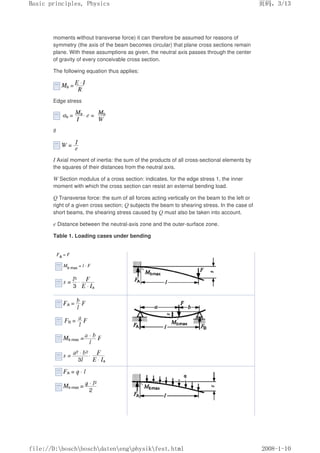
Table 1. Loading cases under bending
FA
= F
Mb max
= l · F
页码,3/13
Basic principles, Physics
2008-1-10
file://D:boschboschdatenengphysikfest.html
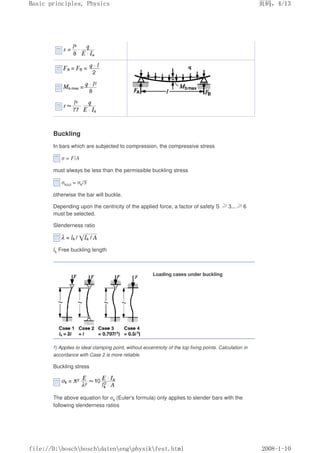
Buckling
In bars which are subjected to compression, the compressive stress
σ = F/A
must always be less than the permissible buckling stress
σkzul = σk/S
otherwise the bar will buckle.
Depending upon the centricity of the applied force, a factor of safety S ≥3...≥6
must be selected.
Slenderness ratio
lk Free buckling length
Loading cases under buckling
3) Applies to ideal clamping point, without eccentricity of the top fixing points. Calculation in
accordance with Case 2 is more reliable.
Buckling stress
The above equation for σk (Euler's formula) only applies to slender bars with the
following slenderness ratios
页码,4/13
Basic principles, Physics
2008-1-10
file://D:boschboschdatenengphysikfest.html
λ ≥100 for St 37 steel,
λ ≥ for steels whose Re values are different from that of St 37,
λ ≥80 for GG 25 gray cast iron,
λ ≥100 for coniferous wood.
According to Tetmajer, the following is valid for lower values of λ:
 for St 37 steel σk = (284 – 0.8 λ) N/mm2,
 for St 52 steel σk = (578 – 3.74 λ) N/mm2,
 for GG 25 gray cast iron σk = (760 – 12 λ + 0.05 λ2) N/mm2 and
 for coniferous wood σk = (29 – 0.19 λ) N/mm2.
2) Hook's Law applies only to elastic deformation, i.e. in practice approximately up to the
elastic limit (yield point, elastic limit under bending, elastic limit under torsion; see also
Permissible loading).
Shear
Shearing stress
τ = F/A
τ = shear force per unit area of the cross section of a body. The stress acts in the
direction of the plane element. Shear strain γ is the angular deformation of the body
element as a result of shear stress.

Shear modulus (modulus of rigidity)1) 2).
G = τ/γ
Shear
1) See Footnote.
2) The relationship between the shear modulus G and the modulus of elasticity E is:
with υ = Poisson's ratio
For metallic materials with υ ≈0.3, G ≈0.385 E; see Properties of materials for values of
E.
Torsion (twisting)

Torsional stress τt = Mt/Wt,
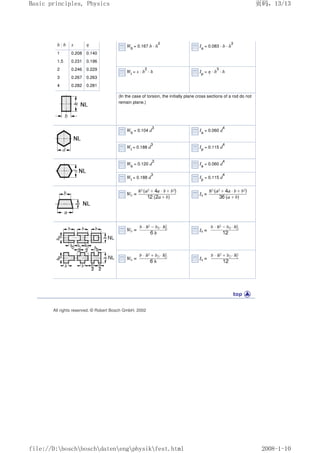
See Section moduli and geometrical moments of inertia for section moduli Wt.
页码,5/13
Basic principles, Physics
2008-1-10
file://D:boschboschdatenengphysikfest.html
Torque Mt = torsional force · lever arm.
The torque generates the illustrated shearing-stress distribution in every cross-
sectional plane on every diameter.
Angle of rotation
The angle of rotation ψ is the angle of twist in rad of a bar of length l (conversion:
1 rad ≈57.3°
, see Units of angle).
See Section moduli and geometrical moments of inertia for polar planar moments of
inertia Ip.
Torsion
Notch effect
The equations cited above apply to smooth rods and bars; if notches are present,
these equations yield the following nominal stresses (referred to the residual cross
section):
σzn = F/A
under tension (see diagram) or compression,
σbn = Mb/Wb
under bending,
τtn = Mt/Wt
under torsion.
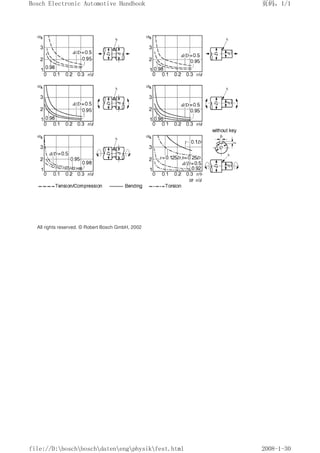
Notch effect caused by grooves and holes
页码,6/13
Basic principles, Physics
2008-1-10
file://D:boschboschdatenengphysikfest.html
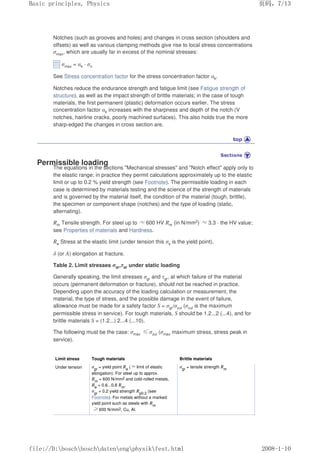
Notches (such as grooves and holes) and changes in cross section (shoulders and
offsets) as well as various clamping methods give rise to local stress concentrations
σmax, which are usually far in excess of the nominal stresses:
σmax = αk · σn
See Stress concentration factor for the stress concentration factor αk.
Notches reduce the endurance strength and fatigue limit (see Fatigue strength of
structure), as well as the impact strength of brittle materials; in the case of tough
materials, the first permanent (plastic) deformation occurs earlier. The stress
concentration factor αk increases with the sharpness and depth of the notch (V
notches, hairline cracks, poorly machined surfaces). This also holds true the more
sharp-edged the changes in cross section are.
Permissible loading
The equations in the sections Mechanical stresses and Notch effect apply only to
the elastic range; in practice they permit calculations approximately up to the elastic
limit or up to 0.2 % yield strength (see Footnote). The permissible loading in each
case is determined by materials testing and the science of the strength of materials
and is governed by the material itself, the condition of the material (tough, brittle),
the specimen or component shape (notches) and the type of loading (static,
alternating).
Rm Tensile strength. For steel up to ≈600 HV Rm (in N/mm2) ≈3.3 · the HV value;
see Properties of materials and Hardness.
Re Stress at the elastic limit (under tension this σs is the yield point).
δ (or A) elongation at fracture.
Table 2. Limit stresses σgr,τgr under static loading
Generally speaking, the limit stresses σgr and τgr, at which failure of the material
occurs (permanent deformation or fracture), should not be reached in practice.
Depending upon the accuracy of the loading calculation or measurement, the
material, the type of stress, and the possible damage in the event of failure,
allowance must be made for a safety factor S = σgr/σzul (σzul is the maximum
permissible stress in service). For tough materials, S should be 1.2...2 (...4), and for
brittle materials S = (1.2...) 2...4 (...10).
The following must be the case: σmax ≤σzul (σmax maximum stress, stress peak in
service).
Limit stress Tough materials Brittle materials
Under tension σgr
= yield point Re
(≈limit of elastic
elongation). For steel up to approx.
Rm
= 600 N/mm2 and cold-rolled metals,
Re
= 0.6...0.8 Rm
.
σgr
= 0.2 yield strength Rp0.2
(see
Footnote). For metals without a marked
yield point such as steels with Rm
≥600 N/mm2, Cu, Al.
σgr
= tensile strength Rm
页码,7/13
Basic principles, Physics
2008-1-10
file://D:boschboschdatenengphysikfest.html
Under
compression
σgr
= compressive yield point σdF
(limit of
elastic compression, roughly corresponding
to Re
).
σgr
= compression strength Rdm
.
For compression
with danger of
buckling
σgr
= buckling strain σk
. σgr
= buckling strain σk
.
Under bending σgr
= elastic limit under bending σbF
(limit of
elastic deflection). σbF
is approximately
equal to yield point Re
under tension.
Permanent curvature if σbF
is exceeded.
σgr
= bending strength σbB
≈Rm
.
For gray cast iron GG 40, however,
σbB
= 1.4...2.0 Rm
since ε = σ/E does
not apply because the neutral axis is
displaced
Under torsion τgr
= elastic limit under torsion τtF
(limit of
elastic twist).Torsional
limit τtF
≈0.5...0.6 Re.
. If exceeded, twist
becomes permanent deformation.
τgr
= torsional strength τtB
.
τtB
= 0.5...0.8 σB
, but for gray cast
iron up to GG 25 τtB
= 1...1.3 σB
.
Under shear τgr
= elastic limit under shear τsF
≈0.6 σS
. τgr
= shear strength τsB
.
When minimal plastic deformations can be accepted, it is permissible to extend the
loads on tough materials beyond the limits of elastic compression and deflection.
The internal areas of the cross section are then stressed up to their yield point while
they provide support for the surface-layer zone. The bending force applied to an
angular bar can be increased by a maximum factor of 1.5; the maximum increase in
torsional force applied to a round torsion bar is 1.33.
Limit stresses under pulsating loads
If the load alternates between two stress values, different (lower) stress limits σgr are
valid: the largest stress amplitude, alternating about a given mean stress, which can
be withstood infinitely often without fracture and impermissible distortion, is called
the fatigue limit or endurance limit σD. It is determined experimentally by applying a
pulsating load to test specimens until fracture occurs, whereby with the reduced load
the number of cycles to fracture increases and yields the so-called Wöhler or
stress-number (S/N) curve. The Wöhler curve is nearly horizontal after 2...10 million
load cycles for steel, and after roughly 100 million cycles for non-ferrous metals;
oscillation stress = fatigue limit in such cases.
If no additional factors are present in operation (wear, corrosion, multiple
overloadingetc.), fracture does not occur after this ultimate number of cycles. It
should be noted that S · σa ≤σW or in the case of increased mean stresses
S · σa ≤σD; safety factor S = 1.25...≥3 (stress values have lower-case subscripts,
fatigue-strength values have upper-case subscripts). A fatigue fracture generally
does not exhibit permanent deformation. With plastics, it is not always possible to
give an ultimate number of cycles because in this case extensive superimposed
creepage becomes effective. With high-tensile steels, the internal stresses resulting
from production processes can have a considerable effect upon the fatigue-strength
values.
Fatigue-limit diagram
The greatest infinitely often endurable stress amplitude can be determined from
the fatigue limit diagram (at right) for any minimum stress σu or mean stress σm. The
diagram is produced using several Wöhler curves with various mean stress factors.
页码,8/13
Basic principles, Physics
2008-1-10
file://D:boschboschdatenengphysikfest.html
Fatigue diagram
Effect of surface quality finish on fatigue
limit during bending and tension-
compression stresses
Special cases of fatigue limit
Fatigue limit under completely reversed stress σW
The stress alternates between two opposite limit values of the same magnitude; the
mean stress is zero.
The fatigue limit σW is approximately:
Load Steel Non-ferrous metals
Tension/compression 0.30...0.45 Rm
0.2...0.4 Rm
Bending 0.40...0.55 Rm
0.3...0.5 Rm
Fatigue limit under pulsating stress σsch
Defines the infinitely endurable number of double amplitudes when the minimum
stress is zero (see Fatigue diagram).
页码,9/13
Basic principles, Physics
2008-1-10
file://D:boschboschdatenengphysikfest.html
Permissible alternating loading of notched machine parts
The fatigue limit of notched parts is usually higher than that calculated using stress
concentration factor αk (see Stress concentration factor). Also, the sensitivity of
materials to the effect of a notch in case of (alternating) fatigue loading varies, e.g.,

spring steels, highly quenched and tempered structural steels, and high-strength
bronzes are more sensitive than cast iron, stainless steel and precipitation-hardened
aluminum alloys. For (alternating) fatigue loading, fatigue-strength reduction factor βk
applies instead of αk so that e.g. at σm = 0 the effective stress amplitude on the
structural member is σwnβk (σwn the nominal alternating stress referred to the residual
cross section). The following must hold true:
σwnβk ≤σwzul = σw/S
Attempts have been made to derive βk from αk where e.g. Thum introduced notch
sensitivity ηk and established that
βk = 1 + (αk – 1) ηk
However ηk is not a material constant, and it also depends upon the condition of the
material, the component geometry (notch acuity) and the type of loading (e.g.
alternating or dynamic).
Fatigue limit values under reversed stress
σw for various materials is given on Properties of metallic materials und Properties
nonferrous metals, heavy metals.
Stress concentration factors
αk for different notch configurations is given on Stress concentration factors.
Fatigue strength of structure
For many component parts, it is difficult or even impossible to determine a stress
concentration factor αk and thus a fatigue-strength reduction factor βk. In this case
the fatigue limit of the entire part (fatigue strength of structural member, e.g.,
pulsating loads in N or moment of oscillation in N · m) must be determined
experimentally and compared with test results given in literature. The local stressing
can continue to be measured, using foil strain gauges for instance. As an alternative,
or for preliminary design purposes, the finite-element method can be applied to
calculate numerically the stress distribution and to compare it with the respective
limit stress.
Creep behavior
If materials are subjected for long periods of time to loads at increased temperatures
and/or to high stresses, creep or relaxation may occur. If resulting deformations
(generally very small) are not acceptable, allowance must be made for the material's
creep behavior:
Creep:
Permanent deformation under constant load, and (at least approximately) constant
页码,10/13
Basic principles, Physics
2008-1-10
file://D:boschboschdatenengphysikfest.html
stress (example: turbine blades).
Relaxation:
Reduction of the tension forces and stresses, whereby the initially applied (usually
purely elastic) deformation remains constant (see Table 3 for examples).
In the case of alternating loads (where σa ≥0.1 σB) and maximum stresses and
temperatures such as are encountered in static relaxation tests, the same
deformations and losses of force only occur after a period of load which is
approximately 10 times (or more) as long as that of the static relaxation tests.
Table 3. Relaxation for various materials
Material Part σB
N/mm2
Initial
stress
N/mm2
Temperature
°
C
Time
h
Relaxation
%
GD-Zn Al4 Cu 1 Thread 280 1501) 20 500 30
GD-Mg Al8 Zn 1 Compression test specimen 157 60 150 500 63
GD-Al Si12 (Cu) 207 60 150 500 3.3
Cq35 Bolt 800 540 160 500 11
40Cr Mo V 47 Bar under tension 850 372 300 1000 12
1) In the stress area of a steel bolt.
Stress concentration factor ak for various notch
configurations
Stress concentration factors for flat bars
Enlarge picture
Stress concentration factors for rods
Enlarge picture
页码,11/13
Basic principles, Physics
2008-1-10
file://D:boschboschdatenengphysikfest.html
All rights reserved. © Robert Bosch GmbH, 2002
页码,1/1
Bosch Electronic Automotive Handbook
2008-1-30
file://D:boschboschdatenengphysikfest.html
Section moduli and geometrical moments of
inertia
NL = neutral axis
See Moments of inertia for mass moments of inertia.
Section modulus
Wb under bending
Wt
under torsion
Planar moment of inertia
Ia axial, referred to NL
Ip
polar, referred to center of
gravity
Wb
= 0.098 d
3
Ia
= 0.049 d
4
Wt
= 0.196 d
3
Ip
= 0.098 d
4
Wb
= 0.098 a
2
·b Ia
= 0.049 a
3
·b
Wt
= 0.196 a·b
2
for
Wb
= 0.118 a
3
Ia
= 0.083 a
4
Wt
= 0.208 a
3
Ip
= 0.140 a
4
页码,12/13
Basic principles, Physics
2008-1-10
file://D:boschboschdatenengphysikfest.html
h : b x η
1 0.208 0.140
1.5 0.231 0.196
2 0.246 0.229
3 0.267 0.263
4 0.282 0.281
Wb
= 0.167 b · h
2
Ia
= 0.083 · b · h
3
Wt
= x · b
2
· h Ip
= η · b
3
· h
(In the case of torsion, the initially plane cross sections of a rod do not
remain plane.)
Wb
= 0.104 d
3
Ia
= 0.060 d
4
Wt
= 0.188 d
3
Ip
= 0.115 d
4
Wb
= 0.120 d
3
Ia
= 0.060 d
4
Wt
= 0.188 d
3
Ip
= 0.115 d
4
All rights reserved. © Robert Bosch GmbH, 2002
页码,13/13
Basic principles, Physics
2008-1-10
file://D:boschboschdatenengphysikfest.html
Basic principles, Physics
Acoustics
Quantities and units
(see also DIN 1332)
Quantity SI unit
c Velocity of sound m/s
f Frequency Hz
I Sound intensity W/m2
LI Sound intensity level dB
LAeq Equivalent continuous sound level, A-weighted dB (A)
LpA Sound pressure level, A-weighted dB (A)
Lr Rating sound level dB (A)
LWA Sound power level, A-weighted dB (A)
P Sound power W
p Sound pressure Pa
S Surface area m2
T Reverberation time s
υ Particle velocity m/s
Z Specific acoustic impedance Pa · s/m
α Sound absorption coefficient 1
λ Wavelength m
ρ Density kg/m3
ω Angular frequency (= 2 πf ) 1/s
General terminology
(see also DIN 1320)
Sound
Mechanical vibrations and waves in an elastic medium, particularly in the audible
frequency range (16 to 20,000 Hz).
Ultrasound
Mechanical vibrations above the frequency range of human hearing.
Propagation of sound
In general, sound propagates spherically from its source. In a free sound field, the
页码,1/10
Basic principles, Physics
2008-1-30
file://D:boschboschdatenengphysikakustik.html
sound pressure decreases by 6 dB each time the distance from the sound source is
doubled. Reflecting objects influence the sound field, and the rate at which the
sound level is reduced as a function of the distance from the sound source is lower.
Velocity of sound c
The velocity of sound is the velocity of propagation of a sound wave.
Sound velocities and wave Iengths in different materials.
Material/medium Velocity of sound c
m/s
Wave-length λ
m at 1000 Hz
Air, 20 °C, 1014 hPa 343 0.343
Water, 10 °
C 1440 1.44
Rubber (according to hardness) 60 ... 1500 0.06 ... 1.5
Aluminium (rod) 5100 5.1
Steel (rod) 5000 5.0
Wavelength
λ = c/f = 2 πc/ω
Particle velocity υ
Particle velocity is the alternating velocity of a vibrating particle. In a free sound field:
υ = p/Z
At low frequencies, perceived vibration is approximately proportional to the particle
velocity.
Sound pressure p
Sound pressure is the alternating pressure generated in a medium by the vibration
of sound. In a free sound field, this pressure equals
p = υ · Z
It is usually measured as the RMS value.
Specific acoustic impedance Z
Specific acoustic impedance is a measure of the ability of a medium to transmit
sound waves.
Z = p/υ = ρ · c.
For air at 20 °C and 1013 hPa (760 torr) Z = 415 Ns/m3, for water at 10 °
C
Z = 1.44 · 106 Ns/m3 = 1.44 · 106 Pa · s/m.
Sound power P
页码,2/10
Basic principles, Physics
2008-1-30
file://D:boschboschdatenengphysikakustik.html
Sound power is the power emitted by a sound source. Sound power of some sound
sources:
Normal conversation,
average 7 · 10–6 W
Violin, fortissimo 1 · 10–3 W
Peak power of the human voice 2 · 10–3 W
Piano, trumpet 0.2 ... 0.3 W
Organ 1 ... 10 W
Kettle drum 10 W
Orchestra (75 musicians) up to 65 W
Sound intensity I
(Sound intensity) I = P/S, i.e. sound power through a plane vertical to the direction of
propagation. In a sound field,
I = p2
/ρ · c = υ2
· ρ · c.
Doppler effect
For moving sound sources: If the distance between the source and the observer
decreases, the perceived pitch (f') is higher than the actual pitch (f); as the distance
increases, the perceived pitch falls. The following relationship holds true if the
observer and the sound force are moving along the same line:
f'/f = (c - u')/(c - u).
c = velocity of sound, u' = velocity of observer, u = velocity of sound source.
Interval
The interval is the ratio of the frequencies of two tones. In the equal-tempered
scale of our musical instruments (introduced by J. S. Bach), the octave (interval 2:1)
is divided into 12 equal semitones with a ratio of = 1.0595, i.e. a series of any
number of tempered intervals always leads back to a tempered interval. In the case
of pure pitch, on the other hand, a sequence of pure intervals usually does not lead
to a pure interval. (Pure pitch has the intervals 1, 16/15, 9/8, 6/5, 5/4, 4/3, 7/5, 3/2,
8/5, 5/3, 9/5, 15/8, 2.)
Sound spectrum
The sound spectrum, generated by means of frequency analysis, is used to show
the relationship between the sound pressure level (airborne or structure-borne
sound) and frequency.
Octave band spectrum
The sound levels are determined and represented in terms of octave bandwidth.
Octave: frequency ranges with fundamental frequencies in a ratio of 1:2. Mean
frequency of octave
Recommended center frequencies: 31.5; 63; 125; 250; 500; 1000; 2000; 4000;
页码,3/10
Basic principles, Physics
2008-1-30
file://D:boschboschdatenengphysikakustik.html
8000 Hz.
Third-octave band spectrum
Sound levels are determined and represented in terms of third-octave bandwidth.
The bandwidth referred to the center frequency is relatively constant, as in the case
of the octave band spectrum.
Sound insulation
Sound insulation is the reduction of the effect of a sound source by interposing a
reflecting (insulating) wall between the source and the impact location.
Sound absorption
Loss of sound energy when reflected on peripheries, but also for the propagation in
a medium.
Sound absorption coefficient α
The sound absorption coefficient is the ratio of the non-reflected sound energy to the
incident sound energy. With total reflection, α = 0; with total absorption, α = 1.
Noise reduction
Attenuation of acoustic emissions: Reduction in the primary mechanical or
electrodynamic generation of structure-borne noise and flow noises; damping and
modification of sympathetic vibrations; reduction of the effective radiation surfaces;
encapsulation.
Low-noise design
Application of simulation techniques (modal analysis, modal variation, finite-element
analysis, analysis of coupling effects of airborne noise) for advance calculation and
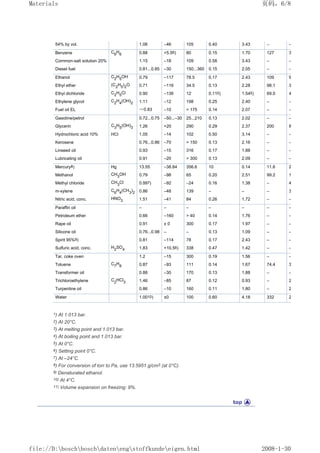
optimization of the acoustic properties of new designs.
Quantities for noise emission measurement
Sound field quantities are normally measured as RMS values, and are expressed in
terms of frequency-dependent weighting (A-weighting). This is indicated by the
subscript A next to the corresponding symbol.
Sound power level Lw
The sound power of a sound source is described by the sound power level Lw. The
sound power level is equal to ten times the logarithm to the base 10 of the ratio of
the calculated sound power to the reference sound power P0 = 10–12 W. Sound
power cannot be measured directly. It is calculated based on quantities of the sound
field which surrounds the source. Measurements are usually also made of the sound
pressure level Lp at specific points around the source (see DIN 45 635). Lw can also
页码,4/10
Basic principles, Physics
2008-1-30
file://D:boschboschdatenengphysikakustik.html
be calculated based on sound intensity levels LI measured at various points on the
surface of an imaginary envelope surrounding the sound source. If noise is emitted
uniformly through a surface of S0 = 1 m2, the sound pressure level Lp and the sound
intensity level LI at this surface have the same value as the sound power level Lw.
Sound pressure level Lp
The sound pressure level is ten times the logarithm to the base 10 of the ratio of the
square of the RMS sound pressure to the square of the reference sound pressure
p0 = 20 µPa. Lp = 10 log p2/p0
2
oder
Lp = 20 log p/p0.
The sound pressure level is given in decibels (dB).
The frequency-dependent, A-weighted sound pressure level LpA as measured at a
distance of d = 1 m is frequently used to characterize sound sources.
Sound intensity level LI
The sound intensity level is equal to ten times the logarithm to the base ten of the
ratio of sound intensity to reference sound intensity
I0 = 10–12 W/m2. LI = 10 log I/I0.
Interaction of two or more sound sources
If two independent sound fields are superimposed, their sound intensities or the
squares of their sound pressures must be added. The overall sound level is then
determined from the individual sound levels as follows:
Difference between
2 individual sound levels
Overall sound level =
higher individual sound
level + supplement of:
0 dB 3 dB
1 dB 2.5 dB
2 dB 2.1 dB
3 dB 1.8 dB
4 dB 1.5 dB
6 dB 1 dB
8 dB 0.6 dB
10 dB 0.4 dB
Motor-vehicle noise measurements and limits
The noise measurements employed to monitor compliance with legal requirements
are concerned exclusively with external noise levels. Testing procedures and limit
页码,5/10
Basic principles, Physics
2008-1-30
file://D:boschboschdatenengphysikakustik.html
values for stationary and moving vehicles were defined in 1981 with the
promulgation of EC Directive 81/334.
Noise emissions from moving vehicles
The vehicle approaches line AA, which is located 10 m from the microphone plane,
at a constant velocity. Upon reaching line AA, the vehicle continues under full
acceleration as far as line BB (also placed 10 m from the microphone plane), which
serves as the end of the test section. The noise-emissions level is the maximum
sound level as recorded by the microphone 7.5 m from the middle of the lane.
Passenger cars with manual transmission and a maximum of 4 forward gears are
tested in 2nd gear. Consecutive readings in 2nd and 3rd gear are employed for
vehicles with more than 4 forward gears, with the noise emissions level being
defined as the arithmetic mean of the two maximum sound levels.
Separate procedures are prescribed for vehicles with automatic transmissions.
Test layout for driving-noise measurement
according to DIN 81/334/EEC through
84/424/EEC
1 Microphone
Noise emissions from stationary vehicles
Measurements are taken in the vicinity of the exhaust muffler in order to facilitate
subsequent testing of motor-vehicle noise levels. Measurements are carried out with
the engine running at 3/4 the speed at which it develops its rated power output. Once
the engine speed levels off, the throttle valve is quickly returned to its idle position.
During this procedure, the maximum A-weighted sound-pressure level is monitored
at a distance of 50 cm from the outlet at a horizontal angle of (45 ±10)°to the
direction of exhaust flow. The recorded level is entered in the vehicle documentation
in dB(A) with the suffix P (making it possible to distinguish between this figure and
levels derived using earlier test procedures). No legal maxima have been specified
for standing noise levels.
Interior noise level
There are no legal requirements pertaining to interior noise levels. The interior noise
is measured, e.g. at constant speed or when gradually accelerating in the range
from 60 km/h or 40 % of the maximum driving speed, as the A-weighted sound
pressure level and then plotted as a function of the driving speed. One series of
measurements is always to be made at the driver's seat; other measurement
locations are selected in accordance with the passenger seating arrangement inside
the vehicle. There are no plans to introduce a single value for indicating inside noise
levels.
页码,6/10
Basic principles, Physics
2008-1-30
file://D:boschboschdatenengphysikakustik.html
Limits and tolerances in dB(A) for noise emission from motor vehicles
Vehicle category 92/97/EWG since Oct. 1995
dB (A)
Passenger cars
With spark-ignition or diesel engine 74 + 1
– with direct-injection diesel engine 75 + 1
Trucks and buses
Permissible total weight below 2 t 76 + 1
– with direct-injection diesel engine 77 + 1
Buses
Permissible total weight 2 t ... 3.5 t 76 + 1
– with direct-injection diesel engine 77 + 1
Permissible total weight above 3.5 t
– engine power output up to 150 kW 78 + 1
– engine power output above 150 kW 80 + 1
Trucks
Permissible total weight 2 t ... 3.5 t 76 + 1
– with direct-injection diesel engine 77 + 1
Permissible total weight above 3.5 t
(FMVSS/CUR: above 2.8 t)
– engine power output up to 75 kW 77 + 1
– engine power output up to 150 kW 78 + 1
– engine power output above 150 kW 80 + 1
Higher limits are valid for off-road and 4WD vehicles.
Supplementary noise limits apply for engine brakes and pneumatic equipment.
Quantities for noise immission measurement
Rating sound level Lr
The effect of noise on the human being is evaluated using the rating sound level Lr
(see also DIN 45 645) This is a measure of the mean noise immission over a period
of time (e.g. 8 working hours), and with fluctuating noises is either measured directly
with integrated measuring instruments or calculated from individual sound-pressure-
level measurements and the associated periods of time of the individual sound
effects (see also DIN 45 641). Noise immission parameters such as pulsation and
tonal quality can be taken into account through level allowances (see table below for
reference values).
The following guideline values for the rating sound level (Germany; Technical
Instructions on Noise Abatement, 16 July 1968) are measured outside the nearest
residential building (0.5 m in front of an open window):
页码,7/10
Basic principles, Physics
2008-1-30
file://D:boschboschdatenengphysikakustik.html
Day Night
Purely industrial areas 70 dB (A) 70 dB (A)
Areas with predominantly industrial premises 65 dB (A) 50 dB (A)
Mixed areas 60 dB (A) 45 dB (A)
Areas with predominantly residential premises 55 dB (A) 40 dB (A)
Purely residential areas 50 dB (A) 35 dB (A)
Health resorts, hospitals etc. 45 dB (A) 35 dB (A)
Equivalent continuous sound level LAeq
In the case of noises which fluctuate in time, the mean A-weighted sound pressure
level resulting from the individual sound pressure levels and the individual exposure
times, equals the equivalent continuous sound level if it describes the mean sound
energy over the entire assessment time period (see DIN 45 641). The equivalent
continuous sound level in accordance with the German Aircraft Noise Abatement
Law is arrived at in a different manner (see DIN 45 643).
Perceived noise levels
The human ear can distinguish approximately 300 levels of acoustic intensity and
3000...4000 different frequencies (pitch levels) in rapid temporal succession and
evaluate them according to complex patterns. Thus there is not necessarily any
direct correspondence between perceived noise levels and (energy-oriented)
technically-defined sound levels. A rough approximation of subjective sound-level
perception is provided by A-weighted sound levels, which take into account
variations in the human ear's sensitivity as a function of frequency, the phon unit and
the definition of loudness in sone. Sound-level measurements alone do not suffice to
define the nuisance and disturbance potential of noise emanating from machinery
and equipment. A hardly-perceptible ticking noise can thus be perceived as
extremely disturbing, even in an otherwise loud environment.
Loudness level Ls
The loudness level is a comparative measure of the intensity of sound perception
measured in phon. The loudness level of a sound (pure tone or noise) is the sound
pressure level of a standard pure tone which, under standard listening conditions, is
judged by a normal observer to be equally loud. The standard pure tone is a plane
sound wave with a frequency of 1000 Hz impinging on the observer's head from the
front. A difference of 8 to 10 phon is perceived as twice or half as loud.
Phon
The standard pure tone judged as being equally loud has a specific sound pressure
level in dB. This value is given as the loudness level of the tested sound, and has
the designation phon. Because human perception of sound is frequency-
dependent, the dB values of the tested sound for notes, for example, do not agree
with the dB values of the standard pure tone (exception: reference frequency 100
页码,8/10
Basic principles, Physics
2008-1-30
file://D:boschboschdatenengphysikakustik.html
Hz), however the phon figures do agree. See the graph below for curves of equal
loudness level according to Fletcher-Munson.
Enlarge picture
Allocation of sounds
to objective and subjective
scales, curves of equal
loudness level, weighting
curve A of sound-level
meter.
Loudness S in sone
The sone is the unit employed to define subjective noise levels. The starting point for
defining the sone is: How much higher or lower is the perceived level of a particular
sound relative to a specific standard.
Definition: sound level Ls = 40 phon corresponds to loudness S = 1 sone. Doubling
or halving the loudness is equivalent to a variation in the loudness level of approx.
10 phon.
There is an ISO standard for calculating stationary sound using tertiary levels
(Zwicker method). This procedure takes into account both frequency weighting and
the screening effects of hearing.
Pitch, sharpness
The spectrum of perceptible sound can be divided into 24 hearing-oriented
frequency groups (bark). The groups define perceived pitch levels. The
loudness/pitch distribution (analogous to the tertiary spectrum) can be used to
quantify other subjective aural impressions, such as the sharpness of a noise.
Technical acoustics
Measuring equipment for acoustics
 Sound-pressure recording with capacitor microphones, e.g. using sound-level
meters in dB(A).
 Artificial-head recordings with ear microphones for faithful sound reproduction
(with headphones).
 Measuring rooms for standard sound measurements are generally equipped with
highly sound-absorbent walls.
 Vibrations, structure-borne sound: acceleration sensor (mass partly under 1 g),
页码,9/10
Basic principles, Physics
2008-1-30
file://D:boschboschdatenengphysikakustik.html
e.g. according to piezoelectric principle; laser vibrometer for rapid non-contact
measurement according to Doppler principle.
Calculating methods in acoustics
Vibration/oscillation: FE modeling and natural-oscillation calculation, adjustment with
experimental modal analysis. Modeling of forces acting during operation enables
calculation of operational vibration shapes. Thus optimization of design with regard
to vibrational behavior.
Air-borne noise, fluid-borne noise: Sound-field calculation e.g. of cabinet radiation or
in cavities using FEM (finite-element method) or BEM (boundary-element method).
Acoustic quality control
This is the evaluation, predominantly by human testers, of noise and interference
levels and the classification of operating defects based on audible sound or
structure-borne noise as part of the production process, e.g. in the run-up of electric
motors. Automated test devices are used for specialized applications, but they are at
present still unable to achieve human levels of flexibility, selectivity and learning
ability. Advances have been made through the use of neural networks and combined
evaluation of sound properties.
Noise design
Specific configuration of operating noises by means of design measures; subjective
aural impressions and psychoacoustics are taken into consideration. The objective is
not primarily to reduce noise but rather to achieve a general sound quality, to
embody specific features (e.g. sporty exhaust sound by way of rough sounds) or
company-specific noises (e.g. a particular door-closing noise in passenger cars,
corporate sound).
All rights reserved. © Robert Bosch GmbH, 2002
页码,10/10
Basic principles, Physics
2008-1-30
file://D:boschboschdatenengphysikakustik.html
Basic principles, Physics
Heat
Symbols and units
See quantities and units for names of units, see Conversion of units of temperature for
conversion of heat units and Properties of materials for thermal expansion, heat of fusion,
heat of evaporation.
Quantity SI unit
A Area, cross-section m2
c Specific heat capacity
cp
Isobaric (constant pressure)
cv
Isochoric (constant volume)
J/(kg · K)
H Enthalpy (heat content) J
k Heat transmission coefficient W/(m2 · K)
m Mass kg
p Pressure Pa = N/m2
Q Heat J
Q Heat flow = Q/z W
Rm Molar gas constant = 8.3145 J/(mol · K)
(same for all gases)
J/(mol · K)
Ri
Special gas constant Ri
= Rm
/M
(M = molecular weight)
J/(kg · K)
S Entropy J/K
s Distance m
T Thermodynamic temperature T = t + 273.15 K
∆T Temperature difference = T1
–T2
= t1
–t2
T1
, t1
higher temperature
T2
, t2
lower temperature
K
t Celsius temperature °
C
V Volume m3
υ Specific volume m3/kg
W Work J
z Time s
α Heat transfer coefficient
αa
external, αi
internal
W/(m2 · K)
ε Emissivity –
λ Thermal conductivity
(See Quantities and Units for values)
W/(m · K)
ρ Density kg/m3
Conversion from outdated units
(see also Quantities and units)
页码,1/7
Basic principles, Physics
2008-1-10
file://D:boschboschdatenengphysikwaerme.html
1 kcal (kilocalorie) = 4186.8 J
≈4200 J ≈4.2 kJ
1 kcal/(m · h · grd) = 1.163 W/(m · K)
Enthalpy (heat content)
H = m · c · T
Enthalpy difference (∆H) is the quantity of heat released (Q) as a result of a change
in temperature
∆T = T1 – T2
∆H = H1 – H2 = Q = m · c · ∆T =
V · ρ · c · ∆T
Heat transfer
Heat is transferred in three different ways:
Thermal conduction: Heat is conveyed inside a solid, liquid or gaseous body by
contact between the particles.
Convection: Heat is conveyed by the particles of a moving liquid or gaseous body. In
natural or free convection, the state of motion is brought about by the effect of
buoyancy; in forced convection, however, the motion is maintained artificially.
Radiation: Heat is transferred from one body to another by electromagnetic waves
without a material carrier.
Thermal conduction
The heat flow in a body of constant cross section A between two parallel cross-
sectional planes separated by a distance s at a temperature difference ∆T is
Thermal radiation
Empty space and air are pervious to thermal radiation. Solid bodies and most liquids
are impervious to thermal radiation, as are various gases to certain wavelengths.
The thermal radiation emitted by the area A at temperature T is
where σ = 5.67 · 10–8 W/(m2 · K4) is the radiation constant of the black-body
radiator1) and ε is the emissivity of the surface area (see table).
页码,2/7
Basic principles, Physics
2008-1-10
file://D:boschboschdatenengphysikwaerme.html
Emissivity ε
up to a temperature of 300°C (573 K)
Black-body radiator1) 1.00
Aluminum, unmachined 0.07
Aluminum, polished 0.04
Ice 0.90
Enamel paint, white 0.91
Glass 0.93
Cast iron, rough, oxidized 0.94
Cast iron, turned 0.44
Wood, smooth 0.90
Lime mortar, rough, white 0.93
Copper, oxidized 0.64
Copper, polished 0.05
Brass, matt 0.22
Brass, polished 0.05
Nickel, polished 0.07
Oil 0.82
Paper 0.80
Porcelain, glazed 0.92
Soot 0.93
Silver, polished 0.02
Steel, matt, oxidized 0.96
Steel, polished, oil-free 0.06
Steel, polished, oiled 0.40
Water 0.92
Bricks 0.93
Zinc, matt 0.23
Zinc, polished 0.05
Tin, polished 0.06
1) A black-body radiator completely absorbs all incident light and heat radiation directed
against it; and therefore when heated radiates the maximum amount of light which can be
emitted by a body. An example of a black-body radiator is the opening in a carbon tube.
Transmission of heat through a wall
The heat flow through a wall of area A and thickness s at a temperature difference
∆T is:
The heat transmission coefficient k is calculated as follows:
1/k = 1/αi + s/λ + 1/αa
页码,3/7
Basic principles, Physics
2008-1-10
file://D:boschboschdatenengphysikwaerme.html
Heat transfer coefficients α
(convection + radiation)
Type of material, wall surface etc. αi or αa
W/(m2· K)
Natural air movement in a closed room:
Wall surfaces, interior windows 8
Exterior windows 11
Floors, ceilings:
from bottom upwards 8
from top downwards 6
Forced air movement on a flat wall
Mean wind velocity w = 2 m/s 15
Mean wind velocity w  5 m/s 6.4 · w0.75
Water on a flat wall
Still 500 ... 2000
Moving 2000 ... 4000
Boiling 2000 ... 6000
Thermal resistance
Thermal resistance is composed of the thermal resistance of the individual layers of
the wall:
s/λ = s1/λ1 + s2/λ2 + ...
See Properties of solids for the thermal conductivity λ of various materials.
Thermal resistance of air layers s/λ
(conduction + convection + radiation)
Position of air layer Thickness of air layer
mm
Thermal resistance s/λ
m2 · K/W
Vertical air layer 10 0.14
20 0.16
50 0.18
100 0.17
150 0.16
Horizontal air layer
Heat flow 10 0.14
from bottom 20 0.15
upwards 50 0.16
Horizontal air layer
Heat flow 10 0.15
from top 20 0.18
downwards 50 0.21
页码,4/7
Basic principles, Physics
2008-1-10
file://D:boschboschdatenengphysikwaerme.html
Heat required to heat dwellings
50 to 60 W is required to heat each m2 of living area.
Technical temperature measurement
(VDE/VDI Guideline 3511)
Measurement
range
Method of operation Examples of application
Liquid-in-glass thermometers
–200 ...1000°C Thermal expansion of the liquid is visible in
a narrow glass tube. Liquid: Pentane (–
200 ... 30°C). Alcohol (–100 ... 210°C),
Toluene (–90 ... 100°
C). Mercury (–38 ...
600°C), Gallium (...1000°
C).
For liquids and gases, for
monitoring steam, heating and
drying systems; refrigeration
equipment; media flowing through
pipes.
Pressure-spring thermometers
–50...500°C Due to its expansion pressure (mercury,
toluene) or vapor pressure (ether, hexane,
toluene, xylene), a liquid in an immersion
vessel actuates a pointer or a recording
instrument via a Bourdon tube.
For monitoring and recording
temperatures (including remote
applications up to 35 m) in power
plants, factories, heating plants,
cold rooms.
Solid expansion thermometers
0 ... 1000°C Different thermal expansion of two metals
(rod in tube).
Temperature regulators.
Bimetallic thermometers
–50...400°C Curvature of a strip consisting of two
different metals.
Temperature regulators.
Resistance thermometers
–220...850°C Change in resistance caused by change in
temperature. Platinum wires –220 ... 850°C,
Nickel wires –60 ... 250°C, Copper wires –
50 ... 150°C, Semiconductors –40 ... 180°C.
Temperature measurements on
machines, windings, refrigeration
equipment. Remote transmission
possible.
Thermistors
0...500°C (2200°
) Sharp drop in electrical resistance as the
temperature increases.
Measurement of minor temperature
differences due to high sensitivity.
Thermocouples
–200...1800°C Thermoelectromotive force of two metals
whose junctions are at different
temperatures.
Temperature measurements on and
in machines, engines, etc. Remote
transmission possible.
Radiation thermometers
(pyrometer, infrared camera, high-speed pyrometer)
–100°C...3500°C The radiation emitted by a body isan
indicator of its temperature. It is sensed by
using either thermocouples or photocells, or
by comparing luminance values.
Emissions level must be observed.
Melting and annealing furnaces.
Surface temperatures. Moving
objects, thermogravimetry,
extremely rapid response.
Temperature-sensitive paints, temperature-indicating crayons
40...1350°C Color changes when specific temperatures
are exceeded. Paints and crayons are
Temperature measurements on
rotating parts, in inaccessible
页码,5/7
Basic principles, Physics
2008-1-10
file://D:boschboschdatenengphysikwaerme.html
available with one or more color changes
(up to 4). The new color remains after
cooling.
places, in machin-ing processes;
warning of excessive temperature;
material testing (cracks).
Suction thermometers, pyrometers
1800...2800°C Gas is extracted from the flame. Measurement of flame tem-perature
(delayed display).
Other temperature-measurement methods: spectroscopy, interferometry, quartz thermometry,
noise thermometry, liquid crystals, acoustic and magnetic thermometers.
Thermodynamics
First law of thermodynamics:
Energy can be neither created nor destroyed. Only the form in which energy exists
can be changed, e.g., heat can be transformed into mechanical energy.
Second law of thermodynamics:
Heat cannot be completely converted to another form of energy, e.g., mechanical
work. All natural and synthetic energy transformation processes are irreversible and
occur in a preferred direction (according to the probable state). On its own, heat
passes only from warmer to colder bodies, the reverse is possible only if energy is
supplied.
Entropy S is a measure of the thermal energy in a system which is no longer
capable of performing work. That proportion of energy available for work is referred
to as exergy.
For reversible processes, the sum of the entropy changes is equal to zero.
The greatest efficiency in the conversion of heat to mechanical work is achieved in a
reversible process. The following then applies for thermal efficiency (Carnot cycle):
ηth = (Q1 – Q2)/Q1 = (T1 – T2)/T1
The maximum work to be gained here is:
W = Q1 (T1 – T2)/T1
Changes of state for gases
(general equation of state: p · υ = Ri · T)
Change
of state
Characteristics Specific heat
capacity1)
Equations
(k, K are
constants)1)
Examples
Isobaric Constant pressure cp p = k
υ = K · T
Constant pressure
combustion in diesel
engines; heating or
页码,6/7
Basic principles, Physics
2008-1-10
file://D:boschboschdatenengphysikwaerme.html
cooling in once-through
boilers.
Isochoric Constant volume cv υ = k
p = K · T
Constant volume
combustion in spark-
ignition engines; heating
or cooling in closed
boilers.
Isothermal Constant temperature – T = k
p · υ = K
Slow change of state
(heat flows through
partitions).
Adiabatic Heat neither supplied
nor dissipated
– P · υχ = k
T · υχ– 1 = k
Tχ · p1 –χ = k
Compression or
expansion stroke without
cooling losses (the ideal
condition which is
virtually achieved in
high-speed machines).
Isentropic Adiabatic and friction-free
(reversible)
– Theoretically optimum
attainable comparison
processes.
Polytropic General change of state P · υn = K
T · υn – 1 = K
Tn · p 1 – n = K
Compression and power
strokes in internal-
combustion engines,
steam engines
(n = 1.2 ... 1.4).
1) cp, cv und χ = cp/cv see Properties of gases,
All rights reserved. © Robert Bosch GmbH, 2002
页码,7/7
Basic principles, Physics
2008-1-10
file://D:boschboschdatenengphysikwaerme.html
Electrical engineering
Quantities and units
Quantity SI unit
A Area m2
a Distance m
B Magnetic flux density, induction T = Wb/m2 = V · s/m2
C Capacitance F = C/V
D Electrical flux density, displacement C/m2
E Electric field strength V/m
F Force N
f Frequency Hz
G Conductance S = 1/Ω
H Magnetic field strength A/m
I Current A
J Magnetic polarization T
k Electrochemical equivalent1) kg/C
L Inductance H = Wb/A = V · s/A
l Length m
M Electric polarization C/m2
P Power W = V · A
Ps Apparent power2) V · A
Pq Reactive power3) var
Q Quantity of electricity, electric charge C = A · s
q Cross-sectional area m2
R Electrical resistance Ω = V/A
t Time s
r Radius m
U Voltage V
V Magnetic potential A
W Work, energy J = W · s
w Number of turns in winding –
X Reactance Ω
Z Impedance Ω
ε Dielectric constant F/m = C/(V · m)
ε0 Electric field constant = 8.854 · 10–12 F/m
εr Relative permittivity –
Θ Current linkage A
µ Permeability H/m = V · s/(A · m)
µ0 Magnetic field constant = 1.257 · 10–6 H/m
页码,1/4
Electrical engineering
2008-1-10
file://D:boschboschdatenengphysikeltecheltech.html
µr Relative permeability –
ρ Resistivity4) Ω · m
σ Specific conductance (= 1/ρ) 1/(Ω · m)
Φ Magnetic flux Wb = V · s
φ Phase displacement angle °(degrees)
φ (P) Potential at point P V
ω Angular frequency (= 2 · π · f) Hz
Additional symbols and units are given in the text.
1) The unit in common use is g/C.
2) Apparent power is usually given in V · A rather than in W.
3) Reactive power is usually given in var (volt-ampere reactive) rather than in W.
4
) The unit in common use is Ω mm2
/m, with the wire cross-section in mm2
and wire length in
m; conversion: 1 Ω mm2/m = 10–6
Ωm = 1 µΩm.
Conversion of obsolete units (see Quantities and units)
 Magnetic field strength H: 1 Oe (oersted) = 79.577 A/m
 Magnetic flux density B: 1 G (gauss) = 10–4 T
 Magnetic flux Φ: 1 M (maxwell) = 10–8 Wb
Electromagnetic fields
Electrical engineering deals with electromagnetic fields and their effects. These
fields are produced by electric charges which are integral multiples of the elementary
charge. Static charges produce an electric field, whereas moving charges give rise
to a magnetic field as well. The relationship between these two fields is described by
Maxwell's equations. The presence of these fields is evidenced by the effects of their
forces on other electric charges. The force between two point charges Q1 and Q2 is
defined by Coulomb's Law:
F = Q1 · Q2/(4π · ε0 · a2
)
The force acting on a moving charge in a magnetic field is expressed by the Lorentz
force equation:
F = Q · υ · B · sinα
ε0Electric constant, Q1 and Q2 Charges, a = Distance between Q1 and Q2, υ =
Velocity of charge Q, B = Magnetic induction, α = Angle between direction of motion
and magnetic field.
Electric field
An electric field can be defined by the following quantities:
Electric potential φ (P) and voltage U
页码,2/4
Electrical engineering
2008-1-10
file://D:boschboschdatenengphysikeltecheltech.html
The electric potential φ (P) at point P is a measure of the work required per charge
to move the charge Q from a reference point to point P:
φ (P) = W (P)/Q
The voltage U is the potential difference (using the same reference point) between
two points P1 and P2:
U = φ (P2) –φ (P1)
Electric field strength E
The electric field strength at point P depends on the location P and its surrounding
charges. It defines the maximum slope of the potential gradient at point P. The
following equation applies to the field strength at a distance a from a point charge Q:
E = Q/(4π · ε0 · a2
)
The following force acts on a charge Q at point P:
F = Q · E
Electric field and matter
Electric polarization M and dielectric displacement density D
In a material which can be polarized (dielectric), an electric field generates electric
dipoles (positive and negative charges at a distance a; Q · a is called the dipole
moment). The dipole moment per unit volume is called the polarization M.
The dielectric displacement density D indicates the density of the electric
displacement flux, and is defined as follows:
D = ε · E = εr · ε0 · E = ε0 · E + M
where
ε: Dielectric constant of the material, ε = εr · ε0
ε0: Electric field constant (dielectric constant of vacuum)
εr: Relative permittivity (relative dielectric constant) εr = 1, for air, see Ceramic
materials for other materials.
Capacitor
Two electrodes separated by a dielectric form a capacitor. When a voltage is applied
to the capacitor, the two electrodes receive equal but opposite charges. The
following equation holds for the received charge Q:
Q = C · U
C is the capacitance of the capacitor. It is dependent on the geometric shape of the
electrodes, the distance by which they are separated and the dielectric constant of
the dielectric.
Energy content of charged capacitor:
W = Q · U/2 = Q2
/(2 C) = C · U2
/2
页码,3/4
Electrical engineering
2008-1-10
file://D:boschboschdatenengphysikeltecheltech.html
The force of attraction between two parallel plates (surface area A) at a distance a
is:
F = E · D · A/2 = εr · ε0 · U2
· A/(2 a2
)
Capacitance C of some conductor arrangements in F
Plate capacitor with n parallel
plates
εr
, ε0 See Electric field and matter
n Number of plates
A Surface area of one plate in
m2
a Distance between plates in m
Parallel conductors (twin
conductors)
l Length of twin conductors in m
a Distance between conductors
in m
r Conductor radius in m
Concentric conductor (cylindrical
capacitor)
l Length of conductor in m
r2
,
r1
Conductor radius in m where
r2
 r1
Conductor to ground l Length of conductor in m
a Distance from conductor to
ground in m
r Conductor radius in m
Sphere with respect to distant
surface
r Sphere radius in m
All rights reserved. © Robert Bosch GmbH, 2002
页码,4/4
Electrical engineering
2008-1-10
file://D:boschboschdatenengphysikeltecheltech.html
Electrical engineering
Direct current (DC)
Moving charges give rise to a current I which is characterized by its intensity and
measured in amperes. The direction of flow and magnitude of direct current are
independent of time.
Direction of current flow and measurement
Current flowing from positive pole to negative pole outside the current source is
designated as positive (in reality, the electrons travel from the negative to the
positive pole).
An ammeter (A) in the current path measures current flow; voltage is measured by a
voltmeter (V) connected in shunt.
Current and voltage measurement
R Load, A Ammeter in circuit, V Shunt-
connected voltmeter.
Ohm's Law
Ohm's law defines the relationship between voltage and current in solid and liquid
conductors.
U = R · I
The constant of proportionality R is called ohmic resistance and is measured in
ohms (Ω). The reciprocal of resistance is called conductance G
G = 1/R
Ohmic resistance1)
Ohmic resistance depends upon the material and its dimensions.
Round wire R = ρ · l/q = l/(q · σ)
Hollow conductor R = In (r2/r1)/(2π · l · σ)
ρ Resistivity in Ωmm2/m
σ = 1/ρ Conductivity
l Wire length in m
q Wire cross section in mm2
页码,1/7
Electrical engineering
2008-1-10
file://D:boschboschdatenengphysikeltechgleich.html
r2 and r1 Wire radii where r2  r1
In the case of metals, resistance increases with temperature:
R = R20 [1 + α ( – 20 °C)]
R Resistance at °
C
R20 Resistance at 20 °
C
α Temperature coefficient2) in 1/K ( = 1/°
C)
Temperature in °
C
Near absolute zero (–273 °C) the resistance of many metals approaches zero
(superconductivity).
1) 2) See Electrical properties for table of ρ values.
Work and power
In a resistor through which current passes, the following holds for the work produced
or for the quantity of heat developed:
W = U · I · t = R · I2
· t
and thus for the power:
P = U · I = R · I2
Kirchhoff's Laws
First Law
The current flowing to each junction in a circuit is equal to the current flowing away
from that point.
Second Law
The algebraic sum of the voltage drops in any closed path in a circuit is equal to the
algebraic sum of the electromotive forces in that path.
Direct-current circuits
Circuit with load
U = (Ra + Rl) · I
Ra = Load
Rl = Line resistance
页码,2/7
Electrical engineering
2008-1-10
file://D:boschboschdatenengphysikeltechgleich.html
Battery-charging circuit
U – U0 = (Rv + Ri) · I
U Line voltage, U0 Open-circuit voltage1) of battery, Rv Series resistance, Ri Internal
resistance of battery.
Condition for charging: charging voltage  battery open-circuit voltage.
1) Formerly called emf (electromotive force).
Charging and discharging a capacitor
The time constant τ = R · C is the decisive factor in the charging and discharging of a
capacitor.
Charging
I = U/R · exp (–t/τ)
UC = U [1 – exp (–t/τ)]
Circuit diagram, voltage and current curves
Discharging
I = I0 · exp (–t/τ)
UC = U0 · exp (–t/τ)
U Charging voltage, I Charging current, UC Capacitor voltage, I0 Initial current,
U0 Voltage at start of discharge.
Series connection of resistors
Rges = R1 + R2 + ...
U = U1 + U2 + ...
The current is the same in all resistors.
页码,3/7
Electrical engineering
2008-1-10
file://D:boschboschdatenengphysikeltechgleich.html
Parallel connection of resistors
1/Rges = 1/R1 + 1/R2 or
G = G1 + G2
I = I1 + I2
I1/I2 = R2/R1
The voltage is the same across all resistors (Kirchhoff's second law).
Measurement of a resistance
A resistance can be measured by measuring current and voltage, by using a direct-
reading ohmmeter or a bridge circuit, e.g., Wheatstone bridge. If sliding contact D is
set so that Wheatstone bridge galvanometer A reads zero, the following equations
apply:
I1 · Rx = I2 · ρ · a/q
I1 · R = I2 · ρ · b/q
thus:
Rx = R · a/b
Wheatstone bridge circuit
Rx Unknown resistance, R Known
resistance, AB Homogeneous measuring
wire (resistivity ρ) with same cross-section q
at every point, A Galvanometer, D Sliding
contact.
Electrolytic conduction
Substances whose solutions or melts (salts, acids, bases) conduct current are called
electrolytes. In contrast to conduction in metals, electrolytic conduction involves
页码,4/7
Electrical engineering
2008-1-10
file://D:boschboschdatenengphysikeltechgleich.html
chemical decomposition at the electrodes. This decomposition is called electrolysis
and the electrodes are termed anode (positive pole) and cathode (negative pole).
When dissolved, the electrolyte dissociates into various ions which move freely.
When voltage is applied, the positive ions (cations) migrate toward the cathode and
the negative ions (anions) migrate toward the anode. Cations are e.g. all metal ions
but also include ammonia ions (NH4
+ ) and hydrogen ions (H+). Anions comprise the
ions of the non-metals, oxygen, halogens, acid radical ions and OH ions (see
Automotive batteries for use in batteries).
The ions are neutralized at the electrodes and precipitate out of solution. Faraday's
laws describe the relationship between the amount of precipitated material and the
transported charge:
1. The amount of precipitate is proportional to the current and time
m = k · I · t
m Mass in g, I Current in A, t Time in s, kElectrochemical equivalent in g/C. The
electrochemical equivalent k indicates how many g of ions are precipitated by 1
coulomb:
k = A/(F · w) = 1.036 · 10–5A/w
A Atomic weight, see Chemical elements, wValence (see table), F Faraday constant
with the value F = 96485 C/g equivalent. The g equivalent is the mass in g which
corresponds to the equivalent weight A/w.
2. When the same quantity of electricity is passed through different electrolytes, the
masses of the precipitates are proportional to their equivalent weights.
Electrochemical equivalent k
Substance Valence w Electrochemical
equivalent k 10–3 g/C
Cations
Aluminium Al 3 0.0932
Lead Pb 2 1.0735
Chromium Cr 3 0.1796
Cadmium Cd 2 0.5824
Copper Cu 1 0.6588
2 0.3294
Sodium Na 1 0.2384
Nickel Ni 2 0.3041
3 0.2027
Silver Ag 1 1.1180
Hydrogen H 1 0.01044
Zinc Zn 2 0.3387
Anions
Chlorine Cl 1 0.3675
Oxygen O 2 0.0829
Hydroxyl OH 1 0.1763
页码,5/7
Electrical engineering
2008-1-10
file://D:boschboschdatenengphysikeltechgleich.html
Chlorate ClO3 1 0.8649
Chromate CrO4 2 0.6011
Carbonate CO3 2 0.3109
Manganate MnO4 2 0.6163
Permanganate MnO4 1 1.2325
Nitrate NO3 1 0.6426
Phosphate PO4 3 0.3280
Sulfate SO4 2 0.4978
Electrolytic polarization
Ohm's law is also essentially applicable with electrolysis. In electrolysis, however,
the so-called inconstant elements precipitate out at the electrodes and create a
voltage Uz which is opposite in polarity to the applied voltage. The following holds for
the current in the cell with resistance R:
I = (U–Uz)/R
The change in the electrodes is called galvanic or electrolytic polarization. It can be
largely avoided through the use of oxidizing chemicals (called depolarizers), e.g.
manganese dioxide to prevent the formation of H2.
Galvanic cells
Galvanic cells convert chemical energy to electrical energy. They consist of two
different metals in one or two electrolytic solutions. The open-circuit voltage of the
cell depends upon the electrode materials and the substance used as the
electrolyte.
Examples:
Weston normal cell
Electrodes: Cd + Hg( – ) and
Hg2SO4+ Hg( + )
Electrolyte: CdSO4
Voltage: 1.0187 V at 20 °C
Leclanché cell (dry cells)
Electrodes: Zn( – ) and C( + )
Depolarizer: MnO2
Electrolyte: NH4Cl
Voltage: 1.5 V
Storage battery or battery (see Automotive batteries)
页码,6/7
Electrical engineering
2008-1-10
file://D:boschboschdatenengphysikeltechgleich.html
Electrical engineering
Alternating current (AC)
Alternating current is a current whose magnitude and direction vary periodically
(often sinusoidally). Its value lies in the fact that it is well suited to remote energy
transmission because it can be stepped up to high voltages by means of
transformers.
Standard frequencies for alternating-current power lines:
Africa: 50 Hz; most of Asia: 50 Hz; Australia: 50 Hz; Europe: 50 Hz; North America:
60 Hz; South America: 50/60 Hz.
Railroad power lines: Austria, Germany, Norway, Sweden, Switzerland: 16 2/3 Hz,
USA 20 Hz.
Alternating-current diagram
T Duration of one complete oscillation (period)
in s,
f Frequency in Hz (f = 1/T), î Peak value
(amplitude) of current,
û Peak value (amplitude) of voltage,
ω Angular frequency in 1/s (ω = 2π · f),
φ Phase displacement angle between current
and voltage (phase-displaced means: current
and voltage reach their peak values or cross
the zero axis at different times).
Electrolytic (galvanic) mean of sinusoidal alternating current.
This value is the arithmetic mean, i.e.
and has the same electrolytic effect as a direct current of this magnitude.
Root-mean-square values of sinusoidal alternating current:
These equations indicate the magnitude of direct current which will generate the
same amount of heat.
There are three kinds of power specified in an alternating-current circuit:
Active power P = U · I · cosφ
Reactive power Pq = U · I · sinφ
页码,1/6
Electrical engineering
2008-1-10
file://D:boschboschdatenengphysikeltechwechsel.html
Apparent power Ps = U · I
The power factor cosφ indicates what percentage of the apparent power is useful as
actual power. The remainder, called reactive power, is useless, and oscillates
between the source and the load, and loads the lines.
In order to reduce the necessary size of the lines, the phase displacement angle φ is
kept as small as possible, usually by using phase shifters (e.g. capacitors).
Alternating-current circuits
Alternating-current circuit with coils
A coil of inductance L (see Inductance of several conductor configurations) acts as a
resistance of magnitude RL = ω · L (inductive resistance). Because it consumes no
energy, it is also called reactance. The induced countervoltage UL (see Law of
induction) lags the current by 90°
, which in turn lags the applied voltage by 90°
.
U = UL = ω · L · I
Inductance of coils connected in series and parallel:
Coils connected in series
Coils connected in parallel
Alternating-current circuit with capacitor
页码,2/6
Electrical engineering
2008-1-10
file://D:boschboschdatenengphysikeltechwechsel.html
A capacitor of capacitance C acts as a resistance of magnitude RC = 1/(ω · C)
(capacitive reactance); it also consumes no power (reactance). The countervoltage
UC across the capacitor leads the current by 90°, which in turn leads the applied
voltage U by 90°.
U = UC = I/(ω · C)
Capacitance of capacitors connected in series and parallel:
Capacitor connected in series
1/Cges = 1/C1 + 1/C2
Capacitor connected in parallel
Cges = C1+C2+ ...
Ohm's Law for alternating current (AC)
In an alternating-current circuit with ohmic resistance (R), coil (inductance L) and
capacitor (capacitance C) the same laws apply to the electrical parameters of
resistance, voltage and current as in a direct-current circuit.
In calculating the total resistance, the voltage and the current in the circuit, however,
phase angle must also be considered, i.e. the vectors of the values must be added
together. Vector diagrams are often used for this purpose.
Series connection
Vector diagrams for determining U, Z, φ
页码,3/6
Electrical engineering
2008-1-10
file://D:boschboschdatenengphysikeltechwechsel.html
Ohm's law states that
U = Z · I
Z is termed impedance and is the vector sum of the individual resistances.
R Ohmic resistance, X Reactance.
X = ω · L – 1/(ω · C)
ω · L is the inductive and 1/(ω · C) the capacitive component of reactance.
The following equation defines the phase displacement φ between current and
voltage:
tanφ = [ω · L – 1/(ω · C)]/R
The maximum possible current (I = U/R), flows when the circuit resonates; the circuit
will resonate if:
ω2 · L · C = 1 (i. e. X = 0)
Parallel connection
Vector diagrams for determining I, Y, φ
Current is determined by the following equation (Ohm's Law):
I = U · Y
Y is the complex admittance,
G (= 1/R) is the conductance
页码,4/6
Electrical engineering
2008-1-10
file://D:boschboschdatenengphysikeltechwechsel.html
B [= ω · C – 1/(ω · L)] is the susceptance
The following equation describes the phase displacement between current and
voltage:
tanφ = R · [ω · C – 1/(ω · L)]
As in the case of series connection, the circuit will resonate (minimum current flows
in the main winding) if:

ω2 · L · C = 1 (i. e. B = 0)

Three-phase current
Three-phase alternating current in which the phases differ by 120°is called three-
phase current. Three-phase current is generated by three-phase generators which
have three mutually independent windings which are displaced relative to one
another by two-thirds of a pole pitch (120°).
The number of conductors carrying voltage is reduced from six to either three or four
by linking the component voltages; customary conductor configurations are the star
(Y) and delta connections.
Star (Y) connection
I = Ip
Delta connection
U = Up
I Line current, Ip Phase current, U Line voltage, Up Phase voltage.
The transmitted power is independent of the type of connection, and is determined
by the following equations:
Apparent power:
True power:
Star (Y) connection
页码,5/6
Electrical engineering
2008-1-10
file://D:boschboschdatenengphysikeltechwechsel.html
Delta connection
All rights reserved. © Robert Bosch GmbH, 2002
页码,6/6
Electrical engineering
2008-1-10
file://D:boschboschdatenengphysikeltechwechsel.html
Electrical engineering
Magnetic field
Magnetic fields are produced by moving electric charges, current-carrying
conductors, magnetized bodies or by an alternating electric field.
They can be detected by their effect on moving electric charges (Lorentz force) or
magnetic dipoles (like poles repel, and unlike poles attract).
Magnetic fields are characterized by the vector of the magnetic flux density B
(induction). This vector can be determined by measuring either force or voltage,
because a voltage is induced in a loop of wire by a changing magnetic field (see Law
of induction).
U = ∆ (B · q)/t
∆ (B · q) Change in the product of magnetic induction (in T) and area of the
conductor loop (in m2), t Time (in s). The following equations show the relationships
between induction B and the other field parameters:
Magnetic flux Φ
Φ = B · q
q = Cross-sectional area in m2
Magnetic field strength H
In a vacuum:
B = µ0 · H
µ0 = 1.257 · 10–6 H/m, magnetic field constant.
Magnetic field and matter
In matter, induction B theoretically consists of two components. One component
comes from the applied field (µ0 · H) and the other from the material (J) (see also the
relationship between electric displacement density and electric field strength).
B = µ0 · H + J
J is the magnetic polarization and describes that component of flux density
contributed by the material. In physical terms, J is the magnetic dipole moment per
unit volume, and is generally a function of field strength H. J  µ0 · H for many
materials, and is proportional to H, so that:
B = µr · µ0 · H
µr Relative permeability. In a vacuum, µr = 1.
Materials are divided into 3 groups according to their relative permeability values:
Diamagnetic materials µr  1
(e.g. Ag, Au, Cd, Cu, Hg, Pb, Zn, water, organic materials, gases)
页码,1/3
Electrical engineering
2008-1-30
file://D:boschboschdatenengphysikeltechmagfeld.html
µr is independent of magnetic field strength and smaller than 1; the values are in the
range
(1 – 10–11)  µr  (1 – 10–5)
Paramagnetic materials µr  1
(e.g. O2, Al, Pt, Ti)
µr is independent of magnetic field strength and greater than 1; the values are in the
range
(1 + 4 · 10–4)  µr  (1 + 10–8)
Ferromagnetic materials µr  1
(e.g. Fe, Co, Ni, ferrites)
The magnetic polarization in these materials is very high, and its change as a
function of the field strength H is non-linear; it is also dependent upon hysteresis.
Nevertheless, if, as is usual in electrical engineering, the relationship B = µr · µ0 · H
is chosen, then µr is a function of H and exhibits hysteresis; the values for µr are in
the range 5 · 105  µr  102
The hysteresis loop, (see graph, which illustrates the relationship between B and H
as well as J and H, is explained as follows:
If the material is in the unmagnetized state (B = J = H = 0) when a magnetic field H
is applied, the magnetization of the material follows the rise path (1) (see graph).
From a specific, material-dependent field strength, all magnetic dipoles are aligned
and J reaches the value of saturation polarization (material-dependent) which can no
longer be increased. If H is now reduced, J decreases along section (2) (see graph)
of the curve and at H = 0 intersects the B or J axis at the remanence point Br or Jr (in
which case Br = Jr). The flux density and polarization drop to zero only upon
application of an opposing field whose field strength is HcB or HcJ; this field strength
is called the coercive field strength. As the field strength is further increased,
saturation polarization in the opposite direction is reached. If the field strength is
again reduced and the field reversed, curve (3) (see graph), which is symmetrical to
curve section 2, is traversed.
Enlarge picture
Hysteresis loop (e.g. hard ferrite).
页码,2/3
Electrical engineering
2008-1-30
file://D:boschboschdatenengphysikeltechmagfeld.html
The most important parameters of the hysteresis loop are:
 Saturation polarization Js,
 Remanence Br (residual induction for H = 0),
 Coercive field strength HcB (demagnetizing field strength where B becomes equal
to 0) or
 Coercive field strength HcJ (demagnetizing field strength where J becomes equal
to 0; of significance only for permanent magnets),
 Limiting field strength HG (a permanent magnet remains stable up to this field
strength),
 µmax (maximum slope of the rise path; significant only for soft magnetic materials),
 Hysteresis loss (energy loss in the material during one remagnetizing cycle,
corresponds to the area of the B–H hysteresis loop; significant only for soft
magnetic materials).
All rights reserved. © Robert Bosch GmbH, 2002
页码,3/3
Electrical engineering
2008-1-30
file://D:boschboschdatenengphysikeltechmagfeld.html
Electrical engineering
Ferromagnetic materials
Ferromagnetic materials are divided into soft and permanent magnetic materials.
The chart Comparison: permanent magnets and soft magnets shows a comparison
of the range of magnetic characteristic values covered by the technically
conventional, crystalline materials and the direction in which the materials are
developed. What must be emphasized is the immense range of 8 powers of ten
covered by the coercive field strength.
Permanent-magnet materials
Permanent-magnet materials have high coercive field strengths; the values lie in the
range
Thus high demagnetizing fields H can occur without the material losing its magnetic
polarization. The magnetic state and operating range of a permanent magnet lie in
the 2nd quadrant of the hysteresis loop, on the so-called demagnetization curve. In
practice, the operating point of a permanent magnet never coincides with the
remanence point because a demagnetizing field is always present due to the
intrinsic self-demagnetization of the magnet which shifts the operating point to the
left.
The point on the demagnetization curve at which the product B · H reaches its
maximum value, (B · H)max, is a measure for the maximum attainable air-gap energy.
In addition to remanence and coercive field strength, this value is important for
characterizing permanent magnets.
AlNiCo, ferrite, FeNdB (REFe), and SeCo magnets are currently the most important
types of permanent magnets in terms of technical applications; their
demagnetization curves exhibit characteristics typical of the individual magnet types
(see Characteristics of permanent-magnet materials)
Soft magnetic materials
Soft magnetic materials have a low coercive field strength (HC  1000 A/m), i.e. a
narrow hysteresis loop. The flux density assumes high values (large µr values)
already for low field strengths such that in customary applications J  µ0 · H, i.e. in
practice, no distinction need be made between B(H)- and J(H) curves (see
Characteristics of soft magnetic materials).
Due to their high induction at low field strengths, soft magnetic materials are used as
conductors of magnetic flux. Because they exhibit minimal magnetic loss
(hysteresis), materials with low coercive field strengths are particularly well-suited for
application in alternating magnetic fields.
The characteristics of soft magnetic materials depend essentially upon their
pretreatment. Machining increases the coercive field strength, i.e. the hysteresis
loop becomes broader. The coercive field strength can be subsequently reduced to
页码,1/3
Electrical engineering
2008-1-10
file://D:boschboschdatenengphysikeltechferro.html
its initial value through material-specific annealing at high temperatures (mag-netic
final annealing). The magnetization curves, i.e. the B–H relationships, are set out
below for several important soft magnetic materials.
Remagnetization losses
In the table below, P1 and P1.5 represent the remagnetization losses for inductions
of 1 and 1.5 tesla respectively, in a 50 Hz field at 20°
C. These losses are composed
of hysteresis losses and eddy-current losses. The eddy-current losses are caused
by voltages which are induced (law of induction) in the magnetically soft circuit
components as a result of changes in flux during alternating-field magnetization.
Eddy-current losses can be kept low by applying the following measures to reduce
electric conductivity:
 lamination of the core,
 use of alloyed materials (e.g. silicon iron),
 use of insulated powder particles (powdered cores) in the higher frequency
range),
 use of ceramic materials (ferrites).
Type of steel sheet Nominal thickness Specific total loss W/kg B (for H = 10 kA/m)
mm P1 P1.5 T
M 270 – 35 A 0.35 1.1 2.7 1.70
M 330 – 35 A 0.35 1.3 3.3 1.70
M 400 – 50 A 0.5 1.7 4.0 1.71
M 530 – 50 A 0.5 2.3 5.3 1.74
M 800 – 50 A 0.5 3.6 8.1 1.77
Enlarge picture
Magnetization curves for
soft magnetic materials
1 Pure iron
2 78 NiFe (Permalloy)
3 36 NiFe
4 Ni-Zn ferrite
5 50 CoFe
6 V360-50A (magnetic
sheet steel)
7 Structural steel
8 Cast iron
9 Powder Fe core
Enlarge picture
Demagnetization curves
for various permanent-
magnet materials
页码,2/3
Electrical engineering
2008-1-10
file://D:boschboschdatenengphysikeltechferro.html
All rights reserved. © Robert Bosch GmbH, 2002
页码,3/3
Electrical engineering
2008-1-10
file://D:boschboschdatenengphysikeltechferro.html
Electrical engineering
Magnetic field and electric current
Moving charges generate a magnetic field, i.e. conductors through which current
flows are surrounded by a magnetic field. The direction in which the current flows (
current flow into the page, current flow out of the page) and the direction of
the magnetic field strength form a right-handed screw. See the table Field strength
for the magnetic field H of various conductor configurations.
Field strength H of several conductor configurations
Circular conductor at center of circle
H = I/(2a)
H Field strength in A/m
I Current in A
a Radius of circular conductor in m
Long, straight conductor outside conductor
H = I/(2π · a)
inside conductor
H = I · a/(2π · r
2
)
a Distance from conductor axis in m
r Conductor radius in m
Cylindrical coil (solenoid) H = I · w/l w Number of turns on coil
l Length of coil in m
Inductance L of several conductor configurations
Cylindrical coil L Inductance in H
µr Relative permeability
w Number of turns
q Coil cross-section in m2
l Coil length in m
Twin conductor
(in air, µr
= 1)
l Length of conductors in m
a Distance between conductors in m
r Conductor radius in m
Conductor to ground
(in air, µr
= 1)
l Length of conductor in m
a Distance from conductor to ground in m
r Conductor radius in m
Enlarge picture
Current-carrying conductors and associated lines of
force (H).
a) A single current-carrying conductor with magnetic field.
b) Parallel conductors attract each other if current flows in the
same direction.
c) Parallel conductors repel each other if current flows in
页码,1/4
Electrical engineering
2008-1-10
file://D:boschboschdatenengphysikeltechfeldstr.html
opposite directions.
d) A magnetic field (B) exerts a force on a current-carrying conductor. The direction in which
force is exerted is determined using the three-finger rule.
Two parallel conductors through which current flows in the same direction attract
each other; if the current flows in opposite directions, they repel each other. The
force acting between two conductors of length l separated by distance a and
carrying currents I1 and I2 is governed by the equation:
In air, the approximate force is given by the equation:
F ≈0.2 · 10–6
· I1 · I2 · l/a1
)
In a magnetic field B, a force is exerted on a current-carrying conductor (current I) of
length l; if the conductor and the magnetic field form an angle of α, the following
applies:
F = B · I · l · sinα 1)
1
) F Force in N, I1, I2 and I Current in A, l and a Length in m; B Inductance in T.
The direction of this force can be determined using the right-hand rule (when the
thumb is pointed in the direction of current flow, and the index finger in the direction
of the magnetic field, the middle finger indicates the direction of force).
Enlarge picture
Three-finger rule.
Law of induction
Any change in the magnetic flux Φ around which there is a conducting loop, caused
for example by movement of the loop or changes in field strength, induces a voltage
Ui in the loop.
Enlarge picture
Induction.
B Magnetic field, C Direction of moving conductor,
页码,2/4
Electrical engineering
2008-1-10
file://D:boschboschdatenengphysikeltechfeldstr.html
Ui Induced voltage.
A voltage Ui going into the page is induced in a conductor moving in direction C
through a magnetic field:
Ui = B · l · υ
Ui in V, B in T, l Conductor length in m, υ Velocity in m/s.
In a direct-current machine
Ui = p · n · z · Φ/(60a)
Ui in V, Φ Magnetic flux generated by the excitation (field) winding in Wb, p Number
of pole pairs, n Rotational speed in min–1, z Number of wires on armature surface,
a Half the number of parallel armature-winding paths.
In an alternating-current machine
Ui = 2.22 f · z · Φ
Ui in V, Φ Magnetic flux generated by the excitation winding in Wb, f Frequency of
alternating current in Hz = p · n/60, p Number of pole pairs, n Rotational speed in
min–1, z Number of wires on armature surface.
In a transformer
U1 = 4.44 f · w · Φ
U1 in V, Φ Magnetic flux in Wb, f Frequency in Hz, w Number of windings on the coil
which surround the flux Φ.
The terminal voltage U is smaller (generator) or larger (motor) than Uiby the ohmic
voltage drop in the winding (approx. 5%). In the case of alternating voltage Ui is the
rms value.
Self-induction
The magnetic field of a current-carrying conductor or a coil changes with the
conductor current. A voltage proportional to the change in current is induced in the
conductor itself and counteracts the current change producing it:
The inductance L depends upon the relative permeability µr which is constant and
practically equal to 1 for most materials with the exception of ferromagnetic materials
(see Ferromagnetic materials). In the case of iron-core coils therefore, L is highly
dependent upon the operating conditions.
Energy of the magnetic field
W = L · I2
/2
页码,3/4
Electrical engineering
2008-1-10
file://D:boschboschdatenengphysikeltechfeldstr.html
Electrical engineering
Electric effects in metallic conductors
Contact potential between conductors
Contact potential occurs in conductors, and is analogous to the triboelectricity or
contact emf in insulators (e.g. glass, hard rubber). If two dissimilar metals (at the
same temperature) are joined to make metal-to-metal contact with one another and
are then separated, a contact potential is present between them. This is caused by
the different work functions of the two metals. The magnitude of contact potential
depends upon the element positions in the electrode-potential series. If more than
two conductors are so joined, the resulting contact potential is the sum of the
individual contact potential values.
Contact potential values
Material pair Contact potential
Zn/Pb 0.39 V
Pb/Sn 0.06 V
Sn/Fe 0.30 V
Fe/Cu 0.14 V
Cu/Ag 0.08 V
Ag/Pt 0.12 V
Pt/C 0.13 V
Zn/Pb/Sn/Fe 0.75 V
Zn/Fe 0.75 V
Zn/Pb/Sn/Fe/Cu/Ag 0.97 V
Zn/Ag 0.97 V
Sn/Cu 0.44 V
Fe/Ag 0.30 V
Ag/Au – 0.07 V
Au/Cu – 0.09 V
Thermoelectricity
A potential difference, the galvanic voltage, forms at the junction of two conductors
due to their dissimilar work functions. The sum of all galvanic voltages is zero in a
closed conductor loop (in which the temperature is the same at all points).
Measurement of these potentials is only possible by indirect means as a function of
temperature (thermoelectric effect, Seebeck effect). The thermoelectric potential
values are highly dependent upon impurities and material pretreatment. The
following equation gives an approximate value for thermoelectric potential in the
case of small temperature differences:
Uth = ∆T · a + ∆T2 · b/2 + ∆T3 · c/3
页码,1/4
Electrical engineering
2008-1-10
file://D:boschboschdatenengphysikeltecheleff.html
where Uth Thermoelectric voltage
∆T = T1–T2 Temperature difference
a, b, c Material constants
The thermoelectric series gives the differential thermoelectromotive forces referred
to a reference metal (usually platinum, copper or lead). At the hot junction, current
flows from the conductor with the lower differential thermoelectromotive force to that
with the higher force. The thermoelectromotive force η of any pair (thermocouple)
equals the difference of the differential thermoelectromotive forces.
Thermoelectric series
(referred to platinum)
Material Thermoelectric voltage 10–6 V/°C
Selenium 1003
Tellurium 500
Silicon 448
Germanium 303
Antimony 47 ... 48.6
Nickel chromium 22
Iron 18.7 ... 18.9
Molybdenum 11.6 ... 13.1
Cerium 10.3
Cadmium 8.5 ... 9.2
Steel (V2A) 7.7
Copper 7.2 ... 7.7
Silver 6.7 ... 7.9
Tungsten 6.5 ... 9.0
Iridium 6.5 ... 6.8
Rhodium 6.5
Zinc 6.0 ... 7.9
Manganin 5.7 ... 8.2
Gold 5.6 ... 8.0
Tin 4.1 ... 4.6
Lead 4.0 ... 4.4
Magnesium 4.0 ... 4.3
Aluminium 3.7 ... 4.1
Platinum ±0
Mercury –0.1
Sodium –2.1
Potassium –9.4
Nickel –19.4 ... -12.0
Cobalt –19.9 ... –15.2
Constantan –34.7 ... –30.4
Bismuth ⊥axis –52
页码,2/4
Electrical engineering
2008-1-10
file://D:boschboschdatenengphysikeltecheleff.html
Bismuth || axis –77
Thermocouples in common use1)
Material pair Temperature
Copper/constantan up to 600 °
C
Iron/constantan up to 900 °
C
Nickel-chromium/constantan up to 900 °
C
Nickel-chromium/nickel up to 1200 °
C
Platinum-rhodium/platinum up to 1600 °
C
Platinum-rhodium/platinum-rhodium up to 1800 °
C
Iridium/iridium-rhodium up to 2300 °
C
Tungsten/tungsten-molybdenum2) up to 2600 °
C
Tungsten/tantalum2) up to 3000 °
C
1) In addition to their use for measuring temperature, thermocouples are used as thermal
generators. Efficiencies hitherto achieved: approx. 10 % (application in satellites).
2) In reducing atmosphere.
The reciprocal of the Seebeck effect is the Peltier effect, in which a temperature
difference is created by electrical energy (heat pump).
If current flows through an A-B-A sequence of conductors, one thermojunction
absorbs heat while the other produces more heat than can be accounted for by the
Joule effect. The amount of heat produced is governed by the equation:
∆Q = π · I · ∆t
π Peltier coefficient
I Current, ∆t Time interval
The relationship between Peltier coefficient and thermoelectromotive force η is as
follows:
π = η · T
where T is temperature
Current flowing through a homogeneous conductor will also generate heat if a
temperature gradient ∆T/l is maintained in the conductor (Thomson effect). Whereas
the power developed by the Joule effect is proportional to I2, the power developed
by the Thomson effect is as follows:
P = – σ · I · ∆T
σ Thomson coefficient, I Current, ∆T Temperature difference
The reciprocal of the Thomson effect is the Benedicks effect, in which an electric
potential is produced as a result of asymmetrical temperature distribution
(particularly at points where there is a significant change in cross-sectional area).
Galvanomagnetic and thermomagnetic effects
页码,3/4
Electrical engineering
2008-1-10
file://D:boschboschdatenengphysikeltecheleff.html
Such effects are understood to be changes caused by a magnetic field in the flow of
electricity or heat within a conductor. There are 12 different recognized effects which
fall into this category, the most well-known of which are the Hall, Ettingshausen,
Righi-Leduc and Nernst effects.
The Hall effect is of particular significance in technical applications (see Hall sensor
for a discussion of the Hall-effect sensor). If a voltage is applied to a conductor
located in a magnetic field perpendicular to the direction of applied voltage, a voltage
is produced which is perpendicular to both the flow of current and the magnetic field.
This voltage is called the Hall voltage UH:
UH = R · IV · B/d
R Hall constant, IV Supply current, B Magnetic field, d Thickness of conductor
The Hall constant can be used to determine particle density and movement of
electrons and holes. In ferromagnetic materials the Hall voltage is a function of
magnetization (hysteresis).
Enlarge picture
Hall effect
B Magnetic field, IH Hall current, IV Supply current,
UH Hall voltage, d Thickness of conductor.
All rights reserved. © Robert Bosch GmbH, 2002
页码,4/4
Electrical engineering
2008-1-10
file://D:boschboschdatenengphysikeltecheleff.html
Electrical engineering
Gas and plasma discharge
Gas discharge describes the process that occurs when electric current travels
through a space containing a gas or vapor atmosphere.
The free charge carriers present in the gas accelerate within the field between the
two charged electrodes, producing charge-carrier cascades due to impact ionization.
This, in turn, results in the actual current discharge, which ignites with voltages of up
to 100 million volts (atmospheric lightning), depending upon the type of gas, the
pressure and the gap between electrodes. Self-discharge occurs when the excitation
energy from the discharge frees electrons at the cathodes; the current flow is then
maintained at sharply reduced arc voltages. Glow discharge generally takes place at
low gas pressures.
The characteristic radiation of light is determined by the transport and reaction zones
produced by field forces and ionic diffusion at low current densities. At higher
currents, thermal ionization in the plasma concentrates the current flow, i.e. the
discharge contracts.
Thermal electron emission from the cathode results in the transition to arc discharge.
The current increases (limited by the external circuit). At temperatures of up to 104
K, intense light is then emitted around the electrodes and from the bow-shaped (due
to convection) plasma column located between them. The arc voltage drops to just a
few volts. The discharge is terminated when voltage drops below the characteristic
extinction potential for the specific momentary condition.
Technical applications: Spark-discharge gap as switching element, arc welding,
spark ignition for combustion of gases, discharge lamps, high-pressure arc lamps.
All rights reserved. © Robert Bosch GmbH, 2002
页码,1/1
Electrical engineering
2008-1-10
file://D:boschboschdatenengphysikeltechgas.html
Electronics
Fundamentals of semiconductor
technology
Electrical conductivity in solid bodies
An individual material's capacity for conducting electricity is determined by the
number and mobility of the free charge carriers which it contains. The disparities in
the electrical conductivities displayed by various solid bodies at room temperature
extend through a range defined by 10 to the 24th power. Accordingly, materials are
divided into three electrical classes (examples):
Conductors,
metals
Semiconductors Nonconductors,
insulators
Silver
Copper
Aluminium
Germanium
Silicon
Galliumarsenide
Teflon
Quarz glass
Aluminumoxide
Metals, insulators, semiconductors
All solid bodies contain approximately 1022 atoms per cm3; these are held together
by electrical forces.
In metals the number of free charge carriers is extremely high (one to two free
electrons per atom). The free carriers are characterized by moderate mobility and
high conductivity. Conductivity of good conductors: 106 siemens/cm.
In insulators the number of free charge carriers is practically nil, resulting in
negligible electrical conductivity. Conductivity of good insulators: 10–18 siemens/cm.
The electrical conductivity of semiconductors lies between that of metals and
insulators. The conductivity response of the semiconductor varies from that of
metals and insulators in being extremely sensitive to factors such as variations in
pressure (affects the mobility of the charge carriers), temperature fluctuations
(number and mobility of the charge carriers), variations in illumination intensity
(number of charge carriers), and the presence of additives (number and type of
charge carriers).
Because they respond to changes in pressure, temperature and light intensity,
semiconductors are suitable for application in sensors.
Doping (controlled addition of electrically active foreign substances to the base
material) makes it possible to define and localize the semiconductor's electrical
conductivity. This procedure forms the basis of present-day semiconductor
components. Doping can be used for technically assured production of silicon-based
页码,1/4
Electronics
2008-1-10
file://D:boschboschdatenengphysikelektronikeltro.html
semiconductors with conducting capacities ranging from 104 to 10–2 siemens/cm.
Electrical conductivity of semiconductors
The following discussion focuses on the silicon-based semiconductor. In its solid
state, silicon assumes the form of a crystal lattice with four equidistant contiguous
atoms. Each silicon atom has 4 outer electrons, with two shared electrons forming
the bond with the contiguous atoms. In this ideal state silicon has no free charge
carriers; thus it is not conductive. The situation changes dramatically with the
addition of appropriate additives and the application of energy.
N-doping:
Because only 4 electrons are required for bonding in a silicon lattice, the introduction
of foreign atoms with 5 outer electrons (e.g. phosphorus) results in the presence of
free electrons. Thus each additional phosphorus atom will provide a free, negatively
charged electron. The silicon is transformed into an N conductor: N-type silicon.
P-doping:
The introduction of foreign atoms with 3 outer electrons (e.g. boron) produces
electron gaps (holes) which result from the fact that the boron atom has one
electron too few for complete bonding in the silicon lattice. This gap in the bonding
pattern is also called a hole.
As the latter designation indicates, these holes remain in motion within the silicon; in
an electric field, they migrate in a direction opposite to that of the electrons. The
holes exhibit the properties of a free positive charge carrier. Thus every additional
boron atom provides a free, positively-charged electron gap (positive hole). The
silicon is transformed into a P conductor: P-type silicon.
Intrinsic conduction
Heat and light also generate free mobile charge carriers in untreated silicon; the
resulting electron-hole pairs produce intrinsic conductivity in the semiconductor
material. This conductivity is generally modest in comparison with that achieved
through doping. Increases in temperature induce an exponential rise in the number
of electron-hole pairs, ultimately obviating the electrical differences between the p
and n regions produced by the doping procedure. This phenomenon defines the
maximum operating temperatures to which semiconductor components may be
subjected:
Germanium 90 ... 100 °C
Silicon 150 ... 200 °C
Gallium arsenide 300 ... 350 °C
A small number of opposite-polarity charge carriers is always present in both n-type
and p-type semiconductors. These minority carriers exert a considerable influence
on the operating characteristics of virtually all semiconductor devices.
页码,2/4
Electronics
2008-1-10
file://D:boschboschdatenengphysikelektronikeltro.html
The pn-junction in the semiconductor
The area of transition between a p-type and an n-type zone within the same
semiconductor crystal is referred to as the pn-junction. The properties of this area
exercise a major influence on the operating properties of most semiconductor
components.
pn-junction without external voltage
The p-type zone has numerous holes ( ), and the n-type zone has only very few.
On the other hand, there are only an extremely limited number of electrons in the p-
type zone, while in the n-type zone there are a very large number ( ). Each type of
mobile charge carrier tends to move across the concentration gradient, diffusing into
the opposed zone (diffusion currents).
The loss of holes in the p-type zone results in a negative charge in this area, while
electron depletion in the n-type zone produces a positive charge in this region. The
result is an electrical potential (diffusion potential) between the p and n-type zones.
This potential opposes the respective migration tendencies of the charge carriers,
ultimately bringing the exchange of holes and electrons to a halt.
Result: An area deficient in mobile charge carriers is produced at the pn-junction.
This area, the space-charge region or depletion layer, is characterized by both
severely attenuated electrical conductivity and the presence of a strong electrical
field.
pn-junction with external voltage
Reverse state:
The negative pole at the p-type zone and the positive pole at the n-type zone
extends the space charge region. Consequently, the flow of current is blocked
except for a minimal residual current (reverse current) which stems from the minority
charge carriers.
Enlarge picture
The pn-junction with external voltage
1 Reverse-biased, 2 Forward-biased.
页码,3/4
Electronics
2008-1-10
file://D:boschboschdatenengphysikelektronikeltro.html
Forward state:
With the positive pole at the p-type zone and the negative pole at the n-type zone,
the depletion layer is reduced and charge carriers permeate the pn-junction,
resulting in a large current flow in the normal direction of conductance.
Breakdown voltage:
This is the level of reverse-direction voltage beyond which a minimal increase in
voltage will suffice to produce a sharp rise in reverse blocking current.
Cause: Separation of bonded electrons from the crystal lattice, either by high field
strength (Zener breakdown), or due to accelerated electrons colliding with the
bonded electrons and separating them from their valence bonds due to impact. This
ultimately produces a dramatic rise in the number of charge carriers (avalanche
breakdown).
All rights reserved. © Robert Bosch GmbH, 2002
页码,4/4
Electronics
2008-1-10
file://D:boschboschdatenengphysikelektronikeltro.html
Electronics
Discrete semiconductor devices
The properties of the pn-junction and the combination of several pn-junctions in a
single semiconductor-crystal wafer (chip) provide the basis for a steadily increasing
array of inexpensive, reliable, rugged, compact semiconductor devices.
A single pn-junction forms a diode, two pn-junctions are used for transistors, and
three or more pn-junctions make up a thyristor. The planar technique makes it
possible to combine numerous operating elements on a single chip to form the
extremely important component group known as integrated semiconductor circuits.
These combine the device and the circuitry in a single unit.
Semiconductor chips measure no more than several square millimeters and are
usually installed in standardized housings (metal, ceramic, plastic).
Diodes
The diode is a semiconductor device incorporating a single pn-junction. An individual
diode's specific properties are determined by the distribution pattern of the dopant in
the crystal. Diodes which conduct currents in excess of 1 A in the forward direction
are referred to as power diodes.
Rectifier diode
The rectifier diode acts as a form of current valve; it is therefore ideally suited for
rectifying alternating current. The current in the reverse direction (reverse current)
can be approximately 107 times lower than the forward current. It rises rapidly in
response to increases in temperature.
Rectifiers for high reverse voltages
At least one zone with low conductivity is required for high reverse voltages (high
resistance in forward direction results in generation of excessive heat). The insertion
of a weakly doped zone (I) between the highly doped p- and n-type zones produces
a PIN rectifier. This type of unit is characterized by a combination of high reverse
voltage and low forward-flow resistance (conductivity modulation).
Switching diode
These devices are generally employed for rapid switching between high and low
impedances. More rapid switching response can be achieved by diffusing gold into
the material (promotes the recombination of electrons and holes).
Zener diode
This is a semiconductor diode which, once a specific initial level of reverse voltage is
reached, responds to further increases of reverse voltage with a sharp rise in current
flow. This phenomenon is a result of a Zener and/or avalanche breakdown. Zener
页码,1/8
Electronics
2008-1-10
file://D:boschboschdatenengphysikelektronikhalb.html
diodes are designed for continuous operation in this breakdown range.
Variable-capacitance diode (varactor)
The space charge region at the pn-junction functions as a capacitor; the dielectric
element is represented by the semiconductor material in which no charge carriers
are present. Increasing the applied voltage extends the depletion layer and reduces
the capacitance, while reducing the voltage increases the capacitance.
Schottky barrier diode (Schottky diode)
A semiconductor diode featuring a metal-to-semiconductor junction. Because the
electrons move more freely from the n-type silicon into the metal layer than in the
opposite direction, an electron-depleted region is created in the semiconductor
material; this is the Schottky barrier layer. Charges are carried exclusively by the
electrons, a factor which results in extremely rapid switching, as the minority carriers
do not perform any charge storage function.
Photodiode
This is a semiconductor diode designed to exploit the photovoltaic effect. Reverse
voltage is present at the pn-junction. Incident light releases electrons from their
lattice bonds to produce additional free electrons and holes. These increase the
reverse current (photovoltaic current) in direct proportion to the intensity of the light.
Photovoltaic cell
(See Solar cell).
LED (light-emitting diode)
See Technical optics.
Transistors
Two contiguous pn-junctions produce the transistor effect, a feature employed in the
design of components used to amplify electrical signals and to assume switching
duties.
Bipolar transistors
Bipolar transistors consist of three zones of varying conductivity, the configuration
being either pnp or npn. The zones (and their terminals) are called: emitter E, base
B and collector C.
There are different transistor classifications, depending on the fields of application:
small-signal transistors (power dissipation up to 1 watt), power transistors, switching
transistors, low-frequency transistors, high-frequency transistors, microwave
transistors, phototransistors etc. They are termed bipolar because charge carriers of
both polarities (holes and electrons) are active. In the npn transistor, the base
页码,2/8
Electronics
2008-1-10
file://D:boschboschdatenengphysikelektronikhalb.html
current's positive charge carriers (holes) control the flow of 100 times their number in
negative charge carriers (electrons) from the emitter to the collector.
Enlarge picture
Bipolar npn transistor (diagram).
Operation of a bipolar transistor
(explanation based on the npn transistor)
The emitter-base junction (EB) is forward biased. This causes electrons to be
injected into the base region.
The base-collector junction (BC) is reverse biased. This induces the formation of a
space-charge region with a strong electrical field. Significant coupling (transistor
effect) occurs if the two pn-junctions lie in close proximity to each other (in silicon ≈
10 µm). The electrons injected at the EB then diffuse through the base to the
collector. Upon entering the BC's electrical field, they are accelerated into the
collector region, whence they continue to flow in the form of collector current. Thus
the concentration gradient in the base is retained, and additional electrons continue
to migrate from the emitter to the collector. In standard transistors 99 % or more of
all the electrons emanating from the emitter reach the space-charge region and
become collector current. The few missing electrons are caught in the electron gaps
while traversing the p-doped base. Left to their own devices, these electrons would
produce a negative charge in the base; almost immediately (50 ns), repulsive forces
would bring the flow of additional electrons to a halt. A small base current comprised
of positive charge carriers (holes) provides partial or complete compensation for this
negative charge in the transistor. Small variations in the base current produce
substantial changes in the emitter-collector current. The npn transistor is a bipolar,
current-controlled semiconductor amplifier.
Field-effect transistors (FET)
In these devices, control of the current flow in a conductive path is exercised
essentially by an electric field. The field, in turn, is generated with voltage applied at
the control electrode, or gate. Field-effect transistors differ from their bipolar
counterparts in utilizing only a single type of charge carrier (electrons or holes),
giving rise to the alternate designation unipolar transistor. They are subdivided into
the following classifications:
 Junction-gate field-effect transitors (junction FET, JFET).
 Insulated-gate field-effect transistors, particularly MOS field-effect transistors
(MOSFET), in short: MOS transistors.
MOS transistors are well suited for application in highly-integrated circuitry. Power
页码,3/8
Electronics
2008-1-10
file://D:boschboschdatenengphysikelektronikhalb.html
FETs represent a genuine alternative to bipolar power transistors in many
applications. Terminals:
gate (G), source (S), drain (D).
Enlarge picture
Junction field-effect transistor
(diagram).
Operation of a junction FET
(applies to the n-channel FET)
DC voltage is present at the ends of an n-type crystal. Electrons flow from the
source to the drain. The width of the channel is defined by two laterally diffused p-
type zones and by the negative voltage present within them. Raising the negative
gate voltage causes the space-charge regions to extend further into the channel,
thereby constricting the current path. Thus the current between source S and drain
D is governed by the voltage at the control electrode G. Only charge carriers of one
polarity are required for FET operation. The power necessary for controlling the
current is virtually nil. Thus the junction FET is a unipolar, voltage-controlled
component.
Operation of an MOS transistor
(applies to the p-channel enhancement device)
MOS represents the standard layer configuration: Metal Oxide Semiconductor. If no
voltage is applied at the gate electrode, then no current will flow between the source
and the drain: the pn-junctions remain in the blocking mode. The application of
negative voltage at the gate causes the electrons in the adjacent n-type region to be
displaced toward the interior of the crystal, while holes – which are always present in
n-type silicon in the form of minority charge carriers – are pulled to the surface. A
narrow p-type layer forms beneath the surface: this is called the P channel. Current
can now flow between the two p-type regions (source and drain). This current
consists exclusively of holes. Because the gate voltage is exercised through an
insulating oxide layer, no current flows in the control circuit: no power is required for
the control function. In summary, the MOS transistor is a unipolar, voltage-controlled
component.
PMOS, NMOS, CMOS transistors
If a p-channel MOS transistor (PMOS transistor) is doped with a donor impurity
rather than an acceptor impurity, it becomes an NMOS transistor. Because the
页码,4/8
Electronics
2008-1-10
file://D:boschboschdatenengphysikelektronikhalb.html
electrons in the NMOS transistor are more mobile, it operates more rapidly than the
PMOS device, although the latter was the first to become available due to the fact
that it is physically easier to manufacture.
It is also possible to employ complementary MOS technology to pair PMOS and
NMOS transistors in a single silicon chip; the resulting devices are called
Complementary MOS, or CMOS transistors. The specific advantages of the CMOS
transistor: extremely low power dissipation, a high degree of immunity to
interference, relative insensitivity to varying supply voltages, suitability for analog
signal processing and highly-integrated applications.
Enlarge picture
PMOS transistor (diagram).
Enlarge picture
CMOS transistor pair (diagram).
BCD hybrid technology
Integrated power structures are becoming increasingly important. Such structures
are realized by combining bipolar and MOS components on a single silicon chip,
thereby utilizing the advantages of both technologies. The BCD hybrid process
(Bipolar/CMOS/DMOS) is a significant manufacturing process in automotive
electronics and also facilitates the manufacture of MOS power components (DMOS).
Thyristors
Three consecutive pn-junctions provide the thyristor effect, which is applied for
components which act as snap switches when triggered by an electrical signal. The
term thyristor is the generic designation for all devices which can be switched from
页码,5/8
Electronics
2008-1-10
file://D:boschboschdatenengphysikelektronikhalb.html
the forward (conducting) state to the reverse (blocking) state (or vice versa).
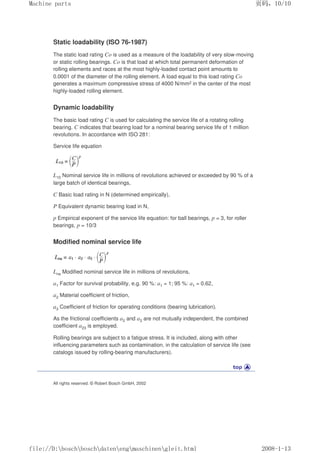

Applications in power electronics: Control of frequency and min–1; rectification and
frequency conversion; switching. In specialized usage, thyristor is understood to
mean a reverse-blocking triode thyristor.
Four-layer diode
DIN definition: A reverse-blocking diode thyristor. A semiconductor device with two
terminals (anode A, cathode K) and switch characteristics. It has four layers of
alternating doping. This device's electrical response is best understood by
visualizing the four-layer structure as representing two transistor paths T1 and T2.
Increasing the current between A and K induces a rise in the reverse currents of
both transistors. At a specific voltage value of UAK (switching voltage), the reverse
current of the one transistor increases to such a degree that it begins to exert a
slight bias effect on the other transistor, resulting in conduction. Meanwhile, the
second transistor operates in the same fashion. The mutual bias effect exerted by
the two transistor units reaches such an intensity that the four-layer diode begins to
act as a conductor: this is the thyristor effect.
Enlarge picture
Four-layer diode and thyristor effect
1 Four-layer structure, 2 Separated into two
transistor paths.
Thyristor with control terminal
DIN definition: Triode thyristor (also SCR, silicon-controlled rectifier), a controllable
device with switching characteristics. It consists of four zones of alternating
conductivity type. Like the four-layer diode, it has two stable states (high resistance
and low resistance). The switching operations between the respective states are
governed via the control terminal (gate) G.
GTO thyristor
DIN definition: Gate turn-off (acronym: GTO) switch activated by positive trigger
pulse, with deactivation via a negative trigger pulse at the same gate.
Triac
DIN definition: Bidirectional triode thyristor (triac = triode alternating current switch),
a controllable thyristor with three terminals. It maintains essentially identical control
properties in both of its two switching directions.
页码,6/8
Electronics
2008-1-10
file://D:boschboschdatenengphysikelektronikhalb.html
Photovoltaic solar cells
The photovoltaic effect is applied to convert light energy directly into electrical
energy.
Solar cells, consisting largely of semiconductor materials, are the basic elements of
photovoltaic technology. Exposure to light results in the creation of free charge
carriers (electron-hole pairs) in the semiconductor material due to the internal
photo-electric effect. If the semiconductor incorporates a pn-junction, then the
charge carriers separate in its electric field before proceeding to the metal contacts
on the semiconductor's surface. Depending on the semiconductor material being
used, a DC voltage (photovoltage) ranging between 0.5 and 1.2 V is created
between the contacts. Connection of a load resistor results in a current flow
(photocurrent) of e.g. 2.8 A for a 100 cm2 Si solar cell at 0.58 V.
The efficiency level with which radiated light energy is converted into electrical
energy (indicated in percent) depends both upon how well the semiconductor
material is suited to the light's spectral distribution, and the efficiency with which the
generated free charge carriers can be isolated and conducted to the appropriate
surface contacts.
The paths within the semiconductor should be short (thin layers from several µm to
300 µm) to prevent the free charge carriers from recombining. The structure of the
crystal lattices in the material must be as perfect as possible, while the material itself
must be free of impurities. The manufacturing processes include procedures of the
type employed for microelectronics components. Silicon is the most commonly used
material for solar cells. It is used in single-crystal, polycrystalline and amorphous
modification. Typical efficiency levels achieved under laboratory conditions include:
Silicon – single crystal 24 %
– polycrystalline 19 %
– amorphous 13 %
CdTe 16 %
CuInSe2 18 %
GaAs1) 28 %
Si/GaAs tandem1) 37 %.
1) Concentrated sunlight.
Average efficiency levels obtained from mass-produced solar cells are
approximately one third lower. The tandem cells achieve their high efficiency by
incorporating two solar cells – made of different materials – in consecutive layers;
the unit is thus capable of converting light from various spectral ranges into charge
carriers.
The individual solar cells are interconnected within a circuit to form solar modules.
The output is always DC voltage; an inverter can be used for the conversion to AC
(e.g., for discharge into mains electrical supply). The characteristic data of a module
are its output voltage and power output in WP referred to full solar exposure
(≈1000 W/m2).
页码,7/8
Electronics
2008-1-10
file://D:boschboschdatenengphysikelektronikhalb.html
The ultimate objective is to develop inexpensive processes allowing the manufacture
of large-area solar cells. Proven procedures include extracting crystals from molten
mass, or cutting cast crystals into individual wafers and blocks. Research is now
extending into new areas such as strip pulling, foil casting and separation of thin
semiconductor layers. Although the energy generated by photovoltaic processes is
still more expensive than that provided by convential power stations, improvements
in cell manufacturing techniques, increases in efficiency, and large-scale production
will combine to allow further reductions in cost. For applications involving isolated
systems (consumers without external electrical connections) and minimal power
requirements (watches, pocket calculators), photovoltaics already represents the
best solution. With a worldwide installed power output of 1 GWP, the photovoltaics
market is currently growing by 16 % every year.
Enlarge picture
Solar cell
1 Light, 2 Electric field, 3 Metal contact.
All rights reserved. © Robert Bosch GmbH, 2002
页码,8/8
Electronics
2008-1-10
file://D:boschboschdatenengphysikelektronikhalb.html
Electronics
Monolithic integrated circuits
Monolithic integration
Planar technology is based on the oxidation of silicon wafers being a relatively
simple matter, and the speed with which the dopants penetrate into silicon being
exponentially greater than that with which they enter the oxide – doping only occurs
at those locations where openings are present in the oxide layer. The specific design
requirements of the individual integrated circuit determine the precise geometric
configuration, which is applied to the wafer in a photolithographic process. All
processing procedures (oxidizing, etching, doping and separation) progress
consecutively from the surface plane (planar).
Planar technology makes it possible to manufacture all circuit componentry
(resistors, capacitors, diodes, transistors, thyristors) and the associated conductor
strips on a single silicon chip in a unified manufacturing process. The semiconductor
devices are combined to produce monolithic integrated circuits: IC = Integrated
Circuit.
Enlarge picture
Basic monolithic
integrated circuit (bipolar)
Circuit and configuration.
1...5 terminals.
This integration generally comprises a subsystem within the electronic circuit and
increasingly comprises the entire system: System on a Chip.
Integration level
Either the number of individual functional elements, the number of transistors, or the
number of gates on a single chip. The following classifications relate to the level of
integration (and chip surface)
 SSI (Small-Scale Integration).
Up to roughly 100 function elements per chip, mean chip surface area 3 mm2, but
can also be very much larger in circuits with high power outputs (e.g. smart power
transistors).
 MSI (Medium-Scale Integration).
Roughly 100 to 1000 function elements per chip, mean chip surface area 8 mm2.
 LSI (Large-Scale Integration).
Up to 100000 function elements per chip, mean chip surface area 20 mm2.
 VLSI (Very-Large-Scale Integration).
页码,1/6
Electronics
2008-1-10
file://D:boschboschdatenengphysikelektronikmonol.html
Up to 1 million function elements per chip, mean chip surface area 30 mm2.
 ULSI (Ultra-Large-Scale Integration). Over 1 million function elements per chip,
surface area up to 300 mm2, smallest structure sizes 0.25 µm.
Computer-aided simulation and design methods (CAE/CAD) are essential elements
in the manufacture of integrated circuits. Entire function blocks are used in VLSI and
ULSI as otherwise the time expenditure and failure risk would make development
impossible.
Classifications for integrated circuitry
 According to transistor engineering:
Bipolar, MOS, mixed (bipolar/MOS, BiCMOS, BCD).
 According to circuit engineering:
Analog, digital, mixed (analog/digital, mixed signal).
 According to component families:
Analog, microcomponents, memories, logic circuits.
 According to application:
Standard IC, application-specific IC (ASIC).
Integrated analog circuits
 Basic structures:
Stabilized-voltage supply, stabilized-current supply, differential amplifier
components, switching elements, potential shift, output stages.
 Application-oriented classes:
Operational amplifiers (OP), voltage regulators, comparators, timers, converters,
interface circuits.
 Special analog ICs:
Voltage references, wideband amplifiers, analog multipliers, function generators,
phase-lock circuits, analog filters, analog switches.
Integrated digital circuits
The scale ranges from LSI (logic chips) through to ULSI (memories,
microcomponents).
Several conditions must be met before logic chips can be combined within a single
system: The voltage supply, logic level, the circuit speed and the signal transit time
must all be identical. This requirement is met within the respective circuit families.
The most important are:
 Various bipolar types: TTL (Transistor-Transistor-Logic), Schottky TTL, Low-
Power Schottky TTL, ECL (Emitter-Coupled Logic) and I2L (Integrated Injection
Logic),
 MOS logic, especially CMOS logic.
MOS and CMOS chips make up 97 % (and the trend is rising) of the production of
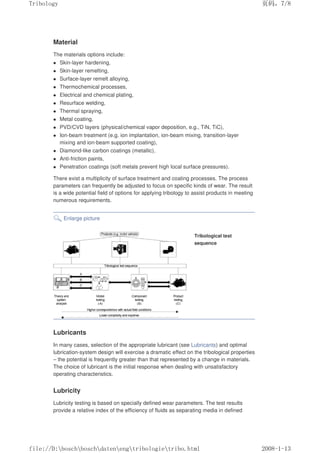
integrated digital circuits.
页码,2/6
Electronics
2008-1-10
file://D:boschboschdatenengphysikelektronikmonol.html
Semiconductor memories
Data storage includes the following operations: Recording (writing, entering), storage
(data storage in the narrow sense), retrieval and readout. The memory operates by
exploiting physical properties that facilitate unambiguous production and recognition
of two opposed states (binary information). In semiconductor memories, the states
produced are conductive/non-conductive or charged/discharged; the latter state
relies on special properties in the silicon/silicon oxide or silicon nitride/metal junction.
Semiconductor memories are divided into the two main categories of volatile and
non-volatile. Virtually all of them are manufactured according to CMOS technology.
 Volatile memories (short-term memories) can be read out and written over an

unlimited number of times, and are thus referred to as RAMs (Random Access
Memory). The data which they contain is lost as soon as the power supply is
switched off.
 Non-volatile memory chips (long-term memories) retain their data even when the
power supply is switched off; they are also referred to as ROMs (Read-Only
Memory).
The chart shows the relationships and classification of the most common types of
memory.
Enlarge picture
Overview of
semiconductor memory
devices
Microprocessors and microcomputers
The microprocessor represents the integration of a computer's central processing
unit on a single chip. Microprocessor design seeks to avoid individualization in the
face of large-scale integration, and the units can be programmed to meet the varied
requirements associated with specific operating conditions. There are two different
main groups of processor:
 For use in PCs (personal computers), CISC processors are used (CISC:
Complete Instruction Set Computing). These processors are very versatile and
user-programmable.
 In WS (work stations), RISC processors are usually used (RISC: Reduced
页码,3/6
Electronics
2008-1-10
file://D:boschboschdatenengphysikelektronikmonol.html
Instruction Set Computing). These processors are very much faster for the
specific tasks frequently associated with WS use, but are significantly slower for
all other tasks.
A microprocessor cannot operate by itself: it always acts as part of a microcomputer.
The microcomputer consists of:
 Microprocessor serving as CPU (central processing unit). The microprocessor
contains the controller, and the arithmetic and logic unit. The arithmetic and logic
unit performs the operations indicated by its name, while the controller ensures
implementation of the commands stored in the program memory.
 Input and output units (I/O), which control data communication with the
peripherals.
 Program memory which provides permanent storage for the operating program
(user program), thus ROM, PROM or EPROM.
 Data memory for the data being run at any given time. These data change
continually; thus the storage medium for this application is the RAM.
 Clock generator and power-supply system.
The bus system links the individual elements of the microcomputer.
A clock generator ensures that all the operations in the microcomputer take place
within a specified timeframe.
Chips for special applications, e.g. for interrupting a program, inserting an
intermediate program etc., are called logic circuits.
Input and output devices and external memories are classed as peripherals.
The main components of a microcomputer are normally combined as separate
components on printed-circuit boards. For simpler tasks, such as e.g. in wireless
communications in the case of Internet access, single-chip computers are
increasingly being used which integrate the above-mentioned functions on a single
silicon chip (system on a chip). The performance of these highly integrated systems
is limited by the relatively small amount of RAM which can be accommodated at
viable expense on the chip.
The microcontroller combines the CPU function, read-only memory (as ROM,
EPROM or EEPROM), input/output capability (I/O) and read/write memory (RAM) on
a single chip. In contrast to the microcomputer, the controller reacts with a
prespecified program which provides particular output values depending on the input
information. It is used to control self- regulating systems such as e.g. engine
management.
The transputer is a special type of microprocessor which is especially useful for
building parallel computer networks. In addition to the standard microprocessor
components, the chip is also equipped with communications and processing
hardware.
It has at least four bidirectional serial transmission channels (links) allowing
extremely rapid communication (500Mbit/s per link) with many other transputers.
Because communications are completely asynchronous, distributed networks do not
require a common clock circuit. Each link has its own DMA controller; once initialized
by the CPU, it can carry out data transmission on its own. Thus processing and
communications are essentially parallel operations. Of particular significance are the
extremely short process switch-over and interrupt response times of  1 µs. The
页码,4/6
Electronics
2008-1-10
file://D:boschboschdatenengphysikelektronikmonol.html
transputer does not need a real-time operating system for this; instead it has the
necessary processing commands directly in its command set.
The transputer operates as a communications node within the parallel network,
meaning that it serves as both computer and communications interface. The
transputer can therefore be employed to avoid one of the gravest liabilities of many
parallel systems, which is the inherent need to share a common bus. Maximum-
performance computers are therefore built using transputers.
Application-specific ICs
Application-specific ICs (ASICs: Application-Specific Integrated Circuits) differ from
standard ICs in that they are conceived to fulfill a single purpose. They are the result
of fruitful cooperation between users, with their specialized system experience, and
manufacturers, who enjoy access to the requisite technology. The essential
advantages of ASICs: fewer components, lower system costs, increased reliability,
more difficult to copy.
The ASIC family is generally classified according to the development method which
has been selected: chip-mounted circuitry, constructed from individual function
elements (full-custom IC), provides the best results with regard to operation and
packaging density. It is, however, only suited for large-series applications (time and
expense).
Standardized basic circuit functions (developed and tested in advance) represent
one step towards rationalizing the development process. The circuits are
incorporated in elements of varying sizes (ROM, RAM, computer core, or
individualized, application-specific circuit groups). Depending upon the number of
available user-specific elements, this method can be employed to reduce
development times without sacrificing efficient exploitation of the chip surface.
The next stage is the use of standardized, relatively complex basic functions which
are developed in advance in standard cells of the same height and variable width.
They are available in the form of cell libraries. These standard cells are automatically
placed in series and then automatically connected with polysilicon and aluminum
conductors. A dual or triple-layer metallic coating can be applied to achieve even
better utilization of the surface area.
Gate arrays are predeveloped as far as the transistor/gate connection, and are
manufactured in advance, leaving only the final masking operations for later
completion. The connection with the application-specific circuitry is then automatic.
Rationalization is achieved by providing standard circuits for frequent basic
computer functions (similar to a cell library). Special gate arrays designed for
specific applications have particular advantages (e.g. pure computer-oriented digital
circuits under the general conditions usual for computers).
Programmable logic devices (PLDs) – completely preassembled transistor arrays –
are programmed by the user in the same way as a special-application PROM. PLDs
thus provide system developers with the option of producing silicon breadboard
circuits within a short period of time. The production of complex systems in silicon is
becoming increasingly important, as it allows the production of practical working
models in the development phase.
页码,5/6
Electronics
2008-1-10
file://D:boschboschdatenengphysikelektronikmonol.html
Smart-power ICs
Automotive and industrial systems rely upon electronics to govern numerous final-
control elements and other loads. The power switches must be capable of assuming
auxiliary functions extending beyond the control of circuit power: driver circuits for
activating switching transistors, protective circuits for excess current, voltage and
temperature, fault acknowledgments in case of incorrect operation. Such bipolar or
MOS-technology power ICs are generically termed smart-power ICs.
All rights reserved. © Robert Bosch GmbH, 2002
页码,6/6
Electronics
2008-1-10
file://D:boschboschdatenengphysikelektronikmonol.html
Electronics
Film and hybrid circuits, MCM
Film circuits
The integrated film circuit features passive circuit elements – these include
capacitors and inductors, as well as conductor tracks, insulators and resistors. An
integrated film circuit is produced by applying the layers which contain these
elements to a substrate carrier. The terms thin-film and thick-film circuit derive
from the fact that the film thickness was originally the determining factor for tailoring
to specific performance characteristics; present technology employs a variety of
manufacturing techniques to achieve the same end.
Thin-film circuits
Integrated film circuits on which the individual layers are applied to glass or ceramic
substrata, usually in a vacuum coating process. Advantages: fine structures (to
approx. 10 µm) provide high circuit-element density, extremely good HF
characteristics and low-noise resistor elements. On the minus side are the relatively
high manufacturing costs.
Thick-film circuits
Integrated film circuits in which the layers are usually applied to ceramic carriers in a
silk-screening process before being fused on. Advantages: Multi-layer construction
provides high circuit-element density and good HF characteristics. A high degree of
manufacturing automation is possible for large-scale production.
Multilayer ceramic substrates
The base material for the multilayer ceramic substrate is the unfired ceramic foil to
which conductor tracks are applied in a silk-screening process. In the next step, a
number of these foils are laminated together to form a multilayer substrate. This
device is then sintered at high temperature (850 ... 1600 °C) to form a hard ceramic
device featuring integrated conductive paths. A metal paste is applied to the orifices
between the individual foils to form the interlayer electrical connections. Special
materials are employed to integrate resistors and capacitors in the device. This
process provides for substantially higher levels of circuit density than thick-film
devices.
Hybrid circuits
Integrated film circuits with additional discrete components such as capacitors and
integrated semiconductor circuits (ICs) which are attached by soldering or adhesive
bonding. A high component density is achieved by using unpacked semiconductor
chips which are contacted by means of bonding, or SMD components
页码,1/2
Electronics
2008-1-10
file://D:boschboschdatenengphysikelektronikmcm.html
(SMD Surface Mounted Device). A multilayer ceramic substrate can be used to
achieve extremely small hybrid control devices (microhybrids). Advantages: The
good thermal dissipation allows high installation temperatures, while compact
construction provides good vibration resistance along with good HF response
characteristics. Hybrid circuits are especially well-suited for automotive applications
and for telecommunications.
MCM
MCM (Multi Chip Module) is used to identify an electronic component consisting of
numerous unpacked integrated semiconductors (ICs). The basic element is the
carrier substrate with its internal circuits. The ICs are unpacked and contacted by
means of bonding or TAB or flip-chip soldering. An MCM can also contain resistors
and capacitors as required.
Classification is according to the selected substrate material:
 MCM-C multilayer ceramic substrate,
 MCM-D thin-layer design, generally on silicon,
 MCM-L organic multilayer laminate.
The MCM is generally selected to achieve compliance with specific operating
requirements. It combines rapid switching response in processor cores with
favorable EMC characteristics and extremely compact packages. The MCM is
frequently employed to obtain electrical performance characteristics that would be
either prohibitively expensive or downright impossible to obtain from current IC
technology.
All rights reserved. © Robert Bosch GmbH, 2002
页码,2/2
Electronics
2008-1-10
file://D:boschboschdatenengphysikelektronikmcm.html
Electronics
Circuit-board technology, SMT
The circuitry of an electronic system can basically be implemented in accordance
with semiconductor, hybrid and circuit-board technologies. Selection is contingent
upon such factors as economy (cost, production-run sizes), time (development time,
service life) and environmental conditions (electrical, thermal, physical).
Circuit-board technology, design options
a) Insertion mounting (conventional),
b) SMD mounting on ceramic substrate (hybrid
technology),
c) Mixed mounting.
1 Wired components, 2 Circuit board, 3 Chips,
4 Ceramic substrate, 5 Bonding material.
Circuit boards represent the classical form for producing an electrical circuit. On the
most basic type of circuit board, the electronic components are mounted on a
fiberboard or fiberglass-reinforced synthetic-resin carrier. A printing process is
employed to apply the conductor tracks (copper foil) to the board (thus: printed
circuit). An alternative is to etch the circuit from a copper-plated board. The
components' contact pins are inserted through holes in the board and soldered into
position.
The increasing IC integration level resulted in a commensurate rapid increase in the
number of terminals (pins). This development initiated the transition from
conventional insertion-mounting to SMT (Surface Mounting Technology). In the
meantime, there is a very wide range of surface-mountable components (SMD
Surface Mount Devices) which are soldered flat to the circuit board. These SMD
components and their housing configurations (SOT, PQFP, PLCC, Flat Pack etc.)
are particularly suitable for processing in automatic insertion machines.
The most important application advantages provided by surface-mounting
technology include:
 Efficient production of subassemblies (high insertion capacity and reliability),
页码,1/2
Electronics
2008-1-10
file://D:boschboschdatenengphysikelektronikleitp.html
Low space requirements with the same function capacity even in the case of
insertion on both sides,
 Use of normal circuit boards (e.g. laminated epoxy-resin plastic FR4),
 Omission or reduction of holes in each circuit board,
 Can be combined with wired components,
 Increased reliability due to reduction of connection points,
 Improved circuit design, coupling and reproducibility,
 Better HF characteristics.
Surface-mounting technology is much more sensitive to the combination of
processing techniques than is conventional insertion mounting. The advantages of
SMT are directly proportional to the care with which componentry, circuit-board
layout, automatic mounting, joining techniques, testing, repair, etc., are mutually
adapted for optimal performance.
All rights reserved. © Robert Bosch GmbH, 2002
页码,2/2
Electronics
2008-1-10
file://D:boschboschdatenengphysikelektronikleitp.html
Electronics
Micromechanics
The term micromechanics is employed to designate the production of mechanical
components using semiconductors (generally silicon) and semiconductor
technology. This type of application exploits both the semiconductive and the
mechanical properties of silicon. The first micromechanical silicon pressure sensors
were installed in motor vehicles at the beginning of the 1980's. Typical mechanical
dimensions can extend into the micrometer range.
The mechanical characteristics of silicon (e.g., strength, hardness and Young's
modulus, see Table) can be compared to those of steel. However, silicon is lighter
and has greater thermal conductivity. Single-crystal Si wafers with almost perfect
physical response characteristics are used: Hysteresis and surface diffusion are
negligible. Due to the brittleness of the single-crystal material, the stress-strain curve
does not display a plastic range; the material ruptures when the elastic range is
exceeded.
Variable Unit Silicon Steel (max.) Stainless steel
Tensile load 105 N/cm2 7.0 4.2 2.1
Knoop hardness kg/mm2 850 1500 660
Elastic modulus 107 N/cm2 1.9 2.1 2.0
Density g/cm3 2.3 7.9 7.9
Thermal conductivity W/cm · K 1.57 0.97 0.33
Thermal expansion 10–6/K 2.3 12.0 17.3
Two methods of manufacturing micromechanical structures in silicon have
established themselves: bulk micromechanics and surface micromechanics.
Both methods use the standard procedures of microelectronics (e.g. epitaxial
growth, oxidation, diffusion and photolithography) together with some additional
special procedures: For the removal of material, bulk micromechanics requires
anisotropic etching with or without electrochemical etch stop, while surface
micromechanics requires vapor-phase etching and deep trenching. Anodic bonding
and seal-glass bonding are used to hermetically join two wafers (capping, inclusion
of reference vacuum).
Enlarge picture
Electrochemical etching
a) Isotropic (in acid etching
media), b) Anisotropic (in alkaline
etching media). 1 Etching mask
(e.g. oxide or nitride), 2 (100)-
silicon.
页码,1/3
Electronics
2008-1-10
file://D:boschboschdatenengphysikelektronikmikro.html
Bulk micromechanics (BMM)
This method involves etching the entire wafer from the reverse side in order to
produce the desired structure. The etching process takes place in alkaline media
(caustic potash solution), in which the etching behavior of silicon demonstrates
pronounced anisotropy, i.e. the etching rate is greatly dependent on the crystal
direction. It is thus possible to represent the structure very accurately in terms of
depth. When silicon wafers with (100)-orientation are used, the (111)-surfaces for
example remain virtually unaffected. In the case of anisotropic etching, (111)-
surfaces therefore develop which form with the (100)-surface a characteristic angle
of 54.74°.
In the simplest case, the etching process is stopped after a certain period of time
while wafer thickness and etching rate are taken into consideration (time etching).
However, for the most part, an electrochemical etch stop is engaged whereby the
etching comes to a halt at the boundary of a pn-junction. BMM can be used to
produce diaphragms with typical thicknesses of between 5 and 50µm for
applications such as pressure sensors and air-mass meters.
Enlarge picture
Structures produced with bulk
micromechanics
1 Diaphragms, 2 Openings,
3 Beams, bridges.
Surface micromechanics (SMM)
In contrast to bulk micromechanics, SMM merely uses the silicon wafer as the base
material. Moving structures are formed from polycrystalline silicon layers which,
similar to a manufacturing process for integrated circuits, are deposited on the
surface of the silicon by epitaxial growth.
When an SMM component is made, a sacrificial layer of silica is first applied and
structured with standard semiconductor processes. An approx. 10µm thick
polysilicon layer (epipoly layer) is then applied at high temperatures in an epitaxial
reactor. The epipoly obtains the desired structure with the aid of a lacquer mask and
anisotropic, i.e. vertical etching (deep trenching). The vertical side walls are obtained
by an alternation of etching and passivation cycles. After an etching cycle, the
etched side-wall section is provided during passivation with a polymer as protection
so that it is not attacked during the subsequent etching. Vertical side walls with a
high representation accuracy are created in this way. In the last process stage, the
sacrificial oxide layer beneath the polysilicon layer is removed with gaseous
hydrogen fluoride in order to expose the structures.
Among other things, SMM is used in the manufacture of capacitive acceleration
页码,2/3
Electronics
2008-1-10
file://D:boschboschdatenengphysikelektronikmikro.html
sensors with movable and fixed electrodes for capacitive evaluation, and rotation-
rate sensors with quasirotatory oscillators.
Enlarge picture
Process stages in surface micromechanics
1 Separation and structuring of sacrificial layer,
2 Separation of polysilicon, 3 Structuring of
polysilicon, 4 Removal of sacrificial layer and
thus creation of freely moving structures on
surface.
Wafer bonding
In addition to structuring the silicon, joining two wafers represents another essential
task for micromechanical production engineering. Joining technology is required in
order for example to hermetically seal cavities (e.g. inclusion of reference vacuum in
pressure sensors), to protect sensitive structures by applying caps (e.g. for
acceleration and rotation-rate sensors), or to join the silicon wafer with intermediate
layers which minimize the thermal and mechanical stresses (e.g. glass base on
pressure sensors).
With anodic bonding, a Pyrex-glass wafer is joined to a silicon wafer at a voltage of
some 100V and a temperature of approx. 400°
C. At these temperatures, the alkaline
ions in the Pyrex glass move. This creates a depletion layer at the boundary to the
silicon, through which the applied voltage drops. A strong electrostatic attraction and
an electrochemical reaction (anodic oxidation) result in a permanent hermetic bond
between the glass and the silicon.
With seal-glass bonding, two silicon wafers are contacted by way of a glass-solder
layer applied in the screen-printing process at approx. 400°C and under the exertion
of pressure. The glass solder melts at this temperature and produces a hermetically
sealed bond with the silicon.
Anodic wafer bonding
1 Pyrex glass, 2 Silicon,
3 Heating plate (T = 400 °
C).
All rights reserved. © Robert Bosch GmbH, 2002
页码,3/3
Electronics
2008-1-10
file://D:boschboschdatenengphysikelektronikmikro.html
Electronics
Mechatronics
Mechatronics is a branch of engineering which seeks to enhance the functionality of
technical systems by close integration of mechanical, electronic and data-processing
components. Mechatronic systems play an important role in the form of complex
control structures (especially in automotive and production engineering). Examples
are engine-management systems for spark-ignition and diesel engines, ABS, TCS,
stability and steering systems, electrical drives, CNC machine tools and handling
systems. The mechanical components in these systems are frequently characterized
by both non-linear response and extensive operating ranges.
The development of mechatronic systems requires a synergistic, interdisciplinary
approach which combines modelling on different abstraction levels and inter-domain,
model-supported design procedures and software engineering. Here, the classical
analysis and design procedures of control engineering are being supplemented and
partially replaced by real-time simulations, identification and parameter optimization
with the inclusion of real components (hardware-in-the-loop).
The objective of microsystems technology is to miniaturize mechatronic systems by
integrating microelectronics and micromechanics.
Enlarge picture
Interrelationships in mechatronics
All rights reserved. © Robert Bosch GmbH, 2002
页码,1/1
Electronics
2008-1-10
file://D:boschboschdatenengphysikelektronikmecha.html
Electronics
Analog/digital conversion
Analog signals are electrical quantities whose amplitude, frequency and phase
convey information on physical variables or technical processes. Data registration is
continuous in both time and quantity; within certain limits, analog signals can reflect
any number of quantitative variations at any given point in time. Analog technology
provides means for processing these signals. Initial processing, consisting of filtering
and amplification, can be supplemented by mathematical operations such as
addition and multiplication, as well as integration over time, etc. The operational
amplifier (OP) is an integrated circuit of extreme importance in analog technology.
Under ideal conditions, a relatively simple external circuit is sufficient for determining
its operating characteristics (infinite amplification, no input current).
Enlarge picture
Operational amplifier (OP)
a) Inversion amplifier, b) Differential amplifier.
Analog units also have several disadvantages: the characteristic response curves of
the various components alter with age, temperature fluctuations influence precision,
and the manufacturing process must generally be supplemented by subsequent
calibration.
Conversion to digital signals entails a transition to discrete monitoring of both time
and intensity, i.e., the analog signal is sampled with specific periodicity (scan spots).
The sampled values are assigned a numeric expression in which the number of
possible values and thus the resolution are limited (quantification).
Instead of using the decimal system, digital technology uses the binary system
which is easier for the computer to handle.
页码,1/3
Electronics
2008-1-10
file://D:boschboschdatenengphysikelektronikanal.html
Enlarge picture
Digital conversion of an analog signal
F Filter, S/H Sample-and-hold element,
A/D Analog/digital converter.
Example: 101 (dual) =
1 · 22 + 0 · 21 + 1 · 20 = 5 (decimal).
The bit (position) with the greatest value i s termed the MSB (Most Significant Bit),
the lowest the LSB (Least Significant Bit). When represented as a two's
complement, the MSB provides the prefix for the decimal number (1 negative, 0
positive). Values ranging from – 4 to + 3 can be represented with a 3-bit word.
Example: 101 =
– 1 · 22 + 0 · 21 + 1 · 20 = – 3.
A word of n bits in length is able to represent 2n different values. This is 256 for
8 bits, for 16 bits it is 65 536. An analog input voltage of ±5 V (FSR – Full Scale
Range) results in a resolution (LSB value) of 39 mV for 8 bits and 0.15 mV for
16 bits.
It is necessary to limit the bandwidth of the time signal being scanned (anti-aliasing
filter). The highest signal frequency fg must be less than half the scanning frequency
fA (fA 2 · fg). If a sample-and-hold scanning element is not employed, the maximum
allowable variation in input voltage during the A/D converter's conversion period
(aperture time) is one LSB.
The transfer function illustrates how a single digital value is assigned to various input
voltages. The maximum amplitude of the quantification error is Q/2 (rounding-off
error) at Q = FSR/(2n) LSB.
The quantification process results in an overlay of quantification noise which
contaminates the actual data signal. If a sinus-curve signal is employed for full
modulation in the A/D converter, the result is a signal-to-noise ratio which increases
by about 6 dB for each additional bit of resolution. Actual A/D converters display
deviations from the ideal transfer curve. These are caused by offset, amplification
页码,2/3
Electronics
2008-1-10
file://D:boschboschdatenengphysikelektronikanal.html
and linearity errors (static errors) as well as aperture inconsistency and finite settling
times (dynamic error).
Enlarge picture
Transfer function of an ideal 3-bit A/D
converter
All rights reserved. © Robert Bosch GmbH, 2002
页码,3/3
Electronics
2008-1-10
file://D:boschboschdatenengphysikelektronikanal.html
Sensors
Basics
Assignment
Sensors convert a physical or chemical (usually non-electrical) quantity into an
electrical quantity (non-electrical intermediate stages may be employed).
Classifications
1. Purpose and application
 Function (open-loop and closed-loop control circuits),
 Safety and back-up,
 Monitoring and information.
2. Types of characteristic curve
 Continuous linear: Control applications across a broad measurement range,
 Continuous non-linear: Closed-loop control of a measured variable within a
narrow measurement range,
 Discontinuous multi-stage: Monitoring in applications where a punctual signal is
required when a limit value is reached,
 Discontinuous dual-stage (with hysteresis in some cases): Monitoring of
correction thresholds for immediate or subsequent adjustments.
Types of characteristic curve
S Output signal, X Measured variable.
a) Continuous linear, b) Continuous nonlinear,
c) Discontinuous multi-stage,
d) Discontinuous dual-stage.
3. Type of output signal
Output signal proportional to:
 current/voltage, amplitude,
页码,1/4
Sensors
2008-1-10
file://D:boschboschdatenengphysiksensorengrundl.html
frequency/periodicity
 pulse duration/pulse duty factor.
Discrete output signal:
 dual stage (binary),
 multi-stage (irregular graduation),
 multi-stage (equidistant) or digital.
Enlarge picture
Signal shapes (examples).
Output signal U:
a) Frequency f, b) Pulse duration TP.
Automotive applications
In their function as peripheral elements, sensors and actuators form the interface
between the vehicle with its complex drive, braking, chassis, suspension and body
functions (including guidance and navigation functions) and the usually digital-
electronic control unit (ECU) as the processing unit. An adapter circuit is generally
used to convert the sensor's signals into the standardized form (measuring chain,
measured-data registration system) required by the ECU.
In addition, system operation can be influenced by sensor information from other
processing elements and/or by driver-operated switches.
Display elements provide the driver with information on the static and dynamic status
of vehicle operation as a single synergistic process.
Enlarge picture
Automotive sensors
Φ Physical quantity, E Electrical quantity,
Z Influencing quantities, AK Actuator, AZ Display,
SA Switch, SE Sensor(s), SG Control unit (ECU).
1 Measuring sensor, 2 Adapter circuit, 3 Driver,
4 Actuators.
页码,2/4
Sensors
2008-1-10
file://D:boschboschdatenengphysiksensorengrundl.html
Main technical requirement, trends
The degree of stress to which the sensor is subjected is determined by the operating
conditions (mechanical, climatic, chemical, electromagnetic influences) present at
the installation location (for standard Degrees of Protection, see DIN 40 050,
Sheet 9).
According to application and technical requirements, automotive sensors are
assigned to one of three reliability classes:
Class 1: Steering, brakes, passenger protection,
Class 2: Engine, drivetrain, suspension, tires,
Class 3: Comfort and convenience, information/diagnosis, theft deterrence.
Miniaturization concepts are employed to achieve compact unit dimensions.
 Substrate and hybrid technology (pressure and temperature sensors),
 Semiconductor technology (monitoring rotational speed, e.g., with Hall sensors),
 Micromechanics (pressure and acceleration sensors),
 Microsystem technology (combination of micromechanics, micro-electronics, can
also include micro-optics).
Integrated intelligent sensors
Systems range from hybrid and monolithic integrated sensors and electronic signal-
processing circuits at the measuring point, all the way to complex digital circuitry,
such as A/D converters and microcomputers (mechatronics), for complete utilization
of the sensor's inherent precision. These systems offer the following benefits and
options:
 Reduction of load on the ECU,
 Uniform, flexible, bus-compatible communications links,
 Multiple application of sensors,
 Multi-sensor designs,
 By means of local amplification and demodulation, very small quantities and HF
signals can be processed,
 Correction of sensor deviations at the measuring point, and common calibration
and compensation of sensor and circuit, are simplified and improved by storage of
the individual correction information in PROM.
Enlarge picture
Sensor integration levels
SE Sensor(s), SA Signal
processing (analog),
A/D Analog-digital
converter, SG Digital control
unit (ECU),
MC Microcomputer.
页码,3/4
Sensors
2008-1-10
file://D:boschboschdatenengphysiksensorengrundl.html
Fiber-optic sensors
Various physical factors can be employed to modify the intensity, phase (coherent
laser light) and polarization of the light conducted in the optical fibers. Fiber-optic
sensors are impervious to electromagnetic interference; they are, however, sensitive
to physical pressure (intensity-modulation sensors), and, to some degree, to
contamination and aging. Inexpensive plastic fibers are now available for application
within some of the temperature ranges associated with automotive applications.
These sensors require special couplers and plug connections.
Extrinsic sensors: The optical conductor generally conducts the light to an end point;
it must emerge from the conductor to exert an effect.
Intrinsic sensors: The measurement effect occurs internally within the fibers.
All rights reserved. © Robert Bosch GmbH, 2002
页码,4/4
Sensors
2008-1-10
file://D:boschboschdatenengphysiksensorengrundl.html
Sensors
Position sensors (displacement/angle)
Position sensors employ both contact wipers and non-contacting (proximity) designs
to register displacement and angle.
Directly monitored variable quantities:
 Throttle-valve position,
 Accelerator-pedal position,
 Seat and mirror position,
 Control-rack travel and position,
 Fuel level,
 Travel of clutch servo unit,
 vehicle obstruction,
 Steering (wheel) angle,
 Tilt angle,
 Vehicle-course angle,
 Brake-pedal position.
Indirectly monitored variable quantities:
 Sensor-flap deflection angle (flow rate/FLR),
 Deflection angle of a spring-mass system (acceleration),
 Diaphragm deflection angle (pressure),
 Suspension compression travel (headlamp vertical-aim adjustment),
 Torsion angle (torque).
Wiper or film potentiometers
The wiper potentiometer measures travel by exploiting the proportional relationship
between the length of a wire or film resistor (conductor track) and its electrical
resistance. This design currently provides the most economical travel and angle
sensors.
The voltage on the measurement track is usually routed through smaller series
resistors RV for overload protection (as well as for zero and progression-rate
adjustments). The shape of the contour across the width of the measurement track
(including that of individual sections) influences the shape of the characteristic curve.
The standard wiper connection is furnished by a second contact track consisting of
the same material mounted on a low-resistance substrate. Wear and measurement
distortions can be avoided by minimizing the current at the pickup (IA  1 mA) and
sealing the unit against dust.
Enlarge picture
Wiper potentiometer
1 Wiper, 2 Resistor track, 3 Contact track.
U0 Supply voltage, UA Measurement voltage,
页码,1/9
Sensors
2008-1-10
file://D:boschboschdatenengphysiksensorenausf.html
R Resistor, α Measurement angle.
Short-circuiting ring sensors
Short-circuiting ring sensors consist of a laminated soft-magnetic core (straight/
curved U- or E-shape), a coil and a moving, highly-conductive short-circuiting ring
made of copper or aluminum.
When an AC voltage is applied at the coil, a current I is created which is dependent
on the inductance of the coil. The eddy currents thereby created in the short-
circuiting ring limit expansion of the magnetic flux to the area between the coil and
the ring itself. The position of the short-circuiting ring influences the inductance and
thus the coil current. The current I is thus a measure of the position of the short-
circuiting ring. Virtually the entire length of the sensor can be utilized for
measurement purposes. The mass to be moved is very low. Contouring the distance
between the sides influences the shape of the characteristic curve: Reducing the
distance between the sides toward the end of the measuring range further enhances
the good natural linearity. Operation is generally in the 5...50 kHz range, depending
on material and shape.
Enlarge picture
Short-circuiting ring sensor
1 Short-circuiting ring (movable), 2 Soft
magnetic core, 3 Coil.
I Current, IW Eddy current, L(x) Inductance
and Φ(x) magnetic flux at travel x.
Half-differential sensors employ a moving measuring ring and a stationary reference
short-circuiting ring to meet exacting demands for precision (on diesel fuel-injection
pumps, the rack-travel sensor for in-line units, and angular-position sensors in the
injected-fuel-quantity actuator of distributor-type injection pumps); they measure by
acting as
 inductive voltage dividers (evaluation L1/L2 or (L1 – L2)/(L1+L2)) or as
 frequency-definition elements in an oscillating circuit, producing a signal
proportional to frequency (excellent interference resistance, easy digital
conversion).
The measuring effect is fairly substantial, typically Lmax/Lmin = 4.
页码,2/9
Sensors
2008-1-10
file://D:boschboschdatenengphysiksensorenausf.html
Enlarge picture
Half-differential sensor
1 Reference (fixed), 2 Short-circuiting ring
(movable), A/D Analog-digital converter,
SA Signal processing, SG Control unit (ECU).
Other sensor types
Solenoid plunger, differential-throttle and differential-transformer sensors operate
based on the variation in the inductance of an individual coil and the proportional
relationship of voltage dividers (supplied either directly or via inductive coupling) with
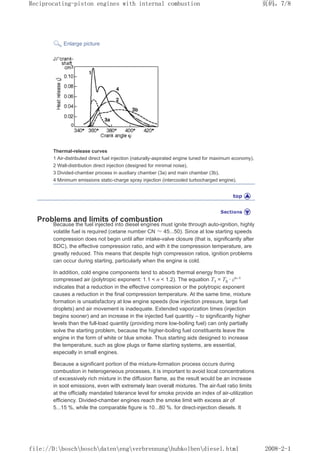
moving cores. The overall length is often considerably greater than the
measurement travel. This disadvantage is avoided by using a multistage winding in
chambers of different dimensions. With this sensor, for angular measurement, the
angle of rotation must be mechanically converted to a linear movement.
HF eddy-current sensors (electronics at the measuring point) are suitable e.g. for

non-contact measurement of the throttle angle and the accelerator-pedal position.
Here, the inductance of mostly nonferrous coils is modified by the approach of
conductive shaped parts (spoilers) or by variable overlapping with them. Because of
the frequently high operating frequency (MHz range), the signal electronics is mostly
accommodated directly on the sensor. This is the case for example when two coils
are wound onto a common cylinder (differential sensor) for measuring the throttle
angle. The same principle is used on sensors incorporating single lateral coils to
measure clutch positions (70 mm measurement range) at substantially lower
frequencies (approx. 7.5 kHz). The first of the above sensor types features a
cylindrical aluminum spoiler with special recesses and is designed to pivot over the
coil winding. The second concept monitors the penetration depth of an aluminum
short-circuit tube within the sensor coil.
Enlarge picture
Eddy-current pedal-travel sensor
1 Spoiler. φ Angle of rotation, L1, L2 Inductance of
semicylindrical coils.
Integrated Hall ICs
The Hall effect is a galvanomagnetic effect and is evaluated mainly by means of thin
页码,3/9
Sensors
2008-1-10
file://D:boschboschdatenengphysiksensorenausf.html
semiconductor chips. When such a current-carrying chip is permeated vertically by a
magnetic induction B, a voltage UH proportional to the field can be picked off
transversely to the current direction (Hall effect) while the chip resistance
simultaneously increases in accordance with a roughly parabolic characteristic
(Gaussian effect, magnetoresistor). When Si is used as the base material, a signal-
conditioning circuit can at the same time be integrated on the chip, which makes
such sensors very economical.
Enlarge picture
Galvanomagnetic effects.
a) Circuit, b) Characteristic of Hall voltage UH,
c) Increase in chip resistance R (Gaussian
effect). B Inductance, UR Longitudinal
voltage.
A disadvantage in the past proved to be their sensitivity to the mechanical stress
which was inevitable due to packaging and resulted in an unfavorable offset
temperature coefficient. This disadvantage has been overcome by the application of
the spinning-current principle. This now made Hall ICs well suited for analog
sensor applications. Mechanical interference (piezoresistive effects) is suppressed
by rapid, electronically controlled rotation of the electrodes or cyclical switching of
the electrodes and averaging of the output signal.
Enlarge picture
Hall sensor according to spinning-current
principle
a) Rotation phase φ1, b) Rotation phase
φ2 = φ1 + 45°
.
1 Semiconductor chip, 2 Active electrode,
3 Passive electrode. I Supply current, UH Hall
voltage.
页码,4/9
Sensors
2008-1-10
file://D:boschboschdatenengphysiksensorenausf.html
Such integrated Hall ICs are mainly suitable for measuring limited travel ranges in
that they register the fluctuating field strengths of a permanent magnet as a function
of the magnet's distance from the IC. Larger angles up to 360°(e.g. for recording the
camshaft position) can be measured e.g. with the configuration shown in the
illustration: The two Hall-effect sensors arranged at right angles supply
sinusoidal/cosinusoidal signals which can be converted by means of the arctan
function into the angle of rotation φ. In principle, the configuration can also be
integrated in planar form with VHDs (Vertical Hall Devices).
It is also possible with a rotating magnet ring and some fixed soft-magnetic
conductors to obtain a linear output signal directly for larger angle ranges without
conversion. In this case, the bipolar field of the magnet ring is passed through a Hall-
effect sensor arranged between semicircular flux concentrating pieces. The effective
magnetic flux through the Hall-effect sensor is dependent on the angle of rotation φ.
The disadvantage here is the persisting dependency on geometrical tolerances of
the magnetic circuit and intensity fluctuations of the permanent magnet.
Enlarge picture
Analog Hall sensor for 360°
a) Built from discrete Hall ICs, b) Built from planar-
integrated Hall ICs.
1 Signal electronics, 2 Camshaft, 3 Control magnet.
B Inductance, I Current, U Voltage,
UA Measurement voltage.
Enlarge picture
Analog Hall angle sensor with linear characteristic
for angles up to approx. 180°
a) Position a, b) Position b, c) Output signal. 1 Magnetic
yoke, 2 Stator (1, 2 Soft iron), 3 Rotor (permanent
magnet), 4 Air gap, 5 Hall sensor. φ Angle of rotation.
页码,5/9
Sensors
2008-1-10
file://D:boschboschdatenengphysiksensorenausf.html
The simplest Hall ICs (Hall-effect switches) also permit – in conjunction with a
small working-point magnet – the construction of digital angle sensors up to 360 °.
For this purpose, for an n-bit resolution, n Hall-effect switches are arranged
equidistantly in a circle. A soft-magnetic code disk blocks the field of the individual
overlying permanent magnets, or enables it, so that when the disk is rotated further
the Hall-effect switches in succession generate n different code words. The Gray
code is used to avoid large indication errors in intermediate states. To implement a
steering-wheel angle sensor, for example, the code disk is connected to the steering
spindle while the rest of the sensor is connected to the chassis. Multiple rotations
can be recorded with an additional, simple 3-bit configuration whose code disk is
moved by means of a reduction gear. The resolution of such configurations is mostly
no better than 2.5°.
Enlarge picture
Digital 360°Hall angle sensor with a circular,
equidistant arrangement of simple Hall switches
1 Housing cover with permanent magnets, 2 Code disk
(soft-magnetic material), 3 Board with Hall switches.
Sensors of the future
Magnetoresistive NiFe thin-film sensors (AMR – anisotropic magnetoresistive thin-
film NiFe, permalloy) provide extremely compact designs for contactless, proximity-
based angular-position sensors.
The substrate consists of oxidized silicon layers in which electronic signal-
processing circuits can be incorporated as desired. The magnetic control field B is
usually generated by a pivoting magnet located above the sensor.
Enlarge picture
AMR steering-angle sensor
1 Steering spindle, 2 Gear with n  m teeth, 3 Gear
with m teeth, 4 Gear with m+1-teeth, 5 Magnets. φ,
ψ, Θ Angle of rotation.
页码,6/9
Sensors
2008-1-10
file://D:boschboschdatenengphysiksensorenausf.html
Magnetoresistive angle sensors in barber's pole configuration display serious
limitations in both precision and measurement ranges (max. ± 15°
). Operation is
based on the detuning of a magnetoresistant voltage divider consisting of
longitudinal permalloy resistors with high-conductance lateral strips in gold.
Enlarge picture
Magnetoresistive angle sensor (barber's pole
configuration).
1 AMR, anisotropic magnetoresistive element
(barber's pole), 2 Rotating permanent magnet
with control inductance B, 3 Response curves for
low, and, 4 for high operating temperature.
a Linear, b Effective measurement range.
α Measurement angle, UA Measurement and
U0 supply voltages.
Magnetoresistive angle sensors in pseudo-Hall configuration utilize the inherent
precision in the sinusoidal pattern of signals monitored at the output terminals of a
quadripolar planar sensor structure. A second element installed at 45°generates a
supplementary cosinusoidal signal. From the mutual relationship of the two signal
voltages, it is possible (e.g. using the arctan function) to determine the angle α (e.g.
with a microcontroller or ASIC) with great accuracy over a range of 180°, largely
irrespective of fluctuations in temperature and magnetic-field intensity (distance,
aging).
Enlarge picture
Magnetoresistive angle sensor
(pseudo-Hall version)
a) Measurement concept, b) Sensor
structure.1 Thin NiFe layer (AMR sensor),
2 Pivoting permanent magnet with inductive
control B, 3 Hybrid, 4 ASIC, 5 Electrical
connection.
IV Supply current, UH1, UH2 Measurement
voltages, α Measurement angle.
页码,7/9
Sensors
2008-1-10
file://D:boschboschdatenengphysiksensorenausf.html
The task of measuring various rotations of a rotating part (e.g. steering spindle) is
solved with a dual configuration of pseudo-Hall angle sensors. Here the two
associated permanent magnets are moved by the rotating part via a step-up gear
train. However, as the two smaller driving gears differ to the tune of one tooth, their
mutual phase angle is a clear measure of the absolute angular position. Each
individual sensor also offers an indeterminate fine resolution of the angle of rotation.
This configuration provides a resolution more precise than 1°for e.g. the entire
steering-angle range of four full rotations.
Systems for monitoring vehicle to vehicle distances can use ultrasonic transit-time
processes (close-range, 0.5...5 m), as well as processes based on transit-time and
triangulation principles using short-range infrared light (lidar: mid-range
measurements extending up to 50 m). Another option is electromagnetic radar (long-
range operation, up to 150 m).
ACC systems (Adaptive Cruise Control) with just such a long-range radar sensor are
vehicle-speed controllers with automatic detection of vehicles which are driving in
front in a lane and where braking may be required. A working frequency of 76 GHz
(wavelength approx. 3.8 mm) permits the compact design required for automotive
applications. A Gunn oscillator (Gunn diode in the cavity resonator) feeds in parallel
three adjacently arranged patch antennas which at the same time also serve to
receive the reflected signals. A plastic lens (Fresnel) set in front focuses the
transmitted beam, referred to the vehicle axle, horizontally at an angle of ± 5°and
vertically at an angle of ± 1.5°. Due to the lateral offset of the antennas, their
reception characteristic (6 dB width 4°
) points in different directions. As well as the
distance of vehicles driving in front and their relative speed, it is thus also possible to
determine the direction under which they are detected. Directional couplers separate
transmitted and received reflection signals. Three downstream mixers transpose the
received frequency down to virtually zero by admixing the transmit frequency
(0...300 kHz). The low-frequency signals are digitized for further evaluation and
subjected to a high-speed Fourier analysis to determine the frequency.
Enlarge picture
ACC-sensor control unit
(block diagram).
The frequency of the Gunn oscillator is compared continually with that of a stable
reference oscillator DRO (Dielectric Resonance Oscillator) and regulated to a
prespecified setpoint value. Here the supply voltage to the Gunn diode is modulated
until it corresponds again to the setpoint value. This control loop is used for
measurement purposes to increase and reduce the Gunn-oscillator frequency every
100 ms briefly in a saw-tooth manner by 300 MHz (FMCW Frequency Modulated
Continuous Wave). The signal reflected from the vehicle driving in front is delayed
页码,8/9
Sensors
2008-1-10
file://D:boschboschdatenengphysiksensorenausf.html
according to the propagation time (i.e. in a rising ramp by a lower frequency and in a
falling ramp by a frequency higher by the same amount). The frequency difference
∆f is a direct measure of the distance (e.g. 2 kHz/m). If however there is additionally
a specific relative speed between the two vehicles, the received frequency fe is
increased on account of the Doppler effect in both the rising and falling ramps by a
specific, proportional amount ∆fd (e.g. 512 Hz per m/s), i.e. there are two different
difference frequencies ∆f1 and ∆f2. Their addition produces the distance between the
vehicles, and their difference the relative speed of the vehicles. This method can be
used to detect and track up to 32 vehicles.
Magnetic-field sensors (saturation-core probes) can monitor the vehicle's direction of
travel for general orientation and application in navigation systems.
Enlarge picture
Distance and velocity measurement with
FMCW radar
fs Transmitted frequency, fe/fe' Received
frequency without/with relative velocity,
∆ fd Frequency increase due to Doppler effect
(relative velocity), ∆ fs /∆ f1.2 Differential
frequency without/with relative velocity.
All rights reserved. © Robert Bosch GmbH, 2002
页码,9/9
Sensors
2008-1-10
file://D:boschboschdatenengphysiksensorenausf.html
Sensors
RPM and velocity sensors
A distinction is made between absolute rotating velocity in space and relative
rotating velocity between two parts.
An example of absolute rotating velocity is the vehicle's yaw rate about its vertical
axis (yaw velocity); this is required for vehicle-dynamics control. Examples of
relative rotating velocity are the crankshaft and camshaft speeds, the wheel speeds
(for ABS/TCS) and the speed of the diesel injection pump. Measurements are mainly
taken with the aid of an incremental sensor system comprising a gear and an min–1
sensor.
Newer applications:
 Bearing-integrated min–1 sensors (wheel bearings, Simmer shaft-seal module on
the crankshaft),
 Linear velocity,
 Vehicle yaw rate about the longitudinal axis (roll velocity for rollover protection).
Inductive sensors
The inductive sensor consists of a bar magnet with a soft-magnetic pole pin
supporting an induction coil with two connections. When a ferromagnetic ring gear
(or a rotor of similar design) turns past this sensor, it generates a voltage in the coil
which is directly proportional to the periodic variation in the magnetic flux. A uniform
tooth pattern generates a sinusoidal voltage curve. The rotational speed is reflected
in the periodic interval between the voltage's zero transition points, while the
amplitude is also proportional to rotating speed.
The air gap and the tooth dimensions are vital factors in defining the (exponential)
signal amplitude. Teeth can still be detected without difficulty up to air-gap widths of
one half or one third of a tooth interval. Standard gears for crankshaft and ABS
wheel-speed sensors cover gaps ranging from 0.8 to 1.5 mm. The reference point
for the ignition timing is obtained either by omitting a tooth or by bridging a gap
between teeth. The resulting increase in distance between zero transitions is
identified as the reference point and is accompanied by a substantial increase in
signal voltage (the system registers a larger tooth).
Enlarge picture
Inductive min–1 sensor
1 Permanent magnet, 2 Housing, 3 Soft-
iron core, 4 Winding, 5 Ring gear (iron)
with reference point.
页码,1/6
Sensors
2008-1-10
file://D:boschboschdatenengphysiksensorendreh.html
Hall-effect sensors/vane switches
Semiconductor sensors utilize the Hall effect (see Galvanomagnetic and
thermomagnetic effects) in the form of Hall-effect vane switches, e.g. as ignition
triggering sensors in ignition distributors (see Transistorized ignition (TI)). The
sensor and the electronic circuitry for supply and signal processing are integrated on
the sensor chip.
This Hall IC (with bipolar technology for sustained temperatures of up to 150°
C and
direct connection to the vehicle electrical system) is located within an almost
completely insulated magnetic circuit consisting of permanent magnet and pole
elements. A soft-magnetic trigger wheel (e.g. camshaft-driven) travels through the
gap. The trigger-wheel vane interrupts the magnetic field (that is, it deflects it around
the sensor), while the gap in the trigger wheel allows it to travel through the sensor
unimpeded.
The differential Hall-effect sensor of a system with electronic ignition distribution
picks off the camshaft position at a special, soft-magnetic segment disk.
Enlarge picture
Hall-effect vane switch (ignition distributor)
1 Vane with width b, 2 Soft-magnetic conductors, 3 Hall
IC, 4 Air gap.
U0 Supply voltage, US Sensor voltage.
Newer sensors
Sensors of the future should satisfy the following criteria:
 static monitoring (e.g. zero min–1),
 larger air gaps,
 independence from air-gap fluctuations (temperature-resistant ≤200°
C).
Gradient sensors
Gradient sensors (e.g., based on Hall, differential, or differential magnetoresistive
sensors) incorporate a permanent magnet on which the pole surface facing the gear
is homogenized with a thin ferromagnetic wafer. Two galvanomagnetic elements
(generic term for Hall sensors and magnetoresistors) are located on each element's
sensor tip, at a distance of roughly one half a tooth interval. Thus one of the
elements is always opposite a gap between teeth when the other is adjacent to a
tooth. The sensor measures the difference in field intensity at two adjacent locations
on the circumference. The output signal is roughly proportional to the diversion of
页码,2/6
Sensors
2008-1-10
file://D:boschboschdatenengphysiksensorendreh.html
field strength as a function of the angle at the circumference; polarity is therefore
independent of the air gap.
Gauss-effect magnetoresistors are magnetically controlled, bipolar semiconductor
resistors (indium antimonide) with a design similar to that of the Hall sensor. In the
standard application range their resistance is essentially proportional to the square
of the field strength. The two resistors of a differential sensor assume the function of
voltage dividers in the electrical circuit; for the most part, they also compensate for
temperature sensitivity. The substantial measurement effect makes it possible to
dispense with local electronic amplifiers (output signal 0.1...1 V). Magnetoresistors
for automotive applications withstand temperatures ≤170°
C (brief peaks ≤200°C).
Enlarge picture
Differential magnetoresistor sensor
(radial).
1 Magnetoresistor R1, R2, 2 Soft-magnetic
substrate, 3 Permanent magnet, 4 Gear.
U0 Supply voltage, UA (φ) Measurement
voltage at rotation angle φ.
Tangential sensors
The tangential sensor differs from its gradient-type counterpart by reacting to
variations in polarity and intensity in the components of a magnetic field located
tangentially to the periphery of the rotor. Design options include AMR thin-film
technology (barber's pole) or single permalloy resistors featuring full- or half-bridge
circuitry. Unlike the gradient sensor, the tangential unit does not need to be adapted
for variations in tooth distribution patterns, and thus permits semi-punctiform
configuration. Although the intrinsic measurement effect exceeds that of the silicon-
based Hall sensor by a factor of approx. 1...2, local amplification is still required.
In the case of a bearing-integrated crankshaft speed sensor (Simmer shaft-seal
module), the AMR thin-film sensor is mounted together with an evaluation IC on a
common leadframe. For the purposes of space saving and temperature protection,
the evaluation IC is bent at an angle of 90°and also located further away from the
sensor tip.
Enlarge picture
AMR sensor (tangential)
1 Gear (Fe), 2 Permanent magnet, 3 Sensor.
B Control field strength with tangential
页码,3/6
Sensors
2008-1-10
file://D:boschboschdatenengphysiksensorendreh.html
component Bt and radial component Br (B' Initial position, Bt = 0), R1, R2 Permalloy thin-film
resistors (AMR), φ Rotation angle, U0 Supply voltage, UA Measurement voltage.
Oscillation gyrometers
Oscillation gyrometers measure the absolute yaw rate Ω around the vehicle's
vertical axis (yaw axis), e.g. in systems for controlling a vehicle's dynamic behavior
(ESP, Electronic Stability Program) and for navigation. They are similar in principle
to mechanical gyroscopes and for measurement purposes utilize the Coriolis
acceleration that occurs during rotational motions in conjunction with an oscillating
motion.
Piezoelectric yaw-rate sensors
Two diametrically opposed piezo-ceramic elements (1-1') induce radial resonant
oscillation in an oscillatory metallic hollow cylinder. A second piezoelectric pair (2-2')
governs the cylinder to a constant oscillation amplitude with four axial nodes (45°
offset to direction of excitation).
The nodes respond to rotation at the rate Ω about the cylinder axis with a slight
peripheral displacement, inducing forces proportional to min–1 in the otherwise force-
free nodes. This state is detected by a third pair of piezoelectric elements (3-3'). The
forces are then processed back to a reference value Uref = 0 by a fourth exciting pair
(4-4') in a closed-loop operation. After careful filtering using synchronized-phase
rectification, the required control value provides an extremely precise output signal.
A controlled temporary change of the setpoint value to Uref≠0 provides a simple
means of testing the entire sensor system (built-in test).
Complex compensation circuitry is required to deal with the temperature sensitivity
of this sensor. Because the piezo-ceramic elements' response characteristics also
change with age, careful pretreatment (artificial aging) is also required.
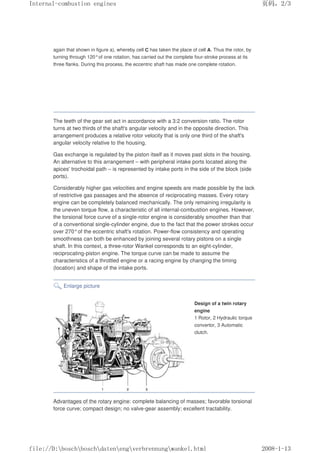
Enlarge picture
Piezoelectric yaw-rate sensor
Operating concept. 1 ... 4 Piezoelectric
elements, 8 Control circuit (fixed phase),
9 Bandpass filter, 10 Phase reference,
11 Rectifier (selective-phase).
UA Measurement voltage, Ω Yaw rate,
Uref = 0 (normal operation),
Uref
≠0 (built-in test).
页码,4/6
Sensors
2008-1-10
file://D:boschboschdatenengphysiksensorendreh.html
Enlarge picture
Piezoelectric yaw-rate sensor
Structure. 1 ... 4 Piezoelectric element pairs,
5 Oscillating cylinder, 6 Baseplate,
7 Connection pins. Ω Yaw rate.
Micromechanical silicon yaw-rate sensors provide an inexpensive and compact
alternative to today's intricate mechanical sensors. A combined technology is used
to achieve the high precision needed in vehicle-dynamics systems: two thicker mass
boards worked from the wafer by means of bulk micromechanics (see
Micromechanics) oscillate in push-pull mode at their resonant frequency, which is

determined by their mass and their coupling-spring stiffness (2 kHz). Each of them
is provided with an extremely small surface-micromechanical, capacitive
acceleration sensor which measures Coriolis acceleration in the wafer plane vertical
to the oscillation direction when the sensor chip rotates about its vertical axis at the
yaw rate Ω . They are proportional to the product of the yaw rate and the oscillation
velocity which is electronically regulated to a constant value. For drive purposes,
there is a simple printed conductor on the relevant oscillation board which is
subjected to a Lorentz force in a permanent-magnetic field vertical to the chip
surface. A similarly simple, chip-surface-saving conductor is used to measure the
oscillation velocity directly and inductively with the same magnetic field. The different
physical natures of the drive and sensor systems prevent unwanted crosstalking
between the two parts. In order to suppress external accelerations (common-mode
signal), the two opposing sensor signals are subtracted from each other (summation
however can also be used to measure the external acceleration). The precise
micromechanical structure helps to suppress the influence of high oscillation
acceleration with regard to the Coriolis acceleration that is lower by several powers
of ten (cross sensitivity well below 40dB). The drive and measuring systems are
mechanically and electrically isolated in rigorous terms here.
Enlarge picture
Micromechanical yaw-rate
sensor with
electrodynamic drive in
combined technology form
(bulk and SMM
页码,5/6
Sensors
2008-1-10
file://D:boschboschdatenengphysiksensorendreh.html
micromechanics)
1 Oscillation direction, 2 Oscillating body, 3 Coriolis acceleration sensor, 4 Retaining/guide
pin, 5 Direction of Coriolis acceleration, Ω Yaw rate, υ Oscillation velocity.
If the Si yaw-rate sensor is manufactured completely in accordance with surface
micromechanics SMM (see Micromechanics), and the magnetic drive and control
system is replaced at the same time by an electrostatic system, this isolation can be
realized less consistently: Using comb structures, a centrally mounted rotary
oscillator is electrostatically driven to oscillate at an amplitude which is constantly
regulated by means of a similar capacitive pick-off. Coriolis forces force a
simultaneous out-of-plane tilting motion whose amplitude is proportional to the yaw
rate Ω and which is detected capacitively with electrodes located under the
oscillator. To prevent this motion from being excessively damped, it is essential to
operate the sensor in a vacuum. The smaller chip size and the simpler
manufacturing process do indeed reduce the cost of such a sensor, but the
reduction in size also diminishes the already slight measuring effect and thus the
attainable accuracy. It places higher demands on the electronics. The influence of
external accelerations is already mechanically suppressed here.
Radar sensors
Research focuses on simple (low-cost) Doppler radar systems for measuring the
vehicle's linear velocity.
All rights reserved. © Robert Bosch GmbH, 2002
页码,6/6
Sensors
2008-1-10
file://D:boschboschdatenengphysiksensorendreh.html
Sensors
Acceleration/vibration sensors
These sensors are suitable for triggering passenger-protection systems (airbags,
seatbelt tensioners, rollover bars), for knock detection and control in internal-
combustion engines, and for registering lateral acceleration rates and velocity
changes in four-wheel-drive vehicles fitted with ABS.
Hall-effect acceleration sensor
In ABS-equipped vehicles with four-wheel drive and modern cars with vehicle-
dynamics control, the wheel-speed sensors are supplemented by a Hall-effect
acceleration sensor to monitor lateral and longitudinal acceleration rates. Deflection
levels in the spring-mass system used in this application are recorded using a
magnet and a Hall-effect sensor (measuring range: 1 g). The sensor is designed for
narrow-band operation (several Hz) and features electrodynamic damping.
Typical acceleration rates in automotive applications:
Application Range
Knock control 1...10 g
Passenger protection
Airbag, seat-belt tightener 50 g
Rollover bar 4 g
Seatbelt inertia reel 0.4 g
ABS, ESP 0.8...1.2 g
Suspension control
Structure 1 g
Axle 10 g
Enlarge picture
Hall acceleration sensor
1 Hall sensor, 2 Permanent magnet (seismic
mass), 3 Spring, 4 Damping plate (Cu).
a Acceleration, IW Eddy currents, UH Hall
voltage, U0 Supply voltage, Φ Magnetic flux.
页码,1/4
Sensors
2008-1-10
file://D:boschboschdatenengphysiksensorenbeschls.html
Piezoelectric sensors
Piezoelectric bimorphous spring elements/two-layer piezoceramics , are used in
applications such as triggering seatbelt tensioners, airbags and rollover bars. Their
intrinsic inertial mass causes them to deflect under acceleration to provide a
dynamic (not DC response pattern) signal with excellent processing characteristics
(typical frequency limit of 10 Hz).
The sensor element is located in a sealed housing shared with the initial signal-
amplification stage. It is sometimes encased in gel for physical protection.
The sensor's actuating principle can also be inverted: An additional actuator
electrode makes it easy to check the sensor (on-board diagnosis).
Enlarge picture
Piezoelectric sensor
a) At rest, b) During acceleration a.
1 Piezo-ceramic bimorphous spring element.
UA Measurement voltage.
Longitudinal elements (knock sensors)
Longitudinal elements are employed as knock sensors (acceleration sensors) for
ignition systems that feature knock control (see Knock control) They measure (with
low directional selectivity) the structure-borne noise at the engine block (measuring
range approx. 10 g at a typical vibration frequency of 5...20 kHz). An
unencapsulated, annular piezo-ceramic ring element measures the inertial forces
exerted upon a seismic mass of the same shape.
New sensor concepts
Capacitive silicon acceleration sensors
The first generation of micromechanical sensors relied on anisotropic and selective
etching techniques to fabricate the required spring-mass system from the full wafer
(bulk silicon micromechanics) and produce the spring profile.
Capacitive pick-offs have proven especially effective for the high-precision
measurement of this seismic-mass deflection. This design entails the use of
supplementary silicon or glass wafers with counter-electrodes above and below the
spring-held seismic mass. This leads to a 3-layer structure, whereby the wafers and
their counterelectrodes also provide overload protection.
A precisely metered air cushion in the hermetically-sealed oscillating system
provides an extremely compact yet efficient and inexpensive damping unit with good
temperature response characteristics. Current designs almost always employ a
fusion bonding process to join the three silicon wafers directly.
页码,2/4
Sensors
2008-1-10
file://D:boschboschdatenengphysiksensorenbeschls.html
Due to variations in the thermal expansion rates of the different components, it is
necessary to mount them on the casing baseplate. This has a decisive effect upon
the desired measuring accuracy. Virtually straight-line mounting is used, with free
support in the sensitive range.
This type of sensor is usually employed for low-level accelerations (≤2 g) and
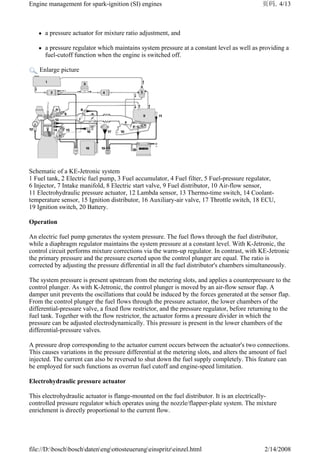
relies upon a three-chip concept: (sensor chip + CMOS processing chip + bipolar
protection IC). Conversion for extended signal evaluation triggers an automatic
reset, returning the seismic mass to its base position and supplying the positioning
signal as initial value.
For higher acceleration rates (passenger-protection systems), surface-
micromechanical sensors with substantially more compact dimensions (typical edge
lengths approx. 100µm) are already in use. An additive process is employed to

construct the spring-mass system on the surface of the silicon wafer.
Enlarge picture
Micromechanical-surface acceleration
sensor
1 Elementary cell, 2, 3 Fixed wafers,
4 Movable wafers, 5 Seismic mass, 6 Spring
shoulder, 7 Anchor. a Acceleration,
C Measurement capacitors.
In contrast to the bulk silicon sensors with capacitance levels of 10...20pF, these
sensors only have a typical capacitance of 1pF. The electronic evaluating circuitry is
therefore installed on a single chip along with the sensor (usually position-controlled
systems).
Enlarge picture
Bulk silicon acceleration sensor
1 Si upper wafer, 2 Si center wafer (seismic
mass), 3 Si oxide, 4 Si lower wafer, 5 Glass
substrate. a Acceleration. C Measurement
capacitors.
页码,3/4
Sensors
2008-1-10
file://D:boschboschdatenengphysiksensorenbeschls.html
Sensors
Pressure sensors
Pressure measurement is direct, by means of diaphragm deflection or force sensor.
Typical applications:
 intake-manifold pressure (1...5 bar),
 braking pressure (10 bar), electropneumatic brakes,
 air-spring pressure (16 bar), for vehicles with pneumatic suspension,
 tire pressure (5 bar absolute), for monitoring and/or adjusting tire pressure,
 hydraulic reservoir pressure (approx. 200 bar), ABS, power steering,
 shock-absorber pressure (+ 200 bar), chassis and suspension-control systems,
 refrigerant pressure (35 bar), air-conditioning systems,
 modulator pressure (35 bar), automatic transmissions,
 brake pressure in master- and wheel-brake cylinders (200 bar), automatic yaw-
moment compensation, electronically controlled brake,
 positive/vacuum pressure in fuel tank (0.5 bar) for on-board diagnostics (OBD),
 combustion-chamber pressure (100 bar, dynamic) for ignition miss and knock
detection,
 diesel pumping-element pressure (1000 bar, dynamic), electronic diesel injection,
 common-rail pressure (1500 to 1800 bar), diesel engines, and
 common-rail pressure (100 bar) for spark-ignition (gasoline) engines.
Enlarge picture
Pressure measurement
a) Direct, pressure-sensitive resistor (3), b) with
force sensor (1), c) via diaphragm
deformation/DMS (2). p Pressure.
Thick-film pressure sensors
The measurement diaphragm and its strain-gauge resistors (DMS) both use thick-
film technology to measure absolute pressures of up to approx. 20 bar with a K
factor (relative variation in resistance/expansion) of K = 12...15.
When the respective coefficients of expansion for the ceramic substrate and the
ceramic cover film are correct, the diaphragm will form a dome-shaped bubble upon
cooling after being bonded-on during manufacture. The result is a hollow chamber
(bubble) approx. 100 µm in height, with a diameter of 3...5 mm. After the
application of additional thick-film strain-gauge resistors, the unit is hermetically
页码,1/4
Sensors
2008-1-10
file://D:boschboschdatenengphysiksensorendrucks.html
sealed with another ceramic glass coating. The residual gas remaining in the
bubble provides partial compensation for temperature changes in the sensor.
The signal-amplification and correction components are separate from the
measurement medium, but are located directly adjacent to the sensor on the same
substrate.
The bubble sensor principle is not suitable for extremely high or low pressures;
versions for these applications generally incorporate flat ceramic diaphragms.
Enlarge picture
Thick-film pressure sensor
1 Piezoresistive measurement bridge, 2 Thick-
film diaphragm, 3 Reference-pressure
chamber (bubble), 4 Ceramic substrate.
p Pressure.
Semiconductor pressure sensors
The pressure is exerted against a Si diaphragm incorporating pressure-sensitive
resistors, manufactured using micromechanics technology. The K factor of the
resistors diffused into the monocrystalline silicon is especially high, typically K = 100.
Up to now the sensor and the hybrid circuitry for signal processing have been
located together in a single housing. Sensor calibration and compensation can be
continuous or in stages, and are performed either on an ancillary hybrid chip (a
second Si chip providing signal amplification and correction) or on the same sensor
chip. Recent developments have seen values, e.g. for zero and lead correction,
being stored in digital form in a PROM.
Integrated single-chip sensors with fully electronic calibration are suitable for use as
load sensors for electronic ignition and fuel-injection systems. Due to their extremely
compact dimensions, they are suitable for the functionally more favorable installation
directly on the intake manifold (earlier designs were mounted either in the relevant
ECU or at a convenient location in the engine compartment). Frequently applied are
reverse assembly techniques in which the measured pressure is conducted to an
electronically passive cavity recessed into the side of the sensor chip. For maximum
protection, the – much more sensitive – side of the chip with the printed circuits and
contacts is enclosed in a reference-vacuum chamber located between the housing's
base and the soldered metal cap.
Enlarge picture
Semiconductor pressure sensor
1 Silicon, 2 Vacuum, 3 Glass (Pyrex). p Pressure,
U0 Supply voltage, UA Measurement voltage, strain-
gauge resistors R1 (expanded) and R2 (deflected) in
bridge circuit.
页码,2/4
Sensors
2008-1-10
file://D:boschboschdatenengphysiksensorendrucks.html
These sensors will also be available for application in tire-pressure monitoring
systems. Measurement will be continuous and non-contacting (transformer concept).
A virtually identical sensor chip can also be used as a combustion-chamber pressure
sensor. This is provided that the Si chip is not directly exposed to high temperatures
(max. 600°
C). A metallic insulation diaphragm and a soldered transfer rod of
adequate length (several mm) furnish the desired protection. Micromechanical
techniques are employed to apply a miniature pedestal to the center of the
diaphragm, effectively converting the unit to a force sensor. The rod transmits the
forces registered at the front diaphragm through the pedestal and into the sensor
chip with a minimum of distortion. This remote installation position means that the
chip is only subjected to operating temperatures below 150°
C.
Enlarge picture
Integrated silicon combustion-pressure
sensor
1 Force-transfer rod, 2 Si pedestal (force
input), 3 Integral Si pressure sensor, 4 Pyrex,
5 Ceramic auxiliary subplate, 6 Steel
baseplate, 7 Connection pins. F Combustion-
chamber pressure force.
New sensor concepts
Piezoelectric sensors
Piezoelectric sensors provide dynamic pressure measurement. On electronically
controlled diesel fuel-injection pumps, for determining port opening and port closing
(end of pump delivery and start of pump delivery respectively) only changes of
pumping-element pressure are registered by the sensor. A thin intermediate
diaphragm is employed for direct or indirect pressure transmission to a cylindrical or
rectangular piezo-ceramic pellet. Because extreme precision is not required in this
application, deviations resulting from hysteresis, temperature and aging are not a
major consideration. An amplifier featuring a high-resistance input circuit is
frequently installed in the sealed housing. This unit decouples the signal locally to
prevent shunts from producing measurement errors.
Enlarge picture
Piezoelectric pressure sensor
1 Metallic coating, 2 Piezoelectric disk,
3 Insulation, 4 Housing. p Pressure,
UA Measurement voltage.
页码,3/4
Sensors
2008-1-10
file://D:boschboschdatenengphysiksensorendrucks.html
High-pressure sensors with metal diaphragm
Sensors are also required to monitor extremely high pressures, e.g., in the common
rails of diesel injection systems to provide data for closed-loop control. Here,
diaphragms made of high-quality spring steel and featuring a DMS pick-up furnish
much better performance than systems designed to monitor manifold pressure.
These units
 use uncomplicated and inexpensive designs to insulate the measured medium
 differ from silicon in retaining a yield range for enhanced burst resistance, and
 are easy to install in metallic housings.
Enlarge picture
Integrated silicon manifold-pressure sensor
1 Bonded connections, 2 Reference vacuum,
3 Glass-enclosed electrical connection path,
4 Sensor chip, 5 Glass pedestal, 6 Cap,
7 Pressure connection. p Pressure.
Insulated sputtered (vacuum-evaporation application) metallic thin-film DMS (K = 2)
and also poly-Si DMS (K = 40) units offer permanently high sensor accuracy.
Amplification, calibration and compensation elements can be combined in a single
ASIC, which is then integrated together with the required EMC protection on a small
carrier in the sensor housing.
Enlarge picture
High-pressure sensor with metallic
diaphragm (measurement element, nos.
1...4, dimensions exaggerated)
1 SiNx passivation, 2 Gold contact, 3 Poly-Si
DMS, 4 SiO2 insulation, 5 Steel diaphragm.
p Pressure.
All rights reserved. © Robert Bosch GmbH, 2002
页码,4/4
Sensors
2008-1-10
file://D:boschboschdatenengphysiksensorendrucks.html
Sensors
Force/torque sensors
Applications: Bearing-pin sensors on tractors in systems for controlling plow force.
Magnetoelastic bearing-pin sensors
The bearing-pin sensors are based on the magnetoelastic principle. The hollow
coupling pin contains a magnetic field coil. Positioned at a 90°angle to this is a
measuring coil to which no magnetic flux is applied when no forces are present.
However, when the ferromagnetic material in the pin becomes anisotropic under
force, a flux proportional to the force permeates the measuring coil, where it induces
electrical voltage. The supply and amplification electronics integrated in a chip are
likewise located inside the pin.
Enlarge picture
Magnetoelastic bearing-pin sensors
1 Primary winding (feed), 2 Secondary winding
(measurement signal), 3 Primary pole surface,
4 Secondary pole surface.
New sensor concepts
 Eddy-current principle: eddy-current torsional-force sensor, radial and axial
torsion-measurement spring, radial and axial slotted-disk and coil configuration.
 Measurement with strain-gauge resistors (DMS principle): pressed-in and welded-
in sensors, pressed-in elements.
 Magnetoelastic force sensor.
 Force-measurement ring using thick-film technology: force measurement with
orthogonally loaded pressure-sensitive resistors.
 Hydrostatic pressure measurement in plunger-loaded hydrostatic cylinders,
generally charged with rubber or gum elastic (no leakage risk).
 Microbending effect: fiber-optic compressive-stress sensor.
New applications:
 Measuring coupling forces on commercial vehicles between towing vehicle and
trailer/semitrailer for controlled, force-free braking.
 Measuring damping forces for electronic chassis and suspension-control systems.
 Measuring axle load for electronically-controlled braking-force distribution on
heavy commercial vehicles.
页码,1/4
Sensors
2008-1-10
file://D:boschboschdatenengphysiksensorenkrafts.html
Measurement of pedal force on electronically-controlled braking systems.
 Measurement of braking force in electrically actuated and electronically controlled
braking systems.
 Non-contact measurement of drive and braking torque.
 Non-contact measurement of steering/power-steering torque.
 Finger-protection for electric power windows and sunroofs.
In the case of the cross-ductor principle used in magnetoelastic
tension/compressive-force sensors, no voltage is induced in the secondary
transformer coil on account of the right-angled offset in the rest state (F = 0). A
voltage is only established in the coil when under the application of force the relative
permeability of the magnetoelastic sensor material used (special steel) becomes
anisotropic. This sensor principle can also be applied for higher operating
temperatures (up to 300 °
C) (e.g. for installation in proximity to the brakes).
Enlarge picture
Magnetoelastic compression-tension force
sensor according to cross-ductor principle
1 Supply coil, 2 Measuring coil, 3 Magnetic
yoke, 4 Magnetoelastic force-sensing element,
5 Phase-selective rectifier. F Force.
Torque measurement:
There are essentially two different ways of measuring torque: angle- and stress-
measuring methods. In contrast to stress-measuring methods (DMS,
magnetoelastic), angle-measuring methods (e.g. eddy current) require a particular
length of torsion shaft over which the torsion angle (approx. 0.4...4 °
) can be picked
off. The mechanical stress proportional to the torque σ is directed at an angle of
under 45°to the shaft axis.
Enlarge picture
Basic principles of torque measurement
1 Torsion bar. Φ Torsion angle, σ Torsional stress,
M Torque, r Radius, l Rod length.
页码,2/4
Sensors
2008-1-10
file://D:boschboschdatenengphysiksensorenkrafts.html
Stress-measuring torque sensor:
The mechanical stress is measured with a strain-gauge bridge. The bridge is
powered via a transformer and the supply is air-gap-independent due to rectifier and
control electronics accommodated on the shaft. Further local electronic components
on the shaft enable the measurement signal to be amplified and converted into an
air-gap-invariant alternating-current waveform (e.g. analogous to frequency) which is
likewise decoupled by a transformer. For larger quantities, the required electronics
can be integrated on the shaft in a single chip. The strain-gauge resistors can be
inexpensively accommodated on a premanufactured round steel plate (e.g. in thin-
film form, see Film and hybrid circuits, MCM) and then welded with the round plate
onto the shaft. High precision levels can be achieved with such a configuration in
spite of reasonable manufacturing costs.
Enlarge picture
Strain-gauge torque sensor with non-
contact, transformer pick-off
1 Torque indicator. σ Torsional stress,
U0 Supply voltage, R1...R4 Strain-gauge
resistors.
Angle-measuring torque sensor:
Concentrically engaged slot sleeves are flanged at each end over a sufficient length
of the measurement shaft. The sleeves have two rows of slots which are arranged in
such a way that, when the shaft is subjected to torsion, an increasingly larger view of
the shaft is exposed in the one row while the view is increasingly blocked off in the
other row. Two fixed high-frequency coils (approx. 1 MHz) arranged over each row
are thus increasingly or decreasingly damped or varied in terms of their inductance
value. In order to achieve sufficient precision, it is essential for the slot sleeves to be
manufactured and mounted to exacting standards. The associated electronics are
appropriately accommodated very near to the coils.
页码,3/4
Sensors
2008-1-10
file://D:boschboschdatenengphysiksensorenkrafts.html
Enlarge picture
Eddy-current torque sensor
1 Slot sleeves, 2 Air gap, 3 High-frequency coils.
All rights reserved. © Robert Bosch GmbH, 2002
页码,4/4
Sensors
2008-1-10
file://D:boschboschdatenengphysiksensorenkrafts.html
Sensors
Flow meters
Flow quantities in automotive applications:
 Fuel flow rate, i.e., amount of fuel actually consumed by the engine, is based on
the difference between forward and return flow rates.
On spark-ignition engines featuring electronically-controlled fuel-metering
systems using air intake as a primary control parameter, this figure is already
available in the form of a calculated metering value; thus measurement for control
of the combustion process is redundant. However, fuel-flow measurement is
required to determine and display fuel consumption on engines not equipped with
electronic control systems.
 Air flow in the engine's intake manifold: The mass relationships are the salient
factors in the chemical process of combustion, thus the actual objective is to
measure the mass flow of the intake or charge air, although procedures
employing volume and dynamic pressure are also applied.
The maximum air-mass flow to be monitored lies within a range of
400...1000 kg/h, depending upon engine output. As a result of the modest idle
requirements of modern engines, the ratio between minimum and maximum air
flow is 1 : 90 ... 1 : 100.
Flow measurement
A medium of uniform density ρ at all points flows through a tube with a constant
cross-section A at a velocity which is virtually uniform in the tube cross-section
(turbulent flow):
Volume flow rate
QV = υ · A
and Mass flow rate
QM = ρ · υ · A · ρ
If an orifice plate is then installed in the duct, forming a restriction, this will result in a
pressure differential ∆p in accordance with Bernoulli's Law. This differential is an
intermediate quantity between the volume and mass flow rates:
∆p = const · ρ · υ2 = const · QV · QM
Fixed-position orifice plates can only cover measurement variables within a range of
1 : 10; variable flaps are able to monitor variations through a substantially greater
ratio range.
Volume flow sensors
According to the principle of the Karman vortex path, whirls and eddies diverge from
the air stream at a constant distance behind an obstruction. Their periodicity as
measured (e.g., monitoring of pressure or acoustic waves) at their periphery (duct
wall) provides an eddy frequency in the form of a signal ratio:
页码,1/4
Sensors
2008-1-10
file://D:boschboschdatenengphysiksensorenduflu.html
f = 1/T = const · QV.
Disadvantage: Pulsation in the flow can result in measuring errors.
The ultrasonic flow-measurement procedures can be employed to monitor the
propagation time t of an acoustic pulse as it travels through the medium to be
measured (e.g. air) at angle α (see Fig.). One measurement is taken upstream and
one downstream using the same measurement path l. The resulting transit-time
differential is proportional to the volumetric flow rate.
Enlarge picture
Ultrasonic flow measurement
1, 2 Transmitter/receiver 1 and 2, l Measurement
path, S Transmit command, t Transit period,
QV Volume flow, α Angle.
Pitot-tube air-flow sensors
Pivoting, variable-position pressure flaps leave a variable section of the flow
diameter unobstructed, with the size of the free diameter being dependent upon the
flow rate. A potentiometer monitors the characteristic flap positions for the respective
flow rates. The physical and electrical design of the air-flow sensor, e.g., for L-
Jetronic (see Multipoint injection systems), is such as to ensure a logarithmic
relationship between flow rate and output signal (at very low flow rates the
incremental voltage variations referred to the flow-rate variation are substantially
greater than at high flow rates). Other types of automotive air-flow sensors are
designed for a linear characteristic (KE-Jetronic, see Multipoint injection systems).
Measuring errors can occur in cases where the flap's mechanical inertia prevents it
from keeping pace with a rapidly pulsating air current (full-load condition at high
engine speeds).
Enlarge picture
Pitot-tube air-flow sensor
1 Pressure flap, 2 Compensation flap,
3 Compression volume. Q Flow.
Air-mass meters
Air-mass meters operate according to the hot-wire or hot-film principle; the unit
页码,2/4
Sensors
2008-1-10
file://D:boschboschdatenengphysiksensorenduflu.html
contains no moving mechanical parts. The closed-loop control circuit in the meter's
housing maintains a constant temperature differential between a fine platinum wire
or thin-film resistor and the passing air stream. The current required for heating
provides an extremely precise – albeit non-linear – index of mass air flow. The
system's ECU generally converts the signals into linear form as well as assuming
other signal-processing duties. Due to its closed-loop design, this type of air-mass
meter can monitor flow rate variations in the millisecond range. However, the
sensor's inability to recognize flow direction can produce substantial measuring
errors when strong pulsation occurs in the manifold.
The platinum wire in the hot-wire air-mass meter functions both as the heating
element and as the heating element's temperature sensor. To ensure stable and
reliable performance throughout an extended service life, the system must burn-off
all accumulated deposits from the hot-wire's surface (at approx. 1000 °
C) after each
phase of active operation (when the ignition is switched off).
Enlarge picture
Hot-wire air-mass meter
QM Mass flow, Um Measurement voltage, RH Hot-
wire resistor, RK Compensation resistor,
RM Measurement resistor, R1, R2 Trimming
resistor.
The hot-film air-mass meter combines all measuring elements and the control
electronics on a single substrate. In current versions, the heating resistor is located
on the back of the base wafer, with the corresponding temperature sensor on the
front. This results in somewhat greater response lag than that associated with the
hot-wire meter. The temperature-compensation sensor (RK) and the heating element
are thermally decoupled by means of a laser cut in the ceramic substrate. More
favorable flow characteristics make it possible to dispense with the hot-wire meter's
burn-off decontamination process.
Enlarge picture
Micromechanical hot-film air-mass meter
1 Dielectric diaphragm, H Heating resistor,
SH Heater-temperature sensor, SL Air-
temperature sensor, S1, S2 Temperature
sensors (upstream and downstream),
QLM Mass air flow, s Measurement point,
t Temperature.
页码,3/4
Sensors
2008-1-10
file://D:boschboschdatenengphysiksensorenduflu.html
Extremely compact micromechanical hot-film air-mass meters also operate
according to thermal principles. Here the heating and measuring resistors are in the
form of thin platinum layers sputtered onto the base Si chip. Thermal decoupling
from the mounting is obtained by installing the Si chip in the area of the heater
resistor H on a micromechanically thinned section of the base (similar to a pressure-
sensor diaphragm). The adjacent heater-temperature sensor SH and the air-
temperature sensor SL (on the thick edge of the Si chip) maintain the heater resistor
H at a constant overtemperature. This method differs from earlier techniques in
dispensing with the heating current as an output signal. Instead, the signal is derived
from the temperature differential in the medium (air) as monitored at the sensors S1
and S2. Temperature sensors are located in the flow path upstream and downstream
from the heater resistor H. Although (as with the earlier process) the response
pattern remains nonlinear, the fact that the resulting signal also indicates the flow
direction represents an improvement over the former method using the heating
current.
All rights reserved. © Robert Bosch GmbH, 2002
页码,4/4
Sensors
2008-1-10
file://D:boschboschdatenengphysiksensorenduflu.html
Sensors
Concentration sensors
Virtually all chemical concentration sensors run the risk of being poisoned during the
necessary direct contact with the measured medium, i.e. irreversibly damaged by
harmful foreign substances. For instance, electrolytic oxygen-concentration sensors
(lambda oxygen sensors) can be rendered useless by lead that may be present in
the fuel or exhaust gas.
Enlarge picture
O2 sensor response curve
λ Excess-air factor, US Sensor voltage.
Oxygen-concentration sensor (lambda oxygen sensor)
The fuel-metering system employs the exhaust-gas residual-oxygen content as
measured by the lambda sensor to very precisely regulate the air-fuel mixture for
combustion to the value λ (lambda) = 1 (see stoichiometric combustion).
The sensor is a solid-state electrolyte made of ZrO ceramic material. At high
temperatures, this electrolyte becomes conductive and generates a characteristic
galvanic charge at the sensor connections; this voltage is an index of the gas'
oxygen content. The maximum variation occurs at λ = 1.
Electrically-heated sensors are especially well-suited for measurements in the lean
range, and already come into operation in the warm-up phase.
Enlarge picture
O2 sensor in exhaust pipe
1 Ceramic sensor, 2 Electrodes, 3 Contact,
4 Housing contacts, 5 Exhaust pipe, 6 Protective
ceramic coating (porous).
For the wide lean range, flat and smaller wafer sensors of multilayer ceramic
design (wide-band lambda sensors) are used; these sensors can also be used in
页码,1/3
Sensors
2008-1-30
file://D:boschboschdatenengphysiksensorenkonzs.html
diesel engines. A sensor of this type is essentially a combination of a conventional
concentration sensor which acts as a galvanic cell (Nernst sensor) and a limit-
current or pump cell. A voltage is applied from an external source to the pump cell,
which is of the same design as a conventional concentration cell. If the voltage is
high enough, a limit current sets in which is proportional to the difference in oxygen
concentration at both ends of the sensor. Oxygen atoms are transported –
depending on the polarity – with the current. An electronic control circuit causes the
pump cell to supply the concentration sensor permanently through a very narrow
diffusion gap with precisely enough oxygen to maintain a status of λ = 1 at the
sensor. I.e. oxygen is pumped away in the event of excess air in the exhaust gas
(lean range); in the event of a low residual-oxygen content in the exhaust gas (rich
range), oxygen is pumped in by reversing the pump voltage. The relevant pump
current forms the output signal.
Enlarge picture
Wide-band O2 sensor (structure)
1 Nernst concentration cell, 2 Oxygen pump
cell, 3 Diffusion gap, 4 Reference-air channel,
5 Heater, 6 Control circuit. IP Pump current,
UH Heating voltage, Uref Reference voltage.
Sensor signal of wide-band O2 sensor
(measured current)
Humidity sensors:
Areas of application:
 Monitoring of air drier for pneumatic brakes,
页码,2/3
Sensors
2008-1-30
file://D:boschboschdatenengphysiksensorenkonzs.html
Monitoring of outside air humidity for slippery-ice warnings,
 Calculation of dew point in vehicle interior (air-quality sensing, climate control,
misting over of vehicle windows).
Capacitive sensors are mostly used to determine relative humidity. A sensor of this
type is composed of a thin-film polymer with a metal coating on both sides. The
capacitance of this capacitor is considerably but reversibly modified by the
adsorption of water. The time constant is typically approx. 30s. The dew point can
also be determined by additionally measuring the air temperature (NTC).
When installed e.g. in an air-quality ECU, a Teflon diaphragm protects the sensor
against harmful substances. Generally speaking, the air-quality ECU also contains
above all CO- und NOX sensors, mostly in the form of thick-film resistors (SnOX) ,
which modify their electrical resistance in a wide range (e.g. 1...100 kohm) by
adsorption of the measured media.
All rights reserved. © Robert Bosch GmbH, 2002
页码,3/3
Sensors
2008-1-30
file://D:boschboschdatenengphysiksensorenkonzs.html
Sensors
Temperature sensors
Temperature measurements in motor vehicles are conducted almost entirely by
exploiting the sensitivity to temperature variation found in electrical resistance
materials with a positive (PTC) or negative (NTC) temperature coefficient as contact
thermometers.. Conversion of the resistance variation into analog voltage is
performed predominantly with the aid of supplementary temperature-neutral or
inversely-sensitive resistors as voltage dividers (also providing increased linearity).
Non-contact (pyrometric) temperature sensing has recently come into consideration
for passenger safety (passenger observation for airbag activation) and also for
passenger comfort (climate control, prevention of window misting); this has been
made economically viable by the introduction of microsystems technology. The
following temperatures occur in motor vehicles:
Location Range °C
Intake air/charge air – 40... 170
Outside atmosphere – 40... 60
Passenger compartment – 20... 80
Ventilation and heating air – 20... 60
Evaporator (AC) – 10... 50
Engine coolant – 40... 130
Engine oil – 40... 170
Battery – 40... 100
Fuel – 40... 120
Tire air – 40... 120
Exhaust gas 100... 1000
Brake calipers – 40... 2000
At many locations, temperature is also measured in order that it can be
compensated for in those cases in which temperature variations trigger faults or act
as an undesirable influencing variable.
Temperature sensors (examples)
1 NTC thermistor, 2 PTC thermistor.
t Temperature, R Resistance.
Sintered-ceramic resistors (NTC)
Sintered-ceramic resistors (heat conductors, thermistors) made of heavy-metal
页码,1/5
Sensors
2008-1-30
file://D:boschboschdatenengphysiksensorentemps.html
oxides and oxidized mixed crystals (sintered in pearl or plate-form) are included
among those semiconductive materials which display an inverted exponential
response curve. High thermal sensitivity means that applications are restricted to a
window of approx. 200 K; however, this range can be defined within a latitude of –
40 ... approx. 850 °C.
Thin-film metallic resistors (PTC)
Thin-film metallic resistors, integrated on a single substrate wafer together with two
supplementary, temperature-neutral trimming resistors, are characterized by
extreme precision, as they can be manufactured and then trimmed with lasers to
maintain exact response-curve tolerances over long periods of time. The use of layer
technology makes it possible to adapt the base material (ceramic, glass, plastic foil)
and the upper layers (plastic molding or paint, sealed foil, glass and ceramic
coatings) to the respective application, and thus provide protection against the
monitored medium. Although metallic layers are less sensitive to thermal variations
than the ceramic-oxide semiconductor sensors, both linearity and reproducibility are
better:
Sensor material Temperature coefficient TC Measurement range
Ni 5.1 · 10 –3/K – 60...320 °C
Cu 4.1 · 10 –3/K – 50...200 °C
Pt 3.5 · 10 –3/K – 220...850 °C
With
TC = [R(100 °C) – R(0 °C)] / [R(0 °C) · 100 K]
Enlarge picture
Metallic-film thermistor
1 Auxiliary contacts, 2 Bridge, RNi Nickel-
plated resistor, R(t) Resistance relative to
temperature t, R1, R2 Temperature-
independent trimming resistors.
Thick-film resistors (PTC/NTC)
Thick-film pastes with both high specific resistance (low surface-area requirement)
and positive and negative temperature coefficients are generally employed as
temperature sensors for compensation purposes. They have non-linear response
characteristics (without, however, the extreme variations of the massive NTC
resistor) and can be laser-trimmed. The measurement effect can be enhanced by
using NTC and PTC materials to form voltage-divider circuits.
Monocrystalline Si-semiconductor resistors (PTC)
页码,2/5
Sensors
2008-1-30
file://D:boschboschdatenengphysiksensorentemps.html
When monocrystalline semiconductor materials such as Si are used to manufacture
the temperature sensor, it is possible to integrate additional active and passive
circuitry on the sensor chip (allowing initial signal conditioning directly at the
measuring point).
Due to the closer tolerancing which is possible, these are manufactured according to
the spreading-resistance principle. The current flows through the measuring resistor
and through a surface-point contact before arriving at the Si bulk material. It then
proceeds, widely distributed, to a counterelectrode covering the base of the sensor
chip. As well as the highly reproducible material constants, the high current density
after the contact point (high precision achieved through photolithographic
manufacture) almost exclusively determines the sensor's resistance value.
The measurement sensitivity is virtually twice that of the Pt resistor (TC = 7.73 · 10–
3/K). However, the temperature-response curve is less linear than that of a metallic
sensor.
Enlarge picture
Si semiconductor resistor (spreading-
resistance principle)
1 Contacts, 2 Passivation (nitride, oxide), 3 Si
substrate, 4 Unconnected counterelectrode.
R(t) Temperature-dependent resistor.
Thermopile sensors
For non-contact measurement of the temperature of a body, the radiation emitted by
this body is measured; this radiation is preferably in the infrared (IR) range
(wavelength: 5...20 µm). Strictly speaking, the product of the radiated power and the
emission coefficient of the body is measured. The latter is material-dependent but
mostly close to 1 for materials of technical interest (also for glass). However, for
reflective or IR-permeable materials (e.g. air, Si), it is 1. The measuring point is
reproduced on a radiation-sensitive element which thus heats up slightly with
respect to its environment (typically 0.01...0.001 °C). This small temperature
difference can be effectively measured with thermocouples many of which are
connected in succession to increase the measuring effect (thermopile). It is possible
to manufacture just such a thermopile sensor at low cost using micromechanical
techniques. All the hot points are located on a thermally well insulated, thin
diaphragm while all the cold points are located on the thicker chip edge (temperature
sink). The sensor's settling time is typically approx. 20 ms. A single-pixel sensor of
this type is ideal for e.g. determining the surface temperature of the windshield so as
to prevent it from misting over should the temperature drop below the dew point.
Enlarge picture
页码,3/5
Sensors
2008-1-30
file://D:boschboschdatenengphysiksensorentemps.html
Micromechanical thermopile infrared sensor
1 Si chip, 2 Thermocouples connected in series, 3 SiN diaphragm, 4 Thermopile connections,
5 Absorber layer.
If several pixels are arranged on a chip to form an array (e.g. 4 x 4), rough imaging
is thus already possible. However, there should not be too much insensitive surface
area between the pixels and the pixels themselves must be thermally well insulated
against each other. As all the pixels can optionally respond electrically, the chip has
a large number of terminals. For a TO5 housing, the ASIC for instance must be
located near the sensor to preamplify and serialize the signal. To determine the
absolute temperature of the pixels, this ASIC also contains in most cases a
reference temperature sensor with which object temperatures can be determined to
an accuracy of approx. ±0.5K.
Enlarge picture
Micromechanical thermopile array
1 Si chip, 2 Pixel, 3, 4 Pixel connections.
In order to reproduce a scene thermally on the sensor array, the array requires an IR
optical imaging unit. The highly inexpensive arched mirror must mostly be ruled out
for reasons of available space. Glass lenses are impervious to IR light and plastic
lenses are only adequate for operating temperatures up to approx. 85 °C. Si lenses
however are very well suited to heat radiation and can be micromechanically
manufactured at low cost as diffraction (Fresnel) or refraction lenses with diameters
of up to approx. 4 mm. When inserted into the cover of a TO5 housing, they serve at
the same time to protect the sensor against direct damage. Although filling the
housing with insert gas increases crosstalk between the pixels somewhat, on the
other hand it also reduces their response time.
Enlarge picture
IR imaging sensor
1 Si IR lens, 2 TO5 housing, 3 Connection pins,
4 Sensor chip, 5 Evaluation ASIC. α Viewing angle.
页码,4/5
Sensors
2008-1-30
file://D:boschboschdatenengphysiksensorentemps.html
All rights reserved. © Robert Bosch GmbH, 2002
页码,5/5
Sensors
2008-1-30
file://D:boschboschdatenengphysiksensorentemps.html
Sensors
Sensors for other applications
Dirt sensors
The sensor measures the level of contamination on the headlamp lens to furnish the
data required for automatic lens cleaning systems.
The sensor's photoelectric reflected-light barrier consists of a light source (LED) and
a light receiver (phototransistor). The source is positioned on the inside of the lens,
within the cleansed area, but not directly in the light beam's path. When the lens is
clean, or covered with rain droplets, the infrared measurement beam emitted by the
unit passes through the lens without being obstructed. Only a minuscule part is
reflected back to the light receiver. However, if it encounters dirt particles on the
outer surface of the lens, it is reflected back to the receiver at an intensity that is
proportional to the degree of contamination and automatically activates the
headlamp washer unit once a defined level is reached.
Rain sensors
The rain sensor recognizes rain droplets on the windshield, so that the windshield
wipers can be triggered automatically. The unit thus frees the driver to concentrate
on other tasks by making the various control operations used to activate
conventional wiper systems redundant. For the time being the driver can still use the
manual controls; if desired, the automatic system must be manually selected when
the vehicle is started.
The sensor consists of an optical transmission and reception path (similar to the dirt
sensor). In this application, the light is directed toward the windshield at an angle. A
dry outer surface reflects (total reflection) it back to the receiver, which is also
mounted at an angle. When water droplets are present on the outer surface, a
substantial amount of the light is refracted outward, thus weakening the return
signal. This system also responds to dirt once the activation threshold is exceeded.
Rain sensor
1 Windshield, 2 Optical coupling, 3 Heater,
4 Rain droplets, 5 Light conductor, 6 LED,
7 Electronics, 8 Photodiode, 9 Shield.
Imaging sensors
With imaging sensors, attempts are now being made to reproduce the superior
页码,1/3
Sensors
2008-1-10
file://D:boschboschdatenengphysiksensorenweitere.html
capability of the human eye and the associated mental recognition faculties (albeit at
present only to a very modest extent). It is certain that in the foreseeable future the
costs of imaging sensors and the high-power processors needed for interpreting a
scene will drop to levels that will be viable for automotive applications. In contrast to
the human eye, current imaging sensors are also sensitive in the close IR range
(wavelength approx. 1 µm). This means that for all the conceivable applications in an
automobile, night-time operation becomes possible using invisible IR illumination.
Imaging sensors could in future find a variety of uses in motor vehicles for
monitoring the passenger compartment (seat position, forward displacement in event
of a crash etc.) and the vehicle environment (lateral guidance, collision avoidance,
parking and back-up assistance, road-sign recognition etc.).
Imaging sensors are a special instance of multisensor structures composed of
light-sensitive elements (pixels) which are arranged in line or matrix form and
receive their light from a conventional optical imaging system. With the Si imaging
sensors available today (CCD Charge-Coupled Devices), the incident light through a
transparent electrode generates charge carriers in proportion to the intensity and
exposure time. These are then collected in a potential pot (Si-SiO2 boundary
layer). Using further electrodes, these charges are transferred into an opaque zone
and further transported in analog shift registers (bucket-brigade principle) in lines
into an output register which is serially read out at a higher clock-pulse rate.
CCD principle (charge-coupled devices)
1 Photodiode, 2 Light, 3 Storage electrode, 4 Shift
gate, 5 Transfer electrode, 6 Optical cover.
While CCD sensors are only of restricted use in motor vehicles on account of their
limited light/dark dynamic response (50 dB), their readout time and their temperature
range ( 50 °
C), newer (smart) imaging sensors based on CMOS technology are
appearing which are fully suitable for automotive applications. The logarithmic
brightness/signal characteristic curve possible here corresponds to the human eye
and has a dynamic response of 120dB. This dispenses with the need for e.g. glare
页码,2/3
Sensors
2008-1-10
file://D:boschboschdatenengphysiksensorenweitere.html
control and delivers constant contrast resolution over the entire brightness range.
These sensors permit random access to the individual pixels with simultaneously
increased sensitivity (higher readout rate). Even the first signal-preprocessing
processes are already possible on the imaging-sensor chip.
Enlarge picture
Imaging-sensor structure
1 Column cycle A1/A2,
2 Photosensors, 3 CCD
array, 4 Line cycle B1/B2,
5 Output register, 6 Video
output.
Future measurement applications:
 Steering-wheel torque sensing (electromotive power steering, steer-by-wire
system)
 Drive-torque sensing (misfire detection, load signal)
 Passenger safety: AOS (Automotive Occupancy Sensing, Out-of-Position
Sensing),
 Measuring wheel forces and friction-coefficient potential
 Fluid sensors
 Sensors for monitoring the vehicle environment (imaging sensors etc.) for
autonomous driving and detection of an imminent impact.
All rights reserved. © Robert Bosch GmbH, 2002
页码,3/3
Sensors
2008-1-10
file://D:boschboschdatenengphysiksensorenweitere.html
Basic principles, Physics
Actuators
Quantities and units
Quantity Unit
A Pole face; piston surface area mm2
B Magnetic induction or magnetic flux density T
F Force N
I Electric current A
l Length of conductor in field mm
M Torque N · m
p Pressure Pa
Q Volume rate of flow l/min
QW Heat flow W
s Distance, piston travel mm
V Volume mm3
Vth Displaced volume per rotation mm3
α Angle between current flow direction and magnetic lines of force °
δ Air-gap length mm
µ0 Permeability constant
φ Rotation angle °
Actuators (final-control elements) form the junction between the electronic signal
processor (data processing) and the actual process (mechanical motion). They
convert the low-power signals conveying the positioning information into operating
signals of an energy level adequate for process control. Signal converters are
combined with amplifier elements to exploit the physical transformation principles
governing the interrelationships between various forms of energy (electrical –
mechanical – fluid – thermal).
Transistor actuator: Element with electronic circuitry for processing control signals.
Includes auxiliary energy input and energy output stages.
Servo component: As above, but with the ability to process nonelectrical control
signals.
Transistor actuator+ servo component = Final-control element.
Converter: Control component without control-signal processing, receives and
transfers energy.
Actuator: Control chain comprising servo component and converter.
The term actuator is also employed as a general-purpose designation for servo
components without converters on their own.
义ⷕˈ
%DVLFSULQFLSOHV3KVLFV

ILOH'?ERVFK?ERVFK?GDWHQ?HQJ?SKVLN?DNWRUHQKWPO
Actuator chain
1 Information, 2 Actuator, 3 Transformer, 4 Control element, 5 Losses, 6 External electrical
energy, 7 External hydraulic energy.
Electromechanical actuators
This type of energy conversion represents one option for classifying
electromechanical actuators. The energy emanating from the source is transformed
into magnetic or electrical field energy, or converted to thermal energy. The
individual force-generation principle is determined by these forms of energy, and
bases upon either field forces or certain specific material characteristics.
Magnetostrictive materials make it possible to design actuators for application in the
micropositioning range. This category also includes piezoelectric actuators, which
are built according to a multilayer design similar to ceramic capacitors and are
potential actuators for fast-acting fuel injectors. Thermal actuators depend
exclusively upon the exploitation of characteristics of specific materials.
Actuators in a motor vehicle are mostly electro-magneto-mechanical transformers
and by extension electrical servomotors (see Electrical machines) and translational
and rotational solenoid actuators. An exception is the pyrotechnical airbag system
(see Safety systems). The solenoid actuators can themselves be the servo element,
or they can assume a control function by governing a downstream force-
amplification device (e.g. mechanical-hydraulic).
Enlarge picture
Electromechanical
actuators (system)
Force generation in the magnetic field
The distinction between the electrodynamic and the electromagnetic actuator
principles stems from the manner in which forces are generated in the magnetic
field. Common to both principles is the magnetic circuit with soft-magnetic material
and the coil for excitation of the magnetic field. A major difference lies in the force
义ⷕˈ
%DVLFSULQFLSOHV3KVLFV

ILOH'?ERVFK?ERVFK?GDWHQ?HQJ?SKVLN?DNWRUHQKWPO
which can be extracted from the unit under technically-feasible conditions. Under
identical conditions, the force produced through application of the electromagnetic
principle is greater by a factor of 40. The electrical time constant for this type of
actuator is comparable to the mechanical time constants. Both force-generation
principles are applied in linear and rotary drive mechanisms.
Electrodynamic principle
Electrodynamic designs are based on the force exerted on mobile charges or
charged conductors within a magnetic field (Lorentz force). An excitation coil or a
permanent magnet generates a constant magnetic field. The electrical energy
destined for conversion is applied to the moving armature coil (plunger or immersion
coil). A high degree of actuator precision is achieved by designing the armature coil
with low mass and low inductivity. The two accumulator elements (one on the fixed
and one on the moving component) produce two active force directions via current-
direction reversal in the armature and excitation coils.
The secondary field produced by the armature current flows in an open magnetic
circuit, thereby diminishing the effects of saturation. Approximately speaking, the
force (torque) exerted by an electrodynamic actuator over its setting range is
proportional to current and independent of travel.
Electrodynamic transformers
Electrodynamic principle
Force on moving chargeF = B · I · l · sin α
Electromagnetic transformers
Electromagnetic principle
Force between pole faces F = B2 · A/2 µ0
Electromagnetic principle
The electromagnetic principle exploits the mutual attraction displayed by soft ferrous
materials in a magnetic field. The electromagnetic actuator is equipped with only one
coil, which generates both the field energy and the energy to be transformed. In
accordance with the operating principles, the excitation coil is equipped with an iron
core to provide higher inductance. However, as the force is proportional to the
square of the density of the magnetic flux, the unit is operative in only one direction.
The electromagnetic actuator thus requires a return element (such as a mechanical
spring or a magnetic return mechanism).
Dynamic response
The dynamic response of an electromechanical actuator, i.e. the activation and
deactivation operations, is defined by the equation of mechanical motion, the
义ⷕˈ
%DVLFSULQFLSOHV3KVLFV

ILOH'?ERVFK?ERVFK?GDWHQ?HQJ?SKVLN?DNWRUHQKWPO
differential equation of electrical circuits and Maxwell's equations of dynamics. The
current- and position-dependent force follows from Maxwell's equations.
The most basic electrical circuit consists of an inductor with an ohmic resistor. One
means of enhancing the dynamic response is through over-excitation at the instant
of activation, while deactivation can be accelerated with a Zener diode. In each
case, increasing the dynamic response of the electrical circuit involves additional
expenditure and increased losses in the actuator's triggering electronics.
Field diffusion is a delay effect which is difficult to influence in actuators with high
dynamic response. Rapid switching operations are accompanied by high-frequency
field fluctuations in the soft-magnetic material of the actuator's magnetic circuit.
These fluctuations, in turn, induce eddy currents, which counteract their cause
(build-up and decay of the magnetic field). The resultant delay in the build-up or
reduction of forces can only be reduced by selecting appropriate materials with low
electrical conductivity and permeability.
Design
Design selection is essentially determined by operating conditions (e.g., installation
space, required force-travel curve and dynamic response).
Electromagnetic actuators
A typical form for translational electromagnetic actuators is the switching solenoid
with a force/travel curve which falls as a function of the square of positioning travel.
The precise shape of the curve is determined by the type of working gap (e.g.,
conical or immersion armature).
Enlarge picture
Switching solenoid
1 Armature, 2 Coil, 3 Magnetic yoke.
Enlarge picture
Switching solenoid (characteristic curves)
1 Solenoid plunger, 2 Conical armature,
3 Cylindrical armature.
义ⷕˈ
%DVLFSULQFLSOHV3KVLFV

ILOH'?ERVFK?ERVFK?GDWHQ?HQJ?SKVLN?DNWRUHQKWPO
Rotational electromagnetic actuators are characterized by a defined pole
arrangement in stator and rotor. When current is applied to one of the coils, the rotor
and stator poles respond with mutual attraction, and in doing so generate a torque.
The single-winding rotary actuator incorporates a pair of poles in each of the two
main sections, as well as a coil in the stator. Its maximum positioning range is
approx. 45°
.
Enlarge picture
Electromagnetic single-winding rotary actuator
1 Winding, 2 Stator, 3 Armature.
Enlarge picture
Electromagnetic rotary actuator
(characteristic curves)
1 Single-winding rotary actuator, 2 Torque
motor.
The torque motor is a bidirectional electromagnetic rotary actuator featuring a stable
working point and without counterforces. The rotor is maintained in a stable position
by the excitation field of the permanent magnet in the stator. The magnetic field
generated by one or two stator windings produces torque and provides unilateral
compensation for the excitation field. This type of layout is suitable for applications in
which substantial forces are required over small angles. The relationship between
the applied current and the torque motor's force is roughly linear. The torque-motor
principle is also employed in translational actuators.
Enlarge picture
Torque motor
1 Magnets, 2 Armature, 3 Control windings.
义ⷕˈ
%DVLFSULQFLSOHV3KVLFV

ILOH'?ERVFK?ERVFK?GDWHQ?HQJ?SKVLN?DNWRUHQKWPO
Electrodynamic actuators
In a pot magnet (immersion-coil actuator), a cylindrical immersion coil (armature
winding) is set in motion in a working gap. The positioning range is limited by the
axial length of the armature winding and by the gap.
Enlarge picture
Electrodynamic immersion-coil actuator
1 Immersion coil, 2 Permanent magnet,
3 Magnetic yoke.
The short-stroke linear motor is an actuator with a virtually round disk coil.
Enlarge picture
Electrodynamic short-stroke linear motor
1 Coil, 2 Permanent magnet, 3 Magnetic yoke.
A distinction is made between single-winding and dual-winding rotary actuators.
Both types include a permanent magnet within the rotor and one or two stator
windings. The rotor magnet is magnetized at both ends to produce magnetic flux in
the rotary magnet's working gap, which combines with the armature current to
produce a torque. Originating from the position illustrated, the positioning range is
less than ±45 °. The positioning range of the single-winding rotary actuator also
varies according to both the torque requirement and the angle range in which the
necessary flux density can be provided.
The dual-winding rotary actuator can be described as a combination of two single-
winding rotary actuators with a 90°peripheral offset and designed to produce
opposed torque flows. A stable working point is achieved at the zero transition point
on the resulting torque curve without auxiliary counteractive forces.
Enlarge picture
Electrodynamic rotary actuator
a) Single-winding rotary actuator, b) Dual-
winding rotary actuator.
1 Coil 1, 2 Coil 2, 3 Stator, 4 Permanent
magnet, 5 Shaft.
义ⷕˈ
%DVLFSULQFLSOHV3KVLFV

ILOH'?ERVFK?ERVFK?GDWHQ?HQJ?SKVLN?DNWRUHQKWPO
Electrodynamic rotary actuator
(characteristic curves)
a) Single-winding rotary actuator, b) Dual-
winding rotary actuator. 1 Coil 1, 2 Coil 2,
3 Coil 1 and 2.
Applications
Electromechanical actuators are direct-action control elements, and without an
intermediate ratio-conversion mechanism they convert the energy of the electrical
control signal into a mechanical positioning factor/work. Typical applications include
positioning of flaps, spools and valves. The described actuators are final-control
elements without internal return mechanisms, i.e. without a stable working point.
They are only capable of carrying out positioning operations from a stable initial
position (working point) when a counterforce is applied (e.g., return spring and
electrical control).
A solenoid plunger provides a stable static bias point when its force-travel curve is
superimposed upon the characteristic response of a return spring. A variation of the
coil current in the solenoid shifts the working point. Simple positioning is achieved by
controlling the current. However, particular attention must be paid here to the
nonlinearity of the force-current characteristic and the positioning system's sensitivity
to interference factors (e.g. mechanical friction, pneumatic and hydraulic forces).
The temperature sensitivity of the coil resistance results in positioning errors, making
corrective current control necessary. A high-precision positioning system with good
dynamic response must incorporate a position sensor and a controller.
Working points (A) of a tractive
electromagnet
1, 2, 3 Curves for different currents, 4 Curve
for a return spring.
义ⷕˈ
%DVLFSULQFLSOHV3KVLFV

ILOH'?ERVFK?ERVFK?GDWHQ?HQJ?SKVLN?DNWRUHQKWPO
Hydraulic actuators Pneumatic actuators
Medium – Fluid, mostly oil – Gas, mostly air
– Supply from tank, oil sump – Supply from surrounding air
– Virtually incompressible – Compressible
– Self-lubricating – Independent lubrication required
– Viscosity heavily
temperature-dependent
– Viscosity fluctuations
virtually irrelevant
Pressure range to approx. 30 MPa
(200 MPa for diesel fuel injectors)
to approx. 1 MPa or greater
(approx. 0.05 MPa for vacuum actuators)
Line connections Supply and return connection
(possible leakage connection)
Pressure connection only,
return directly to environment
Applications Positioning applications with high load
rigidity, demanding requirements for
synchronization and positioning
precision in closed-loop control
system
Actuators with lower power requirement,
positioning by mechanical stops, in open
control loop
Fluid-mechanical actuators
Hydraulic and pneumatic actuators utilize similar principles for the conversion and
regulation of energy (see Automotive hydraulics and Automotive pneumatics). The
table shows the differences in characteristics and applications.
In most applications, fluid-mechanical actuator drives are in the form of hydrostatic
energy converters. These operate according to the displacement principle,
converting the pressure energy of the fluid medium into mechanical work and vice
versa.
In contrast, hydrodynamic transformers operate by converting flow energy (kinetic
energy of the moving fluid) into mechanical work (example: hydrodynamic coupling).
Losses during energy conversion stem from leakage and friction. Fluid-thermal
losses are caused by flow resistance, in which throttle action transforms the
hydraulic energy into heat. A portion of this heat is dissipated into the environment,
and some of it is absorbed and carried away by the fluid medium.
Heat flow QW = Q1 · p1 – Q2 · p2
With incompressible fluids
Heat flow QW = Q1 · (p1 – p2)
The flow develops into turbulence at restrictions. The flow rate of the fluid is then
largely independent of viscosity. On the other hand, viscosity does play a role in the
case of laminar flow in narrow pipes and apertures (see Automotive hydraulics).
Fluid-mechanical amplifiers control the transition of energy between fluid and
mechanical states. The regulating mechanism must be designed for control with only
a very small proportion of the energy required for the ultimate positioning operation.
Fluid-mechanical actuators
义ⷕˈ
%DVLFSULQFLSOHV3KVLFV

ILOH'?ERVFK?ERVFK?GDWHQ?HQJ?SKVLN?DNWRUHQKWPO
Linear actuator
F = pA · A
s = QA / A
Rotary actuator
M = (pA · Vth)/2 π
φ = (QA / Vth) · 2 π
Switching valves open/close the orifice governing the flow to/from a fluid-mechanical
energy converter. Provided that the control-element opens sufficiently, the throttling
losses remain negligible. Pulse-width-modulated opening and closing can be applied
to achieve quasicontinuous control of the fluid-mechanical conversion process with
virtually no losses. In practice, however, pressure fluctuations and mechanical
contact between the valve elements result in undesirable vibration and noise.
Enlarge picture
Energy regulation with 2/2 directional-
control valves
Actuator performance data
The table below compares performance data for nine different actuator types.
It contains data based on components with lengths of 50 ...100 mm and diameters
ranging from 20 ... 50 mm.
Comparisons between rotation motors and linear actuators are based on a
conversion mechanism consisting of a mechanical spindle with nut (1 mm pitch).
Spindle length and motor length are identical.
Performance data
No. Actuator type Expansion Mechanical
stress
Velocity
m/s
Control-
force
Mean
control-
Efficiency
义ⷕˈ
%DVLFSULQFLSOHV3KVLFV

ILOH'?ERVFK?ERVFK?GDWHQ?HQJ?SKVLN?DNWRUHQKWPO
% N/mm2 density
per
stroke
W/cm3
force
density
mW/cm3
%
1 Hydraulic
cylinder
30 21 0.25 9 3020 92
2 Pneumatic
cylinder
76 1 1 3.5 1180 88
3 DC Motor 70 0.0072) 63) 0.8 791 50
4 Ultrasonic
motor
70 0.062) 0.353) 0.13 133 16
5 Piezoeffect
actuator
0.09 30 24) 15.6 61 7
6 Memory
wire
4 50 0.002 0.32 53 0.3
7 Valve
solenoid1)
0.8 2.2 0.5 8 44 5
8 Magnetostriction
actuator
0.09 22 1.5 1.6 5.4 5
9 Solenoid
5 % ED
21 0.1 0.16 0.12 4.1 5
1) Fuel cooled,
2) Shear stress in rotor gap/friction gap,
3) Rotor peripheral velocity,
4) Theoretical limit.
Expansion
Expansion is the stroke relative to the length of the inner actuator where energy is
generated, e.g., piezoelectric-stack length, coil length, internal length of hydraulic
cylinder. The effective stroke (70 % of specified spindle length) is assumed as the
expansion for rotation motors.
Mechanical stress
Mechanical stress is the lift force relative to the force-generating area, e.g. cross-
sectional area of piezoelectric devices, coil gap surface (end face or lateral surface),
inner surface of hydraulic cylinder. The peripheral force at the rotor and the rotor
lateral surface are used to calculate the shear stress in electric motors.
Velocity
The velocity is defined as the control-stroke travel divided by the control time. On
rotating motors, it is the peripheral velocity of the rotor.
Meancontrol-force density
The mean control-force density is the thermally permissible control force relative to
unit volume.
Enlarge picture
义ⷕˈ
%DVLFSULQFLSOHV3KVLFV

ILOH'?ERVFK?ERVFK?GDWHQ?HQJ?SKVLN?DNWRUHQKWPO
Mean control-force density of selected actuators
1 Hydraulic cylinder, 2 Pneumatic cylinder, 3 DC motor, 4 Ultrasonic motor, 5 Piezoeffect
actuator, 6 Memory wire, 7 Valve solenoid actuator, 8 Magnetostriction actuator, 9 Solenoid
actuator 5 % on-time.
Control-force density per stroke
The control-force density per stroke is the transitional maximum control force for one
stroke relative to the unit volume. A spindle (1 mm pitch) with a length equal to the
motor length is specified for motors.
Enlarge picture
Control-force density per
stroke of selected
actuators
1 Hydraulic cylinder,
2 Pneumatic cylinder, 3 DC
motor, 4 Ultrasonic motor,
5 Piezoeffect actuator,
6 Memory wire, 7 Valve
solenoid actuator,
8 Magnetostriction actuator,
9 Solenoid actuator 5 % on-
time.
Efficiency
The efficiency is the supplied energy divided by the energy transmitted to the
actuator, not including losses associated with electronic or other control assemblies.
Options for energy recycling (i.e., with piezoelectric actuators) are not considered.
Characteristics
Extremely high performance levels in the areas of expansion, mechanical stress and
velocity make hydraulic actuators the preferred design for extended heavy-duty
applications.
In electric motors, high peripheral velocities compensate for low magnetic-field
forces, allowing these motors to provide high levels of force density in continuous
operation.
Despite their limited expansion, piezoelectric actuators are capable of generating
high force levels and are thus suitable for providing brief bursts of high energy.
Linear solenoids suffer from substantial thermal losses at the coil; with adequate
义ⷕˈ
%DVLFSULQFLSOHV3KVLFV

ILOH'?ERVFK?ERVFK?GDWHQ?HQJ?SKVLN?DNWRUHQKWPO
cooling they achieve moderate force-density ratings, comparable to those of solid-
body actuators.
All rights reserved. © Robert Bosch GmbH, 2002
义ⷕˈ
%DVLFSULQFLSOHV3KVLFV

ILOH'?ERVFK?ERVFK?GDWHQ?HQJ?SKVLN?DNWRUHQKWPO
Basic principles, Physics
Electrical machines
Operating concept
Electrical machines are used to convert electrical and mechanical energy. An
electric motor converts electrical energy into mechanical energy, a generator
converts energy in the opposite direction. Electrical machines consist of a stationary
component (the stator) and a rotating component (the rotor). There are special
designs which depart from this configuration such as linear machines which produce
linear motion. Permanent magnets or several coils (windings) are used to produce
magnetic fields in the stator and rotor which cause torque to develop between these
two machine components. Electrical machines have iron stators and rotors in order
to control the magnetic fields. Because the magnetic fluxes change over time,
stators and rotors must consist of stacks of individual laminations which are
insulated with respect to one another. The spatial arrangement of the coils and the
type of current used (direct current, alternating current or three-phase current) permit
a number of different electrical machine designs. They differ from one another in the
way they operate, and therefore have different applications.
Motor with permanent-magnet excitation.
Direct-current machines
The stator of a direct-current machine contains salient poles which are magnetized
by the direct-current field windings. In the rotor (here also called the armature), the
coils are distributed among slots in the laminated stack and connected to a
commutator. Carbon brushes in the stator frame wipe against the commutator as it
rotates, thereby transferring direct current to the armature coils. The rotation of the
commutator causes a reversal in the direction of current flow in the coils. The
different rotational speed vs. torque characteristics result from the method selected
for connecting the field winding and armature:
Series connection (series characteristic)
Rotational speed is highly dependent upon load; high starting torque; racing of the
machine if the load is suddenly removed, therefore load must be rigidly coupled;
direction of rotation changed by reversing the direction of current in the armature or
field winding; used, among other things, as motor-vehicle drive motor and starter
motor for internal-combustion engines.
义ⷕˈ
%DVLFSULQFLSOHV3KVLFV

ILOH'?ERVFK?ERVFK?GDWHQ?HQJ?SKVLN?PDVFKKWPO
Series-wound machine.
Parallel (shunt) connection (shunt characteristic)
Rotational speed remains largely constant regardless of load; direction of rotation is
changed by reversing the direction of the current in the armature or field winding;
used for instance, as drive motor for machine tools and as direct-current generator.
A shunt characteristic can also be obtained by using a separate power supply for the
field winding (separate excitation) or by using permanent-magnet excitation in the
stator. Applications for permanent-field motors in motor vehicles: starter, wiper, and
small-power motors for various drives. If the motor incorporates both series and
shunt field windings (compound-wound motor), intermediate levels in the rotational
speed/torque characteristic can be obtained; application: e.g. large starters.
All direct-current machines are easily capable of speed control over a wide range. If
the machine incorporates a static converter which allows adjustment of the armature
voltage, the torque and therefore the rotational speed are infinitely variable. The
rotational speed can be further increased by reducing the field current (field
weakening) when the rated armature voltage is reached. A disadvantage of direct-
current machines is carbon-brush and commutator wear which makes regular
maintenance necessary.
Shunt-wound machine.
Three-phase machines
A three-phase winding is distributed among the stator slots in a three-phase
machine. The three phases of current produce a rotating magnetic field. The speed
n0 (in min–1) of this rotating field is calculated as follows:
n0 = 60 · f / p
f = frequency (in Hz), p = number of pole pairs.
Three-phase machines are either synchronous or asynchronous, depending upon
rotor design.
义ⷕˈ
%DVLFSULQFLSOHV3KVLFV

ILOH'?ERVFK?ERVFK?GDWHQ?HQJ?SKVLN?PDVFKKWPO
Asynchronous machines
The laminated rotor contains either a three-phase winding, as in the stator, or a bar
winding. The three-phase winding is connected to slip rings which are short-circuited
either directly or via series resistors. In the case of the bar winding, the bars are
connected to one another by two short-circuiting rings (squirrel-cage rotor). As long
as the rotational speed of the rotor deviates from n0, the rotating stator field induces
current in the rotor windings, thereby generating torque. Deviation of the rotational
speed of the rotor n from n0 is termed slip s:
s = (n0 – n) / n0
Continuous operation is only economical in the vicinity of n0 because losses
increase as slip increases (nominal slip İ5 %). In this range the asynchronous
machine has a shunt characteristic. The machine operates as a motor when n  n0,
and as a generator when n  n0. The direction of rotation is changed by reversing
two of the phases.
The asynchronous machine is the most frequently used electric motor in the field of
drive engineering. With a squirrel-cage rotor it is easy to operate, and requires little
maintenance.
Three-phase asynchronous motor with squirrel-
cage rotor
Stator winding
on the left: star-connected
on the right: delta-connected
Examples of rotating-field speeds
No. of poles
(2 p)
Frequency
50 Hz 150 Hz 200 Hz
Rotating-field speed in min–1
2 3000 9000 12 000
4 1500 4500 6000
6 1000 3000 4000
8 750 2250 3000
10 600 1800 2400
12 500 1500 2000
Synchronous machines
In the rotor (here also called the inductor), the poles are magnetized by direct-
current coils. The magnetizing current is usually transferred via two slip rings to the
rotor. The inductor can be made of solid steel, because the magnetic flux remains
constant over time. Constant torque is generated as long as the rotor rotates at a
义ⷕˈ
%DVLFSULQFLSOHV3KVLFV

ILOH'?ERVFK?ERVFK?GDWHQ?HQJ?SKVLN?PDVFKKWPO
speed of n0. At other speeds, the torque fluctuates periodically between a positive
and a negative maximum value, and excessively high current is produced.
For this reason, a synchronous machine is not self-starting. The synchronous
machine also differs from the asynchronous machine in that the reactive power
absorption and generation are adjustable. The synchronous machine is most
frequently used as a generator in electric power plants. Synchronous motors are
used in cases where constant motor speed based on constant line frequency is
desired, or where a reactive power demand exists. The automotive three-phase
alternator is a special type of synchronous machine.
The rotational speed of all three-phase machines is determined by the stator
frequency. Such machines can operate over a wide range of speeds if used in
conjunction with static converters which vary the frequency.
Star-connected three-phase synchronous generator
Slip-ring rotor with field winding.
EC motors
The electronically-commutated direct-current or EC motor is becoming
increasingly popular. It is essentially a permanent-magnet synchronous machine,
and thus dispenses with a slip ring. The EC motor is equipped with a rotor-position
sensor, and is connected to the DC power source through its control and power
electronics. The electronic transfer circuit switches the current in the stator winding
according to rotor position – the magnets which induce the excitation current are
attached to the rotor – to provide the interdependence between rotational speed and
torque which is normally associated with a separately excited DC machine. The
respective magnetic functions of the stator and rotor are the opposite of what they
would be in a classical direct-current machine.
The EC motor's potential applications are a result of the advantages which this drive
principle provides: Commutator and carbon brushes are replaced by electronic
circuitry, dispensing with both brush noise and wear. EC motors are maintenance-
free (long service life) and can be constructed to meet high degrees of protection
(see below). The electronic control feature makes it easy for drive units with EC
motors to incorporate auxiliary functions such as infinitely-variable speed
adjustment, direction reversal, gradual starts and lock-up protection.
The main areas of automotive application are in the HVAC (Heating/Ventilation/Air-
Conditioning) sectors, and for pumps and servo units. In the area of production
machinery, EC motors are chiefly employed as precision drive units for feed-control
in machine tools. Here the decisive advantages are freedom from maintenance,
favorable dynamic properties and consistent torque output with minimal ripple.
EC motor
1 Electrical machine with rotor-position sensor,
2 Control and power electronics,
义ⷕˈ
%DVLFSULQFLSOHV3KVLFV

ILOH'?ERVFK?ERVFK?GDWHQ?HQJ?SKVLN?PDVFKKWPO
3 Input.
Single-phase alternating-current machines
Universal motors
The direct-current series-wound motor can be operated on alternating current if a
laminated rather than a solid iron stator is used. It is then called a universal motor.
When operated on alternating current, a torque component at twice the frequency of
the current is superposed on the constant torque component.
Single-phase asynchronous motors with squirrel-cage rotor
The simplest design of a single-phase asynchronous motor is a three-phase
asynchronous machine in which alternating current is supplied to only two stator
phases. Although its operation remains largely the same, the power and the
maximum torque are reduced. In addition, the single-phase asynchronous machine
is not self-starting.
Machines which are intended only for single-phase operation have only a single-
phase main winding in the stator, as well as auxiliary starting circuits. The stator also
contains an auxiliary winding connected in parallel with the main winding for this
purpose. The necessary phase shift of the auxiliary winding current can be achieved
through increased winding resistance (low breakaway torque) or by means of a
capacitor connected in series with the auxiliary winding (somewhat greater starting
torque).
The auxiliary winding is switched off after the motor starts. The direction of rotation
of the motor is changed by reversing the two auxiliary or main winding connections.
A motor which has a capacitor in series with the auxiliary winding is called a
capacitor motor. Capacitor motors with a starting and running capacitor also operate
continuously with capacitor and auxiliary winding. Optimum operation for a specific
working point can be achieved by correct selection of capacitor. An additional
capacitor is often used in order to increase the starting torque; this capacitor is then
disconnected after the motor starts.
Two-value capacitor motor
义ⷕˈ
%DVLFSULQFLSOHV3KVLFV

ILOH'?ERVFK?ERVFK?GDWHQ?HQJ?SKVLN?PDVFKKWPO
Duty-type ratings for electrical machines
(VDE 0530)
S1: Continuous-running duty
Operation under constant load (rated output) of sufficient duration for thermal
equilibrium to be reached.
S2: Short-time duty
Operation under constant load is so brief that thermal equilibrium is not reached.
The rest period is so long that the machine is able to cool down to the temperature
of the coolant.
Recommended short-time duty periods: 10, 30, 60 and 90 min.
S3 to S5: Intermittent duty
Continuous alternating sequence of load and idle periods. Thermal equilibrium is not
reached during the load period or during the cooling period of one duty cycle.
S3 Intermittent duty without influence of starting on temperature.
S4 Intermittent duty with influence of starting on temperature.
S5 Intermittent duty with influence of starting and braking on temperature.
S6: Continuous operation with intermittent loading
Operation with intermittent loading. Continuous alternating sequence of load periods
and no-load periods, otherwise as S3.
S7: Uninterrupted duty
Operation with starting and braking.
S8: Uninterrupted duty
Operation with pole-changing.
For S3 and S6, the duty cycle time is 10 min unless otherwise agreed; and
recommended values for cyclic duration factor are 15, 25, 40 and 60 %. For S2, S3
and S6, the operation time or the duty cycle time and the cyclic duration factor are to
be specified after the rating; the duty cycle time is only to be specified if it differs
from 10 min. Example: S2 –60 min, S3 –25 %.
Cyclic duration factor
The cyclic duration factor is the ratio of the loading period, including starting and
braking, to the cycle time.
Winding temperature
义ⷕˈ
%DVLFSULQFLSOHV3KVLFV

ILOH'?ERVFK?ERVFK?GDWHQ?HQJ?SKVLN?PDVFKKWPO
The mean temperature t2 of the windings of an electrical machine can be determined
by measuring the resistance (R2) and referring it to an initial resistance R1 at a
temperature t1:
where
α = Temperature coefficient.
Degrees of protection for electrical machines
(DIN 40 050)
Examples:
Degree of protection IP 00
No protection against accidental contact, no protection against solid bodies, no
protection against water.
Degree of protection IP 11
Protection against large-area contact by the hand, protection against large solid
bodies, protection against dripping water.
Degree of protection IP 23
Protection against contact by the fingers, protection against medium-size solid
bodies, protection against water sprayed vertically and obliquely up to an angle of
60° to the vertical.
Degree of protection IP 44
Protection against contact by tools or the like, protection against small solid bodies,
protection against splash water from all directions.
Degree of protection IP 67
Total protection against contact, dustproof, protection against entry of dangerous
quantities of water when immersed in water under conditions of defined pressure
and for a defined period of time.
Explosion protection Ex
(VDE 0170/0171)
Symbol d: Explosion-containing enclosure;
义ⷕˈ
%DVLFSULQFLSOHV3KVLFV

ILOH'?ERVFK?ERVFK?GDWHQ?HQJ?SKVLN?PDVFKKWPO
Symbol f: Separate ventilation;
Symbol e: Increased safety;
Symbol s: Special protection, e.g. for machines operating in flammable liquids.
All rights reserved. © Robert Bosch GmbH, 2002
义ⷕˈ
%DVLFSULQFLSOHV3KVLFV

ILOH'?ERVFK?ERVFK?GDWHQ?HQJ?SKVLN?PDVFKKWPO
Basic principles, Physics
Technical optics
Photometric quantities and units
See Photometric quantities and units for names of units
Quantity Unit
A Area
A1
Radiating area (surface)
A2
Irradiated area (surface)
m2
E Illuminance lx = lm/m2
I Luminous intensity cd
L Luminance cd/m2
M Luminous emittance lm/m2
P Power W
Q Luminous energy lm · s
r Distance m
t Time s
ε1 Incident angle of radiation (with respect to surface normal) °
ε2 Angle of refraction °
ε3 Angle of reflection °
η Luminous efficiency lm/W
Φ Luminous flux lm
Ω Solid angle sr
λ Wavelength nm
Electromagnetic radiation
Propagated at speed of light. Wave nature. Not deflected by electric or magnetic
fields. Wavelength λ = c/f, c = light speed Ĭ3 · 108 m/s = 300 000 km/s,
f = frequency in Hz.
Designation Wavelength
range
Origin and/or
creation
Application examples
Cosmic radiation  0.1 pm Bombardment of Earth's
atmosphere by cosmic
elementary particles.
Nuclear-physics tests.
Gamma radiation 0.1...10 pm Radioactive decay. Nuclear physics, isotope
technology.
X-radiation 10 pm...10 nm X-ray tubes (bombardment
of anticathode by high-
Materials tests, medical diagnosis.
义ⷕˈ
%DVLFSULQFLSOHV3KVLFV

ILOH'?ERVFK?ERVFK?GDWHQ?HQJ?SKVLN?WHRSKWPO
energy electrons).
Ultraviolet radiation 10...380 nm Gaseous-discharge lamps,
lasers.
Skin therapy, photolithography in
IC manufacture.
Visible radiation 380...780 nm Gaseous-discharge lamps,
filament lamps, lasers.
Technical optics, photography,
automotive lighting.
Infrared radiation 780 nm...1 mm Thermal radiators, infrared
diodes, lasers.
Therapy, motor-vehicle distance
measurement.
EHF waves 1...10 mm Space-charge-wave tubes,
resonant circuits,quartz
oscillators.
Satellite communications, wave
heating, traffic radar, television,
radio broadcasting, radio.
SHF waves 10...100 mm
UHF waves 100 mm...1 m
VHF waves 1...10 m
HF waves 10...100 m
MF waves 100 m...1 km
LF waves 1...10 km
VLF waves 10...100 km
Geometrical optics
In many cases, the geometrical dimensions of the media in which optical radiation
propagates are large in comparison to the wavelength of the radiation. In such
cases, the propagation of radiation can be explained in terms of light rays, and can
be described by simple geometrical laws.
An incident beam of light is split into a refracted beam and a reflected beam at the
interface between two media.
The law of refraction applies to the refracted beam:
n1 · sin ε1 = n2 · sin ε2
The indices of refraction n1 and n2 of a vacuum and the so-called dielectric media
(e.g. air, glass and plastics) are real numbers; for other media they are complex
numbers. The indices of refraction of media are a function of the wavelength
(dispersion). In most cases, they decrease as the wavelength increases.
The reflected beam behaves according to the following equation:
ε3 = ε1
The ratio of the intensity of the reflected beam to the intensity of the incident beam
(degree of reflection) depends upon the incident angle and the indices of refraction
of the adjacent media. In the case of a beam of light passing through air (n1 = 1.00)
into glass (n2 = 1.52) at an angle of 90°(ε1 = 0) 4.3 % of the energy of the beam is
reflected.
If the beam emanates from the optically denser medium (n1  n2), total reflection can
occur if the angle of incidence ε1 is equal to or exceeds the limiting angle of total
reflection ε1max. According to the law of refraction:
sin ε1max = n2/n1
义ⷕˈ
%DVLFSULQFLSOHV3KVLFV

ILOH'?ERVFK?ERVFK?GDWHQ?HQJ?SKVLN?WHRSKWPO
Enlarge picture
Refraction and reflection.
a Medium 1, Refractive index n1,
b Medium 2, Refractive index n2. 1 Incident
beam, 2 Refracted beam, 3 Reflected beam.
Indices of refraction nD (for yellow sodium light, wavelength λ = 589.3 nm).
Medium nD
Vacuum, air 1.00
Ice (0 °C) 1.31
Water (+20 °C) 1.33
Silica glass 1.46
Standard glass for optics (BK 7) 1.51673
Window glass, glass used for headlamp lenses 1.52
Polymethyl methacrylate 1.49
Polyvinyl chloride 1.54
Polycarbonate 1.58
Polystyrene 1.59
Epoxy resin 1.60
Gallium arsenide (according to doping level) approx. 3.5
Components
Cylindrical lenses
Parallel rays are made to converge in a focal line by a cylindrical lens.
Prisms
Prismatic elements are used for the purpose of deflecting a beam of light by a
desired angle. Parallel rays remain parallel after deflection by a prism.
In the motor-vehicle headlamp, cylindrical lenses and prismatic elements are used in
order to more favorably direct the light emanating from the reflector.
Reflectors
The function of motor-vehicle lamp reflectors is to reflect as much light as possible
义ⷕˈ
%DVLFSULQFLSOHV3KVLFV

ILOH'?ERVFK?ERVFK?GDWHQ?HQJ?SKVLN?WHRSKWPO
from the headlamp bulb, to achieve as great a range as possible, and to influence
the distribution of light on the road in such a way that the requirements of legislation
are met. Additional demands are placed on the headlamps as a result of the design
(for instance, when fitted into the bumper).
Whereas in the past paraboloids were almost exclusively used as reflectors, the
above-mentioned requirements, which are in some cases mutually contradictory,
can today only be met by the use of stepped reflectors, free-formed areas or new
headlamp designs (PES = Polyellipsoid System).
In general, the larger the lens aperture area, the greater the headlamp's range. On
the other hand, the greater the solid angle achieved by the reflector, the greater the
luminous efficiency.
Color filters
Motor-vehicle lamps must meet precise specifications with regard to chromaticity
coordinates depending upon their intended functions (turn-signal lamps, stop lamps).
These specifications can be met through the use of color filters which weaken the
light emitted in certain parts of the visible spectrum.
Enlarge picture
Cylindrical lens element of a headlamp
lens
Light sources
The outer electron shells of atoms of certain materials can absorb varying levels of
energy. The transition from higher to lower levels may lead to the emission of
electromagnetic wave trains.
The various types of light source can fundamentally be distinguished by the nature
of electron excitation (energy supply).
Thermal radiators
In the case of this light source, the energy level is increased by the addition of heat
energy. The emission is continuous across a broad wavelength range. The total
radiation capacity is proportional to the power of 4 of the absolute temperature
(Stephan Boltzmann's Law) and the distribution curve maximum is displaced to
shorter wavelengths as the temperature increases (Wien's Displacement Law).
Incandescent lamps
Incandescent lamps, with tungsten glow filament (melting temperature 3660 K), are
also thermal radiators. The evaporation of the tungsten and the resulting blackening
义ⷕˈ
%DVLFSULQFLSOHV3KVLFV

ILOH'?ERVFK?ERVFK?GDWHQ?HQJ?SKVLN?WHRSKWPO
of the bulb restrict the service life of this type of lamp.
Halogen lamps
The halogen lamp allows the filament temperature to rise to close to the melting
point of the tungsten. It has a halogen filler gas (iodine or bromine). Close to the hot
bulb wall the evaporated tungsten combines with the filler gas to form tungsten
halide. This is gaseous, conductive for light beams and stable in the temperature
range 500 K to 1700 K. It reaches the filament by means of convection, decomposes
as a result of the high filament temperature, and forms an even tungsten deposit on
the filament. In order to maintain this cyclic process, an external bulb temperature of
approx. 300 °C is necessary. To achieve this the bulb, made of silica gel, must
closely surround the filament. A further advantage of this measure is that higher
filling pressure can be used, thereby providing additional resistance to tungsten
evaporation. A disadvantage of these lamps is among others their low luminous
efficiency.
Gaseous-discharge lamps
Gaseous-discharge lamps are distinguished by their higher luminous efficiency. A
gaseous discharge is maintained in an enclosed, gas-filled bulb by applying a
voltage between two electrodes. The excitation of the atoms of the emitted gas is
effected by collisions between electrons and gas atoms. The atoms excited in the
process give off their energy in the form of luminous radiation.
Examples of gaseous-discharge lamps are sodium-vapor lamps (street lighting),
fluorescent lamps (interior illumination), and motor-vehicle headlamps (see Litronic).
Light and the physiology of vision
Because the range of sensitivity to visible radiation varies from person to person, a
general brightness sensitivity function has been established for photometric
calculations and measurements and is contained, in table form for example, in DIN
5031, Part 3. This function V(λ) was determined with test personnel under daylight
conditions (light-adapted eye), and can be used to calculate unambiguously the
photometric values from the objective physical values.
Enlarge picture
Relative spectral sensitivity V(λ) of light-
adapted eye
Definition of photometric quantities and units:
义ⷕˈ
%DVLFSULQFLSOHV3KVLFV

ILOH'?ERVFK?ERVFK?GDWHQ?HQJ?SKVLN?WHRSKWPO
Luminous flux Φ
The radiant power emitted by a source of light assessed on the basis of spectral
brightness sensitivity
Φ = Km · 㺦P λ · V(λ)dλ
Km Maximum value of luminous efficacy of radiation for photopic vision
Km = 683 lm/W
V(λ) Spectral luminous efficiency for a 2°field of vision according to DIN 5031,
Part 3.
P λ Spectral distribution of radiant energy.
Luminous energy Q
The spectral radiation energy assessed on the basis of V(λ) . The following equation
applies for temporally constant luminous flux:
Q = Φ · t
Luminous intensity I
The ratio of luminous flux to a radiation-penetrated solid angle.
I = Φ/Ω
Illuminance E
The ratio of the incident luminous flux to the area of the illuminated surface.
E = Φ/A2
Luminance L
The ratio of the luminous intensity to the apparent (projected) area of the surface
from which it is emitted.
L = I/(A1 · cos α)
where α is the angle between the beam direction and the surface normal.
Luminous emittance M
The ratio of the luminous flux emitted by a luminous surface to the area of that
surface.
M = Φ/A1
Luminous efficiency η
The ratio of the emitted luminous flux to the power absorbed.
η = Φ/P
义ⷕˈ
%DVLFSULQFLSOHV3KVLFV

ILOH'?ERVFK?ERVFK?GDWHQ?HQJ?SKVLN?WHRSKWPO
Luminous efficiency can never exceed the maximum value for luminous efficacy of
radiation Km = 683 lm/W at a wavelength of λ = 555 nm.
Solid angle Ω
The ratio of the radiation-penetrated portion of the surface of a sphere concentric
with the source of radiation to the square of the radius of the sphere. The total solid
angle is
Ω = 4π · sr Ĭ12.56 · sr
sr Steradian
Contrast
The ratio of the luminance values of two adjacent surfaces.
Laser technology
Compared to other light sources, the laser has the following characteristic
properties:
z High luminance, concentration of radiation on a diameter of a few light
wavelengths,
z Low beam expansion,
z Monochromatic radiation,
z Can be used for coherent measuring technology (high radiation coherence
length),
z High power (in laser tools).
Light generation in the laser is effected by induced emission in a specific laser
material, which is brought to a state of excitation by the addition of energy (usually
light). A resonator influences the beam geometry as required. The laser radiation
emerges at the end of the resonator via a semi-transparent mirror.
Examples of lasers in common use are:
Laser type Wavelength Examples of application
Heliumneon laser 633 nm Measuring technology
CO2
laser 10.6 µm Material processing
YAG laser 1064 nm Material processing
Solid-state laser e.g. 670 nm
e.g. 1300 nm
Measuring technology
Telecommunications
With laser measuring technology the non-contact, non-interacting testing of
production tolerances of precision-machined surfaces (e.g. fuel-injection valves) is
possible. With interferometric methods, resolutions in the nm range are achieved.
Further laser applications in technology are holography (spatial image information),
automatic character recognition (bar-code scanners), information recording (CD
scanning), material processing/ machining, microsurgery and transmitters for data
义ⷕˈ
%DVLFSULQFLSOHV3KVLFV

ILOH'?ERVFK?ERVFK?GDWHQ?HQJ?SKVLN?WHRSKWPO
transfer on optical fibers.
Specific regulations are to be observed when handling laser products. Laser
products are classified according to potential hazards. For details, see DIN 0837,
Radiation Safety of Laser Products.
Enlarge picture
Laser principle
1 Pumping light source, 2 Resonator mirror,
3 Laser-active material, 4 Semitransparent
mirror, 5 Laser beam.
Optical fibers/waveguides
Design
Optical fibers transmit electromagnetic waves in the ultraviolet (UV), visible and
infrared (IR) ranges of the spectrum. They are made of quartz, glass or polymers,
usually in the form of fibers or in channels created in transparent materials with a
core of which the index of refraction is higher than that of the cladding. Thus incident
light entering the core zone is retained in that area by means of refraction or total
reflection. Depending on the refractive index profile, a distinction is made between
three types of fiber (see diagram):
z The step-index optical fiber, with a sharply-defined border between the core and
the cladding,
z The graded-index optical fiber, with parabolic refractive index curve form in the
core zone,
z The monomode fiber with a very small core diameter.
Enlarge picture
Light propagation in optical fibers
a Fiber schematic, b Refractive index profile. 1 Step-
index fiber, 2 Graded-index fiber, 3 Monomode fiber.
义ⷕˈ
%DVLFSULQFLSOHV3KVLFV

ILOH'?ERVFK?ERVFK?GDWHQ?HQJ?SKVLN?WHRSKWPO
Step-index and graded-index fibers are multimode fibers, that is, lightwaves can be
propagated in them at varying trajectories, generally at an oblique angle to the fiber
axis. In the monomode fiber, propagation is only possible in the principal mode.
Polymer fibers are always step-index fibers.
Properties
Glass optical fibers have a high degree of transparency in the range UV to IR.
Attenuation is particularly low at the wavelengths 850 nm, 1300 nm and 1550 nm.
Synthetic fibers absorb above 850 nm and below 450 nm.
They can only absorb light from a restricted angular range Θ. The numerical
aperture NA = SIN (Θ/2) serves as a basis for calculating this range (see table).
The differences in dispersion and propagation time of the various modes cause an
increasing widening of light pulses as the length of the fiber increases, and thus
restrict the bandwidth.
Optical fibers can be used in the temperature range –40 °
C to 135 °
C; special
versions can be used up to 800 °
C.
Areas of application
The main area of application is data transmission. Synthetic fibers are preferred for
use in the LAN (Local Area Network) field. Graded-index fibers are the most suitable
for medium ranges. Only monomode fibers are used for long-distance data
transmission. In fiber-optic networks, optical-fiber structures manufactured according
to planar techniques serve as distributors, filters or switches (integrated optics) and
erbium-doped fibers serve as optical amplifiers. Optical fibers are becoming more
and more significant in the field of sensor technology. Fiber-optic sensors generate
neither stray fields nor sparks, and are themselves non-sensitive to that kind of
disturbance. They are currently employed in potentially explosive environments, in
medicine and in high-speed trains (ICE).
Energy transport is at the forefront in the area of material processing with laser
beams, in microsurgery and in lighting engineering.
Characteristics of optical fibers (optical waveguides)
Fiber type Diameter
Core
µm
Cladding
µm
Wavelength
nm
Numerical
aperture
NA
Attenuation
dB/km
Bandwidth
MHz · km
Step-index fiber
Quartz/glass 50...1000 70...1000 250...1550 0.2...0.87 5...10 10
Polymer 200...1000 250...2000 450...850 0.2...0.6 100...500 10
Graded-index fiber 50...150 100...500 450...1550 0.2...0.3 3...5 200...1000
Monomode fiber 3...10 100...500 850...1550 0.12...0.21 0.3...1 2500...15000
义ⷕˈ
%DVLFSULQFLSOHV3KVLFV

ILOH'?ERVFK?ERVFK?GDWHQ?HQJ?SKVLN?WHRSKWPO
Holography
In conventional image recording (photography, video cameras) a three-dimensional
image is reduced to a two-dimensional representation. The spatial information
contained in the image is lost when the image is stored. Spatial impressions gained
when looking at the picture are based on sensory illusions.
With holography, three-dimensional information can be stored and also reproduced.
For recording, coherent lightwave trains are necessary. In hologram imaging, a
beam splitter divides the laser beam into object and reference beams. The resulting
object and reference waves form an interference pattern on the recording medium
(hologram plate) where the latter is stored as a diffraction grating.
The expanded beam of a laser illuminates the hologram plate and reconstructs the
hologram. The diffraction grating on the hologram deforms the laser wave to such an
extent that the observer has the impression that the holographically captured object
is present behind the hologram plate.
Enlarge picture
Hologram reproduction
1 Reconstruction wave, 2 Hologram, 3 Deformed
wave, 4 Observer, 5 Virtual image.
Typical applications
z Registration of minute path deviations,
z Measurement of deformations and vibration amplitudes far below the wavelength
of light by means of holographic interferometry,
z Holographic measuring and testing methods in precision manufacturing (e.g. fuel-
injection components),
z Production of forgery-proof documents,
z Use of holographic elements for illustration purposes.
Display elements
The most important optical information displays are liquid crystal and light-emitting
diode displays.
Liquid crystal display
The liquid crystal display, or LCD, is a passive display element. The contrast
differences created are made visible by additional illumination. The most widely used
type of LCD is the twisted nematic cell, or TN cell.
The liquid crystal substance is held between two glass plates. In the area of the
义ⷕˈ
%DVLFSULQFLSOHV3KVLFV

ILOH'?ERVFK?ERVFK?GDWHQ?HQJ?SKVLN?WHRSKWPO
display segments these glass plates are covered with a transparent conducting layer
to which a voltage can be applied: an electric field is created between the layers. An
additional orientation layer causes the plane of polarization of light passing through
the cell to rotate. When polarizers acting at right angles to one another are added to
both outside surfaces, the cell is initially transparent. In the area of the two opposed
electrodes the liquid crystal molecules are aligned in the direction of the electric field
by applying voltage. Rotation of the plane of polarization is now suppressed and the
display area becomes opaque.
Numbers, letters and symbols are indicated in separately activated segment areas.
Enlarge picture
Principle of operation of a liquid crystal
display (nematic cell)
1 Polarizer, 2 Glass, 3 Orientation and
insulation layer, 4 Electrode, 5 Polarizer (and
reflector).
a Segment area.
Light-emitting diodes
The light-emitting diode, or LED, display is an active (self-luminous) display. It
consists of a semiconductor element with PN junction. The charge carriers (free
electrons and holes) recombine during operation in forward direction. With certain
semiconductor materials, the energy which is released as a result is converted into
electromagnetic radiation energy.
Frequently used semiconductor materials are: gallium arsenide (infrared), gallium
arsenide phosphide (red to yellow) and gallium phosphide (green).
All rights reserved. © Robert Bosch GmbH, 2002
义ⷕˈ
%DVLFSULQFLSOHV3KVLFV

ILOH'?ERVFK?ERVFK?GDWHQ?HQJ?SKVLN?WHRSKWPO
Mathematics, methods
Mathematics
Mathematical signs and symbols
1
) e = 1 + 1/1! + 1/2! + 1/3! + ...
(base of natural logarithms).
Useful numbers
页码,1/10
Mathematics, methods
2008-1-13
file://D:boschboschdatenengmathematikmath.html
Number systems
Number systems are employed to form numerals in cases where the number of
digits is to be less than the quantity of individual units being described. This type of
notation requires the use of a single symbol (digit) for collective representation of
more than one element.
Today's denominational number systems differ from former additive systems in
employing groups which increase in uniform increments. The position of the digit
within the numeral corresponds to the size of the unit (place value). The number at
which the first new unit is formed is equal to the base number of a denominational
number system; it is equal to the maximum number of individual digits which are
available. Most frequently used is the decimal system (base 10). In information
technology/computer science, the dual system (base 2) using the digits 0 and 1, and
the hexadecimal system (base 16) using the digits 0 through 9 and A through F, are
also employed. A real number a is represented in the denominational number
system by:
i Position, B Base, Zi Natural number (0 ≤Zi  B) at position i. A comma is inserted
between the positions i  0 and i = 0.
Roman number system
(addition system)
Decimal system (base 10) Dual system (base 2)
l 1 1
X 10 1010
C 100 1100100
M 1000 1111100110
ll 2 10
V 5 101
L 50 110010
D 500 111110010
MIM or
MDCCCCLXXXXIX
1999 11111001111
(In the Roman system, a smaller numeral is subtracted from a larger subsequent numeral
when it directly precedes it.)
页码,2/10
Mathematics, methods
2008-1-13
file://D:boschboschdatenengmathematikmath.html
Preferred numbers
Preferred numbers are rounded-off terms in geometric series whose increments (the
ratio of a term to its predecessor) are as follows:
Series R 5 R 10 R 20 R 40
Increment
They are used for selecting preferred size and dimension increments.
In addition to the principal series, DIN 323 also contains the exceptional series R 80
as well as series of rounded numbers.
Electrical components such as resistors and capacitors are rated in increments in
accordance with the E Series:
Series E 6 E 12 E 24
Increment
Preferred numbers (DIN 323) E series (DIN 41 426)
Principal series Exact
values
R 5 R 10 R 20 R 40 lg E 6 E 12 E 24
1,00 1,00 1,00 1,00 1,0000 0,0 1,0 1,0 1,0
1,06 1,0593 0,025 1,1
1,12 1,12 1,1220 0,05 1,2 1,2
1,18 1,1885 0,075 1,3
1,25 1,25 1,25 1,2589 0,1 1,5 1,5 1,5
1,32 1,3335 0,125 1,6
1,40 1,40 1,4125 0,15 1,8 1,8
1,50 1,4962 0,175 2,0
1,60 1,60 1,60 1,60 1,5849 0,2 2,2 2,2 2,2
1,70 1,6788 0,225 2,4
1,80 1,80 1,7783 0,25 2,7 2,7
1,90 1,8836 0,275 3,0
2,00 2,00 2,00 1,9953 0,3 3,3 3,3 3,3
2,12 2,1135 0,325 3,6
2,24 2,24 2,2387 0,35 3,9 3,9
2,36 2,3714 0,375 4,3
页码,3/10
Mathematics, methods
2008-1-13
file://D:boschboschdatenengmathematikmath.html
2,50 2,50 2,50 2,50 2,5119 0,4 4,7 4,7 4,7
2,65 2,6607 0,425 5,1
2,80 2,80 2,8184 0,45 5,6 5,6
3,00 2,9854 0,475 6,2
3,15 3,15 3,15 3,1623 0,5 6,8 6,8 6,8
3,35 3,3497 0,525 7,5
3,55 3,55 3,5481 0,55 8,2 8,2
3,75 3,7584 0,575 9,1
4,00 4,00 4,00 4,00 3,9811 0,6
4,25 4,2170 0,625 10,0 10,0 10,0
4,50 4,50 4,4668 0,65
4,75 4,7315 0,675
5,00 5,00 5,00 5,0119 0,7
5,30 5,3088 0,725
5,60 5,60 5,6234 0,75
6,00 5,9566 0,775
6,30 6,30 6,30 6,30 6,3096 0,8
6,70 6,6834 0,825
7,10 7,10 7,0795 0,85
7,50 7,4989 0,875
8,00 8,00 8,00 7,9433 0,9
8,50 8,4140 0,925
9,00 9,00 8,9125 0,95
9,50 9,4409 0,975
10,0 10,0 10,0 10,0 10,0000 1,0
Trigonometric functions
页码,4/10
Mathematics, methods
2008-1-13
file://D:boschboschdatenengmathematikmath.html
φ = ±α 90 ± α 180 ± α 270 ± α
sin φ = ±sin α cos α sin α – cos α
cos φ = ±cos α sin α – cos α ±sin α
tan φ = ±tan α cot α ±tan α cot α
cot φ = ±cot α tan α ±cot α tan α
Sine α side opposite α/hypotenuse
Cosine α side adjacent to α/hypotenuse
Tangent α side opposite α/side adjacent to α
Cotangent α side adjacent to α/side opposite α
Arc α = radian measure of α in circle of radius 1
inv α involute function
页码,5/10
Mathematics, methods
2008-1-13
file://D:boschboschdatenengmathematikmath.html
Euler's formula
(basis of symbolic calculation):
Equations for plane and spherical triangles
Plane triangle
α + β + γ = 180°
Sine law
页码,6/10
Mathematics, methods
2008-1-13
file://D:boschboschdatenengmathematikmath.html
a : b : c = sin α : sin β : sin γ
Pythagorean theorem (cosine law)
a2 = b2 + c2 – 2 bc cos a
for right-angle triangle
a2 = b2 + c2
Spherical triangle
Sine law
sin a : sin b : sin c = sin α : sin β : sin γ
Cosine law for sides
cos a = cosb cosc + sinb sinc cosα
Cosine law for angles
cosα = –cosβ cosγ + sinβ sinγ cosa
Equations often used
Solution of quadratic equation
ax2 + bx + c = 0
Golden section (continuous division)
Conversion of logarithms
Ig N = 0,434294 · In N
In N = 2,302585 · Ig N
页码,7/10
Mathematics, methods
2008-1-13
file://D:boschboschdatenengmathematikmath.html
Geometric series
Arithmetic series
Areas of plane surfaces
Type of surface Area A (π ≈
≈
≈
≈3,1416)
Triangle
Trapezoid
Parallelogram A = a · h = a · b · sinγ
Circle
Circumference
U = π · d
Annulus
Sector
页码,8/10
Mathematics, methods
2008-1-13
file://D:boschboschdatenengmathematikmath.html
φ in degrees Arc length
Segment
φ in degrees Chord length
Arc height
Hexagon
Width across corners
Ellipse A = π · D · d/4 = 0,785 D · d
Circumference
Pappus
theorem for
surfaces of
revolution
The area of a surface of revolution is equal to the length l of
the generatrix line multiplied by the distance traveled by the
centroid
A = 2π · r · l
Volume and surface area of solids
Type of solid Volume V, surface S, lateral area M
π ≈
≈
≈
≈3,1416
Regular
cylinder
M = π · d · h,
S = π · d (d/2 + h)
Pyramid
A Area of
base
h Height
Circular
cone
页码,9/10
Mathematics, methods
2008-1-13
file://D:boschboschdatenengmathematikmath.html
Truncated
cone
Sphere
S = π · d
2
Spherical
segment
(spherical
cap)
M = 2 π · r · h = π (a
2
+ h
2
)
Spherical
sector
S = π · r (2h + a)
Spherical
segment
of two bases
r Radius of
sphere
M = 2 π · r · h
Torus ring
S = π
2
· D · d = 9 ,870 D · d
Ellipsoid
d1
, d2
, d3
Length of axes
Circular cask
D Diameter at bung
d Diameter at base
h Distance between bases
Pappus
theorem for
solids of
revolution
The volume of a body of revolution is equal to the generatrix area
A multiplied by the distance traveledby the centroid
V = 2 π · r · A.
All rights reserved. © Robert Bosch GmbH, 2002
页码,10/10
Mathematics, methods
2008-1-13
file://D:boschboschdatenengmathematikmath.html
Mathematics, methods
Quality
Quality is defined as the extent to which the customer expectations are fulfilled or
even exceeded. The desired quality is determined by the customer. With his
demands and expectations, he determines what quality is – in both products and
services. Because competition leads to increased customer expectations, quality
remains a dynamic quantity. Quality is defined through product- and service-related
factors which are susceptible to quantitative or qualitative analysis. The
preconditions for achieving high quality are:
Quality policy: The company commitment to quality as a top-priority corporate
objective,
Leadership: Employee-motivation measures,
Quality assurance.
Quality management
Quality system
All elements in a quality system and all quality-assurance measures must be
systematically planned. The individual assignments and the areas of competence
and responsibility are to be defined in writing (Quality-Assurance Handbook). Quality
systems are also described in international standards, such as DIN ISO 9001 –
9004.
Increased requirements for defect-free products (zero-defect target) and economic
considerations (defect prevention in place of sorting and reworking, or scrapping)
make it imperative that preventive quality-assurance measures be applied.
These serve the following objectives:
 To develop products that are insensitive to production fluctuations.
 To establish production processes to ensure that quality requirements are
maintained within the specified limits.
 To apply methods which identify the sources of defects at an early stage, and
which can be applied to rectify the manufacturing process in good time.
Three types of Audits are employed in the regular monitoring of all elements in a
quality system:
 System audit: Evaluation of the effectiveness of the quality system regarding its
comprehensiveness and the practical application of the individual elements.
 Process audit: Evaluation of the effectiveness of the quality-management (QM)
elements, confirmation of quality capability, of adherence to and suitability of
particular processes, and the determination of specific measures for
improvement.
 Product audit: Evaluation of the effectiveness of the QM elements performed by
页码,1/8
Mathematics, methods
2008-1-13
file://D:boschboschdatenengmathematikquali.html
examining the final products or their components.
Quality management in development
At the outset, every new product which must fulfill the customer's quality and
reliability demands is allocated a project specifications manual.
As early as the definition phase, its contents serve as the basis for the planning of all
sample and endurance tests required to verify the new product's serviceability and
reliability.
Quality assessment
At the conclusion of specific development stages, all the available data regarding
quality and reliability are subjected to a quality-assessment procedure, leading to
initiation of the required corrective measures. Responsible for the quality
assessment are staff members from development, production engineering, and
quality assurance; these, in turn, receive support from the specialists in the specialist
departments.
Failure Mode and Effects Analysis (FMEA)
This cost-reduction and risk-prevention procedure is suitable for investigating the
types of defects which can occur in system components and their effects on the
system (for details (see Reliability).
Example of application of Failure Mode and Effects Analysis (FMEA).
QUALITY
ASSURANCE
FMEA
Actuator 9 319 150 342
Part 6: Parts production and assembly of bushing holder
DEPT.
FMEA
PAGE
DATE
FVB 75
1289940001
10
10.10.88
NO. COMPONENT
PROCESS
FUNCTION
PURPOSE
DEFECT
TYPE
DEFECT
EFFECT
DEFECT
CAUSES
DEFECT
PREVENTION
DEFECT
DETECTION
S
S
–
A
E
E
1110 Assemble
bushing
holder
Prepare
parts for
soldering
process
Damaged
sealing
surfaces
Actuator
leaking to
surroundings
→gasoline
vapors in
engine
compartment
Swarf in
assembly
device
Wash before
assembly,
clean tools
regularly
100% visual
inspection of
soldering;
surface
check; 100%
visual
inspection
prior to
packing
10 2 1
1180 Solder
bushing
holder
Hold parts
together
Part not
soldered
No solder Scan solder
feed
100% visual
inspection of
soldering;
100% visual
inspection of
surface;
100% leak
test
10
(10
2
2
2
1
Ensure
leak-
tightness
Part
leaking
(bubbles)
Insufficient
solder
Scan solder
feed
100% visual
inspection of
soldering
10
(10
4
3
6
2
页码,2/8
Mathematics, methods
2008-1-13
file://D:boschboschdatenengmathematikquali.html
S = Severity of fault
V = Department responsible
A = Probability of occurrence
T = Deadline for introduction
E = Probability of detection
Risk number RZ = S x A x E
Copyright 1987 Robert Bosch GmbH Stuttgart
Quality management during procurement
This aspect must extend beyond the receiving inspection; it must comprise an entire
system. This system must ensure that the components purchased from suppliers
contribute to the reliable fulfillment of the Technical Specifications defined for the
finished product.
It is imperative that suppliers' quality capabilities be supported by modern,
preventive quality-assurance techniques (e.g. SPC Statistical Process Control or
FMEA). All individual requirements for the product must be specified in a clear and
unambiguous manner in order to allow the subcontractor to achieve and competently
evaluate comprehensive compliance with the individual quality requirements for the
product. These guidelines generally are in the form of drawings, order specifications,
standards, formulas, etc.
For example, the actual manufacturer of the supplied product performs the first initial
sample inspection. This inspection must be reproduced by the purchaser when the
product is received (with particular emphasis on the interrelationships involving
manufacturing processes and the finished product), and confirmed by means of an
incoming inspection.
The supplier's final or shipping inspection can take the place of the purchaser's
incoming inspection in those cases where the subcontractor possesses special
knowledge and/or the technical equipment necessary for carrying out specific forms
of quality testing. The supplier confirms the relevant quality inspections on the
products in quality certificates in accordance with DIN 55 350 or material test
certificates in accordance with DIN 50 049. The test results obtained must be
forwarded to the purchaser.
Quality management in production engineering
The preconditions for supplying assured quality are established in the production-
planning phase. Compliance with the following conditions is required:
 Planning of the production process and material flow.
 Planning of resources requirements.
 Selection and acquisition of suitable production methods and production
equipment, as well as the requisite test stands (e.g. for SPC).
页码,3/8
Mathematics, methods
2008-1-13
file://D:boschboschdatenengmathematikquali.html
Examination of manufacturing methods, production equipment and machines to
determine machine and process capability.
 Documentation of the production procedure in the production-sequence plan.
 Determination of the necessary level of employee qualification.
 Preparation of technical drawings and parts lists.
The Process FMEA provides a means of methodically anticipating potential faults in
the manufacturing process and of assessing their effects on the quality of the
attribute or the product. The Process FMEA is employed to discover the sources of
defects, and to avoid the defects or minimize their effects. This makes it possible to
initiate the necessary production and test-engineering procedures required for defect
prevention.
Enlarge picture
FMEA working group
Inspection planning comprises the following points:
 Analysis of the functions to be tested.
 Determination of the test criteria.
 Selection of suitable inspection methods and measuring and inspection
equipment.
 Determination of the extent and frequency of the inspection.
 Documentation of the test procedure in the inspection plan.
 Planning of recording and documentation of quality data (e.g. in quality-control
charts for SPC).
 Planning for control of inspection, measuring, and test equipment.
 Possible planning of quality-data documentation.
The specified inspection criteria must always include all essential characteristics of
the finished products.
Suitable means for compilation and evaluation of the inspection results are to be
specified for assessing the quality of products and their components, and for
controlling production processes. Test results are to be processed in such a manner
as to be suitable for application in open-loop and closed-loop process-control
systems, fault analysis and fault rectification.
Machine and process capability
The evaluation of machine capability is to confirm performance potential in the
following two areas:
 The machine under examination must operate with verifiable consistency. If
页码,4/8
Mathematics, methods
2008-1-13
file://D:boschboschdatenengmathematikquali.html
necessary, this consistency must be formulated with the aid of statistical
quantities, e.g. as normal distribution with mean value and standard deviation s.
 The machine must be able to maintain production within specified tolerances.
This can only be confirmed using the quantification of consistency indicated
above.
Testing of machine capability is restricted to a limited period, and to the investigation
of the equipment-related effects on the production process. However, it should be
noted that equipment-related and non-equipment-related factors (e.g. effects of
material or procedures) cannot usually be separated completely. Individual tests are
designed to determine whether:
 unusual process results are recognized,
 mean values and scatter range remain stable within the measurement series (the
verification limits of statistical process control are employed for this examination).
If no unusual process results are present, and the mean and the scatter range are
stable, then the process is considered to be fully controlled; the suitability of the
equipment is then described using the familiar statistics cm and cmk . The value for cm
only reflects the scatter range for the machine; it is calculated with the following
equation:
On the other hand, the value for cmk reflects not only the machine's scatter range,
but also the position of the mean within the tolerance range. It is essential that it be
calculated for the production machinery on which adjustments are either imprecise
or impossible. It is calculated as follows:
or
with the lesser value being valid. The definitions are:
Total mean value
UGW Lower tolerance-range limit
OGW Upper tolerance-range limit
Estimate for process control
Bosch only designates production equipment as capable of ensuring that
manufacture will result in the required product attributes when cmk is at least 1.67.
Unusual process results, or an unstable mean or scatter range indicate that the
process is not fully controlled. In this case, non-random influences (interference
factors) are affecting the process. These must be eliminated or compensated for.
The examination of machine capability is then repeated.
If the result of the machine-capability test is positive, it is followed by an examination
of the process capability. This is intended to ensure that the production process is
capable of consistently meeting the quality requirements placed upon it.
The examination of process capability extends over a longer period of time. All
changes to the process (e.g. material changes, tool changes or method changes)
are taken into account when the scope and intervals of sample testing are
页码,5/8
Mathematics, methods
2008-1-13
file://D:boschboschdatenengmathematikquali.html
determined, and then included in the examination procedure.
Once compiled, the data are subjected to a statistical analysis comparable to that
employed for determining equipment performance potentials. Particular attention is
devoted to ascertaining whether the process mean and process control are stable,
i.e., whether the process is fully controlled. If the process is fully controlled, then the
process capability is confirmed using the known statistics cp and cpk These statistics
are calculated in the same way as those for cm and cmk where the values and
from the process examination are used.
If the process is not fully controlled, calculation of cp and cpk is not permitted. In this
case, the causes of the instability in the process must be either eliminated or
compensated for. The process-capability analysis is then repeated.
Bosch designates a process as capable of ensuring the required product attributes
only in cases where cpk is at least 1.33.
Machine- and process-capability analysis are necessary preliminary checks prior to
introduction of SPC. However, both investigations are also important for processes
which are not controlled by SPC, as the required potential must be confirmed for
each type of process.
Statistical Process Control (SPC)
SPC is a process-control system intended to assist in the prevention of errors and
their associated costs. SPC is employed in production, being applied for attributes
which are vital to operation (for details, see Technical Statistics).
Enlarge picture
Process-control system
Measuring and inspection equipment
The measuring and inspection equipment must be able to demonstrate whether the
inspection features of the finished product conform to the prescribed specifications.
Measuring and inspection equipment must be monitored, calibrated and maintained.
Uncertainty of measurement is to be considered when using measuring and
inspection equipment. It must be minimal relative to the tolerance range for the
attribute being tested. With measuring and inspection equipment, attention is to be
paid to:
 Defining the measurements to be performed, the required precision and the
suitable measuring and inspection equipment.
页码,6/8
Mathematics, methods
2008-1-13
file://D:boschboschdatenengmathematikquali.html
Ensuring that the measuring and inspection equipment meets precision
requirements, i.e. the uncertainty of measurement is generally not to exceed 10 %
of the tolerance range.
 All measuring and inspection equipment and measurement systems used for
product quality-assurance are to be specified in an inspection plan; they must be
labeled, and are to be calibrated and adjusted at prescribed intervals.
 Calibration procedures must be specified. These must comprise individual data
on the type of unit, its identification, application area and calibration intervals, and
are also to include the steps to be taken in case of unsatisfactory results.
 Measuring and inspection equipment must be provided with appropriate
identification verifying their calibration status.
 Calibration records (histories) are to be maintained.
 The appropriate environmental conditions for calibrating, testing and
measurement must be maintained.
 Measuring and inspection equipment is to be carefully stored and protected
against contamination in order to maintain consistent levels of precision and
suitability for use.
 The measuring and inspection equipment and the software are to be protected
against any influences which might invalidate their calibration.
Control of inspection, measuring, and test equipment: Type and
extent
Satisfactory arrangements for monitoring test equipment embrace all measuring
devices employed in development, production, assembly and in customer service.
This category includes calipers, unit standards, instruments, recording devices, and
special test equipment along with its ancillary computer software. In addition, the
equipment, mounts and clamps, and instruments employed for process control are
also monitored.
Procedures which extend to include the equipment and the abilities of the operator
are employed in evaluating whether a test process is controlled. Measurement errors
are compared with the quality specifications. Appropriate corrective actions are to be
introduced when the requirements for precision and function in measuring and
inspection equipment are no longer satisfied.
Measuring instruments subject to calibration
German legal requirements on weights and measures stipulate that calibration of
measuring devices which are for use in business transactions be officially certified
in those cases where the results of their measurements are employed to determine
the price of goods or energy. This category includes equipment for measuring
length, surface area, volume and mass, and thermal and electrical energy. If these
conditions apply, then the calibration of the measuring instruments concerned must
be officially certified. Continuing compliance must then be monitored by an official or
an officially approved agency.
Enlarge picture
Relationship between
measurement results,
页码,7/8
Mathematics, methods
2008-1-13
file://D:boschboschdatenengmathematikquali.html
statistical analysis and process capability
All rights reserved. © Robert Bosch GmbH, 2002
页码,8/8
Mathematics, methods
2008-1-13
file://D:boschboschdatenengmathematikquali.html
Mathematics, methods
Technical statistics
Purpose of statistics
Descriptive statistics
To describe sets of similar units with specific, different characteristic values using
statistical characteristics which allow objective comparisons and evaluations.
Rating statistics
To provide information on the statistical characteristics of larger sets (populations)
based on relatively few individual data (samples).
Because such statements are based on the laws of chance and the theory of
probability, their validity is always subject to a certain level of confidence, usually
95% in the field of engineering.
Examples of populations:
z All products of the same type produced under constant manufacturing conditions,
z Set of all the possible results of a measurement under unchanging conditions.
There are two different types of characteristics:
z Quantitative characteristics, e.g., physical quantities (referred to as (measured
values),
z Attribute characteristics, e.g. OK or Defective etc. (referred to as test results
in the following).
Statistical analysis methods provide valuable assistance for ensuring and improving
quality standards in industrial products. Today's levels of vehicle reliability would be
impossible without it.
Presentation of measured values
N Population size: the number of all items which form the basis of statistical analysis
n Number of measured values in the sample
PA Confidence level
x Individual measured value
R Range: R = xmax – xmin
k Number of classes into which R is divided. k = (at least 5)
w Class width
页码,1/13
Mathematics, methods
2008-1-30
file://D:boschboschdatenengmathematikstati.html
i Ordinal number of measured values (as subscript)
j Ordinal number of classes (as subscript)
xj Midpoint of class no. j
nj Absolute frequency of class no. j: number of measured values in class no. j
hj Frequency in class no. j, hj = nj/n
hj/w Frequency density
Gj Cumulative absolute frequency: absolute frequency summed up to a particular
class
Hj Cumulative frequency = Gj/n
F(x) Distribution function: probability for values ≤ x
f (x) Frequency-density function
µ Arithmetic mean of population
Arithmetic mean of a sample
Arithmetic mean of several values
σ Standard deviation of population
s Standard deviation of sample
V Variation coefficient V = s/
u Dispersion factor
X, Y, Z Random variable
Histogram and cumulative frequency curve of an empirical
distribution
The simplest way of clearly presenting a larger number of characteristic values is the
histogram (frequency diagram). In the case of attributes or variables with few
discrete values, bars are drawn over the characteristic values whose height is
proportional to the relative frequency of the values, i.e. the frequency hj of the
attribute j in proportion from the total number of all the values
In the case of variable attributes with a continuous range of values, the range is
divided into k classes and the bars entered over the class midpoints. If the classes
are not all the same size, the bars become rectangles whose areas are proportional
to the relative frequencies of the classes. Thus, in these cases, the heights of the
rectangles are also proportional to the frequency density.
页码,2/13
Mathematics, methods
2008-1-30
file://D:boschboschdatenengmathematikstati.html
If conclusions are to be drawn from the sample presentation described concerning
the population, it is essential to define the classes in such a way that there are at
least five values in each class.
Another way of presenting the distribution of attributes is the cumulative frequency
curve. The advantage of this curve for variable attributes is that for each value or
each interval the percentage of measured values below or above can easily be read
off (estimate of fraction defectives outside the tolerance). The cumulative curve can
be determined from the histogram by summing the relative frequencies up to the
relevant value or interval. For the population, it thus represents the integral over the
density function.
Distributions and statistical parameters
A random variable X is characterized by its distribution. The distribution function F(x)
describes the relationship between the variable value x and the cumulative
frequency or probability for values ≤ x. In empirical distributions, this function
corresponds to the cumulative frequency curve. The histogram corresponds to the
density function f(x).
The most important parameters of a distribution are the arithmetic mean µ and the
standard deviation σ.
Empirical distribution
Normal distribution
Normal, or Gaussian, distribution is the mathematically idealized limit case which
always results when many mutually independent random effects are added together.
The probability-density function of the Gaussian distribution clearly defined by µ and
σ forms a symmetrical bell-shaped curve.
The total area under the bell-shaped curve corresponds to 1 = 100 %. The standard
deviation σ and its multiples allow the delimitation of specific areas with the
boundaries µ ± uσ in which P % of the values fall (see Table 1). The percentages α =
页码,3/13
Mathematics, methods
2008-1-30
file://D:boschboschdatenengmathematikstati.html
(100 – P)/2 lie outside these areas on either side.
Normal distribution
Empirical and normal distribution in probability grid
In a probability grid, the ordinate is distorted in such a way that the S-shaped
cumulative frequency curve is transformed into a straight line.
Determination of µ and σ from the probability grid:
1. Read off µ at 50% cumulative frequency.
2. Read off abscissa values at 16% and 84%.
The difference corresponds to 2σ.
Probability grid
Table 1. Value frequency P within and α outside ± uσ.
页码,4/13
Mathematics, methods
2008-1-30
file://D:boschboschdatenengmathematikstati.html
u 1.00 1.28 1.64 1.96 2.00 2.33 2.58 3.00 3.29
P% 68.27 80 90 95 95.4 98 99 99.7 99.9
α% 15.86 10 5 2.5 2.3 1 0.5 0.15 0.05
Sums of random variables
For the mean and standard deviation of a random variable
Z = a · X + b · Y, created by the linear combination of 2 independently distributed
random variables X and Y, the following apply:
Typical applications
1. Fits.
Hole diameter: x.
Shaft diameter: y.
Clearance: z = x – y.
For σx = σy the following applies: σz
2
= 2 · σx
2
2. Combined dimension.
If the individual dimensions are statistically independently distributed about their
mean tolerances, the tolerance for the combined dimension can be calculated by
quadratic addition (cf. DIN 7186).
Evaluation of series of measurements
Random interval for and s
(direct conclusion)
If many samples each containing n values are taken from one and the same
population with the mean µ and the standard deviation σ, the mean values 1, 2 ...
of the samples are dispersed with the standard deviation
about the true value µ.
In a similar way, random intervals can be defined for s and R.
页码,5/13
Mathematics, methods
2008-1-30
file://D:boschboschdatenengmathematikstati.html
Du and Do as functions of n and P from Tables 1 and 2.
Table 2. Auxiliary constants for evaluation of measurement series
n dn t values for P = Du
Do
90% 95% 99% for P = 95%
2 1.13 6.31 12.7 63.7 0.03 2.24
3 1.69 2.92 4.30 9.92 0.16 1.92
5 2.33 2.13 2.78 4.60 0.35 1.67
10 3.08 1.83 2.26 3.25 0.55 1.45
20 3.74 1.73 2.09 2.86 0.68 1.32
50 – 1.68 2.01 2.68 0.80 1.20
∞ – 1.65 1.96 2.58 1.00 1.00
Confidence intervals for µ and σ
(conclusion)
If only samples with x and s are known and a statement is to be made on the true
mean value µ resulting from an infinite number of measurements, a so-called
confidence interval can be specified which features µ with a probability of PA%. The
same holds true for σ.
t, Do and Du from Table 2.
Enlarge picture
Confidence limits for
fraction of defectives
Comparison of mean values
页码,6/13
Mathematics, methods
2008-1-30
file://D:boschboschdatenengmathematikstati.html
Two samples with values of n1 and n2 have the same standard deviations s1 = s2 but
different mean values 1 ≠ 2. The confidence interval for the difference µ1 –
µ2 = 0 is:
with
sA
2 = ((n1 – 1) s1
2
+ (n2 – 1) s2
2)/(n' – 1)
n' = n1 + n2 – 1 determines t in Table 2.
If the difference x1 – x2 is outside this confidence interval, the two samples come
with confidence level P from different populations (e.g. different manufacturing
conditions).
Estimation of nonconforming fractions
The percentage of parts lying outside the tolerance limit a is to be estimated based
on and s from a sample series
Calculation procedure:
If µ and σ are known, then the percentage outside a in Table 1 or in the Figure
Confidence limits for nonconforming fractions (most probable value curve) is
determined by:
u = | a – µ| /σ.
A value of e.g. u = 1.65 corresponds to a percentage of 5%. But now only and s of
the sample are known, not the values µ and σ of the population. As these values are
random, the nonconforming fraction can only be specified in terms of the confidence
range in which it lies with a particular probability.
In the figure, the confidence limits can be read off as a function of | a – | /s which
are exceeded only with a probability of 5%. Separate analyses are required for each
of the two tolerance limits.
Example:
Prescribed tolerance for ground rollers
Tested are 14 parts of 13.961 to 13.983 mm. = 13.972 mm; R = 0.022 mm.
Estimated value for s from R with dn from Table 2:
s = 0.022/3.5 = 0.0063
Upper tolerance limit exceeded:
Referring to the figure:
Upper confidence limit ≈ 15 %
Most probable value ≈ 3, %
Lowest confidence limit ≈ 0.5 %
Lower tolerance limit exceeded:
页码,7/13
Mathematics, methods
2008-1-30
file://D:boschboschdatenengmathematikstati.html
Referring to the figure:
Upper confidence limit ≈ 9 %
Most probable value ≈ 1 %
Lowest confidence limit  0.5 %
Statistical Process Control (SPC)
Quality-control charts are employed to ensure consistent quality in manufacturing
processes. Small samples are tested at specified intervals; the values and R are
entered for test results while the defects are entered for attribute testing.
Tlo, Tup Lower/upper tolerance limits, T Difference between upper and lower
tolerance limit (tolerance range), T = Tlo – Tup, Tm = (Tlo + Tup)/2, , Values from
≥ 20 samples, σ = /dn = Standard deviation, cp = T/(6 × σ) = Process capability.
A process is considered to be controlled if
1) cp  1 (better: cp ≥ 1.33),
2) the curve displays no unusual variations (no trends, etc.),
3) and R lie within the action limits of the corresponding random intervals.
Table 3 shows the approximate values for action limits as a percentage of T. The
calculation is based upon the assumptions that values are:
99.7% random intervals and cp = 1.
Table 3. Action limits as % of T.
n 3 4 5 6 7 8 10 12 15
R/T % 72 78 82 84 86 88 91 93 95
( – Tm
)  % 29 25 22 20 19 18 16 14 13
Weibull distribution of service lives
Weibull distribution has gained acceptance as the standard in the investigation of the
service lives of technical products. Its distribution function (probability for service
lives ≤ t) is:
F(t) = 1 – e–(t/T)b
Survival probability (reliability function)
R(t) = 1 – F(t)
Failure rate (failures per unit time referred to remaining products)
λ(t) = f(t) / R(t)
where
T Characteristic service life, corresponding sum of failures 63.2%.
b Failure steepness (Weibull slope),
b  1: falling (early failures)
b = 1: constant (random failures)
b  1: rising (wear)
In the Weibull grid with abscissa In t and ordinate In (– In R[t]), F(t) becomes a
页码,8/13
Mathematics, methods
2008-1-30
file://D:boschboschdatenengmathematikstati.html
straight line.
Evaluation of an endurance test involving n test specimens:
The diagram shows the evaluation of an endurance test involving n = 19 switches, of
which r = 12 have failed. Against the service lives t ordered according to length in
cycles, the sum of failures is plotted as
H = (i – 0.5)/n.
The result is:
T = 83 · 103
cycles
b = 3.2 (wear).
T and b are random values like and s. Approximate confidence intervals (n ≥ 50)
for the true values are provided by the formulae:
u from Table 1.
Enlarge picture
Evaluation of an
endurance test involving
n = 19 switches in Weibull
grid
For incomplete observations (r  n):
n' ≈ r · (1 + (r/n))/2
T, b are therefore less precisely defined by r failures at r  n than at r = n. The
proportion exceeding a specific life expectancy is estimated in the following section.
Statistical evaluation of test results
N Size of population (batch). An attribute divides the batch into two classes, e.g.
failed and OK.
n Number of sample units
I Number of defects in batch
i Number of defects in sample
p Defective fraction in sample p = i/n
p' Defective fraction in batch p' = I/N.
页码,9/13
Mathematics, methods
2008-1-30
file://D:boschboschdatenengmathematikstati.html
Enlarge picture
Random and confidence
limits for fractions
defective (binomial
distribution)
Probability of each limit
being exceeded α = 10%.
Distribution of defective fraction p in random samples
The number of defectives i within the sample is a random variable. Larger batches
(N  10 · n) are characterized by binomial distribution, expected value: E(i) = n · p',
Standard deviation:
Random ranges for p (p' known) and confidence intervals for p' (p known)
dependent on n are provided by the diagram with an exceeding probability of
α = 10% for each limit.
For the range p'  5%, frequently encountered in practice, binomial distribution is
replaced by Poisson's law of infrequent events which is exclusively dependent on
n · p' with
Examples:
1. Binomial distribution (see diagram)
In endurance testing with n = 20 units, i = 2 units have failed after extended usage.
What percentage p' of the series will not achieve the corresponding service life T?
Percentage in random sample p = 2/20 = 10%.
At p = 10 %, n = 20, the diagram provides the following figures:
pu' = 2.8%, po' = 24%.
With constant quality, the percentage with a service life  T will lie within this range.
2. Poisson distribution (Table 4)
During receiving inspection, a random sampling of n = 500 parts found i = 1 part
which was out of tolerance.
What is the maximum percentage of defective parts in the batch as expressed with
页码,10/13
Mathematics, methods
2008-1-30
file://D:boschboschdatenengmathematikstati.html
90% probability?
At i = 1, α = 10%, Table 4 provides:
npo' = 3.89
po' = 3.89/500 = 7.78 ‰.
Approximation formula for Poisson distribution
The approximate value for i  10 can be derived using:
Example for Poisson approximation:
In a preproduction series consisting of n = 10000 units, there were i = 17 warranty
claims. With 97.5 % probability, what is the limit for warranty claims which will not be
exceeded in normal series production if identical conditions are maintained?
Inserting the values from Table 4 into the approximation formula given above
provides the following:
Table 4. Confidence limits for infrequent events
Obs.
no.
Lower limit n p'u
Upper limit n p'o
Probability of being exceeded
i 2.5% 10% 10% 2.5%
0 — — 2.30 3.69
1 0.025 0.105 3.89 5.57
2 0.242 0.532 5.32 7.22
3 0.619 1.10 6.68 8.77
4 1.09 1.74 8.00 10.24
5 1.62 2.43 9.27 11.67
6 2.20 3.15 10.53 13.06
7 2.81 3.89 11.77 14.42
8 3.45 4.66 12.99 15.76
9 4.12 5.43 14.21 17.08
10 4.80 6.22 15.41 18.39
u – 1.96 – 1.28 + 1.28 + 1.96
k + 1.0 + 0.2 + 1.2 + 2.0
Measurement: basic terms
Measurements can only be used as the basis for responsible decisions if their limits
of error are known. Here, statistical terms are used.
Definition of terms (as per DIN 1319):
Measured variable
页码,11/13
Mathematics, methods
2008-1-30
file://D:boschboschdatenengmathematikstati.html
Physical variable which is measured (length, density, etc.).
Measured value
Particular value of the measured variables, e.g. 3 m.
Measurement result
Value calculated from one or more measured values, e.g. mean .
Measurement error F = xa – xr
xa indicated measured value;
xr correct measured value
Causes: measured object, measurement equipment, measurement procedure,
environment, observer.
Relative measurement error
Normally: F/xr
For designation of measuring devices F/xe, where xe = full-scale deflection of
measuring device.
Systematic measurement errors
Measurement errors which, under the same conditions, have the same magnitude
and sign.
Those systematic errors which can be detected are to be corrected B = – F,
otherwise the measurement result is incorrect. Systematic errors which cannot be
detected are to be estimated (f ).
Random measurement errors
Measurement errors whose magnitudes and signs are randomly dispersed.
Estimated using the standard deviation s.
Result of a series of measurements
If n measured values xi are measured under the same conditions, the following
should be specified as the measurement result:
Confidence limits for correct measured value, where:
Corrected mean value
Measurement uncertainty.
Calculation of s see Presentation of measured values,
Table 2 for t,
f Non-detected systematic errors.
Separation of measurement and manufacturing accuracy
On each of n products, a characteristic xi is measured twice with measurement error
fik:
yik = xi + fik (i = 1,...n; k = 1.2)
The differences between the 2 measured values on the same product contain 2
measurement errors:
zi = yi1 – yi2 = fi1 – fi2
σz
2 = 2 σf
2
σy
2 = σx
2 + σf
2
页码,12/13
Mathematics, methods
2008-1-30
file://D:boschboschdatenengmathematikstati.html
The last two relationships can be used to determine the standard deviation σf of the
measurement errors and the corrected standard deviation σx of the product
characteristic x.
Standards
DIN 55 303 Statistical assessment of data
DIN 53 804 Statistical assessments
DIN 55 350 Quality assurance and statistics terms
DIN 40 080 Regulations and tables for attributive sampling
DIN 7186 Statistical tolerances
DIN/ISO 9000 Quality systems
DQG-11-04 Quality-assurance terms and formulas (Beuth)
Literature
Graf, Henning, Stange: Formeln und Tabellen der Statistik (Formulas and tables for
statistics) Springer-Verlag, Berlin, 1956;
Rauhut: Berechnung der Lebensdauerverteilung (Calculation of service life
distribution) Glückauf-Verlag, Essen, 1982.
All rights reserved. © Robert Bosch GmbH, 2002
页码,13/13
Mathematics, methods
2008-1-30
file://D:boschboschdatenengmathematikstati.html
Mathematics, methods
Reliability
According to DIN 40041, reliability is the sum total of those characteristics in the unit
under investigation which exert an effect on the unit's ability to achieve specified
requirements under given conditions during a specified period of time. Reliability is a
constituent element of quality (reliability is quality based on time).
The essential concept here is the word dependability. Dependability comprises the
terms reliability, availability, safety, security and maintainability. Dependability
therefore equates to the confidence placed in a service which is to be provided by a
system.
Reliability quantifies availability; it is the probability that at any given time a system
will prove to be fully operational. The failure rate is the conditional probability density
of a component failing before time t+dt provided it has survived beyond time t. The
failure rate generally has the shape of a bathtub curve, which can be described as
the superimposition of three Weibull distributions with varying failure steepness
components (see Technical statistics).
Failure in electronic components is generally spontaneous, with no advance
indication of impending defects. This condition is described by a constant failure rate
(middle section of the curve). Neither quality control nor preventive maintenance can
prevent such failures. Failures caused by incorrect component selection, excessive
loads or abuse or manufacturing defects show a burn-in behavior, described by a
failure rate that falls with time while ageing of a component is represented by a rising
failure rate (left or right section of the curve).
Failure phases
a Early failures, b Random failures, c Failures
due to age.
Reliability analysis and prediction
Mutually supplementary analysis methods are applied to determine the potential
failure risk associated with a product, i.e. to discover all possible effects of
operational and internal failure, as well as external interference factors (e.g. operator
error); these methods are used in different phases of the product's life cycle. Mainly
FMEA and fault-tree analysis are used in the development of motor vehicles.
页码,1/3
Mathematics, methods
2008-1-13
file://D:boschboschdatenengmathematikzuver.html
FMEA (DIN 25448, IEC 812)
FMEA (Failure Mode and Effects Analysis) is a bottom-up analysis. Starting from
faults at the lowest level of the system hierarchy (generally components in design
FMEA, function blocks in system FMEA, work steps in process FMEA), the analysis
examines the way in which they spread to higher levels. In this way, all those critical
system states caused by individual failures are detected and also evaluated in
relation to each other. FMEA can be used in various stages of development and
production.
Design FMEA: Under the precondition that the parts are manufactured in
accordance with their drawings, products/components are examined for conformity
between design and specifications in order to avoid errors in system design and to
facilitate detection of field risks.
Process FMEA: Under the precondition that the specifications are correct, the
process of product manufacture is examined for conformity with the drawings in
order to avoid manufacturing errors.
System FMEA: The system components are examined as to their correct combined
operation in order to avoid errors in system design and to facilitate detection of field
risks.
Fault-tree analysis (DIN 25 424)
Fault-tree analysis (FTA) is a top-down analysis procedure, which permits
quantitative assessment of probabilities. Starting from the undesirable event (top
event), all the conceivable causes are enumerated, even combinations of individual
failures. When the occurrence probabilities of individual failures are known, it is
possible to calculate the probability of the undesirable event occurring. For this
purpose, above all for electrical components, there are data collections of failure
rates such as Mil Hdbk 217E or SAE 870050. However, their suitability for use with
motor vehicles must be critically checked in individual cases.
Reliability enhancement
System reliability can always be improved by avoiding errors or narrowing
tolerances. Preventive measures include e.g. selecting more reliable components
with higher permissible loads; or (for electronic systems), since the availability of
systems declines markedly as the number of components increases, reducing the
number of components and thus connections through increased integration. As a
rule of thumb, purely electronic components such as transistors or integrated circuits
are responsible for 10% of failures and sensors and final controlling elements for
30%; however the connections between components and with the outside world are
responsible for 60% of failures. If preventive measures do not prove sufficient, then
fault-tolerance measures (e.g. multi-channel circuitry, self-monitoring) must be
implemented in order to mask the effects of a defect.
Reliability planning
In the case of products to be newly developed, the reliability growth management
页码,2/3
Mathematics, methods
2008-1-13
file://D:boschboschdatenengmathematikzuver.html
procedure (RG, Mil Hdbk 189) provides a planning basis for the extent of testing
work required to achieve a reliability target depending on the reliability initially
available.
In the course of the development of a product, its reliability improves thanks to the
causes of observed failures being analyzed and eliminated as far as possible.
Strictly speaking, a statistical evaluation of the reliability of a product in its final
version can only be started at the end of its development. However, in the case of
the service lives demanded in the automobile industry, any such evaluation requires
so much time as to delay the series launch. Under certain preconditions, the RG
method allows engineers to assess the reliability of a product at any stage in its
development. This assessment is based on the data of earlier product versions and
the effectiveness of the failure-correction measures introduced. In this way, this
procedure on the one hand reduces the time needed until series launch and on the
other hand increases the available data volume and thus the confidence level.
If the current average service life MTTF (Mean Time To Failure) is plotted on a log-
log scale against the cumulated operating time (total test time of all the test
specimens), experience shows that on average this MTTF value increases in a
straight line. Depending on the product and the effort expended, the upwards
gradient of this line will be between 0.35 and 0.5. This empirical relationship
between testing effort and achieved reliability can be used for planning.
A comparison between planning and current status can be made at any time. As the
RG program progresses, intermediate reliability targets, specified in advance, must
also be met. When planning the test program, it is essential to strike an acceptable
balance between testing time, testing effort and available resources, and also to
make a realistic estimate of the possible reliability gains.
All rights reserved. © Robert Bosch GmbH, 2002
页码,3/3
Mathematics, methods
2008-1-13
file://D:boschboschdatenengmathematikzuver.html
Mathematics, methods
Control engineering
Terms and definitions (in accordance with
DIN 19226)
Closed-loop control Open-loop control
Closed-loop control
Closed-loop control is a process by which a
variable, the variable to be controlled (controlled
variable x), is continuously recorded, compared with
another variable, the reference variable w1
, and
influenced according to the result of this
comparison in the sense of an adaptation to the
reference variable. The ensuing action takes place
in a closed control loop.
The function of closed-loop control is to adapt the
value of the controlled variable to the value
specified by the reference variable in spite of
disturbances even if the given conditions do not
allow for a perfect match.
Open-loop control
Open-loop control is the process in a system in
which one or more variables as input variables
influence other variables as output variables on
account of the rules characteristic of that system.
This type of control is characterized by the open
action via the individual transfer element or the
open control loop.
The term control is often used not only to
denote the control process itself but also the
entire system in which the control function takes
place.
Closed control loop
The closed control loop is formed by all the
elements which take part in the closed action of the
control operation.
The control loop is a closed path of action which
acts in one direction. The controlled variable x acts
in a circular structure in the form of negative
feedback back on itself.
In contrast to open-loop control, closed-loop
control takes into account the influence of all
the disturbances (z1, z2) in the control loop.
The closed control loop is subdivided into controlled
system and controlling system.
Open control loop
An open control loop is an arrangement of
elements (systems) which act on each other in a
chain structure.
An open control loop as a whole can be part of a
higher-level system and interact in any fashion
with other systems.
An open control loop can only counter the effect
of the disturbance which is measured by the
control unit (e.g. z1
); other disturbances (e.g. z2
)
are unaffected.
The open control loop is subdivided into
controlled system and controlling system.
Controlling system (open and closed loops)
The open-loop or closed-loop controlling system is that part of the control loop which acts on the
controlled system via the final-controlling element as determined by the control parameters.
System boundaries
The open-loop and closed-loop controlling systems include all those devices and elements which act
directly to produce the desired condition within the control circuit.
Closed control loop
Input variables and output variable of closed-
loop controlling system
The input variables to the controlling system are the
Open control loop
Input variables and output variable of open-
loop controlling system
The input variables to the controlling system are
the reference variable w and the disturbance(s)
页码,1/6
Mathematics, methods
2008-1-13
file://D:boschboschdatenengmathematikregel.html
controlled variable x, the reference variable w and
the disturbance(s) z1
. The output variable from the
controlling system is the manipulated variable y.
z1
. The output variable from the controlling
system is the manipulated variable y.
Controlled system (open and closed loops)
The open-loop or closed-loop controlled system is that part of the control loop which represents the
area of the system to be influenced according to the function.
Input variables and output variable of closed-
loop controlled system
The input variables to the controlled system are the
manipulated variable y and the disturbances z2
.
The output variable from the controlled system is
the controlled variable x.
Input variable and output variable of open-
loop controlled system
The input variable is the manipulated variable y.
The output variable is the object variable xA
or
an output variable which influences the object
variable in a predetermined manner.
Transfer elements and system elements
Open- and closed-loop controls can be subdivided into elements along the control loop.
In terms of equipment design and function these are called system elements and transfer elements,
respectively.
In terms of closed- or open-loop control function, only the relationship between the variables and their
values which act upon one another in the system are described.
Loop, direction of control action
Both the open control loop and the closed control loop comprise individual elements (or systems) which
are connected together to form a loop.
The loop is that path along which open- or closed-loop control takes place. The direction of control
action is the direction in which the control function operates.
The loop and the direction of control action need not necessarily coincide with the path and the
direction of corresponding energy and mass flows.
Final controlling element, control point
The final controlling element is that element which is located at the upstream end of the controlled
system, and which directly affects the flow of mass or energy. The location at which this action takes
place is called the control point.
Disturbance point
The disturbance point is the location at which a variable not controlled by the system acts on the loop,
thereby adversely affecting the condition which the control is designed to maintain.
Manipulated variable y, manipulating range Yh
The manipulated variable y is both the output variable of the controlling system and the input variable of
the controlled system. It transfers the action of the controlling system to the controlled system.
The manipulating range Yh
is the range within which the manipulated variable can be adjusted.
Reference variable w, reference-variable range Wh
The reference variable w of an open- or closed-loop control is a variable which is not acted on directly
by the control; it is input to the loop from outside the control, and is that variable whose value is to be
reflected by the output variable in accordance with the control parameters.
The reference-variable range Wh
is that range within which the reference variable w of an open- or
closed-loop control may lie.
Disturbances z, disturbance range Zh
Disturbances z in open- and closed-loop controls are all variables acting from outside the control which
adversely affect the action of the control. In many cases, the most important disturbance is the load or
the throughput through the system.
The disturbance range Zh
is that range within which the disturbance may lie without adversely affecting
the operation of the control.
Object variable xA, object range XAh
The object variable xA
of an open- or closed-loop control is that variable which the control is intended to
influence.
The object range XAh
of an open- or closed-loop control is that range within which the object variable
may lie, with full functional capability of the control.
页码,2/6
Mathematics, methods
2008-1-13
file://D:boschboschdatenengmathematikregel.html
Control methods
Transfer elements
Transfer elements are the basic modules and core elements for the control-
engineering analysis and synthesis of dynamic systems. They each contain an
illustration specification which allows an output variable to be clearly assigned to
each input variable that is permitted for the corresponding transfer element. The
general graphical representation of a transfer element is the block diagram (see
illustration).
The illustration specification φ is often termed the operator. With the operator φ, the
functional relationship between the input and output variables of a transfer element
can be described by
y(t) = φ(u(t), t).
A summary of the simplest transfer elements can be found in the accompanying
table.
Table: Summary of some transfer elements
Enlarge picture
A particular position among the general transfer elements is taken up by linear time-
invariant transfer elements. For these elements, the following superposition principle
applies
φ(u1(t) + u2(t)) = φ(u1(t)) + φ(u2(t))
页码,3/6
Mathematics, methods
2008-1-13
file://D:boschboschdatenengmathematikregel.html
together with the condition of time invariance
y(t) = φ(u(t)) →y(t-T) = φ(u(t-T)), T0.
With the transfer elements connected to each other by the action lines, it is possible
to depict complex dynamic systems such as e.g. a DC motor, hydraulic systems,
mechatronic servo-systems etc.
Controller design
A series of analytical and synthesizing processes are available for application in
control engineering. Control engineers distinguish here between time-range and
frequency-range procedures. A classical and effective example of the frequency-
range approach is the design of controllers using Bode diagrams. An efficient time-
range procedure is the design of a state controller by means of pole specification or
the Riccati controller.
Many of the problems posed by the requirements of control engineering are solved
by using certain controller types which are composed as far as possible of the
following four transfer elements:
 P element (proportional-action transfer element),
 I element (integral-action transfer element),
 D element (derivative-action transfer element),
 P-T1 element (1st order time-delay element).
Parallel connection on the input side, addition of the output variables from the three
transfer elements P, I, D and downstream connection of the P-T1 element can be
used to create the controller types P, I, PI, PP, PD, PID, PPD. See DIN 19226 for
characteristics and system performance.
Subdivision of control modes
In control-engineering practice, distinctions are made between the individual control
modes according to the following attributes: continuous-time/continuous-value,
continuous-time/discrete-value, discrete-time/continuous-value and discrete-
time/discrete-value. Of these four attributes, only the instances of continuous-
time/continuous-value and discrete-time/discrete-value control are of significance.
Continuous-time/continuous-value control
In continuous-time/continuous-value control, the controlled variable is recorded in an
uninterrupted process and compared with the reference variable. This comparison
provides the basis for continuous-time and continuous-value generation of the
manipulated variable.
Continuous-time/continuous-value control is also referred to as analog control.
Discrete-time/discrete-value control
In discrete-time/discrete-value control, the controlled variable is recorded, quantified
and subtracted from the quantified reference variable only at the sampling instants.
The manipulated variable is calculated on the basis of the control difference thus
created. For this purpose, an algorithm is generally used which is implemented in
the form of a software program on a microcontroller. A/D and D/A converters are
used as process interfaces. Discrete-time/discrete-value control is also referred to as
页码,4/6
Mathematics, methods
2008-1-13
file://D:boschboschdatenengmathematikregel.html
digital control.
Enlarge picture
Block diagram of digital
control
T Sampling time, * Digital
signal values
Examples of closed-loop control systems in motor vehicles (simplified)
Variables Elements
Control
system
Object
variable
(xA)
Controlled
variable (x)
Reference
variable
(w)
Manipulated
variable (y)
Disturbances
(z)
Controlling
system
Final
controlling
element
Lambda
closed-loop
control
Air/fuel ratio
(λ)
O2
content
of exhaust
gas
λ = 1.0
(fixed-
command
control)
Injected fuel
quantity
Inexact pilot
control, leaks,
crankcase
ventilation
Lambda
control unit
and lambda
sensor
Fuel injectors
Rotational-
speed control
in diesel
engines
Engine speed Setpoint
speed
(follow-up
control)
Injected fuel
quantity
Load Governor Fuel-injection
pump
Antilock
braking
system (ABS
control)
Wheel slip Wheel slip Slip limit
(adaptive)
Braking
pressure
Road and
driving
conditions
Controller in
ABS control
unit
Pressure-
control valve
Temperature
control
(passenger
compartment)
Interior
temperature
Interior,
discharge,
outside-air
temperatures
Setpoint
temperature
(follow-up
control)
Hot-water
flow rate or
hot-/cold-air
mixture ratio
Engine temp.,
outside temp.;
heat radiation;
driving speed;
engine speed
Temperature
regulator
and
temperature
sensor
Electromagnetic
heating valve or
air flap
Examples of open-loop control systems in engines
Variables Elements
Control
system
Object
variables
(xA)
Reference
variables
(w)
Input
variables of
controlling
system
Disturbances
(z)
Manipulated
variable (y)
Controlling
system
Final
controlling
element
Controlled
system
Jetronic
gasoline
injection
Air/fuel
ratio
Air/fuel
ratio
(setpoint)
Engine
speed,
engine
temperature,
vehicle
system
voltage, air
quantity, air
Fuel
temperature,
manifold-wall
fuel
condensation
Duration of
injection
Jetronic
control unit
with various
measuring
elements
Fuel
injectors
Mixture-
formation
area
页码,5/6
Mathematics, methods
2008-1-13
file://D:boschboschdatenengmathematikregel.html
temperature,
throttle-
valve
position
Electronic
ignition
systems
Ignition
point
Ignition
point
(setpoint)
Engine
speed,
crankshaft
position,
intake-
manifold
pressure,
throttle-
valve
position,
engine
temperature,
vehicle
system
voltage
Condition of
spark plugs,
air/fuel ratio,
fuel quality,
mechanical
tolerances
Ignition point Ignition
control unit
Ignition
output
stage
Combustion
chamber in
engine
All rights reserved. © Robert Bosch GmbH, 2002
页码,6/6
Mathematics, methods
2008-1-13
file://D:boschboschdatenengmathematikregel.html
Mathematics, methods
Data processing in motor vehicles
Requirements
Highly sophisticated state-of-the-art open-loop and closed-loop control concepts are
essential for meeting the demands for function, safety, environmental compatibility
and comfort associated with the wide range of automotive subsystems installed in
modern-day vehicles. Sensors monitor reference and controlled variables, which an
electronic control unit (ECU) then converts into the signals required to adjust the
final controlling elements/actuators. The input signals can be analog (e.g. voltage
characteristic at pressure sensor), digital (e.g. switch position) or pulse-shaped (i.e.
information content as a function of time; e.g. engine-speed signal). These signals
are processed after being conditioned (filtering, amplification, pulse shaping) and
converted (analog/digital); digital signal-processing methods are preferred.
Thanks to modern semiconductor technology, powerful computer units, with their
accompanying program and data memories, and special peripheral circuitry,
designed specifically for real-time applications, can all be integrated on a limited
number of chips.
Modern vehicles are equipped with numerous digital control units (ECUs), e.g. for
engine management, ABS and transmission-shift control. Improved performance
and additional functions are obtained by synchronizing the processes controlled by
the individual control units and by mutual real-time adaptation of the respective
parameters. An example of this type of function is traction control (TCS), which
reduces the driving torque when the drive wheels spin.
Up to now, data between the control units (in the example cited above, ABS/TCS
and engine management) have been exchanged mostly through separate individual
circuits. However, this type of point-to-point connection is only suitable for a limited
number of signals. The data-transmission potential between the individual ECUs can
be enhanced by using a simple network topology designed specifically for serial data
transmission in automotive applications.
Microcomputer
The microcomputer comprises both the central processing unit (CPU) for processing
arithmetic operations and logical relationships, and special function modules to
monitor external signals and to generate the control signals for external servo
elements. These peripheral modules are largely capable of assuming complete
control of real-time operations. The program-controlled CPU could only discharge
these at the price of both additional complication and curtailment in the number of
functions (e.g. determining the moment at which an event occurred).
Computing capacity
Apart from the architecture (e.g. accumulator, register machine) and the word length
页码,1/4
Mathematics, methods
2008-1-13
file://D:boschboschdatenengmathematikdaten.html
(4 ... 32 bits), the product of the internal clock frequency and the average number of
clock pulses required per instruction determines the capacity of a CPU:
 Clock frequency: 1...40 MHz (typical),
 Clock pulses per instruction: 1...32 pulses (typical), depending on the CPU's
architecture and the instruction (e.g. 6 pulses for addition, 32 pulses for
multiplication).
Enlarge picture
Microcomputer
Electronic control unit (ECU)
Digital input signals
Register a switch position or digital sensor signals (e.g. rotational-speed pulses from
a Hall-effect sensor).
Voltage range: 0 V to battery voltage.
Analog input signals
Signals from analog sensors (lambda sensor, pressure sensor, potentiometer).
Voltage range: several mV up to 5 V.
Pulse-shaped input signals
Signals from inductive min–1 sensors. After signal conditioning, they are processed
further as digital signals.
Voltage range: 0.5 V to 100 V.
Initial conditioning of input signals
Protective circuits (passive: R and RC circuits; active: special surge-proof
semiconductor elements) are used to limit the voltage of the input signals to
acceptable levels (operating voltage of the microcomputer). Filters remove most of
页码,2/4
Mathematics, methods
2008-1-13
file://D:boschboschdatenengmathematikdaten.html
the superimposed noise from the transmitted signals, which are then amplified to the
microprocessor's input voltage.
Voltage range: 0 V to 5 V.
Signal processing
ECUs generally process signals in digital form. Rapid, periodic, real-time signals are
processed in hardware modules specifically designed for the particular function.
Results, e.g. a counter reading or the time of an event, are transmitted in registers to
the CPU for further processing. This procedure substantially reduces the CPU's
interrupt-response requirements (µs range).
The amount of time available for calculations is determined by the open-loop or
closed-loop control system (ms range).
The software contains the actual control algorithms. Depending on the data, an
almost unlimited number of logic operations can be established and data records
stored and processed in the form of parameters, characteristic curves and
multidimensional program maps.
Enlarge picture
Signal processing in ECU
1 Digital input signals,
2 Analog input signals,
3 Protective circuit,
4 Amplifier, filter, 5 A/D
converter, 6 Digital signal
processing, 7 D/A
converter, 8 Circuit-breaker,
9 Power amplifier.
Output signals
Power switches and power-gain circuits amplify the microprocessor's output signals
(0 to 5 V, several mA) to the levels required by the various final-controlling
elements/actuators (battery voltage, several A).
Complete system
Logistical concept (CARTRONIC)
The concept divides the total automotive electrical system into conveniently-
dimensioned subsystems. Units with closely-related functions (units with a high rate
of mutual data exchange) are combined in a sub-network. This logistical concept
results in sub-networks with varying requirements for transmission capacity, while
data transmission remains compatible.
页码,3/4
Mathematics, methods
2008-1-13
file://D:boschboschdatenengmathematikdaten.html
Topology
At the logical level, all of the known communications systems developed for
automotive applications are based on a single serial connection of the ECUs. The
physical layout employs one-wire or differential two-wire interfaces in bus form to
connect the control units with one another.
Protocol
The protocol consists of a specific collection of execution statements which are used
to control data communications between the individual control units. Procedures
have been laid down for bus access, message structure, bit and data coding, error
recognition and response and the identification of faulty bus users (see CAN).
Transmission speed
Multiplex bus: 10 kbit/s...125 kbit/s,
Triebstrang bus: 125 kbit/s...1 Mbit/s,
Telecommunications bus: 10 kbit/s...125 kbit/s.
Latency time
The period that elapses between the transmitter's send request and the target
station's receipt of the error-free message.
Multiplex bus: 5 ms...100 ms,
Drivetrain bus: 0.5 ms...10 ms,
Telecommunications bus: 5 ms...100 ms.
Enlarge picture
Interfacing of bus
systems
1 ECU, 2 Bus controller,
3 Gateway.
All rights reserved. © Robert Bosch GmbH, 2002
页码,4/4
Mathematics, methods
2008-1-13
file://D:boschboschdatenengmathematikdaten.html
Materials
Chemical elements
Element Symbol Type1) Atomic
number
Relative
atomic
mass
Valence Year
discovered
Discoverer(s)
Actinium Ac m 89 227 3 1899 Debierne
Aluminium Al m 13 26.9815 3 1825 Oersted
Americium2) Am m 95 243 2; 3; 4; 5; 6 1944 Seaborg et al
Antimony Sb m 51 121.760 3; 5 Antiquity
Argon Ar g 18 39.948 0 1894 Ramsay, Rayleigh
Arsenic As n 33 74.9216 3; 5 C13 Magnus
Astatine At n 85 210 1; 3 1940 Corson, MacKenzie, Segré
Barium Ba m 56 137.327 2 1808 Davy
Berkelium2) Bk m 97 247 3; 4 1949 Seaborg et al
Beryllium Be m 4 9.0122 2 1797 Vauquelin
Bismuth Bi m 83 208.9804 1; 3; 5 C15 Unknown
Bohrium2) Bh m3) 107 262 – 4) 1981 Armbruster, Münzenberg et al
Boron B n 5 10.811 3 1808 Gay-Lussac, Thénard, Davy
Bromine Br n 35 79.904 1; 3; 4; 5; 7 1826 Balard
Cadmium Cd m 48 112.411 1; 2 1817 Strohmeyer
Caesium Cs m 55 132.9054 1 1860 Bunsen, Kirchhoff
Calcium Ca m 20 40.078 2 1808 Davy
Californium2) Cf m 98 251 2; 3; 4 1950 Seaborg et al
Carbon C n 6 12.011 2; 4 Antiquity
Cer Ce m 58 140.116 3; 4 1803 Berzelius et al
Chlorine Cl g 17 35.4527 1; 3; 4; 5; 6; 7 1774 Scheele
Chromium Cr m 24 51.9961 1; 2; 3; 4; 5; 6 1780 Vauquelin
Cobalt Co m 27 58.9332 1; 2; 3; 4; 5 1735 Brandt
Copper Cu m 29 63.546 1; 2; 3 Antiquity
Curium2) Cm m 96 247 2; 3; 4 1944 Seaborg et al
Dubnium 2) Db m 3) 105 262 5 (?) 1967/70 Disputed (Flerov or Ghiorso)
Dysprosium Dy m 66 162.50 2; 3; 4 1886 Lecoq de Boisbaudran
Einsteinium2) Es m 99 252 3 1952 Ghiorso et al
Erbium Er m 68 167.26 3 1842 Mosander
Europium Eu m 63 151.964 2; 3 1901 Demarcay
Fermium2) Fm m 3) 100 257 3 1952 Ghiorso et al
Fluorine F g 9 18.998 1 1887 Moissan
Francium Fr m 87 223 1 1939 Perey
Gadolinium Gd m 64 157.25 2; 3 1880 de Marignac
Gallium Ga m 31 69.723 1; 2; 3 1875 Lecoq de Boisbaudran
Germanium Ge m 32 72.61 2; 4 1886 Winkler
页码,1/4
Materials
2008-1-13
file://D:boschboschdatenengstoffkundechem.html
Gold Au m 79 196.9665 1; 3; 5; 7 Antiquity
Hafnium Hf m 72 178.49 4 1923 Hevesey, Coster
Hassium 2) Hs m 3) 108 265 – 4) 1984 Armbruster, Münzenberg et al
Helium He g 2 4.003 0 1895 Ramsay, Cleve, Langlet
Holmium Ho m 67 164.9303 3 1878 Cleve, Delafontaine, Soret
Hydrogen H g 1 1.0079 1 1766 Cavendish
Indium In m 49 114.818 1; 2; 3 1863 Reich, Richter
Iodine I n 53 126.9045 1; 3; 5; 7 1811 Courtois
Iridium Ir m 77 192.217 3; 4 1803 Tennant
Iron Fe m 26 55.845 2; 3; 6 Antiquity
Krypton Kr g 36 83.80 0; 2 1898 Ramsay
Lanthanum La m 57 138.9055 3 1839 Mosander
Lawrencium2) Lr m 3) 103 262 3 1961 Ghiorso et al
Lead Pb m 82 207.2 2; 4 Antiquity
Lithium Li m 3 6.941 1 1817 Arfvedson
Lutetium Lu m 71 174.967 3 1907 Urbain, James
Magnesium Mg m 12 24.3050 2 1755 Black
Manganese Mn m 25 54.9380 2; 3; 4; 6; 7 1774 Grahn
Meitnerium Mt m 3) 109 266 – 4) 1982 Armbruster, Münzenberg et al
Mendelevium2) Md m 3) 101 258 2; 3 1955 Seaborg, Ghiorso et al
Mercury Hg m 80 200.59 1; 2 Antiquity
Molybdenum Mo m 42 95.94 2; 3; 4; 5; 6 1781 Hjelm
Neodymium Nd m 60 144.24 2; 3; 4 1885 Auer von Welsbach
Neon Ne g 10 20.1797 0 1898 Ramsay, Travers
Neptunium2) Np m 93 237 3; 4; 5; 6 1940 McMillan, Abelson
Nickel Ni m 28 58.6934 2; 3 1751 Cronstedt
Niobium Nb m 41 92.9064 3; 4; 5 1801 Hatchett
Nitrogen N g 7 14.0067 2; 3; 4; 5 1772 Rutherford
Nobelium2) No m 3) 102 259 2; 3 1958 Ghiorso, Seaborg
Osmium Os m 76 190.23 2; 3; 4; 5; 7; 8 1803 Tennant
Oxygen O g 8 15.9994 1; 2 1774 Priestley, Scheele
Palladium Pd m 46 106.42 2; 4 1803 Wollaston
Phosphorus P n 15 30.9738 3; 5 1669 Brandt
Platinum Pt m 78 195.078 2; 4; 5; 6 Antiquity (Mayas)
Plutonium2) Pu m 94 244 3; 4; 5; 6 1940 Seaborg et al
Polonium Po m 84 209 2; 4; 6 1898 M. Curie
Potassium K m 19 39.0983 1 1807 Davy
Praseodymium Pr m 59 140.9076 3; 4 1885 Auer von Welsbach
Promethium Pm m 61 145 3 1945 Marinsky et al
Protactinium Pa m 91 231.0359 4; 5 1917 Hahn, Meitner, Fajans
Radium Ra m 88 226 2 1898 P. and M. Curie
Radon Rn g 86 222 0; 2 1900 Dorn
Rhenium Re m 75 186.207 1; 2; 3; 4; 5; 6; 7 1925 Noddack
Rhodium Rh m 45 102.9055 1; 2; 3; 4; 5; 6 1803 Wollaston
Rubidium Rb m 37 85, 4678 1 1861 Bunsen, Kirchhoff
页码,2/4
Materials
2008-1-13
file://D:boschboschdatenengstoffkundechem.html
Ruthenium Ru m 44 101.07 1; 2; 3; 4; 5; 6; 7; 8 1808 Klaus
Rutherfordium2) Rf m 3) 104 261 4 (?) 1964/69 Disputed (Flerov or Ghiorso)
Samarium Sm m 62 150.36 2; 3 1879 Lecoq de Boisbaudran
Scandium Sc m 21 44.9559 3 1879 Nilson
Seaborgium 2) Sg m 3) 106 263 – 4) 1974 Ghiorso et al
Selenium Se n 34 78.96 2; 4; 6 1817 Berzelius
Silver Ag m 47 107.8682 1; 2 Antiquity
Silicon Si n 14 28.0855 2; 4 1824 Berzelius
Strontium Sr m 38 87.62 2 1790 Crawford
Sodium Na m 11 22.9898 1 1807 Davy
Sulfur S n 16 32.066 1; 2; 3; 4; 5; 6 Antiquity
Tantalum Ta m 73 180.9479 1; 3; 4; 5 1802 Eckeberg
Technetium Tc m 43 98 4; 5; 6; 7 1937 Perrier, Segré
Tellurium Te m 52 127.60 2; 4; 6 1783 Müller
Terbium Tb m 65 158.9253 3; 4 1843 Mosander
Thallium Tl m 81 204.3833 1; 3 1861 Crookes
Thorium Th m 90 232.0381 2; 3; 4 1829 Berzelius
Thulium Tm m 69 168.9342 2; 3 1879 Cleve
Tin Sn m 50 118.710 2; 4 Antiquity
Titanium Ti m 22 47.87 2; 3; 4 1791 Gregor
Tungsten W m 74 183.84 2; 3; 4; 5; 6 1783 Elhuijar
Ununbium 2) 5) Uub m 3) 112 277 – 4) 1996 Armbruster, Hofmann
Ununnilium 2) 5) Uun m 3) 110 270 – 4) 1994 Armbruster, Hofmann
Unununium 2) 5) Uuu m 3) 111 272 – 4) 1994 Armbruster, Hofmann
Uranium U m 92 238.0289 3; 4; 5; 6 1789 Klaproth
Vanadium V m 23 50.9415 2; 3; 4; 5 1801 del Rio
Xenon Xe g 54 131.29 0; 2; 4; 6; 8 1898 Ramsay, Travers
Ytterbium Yb m 70 173.04 2; 3 1878 de Marignac
Yttrium Y m 39 88.9059 3 1794 Gadolin
Zinc Zn m 30 65.39 2 Antiquity
Zirconium Zr m 40 91.224 3; 4 1789 Klaproth
1) m Metal, n Nonmetal, g Gas.
2) Artificially produced; does not occur naturally.
3) Unknown. The elements are presumably 100...112 metals.
4) Unknown.
5) Provisional IUPAC designation.
Periodic table of elements
Enlarge picture
页码,3/4
Materials
2008-1-13
file://D:boschboschdatenengstoffkundechem.html
All elements are arranged sequentially according to atomic number (proton number). The
horizontal rows represent the periods (or shells), while the various element groups are divided
into vertical columns. The relative atomic masses are indicated below the element symbols.
The values given in parentheses are the mass numbers (nucleon numbers) of the stablest
isotopes of artificially produced radioactive elements.
All rights reserved. © Robert Bosch GmbH, 2002
页码,4/4
Materials
2008-1-13
file://D:boschboschdatenengstoffkundechem.html
Materials
Terminology, parameters
Material terminology
The following is a list of the most important material terms and parameters which appear in
subsequent materials tables and are not defined elsewhere.
State of aggregation
There are three classical states of aggregation depending upon the arrangement of
the elementary particles (atoms, molecules, ions): solid, liquid and gaseous. Plasma
(ionized gas which has high electrical conductivity) is often considered as a fourth
state of aggregation.
Solution
A solution is a homogeneous mixture of different materials which are distributed at
the atomic or molecular level.
Compound
A compound is the union of two or more chemical elements whose masses are
always in the same ratio with respect to one another. Compounds which have
metallic characteristics are called intermetallic compounds.
Dispersion
A dispersion or disperse system consists of at least two materials; one material,
called the disperse phase, is finely distributed in the other material, called the
dispersion medium.
Suspension
A suspension is a disperse system in which solid particles are distributed in a liquid.
Examples: graphite in oil, clay in water.
Emulsion
An emulsion is a disperse system in which droplets of one liquid are distributed in a
second liquid. Examples: drilling oil, butterfat in milk.
Colloid
A colloid is a disperse system in which the particles of the disperse phase have
linear dimensions ranging from roughly 10–9 to 10–6 m. Examples: smoke, latex,
gold-ruby glass.
页码,1/4
Materials
2008-1-13
file://D:boschboschdatenengstoffkundebegriffe.html
Material parameters
The following is a list of the most important material terms and parameters which appear in
subsequent materials tables and are not defined elsewhere.
Density
Density is the ratio of the mass to the volume of a specific amount of substance.
See DIN 1306, 1984 edition, for special density terms.
Radial crushing strength
Radial crushing strength is a strength parameter which is specified in particular for
the sintered metals used for plain bearings. It is determined from the pressure test
when a hollow cylinder is crushed.
For additional information see Technical Conditions of Delivery for PM Parts (Sint.
03), Aug. 1981 edition.
Yield strength (0.2 %)
The 0.2 % yield strength is that tensile stress which causes permanent (plastic)
elongation of 0.2 % in a solid body; it is determined from the σ-ε curve of a tensile
test with a defined stress-increase rate.
Cyclic loading of a test specimen by tensile/compressive stresses with increasing
amplitude yields the cyclic σ-ε curve and from this the cyclic 0.2 % yield strength.
When compared with the monotonic 0.2 % yield strength, this value is a measure of
possible softening or hardening brought about by cyclic over-stressing.
The yield strength ratio is the ratio of the cyclic to the monotonic 0.2 % yield
strength. γ  1 signifies cyclic hardening, γ  1 cyclic softening.
Fracture toughness
Fracture toughness, or Klc factor, is a material parameter of fracture mechanics. The
Klc factor is that stress intensity ahead of a crack tip which leads to unstable crack
propagation, and therefore to the fracture of the structural part. If the Klc factor of a
material is known, the critical fracture load can be determined from crack length, or
critical crack length can be determined from the given external loading value.
Specific heat capacity
Specific heat capacity (specific heat) is the quantity of heat in J required to raise the
temperature of 1 kg of a substance by 1 K. It is dependent on temperature.
In the case of gases, it is necessary to differentiate between specific heat capacity at
constant pressure and at constant volume (symbols: cp and cv, respectively). This
difference is usually negligible in the case of solid and liquid substances.
Specific heat of fusion
页码,2/4
Materials
2008-1-13
file://D:boschboschdatenengstoffkundebegriffe.html
The specific heat of fusion of a solid is the quantity of heat in J required to transform
1 kg of a substance at fusion temperature from the solid to the liquid state.
Thermal conductivity
The specific heat of evaporation of a liquid is the quantity of heat in J required to
evaporate 1 kg of this liquid at boiling temperature. The specific heat of evaporation
is highly dependent upon pressure.
Thermal conductivity
Thermal conductivity is the quantity of heat in J which flows in 1 s through a material
sample which has a surface area of 1 m2 and a thickness of 1 m if the temperatures
of the two end surfaces of the sample differ by 1 K.
In the case of liquids and gases, thermal conductivity is often highly dependent upon
temperature, whereas temperature is generally not significant in the case of solids.
Coefficient of thermal expansion
The coefficient of linear (or longitudinal) expansion indicates the relative change in
length of a material caused by a change in temperature of 1 K. For a temperature
variation ∆T, the change in length is defined as ∆l = l · α · ∆T. The cubic or volume
coefficient of expansion is defined in the same way. The volume coefficient of
expansion for gases is roughly 1/273. For solids, it is roughly three times as large as
the coefficient of linear expansion.
Permeability
Permeability µ or relative permeability µr describes the dependence of magnetic
induction on the applied field:
B = µr · µ0 · H
Depending on the application in which the magnetic material is used, there are
roughly 15 types of permeability. These are defined according to modulation range
and type of loading (direct-current or alternating-current field loading). Examples:
Initial permeability µa
Slope of the virgin curve for H→0. In most cases, however, the slope for a specific
field strength (in mA/cm) is specified rather than this limit value. Example: µ4 is the
slope of the virgin curve for H = 4 mA/cm.
Maximum permeability µmax
Maximum slope of the virgin curve.
Permanent permeability µp or µrec
Average slope of a retrograde magnetic hysteresis loop whose lowest point usually
lies on the demagnetization curve.
µp = ∆B/(∆H · µ0)
Temperature coefficient of magnetic polarization TK(Js)
页码,3/4
Materials
2008-1-13
file://D:boschboschdatenengstoffkundebegriffe.html
This temperature coefficient indicates the relative change in saturation polarization
as the temperature changes, it is given in % per kelvin.
Temperature coefficient of coercive field strength TK(Hc)
This temperature coefficient indicates the relative change, in % per kelvin, of
coercive field strength as the temperature changes.
Curie point (Curie temperature) Tc
The Curie point is the temperature at which the magnetization of ferromagnetic and
ferrimagnetic materials becomes zero and at which they behave like paramagnetic
materials (sometimes defined differently, see Characteristic values of soft ferrites).
All rights reserved. © Robert Bosch GmbH, 2002
页码,4/4
Materials
2008-1-13
file://D:boschboschdatenengstoffkundebegriffe.html
Materials
Material groups
The materials in current industrial use can be classified according to one of four
categories. Each of these, in turn, includes various subclassifications:
 Metals: wrought, rolled, cast etc. metals, sintered metals,
 Nonmetallic inorganic materials: ceramic materials, glass,
 Nonmetallic organic materials: natural materials, plastics and elastomers,
 Composite materials.
Magnetic materials form an important material group with special characteristics,
and will be described separately.
Metals
Metals generally exhibit a crystalline structure. Their atoms are arranged in a regular
crystal lattice. The valence electrons of the atoms are not bound to a special atom,
but rather are able to move freely within the metal lattice (metallic bond).
This special metal-lattice structure explains the characteristic properties of metals:
high electrical conductivity which decreases as temperature increases; good thermal
conductivity; low transparency to light; high optical reflectivity (metallic luster);
ductility and the resulting high degree of formability. Alloys are metals which consist
of two or more components, of which at least one is a metal.
Wrought, rolled, cast etc. metals
Apart from small flaws such as shrinkholes and nonmetallic inclusions, such metals
contain no voids. Components are produced by casting, either directly (e.g. gray
cast iron, diecast aluminum) or from wrought products (machined with or without
cutting).
Sintered metals
Sintered metals are usually produced by pressing powder or by the injection-molding
of mixtures composed of metallic powder and plastic. Following the removal of
parting agents and plasticizers, the parts are then sintered to give them their
characteristic properties. Sintering is a type of heat treatment in a range from 800 to
1300 °
C. In addition to its chemical composition, the sintered part's properties and
application are to a large extent determined by its degree of porosity. Components
with complicated shapes can often be made particularly cheaply from sintered
metals, either ready-to-install or requiring only little finishing.
Nonmetallic inorganic materials
These materials are characterized by ion bonds (e.g., ceramic materials), mixed
(heteropolar/homopolar) bonds (e.g., glass) or homopolar bonds (e.g., carbon).
页码,1/7
Materials
2008-1-13
file://D:boschboschdatenengstoffkundewegru.html
These kinds of bonds, in turn, are responsible for several characteristic properties:
generally poor thermal and electric conductivity (the latter increases with
temperature), poor luminous reflectance, brittleness and thus almost complete
unsuitability for cold forming.
Ceramics
Ceramics are at least 30 % crystalline in nature; most ceramics also contain
amorphous components and pores. Their manufacture is similar to that of sintered
metals, however nonmetallic powders or powder mixtures are used; sintering at
temperatures generally higher than 1000 °
C gives ceramics their characteristic
properties. Ceramic structural parts are sometimes also shaped at high
temperatures or even by a melting process, with subsequent crystallization.
Glass
Glass is viewed as under-cooled, frozen liquid. Its atoms are only in a short-range
order. It is regarded as amorphous. Molten glass turns to solid glass at the
transformation temperature Tg (Tg is derived from the former designation glass
formation temperature). Tg is dependent on a variety of parameters and therefore
not clearly determined (better: transformation range).
Nonmetallic organic materials
These materials consist mainly of compounds of the elements carbon and hydrogen,
whereby nitrogen, oxygen and other elements are also often included in the
structure. In general, these materials exhibit low thermal and electric conductivity,
and are combustible.
Natural materials
The best-known natural materials are wood, leather, resin, natural rubber, and fibers
made of wool, cotton, flax, hemp and silk. Most natural materials are used in
processed or refined form, or serve as raw materials in the manufacture of plastics.
Plastics
A significant characteristic of plastics is their macromolecular structure. There are
three different types of plastics: thermoplastics, thermosets (sometimes also called
thermosetting plastics) and elastomers. The transformation temperature TE for
thermoplastics and thermosets lies above the temperature of application; the reverse
is true for elastomers TE (comparable with the transformation temperature Tg of
glass) is understood to mean that temperature below which intrinsic molecular
motion ceases. The major importance of thermoplastics and thermosets lies in the
fact that they can be shaped and molded without machining.
Thermoplastics
Thermoplastics soften and lose their dimensional stability at temperatures above TE.
Their physical properties are highly temperature-dependent. The effect of
temperature can be somewhat reduced by using mixtures of thermoplastic polymers.
页码,2/7
Materials
2008-1-13
file://D:boschboschdatenengstoffkundewegru.html
Thermosets
Thermosets retain their dimensional stability up to temperatures almost as high as
the processing temperature due to closely-spaced cross-linking. Their mechanical
properties are less temperature-dependent than those of thermoplastics. Fillers are
usually added to thermosetting resins to counteract their inherent brittleness.
Elastomers
Elastomers are useful in many applications because of their elasticity, which is only
present at temperatures above TE. Elastomers are vulcanized (widely-spaced cross-
linking) in order to stabilize their molecular bonds.
Composite materials
Composite materials consist of at least two physically or chemically different
components. These components must be tightly bound together at a defined
interface. The formation of the interface must have no negative effect on any of the
bound components. Under these two conditions it is possible to bond many
materials together. Composite materials exhibit combinations of properties which
none of the components alone possesses. Different classes of composite materials
are:
Particle composite materials: (e.g., powder-filled resins, hard metals, plastic-bonded
magnets, cermets),
Laminated composite materials: (e.g., composite or sandwich panels, resin-bonded
fabric),
Fiber composite materials: (e.g., with fiberglass, carbon-fiber, and cotton-fiber-
reinforced plastics).
Magnetic materials
Materials which have ferromagnetic or ferrimagnetic properties are called magnetic
materials and belong to one of two groups: metals or nonmetallic inorganic
materials. They are characterized by their ability to store magnetic energy
(permanent magnets), or by their good magnetic flux conductivity (soft magnets). In
addition to ferromagnets and ferrimagnets, diamagnetic, paramagnetic and
antiferromagnetic materials also exist. They differ from each other in terms of their
permeability µ (see Electrical engineering) or the temperature-dependence of their
susceptibility χ.1)
µr = 1 + χ
1) Ratio of the magnetization of a substance to the magnetic field strength or excitation.
Diamagnets: Susceptibility χDia is independent of temperature.
See Electrical engineering for examples.
Paramagnets: Susceptibility χPara drops as temperature increases. Curie's law:
页码,3/7
Materials
2008-1-13
file://D:boschboschdatenengstoffkundewegru.html
χPara = C/T
C Curie constant, T Temperature in K.
See Electrical engineering for examples.
Ferromagnets and ferrimagnets: Both types exhibit spontaneous magnetization
which disappears at the Curie point (Curie temperature Tc). At temperatures above
the Curie temperature, they behave like paramagnets. For T  Tc, the Curie-Weiss
law is applicable to susceptibility: χ = C/(T – Tc)
The saturation induction of ferromagnets is higher than it is for ferrimagnets,
because all magnetic moments are aligned in parallel. In the case of ferrimagnets,
on the other hand, the magnetic moments of the two sublattices are aligned
antiparallel to one another. These materials are nevertheless magnetic, because the
magnetic moments of the two sublattices have different magnitudes.
Antiferromagnets: Examples: MnO, MnS, FeCI2, FeO, NiO, Cr, V2O3, V2O4.
As in the case of ferrimagnets, adjacent magnetic moments are aligned antiparallel
with respect to one another. Because they are of equal magnitude, the effective
magnetization of the material is zero.
At temperatures above the Néel point (Néel temperature TN) they behave like
paramagnets. For T  TN, the following is applicable to susceptibility: χ = C/(T + Θ)
Θ Asymptotic Curie temperature
Soft magnetic materials
The following figures are from the applicable DIN Standards. Soft-magnetic metallic
materials (DIN-IEC 60404-8-6).
Many material qualities defined in this standard relate to the materials in DIN 17 405
(DC relays) and DIN-IEC 740-2 (transformers and reactors).
Designation comprises a letter and number combination:
Code letter, Number 1, Number 2, – Number 3. The code letter indicates the main
alloy constituent:
A pure iron, C silicon, E nickel, F cobalt.
Number 1 indicates the concentration of the main alloy element.
Number 2 defines the different curves: 1: round hysteresis loop, 2: rectangular
hysteresis loop.
The significance of the Number 3 following the hyphen varies according to the
individual alloy. It indicates the minimum initial permeability µa/1000 in nickel alloys;
with other alloys it designates the maximum coercive field strength in A/m. The
properties of these materials are strongly geometry-dependent and highly
application-specific.
The material data quoted in extracts from the standard can therefore only provide an
extremely general overview of the properties of these materials. Refer to Properties
of metallic materials for material data.
Magnetic sheet steel and strip (formerly in DIN 46400).
页码,4/7
Materials
2008-1-13
file://D:boschboschdatenengstoffkundewegru.html
Designation: Code letter 1 Number 1 – Number 2 Code letter 2.
The first code letter is M for all varieties (indicates metallic materials). Number 1 is
one hundred times the maximum magnetic reversal loss at 1.5 or 1.7 Tesla and
50 Hz in W/kg. Number 2 is the product's nominal depth in mm times one hundred.
Code letter 2 provides type data:
A cold-rolled electric sheets, no granular orientation, finish-annealed (DIN-EN
10 106).
Grain-oriented electric sheet, finish-annealed (DIN-EN 10 107): N standard
magnetic reversal loss, S limited magnetic reversal loss, P low magnetic reversal
loss, D cold-rolled electric sheet of unalloyed steel, not finish-annealed (DIN-EN
10 126), E cold-rolled steel-alloy electric sheet, not finish-annealed (DIN-EN
10 165). Materials data see Properties of metallic materials.
Materials for transformers and reactors (DIN-IEC 740-2).
These materials comprise the alloy classes C21, C22, E11, E31 and E41 from the
standard for soft-magnetic materials (DIN-IEC 60404-8-6). The standard essentially
contains the minimum values for core-sheet permeability for specified core-sheet
sections (YEI, YED, YEE, YEL, YUI and YM). See Properties of metallic materials
for material properties.
Materials for DC relays
(DIN 17 405), see Properties of metallic materials for material properties.
Designation:
a) Code letter R (relay material).
b) Code letters for identifying alloy constituents: Fe = unalloyed, Si = silicon
steels, Ni = nickel steels or alloys.
c) Code number for maximum coercive field strength.
d) Code letter for stipulated delivery state: U = untreated, GB = malleable pre-
annealed, GT = pre-annealed for deep-drawing, GF = final-annealed.
DIN-IEC 60404-8-10 essentially contains the limit deviations for magnetic relay
materials based on iron and steel. The designation code defined in this standard is
as follows:
 Code letter M.
 Permitted maximum value for coercive field strength in A/m.
 Code letter for material composition: F = pure ferric material, T = steel alloy,
U = unalloyed steel.
 Code letter for delivery state: H = hot-rolled, C = cold-rolled or cold-drawn.
Example: M 80 TH.
Sintered metals for soft-magnetic components (DIN-IEC 60 404-8-9)
Designation:
 Code letter S: for sintered materials.
 Hyphen, followed by the identifying alloy elements, i.e. Fe plus if necessary P, Si,
Ni or Co.
页码,5/7
Materials
2008-1-13
file://D:boschboschdatenengstoffkundewegru.html
The maximum coercive field strength in A/m follows the second hyphen. Refer to
Properties of metallic materials for material data.
Soft-magnetic ferrite cores
(DIN 41 280)
Soft-magnetic ferrites are formed parts made of a sintered material with the general
formula MO · Fe2O3 where M is one or more of the bivalent metals Cd, Co, Ca, Mg,
Mn, Ni, Zn.
Designation: The various types of magnetically soft ferrites are classified in groups
according to nominal initial permeability, and are designated by capital letters.
Additional numbers may be used to further subdivide them into subgroups; these
numbers have no bearing on material quality.
The coercive field strength Hc of soft ferrites is usually in the range 4...500 A/m.
Based on a field strength of 3000 A/m, the induction B is in the range 350...470 mT.
Refer to Properties of metallic materials for material data.
Permanent-magnet materials
(DIN 17 410, replaced by DIN-IEC 60 404-8-1)
If chemical symbols are used in the abbreviated names of the materials, they refer to
the primary alloying constituents of the materials. The numbers before the forward
slash denote the (BH)max value in kJ/m3 and those after the slash denote one tenth
of the HcJ value in kA/m (rounded values). Permanent magnets with binders are
indicated by a final p.
Designation by abbreviated name or material number1)
DIN: Material number as defined in DIN 17 007, Parts 2 and 4.
IEC: Structure of material numbers; Code letters:
R – Metallic permanent-magnet materials
S – Ceramic permanent-magnet materials
1st number:
indicates type of material, e.g.:
1 AlNiCo, 5 RECo
2nd number:
0: isotropic material
1: anisotropic material
2: isotropic material with binder
3: anisotropic material with binder.
3rd number:
indicates quality level
Refer to Properties of metallic materials for material data.
页码,6/7
Materials
2008-1-13
file://D:boschboschdatenengstoffkundewegru.html
1) The designation system for permanent-magnet materials is currently undergoing extensive
revision. Because the discussions were still in progress at the editorial deadline, no data or
comments could be provided.
All rights reserved. © Robert Bosch GmbH, 2002
页码,7/7
Materials
2008-1-13
file://D:boschboschdatenengstoffkundewegru.html
Materials
Properties of solids
Properties of solids8)
Substance Density Melting
point1)
Boiling
point1)
Thermal
conduc-
tivity2)
Mean
specific
heat
capacity3)
Melting
enthalpy
∆H4)
Coefficient
of
linear
expansion3)
g/cm3 °C °C W/(m · K) kJ/(kg · K) kJ/kg x10–6/K
Aluminum Al 2.70 660 2467 237 0.90 395 23.0
Aluminum alloys 2.60...2.85 480...655 – 70...240 – – 21...24
Amber 1.0...1.1 ≈300 Decom-
poses
– – – –
Antimony Sb 6.69 630.8 1635 24.3 0.21 172 8.5
Arsenic As 5.73 – 6135) 50.0 0.34 370 4.7
Asbestos 2.1...2.8 ≈1300 – – 0.81 – –
Asphalt 1.1...1.4 80...100 ≈300 0.70 0.92 – –
Barium Ba 3.50 729 1637 18.4 0.28 55.8 18.1...21.0
Barium chloride 3.86 963 1560 – 0.38 108 –
Basalt 2.6...3.3 – – 1.67 0.86 – –
Beef tallow 0.9...0.97 40...50 ≈350 – 0.87 – –
Beryllium Be 1.85 1278 2970 200 1.88 1087 11.5
Bismuth Bi 9.75 271 1551 8.1 0.13 59 12.1
Bitumen 1.05 ≈90 – 0.17 1.78 – –
Boiler scale ≈2,5 ≈1200 – 0.12...2.3 0.80 – –
Borax 1.72 740 – – 1.00 – –
Boron B 2.34 2027 3802 27.0 1.30 2053 5
Brass CuZn37 8.4 900 1110 113 0.38 167 18.5
Brickwork 1.9 – – 1.0 0.9 – –
Bronze CuSn 6 8.8 910 2300 64 0.37 – 17.5
Cadmium Cd 8.65 321.1 765 96.8 0.23 54.4 29.8
Calcium Ca 1.54 839 1492 200 0.62 233 22
Calcium chloride 2.15 782 1600 – 0.69 – –
Cellulose acetate 1.3 – – 0.26 1.47 – 100...160
Cement, set 2...2.2 – – 0.9...1.2 1.13 – –
Chalk 1.8...2.6 Decomposes into
CaO and CO2
0.92 0.84 – –
Chamotte (fireclay) 1.7...2.4 ≈2000 – 1.4 0.80 – –
Charcoal 0.3...0.5 – – 0.084 1.0 – –
Chromium Cr 7.19 1875 2482 93.7 0.45 294 6.2
Chromium oxide Cr2
O3 5.21 2435 4000 0.426) 0.75 – –
Clay, dry 1.5...1.8 ≈1600 – 0.9...1.3 0.88 – –
页码,1/8
Materials
2008-1-30
file://D:boschboschdatenengstoffkundeeigen.html
Cobalt Co 8.9 1495 2956 69.1 0.44 268 12.4
Coke 1.6...1.9 – – 0.18 0.83 – –
Colophonium (rosin) 1.08 100...130 Decom-
poses
0.32 1.21 – –
Common salt 2.15 802 1440 – 0.92 – –
Concrete 1.8...2.2 – – ≈1.0 0.88 – –
Copper Cu 8.96 1084.9 2582 401 0.38 205 –
Cork 0.1...0.3 – – 0.04...0.06 1.7...2.1 – –
Corundum, sintered – – – – – – 6.57)
Cotton wadding 0.01 – – 0.04 – –
Diamond C 3.5 3820 – – 0.52 – 1.1
Foam rubber 0.06...0.25 – – 0.04...0.06 – – –
Germanium Ge 5.32 937 2830 59.9 0.31 478 5.6
Glass
(window glass)
2.4...2.7 ≈700 – 0.81 0.83 – ≈8
Glass
(quartz glass)
– – – – – – 0.5
Gold Au 19.32 1064 2967 317 0.13 64.5 14.2
Granite 2.7 – – 3.49 0.83 – –
Graphite, pure C 2.24 ≈3800 ≈4200 168 0.71 – 2.7
Gray cast iron 7.25 1200 2500 58 0.50 125 10.5
Hard coal
(anthracite)
1.35 – – 0.24 1.02 – –
Hard metal K 20 14.8 2000 ≈4000 81.4 0.80 – 5...7
Hard rubber 1.2...1.5 – – 0.16 1.42 – 50...9010)
Heat-conductor
alloy NiCr 8020
8.3 1400 2350 14.6 0.5011) – –
Ice (0°C) 0.92 0 100 2.3312) 2.0912) 333 5113)
Indium In 7.29 156.6 2006 81.6 0.24 28.4 33
Iodine I 4.95 113.5 184 0.45 0.22 120.3 –
Iridium Ir 22.55 2447 4547 147 0.13 137 6.4
Iron, pure Fe 7.87 1535 2887 80.2 0.45 267 12.3
Lead Pb 11.3 327.5 1749 35.5 0.13 24.7 29.1
Lead monoxide PbO 9.3 880 1480 – 0.22 – –
Leather, dry 0.86...1 – – 0.14...0.16 ≈1.5 –
Linoleum 1.2 – – 0.19 – – –
Lithium Li 0.534 180.5 1317 84.7 3.3 663 56
Magnesium Mg 1.74 648.8 1100 156 1.02 372 26.1
Magnesium alloys ≈1.8 ≈630 1500 46...139 – – 24.5
Manganese Mn 7.47 1244 2100 7.82 0.48 362 22
Marble CaCO3 2.6...2.8 Decomposes into
CaO and CO2
2.8 0.84 –
Mica 2.6...2.9 Decomposes at 700°
C
0.35 0.87 – 3
Molybdenum Mo 10.22 2623 5560 138 0.28 288 5.4
Monel metal 8.8 1240...1330 – 19.7 0.43 – –
Mortar, cement 1.6...1.8 – – 1.40 – – –
页码,2/8
Materials
2008-1-30
file://D:boschboschdatenengstoffkundeeigen.html
Mortar, lime 1.6...1.8 – – 0.87 – – –
Nickel Ni 8.90 1455 2782 90.7 0.46 300 13.3
Nickel silver
CuNi12Zn24
8.7 1020 – 48 0.40 – 18
Niobium Nb 8.58 2477 4540 53.7 0.26 293 7.1
Osmium Os 22.57 3045 5027 87.6 0.13 154 4.3...6.8
Palladium Pd 12.0 1554 2927 71.8 0.24 162 11.2
Paper 0.7...1.2 – – 0.14 1.34 – –
Paraffin 0.9 52 300 0.26 3.27 – –
Peat dust (mull),
air-dried
0.19 – – 0.081 – – –
Phosphorus (white) P 1.82 44.1 280.4 – 0.79 20 –
Pitch 1.25 – – 0.13 – – –
Plaster 2.3 1200 – 0.45 1.09 – –
Platinum Pt 21.45 1769 3827 71.6 0.13 101 9
Plutonium Pu 19.8 640 3454 6.7 0.14 11 55
Polyamide 1.1 – – 0.31 – – 70...150
Polycarbonate 1.2 – – 0.20 1.17 – 60...70
Polyethylene 0.94 – – 0.41 2.1 – 200
Polystyrene 1.05 – – 0.17 1.3 – 70
Polyvinyl chloride 1.4 – – 0.16 – – 70...150
Porcelain 2.3...2.5 ≈ 1600 – 1.63) 1.23) – 4...5
Potassium K 0.86 63.65 754 102.4 0.74 61.4 83
Quartz 2.1...2.5 1480 2230 9.9 0.80 815)/14.616)
Radium Ra 5 700 1630 18.6 0.12 32 20.2
Red bronze
CuSn5ZnPb
8.8 950 2300 38 0.67 – –
Red lead, minium Pb3
O4 8.6...9.1 Forms PbO 0.70 0.092 – –
Resin bonded
fabric, paper
1.3...1.4 – – 0.23 1.47 – 10...2510)
Resistance alloy
CuNi 44
8.9 1280 ≈ 2400 22.6 0.41 – 15.2
Rhenium Re 21.02 3160 5762 150 0.14 178 8.4
Rigid foam plastic,
air-filled17)
0.015...0.06 – – 0.036...0.06 – – –
Rigid foam plastic,
freon-filled
0.015...0.06 – – 0.02...0.03 – – –
Roofing felt 1.1 – – 0.19 – – –
Rubber, raw
(caoutchouc)
0.92 125 – 0.15 – – –
Rubidium Rb 1.53 38.9 688 58 0.33 26 90
Sand, quartz, dry 1.5...1.7 ≈1500 2230 0.58 0.80 – –
Sandstone 2...2.5 ≈1500 – 2.3 0.71 – –
Selenium Se 4.8 217 684.9 2.0 0.34 64.6 37
Silicon Si 2.33 1410 2480 148 0.68 1410 4.2
Silicon carbide 2.4 Decomposes above
3000°C
99) 1.059) – 4.0
Sillimanite 2.4 1820 – 1.51 1.0 – –
页码,3/8
Materials
2008-1-30
file://D:boschboschdatenengstoffkundeeigen.html
Silver Ag 10.5 961.9 2195 429 0.24 104.7 19.2
Slag, blast furnace 2.5...3 1300...1400 – 0.14 0.84 – –
Sodium Na 0.97 97.81 883 141 1.24 115 70.6
Soft rubber 1.08 – – 0.14...0.24 – – –
Soot 1.7...1.8 – – 0.07 0.84 – –
Steatite 2.6...2.7 ≈1520 – 1.614) 0.83 – 8...97)
Steel, chromium
steel
– – – – – – 11
Steel, electrical
sheet steel
– – – – – – 12
Steel, high-speed
steel
– – – – – – 11.5
Steel, magnet steel
AlNiCo12/6
– – – – – – 11.5
Steel, nickel steel
36% Ni (invar)
– – – – – – 1.5
Steel, sintered – – – – – – 11.5
Steel, stainless
(18Cr, 8Ni)
7.9 1450 – 14 0.51 – 16
Steel, tungsten
steel (18 W)
8.7 1450 – 26 0.42 – –
Steel, unalloyed
and low-alloy
7.9 1460 2500 48...58 0.49 205 11.5
Sulfur (α) S 2.07 112.8 444.67 0.27 0.73 38 74
Sulfur (β) S 1.96 119.0 – – – – –
Thermosets
Melamin resin with
cellulose fibers
1.5 – – 0.35 – – ≈60
Phenolic resin with
asbestos fibers
1.8 – – 0.70 1.25 – 15...30
Phenolic resin with
fabric chips
1.4 – – 0.35 1.47 – 15...30
Phenolic resin with
wood dust
1.4 – – 0.35 1.47 – 30...50
Phenolic resin w/o
filler
1.3 – – 0.20 1.47 – 80
Tantalum Ta 16.65 2996 5487 57.5 0.14 174 6.6
Tellurium Te 6.24 449.5 989.8 2.3 0.20 106 16.7
Thorium Th 11.72 1750 4227 54 0.14 83 12.5
Tin (white) Sn 7.28 231.97 2270 65.7 0.23 61 21.2
Titanium Ti 4.51 1660 3313 21.9 0.52 437 8.3
Tombac CuZn 20 8.65 1000 ≈1300 159 0.38 – –
Tungsten W 19.25 3422 5727 174 0.13 191 4.6
Uranium U 18.95 1132.3 3677 27.6 0.12 65 12.6
Vanadium V 6.11 1890 3000 30.7 0.50 345 8.3
Vulcanized fiber 1.28 – – 0.21 1.26 – –
Wax 0.96 60 – 0.084 3.4 – –
Wood18)
Ash 0.72 – – 0.16 2.1...2.9 – in fiber
页码,4/8
Materials
2008-1-30
file://D:boschboschdatenengstoffkundeeigen.html
Balsa 0.20 – – 0.06 – direction
3...4,
transverse
to fiber
22...43
Beech 0.72 – – 0.17 –
Birch 0.63 – – 0.14 –
Maple 0.62 – – 0.16 –
Oak 0.69 – – 0.17 –
Pine 0.52 – – 0.14 –
Poplar 0.50 – – 0.12 –
Spruce, fir 0.45 – – 0.14 –
Walnut 0.65 – – 0.15 –
Wood-wool building
slabs
0.36...0.57 – – 0.093 – – –
Zinc Zn 7.14 419.58 907 116 0.38 102 25.0
Zirconium Zr 6.51 1852 4377 22.7 0.28 252 5.8
1) At 1.013 bar.
2
) At 20°C. ∆H of chemical elements at 27°C (300 K).
3) At 0...100°C, see also Material parameters.
4) At the melting point and 1.013 bar.
5) Sublimed.
6) Powder form.
7) At 20...1000°C.
8) Materials, see Properties of materials.
9) At 1000°C.
10) At 20...50°C.
11) At 0...1000°C.
12) At –20...0°C.
13) At –20...–1°C.
14) At 100...200°C.
15) Parallel to crystal axis.
16) Perpendicular to crystal axis.
17) Rigid foam plastic from phenolic resin, polystyrene, polyethylene  similar. Values
dependent on cell diameter and filler gas.
18) Mean values for air-dried wood (moisture content: approx. 12%). Thermal conductivity:
radial. Axial conductivity is roughly twice as high.
Properties of liquids
Substance Density2) Melting
point1)
Boiling
point1)
Thermal
conductivity2)
Specific
heat
capacity2)
Melting
enthalpy
∆H3)
E
e
g/cm3 °C °C W/(m · K) kJ/(kg · K) kJ/kg k
Acetone (CH3
)2
CO 0.79 –95 56 0.16 2.21 98.0 5
Antifreeze-water mixture
23% by vol. 1.03 –12 101 0.53 3.94 – –
38% by vol. 1.04 –25 103 0.45 3.68 – –
页码,5/8
Materials
2008-1-30
file://D:boschboschdatenengstoffkundeeigen.html
54% by vol. 1.06 –46 105 0.40 3.43 – –
Benzene C6
H6 0.88 +5.56) 80 0.15 1.70 127 3
Common-salt solution 20% 1.15 –18 109 0.58 3.43 – –
Diesel fuel 0.81...0.85 –30 150...360 0.15 2.05 – –
Ethanol C2
H5
OH 0.79 –117 78.5 0.17 2.43 109 9
Ethyl ether (C2
H5
)2
O 0.71 –116 34.5 0.13 2.28 98.1 3
Ethyl dichloride C2
H5
Cl 0.90 –136 12 0.115) 1.545) 69.0 4
Ethylene glycol C2
H4
(OH)2 1.11 –12 198 0.25 2.40 – –
Fuel oil EL ≈0.83 –10  175 0.14 2.07 – –
Gasoline/petrol 0.72...0.75 –50...–30 25...210 0.13 2.02 – –
Glycerin C3
H5
(OH)3 1.26 +20 290 0.29 2.37 200 8
Hydrochloric acid 10% HCl 1.05 –14 102 0.50 3.14 – –
Kerosene 0.76...0.86 –70  150 0.13 2.16 – –
Linseed oil 0.93 –15 316 0.17 1.88 – –
Lubricating oil 0.91 –20  300 0.13 2.09 – –
Mercury8) Hg 13.55 –38.84 356.6 10 0.14 11.6 2
Methanol CH3
OH 0.79 –98 65 0.20 2.51 99.2 1
Methyl chloride CH3
Cl 0.997) –92 –24 0.16 1.38 – 4
m-xylene C6
H4
(CH3
)2 0.86 –48 139 – – – 3
Nitric acid, conc. HNO3 1.51 –41 84 0.26 1.72 – –
Paraffin oil – – – – – – –
Petroleum ether 0.66 –160  40 0.14 1.76 – –
Rape oil 0.91 ± 0 300 0.17 1.97 – –
Silicone oil 0.76...0.98 – – 0.13 1.09 – –
Spirit 95%9) 0.81 –114 78 0.17 2.43 – –
Sulfuric acid, conc. H2
SO4 1.83 +10.56) 338 0.47 1.42 – –
Tar, coke oven 1.2 –15 300 0.19 1.56 – –
Toluene C7
H8 0.87 –93 111 0.14 1.67 74.4 3
Transformer oil 0.88 –30 170 0.13 1.88 – –
Trichloroethylene C2
HCl3 1.46 –85 87 0.12 0.93 – 2
Turpentine oil 0.86 –10 160 0.11 1.80 – 2
Water 1.0010) ±0 100 0.60 4.18 332 2
1) At 1.013 bar.
2) At 20°C.
3) At melting point and 1.013 bar.
4) At boiling point and 1.013 bar.
5) At 0°C.
6) Setting point 0°C.
7) At –24°C.
8) For conversion of torr to Pa, use 13.5951 g/cm3 (at 0°C).
9) Denaturated ethanol.
10) At 4°C.
11) Volume expansion on freezing: 9%.
页码,6/8
Materials
2008-1-30
file://D:boschboschdatenengstoffkundeeigen.html
Water vapor
Absolute pressure Boiling point Evaporation enthalpy
bar °C kJ/kg
0.1233 50 2382
0.3855 75 2321
1.0133 100 2256
2.3216 125 2187
4.760 150 2113
8.925 175 2031
15.55 200 1941
25.5 225 1837
39.78 250 1716
59.49 275 1573
85.92 300 1403
120.5 325 1189
165.4 350 892
221.1 374.2 0
Properties of gases
Substance Density1) Melting
point2)
Boiling
point2)
Thermal
conduc-
tivity3)
Specific
heat
capacity3)
kJ/(kg · K) Evapo-
ration
enthalpy2)
kg/m3 °C °C W/(m · K) cp
cv
cp
/cv kJ/kg
Acetylene C2
H2 1.17 –84 –81 0.021 1.64 1.33 1.23 751
Air 1.293 –220 –191 0.026 1.005 0.716 1.40 209
Ammonia NH3 0.77 –78 –33 0.024 2.06 1.56 1.32 1369
Argon Ar 1.78 –189 –186 0.018 0.52 0.31 1.67 163
Blast-furnace gas 1.28 –210 –170 0.024 1.05 0.75 1.40 –
i-butan C4
H10 2.67 –145 –10.2 0.016 – – 1.11 –
n-butane C4
H10 2.70 –138 –0.5 0.016 – – – –
Carbon dioxide CO2 1.98 –574) –78 0.016 0.82 0.63 1.30 368
Carbon disulfide CS2 3.41 –112 +46 0.0073 0.67 0.56 1.19 –
Carbon monoxide CO 1.25 –199 –191 0.025 1.05 0.75 1.40 –
Chlorine Cl2 3.21 –101 –35 0.009 0.48 0.37 1.30 288
City/town gas 0.56...0.61 –230 –210 0.064 2.14 1.59 1.35 –
Cyanogen (dicyan) (CN)2 2.33 –34 –21 – 1.72 1.35 1.27 –
Dichlorodifluoro-
methane (= Freon F 12)
CCl2
F2 5.51 –140 –30 0.010 – – 1.14 –
页码,7/8
Materials
2008-1-30
file://D:boschboschdatenengstoffkundeeigen.html
Ethane C2
H6 1.36 –183 –89 0.021 1.66 1.36 1.22 522
Ethanol vapor 2.04 –114 +78 0.015 – – 1.13 –
Ethylene C2
H4 1.26 –169 –104 0.020 1.47 1.18 1.24 516
Fluorine F2 1.70 –220 –188 0.025 0.83 – – 172
Helium He 0.18 –270 –269 0.15 5.20 3.15 1.65 20
Hydrogen H2 0.09 –258 –253 0.181 14.39 10.10 1.42 228
Hydrogen chloride HCl 1.64 –114 –85 0.014 0.81 0.57 1.42 –
Hydrogen sulfide H2
S 1.54 –86 –61 – 0.96 0.72 1.34 535
Krypton Kr 3.73 –157 –153 0.0095 0.25 0.15 1.67 108
Methane CH4 0.72 –183 –164 0.033 2.19 1.68 1.30 557
Methyl chloride CH3
Cl 2.31 –92 –24 – 0.74 0.57 1.29 446
Natural gas ≈0.83 – –162 – – – – –
Neon Ne 0.90 –249 –246 0.049 1.03 0.62 1.67 86
Nitrogen N2 1.24 –210 –196 0.026 1.04 0.74 1.40 199
Oxygen O2 1.43 –218 –183 0.267 0.92 0.65 1.41 213
Ozone O3 2.14 –251 –112 0.019 – – 1.29 –
Propan C3
H8 2.00 –182 –42 0.018 – – 1.14
Propylene C3
H6 1.91 –185 –47 0.017 – – – 468
Sulfur dioxide SO2 2.93 –73 –10 0.010 0.64 0.46 1.40 402
Water vapor
at 100°C5)
0.60 ±0 +100 0.025 2.01 1.52 1.32 –
Xenon Xe 5.89 –112 –108 0.0057 0.16 0.096 1.67 96
1) At 0°C and 1.013 bar.
2) At 1.013 bar.
3) At 20°C and 1.013 bar.
4) At 5.3 bar.
5) At saturation and 1.013 bar, see also table Properties of liquids.
All rights reserved. © Robert Bosch GmbH, 2002
页码,8/8
Materials
2008-1-30
file://D:boschboschdatenengstoffkundeeigen.html
Properties of metallic materials
Cast iron and malleable cast iron3)
E4) in 103 N/mm2: GG 78...143 5); GGG 160...180; GTW and GTS 175...195
Material Standard Abbreviation
of selected
types
Primary
alloying
constituents,
mean values
in % by mass
Tensile
strength
Rm
Yield
point
Re
(or Rp0.2)
Elongation
at fracture
A5
Fatigue strength
under
reversed
bending
stresses
σbW
1)
Ref. value
N/mm2 N/mm2 % N/mm2
Lamellar graphite iron
(gray cast iron)
DIN EN 1561 EN-GJL-200 Not
standardized
200...300 – – 90
Nodular graphite iron DIN EN 1563 EN-GJS-400-15 Not
standardized
≥400 ≥250 ≥15 200
Malleable cast iron DIN EN 1569
White-heart casting GTW-40-05 Not
standardized
≥400 ≥220 ≥5 (A3
) –
Black-heart casting GTS-35-10 ≥350 ≥200 ≥10 (A3
) –
Cast steel
Material Standard Abbreviation
of selected
types
Primary
alloying
constituents,
mean values
in % by mass
Tensile
strength
Rm
Yield
point
Re
(or Rp0.2)
Elongation
at fracture
A5
Fatigue strength
under
reversed
bending
stresses
σbW
1)
Ref. value
Test bar
dia.2)
N/mm2 N/mm2 % N/mm2 mm
Cast
steel
E4) as
steel
DIN 1681 GS-45 Not
standardized
≥450 ≥230 ≥22 210 –
Steel
页码,1/21
Properties of metallic materials
2008-1-13
file://D:boschboschdatenengstoffkundewerkeigwerk.html
E4) in 103 N/mm2: unalloyed and low-alloy steel 212, austenitic steels ≥190, high-alloy tool
steels ≤230
Material Standard Abbreviation
of selected
types
Primary
alloying
constituents,
mean values
in % by mass
Tensile
strength
Rm
N/mm2
Untreated structural steel
(dia. 16...40 mm)
DIN EN 10 025 S 235 JR ≤0.19 C 340...510
E 360 670...830
Cold-rolled strip of soft
unalloyed steels
DIN EN 10 139 DC 05 LC Not standardized 270...330
Hot-galvanized strip and
sheet
DIN EN 10 142 DX 53 D Not standardized ≤380
Free-cutting steel (dia.
16 ... 40 mm)
DIN EN 10 087 11 SMn30 ≤0.14 C; 1.1 Mn; 0.30 S 380...570
35 S 20 0.35 C; 0.9 Mn; 0.20 S 520...680
Heat-treatable steel,
heat-treated (dia. ≤16
mm)
DIN EN 10 083 C 45 E 0.45 C 700...850
34 Cr 4 0.34 C; 1.1 Cr 900...1100
42 CrMo 4 0.42 C; 1 Cr; 0.2 Mo 1100...1300
30 CrNiMo 8 0.3 C; 2 Cr; 0.4 Mo; 2 Ni 1250...1450
Hardness HV (ref.
value)
Surface
Case-hardened steel,
case-hardened and
tempered (dia. ≤11
mm)
DIN EN 10 084 C 15 E 0.15 C; 700...850
16 MnCr 5 0.16 C; 1 Cr 700...850
17 CrNi 6-6 0.17 C; 1.5 Cr; 1.5 Ni 700...850
18 CrNiMo 7-6 0.18 C; 1.6 Cr; 1.5 Ni; 0.3 Mo 700...850
Nitriding steel, heat-
treated and nitration-
hardened
DIN EN 10 085 31 CrMoV 9 0.31 C; 2.5 Cr; 0.2 Mo; 0.15 V 700...850
34 CrAlMo 5 0.34 C; 1.0 Al; 1.15 Cr; 0.2 Mo 850...1100
Rolling-bearing steel,
hardened and tempered
DIN EN ISO 683-17 100 Cr 6 1 C; 1.5 Cr Hardness 60...64 HRC
Tool steel
Unalloyed cold work
steel, hardened and
tempered
DIN EN ISO 4957 C 80 U 0.8 C Standard hardness
60...64 HRC
Alloyed cold work steel,
hardened and tempered
DIN EN ISO 4957 90 MnCrV 8 0.9 C; 2 Mn; 0.3 Cr; 0.1 V 60...64
HRC
X 153 CrMoV 12 1.53 C; 12 Cr; 0.8 Mo; 0.8 V 60...64
HRC
X 210 Cr 122.1 C; 12 Cr 2.1 C; 12 Cr 60...64 HR
Hot work steel, hardened
and tempered
DIN EN ISO 4957 X 40 CrMoV 5- 1 0.4 C; 5 Cr; 1.3 Mo; 1 V 43...45 HRC
页码,2/21
Properties of metallic materials
2008-1-13
file://D:boschboschdatenengstoffkundewerkeigwerk.html
High-speed steel,
hardened and tempered
DIN EN ISO 4957 HS 6-5-2 0.85 C; 6 W; 5 Mo; 2 V; 4 Cr 61...65 HRC
Stainless steels
Ferritic steel,
annealed
17 440 X 6 Cr 17 ≤0.08 C; 17 Cr 450...600
Hardness  185 HV
Martensitic steel,
hardened and tempered
DIN EN 10 088 X 20 Cr 13 0.20 C; 13 Cr Hardness approx. 40
HRC
X 46 Cr 13 0.46 C; 13 Cr Hardness approx. 45
HRC
X 90 CrMoV 1 8 0.9 C; 18 Cr; 1.1 Mo; 0.1 V Hardness ≥57 HRC
Austenitic steel,
quenched
17 440 X 5 CrNi 18-10 ≤0.07 C; 18 Cr; 9 Ni 500...700
X 8 CrNiS 18-10 ≤0.07 C; 18 Cr; 9 Ni; 0.3 S 500...700
Hard metals
E = 440 000...550 000
– – W (Ti, Ta) carbide + Co 800...1900 HV
Extremely heavy metals
E = 320 000...380 000
– –  90 W; Ni  others ≥650
240...450
HV
1) More precise strength values are to be calculated according to FMK Guideline
Computational verification of strength for machine components.
2) The Fatigue limits given apply to the separately cast test bar.
3) The Fatigue limits of all types of cast iron are dependent on the weight and section
thickness of the cast pieces.
4) Modulus of elasticity.
5
) For gray cast iron, E decreases with increasing tensile stress and remains almost constant
with increasing compression stress.
Spring steel
Material DIN Primary alloying
constituents, approx.
in % by mass
Diameter Tensile strength
Rm min.
Reduction of
area at fracture
Z
Permissible
bending
stress
σb
E and G in N/mm2 mm N/mm2 % N/mm2
Spring
steel wire
D,
patented
and
springy
drawn3)
17 223
Sheet 1
0.8 C; 0.6 Mn;  0.35 Si 1 2230 40 1590
E = 206 000 G = 81 500 3 1840 40 1280
10 1350 30 930
Nonrusting
spring
steel wire
17 224  0.12 C; 17 Cr; 7.5 Ni 1 2000 40 1400
E = 185 000 G = 73 500 3 1600 40 1130
Heat-
treated
valve-
spring
steel
wire3)
17 223
Sheet 2
0.65 C; 0.7 Mn; ≤0.30 Si 1 1720 45 1200
E = 206 000 G = 80 000 3 1480 45 1040
8 1390 38 930
页码,3/21
Properties of metallic materials
2008-1-13
file://D:boschboschdatenengstoffkundewerkeigwerk.html
Heat-
treated,
alloyed
valve-
spring
steel wire
VD Si Cr3)
– 0.55 C; 0.7 Mn; 0.65 Cr; 1.4 Si 1 2060 50 –
E = 200 000 G = 79 000 3 1920 50 –
8 1720 40 –
Heat-
treated,
alloyed
valve-
spring
steel wire
VD Cr V3)
– 0.7 C; 0.7 Mn; 0.5 Cr; 0.15 V; ≤0.30 S 1 1860 45 –
E = 200 000 G = 79 000 3 1670 45 –
8 1420 40 –
Spring
steel strip
Ck 85
17 222 0.85 C; 0.55 Mn; 0.25 Si
E = 206 000
h ≤2.5 1470 – 1270
Nonrusting
spring
steel strip
17 224  0.12 C; 17 Cr; 7.5 Ni
E = 185 000
h ≤1 1370 – 1230
1
) for number of stress cycles N ≥107
.
2) for temperatures to approx. 30 °C and 1...2% relaxation in 10 hrs.; for higher temperatures,
see Spring calculations.
3) Fatigue-strength diagrams see Spring calculations.
4) 480 N/mm2 for peened springs.
5) Approx. 40% higher for peened springs.
Vehicle-body sheet metal
Material
Abbreviated
name
Standard
material
thickness
Yield
strength
Rp0.2
Tensile
strength
Rm
Elongation
at fracture
A80
Properties, Typical
applications
mm N/mm2 N/mm2 %
St 12 0.6...2.5 ≈280 270...410 ≈28 For simple drawn metal
parts.
St 13 ≈250 270...370 ≈32 For complicated drawn
metal parts.
St 14 ≈240 270...350 ≈38 For very complex deep-
drawn parts, outer body
parts (roof, doors, fenders
etc.; 0.75...1.0 mm); see
also DIN 1623.
ZE 260 0.75...2.0 260...340 ≈370 ≈28 For highly stressed
supporting parts whose
degree of forming is not
too complicated.
ZE 340 340...420 ≈420 ≈24
ZE 420 420...500 ≈490 ≈20
AlMg 0.4 Si 1.2 0.8...2.5 ≈140 ≈250 ≈28 For outer body parts such
as front fenders, doors,
engine hood, trunk lid etc.;
页码,4/21
Properties of metallic materials
2008-1-13
file://D:boschboschdatenengstoffkundewerkeigwerk.html
mostly 1.25 mm; see
DIN 1745.
AIMg 4.5 Mn 0.3 0.5...3.5 ≈130 ≈270 ≈28 For inner reinforcements
of hinged covers; for parts
which are not visible; lines
of stress tolerated.
Nonferrous metals, heavy metals
Material
Examples
Abbreviated name
Examples
Composition,
mean values,
Modulus
of
elasticity,
reference
values E
Tensile
strength
Rm
0.2%
yield
strength
Rp0.2
Fatigue
limit
under
reversed
bending
stress
σbW
Properties,
Typical
applications
in % by mass N/mm2 min.
N/mm2
approx.
N/mm2
approx.
N/mm2
Wrought copper alloys (DIN EN 1652...1654, 1758, 12163...12168)
High-
conductivity
copper
EN CW-Cu-FRTP 99.90 Cu 128 · 103 200 1201) 70 Very good
electrical
conductivity
Brass EN CW-CuZn 28 R370 72 Cu; 28 Zn 114 · 103 370 320 120 Deep
capability.
EN CW-CuZn 37 R440 63 Cu; 37 Zn 110 · 103 440 400 140 Good cold
formability.
EN CW-CuZn 39 Pb3 R430 58 Cu; 39 Zn; 3 Pb 96 · 103 430 250 150 Machine
parts.
Nickel
silver
EN CW-CuNi 18 Zn 20 R500 62 Cu; 20 Zn; 18 Ni 135 · 103 500 300 Corrosion
resistant.
Tin bronze EN CW-CuSn 6 R400 94 Cu; 6 Sn 118 · 103 410 300 175 Good
antifriction
qualities;
bearing
bushings,
connectors.
Cast copper alloys (DIN 1705)
Cast tin
bronze
G-CuSn 10 Zn 88 Cu; 10 Sn; 2 Zn 100 · 103 2602) 1402) 90 Corrosion
resistant,
wear
resistant;
gears,
bearings.
Red bronze GC-CuSn 7 ZnPb 85 Cu; 7 Sn; 4 Zn; 6 Pb 95 · 103 270 130 80
Other alloys
Tin alloy
(DIN ISO
4381)
SnSb 12 Cu 6 Pb 80 Sn; 12 Sb; 6 Cu; 2 Pb 30 · 103 – 60 28 Plain
bearings.
Zinc
diecastings
GD-ZnAI 4 Cu 1 96 Zn; 4 AI 85 · 103 2802) 2302) 80 Dimensionally
accurate
页码,5/21
Properties of metallic materials
2008-1-13
file://D:boschboschdatenengstoffkundewerkeigwerk.html
(DIN 1743) castings.
Heating-
conductor
alloy
(DIN
17 470)
NiCr 80 20 80 Ni; 20 Cr – 650 – – High
electrical
resistance
(see
Electrical
Properties
NiCr 60 15 60 Ni; 22 Fe; 17 Cr – 600 – –
Resistance
alloy
(DIN
17 471)
CuNi 44 55 Cu; 44 Ni; 1 Mn – 420 – –
CuNi 30 Mn 67 Cu; 30 Ni; 3 Mn – 400 – –
1) Maximum.
2) For separately cast test rod.
Nonferrous metals, light metals
Material
Examples
Composition,
mean values
Tensile
strength
Rm
1)
0.2%
yield
strength
Rp0.2
2)
Rotating
bending
fatigue
strength
σbW
Properties,
Typical applications
in % by mass min. N/mm2 min.N/mm2 approx. N/mm2
Wrought aluminum alloys (DIN EN 458, 485, 515, 573, 754 ...), modulus of elasticity E = 65 000 ... 73 000 N/mm2
ENAW-Al 99.5 O 99.5 Al 65 20 40 Soft, very good conduc
can be anodized/polish
ENAW-AIMg 2 Mn 0.8 O 97 Al; 2 Mg; 0.8 Mn 190 80 90 Seawater
anodized.
ENAW-AlSiMgMn T 6 97 Al; 0.9 Mg; 1 Si; 0.7 Mn 310 260 90 Aged artificially, seawa
resistant.
ENAW-AlCu 4 MgSi (A) T 4 94 AI; 4 Cu; 0.7 Mg; 0.7 Mn; 0.5 Si 390 245 120 Precipitation
good creep rupture
properties.
ENAW-AlZn 5.5 MgCu T 651 90 AI; 6 Zn; 2 Mg; 2 Cu; 0.2 Cr 525 460 140 Maximum strength.
Cast aluminum alloys1) (DIN EN 1706), modulus of elasticity E = 68 000 ... 80 000 N/mm2
ENAC-AISi 7 Mg 0.3 KT 6 89 Al; 7 Si; 0.4 Mg; 0.1 Ti 290 210 80 Aged artificially; highly
stressed parts with goo
vibration strength.
ENAC-AISi 6 Cu 4 KF 89 AI; 6 Si; 4 Cu; 0.3 Mn; 0.3 Mg 170 100 60 Highly versatile, heat
resistant.
ENAC-AICu 4 Ti KT 6 95 AI; 5 Cu; 0.2 Ti 330 220 90 Aged artificially; simple
parts with maximum
strength and toughness
ENAC-AISi 12 Cu 1 (Fe) DF 88 AI; 12 Si; 1 Cu; 1 Fe 240 140 70 Thin-walled, vibration
resistant parts.
ENAC-AISi 9 Cu 3 (Fe) DF 87 AI; 9 Si; 3 Cu; 0.3 Mn; 0.3 Mg 240 140 702) Heat-resistant; complic
diecastings.
ENAC-AIMg 9 DF 90 AI; 9 Mg; 1 Si; 0.4 Mn 200 130 602) Seawater
medium
页码,6/21
Properties of metallic materials
2008-1-13
file://D:boschboschdatenengstoffkundewerkeigwerk.html
Magnesium alloys (DIN 1729, 9715), modulus of elasticity E = 40 000 ... 45 000 N/mm2
MgAI 6 Zn F 27 93 Mg; 6 AI; 1 Zn; 0.3 Mn 270 195 – Parts
subject to
medium to
high stress.
GK-MgAI 9 Zn 1 wa 90 Mg; 9 AI; 0.6 Zn; 0.2 Mn 240 150 80 Aged
artificially.
GD-MgAI 9 Zn 1 90 Mg; 9 Al; 0.6 Zn; 0.2 Mn 200 150 50 Complicated
diecastings.
Titanium alloys (DIN 17 850, 17 851, 17 860 ... 17 864), modulus of elasticity E≈110 000 N/mm2
Ti 1 99.7 Ti 290 180 – Corrosion
TiAI 6 V 4 F 89 90 Ti; 6 AI; 4 V 890 820 – Corrosion
maximum strength.
1) Strength values apply to permanent mold castings and diecastings for separately cast test
rods. Sand castings have slightly lower values than permanent mold castings.
2) Flat bending fatigue strength.
Sintered metals for plain bearings1)
Permissible ranges Representative examples
Material Material
code
Density Porosity Chemical
composition
% by mass
Radial
breaking
resistance
Hardness Density Chemical
composition
% by mass
ρ (∆V/V) · 100 K2) HB ρ
Sint g/cm3 % % N/mm2 g/cm3 %
Sintered
iron
A 00 5.6...6.0 25 ±2.5  0.3 C;  1.0 Cu;
 2 others; rest Fe
 150  25 5.9  0.2 others; rest Fe
B 00 6.0...6.4 20 ±2.5  180  30 6.3
C 00 6.4...6.8 15 ±2.5  220  40 6.7
Sintered
steel
containing
Cu
A 10 5.6...6.0 25 ±2.5  0.3 C; 1 ... 5 Cu;
 2 others; rest Fe
 160  35 5.9 2.0 Cu;
 0.2 others; rest Fe
B 10 6.0...6.4 20 ±2.5  190  40 6.3
C 10 6.4...6.8 15 ±2.5  230  55 6.7
Sintered
steel
containing
Cu and C
B 11 6.0...6.4 20 ±2.5 0.4 ... 1.0 C; 1 ... 5 Cu;
 2 others; rest Fe
 270  70 6.3 0.6 C; 2.0 Cu;
 0.2 others; rest Fe
Sintered
steel
containing
high
percentage
of Cu
A 20 5.8...6.2 25 ±2.5  0.3 C; 15 ... 25 Cu;
 2 others; rest Fe
 180  30 6.0 20 Cu;
 0.2 others; rest Fe
B 20 6.2...6.6 20 ±2.5  200  45 6.4
Sintered
steel
containing
high
percentage
A 22 5.5...6.0 25 ±2.5 0.5...2.0 C; 15 ... 25 Cu;
 2 others; rest Fe
 120  20 5.7 2.0 C3); 20 Cu;
 0.2 others; rest Fe
B 22 6.0...6.5 20 ±2.5  140  25 6.1
页码,7/21
Properties of metallic materials
2008-1-13
file://D:boschboschdatenengstoffkundewerkeigwerk.html
of Cu and
C
Sintered
bronze
A 50 6.4...6.8 25 ±2.5  0.2 C; 9 ... 11 Sn;
 2 others; rest Cu
 120  25 6.6 10 Sn;
 0.2 others; rest Cu
B 50 6.8...7.2 20 ±2.5  170  30 7.0
C 50 7.2...7.7 15 ±2.5  200  35 7.4
Sintered
bronze
containing
graphite4)
A 51 6.0...6.5 25 ±2.5 0.5 ... 2.0 C; 9 ... 11 Sn;
 2 others; rest Cu
 100  20 6.3 1.5 C4); 10 Sn;
 0.2 others; rest Cu
B 51 6.5...7.0 20 ±2.5  150  25 6.7
C 51 7.0...7.5 15 ±2.5  170  30 7.1
1) According to Material Specification Sheets for Sintered Metals: DIN 30 910, 1990 Edition.
2) Measured on calibrated bearings 10/16 dia. · 10.
3) C is mainly present as free graphite.
4) C is present as free graphite.
Sinter (PM) metals1) for structural parts
Permissible ranges Representative examples
Material Material code Density Porosity Chemical
composition
% by mass
Hardness Density Chemical
composition
% by mass
ρ (∆V/V) · 100 HB ρ
Sint g/cm3 % % g/cm3 %
Sintered
iron
C 00 6.4...6.8 15 ±2.5  0.3 C;  1.0 Cu;
 2 others; rest Fe
 35 6.6  0.5 others; rest Fe
D 00 6.8...7.2 10 ±2.5  45 6.9
E 00  7.2  7.5  60 7.3
Sintered
steel
containing
C
C 01 6.4...6.8 15 ±2.5 0.3...0.6 C;  1.0 Cu;
 2 others; rest Fe
 70 6.6 0.5 C;
 0.5 others; rest Fe
D 01 6.8...7.2 10 ±2.5  90 6.9
Sintered
steel
containing
Cu
C 10 6.4...6.8 15 ±2.5  0.3 C; 1...5 Cu;
 2 others; rest Fe
 40 6.6 1.5 Cu;
 0.5 others; rest Fe
D 10 6.8...7.2 10 ±2.5  50 6.9
E 10  7.2  7.5  80 7.3
Sintered
steel
containing
Cu and C
C 11 6.4...6.8 15 ±2.5 0.4...1.5 C; 1...5 Cu;
 2 others; rest Fe
 80 6.6 0.6 C; 1.5 Cu;
 0.5 others; rest Fe
D 11 6.8...7.2 10 ±2.5  95 6.9
C 21 6.4...6.8 15 ±2.5 0.4...1.5 C; 5...10 Cu;
 2 others; rest Fe
 105 6.6 0.8 C; 6 Cu;
 0.5 others; rest Fe
Sintered
steel
containing
Cu, Ni
and Mo
C 30 6.4...6.8 15 ±2.5  0.3 C; 1...5 Cu;
1...5 Ni;  0.8 Mo;
 2 others; rest Fe
 55 6.6 0.3 C; 1.5 Cu;
4.0 Ni; 0.5 Mo;
 0.5 others; rest Fe
D 30 6.8...7.2 10 ±2.5  60 6.9
E 30  7.2  7.5  90 7.3
Sintered
steel
containing
P
C 35 6.4...6.8 15 ±2.5  0.3 C;  1.0 Cu;
0.3...0.6 P;
 2 others; rest Fe
 70 6.6 0.45 P;
 0.5 others; rest Fe
D 35 6.8...7.2 10 ±2.5  80 6.9
Sintered C 36 6.4...6.8 15 ±2.5  0.3 C; 1...5 Cu; 0,  80 6.6 2.0 Cu; 0.45 P;
页码,8/21
Properties of metallic materials
2008-1-13
file://D:boschboschdatenengstoffkundewerkeigwerk.html
steel
containing
Cu and P
3...0.6 P;
 2 others; rest Fe
 0.5 others; rest Fe
D 36 6.8...7.2 10 ±2.5  90 6.9
Sintered
steel
containing
Cu, Ni,
Mo and C
C 39 6.4...6.8 15 ±2.5 0.3...0.6 C; 1...3 Cu;
1...5 Ni;  0.8 Mo;
 2 others; rest Fe
 90 6.6 0.5 C; 1.5 Cu;
4.0 Ni; 0.5 Mo;
 0.5 others; rest Fe
D 39 6.8...7.2 10 ±2.5  120 6.9
Stainless
sintered
steel
AISI 316 C 40 6.4...6.8 15 ±2.5  0.08 C; 10 ... 14 Ni;
2 ... 4 Mo; 16 ... 19 Cr;
 2 others; rest Fe
 95 6.6 0.06 C; 13 Ni;
2.5 Mo; 18 Cr;
 0.5 others; rest Fe
D 40 6.8...7.2 10 ±2.5  125 6.9
AISI 430 C 42 6.4...6.8 15 ±2.5  0.08 C; 16 ... 19 Cr;
 2 others; rest Fe
 140 6.6 0.06 C; 18 Cr;
 0.5 others; rest Fe
AISI 410 C 43 6.4...6.8 15 ±2.5 0.1 ... 0.3 C; 11 ... 13 Cr;
 2 others; rest Fe
 165 6.6 0.2 C; 13 Cr;
 0.5 others; rest Fe
Sintered
bronze
C 50 7.2...7.7 15 ±2.5 9...11 Sn;
 2 others; rest Cu
 35 7.4 10 Sn;
 0.5 others; rest Cu
D 50 7.7...8.1 10 ±2.5  45 7.9
Sintered
aluminum
containing
Cu
D 73 2.45...2.55 10 ±2.5 4...6 Cu;  1 Mg;
 1 Si;
 2 others; rest Al
 45 2.5 4.5 Cu; 0.6 Mg; 0.7 Si;
 0.5 others; rest Al
E 73 2.55...2.65 6 ±1.5  55 2.6
1) According to Material Specification Sheets for Sintered Metals: DIN 30 910, 1990 Edition.
Soft-magnetic metallic materials
Static magnetic properties
Magnettype Alloying constituents
by mass
Coercive field strength
Hc(max) in A/m
Thickness in mm
Minimum magnetic polarization in tesla (T)
at field strength H in A/m
% 0.4...1.5  1.5 20 50 100 300 500 800 1600 4000
A – 240 100 Fe 240 240 1.15 1.30 1.60
A – 120 100 Fe 120 120 1.15 1.30 1.60
A – 60 100 Fe 60 60 1.25 1.35 1.60
A – 12 100 Fe 12 12 1.15 1.30 1.40 1.60
C1 – 48 0...5 Si (typical 2...4.5) 48 48 0.60 1.10 1.20 1.50
C1 – 12 0...5 Si (typical 2...4.5) 12 12 1.20 1.30 1.35 1.50
C21 – 09 0.4...5 Si (typical
2...4.5)
C22 – 13 0.4...5 Si (typical
2...4.5)
E11 – 60 72...83 Ni 2 4 0.50 0.65 0.70 0.73 0.75
E21 54...68 Ni Not suitable for this thickness
E31 – 06 45...50 Ni 10 10 0.50 0.90 1.10 1.35 1.45
页码,9/21
Properties of metallic materials
2008-1-13
file://D:boschboschdatenengstoffkundewerkeigwerk.html
E32 45...50 Ni Not suitable for this thickness
E41 – 03 35...40 Ni 24 24 0.20 0.45 0.70 1.00 1.18
F11 – 240 47...50 Co 240 1.40 1.70 1.90 2.06
F11 – 60 47...50 Co 60 1.80 2.10 2.20 2.25
F21 35...50 Co 300 1.50 1.60 2.00
F31 23...27 Co 300 1.85
1) Data apply to laminated rings.
Magnetic steel sheet and strip
Sheet type Nominal
thickness
Density ρ Max. cyclic
magnetization loss
(50 Hz) in W/kg
under modulation
Magnetic polarization
in tesla (T)
min. at field strength
H in A/m
Static
coercive
field strength
Hc
in A/m
Permea
bility
µ max
Abbreviated
name
Material
number
(B25) (B50) (B100)
mm g/cm3 P 1.0 P 1.5 P 1.7 2500 5000 10000
M 270–35A 1.0801 0.35 7.60 1.10 2.70 – 1.49 1.60 1.70 ≈100...300 ≈5000
M 330–35A 1.0804 0.35 7.65 1.30 3.30 – 1.49 1.60 1.70
M 330–50A 1.0809 0.50 7.60 1.35 3.30 – 1.49 1.60 1.70
M 530–50A 1.0813 0.50 7.70 2.30 5.30 – 1.56 1.65 1.75
M 800–50A 1.0816 0.50 7.80 3.60 8.00 – 1.60 1.70 1.78
M 400–65A 1.0821 0.65 7.65 1.70 4.00 – 1.52 1.62 1.72
M1000–65A 1.0829 0.65 7.80 4.40 10.0 – 1.61 1.71 1.80
M 800–100A 1.0895 1.00 7.70 3.60 8.00 – 1.56 1.66 1.75
M1300–100A 1.0897 1.00 7.80 5.80 13.0 – 1.60 1.70 1.78
M 660–50D 1.0361 0.50 7.85 2.80 6.60 – 1.62 1.70 1.79
M1050–50D 1.0363 0.50 7.85 4.30 10.50 – 1.57 1.65 1.77
M 800–65D 1.0364 0.65 7.85 3.30 8.00 – 1.62 1.70 1.79
M1200–65D 1.0366 0.65 7.85 5.00 12.00 – 1.57 1.65 1.77
at field strength
H 800 A/m (B8)
M 097–30N 1.0861 0.30 – – 0.97 1.50 1.75 ≈1 ≈
30000
M 140–30S 1.0862 0.30 – – 0.92 1.40 1.78
M 111–30P 1.0881 0.30 – – – 1.11 1.85
M 340–50E 1.0841 0.50 7.65 1.42 3.40 – 1.54 1.62 1.72 ≈100...300 ≈5000
M 560–50E 1.0844 0.50 7.80 2.42 5.60 – 1.58 1.66 1.76
M 390–65E 1.0846 0.65 7.65 1.62 3.90 – 1.54 1.62 1.72
M 630–65E 1.0849 0.65 7.80 2.72 6.30 – 1.58 1.66 1.76
Materials for transformers and reactors
Core-lamination permeability for alloy classes C21, C22, E11, E31 and E41 for core-
lamination section YEI1.
页码,10/21
Properties of metallic materials
2008-1-13
file://D:boschboschdatenengstoffkundewerkeigwerk.html
Minimum core-lamination permeability µlam (min)
IEC
designation
C21-09
Thickness in mm
C22-13
Thickness in mm
E11-60
Thickness in mm
0.3...0.38 0.15...0.2 0.3...0.38 0.3...0.38 0.15...0.2 0.1
YEI 1 –
10
630 630 1000 14000 18000 20000
13 800 630 1000 18000 20000 22400
14 800 630 1000 18000 22400 22400
16 800 630 1000 20000 22400 25000
18 800 630 1000 22400 25000 25000
20 800 630 1120 22400 25000 25000
22 800 630 1120
25 800 630 1120
IEC
designation
E11-100
Thickness in mm
E31-04
Thickness in mm
E31-06
Thickness in mm
0.3...0.38 0.15...0.2 0.1 0.05 0.3...0.38 0.15...0.2 0.1 0.05 0.3...0.38 0.15...0.2 0.1
YEI 1 –
10
18000 25000 31500 31500 2800 2800 3150 3150 3550 4000 4500
13 20000 28000 35500 35500 2800 3150 3150 3550 4000 4500 5000
14 22400 28000 35500 35500 2800 3150 3150 3550 4000 4500 5000
16 25000 31500 35500 35500 2800 3150 3150 3550 4500 4500 5000
18 25000 31500 40000 35500 3150 3150 3550 3550 4500 4500 5000
20 28000 35500 40000 40000 3150 3150 3550 3550 4500 5000 5000
IEC
designation
E31-10
Thickness in mm
E41-02
Thickness in mm
E41-03
Thickness in mm
0.3...0.38 0.15...0.2 0.1 0.05 0.3...0.38 0.15...0.2 0.1 0.05 0.3...0.38 0.15...0.2 0.1
YEI 1 –
10
5600 6300 5600 6300 1600 1800 1800 2000 2000 2240 2500
13 6300 7100 6300 6300 1800 1800 2000 2000 2240 2240 2500
14 6300 7100 6300 7100 1800 1800 2000 2000 2240 2240 2500
16 6300 7100 6300 7100 1800 1800 2000 2000 2240 2500 2500
18 7100 7100 6300 7100 1800 1800 2000 2000 2240 2500 2500
20 7100 7100 6300 7100 1800 2000 2000 2000 2240 2500 2500
Materials for direct-current relays
Material type Alloying
constituents
by mass
Density1) ρ Hardness1) Rema-
nence1)
Permea-
bility1)
Specific
el.
resistance1)
Coercive
field
strength
Abbreviated
name
Material
number
% g/cm3 HV T (Tesla) µmax (Ω· mm2)/m A/m max.
Unalloyed steels
RFe 160 1.1011 – 7.85 max. 150 – – 0.15 160
RFe 80 1.1014 1.10 – 0.15 80
页码,11/21
Properties of metallic materials
2008-1-13
file://D:boschboschdatenengstoffkundewerkeigwerk.html
RFe 60 1.1015 1.20 – 0.12 60
RFe 20 1.1017 1.20 ≈20 000 0.10 20
RFe 12 1.1018 1.20 0.10 12
Silicon steels
RSi 48 1.3840 2.5 7.55 130 0.50 – 0.42 48
RSi 24 1.3843 – – – 1.00 ≈20 000 – 24
RSi 12 1.3845 4 Si 7.75 200 1.00 ≈10 000 0.60 12
Nickel steels and nickel alloys
RNi 24 1.3911 ≈36 Ni 8.2 130...180 0.45 ≈5000 0.75 24
RNi 12 1.3926 ≈50 Ni 8.3 130...180 0.60 ≈30 000 0.45 12
RNi 8 1.3927 ≈50 Ni 8.3 130...180 0.60 30000...100000 0.45 8
RNi 5 2.4596 70 ... 80 Ni
small
quantities
Cu, Cr, Mo
8.7 120...170 0.30 ≈40 000 0.55 5
RNi 2 2.4595 8.7 120...170 0.30 ≈100 000 0.55 2
1) Standard values.
Sinter metals for soft-magnetic components
Material
Abbreviated name
Characteristic
alloying
substances
(except Fe)
Mass proportions
Sinter
density ρs
Porosity ps Maximum
coercive
field strength
Hc(max)
Magnetic polarization
in Tesla (T)
at field strength
H in A/m
Maximum
permeability
% g/cm3 % A/m 500 5 000 15 000 80 000 µ(max)
S-Fe-175 – 6.6 16 175 0.70 1.10 1.40 1.55 2 000
S-Fe-170 – 7.0 11 170 0.90 1.25 1.45 1.65 2 600
S-Fe-165 – 7.2 9 165 1.10 1.40 1.55 1.75 3 000
S-FeP-150 ≈0.45 P 7.0 10 150 1.05 1.30 1.50 1.65 3 400
S-FeP-130 ≈0.45 P 7.2 8 130 1.20 1.45 1.60 1.75 4 000
S-FeSi-80 ≈3 Si 7.3 4 80 1.35 1.55 1.70 1.85 8 000
S-FeSi-50 ≈3 Si 7.5 2 50 1.40 1.65 1.70 1.95 9 500
S-FeNi-20 ≈50 Ni 7.7 7 20 1.10 1.25 1.30 1.30 20 000
S-FeNi-15 ≈50 Ni 8.0 4 15 1.30 1.50 1.55 1.55 30 000
S-FeCo-100 ≈50 Co 7.8 3 100 1.50 2.00 2.10 2.15 2 000
S-FeCo-200 ≈50 Co 7.8 3 200 1.55 2.05 2.15 2.20 3 900
Soft magnetic ferrites
页码,12/21
Properties of metallic materials
2008-1-13
file://D:boschboschdatenengstoffkundewerkeigwerk.html
Ferrite type Initial
permea-
bility1)
µi
Referenced
loss factor
tan δ/µi
2)
Amplitude
power
loss3)
Amplitude
permea-
bility4)
Curie
tempe-
rature5)6)
Θc
Frequency
for
0.8 · µi
6)
Characteristic properties,
applications
± 25 % 10–6 MHz mW/g µa °C MHz
Materials in largely open magnetic circuits
C 1/12 12 350 100 – –  500 400 Initial permeability.
Compared to metallic
magnetic materials,
specific resistance is high:
(100 ... 105 Ω · m, metals
10–7 ... 10–6 Ω · m),
therefore low eddy-current
losses. Communications
technology (coils,
transformers).
D 1/50 50 120 10 – –  400 90
F 1/250 250 100 3 – –  250 22
G 2/600 600 40 1 – –  170 6
H 1/1200 1200 20 0.3 – –  150 2
Materials in largely closed magnetic circuits
E 2 60 ... 160 80 10 – –  400 50
G 3 400 ... 1200 25 1 – –  180 6
J 4 1600 ... 2500 5 0.1 – –  150 1.5
M 1 3000 ... 5000 5 0.03 – –  125 0.4
P1 5000 ... 7000 3 0.01 – –  125 0.3
Materials for power applications
W 1 1000 ... 3000 – – 45 1200  180 –
W 2 1000 ... 3000 – – 25 1500  180 –
1) Nominal values.
2) tan δ/µi denotes the frequency-dependent material losses at a low flux density
(B  0.1 mT).
3
) Losses at high flux density. Measured preferably at: f = 25 kHz, B = 200 mT, Θ = 100 °C.
4) Permeability when subjected to a strong sinusoidal magnetic field. Measured at:
f ≤25 kHz, B = 320 mT, Θ = 100 °C.
5
) Curie temperature Θc in this table is that temperature at which the initial permeability µi
drops to below 10% of its value at 25 °C sinkt.
6) Standard values.
Permanent-magnet materials
Material Chemical composition1) Density
ρ1)
(BH
Abbreviated
name
Material
number
% by weight
DIN IEC Al Co Cu Nb Ni Ti Fe g/cm3 kJ/m
Metallic magnets
Isotropic
AlNiCo 9/5 1.3728 R 1-0-3 11 ... 13 0 ... 5 2 ... 4 – 21 ... 28 0 ... 1 Remainder 6.8 9.0
AlNiCo 18/9 1.3756 – 6 ... 8 24 ... 34 3 ... 6 – 13 ... 19 5 ... 9 7.2 18.0
AlNiCo 7/8p 1.3715 R 1-2-3 6 ... 8 24 ... 34 3 ... 6 – 13 ... 19 5 ... 9 5.5 7.0
页码,13/21
Properties of metallic materials
2008-1-13
file://D:boschboschdatenengstoffkundewerkeigwerk.html
Anisotropic
AlNiCo 35/5 1.3761 – 8 ... 9 23 ... 26 3 ... 4 0 ... 1 13 ... 16 – Remainder 7.2 35.0
AlNiCo 44/5 1.3757 R 1-1-2 8 ... 9 23 ... 26 3 ... 4 0 ... 1 13 ... 16 – 7.2 44.0
AlNiCo 52/6 1.3759 – 8 ... 9 23 ... 26 3 ... 4 0 ... 1 13 ... 16 – 7.2 52.0
AlNiCo 60/11 1.3763 R 1-1-6 6 ... 8 35 ... 39 2 ... 4 0 ... 1 13 ... 15 4 ... 6 7.2 60.0
AlNiCo 30/14 1.3765 – 6 ... 8 38 ... 42 2 ... 4 0 ... 1 13 ... 15 7 ... 9 7.2 30.0
Pt Co
PtCo 60/40 2.5210 R2-0-1 77...78 20...23 15.5 60
V Co Cr Fe
FeCoVCr 11/2 2.4570 R 3-1-3 8 ... 15 51 ... 54 0 ... 4 Remainder – 11.0
FeCoVCr 4/1 2.4571 – 3 ... 15 51 ... 54 0 ... 6 – 4.0
RECo magnets of type RECo5
RECo 80/80 – R 5-1-1 Typically MMCo5
(MM = ceramic-metal material) 8.1 80
RECo 120/96 – R 5-1-2 Typically SmCo5 8.1 120
RECo 160/80 – R 5-1-3 Typically (SmPr) Co5 8.1 160
RECo magnets of type RE2
Co17
RECo 165/50 – R 5-1-11 8.2 165
RECo 180/90 – R 5-1-13 8.2 180
RECo 190/70 – R 5-1-14 8.2 190
RECo 48/60p – R 5-3-1 5.2 48
CrFeCo 12/4 – R 6-0-1 (no data) 7.6 12
CrFeCo 28/5 – R 6-1-1 7.6 28
REFe 165/170 – R 7-1-1 (no data) 7.4 165
REFe 220/140 – R 7-1-6 7.4 220
REFe 240/110 – R 7-1-7 7.4 240
REFe 260/80 – R 7-1-8 7.4 260
Material Density
ρ1)
(BH)max
2) Rema-
nence
Br
2)
Coercive
field strength2)
Rel. per-
manent
permea-
bility1)
µp
Curie
temp.
TC
Abbreviated name Material number of the flux
density HCB
of the pola-
rization HCJ
DIN IEC g/cm3 kJ/m3 mT kA/m kA/m K
Ceramic magnets
Isotropic
Hard ferrite 7/21 1.3641 S 1-0-1 4.9 6.5 190 125 210 1.2 723
Hard ferrite 3/18p 1.3614 S 1-2-2 3.9 3.2 135 85 175 1.1
Anisotropic
Hard ferrite 20/19 1.3643 S 1-1-1 4.8 20.0 320 170 190 1.1 723
Hard ferrite 20/28 1.3645 S 1-1-2 4.6 20.0 320 220 280 1.1
Hard ferrite 24/23 1.3647 S 1-1-3 4.8 24.0 350 215 230 1.1
Hard ferrite 25/22 1.3651 S 1-1-5 4.8 25.0 370 205 220 1.1
Hard ferrite 26/26 – S 1-1-8 4.7 26.0 370 230 260 1.1
Hard ferrite 32/17 – S 1-1-10 4.9 32.0 410 160 165 1.1
Hard ferrite 24/35 – S 1-1-14 4.8 24.0 360 260 350 1.1
Hard ferrite 9/19p 1.3616 S 1-3-1 3.4 9.0 220 145 190 1.1
页码,14/21
Properties of metallic materials
2008-1-13
file://D:boschboschdatenengstoffkundewerkeigwerk.html
Hard ferrite 10/22p – S 1-3-2 3.5 10.0 230 165 225 1.1
1) Standard values.
2) Minimum values.
3) In the range of 273...373 K.
Bosch grades [BTMT] (not standardized)
Material Density ρ1) (BH)max2) Remanence Br
2) Coercive field strength2)
Abbreviated name of the flux density HCB of the polarization HCJ
g/cm3 kJ/m3 mT kA/m kA/m
RBX HC 370 4.7...4.9 25 360 270 390
RBX HC 380 28 380 280 370
RBX 380K 28 380 280 300
RBX 400 30 400 255 260
RBX 400 K 31 400 290 300
RBX HC 400 29 380 285 355
RBX 420 34 420 255 270
RBX 410 K 33 410 305 330
RBX HC 410 30 395 290 340
RBX 420 S 35 425 260 270
RBX HC 400 N 28 380 280 390
1) Standard values.
2) Minimum values.
Comparison: permanent magnets and soft
magnets
Range of magnetic characteristics of some crystalline materials in widespread use.
Enlarge picture
页码,15/21
Properties of metallic materials
2008-1-13
file://D:boschboschdatenengstoffkundewerkeigwerk.html
Solders and filler materials
Soft solders (selection from DIN 1707)
Type of alloy Material code Primary alloying
constituents,
mean values
Melting
range of
alloy
Minimum
workpiece
temperature
Properties
Primary applications
% (by mass) °C °C
Lead-base,
tin-base
soft solders
L-PbSn 20 Sb 3 20 Sn; max. 3 Sb; rest Pb 186 ... 270 270 Soft soldering in
motor-vehicle body
construction.
L-PbSn 12 Sb 12 Sn; max. 0.7 Sb; rest Pb 250 ... 295 295 Soft soldering of
copper in radiator
construction.
L-PbSn 40 (Sb) 40 Sn; max. 0.5 Sb; rest Pb 183 ... 235 235 Tin plating: soft
soldering of sheet
metal parts.
L-PbSn 8 (Sb) 8 Sn; max. 0.5 Sb; rest Pb 280 ... 305 305 Soft soldering; electric
motors, radiator
construction.
Tin-base,
lead-base
soft solders
L-Sn 63 Pb 63 Sn; rest Pb 183 183 Wave soldering of
printed-circuit boards.
L-Sn 60 Pb 60 Sn; rest Pb 183 ... 190 190 Tin plating of copper
and copper alloys in
the electrical industry.
Tin-base, lead-base
soft solders with
Ag, Cu or P added
L-Sn 63 PbAg 63 Sn; max. 1.5 Ag; rest Pb 178 178 Wave soldering of
printed-circuit boards.
L-Sn 60 PbCu 2 60 Sn; max. 2 Cu; rest Pb 183 ... 190 190 Soldering (using an
iron) of copper and
copper alloys in the
electrical industry.
L-Sn 60 PbCuP 60 Sn; max. 0.2 Cu; max. 0.004 P; rest Pb 183 ... 190 190 Dip soldering of
copper and copper
alloys in the electrical
industry.
Special
soft solders
– 57 Bi; 26 In; rest Sn 79 79 Soft soldering of heat
sensitive
components; fuses.
L-Snln 50 50 Sn; rest In 117 ... 125 125 Soft soldering of
glass/metal.
L-SnAg 5 max. 5 Ag; rest Sn 221 ... 240 240 Soft soldering of
copper in the
electrical industry and
in the installation of
water pipes.
L-SnSb 5 max. 5.5 Sb; rest Sn 230 ... 240 240 Soft soldering of
copper in refrigeration
engineering and in
the installation of
water pipes.
页码,16/21
Properties of metallic materials
2008-1-13
file://D:boschboschdatenengstoffkundewerkeigwerk.html
L-SnCu 3 max. 3.5 Cu; rest Sn 230 ... 250 250 Soft soldering of
copper in the
installation of water
pipes.
L-SnZn 10 max. 15 Zn; rest Sn 200 ... 250 250 Ultrasonic soft
soldering of aluminum
and copper
L-ZnAl 5 max. 6 Al; rest Zn 380 ... 390 390 without flux.
Filler metals for brazing and high-temperature brazing (selection
from DIN 8513 and ISO 3677)
Type of alloy Material code Primary alloying
constituents,
mean values
Melting
range of
alloy
Minimum
workpiece
temperature
Properties
Primary applications
% (by mass) °C °C
Aluminum-
base
filler metals
L-AlSi 12 12 Si; rest Al 575 ... 590 590 Brazing of Al and Al
alloys with a
sufficiently high
melting point.
L-AlSi 10 10 Si; rest Al 575 ... 595 595
L-AlSi 7.5 7.5 Si; rest Al 575 ... 615 615
Silver-
bearing filler
metals
Ag  20 %
BCu 75AgP 643 18 Ag; 7.25 P; rest Cu 643 650 Brazing of Cu/Cu
without flux.
L-Ag 15 P 15 Ag; 5 P; rest Cu 650 ... 800 710
L-Ag 5 5 Ag; 55 Cu; 0.2 Si; rest Zn 820 ... 870 860 Brazing of steel, Cu,
Ni and Ni alloys with
flux.
Silver-
bearing filler
metals
Ag ≥20 %
L-Ag55Sn 55 Ag; 22 Cu; 5 Sn; rest Zn 620 ... 660 650 Brazing of steel, Cu,
Ni and Ni alloys with
flux.
L-Ag44 44 Ag; 30 Cu; rest Zn 675 ... 735 730
L-Ag49 49 Ag; 16 Cu; 7.5 Mn; 4.5 Ni;
rest Zn
625 ... 705 690 Brazing of hard metal,
steel, W, Mo and Ta
with flux.
BAg 60 CuIn 605-710 60 Ag; 13 In; rest Cu 605 ... 710 710 Brazing of Cu, Ni,
steel in a vacuum or
under shielding gas.
BAg 60 CuSn 600-700 60 Ag; 10 Sn; rest Cu 600 ... 720 720
L-Ag 72 72 Ag; rest Cu 780 780
BCu 58 AgNi 780-900 40 Ag; 2 Ni; rest Cu 780 ... 900 900
BAg 68 CuPd 807-810 68 Ag; 5 Pd; rest Cu 807 ... 810 810 Brazing of steel, Ni
and Co alloys, Mo, W,
Ti in a vacuum or
under shielding gas.
BAg 54 PdCu 901-950 54 Ag; 21 Pd; rest Cu 901 ... 950 950
BAg 95 Pd 970-1010 95 Ag; rest Pd; 970 ... 1010 1010
BAg 64 PdMn 1180-1200 64 Ag; 3 Mn; rest Pd 1180 ... 1200 1200
L-Ag 56 InNi 56 Ag; 14 In; 4 Ni; rest Cu 620 ... 730 730 Brazing of Cr and
Cr/Ni steels in a
vacuum or under
shielding gas.
L-Ag 85 85 Ag; rest Mn 960 ... 970 960
Copper-base
filler metals
BCu 86 SnP 650-700 6.75 P; 7 Sn; rest Cu 650 ... 700 690 Brazing of Cu and Cu
alloys with flux. Not
for Fe and Ni alloys or
media containing S.
L-CuP 8 8 P; rest Cu 710 ... 740 710
L-CuZn 40 60 Cu; 0.2 Si; rest Zn 890 ... 900 900 Brazing of steel, Cu,
Ni and Ni alloys with
flux.
页码,17/21
Properties of metallic materials
2008-1-13
file://D:boschboschdatenengstoffkundewerkeigwerk.html
L-CuSn 6 6 Sn max; 0.4 P; rest Cu 910 ... 1040 1040 Brazing of steel in a
vacuum or under
shielding gas.
L-SFCu 100 Cu 1083 1100
BCu 86 MnNi 970-990 2 Ni; 12 Mn; rest Cu 970 ... 990 990 Brazing of hard metal,
steel, W, Mo, Ta in a
vacuum or under
shielding-gas partial
pressure.
BCu 87 MnCo 980-1030 3 Co; 10 Mn; rest Cu 980 ... 1030 1020
BCu 96.9 NiSi 1090-1100 0.6 Si; 2.5 Ni; rest Cu 1090 ... 1100 1100
Nickel-base
filler metals
L-Ni6 11 P; rest Ni 880 925 Brazing of Ni, Co and
their alloys,
unalloyed, low
high-alloy steels in a
vacuum or under
hydrogen shielding
gas.
L-Ni1 3 B; 14 Cr; 4.5 Fe; 4.5 Si; rest Ni 980 ... 1040 1065
L-Ni5 19 Cr; 10 Si; rest Ni 1080 ... 1135 1150
Gold-base
filler metals
BAu 80 Cu 910 20 Cu; rest Au 910 910 Brazing of Cu, Ni and
steel in a vacuum or
under shielding gas.
BAu 82 Ni 950 18 Ni; rest Au 950 950 Brazing of W, Mo, Co,
Ni and steels in a
vacuum or under
shielding gas.
Active
filler metals
containing
titanium
– 72.5 Ag; 19.5 Cu; 5 In; rest Ti 730 ... 760 850 Direct brazing of non
metallized ceramics
with each other or
combined with steel in
a vacuum or under
argon protective gas.
– 70.5 Ag; 26.5 Cu; rest Ti 780 ... 805 850
– 96 Ag; rest Ti 970 1000
1) Depending on the process.
Electrical properties
Electrical resistivity at 20 °C
(Resistance of a wire 1 m long with a cross section of 1 mm2)
Resistivity is highly dependent upon the purity of the metal concerned. The mean
temperature coefficient α refers to temperatures between 0 and 100 °C whenever
possible. Resistivity at a temperature t °C is ρt = ρ20 [1 + α (t – 20 °C)]. For
calculation of the temperature of a winding based on the increase in resistance, see
Electrical machines.
1 Ω mm2/m = 1 µΩ m, 1 S m/mm2 = 1 MS/m (S = Siemens)
Material Electrical resistivity ρ Electrical conductivity
γ = 1/ρ
Mean
temperature
coefficient
α x 10–3
Maximum
operating
temperature
µΩm MS/m 1/ °C approx. °C
Aluminium, Al 99.5
(weich)
0.0265 35 3.8 –
页码,18/21
Properties of metallic materials
2008-1-13
file://D:boschboschdatenengstoffkundewerkeigwerk.html
Aluminum, Al 99.5
(soft)
0.0265 35 3.8 –
Aluminum alloy E-
AIMgSi
 0.0328  30.5 3.8 –
Bismuth 1.07 0.8 4.54 –
Brass CuZn 39
Pb 3
0.0667 15 2.33 –
CuZn 20 0.0525 19 1.60 –
Bronze CuBe 0.5, age-
hardened
0.04 ... 0.05 20 ... 25 – 300
Cadmium 0.068 13 – –
Carbon
brushes,
unfilled 10 ... 200 0.1 ... 0.05 – –
metal-
filled
0.05 ... 30 20 ... 0.03 – –
Copper, soft 0.01754 57 3.9 –
hard
(cold-
stretched)
0.01786 56 3.9 –
Gold (fine gold) 0.023 45 4 –
Gold-chromium alloy
Cr2.05
0.33 3.03 ±0.001 –
Gray cast iron 0.6 ... 1.6 0.62 ...1.67 1.9 –
Heating-
element
alloy1)
CrAI 20 5 1.37 0.73 0.05 1200
NiCr 30
20
1.04 0.96 0.35 1100
NiCr 60
15
1.13 0.88 0.15 1150
NiCr 80
20
1.12 0.89 0.05 1200
Lead Pb 99.94 0.206 4.8 4 –
Magnetic steel sheet I 0.21 4.76 – –
Magnetic steel sheet IV 0.56 1.79 – –
Mercury 0.941 1.0386 0.9 –
Molybdenum 0.052 18.5 4.7 16002)
Nickel Ni 99.6 0.095 10.5 5.5 –
Nickel silver CuNi 12
Zn 24
0.232 4.3 – –
Platinum 0.106 10.2 3.923 –
Resistance
alloy3)
CuMn 12
Ni
0.43 2.33 ±0.01 140
CuNi 30
Mn
0.40 2.50 0.14 500
CuNi 44 0.49 2.04 ±0.04 600
Silver (fine silver) 0.016 66.5 4.056 –
Steel C 15 0.14 ... 0.16 7.15 – –
Tantalum 0.124 8.06 3.82 –
Tungsten 0.056 18.2 4.82 –
Tin 0.114 8.82 4.4 –
Zinc 0.06 16.67 4.17 –
页码,19/21
Properties of metallic materials
2008-1-13
file://D:boschboschdatenengstoffkundewerkeigwerk.html
1) DIN 17 470. 2) Under shielding gas or in a vacuum. 3) DIN 17 471.
Insulating materials
Electrical properties
The properties of insulating materials are highly dependent upon the purity,
homogeneity, processing and aging of the material, as well as moisture content and
temperature. The following values are given as a guideline for non-aged test
specimens at room temperature with average moisture content. 1 min test voltage at
50 Hz; specimen thickness: 3 mm.
Loss factor tan δ = active power/reactive power; in USA: loss factor = εr · tan δ.
Insulating material Relative
permittivity
at 800 Hz
(air = 1)
εr
Loss factor tan δ Volume
resistivity
10nΩm
values of n
Dielectric
strength
kVeff/mm
Tracking
resistance
according
to DIN 53 480
degree
at 800 Hz x 10–3 at 106 Hz x 10–3
Cellulose acetates 4.7 ... 5.8 17 ... 24 48 ... 66 11 ... 13 32 –
Epoxy casting resins
and molding
compounds
3.2 ... 5 2 ... 30 2 ... 60 10 ... 15 6 ... 15 KA 3 b, KA 3
c
Hard porcelain 5 ... 6.5 ≈15 6 ... 12  9 30 ... 40 KA 3 c
Mica 5 ... 8 0.1 ... 1 0.2 13 ... 15 60 KA 3 c
Paraffin waxes 1.9 ... 2.3  0.3  0.3 13 ... 16 10 ... 30 –
Phenolic resin
molding compounds
with inorganic filler
5 ... 30 30 ... 400 50 ... 200 6 ... 11 5 ... 30 KA 1
Phenolic resin
molding compounds
with organic filler
4 ... 9 50 ... 500 50 ... 200 6 ... 10 5 ... 20 KA 1
Polyamides 8 ... 14 20 ... 200 20 ... 200 6 ... 12 10 ... 50 KA 3 b, KA 3
c
Polycarbonates 3 1.0 10 14 ... 16 25 KA 1
Polyester casting
resins and molding
compounds
3 ... 7 3 ... 100 6 ... 60 8 ... 14 6 ... 25 KA 3 c
Polyethylene 2.3 0.2 ... 0.6 0.2 ... 0.6  15 ≈80 KA 3 c
Polymethyl
methacrylate
3.1 ... 3.4 40 20  13 30 KA 3 c
Polypropylene 2.3  0.5  0.5  15 – KA 3 b
Polystyrene 2.5 0.1 0.1 14 40 KA 2, KA 1
Polytetrafluorethylene 2 0.1 ... 0.5 0.1 ... 0.5 13 ... 15 50 KA 3 c
Polyvinyl chloride 3.3 ... 6.5 15 ... 150 10 ... 100 10 ... 14 15 ... 50 KA 3 b
Quartz glass 3.5 ... 4.2 0.5 0.2 14 ... 16 25 ... 40 KA 3 c
Silicones 5 ... 8 ≈4 ≈4 10 ... 14 20 ... 60 KA 3 c
Soft rubber 2 ... 14 0.2 ... 100 – 2 ... 14 15 ... 30 KA 1 ... KA 3
c
Steatite 5.5 ... 6.5 1 ... 3 0.3 ... 2 10 ... 12 20 ... 45 KA 3 c
页码,20/21
Properties of metallic materials
2008-1-13
file://D:boschboschdatenengstoffkundewerkeigwerk.html
Titanium ceramic 12 ... 10
000
– 0.05 ... 100 – 2 ... 30 –
Transformer oil, dry 2 ... 2.7 ≈1 ≈10 11 ... 12 5 ... 30 –
All rights reserved. © Robert Bosch GmbH, 2002
页码,21/21
Properties of metallic materials
2008-1-13
file://D:boschboschdatenengstoffkundewerkeigwerk.html
Properties of non-metallic materials
Ceramics
Materials Composition ρ1)
g/cm3
σbB
2)
MN/m2
σdB
3)
MN/m2
E4)
GN/m2
αt
5)
10–6/K
λ6)
W/mK
Aluminum
nitride
AIN  97 % 3.3 250 ... 350 1100 320 ... 350 5.1 100 ... 220
Aluminum
oxide
Al2
O3
 99 % 3.9 ... 4.0 300 ... 500 3000 ... 4000 380 ... 400 7.2 ... 8.6 20 ... 40
Aluminum
titanate
Al2
03
· TiO2 3.0 ... 3.2 20 ... 40 450 ... 550 10 ... 20 0.5 ... 1.5  2
Beryllium
oxide
BeO  99 % 2.9 ... 3.0 250 ... 320 1500 300 ... 340 8.5 ... 9.0 240 ... 280
Boron
carbide
B4
C 2.5 300 ... 500 2800 450 5.0 30 ... 60
Cordierite
e.g.
KER 410,
520
2MgO · 2AI2
O3
· 5SiO2 1.6 ... 2.1 40 ... 200 300 70 ... 100 2.0 ... 5.0 1.3 ... 2.3
Graphite C  99.7 % 1.5 ... 1.8 5 ... 30 20 ... 50 5 ... 15 1.6 ... 4.0 100 ... 180
Porcelain
e.g. KER 110
– 2 (non-
glazed)
Al2
O3
30 ... 35 %
balance SiO2
+ glassy phase
2.2 ... 2.4 45 ... 60 500 ... 550 50 4.0 ... 6.5 1.2 ... 2.6
Silicon
carbide hot-
pressed
HPSiC
SiC  99 % 3.1 ... 3.2 450 ... 650  1500 420 4.0 ... 4.5 100 ... 120
Silicon
carbide
pressureless-
sintered
SSiC
SiC  98 % 3.1 ... 3.2 400 ... 450  1200 400 4.0 ... 4.5 90 ... 120
Silicon
carbide
reaction-
sintered
SiSiC
SiC  90 % + Si 3.0 ... 3.1 300 ... 400  2200 380 4.2 ... 4.3 100 ... 140
Silicon nitride
gas-pressure
sintered
GPSN
Si3
N4
 90 % 3.2 800 ... 1400  2500 300 3.2 ... 3.5 30 ... 40
Silicon nitride
hot-pressed
HPSN
Si3
N4
 95 % 3.2 600 ... 900  3000 310 3.2 ... 3.5 30 ... 40
Silicon nitride
reaction-
Si3
N4
 99 % 2.4 ... 2.6 200 ... 300  2000 140 ... 160 2.9 ... 3.0 15 ... 20
页码,1/14
Properties of non-metallic materials
2008-1-13
file://D:boschboschdatenengstoffkundewerkeignicht.html
sintered
RBSN
Steatite e.g.
KER 220,
221
SiO2
55...65 %
MgO 25 ... 35 %
Al2
O3
2 ... 6 %
Alk. oxide  1.5 %
2.6 ... 2.9 120 ... 140 850 ... 1000 80 ... 100 7.0 ... 9.0 2.3 ... 2.8
Titanium
carbide
TiC 4.9 – – 320 7.4 30
Titanium
dioxide
TiO2 3.5 ... 3.9 90 ... 120 300 – 6.0 ... 8.0 3 ... 4
Titanium
nitride
TiN 5.4 – – 260 9.4 40
Zirconium
dioxide
partially
stabilized,
PSZ
ZrO2
 90 %
balance Y2
O3
5.7 ... 6.0 500 ... 1000 1800 ... 2100 200 9.0 ... 11.0 2 ... 3
Standards DIN EN 623
part 2
DIN EN 843
part 1
pr EN 993
part 5
DIN EN 843
part 2
DIN EN 821
part 1
DIN EN 821
part 2
The characteristic values for each material can vary widely, depending on raw
material, composition and manufacturing process. The material data relate to the
information provided by various manufacturers.
The designation KER corresponds to DIN EN 60 672-1.
1) Density.
2) Flexing strength.
3) Cold compressive strength.
4) Modulus of elasticity.
5) Coefficient of thermal expansion RT ... 1000 °C.
6
) Thermal conductivity at 20 °C.
7) Specific heat.
8
) Specific electrical resistivity at 20 °C and 50 Hz.
9) Relative permittivity.
10) Dielectric loss factor at 25 °C and 10 MHz.
Laminates
Type Type of resin Filler G
1)
°C
σbB
2)
min. N/mm2
ak 10
3)
min. kJ/m2
CTI4)
min. grade
Properties,
applications
Paper-base laminates (DIN 7735, Part 2 / VDE 0318, Part 2)
Hp 2061 Phenolic resin Paper web 120 150 5 CTI 100 For
mechanical
loading.
Hp 2063 Phenolic resin Paper web 120 80 2.5 CTI 100 For electrical
loading;
base
material FR
页码,2/14
Properties of non-metallic materials
2008-1-13
file://D:boschboschdatenengstoffkundewerkeignicht.html
2 for printed-
circuit
boards.
Hp 2262 Melamine resin Paper web 90 100 – CTI 600 Particularly
resistant to
tracking;
decorative
laminates.
Hp 2361.1 Epoxy resin Paper web 90 120 2 CTI 100 Good
electrical
and
mechanical
properties;
flame-
resistant;
base
material FR
3 for printed-
circuit
boards.
Fabric-base laminates (DIN 7735, Part 2 / VDE 0318, Part 2)
Hgw 2072 Phenolic resin Glass-fiber fabric 130 200 40 CTI 100 High
mechanical,
electrical
and thermal
strength.
Hgw 2082 Phenolic resin Fine-weave cotton fabric 110 130 10 CTI 100 Good
workability,
good sliding
and wear
behavior;;
especially
good
material for
gears and
bearings.
Hgw 2083 Phenolic resin Superfine-weave cotton 110 150 12 CTI 100
Hgw 2372.1 Epoxy resin Glass-fiber fabric 120 350 50 CTI 200 Optimum
mechanical
and
electrical
properties;
base
material FR
4 for printed-
circuit
boards.
Hgw 2572 Silicone resin Glass-fiber fabric 180 125 25 CTI 400 For high
service
temperature.
Glass-mat-base laminates (DIN 7735, Part 2 / VDE 0318, Part 2)
Hm 2472 Unsaturated
polyester resin
Glass-fiber mat 130 200 60 CTI 500 Good
mechanical
and
electrical
properties,
particularly
resistant to
tracking.
页码,3/14
Properties of non-metallic materials
2008-1-13
file://D:boschboschdatenengstoffkundewerkeignicht.html
1) Limit temperature according to VDE 0304, Part 2, for service life of 25,000 h.
2) Flexural strength according to DIN 53 452.
3) Notched impact strength in accordance with DIN 53 453.
4) Tracking resistance according to DIN IEC 112, Comparative Tracking Index (CTI).
Plastic molding compounds
Thermoplastics
(Selection from DIN 7740 ... 7749; DIN 16 771 ... 16 781)
Chemical
name
Material code
(ISO 1043/DIN 7728)
tG
1) E2) ak10
3) Resistance at 20°to4)
°C N/mm2 min. kJ/m2 Gas-
oline
Ben-
zene
Die-
sel
fuel
Alco-
hol
Mine-
ral
oil
Acrylnitrile-butadien-styrene ABS 80 2000 5 ... 15 0 – × + +
Fluorinated hydrocarbons FEP 250/205 600 6) + + + + +
PFA 260 650 6) + + + + +
Polyamide 11, 12 PA 11, 12 140/120 1500 20 ... 40 + + + 0 +
Polyamide 6 PA 6 170/120 2500 40 ... 90 + + + × +
Polyamide 66 PA 66 190/120 2800 10 ... 20 + + + × +
Polyamide 6 + GF5) PA 6-GF 190/120 5000 8 ... 14 + + + × +
Polyamide 66 + GF5) PA 66-GF 200/120 6000 6 ... 12 + + + × +
Polyamide 6T/6I/66 + GF45 PA 6T/6I/66
+ GF45
285/185 14 000 8 ... 12 + + + × +
Polyamide 6/6T + GF5) PA6/6 T-GF 250/170 10 000 6 ... 12 + + + × +
Polyamide MXD6
+ GF50
PA MXD6
+ GF50
240/170 15 000 8 ... 12 + + + × +
Polybutylene terephthalate PBT 160/120 1700 2 ... 4 + + + + +
Polybutylene
terephthalate + GF5)
PBT-GF 180/120 5000 5 ... 9 + + + + +
页码,4/14
Properties of non-metallic materials
2008-1-13
file://D:boschboschdatenengstoffkundewerkeignicht.html
Polycarbonate PC 130/125 2500 20 ... 30 + – + 0 +
Polycarbonate + GF5) PC-GF 130 4500 6 ... 15 + – + 0 +
Polyethylene PE 80 1000 6) × 0 + + +
Polyethylene
terephthalate
PET 180/120 2000 2 ... 7 + + + + +
Cyclo-olefine
copolymers
COC 160 3000 1.7 ... 2 – – – + –
Liquid crystal polymers +
GF5)
LCP-GF 300/240 15 000 8 ... 16 + + + + +
Polyethersulfon + GF 5) PES-GF 220/180 9000 6 ... 10 + 0 + + +
Polyether
etherketon + GF5)
PEEK 320/250 9000 6.5 ... 10 + + + + +
Polyethylene
terephthalate + GF5)
PET-GF 200/120 7000 5 ... 12 + + + + +
Polymethylmethacrylate PMMA 80 3000 1.5 ... 2.5 + – × 0 +
Polyoxymethylene POM 125/120 2000 5 ... 7 + 0 + + +
Polyoxymethylene + GF POM-GF 140/120 6000 3 ... 5 + 0 + + +
Polyphenylene
ether + SB7)
(PPE + S/B) 120/100 2500 4 ... 14 0 – 0 0 +
Polyphenylene
sulfide + GF 40
PPS-GF 270/240 13 000 4 ... 7 + + + + +
Polypropylene PP 130/110 1500 6 ... 10 × 0 + × +
Polypropylene + GF5) PP-GF 130/110 4000 4 ... 8 × 0 + × +
Polystyrene PS 80 2500 2 ... 3 – – 0 0 ×
Polyvinyl chloride,
plasticized
PVC-P 80/70 200 6) – – 0 0 +
页码,5/14
Properties of non-metallic materials
2008-1-13
file://D:boschboschdatenengstoffkundewerkeignicht.html
Polyvinyl chloride,
unplasticized
PVC-U 70/60 3000 2 ... 30 + – + + +
Styrene-acrylonitrile SAN 90 3000 1.5 ... 2.5 0 – × 0 +
Styrene-butadiene S/B 60 1500 4 ... 14 – – – × +
Non-cross-linked plastics which can be processed only by molding and sintering:
Polyimide Pl 320/290 3100 2 + + + + +
Polytetrafluorethylene PTFE 300/240 400 13 ... 15 + + + + +
1) Maximum service temperature, short term (1 h)/long-term (5000 h).
2) Modulus of elasticity, approx. standard values.
3) Notched impact strength in accordance with DIN 53 453.
2
) + 3
) Polyamides, saturated by air humidity at 23 °C and 50 % rel. humidity.
4) + good resistance, × limited resistance, 0 low resistance, – no resistance.
5) GF Glass fiber (25 ... 35 % by weight.
6) No fracture.
7) Polymer mixture of polyphenylene ether and styrene/butadiene.
Thermosetting plastics
(selection from DIN 7708, 16 911, 16 912)
Type Type of resin Filler tG
1)
°C
σbB
2)
min. N/mm2
an
3)
min. kJ/m2
CTI4)
min. grade
Properties,
applications
11.5 Phenol Rock flour 200/170 50 3.5 CTI 150 For parts
subject to
thermal
loading, high
resistance to
glow heat,
good heat
dissipation,
little
dimensional
change in
humid
atmosphere.
Good
electrical
properties for
types 11.5
and 13.5.
13.513) Mica 200/170 50 3.0 CTI 150
31 and 31.5 Wood flour 160/140 70 6 CTI 125 Types 30.5
and 31.5 for
页码,6/14
Properties of non-metallic materials
2008-1-13
file://D:boschboschdatenengstoffkundewerkeignicht.html
parts with
high electrical
loads.
51 Cellulose5) 160/140 60 5 CTI 150 Somewhat
greater water
absorption
than types
11 ... 16. For
parts with
good
insulating
properties in
low-voltage
range. Type
74 has high
impact
strength.
71 Cotton fibers5) 160/140 60 6 CTI 150
74 Cotton fabric shreds5) 160/140 60 12 CTI 150
83 Cotton fibers6) 160/140 60 5 CTI 150 Tougher than
type 31.
– Glass fibers, short 220/180 110 6 CTI 150 High
mechanical
strength,
resistant to
glow heat.
– Glass fibers, long 200/180 120 7.5 CTI 150
150 Melamine Wood flour 160/140 70 6 CTI 600 Resistant to
glow heat,
high-grade
electrical
properties,
high
shrinkage
factor.
181 Melamine-phenol Cellulose 160/140 80 7 CTI 250 For parts
subject to
electrical and
mechanical
loads.
801 and 803 Polyester Glass fibers, inorganic fillers 220/170 60 22 CTI 600 Types 801,
804: low
molding
pressure
(large
parts
manufacture);
types 803,
804 glow
heat
resistant.
802 and 804 220/170 55 4.5 CTI 600
870 Epoxy Rock flour 240/200 50 5 CTI 500 Types 870
and 871 as
low-pressure
plastics for
encapsulating
metal parts
and
electronic
components.
Low softening
871 Glass fibers, short 230/200 80 8 CTI 500
872 Glass fibers, long 220/190 90 15 CTI 500
页码,7/14
Properties of non-metallic materials
2008-1-13
file://D:boschboschdatenengstoffkundewerkeignicht.html
temperatures,
low shrinkage
factor.
– Silicone Glass fibers, short 340/180 55 2 CTI 600 High
temperature
resistance,
high-grade
electrical
properties.
1) Maximum service temperature, short-term (100 h)/continuous (20,000 h).
2) Flexing strength.
3) Impact strength.
4) Tracking resistance according to DIN IEC 112 method for determining Comparative
Tracking Index (CTI).
5) With or without addition of other organic fillers.
6) And/or wood flour.
13) Not used in new parts (asbestos ban).
Rubbers
Material Code7) Range of
application8)
Shore A
hardness
Tensile
strength9)
Ultimate
elongation9)
Resistance to11)
°C N/mm2 % Weath
ering
Ozone Gaso
line
Die-
sel
fuel
Polyacrylate rubber ACM – 20 ... + 150 55 ... 90 5 ... 13 100 ... 350 × + – ×
Acrylnitrile butadiene
rubber
NBR – 30 ... + 120 35 ... 100 10 ... 25 100 ... 700 ×10) –10) × ×
Butyl rubber IIR – 40 ... + 125 40 ... 85 7 ... 17 300 ... 600 ×10) ×10) – –
Chloroprene rubber CR – 40 ... + 110 20 ... 90 7 ... 25 100 ... 800 × ×10) × ×
Chlorinated
polyethylene
CM – 30 ... + 140 50 ... 95 10 ... 20 100 ... 700 + + 0 0
Chlorosulfonated
polyethylene
CSM – 30 ... + 140 50 ... 85 15 ... 25 200 ... 500 + + – 0
Epichlorohydrin rubber ECO – 40 ... + 135 50 ... 90 6 ... 15 150 ... 500 + + × ×
Ethylene acrylate
rubber
EAM – 40 ... + 185 50 ... 75 7 ... 14 200 ... 500 + + 0 0
Ethylene propylene
rubber
EPDM – 50 ... + 150 20 ... 85 7 ... 17 150 ... 500 + + – –
Fluorcarbon rubber FKM – 25 ... + 250 40 ... 90 7 ... 17 100 ... 350 + + + +
Fluorsilicon rubber FMQ – 60 ... + 200 40 ... 70 4 ... 9 100 ... 400 + + × +
Hydrogenated nitrile
rubber
HNBR – 20 ... + 150 45 ... 90 15 ... 35 100 ... 600 + + × +
Natural rubber NR – 55 ... + 90 20 ... 100 15 ... 30 100 ... 800 010) –10) – –
Polyurethane elastomer AU EU – 25 ... + 80 50 ... 98 20 ... 50 300 ... 700 × × – –
Silicone rubber VMQ – 60 ... + 200 20 ... 80 4 ... 9 100 ... 400 + + – 0
页码,8/14
Properties of non-metallic materials
2008-1-13
file://D:boschboschdatenengstoffkundewerkeignicht.html
Styrene butadiene
rubber
SBR – 50 ... + 110 30 ... 100 7 ... 30 100 ... 800 010) –10) – –
7) DIN ISO 1629.
8) Not continuous-service temperature.
9) Depending upon composition of compound.
10) Can be improved by adding protective agents.
11) + good resistance, × limited resistance, 0 low resistance, – no resistance.
12) A oil-in-water emulsion;B water-in-oil emulsion;C polyglycol-water solution;
D synthetic liquids.
Thermoplastic elastomers
Material Code7) Range of
application8)
Shore A
hardness (D)
Tensile
strength9)
Ultimate
elongation9)
Resistance to11)
°C N/mm2 % Weath-
ering
Ozone Gaso
line
Blend/olefin with
non-linked to fully
cross-linked rubber
TPE-014) – 40 ... + 100 (120) 45A ... 50D 3 ... 15 250 ... 600 + + 0
Blend/styrene block
polymers
TPE-S14) – 60 ... + 60 (100) 30A ... 90A 3 ... 12 500 ... 900 + + –
Polyester elastomer TPE-E14) – 50 ... + 150 40D ... 80D 9 ... 47 240 ... 800 0 10) × ×
Polyester urethane TPE-U14) – 40 ... + 100 70A ... 70D 15 ... 55 250 ... 600 0 10) + 0
Polyetherblockamide TPE-A14) – 40 ... + 80 75A ... 70D 30 ... 60 300 ... 500 0 10) + ×
7) DIN ISO 1629.
8) Not continuous-service temperature.
9) Depending upon composition of compound.
10) Can be improved by adding protective agents.
11) + good resistance, × limited resistance, 0 low resistance, – no resistance.
14) No ISO standard to date.
Plastics abbreviations with chemical names and
trade names3)
Code Chemical name Trade names
ABS Acrylonitrile butadiene styrene Cycolac, Novodur, Ronfalin, Terluran
ACM Polyacrylate rubber Cyanacryl, Hycar
EAM1) Ethylene acrylate rubber Vamac
APE1) Ethylene propylene rubber Arylef, APEC
ASA Acrylate styrene acrylonitrile Luran S
AU Polyurethane elastomers Urepan
页码,9/14
Properties of non-metallic materials
2008-1-13
file://D:boschboschdatenengstoffkundewerkeignicht.html
CA Cellulose acetate Bergacell, Tenite
CAB Cellulose acetate butyrate Cellidor, Tenite
CM Chlorinated polyethylene Bayer CM, CPE
CR Chloroprene rubber Baypren, Neoprene
CSM Chlorosulfonated polyethylene Hypalon
ECO Epichlorohydrin rubber Herclor, Hydrin
EP Epoxy Araldite
EPDM Ethylene propylene rubber Buna AP, Dutral, Keltan, Nordel, Vistalon
EU Polyurethane elastomers Adiprene C
FPM Fluorcarbon rubber DAI-EL, Fluorel, Tecnoflon, Viton
HNBR1) Hydrogenated nitrile rubber Therban, Zetpol
IR Isoprene rubber Cariflex IR, Natsyn
MF Melamine-formaldehyde Bakelite, Resinol, Supraplast, Resopal
MPF Melamine/phenol-formaldehyde Supraplast, Resiplast
MVQ Silicone rubber Rhodorsil, Silastic, Silopren
NBR Nitrile butadiene rubber Buna N, Chemigum, Hycar, Perbunan
PA 461) Polyamide 46 Stanyl
PA 6-3-T Amorphous polyamide Trogamid T
PA 6 Polyamide 6 (polymers of ε-caprolactam) Akulon, Durethan B, Grilon. Nivionplast,
Perlon, Renyl, Sniamid, Technyl, Ultramid B,
Wellamid
PA 66 Polyamide 66 (polymers of hexamethylene
diamide and adipic acid)
Akulon, Durethan B, Grilon. Nivionplast,
Perlon, Renyl, Sniamid, Technyl, Ultramid B,
Wellamid
PA X1) X = partially aromatic polyamides Ultramid T4), Amodel 1...5), Amodel 4...6),
Grivory GV7), Grivory HTV8), Zytel HTN9),
IXEF10)
PA 11 Polyamide 11 (polymers of 11-
aminoundecanoic acid)
Rilsan B
PA 12 Polyamide 12 (polymers of dodecalactam) Grilamid, Rilsan A, Vestamid
PAI Polyamide imide Torlon
PAN Polyacrylonitrile Dralon, Orlon
PBTP Polybutylene terephthalate Crastin, Pocan, Ultradur, Vestodur, Celanex
PC Polycarbonate Makrolon, Orgalan, Sinvet, Lexan
PA 612 Polyamide 612 (polymers of
hexamethylene diamine and dodecanoic
acid)
Zytel
COC1) Cyclo-olefin copolymers Topas
LCP Liquid crystal polymers Vectra, Zenite
PA 6/66 Copolyamide 6/66 Ultramid C, Technyl, Grilon TSV
SPS1) Syndiotactic polystyrene Questra, Xarec
PK1) Polyketon Carilon
LFT1) Long-fiber reinforced thermoplastic Celstran
(PC +
ABS)
Blend of polycarbonate + ABS Bayblend, Cycoloy
(PC +
ASA)
Blend of polycarbonate + ASA Terblend S
页码,10/14
Properties of non-metallic materials
2008-1-13
file://D:boschboschdatenengstoffkundewerkeignicht.html
(PC-PBT) Blend of polycarbonate + PBT Xenoy
PE Polyethylene Hostalen, Lupolen, Stamylan, Vestolen
PEEK Polyether ether ketone Victrex PEEK
PEI Polyether imide Ultem
PES Polyether sulphone Victrex PES, Ultrason E
PETFE1) Ethylene tetrafluorethylene copolymer Hostaflon ET, Tefzel
PETP Polyethylene terephthalate Arnite, Crastin, Mylar, Rynite, Impet
PF Phenol-formaldehyde Bakelite, Supraplast, Vyncolite
PFA Perfluoralkoxyethylene Teflon PFA
PFEP1) Fluorinated ethylene-propylene copolymer Teflon FEP
Pl Polyimide Kapton, Kerimid, Kinel, Vespel
PMMA Polymethyl methacrylate Degalan, Diakon, Lucryl, Perspex, Plexiglas,
Vedril
POM Polyoxymethylene, polyformaldehyde (a
polyacetal)
Delrin, Hostaform, Ultraform
PP Polypropylene Daplen, Hostalen PP, Moplen Stamylan P,
Starpylen, Vestolen
(PPE +
SB)
Blend of polyphenylene ether + SB Noryl, Luranyl
(PPE +
PA)
Blend of polyphenylene ether + PA Noryl GTX, Ultranyl, Vestoblend
PPS Polyphenylene sulfide Fortron, Ryton, Tedur
PS Polystyrene Edistir, Hostyren, Lustrex
PSU Polysulphone Udel, Ultrason S
PTFE Polytetrafluorethylene Fluon, Hostaflon, Teflon
PUR Polyurethane Lycra, Vulkollan
PVC-P Polyvinyl chloride, plasticized Trosiplast, Vestolit, Vinoflex
PVC-U Polyvinyl chloride, unplasticized Trovidur, Hostalit, Vinidur, Vestolid
PVDF Polyvinylidene fluoride Dyflor, Kynar, Solef
PVF Polyvinyl fluoride Tedlar
SAN Styrene acrylnitrile Kostil, Luran, Tyril
SB Styrene butadiene Hostyren, Lustrex
SBR Styrene butadiene rubber Buna Hüls, Buna S, Cariflex S
TPE-A1) Polyether blockamide Pebax, Vestamid E
TPE-E1) TPE2) polyester base Arnitel, Hytrel, Riteflex
TPE-O1) TPE2) olefin base Leraflex, Santoprene
TPE-S1) TPE2) styrene base Cariflex, Evoprene, Kraton
TPE-111) Polyester urethane Desmopan, Elastollan
UF Urea-formaldehyde Bakelite, Pollopas
UP Unsaturated polyester Keripol, Leguval, Palatal
1) Material code not yet standardized.
2) TPE: Thermoplastic rubber.
3) ISO 1043/DIN 7728 (Thermoplastics, thermosetting plastics), ISO 1629 (Rubbers).
4) PA 6/6T
5) PA 6T/6I/66
页码,11/14
Properties of non-metallic materials
2008-1-13
file://D:boschboschdatenengstoffkundewerkeignicht.html
6) PA 6T/66
7) PA 66 + PA 6I/6T
8) PA 6I/6T
9) PA 6T/MPMDT
10) PA MXD 6
4 – 10) Material codes are standardized
Automotive paints
Structure of solid-color coatings
Layer Layer thickness Structure Composition
in µm Binders Solvents Pigments Extenders Additives and SC Application
1 20...25 KTL Epoxy resins
Polyurethane
Water,
small
amounts of
water-
miscible
organic
solvents
Anorganic
(organic)
Anorganic
extenders
Surface-active
substances, anti-
crater agents,
20% SC
ET
2a approx. 35 Primer Polyester,
melamine, urea
 epoxy resins
Aromatic
compounds,
alcohols
Anorganic
and
organic
Anorganic
solids
e.g. wetting
agents, surface-
active substances
58...62% SC
PZ ESTA
HR
2b approx. 35 Water
extender
Water-soluble
polyester,
polyurethane 
melamine
resins
Water,
small
amounts of
water-
miscible
organic
solvents
43...50% SC PZ ESTA
HR
2c approx. 20 Thin-film
water
extender
Water-soluble
polyurethane 
melamine
resins
Water,
small
amounts of
water-
miscible
organic
solvents
Anorganic
extenders
e.g. wetting
agents, surface-
active substances
32...45% SC
PZ ESTA
HR
3a 40...50 Solid-color
top coat
Alkyd 
melamine
resins
Esters,
aromatic
compounds,
alcohols
– e.g. leveling 
wetting agents
PZ ESTA
HR
3b 10...35 (color-
specific)
Water-borne
solid-color
base coat
Water-soluble
polyester,
polyurethane,
polyacrylate 
melamine
resins
Small
amounts of
water-
miscible co-
solvents
– Wetting agents
20...40% SC
PZ ESTA
HR
4a 40...50 Conventional
clear coat
Acrylic 
melamine
resins
Aromatic
compounds,
alcohols,
– – e.g. leveling
agents and light
stabilizers 45%
PZ ESTA
HR
页码,12/14
Properties of non-metallic materials
2008-1-13
file://D:boschboschdatenengstoffkundewerkeignicht.html
esters SC
4b 40...50 2C-HS HS acrylate
resin
polyisocyanates
Esters,
aromatic
compounds
– – e.g. leveling
agents and light
stabilizers 58%
SC
4c 40...50 Powder-
slurry clear
coat
Urethane-
modified
epoxy/carboxy
system
– – – e.g. light
stabilizers 38%
SC
Acronyms: DS High film build, ESTA-HR Electrostatic high rotation, ET Electrophoretic
coating, SC (FK) Solids content or non-volatiles, KTL Cathodic deposition, PZ Pneumatic
spray, 2K-HS 2-component high-solid (high levels of non-volatile matter).
Structure of metallic coatings
Layer Layer thickness Structure Composition
in µm Binders Solvents Pigments Extenders Additives and SC Application
1 20...25 KTL Epoxy resin
polyurethane
Water,
small
amounts of
water-
miscible
organic
solvents
Anorganic
(organic)
Anorganic
extenders
Surface-active
substances, anti-
crater agents,
20% SC
ET
2a approx. 35 Extender
melamine,
urea 
epoxy resins
Polyester,
alcohols
Aromatic
compounds,
alcohols
Anorganic
and
organic
Anorganic
extenders
e.g. wetting
agents,
surfaceactive
substances
58...62% SC
PZ ESTA
HR
2b approx. 35 Water
extender
Water-soluble
polyester,
polyurethane 
melamine
resins
Water,
small
amounts of
water-
miscible
organic
solvents
43...50% SC PZ ESTA
HR
2c approx. 20 Thin-film
water
extender
Water,
small
amounts of
water-
miscible
organic
solvents
e.g. wetting
agents, surface-
active substances
32...45% SC
PZ ESTA
HR
3a 10...15 Metallic base
coat
Esters,
aromatic
compounds
Aluminum
particles,
mica
particles
– 15...30% SC PZ ESTA
HR
3b 10...15 Water-
soluble
metallic base
coat
Water-soluble
polyester,
polyurethane,
polyacrylate 
melamine
resins
Small
amounts of
water-
miscible co-
solvents
Aluminum
and mica
particles
organic
and
anorganic
– Wetting agent PZ ESTA
HR
页码,13/14
Properties of non-metallic materials
2008-1-13
file://D:boschboschdatenengstoffkundewerkeignicht.html
pigments
4a 40...50 Conventional
clear coat
Acrylic 
melamine
resins
Aromatic
compounds,
alcohols,
esters
– – e.g. leveling
agents and light
stabilizers 45%
SC
PZ ESTA
HR
4b 40...50 2C-HS HS acrylate
resin,
polyisocyanates
Esters,
aromatic
compounds
– – e.g. leveling
agents and light
stabilizers 58%
SC
4c 40...50 Powder-
slurry clear
coat
Urethane-
modified
epoxy/carboxy
system
– – – e.g. light
stabilizers 38%
SC
Acronyms: DS High film build, ESTA-HR Electrostatic high rotation, ET Electrophoretic
coating, SC (FK) Solids content or non-volatiles, KTL Cathodic deposition, PZ Pneumatic
spray, 2K-HS 2-component high-solid (high levels of non-volatile matter).
All rights reserved. © Robert Bosch GmbH, 2002
页码,14/14
Properties of non-metallic materials
2008-1-13
file://D:boschboschdatenengstoffkundewerkeignicht.html
Materials
Lubricants
Terms and definitions
Lubricants provide mutual insulation for components in a state of relative motion.
The lubricant's function is to prevent direct contact between these components,
thereby reducing wear and minimizing, or optimizing, friction. Lubricants serve as
coolants, sealants and corrosion inhibitors, and can also reduce operating noise.
The lubricant can be solid, consistent, liquid or gaseous in form. Specific lubricants
are selected with reference to design characteristics, materials combinations, the
operating environment and the stress factors encountered at the friction surface.
Additives
Additives are substances mixed into the lubricant in order to improve specific
properties. These substances modify either the lubricant's physical characteristics
(e.g. viscosity index improvers, pour-point depressors) or its chemical properties
(e.g. oxidation inhibitors, corrosion inhibitors). In addition, the properties of the
friction surfaces themselves can be modified with additives which change the friction
characteristics (friction modifiers), protect against wear (anti-wear agents), or
provide protection against scoring and seizure (extreme-pressure additives). Great
care must be exercised in order to ensure that the additives are correctly matched
with each other and with the base lubricant.
AFC (Anti-Friction-Coating)
Solid lubricant combinations which a binding agent holds in place on the friction
faces.
ATF (Automatic Transmission Fluid)
Special-purpose lubricants specifically formulated to meet stringent requirements for
operation in automatic transmissions.
Ash (DIN 51575, 51803)
The mineral residue which remains after oxide and sulfate incineration.
Bingham bodies
Materials whose flow characteristics differ from those of Newtonian liquids.
Bleeding (Oil separation, DIN 51817)
Separation of the base oil and the thickener in a lubricating grease.
Cloud point (DIN ISO 3015)
页码,1/14
Materials
2008-1-13
file://D:boschboschdatenengstoffkundeschmi.html
The temperature at which mineral oil becomes opaque due to the formation of
paraffin crystals or precipitation of other soli.
Consistency (DIN ISO 2137)
A measure of the ease with which lubricating greases and pastes can be deformed.
Doped lubricants
Lubricants containing additives for improving specific properties (e.g. aging stability,
wear protection, corrosion protection, viscosity-temperature characteristics).
Dropping point (DIN ISO 2176)
Temperature at which a lubricating grease attains a specified viscosity under defined
conditions.
EP Lubricants (Extreme Pressure)
See high-pressure lubricants.
Fire point/flash point (DIN ISO 2592)
The lowest temperature (referred to 1013 hPa) at which a gaseous mineral product
initially flashes (fire point), or continues to burn for at least 5 secs (burning point).
Flow pressure (DIN 51805)
According to Kesternich, the gas pressure required to press a consistent lubricant
through a standardized test nozzle. The flow pressure is an index of a lubricant's
starting flow characteristics, particularly at low temperatures.
Friction modifiers
Polar lubricant additives which reduce friction in the mixed-friction range and
increase bearing capacity after adsorption on the surface of the metal. They also
inhibit stick-slip behavior.
Gel-type greases
Lubricants with inorganic gelling agents (e.g. Bentonites, Aerosiles, silica gels).
Graphite
Solid lubricant with layer-lattice structure. Graphite provides excellent lubrication
when combined with water (e.g. high atmospheric humidity) and in carbon-dioxide
atmospheres or when combined with oils. It does not inhibit friction in a vacuum.
High-pressure lubricants
Contain additives to enhance load-bearing capacity, to reduce wear and to reduce
scoring (generally provide good performance in steel-to-steel and steel-to-ceramic
页码,2/14
Materials
2008-1-13
file://D:boschboschdatenengstoffkundeschmi.html
applications).
Induction period
The period which elapses before substantial changes occur in a lubricant (e.g. aging
of an oil containing an oxidation inhibitor).
Inhibitors
Lubricant protection additives (e.g. oxidation and corrosion inhibitors).
Low-temperature sludge
Products of oil degradation which form in the engine crankcase due to incomplete
combustion and condensation at low engine load. Low-temperature sludge
increases wear and can cause engine damage. Modern high-quality engine oils
inhibit its formation.
Metal soaps
Reaction products from metals or from their compounds with fatty acids. They are
used as thickeners for grease and as friction modifiers.
Mineral oils
Mineral oils are distillates or raffinates produced from petroleum or coal. They
consist of numerous hydrocarbons in various chemical combinations. Classification
is according to the predominant component: paraffin-based oils (chain-shaped
saturated hydrocarbons), naphthene-based oils (closed-chain saturated
hydrocarbons, generally with 5 or 6 carbon atoms per ring) or aromatic oils (e.g.
alkylbenzene). These substances are distinguished by major variations in their
respective chemical and physical properties.
Molybdenum disulfide (MoS2)
A solid lubricant with layer-lattice structure. Only low cohesive forces are present
between the individual layers, so their mutual displacement is characterized by
relatively low shear forces. A reduction in friction is only obtained when MoS2 is
applied in suitable form to the surface of the metal (e.g. in combination with a binder
such as (MoS2 anti-friction coating).
Multigrade oils
Engine and transmission oils with good resistance to viscosity-temperature change
(high viscosity index VI). These oils are formulated for year-round use in motor
vehicles; their viscosity ratings extend through several SAE grades.
Penetration (DIN ISO 2137)
Depth (in 10–1 mm) to which a standardized cone penetrates into a consistent
lubricant within a defined period and at a specified temperature. The larger the
number, the softer the lubricant.
页码,3/14
Materials
2008-1-13
file://D:boschboschdatenengstoffkundeschmi.html
Polar substances
Dipolar molecules are easily adsorbed onto metal surfaces. They enhance adhesion
and bearing capacity, thus reducing friction and wear. This category includes, for
example, esters, ethers, polyglycols and fatty acids.
Pour point (DIN ISO 3016)
The lowest temperature at which an oil continues to flow when cooled under defined
conditions.
Rheology
Science dealing with the flow characteristics of materials. These are generally
represented in the shape of flow curves.
Coordinate plotting:
Shear stress τ = F/A (N/m2 = Pa)
F force, A surface area
against
Shear rate D = v/y (s–1)
(linear shear rate)
v velocity, y thickness of lubricating film.
Flow curves
1 Rheopex, 2 Thixotropic, 3 Newtonian,
4 Plastic, 5 Dilatant, 6 Intrinsically viscous,
7 Yield limit.
Dynamic viscosity
η = τ/D (Pa · s)
The formerly-employed unit centiPoise (cP) is equal to the unit (mPa · s).
Kinematic viscosity
v = η/ρ (mm2/s)
ρ density (kg/m3).
The formerly-employed unit centiStokes (cSt) is equal to the unit (mm2/s).
Newtonian fluids
These display a linear relationship between τ and D in the shape of a straight line
through zero, with the slope increasing as a function of viscosity.
页码,4/14
Materials
2008-1-13
file://D:boschboschdatenengstoffkundeschmi.html
All materials not characterized by this kind of flow behavior are classified as non-
Newtonian fluids.
Intrinsically viscous flow behavior
Decrease in viscosity with increasing shear rate (e.g. liquid grease, multigrade oil
with VI improvers).
Dilatant flow behavior
Increase in viscosity with increasing shear rate.
Plastic flow behavior
Formability of an intrinsically viscous fluid supplemented by yield value (e.g.
lubricating greases).
Thixotropy
A characteristic of those non-Newtonian fluids that display an increase in viscosity
proportional to shear time, and only gradually recover their original viscosity once
shearing ceases.
Rheopexy
A characteristic of those non-Newtonian fluids that display a reduction in viscosity
proportional to shear time, and only gradually recover their original viscosity once
shearing ceases.
Stribeck curve
Portrays friction levels between two liquid- or grease-lubricated bodies separated by
a narrowing gap (e.g. lubricated plain or roller bearings) as a function of sliding
speed.
Stribeck curve
R Surface roughness,
FN Normal force,
d Distance between basic and
counter-body.
Range a: solid friction, high wear;
Range b: mixed friction, moderate
wear;
Range c: hydrodynamics, no wear.
Solid-body friction
The height of the lubricant layer is lower than that of the roughness protrusions in
the material's surface.
Mixed friction
The height of the lubricant layer is approximately equal to that of the roughness
页码,5/14
Materials
2008-1-13
file://D:boschboschdatenengstoffkundeschmi.html
protrusons.
Hydrodynamics
Complete separation between primary and opposed body (virtually frictionless
condition).
Viscosity (DIN 1342, DIN 51550)
Defines the internal friction of substances. It indicates the degree of resistance
(internal friction) with which the substance's molecules oppose displacement forces
(see Rheology).
Viscosity index (VI) (DIN ISO 2909)
The viscosity index VI is a mathematically-derived number expressing the change in
a mineral-oil product's viscosity relative to its temperature. The greater the VI, the
lower the effect of temperature on the viscosity.
Viscosity/Temperature curves for single
and multigrade engine oils
Viscosity classification
Classification of oils in specific viscosity ranges. ISO viscosity classifications (DIN
51519, see Table 1).
SAE viscosity grades (DIN 51511, SAE J300, DIN 51512, SAE J306c, see Tables 2
and 3).
Table 1. Viscosity classes for industrial lubricating oils to ISO 3448 (DIN
51519)
ISO viscosity class Medium
viscosity
at 40 °
C
mm2/s
Kinematic viscosity limits at 40 °C
mm2/s
min. max.
ISO VG 2 2,2 1,98 2,42
ISO VG 3 3,2 2,88 3,52
页码,6/14
Materials
2008-1-13
file://D:boschboschdatenengstoffkundeschmi.html
ISO VG 5 4,6 4,14 5,06
ISO VG 7 6,8 6,12 7,48
ISO VG 10 10 9,00 11,0
ISO VG 15 15 13,5 16,5
ISO VG 22 22 19,8 24,2
ISO VG 32 32 28,8 35,2
ISO VG 46 46 41,4 50,6
ISO VG 68 68 61,2 74,8
ISO VG 100 100 90,0 110
ISO VG 150 150 135 165
ISO VG 220 220 198 242
ISO VG 320 320 288 352
ISO VG 460 460 414 506
ISO VG 680 680 612 748
ISO VG 1000 1000 900 1100
ISO VG 1500 1500 1350 1650
Table 2. SAE viscosity grades for engine oils/transmission lubricants
(SAE J300, Dec. 95)
SAE
viscosity
grade
Viscosity
(ASTM D 5293)
Limit pumping viscosity
(ASTM D 4684)
with no yield point
Kinematic viscosity
(ASTM D 445)
Viscosity under
high shear
(ASTM D 4683,
CEC L-36-A-90,
ASTM D 4741)
mPa · s at °C mPa · s at °
C mm2/s at 100 °C mPa · s at 150 °C
and 106 s–1
max. max. min. max. min.
0 W 3250 at –30 60000 at –40 3,8 – –
5 W 3500 at –25 60000 at –35 3,8 – –
10 W 3500 at –20 60000 at –30 4,1 – –
15 W 3500 at –15 60000 at –25 5,6 – –
20 W 4500 at –10 60000 at –20 5,6 – –
25 W 6000 at –5 60000 at –15 9,3 – –
20 – – 5,6 9,3 2,6
30 – – 9,3 12,5 2,9
40 – – 12,5 16,3 2,9 (0W–40, 5W–40,
10W–40)
40 – – 12,5 16,3 3,7 (15W–40, 20W–
40, 25W–40, 40)
50 – – 16,3 21,9 3,7
60 – – 21,9 26,1 3,7
Table 3. SAE viscosity grades for transmission lubricants (SAE J306c,
March 85)
页码,7/14
Materials
2008-1-13
file://D:boschboschdatenengstoffkundeschmi.html
SAE
viscosity
grade
Maximum
temperature °C
for dynamic
viscosity at
150,000 mPa · s
(ASTM D2983)
Kinematic
viscosity
mm2/s
at 100 °
C
(ASTM D 445)
min. max.
70 W –55 4,1 –
75 W –40 4,1 –
80 W –26 7,0 –
85 W –12 11,0 –
90 – 13,5 24,0
140 – 24,0 41,0
250 – 41,0 –
Yield point (DIN 13 342)
The minimum shear stress at which a substance begins to flow. Above the yield
point, the rheological characteristics of plastic substances are the same as those of
liquids.
Worked penetration (DIN ISO 2137)
Penetration of a grease sample after it is warmed to 25 °
C and processed in a
grease kneader.
Engine oils
Engine oils are employed primarily to lubricate contiguous components in relative
motion within the internal-combustion engine. The oil also removes heat generated
by friction, carries particles removed by friction away from the source, washes out
contaminants and holds them in suspension, and protects metals against corrosion.
The most common engine oils are mineral oils treated with additives (HD oils: Heavy
Duty for extreme operating conditions). Higher stress-resistance requirements
combined with extended oil-change intervals have led to widespread application of
fully and semi-synthetic oils (e.g. hydro-crack oils). The quality of an engine oil is
determined by its origin, the refining processes used on the mineral oil (except in the
case of synthetic oils) and the additive composition.
Additives are classified according to their respective functions:
 Viscosity-index (VI) improvers,
 Pour-point improvers,
 Oxidation and corrosion inhibitors,
 Detergent and dispersant additives,
 Extreme-pressure (EP) additives,
 Friction modifiers,
 Anti-foaming agents.
Oil is subjected to considerable thermal and mechanical stresses in the IC engine.
页码,8/14
Materials
2008-1-13
file://D:boschboschdatenengstoffkundeschmi.html
The data on the oils' physical properties provide information on their operating
range, but are not indicative of their other performance characteristics.
There thus exist several different procedures for evaluating engine oils (see
comparison of engine-oil performance categories):
 ACEA-(Association des Constructeurs Européens de l'Automobile) standards,
replaced the CCMC standards (Comité des Constructeurs d'Automobiles du
Marché Commun) at the beginning of 1996,
 API Classification (American Petroleum Institute)
 MIL Specifications (Military),
 Manufacturer's specifications.
The approval criteria include the following:
 Sulfate-ash content,
 Zinc content,
 Engine type (diesel or spark-ignition engines, naturally-aspirated or forced-
induction engines),
 Load on power-transmission components and bearings,
 Wear-protection properties,
 Oil operating temperature (in oil pan),
 Combustion residue and chemical stress exerted upon the oil by acidic
combustion products,
 The oil's detergent and residue-scavenging properties,
 Its suitability for use with gasket and sealing materials.
ACEA (CCMC) Specifications
Engine oils for gasoline engines
A1-98: Special high-lubricity oils with reduced viscosity at high temperatures and
high shear.
A2-96: Conventional and high-lubricity engine oils without any restriction on viscosity
class. Higher requirements than CCMC G4 and API SH.
A3-98: Oils of this category meet higher requirements than A2-96 and CCMC G4
and G5.
Engine oils for passenger-car diesel engines
B1-98: Corresponding to A1-98 for low friction losses and, consequently, reduced
fuel consumption.
B2-98: Conventional and high-lubricity engine oils compliant with the current
minimum requirements (higher than those of CCMC PD2).
B3-98: Exceeds B2-98.
B4-98: Corresponds to B2-98, particularly suitable for VW TDI engines.
Engine oils for commercial-vehicle diesel engines
E1-96: Oils for naturally aspirated and turbocharged engines with normal intervals
between oil changes.
E2-96: Derived from MB Specification Sheet 228.1. Primarily for engine designs
页码,9/14
Materials
2008-1-13
file://D:boschboschdatenengstoffkundeschmi.html
predating the Euro-II standard.
E3-96: For Euro-II engines, derived from MB Specification Sheet 228.3. In
comparison with the predecessor category CCMC D5, these oils evince a significant
improvement in soot dispersion capability and a much reduced tendency to thicken.
E4-98: Currently the highest quality category for diesel engines compliant with the
Euro-I and Euro-II standards and with high requirements, particularly for extended
intervals between oil changes (according to manufacturer's specification). Based to a
large extent on MB 228.5.
API Classifications
S Classes (Service) for gasoline engines.
C Classes (Commercial) for diesel engines.
SF: For engines produced in the 80s.
SG: For engines built since 1989, with more stringent sludge test, improved
oxidation stability and friction protection.
SH: Since mid-1993, corresponds to API SG quality level, but with more stringent
process requirements for oil quality testing.
SJ: Since October 1996, more tests than API SH.
CC: Engine oils for non-turbocharged diesel engines with low stress factors.
CD: Engine oils for non-turbocharged and turbocharged diesels, replaced by API CF
in 1994.
CD-2: API CD requirements, plus additional requirements relevant to 2-stroke diesel
engines.
CF-2: Oils with special 2-stroke properties (since 1994).
CE: Oils with CD performance characteristics, with supplementary test operation in
American Mack and Cummins engines.
CF: Replaced API CD in 1994. Specially for indirect injection, even if the sulfur
content of the fuel is  0,5%.
CF-4: As API CE, but with more stringent test procedure in single-cylinder Caterpillar
turbo-diesel engines.
CG-4: For diesel engines operating under very stringent conditions. Exceeds API CD
and CE. Fuel sulfur  0,5%. Required for engines compliant with post-1994
emission-control regulations.
SAE viscosity grades
(DIN 51511, SAE J300, DIN 51512, SAE J306c)
The SAE (Society of Automotive Engineers) classifications are the internationally-
accepted standard for defining viscosity. The standard provides no information on
the quality of the oil. A distinction is drawn between single-grade and multigrade oils.
Multigrade oils are the type in widespread use today.
页码,10/14
Materials
2008-1-13
file://D:boschboschdatenengstoffkundeschmi.html
Two series are employed for the designation (see Table 2) with the letter
W (Winter) being used to define specific cold-flow properties. The viscosity grades
including the letter W are rated according to maximum low-temperature viscosity,
maximum viscosity pumping temperature and the minimum viscosity at 100 °C
viscosity grades without the W are rated only according to viscosity at 100 °C.
Multigrade oils
Multigrade oils are characterized by a less pronounced proportional relationship
between temperature and viscosity. They reduce friction and wear, can be used all
year round, and provide rapid lubrication for all engine components in cold starts.
High-lubricity oils
Lubricating oils with multigrade properties, low viscosity at low temperatures, and
special anti-friction additives. Extremely low engine friction under all operating
conditions reduces fuel consumption.
Transmission lubricants
Specifications for transmission lubricants are defined by the type of transmission and
the stresses to which it is subjected through the entire range of operating conditions.
The requirements (high pressure resistance, high viscosity stability relative to
temperature, high resistance to aging, good anti-foaming properties, compatibility
with gaskets and seals) can only be satisfied by lubricants treated with special
additives. The use of unsuitable and qualitatively inferior oils typically results in
damage to bearings and gear-tooth flanks.
The viscosity must also suit the specific application. Viscosity grades for vehicular
transmissions are defined in DIN 51 512 and SAE J306 (see Table 3).
Synthesized oils are being increasingly used to meet special requirements (e.g.
poly-α-olefines). Advantages over standard mineral lubricants include superior
temperature-viscosity properties and increased aging resistance.
API Classifications for transmission lubricants
GL1-GL3: Outdated, no longer of practical significance.
GL4: Transmission lubricants for moderately-stressed hypoid-gear transmissions
and for transmissions which operate at extreme speeds and impact loads, high
rotational speeds and low torques, or low rotational speeds and high torques.
GL5: Transmission lubricants for highly-stressed hypoid-gear transmissions in
passenger cars and in other vehicles where they are exposed to impact loads at
high rotational speeds, and at high rotational speeds and low torques, or low
rotational speeds and high torques.
MT-1: Non-synchromeshed manual transmissions in American trucks.
Lubricants for automatic transmissions
页码,11/14
Materials
2008-1-13
file://D:boschboschdatenengstoffkundeschmi.html
(ATF: Automatic Transmission Fluid)
Automatic transmissions differ from their manually shifted counterparts in the way
that they transfer torque; positive mechanical and hydrodynamic force transfer being
supplemented by friction coupling arrangements. Thus the friction response of
automatic-transmission fluids is extremely important. Applications are basically
classified according to the friction characteristics:
General Motors: Superseded classifications: Type A, Suffix A, DEXRON®,
DEXRON®B, DEXRON®II C, DEXRON® II D.
DEXRON® II E (valid through 1994).
DEXRON® III. Valid since 1 January, 1994. Features more stringent requirements for
oxidation stability and consistency in frictional coefficient.
Ford: MERCON® (valid since 1987).
Other manufacturers: In accordance with operating instructions.
Lubricating greases
Lubricating greases are thickened lubricating oils. A great advantage that greases
enjoy over oil is that they do not drain from the contact location. Complicated
measures designed to seal them in place are therefore unnecessary (e.g. application
in wheel bearings and moving systems such as ABS, alternators, ignition
distributors, windshield-wiper motors, servo motors).Table 4 provides a general
overview of the components in a consistent lubricating grease as blended from three
basic components – base oil, thickener and additive.
Table 4. Composition of lubricating greases
Base oils Thickeners Additives
Mineral oils Metal soaps Oxidation inhibitors
– Paraffinic (Li,Na,Ca,Ba,Al) Fe, Cu ions, sequestering agents
– Naphthenic Normal Corrosion inhibitors
– Aromatic Hydroxi-Complex Extreme-pressure additives (EP additives)
Poly-α-olefines Wear-protection additives
Alkyl aromatics Polyureas (anti-wear additives)
Esterols Friction reducers
Polyalcohols PE (friction modifiers)
Silicones Bentonites Adhesion improvers
Phenyletherols Silica gels Detergents, dispersants
Perfluorpolyethers VI improvers
Solid lubricants
Whatever the friction pairing, the multiplicity of lubricant components can be used to develop a
high-performance lubricant.
Mineral oils are usually employed as the basic oil component, although full-synthetic
oils have recently become more common as a replacement (e.g. due to more
页码,12/14
Materials
2008-1-13
file://D:boschboschdatenengstoffkundeschmi.html
stringent requirements for aging resistance, cold-flow properties, viscosity-
temperature characteristics).
Thickeners are used as a binder for the base oil; metal soaps being generally
employed. They bind the oil in a sponge-like soap structure (micelle) via occlusion
and Van der Waals forces. The higher the proportion of thickener in the grease
(depends upon the type of thickener), the greater the grease's consistency (depth of
penetration of a test cone into the grease sample) and the higher the NLGI
classification (see Table 5).
Table 5. Consistency classifications for lubricating greases (DIN 51 818).
NLGI grade Worked penetration as per DIN ISO 2137 in units (0.1 mm)
000 445 ... 475
00 400 ... 430
0 355 ... 385
1 310 ... 340
2 265 ... 295
3 220 ... 250
4 175 ... 205
5 130 ... 160
6 85 ... 150
The additives serve to modify physical and chemical properties of the grease to
achieve specific objectives (such as improvement of anti-oxidation properties,
increased load capacity (EP additives), and reduction of friction and wear).
Solid lubricants (e.g. MoS2) are also added to lubricating greases (forinstance for
lubricating constant-velocity joints in motor vehicles).
Specific lubricating greases are selected with reference to their physical
characteristics and their effects upon the sliding surface, and to minimize interaction
between the grease and the contact materials.
Example:
Mutually antagonistic effects with polymers:
 Formation of stress cracks,
 Consistency changes,
 Polymer degradation,
 Swelling, shrinkage, brittleness.
Thus, for example, mineral-oil greases and greases based on synthetic
hydrocarbons should not come into contact with elastomers used together with
brake fluid (polyglycol base), as this could provoke substantial swelling.
In addition, greases with varying compositions should not be mixed (changes in
physical properties, grease liquefaction due to drop-point reduction).
The correct lubricating grease can substantially enhance the performance potential
of products with sliding contact-surfaces (e.g. transmissions, friction and roller
bearings, actuator and control systems).
页码,13/14
Materials
2008-1-13
file://D:boschboschdatenengstoffkundeschmi.html
Materials
Fuels
Characteristics
Net and gross calorific values
The specific values for the net (formerly: low) and gross (formerly: high, or
combustion) calorific values, or Hu and Ho respectively, provide an index for the
energy content of fuels. Only the net calorific value Hu (combustion vapor) is
significant in dealing with fuels with which water is produced as a byproduct of
combustion.
Oxygenates, fuel constituents which contain oxygen, such as alcohols, ether, and
fatty-acid methyl ester have a lower calorific value than pure hydrocarbons, because
their bound oxygen does not contribute to the combustion process. Power
comparable to that achievable with conventional fuels can thus only be attained at
the cost of higher consumption rates.
Calorific value of air-fuel mixture
The calorific value of the combustible air-fuel mixture determines the engine's
output. Assuming a constant stoichiometric ratio, this figure remains roughly the
same for all liquid gases and fuels (approx. 3500 ... 3700 kJ/m3).
Fuels for spark-ignition engines (gasoline/petrol)
The minimum requirements for these types of fuels are contained in various national
and international standards. European Standard EN 228 defines the unleaded fuels
which have been introduced within Europe (Euro-Super). DIN EN 228 contains the
corresponding German specifications along with supplementary descriptions of
unleaded regular and super premium (Super-Plus) fuels. In the USA, fuels for
spark-ignition engines are defined in ASTM D439 (American Society for Testing and
Materials). Fuels for spark-ignition engines are hydrocarbon compounds which may
contain supplements in the form of oxygenous organic components or other
additives to improve performance.
A distinction is made between regular and premium (super-grade) gasolines.
Premium gasoline has higher anti-knock qualities and is formulated for use in high-
compression engines. Volatility ratings vary according to region and whether the fuel
is intended for summer or winter use.
Unleaded gasoline (EN 228)
Unleaded fuel is indispensable for vehicles equipped with catalytic converters for
treating exhaust gases, as lead would damage the noble metals (e.g. platinum) in
页码,1/12
Materials
2008-1-30
file://D:boschboschdatenengstoffkundekraft.html
the catalytic converter and render it inoperative. It would also destroy the Lambda
sensors employed to monitor exhaust gas composition for closed-loop control.
Unleaded fuels are a special mixture of high-grade, high-octane components (e.g.
platformates, alkylates and isomerisates). The anti-knock qualities can be effectively
increased with non-metallic additives such as methyl tertiary butyl ether (MTBE) in
concentrations of 3 ... 15 % and/or alcohol mixtures (methanol 2 ... 3 %, and higher
alcohols). As of the year 2000, the maximum lead content is limited to 5 mg/l.
Leaded gasoline
In Europe, sales of leaded gasoline are prohibited as of the year 2000, although for
a transitional period it will still be available in exceptional cases.
Leaded fuel is still available in some countries, although their number is steadily
decreasing.
Density
European Standard EN 228 limits the fuel density range to 720 ... 775 kg/m3.
Because premium fuels generally include a higher proportion of aromatic
compounds, they are denser than regular gasoline, and also have a slightly higher
calorific value.
Anti-knock quality (octane rating)
The octane rating defines the gasoline's anti-knock quality (resistance to pre-
ignition). The higher the octane rating, the greater the resistance to engine knock.
Two differing procedures are in international use for determining the octane rating;
these are the Research Method and the Motor Method.
Table 1. Essential data for unleaded gasoline, European Standard EN 228
(valid since 1 January 2000).
Requirements Unit Specification
Anti-knock quality
Premium, min. RON/MON 95/85
Regular, min. 1) RON/MON 91/82.5
Super Plus 1) RON/MON 98/88
Density kg/m3 720 ... 775
Sulfur, max. mg/kg 150
Benzene, max. % volume 1
Lead, max. mg/l 5
Volatility
Vapor pressure, summer, min./max. kPa 45/60
Vapor pressure, winter, min./max. kPa 60/90 1)
Evaporated vol. at 70 °C, summer, min./max. % volume 20/48
Evaporated vol. at 70 °C, winter, min./max. % volume 22/50
Evaporated vol. at 100 °C, min./max. % volume 46/71
Evaporated vol. at 150 °C, min./max. % volume 75/–
页码,2/12
Materials
2008-1-30
file://D:boschboschdatenengstoffkundekraft.html
Final boiling point, max. °C 210
VLI transitional period 3), max. 2) 1150 1)
1) National values for Germany,
2) VLI = Vapor Lock Index,
3) spring and fall.
RON, MON
The number determined in testing using the Research Method is the Research
Octane Number, or RON. It serves as the essential index of acceleration knock.
The Motor Octane Number, or MON, is derived from testing according to the Motor
Method. The MON basically provides an indication of the tendency to knock at high
speeds.
The Motor Method differs from the Research Method by using preheated mixtures,
higher engine speeds and variable ignition timing, thereby placing more stringent
thermal demands on the fuel under examination. MON figures are lower than those
for RON.
Octane numbers up to 100 indicate the volumetric content in percent of C8H18 iso-
octane (trimethyl pentane) contained in a mixture with C7H16 n-heptane at the point
where the mixture's knock-resistance in a test engine is identical to that of the fuel
being tested. Iso-octane, which is extremely knock-resistant, is assigned the octane
number 100 (100 RON and MON), while n-heptane, with low-resistance to pre-
ignition, is assigned the number 0.
Increasing the anti-knock quality
Normal (untreated) straight-run gasoline displays little resistance to knock. Various
refinery components must be added to obtain a fuel with an octane rating which is
adequate for modern engines. The highest-possible octane level must also be
maintained throughout the entire boiling range. Cyclic hydrocarbons (aromatics) and
branched chains (iso-paraffins) provide greater knock resistance than straight-chain
molecules (n-paraffins).
Additives based on oxygenous components (methanol, ethanol, methyl tertiary butyl
ether (MTBE)) have a positive effect on the octane number, but can lead to
difficulties in other areas (alcohols raise the volatility level and can damage fuel-
system components).
Volatility
Gasolines must satisfy stringent volatility requirements to ensure satisfactory
operation. The fuel must contain a large enough proportion of highly volatile
components to ensure good cold starting, but the volatility must not be so high as to
impair operation and starting when the engine is hot (vapor lock). In addition,
environmental considerations demand that evaporative losses be held low. Volatility
is defined in various ways.
EN228 defines 10 different volatility classes distinguished by various levels of vapor
pressure, boiling-point curve and VLI (Vapour Lock Index). To meet special
requirements stemming from variations in climatic conditions, countries can
页码,3/12
Materials
2008-1-30
file://D:boschboschdatenengstoffkundekraft.html
incorporate specific individual classes into their own national standards.
Boiling curve
Individual ranges on the boiling curve exercise a particularly pronounced effect on
operating behavior. They can be defined according to volumetric fuel evaporation at
three temperatures. The volume which evaporates up to 70 °C must be adequate to
ensure good cold starting, (particularly important for old carburetor-type engines),
but not so large as to promote formation of vapor bubbles when the engine is hot.
The percentage of vaporized fuel at 100 °C determines the engine's warm-up
qualities, as well as its acceleration and response characteristics once it has
reached normal operating temperature. The vaporized volume up to 150 °C should
be high enough to minimize dilution of the engine's lubricating oil, especially with the
engine cold.
Vapor pressure
Fuel vapor pressure as measured at 38 °C/100 °F in accordance with prEN 13016-1
is primarily an index of the safety with which the fuel can be pumped into and out of
the vehicle's tank. The Reid method is an alternative method of measuring fuel vapor
pressure. All specifications place limits on this vapor pressure. Germany, for
example, prescribes maxima of 60 kPa in summer and 90 kPa in winter. In the case
of modern fuel-injected (EFI) engines though, when trouble-shooting vapor-lock
malfunctions, it is more important to know the vapor pressure at higher temperatures
(80, 100 °C). Research procedures are in place, and a definitive standard is
currently being prepared. Fuels to which methanol is added are characterized by a
pronounced rise in vapor pressure at high temperatures.
Vapor/liquid ratio
This specification provides an index of a fuel's tendency to form vapor bubbles. It is
based on the volume of vapor generated by a specific quantity of fuel at a set
temperature. A drop in pressure (e.g. when driving over a mountain pass)
accompanied by an increase in temperature will raise the vapor/liquid ratio and with
it the probability of operating problems. ASTM D439, for example, defines specific
vapor/liquid ratios for gasolines.
Vapor Lock Index (VLI)
This parameter is the sum of the Reid vapor pressure (in kPa x 10), and that
proportion of the fuel that vaporizes up to a temperature of 70 °C. Both components
in the equation are absolute data, the latter being derived from the boiling-point
curve prior to multiplication by a factor of 7. The VLI provides more useful
information on the fuel's influence on starting and operating a hot engine than that
supplied by conventional data.
The correlation between VLI and vapor/liquid ratio is good in the case of fuels that
contain no alcohol additives.
Sulfur
Direct-injection systems for gasoline engines require fuels with a low sulfur content
on account of their exhaust-emission control systems. The byproducts of sulfur
combustion would render the catalytic converters inoperative. Consequently, and
also on account of the target reduction in SO2 emissions, the sulfur content of fuels
will have to be further reduced in future; figures in the range  10 ppm are desirable.
页码,4/12
Materials
2008-1-30
file://D:boschboschdatenengstoffkundekraft.html
Additives
Along with the structure of the hydrocarbons (refinery components), it is the
additives which determine the ultimate quality of a fuel. The packages generally
used combine individual components with various attributes.
Extreme care and precision are required both when testing additives and in
determining their optimal concentrations. Undesirable side-effects must be avoided.
To obtain optimal results, the quantities used remain the province of the
manufacturer, who can add the correct ratios in the desired concentrations when
filling the tanker at the refinery. Vehicle operators should refrain from adding
supplementary additives of their own.
Anti-aging additives
These agents are added to fuels to improve their stability during storage, and are
particularly important when the fuel also contains cracked components. They inhibit
oxidation due to atmospheric oxygen and prevent catalytic reactions with metal ions
(metal deactivators).
Intake-system contamination inhibitors
The entire intake system (injectors, intake valves) must be kept free of
contamination and deposits for several reasons. A clean intake tract is essential for
maintaining the factory-defined A/F ratios, as well as for trouble-free operation and
minimal exhaust emissions. To achieve this end, effective detergent agents should
be added to the fuel.
Corrosion protection
Moisture entrained with the fuel can lead to corrosion in the fuel system. An
extremely effective remedy is afforded by anti-corrosion additives designed to form a
protective layer below the film of water.
Environmentally compatible gasolines
Environmental authorities and legislative bodies are imposing increasingly stringent
regulations for fuels to ensure low evaporation and pollutant emissions (ecologically
sound fuels, reformulated gasoline). As defined in the regulations, these fuels'
salient characteristics include reduced vapor pressure along with lower levels of
aromatic components, benzene and sulfur, and special specifications for the final
boiling point. In the USA, additives designed to prevent deposit formation in the
intake tract are also mandatory.
Diesel fuels
Diesel fuels contain a multiplicity of individual hydrocarbons with boiling points
ranging from roughly 180 °C to 370 °C. They are the product of graduated distillation
of crude oil. The refineries are adding increasing amounts of conversion products to
the diesel fuel; these cracked components are derived from heavy oil by breaking
up (cracking) large molecules. Specifications for diesel fuels are defined in national
页码,5/12
Materials
2008-1-30
file://D:boschboschdatenengstoffkundekraft.html
standards, while European Standard EN 590 applies throughout Europe. The most
important specifications in this standard are listed in Table 2.
Table 2. Essential data for diesel fuels, European Standard EN 590 (valid since
1 January 2000).
Requirements Unit Specification
Flame point, min. °C 55
Water, max. mg/kg 200
Sulfur content, max. mg/kg 350
Lubricity, wear scardiameter max. µm 460
For temperate climates:
Density (at 15 °C), min./max. kg/m3 820/845
Viscosity (at 40°C), min./max. mm2/s 2/4.5
Cetane number, min. – 51
Cetane index, min. – 46
up to 250 °C, distilled, max. % volume 65
up to 350 °C, distilled, min. % volume 85
up to 360 °C, distilled, min. % volume 95
CFPP1) in 6 classes A...F, max. °C +5 ...–20
For arctic climates (in 5 classes 0 ... 4):
Density (at 15 15°C), min./max. kg/m3 800/845 ... 800/840
Viscosity (at 40 °C), min./max. mm2/s 1.5/4 ... 1.2/4
Cetane number, min. – 49 ... 47
Cetane index, min. – 46 ... 43
up to 180 °C, distilled, max. % volume 10
up to 340 °C, distilled, min. % volume 95
CFPP1), max. °C –20 ... –44
1) Filtration limit.
Ignition quality, cetane number, cetane index
Because the diesel engine dispenses with an externally-supplied ignition spark, the
fuel must ignite spontaneously (auto-ignition) and with minimal delay (ignition lag)
when injected into the hot, compressed air in the combustion chamber. Ignition
quality is an expression of the fuel's suitability for spontaneous auto-ignition in a
diesel engine. The higher the cetane number, the greater the fuel's tendency to
ignite. The cetane number 100 is assigned to n-hexadecane (cetane), which ignites
very easily, while slow-burning methyl naphthalene is allocated the cetane number
0. The cetane number is determined using a test engine. A cetane number in excess
of 50 is desirable for optimal operation in modern engines (smooth operation,
emissions). High-quality diesel fuels contain a high proportion of paraffins with
elevated CN ratings. Conversely, the aromatic compounds found in cracked
components have a detrimental effect on ignitability.
Yet another indication of ignitabilty is provided by the cetane index, which can be
calculated on the basis of density and various points on the boiling curve. In contrast
页码,6/12
Materials
2008-1-30
file://D:boschboschdatenengstoffkundekraft.html
to the cetane number, this index does not reflect the positive influence of ignition
enhancers on the fuel's ignitability.
Cold-flow properties, filtration
Precipitation of paraffin crystals at low temperatures can result in fuel-filter blockage,
ultimately leading to interruption of the fuel flow. Under unfavorable conditions
paraffin particles can start to form at temperatures of 0 °C or even higher. Special
selection and manufacturing procedures are thus necessary for winter diesel fuels in
order to ensure trouble-free operation during cold seasons of the year. Normally,
flow improvers are added to the fuel at the refinery. Although these do not actually
prevent paraffin precipitation, they severely limit the growth of the crystals, which
remain small enough to pass through the pores in the filter material. Other additives
can be used to maintain the crystals in a state of suspension, extending the filtration
limit downward even further.
Suitability for cold-weather operation is defined with reference to a standardized
procedure for determining the limit of filtration. This is known as the CFPP, or Cold
Filter Plugging Point. European Standard EN 590 defines CFPPs for various
classes. Individual classes are then selected according to the country and season
(summer/winter) in which the fuel is to be used.
At one time owners frequently improved the cold response of diesel fuel by adding
kerosene or regular gasoline to the contents of their vehicles' fuel tanks. Fuels
conforming to modern standards have rendered this measure unnecessary, and it is
no longer recommended by vehicle manufacturers.
Flash point
The flash point is the temperature at which the quantities of vapor which a
combustible fluid emits into the atmosphere are sufficient to allow a spark to ignite
the vapor-air mixture above the fluid. Safety considerations (transport, storage)
dictate that diesel fuels must meet the requirements for Class A III (flash point  55 °
C). Less than 3 % gasoline in the diesel fuel is sufficient to lower the flash point to
such an extent that ignition becomes possible at room temperature.
Boiling range
The boiling range affects several parameters of major importance in determining the
diesel fuel's operating characteristics. Extending the boiling range downward to
embrace lower temperatures improves the fuel's cold-operation properties, but at the
price of a reduction in the cetane number. Particularly critical is the negative effect
on the fuel's lubrication properties, with the attendant increase in the risk of wear to
injection-system components. In contrast, raising the final temperature at the upper
end of the boiling range, although desirable from the standpoint of efficient utilization
of petroleum resources, also results in higher soot emissions as well as carbon
deposits (combustion residue) in the injection nozzles.
Density
There is a reasonably constant correspondence between a diesel fuel's calorific
value and its density; higher densities have a higher calorific value. Assuming
constant injection-pump settings (and thus constant injection volume), the use of
页码,7/12
Materials
2008-1-30
file://D:boschboschdatenengstoffkundekraft.html
fuels with widely differing densities in a given system will be accompanied by
variations in mixture ratios stemming from fluctuations in calorific value. Higher
densities provoke increased particulate emissions, while lower densities lead to
reductions in engine output.
Viscosity
Leakage losses in the injection pump result if viscosity is too low, and this in turn
results in lower power, while on the other hand high viscosity has a detrimental
effect on fuel atomization. The viscosity of diesel fuels, therefore, is limited to a
narrow bandwidth.
Lubricity
The hydrodynamic lubricity of diesel fuels is not as important as that in the mixed-
friction range. The introduction of environmentally compatible, hydrogenation-
desulfurized fuels resulted in huge wear problems with distributor injection pumps in
the field. Lubricity enhancers have to be added to the fuel to avoid these problems.
Lubricity is tested using a high-frequency reciprocating rig (HFRR). Minimum
lubricity is defined in EN 590.
Sulfur
Diesel fuels contain chemically bonded sulfur, with the actual quantities depending
upon the quality of the crude petroleum and the components which are added at the
refinery. Cracked components are generally characterized by especially high sulfur
contents, but these can be reduced with hydrogen treatment at the refinery. The
sulfur converted to sulfur dioxide (SO2) during combustion in the engine is
undesirable due to its environmentally harmful acidic reactions. For this reason, the
legal limits placed on sulfur levels in diesel fuels have been progressively tightened
in recent years. As of 1 January, 2000, the European limit is 350 mg/kg. Reducing
particulate mass (sulfate in the soot) is another reason why vehicles with oxidation
catalytic converters require fuel with a low sulfur content. The same applies in terms
of avoiding damage to the converters used for removing nitrogen from the exhaust
gas (NOx treatment). Sulfur contents 10 ppm are desirable.
Carbon-deposit index (carbon residue)
The carbon-deposit index describes the fuel's tendency to form residues on the
injection nozzles. The mechanisms of deposit formation are complex and not easily
described.
The components (particularly the cracking constituents) which the diesel fuel
contains at the end of vaporization exercise a not inconsiderable influence on
deposit formation.
Additives
Additives, long a standard feature in gasolines, have attained increasing significance
as quality improvers for diesel fuels. The various agents are generally combined in
additive packages to achieve a variety of objectives. As the total concentration of the
additives generally lies  0.1 %, the fuel's physical characteristics – such as density,
页码,8/12
Materials
2008-1-30
file://D:boschboschdatenengstoffkundekraft.html
viscosity and boiling range – remain unchanged.
Flow improvers: Flow improvers are polymers whose application is generally
restricted to winter (see Cold-flow properties).
Cetane improvers: Cetane improvers are added to promote good ignition response;
they are in the form of alcohol-derived esters of azotic acid. These agents improve
the fuel's combustion properties, with positive effects upon noise and particulate
emissions.
Detergent additives: Detergent additives help clean the intake system to ensure
efficient mixture preparation and inhibit the formation of carbon deposits on the
injection nozzles.
Corrosion inhibitors: Corrosion inhibitors resist corrosion on metallic components
(when fuel-borne moisture is entrained into the system).
Anti-foaming agents: Anti-foaming agents prevent the fuel foaming, so it is easier to
refuel the vehicle.
Environmentally compatible diesel fuels
Some countries and regions (including Sweden and California) are promoting
reductions in exhaust emissions by providing fiscal incentives for the use of
ecologically sound/environmentally compatible fuels and/or making their use
mandatory. In these fuels the final boiling point and the aromatic content are
reduced, while sulfur is virtually eliminated. Introduction of these fuels was
accompanied by serious problems stemming from component wear and elastomer
damage in fuel-injection systems. Special additives are required to prevent this type
of damage.
Alternative fuels
Coal hydrogenation
The essential raw materials are coal and coke. These emerge from initial processing
in the form of water gas (H2 + CO), while subsequent catalytic conversion produces
hydrocarbons. These, in turn, provide the basic materials for the production of
gasoline and diesel fuel. The byproducts are liquefied petroleum gas (LPG) and
paraffin. Fischer-Tropsch synthesis has acquired particular significance in South
Africa, where it is in widespread use in large industrial installations.
Liquefied Petroleum Gas (LPG)
The two major components of LPG are butane and propane. It is in limited use as a
fuel for motor vehicles. LPG is a byproduct of the petroleum-refining process, and
can be liquefied under pressure. LPG is distinguished by a high octane number
(RON 100).
页码,9/12
Materials
2008-1-30
file://D:boschboschdatenengstoffkundekraft.html
CNG (Compressed Natural Gas)
This usually assumes the form of compressed methane, and is suitable for obtaining
ultra-low emissions from combustion engines. Due to its high H/C ratio (relative to
other fuels), CNG also produces less CO2. CNG is being tested in both diesel and
spark-ignition engines. Soot production is virtually zero when this fuel is combusted
in the diesel cycle. The vehicles must be specially adapted for operation on this type
of alternative fuel.
Alcohol fuels
Methanol, ethanol, and their various byproducts (e.g. ether) are the main contenders
as alternative fuels for spark-ignition engines, being the focus of both discussion and
actual application. Methanol can be derived from the plentiful hydrocarbon reserves
represented by coal, natural gas, and heavy oils, etc. In certain countries (such as
Brazil, but also in the USA), biomass (sugar cane, wheat) is distilled to produce
ethanol for use as an engine fuel and fuel additive.
Methanol additives ≤ 3 % by volume are permissible in many countries. Methanol,
however, should be used only in conjunction with solubilizers. Fuels with higher
concentrations (15 ... 85 %) have been subjected to large-scale testing (flexible fuel).
Ethanol fuel mixtures are commercially available in countries with high agricultural
yield (e.g. E22 in Brazil).
Both calorific value and other factors differ from those of conventional fuels, so
special vehicle modifications are sometimes required.
Dimethylether (DME)
This is a synthetic product with a high cetane number, producing little soot and
reduced nitrogen oxide when combusted in diesel engines. Its calorific value is low,
on account of its low density and high oxygen content. It is a gas-phase fuel, so the
fuel-injection equipment has to be modified. Other ethers (dimethoxymethane, di-n-
pentylether, and others) are also being tested.
Emulsions
Emulsions of water and alcohols in diesel fuels are undergoing testing by a number
of different institutes. Water and alcohols (particularly methanol) are difficult or
impossible to mix with diesel. Emulsifiers are required to keep the mixture stable and
prevent it from de-emulsifying. Corrosion-inhibiting measures are also necessary.
Soot and nitrogen-oxide emissions can be reduced by these emulsions, but to date
their use has been restricted to certain fleet applications; there has been no broad-
based testing for a variety of injection systems.
Fatty-acid methyl ester (FAME)
Fatty-acid methyl ester is the generic term applied to all vegetable and animal oils
and greases transesterified with methanol, including rapeseed (RME), soy, and
sunflower methyl esters, among others. The use of vegetable oils for combustion in
diesel engines is a field of investigation because it would allow agricultural areas to
be used for the production of regenerative energy. Considerable problems arise with
页码,10/12
Materials
2008-1-30
file://D:boschboschdatenengstoffkundekraft.html
pure vegetable oils, due to their high viscosity and severe tendency to cause nozzle
coking; oils transesterified with methanol are free of these difficulties.
Fatty-acid methyl esters are used in pure form and as additives for diesel fuel
(≤ 5 %). In concentrations as low as 1 ... 2 % they boost the lubricity of the fuels. A
definitive standard for these substances is now in preparation. This standard will
have to lay down characteristics, stability and maximum permissible contaminants in
order to ensure trouble-free operation of the injection equipment and engines. FAME
fuels are uneconomical in comparison with conventional fuels and their use will
require subsidization.
Properties of liquid fuels and hydrocarbons
Substance Density Main
constituent
Boiling
temperature
Latent
heat of
evaporation
Specific
calorific
value
Ignition
tempe-
rature
Theore
air
requir
kg/l % by weight °C kJ/kg1) MJ/kg1) °C kg/kg
Spark-ignition engine fuel,
Regular 0.715...0.765 86 C, 14 H 25...215 380...500 42.7 ≈ 300 14.8
Premium 0.730...0.780 86 C, 14 H 25...215 – 43.5 ≈ 400 14.7
Aviation fuel 0.720 85 C, 15 H 40...180 – 43.5 ≈ 500 –
Kerosene 0.77...0.83 87 C, 13 H 170...260 – 43 ≈ 250 14.5
Diesel fuel 0.815...0.855 86 C, 13 H 180...360 ≈ 250 42.5 ≈ 250 14.5
Crude oil 0.70...1.0 80...83 C,
10...14 H
25...360 222...352 39.8...46.1 ≈ 220 –
Lignite tar oil 0.850...0.90 84 C, 11 H 200...360 – 40.2...41.9 – 13.5
Bituminous coal oil 1.0...1.10 89 C, 7 H 170...330 – 36.4...38.5 – –
Pentane C5
H12 0.63 83 C, 17 H 36 352 45.4 285 15.4
Hexane C6
H14 0.66 84 C, 16 H 69 331 44.7 240 15.2
n-Heptane C7
H16 0.68 84 C, 16 H 98 310 44.4 220 15.2
Iso-octane C8
H18 0.69 84 C, 16 H 99 297 44.6 410 15.2
Benzene C6
H6 0.88 92 C, 8 H 80 394 40.2 550 13.3
Toluene C7
H8 0.87 91 C, 9 H 110 364 40.6 530 13.4
Xylene C8
H11 0.88 91 C, 9 H 144 339 40.6 460 13.7
Ether (C2
H5
)2
O 0.72 64 C, 14 H, 22 O 35 377 34.3 170 7.7
Acetone (CH3
)2
CO 0.79 62 C, 10 C, 28 O 56 523 28.5 540 9.4
Ethanol C2
H5
OH 0.79 52 C, 13 H, 35 O 78 904 26.8 420 9
Methanol CH3
OH 0.79 38 C, 12 H, 50 O 65 1110 19.7 450 6.4
Viscosity at 20 °C in mm2
/s (= cSt, see Units of viscosity): gasoline ≈ 0.6; diesel fuel ≈ 4;
ethanol ≈ 1.5; methanol ≈ 0.75.
1) Values per l = values per kg x density in kg/l. For conversion tables see Units of energy.
页码,11/12
Materials
2008-1-30
file://D:boschboschdatenengstoffkundekraft.html
Properties of gaseous fuels and hydrocarbons
Substance Density at
0 °C and
1013 mbar
Main
constituents
Boiling
temp. at
1013 mbar
Specific calorific value Ignition
tempe-
rature
Theor
air
requir
Fuel A/F mixture
kg/m3 % by weight °C MJ/kg1) MJ/m3 1) °C kg/kg
Liquefied gas 2.252) C3
H8
, C4
H1
0 –30 46.1 3.39 ≈ 400 15.5
Municipal gas 0.56...0.61 50 H, 8 CO, 30 CH4 –210 ≈ 30 ≈ 3.25 ≈ 560 10
Natural gas ≈ 0.83 76 C, 24 H –162 47.7 – – –
Water gas 0.71 50 H, 38 CO – 15.1 3.10 ≈ 600 4.3
Blast-furnace gas 1.28 28 CO, 59 N, 12 CO2 –170 3.20 1.88 ≈ 600 0.75
Sewage gas 3) – 46 CH4
, 54 CO2 – 27.23) 3.22 – –
Hydrogen H2 0.090 100 H –253 120.0 2.97 560 34
Carbon monoxide CO 1.25 100 CO –191 10.05 3.48 605 2.5
Methane CH4 0.72 75 C, 25 H –162 50.0 3.22 650 17.2
Acetylene C2
H2 1.17 93 C, 7 H –81 48.1 4.38 305 13.25
Ethane C2
H6 1.36 80 C, 20 H –88 47.5 – 515 17.3
Ethene C2
H4 1.26 86 C, 14 H –102 14.1 – 425 14.7
Propane C3
H8 2.02) 82 C, 18 H –43 46.3 3.35 470 15.6
Propene C3
H6 1.92 86 C, 14 H –47 45.8 – 450 14.7
Butane C4
H10 2.72) 83 C, 17 H –10; +14) 45.6 3.39 365 15.4
Butene C4
H8 2.5 86 C, 14 H –5; +14) 45.2 – – 14.8
Dimethylether C2
H6
O 2.055) 52 C, 13 H, 35 O –25 28.8 3.43 235 9.0
1)Values per m3 = values per kg x density in kg/m3. For conversion tables see Units of energy.
2
) Density of liquefied gas 0.54 kg/l, density of liquefied propane 0.51 kg/l, density of liquefied
butane 0.58 kg/l.
3) Purified sewage gas contains 95 % CH4 (methane) and has a heating value of 37.7 MJ/kg.
4) First value for isobutane, second value for n-butane or n-butene.
5
) Density of liquefied dimethylether: 0.667 kg/l.
All rights reserved. © Robert Bosch GmbH, 2002
页码,12/12
Materials
2008-1-30
file://D:boschboschdatenengstoffkundekraft.html
Materials
Antifreeze and brake fluid
Brake fluids
Brake fluid is the hydraulic medium employed to transmit actuation forces within the
braking system. Compliance with stringent requirements is essential to ensure
reliable brake-system operation. These requirements are defined in various
standards of similar content (SAE J 1703, FMVSS 116, ISO 4925). The performance
data contained in FMVSS 116 (Federal Motor Vehicle Safety Standard), mandatory
in the US, also serve as an international reference. The US Department of
Transportation (DOT) has defined specific ratings for salient characteristics (Table
1).
Table 1. Brake fluids
Reference standard for testing FMVSS 116 SAE J1703
Requirements/Date DOT3 DOT4 DOT5 11. 1983
Dry boiling point min. °C 205 230 260 205
Wet boiling point min. °C 140 155 180 140
Cold viscosity at – 40 °
C mm2/s 1500 1800 900 1800
Requirements
Equilibrium boiling point
The equilibrium boiling point provides an index of the brake fluid's resistance to
thermal stress. The heat encountered in the wheel cylinders (with the highest
temperatures in the entire braking system) can be especially critical. Vapor bubbles
can form at temperatures above the brake fluid's instantaneous boiling point,
resulting in brake failure.
Wet boiling point
The wet boiling point is the fluid's equilibrium boiling point subsequent to moisture
absorption under specified conditions (approx. 3.5 %). Hygroscopic (glycol-based)
fluids respond with an especially pronounced drop in boiling point. The wet boiling
point is tested to quantify the response characteristics of used brake fluid. Brake
fluid absorbs moisture, mostly by diffusion through brake-system hoses. This is the
main reason why it should be replaced every 1 ... 2 years. The illustration shows the
reductions in boiling point that result from moisture absorption in two different brake
fluids.
Enlarge picture
Brake-fluid boiling points as a function
页码,1/4
Materials
2008-1-13
file://D:boschboschdatenengstoffkundebetrieb.html
of moisture content
Viscosity
To ensure consistent reliability throughout the braking system's extended operating
range (– 40 °C ... + 100 °
C), the viscosity should remain as constant as possible,
with minimal sensitivity to temperature variations. Maintaining the lowest possible
viscosity at very low temperatures is especially important in ABS/TCS/ESP systems.
Compressibility
The fluid should maintain a consistently low level of compressibility with minimal
sensitivity to temperature fluctuations.
Corrosion protection
FMVSS 116 stipulates that brake fluids shall exercise no corrosive effect on those
metals generally employed in braking systems. The required corrosion protection
can be achieved only by using additives.
Elastomer swelling
The elastomers employed in a particular brake system must be able to adapt to the
type of brake fluid being used. Although a small amount of swelling is desirable, it is
imperative that it not exceed approximately 10 %. Otherwise, it has a negative effect
on the strength of the elastomer components. Even minute levels of mineral-oil
contamination (such as mineral-oil-based brake fluid, solvents) in glycol-based brake
fluid can lead to destruction of rubber components (such as seals) and ultimately
lead to brake-system failure.
Chemical composition
Glycol-ether fluids
Most brake fluids are based on glycol-ether compounds. These generally consist of
monoethers of low polyethylene glycols. Although these components can be used to
produce a brake fluid which conforms to the DOT 3 requirements, their undesirable
hygroscopic properties cause this fluid to absorb moisture at a relatively rapid rate,
with an attendant swift reduction in the boiling point.
If the free OH (hydroxyl) groups are partially esterified with boric acid, the result is a
superior DOT 4 (or DOT4+, Super DOT4, DOT5.1) brake fluid capable of
reacting with moisture to neutralize its effects. As the DOT 4 brake fluid's boiling
point drops much more slowly than that of a DOT 3 fluid, its service life is longer.
页码,2/4
Materials
2008-1-13
file://D:boschboschdatenengstoffkundebetrieb.html
Mineral-oil fluids (ISO 7308)
The great advantage of mineral-oil-based fluids is the fact that they are not
hygroscopic, so the boiling point does not drop owing to moisture absorption. The
mineral and synthetic oils for this fluid must be selected with utmost care. Viscosity-
index improvers are generally added to achieve the desired relationship between
viscosity and temperature.
The petroleum industry can also supply a range of further additives to improve other
brake-fluid properties. It should be noted that mineral-oil-based fluids should never
be added to braking systems designed for glycol ether (or vice versa), as this
destroys the elastomers.
Silicone fluids (SAE J1705)
Because silicone fluids – like mineral oils – do not absorb moisture, they formerly
saw occasional use as brake fluids. The disadvantages of these products include
considerably higher compressibility and inferior lubrication, both of which reduce
their suitability for use as hydraulic fluid in many systems. A critical factor with brake
fluids based on silicone or mineral oils is the absorption of free water in a fluid state,
as the water forms vapor bubbles when it heats up to more than 100 °
C and freezes
when it cools to less than 0 °
C.
Coolants
Requirements
The cooling system must dissipate that part of the engine's combustion heat that is
not converted into mechanical energy. A fluid-filled cooling circuit transfers the heat
absorbed in the cylinder head to a heat exchanger (radiator) for dispersal into the
air. The fluid in this circuit is exposed to extreme thermal loads; it must also be
formulated to ensure that it does not attack the materials within the cooling system
(corrosion).
Owing to its high specific heat and its correspondingly substantial thermal-absorption
capacity, water is a very good cooling medium. Its disadvantages include its
corrosive properties and limited suitability for application in cold conditions
(freezing).
This is why additives must be mixed with the water for satisfactory performance.
Antifreeze
It is possible to lower the coolant's freezing point by adding ethylene glycol.
Whenglycol is added to form a mixture with water the resulting coolant no longer
freezes at a given temperature. Instead, ice crystals are precipitated in the fluid once
the temperature drops to the flaking point. At this temperature the fluid medium can
still be pumped through the cooling circuit. Glycol also raises the coolant's boiling
point (Table 2).
In their owner's manuals automobile manufacturers usually specify various optional
页码,3/4
Materials
2008-1-13
file://D:boschboschdatenengstoffkundebetrieb.html
antifreeze mixture ratios for different levels of low-temperature frost protection.
Table 2. Ice flaking and boiling points for water-glycol mixtures
Glycol
Vol. %
Ice flaking point
°C
Boiling point
°C
10 –4 101
20 –9 102
30 –17 104
40 –26 106
50 –39 108
Additives
Coolants must include effective additives to protect the glycol against oxidation (with
formation of extremely corrosive byproducts) and to protect metallic cooling-system
components against corrosion. Common additives include:
 Corrosion inhibitors: silicates, nitrates, nitrites, metal salts of organic acids,
benzthiazole derivates,
 Buffers: borates,
 Antifoaming agents: silicones.
Many of these additives are subject to aging deterioration, leading to a gradual
reduction in coolant performance. The manufacturers have responded to this fact by
granting official approval exclusively for coolants of proven long-term stability.
All rights reserved. © Robert Bosch GmbH, 2002
页码,4/4
Materials
2008-1-13
file://D:boschboschdatenengstoffkundebetrieb.html
Materials
Names of chemicals
Hazard codes: E = explosive, O = flammable, F = readily flammable, F+ = highly flammable,
C = caustic, Xn = slightly toxic, Xi = irritant, T = toxic, T+ = highly toxic.
Commercial name Chemical name
English (hazard code) German French
(Glacial) acetic acid (C) Eisessig (Essigessenz) Acide acétique glacial Acetic acid
Acetic ether; vinegar naphtha (F) Essigester (Essigäther) Ether acétique Ethylacetate
Aerosil (fumed silica) Aerosil® Silicon dioxide in
extremely fine particles
Ammonia liquor (Xi
, C) Salmiakgeist Ammoniaque hydroxide Aqueous solution of
ammonium hydroxide
Anon; pimelic ketone (Xn
) Anon Anone Cyclohexanone
Aqua fortis (C) Scheidewasser Eau forte Nitric acid
(50 % aqueous solution)
Aqua regia (C, T+
) Königswasser Eau régale Mixture of nitric acid
and hydrochloric acid
Bitter almond oil (T) Bittermandelöl Essence d'amandes amères Benzaldehyde
Bleach (C)
Chloride of lime
Chlorkalk Chlorure de chaux Calciumchloride-hypochlorite
Blue vitriol Kupfervitrol Vitriol bleu Copper sulphate pentahydrate
Borax (tincal) Borax (Tinkal) Borax (tincal) Sodium tetraborate
Butoxyl Butoxyl® (3-methoxybutyl) acetate
Butter of tin (C) Zinnbutter Beurre d'étain Tin tetrachloride
Calcium carbide (F) Karbid Carbure de calcium Calcium carbide
Calomel (Xn
) Kalomel Calomel Mercury(I) chloride
Carbitol acetateTM 1) Carbitolacetat® Diethylene glycol
ethylether acetate
CarbitolTM1) (solvent) Carbitol®; Dioxitol® Carbitol Diethylene glycol
monoethylether
Carbolic acid (T) Karbolsäure Acide carbolique Phenol
Caustic potash (C) Ätzkali Potasse caustique Potassium hydroxide
Caustic soda (C) Ätznatron Soude caustique Sodium hydroxide
CellosolveTM1) (solvent) Cellosolve®; Oxitol® Ethylene glycol
monoethylether
CellosolveTM1) acetate Cellosolveacetat® Ethylene glycol
ethylether acetate
Chalk Kreide Craie Calcium carbonate
Chloramine-T (Xi
) Chloramin T Chloramine-T Sodium salt of the
p-toluene-sulfonic acid
chloroamide
Chloroprene (F, Xn
) Chloropren Chloroprène 2-chloro 1.3-butadiene
ChlorotheneTM; (1.1.1); (Xn
) Chlorothene® Chlorothène 1.1.1-trichloroethane
Methylchloroform Methylchloroform
Chromic anhydride (C, O, Xi
) Chromsäure Anhydride chromique Chromium trioxide
页码,1/4
Materials
2008-1-13
file://D:boschboschdatenengstoffkundechemik.html
(chromic acid anhydride)
Cinnabar Zinnober Cinabre; vermillon Mercury (II) sulfide
Colophony; rosin Kolophonium Colophane Naturally occurring
abietic acid
Corrosive sublimate (T) Sublimat Sublimé corrosif Mercury (II) chloride
Cryolite (Xn
) Kryolith Cryolite Sodium
hexafluoroaluminate
Decalin Dekalin Décaline Decahydro naphthalene
Diane Bisphenol A;
Diphenylolpropan
Dihydroxyphenyl
propane-2.2
Diisobutylene (F) Diisobutylen Diisobutylène 2.4.4-trimethyl pentenes
1 and 2
DMF (Xn
) DMF DMF N,N-dimethyl formamide
DMSO DMSO DMSO Dimethyl sulfoxide
Dry ice Trockeneis Carboglace (Solid) carbon dioxide
English red Polierrot Rouge d'Angleterre Iron (III) oxide
Epsomite, bitter salt Bittersalz (Magnesiumvitriol) Epsomite Magnesium sulfate
Fixing salt; (hypo) Fixiersalz (Antichlor) Sel fixateur Sodium thiosulfate
Fluorspar; fluorite Flußspat; Fluorit Spath fluor; fluorine Calcium fluoride
Formalin (T) Formalin® Formol Aqueous solution
of formaldehyde
FreonTM(es) Freon®(e); Frigen®(e) Fréon(es); Frigène(s) Compounds of
C, H, F, Cl, (Br)
Glauber's salt; mirabilite Glaubersalz Sel de Glauber Sodium sulphate
Glycol (Xi
) Glysantin®; Glykol Glycol 1.2-ethanediol
Golden antimony sulphide Goldschwefel Soufre doré d'antimoine Antimony (V)-sulfide
Green vitriol Eisenvitriol Vitriol vert;
couperose verte
Iron (II) sulfate
Halone(s) Halon(e) Halon(s) Compounds of
C, F, Cl, Br
HalonTM Halon® Polymer from
tetrafluorethylene
Halothane Halothan 2-bromine 2-chlorine
1.1.1-tetrafluoroethane
Hartshorn salt Hirschhornsalz Sel volatil d'Angleterre Ammonium hydrogen carbonate
+ ammonium carbonate
Hexalin Hexalin® Hexaline Cyclohexanol
(also: hexahydronaphthalene)
Hexone (F) Hexon; MIBK 4-methylpentanone 2
(Methylisobutylketon)
Hydrochloric acid (C) Salzsäure Esprit de sel Aqueous solution of hydrogen chloride
Hydrofluoric acid (T, C) Flußsäure (Acide fluorhydrique) Aqueous solution
of hydrogen fluoride
Hydrogen peroxyde Perhydrol® Eau oxygénée Hydrogen dioxide
Laughing gas (O) Lachgas (Stickoxydul) Gaz hilarant Nitrous oxide
Lead sugar (Xn
) Bleizucker Sel de Saturne Lead acetate
Lead vinegar (Xn
) Bleiessig Eau blanche; vinaigre de plomb Aqueous solution of
lead acetate and
lead hydroxide
Libavius' fuming spirit (C) Spiritus fumans Libavii Tin (IV) chloride
页码,2/4
Materials
2008-1-13
file://D:boschboschdatenengstoffkundechemik.html
Lime saltpeter Salpeter, Kalk-; Norge- Salpètre Calcium nitrate
Liquid gas (F) Flüssiggas Gaz liquéfié Propane, isobutane, n-butane
Lunar caustic (C) Höllenstein;
lapis infernalis
Pierre infernale Silver nitrate
Marble Marmor Marbre Calcium carbonate
Microcosmic salt Phosphorsalz Sodium ammonium
hydrogenphosphate
Mine gas (F) Grubengas; Sumpfgas Grisou; gaz des marais Methane
Minium Mennige Minium Lead (II) orthoplumbate
Mohr's salt Mohr'sches Salz Sel de Mohr Iron (II) ammonium sulfate
Mordant rouge; mordant salt4) Tonerde, essigsaure Mordant d'alun Basic aluminum acetate
Mota (Xn
) Meta® Alcool solidifié Tetramethyltetroxacyclooctane
(metaldehyde)
Muthmann's liquid Muthmann's Flüssigkeit 1.1.2.2-tetrabromethane
Nitroglycerin (E, F) Nitroglycerin Nitroglycérine Glycerol trinitrate
Nitrolim; lime nitrogen Kalkstickstoff Chaux azotée Calcium cyanamide
Norway saltpeter Salpeter, Ammon- Nitrate d'ammonium Ammonium nitrate
Oleum (C) Oleum (Vitriolöl) Oléum Sulfuric acid
+ disulfuric acid
Oxalic acid (Xn
) Kleesäure Acide oxalique Oxalic acid
Phosgene (T) Phosgen Phosgène Carbonic acid dichloride
Phosphine (T+
) Phosphin Phosphine
(sel de phosphore)
Hydrogen phosphide
Picric acid (T, E) Pikrinsäure Acide picrique 2.4.6-trinitrophenole
Potash Pottasche Potasse Potassium carbonate
Potash alum Alaun, Kali- Alun de potassium Potassium
aluminum sulfate
Potassium chlorate (O, Xn
) Knallsalz Sel de Berthollet Potassium chlorate
Potassium metabisulphite Kaliummetabisulfit Métabisulfite
de potassium
potassium disulfite
Pyrolusite (Xn
) Braunstein Pyrolusite Manganese dioxide
Quicklime; burnt lime;
caustic lime
Kalk, gebrannter Chaux vive Calcium oxide
Red prussiate of potash Blutlaugensalz, rotes;
Kaliumferricyanid
Ferricyanure de potassium Potassium
hexacyanoferrate (III)
Rochelle salt;
salt of Seignette
Seignettesalz
(Natronweinstein)
Sel de Seignette potassium
sodium tartrate
Sal ammoniac (Xn
) Salmiak (Salmiaksalz) salmiac Ammonium chloride
Saltpeter Natronsalpeter Salpeter,
Kali-
Saltpètre Potassium nitrate
Silica gel with indicator Blaugel (Silicagel) Gel bleu Porous silicon dioxide
with humidity indicator
Slaked lime Kalk, gelöschter Chaux éteinte Calcium hydroxide
Soda crystals Soda (Kristall-) Soude (cristaux de) Sodium carbonate
Soda niter; Chile saltpeter Salpeter, Chile; Salpètre du Chili Sodium nitrate
Sorrel salt;
potassium binoxalate
Kleesalz Sel d'oseille Potassium tetraoxalate
Sulphuric ether (F) Schwefelether Ether sulfurique Diethyl ether
Tetrachloroethylene (Xn
) Per Tétrachloroéthylène Tetrachloroethylene
页码,3/4
Materials
2008-1-13
file://D:boschboschdatenengstoffkundechemik.html
(perchloroethylene)
Tetrachloromethane (T) Tetra (Tetraform) Tetrachlorométhane Perchloromethane
Tetralin (O, C) Tetralin Tétraline 1.2.3.4-
tetrahydronaphthalene
Tin foil Stanniol Papier d'étain Foil tin
Tin salt Zinnsalz Sel d'étain Tin (II) chloride
TNT; trotyl (E) TNT TNT; tolite 2.4.6-trinitro toluene
Trichlorethylene (Xn
) Tri Trichloréthylène Trichlorethene
Urea Harnstoff Urée Carbonic acid diamide
Urotropine Urotropin Urotropine 1.3.5.7-Tetra
acadamantane
Vichy salt; baking soda Bullrichsalz®; Natron
(Natriumbicarbonat)
Sel de Vichy Sodium hydrogen
carbonate
Waterglass Wasserglas
(Kali- bzw. Natron-)
Verre soluble Aqueous solution of
potassium or
sodium silicates
Yellow prussiate of potash Blutlaugensalz, gelbes;
Kaliumferrocyanid
Ferrocyanure
de potassium
Potassium
hexacyanoferrate (II)
GB-Ester;
Polysolvan O®
Glycol acid butyl ester
(hydroxic acetic
acid butylester)
1) methyl-, propyl-, i-propyl-, butyl-c.: names for analogous ethers containing the above
mentioned groups instead of ethyl-.
2) Numerical codes for freons (fluorine-chlorine derivatives of methane and ethane, CH4 and
C2H6):
Number in hundreds column = number of carbon atoms – 1
Number in tens column = number of hydrogen atoms + 1
Number in ones column = number of fluorine atoms
The missing atoms for valence saturation are chlorine atoms. Examples: F 113 = C2F3Cl3;
F 21 = CHFCl2
3) Numerical codes for halones (fully halogenated hydrocarbons):
Number in thousands column = number of C atoms
Number in hundreds column = number of F atoms
Number in tens column = number of Cl atoms
Number in ones column = number of Br atoms
Examples: halone 1211 = CF2ClBr; Halon 2402 = C2F4Br2
4) Mordanting agent, for instance for dyeing textiles red. See Hawley's Condensed Chemical
Dictionary, 11th ed. 1987, Aluminium acetate.
All rights reserved. © Robert Bosch GmbH, 2002
页码,4/4
Materials
2008-1-13
file://D:boschboschdatenengstoffkundechemik.html
Corrosion and corrosion protection
Corrosion is the attrition of metal as a result of electrochemical reactions with
substances in the environment. As it proceeds, metal atoms oxidize to form
nonmetallic compounds in a process emanating from the affected material's surface.
In thermodynamic terms, the process can be viewed as an entropic transition from
an ordered, high-energy state into a less-ordered state of lower energy and
consequently greater stability.
Corrosion processes are always interphase reactions. An example of this type of
reaction is metal scaling, i.e. oxidation in hot gases. The following deals exclusively
with the corrosion that occurs at the phase limit between the metal and aqueous
phases, generally referred to as electrochemical corrosion.
Corrosive attack
Two distinct reactions occur in every corrosive attack: in the anodic subprocess– the
directly visible corrosive effect – the difference in respective potentials causes the
metal to oxidize as described in the reaction equation
Me →Men+ + ne–
freeing an equivalent number of electrons. The metal ions thus formed can either be
dissolved in the electrolyte, or can precipitate out on the metal after reacting with
constituents in the attacking medium.
This anodic subprocess can continue only as long as the electrons it produces are
consumed in a second process. This second subprocess is a cathodic subreaction in
which oxygen is reduced to hydroxyl ions in neutral or alkaline media, in accordance
with the reduction equation
O2 + 2 H2O + 4 e– →4 OH–.
These hydroxyl ions, in turn, are able to react with the metal ions, whereas in acidic
media the hydrogen ions are reduced via the formation of free hydrogen, which
escapes as a gas according to the following formula:
2 H+ + 2 e– →H2.
When two different metals moistened by the same fluid are in mutual electrical
contact, the cathodic subprocess occurs at the more noble metal while the anodic
subprocess progresses at the baser material. This is called contact corrosion.
However, it is also possible for both reactions to occur on the same metal in a
process termed free corrosion. Anodic and cathodic subprocesses can alternate
continuously at the metal/solution interface with statistically random time and
location distributions for the individual subprocesses.
Enlarge picture
Free corrosion at the metal/corrosive-
medium phase boundary
In an aggressive fluid, oxygen is reduced
页码,1/5
Corrosion and corrosion protection
2008-1-13
file://D:boschboschdatenengstoffkundekorrkorr.html
at the corroding metal and corrosion products are simultaneously formed.
Each of the individual subreactions corresponds to a partial current/voltage curve.
The total current is the sum of the two currents Ia and Ic:
Itotal = Ia + Ic
The two partial current/voltage curves combine to produce the cumulative
current/voltage curve.
Enlarge picture
Partial and cumulative
current/voltage curves for
free corrosion (left) and
contact corrosion (right)
If no voltage is supplied externally, i.e., in free corrosion, the system assumes a
state in which the anodic and cathodic partial currents are precisely balanced:
Ia = – Ic = Icorr
The anodic current is called the corrosion current Icorr, while the corresponding
potential at which this current compensation occurs is called the open-circuit
potential Ecorr.
The open-circuit potential is a mixed potential in which there is no equilibrium; matter
is converted continuously, as defined in the following general equation:
The above is essentially applicable for contact corrosion, although the
interrelationships are more complicated. In addition to pairs of partial current/voltage
curves for each of the two metals and the resulting two cumulative current/voltage
curves, the resultant total current/voltage curve for the entire system must be
considered as a value which can be measured externally.
页码,2/5
Corrosion and corrosion protection
2008-1-13
file://D:boschboschdatenengstoffkundekorrkorr.html
Electrochemical series of metals
Metals are often ranked in electrochemical series of metals corresponding to
consecutively higher standard potentials. Here, the term standard potential
indicates that the specified values apply to standard conditions, especially to the
activities (in the electrochemically active part of the concentration) of the dissolved
metal ions and hydrogen in a concentration of 1 mol/l at a hydrogen pressure of
1 bar at 25 °C. Such conditions are seldom found in practice; in fact, most solutions
are virtually free of ions from the metal in question.
Standard electrode potentials of the
metals
It should be emphasized that the table (Standard electric potentials of the metals)
is limited to thermodynamic values, and does not reflect the effects of corrosion
kinetics, for example as encountered in the formation of protective layers. For
instance, lead is shown as a base metal; as such it should dissolve in sulfuric acid.
Although the practical and technical electrochemical series of metals do not have
this disadvantage, their practical application range remains restricted. In contrast,
electrochemical corrosion measurements provide unambiguous data.
For general reference purposes, the following relationships between electrical
potential and corrosion susceptibility can be specified for metals with no application
of external voltages provided that the metal's response is not affected by secondary
reactions such as complexing reactions or the formation of protective layers:
Very base metals (potential less than – 0.4 V), e.g. Na, Mg, Be, Al, Ti and Fe,
corrode in neutral aqueous solutions, even in the absence of oxygen.
Base metals (potential between – 0.5 and 0 V), e.g. Cd, Co, Ni, Sn and Pb, corrode
in neutral aqueous solutions in the presence of oxygen, and corrode in acids to
produce hydrogen even in the absence of oxygen.
Semi-noble metals (potential between 0 and + 0.7 V). e.g. Cu, Hg and Ag, corrode
页码,3/5
Corrosion and corrosion protection
2008-1-13
file://D:boschboschdatenengstoffkundekorrkorr.html
in all solutions only if oxygen is present.
Noble metals (potentials above + 0.7 V), e.g. Pd, Pt and Au, are generally stable.
These response patterns can vary sharply when external voltage is applied to the
metals. The variations are exploited in the field of electrochemical corrosion
protection (see Electrochemical corrosion protection).
Types of corrosion
General surface corrosion
Uniform removal of material over the entire contact surface between the material
and the attacking medium. This is a very frequent type of corrosion in which the
material penetration rate (removal depth) can be calculated per unit of time based on
the corrosion current.
Pitting corrosion
Limited localized attack by a corrosive medium which penetrates the material by
forming holes, or pits, whose depth is almost always greater than their diameter.
Practically no material is removed from the surface outside the pitted areas. Pitting
corrosion is frequently caused by halogenide ions.
Crevice corrosion
Corrosive attack primarily occurring in narrow crevices, caused by concentration
differences in the corrosive medium, e.g., as a result of long oxygen diffusion paths.
This type of corrosion generates potential differences between the crevice's
extremities, leading to intensified corrosion in more poorly ventilated areas.
Stress corrosion cracking
Corrosion stemming from the simultaneous concerted action of a corrosive medium
and mechanical tensile stress (which can also be present as internal stress in the
object itself). Intercrystalline or transcrystalline fissures form, in many cases without
the appearance of visible corrosion products.
Vibration corrosion cracking
Corrosion caused by the simultaneous effects of a corrosive medium and
mechanical fatigue stress, e.g., caused by vibrations. Transcrystalline fissures are
formed, frequently without visible deformation.
Fretting corrosion
Corrosion caused by the simultaneous effect of a corrosive medium and mechanical
friction; sometimes called frictional oxidation.
页码,4/5
Corrosion and corrosion protection
2008-1-13
file://D:boschboschdatenengstoffkundekorrkorr.html
Intercrystalline and transcrystalline corrosion
Types of corrosion characterized by selective formation along the grain boundaries
or roughly parallel to the deformation plane in the grain's interior.
Dezincification
Selective dissolution of zinc from brass, leaving behind a porous copper structure.
Denickelification and dealuminification are analogous processes.
Rust formation
Formation of ferriferous oxide and hydroxide corrosion products on iron and steel.
All rights reserved. © Robert Bosch GmbH, 2002
页码,5/5
Corrosion and corrosion protection
2008-1-13
file://D:boschboschdatenengstoffkundekorrkorr.html
Corrosion and corrosion protection
Corrosion testing
Electrochemical corrosion-testing procedures
In electrochemical testing procedures, in addition to determining the relationship
between potentials and object materials during the corrosion reaction, above all the
corrosion currents are measured. In the case of uniform surface corrosion, these are
then used for the precise definition of the periodic weight and thickness losses. The
relevant conversion factors are listed in Table 2.
Table 2. Loss of mass and thickness due to surface corrosion of various
metals with a corrosion current density of 1 µA/cm2
Metals Relative
atomic mass
Density
g/cm3
Loss of mass
mg/(cm2 · year)
Loss of thickness
µm/year
Fe 155.8 17.87 19.13 11.6
Cu 163.5 18.93 10.40 11.6
Cd 112.4 18.64 18.40 21.0
Ni 158.7 18.90 19.59 10.8
Zn 165.4 17.14 10.70 15.0
Al 127.0 12.70 12.94 10.9
Sn 118.7 17.28 19.40 26.6
Pb 207.2 11.30 33.90 30.0
These electrochemical processes thus represent a valuable supplement to non-
electrochemical methods.
The rate of free corrosion is defined based on the polarization resistance (slope of
the total-current/voltage curve). Testing entails subjecting the metal to minimal,
alternating anodic and cathodic pulses.
Electrochemical Impedance Spectroscopy (EIS) is employed to examine corrosion
mechanisms. This alternating-current technique determines the AC resistance
(impedance) and the phase angle of an electrochemical test object as a function of
frequency. A low-amplitude sinusoidal alternating voltage is superimposed on the
working electrode's potential, and the current response is measured. After
measurement, the system is approximated in the form of an equivalent network. By
way of example, the illustration captioned Evaluation of EIS data shows the
equivalent network for the metal/coating/medium system.
Enlarge picture
Evaluation of EIS data
1 Metal, 2 Coating, 3 Aggressive medium.
页码,1/4
Corrosion and corrosion protection
2008-1-13
file://D:boschboschdatenengstoffkundekorrkorrpr.html
The parameter-fit method is used to fit the equivalent networks to the experimental
data. The impedance elements (resistances, capacitances, inductances) are
assigned physical properties. Direct conclusions can then be drawn about various
characteristics, such as the effectiveness of corrosion-protection measures, porosity,
thickness, a coating's ability to absorb water, the effectiveness of inhibitors, the rate
of corrosion of the base metal, and so on.
The Scanning Reference Electrode Technique (SRET) is used for detecting
corrosion in its early stages and for examining local corrosion processes.
Pit, gap, and intercrystalline corrosion are examples of local processes that can
significantly impair mechanical properties and even result in failure in extreme
cases. A high local rate of corrosion and a change in local potential are typical of
these processes.
The illustration captioned SRET principle is a diagrammatic view of the
equipotential lines at a local, active corrosion point. A sensor consisting of two offset
platinum tips measuring the micropotential changes above a rotating probe is used
to pick up the signal.
Enlarge picture
SRET principle
1 Cathode, 2 Anode, 3 Electrons, 4 Metal
ions, 5 Equipotential lines, 6 Platinum tips.
Data is recorded automatically on a PC using the appropriate software for analysis
and presentation in the form of 2D graphics.
SRET is used to examine pitting corrosion, activation and repassivation, to detect
defects in organic coatings and at welds, and to trace delamination, etc.
To measure contact corrosion, the current which flows between the two affected
metals is measured directly with both immersed in the same corrosive medium.
The degradation rates determined through electrochemical measurements closely
reflect those obtained in field testing. In addition to the small amount of corrosive
medium required, another advantage of electrochemical procedures over non-
electrochemical methods is that they provide quantitative data on corrosion rates.
Non-electrochemical corrosion-testing
procedures
Non-electrochemical test procedures rely on determining the weight loss by
weighing, or defining the rust level. DIN EN ISO 4628-3 (formerly DIN 53 210)
defines 5 different rust categories according to rust coverage or surface perforation
(Table 3).
页码,2/4
Corrosion and corrosion protection
2008-1-13
file://D:boschboschdatenengstoffkundekorrkorrpr.html
Table 3. Degree of rusting and proportion of rust penetrations and visible sub-
rusting at the surface to DIN EN ISO 4628-3
Degree of rusting Rust surface in %
Ri
0 0
Ri
1 0.05
Ri
2 0.5
Ri
3 1
Ri
4 8
Ri
5 40 ... 50
The corrosion tests have been defined to reflect actual field requirements. In addition
to the standard DIN corrosion-testing procedures (Table 1), processes have evolved
to reflect specific requirements, e.g. motor-vehicle testing. These tests provide
reliable indices of projected service life under normal operating conditions by using
short-term exposure in extremely harsh conditions to simulate long-term stresses in
the real world. (These tests include operating exposure to climatic factors, splash-
water tests of air/fuel mixture systems).
Table 1. Overview of selected standardized non-electrochemical corrosion-
testing procedures
Standard Type of corrosion-testing procedure
DIN1) EN ISO 196
(repl. DIN 50 911)
Testing of copper and copper alloys; mercury nitrate test
DIN EN ISO 3651
(repl. DIN 50 914)
Testing intercrystalline corrosion in stainless steels
DIN EN ISO 4628-3
(draft)
Evaluation of degradation of paint coatings, Part 3: evaluation of degree of
rusting
DIN 53 210 Designation of degree of rusting of paint surfaces and similar coatings (will be
replaced by DIN EN ISO 4628-3)
DIN EN ISO 8565
(repl. DIN 50 917-1)
Corrosion tests in atmosphere; natural weathering tests
DIN EN ISO 11306
(repl. DIN 50 917-2)
Corrosion of metals; testing under natural conditions; testing in sea water
DIN 50 016 Method of test in damp, alternating atmosphere
DIN 50 017 Condensation water test atmospheres
DIN 50 018 Testing in a saturated atmosphere in the presence of sulfur dioxide
DIN 50 021 Salt spray testing
DIN 50 900 -1...3 General terms, electrochemical terms, terms of corrosion testing
DIN 50 905 -1...4 Corrosion testing; principles, corrosion characteristics under uniform corrosion
attack, corrosion characteristics under non-uniform and localized corrosion
attack without mechanical stress
DIN 50 915 Testing intercrystalline stress corrosion in non-alloy and low-alloy steels
DIN 50 919 Testing contact corrosion in electrolyte solutions
DIN 50 920 -1 Testing corrosion in flowing liquids
DIN 50 922 Testing resistance of metallic materials against stress corrosion cracking
DIN 50 928 Testing and evaluating protection of coated metallic materials against aqueous
页码,3/4
Corrosion and corrosion protection
2008-1-13
file://D:boschboschdatenengstoffkundekorrkorrpr.html
corrosive media
DIN 51 213 Testing metallic wire coatings (tin, zinc)
N42AP 206 Climatic tests; testing in constant condensate climate
N42AP 209 Climatic tests; cyclic humidity tests
N42AP 213 Climatic tests; industrial-climate tests
1) Deutsches Institut für Normung e.V.
All rights reserved. © Robert Bosch GmbH, 2002
页码,4/4
Corrosion and corrosion protection
2008-1-13
file://D:boschboschdatenengstoffkundekorrkorrpr.html
Corrosion and corrosion protection
Corrosion protection
The manifestations and mechanisms of corrosion are many and varied, so widely
differing methods can be adopted to protect metals against corrosion attack.
Corrosion protection means intervening in the corrosive process with the object of
reducing the rate of corrosion in order to prolong the service life of the components.
Corrosion protection can be achieved by applying four basic principles:
z Measures in planning and design: the choice of suitable materials and the
suitable structural design of components,
z Measures that intervene in the corrosive process by electrochemical means,
z Measures that separate the metal from the corrosive medium by protective layers
or coatings, and
z Measures that influence the corrosive medium, for example the addition of
inhibitors to the medium.
Corrosion protection by means of suitable structural design
Selecting suitable materials which feature optimum resistance to corrosion under the
expected conditions can be of considerable assistance in avoiding corrosion
damage. When the costs that would otherwise be incurred for upkeep and repair are
factored into the long-term cost of ownership equation, a more expensive material
can often be the more cost-effective alternative.
Design measures, too, are of major importance. A great deal of skill and expertise
goes into design, particularly regarding the connections between parts that are made
of the same material or different materials.
Corners and edges of sections are difficult to protect, and this is where corrosion can
easily attack. Favorable orientation can reduce corrosion.
Good and bad orientations of sections
Beads and folds can trap dirt and moisture. Suitable surfaces and drain openings
can help avoid this problem.
页码,1/7
Corrosion and corrosion protection
2008-1-30
file://D:boschboschdatenengstoffkundekorrkorrsch.html
Design of beads and folds
1 Sloping faces (foreign matter slides off),
2 Wide gap with drain, 3 Accretions of dirt and
moisture.
Welds, which generally modify the microstructure for the worse, are another weak
point. In order to avoid crevice corrosion, welds have to be smooth and free of gaps.
Design-related crevices in welds and how they
can be avoided
Contact corrosion can be avoided by joining same or similar metals, or by installing
washers, spacers or sleeves to ensure that both metals are electrically insulated.
Electric insulation to avoid contact corrosion
1 Insulating washer, 2 Insulating spacer.
页码,2/7
Corrosion and corrosion protection
2008-1-30
file://D:boschboschdatenengstoffkundekorrkorrsch.html
Electrochemical processes
The schematic current/voltage curves for a metal suitable for passivation coating
show how these processes work. The current-density values arranged in ascending
order on the y-axis represent anodic currents corresponding to the corrosion
reaction defined in the equation
Me → Men+ + ne–
In contrast, the descending current-density values represent cathodic currents with
the reaction equation progressing from right to left. The diagram indicates that
external voltage can be applied to suppress corrosion. There are two basic ways of
doing this:
For cathodic protection the potential is shifted so far toward the left that no anodic
currents flow, leading to U  Ua. As an alternative to applying voltage from an
external source, it is also possible to shift the potential by using a base metal to act
as a sacrificial reactive anode.
Another option is to shift the potential of the threatened electrode into the passive
range, i.e., into the potential range between Up and Ud. This is called anodic
protection. The anodic currents which flow in the passive range are less than those
in the active range by exponential powers of between 3 and 6, depending upon the
type of metal and the corrosive medium. The result is excellent protection for the
metal.
However, the potential should not exceed Ud, as oxygen would be produced in this
transpassive range, potentially leading to higher rates of oxidation. Both of these
effects would cause the current to increase.
Schematic current/voltage curve of a
metal suitable for passivation
Ua Free corrosion potential of the metal in
active state,
Up Passivating potential,
Ud Breakthrough potential.
Coatings
Coatings inhibit corrosion by forming protective films applied directly to the metal to
be protected, where they resist attack by the corrosive medium. These protective
coatings should be neither porous nor electrically conductive. Because adequate
页码,3/7
Corrosion and corrosion protection
2008-1-30
file://D:boschboschdatenengstoffkundekorrkorrsch.html
application depths are also essential, considerable difficulties may be encountered
when attempts are made to apply these substances in systems with close
dimensional tolerances.
Inorganic nonmetallic coatings
Protective coatings can be formed interactively with the material to be protected. The
formation of stable oxide coatings can be promoted in many metals by alloying in
small amounts of foreign metals, such as silicon in the case of cast iron, or
molybdenum with chrome-nickel steels. Phosphates, chromates and silicates can
also produce coatings. Examples are found in the automotive industry, where these
substances are employed in body panel manufacture (phosphate coating) and in
cooling systems.
Diffusion process
Surface treatment can be selectively combined with surface hardening by using the
diffusion process to thermochemically carburize, carbonitride or chromate the metal,
or treat it with boron or vanadium. The metal can also be oxidized, nitrited or sulfided
without hardening.
Browning
Browning is used to produce coatings for limited protection over a short period of
time. A ferrous material is browned by dipping it in hot concentrated sodium
hydroxide containing NaNO2.
Anodizing
Anodizing applications are restricted to aluminum. This anodic oxidation process in
electrolytes containing sulfuric, chromic, or oxidic acids generally produces very
durable coatings, which can be further stabilized and colored by chromating.
Cadmium and magnesium surfaces can also be chromated.
Enameling
Enameling furnishes high levels of corrosion protection, particularly on unalloyed
steel. On the negative side, enamel coatings are brittle and thus particularly
susceptible to impact and thermal shock. In addition, they are subject to consistent
internal compressive stress, and tensile stress factors (e.g. when the yielding point
of the carrier material is exceeded) cause fissures in the relatively inflexible enamel.
To improve enamel bonding, an intermediate layer consisting of a base material is
first fused to the metal; this intermediate layer is then covered with the actual silica-
based protective coating.
Glass ceramics
Glass ceramics do not display the disadvantages of enamel under mechanical or
thermal loading. They are applied to the material in the form of a semi-crystalline
coating using controlled crystallization of thermodynamically unstable glasses.
Subsequent heat treatment establishes roughly 50 % crystallinity.
Metallic coatings
Numerous options are available for applying foreign metals or metal compounds to
base materials. In many cases, corrosion protection is combined with enhanced
页码,4/7
Corrosion and corrosion protection
2008-1-30
file://D:boschboschdatenengstoffkundekorrkorrsch.html
wear resistance and with the formation of decorative surfaces. Standard procedures,
suitable metals and application ranges are listed in Table 4. It should be noted
though that not every metal is suitable for every type of protection (e.g. aluminum
applied to base materials in thermal spray processes provides no protection against
wear).
Table 4. Uses of inorganic protective coatings
Method of application Type of metal Primarily used for
Chemical deposition Ni (NiB, NiP, NiPCu), Cu,
dispersion coatings (NiB + SiC, NiP
+ SiC).
Corrosion protection, protection
against wear, decorative surfaces
Vapor deposition Al, Au, Ta. Corrosion protection
Electroplating (external
power source)
Ag, Al, Au, Cd, Cr, Ni, Sn, Zn,
ZnNi, ZnNiP.
Corrosion protection, decorative
surfaces
Plating Al, Cu, Ni, Pb, Ti, Zr and their
alloys, stainless steels.
Corrosion protection
Hot immersion (including
hot-dip galvanization)
Al, Pb, Sn, Zn. Corrosion protection
Thermal spraying Al and alloys, Cr, Ni, NiCr,
NiCrBSi, Ti, borides, carbides,
oxides.
Corrosion protection, protection
against wear
Electroplating (electrolytic deposition)
In electrolytic plating, metals suspended in ionized metallic-salt solutions are
deposited on conductive bases in a cathodic reaction. Under controlled conditions it
is possible to produce alloys and dispersion coatings (layers of finely dispersed
additives) of a type not amenable to duplication in fusion processes. Most metals are
deposited from suspensions in aqueous solutions. In contrast, aluminum – an
extremely base metal – can only be applied using water-free organic or molten
saline solutions.
Chemical deposition
The basic principles are the same as in the electroplating process, but the electrons
required for reduction do not come from an external power source. Instead, they are
furnished by an added reducing agent (usually sodium hypophosphite or sodium
boranate). This is why phosphorus and boron are present in most nickel coatings.
Hot immersion priming
The most common immersion process is the hot-dip galvanizing of iron and steel;
this process is also the one most frequently used in the automotive industry. Here
the pretreated (pickled and wetted with flux) material is immersed in the molten
coating metal to produce alloy layers; this process progresses at the phase limit in
accordance with solubility conditions in the phase diagrams. The alloy layers
promote bonding between the coating and the base material. This process allows
substantially greater layer depths than electroplating methods.
Evaporation
Due to its high cost, the evaporation process is limited to special applications,
particularly in applying thin coatings to objects with limited surface areas
页码,5/7
Corrosion and corrosion protection
2008-1-30
file://D:boschboschdatenengstoffkundekorrkorrsch.html
(substrates). These thin layers often require additional protection from
supplementary inorganic or organic coatings (example: headlight reflectors). The
coating material (metal) is heated by an electric current and evaporated in an
intense vacuum. It condenses on the substrate, forming a fine metal coating.
Thermal spraying
In thermal spraying, the coating material (usually in powdered form) is melted by a
plasma (plasma spraying) or an arc as it leaves the spray gun. Because this
process entails accepting a certain amount of inconsistency and porosity in the final
coating, thick layers (150 to 200 µm) are required to ensure effective corrosion
protection.
Plating
Plating is the joining of two or more metal layers at high temperature and/or under
high pressure. These metal layers do not separate under normal stress. Plating
methods are divided into rolling, transfer and mechanical cladding. The materials are
joined by using diffusion processes, bonding with alloying techniques, or mechanical
interlocking. The application materials are several millimeters in thickness.
Organic coatings
Thermoplastics, elastomers and duromers are the primary types of organic
protective coatings. They are used in the automobile industry in paints, whirl-sintered
compounds, interior coatings, fiber-reinforced resins and fillers. How well these
coatings protect the underlying material depends not only on the individual plastic,
but also on the binder, anti-aging agent, UV stabilizers and the type of filler and
pigment used. Organic coatings can be used alone or together with one of the
inorganic coatings mentioned above.
Painting
Depending upon individual requirements, paint can be applied with brushes and
rollers, using compressed-air or high-pressure sprays, and by immersion processes
(with and without electrophoresis), and with electrostatic spray painting. An
adhesion-promoting primer coat is applied to the pretreated metal surface with
subsequent application of the actual protective coat on top of the primer. Solvent
evaporation and/or oxygen absorption then promote formation of a homogenous,
continuous surface layer.
Powder coating
Powdered plastics, which are very difficult to transform into a liquid phase at room
temperature, can be applied using powder coating processes. The powder can
either be fused onto the preheated parts, flame-sprayed or electrostatically sprayed.
Heat treatment can be employed to form homogenous sealed layers as required.
Powder coating processes are usually more economical than painting processes,
while environmental and occupational safety are both less of a problem.
Internal rubber and plastic coatings
Rubber and plastic coatings are frequently used to protect the insides of transport
and storage tanks, vessels and pipes. Prelinked natural and synthetic rubber, and
pretreated thermoplastic films are applied with interlacing adhesives; final linkage
takes place either catalytically or by applying heat after the coatings have been
页码,6/7
Corrosion and corrosion protection
2008-1-30
file://D:boschboschdatenengstoffkundekorrkorrsch.html
applied to the bare carrier materials.
Plasma polymerization
Plasma polymerization is a process in which a gaseous-discharge plasma promotes
polymerization of organic monomers on the object material. This type of polymer film
represents a suitable coating for any metal. The result is an organic layer without
gas enclosures or the volatile components frequently found in solid polymers.
Inhibitors
Inhibitors are substances added to the corrosive medium in low concentrations (up
to a maximum of several hundred ppm) for absorption at the surface of the protected
metal. Inhibitors drastically reduce the rate of corrosion by blocking either the anodic
or the cathodic subprocess (frequently blocking both subprocesses simultaneously).
Organic amines and amides of organic acids are the most frequent inhibitors. In
automotive applications, for example, inhibitors are used in fuel additives; they are
also added to antifreeze in order to inhibit corrosion damage in the coolant circuit.
Vapor-phase inhibitors provide only temporary protection for metallic products during
storage and shipping. They must be easy to apply and remove.
The drawback of vapor-phase inhibitors is that they are potentially injurious to
health.
Volatile corrosion inhibitors (VCI) or vapor-phase inhibitors (VPI), are organic
substances of moderate vapor pressure. They are frequently enclosed in special-
purpose packing materials or as solvents in liquids or emulsions with oil. The
inhibitors evaporate or sublimate over the course of time, and are adsorbed as
monomolecules on the metal, where they inhibit either anodic or cathodic corrosion
subreactions, or both at once. Dicyclohexylamin nitrite is a typical example.
For optimal effectiveness, the inhibitor should form a sealed coating extending over
the largest possible surface area. This is why they are generally enclosed in packing
materials such as special paper or polyethylene foil. An airtight edge seal is not
required; the packing can be opened briefly for inspection of contents. The duration
of the packing's effectiveness depends on the tightness of the seal and the
temperature (normally approx. 2 years, but less in environments substantially hotter
than room temperature).
Standard commercial vapor-phase inhibitors are generally a combination of
numerous components capable of providing simultaneous protection for several
metals or alloys. Exceptions: cadmium, lead, tungsten and magnesium.
All rights reserved. © Robert Bosch GmbH, 2002
页码,7/7
Corrosion and corrosion protection
2008-1-30
file://D:boschboschdatenengstoffkundekorrkorrsch.html
Materials
Heat treatment of metallic
materials
Heat treatment is employed to endow metallic tools and components with the
specific qualities required either for subsequent manufacturing processes or for
actual operation. The heat-treating process includes one or several time and
temperature cycles. First, the parts to be treated are heated to the required
temperature, where they are maintained for a specific period before being cooled
back down to room temperature (or below in some processes) at a rate calculated to
achieve the desired results.
The process modifies the microstructure to achieve the hardness, strength, ductility,
wear resistance, etc., required to withstand the stresses associated with static and
dynamic loads. The most significant industrial processes are summarized in Table 1
(see DIN EN 10 052 for terminology).
Table 1. Summary of heat-treatment processes
Hardening Austempering Tempering Thermochemical
treatment
Annealing Precipitation
hardening
Through
hardening
Surface
hardening
Hardening
of
carburized
parts (case-
hardening)
Isothermic
transformation
in the bainite
stage
Tempering
of hardened
parts
Hardening
and
tempering
above 550 °
C
Carburizing
Carbonitriding
Nitriding
Nitrocarburizing
Boron treatment
Chromating
Stress-relief
Recrystallization
annealing
Soft annealing,
spheroidization
Normalizing
Homogenizing
Solution
treatment and
aging
Hardening
Hardening procedures produce a martensitic microstructure of extreme hardness
and strength in ferrous materials such as steel and cast iron.
The parts being treated are heated to the austenitizing, or hardening temperature, at
which they are maintained until an austenitic structure emerges, and until an
adequate quantity of carbon (released in the decay of carbides, such as graphite in
cast iron) is dissolved in the treated material. The material is then quenched or
otherwise cooled back to room temperature as quickly as possible in order to obtain
a maximum degree of conversion to a martensitic microstructure (the time-
temperature transformation chart for the specific steel in question contains the
reference figures for the necessary cooling rate).
The austenitizing temperature varies according to the composition of the material in
question (for specific data, consult the DIN Technical Requirements for Steels).
Table 2 above furnishes reference data. See DIN 17 022, Parts 1 and 2, for practical
页码,1/9
Materials
2008-1-30
file://D:boschboschdatenengstoffkundewaerme.html
information on hardening procedures for tools and components.
Table 2. Standard austenitizing temperatures
Type of steel Quality specification Austenitizing temperature°C
Unalloyed and low-alloy steels DIN EN 10 083-1
DIN 17 211
DIN 17 212
780...950
 0.8% by mass of C
≥ 0.8% by mass of C – 780...820
Cold- and hot-working tool steels DIN 17 350 950...1100
High-speed steels 1150...1230
Cast iron – 850...900
Not all types of steel and cast iron are suitable for hardening. The following equation
describes the hardening potential for alloyed and unalloyed steels with mass carbon
contents of between 0.15 and 0.60 %, and can be applied to estimate the hardness
levels achievable with a completely martensitic microstructure:
Max. hardness = 35 + 50 · (%C) ± 2 HRC
If the microstructure does not consist entirely of martensite, then the maximum
hardness will not be reached.
When the carbon content exceeds 0.6 % by mass, it may be assumed that the
material's structure contains untransformed austenite (residual austenite) in addition
to the martensite. This condition prevents the maximum hardness from being
achieved, and the wear resistance will be lower. In addition, residual austenite is
metastable, i.e. there exists a potential for subsequent transformation to martensite
at temperatures below room temperature or under stress, with changes in specific
volume and internal stress as the possible results. Low-temperature follow-up
procedures or tempering operations at over 230 °C can be useful in cases where
residual austenite is an unavoidable product of the hardening procedure.
The surface and core hardnesses remain virtually identical in components with
material thicknesses up to approx. 10 mm. Beyond this point the core hardness is
lower; there is a hardness progression or gradient. The rate of the progression
depends upon the hardening response (testing described in DIN 50 191), which is a
function of the material's composition (Mo, Mn, Cr). This factor requires particular
attention with parts which do not cool well (thick parts and/or slow or graduated
cooling processes designed to minimize the risk of cracks and/or distortion).
DIN 50 150 defines the method for using hardness as the basis for estimating tensile
strength Rm; this method can only be applied in cases where the surface and core
hardnesses are virtually identical:
Rm ≈ (34...37.7) · Rockwell C hardness number in N/mm2 or
Rm ≈ (3.2...3.35) · Vickers hardness number in N/mm2
.
The specific volume of the martensitic microstructure is approximately 1.0 % greater
than that of the original material. In addition, stresses result from the rearrangement
of the microstructure and from contraction during cooling. As the latter phenomenon
does not take place at a uniform rate in all sections of the part, it produces variations
页码,2/9
Materials
2008-1-30
file://D:boschboschdatenengstoffkundewaerme.html
in shape and dimensions; tensile stresses near the surface and pressure tension at
the core are the common result.
Surface hardening
The process is especially suited for integration within large-scale manufacturing
operations, and can be adapted to fit the rhythm of the production line.
Heating and hardening are restricted to the surface, thereby minimizing alterations in
shape and dimensions. Heating is generally provided by high- or medium-frequency
alternating current (inductive hardening) or by a gas burner (flame hardening).
Friction (friction hardening) and high-energy beams (e.g. electron or laser beams)
can also provide the heat required for austenitizing. Table 3 provides a summary of
the specific heat energies for the individual procedures.
Table 3. Comparison of power densities when heating with different sources
Energy source Normal power density W/cm2
Laser beam 103...104
Electron beam 103...104
Induction (MF, HF, HF pulse) 103...104
Flame heating 103...6 · 103
Plasma beam 104
Molten salt (convection) 20
Air/gas (convection) 0.5
These methods can be used to treat both linear and flat surfaces, meaning that the
parts can be heated either while stationary or in motion. The heat source itself can
also be moved. Rotation is the best way of dealing with radially symmetrical parts,
as it ensures concentric hardening. Either immersion or spraying arrangements can
be applied for quenching.
Heat rise is rapid, so the temperatures must be 50...100 °C higher than those used
in furnace heating so as to compensate for the shorter dwell period. The procedure
is generally employed with low-alloy or unalloyed steels with mass carbon contents
of 0.35...0.60 % (consult DIN 17 212 for list of suitable steels). However, surface
hardening processes can also be applied with alloyed steels, cast iron and rolling-
bearing steels. The parts can be heat-treated to provide a combination of improved
base strength and high surface hardness, making them suitable for high-stress
applications (recessed edges, bearing surfaces, cross-sectional transitions).
Surface hardening generally results in internal compression stresses along the edge.
This leads to increased fatigue resistance, especially when notched parts are
exposed to inconstant vibration stress (see illustration).
Enlarge picture
Cyclically alternating stress
according to surface-layer hardening
+ σ Tensile stress, – σ Compression;
页码,3/9
Materials
2008-1-30
file://D:boschboschdatenengstoffkundewaerme.html
1 Case layer, 2 Bending stress, 3 Reduction of tensile stress, 4 Resulting tension, 5 Intrinsic
stress, 6 Increase in compression stress.
The relationship defined above can be employed to estimate the potential surface
hardness. There is a substantial reduction in hardness between the surface and the
unhardened core region. The hardening depth Rht– the depth at which 80 % of the
Vickers surface hardness is found – can be derived from the hardness progression
curve (see DIN 50 190, Part 2).
Austempering
The object of this process is to achieve a bainite microstructure. This microstructure
is not as hard as martensite, but does display greater ductility as well as smaller
changes in specific volume.
After austenitizing (see hardening), the parts for austempering are first cooled to a
temperature of 200...350 °C (depending upon the exact composition of the material)
at the required rate. The parts are then held at this temperature until the
microstructure's transformation into bainite has been completed. The parts can then
be cooled to room temperature (no special procedure required).
Austempering is an excellent alternative for parts whose geometrical configuration
makes them sensitive to distortion and/or cracks, or in which high ductility is required
together with substantial hardness, or which should combine hardness with a low
level of residual austenite.
Draw tempering
Parts emerge from the hardening process in a brittle state; they must be tempered to
increase their ductility in order to reduce the risk of damage associated with
excessive internal tension, such as delayed cracking after hardening or splintering
during grinding. This tempering process is based on the elimination of carbides, a
phenomenon accompanied by an increase in ductility, albeit at the price of
reductions in hardness.
The parts are heated in the draw to a temperature of between 180 and 650 °C; they
are then held there for at least one hour before being allowed to cool to room
temperature. Depending upon the specific composition of the material, tempering at
temperatures in excess of 230°C may result in any residual austenite being
transformed into bainite and/or martensite.
Tempering at temperatures as low as 180 °C is enough to reduce the hardness of
页码,4/9
Materials
2008-1-30
file://D:boschboschdatenengstoffkundewaerme.html
unalloyed and low-alloy steels by approx. 1...5 HRC. The individual materials
respond to higher temperatures with specific characteristic hardness loss. The graph
at the right shows a characteristic tempering curve for typical types of steel. The
graph illustrates the fact that the hardness of high-alloy steels remains constant until
the temperature exceeds 550 °C, after which it drops.
Enlarge picture
Tempering response of various types of
steel
1 Non-alloyed tempering steel (C45),
2 Non-alloyed cold-working tool steel
(C80W2),
3 Low-alloyed cold-working tool steel
(105WCr6),
4 Alloyed cold-working tool steel
(X165CrV12),
5 Hot-working tool steel (X40CrMoV51),
6 High-speed tool steel (S6-5-2).
The mutual relationships between tempering temperature on the one side, and
hardness, strength, yield point, fracture contraction and ductility on the other, can be
taken from the tempering diagrams for the various steels (see DIN EN 10 083).
Tempering of hardened parts is accompanied by a reduction in specific volume. In
some cases, tempering can also induce changes in the progressive variation in
internal tension at different depths in the parts.
It must be remembered that steels alloyed with manganese, chromium, manganese
and chromium, chrome-vanadium, and chromium and nickel should not be tempered
at temperatures of 350...500°C, as brittleness could result. When these types of
materials are cooled from higher tempering temperatures, the transition through this
critical range should also be effected as rapidly as possible (see DIN 17 022, Parts 1
and 2 for additional information).
Quench and draw
This type of quench and draw process combines hardening and tempering at
temperatures above 500 °C. This procedure is designed to achieve an optimal
relationship between strength and ductility. It is applied in cases where extreme
ductility or malleability is required.
Particular care must be devoted to avoiding brittleness in the quench and draw
operation (see above).
Thermochemical treatment
In thermochemical treatment, the parts are annealed in agents which emit specific
elements. These diffuse into the surface layer of the parts being treated and modify
页码,5/9
Materials
2008-1-30
file://D:boschboschdatenengstoffkundewaerme.html
their composition. This results in very specific properties. Of particular importance for
this process are the elements carbon, nitrogen and boron.
Carburizing, carbonitriding, case hardening
Carburizing increases the carbon content in the surface layer, while carbonitriding
supplements the carbon enrichment with nitrogen. This process is generally carried
out in molten salt, granulate, or gas atmospheres at temperatures ranging from
850...1000 °C. The actual hardening is performed subsequently, either by quenching
directly from the carburizing/ carbonitriding temperature (direct hardening), or by
allowing the parts to cool to room temperature (single hardening), or by allowing
them to cool to a suitable intermediate temperature (e.g. 620 °C) prior to reheating
(hardening after isothermic conversion). This process produces a martensitic surface
layer, while the degree of martensite at the core is a function of hardening
temperature, hardenability and part thickness.
Specific temperatures can be selected for either surface hardening in the upper
layers with higher carbon content (case refining), or for the non-carburized core
(core refining) (see DIN 17 022 Part 3).
Carburizing and carbonitriding produce a characteristic carbon declivity, with levels
dropping as the distance from the surface increases (carbon curve). The distance
between the surface and the point at which the mass carbon content is still 0.35 % is
normally defined as the carburization depth At0.35.
The length of the carburizing or carbonitriding process depends upon the required
carburization depth, the temperature and the atmosphere's carbon-diffusion
properties. A reasonable approximation is possible:
in mm
Depending on temperature and carbon levels K lies between 0.3 and 0.6 during
carburization in a gas atmosphere, for example; the correction factor D/β is generally
0.1...0.3 mm; the time t in h must be inserted.
Generally, the objective is to achieve a carbon gradient with a concentration of at
least 0.60 % mass carbon content, the ultimate goal being a surface hardness of
750 HV (corresponding to 65 HRC). Higher concentrations of carbon can lead to
residual austenite and/or carbide diffusion, which could have negative effects on the
performance of case-hardened parts in actual use. Control of the atmosphere's
carbon level, and thus the part's ultimate carbon content, is thus extremely
important.
The gradient defining the relationship between hardness and depth corresponds to
the carbon concentration curve. The hardness gradient is used to define the case
depth Eht . DIN 50 190, Part 1 defines this as the maximum distance from the
surface before the hardness drops below 550 HV.
The case-hardened part generally exhibits compression tension at the surface, and
tensile stresses at the core. As with surface-hardened materials, this distribution
pattern provides enhanced resistance to vibration loads.
In carbonitriding, nitrogen is also absorbed; it serves to improve the material's
tempering properties, increase its durability and enhance its wear resistance. The
positive effects are especially pronounced with non-alloyed steels. For additional,
页码,6/9
Materials
2008-1-30
file://D:boschboschdatenengstoffkundewaerme.html
more detailed information on case-hardening procedures consult DIN 17 022, Part 3,
and Information Sheet 452 of the Steel Information Center, Düsseldorf.
Nitriding and nitrocarburizing
Nitriding is a thermal treatment process (temperature range: 500...600 °C) which can
be used to enrich the surface layer of virtually any ferrous material with nitrogen. In
nitrocarburizing, a certain amount of carbon is diffused into the material at the same
time.
The nitrogen enrichment is accompanied by precipitation hardening. This
strengthens the surface layer, enhancing the material's resistance to wear, corrosion
and alternating cyclic stress.
Because the process employs relatively low temperatures, there are no volumetric
changes of the kind associated with transformations in the microstructure, so that
changes in dimensions and shape are minute.
The nitrided region consists of an outer layer, several millimeters in depth, and a
transitional white layer, the hardness of which may be anywhere from 700 to over
1200 HV, depending upon the composition of the material. Still deeper is a softer
diffusion layer extending several tenths of a millimeter. The thickness of the
individual layers is determined by the temperature and duration of the treatment
process. The process produces a hardness gradient (similar to that which results
from surface and case-hardening); this gradient furnishes the basis for determining
the nitriding depth Nht. DIN 50 190, Part 3 defines this as the depth from the surface
at which the hardness is still 50 HV above the core hardness.
The material's resistance to wear and corrosion is essentially determined by the
white layer, which contains up to 10 mass components of nitrogen in %. The nitriding
depth and the surface hardness determine the material's resistance to alternating
cyclic stress (for additional details, see DIN 17 022, Part 4, and Information Sheet
447 from the Steel Information Center, Düsseldorf).
Boron treatment
This is a thermochemical treatment method which employs boron to enrich the
surface layer of ferrous materials. Depending upon duration and temperature
(normally 850...1000 °C), an iron-boron white layer of 30 µm ... 0.2 mm in depth and
with a hardness of 2000...2500 HV is produced.
Boron treatment is particularly effective as a means of protecting against abrasive
wear. However, the comparatively high process temperature leads to relatively large
changes in shape and dimensions, meaning that this treatment is only suitable for
applications in which large tolerances can be accepted.
Annealing
Annealing can be applied to optimize certain operational or processing
characteristics of parts. With this method, the parts are heated to the required
temperature and maintained there for an adequate period before being cooled to
room temperature. Table 1 lists the various processes used in specific individual
页码,7/9
Materials
2008-1-30
file://D:boschboschdatenengstoffkundewaerme.html
applications.
Stress-relief
Depending upon the precise composition of the parts, this operation is carried out at
temperatures ranging from 450...650 °C. The object is to achieve the maximum
possible reduction in internal stress in components, tools and castings by inducing
physical deformation.
After an oven time of 0.5...1 h, the parts are cooled back to room temperature; this
cooling should be as gradual as possible to prevent new stresses from forming.
Recrystallization annealing
Recrystallization annealing is applied with parts that have been formed using non-
cutting procedures. The goal is to restructure the grain pattern in order to prevent
increased hardening, thereby facilitating subsequent machining work.
The temperature requirement depends upon the composition of the material and the
degree of deformation: it lies between 550...730 °C for steel.
Soft annealing, spheroidization
Soft annealing is intended to facilitate the machining and/or shaping of workpieces
which have hardened owing to deformation processes or other heat treating
procedures.
The temperature requirement is determined by the material's composition. It is in a
range of 650...720 °C for steel, and lower for nonferrous materials.
Spheroidizing of cementite is applied when a microstructure with a granular carbide
pattern is desired. If the initial structure is martensite or bainite, the result will be an
especially homogeneous carbide distribution.
Normalizing
Normalizing is carried out by heating the parts to austenitizing temperature and then
allowing them to gradually cool to room temperature. In low-alloy and non-alloyed
steels, the result is a structure consisting of ferrite and perlite. This process is
essentially employed to reduce grain size, reduce the formation of coarse grain
patterns in parts with limited reshaping, and to provide maximum homogeneity in the
distribution of ferrite and perlite.
Precipitation hardening treatment
This process combines solution treatment with aging at ambient temperature. The
parts are heated and then maintained at temperature to bring precipitated structural
constituents into a solid solution, and quenched at room temperature to form a
supersaturated solution. The aging process comprises one or several cycles in
which the material is heated and held at above-ambient temperatures (hot aging). In
this process, one or several phases, i.e. metallic bonds between certain base alloys,
are formed and precipitated in the matrix.
The precipitated particles enhance the hardness and strength of the base
页码,8/9
Materials
2008-1-30
file://D:boschboschdatenengstoffkundewaerme.html
microstructure. The actual characteristics are determined by the temperature and
duration of the aging process (option of mutual substitution); exceeding a certain
maximum will usually reduce the strength and hardness of the final product.
Precipitation hardening is mostly applied for nonferrous alloys, but some hardenable
steels (maraging steels) can also be processed.
All rights reserved. © Robert Bosch GmbH, 2002
页码,9/9
Materials
2008-1-30
file://D:boschboschdatenengstoffkundewaerme.html
Materials
Hardness
Hardness testing
Hardness is the property of solid materials that defines their resistance to
deformation. In metallic materials the hardness is used to assess mechanical
properties such as strength, machinability, malleability, and resistance to wear. DIN
50 150 defines guidelines for converting hardness to tensile strength. Measurement
processes are practically nondestructive.
Enlarge picture
Correlation between hardness and
strength in accordance with DIN
50 150
1) Applied force ≥ 98 N.
2) Force level 30.
The test data are generally derived from the size or depth of the deformation
produced when a specified indentor is applied at a defined pressure.
A distinction is made between static and dynamic testing. Static testing is based on
measurement of the permanent impression left by the indentor. Conventional
hardness tests include the Rockwell, Vickers and Brinell procedures. Dynamic
testing monitors the rebound of a test tool accelerated against the surface of the test
specimen.
Another option for obtaining an index of surface hardness is to scratch the surface
with a hard test tool and then measure the groove width. The table (next page)
compares the standard application ranges for the Rockwell, Vickers and Brinell
页码,1/7
Materials
2008-1-30
file://D:boschboschdatenengstoffkundehaerte.html
hardness tests.
Enlarge picture
Comparison of hardness ranges for different
test methods
The figures at the range extremities indicate the
hardness data for the respective methods.
HB test procedures with force levels 30 (1);
10 (2); 5 (3); and 1 (4).
Rockwell hardness (DIN EN 10 109)
This method is particularly suitable for large-scale testing of metallic workpieces. A
steel or diamond indentor is positioned vertically against the surface of the test
specimen and a minor load applied prior to application of the full test pressure (major
load) for a period of at least 30 s. The Rockwell hardness is the resulting penetration
depth e in mm (see Table 1).
Table 1. Rockwell test methods
Abbreviation Indentor Minor
load
N
Total
test force
N
Hardness number
(e indentor penetration depth)
HRC Diamond cone 98 ± 2 1471 ± 9 100 – e / 0.002 20...70
HRA 588 ± 5 60...881
HRB Steel ball 980 ± 6.5 130 – e / 0.002 35...100
HRF 588 ± 5 60...100
HR15N Diamond cone 29.4 ± 0.6 147 ± 1 100 – e / 0.001 66...92
HR30N 294 ± 2 39...84
HR45N 441 ± 3 17...75
HR15T 15 ± 0.1 50...94
页码,2/7
Materials
2008-1-30
file://D:boschboschdatenengstoffkundehaerte.html
HR30T Steel ball 3 ± 0.06 30 ± 0.2 10...84
HR45T 45 ± 0.3 0...75
The test surface should be smooth (depending on hardness range,
Rmax ≤ 1.2...3.4 µ m) and as flat as possible. If the specimen's radius of curvature is
less than 20 mm then the results must be scaled using the correction factor for the
individual resistance level.
Selection of the individual test procedures enumerated in Table 1 is based upon
either the specimen's thickness or the case depth of the hardened surface layer
(refer to Figs. A.1...A.3 in DIN EN 10109). The abbreviation for the selected test
method should be appended to the numerical data when specifying hardness, e.g.,
65 HRC, 76 HR 45 N. The Rockwell C procedure's error range is approx. ± 1 HRC.
Advantages of the Rockwell test method include minimal specimen preparation and
rapid measurement; this test process can also be completely automated.
Any tester vibration, or shifting and movement of either the test probe or the
specimen itself can lead to testing errors, as can an uneven support surface or a
damaged indentor.
Brinell hardness (DIN EN 10 003)
This procedure is used for metallic materials of low to medium hardness. The test
tool (indentor) is a hard-metal or hardened-steel ball. It is applied to the surface of
the specimen at an individually specified force F for at least 15 s 1
). Microscopic
examination of the resulting deformation diameter d provides the basis for
calculating the Brinell hardness. These data can be correlated with standard charts
or calculated as follows:
Brinell hardness HB =
F Force in N
D Ball diameter in mm
d Indentation diameter in mm
1) At least 30 s for lead, zinc, etc.
Test pressures range from 9.81 to 29.420 N. Results obtained using spheres of
different diameters are only conditionally comparable, and any comparisons should
be based on testing at identical force levels. Testing should always be performed
using the largest possible spheri-cal sphere, while load factors should be selected to
obtain an indentation diameter of (0.24 ... 0.6) · D. Table 2 lists the recommended
load factors and ball diameters for a variety of materials as laid down in DIN EN
10 003.
Table 2. Application of the Brinell hardness test
Material Brinell hardness Load factor 0.102 F/D2
Steel; nickel and titanium alloys 30
页码,3/7
Materials
2008-1-30
file://D:boschboschdatenengstoffkundehaerte.html
Cast iron 1)  140 10
≥ 140 30
Copper and copper alloys  35 5
35 to 200 10
 200 30
Light metals and their alloys  35 2.5
35 bis 80 5
10
15
 80 10
15
Lead and tin 1
Sintered metals see EN 24498-1
1) Ball nominal diameters of 2.5, 5 or 10 mm are specified for testing cast iron.
In the Brinell hardness designation the numeric data are accompanied by the
procedure code, the material of the ball (W for hard metal, S for steel) and the ball
diameter. The final element is the test force (in N) multiplied by a factor of 0.102.
Example: 250 HBW 2.5/187.5.
To prevent test errors stemming from deformation of the ball itself, testing at
hardness factors in excess of 450 HB is to be carried out exclusively with a hard-
metal ball.
High test pressures producing deformations extending over a relatively wide surface
area can be employed to gather data on materials with inconsistent structures. An
advantage of the Brinell method is the relatively high degree of correlation between
the Brinell hardness factor and the steel's tensile strength.
The range of application for the Brinell test method is limited by specifications for the
thickness of the test specimen (cf. DIN EN 10 003) and by the ball material. The
required preparations and ensuing test procedures are more complex than those
used for Rockwell testing. Potential error sources are the test's reliance on visual
evaluation of the impact area's diagonal length and the possibility of inconsistencies
in the impression itself.
Vickers hardness (DIN 50 133)
This test method can be used for all metallic materials, regardless of hardness. It is
especially suitable for testing minute and thin specimens, while the potential
application range extends to include surface and case-hardened parts as well as
nitrided workpieces and parts carburized in nitrogen-based atmospheres.
The test tool is a square-based diamond pyramid with an apical angle of 136°. This
is applied to the surface of the test specimen at the specified force F.
The diagonal d of the rhomboidal cavity remaining after the tool's removal is
measured using a magnifying glass to obtain the basis for calculating the Vickers
页码,4/7
Materials
2008-1-30
file://D:boschboschdatenengstoffkundehaerte.html
hardness, which can be read from tables or calculated as follows:
Vickers hardness HV = 0.189 · F/d2
F Applied force in N
d Diagonal of impression in mm
Table 3 gives an overview of the graduated force levels defined in DIN 50 133.
Table 3. Vickers hardness force increment.
Abbreviation HV0.2 HV0.3 HV0.5 HV1 HV2 HV3 HV5 HV10 HV20 HV30 HV50 HV100
Applied force N 1.96 2.94 4.9 9.8 19.6 29.4 49 98 196 294 490 980
In the formula for Vickers hardness data, the actual test figure is accompanied by
the abbreviation HV, the force in N (multiplied by a factor of 0.102) and, following a
slash, the force application period (if other than the standard 15 s) in seconds, e.g.:
750 HV 10/25.
The test specimen's surface should be smooth (Rmax ≤ 0.005 · d) and flat DIN
50 133 stipulates that correction factors be used to compensate for any error
stemming from surface curvature. Test pressure levels are selected with reference
to either the thickness of the test specimen itself or of its hardened outer layer (cf.
Fig. 2 in DIN 50 133). Practical experience indicates an error range of
approximately ± 25 HV. Although the geometrical configurations are similar,
hardness data vary as a function of applied-force levels.
A major advantage of this test method is that there are virtually no limitations on
using it to assess thin parts or layers. It allows the use of extremely small force
levels to determine the hardness of individual structural sections. The Brinell and
Vickers numbers correlate up to approximately 350 HV.
However, a certain minimal degree of surface consistency is necessary to ensure
accurate results. Vickers testing furnishes roughly the same accuracy levels as the
Brinell method, although the measurement process is extremely sensitive to
movement of the test set-up. The test tools are more expensive than the balls used
in Brinell testing.
Knoop hardness
This process closely resembles the Vickers procedure. It is the method of choice for
testing thin-layer hardness in the Anglo-Saxon world.
The test tool is designed to leave an impression in the form of a thin, elongated
rhombus. The extended diagonal d is seven times longer than the short one and is
the only one that is actually measured. The applied force is less than 9.8 N.
Hardness ratings are available from standard charts, or may be calculated as
follows:
Knoop hardness HK = 1.451 · F/d2
F Applied load in N
d Long diagonal in mm
页码,5/7
Materials
2008-1-30
file://D:boschboschdatenengstoffkundehaerte.html
The diagonal, which is roughly 2.8 times longer than in the Vickers method, provides
more accurate results with visual assessment procedures. The penetration depth is
1/3 less than in the Vickers method, allowing evaluation of surface hardness in thin
parts and layers. By making Knoop impressions in different directions, even material
anisotropies can be detected.
Disadvantages of this method include pronounced sensitivity to misaligned
specimen surfaces, which must be absolutely perpendicular to the force-application
axis, and the fact that the maximum force is restricted to 9.8 N. There are no special
German standards for this procedure. Test results cannot be correlated with those of
the Vickers test, on account of this lack of standardization.
Shore hardness
This method is primarily used for hardness testing on rubber and soft plastics. The
test tool is a steel pin of 1.25 mm diameter; this is forced against the surface of the
test specimen by a spring. The subsequent change in the spring length (spring
travel) furnishes the basis for determining Shore hardness.
In the Shore D method a pretensioned spring exerts a force of 0.55 N. The tip of the
steel pin has the shape of a frustrum (for testing hard rubber). The spring rate c is
4 N/mm.
In the Shore A method, measurement uses a conical steel pin with a rounded tip and
no pretension. The spring rate c is 17.8 N/mm. Each 0.025 mm of spring travel
corresponds to 100 Shore units.
Ball impression hardness (DIN 53 456)
This is the standard test for determining hardness levels in plastomers, and is also
employed with hard rubber substances. The test tool is a hardened steel ball 5 mm
in diameter. It is applied with a minor load of 9.81 N to the surface of the test
specimen which must be at least 4 mm thick. Subsequent graduated rises in force
provide application pressures of 49, 132, 358 and 961 N. After 30 s the penetration
depth is measured and indicated on an analog display. The test load F should be
selected to provide a penetration depth h of between 0.15 and 0.35 mm.
Ball impression hardness is defined as the ratio of the applied load to the deformed
area in the test surface. It can be read from tables or calculated as follows:
Ball impression hardness HKD =
F Applied load in N
h Penetration depth in mm
Scleroscope hardness
This dynamic measurement method is specially designed for heavy and large metal
页码,6/7
Materials
2008-1-30
file://D:boschboschdatenengstoffkundehaerte.html
pieces. This process is based on the measurement of the rebound height (energy of
impact) of a steel indentor (hammer) featuring a diamond or hard metal tip; this is
dropped from a stipulated height onto the surface of the test specimen. The rebound
serves as the basis for determining the hardness.
The method is not standardized and there is no direct correlative relationship with
any other hardness testing method.
All rights reserved. © Robert Bosch GmbH, 2002
页码,7/7
Materials
2008-1-30
file://D:boschboschdatenengstoffkundehaerte.html
Machine parts
Tolerances
Correlations
In the absence of special supplementary definitions, envelope analysis is mandatory
for all individual form elements in prints based on standardized DIN definitions for
tolerances and fits (e.g. Independence Principle from ISO 8015). The envelope
concept is based on the Taylor gauge test, which specifies that maximum
intolerance material mass shall not penetrate the geometric envelope at any point.
ISO International Organization for Standardization.
Because it is not possible to produce geometrically ideal workpieces, dimension
limits (dimensional tolerances) are defined for production.
DIN 7167 includes all tolerances of form, including tolerances of parallelism, position
and planar regularity as well as dimensional tolerances. The geometrical tolerance
may lie anywhere within the dimensional tolerance (see diagram).
Tolerance position
1 Actual form. a Form tolerance, b Dimensional
tolerance.
For the following tolerances of position the envelope dimension at maximum material
dimension is not defined:
Tolerances of perpendicularity, slope, symmetry, coaxiality and concentricity. For
these tolerances of position either direct specifications on the drawing or the general
tolerances are necessary.
No generally applicable correlative data are defined for the relationship between
dimensional tolerance and peak-to-valley height (general formula: Rz ≤0.5 · T).
ISO system for limit allowances and fits
Die ISO tolerance classes are indicated by letters (for basic allowances) and
numbers (for basic tolerance grades). The definitions are:
 The letters A to Z indicate the position of the tolerance range relative to the base
line; small letters for shafts; capital letters for bores.
 The numbers 01 to 18 indicate the magnitude of the tolerance grade.
页码,1/6
Machine parts
2008-1-13
file://D:boschboschdatenengmaschinentoleranz.html
The ISO tolerance ranges for shafts and bores can be combined as desired to give
fits; the standard bore and standard shaft systems of fits are preferred.
Standard bore: The basic allowances for all holes are identical, and different fits are
obtained by selecting the appropriate shaft sizes.
Standard shaft: The basic allowances for all shafts are identical, and different fits
are obtained by selecting the corresponding bore dimensions.
Most common clearance, transition and interference fits can be defined using the
following selection of ISO tolerances from ISO 286.
Tolerances of form and position
Tolerances of form and position should be specified only where required (e.g. in
response to functional requirements, interchangeability and possible production
conditions).
An element's geometrical and positional tolerances define the zone within which it
must be located (surface, axis or generating line).
Within the tolerance zone the toleranced element may have any desired form or
directional orientation. The tolerance applies to the entire length or surface of the
toleranced element.
Symbols are employed when entering the tolerances in prints (see table).
Symbols for toleranced properties
页码,2/6
Machine parts
2008-1-13
file://D:boschboschdatenengmaschinentoleranz.html
1) Tolerances of form, 2) Tolerances of direction, 3) Tolerances of location, 4) Running
tolerances.
Supplementary symbols
页码,3/6
Machine parts
2008-1-13
file://D:boschboschdatenengmaschinentoleranz.html
Geometrical deviations
The term geometrical deviation refers to all disparities between the actual surface
and its ideal geometrical configuration.
Critical considerations may be restricted to dimensional deviations, surface
irregularities or undulations, or may encompass the entire potential deviation range,
depending upon the specified application. To help distinguish between the different
types of geometrical deviation DIN 4760 defines a classification system including
examples of deviation types and their possible sources:
1st order geometrical deviations
Formal deviations are 1st order geometrical irregularities which can be detected
when an entire surface area is examined. Usually, the general relationship between
formal deviation intervals and depth is  1000 : 1.
2nd to 5th order geometrical deviations
Undulations, or waviness, are geometrical irregularities of the 2nd order. These
essentially periodic irregularities are defined using a representative section of the
actual surface area on the geometrical element under investigation.
Roughness consists of geometrical irregularities of orders 3 through 5. It is
characterized by periodic or irregular formal deviations in which the deviation
intervals are a relatively low multiple of their depth.
Surface parameters
Stylus instruments are employed to record sectioning planes of surface profiles,
registering vertically, horizontally, and as a function of the two components in
combination. The characteristics are derived from the unfiltered primary profile
(P profile), the filtered roughness profile (R profile), and the filtered waviness profile
(W profile). Roughness and waviness are differentiated by means of profile filters.
Enlarge picture
页码,4/6
Machine parts
2008-1-13
file://D:boschboschdatenengmaschinentoleranz.html
Profile height Pt, Rt, Wt
Maximum excursion above the centerline Zp plus the maximum excursion below the
centerline Zv within the traversing length ln.
The traversing length ln can consist of one or more sampling lengths lr. The value of
a parameter is computed from the measured data for its sampling length. As a rule,
five sampling lengths are required for computing the roughness and waviness
parameters. The standardized measuring conditions are based on the maximum
roughness peak-to-valley height and include, for example, limit wave length λc,
sampling length lr, traversing length ln, profile length lt, stylus-tip radius rSP max and
digitizing cutoff ∆xmax). For industrial purposes, the parameters generally employed
in describing surfaces are as follows:
Arithmetic roughness average Ra
Arithmetic average of the absolute values of the ordinates of the roughness profile.
Enlarge picture
Maximum peak-to-valley height Rz
Maximum excursion above the centerline Rp plus the maximum excursion below the
centerline Rv within a sampling length. As the vertical distance between the highest
peak and the lowest valley, Rz is a measure of scatter of the roughness ordinates.
Enlarge picture
Material content of the roughness profile Rmr(c)
The material-content curve reflects the material content as a function of section
height c. The characteristic is formed by a percentage relationship between the sum
of the material lengths MI(c) of the profile elements in a specified section height c
and traversing length ln.
Enlarge picture
页码,5/6
Machine parts
2008-1-13
file://D:boschboschdatenengmaschinentoleranz.html
Parameters of the material-content curve Rk, Rpk, Rvk, Mr1, Mr2
The material-content curve derived from the filtered roughness profile is divided into
three sections characterized by parameters (core peak-to-valley height Rk, reduced
peak height Rpk and reduced score depth Rvk). The parameters Mr1 and Mr2 reflect
the material content at the limits of the roughness core profile.
Enlarge picture
All rights reserved. © Robert Bosch GmbH, 2002
页码,6/6
Machine parts
2008-1-13
file://D:boschboschdatenengmaschinentoleranz.html
Machine parts
Sliding bearings and rolling bearings
Sliding bearings
Different types of sliding bearings range from bearings with usually complete
separation of the sliding surfaces by a lubrication film (fluid friction), through self-
lubricating bearings, most of which exhibit mixed friction i.e. some of the bearing
load is transformed to solid contact between the sliding surfaces), to dry sliding-
contact bearings which exhibit dry friction (i.e. completely without an effective fluid
lubricating film), but which nevertheless have an adequate service life.
Most of the hydrodynamic sliding bearing types used in automotive applications are
circular cylindrical radial-sleeve bearings (often with oval clearance) for holding the
crankshaft and camshaft, and turbocharger bearings. Thrust bearings are usually
used only as axial locators, and are not subjected to large forces.
Hydrodynamic sliding bearings
Symbols (DIN 31 652)
Designation Symbols Unit
Axial bearing length B m
Inside bearing diameter (nominal diameter) D m
Shaft diameter (nominal diameter) d m
Eccentricity (displacement between shaft and bearing centers) e m
Load F N
Min. lubricant depth h0 m
Local lubricant pressure p Pa = N/m2
Specific load
= F/(B · D)
Pa
Bearing clearance s = (D – d) s m
Sommerfeld number So –
Relative eccentricity 2 e/s ε –
Effective dynamic viscosity of the lubricant ηeff Pa · s
Relative bearing clearance ψ = s/D ψ –
Displacement angle β °
Hydrodynamically effective angular velocity ωeff s–1
A hydrodynamic sliding bearing is reliable in service if it remains sufficiently
unaffected by the following:
 Wear (sufficient separation of the contact surfaces by the lubricant),
Sliding bearings
Hydrodynamic sliding bearings
Sintered-metal sliding bearings
Dry sliding bearings
Rolling bearings
页码,1/10
Machine parts
2008-1-13
file://D:boschboschdatenengmaschinengleit.html
Mechanical stress (bearing material of sufficient strength),
 Thermal loading (observance of thermal stability of bearing material and
viscosity/temperature behavior of lubricant).
The dimensionless Sommerfeld number So is used when determining loadability, i.e.
when assessing the formation of the lubricating film
So = F · ψ2/(D · B · ηeff · ωeff)
As the Sommerfeld number So increases, relative eccentricity ε rises and minimum
lubricating-film thickness h0 drops:
h0 = (D – d)/2 – e = 0.5 D · ψ · (1– ε)
with relative eccentricity
ε = 2e/(D – d)
Table 1. Orders of magnitude of the coefficients of friction for
different types of friction
The coefficients of friction given below are approximate values, and are intended
solely for comparison of the different types of friction.
Type of friction Coefficient of friction f
Dry friction 0.1 ...  1
Mixed friction 0.01 ... 0.1
Fluid friction 0.01
Friction in roller bearings 0.001
Table 2. Empirical values for maximum approved specific bearing
load
(Maximum values only apply for very low sliding velocities)
Bearing materials Maximum specif.
bearing load lim
Pb and Sn alloys (babbitt metals) 5 ... 15 N/mm2
Bronze, lead base 7 ... 20 N/mm2
Bronze, tin base 7 ... 25 N/mm2
AlSn alloys 7 ... 18 N/mm2
AlZn alloys 7 ... 20 N/mm2
The Sommerfeld number is also used to determine the coefficient of friction in the
bearing, and thus for calculation of frictional power and thermal stress (cf. DIN
31 652, VDI Guideline 2204).
Because hydrodynamic bearings also operate with mixed friction a certain amount of
the time, they must accommodate a certain amount of contamination without loss of
function, and are additionally subjected to high dynamic and thermal stress
(particularly in piston engines), the bearing material must meet a number of
页码,2/10
Machine parts
2008-1-13
file://D:boschboschdatenengmaschinengleit.html
requirements, some of which are opposed to each another.
 Conformability (compensation of misalignment without shortening service life),
 Wettability by lubricant,
 Embeddability (ability of the bearing surface to absorb particles of dirt without
increasing bearing or shaft wear),
 Wear resistance (in the case of mixed friction),
 Seizure resistance (bearing material must not weld to shaft material, even under
high compressive load and high sliding velocity),
 Anti-seizure performance (resistance to welding),
 Run-in performance (a combination of compatibility, resistance to wear and
embeddability),
 Mechanical loadability,
 Fatigue strength (under fatigue loading, particularly with high thermal stress).
If a bearing (e.g. piston-pin bushing) is to be simultaneously subjected to high loads
and low sliding velocities, high fatigue strength and wear resistance should take
precedence over resistance to seizing. Bearing materials used in such cases are
hard bronzes, e.g. leaded tin bronzes (Table 3).
Table 3. Selection of materials for hydrodynamic sliding bearings
Material Alloy
designation
Composition
in %
HB hardness Remarks,
application examples
20 °C 100 °C
Tin-base
babbitt metal
LgPbSn 80 (WM 80) 80 Sn; 12 Sb;
6 Cu; 2 Pb
27 10 Very soft, good conformance
of contact surfaces to off-axis
operation, excellent anti-
seizure performance.
Lead-base
babbitt metal
LgPbSn 10 (WM 10) 73 Pb; 16 Sb;
10 Sn; 1 Cu
23 9 Reinforcement necessary, e.g.
as composite steel casting or
with intermediate nickel layer
on lead bronze.
Lead-base
bronze
G-CuPb 25 74 Cu; 25 Pb;
1 Sn
50 47 Very soft, excellent anti-
seizure performance, less
resistant to wear.
G-CuPb 22 70 Cu; 22 Pb;
6 Sn; 3 Ni
86 79
Lead-tin-
base bronze
G-CuPb 10 Sn 80 Cu; 10 Pb;
10 Sn
75 67 Improved anti-seizure
performance by alloying with
Pb. More resistant to off-axis
performance than pure tin
bronzes, therefore high-load
Pb-Sn bronzes are preferable
for use as crankshaft
bearings. Composite bearings
used in internal-combustion
engine manufacture, piston-
pins to 100 N/mm2.
G-CuPb 23 Sn 76 Cu; 23 Pb;
1 Sn
55 53 Composite casting for low-
load bearings (70 N/mm2).
Also thick-wall bearing shells.
Very good anti-seizure
performance. Crankshaft and
camshaft bearings,
页码,3/10
Machine parts
2008-1-13
file://D:boschboschdatenengmaschinengleit.html
connecting-rod bearings.
Tin-base
bronze
G-CuSn 10 Zn 88 Cu; 10 Sn;
2 Zn
85 Hard material. Friction-bearing
shells can be subjected to
moderate load at low sliding
velocities. Worm gears.
CuSn 8 92 Cu; 8 Sn 80 ... 220 High-grade wrought alloy.
Good performance under high
loads and in absence of
sufficient lubrication. Steering-
knuckle bearings. Particularly
well suited for use as thin-wall
sliding bearing bushings.
Red brass G-CuSn7
ZnPb
83 Cu; 6 Pb;
7 Sn; 4 Zn
75 65 Tin partially replaced with zinc
and lead. Can be used in
place of tin bronze, but only
for moderate loads
(40 N/mm2). General sliding
bearings for machinery. Piston
pins, bushings, crankshaft and
toggle-lever bearings.
Brass CuZn 31 Si 68 Cu: 31 Zn;
1 Si
90 ... 200 Zn content is disadvantageous
at high bearing temperatures.
Can be used in place of tin
bronze; low loads.
Aluminum
bronze
CuAI 9 Mn 88 Cu; 9 Al;
3 Mn
110 ... 190 Thermal expansion
comparable to that of light
alloys. Suitable for use as
interference-fit bearings in
light-alloy housings. Better
wear resistance than tin
bronze, but higher friction.
Aluminum
alloy
AlSi 12 Cu NiMn 1 Cu; 85 Al;
12 Si; 1 Ni;
1 Mn
110 100 Piston alloy for low sliding
velocities.
Rolled
aluminum
cladding
AlSn 6 1 Cu; 6 Sn;
90 Al; 3 Si
40 30 Liquated tin stretched by
rolling, therefore high
loadability and good anti-
friction properties. Improved
by electroplated layer.
Electroplated
liners
PbSn 10 Cu 2 Cu; 88 Pb;
10 Sn
50 ... 60 Used in modern trimetal
bearings, electroplated to
thickness 10 ... 30 µm, very
fine grain. Intermediate nickel
layer on bearing metal.
For materials, see also DIN 1703, 1705, 1716, 17 660, 17 662, 17 665, 1494, 1725, 1743. ISO
4381, 4382, 4383.
Since they are subjected to high dynamic loads with high sliding velocities,
connecting-rod and crankshaft bearings in internal-combustion engines must fulfill a
number of different requirements. In these applications, multilayer bearings, above
all trimetal bearings, have proved themselves in practice.
Enlarge picture
页码,4/10
Machine parts
2008-1-13
file://D:boschboschdatenengmaschinengleit.html
Multilayer bearing
(Design of a trimetal bearing)
1 Steel backing shell, 2 Cast lead bronze (0.4 mm), 3 Nickel barrier between lead bronze and
babbitt-metal (1 ... 2 µm), 4 Electroplated babbitt-metal liner (overlay, e.g., 20 µm).
Detail X.
Enlarge picture
Section through a grooved friction bearing
(MIBA patent). The liner has very fine grooves in
the running direction VG.
1 Wear-resistant light-alloy metal, 2 Soft liner,
3 Nickel barrier.
The service life of crankshaft bearings can be further increased through the use of
grooved sliding bearings. In these bearings, fine grooves have been machined
into the surface in the sliding direction, and filled with a liner made of soft material
(an electroplated liner similar to that found in trimetal bearings). These contact areas
are separated from one another by a harder light-alloy metal.
These bearings feature low rates of wear and high fatigue strength with good
embeddability regarding lubricant impurities.
Sintered-metal sliding bearings
Sintered-metal sliding bearings consist of sintered metals which are porous and
impregnated with liquid lubricants. For many small motors in automotive
applications, this type of bearing is a good compromise in terms of precision,
installation, freedom from maintenance, service life and cost. They are primarily
used in motors with shaft diameters from 1.5...12 mm. Sintered-iron bearings and
sintered-steel bearings (inexpensive, less likely to interact with the lubricant) are
preferable to sintered-bronze bearings for use in the motor vehicle (Table 4). The
advantages of sintered-bronze bearings are greater loadability, lower noise and
lower friction indices (this type of bearing is used in phonograph equipment, office
equipment, data systems and cameras).
Table 4. Sintered-metal bearing materials
页码,5/10
Machine parts
2008-1-13
file://D:boschboschdatenengmaschinengleit.html
Sint-B indicates 20 % P (porosity) (Sint-A: 25 % P; Sint-C: 15 % P).
Material group Designation
Sintered ...
Composition Remarks
Sintered iron B 00 Fe Standard material which meets moderate load and
noise requirements.
Sintered steel,
containing Cu
B 10  0.3 C
1 ... 5 Cu
Rest Fe
Good resistance to wear, can be subjected to
higher loads than pure Fe bearings.
Sintered steel,
higher Cu content
B 20 20 Cu
Rest Fe
More favorably priced than sintered bronze, good
noise behavior and p · v values.
Sintered bronze B 50  0.2 C
9 ... 10 Sn
Rest Cu
Standard Cu-Sn-base material, good noise
behavior.
The performance of sintered bearings over long periods of service is closely related
to the use of optimum Iubricants.
Mineral oils: Inadequate cold-flow properties, medium non-aging properties.
Synthetic oils: (e.g. esters, Poly-α olefins): Good cold-flow properties, high
resistance to thermal stresses, low evaporation tendency.
Synthetic greases: (oils which include metal soaps): Low starting friction, low wear.
Dry sliding bearings
Table 5. Properties of maintenance-free, self-lubricating bearings
Sintered bearings oil-impregnated Polymer bearings Metal-backed composite bear
Liner
Sintered iron Sintered bronze Thermoplastic
polyamide
Duroplastic
polyimide
PTFE
+ additive
Compression strength N/mm2 80 ... 180 70 110 250
Max. sliding velocity m/s 10 20 2 8 2
Typical load N/mm2 1 ... 4 (10) 15 50
(at 50 °C)
10
(at 200 °C)
20 ... 50
Permissible operating
temperature
°C – 60 ... 180
(depends on oil)
– 130 ... 100 – 100 ... 250 – 200 ... 280
Short-term 200 120 300
Coefficient of friction
without lubrication
with lubrication
0.04 ... 0.2
0.2 ... 0.4
(100 °C)
0.4 ... 0.6
(25 °C)
0.2 ... 0.5
(unfilled)
0.1 ... 0.4
(filled)
0.04 ... 0.2
Thermal
conductivity
W/(m · K) 20 ... 40 0.3 0.4 ... 1 46
页码,6/10
Machine parts
2008-1-13
file://D:boschboschdatenengmaschinengleit.html
Corrosion resistance poor good very good good
Chemical resistance none very good conditional
max. p · υ (N/mm2) · (m/s) 20 0.05 0.2 1.5 ... 2
Embeddability of dirt
and abraded material
poor good good poor
Solid polymer bearings made of thermoplastics
Advantages: Economically-priced, no danger of seizure with metals.
Disadvantages: Low thermal conductivity, relatively low operating temperatures,
possible swelling due to humidity, low loadability, high coefficient of thermal
expansion.
The most frequently used polymer materials are: Polyoxymethylene (POM, POM-C),
polyamide (PA), polyethylene and polybutylene terephthalate (PET, PBT),
polyetheretherketone (PEEK).
The tribological and mechanical properties can be varied over a wide range by
incorporating lubricants and reinforcements in the thermoplastic base material.
Lubricant additives: polytetrafluoroethylene (PTFE), graphite (C), silicone oil and
other liquid lubricants.
Reinforcement additives: glass fibers (GF), carbon fibers (CF).
Application examples: windshield wiper bearings (PA and fiberglass), idle-position
actuators (PEEK and carbon fiber, PTFE and other additives).
Polymer bearings made of duroplastics and elastomers
These materials, with their high levels of intrinsic friction, are seldom used as
bearing materials in the motor vehicle. Duroplastics include: phenol resins (high
friction, e.g. Resitex), epoxy resins (require the addition of PTFE or C in order to
reduce their high intrinsic brittleness, reinforcement necessary usually by fibers),
polyimides (high thermal and mechanical loadability).
Application examples: polyimide axial stop in wiper motor.
Metal-backed composite bearings
Composite bearings are combinations of polymer materials, fibers and metals.
Depending upon bearing structure, they provide advantages over pure or filled
polymer sliding bearings in terms of loadability, bearing clearance, thermal
conductivity and installation (suitable for use with oscillating motion).
Example of bearing structure: Tinplated or copper-clad steel backing (several
millimeters thick), onto which is sintered an 0.2...0.35 mm thick porous bronze layer
with a porosity of 30...40 %. A low-friction polymer material is rolled into this bronze
layer as a liner. Liner made of a) acetal resin, either impregnated with oil or
containing lubricating recesses, or b) PTFE + Pb or MoS2 additive.
页码,7/10
Machine parts
2008-1-13
file://D:boschboschdatenengmaschinengleit.html
Enlarge picture
Cutaway view of a self-lubricated
composite bearing
1 Polymer liner, 2 Porous bronze layer,
3 Copper layer, 4 Steel backing, 5 Tin
layer.
Metal-backed composite bearings are available in a number of different shapes and
compositions. Metal-backed composite bearings with woven PTFE fiber inserts
exhibit unusually high loadability and are suitable for use in ball-and-socket joints.
Some motor-vehicle applications for this type of bearing are: Shock-absorber-piston
bearings, release-lever bearings for clutch pressure plates, brake-shoe bearings in
drum brakes, ball-and-socket bearings, door-hinge bearings, bearings for seat-belt
winding shafts, steering-knuckle bearings, gear-pump bearings.
Enlarge picture
Section through composite bearing with
fabric insert made of PTFE and
fiberglass
1 PTFE fiber fabric, 2 Adhesive fibers,
3 Resin, 4 Fiberglass backing, 5 Adhesive,
6 Steel backing.
Carbon-graphite bearings
Carbon-graphite bearings are members of the ceramic bearing family due to their
method of manufacture and material properties. The base materials are powdered
carbon; tar or synthetic resins are used as binders.
Advantages: Heat-resistant up to 350 °C (hard-burnt carbon) or 500 °C (electro-
graphite), good antifriction properties, good corrosion resistance, good thermal
页码,8/10
Machine parts
2008-1-13
file://D:boschboschdatenengmaschinengleit.html
conductivity, good thermal shock resistance. They are highly brittle, however.
Examples of carbon-graphite bearing applications: Fuel-pump bearings, bearings in
drying ovens, adjustable blades in turbochargers.
Metal-ceramic bearings
Metal-ceramic bearings consist of material manufactured by powder metallurgy
processes; in addition to the metallic matrix, the bearing material also contains finely
distributed solid lubricant particles.
Matrix: e.g. bronze, iron, nickel. Lubricant: e.g. graphite, MoS2.
These materials are suitable for use under extremely high loads, and are at the
same time self-lubricating.
Application example: Steering-knuckle bearings.
Rolling bearings
In rolling bearings, forces are transmitted by rolling elements (balls or rollers). Here,
rolling is a form of movement comprising rolling and sliding. In rolling bearings a
microslip (i.e. sliding) nearly always occurs in addition to the pure rolling movement.
In the case of mixed friction, this sliding movement leads to increased wear.
Advantages:
 Low static coefficient of friction (0.001...0.002), therefore particularly well suited to
applications in which starting occurs frequently,
 Low maintenance,
 Suited to permanent lubrication,
 Low lubricant consumption,
 Small bearing width,
 High precision.
Disadvantages:
 Sensitive to impact loads, sensitive to dirt,
 Bearing noise is too high for some applications,
 Standard bearings are only 1-piece bearings.
Bearing materials
Bearing races and rolling elements are made of a special chromium-alloy steel
(100 Cr6H) which has a high degree of purity and a hardness in the range of
58...65 HRC.
Depending upon application, the bearing cages are made of stamped sheet steel or
brass. Cages made of polymer materials have come into recent use due to their
ease of manufacture, improved adaptability to bearing geometry and other
tribological advantages (e.g. antifriction properties). Polymer materials made of
fiberglass-reinforced polyamide 66 can withstand continuous operating temperatures
of up to 120 °C, and can be operated for brief periods at temperatures up to 140 °C.
页码,9/10
Machine parts
2008-1-13
file://D:boschboschdatenengmaschinengleit.html
Static loadability (ISO 76-1987)
The static load rating Co is used as a measure of the loadability of very slow-moving
or static rolling bearings. Co is that load at which total permanent deformation of
rolling elements and races at the most highly-loaded contact point amounts to
0.0001 of the diameter of the rolling element. A load equal to this load rating Co
generates a maximum compressive stress of 4000 N/mm2 in the center of the most
highly-loaded rolling element.
Dynamic loadability
The basic load rating C is used for calculating the service life of a rotating rolling
bearing. C indicates that bearing load for a nominal bearing service life of 1 million
revolutions. In accordance with ISO 281:
Service life equation
L10 Nominal service life in millions of revolutions achieved or exceeded by 90 % of a
large batch of identical bearings,
C Basic load rating in N (determined empirically),
P Equivalent dynamic bearing load in N,
p Empirical exponent of the service life equation: for ball bearings, p = 3, for roller
bearings, p = 10/3
Modified nominal service life
Lna Modified nominal service life in millions of revolutions,
a1 Factor for survival probability, e.g. 90 %: a1 = 1; 95 %: a1 = 0.62,
a2 Material coefficient of friction,
a3 Coefficient of friction for operating conditions (bearing lubrication).
As the frictional coefficients a2 and a3 are not mutually independent, the combined
coefficient a23 is employed.
Rolling bearings are subject to a fatigue stress. It is included, along with other
influencing parameters such as contamination, in the calculation of service life (see
catalogs issued by rolling-bearing manufacturers).
All rights reserved. © Robert Bosch GmbH, 2002
页码,10/10
Machine parts
2008-1-13
file://D:boschboschdatenengmaschinengleit.html
Machine parts
Spring calculations
For names of units see Quantities and units
Quantity Unit
b Width of spring leaf mm
c Spring rate (spring constant): For leaf springs and helical springs, increase in spring
force per mm of spring deflection;
N/mm
For torsion bar springs, coiled torsion springs and flat spiral springs, increase in spring
moment per degree of rotation
N · mm/°
d Wire diameter mm
D Mean coil diameter mm
E Modulus of elasticity: for spring steel = 206,000 N/mm2,
for other materials, see Properties of spring steel
N/mm2
F Spring force N
G Shear modulus: for hot-formed springs ≈78 500 N/mm2
for cold-formed springs ≈81 400 N/mm2
N/mm2
h Height of spring leaf mm
n Number of active coils –
M Spring moment N · mm
s Spring deflection mm
α Angle of rotation °
σb Bending stress N/mm2
τ Torsional stress N/mm2
Conversion of no longer permissible units:
1 kp = 9.81 N ≈10 N,1 kp/mm ≈10 N/mm, 1 kp mm ≈10 N mm,
1 kp mm/° ≈10 N mm/°, 1 kp/mm2 ≈10 N/mm2.
Springs subjected to bending stress
Type Bending stress Spring rate
Rectangular cantilever spring (constant cross
section)
See fatigue limit diagram
Single-leaf spring, rolled out parabolically (vehicle
页码,1/8
Machine parts
2008-1-13
file://D:boschboschdatenengmaschinenfeder.html
spring)
Q = 2 F
Multi-leaf spring, constant cross-section of the
leaves (vehicle spring)
Q = 2 F
n = number of leaves
n' = number of leaves at ends of spring
Coil spring (DIN 2088)
Spiral torsion spring (both ends clamped)
The same equations are used for torsion and spiral
springs.
Rectangular cross-section
Circular section
where
M = F · R
l = straight length of spring material = 2 π · r · n
(r mean coil radius)
Under a pulsating load the stress increase due to
curvature must be taken into consideration.
Fatigue-limit diagram
For polished spring-steel strip (not for vehicle springs) in accordance with DIN
17 222 Ck 75 and Ck 85, hardened and tempered to 430 ... 500 HV1), and Ck 85
and Ck 101 , hardened and tempered to 500 ... 580 HV.
1) see Vickers hardness.
Example (broken line in diagram):
页码,2/8
Machine parts
2008-1-13
file://D:boschboschdatenengmaschinenfeder.html
For a leaf spring with a hardness of 430...500 HV, assuming a minimum stress of
σU = 600 N/mm2
the permissible stress range is
σhperm = 480 N/mm2
and the overstress is
σO = σU + σhperm = 1080 N/mm2.
For reasons of safety, the stress range selected should be approximately 30 %
lower. Surface damage (corrosion pits, score marks) drastically reduces the fatigue
limit.
Bending
Springs subjected to torsional stress
Type Torsional stress Spring rate
Torsion-bar spring of circular cross-section (DIN 2091)
where
M = F · R
Helical springs made of round wire (DIN 2089) a) In the case of a static
or infrequently
alternating load,
allowance need not be
made for the effect of
页码,3/8
Machine parts
2008-1-13
file://D:boschboschdatenengmaschinenfeder.html
Above: half German loop,
Below: hifo® hook
see Helical extension springs.
the wire curvature:
b) In the case of a
pulsating load, the non-
uniform distribution of
torsional stresses must
be taken into
consideration:
In the case of compression
springs with only 1 ... 3
coils, the load deflection
curve is no longer a straight
line; spring rate c is initially
smaller and then larger than
the calculated rate.
The curvature correction factor k depends on the
spring index D/d.
D/d 3 4 6 8 10 20
k 1.55 1.38 1.24 1.17 1.13 1.06
Avoid D/d  3 and  20.
The maximum permissible stresses τk0 for various wire diameters at temperatures up
to approximately 40 °
C can be taken from the vertical boundary lines of the RDZ
diagrams on the next pages (RDZ = relaxation, fatigue limit, fatigue strength for finite
life). Interpolation is to be used for intermediate values. At higher temperatures, the
relaxation curves (loss of load) must be considered. After 300 h, relaxation values
are approximately 1.5 times as great as after 10 h. Values for other materials are
given on Properties of spring steel.
In the case of extension springs with initial tension, maximum permissible stress
values must be reduced to 90 % of the values indicated in the diagrams because so-
called setting is not possible here.
Nomogram for helical spring calculation
Enlarge picture
页码,4/8
Machine parts
2008-1-13
file://D:boschboschdatenengmaschinenfeder.html
Stress with curvature factor k:
k see Table curvature correction factor.
Example: given: D = 30 mm, d = 4 mm, F = 100 N
found: τi = 120 N/mm2, τk = 140 N/mm2, s' = 1.02 mm
Explanation of the nomogram
The nomogram applies to cylindrical helical extension and compression springs
made of round steel wire (shear modulus G = 81,400 N/mm2). In the case of
materials with a different shear modulus G' spring deflection must be multiplied by
G/G'.
The nomogram indicates the deflection s' of one coil. Total deflection s is obtained
by multiplying (s') by the number of active coilsn: s = n · s'.
Fatigue-limit diagram for torsion springs
Spring-steel wire type C (DIN 17 223, Sheet 1). Torsion springs not shot-
peened.
Example (broken line in diagram):
For a torsion spring with a wire diameter d = 2 mm, the permissible stress range to
which the spring can be subjected for 107 load cycles and more without fracture is
σbh = 500 N/mm2 at a minimum stress of σU = 800 N/mm2.
The maximum stress is then
σO = σU + σbh = 1300 N/mm2.
Enlarge picture
Bending, Type C.
页码,5/8
Machine parts
2008-1-13
file://D:boschboschdatenengmaschinenfeder.html
Diagrams of relaxation fatigue limit and fatigue
strength for finite life (RDZ)
Spring-steel wire, type C (DIN 17 223, Sheet 1). Helical compression springs
not shot-peened, cold-set.
Example (broken line in diagram):
A helical compression spring with a wire diameter of 3 mm a maximum stress of
τkO = 900 N/mm2 at an operating temperature of 80 °C , has a loss of spring force
after 10 h of
∆F10 = 5.5 %.
Given N = 4 × 10⁵ load cycles to failure, the stress range would be
τkh = τkO – τkU = 900 – 480 = 420 N/mm2.
Enlarge picture
Torsion, Type C.
Loss of spring force ∆F10(%) at t = 80 °C
Valve-spring steel wire, VD (DIN 17 223, Sheet 2). Helical compression springs
not shot-peened, cold-set.
Example (broken line in diagram):
A helical compression spring with a wire diameter of 3 mm and a maximum stress of
τkO = 700 N/mm2 at an operating temperature of 80 °C, has a loss of spring force
after 10 h of ∆F10 = 5 %.
For an infinite number of load cycles (N ≥107), a stress range of
τkh = 700 – 320 = 380 N/mm2
is permissible.
Enlarge picture
Torsion, VD
页码,6/8
Machine parts
2008-1-13
file://D:boschboschdatenengmaschinenfeder.html
Loss of spring force ∆F10(%) at t = 80 °C
Valve-spring steel wire, VD CrV.1) Helical compression springs not shot-
peened, cold-set.
Example (broken line in diagram):
A helical compression spring with a wire diameter of 3 mm and a maximum stress of
τkO = 700 N/mm2 at an operating temperature of 160 °C, has a loss of spring force
after 10 h of ∆F10 = 6 %.
For an infinite number of load cycles (N ≥107), a stress range of
τkh = 700 – 240 = 460 N/mm2
is permissible.
Enlarge picture
Torsion, VD CrV
Loss of spring force ∆F10(%) at t = 160 °C
Valve-spring steel wire, VD SiCr.1) Helical compression springs not shot-
peened, cold-set.
Example (broken line in diagram):
A helical compression spring with a wire diameter of 3 mm and a maximum stress of
τkO = 900 N/mm2 at an operating temperature of 160 °C, has a loss of spring force
after 10 h of ∆F10 = 3.5 %.
For an infinite number of load cycles (N ≥107) , a stress range of
页码,7/8
Machine parts
2008-1-13
file://D:boschboschdatenengmaschinenfeder.html
τkh = 900 – 510 = 390 N/mm2
is permissible.
Enlarge picture
Torsion, VD SiCr
Loss of spring force ∆F10(%) at t = 160 °C
1) According to DIN 17 223, Part 2.
If the danger of natural oscillation or other additional loads is present, reduce the
selected stress range by approximately 30 %. Shot peening increases the
permissible stress range by approximately 40 %.
In the case of compression springs, force eccentricity is reduced as far as possible
by winding the spring such that the wire end at each end of the spring touches the
adjoining coil (closed ends). Each end of the spring is then ground flat perpendicular
to the axis of the spring (wire end ≈d/4). The following values then apply:
Total number of coils nt = n + 2.
The solid length from coil to coil ≤(n + 2) d.
Helical extension springs are overstressed by roughly 50 % at standard hooks and
loops when the body of the spring is subjected to permissible stress ranges. Hifo®
hooks (German Patent, and others) exhibit infinite fatigue strength due to internal
high initial force FO.
Due to their favorable internal stresses, twist-wound extension springs can be
subjected to stresses as high as those to which compression springs are subjected,
and exhibit smaller relaxation than the latter. For high initial forces FO (= hifo), these
springs can be up to 50 % shorter at F1 than standard extension springs.
All rights reserved. © Robert Bosch GmbH, 2002
页码,8/8
Machine parts
2008-1-13
file://D:boschboschdatenengmaschinenfeder.html
Machine parts
Gears and tooth systems
(with involute flanks)
Quantities and units (DIN 3960)
Quantity Unit
a Center distance mm
b Face width mm
c Bottom clearance mm
d Reference diameter mm
da Outside diameter mm
db Base circle diameter mm
df Root diameter mm
dw Pitch diameter mm
ha
Addendum = m · h*
aP mm
hf
Dedendum = m · h*
fP mm
i Transmission ratio = z2
/z1 –
jn Normal backlash mm
m Module m = d/z mm
n Rotational speed min–1
p Pitch p = π · m mm
s Tooth thickness (circular) mm
W Span measurement mm
x Addendum modification coefficient –
z Number of teeth –
α Pressure angle °
β Helix angle °
ε Contact ratio °
* Specific value, to be multiplied by m
Superscripts and subscripts
1 referred to gear 1
2 referred to gear 2
a referred to tooth tip
b referred to base circle
f referred to root
n referred to normal profile
t referred to transverse profile
w referred to operating pitch circle
F referred to root tooth load
页码,1/15
Machine parts
2008-1-13
file://D:boschboschdatenengmaschinenzahn.html
P referred to basic rack
W referred to contact pressure
Gear type and shape are determined by the position of the shafts which are joined
by the gears in order to transmit forces or movements.
Cycloidal teeth: Cycloidal teeth are used primarily in the watch and clock industry.
They permit small numbers of teeth without cutter interference (undercut). They are
characterized by low contact pressure, but are sensitive to variations in the distance
between centers.
Involute teeth: Involute teeth, on the other hand, are not sensitive to variations in the
distance between centers. They can be produced with relatively simple tools using
the generating method. The automobile industry uses involute teeth almost
exclusively, therefore the following information is limited to this type of gear system.
All spur gears with the same module (and the same pressure angle) can be
produced using the same generating tool, regardless of the number of teeth and
addendum modification. A number of modules have been standardized in order to
limit the number of such tools and the number of master gears required for gear
testing:
Module for spur and bevel gears: DIN 780 (see Table 4), module for worms and
worm gears: DIN 780, module for toothed shafts and stubs: DIN 5480. The module
in the normal profile for crossed helical gears is also selected in conformance with
DIN 780 in most cases. A series of modules suited to the manufacturing process is
generally used for curved-tooth bevel gears.
Enlarge picture
Parameters for spur gears (cycloidal
teeth)
Definitions
Table 1. Gear types
Position of shafts Gear type Properties Examples of application
页码,2/15
Machine parts
2008-1-13
file://D:boschboschdatenengmaschinenzahn.html
in automotive engineering
Parallel External or internal
spur-gear pair with
straight or helical teeth
Helical teeth run more
smoothly but are subject
to axial thrust
Manual transmissions
Intersecting Bevel-gear pair with
straight, helical, or
curved teeth
Sensitive to fluctuations
in angular and axial
clearance
Differentials
Crossing Offset bevel-gear pair
with helical or curved
teeth
Rear-axle drives
Crossed helical-gear
pair
For small loads Distributor drives
Worm-gear pair High-ratio, single-stage
transmission
Windshield wiper drives
Coaxial Toothed shaft and hub Sliding shaft coupling Starters (Bendix shaft and
pinion)
Table 2. List of standards
Standard Title
DIN 3960 Definitions, parameters and equations for involute cylindrical gears and gear pairs
DIN 3961...4 Tolerances for cylindrical gear teeth
DIN 3990/1...5 Calculation of load capacity of cylindrical gears
DIN 58 405/1...4 Spur gear drives for precision engineering
DIN 3971 Definitions and parameters for bevel gears and bevel gear pairs
DIN 5480 Involute spline joints
DIN 3975 Terms and definitions for cylindrical worm gears with shaft angle 90°
Table 3. Basic equations for spur gears
Designation Straight gear (β = 0) Helical gear (β ≠
≠
≠
≠0)
Reference-
circle
diameter
d = z · m
The neg. value of z is to be used for internal teeth; center distance a becomes neg.
Base-circle
diameter
db
= d · cos αn
db
= d · cos αt αt
from
Center
distance, no
backlash; if
normal
backlash
jn
= 0
as per DIN 867, α = 20°
αw
from:
Involute inv α = tan α - arc α
when α = 20°, inv α = 0.014904; see Trigonometric functions.
Pitch-circle
页码,3/15
Machine parts
2008-1-13
file://D:boschboschdatenengmaschinenzahn.html
diameter dw
= db
/cos αw
dw
= db
/cos αwt
Root-circle
diameter
with dedendum h*
fP
· m (h*
fP
= 1.167 or 1.25 as per DIN 3972)
Tip-circle
diameter
with addendum h*
aP
· m (h*
aP
= 1.0 as per DIN 867)
Bottom
clearance
c1
= amin
– da1
/2 – df2
/2;
c2
= amin
– da2
/2 – df1
/2
c ≥0.15 mn
Tooth
thickness in
pitch circle
(circular)
s = m (π/2 + 2 x · tan α) Normal profile
sn
= mn
(π/2 + 2 x · tan αn
)
Transverse profile
st
= sn
/cos β = mt
(π/2 + 2 · x · tan αn
)
Ideal
number of
teeth
zi
= z
Number of
teeth
spanned
αnx
from
for k take the next whole number
Base
tangent
length over k
teeth
Wk
= {[(k' – 0.5) π + zi
invαn
] cos αn
+ 2x · sin αn
} mn
Back-
reckoning of
x from the
base
tangent
Transverse
contact ratio
for gears
without
allowance
for cutter
interference
(straight teeth)
(helical teeth)
Overlap ratio –
Total contact
ratio
ε γ
= ε α ε γ
= ε α
+ ε β
Apply only if: ε γ
 1 for da min
and amax
Tooth shape
Basic rack for spur gears: DIN 867, DIN 58 400; basic rack for bevel gears: DIN
3971; basic rack for worms and worm gears: DIN 3975; basic rack for toothed shafts
and hubs: DIN 5480.
The tooth shape for crossed helical gears can also be designed in conformance with
the basic rack as per DIN 867. In addition to the standardized pressure angles (20°
页码,4/15
Machine parts
2008-1-13
file://D:boschboschdatenengmaschinenzahn.html
for running gears and 30° for toothed shafts and hubs), pressure angles of 12°, 14°
30', 15°, 17°30', 22°30' and 25° are used.
Addendum modification
Addendum modification (see diagram) is used to avoid undercut when the number of
teeth is small, to increase tooth root strength and to achieve a specific distance
between centers.
Enlarge picture
Effect of addendum modification at spur
gear (cycloidal teeth)
Gear pair with reference center distance
With a gear pair at reference center distance, the addendum modifications to the
gear and pinion are equal but opposite, such that the distance between centers does
not change. This design is preferred for crossed helical and bevel gear pairs.
Gear pair with modified center distance
The addendum modifications to the gear and pinion do not cancel each other, so the
distance between centers changes.
Terms and errors
Terms and errors are explained in detail in the following standards DIN 3960, DIN
58 405 (spur gears), DIN 3971 (bevel gears), and DIN 3975 (worms and worm
gears).
Inserting jn = 0 in the preceding formulas results in gearing with zero backlash. The
tooth thickness and span measurement deviations required to produce backlash can
be specified in accordance with DIN 3967, DIN 58 405 taking into consideration the
quality of the gears. It is necessary to ensure that the minimum backlash is great
enough to compensate for tooth error (such as total composite error, alignment
deviation, center-to-center distance error, etc.) without reducing the backlash to
zero, and without leading to gear jamming. Other parameters for which the
tolerances must be determined (with reference to the tooth errors given above in
parentheses) are those for (two-flank) total composite error and (two-flank) tooth-to-
tooth composite error (DIN 3963, DIN 58 405), alignment deviation (DIN 3962 T2,
DIN 3967, DIN 58 405), and distance between centers (DIN 3964, DIN 58 405).
Module series for spur and bevel gears
页码,5/15
Machine parts
2008-1-13
file://D:boschboschdatenengmaschinenzahn.html
in mm (extract from DIN 780)
0.3 1 3 10 32
0.35 1.125 3.5 11 36
0.4 1.25 4 12 40
0.45 1.375 4.5 14 45
0.5 1.5 5 16 50
0.55 1.75 5.5 18 55
0.6 2 6 20 60
0.65 2.25 7 22 70
0.7 2.5 8 25
0.75 2.75 9 28
0.8
0.85
0.9
0.95
Modules given in bold type are preferred.
DlN gear qualities
(DIN 3961 to DIN 3964)
Table 4. Manufacture and applications
Quality Examples of applications Manufacture
2 Primary-standard master gears Form grinding (50 ... 60% scrap rate)
3 Master gears for the inspection
department
Form grinding and generative grinding
4 Master gears for the workshop,
measuring mechanisms
5 Drives for machine tools, turbines,
measuring equipment
6 As 5, also highest gears of passenger-
car and bus transmissions
7 Motor-vehicle transmissions (highest
gears), machine tools, rail vehicles,
hoisting and handling equipment,
turbines, office machines
Non-hardened gears (carefully manufactured) by
hobbing, generative shaping and planing
(subsequent shaving is desirable); additional
grinding is required for hardened gears
8 and 9 Motor-vehicle transmissions (middle and
lower gears), rail vehicles, machine
tools and office machines
Hobbing, generative shaping and planing (non-
ground but hardened gears)
10 Transmissions for farm tractors,
agricultural machinery, subordinate gear
units in general mechanical equipment,
hoisting equipment
All of the usual processes apply, plus extrusion
and sintering, and injection molding for plastic
gears
11 and General agricultural machinery
页码,6/15
Machine parts
2008-1-13
file://D:boschboschdatenengmaschinenzahn.html
12
Addendum modification coefficient x
Table 5. Addendum modification coefficient x for straight-tooth gearing,
α = 20°, Basic rack I, DIN 3972 (hfP = 1.167 · m)
1 2 3 4
Number of teeth z, for
helical teeth zi
Tooth free from
undercut if x ≥
≥
≥
≥
Top land width
0.2 · m if x ≈
≈
≈
≈
Tooth pointed if
x ≥
≥
≥
≥
7 + 0.47 – + 0.49
8 + 0.45 – + 0.56
9 + 0.4 + 0.4 + 0.63
10 + 0.35 + 0.45 + 0.70
11 + 0.3 + 0.5 + 0.76
12 + 0.25 + 0.56 + 0.82
13 + 0.2 + 0.62 + 0.87
14 + 0.15 + 0.68 + 0.93
15 + 0.1 + 0.72 + 0.98
16 0 + 0.76 + 1.03
If the number of teeth is greater than z = 16, x should not be less than x = (16 –
z)/17, for helical teeth x = (16 – zi)/17.
Starter-tooth design
Table 6. Customary starter gearing
Module m
mm
Diametral pitch P
1/inch
Pressure angle
of basic rack
American
standard
European
standard
2.1167 12 12° SAE J 543 c ISO 8123 1991 E
2.5 – 15° ISO 9457-1 1991 E
2.54 10 20° SAE J 543 c ISO 8123 1991 E
3 – 15° ISO 9457-1 1991 E
3.175 8 20° SAE J 543 c ISO 8123 1991 E
3.5 – 15° ISO 9457-1 1991 E
4.233 6 20° SAE J 543 c ISO 8123 1991 E
The system of tolerances for gears Standard distance between centers as
specified in DIN 3961, which is customary in mechanical engineering and by which
the required backlash is produced by negative tooth thickness tolerances, cannot be
页码,7/15
Machine parts
2008-1-13
file://D:boschboschdatenengmaschinenzahn.html
used for starters. Starter gear teeth require far more backlash than constant-mesh
gears due to the starter engagement process. Such backlash is best achieved by
increasing the distance between centers.
The high torque required for starting necessitates a high transmission ratio
(i = 10 ... 20). For this reason, the starter pinion has a small number of teeth
(z = 8 ... 12). The pinion generally has positive addendum modification. In the case
of pitch gears, this addendum modification is expressed using the following notation
outside Germany: Number of teeth, for instance = 9/10.
This means that only 9 teeth are cut on a gear blank with a diameter for 10 teeth;
this corresponds to an addendum modification coefficient of + 0.5. Slight deviations
of x = + 0.5 are quite common and do not affect the above-mentioned notation
method: Number of teeth = 9/10. (This notation is not to be confused with the P 8/10
notation, see Table 6 and Table 7.)
American gear standards
Instead of the module, in the USA standardization is based on the number of teeth
on 1 inch of pitch diameter = diametral pitch (P).
P = z/d
The conversion is as follows:
Module m = 25.4 mm/P
The tooth spacing in the pitch circle is called circular pitch (CP):
Pitch p = 25.4 mm · CP = π· m
Full-depth teeth
have an addendum ha = m in German standards, however the dedendum is
frequently somewhat different.
Stub teeth
The formulas are the same as for full-depth teeth, however calculation of the
addendum is based on a different module from that used for the other dimensions.
Notation (example):
Notation and conversions:
Outside Diameter:
OD = da
页码,8/15
Machine parts
2008-1-13
file://D:boschboschdatenengmaschinenzahn.html
da outside diameter
Pitch Diameter:
PD = z/P = d in inch
d reference diameter
Root Diameter:
RD = df
df root diameter
Layout Diameter:
LD = (z + 2x)/P in inch
LD = (z + 2x) · m in mm
LD ≈dw
dw pitch circle diameter
Measurement over DM-pins:
Md = measurement over DM-pins
Table 7. Diametral pitches P and modules derived from them
Diametral pitch P
1/inch
Corresponds to module m
mm
20 1.27000
18 1.41111
16 1.58750
14 1.81429
12 2 11667
11 2.30909
10 2.54000
9 2.82222
8 3.17500
7 3.62857
6 4.23333
5.5 4.61818
5 5.08000
4.5 5.64444
4 6.35000
3.5 7.25714
3 8.46667
2.75 9.23636
2.5 10.16000
2.25 11.28889
2 12.70000
页码,9/15
Machine parts
2008-1-13
file://D:boschboschdatenengmaschinenzahn.html
1.75 14.51429
1.5 16.93333
1.25 20.32000
1 25.40000
0.875 29.02857
0.75 33.86667
0.625 40.64000
0.5 50.80000
Calculation of load-bearing capacity
The following can be employed for rough estimations as an alternative to DIN 3990
Calculation of load-bearing capacity of spur bevel gears. It applies to 2-gear pairs
in a stationary transmission unit.
The quantities which appear in the following formulas are to be entered for the units
given below:
Term Unit
P Power kW
PPS Metric horsepower PS*
M Torque N · m
n Rotational speed min–1
F Peripheral force N
u Gear ratio –
φ Life factor –
HB Brinell hardness
HRC Rockwell hardness
bN Effective flank width mm
k Contact pressure N/mm2
Lh Service life h
Table 8. Calculating load-bearing capacity of spur gears
Power P = 0.736 · PPS
P = M · n/9549
P = Ft
· d · n/(19.1 · 10
6
)
Peripheral force
in pitch circle Ftw
= 2000 · M/dw
= 19.1 · 10
6
P/(dw
· n)
in reference circle Ft
= 2000 · M/d = 19.1 · 10
6
P/(d · n)
页码,10/15
Machine parts
2008-1-13
file://D:boschboschdatenengmaschinenzahn.html
Gear ratio u = z2
/z1
= n1
/n2
for pairs of internal gears u –1
Life factor or from the table
Contact pressure
for the small gear
or from the table
Straight teeth
Helical teeth
cos2 β only for full contact, otherwise = 1
Resistance to pitting Sw
= φ · kzul.
/ kIST
≥1
Resistance to pitting and wear due to excessive contact pressure is provided if the
equations for Sw for the smaller gear (gear 1) yield a value equal to or greater than 1.
In the case of gear pairs where z1  20, select Sw ≥1.2 ... 1.5 on account of the
greater contact pressure at the inside single engagement point. Because the contact
pressure k is equal in magnitude for both gears of the pair, for kperm a material can
be selected for gear 2 from the table which has at least the same contact pressure
as for gear 1 at rotational speed n2.
The kperm-values in the table below apply when both gears are made of steel. For
cast iron on steel or bronze on steel, the values should be roughly 1.5 times higher;
for cast iron on cast iron or bronze on bronze, they should be approximately 1.8
times higher. For the gear with non-hardened surfaces, 20 % higher kperm values are
permissible if the other gear in the pair has hardened tooth flanks. The values in the
table apply to a service life Lh of 5000 hours. A different service life Lh is allowed for
in the equation for resistance to pitting Sw by means of the life factor φ.
Table 9. Permissible contact pressure
kperm in N/mm2 for a service life Lh = 5000 h.
Hardness of teeth Rotational speed min–1 (for 1 load change per revolution)
HB HRC 10 25 50 100 250 500 750 1000 1500 2500 5000 10000
90 2.2 1.9 1.7 1.5 1.3 1.1 1.05 1.0 0.94 0.86 0.77 0.68
100 2.7 2.3 2.0 1.8 1.6 1.4 1.3 1.2 1.15 1.06 0.94 0.84
120 3.8 3.3 2.9 2.6 2.2 2.0 1.9 1.8 1.66 1.53 1.36 1.21
140 5.2 4.5 4.0 3.6 3.0 2.7 2.5 2.4 2.26 2.08 1.85 1.65
170 7.7 6.6 5.9 5.2 4.5 4.0 3.75 3.6 3.34 3.06 2.73 2.43
200 10.7 9.1 8.1 7.3 6.2 5.6 5.2 4.9 4.6 4.24 3.78 3.37
230 14.1 12.1 10.8 9.6 8.2 7.3 6.9 6.5 6.1 5.61 5.0 4.45
260 18.0 15.4 13.8 12.2 10.5 9.4 8.8 8.4 7.8 7.17 6.39 5.69
280 20.9 17.9 16.0 14.2 12.2 10.9 10.2 9.7 9.0 8.31 7.41 6.6
300 24.0 20.6 18.3 16.3 14.0 12.5 11.7 11.1 10.4 9.54 8.5 7.6
330 29.0 24.9 22.2 19.8 17.0 15.1 14.1 13.5 12.6 11.6 10.3 9.2
400 42.6 36.6 32.6 29.0 24.9 22.2 20.7 19.8 18.5 17.0 15.1 13.5
57 96.0 82.3 73.3 65.3 56.0 49.9 46.7 44.5 41.6 38.2 34.0 30.3
页码,11/15
Machine parts
2008-1-13
file://D:boschboschdatenengmaschinenzahn.html
≥62 112 96.5 86.0 76.6 65.8 58.6 54.8 52.2 48.8 44.8 39.9 35.6
Corresponding materials are given in the table Strength values.
Table 10. Life factor φ.
The life factor is used to convert the values in the table (referred to a service life Lh
of 5000 hours) to values which correspond to a different service life period.
Service
life in
hours of
operation
Lh
10 50 150 312 625 1200 2500 5000 10 000 40 000 80 000 150 000
Life
factor φ
2.82 2.15 1.79 1.59 1.41 1.27 1.12 1 0.89 0.71 0.83 0.57
Guidelines for selection of service life: Drives in continuous operation at full load:
40,000...150,000 hours of operation; drives run intermittently at full load or only
intermittently: 50...5000 hours of operation.
Teeth calculations for bending and tooth
fracture
Table 11. Formulae for calculating the strength of spur gears
Peripheral velocity
υ1
= υ2
m/s
d1
in mm, n1
in min–1
Velocity factor
fv
Take from table below, or calculate.
Perm. root stress
σF zul
N/mm2
Take σF Iim
and YNT
from table; estimate intermediate values.
σF zul
= σF Iim
· YNT
· YL
YL
= 1 for pulsating loads
YL
= 0.7 for alternating loads.
Tooth profile factor YFa Take from graph below.
Root stress of tooth
σF IST
N/mm2
For straight teeth For helical teeth
εα
see table where (1 – εβ
· β/120°) must be ≥0.75.
m, mn
, b in mm, Ft
in N, see table. εβ
see table, β in °
Resistance to
tooth fracture SF
SF
= σF zul
/σF IST
≥1
Resistance to tooth fracture is provided if the equations for SF for the smaller gear
(gear 1) yield a value greater than or equal to 1.
页码,12/15
Machine parts
2008-1-13
file://D:boschboschdatenengmaschinenzahn.html
If a better material is selected for gear 1 than for gear 2, the calculation for bending
must also be made for gear 2.
Tooth profile factorYFa (α = 20°) is a function of the number of teeth z and the
addendum modification coefficient x.
In the case of internal teeth, YFa ≤2.07
(see graph).
Table 12. Velocity factor fv.
Materials Peripheral velocity υ m/s Basic equation
0.25 0.5 1 2 3 5 10
Steel and other metals Velocity factor fv
0.96 0.93 0.86 0.75 0.67 0.55 0.38
Fabric-base laminates and
other non-metals
0.85 0.75 0.62 0.5 0.44 0.37 0.32
页码,13/15
Machine parts
2008-1-13
file://D:boschboschdatenengmaschinenzahn.html
Gear materials
Table 13. Material parameters
Material Condition Tensile
strength
Rm
N/mm2
Fatigue
strength for
reversed
bending
stress σbW
N/mm2
Hardness
HB
or
HRC
Perm.
root
stress2)
σF Iim
Life factor YNT
3)
at number of load changes
NL = Lh · 60 · n
min. min. min. N/mm2 ≥
≥
≥
≥3 · 106 106 105 104 103
Heat-treatable steel
St 60-2, C 45 annealed 590 255 170 HB 160 1 1.25 1.75 2.5 2.5
heat-treat. 685 295 200 HB 185
heat-treat. 980 410 280 HB 245
St 70-2, C 60 annealed 685 295 200 HB 185
heat-treat. 785 335 230 HB 209
heat-treat. 980 410 280 HB 245
50 Cr V 4 annealed 685 335 200 HB 185
heat-treat. 1130 550 330 HB 294
heat-treat. 1370 665 400 HB 344
37 Mn Si 5 annealed 590 285 170 HB 160
heat-treat. 785 355 230 HB 200
heat-treat. 1030 490 300 HB 270
Case-hardening steel
RSt 34-2, C 15 annealed 335 175 100 HB 110 1 1.25 1.75 2.5 2.5
surf.-hard. 4) 590 255 57 HRC 160 1 1.2 1.5 1.9 2.5
16 Mn Cr 5 annealed 800 – 150 HB – – – – – –
surf.-hard. 4) 1100 – 57 HRC 300 1 1.2 1.5 1.9 2.5
20 Mn Cr 5 annealed 590 275 170 HB 172 – – – – –
surf.-hard. 4) 1180 590 57 HRC 330 1 1.2 1.5 1.9 2.5
18 Cr Ni 8 annealed 640 315 190 HB 200 – – – – –
surf.-hard. 4) 1370 590 57 HRC 370 1 1.2 1.5 1.9 2.5
Gray iron
GG-18 – 175 200 HB 50 1 1.1 1.25 1.4 1.6
GS-52.1 – 510 140 HB 110 1 1.25 1.75 2.5 2.5
G-SnBz 14 195 90 HB 100 1 1.25 1.75 2.5 2.5
Polyamide
PA 66 at 60 °C – 40 – 27 1 1.2 1.75 – –
Pa 66 + 30%GF 140 43 – 29
Fabric-base laminate
fine – – – 75 1 1.15 1.4 1.65 2.0
coarse – – – 50 1 1.2 1.6 2.1 2.8
For the heat-treatable steels, two values are given in each case for the heat-treated
condition. For smaller gears up to roughly module 3, the larger of the two values can
页码,14/15
Machine parts
2008-1-13
file://D:boschboschdatenengmaschinenzahn.html
be specified. With very large gears, however, only the smaller value can be achieved
with certainty.
1
) Values are valid for A = 6 (average tooth quality). With cast gears and high-precision gears,
A = 3 and 10 respectively.
2) For pulsating loads with a material fatigue strength NL ≥3 · 106. In the case of alternating
loads (idler gears), take into account the alternating load factor YL.
3
) Within fatigue strength of finite life, root bending stress is multiplied by the factor YNT,
depending upon the number of load changes NL = Lh · 60 · n.
4) Surface-hardened.
All rights reserved. © Robert Bosch GmbH, 2002
页码,15/15
Machine parts
2008-1-13
file://D:boschboschdatenengmaschinenzahn.html
Machine parts
Belt drives
Friction belt drives
Units and symbols
Quantity Unit
A Belt cross section mm2
F Contact force N
F1 Belt force on load side N
F2 Belt force on slack side N
FF Centrifugal force of belt N
Ff Centrifugal force per side N
FR Frictional force N
Fu Peripheral force N
Fv Pretensioning force N
Fw Tensioning force of shaft N
P Required power transmission kW
k1 Pretension factor, with reference to operating conditions and wrap angle –
k2 Factor for centrifugal force –
υ Belt speed m/s
z Number of belts (V-belt drives) or ribs (V-ribbed belts) –
α Groove angle °
β Wrap angle °
µ Coefficient of friction –
µ' Wedge coefficient of friction –
ρ Mean density of belt material g/cm3
Transmission of force
The general equation for friction
FR = µ · F
yields the following equation for V-belt pulleys (see illustration)
Enlarge picture
V-belt forces
页码,1/8
Machine parts
2008-1-13
file://D:boschboschdatenengmaschinenriemen.html
FR = µ · 2 · F'
or
FR = µ' · F
where µ' = µ/sin (α/2)
The Eytelwein equation describes the transition from static friction to sliding friction:
F1/F2 = eµ'β
where µ' ≈0.5 ±0.15
according to the specifications of the V-belt manufacturers with the incorporation of
various safety factors.
As long as the ratio of forces on the two belt sides is
F1/F2 ≤eµ'β
the belt will not slip during transmission of the peripheral force
Fu = F1 – F2 = P · 1020/υ
A pretensioning force Fv is required in order to transmit the peripheral force Fu; at
high rotational speeds, the centrifugal force constituent FF of the belt must be taken
into consideration. The pretensioning force is
Fv = Fw + FF
where
Fw = Fu · [(eµ'β + 1)/(eµ'β – 1)] · sin(β/2)
FF = 2 · z · Ff · sin (β/2)
Ff = ρ · A · υ2
· 10–3
or in simplified form
FF = 2 · z · k2 · υ2
· sin (β/2)
In practice, the following approximation process is frequently sufficient for calculating
the pretensioning force (according to the Continental Co.):
Fv = (k1 · Fu + 2 · z · k2 · υ2
) · sin (β/2)
The following rule of thumb can often be used for drives with 2 pulleys:
Fv = (1.5 ... 2) · Fu
In order to check belt pretensioning, the static force applied to each side of each belt
Fs = Fv/[2z · sin (β/2)]
is compared with the value obtained by measuring belt deflection.
Enlarge picture
页码,2/8
Machine parts
2008-1-13
file://D:boschboschdatenengmaschinenriemen.html
Determination of the static force FS of the side of the belt by means of belt deflection te
produced by a test force Fe.
Belt drive calculations are performed in accordance with DIN 2218, or in accordance
with the specifications supplied by the belt manufacturers. Manufacturer's belt
performance specifications are based on a theoretical service life of 25,000 h.
Computer programs are used to perform service life calculations. In properly
designed drives, belt creep is less than 1 %, and belt efficiency is 94...97 %.
Belt service life is shortened if the maximum permissible belt speed and bending
frequency are exceeded, if the belt pulleys are smaller than the minimum
permissible pulley diameter or, in the case of V-belts, belt tensioners are used to
apply force to the back of the belt.
V-belt types.
1 Wrapped standard V-belt, 2 Wrapped
narrow V-belt, 3 Raw-edge narrow V-belt.
Standard V-belts
(classical V-belts)
In accordance with DIN 2215, for domestic appliances, agricultural machinery, heavy
machinery. Ratio of top width to height: 1.6 : 1. Belt designs which use corded cable
and bundled fibers as the tension members transmit considerably less power than
equally wide narrow V-belts. Due to their high tensile strength and transverse
stiffness, they are suitable for use under rough operating conditions with sudden
load changes.
页码,3/8
Machine parts
2008-1-13
file://D:boschboschdatenengmaschinenriemen.html
Pretension factor k1
Belt β Drive
Light constant loads Moderate loads Heavy shock loads
V-belts 180° 1.5 1.7 1.9
90° 2.6 2.8 3.0
V-ribbed belt 180° 1.8 2.0 2.2
90° 3.3 3.5 3.7
Intermediate values for other wrap angles may be interpolated.
Belt Cross section Centrifugal factor k2
V-belt SPZ 0.07
SPA 0.12
V-ribbed belt K 0.02
Belt velocities up to 30 m/s and bending frequencies up to 40 s–1 are permissible.
See DIN 2217 for corresponding pulley dimensions.
Narrow V-belts
In accordance with DIN 7753, Part 1; machine construction, motor vehicles built in
the 1960s and 1970s. Ratio of top width to height: 1.2:1. The narrow V-belt is a
modified version of the standard V-belt in which the central section, which in any
case transmitted only limited forces, has been omitted. Higher capacity than
standard V-belts of equal width. Toothed version exhibits less creep when bending
around small pulleys. Belt velocities up to 42 m/s and bending frequencies up to
100 s–1 are permissible. (See DIN 2211 for corresponding pulley dimensions).
Raw-edge V-belts
Raw-edge standard V-belts in accordance with DIN 2215, and raw-edge narrow V-
belts for motor vehicles in accordance with DIN 7753, Part 3 (draft). Sub-surface belt
fibers perpendicular to the direction of belt motion provide a high degree of flexibility
while at the same time giving extreme transverse stiffness and high wear resistance.
They also provide excellent support for the specially treated tension member.
Particularly with small-diameter pulleys, this design increases belt capacity and
provides a longer service life than wrapped narrow V-belts.
Further developments
The latest development are V-belts with tension members made of Kevlar. Kevlar
has very high tensile strength with a very small degree of elongation, and is more
highly temperature-resistant.
V-ribbed belts (poly-grooved belts)
In accordance with DIN 7867. Very flexible; the back of the belt may also be used to
transmit power. This capability makes it possible for one such belt to be used to
页码,4/8
Machine parts
2008-1-13
file://D:boschboschdatenengmaschinenriemen.html
drive several vehicle accessories simultaneously (alternator, fan, water pump, air-
conditioner compressor, power-steering pump, etc.) if the wrap angle around each
driven pulley is sufficiently large. Optional cross sections include the PH, PJ, PK, PL,
and PM, of which the PK cross section has been widely used in motor vehicles in
recent years. This allows use of narrower pulley diameters (db min ≈45 mm) than
those possible with narrow V-belts (cross-section: AVX 10). A pretension
approximately 20 % greater than that employed on a narrow V-belt is recommended
to provide the same force-transmission capabilities.
V-ribbed belts (poly-grooved belts).
Narrow V-belts for motor vehicles
in accordance with DIN 7753 Part 3 Example of designation: narrow V-belt DIN 7753
AVX 10 × 750 La, Raw-edge, toothed with belt cross-section code AVX 10
La = 750 mm.
Dimensions in mm
Narrow V-belt Wrapped Raw-edge
Solid cross section (V) Toothed (G)
Belt cross-section
Code 9.5 12.5 AVP10 AVP13 AVX10 AVX13
ISO code AV 10 AV 13 AV 10 AV 13 AV 10 AV 13
Top width b0
≈ 10 13 10 13 10 13
Belt height h ≈ 8 10 7.5 8.5 8 9
Eff. line differential hb 1.8 2.6 0.9
Belt runout ha max – 2.4
Effective length La 500 to 2550: in increments of 25 mm
Groove cross-section code AV 10 AV 13
页码,5/8
Machine parts
2008-1-13
file://D:boschboschdatenengmaschinenriemen.html
Effective diameter db  57 ≥57  70 ≥70
Groove angle α ±0.5° 34° 36° 34° 36°
Effective width bb 9.7 12.7
Groove depth tmin 11 14
Radius of curvature r 0.8
Distance bet. grooves emin 12.6 16
V-ribbed belts and pulleys
as per DIN 7867.
Designation for a 6-ribbed V-belt, cross-section code PK and reference length
800 mm: V-ribbed belt DIN 7867-6 PK 800.
Designation for the corresponding V-belt pulley with 90 mm reference diameter: V-
ribbed belt pulley DIN 7867-6 Kx 90.
Dimensions in mm Belt Groove profile
Cross-section code PK K
Rib or groove spacing s or e 3.56 3.56
Perm. deviation tolerance for s or e ±0.2 ±0.05
Sum of deviation tolerances s bzw. e ±0.4 ±0.30
Groove angle α 40° ±0.5°
rk
at rib / ra
at groove head 0.50 0.25
rg
at rib / ri
at groove seat 0.25 0.50
Belt height h 6
Nominal dia. of test pin ds 2.50
2 · hs
nominal dimension 0.99
2 · δ (see illustration) 2.06
f (see illustration) 2.5
Belt width b = n · s with number of ribs = n
Effective diameter dw = db + 2 hb for K cross-section hb = 1.6 mm
页码,6/8
Machine parts
2008-1-13
file://D:boschboschdatenengmaschinenriemen.html
Positive belt drives
Synchronous drive belts (toothed belts) in accordance with
DIN/ISO 5296
Toothed belts are used in motor vehicles as camshaft drives, and in some cases as
ignition distributor drives.
Synchronous drive belts with trapezoidal or rounded teeth combine the advantages
of a belt drive (any desired distance between pulley centers, quiet operation, low
maintenance) with the advantages of a positive transmission (synchronous
operation, low bearing stress due to low shaft load).
Synchronous drive belts must be guided on both sides to prevent them from running
off. This is accomplished by using either a toothed pulley with two flanges or two
toothed pulleys with one flange each on opposite sides.
See DIN/ISO 5294 for corresponding toothed-pulley dimensions.
Synchronous drive belts (toothed belts)
1 with trapezoidal teeth, 2 with rounded teeth.
页码,7/8
Machine parts
2008-1-13
file://D:boschboschdatenengmaschinenriemen.html
Machine parts
Basic principles of threaded
fasteners and threads
Units and symbols
Quantity Unit
As Stress area of thread mm2
DKm Effective diameter for determining the friction torque at the fastener head or nut
bearing surface
mm
FM Installed tension force (gen.) N
Fsp (Axial) installed tension force of threaded fastener at 90% of yield strength N
MM Tightening torque for mounting N · m
Msp
Tightening torque required to load a threaded fastener to Fsp N · m
P Thread pitch mm
d Fastener diameter (major diameter of the thread) mm
d2 Mean flank diameter of the thread mm
d3 Root diameter of the thread mm
µG Coefficient of thread friction (friction factor) –
µtot Mean coefficient of friction for the fastener and head or nut bearing faces –
µK Coefficient of friction for the head and nut bearing faces –
σ0.2 0.2 % yield strength of the fastener material (for low-strength fasteners, the yield point
σs
applies instead; see Strength of materials
N/mm2
Basic rules
Threaded fasteners (screws, bolts, nuts) should clamp parts together with a force
great enough to hold them in contact with one another without dislocation in spite of
all applied operating forces. Bolts must not be subjected to shear.
A correctly preloaded fastener needs itself only to absorb a fraction of those
operating forces which are applied roughly parallel to the bolt axis and which are
usually dynamic in nature. When the parts to be joined are themselves as rigid as
possible and elastic fasteners are used (viz. long and reduced in the body to d3 and
of property classes 8.8...12.9 with optimum tension force), the lowest fastener
fatigue loading is achieved. Highly stressed joints are also the best provision against
subsequent working loose (setting of the joint after tightening). As a rule of thumb,
setting of the joint reduces the installed tension force of a joint using 8.8 fasteners by
10...20 % if the maximum temperature is 100 °C and the parts so joined are metals
with a tensile strength of at least 300 N/mm2.
The tensioned section of the threaded fastener should have a minimum threaded
length of 0.5 d, the object being to achieve 1.0 d whenever possible.
The spring force of installed locking devices (spring lock washers and the like)
页码,1/13
Machine parts
2008-2-1
file://D:boschboschdatenengmaschinenverschr.html
should be as great as the tension force of the fastener! Spring lock washers are
usually disadvantageous when used with screws of property classes ≥ 8.8, grip
lengths  2.5 d and metallic components (because F  Fsp, and joint setting in the
bearing faces additionally occurs). In the case of 4.8 and 5.6/5.8 fasteners, spring
lock washers are generally superfluous if grip lengths are ≥ 5 d.
The compressive load per unit area under fastener heads and nuts must not exceed
the crushing yield point (corresponds to at least the 0.2 % permanent elongation limit
or yield strength) of the material of the joint parts (if required, use large washers or
flanged hex screws).
Flange mountings using four bolts are considerably more reliable than such joints
which use 3 bolts in a 120° arrangement (in the latter case, failure of one bolt leads
to failure of the entire bolted joint).
Property classes
The designation system for threaded fasteners consists of two numbers separated
by a decimal point. The first number represents ≈ 1/100 of the minimum tensile
strength in N/mm2, while the second number is 10 times the ratio of the minimum
yield point (or 0.2 % yield strength) to the minimum tensile strength.
Table 1. Threaded fasteners: Mechanical strength properties and designations
Fasteners made of steels alloyed with boron which have a low carbon content are
indicated by a solid line below the numerical designation, e.g. for property class:
10.9 (see also DIN-EN 20 898, Part 1).
Property class 3.6 4.6 4.8 5.6 5.8 6.8 8.8 10.9 12.9
Tensile strength σB
N/mm2
min 330 400 420 500 520 600 800 1040 1220
max ≈ 490 550 700 800 1000 1200 1400
Yield point Rel
N/mm2
min 180 240 320 300 400 480 – – –
0.2 % yield strength σ0.2 min – – – – – – 640 900 1080
Vickers hardness
HV30
min 95 120 130 155 160 190 250 320 385
max 250 320 380 435
The property classes of standard nuts (with nominal heights ≥ 0.8 d and width
across flats ≥ 1.45 d) are indicated by a number which corresponds to 1/100 of the
stress under proof load in N/mm2. This stress corresponds to the minimum tensile
strength of a fastener in the same property class. The ability of a nut to withstand the
stress under proof load is determined using a bolt thread of greater strength (min.
45 HRC); after the stress is relieved, the nut must still be movable on the thread.
Property classes for nuts:
For nuts with limited loadability:
页码,2/13
Machine parts
2008-2-1
file://D:boschboschdatenengmaschinenverschr.html
(e.g. flat nuts)
For thread diameters of 5 mm and larger
z Fasteners in property class 8.8 and greater, as well as
z Nuts of all property classes
must be marked with the property class on the fastener head or nut face. If the
fasteners are small, the decimal point between the two numbers can be omitted; for
nuts, a code system can also be used, whereby the chamfers of the nuts are marked
with notches and dots.
The fatigue limit of cold-formed steel fasteners of sizes up to M12 is
σD = σm ± 50 ... 60 N/mm2 (referred to the root cross-section), and applies up to a
mean stress of σm = 0.6 · σ0.2 and for all property classes from 4.8 to 12.9. Fasteners
of sizes up to M8 whose threads are rolled after hardening and tempering can
achieve σD values up to 450 ± 100 N/mm2, whereas gray cast iron and aluminum
nuts and fasteners can achieve values of ± 120 N/mm2
.
Table 2. Yield strength for threaded fasteners made of other materials
Material Designation Thread 0.2 % yield strength N/mm2
X5CrNi 1911 A2-70 ≤ M20 450
CuZn37 Cu2 ≤ M6 340
M8 ...M39 250
CuSn6 Cu4 ≤ M12 340
M14 ...M39 200
AIMgSi1 AI3 ≤ M39 250
Tightening of threaded fasteners
Sufficient tightening torque for threaded fasteners can be realized by hand using a
screwdriver up to sizes M5 – 8.8, using a hexagon socket up to a maximum of M8 –
10.9, and using a ring wrench or box-end wrench up to a maximum of M12 – 10.9
(provided that µ = µG = µK = 0.14).
When fasteners are tightened using (conventional) torque measurement, variations
in tension force occur in a ratio of approx. 1:2, and are caused by
z Variations in the coefficients of friction µK and µG (for screw head or nut and
thread contact surface),
z Variations in the tightening torque (when tightened by hand and using power
screwdrivers).
For µG = µK = 0.1, the effective force for producing the tension force is 17 % of the
complete tightening torque, whereas the corresponding figure for µG = µK = 0.2 is
only 9.5 % of the complete tightening torque.
The highest possible tension forces with very small variations can be achieved with
页码,3/13
Machine parts
2008-2-1
file://D:boschboschdatenengmaschinenverschr.html
threaded fasteners using the angular tightening method and the yield-point-
controlled tightening method. It must be noted that these procedures – employed to
greatest advantages with grades 8.8 and above – necessitate the use of
precalculations and empirical testing and/or special electronically-controlled
wrenches. In addition, if the yield-point-controlled tightening method is used, the grip
(total thickness of the bolted parts without female thread) should be at least as thick
as the nominal diameter of the bolt which should be ≥ M4.
Tightening threaded-fastener connections
Basic formulas for tightening with torque measurement
The maximum permissible installed tension force in the fastener is limited by the
effective stress (tension and torsion) which is equal to 0.9 times the minimum yield
strength; this installed tension force is designated Fsp. The effective stress for the
stress area is calculated according to the formula
with which the static, axial tensile stresses and the torsional stresses (generated by
thread friction) can be viewed as if the fastener were a smooth component (As is
greater than the root cross-section due to the fact that the threads inhibit
deformation). Thus
The values given in Table 5 for the installed tension forcesFsp were calculated for
various coefficients of thread friction µG using the above formula.
In determining tightening torques it was formerly standard practice to assume that
µG = µK = µtot in order to arrive at the simplified formula
and corresponding graphs. In the case of differing fastener head and thread
coefficients of friction (see example at end of chapter), however, this formula cannot
be used to correctly determine the necessary tightening torque (see also the
explanation above Table 4).
A simple, practical way of calculating tightening torque in the case of differing
页码,4/13
Machine parts
2008-2-1
file://D:boschboschdatenengmaschinenverschr.html
coefficients of friction µG and µK is the K method (proposed by Gill, used in the USA
and contained in VDI Recommendation 2230, 1977 edition):
According to this method, the installed tightening torque is
MM = K · FM · d
and for tightening to 90 % of the yield strength
Msp = K · Fsp · d
where
For differing coefficients of friction µG and µK and a wide range of fastener
dimensions, K can be given independently of d in tabular form (see Table 4).
Coefficients of friction
Using Table 3 below, both the coefficient of friction for fastener head or nut (µK) and
thread friction (µG) at the contact surface are determined separately and one after
the other.
These coefficients of friction are significantly increased by the use of self-locking
screws, washers with sharp roughly radial edges and lock nuts; connections using
these fastening devices must be tightened according to special specifications.
Table 3. Coefficients of friction µK and µG for various surface and lubrication
conditions
µG min (lower value in Table 3) is used to determine tension force Fsp in Table 5.
Surfaces on mating party:
Bearing face on part (µK
)
or nut thread (µG
)
Fastener surfaces:
Bearing face of head or underside of nut (µK
)
or fastener thread (µG
)
Steel, oil-quenched or Zn-phosph. Steel
pressed
rolled
turned
cut
zinc-plated
6 µm
Lubrication condition lightly oiled
Steel,
rolled 0.13...0.19 0.10...0.18 0.10...0.18
turned, cut
planed, milled
0.10...0.18 – 0.10...0.18
ground 0.16...0.22 0.10...0.18 0.10...0.18
Gray cast iron
planed, milled,
turned, cut
0.10...0.18 – 0.10...0.18
Allblack
malleable iron,
ground
0.16...0.22 0.10...0.18 0.10...0.18
页码,5/13
Machine parts
2008-2-1
file://D:boschboschdatenengmaschinenverschr.html
Steel
cadmium-electroplated,
6 µm
0.08...0.16 0.08...0.16 –
zinc-electroplated,
6 µm
0.10...0.18 0.10...0.16 0.16...0.20
zinc-electropl.
female threads
– – 0.10...0.18
gground, rolled,
phosphated
0.12...0.20 – –
machined,
phosphated
0.10...0.18 – –
Al-Mg alloy
processed, cut
0.08...0.20 – –
Lubrication condition dry
Steel
cadmium-electroplated,
6 µm
0.08...0.16 – –
cadm.-electropl.,
female threads
0.08...0.14 – –
zinc-electroplated,
6 µm
0.10...0.18 – 0.20...0.30
zinc-electropl.,
female threads
0.08...0.16 – 0.12...0.20
Table 4. K-Values
The K-values apply to standard threads of sizes M1.4 to M42 and bolt head and nut
sizes corresponding to hexagon bolts and screws in accordance with DIN 931, 933;
fillister-head slotted screws in accordance with DIN 84, hexagon cap screws in
accordance with DIN 912, 6912, 7984; and nuts in accordance with DIN 934.
For M16 to M42 threads, the K-value is to be reduced by 5 %, because the transition
from M14 to M16 represents a significant jump in the coarseness of thread pitch
d/P .
Intermediate values can be interpolated with sufficient accuracy.
Note: In special cases where only µtot has been determined previously, the K-value
is determined for the case in which µK = µG = µtot (see also Tightening of threaded
fasteners).
Coefficient
of friction
for threads
µG
Coefficient of friction for fastener head and nut bearing face µK
0.04 0.06 0.08 0.10 0.12 0.14 0.16 0.18 0.20 0.24 0.28
0.08 0.094 0.108 0.120 0.134 0.148 0.162 0.176 0.190 0.204 0.232 0.260
0.10 0.104 0.118 0.132 0.146 0.158 0.172 0.186 0.200 0.214 0.242 0.270
0.12 0.114 0.128 0.142 0.156 0.170 0.184 0.196 0.210 0.224 0.252 0.280
0.14 0.124 0.138 0.152 0.166 0.180 0.194 0.208 0.222 0.234 0.262 0.290
0.16 0.134 0.148 0.162 0.176 0.190 0.204 0.218 0.232 0.246 0.272 0.300
0.18 0.146 0.160 0.172 0.186 0,200 0.214 0.228 0.242 0.256 2.284 0.312
页码,6/13
Machine parts
2008-2-1
file://D:boschboschdatenengmaschinenverschr.html
0.20 0.156 0.170 0.184 0.198 0.210 0.224 0.238 0.252 0.266 0.294 0.322
0.24 0.176 0.190 0.204 0.218 0.232 0.246 0.260 0.274 0.286 0.314 0.342
0.28 0.198 0.212 0.224 0.238 0.252 0.266 0.280 0.294 0.308 0.336 0.362
Axial tension forces of bolted joints
Scope of Table 5 for installed tension forces Fsp
Table 5 applies only to
z Bolts with standard thread and
z With respect to material strength, the correct mating of nut and bolt, or female
thread in housings;
z Nut height at least 0.8 x thread diameter and sufficient depth of thread in
housings and the like.
Correction factors for tension forces and coefficients of friction
(selection)
Flat nuts with a height of 0.5 · d and the same hardness as the bolts allow a tension
force of only 80 % of the values given in the table. In the case of low-strength flat
nuts (04) on 12.9 bolts, only 33 % of Fsp is permissible.
In the case of fastener heads and nuts with smaller or larger bearing faces as well
as adjusting screws and locating screws which do not have contact at their heads,
the µK-value must be reduced or increased by the same ratio as the ratio of the
mean friction diameter of their bearing faces to the mean friction diameter of the
above-mentioned standard hexagon etc. fasteners and nuts. It is this corrected
hypothetical µK-value which is used to determine the K-value (for this reason, Table
4 gives µK-values beginning with 0.04).
In the case of countersunk-head screws, allowance must be additionally made for
the conical effect of the countersink angle as well as the greater elasticity of the
outer edge of the head; thus the µK-value hypothetically increases by a factor of 1.25
in the case of standard countersunk screws (countersink angle: 90°).
Table 5. Tension forces Fsp in 103
N for standard threads and coefficients of
friction µG in the threads
(for 90 % utilization of σ0.2 or σs)
Dimension
(pitch)
Property
class
Fsp
(103 N) for coefficients of friction µG
in the threads
0.06 0.08 0.10 0.12 0.14 0.16 0.18 0.20 0.24 0.28
M 4 (0.7) 4.8 2.3 2.2 2.1 2.0 1.9 1.9 1.8 1.7 1.6 1.4
5.8 2.8 2.7 2.6 2.5 2.4 2.3 2.2 2.1 2.0 1.8
页码,7/13
Machine parts
2008-2-1
file://D:boschboschdatenengmaschinenverschr.html
8.8 4.5 4.4 4.2 4.1 3.9 3.7 3.6 3.4 3.2 2.9
10.9 6.4 6.2 5.9 5.7 5.5 5.3 5.0 4.8 4.4 4.1
12.9 7.7 7.4 7.1 6.9 6.6 6.3 6.0 5.8 5.3 4.9
M 5 (0.8) 4.8 3.7 3.6 3.5 3.3 3.2 3.1 2.9 2.8 2.6 2.4
5.8 4.6 4.5 4.3 4.2 4.0 3.8 3.6 3.5 3.2 3.0
8 8 7.4 7.2 6.9 6.6 6.4 6.1 5.9 5.6 5.2 4.8
10.9 10.4 10.1 9.7 9.4 9.0 8.6 8.3 7.9 7.3 6.7
12.9 12.5 12.1 11.7 11.2 10.8 10.3 9.9 9.5 8.7 8.1
M 6 (1.0) 4.8 5.2 5.1 4.9 4.7 4.5 4.3 4.1 4.0 3.7 3.4
5.8 6.6 6.3 6.1 5.9 5.6 5.4 5.2 5.0 4.6 4.2
8.8 10.5 10.1 9.8 9.4 9.0 8.6 8.3 7.9 7.3 6.7
10.9 14.7 14.2 13.7 13.2 12.7 12.1 11.7 11.2 10.3 9.5
12.9 17.7 17.1 16.5 15.8 15.2 14.6 14.0 13.4 12.3 11.4
M 8 (1.25) 4.8 9.6 9.3 8.9 8.6 8.3 7.9 7.6 7.3 6.7 6.2
5.8 12.0 11.6 11.2 10.8 10.3 9.9 9.5 9.1 8.4 7.7
8.8 19.2 18.6 17.9 17.2 16.5 15.7 15.2 14.6 13.4 12.4
10.9 27.0 26.1 25.2 24.2 23.2 22.3 21.4 20.5 18.9 17.4
12.9 32.4 31.3 30.2 29.0 27.9 26.8 25.7 24.6 22.6 20.9
M 10 (1.5) 4.8 15.3 14.8 14.2 13.7 13.2 12.6 12.1 11.6 10.7 9.9
5.8 19.0 18.5 17.8 17.1 16.5 15.9 15.1 14.5 13.4 12.3
8.8 30.5 29.5 28.5 27.4 26.3 25.3 24.2 23.2 21.4 19.7
10.9 42.9 41.5 40.1 38.5 37.0 35.5 34.1 32.7 30.1 27.7
12.9 51.5 49.8 48.1 46.2 44.4 42.6 40.1 39.2 36.1 33.2
M 12 (1.75) 4.8 22.2 21.5 20.8 20.0 19.2 18.4 17.7 16.9 15.6 14.4
5.8 27.8 26.9 25.9 25.0 24.0 23.0 22.1 21.2 19.5 18.0
8.8 44.5 43.0 41.5 40.0 38.4 36.8 35.3 33.9 31.2 28.7
10.9 62.5 60.5 58.4 56.2 54.0 51.8 49.7 47.7 43.8 40.4
12.9 75.0 72.6 70.0 67.4 64.8 62.2 59.6 57.2 52.6 48.5
M 14 (2.0) 4.8 30.5 29.6 28.5 27.4 26.4 25.3 24.3 23.3 21.4 19.7
5.8 38.1 36.9 35.6 34.3 32.9 31.6 30.3 29.1 26.8 24.7
8.8 61.0 59.1 57.0 54.9 52.7 50.6 48.5 46.5 42.8 39.5
10.9 85.8 83.1 80.1 77.1 74.1 71.2 68.3 65.5 60.2 55.5
12.9 103 99.7 96.2 92.6 89.0 85.4 81.9 78.5 72.3 66.6
M 16 (2.0) 4.8 41.8 40.5 39.2 37.7 36.3 34.8 33.4 32.1 29.5 27.2
5.8 52.3 50.7 48.9 47.2 45.4 43.6 41.8 40.1 36.9 34.0
8.8 83.6 81.1 78.3 75.5 72.3 69.7 66.9 64.2 59.0 54.4
10.9 118 114 110 106 102 98.0 94.1 90.2 83.0 76.5
12.9 141 137 132 127 122 118 113 108 99.6 91.9
M 20 (2.5) 4.8 65.3 63.3 61.2 59.0 56.7 54.5 52.2 50.1 46.1 42.5
5.8 81.7 79.2 76.5 73.7 70.9 68.1 65.3 62.7 57.7 53.2
8.8 131 127 122 118 113 109 105 100 92.3 85.1
10.9 184 178 172 166 159 153 147 141 130 120
12.9 220 214 206 199 191 184 176 169 156 144
In contrast to 5.8 bolts, the tension forces Fsp for bolts in other (nonferrous) property classes
must be converted based on their yield points or their yield strengths; e.g. for M6 Cu2 fastener
页码,8/13
Machine parts
2008-2-1
file://D:boschboschdatenengmaschinenverschr.html
with µG = 0.10, Fsp = (340/400) · 6.1 · 103 ≈ 5.2 · 103
N.
Advantages of the K-method over previously used methods of
determining tightening torque
z Easily takes into account the different coefficients of friction µK and µG.
z The K-method therefore allows for more reliable design and greater minimum
installed tension force (if the example below were calculated using µtot = µK, the
maximum tension force would be impermissibly high, reaching a value just below
the yield point. If the calculation were made using µtot = µG instead, the tightening
torques would be lower and the minimum tension force would be only 68 % of
14,800 N).
z In order to express the values listed in Table 3 as µtot values, more
comprehensive tabular information would be required. Table 3 requires only a
fraction of this information.
z The K-method is used to precisely determine the tightening torques when
tightening threaded fasteners using a torque wrench, and is an advantageous
replacement for the tables and somewhat complicated graphs used previously.
z Using yield point or angle-controlled tightening methods, better utilization factors
can still be achieved at threaded-fastener connections (see Tightening of
threaded fasteners).
Determining tension forces and tightening
torques
The maximum attainable installed tension force Fsp max is determined using the
smallest coefficient of friction in the threads µG and Table 5. (Most of the torque
applied to the screw shank is used to overcome thread friction, while only the
remainder is converted to tension force by the thread pitch; the maximum
permissible tension force must not be exceeded even when this residual torque
reaches its maximum value and µG its minimum value.)
The maximum permissible installed tightening torque Msp max is calculated using the
K-value for the lowest values for µK and µG (because the maximum permissible
tensioning force must not be exceeded even when maximum tightening torque
coincides with the smallest coefficients of friction).
Msp max = Kmin · Fsp max · d
The lowest installed tightening torque Msp min is a result of the quality of the
tightening process and the equipment used. If good power screwdrivers are used or
the tightening process is carefully performed by hand using torque wrenches, the
nominal torque can usually be achieved within a variation ±10 %. The lowest
installed tightening torque is then
Msp min ≈ 0.8 · Msp max
The lowest installed clamping force Fsp min which then may occur is calculated using
the K-value for the maximum values of the two coefficients of friction µK and µG as
follows:
页码,9/13
Machine parts
2008-2-1
file://D:boschboschdatenengmaschinenverschr.html
Fsp min = Msp min/(Kmax · d)
Enlarge picture
ISO metric screw threads
(DIN 13, ISO 965); Nominal dimensions
Enlarge picture
Thread dimensions in mm
Metric standard thread
Example of designation: M8 (nominal thread diameter: 8 mm)
Nominal thread diameter Pitch Pitch diameter Minor diameter Thread depth Tensile
stress area
d = D P d2
= D2
d3
D1
h3
H1
As
in mm2
3 0.5 2.675 2.387 2.459 0.307 0.271 5.03
4 0.7 3.545 3.141 3.242 0.429 0.379 8.78
5 0.8 4.480 4.019 4.134 0.491 0.433 14.2
6 1 5.350 4.773 4.917 0.613 0.541 20.1
8 1.25 7.188 6.466 6.647 0.767 0.677 36.6
10 1.5 9.026 8.160 8.376 0.920 0.812 58.0
12 1.75 10.863 9.853 10.106 1.074 0.947 84.3
14 2 12.701 11.546 11.835 1.227 1.083 115
16 2 14.701 13.546 13.835 1.227 1.083 157
20 2.5 18.376 16.933 17.294 1.534 1.353 245
页码,10/13
Machine parts
2008-2-1
file://D:boschboschdatenengmaschinenverschr.html
24 3 22.051 20.319 20.752 1.840 1.624 353
Metric fine thread
Example of designation: M8 x 1 (Nominal thread diameter: 8 mm; pitch: 1 mm)
Nominal thread diameter Pitch Pitch diameter Minor diameter Thread depth Tensile
stress area
d = D P d2
= D2
d3
D1
h3
H1
As
in mm2
8 1 7.350 6.773 6.917 0.613 0.541 39.2
10 1.25 9.188 8.466 8.647 0.767 0.677 61.2
10 1 9.350 8.773 8.917 0.613 0.541 64.5
12 1.5 11.026 10.160 10.376 0.920 0.812 88.1
12 1.25 11.188 10.466 10.647 0.767 0.677 92.1
16 1.5 15.026 14.160 14.376 0.920 0.812 167
18 1.5 17.026 16.160 16.376 0.920 0.812 216
20 2 18.701 17.546 17.835 1.227 1.083 258
20 1.5 19.026 18.160 18.376 0.920 0.812 272
22 1.5 21.026 20.160 20.376 0.920 0.812 333
24 2 22.701 21.546 21.835 1.227 1.083 384
24 1.5 23.026 22.160 22.376 0.920 0.812 401
Pipe threads for non self-sealing joints
(DIN ISO 228-1); Parallel internal threads and external threads; nominal dimensions
Enlarge picture
Example of designation: G 1/2 (nominal thread size 1/2 inch)
Nominal
thread size
Number
of threads
per inch
Pitch
P mm
Thread
depth
h
mm
Major
diameter
d = D
mm
Pitch
diameter
d2
= D2
mm
Minor
diameter
d1
= D1
mm
1/4 19 1.337 0.856 13.157 12.301 11.445
页码,11/13
Machine parts
2008-2-1
file://D:boschboschdatenengmaschinenverschr.html
3/8 19 1.337 0.856 16.662 15.806 14.950
1/2 14 1.814 1.162 20.955 19.793 18.631
3/4 14 1.814 1.162 26.441 25.279 24.117
1 11 2.309 1.479 33.249 31.770 30.291
Whitworth pipe threads for threaded pipes and
fittings
(DIN 2999); Parallel internal threads and taper external threads; nominal dimensions
(mm)
Enlarge picture
Parallel internal thread (Abbr. Rp)
Enlarge picture
Tapered external thread (Abbr. R) (taper
1:16)
Designation Major
diameter
Pitch
diameter
Minor
diameter
Pitch Number of
threads
per inch
External
thread
Internal
thread
d = D d2
= D2
d1
= D1 P Z
R 1/4
Rp 1/4 13.157 12.301 11.445 1.337 19
R 3/8
Rp 3/8 16.662 15.806 14.950 1.337 19
R 1/2
Rp 1/2 20.955 19.793 18.631 1.814 14
R 3/4
Rp 3/4 26.441 25.279 24.117 1.814 14
R 1 Rp 1 33.249 31.770 30.291 2.309 11
Areas of application: For joining pipes with parallel internal threads to valves, fittings, threaded
flanges, etc. with tapered external threads.
页码,12/13
Machine parts
2008-2-1
file://D:boschboschdatenengmaschinenverschr.html
Joining and bonding techniques
Welding
Automotive components and subassemblies are joined using a wide and highly
variegated range of welding and bonding techniques. Resistance-pressure and
fusion welding are among the most commonly applied welding methods. This
summary concentrates on the resistance-welding procedures in standard production
use (processes and symbols based on DIN 1910, Part 5).
Resistance welding
Enlarge picture
Enlarge picture
Welding techniques
a) Bilateral resistance spot-
welding, b) Unilateral
resistance spot-welding,
c) Projection welding,
d) Seam welding, e) Flash
butt welding, f) Butt-seam
welding.
Resistance spot-welding
In resistance spot-welding, locally applied electrical current is used to melt the
contact surfaces of the parts to be joined into a soft or fluid state; the parts are then
joined together under pressure. The contact-point electrodes which conduct the
welding current also convey the electrode force to the parts. The amount of heat
义ⷕˈ
-RLQLQJDQGERQGLQJWHFKQLTXHV

ILOH'?ERVFK?ERVFK?GDWHQ?HQJ?YHUELQGXQJ?YHUELKWPO
required to form the welding joint is determined according to Q = I2 · R · t (Joule's
Law).
The precise amount of heat required is a function of current, resistance and time.
The following factors should be coordinated in order to achieve a good weld and
adequate spot diameter d1:
z welding current I,
z electrode force F and
z welding time t.
According to the manner in which the current is conducted, a distinction is drawn
between:
z bilateral direct resistance spot-welding and
z unilateral indirect resistance spot-welding.
The electrode for a specific spot-welding operation is selected with reference to
shape, outside diameter and point diameter. Before welding, the parts must always
be completely free of scaling, oxides, paint, grease and oil; they therefore receive
appropriate surface treatment prior to welding (where indicated).
Projection welding
Projection welding is a process in which electrodes with a large surface area are
employed to conduct the welding current and the electrode force to the workpiece.
The projections, which are generally incorporated into the thicker of the workpieces,
cause the current to concentrate at the contact surfaces. The electrode force
compresses the projections partially or completely during the welding process. A
permanent, inseparable joint is produced at the contact points along the welding
seam. One or more than one projection can be welded simultaneously, depending
on the type of projection (round or annular) and the power available from the welding
unit.
Depending on the number of spots welded, a distinction is drawn between
z single-projection welding and
z multiple-projection welding.
This technique requires high welding currents applied for short periods of time.
Applications:
z welding parts of different thicknesses,
z welding multiple projections in a single operation.
Seam welding
In this process, roller electrodes replace the spot-welding electrodes used in
resistance spot-welding. Contact between the roller pair and the workpiece is limited
to an extremely small surface area. The roller electrodes conduct the welding current
and apply the electrode force. Their rotation is coordinated with the movement of the
part.
Applications:
Production of sealed welds or seam spot welds (e.g. fuel tanks).
Flash-butt welding
In flash-butt welding, the butt ends of the workpieces are joined under moderate
pressure while the flow of current at the contact surfaces produces localized heat
义ⷕˈ
-RLQLQJDQGERQGLQJWHFKQLTXHV

ILOH'?ERVFK?ERVFK?GDWHQ?HQJ?YHUELQGXQJ?YHUELKWPO
and melting (high current density). The metal's vapor pressure drives molten
material from the contact patches (burn-off) while force is applied to form an upset
butt weld. The butt ends should be parallel to each other and at right angles to the
direction in which the force is applied (or virtually so). Smooth surfaces are not
required. A certain amount of extra length must be factored in to compensate for the
losses incurred in the flash-welding process.
Result:
A weld with the characteristic projecting seam (burr).
Butt-seam welding
This process employs copper jaws to conduct the welding current to the workpieces
being joined. When the welding temperature is reached, the current switches off.
Constant pressure is maintained and the workpieces then weld together
(requirement: properly machined butting faces). The result is a burr-free seam. The
process does not completely displace contamination that may be present at the butt
ends.
Fusion welding
The term fusion welding describes a process employing limited local application of
heat to melt and join the parts; no pressure is applied.
Shielded (inert gas) arc welding is a type of fusion welding. The electrical arc
extending between the electrode and the workpiece serves as the heat source.
Meanwhile, a layer of inert gas shields the arc and the melted area from the
atmosphere. The type of electrode is the factor which distinguishes between the
various techniques:
Tungsten inert-gas welding
In this process, an arc is maintained between the workpiece and a stable, non-
melting tungsten electrode. The shielding (inert) gas is argon or helium. Weld
material is supplied from the side (as in gas fusion welding).
Gas-shielded metal-arc welding
In this process, an arc is maintained between the melting end of the wire electrode
(material feed) and the workpiece. The welding current flows to the wire electrode
via sliding contacts in the torch holder. Insert-gas metal-arc welding uses inert gases
(slowly reacting and noble gases such as argon, helium, or combinations of the two)
as protective gas. Active-gas metal-arc welding, on the other hand, employs reactive
gases such as CO2 and mixed gases containing CO2, argon and sometimes oxygen,
and is frequently referred to as CO2 welding.
This process is employed for welding non-alloy and mild-alloy steels.
In addition, the following welding techniques are employed in the automobile
industry:
z electron-beam welding,
z friction welding,
z arc pressure welding (stud welding),
z stored-energy welding (pulse welding).
义ⷕˈ
-RLQLQJDQGERQGLQJWHFKQLTXHV

ILOH'?ERVFK?ERVFK?GDWHQ?HQJ?YHUELQGXQJ?YHUELKWPO
Soldering
In soldering, a supplementary material (solder) is melted onto two or more parts of
similar or varying metallic composition in order to produce a permanent connection
between them. Flux and/or protective gas may also be used. The melting
temperature of the solder is below that of the parts being joined. The solder is
distributed along the join to produce the connection without the parts themselves
being melted.
Soldering processes are classified by working temperature. This is defined as the
lowest surface temperature at the connection between the workpieces to be joined
at which the solder can be melted and distributed to form a bond.
Soft soldering
Soft soldering is employed to form permanent solder joints at melting temperatures
below 450°
C (as with soldering tin). Soft solders which melt at temperatures of 200 °
C and below are also known as quick solders.
Hard soldering
Hard soldering (brazing) is used to form permanent joins at melting temperatures
above 450 °
C (as with copper/zinc, combined copper/zinc and silver alloys, e.g.
silver brazing filler). Further data on soldering materials is contained in DlN Sheets
1707, 8512, 8513 and 8516.
Fluxes (non-metallic substances) are applied to remove any film (oxidation)
remaining on the surface of the parts after cleaning and to prevent a new film from
forming: this makes it possible to apply a consistent coat of solder to the joint
surfaces. Data on fluxes can be found in DIN 8511.
The strength of a soldered joint can be equal to that of the base material itself. This
phenomenon is due to the fact that the more rigid adjoining materials limit the
solder's deformation potential.
The method used for heating provides yet another criterion for the classification of
soldering processes. The two standard types are: open-flame soldering and iron
soldering.
Flame soldering
A hand-held burner or a gas-fired unit provides the heat. Depending on the specific
soldering operation, either oxyacetylene burners (familiar from gas welding) or
soldering lamps are employed.
Iron soldering
A hand-held or mechanically guided soldering iron provides the heat. Irons can also
be used to solder pretinned surfaces.
Other processes include: oven, salt-bath, immersion, resistance, and induction
soldering.
义ⷕˈ
-RLQLQJDQGERQGLQJWHFKQLTXHV

ILOH'?ERVFK?ERVFK?GDWHQ?HQJ?YHUELQGXQJ?YHUELKWPO
Adhesive technologies
Organic or anorganic adhesives are employed to form permanent rigid connections
between two metallic or non-metallic materials. The adhesive bonds under pressure,
either at room temperature or with moderate heat. The bond is adhesive, in other
words physical and chemical bonding forces operate at the molecular level to bond
the surfaces. A distinction is drawn between single-component and two-component
adhesives, referring to their as-delivered condition.
Single-component adhesives
These are components which contain all the constituents necessary to form a bond.
Two-component adhesives
The second component in an adhesive of this type is a hardener that initiates the
cross-linking process. An accelerator may be added to the hardener. Metal
adhesives are generally of the two-component type. The hardening (cross-linking)
process is polymerization, polycondensation or polyaddition under the influence of
temperature and/or time. Spatially interlinked macro-modules are the result.
Depending on the hardening temperature, a distinction is drawn between cold
adhesives (harden at room temperature, relatively easy to apply, and hot adhesives
harden at 100 ... 200 °C).
Adhesive connections should be designed to ensure that the bond is subjected
exclusively to tensile shear loads. Overlapping connections are virtually the only
application for adhesives. Butt joins subjected to tensile or sliding forces should be
avoided.
Metal adhesives can be employed in conjunction with spot welding. The adhesive
prevents premature swelling of the sheets between the resistance-welded spots.
This method is also suitable for reducing stress peaks at the edges of the weld spots
and limited the number of spots required. Constructions of this nature evince
enhanced structural integrity, rigidity, and damping when subjected to dynamic
loads. Welding is carried out when the adhesive is still soft; otherwise the adhesive
would act as an insulator.
The most significant metal adhesives include: epoxy, polyester and acrylic resins,
vinyl acetate, and metal cement.
Automotive applications
Adhesive joining has become a standard technique in automotive engineering. The
individual areas of application can be classified as follows.
z Body shell: Raised-seam and brace bonding for attached components.
z Painting line: Attachment of stiffeners.
z Assembly line: Attachment of insulating material, appliqués, moldings, mirror-
support bracket to windshield.
z Component production: Bonding brake pads, laminated safety glass (LSG),
rubber-to-metal connections to absorb vibration.
义ⷕˈ
-RLQLQJDQGERQGLQJWHFKQLTXHV

ILOH'?ERVFK?ERVFK?GDWHQ?HQJ?YHUELQGXQJ?YHUELKWPO
Riveting
Riveting is used to produce a permanent fixed connection between two or more
components made of identical or dissimilar materials. Depending on the method and
application, riveted connections are divided into the following categories:
z permanent rigid connections (interference fits, for example in mechanical and
plant engineering),
z permanent, sealed connections (for example in boilers and pressure vessels) and
z extremely tight seals (for example in pipes, vacuum equipment, etc.).
In some areas such as mechanical engineering in general and in tank manufacture,
riveting has largely been displaced by welding. A distinction is drawn between cold
and hot riveting, depending on the temperature used. Cold riveting is employed for
rivet joints up to 10 mm in diameter in steel, copper, copper alloys, aluminum, etc.
Rivets with diameters in excess of 10 mm are installed hot.
The most common types of rivet are mushroom head, countersunk, tallow-drop,
hollow and tubular. There are also standardized rivets for specialized applications,
for example explosive rivets and pop rivets. Pop rivets are hollow and are expanded
by a drift or punch. The types of rivet and the corresponding materials are defined in
DlN sheets; structural integrity and chemical composition are specified in DIN
17 111. In order to avoid the danger of electrochemical corrosion, the rivet material
and the material of the parts being joined should be similar, if possible.
Advantages/disadvantages compared to other joining techniques
z Unlike welding, riveting exerts no effects such as hardening or molecular
alteration on the material,
z no distortion of the components,
z suitable for joining dissimilar materials,
z riveting weakens the components,
z butt joints cannot be riveted and
z riveting is generally more expensive than welding when performed outside the
factory.
Automotive applications
z Riveting joint pins (window winders, windshield-wiper linkages),
z Riveting reinforcement plates (in the course of repairs).
Bonding and joining (pressurized clinching)
Pressurized clinching is a mechanical process for penetration assembly of layered
materials. It combines cutting, penetration and cold upsetting in a single continuous
joining operation without the application of additional heat. The basic principle is one
of joining through reshaping. DIN 8593, Part 5, issued in September 1985 contains
the first reference to this process as a means of joining sheet-metal panels by
deformation.
义ⷕˈ
-RLQLQJDQGERQGLQJWHFKQLTXHV

ILOH'?ERVFK?ERVFK?GDWHQ?HQJ?YHUELQGXQJ?YHUELKWPO
Enlarge picture
Pressurized clinching
a) Clinching, b) Tox
clinching;
1 Punch, 2 Work, 3 Die.
The past few years have marked the advent of tox clinching as yet another joining
process: it resembles penetration clinching, but does not include a cutting process.
The tools employed for tox clinching are relatively small. The diameter can be varied
to suit specific applications. At present, pressurized clinching can be used to join
panels up to 3 mm thick, whereby the total thickness of the two sheets should not
exceed 5 mm. The panels being joined can be of the same material (e.g. steel/steel)
or dissimilar materials (e.g. steel/non-ferrous metal). In addition, pressurized
clinching can be used to join coated sheets and painted parts, as well as
components to which adhesives have been applied. Multiple clinching can be used
to produce numerous pressure-assembly elements (up to 50) in a single process
(one stroke of the press, for example). The typical curve for punch force relative to
punch travel can be divided into five characteristic phases (A...E).
Enlarge picture
Punch force/punch travel curve
A Combined indentation and melding.
B Upsetting and expansion. C Filling
upper contour of mold. D Filling
annular canal. E Cup extrusion.
Advantages/disadvantages of pressurized clinching
z No need for noise-abatement encapsulation,
z tox clinching does not impair corrosion protection,
z when combined with a cutting operation there is a partial loss of corrosion
protection,
z no heat distortion,
z painted, protected (oil, wax) and glued sheets can be clinched,
z different materials can be joined (e.g. steel/plastic),
z energy savings, no power supply required for welding and no cooling water,
z one side of the workpiece evinces a projection similar to that produced by a rivet
义ⷕˈ
-RLQLQJDQGERQGLQJWHFKQLTXHV

ILOH'?ERVFK?ERVFK?GDWHQ?HQJ?YHUELQGXQJ?YHUELKWPO
head, while the other side has a corresponding depression.
Automotive applications
z Windshield wiper brackets,
z Fastening door interior panels,
z Positioning individual components.
Punch riveting
The punch riveting technique joins solid materials employing stamping and riveting
elements (solid or semi-hollow rivets) in a combined cutting and joining operation.
The parts to be joined do not have to be predrilled and stamped, as is the case with
other riveting techniques.
Enlarge picture
Punch-riveted joints
a) Solid rivet, b) Semi-
hollow rivet.
Punch riveting with solid rivets
The first stage in punch riveting with solid rivets is to position the work on the die
plate.
The top section of the rivet unit, including the blank holder, descends and the rivet
die presses the rivet through the parts to be joined in a single stamping operation.
Punch riveting with semi-hollow rivets
The first stage in punch riveting with semi-hollow rivets is to position the work on the
(bottom) die plate. The rivet die descends and presses the semi-hollow rivet through
the upper sheet into the lower sheet in a single stamping operation. The rivet
deforms and the bottom spreads to form a securing element, usually without fully
penetrating the lower sheet.
Equipment
Highly rigid hydraulic tools are used in punch riveting. Rivets can be singled from a
batch feed or carried in belts with individual holders to the riveting tool.
Materials
The rivets must be harder than the materials to be joined. The most common
materials are steel, stainless steel, copper and aluminum with various coatings.
义ⷕˈ
-RLQLQJDQGERQGLQJWHFKQLTXHV

ILOH'?ERVFK?ERVFK?GDWHQ?HQJ?YHUELQGXQJ?YHUELKWPO
Characteristics
z Used to join similar and dissimilar materials (e.g. steel, plastic or aluminum), parts
of various thicknesses and strengths, and painted sheets.
z No preliminary stamping or drilling, no electrical current or vacuum extraction
required.
z Approved overall material thicknesses: steel 6.5 mm; aluminum 11 mm.
z Low-heat, low-noise joining process.
z Tools have a long service life (approx. 300,000 rivet applications) with consistent
quality.
z Process dependability with monitored process parameters.
z High forces have to be applied.
z Restricted jaw reach.
Applications
Punch riveting with solid rivets: joining metal sheets in automotive engineering, e.g.
window winders in passenger cars.
Punch riveting with semi-hollow rivets: joining materials at the body-in-white stage in
automotive engineering, household appliances, joining metals to composites (heat
shields).
All rights reserved. © Robert Bosch GmbH, 2002
义ⷕˈ
-RLQLQJDQGERQGLQJWHFKQLTXHV

ILOH'?ERVFK?ERVFK?GDWHQ?HQJ?YHUELQGXQJ?YHUELKWPO
Sheet-metal processing
Deep-drawing technology
Units and symbols
Symbols Units
D Section diameter mm
dB Support diameter of hold-down device mm
d1 Stamping diameter, 1st draw mm
d2 Stamping diameter, 2nd draw mm
F Total deep-drawing force kN
FB Hold-down forc kN
FZ Deep-draw force kN
p Pressure of hold-down device N/mm2
Rm Tensile strength N/mm2
s Sheet thickness mm
β1
, β2 Individual drawing ratio
βmax Maximum possible drawing ratio
Drawing methods
The drawing procedure employs a drawing die, punch and sheet-metal retaining
device to reshape flat sections, blanks and round plates.
The variables exercising an influence on the deep-drawing of three-dimensional
bodywork components are exceedingly complex; rough calculations thus do not
provide a suitable basis for their definition. The finite-element method (FEM), in
which powerful computers employ numerical procedures from continuum mechanics,
is used to calculate deep-drawing processes. Software development has reflected
the significance of specific parameters affecting the deep-drawing process, including
the influence of friction, of bilateral contact, of material values which vary according
to rolling direction, and additional factors.
Deep-draw simulation is of major assistance in designing deep-drawing tools,
helping to optimize production times for this equipment.
Deep-drawing process
The drawing process reshapes a flat blank into a concave section. A punch,
surrounded by a retaining mechanism (holding-down clamp, blank holder), pulls the
sheet metal into the matrix. The clamp applies the defined force to the sheet,
prevents creases from forming, and permits application of tensile force.
The maximum possible drawing ratio is determined by various factors:
义ⷕˈ
6KHHWPHWDOSURFHVVLQJ

ILOH'?ERVFK?ERVFK?GDWHQ?HQJ?EOHFK?EOHFKKWPO
z material strength,
z tool dimensions and sheet thickness,
z retention force,
z friction,
z lubrication,
z material and surface of the workpiece.
Enlarge picture
Deep drawing
a) With single-action press,
b) With double-action press;
1 Ram, 2 Air cushion,
3 Hold-down device,
4 Matrix, 5 Punch, 6 Air
pins, 7 Matrix insert, 8 Hold-
down ram.
Drawing with single-action presses
This category includes all crank presses in which the ram represents the only
moving component.
Applications: for deep-drawing flat workpieces in simple reshaping operations to
produce trimmers, arches, supports.
Drawing on double-action presses
Double-action drawing presses employ separate rams to retain the metal and to pull
it. The hold-down ram is actuated mechanically via disk or toggle, or hydraulically.
Applications: for deep-drawn components of complex geometry, including fenders,
wheel arches, decklids.
Enlarge picture
Forces during drawing
Calculations for the drawing process
FZ = π · (d1 + s) · s · Rm
义ⷕˈ
6KHHWPHWDOSURFHVVLQJ

ILOH'?ERVFK?ERVFK?GDWHQ?HQJ?EOHFK?EOHFKKWPO
F = FZ + FB
β1 = D/d1
β2 = d1/d2
Example
D = 210 mm; dB = 160 mm; d1 = 140 mm; p = 2.5 N/mm2; Rm = 380 N/mm2;
s = 1 mm; βmax = 1.9.
Result
Drawing ratio β1 = 1.5; Deep-drawing force FZ = 112.2 kN; Sheet retention force
FB = 36.3 kN; Total deep-drawing force F = 148.5 kN.
The diagram shows the motions of the drawing ram and the hold-down ram in the
course of one cycle. The rams have differing strokes. The drawing ram, with its
longer stroke, is set in motion first, while the shorter-stroke retention ram starts
second, but is first to achieve contact.
Enlarge picture
Time-distance diagram for a double-action drawing press
1 Curve for drawing ram, 2 Curve for hold-down ram; hz Stroke of drawing ram, hB Stroke of
hold-down ram, zmax Max. drawing depth, tz Duration of drawing process, tHB Holding time of
hold-down ram, α Approach of drawing ram.
Material β1
max.
β2
max.
Pressure of hold-down device p
N/mm2
St 12 1.8 1.2 2.5
St 13 1.9 1.25
St 14 2.0 1.3
Copper 2.1 1.3
CuZn 37 w 2.1 1.4 2.0...2.4
CuZn 37 h 1.9 1.2
CuSn 6 w 1.5 –
Al 99.5 w 2.1 1.6
AlMg 1 w 1.85 1.3 1.2...1.5
AlCuMg 1 pl w 2.0 1.5
义ⷕˈ
6KHHWPHWDOSURFHVVLQJ

ILOH'?ERVFK?ERVFK?GDWHQ?HQJ?EOHFK?EOHFKKWPO
AlCuMg 1 pl ka 1.8 1.3
1) Valid up to d1/s = 300; specified for d1 = 100 mm, s = 1 mm. Different sheet thicknesses
and punch diameters result in minor deviations from the figures given. Basic qualities are also
used with galvanized surfaces. The figures can vary slightly.
Laser technology
Deviation mirrors are used to deflect the coherent light beam generated by the laser
for concentration in a focusing device. At the focal point the laser beam has a
diameter of approx. 0.3...0.5 mm, allowing intensities in excess of 106...108 W/cm2 to
be achieved. The workpiece melts and vaporizes in milliseconds if the focal point is
in its immediate vicinity, an effect which can be exploited in laser-based processing
operations. According to the physical condition of the active medium, the device is
classified as a solid-state, gas, semiconductor or liquid laser. The following are
applied in industrial metal processing:
Overview of laser techniques
Solid-state laser (Nd:YAG)
Neodynium (Nd) is an element of the rare-earth group, while YAG stands for yttrium-
aluminum-garnet (Y5Al5O12). The crystal exhibits mechanical and thermal stability
equal to that of the ruby.
The Nd:YAG laser emits light in the infrared range of the spectrum, with a
wavelength of 1.06 µm. The essential advantage of the Nd:YAG laser lies in the fact
that the generated beam can be transmitted through optical fibers, making it possible
to dispense with complicated beam-relaying systems. Present laser power ratings
are in the range of 400 ... 1200 W; pulse-mode operation is generally employed. The
foremost application for solid-state lasers is in welding parts with high requirements
for precision, e.g. in precision mechanics. Welding depths depend on power and
welding speed, and are in the range of tenths of a millimeter.
Gas laser (CO2)
The CO2 laser is among the most important gas-laser devices. Molecular gas serves
义ⷕˈ
6KHHWPHWDOSURFHVVLQJ

ILOH'?ERVFK?ERVFK?GDWHQ?HQJ?EOHFK?EOHFKKWPO
as the active medium. Radiation emissions are in the medium infrared band, with
wavelengths spread across a number of spectral ranges between 9.2 and 10.9 µm;
the mean is 10.6 µm. This type of laser is generally used in continuous operation,
with standard laser power ratings of between 2 and 5 kW. Laboratory units with up to
20 kW have already been installed.
Characteristics of the laser cutter
z Clean, burr-free edges,
z high dimensional/manufacturing precision (no subsequent processing necessary),
z minimal thermal and mechanical stresses on the workpiece during the cutting
process,
z uncomplicated clamping devices,
z sheet metal of up to 10 mm can be cut (1 kW), rapid cutting (10 m/min with metal
1 mm thick).
Characteristics of laser welding
z High depth/width ratio (e.g. approx. 1 mm seam width at 5 mm seam depth),
z minimal base-material thermal stress results in narrow heat-affected zone (HAZ),
z minimal distortion,
z welding in protective-gas atmosphere,
z joint gaps must be virtually zero,
z welding with filler metals is possible (for bridging gaps and achieving specific
effects at the weld),
z specialized clamping and equipment technology is required.
Applications in machine tool and automotive engineering
z Cutting and welding bodywork sheet metal,
z welding (joining) blanks of various thicknesses,
z welding (joining) of rotationally symmetrical parts (transmission components,
tappets, automotive components),
z boring and perforation,
z surface hardening, e.g. in treating valve seats, etc.,
z providing surfaces with upgraded finishes, e.g. structural transformation around
cylinder liners.
All rights reserved. © Robert Bosch GmbH, 2002
义ⷕˈ
6KHHWPHWDOSURFHVVLQJ

ILOH'?ERVFK?ERVFK?GDWHQ?HQJ?EOHFK?EOHFKKWPO
Tribology
Purpose and goals
Tribology is defined as The study of the phenomena and mechanisms of friction,
lubrication, and wear of surfaces in relative motion. Industrial application is directed
toward gathering information for use in extending the service lives of products and
maximizing utilization of resources. The specific activities are as follows:
z Analysis of friction and wear,
z Analysis and evaluation of tribological damage,
z Provision of technical recommendations on materials, lubricants and design (for
damage control and in the design of new components and products),
z Quality assurance,
z Assistance in providing optimal performance,
z Service-life assessment,
z Development and selection of new materials and lubricants.
The complexity of the task renders a synergetic approach essential. The disciplines
involved include materials science, physics, chemistry and mechanical engineering.
Definitions
Friction (DIN 50 281)
Friction is physical resistance to relative motion at two or more surfaces in a state of
mutual contact. The most significant physical parameters for describing friction are:
Friction force: The amount of force with which a motion is resisted.
Coefficient of friction (or friction factor): Friction force relative to normal force.
Friction power: Friction force x sliding speed.
Classification of friction:
1. According to condition of friction (type of contact),
2. According to type of motion.
Condition of friction (type of contact)
Gas friction: A gas layer completely separates the base object and the opposed
body from one another, thereby assuming the entire load.
Fluid friction (hydrodynamic and hydro-static friction): A fluid layer completely
separates the base object and opposed body from one another, thereby assuming
the entire load.
Combination friction: The base object and the opposed body are in mutual contact at
surface peaks. The load is shared by the fluid/lubricating film and by the objects in
contact.
义ⷕˈ
7ULERORJ

ILOH'?ERVFK?ERVFK?GDWHQ?HQJ?WULERORJLH?WULERKWPO
Dry or boundary friction: The lubricating film no longer performs any support
function, but residue from previously absorbed lubricants continues to exercise a
tribological effect.
Solid-body friction: Direct contact between the opposed surfaces.
Types of motion
Possible types of motion contact include sliding friction, rolling friction, and
combinations of the two.
In many cases the effects which friction produces in machine components are
undesirable, as there are negative consequences for energy consumption and/or
associated temperature increases and/or changes to the material. In other cases,
friction can make a necessary contribution to proper operation. This is the case with
self-locking transmission devices, where the lubricant must furnish a specific
coefficient of friction, and in some types of clutches in which defined levels of friction
are also required.
Tribological concepts (DIN 50 323)
Tribology embraces the science and associated technology devoted to the
interaction of surfaces in mutually opposed states of motion. It focuses on the entire
range of friction, wear and lubrication, and also includes the effects at the contact
surfaces of solids as well as those between solids and gases.
Tribo-technology (DIN 50 323)
This branch is devoted to the actual technical application of tribology.
Tribological stress (DIN 50 320)
The stress which results at a solid body from contact with, and the relative motion of,
an opposed body in solid, fluid or gaseous form.
Tribological damage
Damage resulting from tribological stress. This contrasts with the concepts of wear
and wear damage as defined in DIN 50 320, which always include material erosion.
Here, the term tribological damage extends to embrace both numerous
tribologically induced changes to the material's surface, as well as reductions in
operational efficacy which according to DIN 50 320 are not regarded as wear.
Wear (DIN 50 320)
Progressive loss of material from the surface of a solid body, caused by tribological
stress. Wear is characterized by the presence of abraded particles, as well as
changes in both the material and structure of the surface which is exposed to
tribological stress. This type of wear is generally undesirable, and impairs
functionality (exception: running-in processes). Thus any such procedures which
enhance the object's operational value are not considered as wear.
Tribological system
义ⷕˈ
7ULERORJ

ILOH'?ERVFK?ERVFK?GDWHQ?HQJ?WULERORJLH?WULERKWPO
Wear can be regarded as a system characteristic. There exists no specific material
value for wear-resistance as such, corresponding to, say, tensile strength in
materials science. The tribological system for the contact surfaces which are the
focus of the present discussion consists of:
z The material A elements: base object, opposed body, intermediate material and
surrounding medium (see illustration),
z The properties P of the elements A,
z The reciprocal influence R between the elements A.
Enlarge picture
Tribological system
The elements' properties and their reciprocal effects form the structure of the
tribological system. As the composite stress factor (comprising forces, motion,
temperature) acts upon this structure, it is transformed into useful quantities and loss
quantities. The latter include friction and wear.
Because tribological stresses are surface stresses, the previously mentioned P
properties must also be viewed as surface characteristics. In technical applications,
there frequently exists a substantial discrepancy between the material values
measured for the base material and those actually found upon examination of the
surfaces. Manufacturing procedures, cleaning processes, and the operating
environment can all cause changes in the surface layer, provoking attendant
variations in the tribological response of the material.
Types of wear
Wear processes can be classified according to the type of stress and the materials
involved (system structure), a classification from which the following types of wear
emerge (DIN 50 320):
System structure Solid body/solid body:
Sliding 㸢Sliding wear,
Rolling 㸢Rolling wear,
Oscillation 㸢Vibration wear.
System structure Solid body/liquid:
Flow/oscillation 㸢cavitation erosion
义ⷕˈ
7ULERORJ

ILOH'?ERVFK?ERVFK?GDWHQ?HQJ?WULERORJLH?WULERKWPO
Manifestations of wear
The manifestations of wear as defined by DIN 50 320 apply to the surface changes
resulting from abrasion, as well as to the type and shape of the resulting particles.
Wear mechanisms
Adhesion
Formation and separation of (atomic) surface bonds.
There is a transfer of material when the separation deviates from the original
boundary between the base object and the opposed body.
The adhesion process starts at the molecular level, but can expand until damage on
a massive scale occurs (seizing).
Abrasion
Scraping stress and microscopic scraping action, performed by the base object, the
opposed body, reaction products or solid particles in the intermediate medium.
Surface fatigue
Alternating tribological loads (e.g. impact, rolling, sliding stress, cavitation) cause
mechanical stresses. The resulting fissures lead to material separation (separation
of wear particles).
Tribo-chemical reactions
Reaction of the base and/or opposed object with the intermediate material (and
surrounding medium), caused by tribological stress.
Wear quantities
Rates of wear are defined by the so-called wear quantites. These provide direct or
indirect indices of the variations in the shape or in the mass of a body which are
traceable to wear (definitions based on DIN 50 321).
Coefficient of wear
The quantities by which wear is defined can only be indicated as system-specific
quantities.
The wear coefficient k facilitates comparison of wear rates at varying surface
pressures and speeds:
义ⷕˈ
7ULERORJ

ILOH'?ERVFK?ERVFK?GDWHQ?HQJ?WULERORJLH?WULERKWPO
k = Wv/(F · s) in mm3/(N · m)
F Force,
Wv Volumetric wear,
s Sliding distance.
Tribological damage analysis
In cases where operation of a component results in damage or changes of a kind
which could be expected to affect the component's functional integrity, DIN 50 320
indicates that all stresses and characteristics occurring at the points of tribological
contact should be investigated (DIN 50 320, Appendix A).
The topographical and material analysis of tribological contact (base object, opposed
body, intermediate material) provides information on the mechanisms causing the
damage and/or wear (adhesion, abrasion, surface fatigue, tribo-chemical reaction).
These investigations also provide data on accompanying phenomena and on
changes in the lubricant.
The analysis must be based on the following information:
z surface structure,
z material composition of the surface,
z microstructure,
z microhardness,
z intrinsic tension,
z material composition and chemical/ physical changes in the lubricant.
Tribological test procedures
DIN 50 322 divides wear testing into 6 categories:
Category I: Operational testing.
Category II: Test-stand procedure with complete machine.
Category III: Test-stand procedure with assembly or entire unit.
Category IV: Testing with unmodified component or reduced assembly.
Category V: Simulated operational stress with test specimens.
Category VI: Model test with simple test specimens.
The original production assembly is employed for testing according to Categories I
through III, while the structure of the system is modified substantially from
Category IV onward. It is highly advisable to integrate the tribological examinations
of essential and safety-related products into a tribological test series:
z Model testing (e.g. pin and sphere, plate for sliding and vibration wear),
z Component testing,
z Product testing.
义ⷕˈ
7ULERORJ

ILOH'?ERVFK?ERVFK?GDWHQ?HQJ?WULERORJLH?WULERKWPO
Enlarge picture
Material layers subject to
tribological stress at surface
Model tests (with simple test specimens), although frequently employed in basic
research, are no longer used for examining complex tribological systems. Of the
various elements in the sequence of tribological tests, it is examination of the actual
product itself that provides the most reliable information. Modern research
procedures (such as radio-nuclide testing) make it possible to garner precise data on
wear as a function of composite stress.
For radio-nuclide testing (RNT), the parts to be examined are marked radio-actively.
The abraded particles can then be detected on-line by gamma-ray measurement.
Inhibiting wear
Variations in design, materials and lubricants can all be employed to improve
tribological properties.
Design
The design options include:
z Improving the surface topography,
z Reduction of surface pressures by raising the contact-surface ratio,
z Surface reinforcement,
z Improving lubrication efficiency.
义ⷕˈ
7ULERORJ

ILOH'?ERVFK?ERVFK?GDWHQ?HQJ?WULERORJLH?WULERKWPO
Material
The materials options include:
z Skin-layer hardening,
z Skin-layer remelting,
z Surface-layer remelt alloying,
z Thermochemical processes,
z Electrical and chemical plating,
z Resurface welding,
z Thermal spraying,
z Metal coating,
z PVD/CVD layers (physical/chemical vapor deposition, e.g., TiN, TiC),
z Ion-beam treatment (e.g. ion implantation, ion-beam mixing, transition-layer
mixing and ion-beam supported coating),
z Diamond-like carbon coatings (metallic),
z Anti-friction paints,
z Penetration coatings (soft metals prevent high local surface pressures).
There exist a multiplicity of surface treatment and coating processes. The process
parameters can frequently be adjusted to focus on specific kinds of wear. The result
is a wide potential field of options for applying tribology to assist products in meeting
numerous requirements.
Enlarge picture
Tribological test
sequence
Lubricants
In many cases, selection of the appropriate lubricant (see Lubricants) and optimal
lubrication-system design will exercise a dramatic effect on the tribological properties
– the potential is frequently greater than that represented by a change in materials.
The choice of lubricant is the initial response when dealing with unsatisfactory
operating characteristics.
Lubricity
Lubricity testing is based on specially defined wear parameters. The test results
provide a relative index of the efficiency of fluids as separating media in defined
义ⷕˈ
7ULERORJ

ILOH'?ERVFK?ERVFK?GDWHQ?HQJ?WULERORJLH?WULERKWPO
tribological systems. In evaluations under otherwise identical conditions, a fluid
displays a higher lubricity than another when it produces relative reductions in wear
between the opposed elements in the tribological system and/or lower generation of
friction energy (DIN/ISO 12 156).
It is important to distinguish between lubricity and viscosity.
Descriptions and specific numerical data on lubricity are derived from product,
component and model wear testing with specifically defined stress and load
parameters. The results are indicated in specific test data for wear.
The results of this type of testing are valid only for the object tribological system.
In many products the separating element in the tribological system is also a flow
medium, as in hydraulic and fuel-injection systems.
The lubricity level of such a fluid must suffice to ensure reliable operation and a long
service life.
Special additives can be employed to enhance lubricity.
All rights reserved. © Robert Bosch GmbH, 2002
义ⷕˈ
7ULERORJ

ILOH'?ERVFK?ERVFK?GDWHQ?HQJ?WULERORJLH?WULERKWPO
Influences in motor vehicles
Road-going vehicle requirements
Driveability
The vehicle must be capable of effecting the transition from a stationary to a mobile
state. Once in motion, it must be able to ascend gradients and accelerate to the
desired cruising speed with a reasonable degree of alacrity. With a given power P,
ideal correspondence with these requirements is achieved when force M and the
engine speed n can be varied according to the formula P = M · n. Under these
conditions, the limits on the potential field of operation are defined by PNominal,
resulting in an inverse relationship between available force and vehicle speed (limit
curve defined by tractive-force hyperbola).
Power density and storage density
Both the power density (W/kg) and the energy-storage density (Wh/kg) of the
combined engine/energy-storage system must be high if the size of the vehicle –
and with it the mass to be accelerated – are to be maintained at a modest level. Low
density factors for power and energy storage would increase vehicle size and mass,
with attendant escalations in the power and energy consumption which would be
needed to achieve the desired performance (acceleration, speed).
Enlarge picture
Power and energy-
storage densities for
various propulsion
concepts (Engine/motor
and storage unit).
1 Gas turbine, 2 Internal-
combustion engine,
3 External-combustion
engine, 4 Electric motor
with fuel cell, 5 Electric
motor with lithium-chloride
battery, 6 Electric motor
with zinc-air battery,
7 Electric motor with nickel-
cadmium battery, 8 Electric
motor with lead battery.
(From The Automobile and
Air Pollution, US Dep. of
Commerce (Morsebericht);
义ⷕˈ
,QIOXHQFHVLQPRWRUYHKLFOHV

ILOH'?ERVFK?ERVFK?GDWHQ?HQJ?HLQIOXVV?VWUDVVDQIKWPO
Mahle Kolben-Handbuch (Piston Handbook)).
Discharge or operating time of the energy-
storage device
The vehicle's operating time – and thus the operating range which can be covered
before the energy-storage device must be replenished (renewed/refilled/recharged)
– is a function of the energy-storage density, the power requirement, and the vehicle
weight; the latter, in turn, is influenced by the power-to-weight ratio of the drive
system.
The drive and energy-storage configuration employed for a specific application
determines the relationship between power density/energy-storage density and
operating time; it also exerts a decisive influence on the shape of the torque curve.
Favorable power-to-weight ratios combine with high energy-storage densities (period
of operation per tank of fuel) to make internal-combustion engines particularly
suitable for vehicular applications. However, the torque curves provided by the
standard piston powerplants (diesel and spark-ignition engines) are less satisfactory.
They thus need some form of transmission unit for both the transfer and the
conversion of torque. The unit must be capable of transmitting torque in the slip
range (for starting off) while incorporating various torque-conversion ratios (for
ascending gradients and selecting different speed ranges). Electric and steam-
driven powerplants also need a transmission due to the limitations imposed by the
respective maxima for current and steam pressure.
Enlarge picture
Relative torques for various power units
1 Reference point: Gas-turbine base point,
Piston engine nmax, 2 Steam engine,
3 Electric motor, 4 Limit curve for max.
pressure/max. current, 5 Dual-shaft gas
turbine, 6 Gasoline (SI) engine, 7 Diesel
engine, 8 Single-shaft gas turbine.
In addition to fulfilling the basic requirements enumerated above, the powerplant and
义ⷕˈ
,QIOXHQFHVLQPRWRUYHKLFOHV

ILOH'?ERVFK?ERVFK?GDWHQ?HQJ?HLQIOXVV?VWUDVVDQIKWPO
energy-storage system must also meet the following demands:
Economic efficiency, characterized by minimal fuel consumption, low manufacturing
and maintenance costs, long service life;
Environmental compatibility, with low emissions levels for both pollutants and noise,
sparing use of raw materials;
Flexibility in operation, including good starting from –30 °
C bis +50 °
C, operation
unaffected by climate and altitude, good drive-off, acceleration and braking
characteristics.
Internal-combustion (IC) engines are thus the most favorable option for independent
self-contained vehicles, whereby the priority assigned to the individual factors in the
above list will vary according to application. Examples:
Passenger cars: High power density, low exhaust and noise emissions, low
manufacturing costs,
Trucks and buses: Maximum economy, long service life, and conformity with all
emissions requirements.
Special drive systems, such as those relying exclusively on electric motors, or
hybrids (dual-system buses) can represent the best, or indeed only, option for
special applications and/or under certain operating conditions.
All rights reserved. © Robert Bosch GmbH, 2002
义ⷕˈ
,QIOXHQFHVLQPRWRUYHKLFOHV

ILOH'?ERVFK?ERVFK?GDWHQ?HQJ?HLQIOXVV?VWUDVVDQIKWPO
Influences in motor vehicles
Basic requirements for fuels
Engines featuring external combustion place the least exacting demands on fuel
quality, as their combustion and working gases are not identical and remain isolated
from each other. In contrast, the fuel used in internal-combustion engines must burn
rapidly and virtually without residue.
Determining fuel consumption
The New European Driving Cycle (NEDC, 93/116/EEC) is a cycle run on a
dynamometer to ascertain fuel consumption. It consists of four similarly weighted
urban cycles each lasting 195 s and an extra-urban cycle lasting 400 s. The exhaust
gas is collected in a sample bag and its components subsequently analyzed. CO,
HC and CO2 are factored into the calculations in accordance with the carbon
analysis.
The CO2 content of the exhaust gas is proportional to the fuel consumption. It can
therefore be used as an indicator to gauge the vehicle's fuel consumption (diesel or
gasoline, as appropriate).
The test mass specified for the vehicle equals the vehicle's empty mass plus a
payload of 100 kg. The vehicle mass has to be simulated by finite balanced inertia
masses on the dynamometer, so an inertia-mass class is assigned to the vehicle
test mass.
Current legislation (EU 2) permits the engine to be started 40 s before testing
commences t = t0. This lead-in time will not be allowed under the more stringent
EU 3 requirements.
Enlarge picture
New European Driving
Cycle NEDC (93/116/EEC)
Effect of vehicle design on fuel consumption
Enlarge picture
义ⷕˈ
,QIOXHQFHVLQPRWRUYHKLFOHV

ILOH'?ERVFK?ERVFK?GDWHQ?HQJ?HLQIOXVV?NUDIWDQIKWPO
Mahle Kolben-Handbuch (Piston Handbook)).
Discharge or operating time of the energy-
storage device
The vehicle's operating time – and thus the operating range which can be covered
before the energy-storage device must be replenished (renewed/refilled/recharged)
– is a function of the energy-storage density, the power requirement, and the vehicle
weight; the latter, in turn, is influenced by the power-to-weight ratio of the drive
system.
The drive and energy-storage configuration employed for a specific application
determines the relationship between power density/energy-storage density and
operating time; it also exerts a decisive influence on the shape of the torque curve.
Favorable power-to-weight ratios combine with high energy-storage densities (period
of operation per tank of fuel) to make internal-combustion engines particularly
suitable for vehicular applications. However, the torque curves provided by the
standard piston powerplants (diesel and spark-ignition engines) are less satisfactory.
They thus need some form of transmission unit for both the transfer and the
conversion of torque. The unit must be capable of transmitting torque in the slip
range (for starting off) while incorporating various torque-conversion ratios (for
ascending gradients and selecting different speed ranges). Electric and steam-
driven powerplants also need a transmission due to the limitations imposed by the
respective maxima for current and steam pressure.
Enlarge picture
Relative torques for various power units
1 Reference point: Gas-turbine base point,
Piston engine nmax, 2 Steam engine,
3 Electric motor, 4 Limit curve for max.
pressure/max. current, 5 Dual-shaft gas
turbine, 6 Gasoline (SI) engine, 7 Diesel
engine, 8 Single-shaft gas turbine.
In addition to fulfilling the basic requirements enumerated above, the powerplant and
义ⷕˈ
,QIOXHQFHVLQPRWRUYHKLFOHV

ILOH'?ERVFK?ERVFK?GDWHQ?HQJ?HLQIOXVV?VWUDVVDQIKWPO
energy-storage system must also meet the following demands:
Economic efficiency, characterized by minimal fuel consumption, low manufacturing
and maintenance costs, long service life;
Environmental compatibility, with low emissions levels for both pollutants and noise,
sparing use of raw materials;
Flexibility in operation, including good starting from –30 °
C bis +50 °
C, operation
unaffected by climate and altitude, good drive-off, acceleration and braking
characteristics.
Internal-combustion (IC) engines are thus the most favorable option for independent
self-contained vehicles, whereby the priority assigned to the individual factors in the
above list will vary according to application. Examples:
Passenger cars: High power density, low exhaust and noise emissions, low
manufacturing costs,
Trucks and buses: Maximum economy, long service life, and conformity with all
emissions requirements.
Special drive systems, such as those relying exclusively on electric motors, or
hybrids (dual-system buses) can represent the best, or indeed only, option for
special applications and/or under certain operating conditions.
All rights reserved. © Robert Bosch GmbH, 2002
义ⷕˈ
,QIOXHQFHVLQPRWRUYHKLFOHV

ILOH'?ERVFK?ERVFK?GDWHQ?HQJ?HLQIOXVV?VWUDVVDQIKWPO
Motor-vehicle dynamics
Dynamics of linear motion
Symbol Unit
A Largest cross-section of vehicle 1) m2
a Acceleration, braking (deceleration) m/s2
cw Drag coefficient –
F Motive force N
Fcf Centrifugal force N
FL Aerodynamic drag N
FRo Rolling resistance N
FSt Climbing resistance N
Fw Running resistance N
f Coefficient of rolling resistance –
G Weight = m · g N
GB Sum of wheel forces on driven or braked wheels N
g Gravitational acceleration = 9.81 m/s2 Ĭ10 m/s2 m/s2
i Gear or transmission ratio between engine and drive wheels –
M Engine torque N · m
m Vehicle mass (weight) kg
n Engine speed min–1
P Power W
Pw Motive power W
p Gradient (= 100 tan α) %
r Dynamic radius of tire m
s Distance traveled m
t Time s
υ Vehicle speed m/s
υ0 Headwind speed m/s
W Work J
α Gradient angle °
µr Coefficient of static friction –
Additional symbols and units in text.
1) On passenger cars A Ĭ0.9 × Track × Height.
Total running resistance
The running resistance is calculated as:
FW = FRo + FL + FSt
义ⷕˈ
0RWRUYHKLFOHGQDPLFV

ILOH'?ERVFK?ERVFK?GDWHQ?HQJ?HLQIOXVV?GQDPLN?ODHQJVKWPO
Running-resistance power
The power which must be transmitted through the drive wheels to overcome running
resistance is:
PW = FW · υ
or
with PW in kW, FW in N, υ in km/h.
Enlarge picture
Running resistance
Rolling resistance
The rolling resistance FRo is the product of deformation processes which occur at the
contact patch between tire and road surface.
FRo = f · G = f · m · g
An approximate calculation of the rolling resistance can be made using the
coefficients provided in the following table and in the diagram.
Road surface Coefficient of rolling resistance f
Pneumatic car tires on
Large sett pavement 0.015
Small sett pavement 0.015
Concrete, asphalt 0.013
Rolled gravel 0.02
Tarmacadam 0.025
Unpaved road 0.05
Field 0.1...0.35
Pneumatic truck tires on
concrete, asphalt 0.006...0.01
Strake wheels in
义ⷕˈ
0RWRUYHKLFOHGQDPLFV

ILOH'?ERVFK?ERVFK?GDWHQ?HQJ?HLQIOXVV?GQDPLN?ODHQJVKWPO
field 0.14...0.24
Track-type tractor in
field 0.07...0.12
Wheel on rail 0.001...0.002
The increase in the coefficient of rolling resistance f is directly proportional to the
level of deformation, and inversely proportional to the radius of the tire. The
coefficient will thus increase in response to greater loads, higher speeds and lower
tire pressure.
During cornering, the rolling resistance is augmented by the cornering resistance
FK = fK · G
The coefficient of cornering resistance fK is a function of vehicle speed, curve radius,
suspension geometry, tires, tire pressure, and the vehicle's response under lateral
acceleration.
Enlarge picture
Rolling resistance of radial car tires on
smooth, level road surfaces under normal
load and at correct tire pressure
Aerodynamic drag
Aerodynamic drag is calculated as:
FL = 0.5 · ρ · cw · A (υ + υ0)2
With υ in km/h:
FL = 0.0386 · ρ · cw · A · (υ + υ0)2
Air density ρ (at 200 m altitude ρ = 1.202 kg/m3),
Drag coefficient cw see Basic equations and various body configurations.
Aerodynamic drag in kW
义ⷕˈ
0RWRUYHKLFOHGQDPLFV

ILOH'?ERVFK?ERVFK?GDWHQ?HQJ?HLQIOXVV?GQDPLN?ODHQJVKWPO
PL = FL · υ = 0.5 · ρ · cw · A · υ · (υ + υ0)2
or
PL = 12.9 · 10–6
· cw · A · υ · (υ + υ0)2
with PL in kW, FL in N, υ and υ0 in km/h, A in m2, ρ = 1.202 kg/m3.
Empirical determination of coefficients for
aerodynamic drag and rolling resistance
Allow vehicle to coast down in neutral under windless conditions on a level road
surface. The time that elapses while the vehicle coasts down by a specific increment
of speed is measured from two initial velocities, υ1 (high speed) and υ2 (low speed).
This information is used to calculate the mean deceleration rates a1 and a2. See
following table for formulas and example.
The example is based on a vehicle weighing m = 1450 kg with a cross section
A = 2.2 m2.
The method is suitable for application at vehicle speeds of less than 100 km/h.
1st Trial
(high speed)
2nd Trial
(low speed)
Initial velocity υa1
= 60 km/h υa2
= 15 km/h
Terminal velocity υb1
= 55 km/h υb2
= 10 km/h
Interval between υa
and υb t1
= 6.5 s t2
= 10.5 s
Mean velocity
Mean deceleration
Drag coefficient
Coefficient of rolling resistance
Drag coefficient and associated power
requirements for various body configurations
Drag
coefficient
Drag power in kW, average values for
A = 2 m2 at various speeds1)
cW 40 km/h 80 km/h 120 km/h 160 km/h
Open convertible 0.5...0.7 1 7.9 27 63
义ⷕˈ
0RWRUYHKLFOHGQDPLFV

ILOH'?ERVFK?ERVFK?GDWHQ?HQJ?HLQIOXVV?GQDPLN?ODHQJVKWPO
Station wagon
(2-box)
0.5...0.6 0.91 7.2 24 58
Conventional form
(3-box)
0.4...0.55 0.78 6.3 21 50
Wedge shape,
headlamps and
bumpers integrated
into body, wheels
covered, underbody
covered, optimized
flow of cooling air.
0.3...0.4 0.58 4.6 16 37
Headlamps and all
wheels enclosed
within body,
underbody covered
0.2...0.25 0.37 3.0 10 24
Reversed wedge
shape (minimal
cross-section at tail)
0.23 0.38 3.0 10 24
Optimum
streamlining
0.15...0.20 0.29 2.3 7.8 18
Trucks, truck-trailer combinations 0.8...1.5 – – – –
Motorcycles 0.6...0.7 – – – –
Buses 0.6...0.7 – – – –
Streamlined buses 0.3...0.4 – – – –
1) No headwind (υ0 = 0).
Climbing resistance and downgrade force
Climbing resistance (FSt with positive operational sign) and downgrade force (FSt
with negative operational sign) are calculated as:
FSt = G · sin α = m · g · sin α
or, for a working approximation:
FSt Ĭ0.01 · m · g · p
valid for gradients up to p İ20 %, as sin α Ĭtan α at small angles (less than 2 %
error).
Climbing power is calculated as:
PSt = FSt · υ
义ⷕˈ
0RWRUYHKLFOHGQDPLFV

ILOH'?ERVFK?ERVFK?GDWHQ?HQJ?HLQIOXVV?GQDPLN?ODHQJVKWPO
with PSt in kW, FSt in N, υ in km/h:
or, for a working approximation:
The gradient is:
p = (h/l) · 100 % or
p = (tan α) · 100 %
with h as the height of the projected distance l. In English-speaking countries, the
gradient is calculated as follows:
Conversion:
Gradient 1 in 100/p
义ⷕˈ
0RWRUYHKLFOHGQDPLFV

ILOH'?ERVFK?ERVFK?GDWHQ?HQJ?HLQIOXVV?GQDPLN?ODHQJVKWPO
Example: 1 in 2.
Values at m = 1000 kg
Climbing
resistance
FSt
Climbing power PSt in kW at various speeds
N 20 km/h 30 km/h 40 km/h 50 km/h 60 km/h
6500 36 54 72 – –
6000 33 50 67 – –
5500 31 46 61 – –
5000 28 42 56 69 –
4500 25 37 50 62 –
4000 22 33 44 56 67
3500 19 29 39 49 58
3000 17 25 33 42 50
2500 14 21 28 35 42
义ⷕˈ
0RWRUYHKLFOHGQDPLFV

ILOH'?ERVFK?ERVFK?GDWHQ?HQJ?HLQIOXVV?GQDPLN?ODHQJVKWPO
2000 11 17 22 28 33
1500 8.3 12 17 21 25
1000 5.6 8.3 11 14 17
500 2.3 4.2 5.6 6.9 8.3
0 0 0 0 0 0
Example: To climb a hill with a gradient of p = 18 %, a vehicle weighing 1500 kg will
require approximately 1.5 · 1700 N = 2550 N motive force and, at υ = 40 km/h,
roughly 1.5 · 19 kW = 28.5 kW climbing power.
Motive force
The higher the engine torque M and overall transmission ratio i between engine and
driven wheels, and the lower the power-transmission losses, the higher is the motive
force F available at the drive wheels.
or
η Drivetrain efficiency level
(longitudinally installed engine η Ĭ0.88...0.92)
(transverse engine η Ĭ0.91...0.95)
The motive force F is partially consumed in overcoming the running resistance FW.
Numerically higher transmission ratios are applied to deal with the substantially
increased running resistance encountered on gradients (gearbox).
Vehicle and engine speeds
or with υ in km/h:
Acceleration
The surplus force F – FW accelerates the vehicle (or retards it when FW exceeds F).
义ⷕˈ
0RWRUYHKLFOHGQDPLFV

ILOH'?ERVFK?ERVFK?GDWHQ?HQJ?HLQIOXVV?GQDPLN?ODHQJVKWPO
or
The rotational inertia coefficient km, compensates for the apparent increase in
vehicle mass due to the rotating masses (wheels, flywheel, crankshaft, etc.).
Enlarge picture
Determining the rotational inertia
coefficient km
Motive force and road speed on vehicles with
automatic transmissions
When the formula for motive force is applied to automatic transmissions with
hydrodynamic torque converters or hydrodynamic clutches, the engine torque M is
replaced by the torque at the converter turbine, while the rotational speed of the
converter turbine is used in the formula for engine speed.
Enlarge picture
Hydrodynamic converter
1 Power, 2 Turbine, 3 Pump, 4 Stator, 5 One-way clutch,
6 Output.
The relationship between MTurb = f (nTurb) and the engine characteristic MMot = f
(nMot) is determined using the characteristics of the hydrodynamic converter (see
Retarder braking systems).
Enlarge picture
义ⷕˈ
0RWRUYHKLFOHGQDPLFV

ILOH'?ERVFK?ERVFK?GDWHQ?HQJ?HLQIOXVV?GQDPLN?ODHQJVKWPO
Running diagram for car with automatic transmission and hydrodynamic trilok
converter under full throttle
All rights reserved. © Robert Bosch GmbH, 2002
义ⷕˈ
0RWRUYHKLFOHGQDPLFV

ILOH'?ERVFK?ERVFK?GDWHQ?HQJ?HLQIOXVV?GQDPLN?ODHQJVKWPO
Motor-vehicle dynamics
Adhesion to road surface
Coefficients of static friction for pneumatic tires
on various surfaces
Vehicle
speed
km/h
Tire
condition
Road condition
Dry Wet:
water approx.
0.2 mm deep
Deep rainfall:
water approx.
1 mm deep
Puddles:
water approx.
2 mm deep
Iced
(black ice)
Coefficient of static friction µHF
50 new 0.85 0.65 0.55 0.5 0.1 and less
worn1) 1 0.5 0.4 0.25
90 new 0.8 0.6 0.3 0.05
worn1) 0.95 0.2 0.1 0.05
130 new 0.75 0.55 0.2 0
worn1) 0.9 0.2 0.1 0
1) Worn to tread depth of ı1.6 mm (legal minimum in Germany, as per para. 36.2 StVZO
(FMVSS/CUR)).
The static coefficient of friction (between the tires and the road surface), also known
as the tire-road-interface friction coefficient, is determined by the vehicle's speed, the
condition of the tires and the state of the road surface (see table above). The figures
cited apply for concrete and tarmacadam road surfaces in good condition. The
coefficients of sliding friction (with wheel locked) are usually lower than the
coefficients of static friction.
Special rubber compounds providing friction coefficients of up to 1.8 are employed in
racing tires.
See Maxima for acceleration and uphill driving, and Retardation and downhill
braking.
Aquaplaning
Aquaplaning, has a particularly dramatic influence on the contact between tire and
road surface. It describes the state in which a layer of water separates the tire and
the (wet) road surface. The phenomenon occurs when a wedge of water forces its
way underneath the tire's contact patch and lifts it from the road. The tendency to
aquaplan is dependent upon such factors as the depth of the water on the road
surface, the vehicle's speed, the tread pattern, the tread wear, and the load pressing
the tire against the road surface. Wide tires are particularly susceptible to
aquaplaning. It is not possible to steer or brake an aquaplaning vehicle, as its front
义ⷕˈ
0RWRUYHKLFOHGQDPLFV

ILOH'?ERVFK?ERVFK?GDWHQ?HQJ?HLQIOXVV?GQDPLN?ERGHQKWPO
wheels have ceased to rotate, meaning that neither steering inputs nor braking
forces can be transmitted to the road surface.
Enlarge picture
Aquaplaning
1 Tire, 2 Wedge of water, 3 Road surface.
All rights reserved. © Robert Bosch GmbH, 2002
义ⷕˈ
0RWRUYHKLFOHGQDPLFV

ILOH'?ERVFK?ERVFK?GDWHQ?HQJ?HLQIOXVV?GQDPLN?ERGHQKWPO
Motor-vehicle dynamics
Accelerating and braking
The vehicle is regarded as accelerating or braking (decelerating) at a constant rate
when a remains constant. The following equations apply to an initial or final speed of
0:
Equations for υ in m/s Equations for υ in km/h
Acceleration or braking
(deceleration) in m/s2
Accelerating or braking time
in s
Accelerating or braking distance1)
in m
see Stopping distance.
see Symbols and units.
Enlarge picture
Constant rates of
acceleration and
deceleration
Each point on the graph represents a particular relationship between υ, a or z2), s and t. Two
values must be available for all values to be determined.
Given: Vehicle speed υ = 30 km/h, braking distance s = 13.5 m.
Determined: Mean deceleration a = 2.5 m/s2, retardation z = 0.25, Braking time t = 3.3 s.
1) If final speed υ2 is not 0, braking distance s = υ1 · t – at2/2 at υ1in m/s.
2) Deceleration rate relative to 1 g.
Maxima for acceleration and braking
义ⷕˈ
0RWRUYHKLFOHGQDPLFV

ILOH'?ERVFK?ERVFK?GDWHQ?HQJ?HLQIOXVV?GQDPLN?DQWUHLEKWPO
(deceleration)
When the motive or braking forces exerted at the vehicle's wheels reach such a
magnitude that the tires are just still within their limit of adhesion (maximum
adhesion is still present), the relationships between the gradient angle α, coefficient
of static friction µHF
1) and maximum acceleration or deceleration are defined as
follows. The real-world figures are always somewhat lower, as all the vehicle's tires
do not simultaneously exploit their maximum adhesion during each acceleration
(deceleration). Electronic traction control and antilock braking systems (TCS, ABS,
ESP)2) maintain the traction level in the vicinity of the coefficient of static friction.
k = Ratio between the load on driven or braked wheels and the total weight. All
wheels driven or braked: k = 1. At 50 % weight distribution k = 0.5.
Example: k = 0.5; g = 10 m/s2,
µHF = 0.6; p = 15 %
amax = 0.5 · 10 · (0.6 ±0.15)
Braking on upgrade (+): amax = 3.75 m/s2,
downgrade braking (–): amax = 2.25 m/s2
1) For numerical values see Adhesion to road surface.
2) see ABS: antilock braking system (passenger cars), ABS: antilock braking system
(commercial vehicles), TCS: traction control system, ESP: electronic stability program
Work and power
The power required to maintain a consistent rate of acceleration (deceleration)
varies according to vehicle speed. Power available for acceleration:
Pa = P · η – PW
where P = engine output, η = efficiency, and PW = motive power.
Acceleration and braking (deceleration)
Level road surface Inclined road surface
α°; p = 100 · tan α %
Limit acceleration
or deceleration
amax
in m/s2
amax
İk · g · µr
amax
İk · g (µr
cosα ±sin α) + Upgrade braking or
downgrade acceleration
– Upgrade acceleration
or downgrade braking
approximation 3):
amax
İk · g (µr ±0.01 · p)
3) Valid to approx. p = 20 % (under 2 % error).
义ⷕˈ
0RWRUYHKLFOHGQDPLFV

ILOH'?ERVFK?ERVFK?GDWHQ?HQJ?HLQIOXVV?GQDPLN?DQWUHLEKWPO
Achievable acceleration
ae (Pa in kW, υ in km/h, m in kg)
Level road surface Inclined road surface
+ Downgrade acceleration
– Upgrade acceleration
for g · sinα the approximation3) is
g · p/100
3
) Valid to approx. p = 20 % (under 2 % error).
Work and power
Level road surface Inclined road surface
α°; p = 100 · tanα %
Acceleration or
braking work
W in J4)
W = km
· m · a · s W = m · s (km
· a ±g · sinα)
approximation3):
W = m · s (km
· a ±g·p/100)
+ Downgrade braking
or upgrade acceleration
– Downgrade acceleration
or upgrade braking
υ in m/s.
For υ in km/h,
use υ/3.6.
Acceleration or
braking power
at velocity
υ in W
Pa
= km
· m · a · υ Pa
= m · υ (km
· a ±g · sinα)
approximation3):
Pa
= m · υ (km
· a ±g · p/100)
3) Valid to approx. p = 20 % (under 2 % error).
4) J = N · m = W · s, conversions see Quantities and units
All rights reserved. © Robert Bosch GmbH, 2002
义ⷕˈ
0RWRUYHKLFOHGQDPLFV

ILOH'?ERVFK?ERVFK?GDWHQ?HQJ?HLQIOXVV?GQDPLN?DQWUHLEKWPO
Motor-vehicle dynamics
Stopping distance
This is the distance covered between the moment when a hazard is recognized and
the time when the vehicle comes to a complete stop. It is the sum of the distances
traveled during the reaction time tr, the brake response time ta (at constant vehicle
speed ȣ), and the active braking time tw. Maximum retardation a is obtained in the
pressure-build-up period ts. Alternately, half of the pressure-buildup period may be
considered to be fully decelerated. The periods in which no braking occurs are
combined to form the so-called lost time tȣ z:
tȣz = tr + ta + ts/2.
The upper limits on retardation are determined by the static coefficient of friction
between tires and road surface (see Adhesion to road surface), while the lower
extremes are defined by the legally required minima (see Braking systems).
The difference between the stopping time/distance and the braking time/distance is
defined by tȣ z or ȣ · tȣ z. The brake actuation time includes the times ta + ts/2.
Enlarge picture
Deceleration and stopping distances
Reaction time
The reaction time is the period which elapses between recognition of the object, the
decision to brake and the time it takes for the foot to hit the brake pedal. The
reaction time is not a fixed value: it ranges from 0.3 to 1.7 s, depending upon the
driver and on external factors (Table).
Special tests are necessary to determine individual reaction patterns (such as those
performed by the Medical and Psychological Institute for Traffic Safety of the
German Inspection, Testing, and Certification Authorities, Stuttgart [TÜV Stuttgart,
e.V.]).
义ⷕˈ
0RWRUYHKLFOHGQDPLFV

ILOH'?ERVFK?ERVFK?GDWHQ?HQJ?HLQIOXVV?GQDPLN?DQKDOWKWPO
Equations for ȣ in m/s Equations for ȣ in km/h
Stopping time th
in s
Stopping distance sh
in m
Enlarge picture
Effect of personal and extraneous factors on
reaction time
Reduction down to 0.3 s 㸠 㸢 Extension up to 1.7 s
A) Personal factors Trained, reflexive response Inexperienced, uncoordinated
response
Good frame of mind; optimum
performance potential
Poor frame of mind, e.g. fatigue
Highly skilled driver Lower level of driving skill
Youth Advanced age
Anticipation Inattentiveness, distraction
Physical and mental health Health disorders in response groups
Panic, alcohol
B) Extraneous factors
Traffic situation
Uncomplicated, easily
comprehended, predictable, familiar
Complicated, difficult to comprehend,
unpredictable, rarely encountered
Type of perceived object Explicit, conspicuous Equivocal, inconspicuous
Location of perceived
object
Within field of vision At edge of field of vision
Nature of control
element
Logical layout of mechanic controls Poor layout of mechanical controls
Brake response and pressure build-up times
The condition of the brakes at the moment at which they are applied (e.g. wet brake
disks) is one factor influencing brake response time ta and pressure build-up time ts;
义ⷕˈ
0RWRUYHKLFOHGQDPLFV

ILOH'?ERVFK?ERVFK?GDWHQ?HQJ?HLQIOXVV?GQDPLN?DQKDOWKWPO
others are the designs of the actuation and force-transmission mechanism and
linkage. Consult ECE R13 for legal regulations concerning ta and ts on tightly
adjusted brakes. The applicable regulation1) for testing braking-system effectiveness
uses figures of 0.36 s (vehicle class M1) and 0.54 s (vehicle classes M2, M3, N1...N3)
in thebraking-distance equation ta + ts/2, see Road-vehicle systematics). The
response and pressure build-up times are longer if the brake system is in poor
condition. A response delay of 1 s results in a stopping distance of:
Deceleration
a in m/s2
Vehicle speed prior to braking in km/h
10 30 50 60 70 80 90 100 120 140 160 180 200
Distance during delay of 1 sec (no braking) in m
2.8 8.3 14 17 19 22 25 28 33 39 44 50 56
Stopping distance in m
4.4 3.7 16 36 48 62 78 96 115 160 210 270 335 405
5 3.5 15 33 44 57 71 87 105 145 190 240 300 365
5.8 3.4 14 30 40 52 65 79 94 130 170 215 265 320
7 3.3 13 28 36 46 57 70 83 110 145 185 230 275
8 3.3 13 26 34 43 53 64 76 105 135 170 205 250
9 3.2 12 25 32 40 50 60 71 95 125 155 190 225
1) EC Directive 71J320/EEC.
All rights reserved. © Robert Bosch GmbH, 2002
义ⷕˈ
0RWRUYHKLFOHGQDPLFV

ILOH'?ERVFK?ERVFK?GDWHQ?HQJ?HLQIOXVV?GQDPLN?DQKDOWKWPO
Motor-vehicle dynamics
Passing (overtaking)
Symbol Unit
a Acceleration m/s2
l1
, l2 Vehicle length m
s1
, s2 Safety margin m
sH Relative distance traveled by passing vehicle m
sL Distance traveled by vehicle being passed m
su Passing distance m
tu Passing time s
ȣL Speed of slower vehicle km/h
ȣH Speed of faster vehicle km/h
The complete passing maneuver involves pulling out of the lane, overtaking the
other vehicle, and returning to the original lane. Passing can take place under a wide
variety of highly differing circumstances and conditions, so precise calculations are
difficult. For this reason, the following calculations, graphs, and illustrations will
confine themselves to an examination of two extreme conditions: Passing at a
constant velocity and passing at a constant rate of acceleration.
We can simplify graphic representation by treating the passing distance su as the
sum of two (straight-ahead) components, while disregarding the extra travel involved
in pulling out of the lane and back in again.
Passing distance
sU = sH + sL
The distance sH which the more rapid vehicle most cover compared to the slower
vehicle (considered as being stationary) is the sum of the vehicle lengths l1 And l2
and the safety margins s1 And s2.
sH = s1 + s2 + l1 + l2
During the passing time tu, the slower vehicle covers the distance sL; this is the
distance that the overtaking vehicle must also travel in order to maintain the safety
margin.
sL = tu – ȣL/3.6
Enlarge picture
Passing distance
义ⷕˈ
0RWRUYHKLFOHGQDPLFV

ILOH'?ERVFK?ERVFK?GDWHQ?HQJ?HLQIOXVV?GQDPLN?XHEHUKKWPO
Safety margin
The minimum safety margin corresponds to the distance covered during the lost
time t ȣ z (see Stopping distance). The figure for a lost time of t ȣ z = 1.08 s (velocity in
km/h) is (0.3 · ȣ) meters. However, a minimum of 0.5 · ȣ is advisable outside built-up
areas.
Passing at constant speed
On highways with more than two lanes, the overtaking vehicle will frequently already
be traveling at a speed adequate for passing before the actual process begins. The
passing time (from initial lane change until return to the original lane has been
completed) is then:
The passing distance
t in s,
s in m,
ȣ in km/h
Passing with constant acceleration
On narrow roads, the vehicle will usually have to slow down to the speed of the
preceding car or truck before again accelerating to pass. The attainable acceleration
figures depend upon engine output, vehicle weight, speed and running resistance
(see Accelerating and braking). These generally lie within the range of 0.4...0.8 m/s2,
with up to 1.4 m/s2 available in lower gears for further reductions in passing time.
The distance required to complete the passing maneuver should never exceed half
the visible stretch of road.
Operating on the assumption that a constant rate of acceleration can be maintained
for the duration of the passing maneuver, the passing time will be:
The distance which the slower vehicle covers within this period is defined as
sL = tu · ȣL/3.6. This gives a passing distance of:
su = sH + tu · ȣL/3.6
t in s,
s in m,
ȣ in km/h.
义ⷕˈ
0RWRUYHKLFOHGQDPLFV

ILOH'?ERVFK?ERVFK?GDWHQ?HQJ?HLQIOXVV?GQDPLN?XHEHUKKWPO
The left side of the graph below shows the relative distances sH for speed
differentials ȣH – ȣL and acceleration rates a, while the right side shows the
distances sL covered by the vehicle being passed at various speeds ȣL. The passing
distance su is the sum of sH and sL.
Enlarge picture
Graph for determining
passing distance
The graph is applied as follows. First, determine the distance sH to be traveled by the
passing vehicle. Enter this distance on the left side of the graph between the Y axis
and the applicable line for (ȣH – ȣL) or acceleration. Then extrapolate the line to the
right, over to the speed line ȣL.
Example (represented by broken lines in the graph):
ȣL = ȣH = 50 km/h,
a = 0.4 m/s2,
l1 = 10 m, l2 = 5 m,
s1 = s2 = 0.3 · ȣL = 0.3 · ȣH = 15 m.
Solution: Enter intersection of a a = 0.4 m/s2 mit sH = 15 + 15 + 10 + 5 = 45 m in the
left side of the graph.
Indication tu = 15 s, sL = 210 m.
Thus su = sH + sL = 255 m.
Visual range
For safe passing on narrow roads, the visibility must be at least the sum of the
passing distance plus the distance which would be traveled by an oncoming vehicle
while the passing maneuver is in progress. This distance is approximately 400 m if
the vehicles approaching each other are traveling at speeds of 90 km/h, and the
vehicle being overtaken at 60 km/h.
All rights reserved. © Robert Bosch GmbH, 2002
义ⷕˈ
0RWRUYHKLFOHGQDPLFV

ILOH'?ERVFK?ERVFK?GDWHQ?HQJ?HLQIOXVV?GQDPLN?XHEHUKKWPO
Motor-vehicle dynamics
Dynamics of lateral motion
Response to crosswinds
Strong crosswinds will deflect a vehicle from its lane, particularly at high speeds.
Sudden crosswinds, of the kind encountered when embankments give way to open,
unsheltered roads, can evoke yaw-angle changes as well as causing the vehicle to
drift off course. On vehicles which are sensitive to crosswind (see Stopping distance
for reaction time), these effects are substantial and can occur before the driver has
had time to react and take preventive action. It is thus essential that the relevant
factors be considered in the vehicle design stage.
When wind impacts upon the vehicle from an oblique angle, aerodynamic drag is
supplemented by a lateral component of the aerodynamic force. This force, which is
distributed across the entire body, can be considered as a single force – the
crosswind force – directed toward what is known as the pressure point. The actual
location of the pressure point is determined by body shape and angle of impact.
Enlarge picture
Vehicle exposed to crosswind
FS + MZ impacting at O corresponds to FS
acting at D
υS Crosswind velocity
υW Headwind velocity
υr Air-flow velocity
The pressure point will usually be found on the front half of the vehicle, whereby it is
closer to the center on conventional notchback (three-box) bodies than on vehicles
with a sloping tail section (fast-backs and aerodynamic designs). With the latter,
the pressure point may even lie forward of the front axle in extreme cases. The
pressure point on notchback bodies generally remains in a specific location; on
streamlined vehicles it tends to vary according to the angle of impact. All else being
equal, the greater lateral forces will occur with the notchback.
As the above implies, the pressure point will hardly provide a suitable reference
point for use in illustrating the effects of crosswinds, because it has no fixed location
on the vehicle. At the same time, the center of gravity varies with vehicle load. It is
thus useful to select a central location on the forward section of the body as a
reference point, a practice which also ensures that the data remain unaffected by the
variations in the relative positions of bodywork and suspension.
When the crosswind force is specified for a reference point other than the pressure
point, it must be supplemented by the crosswind moment at the pressure point in
question. The standard practice in aerodynamics is to replace the forces and
义ⷕˈ
0RWRUYHKLFOHGQDPLFV

ILOH'?ERVFK?ERVFK?GDWHQ?HQJ?HLQIOXVV?GQDPLN?IDKTXHGQKWPO
moments with dimensionless coefficients which remain independent of air-flow
velocity. The graph shows the curves for crosswind force and the yaw coefficients
for both a notchback vehicle and a fastback body style. Due to the multiplicity of
possible body designs, the present investigation can only provide general reference
data; wind-tunnel measurements are essential for obtaining precise information on
specific body shapes.
Enlarge picture
Coefficients of crosswind force cS and
yaw moment cMZ relative to air-flow angle
The following equations are applied to derive forces and moments from the
coefficients:
Crosswind force
FS = cS · ρ · (υr
2
/2) · AS
Yaw moment
MZ = cMZ · ρ · (υr
2
/2) · AS · l
ρ Atmospheric density, υr Resulting air-impact velocity, As Projected lateral surface
of the vehicle, l Total length of the vehicle (in coherent units), cS Coefficient of
crosswind force, cMZ Coefficient for crosswind-induced yaw.
The distance between the pressure point and the leading edge of the vehicle is
calculated using
d = MZ/FS = l · cMZ/cS
The crosswind force is resisted by the lateral cornering forces at the wheels. The
degree of lateral cornering force which a pneumatic tire can provide depends upon
numerous factors, such as wheel slip angle, wheel load, tire design and dimensions,
tire pressure and the amount of traction afforded by the road surface.
Enlarge picture
Cornering force as a function of wheel-slip
angle
义ⷕˈ
0RWRUYHKLFOHGQDPLFV

ILOH'?ERVFK?ERVFK?GDWHQ?HQJ?HLQIOXVV?GQDPLN?IDKTXHGQKWPO
The pneumatic tire's specific response characteristics mean that, at a constant slip
angle, higher wheel loads will not evoke proportional increases in cornering forces.
In the example (diagram), doubling the wheel load increases the cornering force by
a factor of only 1.5...1.7. The slip angle must also be increased if the cornering force
is to be doubled. This explains why the axle supporting the greater load assumes a
larger slip angle than its less heavily loaded counterpart, assuming that identical
ratios of lateral (side) force to tire contact force act on both axles.
When the crosswind force impacts against the center of gravity, the distribution ratio
for the required cornering forces between front and rear axles is a function of the
wheel-load factors, i.e. the ratio of contact force to lateral force is the same at both
axles. When the center of gravity is in the forward section of the vehicle, the
crosswind force causes the vehicle to veer-out due to the front axle's necessarily
greater wheel slip angle; when the center of gravity is at the rear, the vehicle veers-
in. In both cases, the vehicle's center of gravity is deflected downwind from the
original path of travel. When the crosswind ceases, the veering-out vehicle will
continue to deviate from its original path, while the veering-in vehicle will return to
and indeed go beyond the original line.
The crosswind's impact point, however, will rarely coincide with the center of gravity;
the distance forward from the center of the vehicle depends upon the individual body
shape. Thus a vehicle which responds to impact at the center of gravity by veering
inwards, will veer out when exposed to actual crosswinds. Due to the forward
displacement of the pressure point, vehicles with a sloping rear section display a
greater tendency to veer-out; they are thus more difficult to control than notchback
vehicles.
Enlarge picture
Crosswind impacting against center of gravity.
Vehicle veers in or veers out
Rear-mounted vertical stabilizer fins can be installed to move the pressure point
rearward, toward the center of gravity. However, except in competition vehicles and
other special applications, this option has to date rarely been applied.
Placing the pressure point in the immediate vicinity of the vehicle's center of gravity
results in improved directional stability. Oversteer vehicles have a minimum
tendency to deviate from their path of travel when the pressure point is forward of
the center of gravity. On understeer vehicles, the best pressure-point location is just
to the rear of the center of gravity.
Crosswind force is generally minimal relative to contact force, and the influence of
义ⷕˈ
0RWRUYHKLFOHGQDPLFV

ILOH'?ERVFK?ERVFK?GDWHQ?HQJ?HLQIOXVV?GQDPLN?IDKTXHGQKWPO
non-linearity in the ratio of contact force to lateral force is limited when small lateral
forces are applied – a vehicle's response to crosswinds is therefore not governed by
tire properties alone. Other important factors include compliance in suspension and
steering. Thus the suspension designer can also exercise a major influence on the
vehicle's crosswind response characteristics.
Oversteer and understeer
Cornering forces can only be generated between a rubber tire and the road surface
when the tire rolls at an angle to its longitudinal plane; that is, a certain wheel slip
angle is required.
A vehicle is said to understeer when, as lateral acceleration increases, the slip angle
at the front axle increases more than it does at the rear axle. The opposite applies
for a vehicle which oversteers.
A vehicle will not necessarily display the same self-steering effect at all possible
rates of lateral acceleration. Some vehicles always understeer or oversteer, and
some display a transition from understeer to oversteer as lateral acceleration
increases, while other vehicles respond in precisely the opposite manner.
References
Barth, R.: Windkanalmessungen an Fahrzeugmodellen und rechteckigen Körpern
mit verschiedenem Seitenverhältnis bei unsymmetrischer Anströmung (Wind
Tunnel Measurements on Vehicle Models and Rectangular Bodies with Different
Side Ratios under Asymmetrical Flow). Dissertation, Stuttgart Technical College,
1958.
Barth, R.: Luftkräfte am Kraftfahrzeug (Aerodynamic Forces Acting on Motor
Vehicles). Deutsche Kraftfahrtforschung und Straßenverkehrstechnik (German
Motor Vehicle Research and Traffic Engineering), Vol. 184, Düsseldorf. VDI-Verlag,
1966.
Mitschke, M.: Dynamik der Kraftfahrzeuge (Dynamics of Motor Vehicles). Springer-
Verlag, 1972.
All rights reserved. © Robert Bosch GmbH, 2002
义ⷕˈ
0RWRUYHKLFOHGQDPLFV

ILOH'?ERVFK?ERVFK?GDWHQ?HQJ?HLQIOXVV?GQDPLN?IDKTXHGQKWPO
Motor-vehicle dynamics
Cornering behavior
Cornering behavior
Centrifugal force in curves
(see Mechanics) or, with υ specified in km/h and rK as the radius of the curve in m
Enlarge picture
Centrifugal force when cornering
b Track width in m
hS Height of center of gravity in m.
Critical speeds
The concrete example provided in the table below would apply to a vehicle with a
track b = 1.5 m, height of center of gravity hS = 0.6 m; max. adhesion coefficient
µr = 0.8, curve radius rK = 90 m, curve banking β = 20 °.
Flat curve Banked curve
Speed at which
the vehicle
exceeds the limit
of adhesion (skid)
Example: İ96 km/h İ137 km/h
Speed at which
the vehicle tips
Example: ı120 km/h (µr
ı1.25) ı184 km/h (µr
ı1.25)
义ⷕˈ
0RWRUYHKLFOHGQDPLFV

ILOH'?ERVFK?ERVFK?GDWHQ?HQJ?HLQIOXVV?GQDPLN?NXUYHQKWPO
Body roll in curves
Roll axis
When cornering, the centrifugal force which concentrates around the center of
gravity causes the vehicle to tilt away from the path of travel. The magnitude of this
rolling motion depends upon the rates of the springs and their response to
alternating compression, and upon the lever arm of the centrifugal force (distance
between the roll axis and the center of gravity). The roll axis is the body's
instantaneous axis of rotation relative to the road surface. Like all rigid bodies, the
vehicle body consistently executes a screwing or rotating motion; this motion is
supplemented by a lateral displacement along the instantaneous axis.
The higher the roll axis, i.e. the closer it is to a parallel axis through the center of
gravity, the greater will be the transverse stability and the less the roll during
cornering. However, this generally implies a corresponding upward displacement of
the wheels, resulting in a change in track width (with negative effects on operating
safety). For this reason, designs are sought which combine a high instantaneous roll
center with minimal track change. The goal therefore is to place the instantaneous
axes of the wheels as high as possible relative to the body, while simultaneously
keeping them as far from the body as possible.
Determining the roll axis
A frequently-applied means for finding the approximate roll axis is based on
determining the centers of rotation of an equivalent body motion. This body motion
takes place in those two planes through the front and rear axles which are vertical
relative to the road. The centers of rotation are those (hypothetical) points in the
body which remain stationary during the rotation. The roll axis, in turn, is the line
which connects these centers (instantaneous centers). Graphic portrayals of the
instantaneous centers are based on a rule according to which the instantaneous
centers of rotation of three systems in a state of relative motion lie on a common
pole line.
The complexity of the operations required for a more precise definition of the spatial
relationships involved in wheel motion makes it advisable to employ computers
capable of carrying out calculations in matrix notation (vector algebra, linear
geometry, etc.).
References
E. v. d. Osten-Sacken: Berechnung allgemein räumlicher, vielgliedriger
Gelenkgetriebe; Dissertation, Aachen Technical College, 1970.
G. Prigge: Grundsätzliches der Ermittlung der Rollachse von Kraftfahrzeugen mit
räumlichen Radführungen; Dissertation, Braunschweig Technical University, 1972.
义ⷕˈ
0RWRUYHKLFOHGQDPLFV

ILOH'?ERVFK?ERVFK?GDWHQ?HQJ?HLQIOXVV?GQDPLN?NXUYHQKWPO
Motor-vehicle dynamics
ISO procedures for evaluating
vehicle handling
The science devoted to studying the dynamics of vehicle handling generally defines
its subject as the overall behavior of the entire system represented by driver +
vehicle + environment. As the first link in the chain, the driver makes judgements on
the vehicle's handling qualities based on the sum of diverse subjective impressions.
On the other hand, handling data derived from specific driving maneuvers executed
without driver input (open-loop operation) provide an objective description of the
vehicle's handling qualities. The driver, who up to the present day still cannot be
defined accurately in terms of behavior, is replaced in these tests by a specific,
objectively quantifiable interference factor. The resulting vehicular response can
then be analyzed and discussed.
Standardized versions of the driving maneuvers in the list (performed on a dry road
surface) below have either already been defined by the ISO or are under
consideration; they serve as recognized standard procedures for vehicular
evaluation [1], [2]:
z Steady-state skidpad [3],
z Transient response [4], [5], [6],
z Braking during cornering [7],
z Crosswind sensitivity,
z Straight-running stability, and
z Reaction to throttle change on skidpad.
To date, it has still not been possible to arrive at comprehensive objective definitions
for the dynamic characteristics associated with closed-loop operation, as adequate
data on the precise control characteristics of the human element are still unavailable.
Enlarge picture
Driver-vehicle-environment
synergism represented as a
closed-loop control system
Enlarge picture
Criteria for evaluating
义ⷕˈ
0RWRUYHKLFOHGQDPLFV

ILOH'?ERVFK?ERVFK?GDWHQ?HQJ?HLQIOXVV?GQDPLN?IDKUYHUKWPO
operating dynamics
Test quantities
The main criteria employed in evaluating vehicle dynamics are:
z Steering-wheel angle,
z Lateral acceleration,
z Longitudinal acceleration and deceleration,
z Yaw speed,
z Float and roll angles.
Additional data are employed to verify and confirm the previously derived information
on specific points of vehicle handling:
z Linear and lateral velocity,
z Steering angles at front and rear wheels,
z Slip angles at all wheels,
z Camber and pitch angles,
z Steering-wheel force.
Steady-state skidpad
The most important data to be derived from steady-state skidpad testing are the
maximum lateral acceleration, and the manner in which individual dynamic
parameters respond to the variations in lateral acceleration which occur up to the
limit. This information is employed in evaluating the vehicle's self-steering response
[2], [3]. Compliance in both the steering system and the suspension is represented in
the current standard definition of steering response, which employs the terms
understeer, oversteer and neutral steering. Several dynamic factors and their
derivatives are considered in conjunction with lateral acceleration in describing
vehicle handling, examples being steering-wheel angle, roll angle and float angle.
Other significant vehicle parameters are steering angle and slip angle.
In the following, a light utility van (similar to a passenger car) and a heavy truck are
used to provide examples of the results gathered on a dry surface.
Enlarge picture
Definitions of attitude in steady-state
义ⷕˈ
0RWRUYHKLFOHGQDPLFV

ILOH'?ERVFK?ERVFK?GDWHQ?HQJ?HLQIOXVV?GQDPLN?IDKUYHUKWPO
cornering (according to Mitschke [10]).
iL Steering ratio, l Wheelbase, R (= const.) Cornering radius, iL (l/R) Ackermann effect.
Enlarge picture
Steady-state skidpad (42 m radius).
a) Steering-wheel angle, b) Roll angle, c) Float angle, d) Rear-
axle steering angle (roll steer), e) Front-wheel slip angle, f) Rear-
wheel slip angle.
Steering-wheel angle
As small utility vehicles are fitted with tires similar to those used in passenger cars,
and are also equipped with relatively high-power engines, they achieve high rates of
lateral acceleration. Both vehicle types understeer.
Enlarge picture
Sudden steering-angle change (unloaded,
ȣ0 = 60 km/h).
a) Steering-wheel angle įL, b) Roll angle ij,
c) Lateral acceleration ay0, d) Yaw speed ȥ.
义ⷕˈ
0RWRUYHKLFOHGQDPLFV

ILOH'?ERVFK?ERVFK?GDWHQ?HQJ?HLQIOXVV?GQDPLN?IDKUYHUKWPO
Roll angle
The degree of self-steering which prevails at the axles is largely determined by the
roll angle. Higher loads result in more pronounced roll angles due to the greater
vehicle mass and the attendant increase in effective centrifugal force.
Float angle
The float angle encountered at high rates of lateral acceleration is regarded as an
index of controllability, in other words the vehicle's response to driver input. High
absolute figures or fluctuations in float angle are regarded as particularly undesirable
[8].
At low rates of lateral acceleration, the float angle is a function of the radius of the
driven circle, and the vehicle's center of gravity which varies along with changes in
vehicle load.
Rear-axle roll steer
The relationship between the steering angle at the rear axle (roll-steer angle) and
lateral acceleration illustrates how the roll-steer angle at the rear axle decreases in
response to higher vehicle loads.
Slip angle
The wheel slip angles at the individual wheels provide information on the vehicle's
self-steering characteristics. The wheel slip angles increase in response to higher
vehicle loads, a consequence of the tires requiring greater slip angles as their
loading increases [2], [9].
Transient response
In addition to self-steering in steady-state testing, yet another significant factor is the
vehicle's response during directional changes (e.g. for rapid evasive maneuvers) [2].
Two test methods have become accepted internationally. These are defined
according to the type of input stimulus, and illustrate both the time and frequency
ranges of the vehicle's response:
z Step-input (sharp change in steering angle),
z Sinusoidal input (sinusoidal steering-angle input).
Step input (time response)
Starting with the vehicle traveling in a straight line, the steering wheel is abruptly
pulled to a specified angle; the vehicle's response serves as the basis for
evaluation. The most important quantities to be measured are [5]:
z Steering-wheel angle,
z Yaw speed,
z Vehicle speed, and
z Lateral acceleration.
义ⷕˈ
0RWRUYHKLFOHGQDPLFV

ILOH'?ERVFK?ERVFK?GDWHQ?HQJ?HLQIOXVV?GQDPLN?IDKUYHUKWPO
The light utility van responds to the step input with a more rapid change in lateral
acceleration – and thus in yaw – than the heavy truck.
US authorities have defined a transient yaw requirement for Experimental Safety
Vehicles (ESV) [11]. Those vehicles which are classified as being similar to
passenger cars may exhibit relatively pronounced overswing in the initial input phase
(whereby this effect must cease after a certain period).
Enlarge picture
ESV limit curves for steady-state yaw
speed in steering-angle jump test (2.5
ton van, empty)
Sinusoidal steering-angle input (frequency curve)
Permanent sinusoidal steering inputs at the steering wheel are also used to measure
frequency-response characteristics. This provides yet another basis for evaluating a
vehicle's transitional handling response, the intensity and phase of which varies
according to the steering frequency. The most important factors for this evaluation
are [6]:
z Steering-wheel angle,
z Lateral acceleration,
z Yaw speed, and
z Roll angle.
Enlarge picture
Sinusoidal steering-angle input
(16-ton truck, ȣ0 = 60 km/h, įL = 60°).
Relative to steering-wheel angle:
a) Lateral acceleration ay0/įL,
b) Yaw velocity ȥ/įLand
c) Roll angle ij/įL; with phase angle ijs.
义ⷕˈ
0RWRUYHKLFOHGQDPLFV

ILOH'?ERVFK?ERVFK?GDWHQ?HQJ?HLQIOXVV?GQDPLN?IDKUYHUKWPO
Braking in a curve
Of all the maneuvers encountered in everyday driving situations, one of the most
critical – and thus one of the most important with regard to vehicle design – is
braking during cornering. The vehicle's concept must be optimized so that its
reaction to this maneuver is characterized by the best possible compromise between
steerability, stability and retardation [2], [7]. Testing starts from a specified initial rate
of lateral acceleration, and focuses upon float angle and yaw speed relative to lateral
deceleration as the significant factors.
The vehicle, initially in steady-state circulation at a stipulated lateral acceleration, is
braked with the rate of deceleration being increased incrementally. In every test,
using the time functions, the measurements are taken 1 s after initial braking for
vehicles with hydraulic brakes (a delay of 1.5...2 s after initial braking is applied for
heavy-duty commercial vehicles with compressed-air brake systems).
Enlarge picture
Time curve for braking during cornering
(7.5 ton truck, loaded). 1 Steady-state
skidpad, 2 Initial braking, 3 Evaluation point.
ȥ Yaw speed, ay Lateral acceleration, ȕ Float
angle.
Float angle
Due to the weight transfer away from the rear axle and the tires' response to this
phenomenon, higher rates of retardation result in greater float angles. At high rates
of deceleration, in the vicinity of the traction limit, the distribution of brake force is the
decisive factor for the float angle. The sequence in which the wheels lock exercises
a decisive influence on the vehicle's stability.
Yaw speed
The yaw speed serves as a reference in determining whether braking performance
during cornering is stable or unstable. In the illustration, both vehicles' yaw-speed
curves move toward zero as the vehicles progress through phases of increasing
deceleration up to full lockup at both axles. This indicates acceptable braking
response: The vehicle remains stable.
Enlarge picture
Typical yaw response when braking
义ⷕˈ
0RWRUYHKLFOHGQDPLFV

ILOH'?ERVFK?ERVFK?GDWHQ?HQJ?HLQIOXVV?GQDPLN?IDKUYHUKWPO
during cornering
a) Float angle ȕ1sand b) Yaw speed ȥ1s1s after initial braking (tn), c) Yaw speed ȥ at moment
tn.
1: 16-ton truck, 2: 2.5-ton van, 3: Vehicle starts to skid, 4: Vehicle remains stable.
References
[1] Rönitz R.; Braess H.H.; Zomotor A. Verfahren und Kriterien des Fahrverhaltens
von Personenwagen. (Testing procedure and evaluation of passenger-car
driveability). AI 322, 1972, Volume 1.
[2] von Glasner E.C. Einbeziehung der Prüfstandsergebnissen in die Simulation des
Fahrverhaltens von Nutzfahrzeugen. (Including test-stand results in driveability
simulation for heavy-duty commercial vehicles). Habilitation, Universität Stuttgart,
1987.
[3] ISO. Road Vehicles – Steady-State Circular Test Procedure. ISO, 1982,
No. 4138.
[4] ISO. Road Vehicles – Double Lane Change. ISO, 1975, TR 3888.
[5] ISO. Draft Proposal for an International Standard, Road Vehicles – Transient
Response Test Procedure (Step/Ramp Input). ISO/TC22/SC9/N 185.
[6] ISO. Draft Proposal for an International Standard, Road Vehicles – Transient
Response Test Procedure (Sinusoidal Input). ISO/TC 22/SC9/N 219.
[7] ISO. Road Vehicles – Braking in a Turn. Open-Loop Test Procedure.
ISO/DIS 7975.
[8] Zomotor A.; Braess H.H.; Rönitz R. Doppelter Fahrspurwechsel, eine Möglichkeit
zur Beurteilung des Fahrverhaltens von Kfz? (Double Lane Change, a Method for
Evaluating a Vehicle's Driveability?) ATZ 76, 1974, Volume 8.
[9] Mitschke M. Dynamik der Kraftfahrzeuge. (Dynamics of the Motor Vehicle),
Springer Verlag, 1st Edition 1972, 2nd Edition 1982 and 1984, and subsequent
Editions.
[10] Mitschke M. Fahrtrichtungshaltung – Analyse der Theorien. (Maintaining
Direction of Travel – Analysis of the Theories). ATZ 70, 1968, Volume 5.
[11] Mischke A.; Göhring E.; Wolsdorf P.; von Glasner E.C. Contribution to the
义ⷕˈ
0RWRUYHKLFOHGQDPLFV

ILOH'?ERVFK?ERVFK?GDWHQ?HQJ?HLQIOXVV?GQDPLN?IDKUYHUKWPO
Development of a Concept of Driving Mechanics for Commercial Vehicles.
SAE 83 0643.
All rights reserved. © Robert Bosch GmbH, 2002
义ⷕˈ
0RWRUYHKLFOHGQDPLFV

ILOH'?ERVFK?ERVFK?GDWHQ?HQJ?HLQIOXVV?GQDPLN?IDKUYHUKWPO
Motor-vehicle dynamics
Special operating dynamics for
commercial vehicles
Units and symbols
GV N Front-axle load
GH N Rear-axle load
GG N Total weight
GF N Sprung weight
UV N Unsprung weight, front
UH N Unsprung weight, rear
CDSt N · m/wheel Torsional spring rate for all stabilizers
CFV,H N/m Spring rates for axle springs
CRV,H N/m Spring rates for tires
SFV,H m Spring track
SRV,H m Tire track
mV,H m Instantaneous center height
hF m Height of center of gravity, sprung weight
hG m Height of center of gravity, total vehicle
CQV,H N/m Lateral stiffness rate of tires
r m Radius of curve
Self-steering properties
In the development phase in which the parameters affecting a vehicle's self-steering
properties are determined, empirical and test-stand measurements and computer
simulations are employed in an optimization process. The major determinants are
the geometry and compliance rates of the steering, the frame and the suspension.
The objects of analysis are those interference factors influencing straight-running
stability and cornering behavior which can be traced to the interaction between
steering and suspension, and which do not stem from driver inputs. The self-steering
effect is examined at both the front and rear axles, in steady-state driving on a
circular course, during braking and under unilateral spring compression.
When the springs are compressed on one side, a solid axle supported on leaf
springs will tend to rotate about the vehicle's vertical axis. The degree of spring tilt
exercises a major effect on this type of roll-steer effect. Neutral behavior or mild
understeer, desirable from the safety point of view, are enhanced by tilting the front
spring upward at the front and downward toward the rear, while the rear spring is
mounted in the opposite manner, with the lowest end at the forward extremity.
Enlarge picture
义ⷕˈ
0RWRUYHKLFOHGQDPLFV

ILOH'?ERVFK?ERVFK?GDWHQ?HQJ?HLQIOXVV?GQDPLN?GQQNZKWPO
Self-steering angle of a 18-ton truck cornering at 3 m/s2 lateral acceleration
The self-steering angle is plotted along Y.
The wheel loads at the truck's rear axle vary dramatically, depending upon whether it
is empty or loaded. This leads to the vehicle responding to reductions in load with
more pronounced understeer.
Enlarge picture
Finite element model of a
semitrailer unit for
determining self-steering
properties
Includes kinematic patterns
for steering and suspension
as well as the entire frame
of the semitrailer tractor.
On three-axle 6 x 4 vehicles, the non-steered tandem axle unit represents a
constraining force around the vehicle's vertical axis, thus enhancing straight-line
stability. For low speeds, the additional cornering force required at the front and rear
axles is determined as follows:
Cornering forces resulting from constraint
FS1 = FS2 – FS3
with
FS2 = cp2 · n2 · Į2
FS3 = cp3 · n3 · Į3
Slip angle
义ⷕˈ
0RWRUYHKLFOHGQDPLFV

ILOH'?ERVFK?ERVFK?GDWHQ?HQJ?HLQIOXVV?GQDPLN?GQQNZKWPO
Į3 = (b/r) – Į2
cp Coefficient of cornering stability from tire performance curve,
n Number of tires per axle, other designations as in illustration.
Enlarge picture
Cornering forces Fs and slip angle Į on a
3-axle vehicle with non-steered tandem axle.
Tipping resistance
As the vehicle's total height increases, there is also an increasing tendency in a
curve for it to tip over to the side before it starts to slide. Simulations of the tipping
process for precise determination of the tip limit take into account both the
elasticities and displacements of the center of gravity.
Achievable rates of lateral acceleration at the tip limit:
Van b = 6 m/s2,
Truck b = 5 m/s2,
Double-decker bus b = 3 m/s2.
Tipping resistance Approximation formula for critical velocities ȞKipp on a 2-axle
truck (in km/h):
with
hm = hm – m
CDF = 1/2 · (CFV · SFV
2
+ CFH · SFH
2
) + CDSt
义ⷕˈ
0RWRUYHKLFOHGQDPLFV

ILOH'?ERVFK?ERVFK?GDWHQ?HQJ?HLQIOXVV?GQDPLN?GQQNZKWPO
CDR = 1/2 · (CRV · SRV
2
+ CRH · SRH
2
)
Width requirement
The width requirement of motor vehicles and truck-trailer combinations is greater
during cornering than when the vehicle moves in a straight line. With respect to
selected driving maneuvers, it is necessary to determine the radius described by the
vehicle's outer extremities during cornering, both in order to ascertain its suitability
for certain applications (e.g. narrow transit routes through constricted areas) and to
confirm compliance with legal regulations. Evaluation is conducted with reference to
the tractrix principle using electronic programs.
Handling characteristics
Objective analyses of vehicle handling are based on various maneuvers such as
steady-state circulation on the skidpad, steering-angle jumps, wag frequency
response, and braking in a curve.
The dynamic lateral response of truck-trailer combinations generally differs from that
of rigid vehicles. Particularly significant are the distribution of loads between truck
and trailer, and the design and geometry of the mechanical coupling device within a
given combination.
Rotary oscillation, with the vehicle's masses turning against the tires (as compliance
element) around a vertical axis, impairs straight-running stability. This phenomenon
is induced by
z Rapid steering corrections associated with evasive maneuvers,
z Crosswinds, and
z Pronounced slope to the side of the road, obstacles on one side, lane grooves.
Oscillation amplitudes associated with this pendulum motion must subside rapidly if
vehicle stability is to be maintained.
Below is a graphic depiction of the yaw-speed progressions for various types of
truck-trailer combination. The worst case is represented by a combination, in which
the towing vehicle is empty, while the center-axle trailer is loaded. Here, the curve
indicates an excessive increase in resonance. This type of combination demands a
high degree of driver skill and circumspection.
Enlarge picture
Yaw-speed frequency
progression
1 Semitrailer unit (loaded),
2 Truck-trailer unit
(empty/loaded), 3 Truck-
trailer unit (loaded), 4 Truck
(loaded).
义ⷕˈ
0RWRUYHKLFOHGQDPLFV

ILOH'?ERVFK?ERVFK?GDWHQ?HQJ?HLQIOXVV?GQDPLN?GQQNZKWPO
With semitrailer units, braking maneuvers undertaken under extreme conditions can
induce jackknifing.
This process is initiated when, on a slippery road surface, loss of lateral-force is
induced by excess braking force being applied at the tractor's rear axle, or due to
excess yaw moment under µ-split conditions. Installation of an antilock braking
system (ABS) represents the most effective means of preventing jackknifing. This
measure is mandatory for towing vehicles  18 metric tons since 1 October, 1991.
Enlarge picture
Tractor-semitrailer combination in the circular
area as stipulated by the German Road Traffic
Regulations (StVZO)
All rights reserved. © Robert Bosch GmbH, 2002
义ⷕˈ
0RWRUYHKLFOHGQDPLFV

ILOH'?ERVFK?ERVFK?GDWHQ?HQJ?HLQIOXVV?GQDPLN?GQQNZKWPO
Motor-vehicles dynamics
Requirements for agricultural tractors
Units and symbols
Symbol Unit
F Weight (wheel load) of a wheel N
FR Rolling resistance N
FRh Rolling resistance, rear axle N
FRv Rolling resistance, front axle N
FSt Climbing resistance N
FT Traction (motive) force of a wheel N
FTh Traction (motive) force, rear N
FTv Traction (motive) force, front N
Fw Soil (ground) resistance N
FZ Drawbar pull of tractor N
FZerf. Drawbar-pull requirement of implement N
Pe Net engine power kW
PGetr. Transmission power losses kW
PN Rated engine power kW
PR Auto-motive power requirement kW
PS Slip power losses kW
PSt Hill-climbing power requirement kW
PZ Drawbar power kW
υ Vehicle speed km/h
υo Peripheral velocity of a driving wheel km/h
ηGetr. Transmission/gearbox efficiency –
ηL Tractive efficiency at tractor wheels –
ηT ractive efficiency of a single wheel –
ηZ Tractive efficiency of an agricultural tractor –
λ Engine utilization ratio –
χ Coefficient of traction force –
ρ Rolling resistance –
σ Wheel slip %
Applications
Agricultural tractors are employed for field work and for general transport and
farmyard duties. Depending upon the type of unit, power from the engine can be
义ⷕˈ
0RWRUYHKLFOHVGQDPLFV

ILOH'?ERVFK?ERVFK?GDWHQ?HQJ?HLQIOXVV?GQDPLN?DFNHUKWPO
transmitted through an auxiliary PTO shaft or hydraulic lines, as well as via the drive
wheels. The engine outputs for farm tractors used in the Federal Republic of
Germany range up to approximately 250 kW, with weights of over 120 kN.
Higher engine outputs exaggerate the problems associated with supporting the
weight at the ground on large-volume tires of adequate capacity, as well as the
difficulties encountered in transforming the engine's power into tractive power at
acceptable tractor speeds.
Essential requirements of a tractor
z High drawbar pull, high tractive efficiency.
z The engine must combine high torque increase and low specific fuel consumption
with as constant a power characteristic as possible.
z Depending upon application and the distances involved, vehicle speeds (rated
speeds) up to 25, 32, 40, 50 km/h, with  60 km/h for special-purpose tractors;
multiple conversion ratios with appropriate gear spacing (especially important up
to 12 km/h), suitable for shifting under load if possible.
z Power take-off (PTO) shaft and hydraulic connections for powering auxiliary
equipment. Option of installing and/or powering equipment at the front of the
tractor.
z Facilities for monitoring and operating auxiliary equipment from the driver's seat,
e.g. with hydraulic control levers (see Hydraulic systems for tractors).
z Clear and logical layout of control levers in ergonomically correct arrangement.
z On field tractors, provision for adjusting track to suit crop-row spacing.
z Driver protection against vibration, dust, noise, climatic influences and accident.
z Universal applicability.
Drawbar pull and drawbar power of a tractor in
field work
The effective drawbar pull is essentially determined by the tractor's weight, the type
of drive (rear-wheel or 4-wheel drive) and the operating characteristics of its tires.
The operational response of the tractor's drive tires is determined by such factors as
type of soil and ground conditions (moisture and porosity), tire dimensions, carcass
and tread design, and tire pressure. Due to these particular operating
characteristics, the farm tractor in field work develops its maximum drawbar pull only
when tire slip is high, whereas the maximum drawbar power is achieved at relatively
low levels of slip and drawbar pull. With the engine developing 90 % of its maximum
output, the drawbar pull of an AWD tractor will not exceed 60 % of the rated engine
power, even under extremely favorable conditions.
The effective engine output is:
Pe = PZ + PR + PS + PGetr.
(+ PSt on gradients)
The drawbar power is calculated as:
义ⷕˈ
0RWRUYHKLFOHVGQDPLFV

ILOH'?ERVFK?ERVFK?GDWHQ?HQJ?HLQIOXVV?GQDPLN?DFNHUKWPO
PZ = FZ · υ
With rear-wheel drive, the power required to propel the tractor itself is:
PR = FRv · υ + FRh · υo
The slip power losses are defined as:
PS = FT · (υo – υ) = FT · σ · υo
The power losses in the transmission unit are determined with the equation:
PGetr. = Pe · (1 – ηGetr.)
Efficiency levels:
With rear-wheel drive:
With all-wheel drive (AWD):
For single wheel:
For the tractor:
ηZ = ηGetr. · ηL = PZ/P e
The coefficients are calculated as follows:
χ = FT/F
ρ = FR/F
λ = Pe/PN
σ = (υo – υ)/ υo
Drawbar-pull requirements of auxiliary
equipment and trailers
At a constant speed on a flat surface, the drawbar-pull requirement depends either
on the rolling resistance FR (e.g. farm equipment) or on soil resistance FW (e.g. the
force needed to move a tool through the soil) or on both at the same time (e.g. beet
lifter). Rolling resistance is calculated using the coefficient of rolling resistance and
the sum of the weights supported at the wheels, giving:
FR = ρ · Σ F
For pneumatic tires on asphalt: ρ İ0.03
义ⷕˈ
0RWRUYHKLFOHVGQDPLFV

ILOH'?ERVFK?ERVFK?GDWHQ?HQJ?HLQIOXVV?GQDPLN?DFNHUKWPO
For pneumatic tires on field:
ρ = 0.04...0.35
Enlarge picture
Operating characteristics of a tractor drive
wheel.
Tire: 6.9/14-30 AS, Wheel load: 1582 daN; Tire
pressure: 1.1 bar; Ground: loamy clay, wheat
stubble, treated with disk harrow, moisture:
17.3...20.8 %.
Tractive efficiency of a wheel ηT
Coefficient of rolling resistance ρ
Coefficient of traction force χ
Soil resistance is determined by the type and condition of the soil, number and type
of implements, working depth and vehicle speed. General reference figures for
plowing would be a specific ground resistance of 400...600 N/dm2 on moderate soils,
with 600...1000 N/dm2 on hard (clay) soils. On moderate ground at speeds of
between 6 and 9 km/h, the soil resistance per meter of working width of a cultivator
is 5500...7800 N for a working depth of 13...15 cm, and 11,000...12,500 N for a
depth of 22...25 cm.
Examples of the power required by PTO-driven agricultural equipment working a
1 meter swath on moderate ground.
Implement Required
engine power
kW
Working
depth
cm
Vehicle
speed
km/h
Tiller on loose soil 10.5 ... 25 8 3 ... 7
Vibrating harrow 8 ... 22 8 3.5 ... 6.5
Circular harrow 0 ... 15 8 3.5 ... 6.5
All rights reserved. © Robert Bosch GmbH, 2002
义ⷕˈ
0RWRUYHKLFOHVGQDPLFV

ILOH'?ERVFK?ERVFK?GDWHQ?HQJ?HLQIOXVV?GQDPLN?DFNHUKWPO
Influences in motor vehicles
Environmental stresses on automotive
equipment
Climatic factors
Climatic stress factors acting upon automotive components encompass the effects
of the natural environment, i.e. the macroclimate, and influences stemming from the
vehicle itself (such as fuel vapor) and the microclimate within a component (such as
the heat generated in electrical devices).
Temperature and temperature variations
The range extends from extremely low temperatures (storage, transport) all the way
to the high temperatures associated with operation of the internal-combustion
engine.
Atmospheric humidity and variations
This range embraces everything from arid desert climates to tropical environments,
and can even extend beyond these under certain conditions (as occur for instance
when water is sprayed against a hot engine block). Humid heat (high temperatures
combined with high atmospheric humidity) is especially demanding. Alternating
humidity results in surface condensation, which causes atmospheric corrosion.
Corrosive atmospheres
Salt spray encountered when the vehicle is operated on salt-treated roads and in
coastal areas promotes electrochemical and atmospheric corrosion. Industrial
atmospheres in concentrated manufacturing regions lead to acid corrosion on
metallic surfaces. When they are present in sufficient concentrations, today's
increasing amounts of atmospheric pollutants (SO2, H2S, Cl2 and NOx) promote the
formation of contaminant layers on contact surfaces, with the result that resistance
increases.
Water
Stresses of varying intensities result from rain, spray, splash, and hose water as
encountered when driving in rain, during car and engine washes, and – in
exceptional cases – during submersion.
Aggressive chemical fluids
The product in question must be able to resist the chemical fluids encountered in the
course of normal operation and maintenance at its particular operating location.
Within the engine compartment, such chemicals include fuel (and fuel vapor), engine
oil and engine detergents. Certain components are confronted by additional
substances, for example, brake-system components and the brake fluid used to
义ⷕˈ
,QIOXHQFHVLQPRWRUYHKLFOHV

ILOH'?ERVFK?ERVFK?GDWHQ?HQJ?HLQIOXVV?NOLPDKWPO
operate them.
Sand and dust
Malfunctions result from the friction due to sand and dust on adjacent moving
surfaces. In addition, under the influence of moisture, certain types of dust layers
can cause current tracking in electrical circuits.
Solar radiation
The sun's rays cause plastics and elastomers to age (a factor to be taken into
account in the design of external, exposed components).
Atmospheric pressure
Fluctuations in atmospheric pressure affect the operation and reliability of
differential-pressure components, such as diaphragms, etc.
Enlarge picture
Test schedule for simulating
combined stresses
tv Dwell time, tn Temperature-variation
cycle, T Test cycle.
Laboratory simulation of stress
Climatic and environmental conditions are simulated both according to standardized
test procedures (DIN IEC 68 – Environmental testing procedures for electronic
components and equipment) and in special field-testing programs designed
specifically for individual cases. The goal is to achieve the greatest possible
approximation of the stresses encountered in actual practice (test tailoring).
Temperature, temperature variation and atmospheric humidity
Simulation is carried out in temperature and climate chambers as well as in climate-
controlled rooms which afford access to test personnel.
The dry heat test allows evaluation of a component's suitability for storage and
operation at high temperatures. Testing is not restricted to ascertaining the effects of
义ⷕˈ
,QIOXHQFHVLQPRWRUYHKLFOHV

ILOH'?ERVFK?ERVFK?GDWHQ?HQJ?HLQIOXVV?NOLPDKWPO
heat upon operation; it also monitors influences on material characteristics.
Depending upon the particular application (component mounted on body, engine, or
exhaust system), the degree of heat can cover an extremely wide range. The stress
time can be up to several hundred hours.
Testing the product's operation under cold conditions devotes particular attention to
starting behavior and changes in materials characteristics at low temperatures. The
testing range extends down to – 40 °C for operation, and to – 55 °C for storage. At
less than 100 hours, the actual testing times are shorter than those employed for dry
heat.
A further test simulates temperature fluctuation between the extremes encountered
in actual operation; the temperature gradient and the dwell time also contribute to
determining the degree of stress. The dwell time must be at least long enough to
ensure that the sample achieves thermal equilibrium. The different levels of thermal
expansion mean that the temperature variations induce both material aging and
mechanical stresses within the component. The selection of appropriate test
parameters makes it possible to achieve substantial time-compression factors.
Atmospheric humidity testing under steady-state damp heat (e.g., + 40 °
C / 93 % relative humidity) is employed in the evaluation of a product's suitability for
operation and storage at relatively high humidity levels (tropical climates).
Corrosive atmospheres
Salt fog is produced by diffusing a 5 % NaCl solution at a room temperature of 35 °
C. Depending upon the intended installation location, the test times can extend to
several hundred hours. Cyclic salt fog is a combination test comprising the following:
salt fog, dry heat and damp heat. It yields a closer correlation with field results. The
industrial-climate test comprises up to 6 cyclical alternations between an 8-hour
dwell period at 40 °C / 100 % relative humidity at 0.67 % SO2 and 16 hours at room
temperature. The pollutant test with SO2, H2S, NOx and Cl2 is performed either for
single gases or as a multisubstance test. Testing is carried out at 25 °C / 75 %
relative humidity with concentrations in the ppm and ppb ranges, and lasts up to 21
days.
Water spray
A pivoting sprayer is used to simulate water spray. Water pressure, spray angle and
the pivot angle can all be adjusted for different stress severity levels. The water-
spray test employs high-pressure jets and standard steam-cleaners of the type used
for cleaning engines.
Aggressive chemical fluids
The sample is wetted with the fluid in question for a defined period. This is followed
by 24-hour storage at elevated temperature. This test can be repeated numerous
times, according to the particular application.
Sand and dust
Dust simulation is carried using a device which maintains a dust density of 5 g per
m3 in moving air. A mixture of lime and fly ash is one of the substances employed.
义ⷕˈ
,QIOXHQFHVLQPRWRUYHKLFOHV

ILOH'?ERVFK?ERVFK?GDWHQ?HQJ?HLQIOXVV?NOLPDKWPO
Combined tests
Combined temperature, temperature variation and humidity tests on an operating
electrical product ensure a high degree of convergence with the aging effects to be
anticipated under extreme operating conditions. The advantage of this test is its high
level of conformity with actual practice. The disadvantage is the test duration, which
is generally well in excess of that required for the corresponding individual
investigations.
All rights reserved. © Robert Bosch GmbH, 2002
义ⷕˈ
,QIOXHQFHVLQPRWRUYHKLFOHV

ILOH'?ERVFK?ERVFK?GDWHQ?HQJ?HLQIOXVV?NOLPDKWPO
Internal-combustion engines
Operating concepts and classifications
The internal-combustion (IC) engine is the most frequently employed power source
for motor vehicles. Internal-combustion engines generate power by converting
chemical energy bound in the fuel into heat, and the heat thus produced into
mechanical work. The conversion of chemical energy into heat is accomplished
through combustion, while the subsequent conversion of this thermal energy into
mechanical work is performed by allowing the heat energy to increase the pressure
within a medium which then performs work as it expands.
Liquids, which supply an increase in working pressure via a change of phase
(vaporization), or gases, whose working pressure can be increased through
compression, are used as working media.
The fuels – largely hydrocarbons – require oxygen in order to burn; the required
oxygen is usually supplied as a constituent of the intake air. If fuel combustion
occurs in the cylinder itself, the process is called internal combustion. Here the
combustion gas itself is used as the working medium. If combustion takes place
outside the cylinder, the process is called external combustion.
Continuous mechanical work is possible only in a cyclic process (piston engine) or a
continuous process (gas turbine) of heat absorption, expansion (production of work)
and return of the working medium to its initial condition (combustion cycle).
If the working medium is altered as it absorbs heat, e.g. when a portion of its
constituents serve as an oxidant, restoration of its initial condition is possible only
through replacement.
This is called an open cycle, and is characterized by cyclic gas exchange (expulsion
of the combustion gases and induction of the fresh charge). Internal combustion
therefore always requires an open cycle.
Table 1. Classification of the internal-combustion engine
Type of process Open process Closed process
Internal combustion External combustion
Combustion gas working medium Combustion gas 㻛
working medium
Phase change
in working medium
No Yes
Type of combustion Cyclic combustion Continuous combustion
Type of ignition Autoignition Externally supplied ignition
Type of machine
Engine
machine enclosing
a working chamber
Diesel Hybrid Otto Rohs Stirling Steam
义ⷕˈ
,QWHUQDOFRPEXVWLRQHQJLQHV

ILOH'?ERVFK?ERVFK?GDWHQ?HQJ?YHUEUHQQXQJ?DUEHLWVZHLVHKWPO
Turbine
gas turbine
- - - Gas Hot steam Steam
Type of mixture Heterogeneous Homogenous Homogenous
(in the combustion chamber) (in a continuous flame)
In external combustion, the actual working medium remains chemically unchanged,
and can thus be returned to its initial condition by suitable measures (cooling,
condensation). This enables the use of a closed process.
In addition to the main process characteristics (open/closed) and the type of
combustion (cyclic/continuous), the various combustion processes for internal-
combustion engines can also be defined according to their air-fuel mixture formation
and ignition arrangements.
In external air-fuel mixture formation, the mixture is formed outside the combustion
chamber. In this type of mixture formation a largely homogenous air-fuel mixture is
present when combustion is initiated, so it is also referred to as homogenous mixture
formation.
In internal air-fuel mixture formation the fuel is introduced directly into the
combustion chamber. The later internal combustion occurs, the more heterogeneous
the air-fuel mixture will be at the time combustion is initiated. Internal mixture
formation is therefore also called heterogeneous mixture formation. External ignition
designs rely on an electric spark or a glow plug to initiate combustion. In auto-
ignition, the mixture ignites as it warms to or beyond its ignition temperature during
compression, or when fuel is injected into air whose boundary conditions permit
evaporation and ignition.
All rights reserved. © Robert Bosch GmbH, 2002
义ⷕˈ
,QWHUQDOFRPEXVWLRQHQJLQHV

ILOH'?ERVFK?ERVFK?GDWHQ?HQJ?YHUEUHQQXQJ?DUEHLWVZHLVHKWPO
Internal-combustion engines
Cycles
The p-V diagram
A basic precondition for continuous conversion of thermal energy into kinetic energy
is a modification in the condition of the working medium; it is also desirable that as
much of the working medium as possible be returned to its initial condition.
Enlarge picture
A thermodynamic cycle illustrated using
the p-V diagram
For technical applications the focus can rest on changes in pressure and the
corresponding volumetric variations which can be plotted on a pressure vs. volume
work diagram, or p-V diagram for short.
As the figure shows, the addition of heat and the change in condition of the working
medium that accompany the progress of the process in the 1 㸢2 phase must
consume less energy than that required for the 2 㸢1 phase. Once this condition is
satisfied the result is an area corresponding to the process work potential:
L = Vdp.
The T-S diagram
The temperature entropy, or T-S diagram, is used to provide a similar graphic
representation of the bidirectional thermal energy transfers in this cyclic process.
Enlarge picture
A thermodynamic cycle illustrated using
the T-S- or H-S diagram.
义ⷕˈ
,QWHUQDOFRPEXVWLRQHQJLQHV

ILOH'?ERVFK?ERVFK?GDWHQ?HQJ?YHUEUHQQXQJ?NUHLVKWPO
In the T-S diagram heat quantities can be represented as areas in the same manner
that work is represented as an area in the p-V diagram. With known specific
working-medium heats, the T-S diagram can be transformed into the H-S diagram,
known as the enthalpy-entropy diagram, in accordance with the equation
dH = cp · dT.
The cycle illustrated in the p-V diagram shows the amount of heat added along a
Qadd = 㺦1
2 Ta dS
and the amount of heat dissipated along b
Qdiss = 㺦1
2 Tb dS, where
Qadd – Qab = L = Vdp
(difference between the amount of heat supplied and the amount of heat discharged)
which corresponds to the available amount of mechanical work. The diagram also
shows that a thermal efficiency ηth = (Qadd – Qdiss)/Qadd can be defined based on the
equality of mechanical work and the difference between the heat quantities. It also
illustrates the theoretical cycle providing the maximum amount of technical work, as
found in the area between two specified temperatures for the working medium.
The Carnot cycle
This cycle, described in 1824 by Carnot, consists of two isothermal1) and two
isentropic2) changes in condition, which yield the maximum area in the T-S diagram
between Tmax and Tmin. Because the Carnot cycle represents maximum process
efficiency between the defined temperature limits, it is the theoretical optimum for
converting heat into work:
ηthCarnot = (Tmax – Tmin)/Tmax
Internal-combustion engines operate according to other cycles, however, because
isothermal compression, i.e. a pressure increase in the working medium without an
increase in temperature, and isothermal expansion are not technically feasible.
Enlarge picture
The Carnot cycle in the p-
V and T-S diagrams
Theoretical treatment today involves the following ideal combustion cycles:
the constant-volume cycle for all piston engines with periodic combustion and
generation of work, and
义ⷕˈ
,QWHUQDOFRPEXVWLRQHQJLQHV

ILOH'?ERVFK?ERVFK?GDWHQ?HQJ?YHUEUHQQXQJ?NUHLVKWPO
the constant-pressure cycle for all turbine engines with continuous combustion and
generation of work.
Both cycles will be dealt with in more detail in the discussion of the corresponding
machines.
1) Isothermal change in condition: temperature does not change.
2) Isentropic change in condition: adiabatic (heat is neither added nor dissipated) and
frictionless (reversible).
All rights reserved. © Robert Bosch GmbH, 2002
义ⷕˈ
,QWHUQDOFRPEXVWLRQHQJLQHV

ILOH'?ERVFK?ERVFK?GDWHQ?HQJ?YHUEUHQQXQJ?NUHLVKWPO
Reciprocating-piston engines with internal
combustion
Operating concept
All reciprocating-piston engines operate by compressing air or an air-fuel mixture in
the working cylinder prior to igniting the mixture, or by injecting fuel into the hot
compressed air to initiate combustion. The crankshaft assembly converts the work
generated in this process into torque available at the end of the crankshaft.
Enlarge picture
The engine power cycle
1 In the p-V diagram,
2 in the p-t and p-α
diagrams.
The p-V diagram reflects the actual power-generation process in the engine as a
function of piston travel. It shows the mean effective pressures pmi within the cylinder
during a complete working cycle. Easier to produce are other diagrams such as the
pressure vs. time (p-t-) and the pressure vs. crankshaft angle (p-α-) diagrams. The
surfaces defined in these two diagrams do not directly indicate the amount of work
generated, but they do provide a clear picture of essential data such as firing point
and peak combustion pressure. The product of the mean effective pressure in the
cylinder and the displacement yields the piston work, and the number of working
cycles per unit of time indicates the piston power or the internal power (power index)
for the engine. Here it will be noted that the power generated by a reciprocating-
piston internal-combustion engine increases as min–1 rises (see equations).
Ideal combustion cycle for piston engines with internal combustion
For reciprocating-piston engines with internal combustion, the ideal thermodynamic
combustion process is the constant-volume process, consisting of isentropic
compression, isochoric3) heat supply, isentropic expansion and isochoric reversion
of the ideal working gas to its initial condition. This cycle is only possible if the
following conditions are met:
z No heat or gas losses, no residual gas,
z Ideal gas with constant specific heats cp, cv and χ = cp/cv = 1,4;
z Infinitely rapid heat supply and discharge,
z No flow losses.
3) Isochoric change in condition: volume does not change.
Enlarge picture
义ⷕˈ
5HFLSURFDWLQJSLVWRQHQJLQHVZLWKLQWHUQDOFRPEXVWLRQ

ILOH'?ERVFK?ERVFK?GDWHQ?HQJ?YHUEUHQQXQJ?KXENROEHQ?KXENROEHQKWPO
Ideal constant-volume combustion cycle as shown in the p-V and T-S diagrams.
Because the crankshaft assembly restricts expansion to finite levels, the 4–5–1
surface in the diagrams is not directly available for use. Section 4–5'–1, lying above
the atmospheric pressure line, becomes available when an exhaust-gas turbine is
connected downstream.
The efficiency of the ideal constant-volume combustion cycle is calculated in the
same manner as all thermal efficiencies:
ηth = ηv = (Qzu – Qab)/Qzu
with
Qzu = Q23 = m · cv · (T3 – T2)
and
Qab = Q41 = m · cv · (T4 – T1)
Using the same χ for compression and expansion:
mit T1/T2 = εχ–1 then
ηth = 1 – ε1–χ
where the compression ratio is defined as
ε = (Vc + Vh)/Vc
with a displacement of Vh and a compression volume of Vc.
Real internal-combustion engines do not operate according to ideal cycles, but
rather with real gas, and are therefore subject to fluid, thermodynamic and
mechanical losses.
Efficiency sequence (DIN 1940)
The overall efficiency ηe includes the sum of all losses, and can thus be defined as
the ratio of effective mechanical work to the mechanical work equivalent of the
supplied fuel:
ηe = We/WB
where
义ⷕˈ
5HFLSURFDWLQJSLVWRQHQJLQHVZLWKLQWHUQDOFRPEXVWLRQ

ILOH'?ERVFK?ERVFK?GDWHQ?HQJ?YHUEUHQQXQJ?KXENROEHQ?KXENROEHQKWPO
We is the effective work available at the clutch and
WB is the work equivalent of the supplied fuel.
In order to better distinguish among the different losses, a further distinction can be
made:
the fuel conversion factor ηB provides an index of combustion quality:
ηB = (WB – WBo)/WB
where
WB is the work equivalent of the supplied fuel,
WBo is the work equivalent of the unburned fuel.
There are no operating conditions in which complete combustion takes place.
A portion of the supplied fuel does not burn (hydrocarbon constituents in the exhaust
gas), or fails to combust completely (CO in exhaust).
ηB is often defined as 1 for small diesel engines at operating temperature and for
comparisons.
The efficiency index ηi is the ratio of indicated high-pressure work to the calorific
content of the supplied fuel ηi = Wi/WB.
The efficiency of cycle factor ηg includes all internal losses occurring in both high-
pressure and low-pressure processes. These stem from:
Real working gas, residual gas, wall heat losses, gas losses and pumping losses.
For this reason, ηg is more appropriately broken down into ηgHD for the high-pressure
portion and ηgLW for gas-exchange processes. The efficiency of cycle factor
therefore indicates how closely engine performance approaches the theoretical ideal
combustion cycle:
ηg = ηgHD · ηgLW = Wi/Wth
where
Wi is the indicated work and
Wth is the work generated in the ideal-combustion cycle.
Mechanical efficiency ηm defines the relationship between mechanical losses –
especially friction losses in the crankshaft assembly and induction/exhaust systems,
and in oil and water pumps, fuel pump, alternator, etc. – and the work index:
ηm = We/Wi
where
We is the effective work available at the clutch and
Wi is the work index.
The efficiency chain therefore appears as follows:
ηe = ηB · ηth · ηgHD · ηgLW · ηm
义ⷕˈ
5HFLSURFDWLQJSLVWRQHQJLQHVZLWKLQWHUQDOFRPEXVWLRQ

ILOH'?ERVFK?ERVFK?GDWHQ?HQJ?YHUEUHQQXQJ?KXENROEHQ?KXENROEHQKWPO
Table 2. Graphic representations and definitions of the individual and overall
efficiencies of the reciprocating-piston engine
All rights reserved. © Robert Bosch GmbH, 2002
义ⷕˈ
5HFLSURFDWLQJSLVWRQHQJLQHVZLWKLQWHUQDOFRPEXVWLRQ

ILOH'?ERVFK?ERVFK?GDWHQ?HQJ?YHUEUHQQXQJ?KXENROEHQ?KXENROEHQKWPO
Reciprocating-piston engines with internal combustion
The spark-ignition (Otto) engine
The spark-ignition engine (or Sl engine) is a piston engine with external or internal
air-fuel mixture formation. External mixture formation generally produces
homogenous mixtures, whereas an internally formed mixture is largely
heterogeneous at the instant of ignition. The time of mixture formation is a major
factor influencing the degree of homogenization achievable by internal mixture
formation.
In both cases, the mixture is compressed to approximately 20...30 bar (ε = 8...12) on
the compression stroke, to generate a final compression temperature of 400...500 °
C. This is still below the auto-ignition threshold of the mixture, which then has to be
ignited by a spark shortly before the piston reaches TDC.
Since reliable ignition of homogenous air-fuel mixtures is only possible within a
narrowly defined window of the air-fuel ratio (excess-air factor λ = 0,6...1,6), and
flame velocity drops steeply as the excess-air factor λ increases, SI engines with
homogenous mixture formation have to operate in a λ range 0.8...1.4 (best overall
efficiency is achieved at 1.2  λ  1.3). The λ range is further restricted to 0.98...1.02
for engines with three-way catalytic converters.
On account of this narrow λ range, load has to be controlled by the quantity of
mixture entering the cylinders (quantity control): this is achieved by throttling the
amount of air-fuel mixture entering the cylinders under part-load operating conditions
(throttle control).
Optimization of the overall efficiency of SI engines has given rise to increasing
development effort directed at engines with internal heterogeneous mixture
formation.
Homogenous and heterogeneous mixture formation are alike in that economic
efficiency and untreated emissions depend on the combustion process which takes
place after ignition. Combustion, in turn, can be influenced to a very large extent by
the flows and turbulences that can be produced in the combustion chamber by the
geometry of the intake duct and the combustion chamber.
Enlarge picture
Mixture-preparation
Differences in the air-fuel
(A/F) ratio in the individual
cylinders as a function of
load and engine speed.
义ⷕˈ
5HFLSURFDWLQJSLVWRQHQJLQHVZLWKLQWHUQDOFRPEXVWLRQ

ILOH'?ERVFK?ERVFK?GDWHQ?HQJ?YHUEUHQQXQJ?KXENROEHQ?RWWRKWPO
Homogenous mixture formation
The homogenous mixtures present at the time when ignition commences cause the
fuel to vaporize fully, because only gas or gas/vapor mixtures can achieve
homogeneity.
If some factor (such as low temperature during a cold start) inhibits complete
vaporization of the fuel, sufficient additional fuel must be provided to ensure that the
volatile, vaporizable constituent can produce an adequately rich – and therefore
combustible – air-fuel mixture (cold-start enrichment).
In addition to mixture homogenization, the mixture-formation system is also
responsible for load regulation (throttle regulation) and for ensuring the minimization
of deviations in the A/F ratio from cylinder to cylinder and from working cycle to
working cycle.
Heterogeneous mixture formation
The aim pursued in heterogeneous internal mixture formation is that of operating the
engine without throttle control across the entire operating map. Internal cooling is a
side-effect of direct injection, so engines of this type can operate at higher
compression ratios. The conjunction of these two factors, no throttle control and
higher compression, means that the degree of efficiency is higher than that
attainable with a homogenous mixture. Load is controlled by means of the mass of
injected fuel. Development in mixture-formation systems gave fresh impetus to the
hybrid or stratified-charge techniques that were the subject of much research
from about 1970 onward. The definitive breakthrough came with the high-speed fuel
injectors that allowed flexibility in injection timing and could achieve the high injection
pressures required.
Enlarge picture
Mixture-formation systems for gasoline direct injection GDI
(assisted by swirl or tumble in each case)
a) Jet-directed, b) Wall-directed, c) Air-directed.
1 Fuel injector, 2 Spark plug.
义ⷕˈ
5HFLSURFDWLQJSLVWRQHQJLQHVZLWKLQWHUQDOFRPEXVWLRQ

ILOH'?ERVFK?ERVFK?GDWHQ?HQJ?YHUEUHQQXQJ?KXENROEHQ?RWWRKWPO
GDI (Gasoline Direct Injection) was the generic term applied to worldwide
development in jet-directed, wall-directed or air-directed mixture-formation
systems (see illustration). The positions of spark plug and injector have a major
influence on mixture formation, but flows in the combustion chamber are another,
supporting factor. Swirl (induced by spiral or tangential channels) is primarily rotation
about an axis paralleling that of the cylinder, whereas the axis of tumble, which is
induced by fill channels, is normal to the cylinder's axis.
Precision positioning of the spark plug and the jet from the fuel injector is essential
for jet-directed spray injection. The spark plug is under severe strain, because it is
struck directly by the jet of liquid fuel. Wall-directed and air-directed configurations
direct the mixture to the plug by means of the motion of the charge, so requirements
in this respect are not as high.
Heterogeneous mixture formation entails excess air (unthrottled operation), so lean-
burn catalytic converters have to be developed in order to reduce nitrogen-oxide
emissions.
Ignition
The ignition system must reliably ignite the compressed mixture at a precisely
defined instant, even under dynamic operating conditions with the attendant
substantial fluctuations in mixture flow patterns and air-fuel ratios. Reliable ignition
can be promoted by selecting spark-plug locations with good mixture access in
combination with efficient mixture swirl patterns; these are especially important
considerations for lean operation and at very low throttle apertures. Similar
improvements can also be achieved by positioning the spark plug in small auxiliary
ignition chambers.
Ignition-energy requirements depend on the mixture's air-fuel (A/F) ratio. An ignition
energy of 0.2 mJ is required for gasoline/air mixtures in the stoichiometric range,
while up to 3 mJ may be required to ignite richer or leaner mixtures.
The ignition voltage required increases with the gas pressure at the instant of
ignition. Increasing the electrode gap is one way of improving ignition reliability, but
at the expense of higher ignition voltage and accelerated electrode wear.
Enlarge picture
Minimal ignition energy for propane/air
mixtures
义ⷕˈ
5HFLSURFDWLQJSLVWRQHQJLQHVZLWKLQWHUQDOFRPEXVWLRQ

ILOH'?ERVFK?ERVFK?GDWHQ?HQJ?YHUEUHQQXQJ?KXENROEHQ?RWWRKWPO
The energy content of the mixture ignited by the spark must be sufficient to ignite the
neighboring mixture. This defines the leanest possible mixture and the earliest
possible instant of ignition. In engines with a compression ratio ε = 8...12, this range
is approximately 40...50 °crankshaft before TDC.
Combustion process
The initial thermal reaction which occurs between the provision of the ignition energy
by the spark and the exothermal reaction of the air-fuel mixture is the ignition phase.
This phase is roughly constant over time, with mixture composition as the only
influencing factor. As a result, increasing engine speeds are accompanied by
proportionately higher ignition delays – referred to piston travel (°crankshaft) – which
change together with excess-air factor (lambda) λ.
The moment of ignition, therefore, has to be advanced as engine speed increases
and excess-air factor λ rises. Ignition advance, however, is limited by the fall-off in
the mixture's energy density in the vicinity of the electrodes (see above). When this
physical limit is reached, designers can resort to twin spark-plug configurations or
pre-chamber ignition to improve the situation.
The heat-release transient is determined by the rate of combustion, which in turn is
defined by the speed of flame propagation and the area of the flame front. The
speed of flame propagation depends on diffusion processes at the flame front and
reaches a peak of approximately 20...40 m · s–1 in gasoline-air mixtures with approx.
10 % air deficiency (λ = 0.9). It is influenced by the excess-air factor λ and the
temperature of the mixture.
The area of the flame front can be influenced by the geometry of the combustion
chamber and the position of the spark plug. Folding of the flame front due to
turbulence and induced flows (such as swirl and tumble) is a significant factor in this
respect. The flows induced primarily by the induction process and to a lesser extent
by combustion-chamber geometry in conjunction with the compression squish fold
the flame front and thus accelerate the process of energy conversion. Tumble, swirl
and squish increase with engine speed and consequently, folding of the flame front
also becomes more pronounced. This explains why the rate of heat release
increases with speed despite the fact that by definition, the rate of flame propagation
must remain constant.
Although it can factor in ultra-low-turbulence processes or in tests in low-flow
pressure chambers, the turbulence created by flame propagation itself is of no
significance in the combustion process as it takes place in modern SI engines.
The rising pressure due to local flame propagation causes an increase in
temperature throughout the mixture, including that not yet reached by the flame and
known as the end gas. On account of local heat radiation and heat conduction,
however, the temperature in the flame front is higher than in the rest of the mixture.
This ensures regular flame propagation. The anomaly known as combustion knock
or pre-ignition, due to simultaneous combustion of the end gas, occurs when the
increase in pressure causes the temperature of the end gas to exceed its ignition
limits.
Low fuel consumption and high efficiency are promoted by high combustion speeds
义ⷕˈ
5HFLSURFDWLQJSLVWRQHQJLQHVZLWKLQWHUQDOFRPEXVWLRQ

ILOH'?ERVFK?ERVFK?GDWHQ?HQJ?YHUEUHQQXQJ?KXENROEHQ?RWWRKWPO
(brief duration), combined with the optimal thermal release pattern relative to piston
travel. Maximum heat release should occur shortly (approx. 5...10 °crankshaft) after
top dead center. If most of the heat is released too early, wall heat losses and
mechanical losses (high peak pressure) are increased. Late heat release leads to
sacrifices in thermal efficiency (efficiency of cycle factor) and high exhaust-gas
temperatures.
The ignition timing must be selected for optimum thermal generation curves in
accordance with the:
z Air-fuel mixture ratio (λ, T),
z Effects of engine parameters (particularly load and speed) on combustion-
chamber turbulence,
z Constant-duration ignition and flame propagation processes, meaning that
variations in ignition timing are required as engine speed increases.
Problems and limits of combustion
In actual practice, reliable flame initiation and propagation in engines with external
mixture formation and spark ignition prohibit the use of mixtures leaner than λ  1.3,
although these would be desirable for improving the levels of theoretical (polytropic
exponent) and gas-exchange (low throttle losses) efficiency, along with useful
reductions in wall-heat and dissociation losses (reduction in combustion
temperature). Appropriate tests are undertaken with GDI engines (Gasoline Direct
Injection).
Although higher compression ratios provide enhanced part-load efficiency, they also
increase the risk of combustion knock (pre-ignition) under full load. Pre-ignition
occurs when the entire charge of end gas reaches ignition temperature and burns
instantaneously without regular flame propagation. The end gas is highly
compressed and its energy density is therefore very high, so pre-ignition suddenly
releases very large amounts of heat. The high local temperatures caused in this way
place extreme loads on the engine components and can also damage them. The
high-energy cycles also result in extreme pressure peaks. Within the combustion
chamber these pressure peaks propagate at the speed of sound and can cause
damage to the piston, cylinder head, and cylinder-head gasket at critical points.
Enlarge picture
Combustion knock with normal
combustion and trailing throttle in the p-α
diagram
义ⷕˈ
5HFLSURFDWLQJSLVWRQHQJLQHVZLWKLQWHUQDOFRPEXVWLRQ

ILOH'?ERVFK?ERVFK?GDWHQ?HQJ?YHUEUHQQXQJ?KXENROEHQ?RWWRKWPO
Enlarge picture
Potential mean effective pressure at
pre-ignition limit as a function of
compression ratio and timing
The risk of combustion knock can be reduced by using fuel additives or by richer
mixtures (supplementary internal cooling).
The current expedient of avoiding pre-ignition by retarding the ignition timing raises
problems of its own, especially when used on high-compression engines. Because
the ignition curve (mean pressure relative to ignition point) becomes increasingly
steeper as compression increases, the resulting sacrifices in mean effective
pressure are accompanied by extreme exhaust-gas temperatures. Reliable detection
and avoidance of pre-ignition are thus vitally important in the ε = 11...13
compression range.
Load control
In unthrottled GDI engines with heterogeneous mixture, load is controlled by means
of the quantity of fuel injected. Spark-ignition engines with homogenous mixture
formation, on the other hand, afford little latitude for operation with lean mixtures, so
load control has to be implemented by adjusting the mass flow of mixture. In
carburetor engines, which have lost virtually all their significance in automotive
engineering, this can be achieved by throttling the mixture mass flow. In engines
with intake-manifold injection, throttle control to reduce the density of the intake air is
the conventional approach. This arrangement, however, increases charge-cycle
losses, so development is concentrating on alternative methods of load control.
Mass flow can be influenced, for example, by prematurely closing the intake valves
and thus shortening the effective intake periods. This complicated means of load
control, however, requires fully variable valve timing and can cause fuel
condensation as the result of expansion when the intake valves are closed. This
drawback can be countered with feedback control, an arrangement in which the
intake valves are not closed until the requisite mass of mixture has just had time to
fill the cylinder.
Another way of reducing or even eliminating throttle losses is exhaust-gas
recirculation with the intake valves open. Load can be varied across a wide range by
modulating the exhaust-gas recirculation rate.
义ⷕˈ
5HFLSURFDWLQJSLVWRQHQJLQHVZLWKLQWHUQDOFRPEXVWLRQ

ILOH'?ERVFK?ERVFK?GDWHQ?HQJ?YHUEUHQQXQJ?KXENROEHQ?RWWRKWPO
Regulating charge-air pressure is a method of accomplishing load control over wide
regions of the characteristic map with supercharged spark-ignition engines.
Power output and economy
The efficiency index for engines with external mixture formation and spark ignition
falls primarily in the lower portion of the map (see illustration). This is owing to
combustion inefficiency (insufficient turbulence, inadequate charge density) along
with an inefficient gas-exchange process.
Enlarge picture
Curves of indicated efficiency vs. load
factor and engine speed for a spark-ignition
engine with throttle control
Effective efficiency is further reduced by the low mechanical efficiency characteristic
of this region of the map.
All measures for avoiding these lower sections of the map therefore contribute to
improving the engine's overall efficiency.
Selective interruption of the fuel supply to individual cylinders allows the remaining
cylinders to operate at higher efficiency levels with improved combustion and gas
exchange. Valve deactivation provides further reductions in power loss by allowing
the intake and exhaust valves for the deactivated cylinders to remain closed.
Cylinder shut-off entails immobilizing the mechanical power-transmission
components of the idle cylinders for further increases in mechanical efficiency.
The measures cited above vary in terms of sophistication, but engine speed
reduction also enhances general efficiency while promoting effective gas exchange;
simultaneous reductions in mean frictional pressure also improve mechanical
efficiency.
Enlarge picture
Relationship between engine speed and
mean pressure of friction loss
5-liter gasoline engine, Pe = 130 kW
= constant at increasing engine load,
pe Mean pressure.
义ⷕˈ
5HFLSURFDWLQJSLVWRQHQJLQHVZLWKLQWHUQDOFRPEXVWLRQ

ILOH'?ERVFK?ERVFK?GDWHQ?HQJ?YHUEUHQQXQJ?KXENROEHQ?RWWRKWPO
页码,1/1
2008-2-1
file://D:boschboschdatenengverbrennunghubkolbengrossabvermit...
Reciprocating-piston engines with internal combustion
The diesel engine
A diesel engine is a reciprocating-piston engine with internal (and thus
heterogeneous) mixture formation and auto-ignition. During the compression stroke
intake air is compressed to 30...55 bar in naturally aspirated engines or 80...110 bar
in supercharged engines, so that its temperature increases to 700...900 °C. This
temperature is sufficient to induce auto-ignition in the fuel injected into the cylinders
shortly before the end of the compression stroke, as the piston approaches TDC. In
heterogeneous processes the mixture formation is decisive in determining the quality
of the combustion which then follows, and the efficiency with which the inducted
combustion air is utilized, and thus in defining the available mean effective pressure
levels.
Mixture formation
In heterogeneous mixtures, the air-fuel ratio λ extends from pure air (λ = ∞) in the
spray periphery to pure fuel (λ = 0) in the spray core.
Enlarge picture
Curve of the air-fuel (A/F) ratio λ in an
individual stationary fuel droplet
The figure provides a schematic illustration of the λ distribution and the associated
flame zone for a single stationary droplet. Because this zone always occurs for every
drop of injected mixture, load control with heterogeneous mixture formation can be
performed by regulating the fuel supply. This is termed mixture-quality control.
As with homogenous mixtures, combustion takes place in the relatively narrow range
between 0.3  λ  1.5. The mass transport necessary for generating these
combustible mixtures relies on diffusion and turbulence; these are produced by the
mixture formation energy sources described below as well as by the combustion
process itself.
Kinetic energy of the fuel spray
The spray's kinetic energy varies according to the pressure differential at the nozzle
orifice. Along with the spray pattern (as determined by the nozzle geometry) and the
fuel's exit velocity it determines the configuration of the space in which the air and
页码,1/8
Reciprocating-piston engines with internal combustion
2008-2-1
file://D:boschboschdatenengverbrennunghubkolbendiesel.html
fuel interact as well as the range of droplet sizes in the chamber. The spray energy
is influenced by the delivery rate of the fuel-injection pump and the dimensions of the
metering orifice in the injector nozzle.
Thermal energy
Thermal energy from the combustion-chamber walls and the compressed air
vaporize the injected fuel (as a film layer on the walls and as droplets).
Combustion-chamber shape
The shape of the combustion chamber and the action of the piston can be utilized to
create turbulence (squish), or to distribute liquid fuel or the fuel-air vapor jet.
Controlled air patterns (swirling action)
If the direction of fuel flow is roughly perpendicular to the direction of the vortex and
droplet vaporization is taking place, a movement imparted to the combustion air
inside the combustion chamber, usually in the form of solid-particle rotating flow,
promotes the flow of air toward the fuel stream, and removes the combusted gases
from the stream.
As the wall film evaporates, the air's swirling motion absorbs the vapor layer and
provides thermal insulation between the combusted and fresh gases, while the
microturbulence patterns superimposed upon the solid-particle vortex ensure rapid
mixture of air and fuel. The air's controlled solid-particle swirl can be induced using
special induction tract geometries or by shifting a portion of the cylinder charge into
a rotationally symmetric auxiliary chamber (by transporting it through a side
passage).
Partial combustion in a swirl chamber
When fuel is partially combusted in an auxiliary chamber its pressure rises above
that in the main combustion chamber. This increase then propels the partially
oxidized combustion gases and vaporized fuel through one or more passages into
the main combustion chamber, where they are thoroughly mixed with the remaining
combustion air.
The diesel combustion process makes use of at least one (but usually an
appropriate combination) of these mixture formation methods.
Direct injection
This term refers to all designs with a single unified combustion chamber.
Low-swirl or static-charge spray-injection combustion
This combustion process operates virtually without swirl of the air mass in the
cylinder, or even with none at all, and relies on the energy in the injection jets to
ensure mixture formation. It was formerly used in large medium- and slow-speed
diesels operating with high excess-air factors on account of thermal design
页码,2/8
Reciprocating-piston engines with internal combustion
2008-2-1
file://D:boschboschdatenengverbrennunghubkolbendiesel.html
considerations.
The combustion chamber is a wide, usually w-shaped recess centered in the piston
crown. Fuel is injected through a central, vertical multi-hole nozzle with 5...8 orifices.
Higher excess-air factors and higher injection-jet energies (resulting from higher
injection pressures) are two consequences of the increasingly lower emission limits
for NOX and particulates in the exhaust gas. At the same time, all modern
commercial-vehicle engines with displacements down to approximately 1 l per
cylinder are turbocharged and are fitted with governors to restrict their speed ranges
for the sake of improved fuel consumption. These are the reasons why this method
has become commonplace for commercial-vehicle engines, particularly since the
retarded start of injection for the sake of further reductions in NOX emissions goes
hand in hand with higher thermal loads in the engines themselves.
Enlarge picture
Combustion-chamber shape and nozzle
location for the static-charge spray-
injection process without air swirl
Swirl-assisted multiple-orifice nozzle combustion process
The mixture-forming energy of the injection jets alone is not enough for sufficiently
uniform and rapid mixture preparation in high-revving diesels with wide operating-
speed ranges and small swept volumes (in other words, the engines most frequently
found in passenger cars and vans). Supportive motion of the air inside the
combustion chamber is required. This is achieved by installing pistons with
considerably shallower recesses. These recesses are constricted at the top in order
to create highly turbulent squish from the piston gap in the vicinity of the injection-jet
contact points and to accelerate the swirl of the air charge induced by the design of
the inlet elements (swirl inlet ducts). The total swirl velocity of the in-cylinder air
mass achieved in this way is selected to ensure that the air-fuel mixture formed over
the injection period from the injection jet issuing from the nozzle, and the air swirl
rotating about an axis normal to this jet, completely fills and utilizes the downflow
region of the combustion chamber until the next injection jet is received.
Consequently, this method employs nozzles with a significantly smaller number of
orifices, namely 4...6. In this case, too, the nozzle is positioned as close as possible
to an imaginary line extending though the center of the piston recess.
If the air-fuel mixture fails to completely fill the combustion-chamber segment, both
air utilization and power output will suffer. On the other hand, if there is an overlap
and the mixture extends beyond this space between the individual injection events,
the resulting excessive local fuel concentration leads to air deficiencies and
increased formation of soot.
Enlarge picture
页码,3/8
Reciprocating-piston engines with internal combustion
2008-2-1
file://D:boschboschdatenengverbrennunghubkolbendiesel.html
Combustion-chamber shape and nozzle location for multiple-orifice process with air
swirl
M System
In the MAN wall-distribution combustion system (M system) most of the fuel is
sprayed against the wall of the combustion chamber. This process supplements the
energy in the injection spray by exploiting the heat from the combustion-chamber
wall and the swirling action of the air to form the mixture. The single-orifice nozzle,
projecting into the narrow piston-crown chamber at an angle, sprays the fuel into the
swirl and against the combustion-chamber wall. Here the fuel forms a film which
vaporizes and forms a very homogenous mixture with the swirling combustion-
chamber air as it passes. This process combines excellent air utilization with low
exhaust-gas opacity (soot emissions).
The fuel film evaporates more slowly from the combustion-chamber wall than the
droplets in the compressed air, so combustion processes of this nature are no longer
of practical value in terms of the requirements applicable to fuel consumption and
gas-phase emissions.
Enlarge picture
Combustion-chamber shape and nozzle
location in the MAN M system
Divided-chamber (two-chamber) combustion
systems
Divided-chamber combustion systems are well-suited to small, high-speed diesel
engines, usually installed in passenger cars. Here, very stringent requirements are
placed on mixture formation speed and air utilization (potential λ). At the same time,
economic considerations dictate that the use of the expensive injection equipment
required to generate high injection energy be avoided.
In addition, swirl-type intake passages present difficulties with regard to volumetric
efficiency.
The divided-chamber method combines rich mixtures in the auxiliary chamber with
页码,4/8
Reciprocating-piston engines with internal combustion
2008-2-1
file://D:boschboschdatenengverbrennunghubkolbendiesel.html
relatively lean charges in the main chamber to achieve extremely low NOx and HC
emissions.
Swirl-chamber system
This process features an almost spherical auxiliary chamber, comprising approx.
50 % of the total compression volume, located at the edge of the main combustion
chamber. The connection between the auxiliary and main chambers is furnished by
a passage which enters the main chamber at an angle directed toward the center of
the piston. The swirl chamber houses the injector and the glow plug (starting aid).
The compression stroke generates an intense air vortex in the swirl chamber. As in
the M process, the fuel is injected eccentrically to converge with the swirl pattern and
land against the chamber's wall. Critical factors are the design of the swirl chamber
(for instance, with supplementary mixture vaporization surfaces where the injection
spray contacts the wall) and the locations of the injector and the glow plug; these
factors define the quality of the combustion process. This process combines very
high engine speeds ( 5000 min–1), with good air utilization and low particulate
emissions.
Enlarge picture
Combustion-chamber shape and nozzle
location for the swirl-chamber system
Prechamber system
The prechamber system features an auxiliary chamber (prechamber) which is
centrally located relative to the main combustion chamber, with 35...40 % of the
compression volume. Here too, the injection nozzle and glow plug (starting aid) are
located in the prechamber. It communicates with the main combustion chamber
through several orifices to allow the combustion gases to mix as completely as
possible with the main combustion air. One optimized prechamber concept utilizes
the deflection surface below the injector nozzle to simultaneously induce rapid
mixture formation and a controlled turbulence pattern (on some designs) in the
prechamber. The turbulent flow meets the injection spray, which is also aimed into
the swirl at an angle. The entire system, including the downstream glow plug,
provides combustion with very low emissions and major reductions in particulates.
The process is distinguished by a high air-utilization factor, and is also suitable for
high engine speeds.
On account of the inherently high fuel consumption, prechamber combustion is
becoming less and less viable for passenger-car applications. Common rail injection
(see Common-rail system) and refined turbocharging techniques for small engines
have rendered direct injection increasingly commonplace in passenger-car diesel
engines.
页码,5/8
Reciprocating-piston engines with internal combustion
2008-2-1
file://D:boschboschdatenengverbrennunghubkolbendiesel.html
Enlarge picture
Combustion-chamber shape and nozzle
location for the prechamber system
Combustion process
The start of injection (and thus the start of mixture formation) and the initiation of the
exothermal reaction (start of ignition) are separated by a certain period of time,
called ignition lag. The actual delay is defined by:
z the ignitability of the fuel (cetane number),
z the compression end pressure (compression ratio, boost factor),
z the compression end temperature (compression ratio, component temperatures,
intercooling), and
z the fuel-management system.
The combustion process, which begins with the start of ignition, can be subdivided
into three phases. In the premixed flame phase, the fuel injected prior to the start
of ignition and mixed with the air combusts. The fuel injected once ignition has
started combusts in a diffusion flame. That portion of the combusted fuel which
burns as a very rapid premixed flame is primarily responsible for the pressure rise,
and thus is the primary cause of both combustion noise and oxides of nitrogen. The
slower-burning diffusion flame is the main source of particulates and unburned
hydrocarbons.
The third, post-injection, phase is when the soot formed primarily during the second
phase is oxidized. This phase is becoming increasingly significant in modern
combustion processes.
The heat release of a diesel engine depends on the combustion process itself, but
also to a very large extent on the start of injection, the injection rate, and the
maximum injection pressure. In direct-injection diesel engines, the number of orifices
in the nozzle is another crucial factor. The injection system, moreover, requires a
pre-injection capability (pilot injection) in order to reduce combustion noise and
ensure that injection for the main injection phase commences as early as possible.
This reduces fuel consumption for given levels of nitrogen-oxide emissions.
The diagram illustrates the thermal-release patterns which are characteristic of the
various injection methods. The dual-stage combustion available with the divided-
chamber process provides yet another means of influencing the combustion process
by allowing selection of different diameters for the passage between the auxiliary
and main chambers.
页码,6/8
Reciprocating-piston engines with internal combustion
2008-2-1
file://D:boschboschdatenengverbrennunghubkolbendiesel.html
Enlarge picture
Thermal-release curves
1 Air-distributed direct fuel injection (naturally-aspirated engine tuned for maximum economy),
2 Wall-distribution direct injection (designed for minimal noise),
3 Divided-chamber process in auxiliary chamber (3a) and main chamber (3b),
4 Minimum emissions static-charge spray injection (intercooled turbocharged engine).
Problems and limits of combustion
Because the fuel injected into diesel engines must ignite through auto-ignition, highly
volatile fuel is required (cetane number CN ≈ 45...50). Since at low starting speeds
compression does not begin until after intake-valve closure (that is, significantly after
BDC), the effective compression ratio, and with it the compression temperature, are
greatly reduced. This means that despite high compression ratios, ignition problems
can occur during starting, particularly when the engine is cold.
In addition, cold engine components tend to absorb thermal energy from the
compressed air (polytropic exponent: 1.1  n  1.2). The equation T1 = T0 · εn–1
indicates that a reduction in the effective compression or the polytropic exponent
causes a reduction in the final compression temperature. At the same time, mixture
formation is unsatisfactory at low engine speeds (low injection pressure, large fuel
droplets) and air movement is inadequate. Extended vaporization times (injection
begins sooner) and an increase in the injected fuel quantity – to significantly higher
levels than the full-load quantity (providing more low-boiling fuel) can only partially
solve the starting problem, because the higher-boiling fuel constituents leave the
engine in the form of white or blue smoke. Thus starting aids designed to increase
the temperature, such as glow plugs or flame starting systems, are essential,
especially in small engines.
Because a significant portion of the mixture-formation process occurs during
combustion in heterogeneous processes, it is important to avoid local concentrations
of excessively rich mixture in the diffusion flame, as the result would be an increase
in soot emissions, even with extremely lean overall mixtures. The air-fuel ratio limits
at the officially mandated tolerance level for smoke provide an index of air-utilization
efficiency. Divided-chamber engines reach the smoke limit with excess air of
5...15 %, while the comparable figure is 10...80 %. for direct-injection diesels. It
页码,7/8
Reciprocating-piston engines with internal combustion
2008-2-1
file://D:boschboschdatenengverbrennunghubkolbendiesel.html
should be noted that large-volume diesel engines must also be run with significant
levels of excess air owing to thermal component load.
Soot is an inevitable byproduct of heterogeneous combustion, so a sootless diesel
engine must inevitably remain a conditional development and will require significant
improvement in soot oxidation.
It has, however, proven possible to reduce the particulate emissions from modern
diesel engines to below the visibility threshold using a variety of measures. These
include raising injection pressures at the nozzle, and the transition to optimized
spray injection processes featuring larger combustion recesses in the piston,
multiple injector orifices, exhaust-gas turbocharging, and charge-air cooling. The
planned limits for particulates, however, dictate the need for the development of
particulate filters employing the requisite regenerative systems.
Due to the abrupt combustion in that portion of the fuel that vaporizes and mixes
with air during the ignition-lag period, the auto-ignition process may be characterized
by hard, loud combustion during operation under those conditions where this fuel
comprises a large proportion of the total. These conditions include idle, low part-
throttle on turbocharged engines, and high-load operation on high-speed naturally-
aspirated powerplants.
The situation can be improved by decreasing the ignition lag (preheating the intake
air, turbocharging or increasing compression) and/or by reducing the injected fuel
quantity during the ignition-lag period. On direct-injection engines, this reduction is
usually obtained by applying pilot injection, whereas on divided-chamber engines a
special injector configuration is employed (throttling pintle nozzle).
Not to be confused with the hard combustion inherent to the design is the knock
to which turbulence-chamber arrangements with pintle nozzles are particularly
susceptible, and which occurs primarily in the medium- and low-load areas of the
diesel's operating curve. This phenomenon is traceable to inadequacies in the
mixture-formation system (poor injector chatter or soot at the injectors), and is
characterized by a pulsating metallic sound.
The diesel engine must be designed for operation with high peak pressures, and its
materials and their dimensions must be selected accordingly. The reasons include:
z High compression ratios required for reliable starting and noise reductions,
z Combustion process with maximum ignition propagation for fuel economy, and
z Increasingly frequent use of turbochargers featuring higher charge pressures.
Owing to the fact that diesel engines must also operate with excess air (lean) at full
throttle, they generally have lower specific outputs than their spark-ignition
counterparts.
All rights reserved. © Robert Bosch GmbH, 2002
页码,8/8
Reciprocating-piston engines with internal combustion
2008-2-1
file://D:boschboschdatenengverbrennunghubkolbendiesel.html
Reciprocating-piston engines with internal combustion
Hybrid processes
Hybrid engines share characteristics with both diesel and spark-ignition engines.
Charge stratification
In stratified-charge SI engines the mixture directly adjacent to the spark plug is
enriched to ensure reliable ignition, while the rest of the combustion process
proceeds in an extremely lean mixture. The objective is to combine the part-throttle
economy comparable to that of a diesel with (especially important) low NOx and CO
emissions.
Research on open-chamber combustion systems with many characteristics similar to
those of diesel systems (mixture quality control, high-pressure injection, etc.) is
focusing on employing internal mixture formation (Texaco TCCS, Ford PROCO,
Ricardo, MAN-FM, KHD-AD) to generate an ignitable mixture at the spark plug while
using progressively leaner mixtures (down to pure air) in the remainder of the
combustion chamber.
Processes which use internal mixture formation have an air-utilization factor
comparable to that of diesel engines.
Divided-chamber combustion systems tend to resemble spark-ignition engines in
their basic layout (throttle control, mixture induction, etc.). In these the spark plug is
located within a small auxiliary chamber – the ignition chamber – corresponding to
roughly 5...25 % of the total compression volume. One or several passages connect
this primary ignition chamber with the main combustion chamber.
The auxiliary combustion chamber features an additional injector which injects a
portion of the fuel directly (VW, Porsche-SKS), or a supplementary valve to supply
fuel-air mixture to the ignition chamber (Honda-CVCC).
A disadvantage of these processes is their more complex design and the higher HC
emissions stemming from lower exhaust-gas temperatures and the attendant
reductions in secondary combustion activity in the exhaust tract.
Multifuel engines
In multifuel engines, the ignitability and knock resistance of the fuel can be relatively
insignificant; these engines must be able to burn fuels of varying qualities without
sustaining damage. Because fuels used with multifuel engines can have a very low
knock-resistance rating, external mixture formation would be accompanied by the
danger of combustion knock or pre-ignition. For this reason, multifuel engines
always use internal mixture formation and retarded injection timing (similar to the
diesel engine). The injection pump for multifuel operation has an annular lubrication
channel in the pumping element to lubricate the plungers with engine oil from the
forced-feed lubrication system. This lubrication channel also prevents fuel from
页码,1/2
Reciprocating-piston engines with internal combustion
2008-2-1
file://D:boschboschdatenengverbrennunghubkolbenhybrid.html
entering the pump's camshaft chamber. Because the low ignition quality of the fuels
makes auto-ignition difficult or even impossible, multifuel engines operate with
extremely high compression ratios (Mercedes-Benz, MTU: ε = 25 : 1). As an
alternative they may be equipped with an auxiliary ignition source such as spark
plugs or glow plugs (MAN-FM). At ε = 14...15, the compression ratio in these
engines with externally-supplied ignition lies between that of spark-ignition and
diesel engines.
A special type of ignition is the ignition spray process used in alcohol and gas
engines (KHD, MWM), in which supplementary diesel fuel – corresponding to
5...10 % of the full-throttle supply of diesel fuel – is sprayed directly into the
combustion chamber to ensure ignition. In this process, the main energy source can
be supplied via external or internal mixture formation.
Whereas stratified charging with new mixture-formation systems is a focus of
attention within the framework of ongoing development of GDI engines, multifuel
engines are of virtually no significance at this time.
All rights reserved. © Robert Bosch GmbH, 2002
页码,2/2
Reciprocating-piston engines with internal combustion
2008-2-1
file://D:boschboschdatenengverbrennunghubkolbenhybrid.html
Reciprocating-piston engines with internal combustion
Gas exchange
In combustion engines employing open processes, the gas-exchange (exhaust and
refill) system must serve two decisive functions:
z 1. Replacement is employed to return the gas medium to its initial (start of cycle)
condition, and
z 2. The oxygen required to burn the fuel is provided in the form of fresh air.
Enlarge picture
Representation of the four-stroke gas
exchange process in the p-V diagram
The parameters defined in DIN 1940 can be used to evaluate the gas-exchange
process. For overall air flow (air expenditure λa = mg/mth) the entire charge
transferred during the work cycle mg is defined with reference to the theoretical
maximum for the specific displacement. In contrast, the volumetric
efficiency λa1 = mz/mth is based exclusively on the fresh charge actually present or
remaining in the cylinder. The difference between mz and the total charge transfer
mg consists of the proportion of the gas that flows directly into the exhaust tract in
the overlap phase, making it unavailable for subsequent combustion.
The retention rate
λz = mz/mg
is an index of the residual charge in the cylinder. The scavenge efficiency
λS = mz/(mz+mr)
indicates the volume of the fresh charge mz relative to the existing total charge,
consisting of the fresh charge and the residual gas mr. Here, the parameter mr
indicates the amount of residual gas from earlier working cycles remaining in the
cylinder after the exhaust process.
In a 2-stroke cycle, the gas is exchanged with every rotation of the crankshaft at the
end of the expansion in the area around bottom dead center. In a 4-stroke cycle,
separate intake and exhaust strokes provide a supplementary gas-exchange cycle.
Enlarge picture
页码,1/7
Reciprocating-piston engines with internal combustion
2008-2-1
file://D:boschboschdatenengverbrennunghubkolbengaswechs.html
4-stroke gas-exchange process
E Exhaust, EO Exhaust opens, EC Exhaust closes, I Intake, IO Intake opens, IC Intake
closes, TDC Top dead center, OTDC Overlap TDC,ITDC Ignition TDC, BDC Bottom dead
center, IP Ignition point.
4-stroke process
Valve timing – and thus gas exchange – are regulated by a control shaft (camshaft)
rotating at half the frequency of the crankshaft by which it is driven. The camshaft
opens the gas-exchange valves by depressing them against the valve springs to
discharge the exhaust gas and to draw in the fresh gas (exhaust and intake valves
respectively). Just before piston bottom dead center (BDC), the exhaust valve opens
and approx. 50 % of the combustion gases leave the combustion chamber under a
supercritical pressure ratio during this predischarge phase. As it moves upward
during the exhaust stroke, the piston sweeps nearly all of the combustion gases from
the combustion chamber.
Shortly ahead of piston top dead center (TDC) and before the exhaust valve has
closed, the intake valve opens. This crankshaft top dead center position is called the
gas-exchange TDC or overlap TDC (because the intake and exhaust processes
overlap at this point) in order to distinguish it from the ignition TDC. Shortly after gas-
exchange TDC, the exhaust valve closes and, with the intake valve still open, the
piston draws in fresh air on its downward stroke. This second stroke of the gas-
exchange process, the intake stroke, continues until shortly after BDC. The
subsequent two strokes in the 4-stroke process are compression and combustion
(expansion).
On throttle-controlled gasoline engines, during the valve overlap period exhaust
gases flow directly from the combustion chamber into the intake passage, or from
the exhaust passage back into the combustion chamber and from there into the
intake passage. This tendency is especially pronounced at low throttle openings with
high manifold vacuum. This internal exhaust-gas recirculation can have negative
effects on idle quality, but it is impossible to avoid entirely, as a compromise has to
页码,2/7
Reciprocating-piston engines with internal combustion
2008-2-1
file://D:boschboschdatenengverbrennunghubkolbengaswechs.html
be found between adequate high-speed valve lift and a satisfactory idle.
Early exhaust valve timing allows a high degree of blowdown, and thus guarantees
low residual-gas compression as the piston sweeps through its upward stroke,
although at the price of a reduction in the work index for the combustion gases.
The intake valve closes (IC) timing exercises a decisive effect on the relationship
between air expenditure and engine speed.
When the intake valve closes early (IC) the maximum charge efficiency occurs at
low engine speeds, while late closing shifts the efficiency peak toward the upper end
of the min–1 spectrum.
Obviously, fixed valve timing will always represent a compromise between two
different design objectives: Maximum brake mean effective pressure – and thus
torque – at the most desirable points on the curve, and the highest possible peak
output. The higher the min–1 at which maximum power occurs, and the wider the
range of engine operating speeds, the less satisfactory will be the ultimate
compromise. Large variations in the valves' effective flow opening relative to stroke
(i.e. in designs featuring more than two valves) will intensify this tendency.
At the same time, the demands for minimal exhaust emissions and maximum fuel
economy mean that low idle speeds and high low-end torque (despite and along with
high specific outputs for reasons of power-unit weight) are becoming increasingly
important. These imperatives have led to the application of variable valve timing
(especially for intake valves), whereby the most significant concepts (with attention
focused on high-speed gasoline engines in series production) have been the
following:
Variable camshaft timing by rotation: A hydraulic control mechanism rotates the
intake camshaft to vary the valve timing for intake opens and intake closes as a
function of engine speed (Alfa-Romeo, Mercedes-Benz).
The camshaft is set for delayed closing of the intake valve at idle and at high engine
speeds. This results in a certain amount of valve overlap at overlap top dead center
(OTDC) for stability at idle and enhanced output at high min–1. The camshaft is
rotated to close the intake valve early (IC) under full load in midrange operation,
furnishing higher volumetric efficiency with correspondingly high levels of torque.
Enlarge picture
Intake-camshaft rotation
1 Retard, 2 Standard, 3 Advance.
页码,3/7
Reciprocating-piston engines with internal combustion
2008-2-1
file://D:boschboschdatenengverbrennunghubkolbengaswechs.html
Selective camshaft-lobe actuation: The timing of the intake and exhaust valves is
varied by alternating between separate lobes featuring two different lift profiles
(Honda).
The first lobe features a profile tailored for optimum intake and exhaust timing and
valve lift in the lower and middle engine-speed ranges. At high min–1, a rocker arm
that pivots freely at low speeds is coupled to the standard rocker arm; this rocker
arm rides on a second cam lobe to provide greater lift and extended opening times.
Enlarge picture
Selective camshaft-lobe actuation
1 Base cam lobe, 2 Auxiliary cam lobe.
Infinitely-variable valve lift and timing: Continuous modification of valve timing as a
function of engine speed (Fiat).
This is the optimum concept, but it is also the most difficult to implement. It employs
cam lobes with a curved three-dimensional profile and lateral camshaft shift to
achieve substantial increases in torque over the engine's entire min–1 range.
High-speed solenoid injectors (injection valves) have opened the way for
development of electro-hydraulically actuated valve timing systems. Work is also
under way on valve timing arrangements with solenoid actuation. At this time,
however, solutions of this nature have not progressed as far as series production.
Enlarge picture
Infinitely-variable valve lift and timing
a) Minimum lift, b) Maximum lift.
页码,4/7
Reciprocating-piston engines with internal combustion
2008-2-1
file://D:boschboschdatenengverbrennunghubkolbengaswechs.html
Evaluating gas-exchange components
The intake and exhaust tracts can be evaluated using stationary flow testing with
flow numbers or passage efficiency levels. It is useful to evaluate the exhaust valves
in the lower lift range with reference to supercritical pressures of the kind occurring
in the blowdown phase.
Alongside assessment of the flow number, analysis of in-cylinder flow is becoming
increasingly significant. These studies can also be based on stationary flow testing
and the derived parameters for swirl and tumble. Increasing use is being made of 3D
computer models which, unlike the available measuring techniques, can furnish local
information about flow conditions. Highly developed engine models are widely used
today in the theoretical assessment of the overall gas cycle.
Advantages of the 4-stroke process
Very good volumetric efficiency over the entire engine-speed range, low sensitivity to
pressure losses in the exhaust system, along with relatively good control of the
charging-efficiency curve through selection of appropriate valve timing and intake
system designs.
Disadvantages of the 4-stroke process
Valve control is highly complex. The power density is reduced because only every
second shaft rotation is used to generate work.
2-stroke process
To maintain gas exchange without an additional crankshaft rotation, the gases are
exchanged in the two-stroke process at the end of expansion and at the beginning of
the compression stroke. The intake and exhaust timing are usually controlled by the
piston as it sweeps past intake and exhaust ports in the cylinder housing near BDC.
This configuration, however, requires symmetrical control times and involves the
problem of short-circuit scavenging. In addition, 15...25 % of the piston stroke cannot
produce work because only charge volume Vf and not displacement volume Vh can
be exploited for power generation. Because the two-stroke process lacks separate
intake and exhaust strokes, the cylinder must be filled and scavenged using positive
pressure, necessitating the use of scavenging pumps. In an especially simple and
very frequently-used design, the bottom surface of the piston works in conjunction
with a crankcase featuring a minimal dead volume to form a scavenging pump. The
illustrations show a 2-stroke engine with crankcase scavenging or crankcase
precompression along with the associated control processes. The processes which
take place on the scavenging pump side are shown in the inner circle, while those
occurring on the cylinder side are shown in the outer circle. Satisfactory cylinder
scavenging is available using crossflow scavenging, loop scavenging and uniflow
scavenging.
页码,5/7
Reciprocating-piston engines with internal combustion
2008-2-1
file://D:boschboschdatenengverbrennunghubkolbengaswechs.html
Enlarge picture
Graphical representation of the 2-stroke gas-
exchange process in the p-V diagram
Advantages of the 2-stroke process
Simple engine design, low weight, low manufacturing costs, better torsional force
pattern.
Disadvantages of the 2-stroke process
Higher fuel consumption and higher HC emissions (cylinder scavenging is
problematic), lower mean effective pressures (poorer volumetric efficiency), higher
thermal loads (no gas-exchange stroke), poor idle (higher percentage of residual
gas).
Enlarge picture
2-stroke gas-exchange
process with crankcase
compression
E Exhaust, EO Exhaust
opens, EC Exhaust closes,
I Intake, IO Intake opens,
IC Intake closes, T Transfer
passage, closes, TO Transfer
passage, TC Transfer
passage opens, TDC Top
dead center, BDC Bottom
dead center, IP Ignition point.
页码,6/7
Reciprocating-piston engines with internal combustion
2008-2-1
file://D:boschboschdatenengverbrennunghubkolbengaswechs.html
Enlarge picture
2-stroke scavenging
1 Cross scavenging, 2 Loop
scavenging, 3 and
4 Uniflow scavenging.
All rights reserved. © Robert Bosch GmbH, 2002
页码,7/7
Reciprocating-piston engines with internal combustion
2008-2-1
file://D:boschboschdatenengverbrennunghubkolbengaswechs.html
Reciprocating-piston engines with internal combustion
Supercharging processes
The power of an engine is proportional to the processed air mass mz. Because this
air throughput, in turn, is proportional to air density, the power of an engine, given a
specific displacement and engine speed, can be increased by precompressing the
air before it enters the cylinders, i.e. by supercharging.
The supercharging ratio indicates the density rise as compared to a naturally-
aspirated engine. One determining factor is the system used (potential pressure
ratio). The maximum ratio for a given pressure increase is obtained when the
temperature of the compressed air (boost air) is not increased or is returned to its
initial level by intercooling.
In the spark-ignition engine, the supercharging ratio is restricted by the pre-ignition
threshold. In the diesel engine maximum permissible peak pressures are the limiting
factor. In order to avoid these problems, supercharged engines usually have lower
compression ratios than their naturally aspirated counterparts.
Dynamic supercharging
The simplest type of supercharging exploits the dynamic properties of the intake air.
Ram-pipe supercharging
Each cylinder has a special intake manifold of a specific length, usually connected to
a common plenum chamber. The energy balance is characterized by the fact that
the intake work of the piston is converted into kinetic energy in the column of gas
upstream from the intake valve, and this kinetic energy, in turn, is converted into
charge compression work.
Enlarge picture
Ram-pipe supercharging
Configuration and energy balance. Induction
work A of the piston corresponds to
compression work B.
页码,1/7
Reciprocating-piston engines with internal combustion
2008-2-1
file://D:boschboschdatenengverbrennunghubkolbenauflade.html
Tuned-intake-tube charging
In tuned-intake charging, short ducts connect groups of cylinders with the same
ignition intervals to resonance chambers. These resonance chambers are connected
to the atmosphere or a common chamber by tuned tubes, and act as Helmholtz
resonators.
Enlarge picture
Tuned-intake-tube charging
Configuration and charging-efficiency curve.
Variable-geometry intake manifold
Several manufacturers (BMW, Citroën, Opel, Ford) have already introduced systems
employing the principles of dynamic boost (including combination designs). These
systems enhance charge efficiency, above all at low min–1.
Switch-over in the variable-geometry system uses flaps or similar devices to connect
or isolate the different groups of cylinders as a function of engine speed.
Enlarge picture
Variable-geometry intake manifold
a) Two-stage operation. b) Three-stage
operation.
A, B Cylinder groups;
1, 2 Flaps, min–1-regulated.
页码,2/7
Reciprocating-piston engines with internal combustion
2008-2-1
file://D:boschboschdatenengverbrennunghubkolbenauflade.html
At low min–1 the variable-length intake runners operate in conjunction with an initial
resonance chamber. The length of the intake runners is adjusted continually as
engine speed increases, the entire process culminating with the opening of a second
resonance chamber.
Enlarge picture
Variable-length intake
runners
1 Resonance chamber 1,
2 Adjuster, 3 Resonance
chamber 2.
Mechanical supercharging
In mechanical supercharging, the supercharger is powered directly by the engine,
which usually drives the supercharger at a fixed transmission ratio. Mechanical or
electromagnetic clutches are often used to control supercharger activation.
A clear illustration of the relationship between the engine and the supercharger is
provided by the diagram for pressure vs. volumetric flow rate, in which the pressure
ratio πc of the supercharger is plotted against volumetric flow rate .
The curves for unthrottled 4-stroke engines (diesel) are particularly descriptive
because they contain sloped straight lines (engine mass flow characteristics) which
represent increasing engine air-throughput values as the pressure ratio πc p2/p1
increases at constant engine speed.
The diagram shows pressure ratios which result at corresponding constant
supercharger speeds for a positive-displacement supercharger and a hydrokinetic
compressor.
Only superchargers whose delivery rates vary linearly with their rotational speeds
are suitable for vehicle engines. These are positive-displacement superchargers of
piston or rotating-vane design or Roots blowers (see Air supply). Hydrokinetic flow
compressors are not suitable.
Enlarge picture
Pressure vs. volumetric flow-
rate map of mechanically
driven positive-displacement
supercharger and
turbocharger
VL Positive-displacement
supercharger, SL Hydrokinetic
flow compressor.
页码,3/7
Reciprocating-piston engines with internal combustion
2008-2-1
file://D:boschboschdatenengverbrennunghubkolbenauflade.html
Advantages of mechanical supercharging
Relatively simple superchargers on cold side of engine. Engine exhaust gas is not
involved.
Supercharger responds immediately to load changes.
Disadvantages of mechanical supercharging
The supercharger must be engine-powered, causing increased fuel consumption.
Exhaust-gas turbocharging
In exhaust-gas turbocharging, the energy for the turbocharger is extracted from the
engine's exhaust gases. Although the process exploits energy that remains unused
(owing to crankshaft assembly expansion limits) by naturally-aspirated engines,
exhaust back-pressure increases as the gases furnish the power required to turn the
compressor.
Current turbocharged engines employ an exhaust-driven turbine to convert the
energy in the exhaust gas into mechanical energy, making it possible for the
turbocharger to compress the induction gas.
The exhaust-gas turbocharger is a combined exhaust-driven turbine and flow
compressor (see Air supply).
Exhaust-gas turbochargers are usually designed to generate a high boost pressure
even at low engine speeds. Conversely, however, boost pressure at the high end of
the engine min–1 range can increase to levels that could place excessive load on the
engine. Engines with wide speed ranges in particular therefore require a waste gate
bypassing the turbine, although this means a loss of exhaust-gas energy. Much
more satisfactory results can be achieved with a compromise between high charge
pressure at low min–1 and avoidance of engine overload at the high end of the min–1
range by employing Variable Turbine Geometry (VTG). The blading of a VTG turbine
adjusts to suit the flow cross-section and thus the gas pressure at the turbine by
variation of the flow cross-section.
Enlarge picture
Pressure vs. volumetric flow-
rate map of an exhaust-gas
turbocharger showing boost
pressure and exhaust
backpressure curves
页码,4/7
Reciprocating-piston engines with internal combustion
2008-2-1
file://D:boschboschdatenengverbrennunghubkolbenauflade.html
Advantages of exhaust-gas turbocharging
Considerable increase in power output per liter from a given configuration; improved
torque curve within the effective engine-speed range; significant improvement in fuel
consumption figures relative to naturally-aspirated engines with the same output
power; improvement in exhaust-gas emissions.
Disadvantages of exhaust-gas turbocharging
Installation of the turbocharger in the hot exhaust-gas tract requiring materials
resistant to high temperatures; complexity and space requirements for turbocharger
and intercooler; low base torque at low engine speed; throttle response is extremely
sensitive to the efficient matching of the turbocharger to the engine.
Pressure-wave supercharging
The pressure-wave supercharger uses direct energy exchange between exhaust
gas and the intake air to increase the latter's density. This is accomplished by
utilizing the differing speeds of the gas particles and pressure waves on the one
side, and the reflection properties of these pressure waves on the other (see Air
supply).
The pressure-wave supercharger consists of a cell rotor with an air casing on one
side and an exhaust casing on the other. These incorporate specific timing edges
and gas-pocket configurations.
Advantages of pressure-wave supercharging
Rapid throttle response because energy exchange between exhaust gas and boost
air takes place at the speed of sound; high compression at low engine speeds.
Disadvantages of pressure-wave supercharging
Restrictions on installation flexibility owing to the belt drive and gas lines; increased
quantities of exhaust gas and scavenge air; loud operation; extremely sensitive to
increased resistance on the low-pressure side.
Enlarge picture
Static and transient torque curves
for turbocharged and naturally-
页码,5/7
Reciprocating-piston engines with internal combustion
2008-2-1
file://D:boschboschdatenengverbrennunghubkolbenauflade.html
aspirated engines
Enlarge picture
Specific part-load fuel consumption curves for atmospheric-induction and
turbocharged engines of the same power
Enlarge picture
Truck diesel engine with exhaust-gas turbocharging, tuned-intake-tube supercharging
and intercooler
1 Tuned tubes, 2 Resonance chamber for cylinders 4-5-6, 3 Turbocharger, 4 Balance
页码,6/7
Reciprocating-piston engines with internal combustion
2008-2-1
file://D:boschboschdatenengverbrennunghubkolbenauflade.html
chamber, 5 Resonance chamber for cylinders 1-2-3, 6 Radiator, 7 Intercooler, 8 Fan.
All rights reserved. © Robert Bosch GmbH, 2002
页码,7/7
Reciprocating-piston engines with internal combustion
2008-2-1
file://D:boschboschdatenengverbrennunghubkolbenauflade.html
Power transfer in reciprocating-piston
engines
Engine types
Single-piston-power unit
The working chamber is formed by cylinder head, cylinder liner, and piston.
In-line engine (see illustration, section 1)
Cylinders arranged consecutively in a single plane.
V-engine (see illustration, section 2)
The cylinders are arranged in two planes in a V configuration.
Radial engine (see illustration, section 3)
The cylinders are arranged radially in one or more planes.
Opposed-cylinder (boxer) engine (see illustration, section 4)
The cylinders are horizontally opposed.
Multi-piston-power unit
More than one (usually two) working pistons share a common combustion chamber.
U-engine (see illustration, section 5)
The pistons move in the same direction.
Opposed-piston engine (see illustration, section 6)
The pistons move in opposite directions.
Enlarge picture
Reciprocating-piston
engine types
义ⷕˈ
3RZHUWUDQVIHULQUHFLSURFDWLQJSLVWRQHQJLQHV

ILOH'?ERVFK?ERVFK?GDWHQ?HQJ?YHUEUHQQXQJ?KXENROEHQ?WULHE?WULHEZH
Direction of rotation
(DIN 73 021)1)
Clockwise rotation: as viewed looking at the end of the engine opposite the power-
output end. Abbreviation: cw.
Counterclockwise rotation: as viewed looking at the end of the engine opposite
the power-output end. Abbreviation: ccw.
1) Applies to motor-vehicle engines only. For internal-combustion engines for general and
marine use, the reverse direction (as viewed looking at the power-output end) is standardized
(IS0 1204 and 1205, DIN 6265).
Numbering the cylinders
(DIN 73 021)1)
The cylinders are numbered consecutively 1, 2, 3, etc. in the order in which they
would be intersected by an imaginary reference plane. As viewed looking at the end
of the engine opposite the power-output end. This plane is located horizontally to the
left when numbering begins; the numerical assignments then proceed clockwise
around the longitudinal axis of the engine (table). If there is more than one cylinder
in a reference plane, the cylinder nearest the observer is assigned the number 1,
with consecutive numbers being assigned to the following cylinders. Cylinder 1 is to
be identified by the number 1.
1) Applies to motor-vehicle engines only. For internal-combustion engines for general and
marine use, the reverse direction (as viewed looking at the power-output end) is standardized
(IS0 1204 and 1205, DIN 6265).
Firing order
The firing order is the sequence in which combustion is initiated in the cylinders.
Engine design configuration, uniformity in ignition intervals, ease of crankshaft
manufacture, optimal crankshaft load patterns, etc., all play a role in defining the
firing order.
义ⷕˈ
3RZHUWUDQVIHULQUHFLSURFDWLQJSLVWRQHQJLQHV

ILOH'?ERVFK?ERVFK?GDWHQ?HQJ?YHUEUHQQXQJ?KXENROEHQ?WULHE?WULHEZH
All rights reserved. © Robert Bosch GmbH, 2002
义ⷕˈ
3RZHUWUDQVIHULQUHFLSURFDWLQJSLVWRQHQJLQHV

ILOH'?ERVFK?ERVFK?GDWHQ?HQJ?YHUEUHQQXQJ?KXENROEHQ?WULHE?WULHEZH
Power transfer in reciprocating-piston engines
Crankshaft-assembly operation
and dynamic properties
The purpose of the piston, connecting rod and crankshaft assembly in the
reciprocating-piston engine is to transform the gas forces generated during
combustion within the working cylinder into a piston stroke, which the crankshaft
then converts into useful torque available at the power-output end of the engine. The
cyclic principle of operation leads to unequal gas forces, and the acceleration and
deceleration of the reciprocating power-transfer components generate inertial forces.
It is usual to distinguish between internal and external effects of the gas-pressure
and inertial forces.
The external effects, consisting of free forces or moments, impart movement to the
engine. This is then transmitted to the engine supports in the form of vibration.
In this context, the smooth running of an engine is understood to mean freedom from
low-frequency vibration, while quiet running means freedom from high-frequency,
audible vibration.
The internal forces induce periodically variable loads in block, piston, connecting
rod, crankshaft assembly and force-transfer components. These factors must be
included in calculations for defining their dimensions and fatigue resistance.
Enlarge picture
Piston and crankshaft assembly of the reciprocating-piston engine
(concept)
1 Valve gear, 2 Piston, 3 Connecting rod, 4 Crankshaft.
Crankshaft assembly and gas force
The crankshaft assembly of a single-cylinder powerplant comprises the piston,
connecting rod (conrod) and crankshaft. These components react to gas forces by
generating mass inertial forces of their own.
The gas force FG which acts on the piston can be subdivided into the side forces FN
applied by the piston to the cylinder wall and supported by it, and the connecting-rod
force FS. The connecting-rod force, in turn, causes the tangential force FT to be
义ⷕˈ
3RZHUWUDQVIHULQUHFLSURFDWLQJSLVWRQHQJLQHV

ILOH'?ERVFK?ERVFK?GDWHQ?HQJ?YHUEUHQQXQJ?KXENROEHQ?WULHE?WULHEG
applied at the crankshaft journal. This force together with the crank radius generates
the shaft torque and the radial force FR.
These forces can be calculated as a function of the gas force using the crank
angle α, the pivoting angle of the connecting rod β and the stroke/connecting rod
ratio λ:
Connecting-rod force:
FS = FG/cosβ
Piston side force:
FN = FG · tanβ
Radial force:
FR = FG · cos (α + β)/cosβ
Tangential force:
FT = FG · sin (α + β)/cosβ
where
λ = r/l
sinβ = λ · sinα
All of these relationships can be represented in the form of a Fourier series, which
can be useful in vibration calculations.
Enlarge picture
Gas-force components shown on a basic
crankshaft assembly
Inertial forces and moments of inertia
The mass inertial properties of the piston, connecting rod and crankshaft assembly
are a composite of the forces of the rotating masses of the crankshaft around their
义ⷕˈ
3RZHUWUDQVIHULQUHFLSURFDWLQJSLVWRQHQJLQHV

ILOH'?ERVFK?ERVFK?GDWHQ?HQJ?YHUEUHQQXQJ?KXENROEHQ?WULHE?WULHEG
axis (x-axis) and the reciprocating masses in the cylinder direction (z-axis for in-line
engines). With multiple-cylinder machines, free moments of inertia occur owing to
different points of application for gas and inertial forces. The inertial properties of a
single-cylinder engine can be determined using the piston mass mK (exclusively
oscillating mass), the crankshaft mass mW (exclusively rotating mass) and the
corresponding connecting-rod mass components (usually assumed to consist of
oscillating and rotating rod masses amounting to one third and two thirds of the total
mass respectively):
Oscillating mass
mo = mPl/3 + mK
Rotating mass
mr = 2 mPl/3 + mW
The rotating inertial force acting on the crankshaft is as follows:
Fr = mr · r · ω2
Oscillating inertial force:
Fo = mo · r · ω2
· (cosα + λ · cos2α + ...)
cos = 1st order. cos2 = 2nd order
The following approximations also apply:
Fy = r · ω2
· mr · sinα
Fz = r · ω2
· [mr · cosα + mo (cosα + λ · cos2α)]
where λ = r/l
Enlarge picture
Reference coordinates and inertial forces
(single-cylinder engine)
The inertial-force components are designated as inertial forces of the 1st, 2nd or 4th
order, depending upon their rotational frequencies relative to engine speed.
In general, only the 1st and 2nd order components are significant; higher orders can
be disregarded.
In the case of multiple-cylinder engines, free moments of inertia are present when all
of the complete crankshaft assembly's inertial forces combine to produce a force
couple at the crankshaft. The crankshaft assembly must therefore be regarded as a
three-dimensional configuration when determining the free moments of inertia, while
义ⷕˈ
3RZHUWUDQVIHULQUHFLSURFDWLQJSLVWRQHQJLQHV

ILOH'?ERVFK?ERVFK?GDWHQ?HQJ?YHUEUHQQXQJ?KXENROEHQ?WULHE?WULHEG
the inertial forces can be determined using a two-dimensional system.
Enlarge picture
Torsional-force diagram for the reciprocating-
piston engine
If the periodic gas force acting on the piston and the periodic mass inertial forces
acting on the piston, connecting rod and crankshaft assembly are grouped together,
they generate a sum of tangential force components at the crankshaft journal. When
multiplied by the crank radius, this yields a periodically variable torque value. If this
torque value is referred to the piston surface and the crank radius, the result is a
value valid for any engine size: tangential pressure. The torsional-force diagram
shows the curve for this pressure as a function of crankshaft position. It is one of the
most important characteristic curves in assessing dynamic engine behavior.
Enlarge picture
Torsional-force diagram for a
single-cylinder, four-stroke engine
1 Gas and inertial forces, 2 Gas
forces, 3 Inertial forces.
With multiple-cylinder engines, the tangential-pressure curves for the individual
义ⷕˈ
3RZHUWUDQVIHULQUHFLSURFDWLQJSLVWRQHQJLQHV

ILOH'?ERVFK?ERVFK?GDWHQ?HQJ?YHUEUHQQXQJ?KXENROEHQ?WULHE?WULHEG
cylinders are superimposed with a phase shift in accordance with the number of
cylinders, their configuration, crankshaft design and the firing order. The resulting
composite curve is characteristic for the engine design, and covers a full working
cycle (i.e., 2 crankshaft rotations for 4-stroke engines). It is also called a tangential-
pressure diagram.
Harmonic analysis can be employed to replace the torsional-force diagram with a
series of sinusoidal oscillations featuring whole-number multiples of the basic
frequencies, and to obtain the torsional harmonics. When defined according to
engine speed these multiples are also called orders. When applied to a four-stroke
engine this procedure generates half orders, e.g. the 0.5th order.
The cyclical fluctuations in torsional force encountered in all reciprocating-piston
engines lead to variations in the crankshaft's rotation speed, the so-called coefficient
of cyclic variation.
δs = (ωmax – ωmin)/ωmin
An energy storage device (the flywheel) provides adequate compensation for these
variations in rotation rate in normal applications.
Enlarge picture
Complete 1st and 2nd order
balancing of masses in a
single-stroke system
All rights reserved. © Robert Bosch GmbH, 2002
义ⷕˈ
3RZHUWUDQVIHULQUHFLSURFDWLQJSLVWRQHQJLQHV

ILOH'?ERVFK?ERVFK?GDWHQ?HQJ?YHUEUHQQXQJ?KXENROEHQ?WULHE?WULHEG
Power transfer in reciprocating-piston engines
Balancing of masses in the
reciprocating-piston engine
Mass balancing encompasses a wide array of measures employed to obtain partial
or complete compensation for the inertial forces and moments of inertia emanating
from the crankshaft assembly. All masses are externally balanced when no free
inertial forces or moments of inertia are transmitted through the block to the outside.
However, the remaining internal forces and moments subject the engine mounts and
block to various loads as well as deformative and vibratory stresses. The basic loads
imposed by gas-based and inertial forces are shown in Table 3.
Table 3. Forces and moments applied to the piston, connecting
rod and crankshaft assembly
Forces and
moments at
the engine
Designation Oscillating
torque,
transverse
tilting
moment,
reaction
torque
Free inertial
forces
Free inertial moment, longitudinal tilting
moment about the y-axis (transverse
axis) (pitching moment) about the z-axis
(vertical axis) (rolling moment)
Internal flex
forces
Cause Tangential
gas forces as
well as
tangential
inertial forces
for ordinals 1,
2, 3 and 4
Unbalanced
oscillating
inertial forces
1st order in 1
and 2
cylinders;
2nd order in
1, 2, and 4
cylinders
Unbalanced oscillating inertial forces as a
composite of 1st and 2nd order forces
Rotating and
oscillating
inertial forces
Design
factors
Number of
cylinders,
ignition
intervals,
displacement,
pi
, ε, pz
, m0
, r,
ω, λ
Number of
cylinders,
crank
configuration
m0
, r, ω, λ
Number of cylinders, crank
configuration,cylinder spacing,
counterweight size influences inertial
torque components about the y- and z-
axes m0
, r, ω, λ, a
Number of
throws, crank
configuration,
engine length,
engine-block
rigidity
Remedy Can only be
compensated
for in
exceptional
cases
Free mass effects can be eliminated with rotating
balancing systems, however this process is complex and
therefore rare; crank sequences with limited or no mass
effects are preferable
Counterweights,
rigid engine
block
Shielding of the environment through flexible engine mounts (in particular
for orders ı2)
义ⷕˈ
3RZHUWUDQVIHULQUHFLSURFDWLQJSLVWRQHQJLQHV

ILOH'?ERVFK?ERVFK?GDWHQ?HQJ?YHUEUHQQXQJ?KXENROEHQ?WULHE?PDVVHQ
Balancing of inertial forces in the single-stroke
powerplant
The simplest way to balance rotating masses is to use counterweights to generate
an equal force to oppose the centrifugal force. Oscillating masses generate periodic
forces. The 1st order forces are propagated at crankshaft speed, while the periodicity
of the 2nd order forces is twice the crankshaft's rotation rate. Compensation for these
forces is available in the form of a counterweight balance system designed for
opposed rotation at a rate equal to or twice that of the crankshaft. The balance
forces' magnitudes must equal those of the rotating inertial-force vectors while acting
in the opposite direction.
Balancing rate
The forces exerted by the counterweights used to balance the rotating masses can
be increased by a certain percentage of the oscillating mass in order to reduce the
oscillating forces acting in the direction of the cylinders (z). The percentage of this
inertial force which is counteracted then appears in the y-axis. The ratio of the
compensated inertial-force component in the z-axis relative to the initial value for the
1st order inertial force is termed the balancing rate (Table 4).
Table 4. Residual 1st order inertial forces with differing balancing
rates
Balancing rate
0 % 50 % 100 %
Size of counterweight mG mr mr + 0.5m0 mr + m0
Residual inertial force (z)
1st order
F1z
= m0
· r · ω2 0.5 · m0
· r · ω2 0
Residual inertial force (y)
1st order
F1y
= 0 0.5 · m0
· r · ω2 m0
· r · ω2
Balancing of inertial forces in the multi-cylinder
engine
In multi-cylinder engines the mutual counteractions of the various components in the
crankshaft assembly are one of the essential factors determining the selection of the
crankshaft's configuration, and with it the design of the engine itself. The inertial
forces are balanced if the common center of gravity for all moving crankshaft-
assembly components lies at the crankshaft's midpoint, i.e. if the crankshaft is
义ⷕˈ
3RZHUWUDQVIHULQUHFLSURFDWLQJSLVWRQHQJLQHV

ILOH'?ERVFK?ERVFK?GDWHQ?HQJ?YHUEUHQQXQJ?KXENROEHQ?WULHE?PDVVHQ
symmetrical (as viewed from the front). The crankshaft's symmetry level can be
defined using geometrical representations of 1st- and 2nd-order forces (star
diagrams). The 2nd order star diagram for the four-cylinder in-line engine is
asymmetrical, meaning that this order is characterized by substantial free inertial
forces. These forces can be balanced using two countershafts rotating in opposite
directions at double the rate of the crankshaft (Lanchester system).
Table 5. Star diagram of the 1st and 2nd order for three- to six-
cylinder, in-line engines
3-cylinder 4-cylinder 5-cylinder 6-cylinder
Crank sequence
Star diagram 1st Order
Star diagram 2nd Order
Balancing of inertial and gas forces
The tangential gas forces produce yet another periodic torque; this can be detected
as reaction torque in the engine block. The composite forces generated in a four-
cylinder in-line engine include free mass forces of the 2nd order as well as variable
torque forces from the 2nd order mass and gas forces. Compensation for 2nd order
mass forces, along with a reduction in the intensity of the 2nd order force transitions,
is available from two offset balance shafts.
Enlarge picture
Balancing 2nd order
inertial and transitional
forces in a four-cylinder,
in-line engine with two
offset countershafts
1 Inertial torque only;
义ⷕˈ
3RZHUWUDQVIHULQUHFLSURFDWLQJSLVWRQHQJLQHV

ILOH'?ERVFK?ERVFK?GDWHQ?HQJ?YHUEUHQQXQJ?KXENROEHQ?WULHE?PDVVHQ
2 Gas torque only or complete balancing of inertial torque, zI – zII = – 2 B2/A2 · r;
3 Gas and inertial torque without force compensation;
4 Gas and inertial torque with half of the inertial torque balanced, zI – zII Ĭ0.5 · I.
All rights reserved. © Robert Bosch GmbH, 2002
义ⷕˈ
3RZHUWUDQVIHULQUHFLSURFDWLQJSLVWRQHQJLQHV

ILOH'?ERVFK?ERVFK?GDWHQ?HQJ?YHUEUHQQXQJ?KXENROEHQ?WULHE?PDVVHQ
Power transfer in reciprocating-piston engines
Table 6. Free forces and moments of the 1st and 2nd order, and
ignition intervals of the most common engine designs
Fr = mr · r · ω2
F1 = m0 · r · ω2
· cosα
F2 = m0 · r · ω2
· λ · cos2α
Cylinder arrangement Free
forces of
1st order1)
Free
forces of
2nd order
Free moments of
1st order1)
Free moments of
2nd order
I
i
3-cylinder
In-line, 3 throws
0 0 2
4-cylinder
In-line, 4 throws
0 4 · F2 0 0 1
Opposed-cylinder (boxer), 4 throws
0 0 0 2 · F2 · b 1
5-cylinder
0 0 0,449 · F1 · a 4,98 · F2 · a 1
页码,1/3
Power transfer in reciprocating-piston engines
2008-2-1
file://D:boschboschdatenengverbrennunghubkolbentriebtabelle....
In-line, 5 throws
6-cylinder
In-line, 6 throws
0 0 0 0 1
V 90°, 3 throws
0 0 1
1
Normal balance
V 90°, 3 throws,
30° crank offset
0 0 1
Opposed-cylinder, 6 throws
0 0 0 0 1
0 0 1
页码,2/3
Power transfer in reciprocating-piston engines
2008-2-1
file://D:boschboschdatenengverbrennunghubkolbentriebtabelle....
V 60°, 6 throws
8-cylinder
V 90°, 4 throws in two planes
0 0 2
) 0 9
12-cylinder
V 60°, 6 throws
0 0 0 0 6
1) Without counterweights.
2) Can be completely balanced by using counterweights.
All rights reserved. © Robert Bosch GmbH, 2002
页码,3/3
Power transfer in reciprocating-piston engines
2008-2-1
file://D:boschboschdatenengverbrennunghubkolbentriebtabelle....
Power transfer in reciprocating-piston engines
Main components of
reciprocating-piston engine
Piston
Pistons in today's motor-vehicle engines must perform a wide range of functions:
z They transmit the force generated by the combustion gas to the connecting rods,
z They serve as crosstails to define the connecting rods' travel paths within the
cylinders,
z They support the normal force applied against the cylinder walls while the cylinder
pressure is conveyed to the connecting rod,
z Together with their sealing elements, they seal the combustion chamber from the
crankcase,
z They absorb heat for subsequent transfer to the cooling system.
Enlarge picture
Piston shapes in various engine designs
1 Strip inserts for expansion control.
Both the piston's design and the wristpin configuration employed to transfer the
combustion gas forces to the connecting rod are largely determined by the
combustion chamber's shape, including the geometry of the piston crown, while
other variables include the selected combustion process and the associated
pressure maxima. The priority is to produce the lightest possible piston in a unit
capable of withstanding intense forces during operation in an environment with
temperatures that can approach the physical limits of the materials used in its
manufacture. Precise definition of the dimensions for the piston, wristpin and wristpin
bushings are essential for achieving this goal.
Enlarge picture
Piston operating
temperatures in motor-
页码,1/8
Power transfer in reciprocating-piston engines
2008-2-1
file://D:boschboschdatenengverbrennunghubkolbentriebbauteile...
vehicle engines at full load (schematic)
The most frequently used materials for cylinder liners and pistons are gray cast iron
and aluminum. Variations in piston clearance within the cylinder must be minimized
to reduce noise (piston slap) and improve sealing, notwithstanding the fact that
piston and cylinder liner have different coefficients of expansion. To this end, steel
strips or similar elements are sometimes cast into the piston to limit its expansion.
Piston rings form the sealing element between the combustion chamber and the
crankcase. The upper two – the compression rings – serve as gas seals. At least
one additional ring (generally of a different design), the oil control ring, is also
present. This is a scraper ring and ensures correct lubrication of the piston and
compression rings. Owing to the rings' extreme tension and the force that they exert
against the cylinder walls, they are a major source of friction within the reciprocating-
piston engine.
Enlarge picture
Piston-ring shapes and configurations
Diesel engine:
1 Keystone ring, crowned, 2 Taper-face
compression ring with inner bevel, 3 Stepped
compression ring, 4 Double-beveled
ventilated oil control ring with spiral-type
expander.
Spark-ignition engine:
5 Plain compression ring, crowned, 6 Taper-
face compression ring, 7 Stepped ring,
8 Double-beveled ring, 9 Multipart steel oil
ring.
Connecting rod
The connecting rod (conrod) is the joining element between piston and crankshaft. It
is subject to extreme tensile, compression and flex stresses, while it also houses the
wristpin bushings and crankshaft bearings. Connecting-rod length is determined by
the piston stroke and the counterweight radius; whereby the engine height can also
be an important factor (usually the case in vehicle engines).
Enlarge picture
Passenger-car engine connecting rod
页码,2/8
Power transfer in reciprocating-piston engines
2008-2-1
file://D:boschboschdatenengverbrennunghubkolbentriebbauteile...
Crankshaft
The crankshaft with its rod extensions, or throws, converts the reciprocating motion
of the pistons – conveyed to it by the connecting rods – into rotary motion, making
effective torque available at the crankshaft's end. The forces acting upon the
crankshaft are characterized by highly variable periodicities and vary greatly
according to location. These torques and flex forces, and the secondary vibrations
which they generate, all represent intense and highly complex stress factors for the
crankshaft itself. As a result, its structural properties and vibrational response
patterns rely upon precise calculations and carefully defined dimensions.
Calculations and dimensioning though are further complicated by the fact that too
many multiple journal bearings are practically always installed as a precautionary
measure.
Enlarge picture
Crankshaft throw
Primary stresses and deformations due to gas pressure and
inertial forces.
The number of crankshaft bearings is primarily determined by overall load factor and
maximum engine speed. To accommodate their intense operating pressures, all
diesel-engine crankshafts incorporate a main bearing journal between each
crankshaft throw and at each end of the crankshaft. This arrangement is also found
in high-speed spark-ignition (SI) engines designed for high specific outputs.
Crankshafts in some smaller SI engines designed for operation at lower load factors
sometimes extend the interval between main bearings to 2 cylinders to reduce
expense. The number of counterweights also depends upon the criteria cited above.
Stresses and load factors are also primary considerations in the selection of both
materials and manufacturing processes. Highly-stressed crankshafts are usually
drop-forged. In smaller and less highly stressed engines, cast crankshafts,
incorporating the dual advantages of lower weight and less expense, are becoming
increasingly popular.
Crankshaft vibrations
Flexural vibration is significant only on engines with a small number of cylinders,
because the crankshaft and the necessary large flywheel form an oscillatory system
with a low natural frequency. Flexural vibration is not a critical factor on engines of 3
cylinders or more. By logical extension, this also applies to the longitudinal
crankshaft vibrations induced by flexural vibrations.
页码,3/8
Power transfer in reciprocating-piston engines
2008-2-1
file://D:boschboschdatenengverbrennunghubkolbentriebbauteile...
Cast crankshaft
At the same time, the torsional vibrations of the resonant system formed by
crankshaft, connecting rods and pistons become increasingly critical with higher
numbers of cylinders. This system, in which the mass moments of inertia for
connecting rods and pistons vary according to crankshaft angle, can be calculated
by reducing it to a smooth, flexible shaft free of inertia with equivalent masses
mounted on it. The oscillation reduction model makes it possible to determine both
the system's inherent frequency and the intensity of the vibration forces. The
oscillations emanate from the tangential forces generated by a combination of gas
forces and oscillating mass forces at the crank pin. Vibration dampers are required
to reduce the crankshaft's torsional vibrations to acceptable levels (e.g. bonded
rubber vibration dampers or viscous vibration dampers).
Enlarge picture
Vibrational schematic of a
6-cylinder crankshaft (K)
with flywheel (S) and
transmission (G).
a Relative amplitudes,
n Engine speed.
Enlarge picture
Order analysis of the
crankshaft vibrations of a
6-cylinder engine,
with differing firing orders,
a Relative amplitudes.
Engine block and crankcase
The block and crankcase unit supports the force-transfer mechanism between
cylinder head and crankshaft assembly; it bears the crankshaft assembly's support
bearings, and incorporates (or holds) the cylinder sleeves. Also included in the block
are a separate water jacket and sealed oil chambers and galleries. The block also
serves as a mounting and support surface for most of the engine's ancillary units.
A cast block and crankcase unit is the standard configuration for automotive
applications. The cylinder-head bolts oppose the gas forces to facilitate a force
transfer of maximum linearity and minimal flexural tendency through transverse
support walls and to the main bearings. For greater strength the crankcase is
页码,4/8
Power transfer in reciprocating-piston engines
2008-2-1
file://D:boschboschdatenengverbrennunghubkolbentriebbauteile...
frequently extended to below the crankshaft's center axis. The pistons in spark-
ignition engines almost always run in integral cylinders machined from the block
casting. In diesel engines, separate dry or wet liners made of special wear-resistant
materials are usually used.
Whereas, virtually all blocks for truck engines continue to be manufactured in cast
iron, aluminum passenger-car blocks are becoming increasingly popular owing to
their weight-savings potential.
Cylinder head
The cylinder head seals off the upper end of the block and cylinder(s). It houses the
gas-exchange valves as well as the spark plugs and/or injectors. Together with the
piston, it also provides the desired combustion-chamber shape. In the vast majority
of passenger-car engines, the entire valve gear is also mounted in the cylinder head.
Enlarge picture
Cylinder-head designs according to intake
and exhaust tract location.
1 Crossflow design,
2 Counterflow design.
Based on the gas-exchange concepts, one differentiates between two basic design
configurations:
z Counterflow cylinder head: Intake and exhaust passages open onto the same
side of the cylinder head. This limits the space available for the intake and
exhaust gas passages, but due to the short flow tracts this represents a
substantial advantage in supercharged applications. This design, with the gas
supply and discharge tracts on a single side, also provides practical advantages
in transverse-mounted engines.
z Crossflow cylinder head: Intake and exhaust passages are located on opposite
sides of the engine, furnishing a diagonal flow pattern for the intake and exhaust
gases. This layout's advantages include more latitude in intake and exhaust-tract
design as well as less complicated sealing arrangements.
In truck and large industrial engines, individual cylinder heads are often used on
each cylinder for better sealing-force distribution and easier maintenance and repair.
Separate cylinder heads are also specified for improved cooling efficiency on air-
cooled engines.
In passenger-car and low-power engines, one cylinder head is usually employed for
all cylinders together. The cylinder heads on water-cooled diesel truck engines are
页码,5/8
Power transfer in reciprocating-piston engines
2008-2-1
file://D:boschboschdatenengverbrennunghubkolbentriebbauteile...
usually made of cast iron.
Superior heat dissipation and lower weight have combined to make aluminum the
material of choice in the construction of cylinder heads for air-cooled engines as well
as on virtually all spark-ignition and diesel engines for passenger cars.
Valve gear
It is the function of the valve-gear assembly in a 4-stroke engine to permit and to
control the exchange of gases in the IC engine (see Gas exchange). The valve gear
includes the intake and exhaust valves, the springs which close them, the camshaft
drive assembly and the various force-transfer devices.
Valve-actuation concepts
In the following widely-used designs the camshaft is located in the cylinder head:
z Overhead bucket-tappet assembly, in which a bucket moving back and forth in
the cylinder head absorbs the cam lobe's lateral force while transferring its linear
actuating pressure to the valve stem.
z Cam follower or single rocker-arm assembly actuated by an overhead cam, in
which the cam lobe's lateral and linear forces are absorbed and relayed by a
cylinder-head-mounted lever rocking back and forth between cam lobe and valve.
In addition to transferring forces, the rocker arm can also be designed to magnify
the effective lobe profile for greater valve travel.
z Twin rocker-arm assembly actuated by overhead cam, in which the rocker arm's
tilt axis is located between the camshaft and the valve. Here too, the rocker arm is
usually designed as a cam lift multiplier to produce the desired valve travel.
When the camshaft is installed within the block, the camshaft lobe acts against an
intermediate lifter and pushrod assembly instead of directly against the valve (Push-
rod assembly).
Enlarge picture
Valve-gear designs
(source: Hütten
Motoren)
1 Push-rod assembly,
2 Single rocker-arm
assembly, 3 Twin rocker-
arm assembly, 4 Overhead
bucket-tappet assembly,
OHV Overhead valves,
OHC Overhead camshaft,
DOHC Double overhead
camshaft.
页码,6/8
Power transfer in reciprocating-piston engines
2008-2-1
file://D:boschboschdatenengverbrennunghubkolbentriebbauteile...
Valve arrangements
The valve control arrangement and the design of the combustion chamber are
closely interrelated. Today, nearly all valve assemblies are overhead units mounted
in the cylinder head. In diesels and simpler spark-ignition engines, the valves are
parallel to the cylinder axis, and are usually actuated by twin rocker arms, bucket
tappets or single rocker arms. With increasing frequency, those current spark-
ignition engines designed for higher specific outputs tend to feature intake and
exhaust valves which are inclined towards each other. This configuration allows
larger valve diameters for a given cylinder bore while also providing greater latitude
for optimizing intake and exhaust passage design. Twin rocker-arm assemblies
actuated by overhead cams are used most often here. High-performance and racing
engines are increasingly using four valves per cylinder and overhead-bucket-tappet
valve assemblies.
An engine's valve-timing diagram shows the opening and closing times of the valves,
the valve-lift curve with maximum lift, and the valve's velocities and acceleration
rates.
Enlarge picture
Valve timing diagram
showing valve lift (s),
valve velocity (s') and
valve acceleration (s).
Typical valve acceleration rates for passenger-car OHC (overhead camshaft) valve
assemblies:
s = 60 ... 65 mm (b/ω2
) 6400 m/s2
at 6000 min–1
for single and twin rocker-arm
assemblies,
s = 70 ... 80 mm (b/ω2) 7900 m/s2 at 6000 min–1 for overhead-bucket tappet
assemblies. For heavy commercial-vehicle engines with block-mounted camshafts:
s = 100 ... 120 mm (b/ω2
) 2000 m/s2
at 2400 min–1
.
Valve, valve guide and valve seat
The materials employed in manufacturing valves are heat and scale-resistant. The
valve seat's contact surface is frequently hardened. A proven method for improving
the thermal transfer characteristics of exhaust valves is to fill their stems with
sodium. To extend service life and improve sealing, valve-rotating systems
(rotocaps) are now in common use.
The valve guides in high-performance engines must feature high thermal
conductivity and good antifriction properties. They are usually pressed into the
页码,7/8
Power transfer in reciprocating-piston engines
2008-2-1
file://D:boschboschdatenengverbrennunghubkolbentriebbauteile...
cylinder head and are often supplemented by valve stem seals at their cold ends for
reducing oil consumption.
Valve-seat wear is generally reduced by making the valve seats of cast or sintered
materials and shrink-fitting them into the cylinder head.
Lobe design and timing dynamics
The cam lobe must be able to open (and close) the valve as far as possible, as fast
as possible and as smoothly as possible. The closing force for the valves is applied
by the valve springs, which are also responsible for maintaining contact between the
cam lobe and the valve. Dynamic forces impose limits on cam and valve lift.
The entire valve-gear assembly can be viewed as a spring/mass system in which the
conversion from stored to free energy causes forced vibration. Valve-gear
assemblies with overhead camshafts can be represented with sufficient accuracy by
a 1-mass system (consisting of the propelled mass, valve-gear assembly stiffness,
and the corresponding damping effects).
Dual-mass systems are becoming increasingly popular for use with block-mounted
camshafts and pushrods.
The maximum permissible surface pressure, usually regarded as the decisive
parameter limiting cam-lobe radius and the rate of opening on the flank, currently
lies between 600 ... 750 N/mm2, depending upon the employed material pairings.
All rights reserved. © Robert Bosch GmbH, 2002
页码,8/8
Power transfer in reciprocating-piston engines
2008-2-1
file://D:boschboschdatenengverbrennunghubkolbentriebbauteile...
Reciprocating-piston engines with internal combustion
Cooling
In order to avoid thermal overload, combustion of the lubricating oil on the piston's
sliding surface, and uncontrolled combustion due to excessive component
temperatures, the components surrounding the hot combustion chamber (cylinder
liner, cylinder head, valves and in some cases the pistons themselves) must be
intensively cooled.
Direct cooling
Direct air cooling removes heat directly from the components. The underlying
principle is based on intensive air flow, usually through a finned surface. Although
primarily used in motorcycle and aircraft engines, this form of cooling is also
employed for some passenger-car and commercial-vehicle diesel and spark-ignition
engines. Its main advantage is its high reliability and freedom from maintenance. On
the negative side, the design measures required to ensure efficient heat dissipation
to the cooling air increase the cost of the components.
Indirect cooling
Because water has a high specific heat capacity and provides efficient thermal
transition between the materials, most contemporary vehicle engines are water-
cooled. The air/water recirculation cooling system is the most prevalent system. It
comprises a closed circuit allowing the use of anti-corrosion and anti-freeze
additives. The coolant is pumped through the engine and through an air/water
radiator. The cooling air flows through the radiator in response to vehicle movement
and/or is forced through it by a fan. The coolant temperature is regulated by a
thermostatic valve which bypasses the radiator as required.
Enlarge picture
Water cooling system with coolant circuit
1 Radiator, 2 Thermostat, 3 Water pump,
4 Water passages in cylinder block, 5 Coolant
passages in cylinder head.
义ⷕˈ
5HFLSURFDWLQJSLVWRQHQJLQHVZLWKLQWHUQDOFRPEXVWLRQ

ILOH'?ERVFK?ERVFK?GDWHQ?HQJ?YHUEUHQQXQJ?KXENROEHQ?NXHKOKWPO
Reciprocating-piston engines with internal combustion
Lubrication
The internal-combustion engine employs oil to lubricate and cool all of the power-
transmission components. This oil is also used to remove dirt and neutralize
chemically-active combustion products, as well as for transmitting forces and
damping vibration. The oil can only fulfill all these requirements if it is transported in
adequate quantities to the engine's critical points, and if its properties are adapted to
the specific requirements by appropriate measures taken during manufacture (e.g.,
inclusion of additives).
In total-loss lubrication (fresh-oil lubrication), a metering system supplies oil to the
lubrication points, where it is subsequently consumed. A special case of this type of
lubrication is mixture lubrication in which oil is either added to the fuel in a ratio
ranging from 1:20 to 1:100, or metered to the engine (this process is used primarily
in small two-stroke engines).
In most motor-vehicle engines, force-feed lubrication systems are used in
combination with splash and oil mist lubrication. The basic force-feed system pumps
pressurized oil (usually by gear pump) to all bearing points, while sliding parts are
lubricated by splash lubrication systems and oil mist.
Enlarge picture
Force-feed lubrication system
1 Pressure relief valve, 2 Oil filter, 3 Gear pump, 4 From main bearing to connecting-rod
bearing, 5 Suction strainer, 6 Main oil-pressure line to crankshaft bearings, 7 Return flow from
timing-gear case to crankcase, 8 To camshaft bearings.
After flowing through the bearing points and sliding parts, the oil collects below the
piston, connecting rod and crankshaft assembly in the oil pan (sump). The sump is a
reservoir where the oil cools while the foam dissipates and settles. Engines subject
to high loads are also fitted with an oil cooler. Engine service life can be prolonged
dramatically by keeping the oil clean.
页码,1/2
Reciprocating-piston engines with internal combustion
2008-2-1
file://D:boschboschdatenengverbrennunghubkolbenschmier.html
Oil filters
Oil filters remove solid particles from the engine oil (combustion residue, metal
particles and dust) and maintain the lubricating capability of the oil in the intervals
between changes. Oil-filter dimensions are governed by the degree to which
impurities are generated in the engine and by the maintenance intervals prescribed
by the engine manufacturer. Filter maintenance and oil changes should be
performed at the same time.
Full-flow filters protect the entire oil circuit because particles which cause wear are
trapped during their first pass through the circuit. Fine-mesh paper filters have
proven effective as filtration elements in full-flow circuits. Their filtration is
significantly finer than that furnished by strainers or disk filters. Full-flow filters must
incorporate a bypass valve to prevent interruptions in oil supply should the filter get
clogged. They should always be installed in the oil circuit downstream from the
pressure-relief valve. Full-flow filters usually incorporate replaceable elements.
Bypass filters remove only about 5 ... 10 % of the oil from the engine's lubricating
system for subsequent return to the oil pan after filtering. Most bypass filters are of
the fiber-filling type (deep-bed filter).
Such bypass filters are recommended for use only in conjunction with full-flow filters.
The bypass filter can remove extremely fine particles (primarily soot) not previously
extracted by the full-flow filter, reducing the concentration of micro-contaminants in
the oil.
All rights reserved. © Robert Bosch GmbH, 2002
页码,2/2
Reciprocating-piston engines with internal combustion
2008-2-1
file://D:boschboschdatenengverbrennunghubkolbenschmier.html
Empirical values and data for calculation
Comparisons
Enlarge picture
Mean effective pressure and fuel
consumption1) trends for truck
engines
Enlarge picture
Trend in power per unit displacement
for diesel and spark-ignition passenger-
car engines
页码,1/5
Empirical values and data for calculation
2008-2-1
file://D:boschboschdatenengverbrennunghubkolbenberechnungver...
Enlarge picture
Fuel consumption of
diesel and spark-ignition
engines1).
1) See on-the vehicle measures influencing fuel consumption. TC = Turbo Compound.
Comparative data
Engine type Engine
speed
min–1
Com-
pression
ratio
Mean
pressure
bar
Power
per liter
kW/l
Weight-
to-power
ratio
kg/kW
Fuel con-
sumption
g/kWh
Torque
increase
%
SI engine for
Motorcycles 2-stroke 4500...12000 7...9 5...12 40...100 5...0.5 600...350 5...10
4-stroke 5000...10000 8...11 7...10 30...70 4...0.5 350...270 5...25
Pass. cars NA1) 4500...7500 8...12 8...11 35...65 3...1 350...250 15...25
SC2) 5000...7000 7...9 11...15 50...100 3...1 380...280 10...30
Trucks 2500...5000 7...9 8...10 20...30 6...3 380...270 15...25
Diesel engine for
Pass. cars NA1) 3500...5000 20...24 7...9 20...35 5...3 320...240 10...15
SC2) 3500...4500 20...24 9...12 30...45 4...2 290...240 15...25
Trucks NA1) 2000...4000 16...18 7...10 10...20 9...4 240...210 10...15
SC2) 2000...3200 15...17 10...13 15...25 8...3 230...205 15...30
CAC3) 1800...2600 14...16 13...18 25...40 5...2.5 225...195 20...40
Special types
Rotary engine 6000...8000 7...9 8...1 35...45 1.5...1 380...300 5...15
Stirling engine 2000...4500 4...6 – – 10...7 300...240 20...40
Gas turbine 8000...70000 4...6 – – 3...1 1000...300 50...100
1) Naturally aspirated engine, 2) with supercharging, 3) with charge air cooling/intercooling.
Enlarge picture
Power and torque curves.
页码,2/5
Empirical values and data for calculation
2008-2-1
file://D:boschboschdatenengverbrennunghubkolbenberechnungver...
Enlarge picture
Performance curves (part-load behavior)
for a specific control-rack travel or
specific accelerator-pedal position
Diesel engine with constant control-rack
travel.Md remains roughly constant with n.
Enlarge picture
Performance curves (part-load behavior)
for a specific control-rack travel or
specific accelerator-pedal position
Carburetor SI engine (4-stroke) with constant
throttle position. Md drops rapidly as n
increases, Peff remains roughly constant.
Torque position
The position on the engine-speed curve (relative to min–1 for max. output) at which
maximum torque is developed, specified in (nMdmax/nnenn · 100).
Useful speed range
(minimum full-load speed/nominal speed)
Engine type Useful speed range
∆nN
Torque position
%
Diesel engine for pass. cars 3.5...5 15...40
for trucks 1.8...3.2 10...60
Spark-ignition engine 4...7 25...35
Torque increase
Engine type Torque increase
Md
in %
Diesel engine
Pass. cars
Nat. asp. engine 15...20
SC1) 20...30
SC1) + CAC2) 25...35
Diesel engine
Trucks
Nat. asp. engine 10...15
SC1) 15...30
页码,3/5
Empirical values and data for calculation
2008-2-1
file://D:boschboschdatenengverbrennunghubkolbenberechnungver...
SC1) + CAC2) 25...40
Spark-ignition engine Nat. asp. engine 25...30
SC1) + CAC2) 30...35
1) with supercharging, 2) with charge-air cooling/intercooling.
Engine output, atmospheric conditions
The torque and thus the power output of an internal-combustion engine are
essentially determined by the calorific content of the cylinder charge. The amount of
air (or, more precisely, of oxygen) in the cylinder charge provides a direct index of
calorific content. The change which the engine will display at full power can be
calculated as a function of variations in the condition of the ambient air (temperature,
barometric pressure, humidity), provided that engine speed, air/fuel (A/F) ratio,
volumetric efficiency, combustion efficiency, and total engine power loss remain
constant. The A/F mixture responds to lower atmospheric density by becoming
richer. The volumetric efficiency (pressure in cylinder at BDC relative to pressure in
ambient atmosphere) only remains constant for all atmospheric conditions at
maximum throttle-valve aperture (full-throttle). Combustion efficiency drops in cold
thin air as vaporization rate, turbulence, and combustion speed all fall. Engine power
loss (friction losses + gas-exchange work + boost power drain) reduces the indicated
power.
Effect of atmospheric conditions
The quantity of air which an engine draws in, or is inputted to the engine by
supercharging, depends upon the ambient atmosphere's density; colder, heavier,
denser air increases engine output . Rule of thumb: Engine power drops by
approximately 1 % for each 100 m increase in altitude. Depending upon engine
design, the cold intake air is normally heated to some degree while traversing the
intake passages, thereby reducing its density and thus the engine's ultimate output.
Humid air contains less oxygen than dry air and therefore produces lower engine
power outputs. The decrease is generally modest to the point of insignificance. The
warm humidity of air in tropical regions can result in a noticeable engine power loss.
Definitions of power
The effective power is the engine's power as measured at the crankshaft or ancillary
mechanism (such as the transmission) at the specified min–1. When measurements
are made downstream from the transmission, the transmission losses must be
factored into the equation. Rated power is the maximum effective power of the
engine at full throttle. Net power corresponds to effective power.
Conversion formulas are used to convert the results of dynamometer testing to
reflect standard conditions, thereby negating the influences of such factors as time
of day and year while simultaneously allowing the various manufacturers to provide
mutually comparable data. The procedure converts atmospheric density – and thus
页码,4/5
Empirical values and data for calculation
2008-2-1
file://D:boschboschdatenengverbrennunghubkolbenberechnungver...
the effective volume of air in the engine – to defined standard conditions for air
mass.
The comparison data in the following table show the most important standards used
in power correction.
Power correction standards (Comparison)
Standard EEC
80/1269
ISO
1585
JIS D
1001
SAE J
1349
DIN
70 020
(Date of publication) (4/81) (5/82) (10/82) (5/85) (11/76)
Barometric pressure during testing (* vapor pressure subtracted)
Dry pPT
* kPa 99 99 99 99 –
Absolute pPF
kPa – – – – 101.3
Temperature during testing
Absolute Tp
K 298 298 298 298 293
Engines with spark ignition, naturally-aspirated and turbo/supercharged
Correction factor αa αa
= A1.2 · B0.6 αa
= A · B0.5
A = 99/pPT A = 101.3/pPF
B = Tp
/298 B = T/293
Corrected power: P0
= αa
· P(kW) (P measured power)
Diesel engines, naturally-aspirated and turbo/supercharged
Atmospheric correction factor fa
fa
= A · B0.7 (A = 99/pPT
; B = Tp
/293) as αa
for SI
engines
(naturally-aspirated and mechanically-
supercharged engines).
fa
= A0.7 · B1.5 (A = 99/pPT
; B = Tp
/293)
(turbocharged engines with/without charge-air
cooling).
Engine correction factor fm 40 ≤ q/r ≤ 65: fm
= 0.036 · (q/r) –1.14 fm
= 1
q/r  40: fm
= 0.3
q/r  65: fm
= 1.2
r = pL
/pE
Boost pressure response, with pL
absolute boost pressure,
pE
absolute pressure before compressor, q spec. fuel consumption (SAE J 1349).
4-stroke engines: q = 120 000 F/DN, 2-stroke engines: q = 60 000 F/DN,
with F Fuel flow (mg/s), D Effective stroke volume (l); N Engine speed (min–1).
Corrected power: P0
= P · fa
fm (kW) (P measured power).
Prescribed accessories
Fan Yes, with electric/viscous-drive fan at max. slip Not defined
Emissions control system Yes Not defined
Alternator Yes, loaded with engine-current draw Yes
Servo pumps No No
Air conditioner No No
All rights reserved. © Robert Bosch GmbH, 2002
页码,5/5
Empirical values and data for calculation
2008-2-1
file://D:boschboschdatenengverbrennunghubkolbenberechnungver...
Empirical values and data for calculation
Calculation
Quantity Unit
αK Piston acceleration m/s2
B Fuel consumption kg/h; dm3/h
be Spec. fuel consumption g/kWh
D Cylinder diameter 2 · r mm
dv Valve diameter mm
F Force N
FG Gas force in the cylinder N
FN Piston side thrust N
Fo Oscillating inertial force N
Fr Rotating inertial force N
Fs Rod force N
FT Tangential force N
M Torque N · m
Mo Oscillating moments N · m
Mr Rotating moments N · m
Md Engine torque N · m
mp Weight-to-power ratio kg/kW
n Engine speed min–1
np Injection-pump speed min–1
P Power kW
Peff Net horsepower1) kW
PH Power output per liter kW/dm3
p Pressure bar
pc Final compression pressure bar
pe Mean effective pressure (mean pressure, mean working pressure) bar
pL Boost pressure bar
pmax Peak cylinder pressure bar
r Crank radius mm
sd Injection cross section of the nozzle mm2
S, s Stroke, general mm
s Piston stroke mm
sf Suction stroke of a cylinder (2-stroke) mm
sF Suction stroke, 2-stroke engine mm
Sk Piston clearance from TDC mm
Ss Slot height, 2-stroke engine mm
T Temperature °C, K
Tc Final compression temperature K
TL Boost-air temperature K
页码,1/8
Empirical values and data for calculation
2008-2-1
file://D:boschboschdatenengverbrennunghubkolbenberechnungber...
Tmax Peak temperature in combustion chamber K
t Time s
V Volume m3
Vc Cylinder compression volume dm3
VE Injected quantity per pump stroke mm3
Vf Charge volume of a cylinder (2-stroke) dm3
VF Charge volume of a 2-stroke engine dm3
Vh Displacement of a cylinder dm3
VH Displacement of the engine dm3
υ Velocity m/s
υd Mean velocity of the injected spray m/s
υg Gas velocity m/s
υm Mean piston velocity m/s
υmax Max. piston velocity m/s
z Number of cylinders -
αd Injection period (in °crankshaft at injection pump) °
β Pivot angle of connecting rod °
ε Compression ratio -
η Efficiency -
ηe Net efficiency -
ηth Thermal efficiency -
v, n Polytropic exponent of real gases -
ρ Density kg/m3
φ,α Crank angle (φo
= top dead center) °
ω Angular velocity rad/s
λ = r/l Stroke/connecting-rod ratio -
λ Air/fuel (A/F) ratio -
χ = cp
/cv
Adiabatic exponent of ideal gases -
Superscripts and subscripts
0, 1, 2, 3, 4, 5 Cycle values/main values
o Oscillating
r Rotating
1st, 2nd 1st, 2nd order
A Constant
',  Subdivision of main values, derivations
1) Effective power Peff is the effective horsepower delivered by the internal-combustion
engine, with it driving the auxiliary equipment necessary for operation (e.g., ignition
equipment, fuel-injection pump, scavenging-air and cooling-air fan, water pump and fan,
supercharger) (DIN 1940). This power is called net engine power in DIN 70 020 (see Power
correction standards).
页码,2/8
Empirical values and data for calculation
2008-2-1
file://D:boschboschdatenengverbrennunghubkolbenberechnungber...
Conversion of units
1 g/PS · h = 1.36 g/kW · h
1 g/kW · h = 0.735 g/PS · h
1 kp · m = 9.81 N · m ≈ 10 N · m
1 N · m = 0.102 kp · m ≈ 0.1 kp · m
1 PS = 0.735 kW
1 kW = 1.36 PS
1 at = 0.981 bar ≈ 1 bar
1 bar = 1.02 at ≈ 1 at
Calculation equations
Mathematical relationship between quantities Numerical relationship between quantities
Swept volume (displacement)
Swept volume of a cylinder
; (2-stroke)
Vh
= 0.785 · 10
–6
d
2
· s
Vh
in dm3, d in mm, s in mm
Swept volume of engine
; (2-stroke) Vh
= 0.785 · 10
–6
d
2
· s · z
Vh
in dm3, d in mm, s in mm
Compression
Compression ratio
4-stroke engine 2-stroke engine
φ in °, n in min–1, t in s
υ in m/s, n in min–1, l, r and s in mm
(see diagram)
(see diagram)
Final compression pressure
Final compression temperature
Piston movement (see diagram)
Piston clearance from top dead center
Crankshaft angle
(φ in rad)
Piston velocity (approximation)
Mean piston velocity
页码,3/8
Empirical values and data for calculation
2008-2-1
file://D:boschboschdatenengverbrennunghubkolbenberechnungber...
Maximum piston velocity (approximate, if connecting
rod is on a tangent with the big-end trajectory;
αk
= 0)
υm
in m/s, n in min–1, s in mm
l/r 3.5 4 4.5
υmax
1.63 · υm
1.62 · υm
1.61 · υm
(see diagram)
Piston acceleration (approximation)
αk
in m/s2, n in min–1, l, r and s in mm
Gas velocity
Mean gas velocity in the valve section
υg
in m/s, d, dv
, and s in mm, n in min–1
The highest volumetric efficiency values are achieved at mean gas velocities of 90...110 m/s (empirical values).
Fuel supply
Injected quantity per injection pump stroke
VE
in mm3, Peff
in kW, be
in g/kW · h
(or also Peff
in PS, be
in g/PS · h),
np
in min–1, ρ in kg/dm3 (for fuels ρ ≈ 0.85 kg/dm3)
Mean velocity of injection spray
(αd
in rad)
υd
= in m/s, np
in min–1, VE
in mm3, Sd
in mm2, αd
in °
Engine power
P in kW, M in N · m (= W · s),
K = 1 for 2-stroke engine
K = 2 for 4-stroke engine
Peff
in kW, pe
in bar, n in min–1.
Md
in N · m
Power per unit displacement (power output per liter)
P in PS, M in kp · m, n in min–1
Weight-to-power ratio
Mean piston pressure (mean pressure, mean working pressure)
4-stroke engine 2-stroke engine 4-stroke engine 2-stroke engine
页码,4/8
Empirical values and data for calculation
2008-2-1
file://D:boschboschdatenengverbrennunghubkolbenberechnungber...
p in bar, P in kW, VH
in dm3, n in min–1
p in bar, P in PS, VH
in dm3, n in min–1
p in bar, M in N · m, VH
in dm3
Engine torque
Md
in N · m, VH
in dm3, pe
in bar
Md
= 9549 · Peff
/n
Md
in N · m, Peff
in kW, n in min–1
Fuel consumption 1)
B = Measured values in kg/h B in dm3/h or kg/h
VB
= Measured volume on test dynamometer
tB
= Elapsed time for measured volume consumption
ρB
= Fuel density in g/cm3,
tB
in s, VB
in cm3, Peff
in kW.
Efficiency
where Hu
= specific calorific value 42,000 kJ/kg
be
in g/(kW · h)
1) see the effect of vehicle design measures on fuel consumption.
Enlarge picture
Displacement and
compression area
The diagram below applies
to the displacement Vh and
compression space Vc of
the individual cylinder, and
to the total displacement VH
and total compression
space VC.
See diagram and equation.
页码,5/8
Empirical values and data for calculation
2008-2-1
file://D:boschboschdatenengverbrennunghubkolbenberechnungber...
Example:
An engine with a displacement of 1.2 dm3
and a compression ratio ε = 8 has a
compression area of 0.17 dm3.
Enlarge picture
Piston clearance from top
dead center
Conversion of degrees
crank angle to mm piston
travel
See equation
Example:
The piston clearance from top dead center is 25 mm for a stroke of 140 mm at 45 °
crankshaft.
The diagram is based on a crank ratio l/r = 4 (l connecting-rod length, r one half of
the stroke length). However, it also applies with very good approximation (error less
than 2 %) for all ratios l/r between 3.5 and 4.5.
Enlarge picture
Piston velocity.
See equation.
页码,6/8
Empirical values and data for calculation
2008-2-1
file://D:boschboschdatenengverbrennunghubkolbenberechnungber...
Example:
Mean piston velocity υm = 8 m/s and maximum piston velocity υmax = 13 m/s for
stroke s = 86 mm and at an engine speed of n = 2800 min–1
.
The diagram is based on υmax = 1.62 υm (See calculation equations).
Enlarge picture
Charge density increase
in the cylinder with
turbo/supercharging
Increase in density on
supercharging as a function
of the pressure ratio in the
compressor, the
compressor efficiency and
the intercooling rate for
charge-air cooling (CAC).
p2/p1 = πc = Pressure ratio
during crankcase
compression,
ρ2/ρ1 = Increase in density,
ρ1 = Density upstream of
compressor,
ρ2 = Density downstream of
compressor in kg/m3
T2'/T2 = Intercooling rate,
T2 = Temperature before
CAC,
T2' = Temperature after
CAC in K
η is-v = Isentropic
compressor efficiency
Enlarge picture
Final compression pressure and
temperature
Final compression temperature as a function
of the compression ratio and the intake
temperature.
tc = Tc – 273.15 K, Tc = TA · εn–1, n = 1.35
页码,7/8
Empirical values and data for calculation
2008-2-1
file://D:boschboschdatenengverbrennunghubkolbenberechnungber...
Enlarge picture
Final compression pressure and
temperature
Final compression pressure as a function of
the compression ratio and boost pressure.
pc = pL · εn, n = 1.35
All rights reserved. © Robert Bosch GmbH, 2002
页码,8/8
Empirical values and data for calculation
2008-2-1
file://D:boschboschdatenengverbrennunghubkolbenberechnungber...
Internal-combustion engines
Reciprocating-piston engine with external
combustion (Stirling engine)
Operating concept and efficiency
Cycle sequence: In phase I, the power piston (bottom), or working piston, is at its
lowest position and the displacer (top piston) is in its highest; all of the working gas
is expanded in the cold area between the two pistons. During the transition from
phase I to phase II, the power piston compresses the working medium in the cold
chamber. The displacer remains in its uppermost position. During the transition from
phase II to phase III, the displacer moves down to push the compressed working
medium through the heat exchanger and into the regenerator (where it absorbs the
stored heat) and from there into the heater (where it is heated to maximum working
temperature). Because the power piston remains in its lowermost position, the
volume does not change.
Enlarge picture
The Stirling engine cycle.
Four states of
discontinuous power-piston
and displacer movement.
1 Power piston, 2 Displacer,
3 Cold space, 4 Hot space,
5 Heat exchanger,
6 Regenerator, 7 Heater.
After being heated the gas enters the hot area above the displacer. During the
transition from phase III to phase IV the hot gas expands; the power piston and
displacer are pushed into their lowermost positions and power is produced. The
cycle is completed with the transition from phase IV back to phase I, where the
displacer's upward motion again propels the gas through the heater and into the
regenerator, radiating substantial heat in the process. The residual heat is extracted
at the heat exchanger before the gas reenters the cold area.
Thus the theoretical cycle largely corresponds to isothermal compression (the
working gas is cooled back down to its initial temperature in the heat exchanger after
adiabatic compression), isochoric heat addition via the regenerator and heater,
quasi-isothermal expansion (the working gas is reheated to its initial condition in the
heater after adiabatic expansion) and isochoric heat dissipation via the regenerator
and heat exchanger.
The ideal cycle shown in the p-V and T-S diagrams could only be achieved if – as
described – the movement of the power and displacer systems were discontinuous.
If both pistons are connected to a shaft, i.e., via a rhombic drive, they carry out
phase-shifted sinusoidal movements leading to a rounded work diagram with the
页码,1/3
Internal-combustion engines
2008-2-1
file://D:boschboschdatenengverbrennungstirling.html
same cycle efficiency – similar to the efficiency of the Carnot cycle – but with
sacrifices in power and net efficiency.
Enlarge picture
Theoretical Stirling
engine cycle as shown in
the p-V and T-S diagrams.
Design and operating characteristics
Modern Stirling engines are double-acting engines with (forinstance) 4 cylinders
operating with a defined phase shift. Each cylinder has only one piston whose top
surface acts as a power piston, and whose bottom surface acts as a displacer for the
following cylinder. The heat exchanger, regenerator and heater are located between
the cylinders.
In order to maintain an acceptable ratio between power and displacement, the
engines run at high pressures of 50 to 200 bar, variable for purposes of load control.
Gases with low flow losses and high specific heats (usually hydrogen) must be used
as working fluids. Because the heat exchanger must transfer all of the heat which is
to be extracted from the process to the outside air, Stirling engines require
considerably larger heat exchangers than IC-engines.
Enlarge picture
Double-action Stirling engine
1 Heater, 2 Regenerator, 3 Heat exchanger.
Advantages of the Stirling engine: very low concentrations of all the pollutants which
are subject to legislation (HC, CO and NOX); quiet operation without combustion
noise; burns a wide variety of different fuels (multifuel capability); fuel consumption
(in program map) roughly equivalent to that of a direct-injection diesel engine at
comparable speeds.
页码,2/3
Internal-combustion engines
2008-2-1
file://D:boschboschdatenengverbrennungstirling.html
Heat balance of Stirling engine
Disadvantages: high manufacturing costs due to complicated design; very high
operating pressures with only moderate power output relative to the unit's volume
and weight; expensive load-control system required; large cooling surface and/or
ventilation power required.
All rights reserved. © Robert Bosch GmbH, 2002
页码,3/3
Internal-combustion engines
2008-2-1
file://D:boschboschdatenengverbrennungstirling.html
Internal-combustion engines
Wankel rotary engine
The rotary engine is an unconventional piston powerplant in which the crankshaft
mechanism is replaced by an eccentric drive unit operated by a rotary piston. The
piston forms the combustion chambers as it proceeds through its trochoidal rotation
pattern.
Viewed from the side, the rotor is a triangle with convex sides. Located within the
water-cooled housing is the oval – or more precisely: hourglass shaped – piston
chamber (epitrochoid). As the rotor turns, its three apices follow the wall of the
housing to form three mutually-sealed, variable displacement chambers (A, B and C)
spaced at 120°intervals. Each of these chambers hosts a complete four-stroke
combustion cycle during each full rotation of the rotor, i.e. after one full rotation of
the triangular rotor, the engine has completed the four-stroke cycle three times and
the eccentric shaft has completed an equal number of rotations.
The rotor is equipped with both face and apex seals. It incorporates a concentric
internal ring gear and the bearings for the engine shaft's eccentric. The rotary
piston's internal ring gear turns against a housing-mounted gear: this gear runs
concentrically relative to the eccentric shaft. This gear set transmits no force.
Instead, it maintains the rotary piston in the trochoidal orbit pattern required to
synchronize piston and eccentric shaft.
Enlarge picture
Design and operating
concept of the Wankel
rotary engine
1 Rotor, 2 Internal gearing
in rotor, 3 Spark plug,
4 Fixed pinion, 5 Running
surface of eccentric. a)
Cell A takes in air-fuel
mixture, cell B compresses
the mixture, and the
combustion gases C are
exhausted from cell C.
(Depressions in the rotor
flanks allow gas to pass by
the trochoidal restriction.)
b) Cell A is filled with fresh
gas, the combustion gases
expand in cell B, thereby
turning the eccentric shaft
via the rotor, combustion
gases continue to be
exhausted from cell C. The
next phase of combustion is
义ⷕˈ
,QWHUQDOFRPEXVWLRQHQJLQHV

ILOH'?ERVFK?ERVFK?GDWHQ?HQJ?YHUEUHQQXQJ?ZDQNHOKWPO
again that shown in figure a), whereby cell C has taken the place of cell A. Thus the rotor, by
turning through 120°of one rotation, has carried out the complete four-stroke process at its
three flanks. During this process, the eccentric shaft has made one complete rotation.
The teeth of the gear set act in accordance with a 3:2 conversion ratio. The rotor
turns at two thirds of the shaft's angular velocity and in the opposite direction. This
arrangement produces a relative rotor velocity that is only one third of the shaft's
angular velocity relative to the housing.
Gas exchange is regulated by the piston itself as it moves past slots in the housing.
An alternative to this arrangement – with peripheral intake ports located along the
apices' trochoidal path – is represented by intake ports in the side of the block (side
ports).
Considerably higher gas velocities and engine speeds are made possible by the lack
of restrictive gas passages and the absence of reciprocating masses. Every rotary
engine can be completely balanced mechanically. The only remaining irregularity is
the uneven torque flow, a characteristic of all internal-combustion engines. However,
the torsional force curve of a single-rotor engine is considerably smoother than that
of a conventional single-cylinder engine, due to the fact that the power strokes occur
over 270°of the eccentric shaft's rotation. Power-flow consistency and operating
smoothness can both be enhanced by joining several rotary pistons on a single
shaft. In this context, a three-rotor Wankel corresponds to an eight-cylinder,
reciprocating-piston engine. The torque curve can be made to assume the
characteristics of a throttled engine or a racing engine by changing the timing
(location) and shape of the intake ports.
Enlarge picture
Design of a twin rotary
engine
1 Rotor, 2 Hydraulic torque
convertor, 3 Automatic
clutch.
Advantages of the rotary engine: complete balancing of masses; favorable torsional
force curve; compact design; no valve-gear assembly; excellent tractability.
义ⷕˈ
,QWHUQDOFRPEXVWLRQHQJLQHV

ILOH'?ERVFK?ERVFK?GDWHQ?HQJ?YHUEUHQQXQJ?ZDQNHOKWPO
Disadvantages: less than optimal combustion chamber shape with long flame paths,
high HC emissions, increased fuel and oil consumption, higher manufacturing costs,
diesel operation not possible, high location of output shaft.
All rights reserved. © Robert Bosch GmbH, 2002
义ⷕˈ
,QWHUQDOFRPEXVWLRQHQJLQHV

ILOH'?ERVFK?ERVFK?GDWHQ?HQJ?YHUEUHQQXQJ?ZDQNHOKWPO
Internal-combustion engines
Gas turbine
In the gas turbine, the individual changes of state during the cycle take place in
spatially separate components (compressors, burners and turbines), which
communicate with one another via flow-conducting components (diffusers, spirals
and the like). These changes of state therefore occur continuously.
Operating concept, comparative cycle and
efficiency
In automotive gas turbines, the intake air is drawn in continuously through a filter
and noise attenuator prior to condensation in a radial compressor and subsequent
warming in a heat exchanger. The heat exchanger in current automotive units is
usually designed as a rotating regenerator.
The compressed and preheated air then flows into the burner where it is directly
heated through injection and combustion of gaseous, liquid or emulsified fuels.
Energy from the compressed and heated gases is then transmitted to one, two or
three turbine stages on one to three shaft assemblies. The radial- or axial-flow
turbines initially drive compressors and auxiliary assemblies, which then relay the
remaining power to the drive-shaft via a power turbine, reduction gear and
transmission.
Characteristic operating temperatures (orders of magnitude) at
various positions in metallic and ceramic automotive gas
turbines at full load
Measuring point Metal turbine Ceramic turbine
Compressor exit 230 °
C 250 °C
Heat-exchanger exit (air side) 700 °
C 950 °C
Burner exit 1000 °C...1100 °C 1250 °C...1350 °C
Heat-exchanger inlet (gas side) 750 °
C 1000 °C
Heat-exchanger exit 270 °
C 300 °C
The turbine usually incorporates adjustable guide vanes (AGV turbine) designed to
reduce fuel consumption at idle and in part-load operation whilst simultaneously
enhancing tractability during acceleration. In single-shaft machines, this necessitates
an adjustment mechanism at the transmission.
After partial cooling in the expansion phase the gases flow through the gas section
of the heat exchanger, where most of their residual heat is discharged into the air.
The gases themselves are then expelled through the exhaust passage, whereby
they can also supply heat for the vehicle's heating system.
The thermal efficiency and with it the fuel consumption of the gas turbine are largely
义ⷕˈ
,QWHUQDOFRPEXVWLRQHQJLQHV

ILOH'?ERVFK?ERVFK?GDWHQ?HQJ?YHUEUHQQXQJ?JDVWXUEKWPO
determined by the maximum possible operating temperature (burner exit
temperature). The temperatures that can be achieved using highly heat-resistant
cobalt- or nickel-based alloys do not allow fuel consumption that is comparable with
present-day piston engines. It will need the changeover to ceramic materials before
similar or even better fuel efficiency can be achieved.
Enlarge picture
Thermodynamic
comparative cycle as
shown in the p-V and T-S
diagrams.
The comparative thermodynamic cycle for the gas turbine is the constant-pressure
or Joule cycle. It consists of isentropic compression (process 1 㸢2),isobaric heat
addition (process 2 㸢3), isentropic expansion (process 3 㸢4) and isobaric heat
dissipation (process 4 㸢1). High levels of thermal efficiency are only available
when the temperature increase from T2 to T2', supplied by the heat exchanger, is
coupled with a thermal discharge (4 㸢4'). If heat is completely exchanged, the
quantity of heat to be added per unit of gas is reduced to
and the quantity of heat to be removed is
The maximum thermal efficiency for the gas turbine with heat exchanger is:
Where
and T4 = T3 · (T1/T2) it follows that
Current gas-turbine powerplants achieve thermal efficiencies of up to 35 %.
Advantages of the gas turbine: clean exhaust without supplementary emissions-
control devices; extremely smooth running; multifuel capability; good static torque
curve; extended maintenance intervals.
Disadvantages: manufacturing costs still high, poor transitional response, higher fuel
consumption, less suitable for low-power applications.
Enlarge picture
Gas turbine
义ⷕˈ
,QWHUQDOFRPEXVWLRQHQJLQHV

ILOH'?ERVFK?ERVFK?GDWHQ?HQJ?YHUEUHQQXQJ?JDVWXUEKWPO
1 Filter and silencer, 2 Radial-flow compressor, 3 Burner, 4 Heat exchanger, 5 Exhaust port,
6 Reduction gearset, 7 Power turbine, 8 Adjustable guide vanes, 9 Compressor-turbine,
10 Starter, 11 Auxiliary equipment drive, 12 Lubricating-oil pump.
All rights reserved. © Robert Bosch GmbH, 2002
义ⷕˈ
,QWHUQDOFRPEXVWLRQHQJLQHV

ILOH'?ERVFK?ERVFK?GDWHQ?HQJ?YHUEUHQQXQJ?JDVWXUEKWPO
Engine cooling
Air cooling
Cooling air is routed by dynamic pressure and/or a fan around the finned external
walls of the cylinder casing. Flow restrictors and fan-speed control, etc., can be
employed to regulate the current in response to variations in temperature and load
factor. Power consumption is 3...4 % of total engine output. Suitable soundproofing
measures can be employed to obtain both consistent engine temperatures and noise
levels comparable to those of liquid-cooled engines. Heat absorbed by the engine's
oil is dispersed by an air-cooled oil cooler mounted at a suitable position in the air
stream.
Water cooling
Water cooling has become the standard in both passenger cars and heavy-duty
vehicles.
Pure water is no longer employed as coolant; today's coolants are a mixture of water
(drinking quality), antifreeze (generally ethylene glycol), and various corrosion
inhibitors selected for the specific application. An antifreeze concentration of
30...50 % raises the coolant mixture's boiling point to allow operating temperatures
of up to 120 °C at a pressure of 1.4 bar in passenger cars.
Radiator designs and materials
The cores of the coolant radiators in modern passenger cars are almost always
made of aluminum, which is also being used in an increasing number of heavy-
vehicle radiators throughout the world. There are two basic assembly variations:
brazed and mechanically joined radiators.
For cooling high-output engines, or when space is limited, the best solution is a
brazed, high-performance flat-tube and corrugated-fin radiator layout with minimal
aerodynamic resistance on the air-intake side.
The less expensive, mechanically-assembled finned-tube system is generally
employed for applications with less powerful engines or when more space is
available.
When the radiator is assembled mechanically, the cooling grid is formed by
mounting stamped fins around round, oval and flat-oval tubes. The fins are
corrugated and/or slotted at right angles to the direction of air flow.
Enlarge picture
Passenger-car cooling
system
1 Radiator tank,
2 Transmission-fluid cooler,
页码,1/5
Engine cooling
2008-1-13
file://D:boschboschdatenengkuehlungluwakue.html
3 Gasket, 4 Engine-coolant radiator, 5 Side brace, 6 Base, 7 Oil tank, 8 Engine-oil cooler,
9 VISCO® coupling, 10 Fan.
Turbulators are applied in all types of radiators to enhance the thermal transfer on
the coolant side (i.e. in the pipes) provided the attendant pressure losses remain
within acceptable limits. On the cooling-air side, corrugations and gills provide
improved thermal transfer in the fins.
The radiator tank ensures that the coolant is distributed throughout the block. These
tanks are made of fiberglass-reinforced polyamides, and are injection molded with all
connections and mountings in a single unit. They are flange-mounted to the radiator
core.
Radiator design
Regardless of operating and environmental conditions, the radiator must continue to
provide reliable thermal transfer by discharging engine heat into the surrounding air.
Different methods can be applied to determine radiator capacity. The cooling
capacity required for a specific radiator can be determined empirically, using
comparisons with reference units of the same design, or calculations based on
correlation equations for thermal transfer and flow-pressure loss can be employed.
Aside from reliable cooling, other priorities in radiator design include minimizing the
power required to operate the fan and maintaining low aerodynamic drag. The mass
of the cooling air stream is a decisive factor, as there is an inverse relationship
between fan and radiator capacities: A more powerful fan with higher energy
consumption allows a smaller radiator, and vice versa. In addition, the temperature
differential between the surrounding air and the coolant should be as large as
possible, an objective that can only be achieved by maximizing coolant temperature,
which in turn entails a corresponding increase in system pressure.
Regulation of coolant temperature
A motor vehicle's engine operates in a very wide range of climatic conditions and
with major fluctuations in engine load factors. The temperature of the coolant – and
with it that of the engine – must be regulated if they are to remain constant within a
narrow range. An efficient way to compensate for varying conditions is to install a
temperature-sensitive thermostat incorporating an expansion element to regulate
temperature independent of pressure variations in the cooling system. The
thermostat responds to drops in coolant temperature by activating a valve to
increase the amount of coolant bypassing the radiator. This method provides
页码,2/5
Engine cooling
2008-1-13
file://D:boschboschdatenengkuehlungluwakue.html
consistent operating temperatures, good vehicle-heater performance and helps
lower emissions while also reducing engine wear.
Further possibilities are permitted when a map thermostat is used. An electronically
controlled thermostat differs from purely expansion-element-regulated thermostats in
that it has a larger logic content. When the wax element is heated in the map
thermostat, which can be controlled by the engine-management system, an
increased coolant temperature is simulated such that an optimum temperature level
is set.
Enlarge picture
Electronic control of
coolant temperature
Coolant expansion tank
The expansion tank provides a reliable escape channel for pressurized gases,
preventing cavitation of the kind that tends to occur on the suction side of the water
pump. The expansion tank's air volume must be large enough to absorb the
coolant's thermal expansion during rapid pressure buildup and prevent the coolant
from boiling over.
Expansion tanks are injected-molded in plastic (generally polypropylene), although
simple designs can also be inflated to shape. The expansion tank can form a single
unit with the radiator tank, or the two can be joined in a flange or plug connection. It
is also possible to install the expansion tank at a remote location.
The position and shape of the filler opening can be used to limit capacity, thus
preventing overfilling. A sight glass or an electronic level sensor can be employed to
monitor the level of the coolant, or the expansion tank can be manufactured in
undyed, transparent plastic. However, colorless polypropylene is sensitive to
ultraviolet rays; it is thus important that the expansion tank not be exposed to direct
sunlight.
Cooling-air fan
Because motor vehicles also require substantial cooling capacity at low speeds,
force-air ventilation is required for the radiator. Single-piece injection-molded plastic
fans are generally employed in passenger cars; injection-molded fans with drive-
power ratings extending up to 20 kW are likewise now used in commercial vehicles.
页码,3/5
Engine cooling
2008-1-13
file://D:boschboschdatenengkuehlungluwakue.html
Fans with more modest power ratings are mostly driven electrically by DC and EC
motors (up to 600 W). Although blade design and arrangement can be selected to
provide relatively quiet operation, the noise levels of such fans remain substantial
due to their consistently high rotation speeds. Using electric motors for cooling in
mid-size cars and larger vehicles would entail excessive costs. On these vehicles,
the fan is powered directly by the engine, via a drive belt, or, in heavy trucks, the fan
is attached directly to the crankshaft, dispensing with an intermediate drive element.
The fan-control arrangement requires particular attention. Depending upon vehicle
and operating conditions, the unassisted air stream can provide sufficient cooling up
to 95 % of the time. It is thus possible to economize on the fuel which would
otherwise have to provide the energy to drive the fan. Electric fans use a multistage
or continuous control system for this purpose, i.e. the fan is only activated above
precisely defined coolant temperatures by means of electric temperature switches or
by the engine electronics.
The fluid-friction or viscous-drive fan (VISCO® coupling) is a mechanical-drive
arrangement of proven effectiveness for application in both passenger cars and
heavy vehicles. It basically consists of three sections: the engine-powered primary
(or input) disk, the internally-activated secondary (or output) section, and the control
mechanism.
Control can be effected by two methods:
 Firstly, the pure temperature-dependent, self-regulating coupling, which varies its
speed infinitely through a bimetallic element, an operating pin and a valve lever
by means of the amount of silicone oil located in the working chamber. The
controlled variable is the temperature of the air leaving the radiator, and thus
indirectly the temperature of the coolant.
 Secondly, the electrically activated coupling; this coupling is electronically
controlled and electromagnetically actuated. Instead of just one controlled
variable, a wide range of input variables is used for control purposes. These are
usually the temperature limits of the various cooling media.
Enlarge picture
Visco coupling TE20-K2
1 Basic body, 2 Cover, 3 Primary disk, 4 Magnet
bearing, 5 Solenoid coil, 6 Solenoid, 7 Permanent
magnet, 8 Stop plate, 9 Intermediate disk,
10 Coupling bearing, 11 Flanged shaft, 12 Valve-
lever spring.
页码,4/5
Engine cooling
2008-1-13
file://D:boschboschdatenengkuehlungluwakue.html
An intermediate disk divides the secondary section into a supply chamber and a
working chamber through which the fluid circulates. There is no mechanical
connection between the working chamber and the primary disk, which rotates freely
within it. Torque is transmitted through the internal friction of the highly-viscous fluid
and its adhesion to the inner surfaces. There is a degree of slippage between input
and output.
All rights reserved. © Robert Bosch GmbH, 2002
页码,5/5
Engine cooling
2008-1-13
file://D:boschboschdatenengkuehlungluwakue.html
Engine cooling
Intercooling (charge-air cooling)
Cooling the boost air reduces both the thermal loads placed on the engine and the
exhaust-gas temperatures, with attendant benefits in NOX emissions and fuel
consumption. It also inhibits preignition in spark-ignition engines. Basically speaking,
both the engine coolant and the ambient air can be employed to cool the boost air.
An air-to-coolant intercooler can be installed in virtually any location, a benefit
associated with this water-cooled unit's modest dimensions. However, without an
auxiliary cooling circuit, this type of system can only cool the charge air down almost
to the temperature of the engine coolant.
For these reasons air-to-air intercoolers have become the configuration of choice in
both passenger cars and heavy vehicles. These intercoolers can be mounted in front
of, beside or above the engine radiator, or at a completely separate location. A
separately-mounted intercooler can utilize either the unassisted vehicle air stream or
its own fan. Extra effort is required to ensure adequate air supply when the
intercooler is to be located to the front of the engine radiator. The advantage of this
location lies in the fact that the fan ensures sufficient air flow across the intercooler
at low vehicle speeds. A disadvantage is that the cooling air is itself heated in the
process: The capacity of the engine radiator must therefore be increased
accordingly.
The system of corrugated aluminum fins and tubes employed for the intercooler core
is similar to that used in the radiator for the engine coolant. Wide tubes with internal
fins provide superior performance and structural integrity in actual practice. Owing to
the high level of thermal-transfer resistance on the charge-air side it is possible to
hold the fin density on the cooling-air side to a minimum. The diffusion rate Φ is a
particularly important intercooler property. It defines the relationship between boost-
air cooling efficiency and the boost-air/cooling-air temperature differential:
Φ = (t1E – t1A) / (t1E – t2E)
The equation's elements are
Φ Diffusion rate,
t1E Boost-air intake temperature,
t1A Boost-air exit temperature,
t2E Cooling-air intake temperature.
For passenger cars: Φ = 0.4...0.7;
For commercial vehicles: Φ = 0.65...0.85.
Whenever possible, the plenum chamber is injection-molded in fiberglass-reinforced
polyamide as a single casting incorporating all connections and mounts. Plenum
chambers which are subject to increased stresses, e.g. the charge-air inlet system,
are injection-molded from highly heat-resistant PPA or PPS. The plenum chamber is
flange-mounted on the radiator core. Plenum chambers which feature undercut
shapes or are intended for high-temperature applications are die-cast in aluminum,
and welded to the core.
页码,1/2
Engine cooling
2008-1-13
file://D:boschboschdatenengkuehlunglalukue.html
Engine cooling
Oil and fuel cooling
Oil coolers are often needed in motor vehicles to cool both engine oil and gear oil.
They are used when the heat losses from the engine or transmission can no longer
be dissipated via the surface of the oil pan or the transmission with the result that the
permitted oil temperatures are exceeded.
Fuel coolers are installed in modern diesel assemblies in order to cool down to a
permissible level the excess diesel fuel from the return which heats up during the
injection process.
Oil coolers generally take the form of aluminum oil-to-air or oil-to-coolant coolers,
which can be installed either adjacent to the engine-coolant radiator in the cooling
module or separately. Separately mounted units depend upon the unassisted air
stream or an extra fan for cooling.
Oil-to-air coolers mostly consist of a system of flat tubes and corrugated fins with a
high power density, or of a system of round tubes and flat fins. Turbulence inserts
are soldered into flat-tube systems for strength reasons (high internal pressures).
Stainless-steel disk coolers and aluminum forked-pipe coolers are used to cool
lubricating oil and engine coolant in passenger cars. However, aluminum stack
designs have entered the market and proven successful over the last few years.
Disk coolers have their own casing and are mounted between the engine block and
the oil filter. Forked-pipe coolers have no casing and must therefore be integrated in
the oil-filter housing or in the oil pan.
Disk-stack oil coolers are made up of individual disks which are turned and arranged
on top of each other. Turbulence inserts are inserted between the individual disks.
If only a modest cooling output is required (e.g. cooling of transmission fluid in
automatic transmissions), aluminum flat-tube coolers can be used for passenger
cars and commercial vehicles. They are installed in the outlet tank of the engine
radiator.
An oil-to-air cooler is used to cool transmission fluid in more powerful heavy
vehicles. The unit is mounted in front of the engine radiator in order to ensure good
ventilation.
Lube oil in heavy vehicles is generally cooled by stainless-steel disk packs or
aluminum disk-stack coolers which are accommodated in an extended coolant duct
in the engine block. If conditions are favorable, neither a casing nor additional lines
are required.
Cooling-module technology
Cooling modules are structural units which consist of various cooling and air-
conditioning components for a passenger vehicle, and include a fan unit complete
with drive, e.g. a hydrostatic or electric motor or a Visco® coupling.
In principle, module technology features a whole range of technical and economic
页码,1/2
Engine cooling
2008-1-13
file://D:boschboschdatenengkuehlungoelkue.html
advantages:
 optimum layout and alignment of the components to the fan's power output,
 thus improved efficiency in the passenger car, or smaller and more inexpensive
components can be realized.
The optimum layout of the individual components and their coordination with each
other are made possible by exact knowledge of the characteristic curves for the fan,
the fan-drive and the heat-exchanger. This prevents e.g. the backflow of cooling air,
which would reduce the effective cross-sectional area of the cooler.
All rights reserved. © Robert Bosch GmbH, 2002
页码,2/2
Engine cooling
2008-1-13
file://D:boschboschdatenengkuehlungoelkue.html
Engine cooling
Intelligent thermomanagement
Future developments are heading in the direction of operationally optimized
regulation of different heat flows.
Thermomanagement involves operationally optimized cooling by means of the
demand-compatible regulation and allocation of material and heat flows. Thus the
cooling-air flow must be regulated by the fan and radiator-blind actuators in such a
way that only the minimum throughput that is actually required for heat dissipation
passes through the cooling-air system (demand-triggered regulation). This minimum
throughput must then be made available by suitable routing elements to the heat
exchangers which require cooling air. This philosophy is to be applied to all material
flows such as coolant, cooling air, engine and gear oil, charge air and fuel. For this
concept to be successfully implemented, it is essential that new actuators be used in
the cooling-air system and fluid circuits such as e.g. controllable fans, pumps,
valves, flaps, throttling and routing elements, and that they be incorporated in a
microprocessor-controlled control system.
Exhaust-gas cooling
Because of the introduction of new, stricter exhaust-emission regulations for diesel
engines, new technologies for reducing emissions have become the focus of
engineers' attention.
One such technology is cooled exhaust-gas recirculation (EGR), which allows the
reduction of emissions at the cost of only a minimum rise in fuel consumption.
The EGR system is accommodated in the high-pressure area of the engine. The
exhaust gas to be recirculated is removed from the main flow between the cylinder
and turbine, cooled by the engine coolant and then reintroduced to the fresh air after
the intercooler. The EGR system consists of a valve which regulates the amount of
exhaust gas to be recirculated, the exhaust lines, and the exhaust-gas-to-coolant
heat exchanger.
Because of its location in the high-pressure area, the exhaust-gas heat exchanger is
subject to extreme operating conditions. For instance, the exhaust-gas temperature
can reach up to 400 °
C for passenger cars and up to 700 °
C for commercial
vehicles, a fact which makes it imperative to use heat-resistant materials.
Enlarge picture
Cooled exhaust-gas
recirculation (schematic).
1 Engine, 2 Exhaust-gas
heat exchanger, 3 Water
connection, 4 Intercooler,
5 EGR valve, 6 Turbine,
7 Compressor.
页码,1/2
Engine cooling
2008-1-13
file://D:boschboschdatenengkuehlungthermo.html
Fuel filters
Fuel filters
Injection systems for spark-ignition and diesel engines are sensitive to the smallest
impurities in the fuel. Damage can be caused above all by particulate erosion,
abrasion and water corrosion. The service life of the fuel-injection system is only
guaranteed by a specific minimum purity of the fuel supplied to the components
exposed to wear.
The function of the fuel filter is to reduce particulate impurities. The necessary filter
fineness is defined by the requirements of the fuel-injection system. As well as
guaranteeing protection against wear, the fuel filter must feature an adequate
particulate retention capacity. Filters with insufficient capacity to retain contaminants
are liable to become clogged before the end of the official replacement interval. This
will result in a reduction in fuel delivery and thus a drop in engine power. It is
therefore essential to install a fuel filter that is custom-tailored to the relevant
injection system. Using unsuitable filters has at best unpleasant and at worst very
costly consequences (replacement of components up to and including the entire
injection system).
Fuel filters for gasoline injection systems
Fuel filters for spark-ignition engines are located between the fuel tank and the fuel
pump and/or on the pressure side downstream of the fuel pump. The preferred
design is the in-line filter. In addition, easy-change filters screwed to a base, and
housing filters with non-metal filter elements are used. Components such as the
pressure control valve can be integrated in the filter head.
The filter element consists of radial or spiral vee-shaped filter media. Modern filter
media for gasoline consist of mixtures of superfine pulp and polyester fibers. The
filter media are always deep-bed filters where particulates are predominantly
retained on the inside of the medium. The filtration efficiency in once-through
operation for a particulate fraction of between 3 and 5 µm (ISO/TR 13 353: 1994,
Part 1) is 20...50 % depending on the injection system. The structure of the mixed-
fiber medium and the filter area determine the particulate retention capacity and thus
the maintenance interval. The design of new fuel filters for spark-ignition engines is
increasingly tending towards maintenance-free service-life concepts (e.g. filter in the
in-tank fuel-pump unit).
Enlarge picture
In-line gasoline filter
1 Radial vee-shaped filter element.
义ⷕˈ
)XHOILOWHUV

ILOH'?ERVFK?ERVFK?GDWHQ?HQJ?NUDIWVWRIIILOWHU?NUDIWKWPO
Fuel filters for diesel injection systems
Because of the significantly higher injection pressures, considerably higher demands
are placed on the wear-protection performance of modern diesel injection systems
compared with gasoline injection systems. This ensures reliability, low fuel
consumption and compliance with emission limits over the entire service life of the
vehicle (up to 1,000,000 km for commercial vehicles). Depending on the fuel
contamination and application, this requires a filtration efficiency in once-through
operation for a particulate fraction of between 3 and 5 3 und 5 µ of 70 ...  95 %
(ISO/TR 13 353: 1994, Part 1). Less severe filtration stipulations apply to in-line
injection pumps since they are connected to the engine lube-oil circuit.
As well as high levels of superfine particulate separation, the fuel filter is expected to
feature a particulate-retention capability which will permit compliance with the
maintenance intervals as stipulated by the vehicle manufacturer. This can only be
achieved by using special filter mediums, e.g. in multilayer form with synthetic
microfiber layers. These filter mediums apply a fine prefilter effect, and guarantee
maximum particulate-retention capability by separating the particulates inside the
particular filter layer.
A second essential function of the diesel filter is to separate emulsified and free
water in order to prevent corrosion damage. An effective water separation of  93 %
at rated flow (ISO 4020) is absolutely essential for distributor injection pumps and
common-rail systems. Water separation takes the form of coalescence on the filter
medium. The separated water collects in the water chamber in the bottom of the
filter housing. Conductivity sensors are used to monitor the water level, and the
water is drained off manually via a drain plug.
Diesel fuel is more heavily contaminated than gasoline (particularly due to products
which result from the aging process). Diesel filters are therefore designed as easy-
change filters. Screw-on easy-change filters with radial or spiral vee-shaped filter
elements are widely used. Fuel filters with aluminum/plastic and fully plastic
housings are being increasingly used. Only a non-metal filter element remains as a
replacement part.
If particularly exacting demands are placed on wear protection and/or maintenance
intervals, there are filter systems which have a prefilter that is adapted to the fine
filter. In addition to the microfiltration and water separation functions, modern
diesel filters combine fuel preheating (using electrical, coolant, or fuel-recirculation
methods) to prevent clogging due to paraffin during winter operation, maintenance
indication by way of a differential-pressure measurement, and manual pumping for
filling/venting after the filter is replaced.
Enlarge picture
Diesel filter with water drain
1 Filter cover, 2 Fuel inlet, 3 Paper filter element,
4 Housing, 5 Water collecting chamber, 6 Water
drain plug, 7 Fuel outlet.
义ⷕˈ
)XHOILOWHUV

ILOH'?ERVFK?ERVFK?GDWHQ?HQJ?NUDIWVWRIIILOWHU?NUDIWKWPO
Enlarge picture
Easy-change diesel filter
All rights reserved. © Robert Bosch GmbH, 2002
义ⷕˈ
)XHOILOWHUV

ILOH'?ERVFK?ERVFK?GDWHQ?HQJ?NUDIWVWRIIILOWHU?NUDIWKWPO
Air supply
Air filters
The air filter serves to inhibit internal wear by preventing air-borne dust from being
drawn into the engine.
On paved roads, the dust content of the air averages 1 mg/m3, however, on unpaved
roads and on construction sites the dust content can be high as 40 mg/m3. This
means that – depending on roads and operating conditions – a medium-sized
engine can draw in up to 50 g of dust over 1,000 km.
Passenger-car air filters
In addition to filtering the air, passenger-car air filters preheat the intake air and
regulate its temperature, as well as damping the air-intake noise. Intake-air
temperature regulation is important for the operation of the vehicle and for the
composition of the exhaust gases. The temperature of the intake air may differ under
part-load and full-load operating conditions.
The required amount of hot air is drawn in in the vicinity of the exhaust and added to
the cold intake air at the filter inlet by means of a flap-valve mechanism. The
regulating mechanism is usually an automatic arrangement employing either a
pneumatic vacuum unit connected to the intake manifold or an expansion element.
The constant regulated intake-air temperature improves engine performance and
fuel consumption, and decreases the percentage of pollutants in the exhaust gases
as a result of better fuel management and distribution of the air-fuel mixture.
Preheating the intake air also shortens the warm-up phase of the engine after it is
started, particularly in cold weather. It also prevents ice from forming in the
carburetor.
Passenger-car air filters employ paper cartridges and can be mounted either
centrally or at the side of the engine compartment. This type of filter is characterized
by a high retention factor which, to a large extent, remains insensitive to fluctuations
in load. Cartridge replacement is a simple operation performed at the intervals
specified by the vehicle's manufacturer. Passenger-car air filters must be specially
matched to each engine type in order to optimize power output, fuel consumption,
intake-air temperature and damping.
Enlarge picture
Side-mounted passenger-car air filter.
1 Fresh-air intake, 2 Warm-air intake, 3 Outlet
for warm/fresh air mixture.
页码,1/4
Air supply
2008-1-13
file://D:boschboschdatenengluftversorgungfilter.html
Enlarge picture
Central passenger-car air filter.
1 Fresh-air intake, 2 Warm-air intake,
3 Outlet for warm/fresh air mixture,
4 Vacuum unit.
Commercial-vehicle air filters
Most of the air filters used in heavy vehicles are of the paper-element type, although
oil-bath filters are employed in some applications. Paper filters exhibit high filtering
efficiency in all load ranges and increased flow resistance as the amount of dirt
retained by the filter increases. To save space, a cyclone prefilter is often integrated
in the air-filter housing fitted with a paper element. The filter is serviced by either
replacing the filter element or emptying the dust cup.
Paper air filters often incorporate maintenance indicators to show when the filter
needs servicing.
The servicing information provided by the manufacturer of the vehicle or the
equipment must be followed. Servicing can be simplified, according to the intensity
of engine-air pulsation, by using specially matched automatic dust-unloading valves.
Cyclones increase filter service life and extend the maintenance intervals. The
cyclone vanes rotate the air, causing the majority of dust particles to be separated
from the air before reaching the downstream air filter. Cyclones can be installed
upstream of both paper air filters and oil-bath air filters. They cannot be used alone
as engine air filters because their filtering efficiency is inadequate.
Enlarge picture
Paper air filter with cyclone for commercial vehicles.
1 Air inlet, 2 Air outlet, 3 Cyclone vanes, 4 Filter element,
5 Dust bowl.
页码,2/4
Air supply
2
Bosch_automotive_handbook.pdf

Bosch_automotive_handbook.pdf

  • 2.
    Electronic Automotive Handbook 1. Edition ©Robert Bosch GmbH, 2002 Choose a chapter in the table of contents or start with the first page. 页码,1/1 Titelseite 2008-1-13 file://D:boschboschdatenengtitel.html
  • 3.
    Basic principles, Physics Quantitiesand units SI units SI denotes "Système International d'Unités" (International System of Units). The system is laid down in ISO 31 and ISO 1000 (ISO: International Organization for Standardization) and for Germany in DIN 1301 (DIN: Deutsches Institut für Normung – German Institute for Standardization). SI units comprise the seven base SI units and coherent units derived from these base Sl units using a numerical factor of 1. Base SI units Base quantity and symbols Base SI unit Name Symbol Length l meter m Mass m kilogram kg Time t second s Electric current I ampere A Thermodynamic temperature T kelvin K Amount of substance n mole mol Luminous intensity I candela cd All other quantities and units are derived from the base quantities and base units. The international unit of force is thus obtained by applying Newton's Law: force = mass x acceleration where m = 1 kg and a = 1 m/s2, thus F = 1 kg · 1 m/s2 = 1 kg · m/s2 = 1 N (newton). Definitions of the base Sl units 1 meter is defined as the distance which light travels in a vacuum in 1/299,792,458 seconds (17th CGPM, 19831). The meter is therefore defined using the speed of light in a vacuum, c = 299,792,458 m/s, and no longer by the wavelength of the radiation emitted by the krypton nuclide 86Kr. The meter was originally defined as the forty- millionth part of a terrestrial meridian (standard meter, Paris, 1875). 1 kilogram is the mass of the international prototype kilogram (1st CGPM, 1889 and 3rd CGPM, 19011). 1 second is defined as the duration of 9,192,631,770 periods of the radiation corresponding to the transition between the two hyperfine levels of the ground state 页码,1/9 Basic principles, Physics 2008-1-10 file://D:boschboschdatenengphysikgroessen.html
  • 4.
    of atoms ofthe 133Cs nuclide (13th CGPM, 1967.1) 1 ampere is defined as that constant electric current which, if maintained in two straight parallel conductors of infinite length, of negligible circular cross-sections, and placed 1 meter apart in a vacuum will produce between these conductors a force equal to 2 · 10–7 N per meter of length (9th CGPM, 1948.1) 1 kelvin is defined as the fraction 1/273.16 of the thermodynamic temperature of the triple point2) of water (13th CGPM, 1967.1) 1 mole is defined as the amount of substance of a system which contains as many elementary entities as there are atoms in 0.012 kilogram of the carbon nuclide 12C. When the mole is used, the elementary entities must be specified and may be atoms, molecules, ions, electrons, other particles, or specified groups of such particles (14th CGPM1), 1971. 1 candela is the luminous intensity in a given direction of a source which emits monochromatic radiation of frequency 540 x 1012 hertz and of which the radiant intensity in that direction is 1/683 watt per steradian (16th CGPM, 1979.1) 1) CGPM: Conférence Générale des Poids et Mesures (General Conference on Weights and Measures). 2) Fixed point on the international temperature scale. The triple point is the only point at which all three phases of water (solid, liquid and gaseous) are in equilibrium (at a pressure of 1013.25 hPa). This temperature of 273.16 K is 0.01 K above the freezing point of water (273.15 K). Decimal multiples and fractions of Sl units Decimal multiples and fractions of SI units are denoted by prefixes before the name of the unit or prefix symbols before the unit symbol. The prefix symbol is placed immediately in front of the unit symbol to form a coherent unit, such as the milligram (mg). Multiple prefixes, such as microkilogram (µkg), may not be used. Prefixes are not to be used before the units angular degree, minute and second, the time units minute, hour, day and year, and the temperature unit degree Celsius. Prefix Prefix symbol Power of ten Name atto a 10–18 trillionth femto f 10–15 thousand billionth pico p 10–12 billionth nano n 10–9 thousand millionth micro µ 10–6 millionth milli m 10–3 thousandth centi c 10–2 hundredth deci d 10–1 tenth deca da 101 ten hecto h 102 hundred kilo k 103 thousand mega M 106 million giga G 109 milliard1) 页码,2/9 Basic principles, Physics 2008-1-10 file://D:boschboschdatenengphysikgroessen.html
  • 5.
    tera T 1012billion1) peta P 1015 thousand billion exa E 1018 trillion 1) In the USA: 109 = 1 billion, 1012 = 1 trillion. Legal units The Law on Units in Metrology of 2 July 1969 and the related implementing order of 26 June 1970 specify the use of "Legal units" in business and official transactions in Germany.2) Legal units are the SI units, decimal multiples and submultiples of the SI units, other permitted units; see the tables on the following pages. Legal units are used in the Bosch Automotive Handbook. In many sections, values are also given in units of the technical system of units (e.g. in parentheses) to the extent considered necessary. 2) Also valid: Gesetz zur Änderung des Gesetzes über Einheiten im Meßwesen dated 6 July 1973; Verordnung zur Änderung der Ausführungsverordnung dated 27 November 1973; Zweite Verordnung zur Änderung der Ausführungsverordnung dated 12 December 1977. Systems of units not to be used The physical system of units Like the SI system of units, the physical system of units used the base quantities length, mass and time. However, the base units used for these quantities were the centimeter (cm), gram (g), and second (s) (CGS System). The technical system of units The technical system of units used the following base quantities and base units: Base quantity Base unit Name Symbol Length meter m Force kilopond kp Time second s Newton's Law, 页码,3/9 Basic principles, Physics 2008-1-10 file://D:boschboschdatenengphysikgroessen.html
  • 6.
    provides the linkbetween the international system of units and the technical system of units, where force due to weight G is substituted for F and acceleration of free fall g is substituted for a. In contrast to mass, acceleration of free fall and therefore force due to weight depend upon location. The standard value of acceleration of free fall is defined as gn = 9.80665 m/s2 (DIN 1305). The approximate value g = 9.81 m/s2 is generally acceptable in technical calculations. 1 kp is the force with which a mass of 1 kg exerts pressure on the surface beneath it at a place on the earth. With thus 1 kp = 1 kg · 9.81 m/s2 = 9.81 N. Quantities and units Overview (from DIN 1301) The following table gives a survey of the most important physical quantities and their standardized symbols, and includes a selection of the legal units specified for these quantities. Additional legal units can be formed by adding prefixes (see SI units) For this reason, the column other units only gives the decimal multiples and submultiples of the Sl units which have their own names. Units which are not to be used are given in the last column together with their conversion formulas. Page numbers refer to conversion tables. 1. Length, area, volume (see Conversion of units of length) Quantity and symbol Legal units Relationship Remarks and units not to be used, incl. their conversion SI Others Name Length l m meter 1 µ (micron) = 1 µm 1 Å (ångström) = 10–10 m 1 X.U. (X-unit) ≈10–13 m 1 p (typograph. point) = 0.376 mm nm international nautical mile 1 nm = 1852 m Area A m2 square meter a are 1 a = 100 m2 ha hectare 1 ha = 100 a = 104 m2 Volume V m3 cubic meter l, L liter 1 l = 1 L = 1 dm3 2. Angle (see Conversion of units of angle) 页码,4/9 Basic principles, Physics 2008-1-10 file://D:boschboschdatenengphysikgroessen.html
  • 7.
    Quantity and symbol Legal unitsRelationship Remarks and units not to be used, incl. their conversion SI Others Name (Plane) angle α, β etc. rad1) radian 1 rad = 1 (right angle) = 90° = (π/2) rad = 100 gon 1g (centesimal degree) = 1 gon 1c (centesimal minute) = 1 cgon 1c c (centesimal second) = 0.1 mgon ° degree 1 rad = 180°/π = 57.296° ≈57.3° 1° = 0.017453 rad 1° = 60' = 3600 1 gon = (π/200) rad ' minute second gon gon solid angle Ω sr steradian 1 sr = 1) The unit rad can be replaced by the numeral 1 in calculations. 3. Mass (see Conversion of units of mass) Quantity and symbol Legal units Relationship Remarks and units not to be used, incl. their conversion SI Others Name Mass (weight)2) m kg kilogram 1γ (gamma) = 1µg 1 quintal = 100 kg 1 Kt (karat) = 0.2 g g gram t ton 1 t = 1 Mg = 103 kg Density ρ kg/m3 1 kg/dm3 = 1 kg/l = 1 g/cm3 = 1000 kg/m3 Weight per unit volumeγ (kp/dm3 or p/cm3). Conversion: The numerical value of the weight per unit volume in kp/dm3 is roughly equal to the numerical value of the density in kg/dm3 kg/l g/cm3 Moment of inertia (mass moment, 2nd order) J kg · m2 J = m · i2 i = radius of gyration Flywheel effect G · D2. Conversion: Numerical value of G · D2 in kp · m2 = 4 x numerical value of J in kg · m2 2) The term weight is ambiguous in everyday usage; it is used to denote mass as well as weight (DIN 1305). 4. Time quantities (see Conversion of units of time) Quantity and symbol Legal units Relationship Remarks and units not to be used, incl. their conversion SI Others Name Time, duration, interval t s second1) In the energy industry, one year is calculated at 8760 hours min minute1) 1 min = 60 s h hour1) 1 h = 60 min d day 1 d = 24 h a year 页码,5/9 Basic principles, Physics 2008-1-10 file://D:boschboschdatenengphysikgroessen.html
  • 8.
    Frequency f Hzhertz 1 Hz = 1/s Rotational speed (frequency of rotation) n s–1 1 s-1 = 1/s min–1 and r/min (revolutions per minute) are still permissible for expressing rotational speed, but are better replaced by min–1 (1 min–1 = 1 r/min = 1 min–1) min–1, 1/min 1 min–1 = 1/min = (1/60)s–1 Angular frequency ω = 2πf ω s–1 Velocity υ m/s km/h 1 km/h = (1/3.6) m/s kn knot 1 kn = 1 sm/h = 1.852 km/h Acceleration a m/s2 acceleration of free fall g Angular velocity ω rad/s2) Angular acceleration α rad/s2 2) 1) Clock time: h, m, s written as superscripts; example: 3h 25m 6s. 2) The unit rad can be replaced by the numeral 1 in calculations. 5. Force, energy, power (see Conversion of units of force, energy, power) Quantity and symbol Legal units Relationship Remarks and units not to be used, incl. their conversion SI Others Name Force F N newton 1 N = 1 kg · m/s2 1 p (pond) = 9.80665 mN 1 kp (kilopond) = 9.80665 N ≈10 N 1 dyn (dyne) = 10–5 N due to weight G N Pressure, gen. p Pa pascal 1 Pa = 1 N/m2 1 at (techn. atmosphere) = 1 kp/cm2 = 0.980665 bar ≈1 bar 1 atm (physical atmosphere) = 1.01325 bar1) 1 mm w.g. (water gauge) = 1 kp/m2 = 0.0980665 hPa ≈0.1 hPa 1 torr = 1 mm Hg (mercury column) = 1.33322 hPa dyn/cm2 = 1 µbar Absolute pressure pabs bar bar 1 bar = 105 Pa = 10 N/cm2 1 µbar = 0.1 Pa 1 mbar = 1 hPa Atmospheric pressure pamb Gauge pressure pe pe = pabs – pamb Gauge pressure etc. is no longer denoted by the unit symbol, but rather by a formula symbol. Negative pressure is given as negative gauge pressure. Examples: previously 3 atü 10 ata 0.4 atu now pe = 2.94 bar ≈3 bar pabs = 9.81 bar ≈10 bar pe = – 0.39 bar ≈– 0.4 bar Mechanical stress σ, τ N/m2 1 N/m2 = 1 Pa 1 kp/mm2 = 9.81 N/mm2 ≈10 N/mm2 1 kp/cm2 ≈0.1 N/mm2 N/mm2 1 N/mm2 = 1 MPa Hardness (see Materials) Brinell and Vickers hardness are no longer given in Examples: 页码,6/9 Basic principles, Physics 2008-1-10 file://D:boschboschdatenengphysikgroessen.html
  • 9.
    kp/mm2. Instead, anabbreviation of the relevant hardness scale is written as the unit after the numerical value used previously (including an indication of the test force etc. where applicable). previously : HB = 350 kp/mm2 now: 350 HB previously : HV30 = 720 kp/mm now: 720 HV30 previously : HRC = 60 now: 60 HRC Energy, work E, W J joule 1 J = 1 N · m =1 W · s = 1 kg m2/s2 1 kp · m (kilopondmeter) = 9.81 J ≈10 J 1 HP · h (horsepower-hour) = 0.7355 kW · h ≈0.74 kW · h 1 erg (erg) = 10–7 J 1 kcal (kilocalorie) = 4.1868 kJ ≈4.2 kJ 1 cal (calorie) = 4.1868 J ≈4.2 J Heat, Quantity of heat (see Conversion of units of heat) Q W · s watt-second kW · h kilowatt-hour 1 kW · h = 3.6 MJ eV electron-volt 1 eV = 1.60219 · 10–19J Torque M N · m newtonmeter 1 kp · m (kilopondmeter) = 9.81 N · m ≈10 N · m Power Heat flow (see Conversion of units of power) P Q, Φ W watt 1 W = 1 J/s = 1 N · m/s 1 kp · m/s = 9.81 W ≈10 W 1 HP (horsepower) = 0.7355 kW ≈0.74 kW 1 kcal/s = 4.1868 kW ≈4.2 kW 1 kcal/h = 1.163 W 1) 1.01325 bar = 1013.25 hPa = 760 mm mercury column is the standard value for atmospheric pressure. 6. Viscosimetric quantities (see Conversion of units of viscosity) Quantity and symbol Legal units Relationship Remarks and units not to be used, incl. their conversion SI Others Name Dynamic viscosity η Pa · s Pascalsecond 1 Pa · s = 1 N s/m2 = 1 kg/(s · m) 1 P (poise) = 0.1 Pa · s 1 cP (centipoise) = 1 mPa · s Kinematic viscosity ν m2/s 1 m2/s = 1 Pa · s/(kg/m3) 1 St (stokes) = 10–4 m2/s = 1 cm2/s 1 cSt (centistokes) = 1 mm2/s 7. Temperature and heat (see Conversion of units of temperature) Quantity and symbol Legal units Relationship Remarks and units not to be used, incl. their conversion SI Others Name Temperature T K kelvin t °C degree Celsius Temperature ∆ T K kelvin 1 K = 1 °C 页码,7/9 Basic principles, Physics 2008-1-10 file://D:boschboschdatenengphysikgroessen.html
  • 10.
    difference ∆ t°C degree Celsius In the case of composite units, express temperature differences in K, e.g. kJ/(m · h · K); tolerances for temperatures in degree Celsius, e.g. are written as follows: t = (40 ± 2) °C or t = 40 °C ± 2 °C or t = 40 °C ± 2 K. Refer to 5. forquantity of heat and heat flow. Specific heat ca pacity (spec. heat) c 1 kcal/(kg · grd) = 4.187 kJ/(kg · K) ≈ 4.2 kJ/(kg · K) Thermal conductivity λ 1 kcal/(m · h · grd) = 1.163 W/(m · K) ≈ 1.2 W/(m · K) 1 cal/(cm · s · grd) = 4.187 W/(cm · K) 1 W/(m · K) = 3.6 kJ/(m · h · K) 8. Electrical quantities (see Electrical engineering) Quantity and symbol Legal units Relationship Remarks and units not to be used, incl. their conversion SI Others Name Electric current I A ampere Electric potential U V volt 1 V = 1 W/A Electric conductance G S siemens 1 S = 1 A/V = 1/Ω Electric resistance R Ω ohm 1 Ω = 1/S = 1 V/A Quantity of electricity, electric charge Q C coulomb 1 C = 1 A · s A · h ampere hour 1 A · h = 3600 C Electric capacitance C F farad 1 F = 1 C/V Electric flux density, displacement D C/m2 Electric field strength E V/m 9. Magnetic quantities (see Electrical engineering) Quantity and symbol Legal units Relationship Remarks and units not to be used, incl. their conversion SI Others Name Magnetic flux Φ Wb weber 1 Wb = 1 V · s 1 M (maxwell) = 10–8 Wb Magnetic flux density, induction B T tesla 1 T = 1 Wb/m2 1 G (gauss) = 10–4 T Inductance L H henry 1 H = 1 Wb/A Magnetic field strength H A/m 1 A/m = 1 N/Wb 1 Oe (oersted) = 103/(4 π) A/m 页码,8/9 Basic principles, Physics 2008-1-10 file://D:boschboschdatenengphysikgroessen.html
  • 11.
    = 79.58 A/m 10.Photometric quantities and units (see Technical optics) Quantity and symbol Legal units Relationship Remarks and units not to be used, incl. their conversion SI Others Name Luminous intensity I cd candela1) Luminance L cd/m2 1 sb (stilb) = 104 cd/m2 1 asb (apostilb) = 1/π cd/m2 Luminous flux Φ lm lumen 1 lm = 1 cd · sr (sr = steradian) Illuminance E Ix lux 1 Ix = 1 Im/m2 1) The stress is on the second syllable: the candela. 11. Quantities used in atom physics and other fields Quantity and symbol Legal units Relationship Remarks and units not to be used, incl. their conversion SI Others Name Energy W eV electron- volt 1 eV= 1.60219 · 10-19J 1 MeV= 106 eV Activity of a radio- active substance A Bq becquerel 1 Bq = 1 s–1 1 Ci (curie) = 3.7 · 1010 Bq Absorbed dose D Gy gray 1 Gy = 1 J/kg 1 rd (rad) = 10–2 Gy Dose equivalent Dq Sv sievert 1 Sv = 1 J/kg 1 rem (rem) = 10–2 Sv Absorbed dose rate 1 Gy/s = 1 W/kg Ion dose J C/kg 1 R (röntgen) = 258 · 10–6C/kg Ion dose rate A/kg Amount of substance n mol mole All rights reserved. © Robert Bosch GmbH, 2002 页码,9/9 Basic principles, Physics 2008-1-10 file://D:boschboschdatenengphysikgroessen.html
  • 12.
    Basic principles, Physics Conversionof units Units of length Unit XU pm Å nm µm mm cm dm m km 1 XU ≈ 1 10–1 10–3 10–4 10–7 10–10 10–11 10–12 10–13 — 1 pm = 10 1 10–2 10–3 10–6 10–9 10–10 10–11 10–12 — 1 Å = 103 102 1 10–1 10–4 10–7 10–8 10–9 10–10 — 1 nm = 104 103 10 1 10–3 10–6 10–7 10–8 10–9 10–12 1 µm = 107 106 104 103 1 10–3 10–4 10–5 10–6 10–9 1 mm = 1010 109 107 106 103 1 10–1 10–2 10–3 10–6 1 cm = 1011 1010 108 107 104 10 1 10–1 10–2 10–5 1 dm = 1012 1011 109 108 105 102 10 1 10–1 10–4 1 m = – 1012 1010 109 106 103 102 10 1 10–3 1 km = – – – 1012 109 106 105 104 103 1 Do not use XU (X-unit) and Å (Ångström) Unit in ft yd mile n mile mm m km 1 in = 1 0.08333 0.02778 – – 25.4 0.0254 – 1 ft = 12 1 0.33333 – – 304.8 0.3048 – 1 yd = 36 3 1 – – 914.4 0.9144 – 1 mile = 63 360 5280 1760 1 0.86898 – 1609.34 1.609 1 n mile1) = 72 913 6076.1 2025.4 1.1508 1 – 1852 1.852 1 mm = 0.03937 3.281 · 10–3 1.094 · 10–3 – – 1 0.001 10–6 1 m = 39.3701 3.2808 1.0936 – – 1000 1 0.001 1 km = 39 370 3280.8 1093.6 0.62137 0.53996 106 1000 1 1 ) 1 n mile = 1 nm = 1 international nautical mile ≈1 arc minute of the degree of longitude. 1 knot = 1 n mile/h = 1.852 km/h. in = inch, ft = foot, y = yard, mile = statute mile, n mile = nautical mile Other British andAmerican units of length 1 µ in (microinch) = 0.0254 µm, 1 mil (milliinch) = 0.0254 mm, 1 link = 201.17 mm, 1 rod = 1 pole = 1 perch = 5.5 yd = 5,0292 m, 1 chain = 22 yd = 20.1168 m, 页码,1/14 Basic principles, Physics 2008-1-10 file://D:boschboschdatenengphysikumrech.html
  • 13.
    1 furlong =220 yd = 201.168 m, 1 fathom = 2 yd = 1.8288 m. Astronomical units 1 l.y. (light year) = 9.46053 · 1015 m (distance traveled by electromagnetic waves in 1 year), 1 AU (astronomical unit) = 1.496 · 1011 m (mean distance from earth to sun), 1 pc (parsec, parallax second) = 206 265 AU = 3,0857 · 1016 m (distance at which the AU subtends an angle of one second of arc). Do not use 1 line (watch clock making) = 2.256 mm, 1 p (typographical point) = 0.376 mm, 1 German mile = 7500 m, 1 geographical mile = 7420.4 m (≈4 arc minutes of equator). Units of area Unit in2 ft2 yd2 acre mile2 cm2 m2 a ha km2 1 in2 = 1 – – – 6.4516 – – – – 1 ft2 = 144 1 0.1111 – – 929 0.0929 – – – 1 yd2 = 1296 9 1 – – 8361 0.8361 – – – 1 acre = – – 4840 1 0.16 – 4047 40.47 0.40 – 1 mile2 = – – – 6.40 1 – – – 259 2.59 1 cm2 = 0.155 – – – – 1 0.01 – – – 1 m2 = 1550 10.76 1.196 – – 10000 1 0.01 – – 1 a = – 1076 119.6 – – – 100 1 0.01 – 1 ha = – – – 2.47 – – 10000 100 1 0.01 1 km2 = – – – 247 0.3861 – – 10000 100 1 in2 = square inch (sq in), ft2 = square foot (sq ft), yd2 = square yard (sq yd), mile2 = square mile (sq mile). Paper sizes (DIN 476) 页码,2/14 Basic principles, Physics 2008-1-10 file://D:boschboschdatenengphysikumrech.html
  • 14.
    Dimensions in mm A0 841 x 1189 A 1 594 x 841 A 2 420 x 594 A 3 297 x 420 A 4 210 x 2971) A 5 148 x 210 A 6 105 x 148 A 7 74 x 105 A 8 52 x 74 A 9 37 x 52 A 10 26 x 37 1) Customary format in USA: 216 mm x 279 mm Units of volume Unit in3 ft3 yd3 gal (UK) gal (US) cm3 dm3(l) m3 1 in3 = 1 – – – – 16.3871 0.01639 – 1 ft3 = 1728 1 0.03704 6.229 7.481 – 28.3168 0.02832 1 yd3 = 46656 27 1 168.18 201.97 – 764.555 0.76456 1 gal (UK) = 277.42 0.16054 – 1 1.20095 4546,09 4.54609 – 1 gal (US) = 231 0.13368 – 0.83267 1 3785.41 3.78541 – 1 cm3 = 0.06102 – – – – 1 0.001 – 1 dm3 (l) = 61.0236 0.03531 0.00131 0.21997 0.26417 1000 1 0.001 1 m3 = 61023.6 35.315 1.30795 219.969 264.172 106 1000 1 in3 = cubic inch (cu in), ft3 = cubic foot (cu ft), yd3 = cubic yard (cu yd), gal = gallon. Other units of volume Great Britain (UK) 1 fl oz (fluid ounce) = 0.028413 l 1 pt (pint) = 0.56826 l, 页码,3/14 Basic principles, Physics 2008-1-10 file://D:boschboschdatenengphysikumrech.html
  • 15.
    1 qt (quart)= 2 pt = 1.13652 l, 1 gal (gallon) = 4 qt = 4.5461 l, 1 bbl (barrel) = 36 gal = 163.6 l, Units of dry measure: 1 bu (bushel) = 8 gal = 36.369 l. United States (US) 1 fl oz (fluid ounce) = 0.029574 l 1 liq pt (liquid pint) = 0.47318 l 1 liq quart = 2 liq pt = 0.94635 l 1 gal (gallon) = 231 in3 = 4 liq quarts = 3.7854 l 1 liq bbl (liquid barrel) = 119.24 l 1 barrel petroleum1) = 42 gal = 158.99 l Units of dry measure: 1 bushel = 35.239 dm3 1) For crude oil. Volume of ships 1 RT (register ton) = 100 ft3 = 2.832 m3; GRT (gross RT) = total shipping space, net register ton = cargo space of a ship. GTI (gross tonnage index) = total volume of ship (shell) in m3. 1 ocean ton = 40 ft3 = 1.1327 m3. Units of angle Unit2) ° ' rad gon cgon mgon 1° = 1 60 3600 0.017453 1.1111 111.11 1111.11 1' = 0.016667 1 60 – 0.018518 1.85185 18.5185 1'' = 0.0002778 0.016667 1 – 0.0003086 0.030864 0.30864 1 rad = 57.2958 3437.75 206265 1 63.662 6366.2 63662 1 gon = 0.9 54 3240 0.015708 1 100 1000 1 cgon = 0.009 0.54 32.4 – 0.01 1 10 1 mgon = 0.0009 0.054 3.24 – 0.001 0.1 1 2) It is better to indicate angles by using only one of the units given above, i.e. not α= 33° 17' 27.6 but rather α= 33.291° or α= 1997.46' or α= 119847.6. 页码,4/14 Basic principles, Physics 2008-1-10 file://D:boschboschdatenengphysikumrech.html
  • 16.
    Velocities 1 km/h =0.27778 m/s, 1 mile/h = 1.60934 km/h, 1 kn (knot) = 1.852 km/h, 1 ft/min = 0.3048 m/min 1 m/s = 3.6 km/h, 1 km/h = 0.62137 mile/h, 1 km/h = 0.53996 kn, 1 m/min = 3.28084 ft/min, The Mach number Ma specifies how much faster a body travels than sound (approx. 333m/s in air). Ma = 1.3 therefore denotes 1.3 times the speed of sound. Fuel consumption 1 g/PS · h = 1.3596 g/kW · h, 1 Ib/hp · h = 608.277 g/kW · h, 1 liq pt/hp · h = 634.545 cm3/kW · h, 1 pt (UK)/hp · h = 762,049 cm3/kW · h, 1 g/kW · h = 0.7355 g/PS · h, 1 g/kW · h = 0.001644 lb/hp · h, 1 cm3/kW · h = 0.001576 liq pt/hp · h, 1 cm3/kW · h = 0.001312 pt (UK)/hp · h, 页码,5/14 Basic principles, Physics 2008-1-10 file://D:boschboschdatenengphysikumrech.html
  • 17.
    Units of mass (colloquiallyalso called units of weight) Avoirdupois system (commercial weights in general use in UK and US) Unit gr dram oz lb cwt (UK) cwt (US) ton (UK) ton (US) g kg t 1 gr = 1 0.03657 0.00229 1/7000 – – – – 0.064799 – – 1 dram = 27.344 1 0.0625 0.00391 – – – – 1.77184 – – 1 oz = 437.5 16 1 0.0625 – – – – 28.3495 – – 1 lb = 7000 256 16 1 0.00893 0.01 – 0.0005 453.592 0.45359 – 1 cwt (UK)1) = – – – 112 1 1.12 0.05 – – 50.8023 – 1 cwt (US)2) = – – – 100 0.8929 1 0.04464 0.05 – 45.3592 – 1 ton (UK)3) = – – – 2240 20 22.4 1 1.12 – 1016,05 1.01605 1 ton (US)4) = – – – 2000 17.857 20 0.8929 1 – 907.185 0.90718 1 g = 15.432 0.5644 0.03527 – – – – – 1 0.001 – 1 kg = – – 35.274 2.2046 0.01968 0.02205 – – 1000 1 0.001 1 t = – – – 2204.6 19.684 22,046 0.9842 1.1023 106 1000 1 1) Also long cwt (cwt l), 2) Also short cwt (cwt sh), 3) Also long ton (tn l), 4) Also short ton (tn sh). Troy system and Apothecaries' system Troy system (used in UK and US for precious stones and metals) and Apothecaries' system (used in UK and US for drugs) Unit gr s ap dwt dr ap oz t = oz ap lb t = lb ap Kt g 1 gr = 1 0.05 0.04167 0.01667 – – 0.324 0.064799 1 s ap = 20 1 0.8333 0.3333 – – – 1.296 1 dwt = 24 1.2 1 0.4 0.05 – – 1.5552 1 dr ap = 60 3 2.5 1 0.125 – – 3.8879 1 oz t = 1 oz ap = 480 24 20 8 1 0.08333 – 31.1035 1 lb t = 1 lb ap = 5760 288 240 96 12 1 – 373.24 1 Kt = 3,086 – – – – – 1 0.2000 1 g = 15.432 0.7716 0.643 0.2572 0.03215 0.002679 5 1 UK = United Kingdom, US = USA. 页码,6/14 Basic principles, Physics 2008-1-10 file://D:boschboschdatenengphysikumrech.html
  • 18.
    gr = grain,oz = ounce, lb = pound, cwt = hundredweight, 1 slug = 14.5939 kg = mass, accelerated at 1 ft/s2 by a force of 1 lbf, 1 st (stone) = 14 lb = 6.35 kg (UK only), 1 qr (quarter) = 28 lb = 12.7006 kg (UK only, seldom used), 1 quintal = 100 lb = 1 cwt (US) = 45.3592 kg, 1 tdw (ton dead weight) = 1 ton (UK) = 1.016 t. The tonnage of dry cargo ships (cargo + ballast + fuel + supplies) is given in tdw. s ap = apothecaries' scruple, dwt = pennyweight, dr ap = apothecaries' drachm (US: apothecaries' dram), oz t (UK: oz tr) = troy ounce, oz ap (UK: oz apoth) = apothecaries' ounce, lb t = troy pound, lb ap = apothecaries' pound, Kt = metric karat, used only for precious stones5). 5) The term karat was formerly used with a different meaning in connection with gold alloys to denote the gold content: pure gold (fine gold) = 24 karat; 14-karat gold has 14/24 = 585/1000 parts by weight of fine gold. Mass per unit length Sl unit kg/m 1 Ib/ft = 1.48816 kg/m, 1 Ib/yd = 0.49605 kg/m Units in textile industry (DIN 60905 und 60910): 1 tex = 1 g/km, 1 mtex = 1 mg/km, 1 dtex = 1 dg/km, 1 ktex = 1 kg/km Former unit (do not use): 1 den (denier) = 1 g/9 km = 0.1111 tex, 1 tex = 9 den Density Sl unit kg/m3 1 kg/dm3 = 1 kg/l = 1 g/cm3 = 1000 kg/m3 1 Ib/ft3 = 16,018 kg/m3 = 0.016018 kg/l 1 ib/gal (UK) = 0.099776 kg/l, 1 Ib/gal (US) = 0.11983 kg/l °Bé (degrees Baumé) is a measure of the density of liquids which are heavier (+ ° Bé) or lighter (–°Bé) than water (at 15°C). Do not use the unit °Bé. ρ = 144.3/(144.3 ±n) 页码,7/14 Basic principles, Physics 2008-1-10 file://D:boschboschdatenengphysikumrech.html
  • 19.
    ρ Density inkg/l, n hydrometer degrees in °Bé. °API (American Petroleum Institute) is used in the USA to indicate the density of fuels and oils. ρ = 141.5/(131.5 +n) ρ Density in kg/l, n hydrometer degrees in °API. Examples: –12 °Bé = 144.3/(144.3 + 12) kg/l = 0.923 kg/l +34 °Bé = 144.3/(144.3 – 34) kg/l = 1.308 kg/l 28 °API = 141.5/(131.5 + 28) kg/l = 0.887 kg/l Units of force Unit N kp Ibf 1 N (newton) = 1 0.101972 0.224809 Do not use 1 kp (kilopond) = 9.80665 1 2.204615 1 Ibf (pound-force) = 4.44822 0.453594 1 1 pdl (poundal) = 0.138255 N = force which accelerates a mass of 1 lb by 1 ft/s2. 1 sn (sthène)* = 103 N Units of pressure and stress Unit1) Pa µbar hPa bar N/mm2 kp/mm2 at kp/m2 torr atm 1 Pa = 1 N/m2 = 1 10 0.01 10–5 10–6 – – 0.10197 0.0075 – 1 µbar = 0.1 1 0.001 10–6 10–7 – – 0.0102 – – 1 hPa = 1 mbar = 100 1000 1 0.001 0.0001 – – 10.197 0.7501 – 1 bar = 105 106 1000 1 0.1 0.0102 1.0197 10197 750.06 0.9869 1 N/mm2 = 106 107 10000 10 1 0.10197 10.197 101972 7501 9.8692 Do not use 1 kp/mm2 = – – 98066.5 98,0665 9.80665 1 100 106 73556 96.784 1 at = 1 kp/cm2 = 98066.5 – 980.665 0.98066 0.0981 0.01 1 10000 735.56 0.96784 1 kp/m2 = 1 mmWS = 9.80665 98,0665 0.0981 – – 10–6 10–4 1 – – 1 torr = 1 mmHg = 133.322 1333.22 1.33322 – – – 0.00136 13.5951 1 0.00132 1 atm = 101325 – 1013.25 1.01325 – – 1.03323 10332.3 760 1 British and American units 1 Ibf/in2 = 6894.76 68948 68.948 0.0689 0.00689 – 0.07031 703,07 51.715 0.06805 页码,8/14 Basic principles, Physics 2008-1-10 file://D:boschboschdatenengphysikumrech.html
  • 20.
    1 Ibf/ft2 =47.8803 478.8 0.4788 – – – – 4.8824 0.35913 – 1 tonf/in2 = – – – 154.443 15.4443 1.57488 157.488 – – 152.42 Ibf/in2 = pound–force per square inch (psi), Ibf/ft2 = pound–force per square foot (psf), tonf/in2 = ton–force (UK) per square inch 1 pdl/ft2 (poundal per square foot) = 1.48816 Pa 1 barye* = 1µbar; 1 pz (pièce)* = 1 sn/m2 (sthène/m2)* = 103 Pa Standards: DIN 66034 Conversion tables, kilopond – newton, newton – kilopond, DIN 66037 Conversion tables, kilopond/cm2– bar, bar – kilopond/cm2, DIN 66038 Conversion tables, torr – millibar, millibar – torr 1) for names of units see time qunatities, force, energy, power. * French units. Units of energy (units of work) Unit1) J kW · h kp · m PS · h kcal ft · Ibf Btu 1 J = 1 277.8 · 10–9 0.10197 377.67 · 10–9 238.85 · 10–6 0.73756 947.8 · 10–6 1 kW · h = 3.6 · 106 1 367098 1.35962 859.85 2.6552 · 106 3412.13 Do not use 1 kp · m = 9.80665 2.7243 · 10–6 1 3.704 · 10–6 2.342 · 10–3 7.2330 9.295 · 10–3 1 PS · h = 2.6478 · 106 0.735499 270000 1 632.369 1.9529 · 106 2509.6 1 kcal2) = 4186.8 1.163 · 10–3 426.935 1.581 · 10–3 1 3088 3.9683 British and American units 1 ft · Ibf = 1.35582 376.6 · 10–9 0.13826 512.1 · 10–9 323.8 · 10–6 1 1.285 · 10–3 1 Btu3) = 1055,06 293.1 · 10–6 107.59 398.5 · 10–6 0.2520 778.17 1 ft Ibf = foot pound-force, Btu = British thermal unit, 1 in ozf (inch ounce-force) = 0.007062 J, 1 in Ibf (inch pound-force) = 0.112985 J, 1 ft pdl (foot poundal) = 0.04214 J, 1 hph (horsepower hour) = 2.685 · 106 J = 0.7457 kW · h, 1 thermie (France) = 1000 frigories (France) = 1000 kcal = 4.1868 MJ, 1 kg C.E. (coal equivalent kilogram)4) = 29.3076 MJ = 8.141 kWh, 1 t C.E. (coal equivalent ton)4) = 1000 kg SKE = 29.3076 GJ = 8.141 MWh. Units of power 页码,9/14 Basic principles, Physics 2008-1-10 file://D:boschboschdatenengphysikumrech.html
  • 21.
    Unit1) W kWkp m/s PS* kcal/s hp Btu/s 1 W = 1 0.001 0.10197 1.3596 · 10–3 238.8 · 10–6 1.341 · 10–3 947.8 · 10–6 1 kW = 1000 1 101.97 1.35962 238.8 · 10–3 1.34102 947.8 · 10–3 Do not use 1 kp · m/s = 9.80665 9.807 · 10–3 1 13.33 · 10–3 2.342 · 10–3 13.15 · 10–3 9.295 · 10–3 1 PS = 735.499 0.735499 75 1 0.17567 0.98632 0.69712 1 kcal/s = 4186.8 4.1868 426.935 5.6925 1 5.6146 3.9683 British and American units 1 hp = 745.70 0.74570 76,0402 1.0139 0.17811 1 0.70678 1 Btu/s = 1055,06 1.05506 107.586 1.4345 0.2520 1.4149 1 hp = horsepower, 1 ft · Ibf/s = 1.35582 W, 1 ch (cheval vapeur) (France) = 1 PS = 0.7355 kW, 1 poncelet (France) = 100 kp · m/s = 0.981 kW, Continuous human power generation ≈0.1 kW. Standards: DIN 66 035 Conversion tables, calorie – joule, joule – calorie, DIN 66 036 Conversion tables, metric horsepower – kilowatt, kilowatt – metric horsepower, DIN 66 039 Conversion tables, kilocalorie – watt-hour, watt-hour – kilocalorie. 1) Names of units, see force, energy power. 2) 1 kcal ≈quantity of heat required to increase temperature of 1 kg water at 15 ° C by 1 ° C. 3) 1 Btu ≈quantity of heat required to raise temperature of 1 lb water by 1 ° F. 1 therm = 105 Btu. 4) The units of energy kg C.E. and t C.E. were based on a specific calorific value Hu of 7000 kcal/kg of coal. * Metric horsepower. Units of temperature ° C = degree Celsius, K = Kelvin, ° F = degree Fahrenheit, ° R = degree Rankine. Temperature points 页码,10/14 Basic principles, Physics 2008-1-10 file://D:boschboschdatenengphysikumrech.html
  • 22.
    tC, tF, TKund TR denote the temperature points in ° C, ° F, K and °R. Temperature difference 1 K = 1 °C = 1.8 °F = 1.8 ° R Zero points: 0 ° C 32 ° F, 0 ° F –17.78 °C. Absolute zero: 0K –273.15 ° C 0 ° R –459.67 ° F. International practical temperature scale: Boiling point of oxygen –182.97 ° C, triple point of water 0.01 ° C1), boiling point of water 100 ° C, boiling point of sulfur (sulfur point) 444.6 ° C, setting point of silver (silver point) 960.8 ° C, setting point of gold 1063 °C. 1) That temperature of pure water at which ice, water and water vapor occur together in equilibrium (at 1013.25 hPa). See also SI Units (Footnote). Enlarge picture Units of viscosity Legal units of kinematic viscosity v 1 m2/s = 1 Pa · s/(kg/m3) = 104cm2/s = 106 mm2/s. British and American units: 页码,11/14 Basic principles, Physics 2008-1-10 file://D:boschboschdatenengphysikumrech.html
  • 23.
    1 ft2/s =0.092903 m2/s, Rl seconds = efflux time from Redwood-I viscometer (UK), SU seconds = efflux time from Saybolt-Universal viscometer (US). Do not use: St (stokes) = cm2/s, cSt = mm2/s. Conventional units E (Engler degree) = relative efflux time from Engler apparatus DIN 51560. For v 60 mm2/s, 1 mm2/s = 0.132 E. At values below 3 E, Engler degrees do not give a true indication of the variation of viscosity; for example, a fluid with 2 E does not have twice the kinematic viscosity of a fluid with 1 E, but rather 12 times that value. A seconds = efflux time from flow cup DIN 53 211. Enlarge picture Units of time Unit1) s min h d 1 s2) (second) = 1 0.01667 0.2778 · 10–3 11.574 · 10–6 1 min (minute) = 60 1 0.01667 0.6944 · 10–3 1 h (hour) = 3600 60 1 0.041667 1 d (day) = 86 400 1440 24 1 页码,12/14 Basic principles, Physics 2008-1-10 file://D:boschboschdatenengphysikumrech.html
  • 24.
    1 civil year= 365 (or 366) days = 8760 (8784) hours (for calculation of interest in banking, 1 year = 360 days), 1 solar year3) = 365.2422 mean solar days = 365 d 5 h 48 min 46 s, 1 sidereal year4) = 365.2564 mean solar days. 1) See also Time quantities. 2) Base SI unit, see SI Units for definition. 3) Time between two successive passages of the earth through the vernal equinox. 4) True time of revolution of the earth about the sun. Clock times The clock times listed for the following time zones are based on 12.00 CET (Central European Time)5): Clock time Time-zone meridian Countries (examples) West longitude 1.00 150° Alaska. 3.00 120° West coast of Canada and USA. 4.00 105° Western central zone of Canada and USA. 5.00 90° Central zone of Canada and USA, Mexico, Central America. 6.00 75° Canada between 68°and 90° , Eastern USA, Ecuador, Colombia, Panama, Peru. 7.00 60° Canada east of 68° , Bolivia, Chile, Venezuela. 8.00 45° Argentina, Brazil, Greenland, Paraguay, Uruguay. 11.00 0° Greenwich Mean Time (GMT)6): Canary Islands, Great Britain, Ireland, Portugal, West Africa. East longitude 12.00 15° Central European Time (CET): Austria, Belgium, Denmark, France, Germany, Hungary, Italy, Luxembourg, Netherlands, Norway, Poland, Sweden, Switzerland, Spain; Algeria, Israel, Libya, Nigeria, Tunisia, Zaire. 13.00 30° Eastern European Time (EET): Bulgaria, Finland, Greece, Romania; Egypt, Lebanon, Jordan, Sudan, South Africa, Syria. 14.00 45° Western Russia, Turkey, Iraq, Saudi Arabia, Eastern Africa. 14.30 52.5° Iran. 16.30 82.5° India, Sri Lanka. 18.00 105° Cambodia, Indonesia, Laos, Thailand, Vietnam. 19.00 120° Chinese coast, Philippines, Western Australia. 20.00 135° Japan, Korea. 20.30 142.5° North and South Australia. 21.00 150° Eastern Australia. 5) During the summer months in countries in which daylight saving time is observed, clocks are set ahead by 1 hour (from approximately April to September north of the equator and October to March south of the equator). 页码,13/14 Basic principles, Physics 2008-1-10 file://D:boschboschdatenengphysikumrech.html
  • 25.
    6) = UT(Universal Time), mean solar time at the 0°meridian of Greenwich, or UTC (Coordinated Universal Time), defined by the invariable second of the International System of Units (see SI Units). Because the period of rotation of the earth about the sun is gradually becoming longer, UTC is adjusted to UT from time to time by the addition of a leap second. All rights reserved. © Robert Bosch GmbH, 2002 页码,14/14 Basic principles, Physics 2008-1-10 file://D:boschboschdatenengphysikumrech.html
  • 26.
    Basic principles, Physics Vibrationand oscillation Symbols and units Quantity Unit a Storage coefficient b Damping coefficient c Storage coefficient c Spring constant N/m c α Torsional rigidity N · m/rad C Capacity F f Frequency Hz fg Resonant frequency Hz ∆f Half-value width Hz F Force N FQ Excitation function I Current A J Moment of inertia kg · m2 L Self-inductance H m Mass kg M Torque N · m n Rotational speed 1/min Q Charge C Q Resonance sharpness r Damping factor N · s/m r α Rotational damping coefficient N · s · m R Ohmic resistance Ω t Time s T Period s U Voltage V v Particle velocity m/s x Travel/displacement y Instantaneous value Amplitude (ÿ) Single (double) derivative with respect to time yrec Rectified value yeff Effective value α Angle rad δ Decay coefficient 1/s 页码,1/10 Basic principles, Physics 2008-1-10 file://D:boschboschdatenengphysikschwi.html
  • 27.
    Λ Logarithmic decrement ωAngular velocity rad/s ω Angular frequency 1/s Ω Exciter-circuit frequency 1/s Damping ratio opt Optimum damping ratio Subscripts: 0: Undamped d: Damped T: Absorber U: Base support G: Machine Terms (see also DIN 1311) Vibrations and oscillations Vibrations and oscillations are the terms used to denote changes in a physical quantity which repeat at more or less regular time intervals and whose direction changes with similar regularity. Period The period is the time taken for one complete cycle of a single oscillation (period). Amplitude Amplitude is the maximum instantaneous value (peak value) of a sinusoidally oscillating physical quantity. Frequency Frequency is the number of oscillations in one second, the reciprocal value of the period of oscillation T. Angular frequency Angular frequency is 2π-times the frequency. Particle velocity Particle velocity is the instantaneous value of the alternating velocity of a vibrating particle in its direction of vibration. It must not be confused with the velocity of propagation of a traveling wave (e.g. the velocity of sound). 页码,2/10 Basic principles, Physics 2008-1-10 file://D:boschboschdatenengphysikschwi.html
  • 28.
    Fourier series Every periodicfunction, which is piece-wise monotonic and smooth, can be expressed as the sum of sinusoidal harmonic components. Beats Beats occur when two sinusoidal oscilla-tions, whose frequencies do not differ greatly, are superposed. They are periodic. Their basic frequency is the difference between the frequencies of the superposed sinusoidal oscillations. Natural oscillations The frequency of natural oscillations (natural frequency) is dependent only on the properties of the oscillating system. Damping Damping is a measure of the energy losses in an oscillatory system when one form of energy is converted into another. Logarithmic decrement Natural logarithm of the relationship between two extreme values of a natural oscillation which are separated by one period. Damping ratio Measure for the degree of damping. Forced oscillations Forced oscillations arise under the influence of an external physical force (excitation), which does not change the properties of the oscillator. The frequency of forced oscillations is determined by the frequency of the excitation. Transfer function The transfer function is the quotient of amplitude of the observed variable divided by the amplitude of excitation, plotted against the exciter frequency. Resonance Resonance occurs when the transfer function produces very large values as the exciter frequency approaches the natural frequency. Resonant frequency Resonant frequency is the exciter frequency at which the oscillator variable attains its maximum value. 页码,3/10 Basic principles, Physics 2008-1-10 file://D:boschboschdatenengphysikschwi.html
  • 29.
    Half-value width The half-valuewidth is the difference between the frequencies at which the level of the variable has dropped to of the maximum value. Resonance sharpness Resonance sharpness, or the quality factor (Q-factor), is the maximum value of the transfer function. Coupling If two oscillatory systems are coupled together – mechanically by mass or elasticity, electrically by inductance or capacitance – a periodic exchange of energy takes place between the systems. Wave Spatial and temporal change of state of a continuum, which can be expressed as a unidirectional transfer of location of a certain state over a period of time. There are transversal waves (e.g. waves in rope and water) and longitudinal waves (e.g. sound waves in air). Interference The principle of undisturbed superposition of waves. At every point in space the instantaneous value of the resulting wave is equal to the sum of the instantaneous values of the individual waves. Standing waves Standing waves occur as a result of interference between two waves of equal frequency, wavelength and amplitude traveling in opposite directions. In contrast to a propagating wave, the amplitude of the standing wave is constant at every point; nodes (zero amplitude) and antinodes (maximum amplitude) occur. Standing waves occur by reflection of a wave back on itself if the characteristic impedance of the medium differs greatly from the impedance of the reflector. Rectification value Arithmetic mean value, linear in time, of the values of a periodic signal. Sinusoidal oscillation 页码,4/10 Basic principles, Physics 2008-1-10 file://D:boschboschdatenengphysikschwi.html
  • 30.
    For a sinecurve: Effective value Quadratic mean value in time of a periodic signal. For a sine curve: Form factor = yeff/yrec For a sine curve: yeff/yrec ≈1,111. Peak factor = /yeff For a sine curve: Equations The equations apply for the following simple oscillators if the general quantity designations in the formulas are replaced by the relevant physical quantities. 页码,5/10 Basic principles, Physics 2008-1-10 file://D:boschboschdatenengphysikschwi.html
  • 31.
    Free oscillation anddamping Differential equations Period T = 1/ƒ Angular frequency ω = 2ƒπ Sinusoidal oscillation (e. g. vibration displacement) Free oscillations (FQ = 0) Logarithmic decrement Decay coefficient δ = b/(2a) Damping ratio (low level of damping) Angular frequency of undamped oscillation Angular frequency of damped oscillation 页码,6/10 Basic principles, Physics 2008-1-10 file://D:boschboschdatenengphysikschwi.html
  • 32.
    For ≥1 nooscillations but creepage. Forced oscillations Quantity of transfer function Resonant frequency Resonance sharpness Oscillator with low level of damping ( ≤0,1): Resonant frequency Resonance sharpness Half-value width Vibration reduction Vibration damping If damping can only be carried out between the machine and a quiescent point, the damping must be at a high level (cf. diagram). Standardized transmission function 页码,7/10 Basic principles, Physics 2008-1-10 file://D:boschboschdatenengphysikschwi.html
  • 33.
    Vibration isolation Active vibrationisolation Machines are to be mounted so that the forces transmitted to the base support are small. One measure to be taken: The bearing point should be set below resonance, so that the natural frequency lies below the lowest exciter frequency. Damping impedes isolation. Low values can result in excessively high vibrations during running-up when the resonant range is passed through. Passive vibration isolation Machines are to be mounted so that vibration and shaking reaching the base support are only transmitted to the machines to a minor degree. Measures to be taken: as for active isolation. In many cases flexible suspension or extreme damping is not practicable. So that no resonance can arise, the machine attachment should be so rigid that the natural frequency is far enough in excess of the highest exciter frequency which can occur. Vibration isolation a Transmission function b Low tuning Vibration absorption Absorber with fixed natural frequency By tuning the natural frequency ωT of an absorption mass with a flexible, loss-free coupling to the excitation frequency, the vibrations of the machine are completely absorbed. Only the absorption mass still vibrates. The effectiveness of the absorption decreases as the exciter frequency changes. Damping prevents complete absorption. However, appropriate tuning of the absorber frequency and an 页码,8/10 Basic principles, Physics 2008-1-10 file://D:boschboschdatenengphysikschwi.html
  • 34.
    optimum damping ratioproduce broadband vibration reduction, which remains effective when the exciter frequency changes. Vibration absorption a Transmission function of machine b Structure of principle Absorber with changeable natural frequency Rotational oscillations with exciter frequencies proportional to the rotational speed (e. B. orders of balancing in IC engines, see Crankshaft-assembly operation.) can be absorbed by absorbers with natural frequencies proportional to the rotational speed (pendulum in the centrifugal force field). The absorption is effective at all rotational speeds. Absorption is also possible for oscillators with several degrees of freedom and interrelationships, as well as by the use of several absorption bodies. Modal analysis The dynamic behavior (oscillatory characteristics) of a mechanical structure can be predicted with the aid of a mathematical model. The model parameters of the modal model are determined by means of modal analysis. A time-invariant and linear- elastic structure is an essential precondition. The oscillations are only observed at a limited number of points in the possible oscillation directions (degrees of freedom) and at defined frequency intervals. The continuous structure is then replaced in a clearly-defined manner by a finite number of single-mass oscillators. Each single- mass oscillator is comprehensively and clearly defined by a characteristic vector and a characteristic value. The characteristic vector (mode form, natural oscillation form) describes the relative amplitudes and phases of all degrees of freedom, the characteristic value describes the behavior in terms of time (damped harmonic oscillation). Every oscillation of the structure can be artificially recreated from the characteristic vectors and values. 页码,9/10 Basic principles, Physics 2008-1-10 file://D:boschboschdatenengphysikschwi.html
  • 35.
    The modal modelnot only describes the actual state but also forms the basis for simulation calculations: In response calculation, the response of the structure to a defined excitation, corresponding, for instance, to test laboratory conditions, is calculated. By means of structure modifications (changes in mass, damping or stiffness) the vibrational behavior can be optimized to the level required by operating conditions. The substructure coupling process collates modal models of various structures, for example, into one overall model. The modal model can be constructed analytically. When the modal models produced by both processes are compared with each other, the modal model resulting from an analytical modal analysis is more accurate than that from an experimental modal analysis as a result of the greater number of degrees of freedom in the analytical process. This applies in particular to simulation calculations based on the model. Analytical modal analysis The geometry, material data and marginal conditions must be known. Multibody- system or finite-element models provide characteristic values and vectors. Analytical modal analysis requires no specimen sample, and can therefore be used at an early stage of development. However, it is often the case that precise knowledge concerning the structure's fundamental properties (damping, marginal conditions) are lacking, which means that the modal model can be very inaccurate. As well as this, the error is unidentified. A remedy can be to adjust the model to the results of an experimental modal analysis. Experimental modal analysis Knowledge of the structure is not necessary, but a specimen is required. Analysis is based on measurements of the transmission functions in the frequency range in question from one excitation point to a number of response points, and vice versa. The modal model is derived from the matrix of the transmission functions (which defines the response model). All rights reserved. © Robert Bosch GmbH, 2002 页码,10/10 Basic principles, Physics 2008-1-10 file://D:boschboschdatenengphysikschwi.html
  • 36.
    Basic principles, Physics Basicequations used in mechanics See Quantities and units for names of units. Symbol Quantity SI unit A Area m2 a Acceleration m/s2 acf Centrifugal acceleration m/s2 d Diameter m E Energy J Ek Kinetic energy J Ep Potential energy J F Force N Fcf Centrifugal force N G Weight N g Acceleration of free fall (g = 9.81 m/s2, see Quantities) m/s2 h Height m i Radius of gyration m J Moment of inertia (second-order moment of mass) kg · m2 L Angular momentum N · s · m l Length m M Torque N · m m Mass (weight) kg n Rotational frequency s–1 P Power W p Linear momentum N · s r Radius m s Length of path m T Period, time of one revolution s t Time s V Volume m3 υ Velocity υ1 Initial velocity υ2 Final velocity υm Mean velocity m/s W Work, energy J α Angular acceleration rad/s2 1) ε Wrap angle rad1) µ Coefficient of friction – ρ Density kg/m3 页码,1/14 Basic principles, Physics 2008-1-10 file://D:boschboschdatenengphysikmechanik.html
  • 37.
    φ Angle ofrotation rad1) ω Angular velocity rad/s1) 1) The unit rad (= m/m) can be replaced by the number 1. Relationships between quantities, numbers If not otherwise specified, the following relationships are relationships between quantities, i.e. the quantities can be inserted using any units (e.g. the SI units given above). The unit of the quantity to be calculated is obtained from the units chosen for the terms of the equation. In some cases, additional numerical relationships are given for customary units (e.g. time in s, but speed in km/h). These relationships are identified by the term numerical relationship, and are only valid if the units given for the relationship are used. Rectilinear motion Uniform rectilinear motion Velocity υ = s/t Uniform rectilinear acceleration Mean velocity υm = (υ1 + υ2)/2 Acceleration a = (υ2–υ1)/t = (υ2 2–υ2 1)/(2s) Numerical relationship: a = (υ2–υ1)/(3.6 t) a in m/s2, υ2 and υ1 in km/h, t in s Distance covered after time t Final velocity Initial velocity For uniformly retarded motion (υ2 smaller than υ1) a is negative. 页码,2/14 Basic principles, Physics 2008-1-10 file://D:boschboschdatenengphysikmechanik.html
  • 38.
    For acceleration fromrest, substitute υ1 = 0. For retardation to rest, substitute υ2 = 0. Force F = m · a Work, energy W = F · s = m · a · s = P · t Potential energy Ep = G · h = m · g · h Kinetic energy Ek = m · υ2 /2 Power P = W/t = F · υ Lifting power P = m · g · υ Linear momentum p = m · υ Rotary motion Uniform rotary motion Peripheral velocity υ = r · ω Numerical relationship: υ = π · d · n/60 υ in m/s, d in m, n in min–1 υ = 6 · π · d · n/100 υ in km/h, d in m, n in min–1 Angular velocity ω = φ/t = υ/r = 2π · n Numerical relationship: ω = π · n/30 ω in s–1, n in min–1 Uniform angular acceleration 页码,3/14 Basic principles, Physics 2008-1-10 file://D:boschboschdatenengphysikmechanik.html
  • 39.
    Angular acceleration α =(ω2 – ω1)/t Numerical relationship: α = π (n2 – n1)/(30t) α in 1/s2, n1 und n2 in min–1, t in s Final angular velocity ω2 = ω1 + α · t Initial angular velocity ω1 = ω2 – α · t For uniformly retarded rotary motion (ω2 is smaller than ω1) ist α is negative. Centrifugal force Fcf = m · r · ω2 = m · υ2 /r Centrifugal acceleration acf = r · ω2 Torque M = F · r = P/ω Numerical relationship: M = 9550 · P/n M in N · m, P in kW, n in min–1 Moment of inertia (see Moments of inertia) J = m · i2 Work W = M · φ = P · t Power P = M · ω = M · 2π · n Numerical relationship: P = M · n/9550 (see graph) P in kW, M in N · m (= W · s), n in min–1 Energy of rotation 页码,4/14 Basic principles, Physics 2008-1-10 file://D:boschboschdatenengphysikmechanik.html
  • 40.
    Erot = J· ω2 /2 = J · 2π2 · n2 Numerical relationship: Erot = J · n2 /182.4 Erot in J (= N · m), J in kg · m2, n in min–1 Angular momentum L = J · ω = J · 2π · n Numerical relationship: L = J · π · n/30 = 0.1047 J · n L in N · s · m, J in kg · m2, n in min–1 Pendulum motion (Mathematical pendulum, i.e. a point-size mass suspended from a thread of zero mass) Plane pendulum Period of oscillation (back and forth) The above equation is only accurate for small excursions α from the rest position (for α = 10° , the error is approximately 0.2 %). Conical pendulum Time for one revolution Centrifugal force Fcf = m · g · tanα Force pulling on thread Fz = m · g/cosα 页码,5/14 Basic principles, Physics 2008-1-10 file://D:boschboschdatenengphysikmechanik.html
  • 41.
    Throwing and falling (seeequation symbols) Body thrown vertically upward (neglecting air resistance). Uniform decelerated motion, deceleration a = g = 9.81 m/s2 Upward velocity Height reached Time of upward travel At highest point Body thrown obliquely upward (neglecting air resistance). Angle of throw α; superposition of uniform rectilinear motion and free fall Range of throw (max. value at α = 45° ) Duration of throw Height of throw Energy of throw E = G · h = m · g · h Free fall (neglecting air resistance). Uniform accelerated motion, acceleration a = g = 9.81 m/s2 Velocity of fall Height of fall Time of fall Fall with allowance of air resistance Non-uniform accelerated motion, initial acceleration a1 = g = 9.81 m/s2, final acceleration a2 = 0 The velocity of fall approaches a limit velocity υ0 at which the air resistance is as great as the weight G = m · g of the falling body. Thus: Limit velocity (ρ air density, cw coefficient of drag, A cross-sectional area of body). Velocity of fall The following abbreviation is used Height of fall Time of fall Example: A heavy body (mass m = 1000 kg, cross-sectional area A = 1 m2, coefficient of drag cw = 0.9) falls from a great height. The air density ρ = 1.293 kg/m3 and the acceleration of free fall g = 9.81 m/s2 are assumed to be the same over the entire range as at ground level. 页码,6/14 Basic principles, Physics 2008-1-10 file://D:boschboschdatenengphysikmechanik.html
  • 42.
    Height of fall Neglecting airresistance, values at end of fall from indicated height would be Allowing for air resistance, values at end of fall from indicated height are Time of fall Velocity of fall Energy Time of fall Velocity of fall Energy m s m/s kJ s m/s kJ 10 1.43 14.0 98 1.43 13.97 97 50 3.19 31.3 490 3.2 30.8 475 100 4.52 44.3 980 4.6 43 925 500 10.1 99 4900 10.6 86.2 3690 1000 14.3 140 9800 15.7 108 5850 5000 31.9 313 49 000 47.6 130 8410 10 000 45.2 443 98 000 86.1 130 8410 Drag coefficients cw Reynolds number 页码,7/14 Basic principles, Physics 2008-1-10 file://D:boschboschdatenengphysikmechanik.html
  • 43.
    Re = (υ+ υ0) · l/ν υ Velocity of body in m/s, υ0 Velocity of air in m/s, l Length of body in m (in direction of flow), d Thickness of body in m, ν Kinematic viscosity in m2/s. For air with ν = 14 · 10–6 m2/s (annual mean 200 m above sea level) Re ≈72 000 (υ + υ0) · l with υ and υ0 in m/s Re ≈20 000 (υ + υ0) · l with υ and υ0 in km/h The results of flow measurements on two geometrically similar bodies of different sizes are comparable only if the Reynolds number is of equal magnitude in both cases (this is important in tests on models). Gravitation Force of attraction between two masses F = f (m1 · m2)/r2 r Distance between centers of mass f Gravitation constant = 6.67 · 10–11 N · m2/kg2 Discharge of air from nozzles The curves below only give approximate values. In addition to pressure and nozzle cross section, the air discharge rate depends upon the surface and length of the nozzle bore, the supply line and the rounding of the edges of the discharge port. Lever law 页码,8/14 Basic principles, Physics 2008-1-10 file://D:boschboschdatenengphysikmechanik.html
  • 44.
    Moments of inertia Seesymbols for symbols; mass m = V · ρ; see Mathematics for volumes of solids V; see Mass quantities and Properties of solids for density ρ; see Strength of materials for planar moments of inertia. Type of body Moments of inertia Jx about the x-axis1), Jy about the y- axis1) Rectangular parallelepiped, cuboid Cube with side length a: Regular cylinder Hollow regular cylinder Circular cone Envelope of cone (excluding end base) Frustrum of circular cone Envelope of cone (excluding end faces) Pyramid Sphere and hemisphere 页码,9/14 Basic principles, Physics 2008-1-10 file://D:boschboschdatenengphysikmechanik.html
  • 45.
    Surface area ofsphere Hollow sphere ra outer sphere radius ri inner sphere radius Cylindrical ring 1) The moment of inertia for an axis parallel to the x-axis or y-axis at a distance a is JA = Jx + m · a2 or JA = Jy + m · a2. Friction Friction on a horizontal plane Frictional force (frictional resistance): FR = µ · m · g Friction on an inclined plane Frictional force (frictional resistance): FR = µ · Fn = µ · m · g · cosα Force in direction of inclined plane1) F = G · sinα – FR = m · g (sinα – µ · cosα) Acceleration in direction of inclined plane1) a = g (sinα – µ · cosα) Velocity after distance s (or height h = s · sinα) 页码,10/14 Basic principles, Physics 2008-1-10 file://D:boschboschdatenengphysikmechanik.html
  • 46.
    1) The bodyremains at rest if (sinα–µ· cosα) is negative or zero. Coefficient of friction The coefficient of friction µ always denotes a system property and not a material property. Coefficients of friction are among other things dependent on material pairing, temperature, surface condition, sliding speed, surrounding medium (e.g. water or CO2, which can be adsorbed by the surface) or the intermediate material (e.g. lubricant). The coefficient of static friction is often greater than that of sliding friction. In special cases, the friction coefficient can exceed 1 (e.g. with very smooth surfaces where cohesion forces are predominant or with racing tires featuring an adhesion or suction effect). Belt-wrap friction Tension forces: F1 = F2 · eµε Transmittable peripheral force: Fu = F1 – F2 = F1 (1 – e–µε) = F2 (eµε– 1) e = 2.718 (base of natural logarithms) Power and torque See Rotary motion for equations Enlarge picture 页码,11/14 Basic principles, Physics 2008-1-10 file://D:boschboschdatenengphysikmechanik.html
  • 47.
    The same multipleof P corresponds to a multiple of M or n. Examples: For M = 50 N · m and n = 600 min–1, P = 3.15 kW (4.3 PS) For M = 5 N · m and n = 600 min–1, P = 0.315 kW (0.43 PS) For M = 5000 N · m and n = 60 min–1, P = 31.5 kW (43 PS *) * PS = Pferdestärke = metric horsepower Fluid mechanics Symbol Quantity SI unit A Cross-sectional area m2 Ab Area of base m2 As Area of side m2 F Force N1) Fa Buoyancy force N Fb Force acting on bottom N Fs Force acting on sides N G Weight N g Acceleration of free fall g = 9.81 m/s2 m/s2 h Depth of fluid m m Mass kg p Fluid pressure Pa2) p1 –p2 differential pressure Pa pe Gauge pressure compared with atmospheric pressure Pa Q Flow rate m3/s V Volume m3 υ Flow velocity m/s ρ Density Density of water3) ρw = 1 kg/dm3 = 1000 kg/m3 kg/m3 1) 1 N = 1 kg m/s2 (See SI units). 2) 1 Pa = 1 N/m2; 1 bar = 105 Pa; 1 at (= 1 kp/cm2)= 0.981 bar ≈1 bar (see units for pressure). 3) See Properties of liquids for densities of other fluids. Fluid at rest in an open container 页码,12/14 Basic principles, Physics 2008-1-10 file://D:boschboschdatenengphysikmechanik.html
  • 48.
    Force acting onbottom Fb = Ab · h · ρ · g Force acting on sides Fs = 0.5 As · h · ρ · g Buoyancy force Fa = V · ρ · g = weight of displaced volume of fluid. A body will float if Fa ≥G. Hydrostatic press Fluid pressure Piston forces Flow with change in cross section Flow rate Discharge from vessels 页码,13/14 Basic principles, Physics 2008-1-10 file://D:boschboschdatenengphysikmechanik.html
  • 49.
    Discharge velocity Discharge rate Coefficientof contraction χ with sharp edge: 0.62 ... 0.64; for slightly broken edge: 0.7 ... 0.8; for slightly rounded edge: 0.9; for heavily rounded, smooth edge: 0.99. Discharge coefficient ψ = 0.97 ... 0.998. All rights reserved. © Robert Bosch GmbH, 2002 页码,14/14 Basic principles, Physics 2008-1-10 file://D:boschboschdatenengphysikmechanik.html
  • 50.
    Basic principles, Physics Strengthof materials Symbols and units See Quantities and units for names of units. Quantity Unit A Cross-sectional area mm2 E Modulus of elasticity N/mm2 F Force, load N G Modulus of elasticity in shear N/mm2 Ia Axial planar moment of inertia (See Section moduli and geometrical moments of inertia) mm4 Ip Polar planar moment of inertia (See Section moduli and geometrical moments of inertia) mm4 l Length mm Mb Bending moment N · mm Mt Torque; turning moment N · mm q Knife-edge load N/mm R Radius of curvature at neutral axis mm Rdm Compression strength N/mm2 Re Yield point N/mm2 Rm Tensile strength N/mm2 Rp0.2 0.2 % yield strength1) N/mm2 S Safety factor – s Maximum deflection mm Wb Section modulus under bending (See Section moduli and geometrical moments of inertia) mm3 Wt Section modulus under torsion (See Section moduli and geometrical moments of inertia) mm3 αk Stress concentration factor (notch factor) – βk Fatigue-strength reduction factor – γ Elastic shear rad δ, A Elongation at fracture % ε Elastic elongation or compression, strain % ω Poisson's ratio – σ Stress N/mm2 σzdw Reversed-bending fatigue strength N/mm2 σgr Limit stress N/mm2 σD Endurance limit = fatigue limit N/mm2 σW Endurance limit at complete stress reversal N/mm2 σa Stress amplitude N/mm2 页码,1/13 Basic principles, Physics 2008-1-10 file://D:boschboschdatenengphysikfest.html
  • 51.
    σbB Bending strengthN/mm2 σbF Elastic limit under bending N/mm2 σbW Fatigue limit under reversed bending stresses N/mm2 τ Shear stress N/mm2 τt Torsional stress N/mm2 τgr Torsional stress limit N/mm2 τtB Torsional strength N/mm2 τtF Elastic limit under torsion N/mm2 τtW Fatigue limit under reversed torsional stress N/mm2 ψ Angle of rotation rad 1) 0.2% yield strength: that stress which causes permanent deformation of 0.2%. The equations in this section are general equations of quantities, i.e. they are also applicable if other units are chosen, except equations for buckling. Mechanical stresses Tension and compression (perpendicular to cross-sectional area) Tensile (compression) stress Compression strain ∆l Increase (or decrease) in length l Original length Modulus of elasticity2) Long, thin bars subjected to compressive loads must also be investigated with regard to their buckling strength. 2) Hook's Law applies only to elastic deformation, i.e. in practice approximately up to the elastic limit (yield point, elastic limit under bending, elastic limit under torsion; see also Permissible loading). Bending The effects of a transverse force can be neglected in the case of long beams subjected to bending stress. In calculating bending stresses (resulting from bending 页码,2/13 Basic principles, Physics 2008-1-10 file://D:boschboschdatenengphysikfest.html
  • 52.
    moments without transverseforce) it can therefore be assumed for reasons of symmetry (the axis of the beam becomes circular) that plane cross sections remain plane. With these assumptions as given, the neutral axis passes through the center of gravity of every conceivable cross section. The following equation thus applies: Edge stress if I Axial moment of inertia: the sum of the products of all cross-sectional elements by the squares of their distances from the neutral axis. W Section modulus of a cross section: indicates, for the edge stress 1, the inner moment with which the cross section can resist an external bending load. Q Transverse force: the sum of all forces acting vertically on the beam to the left or right of a given cross section; Q subjects the beam to shearing stress. In the case of short beams, the shearing stress caused by Q must also be taken into account. e Distance between the neutral-axis zone and the outer-surface zone. Table 1. Loading cases under bending FA = F Mb max = l · F 页码,3/13 Basic principles, Physics 2008-1-10 file://D:boschboschdatenengphysikfest.html
  • 53.
    Buckling In bars whichare subjected to compression, the compressive stress σ = F/A must always be less than the permissible buckling stress σkzul = σk/S otherwise the bar will buckle. Depending upon the centricity of the applied force, a factor of safety S ≥3...≥6 must be selected. Slenderness ratio lk Free buckling length Loading cases under buckling 3) Applies to ideal clamping point, without eccentricity of the top fixing points. Calculation in accordance with Case 2 is more reliable. Buckling stress The above equation for σk (Euler's formula) only applies to slender bars with the following slenderness ratios 页码,4/13 Basic principles, Physics 2008-1-10 file://D:boschboschdatenengphysikfest.html
  • 54.
    λ ≥100 forSt 37 steel, λ ≥ for steels whose Re values are different from that of St 37, λ ≥80 for GG 25 gray cast iron, λ ≥100 for coniferous wood. According to Tetmajer, the following is valid for lower values of λ: for St 37 steel σk = (284 – 0.8 λ) N/mm2, for St 52 steel σk = (578 – 3.74 λ) N/mm2, for GG 25 gray cast iron σk = (760 – 12 λ + 0.05 λ2) N/mm2 and for coniferous wood σk = (29 – 0.19 λ) N/mm2. 2) Hook's Law applies only to elastic deformation, i.e. in practice approximately up to the elastic limit (yield point, elastic limit under bending, elastic limit under torsion; see also Permissible loading). Shear Shearing stress τ = F/A τ = shear force per unit area of the cross section of a body. The stress acts in the direction of the plane element. Shear strain γ is the angular deformation of the body element as a result of shear stress. Shear modulus (modulus of rigidity)1) 2). G = τ/γ Shear 1) See Footnote. 2) The relationship between the shear modulus G and the modulus of elasticity E is: with υ = Poisson's ratio For metallic materials with υ ≈0.3, G ≈0.385 E; see Properties of materials for values of E. Torsion (twisting) Torsional stress τt = Mt/Wt, See Section moduli and geometrical moments of inertia for section moduli Wt. 页码,5/13 Basic principles, Physics 2008-1-10 file://D:boschboschdatenengphysikfest.html
  • 55.
    Torque Mt =torsional force · lever arm. The torque generates the illustrated shearing-stress distribution in every cross- sectional plane on every diameter. Angle of rotation The angle of rotation ψ is the angle of twist in rad of a bar of length l (conversion: 1 rad ≈57.3° , see Units of angle). See Section moduli and geometrical moments of inertia for polar planar moments of inertia Ip. Torsion Notch effect The equations cited above apply to smooth rods and bars; if notches are present, these equations yield the following nominal stresses (referred to the residual cross section): σzn = F/A under tension (see diagram) or compression, σbn = Mb/Wb under bending, τtn = Mt/Wt under torsion. Notch effect caused by grooves and holes 页码,6/13 Basic principles, Physics 2008-1-10 file://D:boschboschdatenengphysikfest.html
  • 56.
    Notches (such asgrooves and holes) and changes in cross section (shoulders and offsets) as well as various clamping methods give rise to local stress concentrations σmax, which are usually far in excess of the nominal stresses: σmax = αk · σn See Stress concentration factor for the stress concentration factor αk. Notches reduce the endurance strength and fatigue limit (see Fatigue strength of structure), as well as the impact strength of brittle materials; in the case of tough materials, the first permanent (plastic) deformation occurs earlier. The stress concentration factor αk increases with the sharpness and depth of the notch (V notches, hairline cracks, poorly machined surfaces). This also holds true the more sharp-edged the changes in cross section are. Permissible loading The equations in the sections Mechanical stresses and Notch effect apply only to the elastic range; in practice they permit calculations approximately up to the elastic limit or up to 0.2 % yield strength (see Footnote). The permissible loading in each case is determined by materials testing and the science of the strength of materials and is governed by the material itself, the condition of the material (tough, brittle), the specimen or component shape (notches) and the type of loading (static, alternating). Rm Tensile strength. For steel up to ≈600 HV Rm (in N/mm2) ≈3.3 · the HV value; see Properties of materials and Hardness. Re Stress at the elastic limit (under tension this σs is the yield point). δ (or A) elongation at fracture. Table 2. Limit stresses σgr,τgr under static loading Generally speaking, the limit stresses σgr and τgr, at which failure of the material occurs (permanent deformation or fracture), should not be reached in practice. Depending upon the accuracy of the loading calculation or measurement, the material, the type of stress, and the possible damage in the event of failure, allowance must be made for a safety factor S = σgr/σzul (σzul is the maximum permissible stress in service). For tough materials, S should be 1.2...2 (...4), and for brittle materials S = (1.2...) 2...4 (...10). The following must be the case: σmax ≤σzul (σmax maximum stress, stress peak in service). Limit stress Tough materials Brittle materials Under tension σgr = yield point Re (≈limit of elastic elongation). For steel up to approx. Rm = 600 N/mm2 and cold-rolled metals, Re = 0.6...0.8 Rm . σgr = 0.2 yield strength Rp0.2 (see Footnote). For metals without a marked yield point such as steels with Rm ≥600 N/mm2, Cu, Al. σgr = tensile strength Rm 页码,7/13 Basic principles, Physics 2008-1-10 file://D:boschboschdatenengphysikfest.html
  • 57.
    Under compression σgr = compressive yieldpoint σdF (limit of elastic compression, roughly corresponding to Re ). σgr = compression strength Rdm . For compression with danger of buckling σgr = buckling strain σk . σgr = buckling strain σk . Under bending σgr = elastic limit under bending σbF (limit of elastic deflection). σbF is approximately equal to yield point Re under tension. Permanent curvature if σbF is exceeded. σgr = bending strength σbB ≈Rm . For gray cast iron GG 40, however, σbB = 1.4...2.0 Rm since ε = σ/E does not apply because the neutral axis is displaced Under torsion τgr = elastic limit under torsion τtF (limit of elastic twist).Torsional limit τtF ≈0.5...0.6 Re. . If exceeded, twist becomes permanent deformation. τgr = torsional strength τtB . τtB = 0.5...0.8 σB , but for gray cast iron up to GG 25 τtB = 1...1.3 σB . Under shear τgr = elastic limit under shear τsF ≈0.6 σS . τgr = shear strength τsB . When minimal plastic deformations can be accepted, it is permissible to extend the loads on tough materials beyond the limits of elastic compression and deflection. The internal areas of the cross section are then stressed up to their yield point while they provide support for the surface-layer zone. The bending force applied to an angular bar can be increased by a maximum factor of 1.5; the maximum increase in torsional force applied to a round torsion bar is 1.33. Limit stresses under pulsating loads If the load alternates between two stress values, different (lower) stress limits σgr are valid: the largest stress amplitude, alternating about a given mean stress, which can be withstood infinitely often without fracture and impermissible distortion, is called the fatigue limit or endurance limit σD. It is determined experimentally by applying a pulsating load to test specimens until fracture occurs, whereby with the reduced load the number of cycles to fracture increases and yields the so-called Wöhler or stress-number (S/N) curve. The Wöhler curve is nearly horizontal after 2...10 million load cycles for steel, and after roughly 100 million cycles for non-ferrous metals; oscillation stress = fatigue limit in such cases. If no additional factors are present in operation (wear, corrosion, multiple overloadingetc.), fracture does not occur after this ultimate number of cycles. It should be noted that S · σa ≤σW or in the case of increased mean stresses S · σa ≤σD; safety factor S = 1.25...≥3 (stress values have lower-case subscripts, fatigue-strength values have upper-case subscripts). A fatigue fracture generally does not exhibit permanent deformation. With plastics, it is not always possible to give an ultimate number of cycles because in this case extensive superimposed creepage becomes effective. With high-tensile steels, the internal stresses resulting from production processes can have a considerable effect upon the fatigue-strength values. Fatigue-limit diagram The greatest infinitely often endurable stress amplitude can be determined from the fatigue limit diagram (at right) for any minimum stress σu or mean stress σm. The diagram is produced using several Wöhler curves with various mean stress factors. 页码,8/13 Basic principles, Physics 2008-1-10 file://D:boschboschdatenengphysikfest.html
  • 58.
    Fatigue diagram Effect ofsurface quality finish on fatigue limit during bending and tension- compression stresses Special cases of fatigue limit Fatigue limit under completely reversed stress σW The stress alternates between two opposite limit values of the same magnitude; the mean stress is zero. The fatigue limit σW is approximately: Load Steel Non-ferrous metals Tension/compression 0.30...0.45 Rm 0.2...0.4 Rm Bending 0.40...0.55 Rm 0.3...0.5 Rm Fatigue limit under pulsating stress σsch Defines the infinitely endurable number of double amplitudes when the minimum stress is zero (see Fatigue diagram). 页码,9/13 Basic principles, Physics 2008-1-10 file://D:boschboschdatenengphysikfest.html
  • 59.
    Permissible alternating loadingof notched machine parts The fatigue limit of notched parts is usually higher than that calculated using stress concentration factor αk (see Stress concentration factor). Also, the sensitivity of materials to the effect of a notch in case of (alternating) fatigue loading varies, e.g., spring steels, highly quenched and tempered structural steels, and high-strength bronzes are more sensitive than cast iron, stainless steel and precipitation-hardened aluminum alloys. For (alternating) fatigue loading, fatigue-strength reduction factor βk applies instead of αk so that e.g. at σm = 0 the effective stress amplitude on the structural member is σwnβk (σwn the nominal alternating stress referred to the residual cross section). The following must hold true: σwnβk ≤σwzul = σw/S Attempts have been made to derive βk from αk where e.g. Thum introduced notch sensitivity ηk and established that βk = 1 + (αk – 1) ηk However ηk is not a material constant, and it also depends upon the condition of the material, the component geometry (notch acuity) and the type of loading (e.g. alternating or dynamic). Fatigue limit values under reversed stress σw for various materials is given on Properties of metallic materials und Properties nonferrous metals, heavy metals. Stress concentration factors αk for different notch configurations is given on Stress concentration factors. Fatigue strength of structure For many component parts, it is difficult or even impossible to determine a stress concentration factor αk and thus a fatigue-strength reduction factor βk. In this case the fatigue limit of the entire part (fatigue strength of structural member, e.g., pulsating loads in N or moment of oscillation in N · m) must be determined experimentally and compared with test results given in literature. The local stressing can continue to be measured, using foil strain gauges for instance. As an alternative, or for preliminary design purposes, the finite-element method can be applied to calculate numerically the stress distribution and to compare it with the respective limit stress. Creep behavior If materials are subjected for long periods of time to loads at increased temperatures and/or to high stresses, creep or relaxation may occur. If resulting deformations (generally very small) are not acceptable, allowance must be made for the material's creep behavior: Creep: Permanent deformation under constant load, and (at least approximately) constant 页码,10/13 Basic principles, Physics 2008-1-10 file://D:boschboschdatenengphysikfest.html
  • 60.
    stress (example: turbineblades). Relaxation: Reduction of the tension forces and stresses, whereby the initially applied (usually purely elastic) deformation remains constant (see Table 3 for examples). In the case of alternating loads (where σa ≥0.1 σB) and maximum stresses and temperatures such as are encountered in static relaxation tests, the same deformations and losses of force only occur after a period of load which is approximately 10 times (or more) as long as that of the static relaxation tests. Table 3. Relaxation for various materials Material Part σB N/mm2 Initial stress N/mm2 Temperature ° C Time h Relaxation % GD-Zn Al4 Cu 1 Thread 280 1501) 20 500 30 GD-Mg Al8 Zn 1 Compression test specimen 157 60 150 500 63 GD-Al Si12 (Cu) 207 60 150 500 3.3 Cq35 Bolt 800 540 160 500 11 40Cr Mo V 47 Bar under tension 850 372 300 1000 12 1) In the stress area of a steel bolt. Stress concentration factor ak for various notch configurations Stress concentration factors for flat bars Enlarge picture Stress concentration factors for rods Enlarge picture 页码,11/13 Basic principles, Physics 2008-1-10 file://D:boschboschdatenengphysikfest.html
  • 61.
    All rights reserved.© Robert Bosch GmbH, 2002 页码,1/1 Bosch Electronic Automotive Handbook 2008-1-30 file://D:boschboschdatenengphysikfest.html
  • 62.
    Section moduli andgeometrical moments of inertia NL = neutral axis See Moments of inertia for mass moments of inertia. Section modulus Wb under bending Wt under torsion Planar moment of inertia Ia axial, referred to NL Ip polar, referred to center of gravity Wb = 0.098 d 3 Ia = 0.049 d 4 Wt = 0.196 d 3 Ip = 0.098 d 4 Wb = 0.098 a 2 ·b Ia = 0.049 a 3 ·b Wt = 0.196 a·b 2 for Wb = 0.118 a 3 Ia = 0.083 a 4 Wt = 0.208 a 3 Ip = 0.140 a 4 页码,12/13 Basic principles, Physics 2008-1-10 file://D:boschboschdatenengphysikfest.html
  • 63.
    h : bx η 1 0.208 0.140 1.5 0.231 0.196 2 0.246 0.229 3 0.267 0.263 4 0.282 0.281 Wb = 0.167 b · h 2 Ia = 0.083 · b · h 3 Wt = x · b 2 · h Ip = η · b 3 · h (In the case of torsion, the initially plane cross sections of a rod do not remain plane.) Wb = 0.104 d 3 Ia = 0.060 d 4 Wt = 0.188 d 3 Ip = 0.115 d 4 Wb = 0.120 d 3 Ia = 0.060 d 4 Wt = 0.188 d 3 Ip = 0.115 d 4 All rights reserved. © Robert Bosch GmbH, 2002 页码,13/13 Basic principles, Physics 2008-1-10 file://D:boschboschdatenengphysikfest.html
  • 64.
    Basic principles, Physics Acoustics Quantitiesand units (see also DIN 1332) Quantity SI unit c Velocity of sound m/s f Frequency Hz I Sound intensity W/m2 LI Sound intensity level dB LAeq Equivalent continuous sound level, A-weighted dB (A) LpA Sound pressure level, A-weighted dB (A) Lr Rating sound level dB (A) LWA Sound power level, A-weighted dB (A) P Sound power W p Sound pressure Pa S Surface area m2 T Reverberation time s υ Particle velocity m/s Z Specific acoustic impedance Pa · s/m α Sound absorption coefficient 1 λ Wavelength m ρ Density kg/m3 ω Angular frequency (= 2 πf ) 1/s General terminology (see also DIN 1320) Sound Mechanical vibrations and waves in an elastic medium, particularly in the audible frequency range (16 to 20,000 Hz). Ultrasound Mechanical vibrations above the frequency range of human hearing. Propagation of sound In general, sound propagates spherically from its source. In a free sound field, the 页码,1/10 Basic principles, Physics 2008-1-30 file://D:boschboschdatenengphysikakustik.html
  • 65.
    sound pressure decreasesby 6 dB each time the distance from the sound source is doubled. Reflecting objects influence the sound field, and the rate at which the sound level is reduced as a function of the distance from the sound source is lower. Velocity of sound c The velocity of sound is the velocity of propagation of a sound wave. Sound velocities and wave Iengths in different materials. Material/medium Velocity of sound c m/s Wave-length λ m at 1000 Hz Air, 20 °C, 1014 hPa 343 0.343 Water, 10 ° C 1440 1.44 Rubber (according to hardness) 60 ... 1500 0.06 ... 1.5 Aluminium (rod) 5100 5.1 Steel (rod) 5000 5.0 Wavelength λ = c/f = 2 πc/ω Particle velocity υ Particle velocity is the alternating velocity of a vibrating particle. In a free sound field: υ = p/Z At low frequencies, perceived vibration is approximately proportional to the particle velocity. Sound pressure p Sound pressure is the alternating pressure generated in a medium by the vibration of sound. In a free sound field, this pressure equals p = υ · Z It is usually measured as the RMS value. Specific acoustic impedance Z Specific acoustic impedance is a measure of the ability of a medium to transmit sound waves. Z = p/υ = ρ · c. For air at 20 °C and 1013 hPa (760 torr) Z = 415 Ns/m3, for water at 10 ° C Z = 1.44 · 106 Ns/m3 = 1.44 · 106 Pa · s/m. Sound power P 页码,2/10 Basic principles, Physics 2008-1-30 file://D:boschboschdatenengphysikakustik.html
  • 66.
    Sound power isthe power emitted by a sound source. Sound power of some sound sources: Normal conversation, average 7 · 10–6 W Violin, fortissimo 1 · 10–3 W Peak power of the human voice 2 · 10–3 W Piano, trumpet 0.2 ... 0.3 W Organ 1 ... 10 W Kettle drum 10 W Orchestra (75 musicians) up to 65 W Sound intensity I (Sound intensity) I = P/S, i.e. sound power through a plane vertical to the direction of propagation. In a sound field, I = p2 /ρ · c = υ2 · ρ · c. Doppler effect For moving sound sources: If the distance between the source and the observer decreases, the perceived pitch (f') is higher than the actual pitch (f); as the distance increases, the perceived pitch falls. The following relationship holds true if the observer and the sound force are moving along the same line: f'/f = (c - u')/(c - u). c = velocity of sound, u' = velocity of observer, u = velocity of sound source. Interval The interval is the ratio of the frequencies of two tones. In the equal-tempered scale of our musical instruments (introduced by J. S. Bach), the octave (interval 2:1) is divided into 12 equal semitones with a ratio of = 1.0595, i.e. a series of any number of tempered intervals always leads back to a tempered interval. In the case of pure pitch, on the other hand, a sequence of pure intervals usually does not lead to a pure interval. (Pure pitch has the intervals 1, 16/15, 9/8, 6/5, 5/4, 4/3, 7/5, 3/2, 8/5, 5/3, 9/5, 15/8, 2.) Sound spectrum The sound spectrum, generated by means of frequency analysis, is used to show the relationship between the sound pressure level (airborne or structure-borne sound) and frequency. Octave band spectrum The sound levels are determined and represented in terms of octave bandwidth. Octave: frequency ranges with fundamental frequencies in a ratio of 1:2. Mean frequency of octave Recommended center frequencies: 31.5; 63; 125; 250; 500; 1000; 2000; 4000; 页码,3/10 Basic principles, Physics 2008-1-30 file://D:boschboschdatenengphysikakustik.html
  • 67.
    8000 Hz. Third-octave bandspectrum Sound levels are determined and represented in terms of third-octave bandwidth. The bandwidth referred to the center frequency is relatively constant, as in the case of the octave band spectrum. Sound insulation Sound insulation is the reduction of the effect of a sound source by interposing a reflecting (insulating) wall between the source and the impact location. Sound absorption Loss of sound energy when reflected on peripheries, but also for the propagation in a medium. Sound absorption coefficient α The sound absorption coefficient is the ratio of the non-reflected sound energy to the incident sound energy. With total reflection, α = 0; with total absorption, α = 1. Noise reduction Attenuation of acoustic emissions: Reduction in the primary mechanical or electrodynamic generation of structure-borne noise and flow noises; damping and modification of sympathetic vibrations; reduction of the effective radiation surfaces; encapsulation. Low-noise design Application of simulation techniques (modal analysis, modal variation, finite-element analysis, analysis of coupling effects of airborne noise) for advance calculation and optimization of the acoustic properties of new designs. Quantities for noise emission measurement Sound field quantities are normally measured as RMS values, and are expressed in terms of frequency-dependent weighting (A-weighting). This is indicated by the subscript A next to the corresponding symbol. Sound power level Lw The sound power of a sound source is described by the sound power level Lw. The sound power level is equal to ten times the logarithm to the base 10 of the ratio of the calculated sound power to the reference sound power P0 = 10–12 W. Sound power cannot be measured directly. It is calculated based on quantities of the sound field which surrounds the source. Measurements are usually also made of the sound pressure level Lp at specific points around the source (see DIN 45 635). Lw can also 页码,4/10 Basic principles, Physics 2008-1-30 file://D:boschboschdatenengphysikakustik.html
  • 68.
    be calculated basedon sound intensity levels LI measured at various points on the surface of an imaginary envelope surrounding the sound source. If noise is emitted uniformly through a surface of S0 = 1 m2, the sound pressure level Lp and the sound intensity level LI at this surface have the same value as the sound power level Lw. Sound pressure level Lp The sound pressure level is ten times the logarithm to the base 10 of the ratio of the square of the RMS sound pressure to the square of the reference sound pressure p0 = 20 µPa. Lp = 10 log p2/p0 2 oder Lp = 20 log p/p0. The sound pressure level is given in decibels (dB). The frequency-dependent, A-weighted sound pressure level LpA as measured at a distance of d = 1 m is frequently used to characterize sound sources. Sound intensity level LI The sound intensity level is equal to ten times the logarithm to the base ten of the ratio of sound intensity to reference sound intensity I0 = 10–12 W/m2. LI = 10 log I/I0. Interaction of two or more sound sources If two independent sound fields are superimposed, their sound intensities or the squares of their sound pressures must be added. The overall sound level is then determined from the individual sound levels as follows: Difference between 2 individual sound levels Overall sound level = higher individual sound level + supplement of: 0 dB 3 dB 1 dB 2.5 dB 2 dB 2.1 dB 3 dB 1.8 dB 4 dB 1.5 dB 6 dB 1 dB 8 dB 0.6 dB 10 dB 0.4 dB Motor-vehicle noise measurements and limits The noise measurements employed to monitor compliance with legal requirements are concerned exclusively with external noise levels. Testing procedures and limit 页码,5/10 Basic principles, Physics 2008-1-30 file://D:boschboschdatenengphysikakustik.html
  • 69.
    values for stationaryand moving vehicles were defined in 1981 with the promulgation of EC Directive 81/334. Noise emissions from moving vehicles The vehicle approaches line AA, which is located 10 m from the microphone plane, at a constant velocity. Upon reaching line AA, the vehicle continues under full acceleration as far as line BB (also placed 10 m from the microphone plane), which serves as the end of the test section. The noise-emissions level is the maximum sound level as recorded by the microphone 7.5 m from the middle of the lane. Passenger cars with manual transmission and a maximum of 4 forward gears are tested in 2nd gear. Consecutive readings in 2nd and 3rd gear are employed for vehicles with more than 4 forward gears, with the noise emissions level being defined as the arithmetic mean of the two maximum sound levels. Separate procedures are prescribed for vehicles with automatic transmissions. Test layout for driving-noise measurement according to DIN 81/334/EEC through 84/424/EEC 1 Microphone Noise emissions from stationary vehicles Measurements are taken in the vicinity of the exhaust muffler in order to facilitate subsequent testing of motor-vehicle noise levels. Measurements are carried out with the engine running at 3/4 the speed at which it develops its rated power output. Once the engine speed levels off, the throttle valve is quickly returned to its idle position. During this procedure, the maximum A-weighted sound-pressure level is monitored at a distance of 50 cm from the outlet at a horizontal angle of (45 ±10)°to the direction of exhaust flow. The recorded level is entered in the vehicle documentation in dB(A) with the suffix P (making it possible to distinguish between this figure and levels derived using earlier test procedures). No legal maxima have been specified for standing noise levels. Interior noise level There are no legal requirements pertaining to interior noise levels. The interior noise is measured, e.g. at constant speed or when gradually accelerating in the range from 60 km/h or 40 % of the maximum driving speed, as the A-weighted sound pressure level and then plotted as a function of the driving speed. One series of measurements is always to be made at the driver's seat; other measurement locations are selected in accordance with the passenger seating arrangement inside the vehicle. There are no plans to introduce a single value for indicating inside noise levels. 页码,6/10 Basic principles, Physics 2008-1-30 file://D:boschboschdatenengphysikakustik.html
  • 70.
    Limits and tolerancesin dB(A) for noise emission from motor vehicles Vehicle category 92/97/EWG since Oct. 1995 dB (A) Passenger cars With spark-ignition or diesel engine 74 + 1 – with direct-injection diesel engine 75 + 1 Trucks and buses Permissible total weight below 2 t 76 + 1 – with direct-injection diesel engine 77 + 1 Buses Permissible total weight 2 t ... 3.5 t 76 + 1 – with direct-injection diesel engine 77 + 1 Permissible total weight above 3.5 t – engine power output up to 150 kW 78 + 1 – engine power output above 150 kW 80 + 1 Trucks Permissible total weight 2 t ... 3.5 t 76 + 1 – with direct-injection diesel engine 77 + 1 Permissible total weight above 3.5 t (FMVSS/CUR: above 2.8 t) – engine power output up to 75 kW 77 + 1 – engine power output up to 150 kW 78 + 1 – engine power output above 150 kW 80 + 1 Higher limits are valid for off-road and 4WD vehicles. Supplementary noise limits apply for engine brakes and pneumatic equipment. Quantities for noise immission measurement Rating sound level Lr The effect of noise on the human being is evaluated using the rating sound level Lr (see also DIN 45 645) This is a measure of the mean noise immission over a period of time (e.g. 8 working hours), and with fluctuating noises is either measured directly with integrated measuring instruments or calculated from individual sound-pressure- level measurements and the associated periods of time of the individual sound effects (see also DIN 45 641). Noise immission parameters such as pulsation and tonal quality can be taken into account through level allowances (see table below for reference values). The following guideline values for the rating sound level (Germany; Technical Instructions on Noise Abatement, 16 July 1968) are measured outside the nearest residential building (0.5 m in front of an open window): 页码,7/10 Basic principles, Physics 2008-1-30 file://D:boschboschdatenengphysikakustik.html
  • 71.
    Day Night Purely industrialareas 70 dB (A) 70 dB (A) Areas with predominantly industrial premises 65 dB (A) 50 dB (A) Mixed areas 60 dB (A) 45 dB (A) Areas with predominantly residential premises 55 dB (A) 40 dB (A) Purely residential areas 50 dB (A) 35 dB (A) Health resorts, hospitals etc. 45 dB (A) 35 dB (A) Equivalent continuous sound level LAeq In the case of noises which fluctuate in time, the mean A-weighted sound pressure level resulting from the individual sound pressure levels and the individual exposure times, equals the equivalent continuous sound level if it describes the mean sound energy over the entire assessment time period (see DIN 45 641). The equivalent continuous sound level in accordance with the German Aircraft Noise Abatement Law is arrived at in a different manner (see DIN 45 643). Perceived noise levels The human ear can distinguish approximately 300 levels of acoustic intensity and 3000...4000 different frequencies (pitch levels) in rapid temporal succession and evaluate them according to complex patterns. Thus there is not necessarily any direct correspondence between perceived noise levels and (energy-oriented) technically-defined sound levels. A rough approximation of subjective sound-level perception is provided by A-weighted sound levels, which take into account variations in the human ear's sensitivity as a function of frequency, the phon unit and the definition of loudness in sone. Sound-level measurements alone do not suffice to define the nuisance and disturbance potential of noise emanating from machinery and equipment. A hardly-perceptible ticking noise can thus be perceived as extremely disturbing, even in an otherwise loud environment. Loudness level Ls The loudness level is a comparative measure of the intensity of sound perception measured in phon. The loudness level of a sound (pure tone or noise) is the sound pressure level of a standard pure tone which, under standard listening conditions, is judged by a normal observer to be equally loud. The standard pure tone is a plane sound wave with a frequency of 1000 Hz impinging on the observer's head from the front. A difference of 8 to 10 phon is perceived as twice or half as loud. Phon The standard pure tone judged as being equally loud has a specific sound pressure level in dB. This value is given as the loudness level of the tested sound, and has the designation phon. Because human perception of sound is frequency- dependent, the dB values of the tested sound for notes, for example, do not agree with the dB values of the standard pure tone (exception: reference frequency 100 页码,8/10 Basic principles, Physics 2008-1-30 file://D:boschboschdatenengphysikakustik.html
  • 72.
    Hz), however thephon figures do agree. See the graph below for curves of equal loudness level according to Fletcher-Munson. Enlarge picture Allocation of sounds to objective and subjective scales, curves of equal loudness level, weighting curve A of sound-level meter. Loudness S in sone The sone is the unit employed to define subjective noise levels. The starting point for defining the sone is: How much higher or lower is the perceived level of a particular sound relative to a specific standard. Definition: sound level Ls = 40 phon corresponds to loudness S = 1 sone. Doubling or halving the loudness is equivalent to a variation in the loudness level of approx. 10 phon. There is an ISO standard for calculating stationary sound using tertiary levels (Zwicker method). This procedure takes into account both frequency weighting and the screening effects of hearing. Pitch, sharpness The spectrum of perceptible sound can be divided into 24 hearing-oriented frequency groups (bark). The groups define perceived pitch levels. The loudness/pitch distribution (analogous to the tertiary spectrum) can be used to quantify other subjective aural impressions, such as the sharpness of a noise. Technical acoustics Measuring equipment for acoustics Sound-pressure recording with capacitor microphones, e.g. using sound-level meters in dB(A). Artificial-head recordings with ear microphones for faithful sound reproduction (with headphones). Measuring rooms for standard sound measurements are generally equipped with highly sound-absorbent walls. Vibrations, structure-borne sound: acceleration sensor (mass partly under 1 g), 页码,9/10 Basic principles, Physics 2008-1-30 file://D:boschboschdatenengphysikakustik.html
  • 73.
    e.g. according topiezoelectric principle; laser vibrometer for rapid non-contact measurement according to Doppler principle. Calculating methods in acoustics Vibration/oscillation: FE modeling and natural-oscillation calculation, adjustment with experimental modal analysis. Modeling of forces acting during operation enables calculation of operational vibration shapes. Thus optimization of design with regard to vibrational behavior. Air-borne noise, fluid-borne noise: Sound-field calculation e.g. of cabinet radiation or in cavities using FEM (finite-element method) or BEM (boundary-element method). Acoustic quality control This is the evaluation, predominantly by human testers, of noise and interference levels and the classification of operating defects based on audible sound or structure-borne noise as part of the production process, e.g. in the run-up of electric motors. Automated test devices are used for specialized applications, but they are at present still unable to achieve human levels of flexibility, selectivity and learning ability. Advances have been made through the use of neural networks and combined evaluation of sound properties. Noise design Specific configuration of operating noises by means of design measures; subjective aural impressions and psychoacoustics are taken into consideration. The objective is not primarily to reduce noise but rather to achieve a general sound quality, to embody specific features (e.g. sporty exhaust sound by way of rough sounds) or company-specific noises (e.g. a particular door-closing noise in passenger cars, corporate sound). All rights reserved. © Robert Bosch GmbH, 2002 页码,10/10 Basic principles, Physics 2008-1-30 file://D:boschboschdatenengphysikakustik.html
  • 74.
    Basic principles, Physics Heat Symbolsand units See quantities and units for names of units, see Conversion of units of temperature for conversion of heat units and Properties of materials for thermal expansion, heat of fusion, heat of evaporation. Quantity SI unit A Area, cross-section m2 c Specific heat capacity cp Isobaric (constant pressure) cv Isochoric (constant volume) J/(kg · K) H Enthalpy (heat content) J k Heat transmission coefficient W/(m2 · K) m Mass kg p Pressure Pa = N/m2 Q Heat J Q Heat flow = Q/z W Rm Molar gas constant = 8.3145 J/(mol · K) (same for all gases) J/(mol · K) Ri Special gas constant Ri = Rm /M (M = molecular weight) J/(kg · K) S Entropy J/K s Distance m T Thermodynamic temperature T = t + 273.15 K ∆T Temperature difference = T1 –T2 = t1 –t2 T1 , t1 higher temperature T2 , t2 lower temperature K t Celsius temperature ° C V Volume m3 υ Specific volume m3/kg W Work J z Time s α Heat transfer coefficient αa external, αi internal W/(m2 · K) ε Emissivity – λ Thermal conductivity (See Quantities and Units for values) W/(m · K) ρ Density kg/m3 Conversion from outdated units (see also Quantities and units) 页码,1/7 Basic principles, Physics 2008-1-10 file://D:boschboschdatenengphysikwaerme.html
  • 75.
    1 kcal (kilocalorie)= 4186.8 J ≈4200 J ≈4.2 kJ 1 kcal/(m · h · grd) = 1.163 W/(m · K) Enthalpy (heat content) H = m · c · T Enthalpy difference (∆H) is the quantity of heat released (Q) as a result of a change in temperature ∆T = T1 – T2 ∆H = H1 – H2 = Q = m · c · ∆T = V · ρ · c · ∆T Heat transfer Heat is transferred in three different ways: Thermal conduction: Heat is conveyed inside a solid, liquid or gaseous body by contact between the particles. Convection: Heat is conveyed by the particles of a moving liquid or gaseous body. In natural or free convection, the state of motion is brought about by the effect of buoyancy; in forced convection, however, the motion is maintained artificially. Radiation: Heat is transferred from one body to another by electromagnetic waves without a material carrier. Thermal conduction The heat flow in a body of constant cross section A between two parallel cross- sectional planes separated by a distance s at a temperature difference ∆T is Thermal radiation Empty space and air are pervious to thermal radiation. Solid bodies and most liquids are impervious to thermal radiation, as are various gases to certain wavelengths. The thermal radiation emitted by the area A at temperature T is where σ = 5.67 · 10–8 W/(m2 · K4) is the radiation constant of the black-body radiator1) and ε is the emissivity of the surface area (see table). 页码,2/7 Basic principles, Physics 2008-1-10 file://D:boschboschdatenengphysikwaerme.html
  • 76.
    Emissivity ε up toa temperature of 300°C (573 K) Black-body radiator1) 1.00 Aluminum, unmachined 0.07 Aluminum, polished 0.04 Ice 0.90 Enamel paint, white 0.91 Glass 0.93 Cast iron, rough, oxidized 0.94 Cast iron, turned 0.44 Wood, smooth 0.90 Lime mortar, rough, white 0.93 Copper, oxidized 0.64 Copper, polished 0.05 Brass, matt 0.22 Brass, polished 0.05 Nickel, polished 0.07 Oil 0.82 Paper 0.80 Porcelain, glazed 0.92 Soot 0.93 Silver, polished 0.02 Steel, matt, oxidized 0.96 Steel, polished, oil-free 0.06 Steel, polished, oiled 0.40 Water 0.92 Bricks 0.93 Zinc, matt 0.23 Zinc, polished 0.05 Tin, polished 0.06 1) A black-body radiator completely absorbs all incident light and heat radiation directed against it; and therefore when heated radiates the maximum amount of light which can be emitted by a body. An example of a black-body radiator is the opening in a carbon tube. Transmission of heat through a wall The heat flow through a wall of area A and thickness s at a temperature difference ∆T is: The heat transmission coefficient k is calculated as follows: 1/k = 1/αi + s/λ + 1/αa 页码,3/7 Basic principles, Physics 2008-1-10 file://D:boschboschdatenengphysikwaerme.html
  • 77.
    Heat transfer coefficientsα (convection + radiation) Type of material, wall surface etc. αi or αa W/(m2· K) Natural air movement in a closed room: Wall surfaces, interior windows 8 Exterior windows 11 Floors, ceilings: from bottom upwards 8 from top downwards 6 Forced air movement on a flat wall Mean wind velocity w = 2 m/s 15 Mean wind velocity w 5 m/s 6.4 · w0.75 Water on a flat wall Still 500 ... 2000 Moving 2000 ... 4000 Boiling 2000 ... 6000 Thermal resistance Thermal resistance is composed of the thermal resistance of the individual layers of the wall: s/λ = s1/λ1 + s2/λ2 + ... See Properties of solids for the thermal conductivity λ of various materials. Thermal resistance of air layers s/λ (conduction + convection + radiation) Position of air layer Thickness of air layer mm Thermal resistance s/λ m2 · K/W Vertical air layer 10 0.14 20 0.16 50 0.18 100 0.17 150 0.16 Horizontal air layer Heat flow 10 0.14 from bottom 20 0.15 upwards 50 0.16 Horizontal air layer Heat flow 10 0.15 from top 20 0.18 downwards 50 0.21 页码,4/7 Basic principles, Physics 2008-1-10 file://D:boschboschdatenengphysikwaerme.html
  • 78.
    Heat required toheat dwellings 50 to 60 W is required to heat each m2 of living area. Technical temperature measurement (VDE/VDI Guideline 3511) Measurement range Method of operation Examples of application Liquid-in-glass thermometers –200 ...1000°C Thermal expansion of the liquid is visible in a narrow glass tube. Liquid: Pentane (– 200 ... 30°C). Alcohol (–100 ... 210°C), Toluene (–90 ... 100° C). Mercury (–38 ... 600°C), Gallium (...1000° C). For liquids and gases, for monitoring steam, heating and drying systems; refrigeration equipment; media flowing through pipes. Pressure-spring thermometers –50...500°C Due to its expansion pressure (mercury, toluene) or vapor pressure (ether, hexane, toluene, xylene), a liquid in an immersion vessel actuates a pointer or a recording instrument via a Bourdon tube. For monitoring and recording temperatures (including remote applications up to 35 m) in power plants, factories, heating plants, cold rooms. Solid expansion thermometers 0 ... 1000°C Different thermal expansion of two metals (rod in tube). Temperature regulators. Bimetallic thermometers –50...400°C Curvature of a strip consisting of two different metals. Temperature regulators. Resistance thermometers –220...850°C Change in resistance caused by change in temperature. Platinum wires –220 ... 850°C, Nickel wires –60 ... 250°C, Copper wires – 50 ... 150°C, Semiconductors –40 ... 180°C. Temperature measurements on machines, windings, refrigeration equipment. Remote transmission possible. Thermistors 0...500°C (2200° ) Sharp drop in electrical resistance as the temperature increases. Measurement of minor temperature differences due to high sensitivity. Thermocouples –200...1800°C Thermoelectromotive force of two metals whose junctions are at different temperatures. Temperature measurements on and in machines, engines, etc. Remote transmission possible. Radiation thermometers (pyrometer, infrared camera, high-speed pyrometer) –100°C...3500°C The radiation emitted by a body isan indicator of its temperature. It is sensed by using either thermocouples or photocells, or by comparing luminance values. Emissions level must be observed. Melting and annealing furnaces. Surface temperatures. Moving objects, thermogravimetry, extremely rapid response. Temperature-sensitive paints, temperature-indicating crayons 40...1350°C Color changes when specific temperatures are exceeded. Paints and crayons are Temperature measurements on rotating parts, in inaccessible 页码,5/7 Basic principles, Physics 2008-1-10 file://D:boschboschdatenengphysikwaerme.html
  • 79.
    available with oneor more color changes (up to 4). The new color remains after cooling. places, in machin-ing processes; warning of excessive temperature; material testing (cracks). Suction thermometers, pyrometers 1800...2800°C Gas is extracted from the flame. Measurement of flame tem-perature (delayed display). Other temperature-measurement methods: spectroscopy, interferometry, quartz thermometry, noise thermometry, liquid crystals, acoustic and magnetic thermometers. Thermodynamics First law of thermodynamics: Energy can be neither created nor destroyed. Only the form in which energy exists can be changed, e.g., heat can be transformed into mechanical energy. Second law of thermodynamics: Heat cannot be completely converted to another form of energy, e.g., mechanical work. All natural and synthetic energy transformation processes are irreversible and occur in a preferred direction (according to the probable state). On its own, heat passes only from warmer to colder bodies, the reverse is possible only if energy is supplied. Entropy S is a measure of the thermal energy in a system which is no longer capable of performing work. That proportion of energy available for work is referred to as exergy. For reversible processes, the sum of the entropy changes is equal to zero. The greatest efficiency in the conversion of heat to mechanical work is achieved in a reversible process. The following then applies for thermal efficiency (Carnot cycle): ηth = (Q1 – Q2)/Q1 = (T1 – T2)/T1 The maximum work to be gained here is: W = Q1 (T1 – T2)/T1 Changes of state for gases (general equation of state: p · υ = Ri · T) Change of state Characteristics Specific heat capacity1) Equations (k, K are constants)1) Examples Isobaric Constant pressure cp p = k υ = K · T Constant pressure combustion in diesel engines; heating or 页码,6/7 Basic principles, Physics 2008-1-10 file://D:boschboschdatenengphysikwaerme.html
  • 80.
    cooling in once-through boilers. IsochoricConstant volume cv υ = k p = K · T Constant volume combustion in spark- ignition engines; heating or cooling in closed boilers. Isothermal Constant temperature – T = k p · υ = K Slow change of state (heat flows through partitions). Adiabatic Heat neither supplied nor dissipated – P · υχ = k T · υχ– 1 = k Tχ · p1 –χ = k Compression or expansion stroke without cooling losses (the ideal condition which is virtually achieved in high-speed machines). Isentropic Adiabatic and friction-free (reversible) – Theoretically optimum attainable comparison processes. Polytropic General change of state P · υn = K T · υn – 1 = K Tn · p 1 – n = K Compression and power strokes in internal- combustion engines, steam engines (n = 1.2 ... 1.4). 1) cp, cv und χ = cp/cv see Properties of gases, All rights reserved. © Robert Bosch GmbH, 2002 页码,7/7 Basic principles, Physics 2008-1-10 file://D:boschboschdatenengphysikwaerme.html
  • 81.
    Electrical engineering Quantities andunits Quantity SI unit A Area m2 a Distance m B Magnetic flux density, induction T = Wb/m2 = V · s/m2 C Capacitance F = C/V D Electrical flux density, displacement C/m2 E Electric field strength V/m F Force N f Frequency Hz G Conductance S = 1/Ω H Magnetic field strength A/m I Current A J Magnetic polarization T k Electrochemical equivalent1) kg/C L Inductance H = Wb/A = V · s/A l Length m M Electric polarization C/m2 P Power W = V · A Ps Apparent power2) V · A Pq Reactive power3) var Q Quantity of electricity, electric charge C = A · s q Cross-sectional area m2 R Electrical resistance Ω = V/A t Time s r Radius m U Voltage V V Magnetic potential A W Work, energy J = W · s w Number of turns in winding – X Reactance Ω Z Impedance Ω ε Dielectric constant F/m = C/(V · m) ε0 Electric field constant = 8.854 · 10–12 F/m εr Relative permittivity – Θ Current linkage A µ Permeability H/m = V · s/(A · m) µ0 Magnetic field constant = 1.257 · 10–6 H/m 页码,1/4 Electrical engineering 2008-1-10 file://D:boschboschdatenengphysikeltecheltech.html
  • 82.
    µr Relative permeability– ρ Resistivity4) Ω · m σ Specific conductance (= 1/ρ) 1/(Ω · m) Φ Magnetic flux Wb = V · s φ Phase displacement angle °(degrees) φ (P) Potential at point P V ω Angular frequency (= 2 · π · f) Hz Additional symbols and units are given in the text. 1) The unit in common use is g/C. 2) Apparent power is usually given in V · A rather than in W. 3) Reactive power is usually given in var (volt-ampere reactive) rather than in W. 4 ) The unit in common use is Ω mm2 /m, with the wire cross-section in mm2 and wire length in m; conversion: 1 Ω mm2/m = 10–6 Ωm = 1 µΩm. Conversion of obsolete units (see Quantities and units) Magnetic field strength H: 1 Oe (oersted) = 79.577 A/m Magnetic flux density B: 1 G (gauss) = 10–4 T Magnetic flux Φ: 1 M (maxwell) = 10–8 Wb Electromagnetic fields Electrical engineering deals with electromagnetic fields and their effects. These fields are produced by electric charges which are integral multiples of the elementary charge. Static charges produce an electric field, whereas moving charges give rise to a magnetic field as well. The relationship between these two fields is described by Maxwell's equations. The presence of these fields is evidenced by the effects of their forces on other electric charges. The force between two point charges Q1 and Q2 is defined by Coulomb's Law: F = Q1 · Q2/(4π · ε0 · a2 ) The force acting on a moving charge in a magnetic field is expressed by the Lorentz force equation: F = Q · υ · B · sinα ε0Electric constant, Q1 and Q2 Charges, a = Distance between Q1 and Q2, υ = Velocity of charge Q, B = Magnetic induction, α = Angle between direction of motion and magnetic field. Electric field An electric field can be defined by the following quantities: Electric potential φ (P) and voltage U 页码,2/4 Electrical engineering 2008-1-10 file://D:boschboschdatenengphysikeltecheltech.html
  • 83.
    The electric potentialφ (P) at point P is a measure of the work required per charge to move the charge Q from a reference point to point P: φ (P) = W (P)/Q The voltage U is the potential difference (using the same reference point) between two points P1 and P2: U = φ (P2) –φ (P1) Electric field strength E The electric field strength at point P depends on the location P and its surrounding charges. It defines the maximum slope of the potential gradient at point P. The following equation applies to the field strength at a distance a from a point charge Q: E = Q/(4π · ε0 · a2 ) The following force acts on a charge Q at point P: F = Q · E Electric field and matter Electric polarization M and dielectric displacement density D In a material which can be polarized (dielectric), an electric field generates electric dipoles (positive and negative charges at a distance a; Q · a is called the dipole moment). The dipole moment per unit volume is called the polarization M. The dielectric displacement density D indicates the density of the electric displacement flux, and is defined as follows: D = ε · E = εr · ε0 · E = ε0 · E + M where ε: Dielectric constant of the material, ε = εr · ε0 ε0: Electric field constant (dielectric constant of vacuum) εr: Relative permittivity (relative dielectric constant) εr = 1, for air, see Ceramic materials for other materials. Capacitor Two electrodes separated by a dielectric form a capacitor. When a voltage is applied to the capacitor, the two electrodes receive equal but opposite charges. The following equation holds for the received charge Q: Q = C · U C is the capacitance of the capacitor. It is dependent on the geometric shape of the electrodes, the distance by which they are separated and the dielectric constant of the dielectric. Energy content of charged capacitor: W = Q · U/2 = Q2 /(2 C) = C · U2 /2 页码,3/4 Electrical engineering 2008-1-10 file://D:boschboschdatenengphysikeltecheltech.html
  • 84.
    The force ofattraction between two parallel plates (surface area A) at a distance a is: F = E · D · A/2 = εr · ε0 · U2 · A/(2 a2 ) Capacitance C of some conductor arrangements in F Plate capacitor with n parallel plates εr , ε0 See Electric field and matter n Number of plates A Surface area of one plate in m2 a Distance between plates in m Parallel conductors (twin conductors) l Length of twin conductors in m a Distance between conductors in m r Conductor radius in m Concentric conductor (cylindrical capacitor) l Length of conductor in m r2 , r1 Conductor radius in m where r2 r1 Conductor to ground l Length of conductor in m a Distance from conductor to ground in m r Conductor radius in m Sphere with respect to distant surface r Sphere radius in m All rights reserved. © Robert Bosch GmbH, 2002 页码,4/4 Electrical engineering 2008-1-10 file://D:boschboschdatenengphysikeltecheltech.html
  • 85.
    Electrical engineering Direct current(DC) Moving charges give rise to a current I which is characterized by its intensity and measured in amperes. The direction of flow and magnitude of direct current are independent of time. Direction of current flow and measurement Current flowing from positive pole to negative pole outside the current source is designated as positive (in reality, the electrons travel from the negative to the positive pole). An ammeter (A) in the current path measures current flow; voltage is measured by a voltmeter (V) connected in shunt. Current and voltage measurement R Load, A Ammeter in circuit, V Shunt- connected voltmeter. Ohm's Law Ohm's law defines the relationship between voltage and current in solid and liquid conductors. U = R · I The constant of proportionality R is called ohmic resistance and is measured in ohms (Ω). The reciprocal of resistance is called conductance G G = 1/R Ohmic resistance1) Ohmic resistance depends upon the material and its dimensions. Round wire R = ρ · l/q = l/(q · σ) Hollow conductor R = In (r2/r1)/(2π · l · σ) ρ Resistivity in Ωmm2/m σ = 1/ρ Conductivity l Wire length in m q Wire cross section in mm2 页码,1/7 Electrical engineering 2008-1-10 file://D:boschboschdatenengphysikeltechgleich.html
  • 86.
    r2 and r1Wire radii where r2 r1 In the case of metals, resistance increases with temperature: R = R20 [1 + α ( – 20 °C)] R Resistance at ° C R20 Resistance at 20 ° C α Temperature coefficient2) in 1/K ( = 1/° C) Temperature in ° C Near absolute zero (–273 °C) the resistance of many metals approaches zero (superconductivity). 1) 2) See Electrical properties for table of ρ values. Work and power In a resistor through which current passes, the following holds for the work produced or for the quantity of heat developed: W = U · I · t = R · I2 · t and thus for the power: P = U · I = R · I2 Kirchhoff's Laws First Law The current flowing to each junction in a circuit is equal to the current flowing away from that point. Second Law The algebraic sum of the voltage drops in any closed path in a circuit is equal to the algebraic sum of the electromotive forces in that path. Direct-current circuits Circuit with load U = (Ra + Rl) · I Ra = Load Rl = Line resistance 页码,2/7 Electrical engineering 2008-1-10 file://D:boschboschdatenengphysikeltechgleich.html
  • 87.
    Battery-charging circuit U –U0 = (Rv + Ri) · I U Line voltage, U0 Open-circuit voltage1) of battery, Rv Series resistance, Ri Internal resistance of battery. Condition for charging: charging voltage battery open-circuit voltage. 1) Formerly called emf (electromotive force). Charging and discharging a capacitor The time constant τ = R · C is the decisive factor in the charging and discharging of a capacitor. Charging I = U/R · exp (–t/τ) UC = U [1 – exp (–t/τ)] Circuit diagram, voltage and current curves Discharging I = I0 · exp (–t/τ) UC = U0 · exp (–t/τ) U Charging voltage, I Charging current, UC Capacitor voltage, I0 Initial current, U0 Voltage at start of discharge. Series connection of resistors Rges = R1 + R2 + ... U = U1 + U2 + ... The current is the same in all resistors. 页码,3/7 Electrical engineering 2008-1-10 file://D:boschboschdatenengphysikeltechgleich.html
  • 88.
    Parallel connection ofresistors 1/Rges = 1/R1 + 1/R2 or G = G1 + G2 I = I1 + I2 I1/I2 = R2/R1 The voltage is the same across all resistors (Kirchhoff's second law). Measurement of a resistance A resistance can be measured by measuring current and voltage, by using a direct- reading ohmmeter or a bridge circuit, e.g., Wheatstone bridge. If sliding contact D is set so that Wheatstone bridge galvanometer A reads zero, the following equations apply: I1 · Rx = I2 · ρ · a/q I1 · R = I2 · ρ · b/q thus: Rx = R · a/b Wheatstone bridge circuit Rx Unknown resistance, R Known resistance, AB Homogeneous measuring wire (resistivity ρ) with same cross-section q at every point, A Galvanometer, D Sliding contact. Electrolytic conduction Substances whose solutions or melts (salts, acids, bases) conduct current are called electrolytes. In contrast to conduction in metals, electrolytic conduction involves 页码,4/7 Electrical engineering 2008-1-10 file://D:boschboschdatenengphysikeltechgleich.html
  • 89.
    chemical decomposition atthe electrodes. This decomposition is called electrolysis and the electrodes are termed anode (positive pole) and cathode (negative pole). When dissolved, the electrolyte dissociates into various ions which move freely. When voltage is applied, the positive ions (cations) migrate toward the cathode and the negative ions (anions) migrate toward the anode. Cations are e.g. all metal ions but also include ammonia ions (NH4 + ) and hydrogen ions (H+). Anions comprise the ions of the non-metals, oxygen, halogens, acid radical ions and OH ions (see Automotive batteries for use in batteries). The ions are neutralized at the electrodes and precipitate out of solution. Faraday's laws describe the relationship between the amount of precipitated material and the transported charge: 1. The amount of precipitate is proportional to the current and time m = k · I · t m Mass in g, I Current in A, t Time in s, kElectrochemical equivalent in g/C. The electrochemical equivalent k indicates how many g of ions are precipitated by 1 coulomb: k = A/(F · w) = 1.036 · 10–5A/w A Atomic weight, see Chemical elements, wValence (see table), F Faraday constant with the value F = 96485 C/g equivalent. The g equivalent is the mass in g which corresponds to the equivalent weight A/w. 2. When the same quantity of electricity is passed through different electrolytes, the masses of the precipitates are proportional to their equivalent weights. Electrochemical equivalent k Substance Valence w Electrochemical equivalent k 10–3 g/C Cations Aluminium Al 3 0.0932 Lead Pb 2 1.0735 Chromium Cr 3 0.1796 Cadmium Cd 2 0.5824 Copper Cu 1 0.6588 2 0.3294 Sodium Na 1 0.2384 Nickel Ni 2 0.3041 3 0.2027 Silver Ag 1 1.1180 Hydrogen H 1 0.01044 Zinc Zn 2 0.3387 Anions Chlorine Cl 1 0.3675 Oxygen O 2 0.0829 Hydroxyl OH 1 0.1763 页码,5/7 Electrical engineering 2008-1-10 file://D:boschboschdatenengphysikeltechgleich.html
  • 90.
    Chlorate ClO3 10.8649 Chromate CrO4 2 0.6011 Carbonate CO3 2 0.3109 Manganate MnO4 2 0.6163 Permanganate MnO4 1 1.2325 Nitrate NO3 1 0.6426 Phosphate PO4 3 0.3280 Sulfate SO4 2 0.4978 Electrolytic polarization Ohm's law is also essentially applicable with electrolysis. In electrolysis, however, the so-called inconstant elements precipitate out at the electrodes and create a voltage Uz which is opposite in polarity to the applied voltage. The following holds for the current in the cell with resistance R: I = (U–Uz)/R The change in the electrodes is called galvanic or electrolytic polarization. It can be largely avoided through the use of oxidizing chemicals (called depolarizers), e.g. manganese dioxide to prevent the formation of H2. Galvanic cells Galvanic cells convert chemical energy to electrical energy. They consist of two different metals in one or two electrolytic solutions. The open-circuit voltage of the cell depends upon the electrode materials and the substance used as the electrolyte. Examples: Weston normal cell Electrodes: Cd + Hg( – ) and Hg2SO4+ Hg( + ) Electrolyte: CdSO4 Voltage: 1.0187 V at 20 °C Leclanché cell (dry cells) Electrodes: Zn( – ) and C( + ) Depolarizer: MnO2 Electrolyte: NH4Cl Voltage: 1.5 V Storage battery or battery (see Automotive batteries) 页码,6/7 Electrical engineering 2008-1-10 file://D:boschboschdatenengphysikeltechgleich.html
  • 91.
    Electrical engineering Alternating current(AC) Alternating current is a current whose magnitude and direction vary periodically (often sinusoidally). Its value lies in the fact that it is well suited to remote energy transmission because it can be stepped up to high voltages by means of transformers. Standard frequencies for alternating-current power lines: Africa: 50 Hz; most of Asia: 50 Hz; Australia: 50 Hz; Europe: 50 Hz; North America: 60 Hz; South America: 50/60 Hz. Railroad power lines: Austria, Germany, Norway, Sweden, Switzerland: 16 2/3 Hz, USA 20 Hz. Alternating-current diagram T Duration of one complete oscillation (period) in s, f Frequency in Hz (f = 1/T), î Peak value (amplitude) of current, û Peak value (amplitude) of voltage, ω Angular frequency in 1/s (ω = 2π · f), φ Phase displacement angle between current and voltage (phase-displaced means: current and voltage reach their peak values or cross the zero axis at different times). Electrolytic (galvanic) mean of sinusoidal alternating current. This value is the arithmetic mean, i.e. and has the same electrolytic effect as a direct current of this magnitude. Root-mean-square values of sinusoidal alternating current: These equations indicate the magnitude of direct current which will generate the same amount of heat. There are three kinds of power specified in an alternating-current circuit: Active power P = U · I · cosφ Reactive power Pq = U · I · sinφ 页码,1/6 Electrical engineering 2008-1-10 file://D:boschboschdatenengphysikeltechwechsel.html
  • 92.
    Apparent power Ps= U · I The power factor cosφ indicates what percentage of the apparent power is useful as actual power. The remainder, called reactive power, is useless, and oscillates between the source and the load, and loads the lines. In order to reduce the necessary size of the lines, the phase displacement angle φ is kept as small as possible, usually by using phase shifters (e.g. capacitors). Alternating-current circuits Alternating-current circuit with coils A coil of inductance L (see Inductance of several conductor configurations) acts as a resistance of magnitude RL = ω · L (inductive resistance). Because it consumes no energy, it is also called reactance. The induced countervoltage UL (see Law of induction) lags the current by 90° , which in turn lags the applied voltage by 90° . U = UL = ω · L · I Inductance of coils connected in series and parallel: Coils connected in series Coils connected in parallel Alternating-current circuit with capacitor 页码,2/6 Electrical engineering 2008-1-10 file://D:boschboschdatenengphysikeltechwechsel.html
  • 93.
    A capacitor ofcapacitance C acts as a resistance of magnitude RC = 1/(ω · C) (capacitive reactance); it also consumes no power (reactance). The countervoltage UC across the capacitor leads the current by 90°, which in turn leads the applied voltage U by 90°. U = UC = I/(ω · C) Capacitance of capacitors connected in series and parallel: Capacitor connected in series 1/Cges = 1/C1 + 1/C2 Capacitor connected in parallel Cges = C1+C2+ ... Ohm's Law for alternating current (AC) In an alternating-current circuit with ohmic resistance (R), coil (inductance L) and capacitor (capacitance C) the same laws apply to the electrical parameters of resistance, voltage and current as in a direct-current circuit. In calculating the total resistance, the voltage and the current in the circuit, however, phase angle must also be considered, i.e. the vectors of the values must be added together. Vector diagrams are often used for this purpose. Series connection Vector diagrams for determining U, Z, φ 页码,3/6 Electrical engineering 2008-1-10 file://D:boschboschdatenengphysikeltechwechsel.html
  • 94.
    Ohm's law statesthat U = Z · I Z is termed impedance and is the vector sum of the individual resistances. R Ohmic resistance, X Reactance. X = ω · L – 1/(ω · C) ω · L is the inductive and 1/(ω · C) the capacitive component of reactance. The following equation defines the phase displacement φ between current and voltage: tanφ = [ω · L – 1/(ω · C)]/R The maximum possible current (I = U/R), flows when the circuit resonates; the circuit will resonate if: ω2 · L · C = 1 (i. e. X = 0) Parallel connection Vector diagrams for determining I, Y, φ Current is determined by the following equation (Ohm's Law): I = U · Y Y is the complex admittance, G (= 1/R) is the conductance 页码,4/6 Electrical engineering 2008-1-10 file://D:boschboschdatenengphysikeltechwechsel.html
  • 95.
    B [= ω· C – 1/(ω · L)] is the susceptance The following equation describes the phase displacement between current and voltage: tanφ = R · [ω · C – 1/(ω · L)] As in the case of series connection, the circuit will resonate (minimum current flows in the main winding) if: ω2 · L · C = 1 (i. e. B = 0) Three-phase current Three-phase alternating current in which the phases differ by 120°is called three- phase current. Three-phase current is generated by three-phase generators which have three mutually independent windings which are displaced relative to one another by two-thirds of a pole pitch (120°). The number of conductors carrying voltage is reduced from six to either three or four by linking the component voltages; customary conductor configurations are the star (Y) and delta connections. Star (Y) connection I = Ip Delta connection U = Up I Line current, Ip Phase current, U Line voltage, Up Phase voltage. The transmitted power is independent of the type of connection, and is determined by the following equations: Apparent power: True power: Star (Y) connection 页码,5/6 Electrical engineering 2008-1-10 file://D:boschboschdatenengphysikeltechwechsel.html
  • 96.
    Delta connection All rightsreserved. © Robert Bosch GmbH, 2002 页码,6/6 Electrical engineering 2008-1-10 file://D:boschboschdatenengphysikeltechwechsel.html
  • 97.
    Electrical engineering Magnetic field Magneticfields are produced by moving electric charges, current-carrying conductors, magnetized bodies or by an alternating electric field. They can be detected by their effect on moving electric charges (Lorentz force) or magnetic dipoles (like poles repel, and unlike poles attract). Magnetic fields are characterized by the vector of the magnetic flux density B (induction). This vector can be determined by measuring either force or voltage, because a voltage is induced in a loop of wire by a changing magnetic field (see Law of induction). U = ∆ (B · q)/t ∆ (B · q) Change in the product of magnetic induction (in T) and area of the conductor loop (in m2), t Time (in s). The following equations show the relationships between induction B and the other field parameters: Magnetic flux Φ Φ = B · q q = Cross-sectional area in m2 Magnetic field strength H In a vacuum: B = µ0 · H µ0 = 1.257 · 10–6 H/m, magnetic field constant. Magnetic field and matter In matter, induction B theoretically consists of two components. One component comes from the applied field (µ0 · H) and the other from the material (J) (see also the relationship between electric displacement density and electric field strength). B = µ0 · H + J J is the magnetic polarization and describes that component of flux density contributed by the material. In physical terms, J is the magnetic dipole moment per unit volume, and is generally a function of field strength H. J µ0 · H for many materials, and is proportional to H, so that: B = µr · µ0 · H µr Relative permeability. In a vacuum, µr = 1. Materials are divided into 3 groups according to their relative permeability values: Diamagnetic materials µr 1 (e.g. Ag, Au, Cd, Cu, Hg, Pb, Zn, water, organic materials, gases) 页码,1/3 Electrical engineering 2008-1-30 file://D:boschboschdatenengphysikeltechmagfeld.html
  • 98.
    µr is independentof magnetic field strength and smaller than 1; the values are in the range (1 – 10–11) µr (1 – 10–5) Paramagnetic materials µr 1 (e.g. O2, Al, Pt, Ti) µr is independent of magnetic field strength and greater than 1; the values are in the range (1 + 4 · 10–4) µr (1 + 10–8) Ferromagnetic materials µr 1 (e.g. Fe, Co, Ni, ferrites) The magnetic polarization in these materials is very high, and its change as a function of the field strength H is non-linear; it is also dependent upon hysteresis. Nevertheless, if, as is usual in electrical engineering, the relationship B = µr · µ0 · H is chosen, then µr is a function of H and exhibits hysteresis; the values for µr are in the range 5 · 105 µr 102 The hysteresis loop, (see graph, which illustrates the relationship between B and H as well as J and H, is explained as follows: If the material is in the unmagnetized state (B = J = H = 0) when a magnetic field H is applied, the magnetization of the material follows the rise path (1) (see graph). From a specific, material-dependent field strength, all magnetic dipoles are aligned and J reaches the value of saturation polarization (material-dependent) which can no longer be increased. If H is now reduced, J decreases along section (2) (see graph) of the curve and at H = 0 intersects the B or J axis at the remanence point Br or Jr (in which case Br = Jr). The flux density and polarization drop to zero only upon application of an opposing field whose field strength is HcB or HcJ; this field strength is called the coercive field strength. As the field strength is further increased, saturation polarization in the opposite direction is reached. If the field strength is again reduced and the field reversed, curve (3) (see graph), which is symmetrical to curve section 2, is traversed. Enlarge picture Hysteresis loop (e.g. hard ferrite). 页码,2/3 Electrical engineering 2008-1-30 file://D:boschboschdatenengphysikeltechmagfeld.html
  • 99.
    The most importantparameters of the hysteresis loop are: Saturation polarization Js, Remanence Br (residual induction for H = 0), Coercive field strength HcB (demagnetizing field strength where B becomes equal to 0) or Coercive field strength HcJ (demagnetizing field strength where J becomes equal to 0; of significance only for permanent magnets), Limiting field strength HG (a permanent magnet remains stable up to this field strength), µmax (maximum slope of the rise path; significant only for soft magnetic materials), Hysteresis loss (energy loss in the material during one remagnetizing cycle, corresponds to the area of the B–H hysteresis loop; significant only for soft magnetic materials). All rights reserved. © Robert Bosch GmbH, 2002 页码,3/3 Electrical engineering 2008-1-30 file://D:boschboschdatenengphysikeltechmagfeld.html
  • 100.
    Electrical engineering Ferromagnetic materials Ferromagneticmaterials are divided into soft and permanent magnetic materials. The chart Comparison: permanent magnets and soft magnets shows a comparison of the range of magnetic characteristic values covered by the technically conventional, crystalline materials and the direction in which the materials are developed. What must be emphasized is the immense range of 8 powers of ten covered by the coercive field strength. Permanent-magnet materials Permanent-magnet materials have high coercive field strengths; the values lie in the range Thus high demagnetizing fields H can occur without the material losing its magnetic polarization. The magnetic state and operating range of a permanent magnet lie in the 2nd quadrant of the hysteresis loop, on the so-called demagnetization curve. In practice, the operating point of a permanent magnet never coincides with the remanence point because a demagnetizing field is always present due to the intrinsic self-demagnetization of the magnet which shifts the operating point to the left. The point on the demagnetization curve at which the product B · H reaches its maximum value, (B · H)max, is a measure for the maximum attainable air-gap energy. In addition to remanence and coercive field strength, this value is important for characterizing permanent magnets. AlNiCo, ferrite, FeNdB (REFe), and SeCo magnets are currently the most important types of permanent magnets in terms of technical applications; their demagnetization curves exhibit characteristics typical of the individual magnet types (see Characteristics of permanent-magnet materials) Soft magnetic materials Soft magnetic materials have a low coercive field strength (HC 1000 A/m), i.e. a narrow hysteresis loop. The flux density assumes high values (large µr values) already for low field strengths such that in customary applications J µ0 · H, i.e. in practice, no distinction need be made between B(H)- and J(H) curves (see Characteristics of soft magnetic materials). Due to their high induction at low field strengths, soft magnetic materials are used as conductors of magnetic flux. Because they exhibit minimal magnetic loss (hysteresis), materials with low coercive field strengths are particularly well-suited for application in alternating magnetic fields. The characteristics of soft magnetic materials depend essentially upon their pretreatment. Machining increases the coercive field strength, i.e. the hysteresis loop becomes broader. The coercive field strength can be subsequently reduced to 页码,1/3 Electrical engineering 2008-1-10 file://D:boschboschdatenengphysikeltechferro.html
  • 101.
    its initial valuethrough material-specific annealing at high temperatures (mag-netic final annealing). The magnetization curves, i.e. the B–H relationships, are set out below for several important soft magnetic materials. Remagnetization losses In the table below, P1 and P1.5 represent the remagnetization losses for inductions of 1 and 1.5 tesla respectively, in a 50 Hz field at 20° C. These losses are composed of hysteresis losses and eddy-current losses. The eddy-current losses are caused by voltages which are induced (law of induction) in the magnetically soft circuit components as a result of changes in flux during alternating-field magnetization. Eddy-current losses can be kept low by applying the following measures to reduce electric conductivity: lamination of the core, use of alloyed materials (e.g. silicon iron), use of insulated powder particles (powdered cores) in the higher frequency range), use of ceramic materials (ferrites). Type of steel sheet Nominal thickness Specific total loss W/kg B (for H = 10 kA/m) mm P1 P1.5 T M 270 – 35 A 0.35 1.1 2.7 1.70 M 330 – 35 A 0.35 1.3 3.3 1.70 M 400 – 50 A 0.5 1.7 4.0 1.71 M 530 – 50 A 0.5 2.3 5.3 1.74 M 800 – 50 A 0.5 3.6 8.1 1.77 Enlarge picture Magnetization curves for soft magnetic materials 1 Pure iron 2 78 NiFe (Permalloy) 3 36 NiFe 4 Ni-Zn ferrite 5 50 CoFe 6 V360-50A (magnetic sheet steel) 7 Structural steel 8 Cast iron 9 Powder Fe core Enlarge picture Demagnetization curves for various permanent- magnet materials 页码,2/3 Electrical engineering 2008-1-10 file://D:boschboschdatenengphysikeltechferro.html
  • 102.
    All rights reserved.© Robert Bosch GmbH, 2002 页码,3/3 Electrical engineering 2008-1-10 file://D:boschboschdatenengphysikeltechferro.html
  • 103.
    Electrical engineering Magnetic fieldand electric current Moving charges generate a magnetic field, i.e. conductors through which current flows are surrounded by a magnetic field. The direction in which the current flows ( current flow into the page, current flow out of the page) and the direction of the magnetic field strength form a right-handed screw. See the table Field strength for the magnetic field H of various conductor configurations. Field strength H of several conductor configurations Circular conductor at center of circle H = I/(2a) H Field strength in A/m I Current in A a Radius of circular conductor in m Long, straight conductor outside conductor H = I/(2π · a) inside conductor H = I · a/(2π · r 2 ) a Distance from conductor axis in m r Conductor radius in m Cylindrical coil (solenoid) H = I · w/l w Number of turns on coil l Length of coil in m Inductance L of several conductor configurations Cylindrical coil L Inductance in H µr Relative permeability w Number of turns q Coil cross-section in m2 l Coil length in m Twin conductor (in air, µr = 1) l Length of conductors in m a Distance between conductors in m r Conductor radius in m Conductor to ground (in air, µr = 1) l Length of conductor in m a Distance from conductor to ground in m r Conductor radius in m Enlarge picture Current-carrying conductors and associated lines of force (H). a) A single current-carrying conductor with magnetic field. b) Parallel conductors attract each other if current flows in the same direction. c) Parallel conductors repel each other if current flows in 页码,1/4 Electrical engineering 2008-1-10 file://D:boschboschdatenengphysikeltechfeldstr.html
  • 104.
    opposite directions. d) Amagnetic field (B) exerts a force on a current-carrying conductor. The direction in which force is exerted is determined using the three-finger rule. Two parallel conductors through which current flows in the same direction attract each other; if the current flows in opposite directions, they repel each other. The force acting between two conductors of length l separated by distance a and carrying currents I1 and I2 is governed by the equation: In air, the approximate force is given by the equation: F ≈0.2 · 10–6 · I1 · I2 · l/a1 ) In a magnetic field B, a force is exerted on a current-carrying conductor (current I) of length l; if the conductor and the magnetic field form an angle of α, the following applies: F = B · I · l · sinα 1) 1 ) F Force in N, I1, I2 and I Current in A, l and a Length in m; B Inductance in T. The direction of this force can be determined using the right-hand rule (when the thumb is pointed in the direction of current flow, and the index finger in the direction of the magnetic field, the middle finger indicates the direction of force). Enlarge picture Three-finger rule. Law of induction Any change in the magnetic flux Φ around which there is a conducting loop, caused for example by movement of the loop or changes in field strength, induces a voltage Ui in the loop. Enlarge picture Induction. B Magnetic field, C Direction of moving conductor, 页码,2/4 Electrical engineering 2008-1-10 file://D:boschboschdatenengphysikeltechfeldstr.html
  • 105.
    Ui Induced voltage. Avoltage Ui going into the page is induced in a conductor moving in direction C through a magnetic field: Ui = B · l · υ Ui in V, B in T, l Conductor length in m, υ Velocity in m/s. In a direct-current machine Ui = p · n · z · Φ/(60a) Ui in V, Φ Magnetic flux generated by the excitation (field) winding in Wb, p Number of pole pairs, n Rotational speed in min–1, z Number of wires on armature surface, a Half the number of parallel armature-winding paths. In an alternating-current machine Ui = 2.22 f · z · Φ Ui in V, Φ Magnetic flux generated by the excitation winding in Wb, f Frequency of alternating current in Hz = p · n/60, p Number of pole pairs, n Rotational speed in min–1, z Number of wires on armature surface. In a transformer U1 = 4.44 f · w · Φ U1 in V, Φ Magnetic flux in Wb, f Frequency in Hz, w Number of windings on the coil which surround the flux Φ. The terminal voltage U is smaller (generator) or larger (motor) than Uiby the ohmic voltage drop in the winding (approx. 5%). In the case of alternating voltage Ui is the rms value. Self-induction The magnetic field of a current-carrying conductor or a coil changes with the conductor current. A voltage proportional to the change in current is induced in the conductor itself and counteracts the current change producing it: The inductance L depends upon the relative permeability µr which is constant and practically equal to 1 for most materials with the exception of ferromagnetic materials (see Ferromagnetic materials). In the case of iron-core coils therefore, L is highly dependent upon the operating conditions. Energy of the magnetic field W = L · I2 /2 页码,3/4 Electrical engineering 2008-1-10 file://D:boschboschdatenengphysikeltechfeldstr.html
  • 106.
    Electrical engineering Electric effectsin metallic conductors Contact potential between conductors Contact potential occurs in conductors, and is analogous to the triboelectricity or contact emf in insulators (e.g. glass, hard rubber). If two dissimilar metals (at the same temperature) are joined to make metal-to-metal contact with one another and are then separated, a contact potential is present between them. This is caused by the different work functions of the two metals. The magnitude of contact potential depends upon the element positions in the electrode-potential series. If more than two conductors are so joined, the resulting contact potential is the sum of the individual contact potential values. Contact potential values Material pair Contact potential Zn/Pb 0.39 V Pb/Sn 0.06 V Sn/Fe 0.30 V Fe/Cu 0.14 V Cu/Ag 0.08 V Ag/Pt 0.12 V Pt/C 0.13 V Zn/Pb/Sn/Fe 0.75 V Zn/Fe 0.75 V Zn/Pb/Sn/Fe/Cu/Ag 0.97 V Zn/Ag 0.97 V Sn/Cu 0.44 V Fe/Ag 0.30 V Ag/Au – 0.07 V Au/Cu – 0.09 V Thermoelectricity A potential difference, the galvanic voltage, forms at the junction of two conductors due to their dissimilar work functions. The sum of all galvanic voltages is zero in a closed conductor loop (in which the temperature is the same at all points). Measurement of these potentials is only possible by indirect means as a function of temperature (thermoelectric effect, Seebeck effect). The thermoelectric potential values are highly dependent upon impurities and material pretreatment. The following equation gives an approximate value for thermoelectric potential in the case of small temperature differences: Uth = ∆T · a + ∆T2 · b/2 + ∆T3 · c/3 页码,1/4 Electrical engineering 2008-1-10 file://D:boschboschdatenengphysikeltecheleff.html
  • 107.
    where Uth Thermoelectricvoltage ∆T = T1–T2 Temperature difference a, b, c Material constants The thermoelectric series gives the differential thermoelectromotive forces referred to a reference metal (usually platinum, copper or lead). At the hot junction, current flows from the conductor with the lower differential thermoelectromotive force to that with the higher force. The thermoelectromotive force η of any pair (thermocouple) equals the difference of the differential thermoelectromotive forces. Thermoelectric series (referred to platinum) Material Thermoelectric voltage 10–6 V/°C Selenium 1003 Tellurium 500 Silicon 448 Germanium 303 Antimony 47 ... 48.6 Nickel chromium 22 Iron 18.7 ... 18.9 Molybdenum 11.6 ... 13.1 Cerium 10.3 Cadmium 8.5 ... 9.2 Steel (V2A) 7.7 Copper 7.2 ... 7.7 Silver 6.7 ... 7.9 Tungsten 6.5 ... 9.0 Iridium 6.5 ... 6.8 Rhodium 6.5 Zinc 6.0 ... 7.9 Manganin 5.7 ... 8.2 Gold 5.6 ... 8.0 Tin 4.1 ... 4.6 Lead 4.0 ... 4.4 Magnesium 4.0 ... 4.3 Aluminium 3.7 ... 4.1 Platinum ±0 Mercury –0.1 Sodium –2.1 Potassium –9.4 Nickel –19.4 ... -12.0 Cobalt –19.9 ... –15.2 Constantan –34.7 ... –30.4 Bismuth ⊥axis –52 页码,2/4 Electrical engineering 2008-1-10 file://D:boschboschdatenengphysikeltecheleff.html
  • 108.
    Bismuth || axis–77 Thermocouples in common use1) Material pair Temperature Copper/constantan up to 600 ° C Iron/constantan up to 900 ° C Nickel-chromium/constantan up to 900 ° C Nickel-chromium/nickel up to 1200 ° C Platinum-rhodium/platinum up to 1600 ° C Platinum-rhodium/platinum-rhodium up to 1800 ° C Iridium/iridium-rhodium up to 2300 ° C Tungsten/tungsten-molybdenum2) up to 2600 ° C Tungsten/tantalum2) up to 3000 ° C 1) In addition to their use for measuring temperature, thermocouples are used as thermal generators. Efficiencies hitherto achieved: approx. 10 % (application in satellites). 2) In reducing atmosphere. The reciprocal of the Seebeck effect is the Peltier effect, in which a temperature difference is created by electrical energy (heat pump). If current flows through an A-B-A sequence of conductors, one thermojunction absorbs heat while the other produces more heat than can be accounted for by the Joule effect. The amount of heat produced is governed by the equation: ∆Q = π · I · ∆t π Peltier coefficient I Current, ∆t Time interval The relationship between Peltier coefficient and thermoelectromotive force η is as follows: π = η · T where T is temperature Current flowing through a homogeneous conductor will also generate heat if a temperature gradient ∆T/l is maintained in the conductor (Thomson effect). Whereas the power developed by the Joule effect is proportional to I2, the power developed by the Thomson effect is as follows: P = – σ · I · ∆T σ Thomson coefficient, I Current, ∆T Temperature difference The reciprocal of the Thomson effect is the Benedicks effect, in which an electric potential is produced as a result of asymmetrical temperature distribution (particularly at points where there is a significant change in cross-sectional area). Galvanomagnetic and thermomagnetic effects 页码,3/4 Electrical engineering 2008-1-10 file://D:boschboschdatenengphysikeltecheleff.html
  • 109.
    Such effects areunderstood to be changes caused by a magnetic field in the flow of electricity or heat within a conductor. There are 12 different recognized effects which fall into this category, the most well-known of which are the Hall, Ettingshausen, Righi-Leduc and Nernst effects. The Hall effect is of particular significance in technical applications (see Hall sensor for a discussion of the Hall-effect sensor). If a voltage is applied to a conductor located in a magnetic field perpendicular to the direction of applied voltage, a voltage is produced which is perpendicular to both the flow of current and the magnetic field. This voltage is called the Hall voltage UH: UH = R · IV · B/d R Hall constant, IV Supply current, B Magnetic field, d Thickness of conductor The Hall constant can be used to determine particle density and movement of electrons and holes. In ferromagnetic materials the Hall voltage is a function of magnetization (hysteresis). Enlarge picture Hall effect B Magnetic field, IH Hall current, IV Supply current, UH Hall voltage, d Thickness of conductor. All rights reserved. © Robert Bosch GmbH, 2002 页码,4/4 Electrical engineering 2008-1-10 file://D:boschboschdatenengphysikeltecheleff.html
  • 110.
    Electrical engineering Gas andplasma discharge Gas discharge describes the process that occurs when electric current travels through a space containing a gas or vapor atmosphere. The free charge carriers present in the gas accelerate within the field between the two charged electrodes, producing charge-carrier cascades due to impact ionization. This, in turn, results in the actual current discharge, which ignites with voltages of up to 100 million volts (atmospheric lightning), depending upon the type of gas, the pressure and the gap between electrodes. Self-discharge occurs when the excitation energy from the discharge frees electrons at the cathodes; the current flow is then maintained at sharply reduced arc voltages. Glow discharge generally takes place at low gas pressures. The characteristic radiation of light is determined by the transport and reaction zones produced by field forces and ionic diffusion at low current densities. At higher currents, thermal ionization in the plasma concentrates the current flow, i.e. the discharge contracts. Thermal electron emission from the cathode results in the transition to arc discharge. The current increases (limited by the external circuit). At temperatures of up to 104 K, intense light is then emitted around the electrodes and from the bow-shaped (due to convection) plasma column located between them. The arc voltage drops to just a few volts. The discharge is terminated when voltage drops below the characteristic extinction potential for the specific momentary condition. Technical applications: Spark-discharge gap as switching element, arc welding, spark ignition for combustion of gases, discharge lamps, high-pressure arc lamps. All rights reserved. © Robert Bosch GmbH, 2002 页码,1/1 Electrical engineering 2008-1-10 file://D:boschboschdatenengphysikeltechgas.html
  • 111.
    Electronics Fundamentals of semiconductor technology Electricalconductivity in solid bodies An individual material's capacity for conducting electricity is determined by the number and mobility of the free charge carriers which it contains. The disparities in the electrical conductivities displayed by various solid bodies at room temperature extend through a range defined by 10 to the 24th power. Accordingly, materials are divided into three electrical classes (examples): Conductors, metals Semiconductors Nonconductors, insulators Silver Copper Aluminium Germanium Silicon Galliumarsenide Teflon Quarz glass Aluminumoxide Metals, insulators, semiconductors All solid bodies contain approximately 1022 atoms per cm3; these are held together by electrical forces. In metals the number of free charge carriers is extremely high (one to two free electrons per atom). The free carriers are characterized by moderate mobility and high conductivity. Conductivity of good conductors: 106 siemens/cm. In insulators the number of free charge carriers is practically nil, resulting in negligible electrical conductivity. Conductivity of good insulators: 10–18 siemens/cm. The electrical conductivity of semiconductors lies between that of metals and insulators. The conductivity response of the semiconductor varies from that of metals and insulators in being extremely sensitive to factors such as variations in pressure (affects the mobility of the charge carriers), temperature fluctuations (number and mobility of the charge carriers), variations in illumination intensity (number of charge carriers), and the presence of additives (number and type of charge carriers). Because they respond to changes in pressure, temperature and light intensity, semiconductors are suitable for application in sensors. Doping (controlled addition of electrically active foreign substances to the base material) makes it possible to define and localize the semiconductor's electrical conductivity. This procedure forms the basis of present-day semiconductor components. Doping can be used for technically assured production of silicon-based 页码,1/4 Electronics 2008-1-10 file://D:boschboschdatenengphysikelektronikeltro.html
  • 112.
    semiconductors with conductingcapacities ranging from 104 to 10–2 siemens/cm. Electrical conductivity of semiconductors The following discussion focuses on the silicon-based semiconductor. In its solid state, silicon assumes the form of a crystal lattice with four equidistant contiguous atoms. Each silicon atom has 4 outer electrons, with two shared electrons forming the bond with the contiguous atoms. In this ideal state silicon has no free charge carriers; thus it is not conductive. The situation changes dramatically with the addition of appropriate additives and the application of energy. N-doping: Because only 4 electrons are required for bonding in a silicon lattice, the introduction of foreign atoms with 5 outer electrons (e.g. phosphorus) results in the presence of free electrons. Thus each additional phosphorus atom will provide a free, negatively charged electron. The silicon is transformed into an N conductor: N-type silicon. P-doping: The introduction of foreign atoms with 3 outer electrons (e.g. boron) produces electron gaps (holes) which result from the fact that the boron atom has one electron too few for complete bonding in the silicon lattice. This gap in the bonding pattern is also called a hole. As the latter designation indicates, these holes remain in motion within the silicon; in an electric field, they migrate in a direction opposite to that of the electrons. The holes exhibit the properties of a free positive charge carrier. Thus every additional boron atom provides a free, positively-charged electron gap (positive hole). The silicon is transformed into a P conductor: P-type silicon. Intrinsic conduction Heat and light also generate free mobile charge carriers in untreated silicon; the resulting electron-hole pairs produce intrinsic conductivity in the semiconductor material. This conductivity is generally modest in comparison with that achieved through doping. Increases in temperature induce an exponential rise in the number of electron-hole pairs, ultimately obviating the electrical differences between the p and n regions produced by the doping procedure. This phenomenon defines the maximum operating temperatures to which semiconductor components may be subjected: Germanium 90 ... 100 °C Silicon 150 ... 200 °C Gallium arsenide 300 ... 350 °C A small number of opposite-polarity charge carriers is always present in both n-type and p-type semiconductors. These minority carriers exert a considerable influence on the operating characteristics of virtually all semiconductor devices. 页码,2/4 Electronics 2008-1-10 file://D:boschboschdatenengphysikelektronikeltro.html
  • 113.
    The pn-junction inthe semiconductor The area of transition between a p-type and an n-type zone within the same semiconductor crystal is referred to as the pn-junction. The properties of this area exercise a major influence on the operating properties of most semiconductor components. pn-junction without external voltage The p-type zone has numerous holes ( ), and the n-type zone has only very few. On the other hand, there are only an extremely limited number of electrons in the p- type zone, while in the n-type zone there are a very large number ( ). Each type of mobile charge carrier tends to move across the concentration gradient, diffusing into the opposed zone (diffusion currents). The loss of holes in the p-type zone results in a negative charge in this area, while electron depletion in the n-type zone produces a positive charge in this region. The result is an electrical potential (diffusion potential) between the p and n-type zones. This potential opposes the respective migration tendencies of the charge carriers, ultimately bringing the exchange of holes and electrons to a halt. Result: An area deficient in mobile charge carriers is produced at the pn-junction. This area, the space-charge region or depletion layer, is characterized by both severely attenuated electrical conductivity and the presence of a strong electrical field. pn-junction with external voltage Reverse state: The negative pole at the p-type zone and the positive pole at the n-type zone extends the space charge region. Consequently, the flow of current is blocked except for a minimal residual current (reverse current) which stems from the minority charge carriers. Enlarge picture The pn-junction with external voltage 1 Reverse-biased, 2 Forward-biased. 页码,3/4 Electronics 2008-1-10 file://D:boschboschdatenengphysikelektronikeltro.html
  • 114.
    Forward state: With thepositive pole at the p-type zone and the negative pole at the n-type zone, the depletion layer is reduced and charge carriers permeate the pn-junction, resulting in a large current flow in the normal direction of conductance. Breakdown voltage: This is the level of reverse-direction voltage beyond which a minimal increase in voltage will suffice to produce a sharp rise in reverse blocking current. Cause: Separation of bonded electrons from the crystal lattice, either by high field strength (Zener breakdown), or due to accelerated electrons colliding with the bonded electrons and separating them from their valence bonds due to impact. This ultimately produces a dramatic rise in the number of charge carriers (avalanche breakdown). All rights reserved. © Robert Bosch GmbH, 2002 页码,4/4 Electronics 2008-1-10 file://D:boschboschdatenengphysikelektronikeltro.html
  • 115.
    Electronics Discrete semiconductor devices Theproperties of the pn-junction and the combination of several pn-junctions in a single semiconductor-crystal wafer (chip) provide the basis for a steadily increasing array of inexpensive, reliable, rugged, compact semiconductor devices. A single pn-junction forms a diode, two pn-junctions are used for transistors, and three or more pn-junctions make up a thyristor. The planar technique makes it possible to combine numerous operating elements on a single chip to form the extremely important component group known as integrated semiconductor circuits. These combine the device and the circuitry in a single unit. Semiconductor chips measure no more than several square millimeters and are usually installed in standardized housings (metal, ceramic, plastic). Diodes The diode is a semiconductor device incorporating a single pn-junction. An individual diode's specific properties are determined by the distribution pattern of the dopant in the crystal. Diodes which conduct currents in excess of 1 A in the forward direction are referred to as power diodes. Rectifier diode The rectifier diode acts as a form of current valve; it is therefore ideally suited for rectifying alternating current. The current in the reverse direction (reverse current) can be approximately 107 times lower than the forward current. It rises rapidly in response to increases in temperature. Rectifiers for high reverse voltages At least one zone with low conductivity is required for high reverse voltages (high resistance in forward direction results in generation of excessive heat). The insertion of a weakly doped zone (I) between the highly doped p- and n-type zones produces a PIN rectifier. This type of unit is characterized by a combination of high reverse voltage and low forward-flow resistance (conductivity modulation). Switching diode These devices are generally employed for rapid switching between high and low impedances. More rapid switching response can be achieved by diffusing gold into the material (promotes the recombination of electrons and holes). Zener diode This is a semiconductor diode which, once a specific initial level of reverse voltage is reached, responds to further increases of reverse voltage with a sharp rise in current flow. This phenomenon is a result of a Zener and/or avalanche breakdown. Zener 页码,1/8 Electronics 2008-1-10 file://D:boschboschdatenengphysikelektronikhalb.html
  • 116.
    diodes are designedfor continuous operation in this breakdown range. Variable-capacitance diode (varactor) The space charge region at the pn-junction functions as a capacitor; the dielectric element is represented by the semiconductor material in which no charge carriers are present. Increasing the applied voltage extends the depletion layer and reduces the capacitance, while reducing the voltage increases the capacitance. Schottky barrier diode (Schottky diode) A semiconductor diode featuring a metal-to-semiconductor junction. Because the electrons move more freely from the n-type silicon into the metal layer than in the opposite direction, an electron-depleted region is created in the semiconductor material; this is the Schottky barrier layer. Charges are carried exclusively by the electrons, a factor which results in extremely rapid switching, as the minority carriers do not perform any charge storage function. Photodiode This is a semiconductor diode designed to exploit the photovoltaic effect. Reverse voltage is present at the pn-junction. Incident light releases electrons from their lattice bonds to produce additional free electrons and holes. These increase the reverse current (photovoltaic current) in direct proportion to the intensity of the light. Photovoltaic cell (See Solar cell). LED (light-emitting diode) See Technical optics. Transistors Two contiguous pn-junctions produce the transistor effect, a feature employed in the design of components used to amplify electrical signals and to assume switching duties. Bipolar transistors Bipolar transistors consist of three zones of varying conductivity, the configuration being either pnp or npn. The zones (and their terminals) are called: emitter E, base B and collector C. There are different transistor classifications, depending on the fields of application: small-signal transistors (power dissipation up to 1 watt), power transistors, switching transistors, low-frequency transistors, high-frequency transistors, microwave transistors, phototransistors etc. They are termed bipolar because charge carriers of both polarities (holes and electrons) are active. In the npn transistor, the base 页码,2/8 Electronics 2008-1-10 file://D:boschboschdatenengphysikelektronikhalb.html
  • 117.
    current's positive chargecarriers (holes) control the flow of 100 times their number in negative charge carriers (electrons) from the emitter to the collector. Enlarge picture Bipolar npn transistor (diagram). Operation of a bipolar transistor (explanation based on the npn transistor) The emitter-base junction (EB) is forward biased. This causes electrons to be injected into the base region. The base-collector junction (BC) is reverse biased. This induces the formation of a space-charge region with a strong electrical field. Significant coupling (transistor effect) occurs if the two pn-junctions lie in close proximity to each other (in silicon ≈ 10 µm). The electrons injected at the EB then diffuse through the base to the collector. Upon entering the BC's electrical field, they are accelerated into the collector region, whence they continue to flow in the form of collector current. Thus the concentration gradient in the base is retained, and additional electrons continue to migrate from the emitter to the collector. In standard transistors 99 % or more of all the electrons emanating from the emitter reach the space-charge region and become collector current. The few missing electrons are caught in the electron gaps while traversing the p-doped base. Left to their own devices, these electrons would produce a negative charge in the base; almost immediately (50 ns), repulsive forces would bring the flow of additional electrons to a halt. A small base current comprised of positive charge carriers (holes) provides partial or complete compensation for this negative charge in the transistor. Small variations in the base current produce substantial changes in the emitter-collector current. The npn transistor is a bipolar, current-controlled semiconductor amplifier. Field-effect transistors (FET) In these devices, control of the current flow in a conductive path is exercised essentially by an electric field. The field, in turn, is generated with voltage applied at the control electrode, or gate. Field-effect transistors differ from their bipolar counterparts in utilizing only a single type of charge carrier (electrons or holes), giving rise to the alternate designation unipolar transistor. They are subdivided into the following classifications: Junction-gate field-effect transitors (junction FET, JFET). Insulated-gate field-effect transistors, particularly MOS field-effect transistors (MOSFET), in short: MOS transistors. MOS transistors are well suited for application in highly-integrated circuitry. Power 页码,3/8 Electronics 2008-1-10 file://D:boschboschdatenengphysikelektronikhalb.html
  • 118.
    FETs represent agenuine alternative to bipolar power transistors in many applications. Terminals: gate (G), source (S), drain (D). Enlarge picture Junction field-effect transistor (diagram). Operation of a junction FET (applies to the n-channel FET) DC voltage is present at the ends of an n-type crystal. Electrons flow from the source to the drain. The width of the channel is defined by two laterally diffused p- type zones and by the negative voltage present within them. Raising the negative gate voltage causes the space-charge regions to extend further into the channel, thereby constricting the current path. Thus the current between source S and drain D is governed by the voltage at the control electrode G. Only charge carriers of one polarity are required for FET operation. The power necessary for controlling the current is virtually nil. Thus the junction FET is a unipolar, voltage-controlled component. Operation of an MOS transistor (applies to the p-channel enhancement device) MOS represents the standard layer configuration: Metal Oxide Semiconductor. If no voltage is applied at the gate electrode, then no current will flow between the source and the drain: the pn-junctions remain in the blocking mode. The application of negative voltage at the gate causes the electrons in the adjacent n-type region to be displaced toward the interior of the crystal, while holes – which are always present in n-type silicon in the form of minority charge carriers – are pulled to the surface. A narrow p-type layer forms beneath the surface: this is called the P channel. Current can now flow between the two p-type regions (source and drain). This current consists exclusively of holes. Because the gate voltage is exercised through an insulating oxide layer, no current flows in the control circuit: no power is required for the control function. In summary, the MOS transistor is a unipolar, voltage-controlled component. PMOS, NMOS, CMOS transistors If a p-channel MOS transistor (PMOS transistor) is doped with a donor impurity rather than an acceptor impurity, it becomes an NMOS transistor. Because the 页码,4/8 Electronics 2008-1-10 file://D:boschboschdatenengphysikelektronikhalb.html
  • 119.
    electrons in theNMOS transistor are more mobile, it operates more rapidly than the PMOS device, although the latter was the first to become available due to the fact that it is physically easier to manufacture. It is also possible to employ complementary MOS technology to pair PMOS and NMOS transistors in a single silicon chip; the resulting devices are called Complementary MOS, or CMOS transistors. The specific advantages of the CMOS transistor: extremely low power dissipation, a high degree of immunity to interference, relative insensitivity to varying supply voltages, suitability for analog signal processing and highly-integrated applications. Enlarge picture PMOS transistor (diagram). Enlarge picture CMOS transistor pair (diagram). BCD hybrid technology Integrated power structures are becoming increasingly important. Such structures are realized by combining bipolar and MOS components on a single silicon chip, thereby utilizing the advantages of both technologies. The BCD hybrid process (Bipolar/CMOS/DMOS) is a significant manufacturing process in automotive electronics and also facilitates the manufacture of MOS power components (DMOS). Thyristors Three consecutive pn-junctions provide the thyristor effect, which is applied for components which act as snap switches when triggered by an electrical signal. The term thyristor is the generic designation for all devices which can be switched from 页码,5/8 Electronics 2008-1-10 file://D:boschboschdatenengphysikelektronikhalb.html
  • 120.
    the forward (conducting)state to the reverse (blocking) state (or vice versa). Applications in power electronics: Control of frequency and min–1; rectification and frequency conversion; switching. In specialized usage, thyristor is understood to mean a reverse-blocking triode thyristor. Four-layer diode DIN definition: A reverse-blocking diode thyristor. A semiconductor device with two terminals (anode A, cathode K) and switch characteristics. It has four layers of alternating doping. This device's electrical response is best understood by visualizing the four-layer structure as representing two transistor paths T1 and T2. Increasing the current between A and K induces a rise in the reverse currents of both transistors. At a specific voltage value of UAK (switching voltage), the reverse current of the one transistor increases to such a degree that it begins to exert a slight bias effect on the other transistor, resulting in conduction. Meanwhile, the second transistor operates in the same fashion. The mutual bias effect exerted by the two transistor units reaches such an intensity that the four-layer diode begins to act as a conductor: this is the thyristor effect. Enlarge picture Four-layer diode and thyristor effect 1 Four-layer structure, 2 Separated into two transistor paths. Thyristor with control terminal DIN definition: Triode thyristor (also SCR, silicon-controlled rectifier), a controllable device with switching characteristics. It consists of four zones of alternating conductivity type. Like the four-layer diode, it has two stable states (high resistance and low resistance). The switching operations between the respective states are governed via the control terminal (gate) G. GTO thyristor DIN definition: Gate turn-off (acronym: GTO) switch activated by positive trigger pulse, with deactivation via a negative trigger pulse at the same gate. Triac DIN definition: Bidirectional triode thyristor (triac = triode alternating current switch), a controllable thyristor with three terminals. It maintains essentially identical control properties in both of its two switching directions. 页码,6/8 Electronics 2008-1-10 file://D:boschboschdatenengphysikelektronikhalb.html
  • 121.
    Photovoltaic solar cells Thephotovoltaic effect is applied to convert light energy directly into electrical energy. Solar cells, consisting largely of semiconductor materials, are the basic elements of photovoltaic technology. Exposure to light results in the creation of free charge carriers (electron-hole pairs) in the semiconductor material due to the internal photo-electric effect. If the semiconductor incorporates a pn-junction, then the charge carriers separate in its electric field before proceeding to the metal contacts on the semiconductor's surface. Depending on the semiconductor material being used, a DC voltage (photovoltage) ranging between 0.5 and 1.2 V is created between the contacts. Connection of a load resistor results in a current flow (photocurrent) of e.g. 2.8 A for a 100 cm2 Si solar cell at 0.58 V. The efficiency level with which radiated light energy is converted into electrical energy (indicated in percent) depends both upon how well the semiconductor material is suited to the light's spectral distribution, and the efficiency with which the generated free charge carriers can be isolated and conducted to the appropriate surface contacts. The paths within the semiconductor should be short (thin layers from several µm to 300 µm) to prevent the free charge carriers from recombining. The structure of the crystal lattices in the material must be as perfect as possible, while the material itself must be free of impurities. The manufacturing processes include procedures of the type employed for microelectronics components. Silicon is the most commonly used material for solar cells. It is used in single-crystal, polycrystalline and amorphous modification. Typical efficiency levels achieved under laboratory conditions include: Silicon – single crystal 24 % – polycrystalline 19 % – amorphous 13 % CdTe 16 % CuInSe2 18 % GaAs1) 28 % Si/GaAs tandem1) 37 %. 1) Concentrated sunlight. Average efficiency levels obtained from mass-produced solar cells are approximately one third lower. The tandem cells achieve their high efficiency by incorporating two solar cells – made of different materials – in consecutive layers; the unit is thus capable of converting light from various spectral ranges into charge carriers. The individual solar cells are interconnected within a circuit to form solar modules. The output is always DC voltage; an inverter can be used for the conversion to AC (e.g., for discharge into mains electrical supply). The characteristic data of a module are its output voltage and power output in WP referred to full solar exposure (≈1000 W/m2). 页码,7/8 Electronics 2008-1-10 file://D:boschboschdatenengphysikelektronikhalb.html
  • 122.
    The ultimate objectiveis to develop inexpensive processes allowing the manufacture of large-area solar cells. Proven procedures include extracting crystals from molten mass, or cutting cast crystals into individual wafers and blocks. Research is now extending into new areas such as strip pulling, foil casting and separation of thin semiconductor layers. Although the energy generated by photovoltaic processes is still more expensive than that provided by convential power stations, improvements in cell manufacturing techniques, increases in efficiency, and large-scale production will combine to allow further reductions in cost. For applications involving isolated systems (consumers without external electrical connections) and minimal power requirements (watches, pocket calculators), photovoltaics already represents the best solution. With a worldwide installed power output of 1 GWP, the photovoltaics market is currently growing by 16 % every year. Enlarge picture Solar cell 1 Light, 2 Electric field, 3 Metal contact. All rights reserved. © Robert Bosch GmbH, 2002 页码,8/8 Electronics 2008-1-10 file://D:boschboschdatenengphysikelektronikhalb.html
  • 123.
    Electronics Monolithic integrated circuits Monolithicintegration Planar technology is based on the oxidation of silicon wafers being a relatively simple matter, and the speed with which the dopants penetrate into silicon being exponentially greater than that with which they enter the oxide – doping only occurs at those locations where openings are present in the oxide layer. The specific design requirements of the individual integrated circuit determine the precise geometric configuration, which is applied to the wafer in a photolithographic process. All processing procedures (oxidizing, etching, doping and separation) progress consecutively from the surface plane (planar). Planar technology makes it possible to manufacture all circuit componentry (resistors, capacitors, diodes, transistors, thyristors) and the associated conductor strips on a single silicon chip in a unified manufacturing process. The semiconductor devices are combined to produce monolithic integrated circuits: IC = Integrated Circuit. Enlarge picture Basic monolithic integrated circuit (bipolar) Circuit and configuration. 1...5 terminals. This integration generally comprises a subsystem within the electronic circuit and increasingly comprises the entire system: System on a Chip. Integration level Either the number of individual functional elements, the number of transistors, or the number of gates on a single chip. The following classifications relate to the level of integration (and chip surface) SSI (Small-Scale Integration). Up to roughly 100 function elements per chip, mean chip surface area 3 mm2, but can also be very much larger in circuits with high power outputs (e.g. smart power transistors). MSI (Medium-Scale Integration). Roughly 100 to 1000 function elements per chip, mean chip surface area 8 mm2. LSI (Large-Scale Integration). Up to 100000 function elements per chip, mean chip surface area 20 mm2. VLSI (Very-Large-Scale Integration). 页码,1/6 Electronics 2008-1-10 file://D:boschboschdatenengphysikelektronikmonol.html
  • 124.
    Up to 1million function elements per chip, mean chip surface area 30 mm2. ULSI (Ultra-Large-Scale Integration). Over 1 million function elements per chip, surface area up to 300 mm2, smallest structure sizes 0.25 µm. Computer-aided simulation and design methods (CAE/CAD) are essential elements in the manufacture of integrated circuits. Entire function blocks are used in VLSI and ULSI as otherwise the time expenditure and failure risk would make development impossible. Classifications for integrated circuitry According to transistor engineering: Bipolar, MOS, mixed (bipolar/MOS, BiCMOS, BCD). According to circuit engineering: Analog, digital, mixed (analog/digital, mixed signal). According to component families: Analog, microcomponents, memories, logic circuits. According to application: Standard IC, application-specific IC (ASIC). Integrated analog circuits Basic structures: Stabilized-voltage supply, stabilized-current supply, differential amplifier components, switching elements, potential shift, output stages. Application-oriented classes: Operational amplifiers (OP), voltage regulators, comparators, timers, converters, interface circuits. Special analog ICs: Voltage references, wideband amplifiers, analog multipliers, function generators, phase-lock circuits, analog filters, analog switches. Integrated digital circuits The scale ranges from LSI (logic chips) through to ULSI (memories, microcomponents). Several conditions must be met before logic chips can be combined within a single system: The voltage supply, logic level, the circuit speed and the signal transit time must all be identical. This requirement is met within the respective circuit families. The most important are: Various bipolar types: TTL (Transistor-Transistor-Logic), Schottky TTL, Low- Power Schottky TTL, ECL (Emitter-Coupled Logic) and I2L (Integrated Injection Logic), MOS logic, especially CMOS logic. MOS and CMOS chips make up 97 % (and the trend is rising) of the production of integrated digital circuits. 页码,2/6 Electronics 2008-1-10 file://D:boschboschdatenengphysikelektronikmonol.html
  • 125.
    Semiconductor memories Data storageincludes the following operations: Recording (writing, entering), storage (data storage in the narrow sense), retrieval and readout. The memory operates by exploiting physical properties that facilitate unambiguous production and recognition of two opposed states (binary information). In semiconductor memories, the states produced are conductive/non-conductive or charged/discharged; the latter state relies on special properties in the silicon/silicon oxide or silicon nitride/metal junction. Semiconductor memories are divided into the two main categories of volatile and non-volatile. Virtually all of them are manufactured according to CMOS technology. Volatile memories (short-term memories) can be read out and written over an unlimited number of times, and are thus referred to as RAMs (Random Access Memory). The data which they contain is lost as soon as the power supply is switched off. Non-volatile memory chips (long-term memories) retain their data even when the power supply is switched off; they are also referred to as ROMs (Read-Only Memory). The chart shows the relationships and classification of the most common types of memory. Enlarge picture Overview of semiconductor memory devices Microprocessors and microcomputers The microprocessor represents the integration of a computer's central processing unit on a single chip. Microprocessor design seeks to avoid individualization in the face of large-scale integration, and the units can be programmed to meet the varied requirements associated with specific operating conditions. There are two different main groups of processor: For use in PCs (personal computers), CISC processors are used (CISC: Complete Instruction Set Computing). These processors are very versatile and user-programmable. In WS (work stations), RISC processors are usually used (RISC: Reduced 页码,3/6 Electronics 2008-1-10 file://D:boschboschdatenengphysikelektronikmonol.html
  • 126.
    Instruction Set Computing).These processors are very much faster for the specific tasks frequently associated with WS use, but are significantly slower for all other tasks. A microprocessor cannot operate by itself: it always acts as part of a microcomputer. The microcomputer consists of: Microprocessor serving as CPU (central processing unit). The microprocessor contains the controller, and the arithmetic and logic unit. The arithmetic and logic unit performs the operations indicated by its name, while the controller ensures implementation of the commands stored in the program memory. Input and output units (I/O), which control data communication with the peripherals. Program memory which provides permanent storage for the operating program (user program), thus ROM, PROM or EPROM. Data memory for the data being run at any given time. These data change continually; thus the storage medium for this application is the RAM. Clock generator and power-supply system. The bus system links the individual elements of the microcomputer. A clock generator ensures that all the operations in the microcomputer take place within a specified timeframe. Chips for special applications, e.g. for interrupting a program, inserting an intermediate program etc., are called logic circuits. Input and output devices and external memories are classed as peripherals. The main components of a microcomputer are normally combined as separate components on printed-circuit boards. For simpler tasks, such as e.g. in wireless communications in the case of Internet access, single-chip computers are increasingly being used which integrate the above-mentioned functions on a single silicon chip (system on a chip). The performance of these highly integrated systems is limited by the relatively small amount of RAM which can be accommodated at viable expense on the chip. The microcontroller combines the CPU function, read-only memory (as ROM, EPROM or EEPROM), input/output capability (I/O) and read/write memory (RAM) on a single chip. In contrast to the microcomputer, the controller reacts with a prespecified program which provides particular output values depending on the input information. It is used to control self- regulating systems such as e.g. engine management. The transputer is a special type of microprocessor which is especially useful for building parallel computer networks. In addition to the standard microprocessor components, the chip is also equipped with communications and processing hardware. It has at least four bidirectional serial transmission channels (links) allowing extremely rapid communication (500Mbit/s per link) with many other transputers. Because communications are completely asynchronous, distributed networks do not require a common clock circuit. Each link has its own DMA controller; once initialized by the CPU, it can carry out data transmission on its own. Thus processing and communications are essentially parallel operations. Of particular significance are the extremely short process switch-over and interrupt response times of 1 µs. The 页码,4/6 Electronics 2008-1-10 file://D:boschboschdatenengphysikelektronikmonol.html
  • 127.
    transputer does notneed a real-time operating system for this; instead it has the necessary processing commands directly in its command set. The transputer operates as a communications node within the parallel network, meaning that it serves as both computer and communications interface. The transputer can therefore be employed to avoid one of the gravest liabilities of many parallel systems, which is the inherent need to share a common bus. Maximum- performance computers are therefore built using transputers. Application-specific ICs Application-specific ICs (ASICs: Application-Specific Integrated Circuits) differ from standard ICs in that they are conceived to fulfill a single purpose. They are the result of fruitful cooperation between users, with their specialized system experience, and manufacturers, who enjoy access to the requisite technology. The essential advantages of ASICs: fewer components, lower system costs, increased reliability, more difficult to copy. The ASIC family is generally classified according to the development method which has been selected: chip-mounted circuitry, constructed from individual function elements (full-custom IC), provides the best results with regard to operation and packaging density. It is, however, only suited for large-series applications (time and expense). Standardized basic circuit functions (developed and tested in advance) represent one step towards rationalizing the development process. The circuits are incorporated in elements of varying sizes (ROM, RAM, computer core, or individualized, application-specific circuit groups). Depending upon the number of available user-specific elements, this method can be employed to reduce development times without sacrificing efficient exploitation of the chip surface. The next stage is the use of standardized, relatively complex basic functions which are developed in advance in standard cells of the same height and variable width. They are available in the form of cell libraries. These standard cells are automatically placed in series and then automatically connected with polysilicon and aluminum conductors. A dual or triple-layer metallic coating can be applied to achieve even better utilization of the surface area. Gate arrays are predeveloped as far as the transistor/gate connection, and are manufactured in advance, leaving only the final masking operations for later completion. The connection with the application-specific circuitry is then automatic. Rationalization is achieved by providing standard circuits for frequent basic computer functions (similar to a cell library). Special gate arrays designed for specific applications have particular advantages (e.g. pure computer-oriented digital circuits under the general conditions usual for computers). Programmable logic devices (PLDs) – completely preassembled transistor arrays – are programmed by the user in the same way as a special-application PROM. PLDs thus provide system developers with the option of producing silicon breadboard circuits within a short period of time. The production of complex systems in silicon is becoming increasingly important, as it allows the production of practical working models in the development phase. 页码,5/6 Electronics 2008-1-10 file://D:boschboschdatenengphysikelektronikmonol.html
  • 128.
    Smart-power ICs Automotive andindustrial systems rely upon electronics to govern numerous final- control elements and other loads. The power switches must be capable of assuming auxiliary functions extending beyond the control of circuit power: driver circuits for activating switching transistors, protective circuits for excess current, voltage and temperature, fault acknowledgments in case of incorrect operation. Such bipolar or MOS-technology power ICs are generically termed smart-power ICs. All rights reserved. © Robert Bosch GmbH, 2002 页码,6/6 Electronics 2008-1-10 file://D:boschboschdatenengphysikelektronikmonol.html
  • 129.
    Electronics Film and hybridcircuits, MCM Film circuits The integrated film circuit features passive circuit elements – these include capacitors and inductors, as well as conductor tracks, insulators and resistors. An integrated film circuit is produced by applying the layers which contain these elements to a substrate carrier. The terms thin-film and thick-film circuit derive from the fact that the film thickness was originally the determining factor for tailoring to specific performance characteristics; present technology employs a variety of manufacturing techniques to achieve the same end. Thin-film circuits Integrated film circuits on which the individual layers are applied to glass or ceramic substrata, usually in a vacuum coating process. Advantages: fine structures (to approx. 10 µm) provide high circuit-element density, extremely good HF characteristics and low-noise resistor elements. On the minus side are the relatively high manufacturing costs. Thick-film circuits Integrated film circuits in which the layers are usually applied to ceramic carriers in a silk-screening process before being fused on. Advantages: Multi-layer construction provides high circuit-element density and good HF characteristics. A high degree of manufacturing automation is possible for large-scale production. Multilayer ceramic substrates The base material for the multilayer ceramic substrate is the unfired ceramic foil to which conductor tracks are applied in a silk-screening process. In the next step, a number of these foils are laminated together to form a multilayer substrate. This device is then sintered at high temperature (850 ... 1600 °C) to form a hard ceramic device featuring integrated conductive paths. A metal paste is applied to the orifices between the individual foils to form the interlayer electrical connections. Special materials are employed to integrate resistors and capacitors in the device. This process provides for substantially higher levels of circuit density than thick-film devices. Hybrid circuits Integrated film circuits with additional discrete components such as capacitors and integrated semiconductor circuits (ICs) which are attached by soldering or adhesive bonding. A high component density is achieved by using unpacked semiconductor chips which are contacted by means of bonding, or SMD components 页码,1/2 Electronics 2008-1-10 file://D:boschboschdatenengphysikelektronikmcm.html
  • 130.
    (SMD Surface MountedDevice). A multilayer ceramic substrate can be used to achieve extremely small hybrid control devices (microhybrids). Advantages: The good thermal dissipation allows high installation temperatures, while compact construction provides good vibration resistance along with good HF response characteristics. Hybrid circuits are especially well-suited for automotive applications and for telecommunications. MCM MCM (Multi Chip Module) is used to identify an electronic component consisting of numerous unpacked integrated semiconductors (ICs). The basic element is the carrier substrate with its internal circuits. The ICs are unpacked and contacted by means of bonding or TAB or flip-chip soldering. An MCM can also contain resistors and capacitors as required. Classification is according to the selected substrate material: MCM-C multilayer ceramic substrate, MCM-D thin-layer design, generally on silicon, MCM-L organic multilayer laminate. The MCM is generally selected to achieve compliance with specific operating requirements. It combines rapid switching response in processor cores with favorable EMC characteristics and extremely compact packages. The MCM is frequently employed to obtain electrical performance characteristics that would be either prohibitively expensive or downright impossible to obtain from current IC technology. All rights reserved. © Robert Bosch GmbH, 2002 页码,2/2 Electronics 2008-1-10 file://D:boschboschdatenengphysikelektronikmcm.html
  • 131.
    Electronics Circuit-board technology, SMT Thecircuitry of an electronic system can basically be implemented in accordance with semiconductor, hybrid and circuit-board technologies. Selection is contingent upon such factors as economy (cost, production-run sizes), time (development time, service life) and environmental conditions (electrical, thermal, physical). Circuit-board technology, design options a) Insertion mounting (conventional), b) SMD mounting on ceramic substrate (hybrid technology), c) Mixed mounting. 1 Wired components, 2 Circuit board, 3 Chips, 4 Ceramic substrate, 5 Bonding material. Circuit boards represent the classical form for producing an electrical circuit. On the most basic type of circuit board, the electronic components are mounted on a fiberboard or fiberglass-reinforced synthetic-resin carrier. A printing process is employed to apply the conductor tracks (copper foil) to the board (thus: printed circuit). An alternative is to etch the circuit from a copper-plated board. The components' contact pins are inserted through holes in the board and soldered into position. The increasing IC integration level resulted in a commensurate rapid increase in the number of terminals (pins). This development initiated the transition from conventional insertion-mounting to SMT (Surface Mounting Technology). In the meantime, there is a very wide range of surface-mountable components (SMD Surface Mount Devices) which are soldered flat to the circuit board. These SMD components and their housing configurations (SOT, PQFP, PLCC, Flat Pack etc.) are particularly suitable for processing in automatic insertion machines. The most important application advantages provided by surface-mounting technology include: Efficient production of subassemblies (high insertion capacity and reliability), 页码,1/2 Electronics 2008-1-10 file://D:boschboschdatenengphysikelektronikleitp.html
  • 132.
    Low space requirementswith the same function capacity even in the case of insertion on both sides, Use of normal circuit boards (e.g. laminated epoxy-resin plastic FR4), Omission or reduction of holes in each circuit board, Can be combined with wired components, Increased reliability due to reduction of connection points, Improved circuit design, coupling and reproducibility, Better HF characteristics. Surface-mounting technology is much more sensitive to the combination of processing techniques than is conventional insertion mounting. The advantages of SMT are directly proportional to the care with which componentry, circuit-board layout, automatic mounting, joining techniques, testing, repair, etc., are mutually adapted for optimal performance. All rights reserved. © Robert Bosch GmbH, 2002 页码,2/2 Electronics 2008-1-10 file://D:boschboschdatenengphysikelektronikleitp.html
  • 133.
    Electronics Micromechanics The term micromechanicsis employed to designate the production of mechanical components using semiconductors (generally silicon) and semiconductor technology. This type of application exploits both the semiconductive and the mechanical properties of silicon. The first micromechanical silicon pressure sensors were installed in motor vehicles at the beginning of the 1980's. Typical mechanical dimensions can extend into the micrometer range. The mechanical characteristics of silicon (e.g., strength, hardness and Young's modulus, see Table) can be compared to those of steel. However, silicon is lighter and has greater thermal conductivity. Single-crystal Si wafers with almost perfect physical response characteristics are used: Hysteresis and surface diffusion are negligible. Due to the brittleness of the single-crystal material, the stress-strain curve does not display a plastic range; the material ruptures when the elastic range is exceeded. Variable Unit Silicon Steel (max.) Stainless steel Tensile load 105 N/cm2 7.0 4.2 2.1 Knoop hardness kg/mm2 850 1500 660 Elastic modulus 107 N/cm2 1.9 2.1 2.0 Density g/cm3 2.3 7.9 7.9 Thermal conductivity W/cm · K 1.57 0.97 0.33 Thermal expansion 10–6/K 2.3 12.0 17.3 Two methods of manufacturing micromechanical structures in silicon have established themselves: bulk micromechanics and surface micromechanics. Both methods use the standard procedures of microelectronics (e.g. epitaxial growth, oxidation, diffusion and photolithography) together with some additional special procedures: For the removal of material, bulk micromechanics requires anisotropic etching with or without electrochemical etch stop, while surface micromechanics requires vapor-phase etching and deep trenching. Anodic bonding and seal-glass bonding are used to hermetically join two wafers (capping, inclusion of reference vacuum). Enlarge picture Electrochemical etching a) Isotropic (in acid etching media), b) Anisotropic (in alkaline etching media). 1 Etching mask (e.g. oxide or nitride), 2 (100)- silicon. 页码,1/3 Electronics 2008-1-10 file://D:boschboschdatenengphysikelektronikmikro.html
  • 134.
    Bulk micromechanics (BMM) Thismethod involves etching the entire wafer from the reverse side in order to produce the desired structure. The etching process takes place in alkaline media (caustic potash solution), in which the etching behavior of silicon demonstrates pronounced anisotropy, i.e. the etching rate is greatly dependent on the crystal direction. It is thus possible to represent the structure very accurately in terms of depth. When silicon wafers with (100)-orientation are used, the (111)-surfaces for example remain virtually unaffected. In the case of anisotropic etching, (111)- surfaces therefore develop which form with the (100)-surface a characteristic angle of 54.74°. In the simplest case, the etching process is stopped after a certain period of time while wafer thickness and etching rate are taken into consideration (time etching). However, for the most part, an electrochemical etch stop is engaged whereby the etching comes to a halt at the boundary of a pn-junction. BMM can be used to produce diaphragms with typical thicknesses of between 5 and 50µm for applications such as pressure sensors and air-mass meters. Enlarge picture Structures produced with bulk micromechanics 1 Diaphragms, 2 Openings, 3 Beams, bridges. Surface micromechanics (SMM) In contrast to bulk micromechanics, SMM merely uses the silicon wafer as the base material. Moving structures are formed from polycrystalline silicon layers which, similar to a manufacturing process for integrated circuits, are deposited on the surface of the silicon by epitaxial growth. When an SMM component is made, a sacrificial layer of silica is first applied and structured with standard semiconductor processes. An approx. 10µm thick polysilicon layer (epipoly layer) is then applied at high temperatures in an epitaxial reactor. The epipoly obtains the desired structure with the aid of a lacquer mask and anisotropic, i.e. vertical etching (deep trenching). The vertical side walls are obtained by an alternation of etching and passivation cycles. After an etching cycle, the etched side-wall section is provided during passivation with a polymer as protection so that it is not attacked during the subsequent etching. Vertical side walls with a high representation accuracy are created in this way. In the last process stage, the sacrificial oxide layer beneath the polysilicon layer is removed with gaseous hydrogen fluoride in order to expose the structures. Among other things, SMM is used in the manufacture of capacitive acceleration 页码,2/3 Electronics 2008-1-10 file://D:boschboschdatenengphysikelektronikmikro.html
  • 135.
    sensors with movableand fixed electrodes for capacitive evaluation, and rotation- rate sensors with quasirotatory oscillators. Enlarge picture Process stages in surface micromechanics 1 Separation and structuring of sacrificial layer, 2 Separation of polysilicon, 3 Structuring of polysilicon, 4 Removal of sacrificial layer and thus creation of freely moving structures on surface. Wafer bonding In addition to structuring the silicon, joining two wafers represents another essential task for micromechanical production engineering. Joining technology is required in order for example to hermetically seal cavities (e.g. inclusion of reference vacuum in pressure sensors), to protect sensitive structures by applying caps (e.g. for acceleration and rotation-rate sensors), or to join the silicon wafer with intermediate layers which minimize the thermal and mechanical stresses (e.g. glass base on pressure sensors). With anodic bonding, a Pyrex-glass wafer is joined to a silicon wafer at a voltage of some 100V and a temperature of approx. 400° C. At these temperatures, the alkaline ions in the Pyrex glass move. This creates a depletion layer at the boundary to the silicon, through which the applied voltage drops. A strong electrostatic attraction and an electrochemical reaction (anodic oxidation) result in a permanent hermetic bond between the glass and the silicon. With seal-glass bonding, two silicon wafers are contacted by way of a glass-solder layer applied in the screen-printing process at approx. 400°C and under the exertion of pressure. The glass solder melts at this temperature and produces a hermetically sealed bond with the silicon. Anodic wafer bonding 1 Pyrex glass, 2 Silicon, 3 Heating plate (T = 400 ° C). All rights reserved. © Robert Bosch GmbH, 2002 页码,3/3 Electronics 2008-1-10 file://D:boschboschdatenengphysikelektronikmikro.html
  • 136.
    Electronics Mechatronics Mechatronics is abranch of engineering which seeks to enhance the functionality of technical systems by close integration of mechanical, electronic and data-processing components. Mechatronic systems play an important role in the form of complex control structures (especially in automotive and production engineering). Examples are engine-management systems for spark-ignition and diesel engines, ABS, TCS, stability and steering systems, electrical drives, CNC machine tools and handling systems. The mechanical components in these systems are frequently characterized by both non-linear response and extensive operating ranges. The development of mechatronic systems requires a synergistic, interdisciplinary approach which combines modelling on different abstraction levels and inter-domain, model-supported design procedures and software engineering. Here, the classical analysis and design procedures of control engineering are being supplemented and partially replaced by real-time simulations, identification and parameter optimization with the inclusion of real components (hardware-in-the-loop). The objective of microsystems technology is to miniaturize mechatronic systems by integrating microelectronics and micromechanics. Enlarge picture Interrelationships in mechatronics All rights reserved. © Robert Bosch GmbH, 2002 页码,1/1 Electronics 2008-1-10 file://D:boschboschdatenengphysikelektronikmecha.html
  • 137.
    Electronics Analog/digital conversion Analog signalsare electrical quantities whose amplitude, frequency and phase convey information on physical variables or technical processes. Data registration is continuous in both time and quantity; within certain limits, analog signals can reflect any number of quantitative variations at any given point in time. Analog technology provides means for processing these signals. Initial processing, consisting of filtering and amplification, can be supplemented by mathematical operations such as addition and multiplication, as well as integration over time, etc. The operational amplifier (OP) is an integrated circuit of extreme importance in analog technology. Under ideal conditions, a relatively simple external circuit is sufficient for determining its operating characteristics (infinite amplification, no input current). Enlarge picture Operational amplifier (OP) a) Inversion amplifier, b) Differential amplifier. Analog units also have several disadvantages: the characteristic response curves of the various components alter with age, temperature fluctuations influence precision, and the manufacturing process must generally be supplemented by subsequent calibration. Conversion to digital signals entails a transition to discrete monitoring of both time and intensity, i.e., the analog signal is sampled with specific periodicity (scan spots). The sampled values are assigned a numeric expression in which the number of possible values and thus the resolution are limited (quantification). Instead of using the decimal system, digital technology uses the binary system which is easier for the computer to handle. 页码,1/3 Electronics 2008-1-10 file://D:boschboschdatenengphysikelektronikanal.html
  • 138.
    Enlarge picture Digital conversionof an analog signal F Filter, S/H Sample-and-hold element, A/D Analog/digital converter. Example: 101 (dual) = 1 · 22 + 0 · 21 + 1 · 20 = 5 (decimal). The bit (position) with the greatest value i s termed the MSB (Most Significant Bit), the lowest the LSB (Least Significant Bit). When represented as a two's complement, the MSB provides the prefix for the decimal number (1 negative, 0 positive). Values ranging from – 4 to + 3 can be represented with a 3-bit word. Example: 101 = – 1 · 22 + 0 · 21 + 1 · 20 = – 3. A word of n bits in length is able to represent 2n different values. This is 256 for 8 bits, for 16 bits it is 65 536. An analog input voltage of ±5 V (FSR – Full Scale Range) results in a resolution (LSB value) of 39 mV for 8 bits and 0.15 mV for 16 bits. It is necessary to limit the bandwidth of the time signal being scanned (anti-aliasing filter). The highest signal frequency fg must be less than half the scanning frequency fA (fA 2 · fg). If a sample-and-hold scanning element is not employed, the maximum allowable variation in input voltage during the A/D converter's conversion period (aperture time) is one LSB. The transfer function illustrates how a single digital value is assigned to various input voltages. The maximum amplitude of the quantification error is Q/2 (rounding-off error) at Q = FSR/(2n) LSB. The quantification process results in an overlay of quantification noise which contaminates the actual data signal. If a sinus-curve signal is employed for full modulation in the A/D converter, the result is a signal-to-noise ratio which increases by about 6 dB for each additional bit of resolution. Actual A/D converters display deviations from the ideal transfer curve. These are caused by offset, amplification 页码,2/3 Electronics 2008-1-10 file://D:boschboschdatenengphysikelektronikanal.html
  • 139.
    and linearity errors(static errors) as well as aperture inconsistency and finite settling times (dynamic error). Enlarge picture Transfer function of an ideal 3-bit A/D converter All rights reserved. © Robert Bosch GmbH, 2002 页码,3/3 Electronics 2008-1-10 file://D:boschboschdatenengphysikelektronikanal.html
  • 140.
    Sensors Basics Assignment Sensors convert aphysical or chemical (usually non-electrical) quantity into an electrical quantity (non-electrical intermediate stages may be employed). Classifications 1. Purpose and application Function (open-loop and closed-loop control circuits), Safety and back-up, Monitoring and information. 2. Types of characteristic curve Continuous linear: Control applications across a broad measurement range, Continuous non-linear: Closed-loop control of a measured variable within a narrow measurement range, Discontinuous multi-stage: Monitoring in applications where a punctual signal is required when a limit value is reached, Discontinuous dual-stage (with hysteresis in some cases): Monitoring of correction thresholds for immediate or subsequent adjustments. Types of characteristic curve S Output signal, X Measured variable. a) Continuous linear, b) Continuous nonlinear, c) Discontinuous multi-stage, d) Discontinuous dual-stage. 3. Type of output signal Output signal proportional to: current/voltage, amplitude, 页码,1/4 Sensors 2008-1-10 file://D:boschboschdatenengphysiksensorengrundl.html
  • 141.
    frequency/periodicity pulse duration/pulseduty factor. Discrete output signal: dual stage (binary), multi-stage (irregular graduation), multi-stage (equidistant) or digital. Enlarge picture Signal shapes (examples). Output signal U: a) Frequency f, b) Pulse duration TP. Automotive applications In their function as peripheral elements, sensors and actuators form the interface between the vehicle with its complex drive, braking, chassis, suspension and body functions (including guidance and navigation functions) and the usually digital- electronic control unit (ECU) as the processing unit. An adapter circuit is generally used to convert the sensor's signals into the standardized form (measuring chain, measured-data registration system) required by the ECU. In addition, system operation can be influenced by sensor information from other processing elements and/or by driver-operated switches. Display elements provide the driver with information on the static and dynamic status of vehicle operation as a single synergistic process. Enlarge picture Automotive sensors Φ Physical quantity, E Electrical quantity, Z Influencing quantities, AK Actuator, AZ Display, SA Switch, SE Sensor(s), SG Control unit (ECU). 1 Measuring sensor, 2 Adapter circuit, 3 Driver, 4 Actuators. 页码,2/4 Sensors 2008-1-10 file://D:boschboschdatenengphysiksensorengrundl.html
  • 142.
    Main technical requirement,trends The degree of stress to which the sensor is subjected is determined by the operating conditions (mechanical, climatic, chemical, electromagnetic influences) present at the installation location (for standard Degrees of Protection, see DIN 40 050, Sheet 9). According to application and technical requirements, automotive sensors are assigned to one of three reliability classes: Class 1: Steering, brakes, passenger protection, Class 2: Engine, drivetrain, suspension, tires, Class 3: Comfort and convenience, information/diagnosis, theft deterrence. Miniaturization concepts are employed to achieve compact unit dimensions. Substrate and hybrid technology (pressure and temperature sensors), Semiconductor technology (monitoring rotational speed, e.g., with Hall sensors), Micromechanics (pressure and acceleration sensors), Microsystem technology (combination of micromechanics, micro-electronics, can also include micro-optics). Integrated intelligent sensors Systems range from hybrid and monolithic integrated sensors and electronic signal- processing circuits at the measuring point, all the way to complex digital circuitry, such as A/D converters and microcomputers (mechatronics), for complete utilization of the sensor's inherent precision. These systems offer the following benefits and options: Reduction of load on the ECU, Uniform, flexible, bus-compatible communications links, Multiple application of sensors, Multi-sensor designs, By means of local amplification and demodulation, very small quantities and HF signals can be processed, Correction of sensor deviations at the measuring point, and common calibration and compensation of sensor and circuit, are simplified and improved by storage of the individual correction information in PROM. Enlarge picture Sensor integration levels SE Sensor(s), SA Signal processing (analog), A/D Analog-digital converter, SG Digital control unit (ECU), MC Microcomputer. 页码,3/4 Sensors 2008-1-10 file://D:boschboschdatenengphysiksensorengrundl.html
  • 143.
    Fiber-optic sensors Various physicalfactors can be employed to modify the intensity, phase (coherent laser light) and polarization of the light conducted in the optical fibers. Fiber-optic sensors are impervious to electromagnetic interference; they are, however, sensitive to physical pressure (intensity-modulation sensors), and, to some degree, to contamination and aging. Inexpensive plastic fibers are now available for application within some of the temperature ranges associated with automotive applications. These sensors require special couplers and plug connections. Extrinsic sensors: The optical conductor generally conducts the light to an end point; it must emerge from the conductor to exert an effect. Intrinsic sensors: The measurement effect occurs internally within the fibers. All rights reserved. © Robert Bosch GmbH, 2002 页码,4/4 Sensors 2008-1-10 file://D:boschboschdatenengphysiksensorengrundl.html
  • 144.
    Sensors Position sensors (displacement/angle) Positionsensors employ both contact wipers and non-contacting (proximity) designs to register displacement and angle. Directly monitored variable quantities: Throttle-valve position, Accelerator-pedal position, Seat and mirror position, Control-rack travel and position, Fuel level, Travel of clutch servo unit, vehicle obstruction, Steering (wheel) angle, Tilt angle, Vehicle-course angle, Brake-pedal position. Indirectly monitored variable quantities: Sensor-flap deflection angle (flow rate/FLR), Deflection angle of a spring-mass system (acceleration), Diaphragm deflection angle (pressure), Suspension compression travel (headlamp vertical-aim adjustment), Torsion angle (torque). Wiper or film potentiometers The wiper potentiometer measures travel by exploiting the proportional relationship between the length of a wire or film resistor (conductor track) and its electrical resistance. This design currently provides the most economical travel and angle sensors. The voltage on the measurement track is usually routed through smaller series resistors RV for overload protection (as well as for zero and progression-rate adjustments). The shape of the contour across the width of the measurement track (including that of individual sections) influences the shape of the characteristic curve. The standard wiper connection is furnished by a second contact track consisting of the same material mounted on a low-resistance substrate. Wear and measurement distortions can be avoided by minimizing the current at the pickup (IA 1 mA) and sealing the unit against dust. Enlarge picture Wiper potentiometer 1 Wiper, 2 Resistor track, 3 Contact track. U0 Supply voltage, UA Measurement voltage, 页码,1/9 Sensors 2008-1-10 file://D:boschboschdatenengphysiksensorenausf.html
  • 145.
    R Resistor, αMeasurement angle. Short-circuiting ring sensors Short-circuiting ring sensors consist of a laminated soft-magnetic core (straight/ curved U- or E-shape), a coil and a moving, highly-conductive short-circuiting ring made of copper or aluminum. When an AC voltage is applied at the coil, a current I is created which is dependent on the inductance of the coil. The eddy currents thereby created in the short- circuiting ring limit expansion of the magnetic flux to the area between the coil and the ring itself. The position of the short-circuiting ring influences the inductance and thus the coil current. The current I is thus a measure of the position of the short- circuiting ring. Virtually the entire length of the sensor can be utilized for measurement purposes. The mass to be moved is very low. Contouring the distance between the sides influences the shape of the characteristic curve: Reducing the distance between the sides toward the end of the measuring range further enhances the good natural linearity. Operation is generally in the 5...50 kHz range, depending on material and shape. Enlarge picture Short-circuiting ring sensor 1 Short-circuiting ring (movable), 2 Soft magnetic core, 3 Coil. I Current, IW Eddy current, L(x) Inductance and Φ(x) magnetic flux at travel x. Half-differential sensors employ a moving measuring ring and a stationary reference short-circuiting ring to meet exacting demands for precision (on diesel fuel-injection pumps, the rack-travel sensor for in-line units, and angular-position sensors in the injected-fuel-quantity actuator of distributor-type injection pumps); they measure by acting as inductive voltage dividers (evaluation L1/L2 or (L1 – L2)/(L1+L2)) or as frequency-definition elements in an oscillating circuit, producing a signal proportional to frequency (excellent interference resistance, easy digital conversion). The measuring effect is fairly substantial, typically Lmax/Lmin = 4. 页码,2/9 Sensors 2008-1-10 file://D:boschboschdatenengphysiksensorenausf.html
  • 146.
    Enlarge picture Half-differential sensor 1Reference (fixed), 2 Short-circuiting ring (movable), A/D Analog-digital converter, SA Signal processing, SG Control unit (ECU). Other sensor types Solenoid plunger, differential-throttle and differential-transformer sensors operate based on the variation in the inductance of an individual coil and the proportional relationship of voltage dividers (supplied either directly or via inductive coupling) with moving cores. The overall length is often considerably greater than the measurement travel. This disadvantage is avoided by using a multistage winding in chambers of different dimensions. With this sensor, for angular measurement, the angle of rotation must be mechanically converted to a linear movement. HF eddy-current sensors (electronics at the measuring point) are suitable e.g. for non-contact measurement of the throttle angle and the accelerator-pedal position. Here, the inductance of mostly nonferrous coils is modified by the approach of conductive shaped parts (spoilers) or by variable overlapping with them. Because of the frequently high operating frequency (MHz range), the signal electronics is mostly accommodated directly on the sensor. This is the case for example when two coils are wound onto a common cylinder (differential sensor) for measuring the throttle angle. The same principle is used on sensors incorporating single lateral coils to measure clutch positions (70 mm measurement range) at substantially lower frequencies (approx. 7.5 kHz). The first of the above sensor types features a cylindrical aluminum spoiler with special recesses and is designed to pivot over the coil winding. The second concept monitors the penetration depth of an aluminum short-circuit tube within the sensor coil. Enlarge picture Eddy-current pedal-travel sensor 1 Spoiler. φ Angle of rotation, L1, L2 Inductance of semicylindrical coils. Integrated Hall ICs The Hall effect is a galvanomagnetic effect and is evaluated mainly by means of thin 页码,3/9 Sensors 2008-1-10 file://D:boschboschdatenengphysiksensorenausf.html
  • 147.
    semiconductor chips. Whensuch a current-carrying chip is permeated vertically by a magnetic induction B, a voltage UH proportional to the field can be picked off transversely to the current direction (Hall effect) while the chip resistance simultaneously increases in accordance with a roughly parabolic characteristic (Gaussian effect, magnetoresistor). When Si is used as the base material, a signal- conditioning circuit can at the same time be integrated on the chip, which makes such sensors very economical. Enlarge picture Galvanomagnetic effects. a) Circuit, b) Characteristic of Hall voltage UH, c) Increase in chip resistance R (Gaussian effect). B Inductance, UR Longitudinal voltage. A disadvantage in the past proved to be their sensitivity to the mechanical stress which was inevitable due to packaging and resulted in an unfavorable offset temperature coefficient. This disadvantage has been overcome by the application of the spinning-current principle. This now made Hall ICs well suited for analog sensor applications. Mechanical interference (piezoresistive effects) is suppressed by rapid, electronically controlled rotation of the electrodes or cyclical switching of the electrodes and averaging of the output signal. Enlarge picture Hall sensor according to spinning-current principle a) Rotation phase φ1, b) Rotation phase φ2 = φ1 + 45° . 1 Semiconductor chip, 2 Active electrode, 3 Passive electrode. I Supply current, UH Hall voltage. 页码,4/9 Sensors 2008-1-10 file://D:boschboschdatenengphysiksensorenausf.html
  • 148.
    Such integrated HallICs are mainly suitable for measuring limited travel ranges in that they register the fluctuating field strengths of a permanent magnet as a function of the magnet's distance from the IC. Larger angles up to 360°(e.g. for recording the camshaft position) can be measured e.g. with the configuration shown in the illustration: The two Hall-effect sensors arranged at right angles supply sinusoidal/cosinusoidal signals which can be converted by means of the arctan function into the angle of rotation φ. In principle, the configuration can also be integrated in planar form with VHDs (Vertical Hall Devices). It is also possible with a rotating magnet ring and some fixed soft-magnetic conductors to obtain a linear output signal directly for larger angle ranges without conversion. In this case, the bipolar field of the magnet ring is passed through a Hall- effect sensor arranged between semicircular flux concentrating pieces. The effective magnetic flux through the Hall-effect sensor is dependent on the angle of rotation φ. The disadvantage here is the persisting dependency on geometrical tolerances of the magnetic circuit and intensity fluctuations of the permanent magnet. Enlarge picture Analog Hall sensor for 360° a) Built from discrete Hall ICs, b) Built from planar- integrated Hall ICs. 1 Signal electronics, 2 Camshaft, 3 Control magnet. B Inductance, I Current, U Voltage, UA Measurement voltage. Enlarge picture Analog Hall angle sensor with linear characteristic for angles up to approx. 180° a) Position a, b) Position b, c) Output signal. 1 Magnetic yoke, 2 Stator (1, 2 Soft iron), 3 Rotor (permanent magnet), 4 Air gap, 5 Hall sensor. φ Angle of rotation. 页码,5/9 Sensors 2008-1-10 file://D:boschboschdatenengphysiksensorenausf.html
  • 149.
    The simplest HallICs (Hall-effect switches) also permit – in conjunction with a small working-point magnet – the construction of digital angle sensors up to 360 °. For this purpose, for an n-bit resolution, n Hall-effect switches are arranged equidistantly in a circle. A soft-magnetic code disk blocks the field of the individual overlying permanent magnets, or enables it, so that when the disk is rotated further the Hall-effect switches in succession generate n different code words. The Gray code is used to avoid large indication errors in intermediate states. To implement a steering-wheel angle sensor, for example, the code disk is connected to the steering spindle while the rest of the sensor is connected to the chassis. Multiple rotations can be recorded with an additional, simple 3-bit configuration whose code disk is moved by means of a reduction gear. The resolution of such configurations is mostly no better than 2.5°. Enlarge picture Digital 360°Hall angle sensor with a circular, equidistant arrangement of simple Hall switches 1 Housing cover with permanent magnets, 2 Code disk (soft-magnetic material), 3 Board with Hall switches. Sensors of the future Magnetoresistive NiFe thin-film sensors (AMR – anisotropic magnetoresistive thin- film NiFe, permalloy) provide extremely compact designs for contactless, proximity- based angular-position sensors. The substrate consists of oxidized silicon layers in which electronic signal- processing circuits can be incorporated as desired. The magnetic control field B is usually generated by a pivoting magnet located above the sensor. Enlarge picture AMR steering-angle sensor 1 Steering spindle, 2 Gear with n m teeth, 3 Gear with m teeth, 4 Gear with m+1-teeth, 5 Magnets. φ, ψ, Θ Angle of rotation. 页码,6/9 Sensors 2008-1-10 file://D:boschboschdatenengphysiksensorenausf.html
  • 150.
    Magnetoresistive angle sensorsin barber's pole configuration display serious limitations in both precision and measurement ranges (max. ± 15° ). Operation is based on the detuning of a magnetoresistant voltage divider consisting of longitudinal permalloy resistors with high-conductance lateral strips in gold. Enlarge picture Magnetoresistive angle sensor (barber's pole configuration). 1 AMR, anisotropic magnetoresistive element (barber's pole), 2 Rotating permanent magnet with control inductance B, 3 Response curves for low, and, 4 for high operating temperature. a Linear, b Effective measurement range. α Measurement angle, UA Measurement and U0 supply voltages. Magnetoresistive angle sensors in pseudo-Hall configuration utilize the inherent precision in the sinusoidal pattern of signals monitored at the output terminals of a quadripolar planar sensor structure. A second element installed at 45°generates a supplementary cosinusoidal signal. From the mutual relationship of the two signal voltages, it is possible (e.g. using the arctan function) to determine the angle α (e.g. with a microcontroller or ASIC) with great accuracy over a range of 180°, largely irrespective of fluctuations in temperature and magnetic-field intensity (distance, aging). Enlarge picture Magnetoresistive angle sensor (pseudo-Hall version) a) Measurement concept, b) Sensor structure.1 Thin NiFe layer (AMR sensor), 2 Pivoting permanent magnet with inductive control B, 3 Hybrid, 4 ASIC, 5 Electrical connection. IV Supply current, UH1, UH2 Measurement voltages, α Measurement angle. 页码,7/9 Sensors 2008-1-10 file://D:boschboschdatenengphysiksensorenausf.html
  • 151.
    The task ofmeasuring various rotations of a rotating part (e.g. steering spindle) is solved with a dual configuration of pseudo-Hall angle sensors. Here the two associated permanent magnets are moved by the rotating part via a step-up gear train. However, as the two smaller driving gears differ to the tune of one tooth, their mutual phase angle is a clear measure of the absolute angular position. Each individual sensor also offers an indeterminate fine resolution of the angle of rotation. This configuration provides a resolution more precise than 1°for e.g. the entire steering-angle range of four full rotations. Systems for monitoring vehicle to vehicle distances can use ultrasonic transit-time processes (close-range, 0.5...5 m), as well as processes based on transit-time and triangulation principles using short-range infrared light (lidar: mid-range measurements extending up to 50 m). Another option is electromagnetic radar (long- range operation, up to 150 m). ACC systems (Adaptive Cruise Control) with just such a long-range radar sensor are vehicle-speed controllers with automatic detection of vehicles which are driving in front in a lane and where braking may be required. A working frequency of 76 GHz (wavelength approx. 3.8 mm) permits the compact design required for automotive applications. A Gunn oscillator (Gunn diode in the cavity resonator) feeds in parallel three adjacently arranged patch antennas which at the same time also serve to receive the reflected signals. A plastic lens (Fresnel) set in front focuses the transmitted beam, referred to the vehicle axle, horizontally at an angle of ± 5°and vertically at an angle of ± 1.5°. Due to the lateral offset of the antennas, their reception characteristic (6 dB width 4° ) points in different directions. As well as the distance of vehicles driving in front and their relative speed, it is thus also possible to determine the direction under which they are detected. Directional couplers separate transmitted and received reflection signals. Three downstream mixers transpose the received frequency down to virtually zero by admixing the transmit frequency (0...300 kHz). The low-frequency signals are digitized for further evaluation and subjected to a high-speed Fourier analysis to determine the frequency. Enlarge picture ACC-sensor control unit (block diagram). The frequency of the Gunn oscillator is compared continually with that of a stable reference oscillator DRO (Dielectric Resonance Oscillator) and regulated to a prespecified setpoint value. Here the supply voltage to the Gunn diode is modulated until it corresponds again to the setpoint value. This control loop is used for measurement purposes to increase and reduce the Gunn-oscillator frequency every 100 ms briefly in a saw-tooth manner by 300 MHz (FMCW Frequency Modulated Continuous Wave). The signal reflected from the vehicle driving in front is delayed 页码,8/9 Sensors 2008-1-10 file://D:boschboschdatenengphysiksensorenausf.html
  • 152.
    according to thepropagation time (i.e. in a rising ramp by a lower frequency and in a falling ramp by a frequency higher by the same amount). The frequency difference ∆f is a direct measure of the distance (e.g. 2 kHz/m). If however there is additionally a specific relative speed between the two vehicles, the received frequency fe is increased on account of the Doppler effect in both the rising and falling ramps by a specific, proportional amount ∆fd (e.g. 512 Hz per m/s), i.e. there are two different difference frequencies ∆f1 and ∆f2. Their addition produces the distance between the vehicles, and their difference the relative speed of the vehicles. This method can be used to detect and track up to 32 vehicles. Magnetic-field sensors (saturation-core probes) can monitor the vehicle's direction of travel for general orientation and application in navigation systems. Enlarge picture Distance and velocity measurement with FMCW radar fs Transmitted frequency, fe/fe' Received frequency without/with relative velocity, ∆ fd Frequency increase due to Doppler effect (relative velocity), ∆ fs /∆ f1.2 Differential frequency without/with relative velocity. All rights reserved. © Robert Bosch GmbH, 2002 页码,9/9 Sensors 2008-1-10 file://D:boschboschdatenengphysiksensorenausf.html
  • 153.
    Sensors RPM and velocitysensors A distinction is made between absolute rotating velocity in space and relative rotating velocity between two parts. An example of absolute rotating velocity is the vehicle's yaw rate about its vertical axis (yaw velocity); this is required for vehicle-dynamics control. Examples of relative rotating velocity are the crankshaft and camshaft speeds, the wheel speeds (for ABS/TCS) and the speed of the diesel injection pump. Measurements are mainly taken with the aid of an incremental sensor system comprising a gear and an min–1 sensor. Newer applications: Bearing-integrated min–1 sensors (wheel bearings, Simmer shaft-seal module on the crankshaft), Linear velocity, Vehicle yaw rate about the longitudinal axis (roll velocity for rollover protection). Inductive sensors The inductive sensor consists of a bar magnet with a soft-magnetic pole pin supporting an induction coil with two connections. When a ferromagnetic ring gear (or a rotor of similar design) turns past this sensor, it generates a voltage in the coil which is directly proportional to the periodic variation in the magnetic flux. A uniform tooth pattern generates a sinusoidal voltage curve. The rotational speed is reflected in the periodic interval between the voltage's zero transition points, while the amplitude is also proportional to rotating speed. The air gap and the tooth dimensions are vital factors in defining the (exponential) signal amplitude. Teeth can still be detected without difficulty up to air-gap widths of one half or one third of a tooth interval. Standard gears for crankshaft and ABS wheel-speed sensors cover gaps ranging from 0.8 to 1.5 mm. The reference point for the ignition timing is obtained either by omitting a tooth or by bridging a gap between teeth. The resulting increase in distance between zero transitions is identified as the reference point and is accompanied by a substantial increase in signal voltage (the system registers a larger tooth). Enlarge picture Inductive min–1 sensor 1 Permanent magnet, 2 Housing, 3 Soft- iron core, 4 Winding, 5 Ring gear (iron) with reference point. 页码,1/6 Sensors 2008-1-10 file://D:boschboschdatenengphysiksensorendreh.html
  • 154.
    Hall-effect sensors/vane switches Semiconductorsensors utilize the Hall effect (see Galvanomagnetic and thermomagnetic effects) in the form of Hall-effect vane switches, e.g. as ignition triggering sensors in ignition distributors (see Transistorized ignition (TI)). The sensor and the electronic circuitry for supply and signal processing are integrated on the sensor chip. This Hall IC (with bipolar technology for sustained temperatures of up to 150° C and direct connection to the vehicle electrical system) is located within an almost completely insulated magnetic circuit consisting of permanent magnet and pole elements. A soft-magnetic trigger wheel (e.g. camshaft-driven) travels through the gap. The trigger-wheel vane interrupts the magnetic field (that is, it deflects it around the sensor), while the gap in the trigger wheel allows it to travel through the sensor unimpeded. The differential Hall-effect sensor of a system with electronic ignition distribution picks off the camshaft position at a special, soft-magnetic segment disk. Enlarge picture Hall-effect vane switch (ignition distributor) 1 Vane with width b, 2 Soft-magnetic conductors, 3 Hall IC, 4 Air gap. U0 Supply voltage, US Sensor voltage. Newer sensors Sensors of the future should satisfy the following criteria: static monitoring (e.g. zero min–1), larger air gaps, independence from air-gap fluctuations (temperature-resistant ≤200° C). Gradient sensors Gradient sensors (e.g., based on Hall, differential, or differential magnetoresistive sensors) incorporate a permanent magnet on which the pole surface facing the gear is homogenized with a thin ferromagnetic wafer. Two galvanomagnetic elements (generic term for Hall sensors and magnetoresistors) are located on each element's sensor tip, at a distance of roughly one half a tooth interval. Thus one of the elements is always opposite a gap between teeth when the other is adjacent to a tooth. The sensor measures the difference in field intensity at two adjacent locations on the circumference. The output signal is roughly proportional to the diversion of 页码,2/6 Sensors 2008-1-10 file://D:boschboschdatenengphysiksensorendreh.html
  • 155.
    field strength asa function of the angle at the circumference; polarity is therefore independent of the air gap. Gauss-effect magnetoresistors are magnetically controlled, bipolar semiconductor resistors (indium antimonide) with a design similar to that of the Hall sensor. In the standard application range their resistance is essentially proportional to the square of the field strength. The two resistors of a differential sensor assume the function of voltage dividers in the electrical circuit; for the most part, they also compensate for temperature sensitivity. The substantial measurement effect makes it possible to dispense with local electronic amplifiers (output signal 0.1...1 V). Magnetoresistors for automotive applications withstand temperatures ≤170° C (brief peaks ≤200°C). Enlarge picture Differential magnetoresistor sensor (radial). 1 Magnetoresistor R1, R2, 2 Soft-magnetic substrate, 3 Permanent magnet, 4 Gear. U0 Supply voltage, UA (φ) Measurement voltage at rotation angle φ. Tangential sensors The tangential sensor differs from its gradient-type counterpart by reacting to variations in polarity and intensity in the components of a magnetic field located tangentially to the periphery of the rotor. Design options include AMR thin-film technology (barber's pole) or single permalloy resistors featuring full- or half-bridge circuitry. Unlike the gradient sensor, the tangential unit does not need to be adapted for variations in tooth distribution patterns, and thus permits semi-punctiform configuration. Although the intrinsic measurement effect exceeds that of the silicon- based Hall sensor by a factor of approx. 1...2, local amplification is still required. In the case of a bearing-integrated crankshaft speed sensor (Simmer shaft-seal module), the AMR thin-film sensor is mounted together with an evaluation IC on a common leadframe. For the purposes of space saving and temperature protection, the evaluation IC is bent at an angle of 90°and also located further away from the sensor tip. Enlarge picture AMR sensor (tangential) 1 Gear (Fe), 2 Permanent magnet, 3 Sensor. B Control field strength with tangential 页码,3/6 Sensors 2008-1-10 file://D:boschboschdatenengphysiksensorendreh.html
  • 156.
    component Bt andradial component Br (B' Initial position, Bt = 0), R1, R2 Permalloy thin-film resistors (AMR), φ Rotation angle, U0 Supply voltage, UA Measurement voltage. Oscillation gyrometers Oscillation gyrometers measure the absolute yaw rate Ω around the vehicle's vertical axis (yaw axis), e.g. in systems for controlling a vehicle's dynamic behavior (ESP, Electronic Stability Program) and for navigation. They are similar in principle to mechanical gyroscopes and for measurement purposes utilize the Coriolis acceleration that occurs during rotational motions in conjunction with an oscillating motion. Piezoelectric yaw-rate sensors Two diametrically opposed piezo-ceramic elements (1-1') induce radial resonant oscillation in an oscillatory metallic hollow cylinder. A second piezoelectric pair (2-2') governs the cylinder to a constant oscillation amplitude with four axial nodes (45° offset to direction of excitation). The nodes respond to rotation at the rate Ω about the cylinder axis with a slight peripheral displacement, inducing forces proportional to min–1 in the otherwise force- free nodes. This state is detected by a third pair of piezoelectric elements (3-3'). The forces are then processed back to a reference value Uref = 0 by a fourth exciting pair (4-4') in a closed-loop operation. After careful filtering using synchronized-phase rectification, the required control value provides an extremely precise output signal. A controlled temporary change of the setpoint value to Uref≠0 provides a simple means of testing the entire sensor system (built-in test). Complex compensation circuitry is required to deal with the temperature sensitivity of this sensor. Because the piezo-ceramic elements' response characteristics also change with age, careful pretreatment (artificial aging) is also required. Enlarge picture Piezoelectric yaw-rate sensor Operating concept. 1 ... 4 Piezoelectric elements, 8 Control circuit (fixed phase), 9 Bandpass filter, 10 Phase reference, 11 Rectifier (selective-phase). UA Measurement voltage, Ω Yaw rate, Uref = 0 (normal operation), Uref ≠0 (built-in test). 页码,4/6 Sensors 2008-1-10 file://D:boschboschdatenengphysiksensorendreh.html
  • 157.
    Enlarge picture Piezoelectric yaw-ratesensor Structure. 1 ... 4 Piezoelectric element pairs, 5 Oscillating cylinder, 6 Baseplate, 7 Connection pins. Ω Yaw rate. Micromechanical silicon yaw-rate sensors provide an inexpensive and compact alternative to today's intricate mechanical sensors. A combined technology is used to achieve the high precision needed in vehicle-dynamics systems: two thicker mass boards worked from the wafer by means of bulk micromechanics (see Micromechanics) oscillate in push-pull mode at their resonant frequency, which is determined by their mass and their coupling-spring stiffness (2 kHz). Each of them is provided with an extremely small surface-micromechanical, capacitive acceleration sensor which measures Coriolis acceleration in the wafer plane vertical to the oscillation direction when the sensor chip rotates about its vertical axis at the yaw rate Ω . They are proportional to the product of the yaw rate and the oscillation velocity which is electronically regulated to a constant value. For drive purposes, there is a simple printed conductor on the relevant oscillation board which is subjected to a Lorentz force in a permanent-magnetic field vertical to the chip surface. A similarly simple, chip-surface-saving conductor is used to measure the oscillation velocity directly and inductively with the same magnetic field. The different physical natures of the drive and sensor systems prevent unwanted crosstalking between the two parts. In order to suppress external accelerations (common-mode signal), the two opposing sensor signals are subtracted from each other (summation however can also be used to measure the external acceleration). The precise micromechanical structure helps to suppress the influence of high oscillation acceleration with regard to the Coriolis acceleration that is lower by several powers of ten (cross sensitivity well below 40dB). The drive and measuring systems are mechanically and electrically isolated in rigorous terms here. Enlarge picture Micromechanical yaw-rate sensor with electrodynamic drive in combined technology form (bulk and SMM 页码,5/6 Sensors 2008-1-10 file://D:boschboschdatenengphysiksensorendreh.html
  • 158.
    micromechanics) 1 Oscillation direction,2 Oscillating body, 3 Coriolis acceleration sensor, 4 Retaining/guide pin, 5 Direction of Coriolis acceleration, Ω Yaw rate, υ Oscillation velocity. If the Si yaw-rate sensor is manufactured completely in accordance with surface micromechanics SMM (see Micromechanics), and the magnetic drive and control system is replaced at the same time by an electrostatic system, this isolation can be realized less consistently: Using comb structures, a centrally mounted rotary oscillator is electrostatically driven to oscillate at an amplitude which is constantly regulated by means of a similar capacitive pick-off. Coriolis forces force a simultaneous out-of-plane tilting motion whose amplitude is proportional to the yaw rate Ω and which is detected capacitively with electrodes located under the oscillator. To prevent this motion from being excessively damped, it is essential to operate the sensor in a vacuum. The smaller chip size and the simpler manufacturing process do indeed reduce the cost of such a sensor, but the reduction in size also diminishes the already slight measuring effect and thus the attainable accuracy. It places higher demands on the electronics. The influence of external accelerations is already mechanically suppressed here. Radar sensors Research focuses on simple (low-cost) Doppler radar systems for measuring the vehicle's linear velocity. All rights reserved. © Robert Bosch GmbH, 2002 页码,6/6 Sensors 2008-1-10 file://D:boschboschdatenengphysiksensorendreh.html
  • 159.
    Sensors Acceleration/vibration sensors These sensorsare suitable for triggering passenger-protection systems (airbags, seatbelt tensioners, rollover bars), for knock detection and control in internal- combustion engines, and for registering lateral acceleration rates and velocity changes in four-wheel-drive vehicles fitted with ABS. Hall-effect acceleration sensor In ABS-equipped vehicles with four-wheel drive and modern cars with vehicle- dynamics control, the wheel-speed sensors are supplemented by a Hall-effect acceleration sensor to monitor lateral and longitudinal acceleration rates. Deflection levels in the spring-mass system used in this application are recorded using a magnet and a Hall-effect sensor (measuring range: 1 g). The sensor is designed for narrow-band operation (several Hz) and features electrodynamic damping. Typical acceleration rates in automotive applications: Application Range Knock control 1...10 g Passenger protection Airbag, seat-belt tightener 50 g Rollover bar 4 g Seatbelt inertia reel 0.4 g ABS, ESP 0.8...1.2 g Suspension control Structure 1 g Axle 10 g Enlarge picture Hall acceleration sensor 1 Hall sensor, 2 Permanent magnet (seismic mass), 3 Spring, 4 Damping plate (Cu). a Acceleration, IW Eddy currents, UH Hall voltage, U0 Supply voltage, Φ Magnetic flux. 页码,1/4 Sensors 2008-1-10 file://D:boschboschdatenengphysiksensorenbeschls.html
  • 160.
    Piezoelectric sensors Piezoelectric bimorphousspring elements/two-layer piezoceramics , are used in applications such as triggering seatbelt tensioners, airbags and rollover bars. Their intrinsic inertial mass causes them to deflect under acceleration to provide a dynamic (not DC response pattern) signal with excellent processing characteristics (typical frequency limit of 10 Hz). The sensor element is located in a sealed housing shared with the initial signal- amplification stage. It is sometimes encased in gel for physical protection. The sensor's actuating principle can also be inverted: An additional actuator electrode makes it easy to check the sensor (on-board diagnosis). Enlarge picture Piezoelectric sensor a) At rest, b) During acceleration a. 1 Piezo-ceramic bimorphous spring element. UA Measurement voltage. Longitudinal elements (knock sensors) Longitudinal elements are employed as knock sensors (acceleration sensors) for ignition systems that feature knock control (see Knock control) They measure (with low directional selectivity) the structure-borne noise at the engine block (measuring range approx. 10 g at a typical vibration frequency of 5...20 kHz). An unencapsulated, annular piezo-ceramic ring element measures the inertial forces exerted upon a seismic mass of the same shape. New sensor concepts Capacitive silicon acceleration sensors The first generation of micromechanical sensors relied on anisotropic and selective etching techniques to fabricate the required spring-mass system from the full wafer (bulk silicon micromechanics) and produce the spring profile. Capacitive pick-offs have proven especially effective for the high-precision measurement of this seismic-mass deflection. This design entails the use of supplementary silicon or glass wafers with counter-electrodes above and below the spring-held seismic mass. This leads to a 3-layer structure, whereby the wafers and their counterelectrodes also provide overload protection. A precisely metered air cushion in the hermetically-sealed oscillating system provides an extremely compact yet efficient and inexpensive damping unit with good temperature response characteristics. Current designs almost always employ a fusion bonding process to join the three silicon wafers directly. 页码,2/4 Sensors 2008-1-10 file://D:boschboschdatenengphysiksensorenbeschls.html
  • 161.
    Due to variationsin the thermal expansion rates of the different components, it is necessary to mount them on the casing baseplate. This has a decisive effect upon the desired measuring accuracy. Virtually straight-line mounting is used, with free support in the sensitive range. This type of sensor is usually employed for low-level accelerations (≤2 g) and relies upon a three-chip concept: (sensor chip + CMOS processing chip + bipolar protection IC). Conversion for extended signal evaluation triggers an automatic reset, returning the seismic mass to its base position and supplying the positioning signal as initial value. For higher acceleration rates (passenger-protection systems), surface- micromechanical sensors with substantially more compact dimensions (typical edge lengths approx. 100µm) are already in use. An additive process is employed to construct the spring-mass system on the surface of the silicon wafer. Enlarge picture Micromechanical-surface acceleration sensor 1 Elementary cell, 2, 3 Fixed wafers, 4 Movable wafers, 5 Seismic mass, 6 Spring shoulder, 7 Anchor. a Acceleration, C Measurement capacitors. In contrast to the bulk silicon sensors with capacitance levels of 10...20pF, these sensors only have a typical capacitance of 1pF. The electronic evaluating circuitry is therefore installed on a single chip along with the sensor (usually position-controlled systems). Enlarge picture Bulk silicon acceleration sensor 1 Si upper wafer, 2 Si center wafer (seismic mass), 3 Si oxide, 4 Si lower wafer, 5 Glass substrate. a Acceleration. C Measurement capacitors. 页码,3/4 Sensors 2008-1-10 file://D:boschboschdatenengphysiksensorenbeschls.html
  • 162.
    Sensors Pressure sensors Pressure measurementis direct, by means of diaphragm deflection or force sensor. Typical applications: intake-manifold pressure (1...5 bar), braking pressure (10 bar), electropneumatic brakes, air-spring pressure (16 bar), for vehicles with pneumatic suspension, tire pressure (5 bar absolute), for monitoring and/or adjusting tire pressure, hydraulic reservoir pressure (approx. 200 bar), ABS, power steering, shock-absorber pressure (+ 200 bar), chassis and suspension-control systems, refrigerant pressure (35 bar), air-conditioning systems, modulator pressure (35 bar), automatic transmissions, brake pressure in master- and wheel-brake cylinders (200 bar), automatic yaw- moment compensation, electronically controlled brake, positive/vacuum pressure in fuel tank (0.5 bar) for on-board diagnostics (OBD), combustion-chamber pressure (100 bar, dynamic) for ignition miss and knock detection, diesel pumping-element pressure (1000 bar, dynamic), electronic diesel injection, common-rail pressure (1500 to 1800 bar), diesel engines, and common-rail pressure (100 bar) for spark-ignition (gasoline) engines. Enlarge picture Pressure measurement a) Direct, pressure-sensitive resistor (3), b) with force sensor (1), c) via diaphragm deformation/DMS (2). p Pressure. Thick-film pressure sensors The measurement diaphragm and its strain-gauge resistors (DMS) both use thick- film technology to measure absolute pressures of up to approx. 20 bar with a K factor (relative variation in resistance/expansion) of K = 12...15. When the respective coefficients of expansion for the ceramic substrate and the ceramic cover film are correct, the diaphragm will form a dome-shaped bubble upon cooling after being bonded-on during manufacture. The result is a hollow chamber (bubble) approx. 100 µm in height, with a diameter of 3...5 mm. After the application of additional thick-film strain-gauge resistors, the unit is hermetically 页码,1/4 Sensors 2008-1-10 file://D:boschboschdatenengphysiksensorendrucks.html
  • 163.
    sealed with anotherceramic glass coating. The residual gas remaining in the bubble provides partial compensation for temperature changes in the sensor. The signal-amplification and correction components are separate from the measurement medium, but are located directly adjacent to the sensor on the same substrate. The bubble sensor principle is not suitable for extremely high or low pressures; versions for these applications generally incorporate flat ceramic diaphragms. Enlarge picture Thick-film pressure sensor 1 Piezoresistive measurement bridge, 2 Thick- film diaphragm, 3 Reference-pressure chamber (bubble), 4 Ceramic substrate. p Pressure. Semiconductor pressure sensors The pressure is exerted against a Si diaphragm incorporating pressure-sensitive resistors, manufactured using micromechanics technology. The K factor of the resistors diffused into the monocrystalline silicon is especially high, typically K = 100. Up to now the sensor and the hybrid circuitry for signal processing have been located together in a single housing. Sensor calibration and compensation can be continuous or in stages, and are performed either on an ancillary hybrid chip (a second Si chip providing signal amplification and correction) or on the same sensor chip. Recent developments have seen values, e.g. for zero and lead correction, being stored in digital form in a PROM. Integrated single-chip sensors with fully electronic calibration are suitable for use as load sensors for electronic ignition and fuel-injection systems. Due to their extremely compact dimensions, they are suitable for the functionally more favorable installation directly on the intake manifold (earlier designs were mounted either in the relevant ECU or at a convenient location in the engine compartment). Frequently applied are reverse assembly techniques in which the measured pressure is conducted to an electronically passive cavity recessed into the side of the sensor chip. For maximum protection, the – much more sensitive – side of the chip with the printed circuits and contacts is enclosed in a reference-vacuum chamber located between the housing's base and the soldered metal cap. Enlarge picture Semiconductor pressure sensor 1 Silicon, 2 Vacuum, 3 Glass (Pyrex). p Pressure, U0 Supply voltage, UA Measurement voltage, strain- gauge resistors R1 (expanded) and R2 (deflected) in bridge circuit. 页码,2/4 Sensors 2008-1-10 file://D:boschboschdatenengphysiksensorendrucks.html
  • 164.
    These sensors willalso be available for application in tire-pressure monitoring systems. Measurement will be continuous and non-contacting (transformer concept). A virtually identical sensor chip can also be used as a combustion-chamber pressure sensor. This is provided that the Si chip is not directly exposed to high temperatures (max. 600° C). A metallic insulation diaphragm and a soldered transfer rod of adequate length (several mm) furnish the desired protection. Micromechanical techniques are employed to apply a miniature pedestal to the center of the diaphragm, effectively converting the unit to a force sensor. The rod transmits the forces registered at the front diaphragm through the pedestal and into the sensor chip with a minimum of distortion. This remote installation position means that the chip is only subjected to operating temperatures below 150° C. Enlarge picture Integrated silicon combustion-pressure sensor 1 Force-transfer rod, 2 Si pedestal (force input), 3 Integral Si pressure sensor, 4 Pyrex, 5 Ceramic auxiliary subplate, 6 Steel baseplate, 7 Connection pins. F Combustion- chamber pressure force. New sensor concepts Piezoelectric sensors Piezoelectric sensors provide dynamic pressure measurement. On electronically controlled diesel fuel-injection pumps, for determining port opening and port closing (end of pump delivery and start of pump delivery respectively) only changes of pumping-element pressure are registered by the sensor. A thin intermediate diaphragm is employed for direct or indirect pressure transmission to a cylindrical or rectangular piezo-ceramic pellet. Because extreme precision is not required in this application, deviations resulting from hysteresis, temperature and aging are not a major consideration. An amplifier featuring a high-resistance input circuit is frequently installed in the sealed housing. This unit decouples the signal locally to prevent shunts from producing measurement errors. Enlarge picture Piezoelectric pressure sensor 1 Metallic coating, 2 Piezoelectric disk, 3 Insulation, 4 Housing. p Pressure, UA Measurement voltage. 页码,3/4 Sensors 2008-1-10 file://D:boschboschdatenengphysiksensorendrucks.html
  • 165.
    High-pressure sensors withmetal diaphragm Sensors are also required to monitor extremely high pressures, e.g., in the common rails of diesel injection systems to provide data for closed-loop control. Here, diaphragms made of high-quality spring steel and featuring a DMS pick-up furnish much better performance than systems designed to monitor manifold pressure. These units use uncomplicated and inexpensive designs to insulate the measured medium differ from silicon in retaining a yield range for enhanced burst resistance, and are easy to install in metallic housings. Enlarge picture Integrated silicon manifold-pressure sensor 1 Bonded connections, 2 Reference vacuum, 3 Glass-enclosed electrical connection path, 4 Sensor chip, 5 Glass pedestal, 6 Cap, 7 Pressure connection. p Pressure. Insulated sputtered (vacuum-evaporation application) metallic thin-film DMS (K = 2) and also poly-Si DMS (K = 40) units offer permanently high sensor accuracy. Amplification, calibration and compensation elements can be combined in a single ASIC, which is then integrated together with the required EMC protection on a small carrier in the sensor housing. Enlarge picture High-pressure sensor with metallic diaphragm (measurement element, nos. 1...4, dimensions exaggerated) 1 SiNx passivation, 2 Gold contact, 3 Poly-Si DMS, 4 SiO2 insulation, 5 Steel diaphragm. p Pressure. All rights reserved. © Robert Bosch GmbH, 2002 页码,4/4 Sensors 2008-1-10 file://D:boschboschdatenengphysiksensorendrucks.html
  • 166.
    Sensors Force/torque sensors Applications: Bearing-pinsensors on tractors in systems for controlling plow force. Magnetoelastic bearing-pin sensors The bearing-pin sensors are based on the magnetoelastic principle. The hollow coupling pin contains a magnetic field coil. Positioned at a 90°angle to this is a measuring coil to which no magnetic flux is applied when no forces are present. However, when the ferromagnetic material in the pin becomes anisotropic under force, a flux proportional to the force permeates the measuring coil, where it induces electrical voltage. The supply and amplification electronics integrated in a chip are likewise located inside the pin. Enlarge picture Magnetoelastic bearing-pin sensors 1 Primary winding (feed), 2 Secondary winding (measurement signal), 3 Primary pole surface, 4 Secondary pole surface. New sensor concepts Eddy-current principle: eddy-current torsional-force sensor, radial and axial torsion-measurement spring, radial and axial slotted-disk and coil configuration. Measurement with strain-gauge resistors (DMS principle): pressed-in and welded- in sensors, pressed-in elements. Magnetoelastic force sensor. Force-measurement ring using thick-film technology: force measurement with orthogonally loaded pressure-sensitive resistors. Hydrostatic pressure measurement in plunger-loaded hydrostatic cylinders, generally charged with rubber or gum elastic (no leakage risk). Microbending effect: fiber-optic compressive-stress sensor. New applications: Measuring coupling forces on commercial vehicles between towing vehicle and trailer/semitrailer for controlled, force-free braking. Measuring damping forces for electronic chassis and suspension-control systems. Measuring axle load for electronically-controlled braking-force distribution on heavy commercial vehicles. 页码,1/4 Sensors 2008-1-10 file://D:boschboschdatenengphysiksensorenkrafts.html
  • 167.
    Measurement of pedalforce on electronically-controlled braking systems. Measurement of braking force in electrically actuated and electronically controlled braking systems. Non-contact measurement of drive and braking torque. Non-contact measurement of steering/power-steering torque. Finger-protection for electric power windows and sunroofs. In the case of the cross-ductor principle used in magnetoelastic tension/compressive-force sensors, no voltage is induced in the secondary transformer coil on account of the right-angled offset in the rest state (F = 0). A voltage is only established in the coil when under the application of force the relative permeability of the magnetoelastic sensor material used (special steel) becomes anisotropic. This sensor principle can also be applied for higher operating temperatures (up to 300 ° C) (e.g. for installation in proximity to the brakes). Enlarge picture Magnetoelastic compression-tension force sensor according to cross-ductor principle 1 Supply coil, 2 Measuring coil, 3 Magnetic yoke, 4 Magnetoelastic force-sensing element, 5 Phase-selective rectifier. F Force. Torque measurement: There are essentially two different ways of measuring torque: angle- and stress- measuring methods. In contrast to stress-measuring methods (DMS, magnetoelastic), angle-measuring methods (e.g. eddy current) require a particular length of torsion shaft over which the torsion angle (approx. 0.4...4 ° ) can be picked off. The mechanical stress proportional to the torque σ is directed at an angle of under 45°to the shaft axis. Enlarge picture Basic principles of torque measurement 1 Torsion bar. Φ Torsion angle, σ Torsional stress, M Torque, r Radius, l Rod length. 页码,2/4 Sensors 2008-1-10 file://D:boschboschdatenengphysiksensorenkrafts.html
  • 168.
    Stress-measuring torque sensor: Themechanical stress is measured with a strain-gauge bridge. The bridge is powered via a transformer and the supply is air-gap-independent due to rectifier and control electronics accommodated on the shaft. Further local electronic components on the shaft enable the measurement signal to be amplified and converted into an air-gap-invariant alternating-current waveform (e.g. analogous to frequency) which is likewise decoupled by a transformer. For larger quantities, the required electronics can be integrated on the shaft in a single chip. The strain-gauge resistors can be inexpensively accommodated on a premanufactured round steel plate (e.g. in thin- film form, see Film and hybrid circuits, MCM) and then welded with the round plate onto the shaft. High precision levels can be achieved with such a configuration in spite of reasonable manufacturing costs. Enlarge picture Strain-gauge torque sensor with non- contact, transformer pick-off 1 Torque indicator. σ Torsional stress, U0 Supply voltage, R1...R4 Strain-gauge resistors. Angle-measuring torque sensor: Concentrically engaged slot sleeves are flanged at each end over a sufficient length of the measurement shaft. The sleeves have two rows of slots which are arranged in such a way that, when the shaft is subjected to torsion, an increasingly larger view of the shaft is exposed in the one row while the view is increasingly blocked off in the other row. Two fixed high-frequency coils (approx. 1 MHz) arranged over each row are thus increasingly or decreasingly damped or varied in terms of their inductance value. In order to achieve sufficient precision, it is essential for the slot sleeves to be manufactured and mounted to exacting standards. The associated electronics are appropriately accommodated very near to the coils. 页码,3/4 Sensors 2008-1-10 file://D:boschboschdatenengphysiksensorenkrafts.html
  • 169.
    Enlarge picture Eddy-current torquesensor 1 Slot sleeves, 2 Air gap, 3 High-frequency coils. All rights reserved. © Robert Bosch GmbH, 2002 页码,4/4 Sensors 2008-1-10 file://D:boschboschdatenengphysiksensorenkrafts.html
  • 170.
    Sensors Flow meters Flow quantitiesin automotive applications: Fuel flow rate, i.e., amount of fuel actually consumed by the engine, is based on the difference between forward and return flow rates. On spark-ignition engines featuring electronically-controlled fuel-metering systems using air intake as a primary control parameter, this figure is already available in the form of a calculated metering value; thus measurement for control of the combustion process is redundant. However, fuel-flow measurement is required to determine and display fuel consumption on engines not equipped with electronic control systems. Air flow in the engine's intake manifold: The mass relationships are the salient factors in the chemical process of combustion, thus the actual objective is to measure the mass flow of the intake or charge air, although procedures employing volume and dynamic pressure are also applied. The maximum air-mass flow to be monitored lies within a range of 400...1000 kg/h, depending upon engine output. As a result of the modest idle requirements of modern engines, the ratio between minimum and maximum air flow is 1 : 90 ... 1 : 100. Flow measurement A medium of uniform density ρ at all points flows through a tube with a constant cross-section A at a velocity which is virtually uniform in the tube cross-section (turbulent flow): Volume flow rate QV = υ · A and Mass flow rate QM = ρ · υ · A · ρ If an orifice plate is then installed in the duct, forming a restriction, this will result in a pressure differential ∆p in accordance with Bernoulli's Law. This differential is an intermediate quantity between the volume and mass flow rates: ∆p = const · ρ · υ2 = const · QV · QM Fixed-position orifice plates can only cover measurement variables within a range of 1 : 10; variable flaps are able to monitor variations through a substantially greater ratio range. Volume flow sensors According to the principle of the Karman vortex path, whirls and eddies diverge from the air stream at a constant distance behind an obstruction. Their periodicity as measured (e.g., monitoring of pressure or acoustic waves) at their periphery (duct wall) provides an eddy frequency in the form of a signal ratio: 页码,1/4 Sensors 2008-1-10 file://D:boschboschdatenengphysiksensorenduflu.html
  • 171.
    f = 1/T= const · QV. Disadvantage: Pulsation in the flow can result in measuring errors. The ultrasonic flow-measurement procedures can be employed to monitor the propagation time t of an acoustic pulse as it travels through the medium to be measured (e.g. air) at angle α (see Fig.). One measurement is taken upstream and one downstream using the same measurement path l. The resulting transit-time differential is proportional to the volumetric flow rate. Enlarge picture Ultrasonic flow measurement 1, 2 Transmitter/receiver 1 and 2, l Measurement path, S Transmit command, t Transit period, QV Volume flow, α Angle. Pitot-tube air-flow sensors Pivoting, variable-position pressure flaps leave a variable section of the flow diameter unobstructed, with the size of the free diameter being dependent upon the flow rate. A potentiometer monitors the characteristic flap positions for the respective flow rates. The physical and electrical design of the air-flow sensor, e.g., for L- Jetronic (see Multipoint injection systems), is such as to ensure a logarithmic relationship between flow rate and output signal (at very low flow rates the incremental voltage variations referred to the flow-rate variation are substantially greater than at high flow rates). Other types of automotive air-flow sensors are designed for a linear characteristic (KE-Jetronic, see Multipoint injection systems). Measuring errors can occur in cases where the flap's mechanical inertia prevents it from keeping pace with a rapidly pulsating air current (full-load condition at high engine speeds). Enlarge picture Pitot-tube air-flow sensor 1 Pressure flap, 2 Compensation flap, 3 Compression volume. Q Flow. Air-mass meters Air-mass meters operate according to the hot-wire or hot-film principle; the unit 页码,2/4 Sensors 2008-1-10 file://D:boschboschdatenengphysiksensorenduflu.html
  • 172.
    contains no movingmechanical parts. The closed-loop control circuit in the meter's housing maintains a constant temperature differential between a fine platinum wire or thin-film resistor and the passing air stream. The current required for heating provides an extremely precise – albeit non-linear – index of mass air flow. The system's ECU generally converts the signals into linear form as well as assuming other signal-processing duties. Due to its closed-loop design, this type of air-mass meter can monitor flow rate variations in the millisecond range. However, the sensor's inability to recognize flow direction can produce substantial measuring errors when strong pulsation occurs in the manifold. The platinum wire in the hot-wire air-mass meter functions both as the heating element and as the heating element's temperature sensor. To ensure stable and reliable performance throughout an extended service life, the system must burn-off all accumulated deposits from the hot-wire's surface (at approx. 1000 ° C) after each phase of active operation (when the ignition is switched off). Enlarge picture Hot-wire air-mass meter QM Mass flow, Um Measurement voltage, RH Hot- wire resistor, RK Compensation resistor, RM Measurement resistor, R1, R2 Trimming resistor. The hot-film air-mass meter combines all measuring elements and the control electronics on a single substrate. In current versions, the heating resistor is located on the back of the base wafer, with the corresponding temperature sensor on the front. This results in somewhat greater response lag than that associated with the hot-wire meter. The temperature-compensation sensor (RK) and the heating element are thermally decoupled by means of a laser cut in the ceramic substrate. More favorable flow characteristics make it possible to dispense with the hot-wire meter's burn-off decontamination process. Enlarge picture Micromechanical hot-film air-mass meter 1 Dielectric diaphragm, H Heating resistor, SH Heater-temperature sensor, SL Air- temperature sensor, S1, S2 Temperature sensors (upstream and downstream), QLM Mass air flow, s Measurement point, t Temperature. 页码,3/4 Sensors 2008-1-10 file://D:boschboschdatenengphysiksensorenduflu.html
  • 173.
    Extremely compact micromechanicalhot-film air-mass meters also operate according to thermal principles. Here the heating and measuring resistors are in the form of thin platinum layers sputtered onto the base Si chip. Thermal decoupling from the mounting is obtained by installing the Si chip in the area of the heater resistor H on a micromechanically thinned section of the base (similar to a pressure- sensor diaphragm). The adjacent heater-temperature sensor SH and the air- temperature sensor SL (on the thick edge of the Si chip) maintain the heater resistor H at a constant overtemperature. This method differs from earlier techniques in dispensing with the heating current as an output signal. Instead, the signal is derived from the temperature differential in the medium (air) as monitored at the sensors S1 and S2. Temperature sensors are located in the flow path upstream and downstream from the heater resistor H. Although (as with the earlier process) the response pattern remains nonlinear, the fact that the resulting signal also indicates the flow direction represents an improvement over the former method using the heating current. All rights reserved. © Robert Bosch GmbH, 2002 页码,4/4 Sensors 2008-1-10 file://D:boschboschdatenengphysiksensorenduflu.html
  • 174.
    Sensors Concentration sensors Virtually allchemical concentration sensors run the risk of being poisoned during the necessary direct contact with the measured medium, i.e. irreversibly damaged by harmful foreign substances. For instance, electrolytic oxygen-concentration sensors (lambda oxygen sensors) can be rendered useless by lead that may be present in the fuel or exhaust gas. Enlarge picture O2 sensor response curve λ Excess-air factor, US Sensor voltage. Oxygen-concentration sensor (lambda oxygen sensor) The fuel-metering system employs the exhaust-gas residual-oxygen content as measured by the lambda sensor to very precisely regulate the air-fuel mixture for combustion to the value λ (lambda) = 1 (see stoichiometric combustion). The sensor is a solid-state electrolyte made of ZrO ceramic material. At high temperatures, this electrolyte becomes conductive and generates a characteristic galvanic charge at the sensor connections; this voltage is an index of the gas' oxygen content. The maximum variation occurs at λ = 1. Electrically-heated sensors are especially well-suited for measurements in the lean range, and already come into operation in the warm-up phase. Enlarge picture O2 sensor in exhaust pipe 1 Ceramic sensor, 2 Electrodes, 3 Contact, 4 Housing contacts, 5 Exhaust pipe, 6 Protective ceramic coating (porous). For the wide lean range, flat and smaller wafer sensors of multilayer ceramic design (wide-band lambda sensors) are used; these sensors can also be used in 页码,1/3 Sensors 2008-1-30 file://D:boschboschdatenengphysiksensorenkonzs.html
  • 175.
    diesel engines. Asensor of this type is essentially a combination of a conventional concentration sensor which acts as a galvanic cell (Nernst sensor) and a limit- current or pump cell. A voltage is applied from an external source to the pump cell, which is of the same design as a conventional concentration cell. If the voltage is high enough, a limit current sets in which is proportional to the difference in oxygen concentration at both ends of the sensor. Oxygen atoms are transported – depending on the polarity – with the current. An electronic control circuit causes the pump cell to supply the concentration sensor permanently through a very narrow diffusion gap with precisely enough oxygen to maintain a status of λ = 1 at the sensor. I.e. oxygen is pumped away in the event of excess air in the exhaust gas (lean range); in the event of a low residual-oxygen content in the exhaust gas (rich range), oxygen is pumped in by reversing the pump voltage. The relevant pump current forms the output signal. Enlarge picture Wide-band O2 sensor (structure) 1 Nernst concentration cell, 2 Oxygen pump cell, 3 Diffusion gap, 4 Reference-air channel, 5 Heater, 6 Control circuit. IP Pump current, UH Heating voltage, Uref Reference voltage. Sensor signal of wide-band O2 sensor (measured current) Humidity sensors: Areas of application: Monitoring of air drier for pneumatic brakes, 页码,2/3 Sensors 2008-1-30 file://D:boschboschdatenengphysiksensorenkonzs.html
  • 176.
    Monitoring of outsideair humidity for slippery-ice warnings, Calculation of dew point in vehicle interior (air-quality sensing, climate control, misting over of vehicle windows). Capacitive sensors are mostly used to determine relative humidity. A sensor of this type is composed of a thin-film polymer with a metal coating on both sides. The capacitance of this capacitor is considerably but reversibly modified by the adsorption of water. The time constant is typically approx. 30s. The dew point can also be determined by additionally measuring the air temperature (NTC). When installed e.g. in an air-quality ECU, a Teflon diaphragm protects the sensor against harmful substances. Generally speaking, the air-quality ECU also contains above all CO- und NOX sensors, mostly in the form of thick-film resistors (SnOX) , which modify their electrical resistance in a wide range (e.g. 1...100 kohm) by adsorption of the measured media. All rights reserved. © Robert Bosch GmbH, 2002 页码,3/3 Sensors 2008-1-30 file://D:boschboschdatenengphysiksensorenkonzs.html
  • 177.
    Sensors Temperature sensors Temperature measurementsin motor vehicles are conducted almost entirely by exploiting the sensitivity to temperature variation found in electrical resistance materials with a positive (PTC) or negative (NTC) temperature coefficient as contact thermometers.. Conversion of the resistance variation into analog voltage is performed predominantly with the aid of supplementary temperature-neutral or inversely-sensitive resistors as voltage dividers (also providing increased linearity). Non-contact (pyrometric) temperature sensing has recently come into consideration for passenger safety (passenger observation for airbag activation) and also for passenger comfort (climate control, prevention of window misting); this has been made economically viable by the introduction of microsystems technology. The following temperatures occur in motor vehicles: Location Range °C Intake air/charge air – 40... 170 Outside atmosphere – 40... 60 Passenger compartment – 20... 80 Ventilation and heating air – 20... 60 Evaporator (AC) – 10... 50 Engine coolant – 40... 130 Engine oil – 40... 170 Battery – 40... 100 Fuel – 40... 120 Tire air – 40... 120 Exhaust gas 100... 1000 Brake calipers – 40... 2000 At many locations, temperature is also measured in order that it can be compensated for in those cases in which temperature variations trigger faults or act as an undesirable influencing variable. Temperature sensors (examples) 1 NTC thermistor, 2 PTC thermistor. t Temperature, R Resistance. Sintered-ceramic resistors (NTC) Sintered-ceramic resistors (heat conductors, thermistors) made of heavy-metal 页码,1/5 Sensors 2008-1-30 file://D:boschboschdatenengphysiksensorentemps.html
  • 178.
    oxides and oxidizedmixed crystals (sintered in pearl or plate-form) are included among those semiconductive materials which display an inverted exponential response curve. High thermal sensitivity means that applications are restricted to a window of approx. 200 K; however, this range can be defined within a latitude of – 40 ... approx. 850 °C. Thin-film metallic resistors (PTC) Thin-film metallic resistors, integrated on a single substrate wafer together with two supplementary, temperature-neutral trimming resistors, are characterized by extreme precision, as they can be manufactured and then trimmed with lasers to maintain exact response-curve tolerances over long periods of time. The use of layer technology makes it possible to adapt the base material (ceramic, glass, plastic foil) and the upper layers (plastic molding or paint, sealed foil, glass and ceramic coatings) to the respective application, and thus provide protection against the monitored medium. Although metallic layers are less sensitive to thermal variations than the ceramic-oxide semiconductor sensors, both linearity and reproducibility are better: Sensor material Temperature coefficient TC Measurement range Ni 5.1 · 10 –3/K – 60...320 °C Cu 4.1 · 10 –3/K – 50...200 °C Pt 3.5 · 10 –3/K – 220...850 °C With TC = [R(100 °C) – R(0 °C)] / [R(0 °C) · 100 K] Enlarge picture Metallic-film thermistor 1 Auxiliary contacts, 2 Bridge, RNi Nickel- plated resistor, R(t) Resistance relative to temperature t, R1, R2 Temperature- independent trimming resistors. Thick-film resistors (PTC/NTC) Thick-film pastes with both high specific resistance (low surface-area requirement) and positive and negative temperature coefficients are generally employed as temperature sensors for compensation purposes. They have non-linear response characteristics (without, however, the extreme variations of the massive NTC resistor) and can be laser-trimmed. The measurement effect can be enhanced by using NTC and PTC materials to form voltage-divider circuits. Monocrystalline Si-semiconductor resistors (PTC) 页码,2/5 Sensors 2008-1-30 file://D:boschboschdatenengphysiksensorentemps.html
  • 179.
    When monocrystalline semiconductormaterials such as Si are used to manufacture the temperature sensor, it is possible to integrate additional active and passive circuitry on the sensor chip (allowing initial signal conditioning directly at the measuring point). Due to the closer tolerancing which is possible, these are manufactured according to the spreading-resistance principle. The current flows through the measuring resistor and through a surface-point contact before arriving at the Si bulk material. It then proceeds, widely distributed, to a counterelectrode covering the base of the sensor chip. As well as the highly reproducible material constants, the high current density after the contact point (high precision achieved through photolithographic manufacture) almost exclusively determines the sensor's resistance value. The measurement sensitivity is virtually twice that of the Pt resistor (TC = 7.73 · 10– 3/K). However, the temperature-response curve is less linear than that of a metallic sensor. Enlarge picture Si semiconductor resistor (spreading- resistance principle) 1 Contacts, 2 Passivation (nitride, oxide), 3 Si substrate, 4 Unconnected counterelectrode. R(t) Temperature-dependent resistor. Thermopile sensors For non-contact measurement of the temperature of a body, the radiation emitted by this body is measured; this radiation is preferably in the infrared (IR) range (wavelength: 5...20 µm). Strictly speaking, the product of the radiated power and the emission coefficient of the body is measured. The latter is material-dependent but mostly close to 1 for materials of technical interest (also for glass). However, for reflective or IR-permeable materials (e.g. air, Si), it is 1. The measuring point is reproduced on a radiation-sensitive element which thus heats up slightly with respect to its environment (typically 0.01...0.001 °C). This small temperature difference can be effectively measured with thermocouples many of which are connected in succession to increase the measuring effect (thermopile). It is possible to manufacture just such a thermopile sensor at low cost using micromechanical techniques. All the hot points are located on a thermally well insulated, thin diaphragm while all the cold points are located on the thicker chip edge (temperature sink). The sensor's settling time is typically approx. 20 ms. A single-pixel sensor of this type is ideal for e.g. determining the surface temperature of the windshield so as to prevent it from misting over should the temperature drop below the dew point. Enlarge picture 页码,3/5 Sensors 2008-1-30 file://D:boschboschdatenengphysiksensorentemps.html
  • 180.
    Micromechanical thermopile infraredsensor 1 Si chip, 2 Thermocouples connected in series, 3 SiN diaphragm, 4 Thermopile connections, 5 Absorber layer. If several pixels are arranged on a chip to form an array (e.g. 4 x 4), rough imaging is thus already possible. However, there should not be too much insensitive surface area between the pixels and the pixels themselves must be thermally well insulated against each other. As all the pixels can optionally respond electrically, the chip has a large number of terminals. For a TO5 housing, the ASIC for instance must be located near the sensor to preamplify and serialize the signal. To determine the absolute temperature of the pixels, this ASIC also contains in most cases a reference temperature sensor with which object temperatures can be determined to an accuracy of approx. ±0.5K. Enlarge picture Micromechanical thermopile array 1 Si chip, 2 Pixel, 3, 4 Pixel connections. In order to reproduce a scene thermally on the sensor array, the array requires an IR optical imaging unit. The highly inexpensive arched mirror must mostly be ruled out for reasons of available space. Glass lenses are impervious to IR light and plastic lenses are only adequate for operating temperatures up to approx. 85 °C. Si lenses however are very well suited to heat radiation and can be micromechanically manufactured at low cost as diffraction (Fresnel) or refraction lenses with diameters of up to approx. 4 mm. When inserted into the cover of a TO5 housing, they serve at the same time to protect the sensor against direct damage. Although filling the housing with insert gas increases crosstalk between the pixels somewhat, on the other hand it also reduces their response time. Enlarge picture IR imaging sensor 1 Si IR lens, 2 TO5 housing, 3 Connection pins, 4 Sensor chip, 5 Evaluation ASIC. α Viewing angle. 页码,4/5 Sensors 2008-1-30 file://D:boschboschdatenengphysiksensorentemps.html
  • 181.
    All rights reserved.© Robert Bosch GmbH, 2002 页码,5/5 Sensors 2008-1-30 file://D:boschboschdatenengphysiksensorentemps.html
  • 182.
    Sensors Sensors for otherapplications Dirt sensors The sensor measures the level of contamination on the headlamp lens to furnish the data required for automatic lens cleaning systems. The sensor's photoelectric reflected-light barrier consists of a light source (LED) and a light receiver (phototransistor). The source is positioned on the inside of the lens, within the cleansed area, but not directly in the light beam's path. When the lens is clean, or covered with rain droplets, the infrared measurement beam emitted by the unit passes through the lens without being obstructed. Only a minuscule part is reflected back to the light receiver. However, if it encounters dirt particles on the outer surface of the lens, it is reflected back to the receiver at an intensity that is proportional to the degree of contamination and automatically activates the headlamp washer unit once a defined level is reached. Rain sensors The rain sensor recognizes rain droplets on the windshield, so that the windshield wipers can be triggered automatically. The unit thus frees the driver to concentrate on other tasks by making the various control operations used to activate conventional wiper systems redundant. For the time being the driver can still use the manual controls; if desired, the automatic system must be manually selected when the vehicle is started. The sensor consists of an optical transmission and reception path (similar to the dirt sensor). In this application, the light is directed toward the windshield at an angle. A dry outer surface reflects (total reflection) it back to the receiver, which is also mounted at an angle. When water droplets are present on the outer surface, a substantial amount of the light is refracted outward, thus weakening the return signal. This system also responds to dirt once the activation threshold is exceeded. Rain sensor 1 Windshield, 2 Optical coupling, 3 Heater, 4 Rain droplets, 5 Light conductor, 6 LED, 7 Electronics, 8 Photodiode, 9 Shield. Imaging sensors With imaging sensors, attempts are now being made to reproduce the superior 页码,1/3 Sensors 2008-1-10 file://D:boschboschdatenengphysiksensorenweitere.html
  • 183.
    capability of thehuman eye and the associated mental recognition faculties (albeit at present only to a very modest extent). It is certain that in the foreseeable future the costs of imaging sensors and the high-power processors needed for interpreting a scene will drop to levels that will be viable for automotive applications. In contrast to the human eye, current imaging sensors are also sensitive in the close IR range (wavelength approx. 1 µm). This means that for all the conceivable applications in an automobile, night-time operation becomes possible using invisible IR illumination. Imaging sensors could in future find a variety of uses in motor vehicles for monitoring the passenger compartment (seat position, forward displacement in event of a crash etc.) and the vehicle environment (lateral guidance, collision avoidance, parking and back-up assistance, road-sign recognition etc.). Imaging sensors are a special instance of multisensor structures composed of light-sensitive elements (pixels) which are arranged in line or matrix form and receive their light from a conventional optical imaging system. With the Si imaging sensors available today (CCD Charge-Coupled Devices), the incident light through a transparent electrode generates charge carriers in proportion to the intensity and exposure time. These are then collected in a potential pot (Si-SiO2 boundary layer). Using further electrodes, these charges are transferred into an opaque zone and further transported in analog shift registers (bucket-brigade principle) in lines into an output register which is serially read out at a higher clock-pulse rate. CCD principle (charge-coupled devices) 1 Photodiode, 2 Light, 3 Storage electrode, 4 Shift gate, 5 Transfer electrode, 6 Optical cover. While CCD sensors are only of restricted use in motor vehicles on account of their limited light/dark dynamic response (50 dB), their readout time and their temperature range ( 50 ° C), newer (smart) imaging sensors based on CMOS technology are appearing which are fully suitable for automotive applications. The logarithmic brightness/signal characteristic curve possible here corresponds to the human eye and has a dynamic response of 120dB. This dispenses with the need for e.g. glare 页码,2/3 Sensors 2008-1-10 file://D:boschboschdatenengphysiksensorenweitere.html
  • 184.
    control and deliversconstant contrast resolution over the entire brightness range. These sensors permit random access to the individual pixels with simultaneously increased sensitivity (higher readout rate). Even the first signal-preprocessing processes are already possible on the imaging-sensor chip. Enlarge picture Imaging-sensor structure 1 Column cycle A1/A2, 2 Photosensors, 3 CCD array, 4 Line cycle B1/B2, 5 Output register, 6 Video output. Future measurement applications: Steering-wheel torque sensing (electromotive power steering, steer-by-wire system) Drive-torque sensing (misfire detection, load signal) Passenger safety: AOS (Automotive Occupancy Sensing, Out-of-Position Sensing), Measuring wheel forces and friction-coefficient potential Fluid sensors Sensors for monitoring the vehicle environment (imaging sensors etc.) for autonomous driving and detection of an imminent impact. All rights reserved. © Robert Bosch GmbH, 2002 页码,3/3 Sensors 2008-1-10 file://D:boschboschdatenengphysiksensorenweitere.html
  • 185.
    Basic principles, Physics Actuators Quantitiesand units Quantity Unit A Pole face; piston surface area mm2 B Magnetic induction or magnetic flux density T F Force N I Electric current A l Length of conductor in field mm M Torque N · m p Pressure Pa Q Volume rate of flow l/min QW Heat flow W s Distance, piston travel mm V Volume mm3 Vth Displaced volume per rotation mm3 α Angle between current flow direction and magnetic lines of force ° δ Air-gap length mm µ0 Permeability constant φ Rotation angle ° Actuators (final-control elements) form the junction between the electronic signal processor (data processing) and the actual process (mechanical motion). They convert the low-power signals conveying the positioning information into operating signals of an energy level adequate for process control. Signal converters are combined with amplifier elements to exploit the physical transformation principles governing the interrelationships between various forms of energy (electrical – mechanical – fluid – thermal). Transistor actuator: Element with electronic circuitry for processing control signals. Includes auxiliary energy input and energy output stages. Servo component: As above, but with the ability to process nonelectrical control signals. Transistor actuator+ servo component = Final-control element. Converter: Control component without control-signal processing, receives and transfers energy. Actuator: Control chain comprising servo component and converter. The term actuator is also employed as a general-purpose designation for servo components without converters on their own. 义ⷕˈ %DVLFSULQFLSOHV3KVLFV ILOH'?ERVFK?ERVFK?GDWHQ?HQJ?SKVLN?DNWRUHQKWPO
  • 186.
    Actuator chain 1 Information,2 Actuator, 3 Transformer, 4 Control element, 5 Losses, 6 External electrical energy, 7 External hydraulic energy. Electromechanical actuators This type of energy conversion represents one option for classifying electromechanical actuators. The energy emanating from the source is transformed into magnetic or electrical field energy, or converted to thermal energy. The individual force-generation principle is determined by these forms of energy, and bases upon either field forces or certain specific material characteristics. Magnetostrictive materials make it possible to design actuators for application in the micropositioning range. This category also includes piezoelectric actuators, which are built according to a multilayer design similar to ceramic capacitors and are potential actuators for fast-acting fuel injectors. Thermal actuators depend exclusively upon the exploitation of characteristics of specific materials. Actuators in a motor vehicle are mostly electro-magneto-mechanical transformers and by extension electrical servomotors (see Electrical machines) and translational and rotational solenoid actuators. An exception is the pyrotechnical airbag system (see Safety systems). The solenoid actuators can themselves be the servo element, or they can assume a control function by governing a downstream force- amplification device (e.g. mechanical-hydraulic). Enlarge picture Electromechanical actuators (system) Force generation in the magnetic field The distinction between the electrodynamic and the electromagnetic actuator principles stems from the manner in which forces are generated in the magnetic field. Common to both principles is the magnetic circuit with soft-magnetic material and the coil for excitation of the magnetic field. A major difference lies in the force 义ⷕˈ %DVLFSULQFLSOHV3KVLFV ILOH'?ERVFK?ERVFK?GDWHQ?HQJ?SKVLN?DNWRUHQKWPO
  • 187.
    which can beextracted from the unit under technically-feasible conditions. Under identical conditions, the force produced through application of the electromagnetic principle is greater by a factor of 40. The electrical time constant for this type of actuator is comparable to the mechanical time constants. Both force-generation principles are applied in linear and rotary drive mechanisms. Electrodynamic principle Electrodynamic designs are based on the force exerted on mobile charges or charged conductors within a magnetic field (Lorentz force). An excitation coil or a permanent magnet generates a constant magnetic field. The electrical energy destined for conversion is applied to the moving armature coil (plunger or immersion coil). A high degree of actuator precision is achieved by designing the armature coil with low mass and low inductivity. The two accumulator elements (one on the fixed and one on the moving component) produce two active force directions via current- direction reversal in the armature and excitation coils. The secondary field produced by the armature current flows in an open magnetic circuit, thereby diminishing the effects of saturation. Approximately speaking, the force (torque) exerted by an electrodynamic actuator over its setting range is proportional to current and independent of travel. Electrodynamic transformers Electrodynamic principle Force on moving chargeF = B · I · l · sin α Electromagnetic transformers Electromagnetic principle Force between pole faces F = B2 · A/2 µ0 Electromagnetic principle The electromagnetic principle exploits the mutual attraction displayed by soft ferrous materials in a magnetic field. The electromagnetic actuator is equipped with only one coil, which generates both the field energy and the energy to be transformed. In accordance with the operating principles, the excitation coil is equipped with an iron core to provide higher inductance. However, as the force is proportional to the square of the density of the magnetic flux, the unit is operative in only one direction. The electromagnetic actuator thus requires a return element (such as a mechanical spring or a magnetic return mechanism). Dynamic response The dynamic response of an electromechanical actuator, i.e. the activation and deactivation operations, is defined by the equation of mechanical motion, the 义ⷕˈ %DVLFSULQFLSOHV3KVLFV ILOH'?ERVFK?ERVFK?GDWHQ?HQJ?SKVLN?DNWRUHQKWPO
  • 188.
    differential equation ofelectrical circuits and Maxwell's equations of dynamics. The current- and position-dependent force follows from Maxwell's equations. The most basic electrical circuit consists of an inductor with an ohmic resistor. One means of enhancing the dynamic response is through over-excitation at the instant of activation, while deactivation can be accelerated with a Zener diode. In each case, increasing the dynamic response of the electrical circuit involves additional expenditure and increased losses in the actuator's triggering electronics. Field diffusion is a delay effect which is difficult to influence in actuators with high dynamic response. Rapid switching operations are accompanied by high-frequency field fluctuations in the soft-magnetic material of the actuator's magnetic circuit. These fluctuations, in turn, induce eddy currents, which counteract their cause (build-up and decay of the magnetic field). The resultant delay in the build-up or reduction of forces can only be reduced by selecting appropriate materials with low electrical conductivity and permeability. Design Design selection is essentially determined by operating conditions (e.g., installation space, required force-travel curve and dynamic response). Electromagnetic actuators A typical form for translational electromagnetic actuators is the switching solenoid with a force/travel curve which falls as a function of the square of positioning travel. The precise shape of the curve is determined by the type of working gap (e.g., conical or immersion armature). Enlarge picture Switching solenoid 1 Armature, 2 Coil, 3 Magnetic yoke. Enlarge picture Switching solenoid (characteristic curves) 1 Solenoid plunger, 2 Conical armature, 3 Cylindrical armature. 义ⷕˈ %DVLFSULQFLSOHV3KVLFV ILOH'?ERVFK?ERVFK?GDWHQ?HQJ?SKVLN?DNWRUHQKWPO
  • 189.
    Rotational electromagnetic actuatorsare characterized by a defined pole arrangement in stator and rotor. When current is applied to one of the coils, the rotor and stator poles respond with mutual attraction, and in doing so generate a torque. The single-winding rotary actuator incorporates a pair of poles in each of the two main sections, as well as a coil in the stator. Its maximum positioning range is approx. 45° . Enlarge picture Electromagnetic single-winding rotary actuator 1 Winding, 2 Stator, 3 Armature. Enlarge picture Electromagnetic rotary actuator (characteristic curves) 1 Single-winding rotary actuator, 2 Torque motor. The torque motor is a bidirectional electromagnetic rotary actuator featuring a stable working point and without counterforces. The rotor is maintained in a stable position by the excitation field of the permanent magnet in the stator. The magnetic field generated by one or two stator windings produces torque and provides unilateral compensation for the excitation field. This type of layout is suitable for applications in which substantial forces are required over small angles. The relationship between the applied current and the torque motor's force is roughly linear. The torque-motor principle is also employed in translational actuators. Enlarge picture Torque motor 1 Magnets, 2 Armature, 3 Control windings. 义ⷕˈ %DVLFSULQFLSOHV3KVLFV ILOH'?ERVFK?ERVFK?GDWHQ?HQJ?SKVLN?DNWRUHQKWPO
  • 190.
    Electrodynamic actuators In apot magnet (immersion-coil actuator), a cylindrical immersion coil (armature winding) is set in motion in a working gap. The positioning range is limited by the axial length of the armature winding and by the gap. Enlarge picture Electrodynamic immersion-coil actuator 1 Immersion coil, 2 Permanent magnet, 3 Magnetic yoke. The short-stroke linear motor is an actuator with a virtually round disk coil. Enlarge picture Electrodynamic short-stroke linear motor 1 Coil, 2 Permanent magnet, 3 Magnetic yoke. A distinction is made between single-winding and dual-winding rotary actuators. Both types include a permanent magnet within the rotor and one or two stator windings. The rotor magnet is magnetized at both ends to produce magnetic flux in the rotary magnet's working gap, which combines with the armature current to produce a torque. Originating from the position illustrated, the positioning range is less than ±45 °. The positioning range of the single-winding rotary actuator also varies according to both the torque requirement and the angle range in which the necessary flux density can be provided. The dual-winding rotary actuator can be described as a combination of two single- winding rotary actuators with a 90°peripheral offset and designed to produce opposed torque flows. A stable working point is achieved at the zero transition point on the resulting torque curve without auxiliary counteractive forces. Enlarge picture Electrodynamic rotary actuator a) Single-winding rotary actuator, b) Dual- winding rotary actuator. 1 Coil 1, 2 Coil 2, 3 Stator, 4 Permanent magnet, 5 Shaft. 义ⷕˈ %DVLFSULQFLSOHV3KVLFV ILOH'?ERVFK?ERVFK?GDWHQ?HQJ?SKVLN?DNWRUHQKWPO
  • 191.
    Electrodynamic rotary actuator (characteristiccurves) a) Single-winding rotary actuator, b) Dual- winding rotary actuator. 1 Coil 1, 2 Coil 2, 3 Coil 1 and 2. Applications Electromechanical actuators are direct-action control elements, and without an intermediate ratio-conversion mechanism they convert the energy of the electrical control signal into a mechanical positioning factor/work. Typical applications include positioning of flaps, spools and valves. The described actuators are final-control elements without internal return mechanisms, i.e. without a stable working point. They are only capable of carrying out positioning operations from a stable initial position (working point) when a counterforce is applied (e.g., return spring and electrical control). A solenoid plunger provides a stable static bias point when its force-travel curve is superimposed upon the characteristic response of a return spring. A variation of the coil current in the solenoid shifts the working point. Simple positioning is achieved by controlling the current. However, particular attention must be paid here to the nonlinearity of the force-current characteristic and the positioning system's sensitivity to interference factors (e.g. mechanical friction, pneumatic and hydraulic forces). The temperature sensitivity of the coil resistance results in positioning errors, making corrective current control necessary. A high-precision positioning system with good dynamic response must incorporate a position sensor and a controller. Working points (A) of a tractive electromagnet 1, 2, 3 Curves for different currents, 4 Curve for a return spring. 义ⷕˈ %DVLFSULQFLSOHV3KVLFV ILOH'?ERVFK?ERVFK?GDWHQ?HQJ?SKVLN?DNWRUHQKWPO
  • 192.
    Hydraulic actuators Pneumaticactuators Medium – Fluid, mostly oil – Gas, mostly air – Supply from tank, oil sump – Supply from surrounding air – Virtually incompressible – Compressible – Self-lubricating – Independent lubrication required – Viscosity heavily temperature-dependent – Viscosity fluctuations virtually irrelevant Pressure range to approx. 30 MPa (200 MPa for diesel fuel injectors) to approx. 1 MPa or greater (approx. 0.05 MPa for vacuum actuators) Line connections Supply and return connection (possible leakage connection) Pressure connection only, return directly to environment Applications Positioning applications with high load rigidity, demanding requirements for synchronization and positioning precision in closed-loop control system Actuators with lower power requirement, positioning by mechanical stops, in open control loop Fluid-mechanical actuators Hydraulic and pneumatic actuators utilize similar principles for the conversion and regulation of energy (see Automotive hydraulics and Automotive pneumatics). The table shows the differences in characteristics and applications. In most applications, fluid-mechanical actuator drives are in the form of hydrostatic energy converters. These operate according to the displacement principle, converting the pressure energy of the fluid medium into mechanical work and vice versa. In contrast, hydrodynamic transformers operate by converting flow energy (kinetic energy of the moving fluid) into mechanical work (example: hydrodynamic coupling). Losses during energy conversion stem from leakage and friction. Fluid-thermal losses are caused by flow resistance, in which throttle action transforms the hydraulic energy into heat. A portion of this heat is dissipated into the environment, and some of it is absorbed and carried away by the fluid medium. Heat flow QW = Q1 · p1 – Q2 · p2 With incompressible fluids Heat flow QW = Q1 · (p1 – p2) The flow develops into turbulence at restrictions. The flow rate of the fluid is then largely independent of viscosity. On the other hand, viscosity does play a role in the case of laminar flow in narrow pipes and apertures (see Automotive hydraulics). Fluid-mechanical amplifiers control the transition of energy between fluid and mechanical states. The regulating mechanism must be designed for control with only a very small proportion of the energy required for the ultimate positioning operation. Fluid-mechanical actuators 义ⷕˈ %DVLFSULQFLSOHV3KVLFV ILOH'?ERVFK?ERVFK?GDWHQ?HQJ?SKVLN?DNWRUHQKWPO
  • 193.
    Linear actuator F =pA · A s = QA / A Rotary actuator M = (pA · Vth)/2 π φ = (QA / Vth) · 2 π Switching valves open/close the orifice governing the flow to/from a fluid-mechanical energy converter. Provided that the control-element opens sufficiently, the throttling losses remain negligible. Pulse-width-modulated opening and closing can be applied to achieve quasicontinuous control of the fluid-mechanical conversion process with virtually no losses. In practice, however, pressure fluctuations and mechanical contact between the valve elements result in undesirable vibration and noise. Enlarge picture Energy regulation with 2/2 directional- control valves Actuator performance data The table below compares performance data for nine different actuator types. It contains data based on components with lengths of 50 ...100 mm and diameters ranging from 20 ... 50 mm. Comparisons between rotation motors and linear actuators are based on a conversion mechanism consisting of a mechanical spindle with nut (1 mm pitch). Spindle length and motor length are identical. Performance data No. Actuator type Expansion Mechanical stress Velocity m/s Control- force Mean control- Efficiency 义ⷕˈ %DVLFSULQFLSOHV3KVLFV ILOH'?ERVFK?ERVFK?GDWHQ?HQJ?SKVLN?DNWRUHQKWPO
  • 194.
    % N/mm2 density per stroke W/cm3 force density mW/cm3 % 1Hydraulic cylinder 30 21 0.25 9 3020 92 2 Pneumatic cylinder 76 1 1 3.5 1180 88 3 DC Motor 70 0.0072) 63) 0.8 791 50 4 Ultrasonic motor 70 0.062) 0.353) 0.13 133 16 5 Piezoeffect actuator 0.09 30 24) 15.6 61 7 6 Memory wire 4 50 0.002 0.32 53 0.3 7 Valve solenoid1) 0.8 2.2 0.5 8 44 5 8 Magnetostriction actuator 0.09 22 1.5 1.6 5.4 5 9 Solenoid 5 % ED 21 0.1 0.16 0.12 4.1 5 1) Fuel cooled, 2) Shear stress in rotor gap/friction gap, 3) Rotor peripheral velocity, 4) Theoretical limit. Expansion Expansion is the stroke relative to the length of the inner actuator where energy is generated, e.g., piezoelectric-stack length, coil length, internal length of hydraulic cylinder. The effective stroke (70 % of specified spindle length) is assumed as the expansion for rotation motors. Mechanical stress Mechanical stress is the lift force relative to the force-generating area, e.g. cross- sectional area of piezoelectric devices, coil gap surface (end face or lateral surface), inner surface of hydraulic cylinder. The peripheral force at the rotor and the rotor lateral surface are used to calculate the shear stress in electric motors. Velocity The velocity is defined as the control-stroke travel divided by the control time. On rotating motors, it is the peripheral velocity of the rotor. Meancontrol-force density The mean control-force density is the thermally permissible control force relative to unit volume. Enlarge picture 义ⷕˈ %DVLFSULQFLSOHV3KVLFV ILOH'?ERVFK?ERVFK?GDWHQ?HQJ?SKVLN?DNWRUHQKWPO
  • 195.
    Mean control-force densityof selected actuators 1 Hydraulic cylinder, 2 Pneumatic cylinder, 3 DC motor, 4 Ultrasonic motor, 5 Piezoeffect actuator, 6 Memory wire, 7 Valve solenoid actuator, 8 Magnetostriction actuator, 9 Solenoid actuator 5 % on-time. Control-force density per stroke The control-force density per stroke is the transitional maximum control force for one stroke relative to the unit volume. A spindle (1 mm pitch) with a length equal to the motor length is specified for motors. Enlarge picture Control-force density per stroke of selected actuators 1 Hydraulic cylinder, 2 Pneumatic cylinder, 3 DC motor, 4 Ultrasonic motor, 5 Piezoeffect actuator, 6 Memory wire, 7 Valve solenoid actuator, 8 Magnetostriction actuator, 9 Solenoid actuator 5 % on- time. Efficiency The efficiency is the supplied energy divided by the energy transmitted to the actuator, not including losses associated with electronic or other control assemblies. Options for energy recycling (i.e., with piezoelectric actuators) are not considered. Characteristics Extremely high performance levels in the areas of expansion, mechanical stress and velocity make hydraulic actuators the preferred design for extended heavy-duty applications. In electric motors, high peripheral velocities compensate for low magnetic-field forces, allowing these motors to provide high levels of force density in continuous operation. Despite their limited expansion, piezoelectric actuators are capable of generating high force levels and are thus suitable for providing brief bursts of high energy. Linear solenoids suffer from substantial thermal losses at the coil; with adequate 义ⷕˈ %DVLFSULQFLSOHV3KVLFV ILOH'?ERVFK?ERVFK?GDWHQ?HQJ?SKVLN?DNWRUHQKWPO
  • 196.
    cooling they achievemoderate force-density ratings, comparable to those of solid- body actuators. All rights reserved. © Robert Bosch GmbH, 2002 义ⷕˈ %DVLFSULQFLSOHV3KVLFV ILOH'?ERVFK?ERVFK?GDWHQ?HQJ?SKVLN?DNWRUHQKWPO
  • 197.
    Basic principles, Physics Electricalmachines Operating concept Electrical machines are used to convert electrical and mechanical energy. An electric motor converts electrical energy into mechanical energy, a generator converts energy in the opposite direction. Electrical machines consist of a stationary component (the stator) and a rotating component (the rotor). There are special designs which depart from this configuration such as linear machines which produce linear motion. Permanent magnets or several coils (windings) are used to produce magnetic fields in the stator and rotor which cause torque to develop between these two machine components. Electrical machines have iron stators and rotors in order to control the magnetic fields. Because the magnetic fluxes change over time, stators and rotors must consist of stacks of individual laminations which are insulated with respect to one another. The spatial arrangement of the coils and the type of current used (direct current, alternating current or three-phase current) permit a number of different electrical machine designs. They differ from one another in the way they operate, and therefore have different applications. Motor with permanent-magnet excitation. Direct-current machines The stator of a direct-current machine contains salient poles which are magnetized by the direct-current field windings. In the rotor (here also called the armature), the coils are distributed among slots in the laminated stack and connected to a commutator. Carbon brushes in the stator frame wipe against the commutator as it rotates, thereby transferring direct current to the armature coils. The rotation of the commutator causes a reversal in the direction of current flow in the coils. The different rotational speed vs. torque characteristics result from the method selected for connecting the field winding and armature: Series connection (series characteristic) Rotational speed is highly dependent upon load; high starting torque; racing of the machine if the load is suddenly removed, therefore load must be rigidly coupled; direction of rotation changed by reversing the direction of current in the armature or field winding; used, among other things, as motor-vehicle drive motor and starter motor for internal-combustion engines. 义ⷕˈ %DVLFSULQFLSOHV3KVLFV ILOH'?ERVFK?ERVFK?GDWHQ?HQJ?SKVLN?PDVFKKWPO
  • 198.
    Series-wound machine. Parallel (shunt)connection (shunt characteristic) Rotational speed remains largely constant regardless of load; direction of rotation is changed by reversing the direction of the current in the armature or field winding; used for instance, as drive motor for machine tools and as direct-current generator. A shunt characteristic can also be obtained by using a separate power supply for the field winding (separate excitation) or by using permanent-magnet excitation in the stator. Applications for permanent-field motors in motor vehicles: starter, wiper, and small-power motors for various drives. If the motor incorporates both series and shunt field windings (compound-wound motor), intermediate levels in the rotational speed/torque characteristic can be obtained; application: e.g. large starters. All direct-current machines are easily capable of speed control over a wide range. If the machine incorporates a static converter which allows adjustment of the armature voltage, the torque and therefore the rotational speed are infinitely variable. The rotational speed can be further increased by reducing the field current (field weakening) when the rated armature voltage is reached. A disadvantage of direct- current machines is carbon-brush and commutator wear which makes regular maintenance necessary. Shunt-wound machine. Three-phase machines A three-phase winding is distributed among the stator slots in a three-phase machine. The three phases of current produce a rotating magnetic field. The speed n0 (in min–1) of this rotating field is calculated as follows: n0 = 60 · f / p f = frequency (in Hz), p = number of pole pairs. Three-phase machines are either synchronous or asynchronous, depending upon rotor design. 义ⷕˈ %DVLFSULQFLSOHV3KVLFV ILOH'?ERVFK?ERVFK?GDWHQ?HQJ?SKVLN?PDVFKKWPO
  • 199.
    Asynchronous machines The laminatedrotor contains either a three-phase winding, as in the stator, or a bar winding. The three-phase winding is connected to slip rings which are short-circuited either directly or via series resistors. In the case of the bar winding, the bars are connected to one another by two short-circuiting rings (squirrel-cage rotor). As long as the rotational speed of the rotor deviates from n0, the rotating stator field induces current in the rotor windings, thereby generating torque. Deviation of the rotational speed of the rotor n from n0 is termed slip s: s = (n0 – n) / n0 Continuous operation is only economical in the vicinity of n0 because losses increase as slip increases (nominal slip İ5 %). In this range the asynchronous machine has a shunt characteristic. The machine operates as a motor when n n0, and as a generator when n n0. The direction of rotation is changed by reversing two of the phases. The asynchronous machine is the most frequently used electric motor in the field of drive engineering. With a squirrel-cage rotor it is easy to operate, and requires little maintenance. Three-phase asynchronous motor with squirrel- cage rotor Stator winding on the left: star-connected on the right: delta-connected Examples of rotating-field speeds No. of poles (2 p) Frequency 50 Hz 150 Hz 200 Hz Rotating-field speed in min–1 2 3000 9000 12 000 4 1500 4500 6000 6 1000 3000 4000 8 750 2250 3000 10 600 1800 2400 12 500 1500 2000 Synchronous machines In the rotor (here also called the inductor), the poles are magnetized by direct- current coils. The magnetizing current is usually transferred via two slip rings to the rotor. The inductor can be made of solid steel, because the magnetic flux remains constant over time. Constant torque is generated as long as the rotor rotates at a 义ⷕˈ %DVLFSULQFLSOHV3KVLFV ILOH'?ERVFK?ERVFK?GDWHQ?HQJ?SKVLN?PDVFKKWPO
  • 200.
    speed of n0.At other speeds, the torque fluctuates periodically between a positive and a negative maximum value, and excessively high current is produced. For this reason, a synchronous machine is not self-starting. The synchronous machine also differs from the asynchronous machine in that the reactive power absorption and generation are adjustable. The synchronous machine is most frequently used as a generator in electric power plants. Synchronous motors are used in cases where constant motor speed based on constant line frequency is desired, or where a reactive power demand exists. The automotive three-phase alternator is a special type of synchronous machine. The rotational speed of all three-phase machines is determined by the stator frequency. Such machines can operate over a wide range of speeds if used in conjunction with static converters which vary the frequency. Star-connected three-phase synchronous generator Slip-ring rotor with field winding. EC motors The electronically-commutated direct-current or EC motor is becoming increasingly popular. It is essentially a permanent-magnet synchronous machine, and thus dispenses with a slip ring. The EC motor is equipped with a rotor-position sensor, and is connected to the DC power source through its control and power electronics. The electronic transfer circuit switches the current in the stator winding according to rotor position – the magnets which induce the excitation current are attached to the rotor – to provide the interdependence between rotational speed and torque which is normally associated with a separately excited DC machine. The respective magnetic functions of the stator and rotor are the opposite of what they would be in a classical direct-current machine. The EC motor's potential applications are a result of the advantages which this drive principle provides: Commutator and carbon brushes are replaced by electronic circuitry, dispensing with both brush noise and wear. EC motors are maintenance- free (long service life) and can be constructed to meet high degrees of protection (see below). The electronic control feature makes it easy for drive units with EC motors to incorporate auxiliary functions such as infinitely-variable speed adjustment, direction reversal, gradual starts and lock-up protection. The main areas of automotive application are in the HVAC (Heating/Ventilation/Air- Conditioning) sectors, and for pumps and servo units. In the area of production machinery, EC motors are chiefly employed as precision drive units for feed-control in machine tools. Here the decisive advantages are freedom from maintenance, favorable dynamic properties and consistent torque output with minimal ripple. EC motor 1 Electrical machine with rotor-position sensor, 2 Control and power electronics, 义ⷕˈ %DVLFSULQFLSOHV3KVLFV ILOH'?ERVFK?ERVFK?GDWHQ?HQJ?SKVLN?PDVFKKWPO
  • 201.
    3 Input. Single-phase alternating-currentmachines Universal motors The direct-current series-wound motor can be operated on alternating current if a laminated rather than a solid iron stator is used. It is then called a universal motor. When operated on alternating current, a torque component at twice the frequency of the current is superposed on the constant torque component. Single-phase asynchronous motors with squirrel-cage rotor The simplest design of a single-phase asynchronous motor is a three-phase asynchronous machine in which alternating current is supplied to only two stator phases. Although its operation remains largely the same, the power and the maximum torque are reduced. In addition, the single-phase asynchronous machine is not self-starting. Machines which are intended only for single-phase operation have only a single- phase main winding in the stator, as well as auxiliary starting circuits. The stator also contains an auxiliary winding connected in parallel with the main winding for this purpose. The necessary phase shift of the auxiliary winding current can be achieved through increased winding resistance (low breakaway torque) or by means of a capacitor connected in series with the auxiliary winding (somewhat greater starting torque). The auxiliary winding is switched off after the motor starts. The direction of rotation of the motor is changed by reversing the two auxiliary or main winding connections. A motor which has a capacitor in series with the auxiliary winding is called a capacitor motor. Capacitor motors with a starting and running capacitor also operate continuously with capacitor and auxiliary winding. Optimum operation for a specific working point can be achieved by correct selection of capacitor. An additional capacitor is often used in order to increase the starting torque; this capacitor is then disconnected after the motor starts. Two-value capacitor motor 义ⷕˈ %DVLFSULQFLSOHV3KVLFV ILOH'?ERVFK?ERVFK?GDWHQ?HQJ?SKVLN?PDVFKKWPO
  • 202.
    Duty-type ratings forelectrical machines (VDE 0530) S1: Continuous-running duty Operation under constant load (rated output) of sufficient duration for thermal equilibrium to be reached. S2: Short-time duty Operation under constant load is so brief that thermal equilibrium is not reached. The rest period is so long that the machine is able to cool down to the temperature of the coolant. Recommended short-time duty periods: 10, 30, 60 and 90 min. S3 to S5: Intermittent duty Continuous alternating sequence of load and idle periods. Thermal equilibrium is not reached during the load period or during the cooling period of one duty cycle. S3 Intermittent duty without influence of starting on temperature. S4 Intermittent duty with influence of starting on temperature. S5 Intermittent duty with influence of starting and braking on temperature. S6: Continuous operation with intermittent loading Operation with intermittent loading. Continuous alternating sequence of load periods and no-load periods, otherwise as S3. S7: Uninterrupted duty Operation with starting and braking. S8: Uninterrupted duty Operation with pole-changing. For S3 and S6, the duty cycle time is 10 min unless otherwise agreed; and recommended values for cyclic duration factor are 15, 25, 40 and 60 %. For S2, S3 and S6, the operation time or the duty cycle time and the cyclic duration factor are to be specified after the rating; the duty cycle time is only to be specified if it differs from 10 min. Example: S2 –60 min, S3 –25 %. Cyclic duration factor The cyclic duration factor is the ratio of the loading period, including starting and braking, to the cycle time. Winding temperature 义ⷕˈ %DVLFSULQFLSOHV3KVLFV ILOH'?ERVFK?ERVFK?GDWHQ?HQJ?SKVLN?PDVFKKWPO
  • 203.
    The mean temperaturet2 of the windings of an electrical machine can be determined by measuring the resistance (R2) and referring it to an initial resistance R1 at a temperature t1: where α = Temperature coefficient. Degrees of protection for electrical machines (DIN 40 050) Examples: Degree of protection IP 00 No protection against accidental contact, no protection against solid bodies, no protection against water. Degree of protection IP 11 Protection against large-area contact by the hand, protection against large solid bodies, protection against dripping water. Degree of protection IP 23 Protection against contact by the fingers, protection against medium-size solid bodies, protection against water sprayed vertically and obliquely up to an angle of 60° to the vertical. Degree of protection IP 44 Protection against contact by tools or the like, protection against small solid bodies, protection against splash water from all directions. Degree of protection IP 67 Total protection against contact, dustproof, protection against entry of dangerous quantities of water when immersed in water under conditions of defined pressure and for a defined period of time. Explosion protection Ex (VDE 0170/0171) Symbol d: Explosion-containing enclosure; 义ⷕˈ %DVLFSULQFLSOHV3KVLFV ILOH'?ERVFK?ERVFK?GDWHQ?HQJ?SKVLN?PDVFKKWPO
  • 204.
    Symbol f: Separateventilation; Symbol e: Increased safety; Symbol s: Special protection, e.g. for machines operating in flammable liquids. All rights reserved. © Robert Bosch GmbH, 2002 义ⷕˈ %DVLFSULQFLSOHV3KVLFV ILOH'?ERVFK?ERVFK?GDWHQ?HQJ?SKVLN?PDVFKKWPO
  • 205.
    Basic principles, Physics Technicaloptics Photometric quantities and units See Photometric quantities and units for names of units Quantity Unit A Area A1 Radiating area (surface) A2 Irradiated area (surface) m2 E Illuminance lx = lm/m2 I Luminous intensity cd L Luminance cd/m2 M Luminous emittance lm/m2 P Power W Q Luminous energy lm · s r Distance m t Time s ε1 Incident angle of radiation (with respect to surface normal) ° ε2 Angle of refraction ° ε3 Angle of reflection ° η Luminous efficiency lm/W Φ Luminous flux lm Ω Solid angle sr λ Wavelength nm Electromagnetic radiation Propagated at speed of light. Wave nature. Not deflected by electric or magnetic fields. Wavelength λ = c/f, c = light speed Ĭ3 · 108 m/s = 300 000 km/s, f = frequency in Hz. Designation Wavelength range Origin and/or creation Application examples Cosmic radiation 0.1 pm Bombardment of Earth's atmosphere by cosmic elementary particles. Nuclear-physics tests. Gamma radiation 0.1...10 pm Radioactive decay. Nuclear physics, isotope technology. X-radiation 10 pm...10 nm X-ray tubes (bombardment of anticathode by high- Materials tests, medical diagnosis. 义ⷕˈ %DVLFSULQFLSOHV3KVLFV ILOH'?ERVFK?ERVFK?GDWHQ?HQJ?SKVLN?WHRSKWPO
  • 206.
    energy electrons). Ultraviolet radiation10...380 nm Gaseous-discharge lamps, lasers. Skin therapy, photolithography in IC manufacture. Visible radiation 380...780 nm Gaseous-discharge lamps, filament lamps, lasers. Technical optics, photography, automotive lighting. Infrared radiation 780 nm...1 mm Thermal radiators, infrared diodes, lasers. Therapy, motor-vehicle distance measurement. EHF waves 1...10 mm Space-charge-wave tubes, resonant circuits,quartz oscillators. Satellite communications, wave heating, traffic radar, television, radio broadcasting, radio. SHF waves 10...100 mm UHF waves 100 mm...1 m VHF waves 1...10 m HF waves 10...100 m MF waves 100 m...1 km LF waves 1...10 km VLF waves 10...100 km Geometrical optics In many cases, the geometrical dimensions of the media in which optical radiation propagates are large in comparison to the wavelength of the radiation. In such cases, the propagation of radiation can be explained in terms of light rays, and can be described by simple geometrical laws. An incident beam of light is split into a refracted beam and a reflected beam at the interface between two media. The law of refraction applies to the refracted beam: n1 · sin ε1 = n2 · sin ε2 The indices of refraction n1 and n2 of a vacuum and the so-called dielectric media (e.g. air, glass and plastics) are real numbers; for other media they are complex numbers. The indices of refraction of media are a function of the wavelength (dispersion). In most cases, they decrease as the wavelength increases. The reflected beam behaves according to the following equation: ε3 = ε1 The ratio of the intensity of the reflected beam to the intensity of the incident beam (degree of reflection) depends upon the incident angle and the indices of refraction of the adjacent media. In the case of a beam of light passing through air (n1 = 1.00) into glass (n2 = 1.52) at an angle of 90°(ε1 = 0) 4.3 % of the energy of the beam is reflected. If the beam emanates from the optically denser medium (n1 n2), total reflection can occur if the angle of incidence ε1 is equal to or exceeds the limiting angle of total reflection ε1max. According to the law of refraction: sin ε1max = n2/n1 义ⷕˈ %DVLFSULQFLSOHV3KVLFV ILOH'?ERVFK?ERVFK?GDWHQ?HQJ?SKVLN?WHRSKWPO
  • 207.
    Enlarge picture Refraction andreflection. a Medium 1, Refractive index n1, b Medium 2, Refractive index n2. 1 Incident beam, 2 Refracted beam, 3 Reflected beam. Indices of refraction nD (for yellow sodium light, wavelength λ = 589.3 nm). Medium nD Vacuum, air 1.00 Ice (0 °C) 1.31 Water (+20 °C) 1.33 Silica glass 1.46 Standard glass for optics (BK 7) 1.51673 Window glass, glass used for headlamp lenses 1.52 Polymethyl methacrylate 1.49 Polyvinyl chloride 1.54 Polycarbonate 1.58 Polystyrene 1.59 Epoxy resin 1.60 Gallium arsenide (according to doping level) approx. 3.5 Components Cylindrical lenses Parallel rays are made to converge in a focal line by a cylindrical lens. Prisms Prismatic elements are used for the purpose of deflecting a beam of light by a desired angle. Parallel rays remain parallel after deflection by a prism. In the motor-vehicle headlamp, cylindrical lenses and prismatic elements are used in order to more favorably direct the light emanating from the reflector. Reflectors The function of motor-vehicle lamp reflectors is to reflect as much light as possible 义ⷕˈ %DVLFSULQFLSOHV3KVLFV ILOH'?ERVFK?ERVFK?GDWHQ?HQJ?SKVLN?WHRSKWPO
  • 208.
    from the headlampbulb, to achieve as great a range as possible, and to influence the distribution of light on the road in such a way that the requirements of legislation are met. Additional demands are placed on the headlamps as a result of the design (for instance, when fitted into the bumper). Whereas in the past paraboloids were almost exclusively used as reflectors, the above-mentioned requirements, which are in some cases mutually contradictory, can today only be met by the use of stepped reflectors, free-formed areas or new headlamp designs (PES = Polyellipsoid System). In general, the larger the lens aperture area, the greater the headlamp's range. On the other hand, the greater the solid angle achieved by the reflector, the greater the luminous efficiency. Color filters Motor-vehicle lamps must meet precise specifications with regard to chromaticity coordinates depending upon their intended functions (turn-signal lamps, stop lamps). These specifications can be met through the use of color filters which weaken the light emitted in certain parts of the visible spectrum. Enlarge picture Cylindrical lens element of a headlamp lens Light sources The outer electron shells of atoms of certain materials can absorb varying levels of energy. The transition from higher to lower levels may lead to the emission of electromagnetic wave trains. The various types of light source can fundamentally be distinguished by the nature of electron excitation (energy supply). Thermal radiators In the case of this light source, the energy level is increased by the addition of heat energy. The emission is continuous across a broad wavelength range. The total radiation capacity is proportional to the power of 4 of the absolute temperature (Stephan Boltzmann's Law) and the distribution curve maximum is displaced to shorter wavelengths as the temperature increases (Wien's Displacement Law). Incandescent lamps Incandescent lamps, with tungsten glow filament (melting temperature 3660 K), are also thermal radiators. The evaporation of the tungsten and the resulting blackening 义ⷕˈ %DVLFSULQFLSOHV3KVLFV ILOH'?ERVFK?ERVFK?GDWHQ?HQJ?SKVLN?WHRSKWPO
  • 209.
    of the bulbrestrict the service life of this type of lamp. Halogen lamps The halogen lamp allows the filament temperature to rise to close to the melting point of the tungsten. It has a halogen filler gas (iodine or bromine). Close to the hot bulb wall the evaporated tungsten combines with the filler gas to form tungsten halide. This is gaseous, conductive for light beams and stable in the temperature range 500 K to 1700 K. It reaches the filament by means of convection, decomposes as a result of the high filament temperature, and forms an even tungsten deposit on the filament. In order to maintain this cyclic process, an external bulb temperature of approx. 300 °C is necessary. To achieve this the bulb, made of silica gel, must closely surround the filament. A further advantage of this measure is that higher filling pressure can be used, thereby providing additional resistance to tungsten evaporation. A disadvantage of these lamps is among others their low luminous efficiency. Gaseous-discharge lamps Gaseous-discharge lamps are distinguished by their higher luminous efficiency. A gaseous discharge is maintained in an enclosed, gas-filled bulb by applying a voltage between two electrodes. The excitation of the atoms of the emitted gas is effected by collisions between electrons and gas atoms. The atoms excited in the process give off their energy in the form of luminous radiation. Examples of gaseous-discharge lamps are sodium-vapor lamps (street lighting), fluorescent lamps (interior illumination), and motor-vehicle headlamps (see Litronic). Light and the physiology of vision Because the range of sensitivity to visible radiation varies from person to person, a general brightness sensitivity function has been established for photometric calculations and measurements and is contained, in table form for example, in DIN 5031, Part 3. This function V(λ) was determined with test personnel under daylight conditions (light-adapted eye), and can be used to calculate unambiguously the photometric values from the objective physical values. Enlarge picture Relative spectral sensitivity V(λ) of light- adapted eye Definition of photometric quantities and units: 义ⷕˈ %DVLFSULQFLSOHV3KVLFV ILOH'?ERVFK?ERVFK?GDWHQ?HQJ?SKVLN?WHRSKWPO
  • 210.
    Luminous flux Φ Theradiant power emitted by a source of light assessed on the basis of spectral brightness sensitivity Φ = Km · 㺦P λ · V(λ)dλ Km Maximum value of luminous efficacy of radiation for photopic vision Km = 683 lm/W V(λ) Spectral luminous efficiency for a 2°field of vision according to DIN 5031, Part 3. P λ Spectral distribution of radiant energy. Luminous energy Q The spectral radiation energy assessed on the basis of V(λ) . The following equation applies for temporally constant luminous flux: Q = Φ · t Luminous intensity I The ratio of luminous flux to a radiation-penetrated solid angle. I = Φ/Ω Illuminance E The ratio of the incident luminous flux to the area of the illuminated surface. E = Φ/A2 Luminance L The ratio of the luminous intensity to the apparent (projected) area of the surface from which it is emitted. L = I/(A1 · cos α) where α is the angle between the beam direction and the surface normal. Luminous emittance M The ratio of the luminous flux emitted by a luminous surface to the area of that surface. M = Φ/A1 Luminous efficiency η The ratio of the emitted luminous flux to the power absorbed. η = Φ/P 义ⷕˈ %DVLFSULQFLSOHV3KVLFV ILOH'?ERVFK?ERVFK?GDWHQ?HQJ?SKVLN?WHRSKWPO
  • 211.
    Luminous efficiency cannever exceed the maximum value for luminous efficacy of radiation Km = 683 lm/W at a wavelength of λ = 555 nm. Solid angle Ω The ratio of the radiation-penetrated portion of the surface of a sphere concentric with the source of radiation to the square of the radius of the sphere. The total solid angle is Ω = 4π · sr Ĭ12.56 · sr sr Steradian Contrast The ratio of the luminance values of two adjacent surfaces. Laser technology Compared to other light sources, the laser has the following characteristic properties: z High luminance, concentration of radiation on a diameter of a few light wavelengths, z Low beam expansion, z Monochromatic radiation, z Can be used for coherent measuring technology (high radiation coherence length), z High power (in laser tools). Light generation in the laser is effected by induced emission in a specific laser material, which is brought to a state of excitation by the addition of energy (usually light). A resonator influences the beam geometry as required. The laser radiation emerges at the end of the resonator via a semi-transparent mirror. Examples of lasers in common use are: Laser type Wavelength Examples of application Heliumneon laser 633 nm Measuring technology CO2 laser 10.6 µm Material processing YAG laser 1064 nm Material processing Solid-state laser e.g. 670 nm e.g. 1300 nm Measuring technology Telecommunications With laser measuring technology the non-contact, non-interacting testing of production tolerances of precision-machined surfaces (e.g. fuel-injection valves) is possible. With interferometric methods, resolutions in the nm range are achieved. Further laser applications in technology are holography (spatial image information), automatic character recognition (bar-code scanners), information recording (CD scanning), material processing/ machining, microsurgery and transmitters for data 义ⷕˈ %DVLFSULQFLSOHV3KVLFV ILOH'?ERVFK?ERVFK?GDWHQ?HQJ?SKVLN?WHRSKWPO
  • 212.
    transfer on opticalfibers. Specific regulations are to be observed when handling laser products. Laser products are classified according to potential hazards. For details, see DIN 0837, Radiation Safety of Laser Products. Enlarge picture Laser principle 1 Pumping light source, 2 Resonator mirror, 3 Laser-active material, 4 Semitransparent mirror, 5 Laser beam. Optical fibers/waveguides Design Optical fibers transmit electromagnetic waves in the ultraviolet (UV), visible and infrared (IR) ranges of the spectrum. They are made of quartz, glass or polymers, usually in the form of fibers or in channels created in transparent materials with a core of which the index of refraction is higher than that of the cladding. Thus incident light entering the core zone is retained in that area by means of refraction or total reflection. Depending on the refractive index profile, a distinction is made between three types of fiber (see diagram): z The step-index optical fiber, with a sharply-defined border between the core and the cladding, z The graded-index optical fiber, with parabolic refractive index curve form in the core zone, z The monomode fiber with a very small core diameter. Enlarge picture Light propagation in optical fibers a Fiber schematic, b Refractive index profile. 1 Step- index fiber, 2 Graded-index fiber, 3 Monomode fiber. 义ⷕˈ %DVLFSULQFLSOHV3KVLFV ILOH'?ERVFK?ERVFK?GDWHQ?HQJ?SKVLN?WHRSKWPO
  • 213.
    Step-index and graded-indexfibers are multimode fibers, that is, lightwaves can be propagated in them at varying trajectories, generally at an oblique angle to the fiber axis. In the monomode fiber, propagation is only possible in the principal mode. Polymer fibers are always step-index fibers. Properties Glass optical fibers have a high degree of transparency in the range UV to IR. Attenuation is particularly low at the wavelengths 850 nm, 1300 nm and 1550 nm. Synthetic fibers absorb above 850 nm and below 450 nm. They can only absorb light from a restricted angular range Θ. The numerical aperture NA = SIN (Θ/2) serves as a basis for calculating this range (see table). The differences in dispersion and propagation time of the various modes cause an increasing widening of light pulses as the length of the fiber increases, and thus restrict the bandwidth. Optical fibers can be used in the temperature range –40 ° C to 135 ° C; special versions can be used up to 800 ° C. Areas of application The main area of application is data transmission. Synthetic fibers are preferred for use in the LAN (Local Area Network) field. Graded-index fibers are the most suitable for medium ranges. Only monomode fibers are used for long-distance data transmission. In fiber-optic networks, optical-fiber structures manufactured according to planar techniques serve as distributors, filters or switches (integrated optics) and erbium-doped fibers serve as optical amplifiers. Optical fibers are becoming more and more significant in the field of sensor technology. Fiber-optic sensors generate neither stray fields nor sparks, and are themselves non-sensitive to that kind of disturbance. They are currently employed in potentially explosive environments, in medicine and in high-speed trains (ICE). Energy transport is at the forefront in the area of material processing with laser beams, in microsurgery and in lighting engineering. Characteristics of optical fibers (optical waveguides) Fiber type Diameter Core µm Cladding µm Wavelength nm Numerical aperture NA Attenuation dB/km Bandwidth MHz · km Step-index fiber Quartz/glass 50...1000 70...1000 250...1550 0.2...0.87 5...10 10 Polymer 200...1000 250...2000 450...850 0.2...0.6 100...500 10 Graded-index fiber 50...150 100...500 450...1550 0.2...0.3 3...5 200...1000 Monomode fiber 3...10 100...500 850...1550 0.12...0.21 0.3...1 2500...15000 义ⷕˈ %DVLFSULQFLSOHV3KVLFV ILOH'?ERVFK?ERVFK?GDWHQ?HQJ?SKVLN?WHRSKWPO
  • 214.
    Holography In conventional imagerecording (photography, video cameras) a three-dimensional image is reduced to a two-dimensional representation. The spatial information contained in the image is lost when the image is stored. Spatial impressions gained when looking at the picture are based on sensory illusions. With holography, three-dimensional information can be stored and also reproduced. For recording, coherent lightwave trains are necessary. In hologram imaging, a beam splitter divides the laser beam into object and reference beams. The resulting object and reference waves form an interference pattern on the recording medium (hologram plate) where the latter is stored as a diffraction grating. The expanded beam of a laser illuminates the hologram plate and reconstructs the hologram. The diffraction grating on the hologram deforms the laser wave to such an extent that the observer has the impression that the holographically captured object is present behind the hologram plate. Enlarge picture Hologram reproduction 1 Reconstruction wave, 2 Hologram, 3 Deformed wave, 4 Observer, 5 Virtual image. Typical applications z Registration of minute path deviations, z Measurement of deformations and vibration amplitudes far below the wavelength of light by means of holographic interferometry, z Holographic measuring and testing methods in precision manufacturing (e.g. fuel- injection components), z Production of forgery-proof documents, z Use of holographic elements for illustration purposes. Display elements The most important optical information displays are liquid crystal and light-emitting diode displays. Liquid crystal display The liquid crystal display, or LCD, is a passive display element. The contrast differences created are made visible by additional illumination. The most widely used type of LCD is the twisted nematic cell, or TN cell. The liquid crystal substance is held between two glass plates. In the area of the 义ⷕˈ %DVLFSULQFLSOHV3KVLFV ILOH'?ERVFK?ERVFK?GDWHQ?HQJ?SKVLN?WHRSKWPO
  • 215.
    display segments theseglass plates are covered with a transparent conducting layer to which a voltage can be applied: an electric field is created between the layers. An additional orientation layer causes the plane of polarization of light passing through the cell to rotate. When polarizers acting at right angles to one another are added to both outside surfaces, the cell is initially transparent. In the area of the two opposed electrodes the liquid crystal molecules are aligned in the direction of the electric field by applying voltage. Rotation of the plane of polarization is now suppressed and the display area becomes opaque. Numbers, letters and symbols are indicated in separately activated segment areas. Enlarge picture Principle of operation of a liquid crystal display (nematic cell) 1 Polarizer, 2 Glass, 3 Orientation and insulation layer, 4 Electrode, 5 Polarizer (and reflector). a Segment area. Light-emitting diodes The light-emitting diode, or LED, display is an active (self-luminous) display. It consists of a semiconductor element with PN junction. The charge carriers (free electrons and holes) recombine during operation in forward direction. With certain semiconductor materials, the energy which is released as a result is converted into electromagnetic radiation energy. Frequently used semiconductor materials are: gallium arsenide (infrared), gallium arsenide phosphide (red to yellow) and gallium phosphide (green). All rights reserved. © Robert Bosch GmbH, 2002 义ⷕˈ %DVLFSULQFLSOHV3KVLFV ILOH'?ERVFK?ERVFK?GDWHQ?HQJ?SKVLN?WHRSKWPO
  • 216.
    Mathematics, methods Mathematics Mathematical signsand symbols 1 ) e = 1 + 1/1! + 1/2! + 1/3! + ... (base of natural logarithms). Useful numbers 页码,1/10 Mathematics, methods 2008-1-13 file://D:boschboschdatenengmathematikmath.html
  • 217.
    Number systems Number systemsare employed to form numerals in cases where the number of digits is to be less than the quantity of individual units being described. This type of notation requires the use of a single symbol (digit) for collective representation of more than one element. Today's denominational number systems differ from former additive systems in employing groups which increase in uniform increments. The position of the digit within the numeral corresponds to the size of the unit (place value). The number at which the first new unit is formed is equal to the base number of a denominational number system; it is equal to the maximum number of individual digits which are available. Most frequently used is the decimal system (base 10). In information technology/computer science, the dual system (base 2) using the digits 0 and 1, and the hexadecimal system (base 16) using the digits 0 through 9 and A through F, are also employed. A real number a is represented in the denominational number system by: i Position, B Base, Zi Natural number (0 ≤Zi B) at position i. A comma is inserted between the positions i 0 and i = 0. Roman number system (addition system) Decimal system (base 10) Dual system (base 2) l 1 1 X 10 1010 C 100 1100100 M 1000 1111100110 ll 2 10 V 5 101 L 50 110010 D 500 111110010 MIM or MDCCCCLXXXXIX 1999 11111001111 (In the Roman system, a smaller numeral is subtracted from a larger subsequent numeral when it directly precedes it.) 页码,2/10 Mathematics, methods 2008-1-13 file://D:boschboschdatenengmathematikmath.html
  • 218.
    Preferred numbers Preferred numbersare rounded-off terms in geometric series whose increments (the ratio of a term to its predecessor) are as follows: Series R 5 R 10 R 20 R 40 Increment They are used for selecting preferred size and dimension increments. In addition to the principal series, DIN 323 also contains the exceptional series R 80 as well as series of rounded numbers. Electrical components such as resistors and capacitors are rated in increments in accordance with the E Series: Series E 6 E 12 E 24 Increment Preferred numbers (DIN 323) E series (DIN 41 426) Principal series Exact values R 5 R 10 R 20 R 40 lg E 6 E 12 E 24 1,00 1,00 1,00 1,00 1,0000 0,0 1,0 1,0 1,0 1,06 1,0593 0,025 1,1 1,12 1,12 1,1220 0,05 1,2 1,2 1,18 1,1885 0,075 1,3 1,25 1,25 1,25 1,2589 0,1 1,5 1,5 1,5 1,32 1,3335 0,125 1,6 1,40 1,40 1,4125 0,15 1,8 1,8 1,50 1,4962 0,175 2,0 1,60 1,60 1,60 1,60 1,5849 0,2 2,2 2,2 2,2 1,70 1,6788 0,225 2,4 1,80 1,80 1,7783 0,25 2,7 2,7 1,90 1,8836 0,275 3,0 2,00 2,00 2,00 1,9953 0,3 3,3 3,3 3,3 2,12 2,1135 0,325 3,6 2,24 2,24 2,2387 0,35 3,9 3,9 2,36 2,3714 0,375 4,3 页码,3/10 Mathematics, methods 2008-1-13 file://D:boschboschdatenengmathematikmath.html
  • 219.
    2,50 2,50 2,502,50 2,5119 0,4 4,7 4,7 4,7 2,65 2,6607 0,425 5,1 2,80 2,80 2,8184 0,45 5,6 5,6 3,00 2,9854 0,475 6,2 3,15 3,15 3,15 3,1623 0,5 6,8 6,8 6,8 3,35 3,3497 0,525 7,5 3,55 3,55 3,5481 0,55 8,2 8,2 3,75 3,7584 0,575 9,1 4,00 4,00 4,00 4,00 3,9811 0,6 4,25 4,2170 0,625 10,0 10,0 10,0 4,50 4,50 4,4668 0,65 4,75 4,7315 0,675 5,00 5,00 5,00 5,0119 0,7 5,30 5,3088 0,725 5,60 5,60 5,6234 0,75 6,00 5,9566 0,775 6,30 6,30 6,30 6,30 6,3096 0,8 6,70 6,6834 0,825 7,10 7,10 7,0795 0,85 7,50 7,4989 0,875 8,00 8,00 8,00 7,9433 0,9 8,50 8,4140 0,925 9,00 9,00 8,9125 0,95 9,50 9,4409 0,975 10,0 10,0 10,0 10,0 10,0000 1,0 Trigonometric functions 页码,4/10 Mathematics, methods 2008-1-13 file://D:boschboschdatenengmathematikmath.html
  • 220.
    φ = ±α90 ± α 180 ± α 270 ± α sin φ = ±sin α cos α sin α – cos α cos φ = ±cos α sin α – cos α ±sin α tan φ = ±tan α cot α ±tan α cot α cot φ = ±cot α tan α ±cot α tan α Sine α side opposite α/hypotenuse Cosine α side adjacent to α/hypotenuse Tangent α side opposite α/side adjacent to α Cotangent α side adjacent to α/side opposite α Arc α = radian measure of α in circle of radius 1 inv α involute function 页码,5/10 Mathematics, methods 2008-1-13 file://D:boschboschdatenengmathematikmath.html
  • 221.
    Euler's formula (basis ofsymbolic calculation): Equations for plane and spherical triangles Plane triangle α + β + γ = 180° Sine law 页码,6/10 Mathematics, methods 2008-1-13 file://D:boschboschdatenengmathematikmath.html
  • 222.
    a : b: c = sin α : sin β : sin γ Pythagorean theorem (cosine law) a2 = b2 + c2 – 2 bc cos a for right-angle triangle a2 = b2 + c2 Spherical triangle Sine law sin a : sin b : sin c = sin α : sin β : sin γ Cosine law for sides cos a = cosb cosc + sinb sinc cosα Cosine law for angles cosα = –cosβ cosγ + sinβ sinγ cosa Equations often used Solution of quadratic equation ax2 + bx + c = 0 Golden section (continuous division) Conversion of logarithms Ig N = 0,434294 · In N In N = 2,302585 · Ig N 页码,7/10 Mathematics, methods 2008-1-13 file://D:boschboschdatenengmathematikmath.html
  • 223.
    Geometric series Arithmetic series Areasof plane surfaces Type of surface Area A (π ≈ ≈ ≈ ≈3,1416) Triangle Trapezoid Parallelogram A = a · h = a · b · sinγ Circle Circumference U = π · d Annulus Sector 页码,8/10 Mathematics, methods 2008-1-13 file://D:boschboschdatenengmathematikmath.html
  • 224.
    φ in degreesArc length Segment φ in degrees Chord length Arc height Hexagon Width across corners Ellipse A = π · D · d/4 = 0,785 D · d Circumference Pappus theorem for surfaces of revolution The area of a surface of revolution is equal to the length l of the generatrix line multiplied by the distance traveled by the centroid A = 2π · r · l Volume and surface area of solids Type of solid Volume V, surface S, lateral area M π ≈ ≈ ≈ ≈3,1416 Regular cylinder M = π · d · h, S = π · d (d/2 + h) Pyramid A Area of base h Height Circular cone 页码,9/10 Mathematics, methods 2008-1-13 file://D:boschboschdatenengmathematikmath.html
  • 225.
    Truncated cone Sphere S = π· d 2 Spherical segment (spherical cap) M = 2 π · r · h = π (a 2 + h 2 ) Spherical sector S = π · r (2h + a) Spherical segment of two bases r Radius of sphere M = 2 π · r · h Torus ring S = π 2 · D · d = 9 ,870 D · d Ellipsoid d1 , d2 , d3 Length of axes Circular cask D Diameter at bung d Diameter at base h Distance between bases Pappus theorem for solids of revolution The volume of a body of revolution is equal to the generatrix area A multiplied by the distance traveledby the centroid V = 2 π · r · A. All rights reserved. © Robert Bosch GmbH, 2002 页码,10/10 Mathematics, methods 2008-1-13 file://D:boschboschdatenengmathematikmath.html
  • 226.
    Mathematics, methods Quality Quality isdefined as the extent to which the customer expectations are fulfilled or even exceeded. The desired quality is determined by the customer. With his demands and expectations, he determines what quality is – in both products and services. Because competition leads to increased customer expectations, quality remains a dynamic quantity. Quality is defined through product- and service-related factors which are susceptible to quantitative or qualitative analysis. The preconditions for achieving high quality are: Quality policy: The company commitment to quality as a top-priority corporate objective, Leadership: Employee-motivation measures, Quality assurance. Quality management Quality system All elements in a quality system and all quality-assurance measures must be systematically planned. The individual assignments and the areas of competence and responsibility are to be defined in writing (Quality-Assurance Handbook). Quality systems are also described in international standards, such as DIN ISO 9001 – 9004. Increased requirements for defect-free products (zero-defect target) and economic considerations (defect prevention in place of sorting and reworking, or scrapping) make it imperative that preventive quality-assurance measures be applied. These serve the following objectives: To develop products that are insensitive to production fluctuations. To establish production processes to ensure that quality requirements are maintained within the specified limits. To apply methods which identify the sources of defects at an early stage, and which can be applied to rectify the manufacturing process in good time. Three types of Audits are employed in the regular monitoring of all elements in a quality system: System audit: Evaluation of the effectiveness of the quality system regarding its comprehensiveness and the practical application of the individual elements. Process audit: Evaluation of the effectiveness of the quality-management (QM) elements, confirmation of quality capability, of adherence to and suitability of particular processes, and the determination of specific measures for improvement. Product audit: Evaluation of the effectiveness of the QM elements performed by 页码,1/8 Mathematics, methods 2008-1-13 file://D:boschboschdatenengmathematikquali.html
  • 227.
    examining the finalproducts or their components. Quality management in development At the outset, every new product which must fulfill the customer's quality and reliability demands is allocated a project specifications manual. As early as the definition phase, its contents serve as the basis for the planning of all sample and endurance tests required to verify the new product's serviceability and reliability. Quality assessment At the conclusion of specific development stages, all the available data regarding quality and reliability are subjected to a quality-assessment procedure, leading to initiation of the required corrective measures. Responsible for the quality assessment are staff members from development, production engineering, and quality assurance; these, in turn, receive support from the specialists in the specialist departments. Failure Mode and Effects Analysis (FMEA) This cost-reduction and risk-prevention procedure is suitable for investigating the types of defects which can occur in system components and their effects on the system (for details (see Reliability). Example of application of Failure Mode and Effects Analysis (FMEA). QUALITY ASSURANCE FMEA Actuator 9 319 150 342 Part 6: Parts production and assembly of bushing holder DEPT. FMEA PAGE DATE FVB 75 1289940001 10 10.10.88 NO. COMPONENT PROCESS FUNCTION PURPOSE DEFECT TYPE DEFECT EFFECT DEFECT CAUSES DEFECT PREVENTION DEFECT DETECTION S S – A E E 1110 Assemble bushing holder Prepare parts for soldering process Damaged sealing surfaces Actuator leaking to surroundings →gasoline vapors in engine compartment Swarf in assembly device Wash before assembly, clean tools regularly 100% visual inspection of soldering; surface check; 100% visual inspection prior to packing 10 2 1 1180 Solder bushing holder Hold parts together Part not soldered No solder Scan solder feed 100% visual inspection of soldering; 100% visual inspection of surface; 100% leak test 10 (10 2 2 2 1 Ensure leak- tightness Part leaking (bubbles) Insufficient solder Scan solder feed 100% visual inspection of soldering 10 (10 4 3 6 2 页码,2/8 Mathematics, methods 2008-1-13 file://D:boschboschdatenengmathematikquali.html
  • 228.
    S = Severityof fault V = Department responsible A = Probability of occurrence T = Deadline for introduction E = Probability of detection Risk number RZ = S x A x E Copyright 1987 Robert Bosch GmbH Stuttgart Quality management during procurement This aspect must extend beyond the receiving inspection; it must comprise an entire system. This system must ensure that the components purchased from suppliers contribute to the reliable fulfillment of the Technical Specifications defined for the finished product. It is imperative that suppliers' quality capabilities be supported by modern, preventive quality-assurance techniques (e.g. SPC Statistical Process Control or FMEA). All individual requirements for the product must be specified in a clear and unambiguous manner in order to allow the subcontractor to achieve and competently evaluate comprehensive compliance with the individual quality requirements for the product. These guidelines generally are in the form of drawings, order specifications, standards, formulas, etc. For example, the actual manufacturer of the supplied product performs the first initial sample inspection. This inspection must be reproduced by the purchaser when the product is received (with particular emphasis on the interrelationships involving manufacturing processes and the finished product), and confirmed by means of an incoming inspection. The supplier's final or shipping inspection can take the place of the purchaser's incoming inspection in those cases where the subcontractor possesses special knowledge and/or the technical equipment necessary for carrying out specific forms of quality testing. The supplier confirms the relevant quality inspections on the products in quality certificates in accordance with DIN 55 350 or material test certificates in accordance with DIN 50 049. The test results obtained must be forwarded to the purchaser. Quality management in production engineering The preconditions for supplying assured quality are established in the production- planning phase. Compliance with the following conditions is required: Planning of the production process and material flow. Planning of resources requirements. Selection and acquisition of suitable production methods and production equipment, as well as the requisite test stands (e.g. for SPC). 页码,3/8 Mathematics, methods 2008-1-13 file://D:boschboschdatenengmathematikquali.html
  • 229.
    Examination of manufacturingmethods, production equipment and machines to determine machine and process capability. Documentation of the production procedure in the production-sequence plan. Determination of the necessary level of employee qualification. Preparation of technical drawings and parts lists. The Process FMEA provides a means of methodically anticipating potential faults in the manufacturing process and of assessing their effects on the quality of the attribute or the product. The Process FMEA is employed to discover the sources of defects, and to avoid the defects or minimize their effects. This makes it possible to initiate the necessary production and test-engineering procedures required for defect prevention. Enlarge picture FMEA working group Inspection planning comprises the following points: Analysis of the functions to be tested. Determination of the test criteria. Selection of suitable inspection methods and measuring and inspection equipment. Determination of the extent and frequency of the inspection. Documentation of the test procedure in the inspection plan. Planning of recording and documentation of quality data (e.g. in quality-control charts for SPC). Planning for control of inspection, measuring, and test equipment. Possible planning of quality-data documentation. The specified inspection criteria must always include all essential characteristics of the finished products. Suitable means for compilation and evaluation of the inspection results are to be specified for assessing the quality of products and their components, and for controlling production processes. Test results are to be processed in such a manner as to be suitable for application in open-loop and closed-loop process-control systems, fault analysis and fault rectification. Machine and process capability The evaluation of machine capability is to confirm performance potential in the following two areas: The machine under examination must operate with verifiable consistency. If 页码,4/8 Mathematics, methods 2008-1-13 file://D:boschboschdatenengmathematikquali.html
  • 230.
    necessary, this consistencymust be formulated with the aid of statistical quantities, e.g. as normal distribution with mean value and standard deviation s. The machine must be able to maintain production within specified tolerances. This can only be confirmed using the quantification of consistency indicated above. Testing of machine capability is restricted to a limited period, and to the investigation of the equipment-related effects on the production process. However, it should be noted that equipment-related and non-equipment-related factors (e.g. effects of material or procedures) cannot usually be separated completely. Individual tests are designed to determine whether: unusual process results are recognized, mean values and scatter range remain stable within the measurement series (the verification limits of statistical process control are employed for this examination). If no unusual process results are present, and the mean and the scatter range are stable, then the process is considered to be fully controlled; the suitability of the equipment is then described using the familiar statistics cm and cmk . The value for cm only reflects the scatter range for the machine; it is calculated with the following equation: On the other hand, the value for cmk reflects not only the machine's scatter range, but also the position of the mean within the tolerance range. It is essential that it be calculated for the production machinery on which adjustments are either imprecise or impossible. It is calculated as follows: or with the lesser value being valid. The definitions are: Total mean value UGW Lower tolerance-range limit OGW Upper tolerance-range limit Estimate for process control Bosch only designates production equipment as capable of ensuring that manufacture will result in the required product attributes when cmk is at least 1.67. Unusual process results, or an unstable mean or scatter range indicate that the process is not fully controlled. In this case, non-random influences (interference factors) are affecting the process. These must be eliminated or compensated for. The examination of machine capability is then repeated. If the result of the machine-capability test is positive, it is followed by an examination of the process capability. This is intended to ensure that the production process is capable of consistently meeting the quality requirements placed upon it. The examination of process capability extends over a longer period of time. All changes to the process (e.g. material changes, tool changes or method changes) are taken into account when the scope and intervals of sample testing are 页码,5/8 Mathematics, methods 2008-1-13 file://D:boschboschdatenengmathematikquali.html
  • 231.
    determined, and thenincluded in the examination procedure. Once compiled, the data are subjected to a statistical analysis comparable to that employed for determining equipment performance potentials. Particular attention is devoted to ascertaining whether the process mean and process control are stable, i.e., whether the process is fully controlled. If the process is fully controlled, then the process capability is confirmed using the known statistics cp and cpk These statistics are calculated in the same way as those for cm and cmk where the values and from the process examination are used. If the process is not fully controlled, calculation of cp and cpk is not permitted. In this case, the causes of the instability in the process must be either eliminated or compensated for. The process-capability analysis is then repeated. Bosch designates a process as capable of ensuring the required product attributes only in cases where cpk is at least 1.33. Machine- and process-capability analysis are necessary preliminary checks prior to introduction of SPC. However, both investigations are also important for processes which are not controlled by SPC, as the required potential must be confirmed for each type of process. Statistical Process Control (SPC) SPC is a process-control system intended to assist in the prevention of errors and their associated costs. SPC is employed in production, being applied for attributes which are vital to operation (for details, see Technical Statistics). Enlarge picture Process-control system Measuring and inspection equipment The measuring and inspection equipment must be able to demonstrate whether the inspection features of the finished product conform to the prescribed specifications. Measuring and inspection equipment must be monitored, calibrated and maintained. Uncertainty of measurement is to be considered when using measuring and inspection equipment. It must be minimal relative to the tolerance range for the attribute being tested. With measuring and inspection equipment, attention is to be paid to: Defining the measurements to be performed, the required precision and the suitable measuring and inspection equipment. 页码,6/8 Mathematics, methods 2008-1-13 file://D:boschboschdatenengmathematikquali.html
  • 232.
    Ensuring that themeasuring and inspection equipment meets precision requirements, i.e. the uncertainty of measurement is generally not to exceed 10 % of the tolerance range. All measuring and inspection equipment and measurement systems used for product quality-assurance are to be specified in an inspection plan; they must be labeled, and are to be calibrated and adjusted at prescribed intervals. Calibration procedures must be specified. These must comprise individual data on the type of unit, its identification, application area and calibration intervals, and are also to include the steps to be taken in case of unsatisfactory results. Measuring and inspection equipment must be provided with appropriate identification verifying their calibration status. Calibration records (histories) are to be maintained. The appropriate environmental conditions for calibrating, testing and measurement must be maintained. Measuring and inspection equipment is to be carefully stored and protected against contamination in order to maintain consistent levels of precision and suitability for use. The measuring and inspection equipment and the software are to be protected against any influences which might invalidate their calibration. Control of inspection, measuring, and test equipment: Type and extent Satisfactory arrangements for monitoring test equipment embrace all measuring devices employed in development, production, assembly and in customer service. This category includes calipers, unit standards, instruments, recording devices, and special test equipment along with its ancillary computer software. In addition, the equipment, mounts and clamps, and instruments employed for process control are also monitored. Procedures which extend to include the equipment and the abilities of the operator are employed in evaluating whether a test process is controlled. Measurement errors are compared with the quality specifications. Appropriate corrective actions are to be introduced when the requirements for precision and function in measuring and inspection equipment are no longer satisfied. Measuring instruments subject to calibration German legal requirements on weights and measures stipulate that calibration of measuring devices which are for use in business transactions be officially certified in those cases where the results of their measurements are employed to determine the price of goods or energy. This category includes equipment for measuring length, surface area, volume and mass, and thermal and electrical energy. If these conditions apply, then the calibration of the measuring instruments concerned must be officially certified. Continuing compliance must then be monitored by an official or an officially approved agency. Enlarge picture Relationship between measurement results, 页码,7/8 Mathematics, methods 2008-1-13 file://D:boschboschdatenengmathematikquali.html
  • 233.
    statistical analysis andprocess capability All rights reserved. © Robert Bosch GmbH, 2002 页码,8/8 Mathematics, methods 2008-1-13 file://D:boschboschdatenengmathematikquali.html
  • 234.
    Mathematics, methods Technical statistics Purposeof statistics Descriptive statistics To describe sets of similar units with specific, different characteristic values using statistical characteristics which allow objective comparisons and evaluations. Rating statistics To provide information on the statistical characteristics of larger sets (populations) based on relatively few individual data (samples). Because such statements are based on the laws of chance and the theory of probability, their validity is always subject to a certain level of confidence, usually 95% in the field of engineering. Examples of populations: z All products of the same type produced under constant manufacturing conditions, z Set of all the possible results of a measurement under unchanging conditions. There are two different types of characteristics: z Quantitative characteristics, e.g., physical quantities (referred to as (measured values), z Attribute characteristics, e.g. OK or Defective etc. (referred to as test results in the following). Statistical analysis methods provide valuable assistance for ensuring and improving quality standards in industrial products. Today's levels of vehicle reliability would be impossible without it. Presentation of measured values N Population size: the number of all items which form the basis of statistical analysis n Number of measured values in the sample PA Confidence level x Individual measured value R Range: R = xmax – xmin k Number of classes into which R is divided. k = (at least 5) w Class width 页码,1/13 Mathematics, methods 2008-1-30 file://D:boschboschdatenengmathematikstati.html
  • 235.
    i Ordinal numberof measured values (as subscript) j Ordinal number of classes (as subscript) xj Midpoint of class no. j nj Absolute frequency of class no. j: number of measured values in class no. j hj Frequency in class no. j, hj = nj/n hj/w Frequency density Gj Cumulative absolute frequency: absolute frequency summed up to a particular class Hj Cumulative frequency = Gj/n F(x) Distribution function: probability for values ≤ x f (x) Frequency-density function µ Arithmetic mean of population Arithmetic mean of a sample Arithmetic mean of several values σ Standard deviation of population s Standard deviation of sample V Variation coefficient V = s/ u Dispersion factor X, Y, Z Random variable Histogram and cumulative frequency curve of an empirical distribution The simplest way of clearly presenting a larger number of characteristic values is the histogram (frequency diagram). In the case of attributes or variables with few discrete values, bars are drawn over the characteristic values whose height is proportional to the relative frequency of the values, i.e. the frequency hj of the attribute j in proportion from the total number of all the values In the case of variable attributes with a continuous range of values, the range is divided into k classes and the bars entered over the class midpoints. If the classes are not all the same size, the bars become rectangles whose areas are proportional to the relative frequencies of the classes. Thus, in these cases, the heights of the rectangles are also proportional to the frequency density. 页码,2/13 Mathematics, methods 2008-1-30 file://D:boschboschdatenengmathematikstati.html
  • 236.
    If conclusions areto be drawn from the sample presentation described concerning the population, it is essential to define the classes in such a way that there are at least five values in each class. Another way of presenting the distribution of attributes is the cumulative frequency curve. The advantage of this curve for variable attributes is that for each value or each interval the percentage of measured values below or above can easily be read off (estimate of fraction defectives outside the tolerance). The cumulative curve can be determined from the histogram by summing the relative frequencies up to the relevant value or interval. For the population, it thus represents the integral over the density function. Distributions and statistical parameters A random variable X is characterized by its distribution. The distribution function F(x) describes the relationship between the variable value x and the cumulative frequency or probability for values ≤ x. In empirical distributions, this function corresponds to the cumulative frequency curve. The histogram corresponds to the density function f(x). The most important parameters of a distribution are the arithmetic mean µ and the standard deviation σ. Empirical distribution Normal distribution Normal, or Gaussian, distribution is the mathematically idealized limit case which always results when many mutually independent random effects are added together. The probability-density function of the Gaussian distribution clearly defined by µ and σ forms a symmetrical bell-shaped curve. The total area under the bell-shaped curve corresponds to 1 = 100 %. The standard deviation σ and its multiples allow the delimitation of specific areas with the boundaries µ ± uσ in which P % of the values fall (see Table 1). The percentages α = 页码,3/13 Mathematics, methods 2008-1-30 file://D:boschboschdatenengmathematikstati.html
  • 237.
    (100 – P)/2lie outside these areas on either side. Normal distribution Empirical and normal distribution in probability grid In a probability grid, the ordinate is distorted in such a way that the S-shaped cumulative frequency curve is transformed into a straight line. Determination of µ and σ from the probability grid: 1. Read off µ at 50% cumulative frequency. 2. Read off abscissa values at 16% and 84%. The difference corresponds to 2σ. Probability grid Table 1. Value frequency P within and α outside ± uσ. 页码,4/13 Mathematics, methods 2008-1-30 file://D:boschboschdatenengmathematikstati.html
  • 238.
    u 1.00 1.281.64 1.96 2.00 2.33 2.58 3.00 3.29 P% 68.27 80 90 95 95.4 98 99 99.7 99.9 α% 15.86 10 5 2.5 2.3 1 0.5 0.15 0.05 Sums of random variables For the mean and standard deviation of a random variable Z = a · X + b · Y, created by the linear combination of 2 independently distributed random variables X and Y, the following apply: Typical applications 1. Fits. Hole diameter: x. Shaft diameter: y. Clearance: z = x – y. For σx = σy the following applies: σz 2 = 2 · σx 2 2. Combined dimension. If the individual dimensions are statistically independently distributed about their mean tolerances, the tolerance for the combined dimension can be calculated by quadratic addition (cf. DIN 7186). Evaluation of series of measurements Random interval for and s (direct conclusion) If many samples each containing n values are taken from one and the same population with the mean µ and the standard deviation σ, the mean values 1, 2 ... of the samples are dispersed with the standard deviation about the true value µ. In a similar way, random intervals can be defined for s and R. 页码,5/13 Mathematics, methods 2008-1-30 file://D:boschboschdatenengmathematikstati.html
  • 239.
    Du and Doas functions of n and P from Tables 1 and 2. Table 2. Auxiliary constants for evaluation of measurement series n dn t values for P = Du Do 90% 95% 99% for P = 95% 2 1.13 6.31 12.7 63.7 0.03 2.24 3 1.69 2.92 4.30 9.92 0.16 1.92 5 2.33 2.13 2.78 4.60 0.35 1.67 10 3.08 1.83 2.26 3.25 0.55 1.45 20 3.74 1.73 2.09 2.86 0.68 1.32 50 – 1.68 2.01 2.68 0.80 1.20 ∞ – 1.65 1.96 2.58 1.00 1.00 Confidence intervals for µ and σ (conclusion) If only samples with x and s are known and a statement is to be made on the true mean value µ resulting from an infinite number of measurements, a so-called confidence interval can be specified which features µ with a probability of PA%. The same holds true for σ. t, Do and Du from Table 2. Enlarge picture Confidence limits for fraction of defectives Comparison of mean values 页码,6/13 Mathematics, methods 2008-1-30 file://D:boschboschdatenengmathematikstati.html
  • 240.
    Two samples withvalues of n1 and n2 have the same standard deviations s1 = s2 but different mean values 1 ≠ 2. The confidence interval for the difference µ1 – µ2 = 0 is: with sA 2 = ((n1 – 1) s1 2 + (n2 – 1) s2 2)/(n' – 1) n' = n1 + n2 – 1 determines t in Table 2. If the difference x1 – x2 is outside this confidence interval, the two samples come with confidence level P from different populations (e.g. different manufacturing conditions). Estimation of nonconforming fractions The percentage of parts lying outside the tolerance limit a is to be estimated based on and s from a sample series Calculation procedure: If µ and σ are known, then the percentage outside a in Table 1 or in the Figure Confidence limits for nonconforming fractions (most probable value curve) is determined by: u = | a – µ| /σ. A value of e.g. u = 1.65 corresponds to a percentage of 5%. But now only and s of the sample are known, not the values µ and σ of the population. As these values are random, the nonconforming fraction can only be specified in terms of the confidence range in which it lies with a particular probability. In the figure, the confidence limits can be read off as a function of | a – | /s which are exceeded only with a probability of 5%. Separate analyses are required for each of the two tolerance limits. Example: Prescribed tolerance for ground rollers Tested are 14 parts of 13.961 to 13.983 mm. = 13.972 mm; R = 0.022 mm. Estimated value for s from R with dn from Table 2: s = 0.022/3.5 = 0.0063 Upper tolerance limit exceeded: Referring to the figure: Upper confidence limit ≈ 15 % Most probable value ≈ 3, % Lowest confidence limit ≈ 0.5 % Lower tolerance limit exceeded: 页码,7/13 Mathematics, methods 2008-1-30 file://D:boschboschdatenengmathematikstati.html
  • 241.
    Referring to thefigure: Upper confidence limit ≈ 9 % Most probable value ≈ 1 % Lowest confidence limit 0.5 % Statistical Process Control (SPC) Quality-control charts are employed to ensure consistent quality in manufacturing processes. Small samples are tested at specified intervals; the values and R are entered for test results while the defects are entered for attribute testing. Tlo, Tup Lower/upper tolerance limits, T Difference between upper and lower tolerance limit (tolerance range), T = Tlo – Tup, Tm = (Tlo + Tup)/2, , Values from ≥ 20 samples, σ = /dn = Standard deviation, cp = T/(6 × σ) = Process capability. A process is considered to be controlled if 1) cp 1 (better: cp ≥ 1.33), 2) the curve displays no unusual variations (no trends, etc.), 3) and R lie within the action limits of the corresponding random intervals. Table 3 shows the approximate values for action limits as a percentage of T. The calculation is based upon the assumptions that values are: 99.7% random intervals and cp = 1. Table 3. Action limits as % of T. n 3 4 5 6 7 8 10 12 15 R/T % 72 78 82 84 86 88 91 93 95 ( – Tm ) % 29 25 22 20 19 18 16 14 13 Weibull distribution of service lives Weibull distribution has gained acceptance as the standard in the investigation of the service lives of technical products. Its distribution function (probability for service lives ≤ t) is: F(t) = 1 – e–(t/T)b Survival probability (reliability function) R(t) = 1 – F(t) Failure rate (failures per unit time referred to remaining products) λ(t) = f(t) / R(t) where T Characteristic service life, corresponding sum of failures 63.2%. b Failure steepness (Weibull slope), b 1: falling (early failures) b = 1: constant (random failures) b 1: rising (wear) In the Weibull grid with abscissa In t and ordinate In (– In R[t]), F(t) becomes a 页码,8/13 Mathematics, methods 2008-1-30 file://D:boschboschdatenengmathematikstati.html
  • 242.
    straight line. Evaluation ofan endurance test involving n test specimens: The diagram shows the evaluation of an endurance test involving n = 19 switches, of which r = 12 have failed. Against the service lives t ordered according to length in cycles, the sum of failures is plotted as H = (i – 0.5)/n. The result is: T = 83 · 103 cycles b = 3.2 (wear). T and b are random values like and s. Approximate confidence intervals (n ≥ 50) for the true values are provided by the formulae: u from Table 1. Enlarge picture Evaluation of an endurance test involving n = 19 switches in Weibull grid For incomplete observations (r n): n' ≈ r · (1 + (r/n))/2 T, b are therefore less precisely defined by r failures at r n than at r = n. The proportion exceeding a specific life expectancy is estimated in the following section. Statistical evaluation of test results N Size of population (batch). An attribute divides the batch into two classes, e.g. failed and OK. n Number of sample units I Number of defects in batch i Number of defects in sample p Defective fraction in sample p = i/n p' Defective fraction in batch p' = I/N. 页码,9/13 Mathematics, methods 2008-1-30 file://D:boschboschdatenengmathematikstati.html
  • 243.
    Enlarge picture Random andconfidence limits for fractions defective (binomial distribution) Probability of each limit being exceeded α = 10%. Distribution of defective fraction p in random samples The number of defectives i within the sample is a random variable. Larger batches (N 10 · n) are characterized by binomial distribution, expected value: E(i) = n · p', Standard deviation: Random ranges for p (p' known) and confidence intervals for p' (p known) dependent on n are provided by the diagram with an exceeding probability of α = 10% for each limit. For the range p' 5%, frequently encountered in practice, binomial distribution is replaced by Poisson's law of infrequent events which is exclusively dependent on n · p' with Examples: 1. Binomial distribution (see diagram) In endurance testing with n = 20 units, i = 2 units have failed after extended usage. What percentage p' of the series will not achieve the corresponding service life T? Percentage in random sample p = 2/20 = 10%. At p = 10 %, n = 20, the diagram provides the following figures: pu' = 2.8%, po' = 24%. With constant quality, the percentage with a service life T will lie within this range. 2. Poisson distribution (Table 4) During receiving inspection, a random sampling of n = 500 parts found i = 1 part which was out of tolerance. What is the maximum percentage of defective parts in the batch as expressed with 页码,10/13 Mathematics, methods 2008-1-30 file://D:boschboschdatenengmathematikstati.html
  • 244.
    90% probability? At i= 1, α = 10%, Table 4 provides: npo' = 3.89 po' = 3.89/500 = 7.78 ‰. Approximation formula for Poisson distribution The approximate value for i 10 can be derived using: Example for Poisson approximation: In a preproduction series consisting of n = 10000 units, there were i = 17 warranty claims. With 97.5 % probability, what is the limit for warranty claims which will not be exceeded in normal series production if identical conditions are maintained? Inserting the values from Table 4 into the approximation formula given above provides the following: Table 4. Confidence limits for infrequent events Obs. no. Lower limit n p'u Upper limit n p'o Probability of being exceeded i 2.5% 10% 10% 2.5% 0 — — 2.30 3.69 1 0.025 0.105 3.89 5.57 2 0.242 0.532 5.32 7.22 3 0.619 1.10 6.68 8.77 4 1.09 1.74 8.00 10.24 5 1.62 2.43 9.27 11.67 6 2.20 3.15 10.53 13.06 7 2.81 3.89 11.77 14.42 8 3.45 4.66 12.99 15.76 9 4.12 5.43 14.21 17.08 10 4.80 6.22 15.41 18.39 u – 1.96 – 1.28 + 1.28 + 1.96 k + 1.0 + 0.2 + 1.2 + 2.0 Measurement: basic terms Measurements can only be used as the basis for responsible decisions if their limits of error are known. Here, statistical terms are used. Definition of terms (as per DIN 1319): Measured variable 页码,11/13 Mathematics, methods 2008-1-30 file://D:boschboschdatenengmathematikstati.html
  • 245.
    Physical variable whichis measured (length, density, etc.). Measured value Particular value of the measured variables, e.g. 3 m. Measurement result Value calculated from one or more measured values, e.g. mean . Measurement error F = xa – xr xa indicated measured value; xr correct measured value Causes: measured object, measurement equipment, measurement procedure, environment, observer. Relative measurement error Normally: F/xr For designation of measuring devices F/xe, where xe = full-scale deflection of measuring device. Systematic measurement errors Measurement errors which, under the same conditions, have the same magnitude and sign. Those systematic errors which can be detected are to be corrected B = – F, otherwise the measurement result is incorrect. Systematic errors which cannot be detected are to be estimated (f ). Random measurement errors Measurement errors whose magnitudes and signs are randomly dispersed. Estimated using the standard deviation s. Result of a series of measurements If n measured values xi are measured under the same conditions, the following should be specified as the measurement result: Confidence limits for correct measured value, where: Corrected mean value Measurement uncertainty. Calculation of s see Presentation of measured values, Table 2 for t, f Non-detected systematic errors. Separation of measurement and manufacturing accuracy On each of n products, a characteristic xi is measured twice with measurement error fik: yik = xi + fik (i = 1,...n; k = 1.2) The differences between the 2 measured values on the same product contain 2 measurement errors: zi = yi1 – yi2 = fi1 – fi2 σz 2 = 2 σf 2 σy 2 = σx 2 + σf 2 页码,12/13 Mathematics, methods 2008-1-30 file://D:boschboschdatenengmathematikstati.html
  • 246.
    The last tworelationships can be used to determine the standard deviation σf of the measurement errors and the corrected standard deviation σx of the product characteristic x. Standards DIN 55 303 Statistical assessment of data DIN 53 804 Statistical assessments DIN 55 350 Quality assurance and statistics terms DIN 40 080 Regulations and tables for attributive sampling DIN 7186 Statistical tolerances DIN/ISO 9000 Quality systems DQG-11-04 Quality-assurance terms and formulas (Beuth) Literature Graf, Henning, Stange: Formeln und Tabellen der Statistik (Formulas and tables for statistics) Springer-Verlag, Berlin, 1956; Rauhut: Berechnung der Lebensdauerverteilung (Calculation of service life distribution) Glückauf-Verlag, Essen, 1982. All rights reserved. © Robert Bosch GmbH, 2002 页码,13/13 Mathematics, methods 2008-1-30 file://D:boschboschdatenengmathematikstati.html
  • 247.
    Mathematics, methods Reliability According toDIN 40041, reliability is the sum total of those characteristics in the unit under investigation which exert an effect on the unit's ability to achieve specified requirements under given conditions during a specified period of time. Reliability is a constituent element of quality (reliability is quality based on time). The essential concept here is the word dependability. Dependability comprises the terms reliability, availability, safety, security and maintainability. Dependability therefore equates to the confidence placed in a service which is to be provided by a system. Reliability quantifies availability; it is the probability that at any given time a system will prove to be fully operational. The failure rate is the conditional probability density of a component failing before time t+dt provided it has survived beyond time t. The failure rate generally has the shape of a bathtub curve, which can be described as the superimposition of three Weibull distributions with varying failure steepness components (see Technical statistics). Failure in electronic components is generally spontaneous, with no advance indication of impending defects. This condition is described by a constant failure rate (middle section of the curve). Neither quality control nor preventive maintenance can prevent such failures. Failures caused by incorrect component selection, excessive loads or abuse or manufacturing defects show a burn-in behavior, described by a failure rate that falls with time while ageing of a component is represented by a rising failure rate (left or right section of the curve). Failure phases a Early failures, b Random failures, c Failures due to age. Reliability analysis and prediction Mutually supplementary analysis methods are applied to determine the potential failure risk associated with a product, i.e. to discover all possible effects of operational and internal failure, as well as external interference factors (e.g. operator error); these methods are used in different phases of the product's life cycle. Mainly FMEA and fault-tree analysis are used in the development of motor vehicles. 页码,1/3 Mathematics, methods 2008-1-13 file://D:boschboschdatenengmathematikzuver.html
  • 248.
    FMEA (DIN 25448,IEC 812) FMEA (Failure Mode and Effects Analysis) is a bottom-up analysis. Starting from faults at the lowest level of the system hierarchy (generally components in design FMEA, function blocks in system FMEA, work steps in process FMEA), the analysis examines the way in which they spread to higher levels. In this way, all those critical system states caused by individual failures are detected and also evaluated in relation to each other. FMEA can be used in various stages of development and production. Design FMEA: Under the precondition that the parts are manufactured in accordance with their drawings, products/components are examined for conformity between design and specifications in order to avoid errors in system design and to facilitate detection of field risks. Process FMEA: Under the precondition that the specifications are correct, the process of product manufacture is examined for conformity with the drawings in order to avoid manufacturing errors. System FMEA: The system components are examined as to their correct combined operation in order to avoid errors in system design and to facilitate detection of field risks. Fault-tree analysis (DIN 25 424) Fault-tree analysis (FTA) is a top-down analysis procedure, which permits quantitative assessment of probabilities. Starting from the undesirable event (top event), all the conceivable causes are enumerated, even combinations of individual failures. When the occurrence probabilities of individual failures are known, it is possible to calculate the probability of the undesirable event occurring. For this purpose, above all for electrical components, there are data collections of failure rates such as Mil Hdbk 217E or SAE 870050. However, their suitability for use with motor vehicles must be critically checked in individual cases. Reliability enhancement System reliability can always be improved by avoiding errors or narrowing tolerances. Preventive measures include e.g. selecting more reliable components with higher permissible loads; or (for electronic systems), since the availability of systems declines markedly as the number of components increases, reducing the number of components and thus connections through increased integration. As a rule of thumb, purely electronic components such as transistors or integrated circuits are responsible for 10% of failures and sensors and final controlling elements for 30%; however the connections between components and with the outside world are responsible for 60% of failures. If preventive measures do not prove sufficient, then fault-tolerance measures (e.g. multi-channel circuitry, self-monitoring) must be implemented in order to mask the effects of a defect. Reliability planning In the case of products to be newly developed, the reliability growth management 页码,2/3 Mathematics, methods 2008-1-13 file://D:boschboschdatenengmathematikzuver.html
  • 249.
    procedure (RG, MilHdbk 189) provides a planning basis for the extent of testing work required to achieve a reliability target depending on the reliability initially available. In the course of the development of a product, its reliability improves thanks to the causes of observed failures being analyzed and eliminated as far as possible. Strictly speaking, a statistical evaluation of the reliability of a product in its final version can only be started at the end of its development. However, in the case of the service lives demanded in the automobile industry, any such evaluation requires so much time as to delay the series launch. Under certain preconditions, the RG method allows engineers to assess the reliability of a product at any stage in its development. This assessment is based on the data of earlier product versions and the effectiveness of the failure-correction measures introduced. In this way, this procedure on the one hand reduces the time needed until series launch and on the other hand increases the available data volume and thus the confidence level. If the current average service life MTTF (Mean Time To Failure) is plotted on a log- log scale against the cumulated operating time (total test time of all the test specimens), experience shows that on average this MTTF value increases in a straight line. Depending on the product and the effort expended, the upwards gradient of this line will be between 0.35 and 0.5. This empirical relationship between testing effort and achieved reliability can be used for planning. A comparison between planning and current status can be made at any time. As the RG program progresses, intermediate reliability targets, specified in advance, must also be met. When planning the test program, it is essential to strike an acceptable balance between testing time, testing effort and available resources, and also to make a realistic estimate of the possible reliability gains. All rights reserved. © Robert Bosch GmbH, 2002 页码,3/3 Mathematics, methods 2008-1-13 file://D:boschboschdatenengmathematikzuver.html
  • 250.
    Mathematics, methods Control engineering Termsand definitions (in accordance with DIN 19226) Closed-loop control Open-loop control Closed-loop control Closed-loop control is a process by which a variable, the variable to be controlled (controlled variable x), is continuously recorded, compared with another variable, the reference variable w1 , and influenced according to the result of this comparison in the sense of an adaptation to the reference variable. The ensuing action takes place in a closed control loop. The function of closed-loop control is to adapt the value of the controlled variable to the value specified by the reference variable in spite of disturbances even if the given conditions do not allow for a perfect match. Open-loop control Open-loop control is the process in a system in which one or more variables as input variables influence other variables as output variables on account of the rules characteristic of that system. This type of control is characterized by the open action via the individual transfer element or the open control loop. The term control is often used not only to denote the control process itself but also the entire system in which the control function takes place. Closed control loop The closed control loop is formed by all the elements which take part in the closed action of the control operation. The control loop is a closed path of action which acts in one direction. The controlled variable x acts in a circular structure in the form of negative feedback back on itself. In contrast to open-loop control, closed-loop control takes into account the influence of all the disturbances (z1, z2) in the control loop. The closed control loop is subdivided into controlled system and controlling system. Open control loop An open control loop is an arrangement of elements (systems) which act on each other in a chain structure. An open control loop as a whole can be part of a higher-level system and interact in any fashion with other systems. An open control loop can only counter the effect of the disturbance which is measured by the control unit (e.g. z1 ); other disturbances (e.g. z2 ) are unaffected. The open control loop is subdivided into controlled system and controlling system. Controlling system (open and closed loops) The open-loop or closed-loop controlling system is that part of the control loop which acts on the controlled system via the final-controlling element as determined by the control parameters. System boundaries The open-loop and closed-loop controlling systems include all those devices and elements which act directly to produce the desired condition within the control circuit. Closed control loop Input variables and output variable of closed- loop controlling system The input variables to the controlling system are the Open control loop Input variables and output variable of open- loop controlling system The input variables to the controlling system are the reference variable w and the disturbance(s) 页码,1/6 Mathematics, methods 2008-1-13 file://D:boschboschdatenengmathematikregel.html
  • 251.
    controlled variable x,the reference variable w and the disturbance(s) z1 . The output variable from the controlling system is the manipulated variable y. z1 . The output variable from the controlling system is the manipulated variable y. Controlled system (open and closed loops) The open-loop or closed-loop controlled system is that part of the control loop which represents the area of the system to be influenced according to the function. Input variables and output variable of closed- loop controlled system The input variables to the controlled system are the manipulated variable y and the disturbances z2 . The output variable from the controlled system is the controlled variable x. Input variable and output variable of open- loop controlled system The input variable is the manipulated variable y. The output variable is the object variable xA or an output variable which influences the object variable in a predetermined manner. Transfer elements and system elements Open- and closed-loop controls can be subdivided into elements along the control loop. In terms of equipment design and function these are called system elements and transfer elements, respectively. In terms of closed- or open-loop control function, only the relationship between the variables and their values which act upon one another in the system are described. Loop, direction of control action Both the open control loop and the closed control loop comprise individual elements (or systems) which are connected together to form a loop. The loop is that path along which open- or closed-loop control takes place. The direction of control action is the direction in which the control function operates. The loop and the direction of control action need not necessarily coincide with the path and the direction of corresponding energy and mass flows. Final controlling element, control point The final controlling element is that element which is located at the upstream end of the controlled system, and which directly affects the flow of mass or energy. The location at which this action takes place is called the control point. Disturbance point The disturbance point is the location at which a variable not controlled by the system acts on the loop, thereby adversely affecting the condition which the control is designed to maintain. Manipulated variable y, manipulating range Yh The manipulated variable y is both the output variable of the controlling system and the input variable of the controlled system. It transfers the action of the controlling system to the controlled system. The manipulating range Yh is the range within which the manipulated variable can be adjusted. Reference variable w, reference-variable range Wh The reference variable w of an open- or closed-loop control is a variable which is not acted on directly by the control; it is input to the loop from outside the control, and is that variable whose value is to be reflected by the output variable in accordance with the control parameters. The reference-variable range Wh is that range within which the reference variable w of an open- or closed-loop control may lie. Disturbances z, disturbance range Zh Disturbances z in open- and closed-loop controls are all variables acting from outside the control which adversely affect the action of the control. In many cases, the most important disturbance is the load or the throughput through the system. The disturbance range Zh is that range within which the disturbance may lie without adversely affecting the operation of the control. Object variable xA, object range XAh The object variable xA of an open- or closed-loop control is that variable which the control is intended to influence. The object range XAh of an open- or closed-loop control is that range within which the object variable may lie, with full functional capability of the control. 页码,2/6 Mathematics, methods 2008-1-13 file://D:boschboschdatenengmathematikregel.html
  • 252.
    Control methods Transfer elements Transferelements are the basic modules and core elements for the control- engineering analysis and synthesis of dynamic systems. They each contain an illustration specification which allows an output variable to be clearly assigned to each input variable that is permitted for the corresponding transfer element. The general graphical representation of a transfer element is the block diagram (see illustration). The illustration specification φ is often termed the operator. With the operator φ, the functional relationship between the input and output variables of a transfer element can be described by y(t) = φ(u(t), t). A summary of the simplest transfer elements can be found in the accompanying table. Table: Summary of some transfer elements Enlarge picture A particular position among the general transfer elements is taken up by linear time- invariant transfer elements. For these elements, the following superposition principle applies φ(u1(t) + u2(t)) = φ(u1(t)) + φ(u2(t)) 页码,3/6 Mathematics, methods 2008-1-13 file://D:boschboschdatenengmathematikregel.html
  • 253.
    together with thecondition of time invariance y(t) = φ(u(t)) →y(t-T) = φ(u(t-T)), T0. With the transfer elements connected to each other by the action lines, it is possible to depict complex dynamic systems such as e.g. a DC motor, hydraulic systems, mechatronic servo-systems etc. Controller design A series of analytical and synthesizing processes are available for application in control engineering. Control engineers distinguish here between time-range and frequency-range procedures. A classical and effective example of the frequency- range approach is the design of controllers using Bode diagrams. An efficient time- range procedure is the design of a state controller by means of pole specification or the Riccati controller. Many of the problems posed by the requirements of control engineering are solved by using certain controller types which are composed as far as possible of the following four transfer elements: P element (proportional-action transfer element), I element (integral-action transfer element), D element (derivative-action transfer element), P-T1 element (1st order time-delay element). Parallel connection on the input side, addition of the output variables from the three transfer elements P, I, D and downstream connection of the P-T1 element can be used to create the controller types P, I, PI, PP, PD, PID, PPD. See DIN 19226 for characteristics and system performance. Subdivision of control modes In control-engineering practice, distinctions are made between the individual control modes according to the following attributes: continuous-time/continuous-value, continuous-time/discrete-value, discrete-time/continuous-value and discrete- time/discrete-value. Of these four attributes, only the instances of continuous- time/continuous-value and discrete-time/discrete-value control are of significance. Continuous-time/continuous-value control In continuous-time/continuous-value control, the controlled variable is recorded in an uninterrupted process and compared with the reference variable. This comparison provides the basis for continuous-time and continuous-value generation of the manipulated variable. Continuous-time/continuous-value control is also referred to as analog control. Discrete-time/discrete-value control In discrete-time/discrete-value control, the controlled variable is recorded, quantified and subtracted from the quantified reference variable only at the sampling instants. The manipulated variable is calculated on the basis of the control difference thus created. For this purpose, an algorithm is generally used which is implemented in the form of a software program on a microcontroller. A/D and D/A converters are used as process interfaces. Discrete-time/discrete-value control is also referred to as 页码,4/6 Mathematics, methods 2008-1-13 file://D:boschboschdatenengmathematikregel.html
  • 254.
    digital control. Enlarge picture Blockdiagram of digital control T Sampling time, * Digital signal values Examples of closed-loop control systems in motor vehicles (simplified) Variables Elements Control system Object variable (xA) Controlled variable (x) Reference variable (w) Manipulated variable (y) Disturbances (z) Controlling system Final controlling element Lambda closed-loop control Air/fuel ratio (λ) O2 content of exhaust gas λ = 1.0 (fixed- command control) Injected fuel quantity Inexact pilot control, leaks, crankcase ventilation Lambda control unit and lambda sensor Fuel injectors Rotational- speed control in diesel engines Engine speed Setpoint speed (follow-up control) Injected fuel quantity Load Governor Fuel-injection pump Antilock braking system (ABS control) Wheel slip Wheel slip Slip limit (adaptive) Braking pressure Road and driving conditions Controller in ABS control unit Pressure- control valve Temperature control (passenger compartment) Interior temperature Interior, discharge, outside-air temperatures Setpoint temperature (follow-up control) Hot-water flow rate or hot-/cold-air mixture ratio Engine temp., outside temp.; heat radiation; driving speed; engine speed Temperature regulator and temperature sensor Electromagnetic heating valve or air flap Examples of open-loop control systems in engines Variables Elements Control system Object variables (xA) Reference variables (w) Input variables of controlling system Disturbances (z) Manipulated variable (y) Controlling system Final controlling element Controlled system Jetronic gasoline injection Air/fuel ratio Air/fuel ratio (setpoint) Engine speed, engine temperature, vehicle system voltage, air quantity, air Fuel temperature, manifold-wall fuel condensation Duration of injection Jetronic control unit with various measuring elements Fuel injectors Mixture- formation area 页码,5/6 Mathematics, methods 2008-1-13 file://D:boschboschdatenengmathematikregel.html
  • 255.
    temperature, throttle- valve position Electronic ignition systems Ignition point Ignition point (setpoint) Engine speed, crankshaft position, intake- manifold pressure, throttle- valve position, engine temperature, vehicle system voltage Condition of spark plugs, air/fuelratio, fuel quality, mechanical tolerances Ignition point Ignition control unit Ignition output stage Combustion chamber in engine All rights reserved. © Robert Bosch GmbH, 2002 页码,6/6 Mathematics, methods 2008-1-13 file://D:boschboschdatenengmathematikregel.html
  • 256.
    Mathematics, methods Data processingin motor vehicles Requirements Highly sophisticated state-of-the-art open-loop and closed-loop control concepts are essential for meeting the demands for function, safety, environmental compatibility and comfort associated with the wide range of automotive subsystems installed in modern-day vehicles. Sensors monitor reference and controlled variables, which an electronic control unit (ECU) then converts into the signals required to adjust the final controlling elements/actuators. The input signals can be analog (e.g. voltage characteristic at pressure sensor), digital (e.g. switch position) or pulse-shaped (i.e. information content as a function of time; e.g. engine-speed signal). These signals are processed after being conditioned (filtering, amplification, pulse shaping) and converted (analog/digital); digital signal-processing methods are preferred. Thanks to modern semiconductor technology, powerful computer units, with their accompanying program and data memories, and special peripheral circuitry, designed specifically for real-time applications, can all be integrated on a limited number of chips. Modern vehicles are equipped with numerous digital control units (ECUs), e.g. for engine management, ABS and transmission-shift control. Improved performance and additional functions are obtained by synchronizing the processes controlled by the individual control units and by mutual real-time adaptation of the respective parameters. An example of this type of function is traction control (TCS), which reduces the driving torque when the drive wheels spin. Up to now, data between the control units (in the example cited above, ABS/TCS and engine management) have been exchanged mostly through separate individual circuits. However, this type of point-to-point connection is only suitable for a limited number of signals. The data-transmission potential between the individual ECUs can be enhanced by using a simple network topology designed specifically for serial data transmission in automotive applications. Microcomputer The microcomputer comprises both the central processing unit (CPU) for processing arithmetic operations and logical relationships, and special function modules to monitor external signals and to generate the control signals for external servo elements. These peripheral modules are largely capable of assuming complete control of real-time operations. The program-controlled CPU could only discharge these at the price of both additional complication and curtailment in the number of functions (e.g. determining the moment at which an event occurred). Computing capacity Apart from the architecture (e.g. accumulator, register machine) and the word length 页码,1/4 Mathematics, methods 2008-1-13 file://D:boschboschdatenengmathematikdaten.html
  • 257.
    (4 ... 32bits), the product of the internal clock frequency and the average number of clock pulses required per instruction determines the capacity of a CPU: Clock frequency: 1...40 MHz (typical), Clock pulses per instruction: 1...32 pulses (typical), depending on the CPU's architecture and the instruction (e.g. 6 pulses for addition, 32 pulses for multiplication). Enlarge picture Microcomputer Electronic control unit (ECU) Digital input signals Register a switch position or digital sensor signals (e.g. rotational-speed pulses from a Hall-effect sensor). Voltage range: 0 V to battery voltage. Analog input signals Signals from analog sensors (lambda sensor, pressure sensor, potentiometer). Voltage range: several mV up to 5 V. Pulse-shaped input signals Signals from inductive min–1 sensors. After signal conditioning, they are processed further as digital signals. Voltage range: 0.5 V to 100 V. Initial conditioning of input signals Protective circuits (passive: R and RC circuits; active: special surge-proof semiconductor elements) are used to limit the voltage of the input signals to acceptable levels (operating voltage of the microcomputer). Filters remove most of 页码,2/4 Mathematics, methods 2008-1-13 file://D:boschboschdatenengmathematikdaten.html
  • 258.
    the superimposed noisefrom the transmitted signals, which are then amplified to the microprocessor's input voltage. Voltage range: 0 V to 5 V. Signal processing ECUs generally process signals in digital form. Rapid, periodic, real-time signals are processed in hardware modules specifically designed for the particular function. Results, e.g. a counter reading or the time of an event, are transmitted in registers to the CPU for further processing. This procedure substantially reduces the CPU's interrupt-response requirements (µs range). The amount of time available for calculations is determined by the open-loop or closed-loop control system (ms range). The software contains the actual control algorithms. Depending on the data, an almost unlimited number of logic operations can be established and data records stored and processed in the form of parameters, characteristic curves and multidimensional program maps. Enlarge picture Signal processing in ECU 1 Digital input signals, 2 Analog input signals, 3 Protective circuit, 4 Amplifier, filter, 5 A/D converter, 6 Digital signal processing, 7 D/A converter, 8 Circuit-breaker, 9 Power amplifier. Output signals Power switches and power-gain circuits amplify the microprocessor's output signals (0 to 5 V, several mA) to the levels required by the various final-controlling elements/actuators (battery voltage, several A). Complete system Logistical concept (CARTRONIC) The concept divides the total automotive electrical system into conveniently- dimensioned subsystems. Units with closely-related functions (units with a high rate of mutual data exchange) are combined in a sub-network. This logistical concept results in sub-networks with varying requirements for transmission capacity, while data transmission remains compatible. 页码,3/4 Mathematics, methods 2008-1-13 file://D:boschboschdatenengmathematikdaten.html
  • 259.
    Topology At the logicallevel, all of the known communications systems developed for automotive applications are based on a single serial connection of the ECUs. The physical layout employs one-wire or differential two-wire interfaces in bus form to connect the control units with one another. Protocol The protocol consists of a specific collection of execution statements which are used to control data communications between the individual control units. Procedures have been laid down for bus access, message structure, bit and data coding, error recognition and response and the identification of faulty bus users (see CAN). Transmission speed Multiplex bus: 10 kbit/s...125 kbit/s, Triebstrang bus: 125 kbit/s...1 Mbit/s, Telecommunications bus: 10 kbit/s...125 kbit/s. Latency time The period that elapses between the transmitter's send request and the target station's receipt of the error-free message. Multiplex bus: 5 ms...100 ms, Drivetrain bus: 0.5 ms...10 ms, Telecommunications bus: 5 ms...100 ms. Enlarge picture Interfacing of bus systems 1 ECU, 2 Bus controller, 3 Gateway. All rights reserved. © Robert Bosch GmbH, 2002 页码,4/4 Mathematics, methods 2008-1-13 file://D:boschboschdatenengmathematikdaten.html
  • 260.
    Materials Chemical elements Element SymbolType1) Atomic number Relative atomic mass Valence Year discovered Discoverer(s) Actinium Ac m 89 227 3 1899 Debierne Aluminium Al m 13 26.9815 3 1825 Oersted Americium2) Am m 95 243 2; 3; 4; 5; 6 1944 Seaborg et al Antimony Sb m 51 121.760 3; 5 Antiquity Argon Ar g 18 39.948 0 1894 Ramsay, Rayleigh Arsenic As n 33 74.9216 3; 5 C13 Magnus Astatine At n 85 210 1; 3 1940 Corson, MacKenzie, Segré Barium Ba m 56 137.327 2 1808 Davy Berkelium2) Bk m 97 247 3; 4 1949 Seaborg et al Beryllium Be m 4 9.0122 2 1797 Vauquelin Bismuth Bi m 83 208.9804 1; 3; 5 C15 Unknown Bohrium2) Bh m3) 107 262 – 4) 1981 Armbruster, Münzenberg et al Boron B n 5 10.811 3 1808 Gay-Lussac, Thénard, Davy Bromine Br n 35 79.904 1; 3; 4; 5; 7 1826 Balard Cadmium Cd m 48 112.411 1; 2 1817 Strohmeyer Caesium Cs m 55 132.9054 1 1860 Bunsen, Kirchhoff Calcium Ca m 20 40.078 2 1808 Davy Californium2) Cf m 98 251 2; 3; 4 1950 Seaborg et al Carbon C n 6 12.011 2; 4 Antiquity Cer Ce m 58 140.116 3; 4 1803 Berzelius et al Chlorine Cl g 17 35.4527 1; 3; 4; 5; 6; 7 1774 Scheele Chromium Cr m 24 51.9961 1; 2; 3; 4; 5; 6 1780 Vauquelin Cobalt Co m 27 58.9332 1; 2; 3; 4; 5 1735 Brandt Copper Cu m 29 63.546 1; 2; 3 Antiquity Curium2) Cm m 96 247 2; 3; 4 1944 Seaborg et al Dubnium 2) Db m 3) 105 262 5 (?) 1967/70 Disputed (Flerov or Ghiorso) Dysprosium Dy m 66 162.50 2; 3; 4 1886 Lecoq de Boisbaudran Einsteinium2) Es m 99 252 3 1952 Ghiorso et al Erbium Er m 68 167.26 3 1842 Mosander Europium Eu m 63 151.964 2; 3 1901 Demarcay Fermium2) Fm m 3) 100 257 3 1952 Ghiorso et al Fluorine F g 9 18.998 1 1887 Moissan Francium Fr m 87 223 1 1939 Perey Gadolinium Gd m 64 157.25 2; 3 1880 de Marignac Gallium Ga m 31 69.723 1; 2; 3 1875 Lecoq de Boisbaudran Germanium Ge m 32 72.61 2; 4 1886 Winkler 页码,1/4 Materials 2008-1-13 file://D:boschboschdatenengstoffkundechem.html
  • 261.
    Gold Au m79 196.9665 1; 3; 5; 7 Antiquity Hafnium Hf m 72 178.49 4 1923 Hevesey, Coster Hassium 2) Hs m 3) 108 265 – 4) 1984 Armbruster, Münzenberg et al Helium He g 2 4.003 0 1895 Ramsay, Cleve, Langlet Holmium Ho m 67 164.9303 3 1878 Cleve, Delafontaine, Soret Hydrogen H g 1 1.0079 1 1766 Cavendish Indium In m 49 114.818 1; 2; 3 1863 Reich, Richter Iodine I n 53 126.9045 1; 3; 5; 7 1811 Courtois Iridium Ir m 77 192.217 3; 4 1803 Tennant Iron Fe m 26 55.845 2; 3; 6 Antiquity Krypton Kr g 36 83.80 0; 2 1898 Ramsay Lanthanum La m 57 138.9055 3 1839 Mosander Lawrencium2) Lr m 3) 103 262 3 1961 Ghiorso et al Lead Pb m 82 207.2 2; 4 Antiquity Lithium Li m 3 6.941 1 1817 Arfvedson Lutetium Lu m 71 174.967 3 1907 Urbain, James Magnesium Mg m 12 24.3050 2 1755 Black Manganese Mn m 25 54.9380 2; 3; 4; 6; 7 1774 Grahn Meitnerium Mt m 3) 109 266 – 4) 1982 Armbruster, Münzenberg et al Mendelevium2) Md m 3) 101 258 2; 3 1955 Seaborg, Ghiorso et al Mercury Hg m 80 200.59 1; 2 Antiquity Molybdenum Mo m 42 95.94 2; 3; 4; 5; 6 1781 Hjelm Neodymium Nd m 60 144.24 2; 3; 4 1885 Auer von Welsbach Neon Ne g 10 20.1797 0 1898 Ramsay, Travers Neptunium2) Np m 93 237 3; 4; 5; 6 1940 McMillan, Abelson Nickel Ni m 28 58.6934 2; 3 1751 Cronstedt Niobium Nb m 41 92.9064 3; 4; 5 1801 Hatchett Nitrogen N g 7 14.0067 2; 3; 4; 5 1772 Rutherford Nobelium2) No m 3) 102 259 2; 3 1958 Ghiorso, Seaborg Osmium Os m 76 190.23 2; 3; 4; 5; 7; 8 1803 Tennant Oxygen O g 8 15.9994 1; 2 1774 Priestley, Scheele Palladium Pd m 46 106.42 2; 4 1803 Wollaston Phosphorus P n 15 30.9738 3; 5 1669 Brandt Platinum Pt m 78 195.078 2; 4; 5; 6 Antiquity (Mayas) Plutonium2) Pu m 94 244 3; 4; 5; 6 1940 Seaborg et al Polonium Po m 84 209 2; 4; 6 1898 M. Curie Potassium K m 19 39.0983 1 1807 Davy Praseodymium Pr m 59 140.9076 3; 4 1885 Auer von Welsbach Promethium Pm m 61 145 3 1945 Marinsky et al Protactinium Pa m 91 231.0359 4; 5 1917 Hahn, Meitner, Fajans Radium Ra m 88 226 2 1898 P. and M. Curie Radon Rn g 86 222 0; 2 1900 Dorn Rhenium Re m 75 186.207 1; 2; 3; 4; 5; 6; 7 1925 Noddack Rhodium Rh m 45 102.9055 1; 2; 3; 4; 5; 6 1803 Wollaston Rubidium Rb m 37 85, 4678 1 1861 Bunsen, Kirchhoff 页码,2/4 Materials 2008-1-13 file://D:boschboschdatenengstoffkundechem.html
  • 262.
    Ruthenium Ru m44 101.07 1; 2; 3; 4; 5; 6; 7; 8 1808 Klaus Rutherfordium2) Rf m 3) 104 261 4 (?) 1964/69 Disputed (Flerov or Ghiorso) Samarium Sm m 62 150.36 2; 3 1879 Lecoq de Boisbaudran Scandium Sc m 21 44.9559 3 1879 Nilson Seaborgium 2) Sg m 3) 106 263 – 4) 1974 Ghiorso et al Selenium Se n 34 78.96 2; 4; 6 1817 Berzelius Silver Ag m 47 107.8682 1; 2 Antiquity Silicon Si n 14 28.0855 2; 4 1824 Berzelius Strontium Sr m 38 87.62 2 1790 Crawford Sodium Na m 11 22.9898 1 1807 Davy Sulfur S n 16 32.066 1; 2; 3; 4; 5; 6 Antiquity Tantalum Ta m 73 180.9479 1; 3; 4; 5 1802 Eckeberg Technetium Tc m 43 98 4; 5; 6; 7 1937 Perrier, Segré Tellurium Te m 52 127.60 2; 4; 6 1783 Müller Terbium Tb m 65 158.9253 3; 4 1843 Mosander Thallium Tl m 81 204.3833 1; 3 1861 Crookes Thorium Th m 90 232.0381 2; 3; 4 1829 Berzelius Thulium Tm m 69 168.9342 2; 3 1879 Cleve Tin Sn m 50 118.710 2; 4 Antiquity Titanium Ti m 22 47.87 2; 3; 4 1791 Gregor Tungsten W m 74 183.84 2; 3; 4; 5; 6 1783 Elhuijar Ununbium 2) 5) Uub m 3) 112 277 – 4) 1996 Armbruster, Hofmann Ununnilium 2) 5) Uun m 3) 110 270 – 4) 1994 Armbruster, Hofmann Unununium 2) 5) Uuu m 3) 111 272 – 4) 1994 Armbruster, Hofmann Uranium U m 92 238.0289 3; 4; 5; 6 1789 Klaproth Vanadium V m 23 50.9415 2; 3; 4; 5 1801 del Rio Xenon Xe g 54 131.29 0; 2; 4; 6; 8 1898 Ramsay, Travers Ytterbium Yb m 70 173.04 2; 3 1878 de Marignac Yttrium Y m 39 88.9059 3 1794 Gadolin Zinc Zn m 30 65.39 2 Antiquity Zirconium Zr m 40 91.224 3; 4 1789 Klaproth 1) m Metal, n Nonmetal, g Gas. 2) Artificially produced; does not occur naturally. 3) Unknown. The elements are presumably 100...112 metals. 4) Unknown. 5) Provisional IUPAC designation. Periodic table of elements Enlarge picture 页码,3/4 Materials 2008-1-13 file://D:boschboschdatenengstoffkundechem.html
  • 263.
    All elements arearranged sequentially according to atomic number (proton number). The horizontal rows represent the periods (or shells), while the various element groups are divided into vertical columns. The relative atomic masses are indicated below the element symbols. The values given in parentheses are the mass numbers (nucleon numbers) of the stablest isotopes of artificially produced radioactive elements. All rights reserved. © Robert Bosch GmbH, 2002 页码,4/4 Materials 2008-1-13 file://D:boschboschdatenengstoffkundechem.html
  • 264.
    Materials Terminology, parameters Material terminology Thefollowing is a list of the most important material terms and parameters which appear in subsequent materials tables and are not defined elsewhere. State of aggregation There are three classical states of aggregation depending upon the arrangement of the elementary particles (atoms, molecules, ions): solid, liquid and gaseous. Plasma (ionized gas which has high electrical conductivity) is often considered as a fourth state of aggregation. Solution A solution is a homogeneous mixture of different materials which are distributed at the atomic or molecular level. Compound A compound is the union of two or more chemical elements whose masses are always in the same ratio with respect to one another. Compounds which have metallic characteristics are called intermetallic compounds. Dispersion A dispersion or disperse system consists of at least two materials; one material, called the disperse phase, is finely distributed in the other material, called the dispersion medium. Suspension A suspension is a disperse system in which solid particles are distributed in a liquid. Examples: graphite in oil, clay in water. Emulsion An emulsion is a disperse system in which droplets of one liquid are distributed in a second liquid. Examples: drilling oil, butterfat in milk. Colloid A colloid is a disperse system in which the particles of the disperse phase have linear dimensions ranging from roughly 10–9 to 10–6 m. Examples: smoke, latex, gold-ruby glass. 页码,1/4 Materials 2008-1-13 file://D:boschboschdatenengstoffkundebegriffe.html
  • 265.
    Material parameters The followingis a list of the most important material terms and parameters which appear in subsequent materials tables and are not defined elsewhere. Density Density is the ratio of the mass to the volume of a specific amount of substance. See DIN 1306, 1984 edition, for special density terms. Radial crushing strength Radial crushing strength is a strength parameter which is specified in particular for the sintered metals used for plain bearings. It is determined from the pressure test when a hollow cylinder is crushed. For additional information see Technical Conditions of Delivery for PM Parts (Sint. 03), Aug. 1981 edition. Yield strength (0.2 %) The 0.2 % yield strength is that tensile stress which causes permanent (plastic) elongation of 0.2 % in a solid body; it is determined from the σ-ε curve of a tensile test with a defined stress-increase rate. Cyclic loading of a test specimen by tensile/compressive stresses with increasing amplitude yields the cyclic σ-ε curve and from this the cyclic 0.2 % yield strength. When compared with the monotonic 0.2 % yield strength, this value is a measure of possible softening or hardening brought about by cyclic over-stressing. The yield strength ratio is the ratio of the cyclic to the monotonic 0.2 % yield strength. γ 1 signifies cyclic hardening, γ 1 cyclic softening. Fracture toughness Fracture toughness, or Klc factor, is a material parameter of fracture mechanics. The Klc factor is that stress intensity ahead of a crack tip which leads to unstable crack propagation, and therefore to the fracture of the structural part. If the Klc factor of a material is known, the critical fracture load can be determined from crack length, or critical crack length can be determined from the given external loading value. Specific heat capacity Specific heat capacity (specific heat) is the quantity of heat in J required to raise the temperature of 1 kg of a substance by 1 K. It is dependent on temperature. In the case of gases, it is necessary to differentiate between specific heat capacity at constant pressure and at constant volume (symbols: cp and cv, respectively). This difference is usually negligible in the case of solid and liquid substances. Specific heat of fusion 页码,2/4 Materials 2008-1-13 file://D:boschboschdatenengstoffkundebegriffe.html
  • 266.
    The specific heatof fusion of a solid is the quantity of heat in J required to transform 1 kg of a substance at fusion temperature from the solid to the liquid state. Thermal conductivity The specific heat of evaporation of a liquid is the quantity of heat in J required to evaporate 1 kg of this liquid at boiling temperature. The specific heat of evaporation is highly dependent upon pressure. Thermal conductivity Thermal conductivity is the quantity of heat in J which flows in 1 s through a material sample which has a surface area of 1 m2 and a thickness of 1 m if the temperatures of the two end surfaces of the sample differ by 1 K. In the case of liquids and gases, thermal conductivity is often highly dependent upon temperature, whereas temperature is generally not significant in the case of solids. Coefficient of thermal expansion The coefficient of linear (or longitudinal) expansion indicates the relative change in length of a material caused by a change in temperature of 1 K. For a temperature variation ∆T, the change in length is defined as ∆l = l · α · ∆T. The cubic or volume coefficient of expansion is defined in the same way. The volume coefficient of expansion for gases is roughly 1/273. For solids, it is roughly three times as large as the coefficient of linear expansion. Permeability Permeability µ or relative permeability µr describes the dependence of magnetic induction on the applied field: B = µr · µ0 · H Depending on the application in which the magnetic material is used, there are roughly 15 types of permeability. These are defined according to modulation range and type of loading (direct-current or alternating-current field loading). Examples: Initial permeability µa Slope of the virgin curve for H→0. In most cases, however, the slope for a specific field strength (in mA/cm) is specified rather than this limit value. Example: µ4 is the slope of the virgin curve for H = 4 mA/cm. Maximum permeability µmax Maximum slope of the virgin curve. Permanent permeability µp or µrec Average slope of a retrograde magnetic hysteresis loop whose lowest point usually lies on the demagnetization curve. µp = ∆B/(∆H · µ0) Temperature coefficient of magnetic polarization TK(Js) 页码,3/4 Materials 2008-1-13 file://D:boschboschdatenengstoffkundebegriffe.html
  • 267.
    This temperature coefficientindicates the relative change in saturation polarization as the temperature changes, it is given in % per kelvin. Temperature coefficient of coercive field strength TK(Hc) This temperature coefficient indicates the relative change, in % per kelvin, of coercive field strength as the temperature changes. Curie point (Curie temperature) Tc The Curie point is the temperature at which the magnetization of ferromagnetic and ferrimagnetic materials becomes zero and at which they behave like paramagnetic materials (sometimes defined differently, see Characteristic values of soft ferrites). All rights reserved. © Robert Bosch GmbH, 2002 页码,4/4 Materials 2008-1-13 file://D:boschboschdatenengstoffkundebegriffe.html
  • 268.
    Materials Material groups The materialsin current industrial use can be classified according to one of four categories. Each of these, in turn, includes various subclassifications: Metals: wrought, rolled, cast etc. metals, sintered metals, Nonmetallic inorganic materials: ceramic materials, glass, Nonmetallic organic materials: natural materials, plastics and elastomers, Composite materials. Magnetic materials form an important material group with special characteristics, and will be described separately. Metals Metals generally exhibit a crystalline structure. Their atoms are arranged in a regular crystal lattice. The valence electrons of the atoms are not bound to a special atom, but rather are able to move freely within the metal lattice (metallic bond). This special metal-lattice structure explains the characteristic properties of metals: high electrical conductivity which decreases as temperature increases; good thermal conductivity; low transparency to light; high optical reflectivity (metallic luster); ductility and the resulting high degree of formability. Alloys are metals which consist of two or more components, of which at least one is a metal. Wrought, rolled, cast etc. metals Apart from small flaws such as shrinkholes and nonmetallic inclusions, such metals contain no voids. Components are produced by casting, either directly (e.g. gray cast iron, diecast aluminum) or from wrought products (machined with or without cutting). Sintered metals Sintered metals are usually produced by pressing powder or by the injection-molding of mixtures composed of metallic powder and plastic. Following the removal of parting agents and plasticizers, the parts are then sintered to give them their characteristic properties. Sintering is a type of heat treatment in a range from 800 to 1300 ° C. In addition to its chemical composition, the sintered part's properties and application are to a large extent determined by its degree of porosity. Components with complicated shapes can often be made particularly cheaply from sintered metals, either ready-to-install or requiring only little finishing. Nonmetallic inorganic materials These materials are characterized by ion bonds (e.g., ceramic materials), mixed (heteropolar/homopolar) bonds (e.g., glass) or homopolar bonds (e.g., carbon). 页码,1/7 Materials 2008-1-13 file://D:boschboschdatenengstoffkundewegru.html
  • 269.
    These kinds ofbonds, in turn, are responsible for several characteristic properties: generally poor thermal and electric conductivity (the latter increases with temperature), poor luminous reflectance, brittleness and thus almost complete unsuitability for cold forming. Ceramics Ceramics are at least 30 % crystalline in nature; most ceramics also contain amorphous components and pores. Their manufacture is similar to that of sintered metals, however nonmetallic powders or powder mixtures are used; sintering at temperatures generally higher than 1000 ° C gives ceramics their characteristic properties. Ceramic structural parts are sometimes also shaped at high temperatures or even by a melting process, with subsequent crystallization. Glass Glass is viewed as under-cooled, frozen liquid. Its atoms are only in a short-range order. It is regarded as amorphous. Molten glass turns to solid glass at the transformation temperature Tg (Tg is derived from the former designation glass formation temperature). Tg is dependent on a variety of parameters and therefore not clearly determined (better: transformation range). Nonmetallic organic materials These materials consist mainly of compounds of the elements carbon and hydrogen, whereby nitrogen, oxygen and other elements are also often included in the structure. In general, these materials exhibit low thermal and electric conductivity, and are combustible. Natural materials The best-known natural materials are wood, leather, resin, natural rubber, and fibers made of wool, cotton, flax, hemp and silk. Most natural materials are used in processed or refined form, or serve as raw materials in the manufacture of plastics. Plastics A significant characteristic of plastics is their macromolecular structure. There are three different types of plastics: thermoplastics, thermosets (sometimes also called thermosetting plastics) and elastomers. The transformation temperature TE for thermoplastics and thermosets lies above the temperature of application; the reverse is true for elastomers TE (comparable with the transformation temperature Tg of glass) is understood to mean that temperature below which intrinsic molecular motion ceases. The major importance of thermoplastics and thermosets lies in the fact that they can be shaped and molded without machining. Thermoplastics Thermoplastics soften and lose their dimensional stability at temperatures above TE. Their physical properties are highly temperature-dependent. The effect of temperature can be somewhat reduced by using mixtures of thermoplastic polymers. 页码,2/7 Materials 2008-1-13 file://D:boschboschdatenengstoffkundewegru.html
  • 270.
    Thermosets Thermosets retain theirdimensional stability up to temperatures almost as high as the processing temperature due to closely-spaced cross-linking. Their mechanical properties are less temperature-dependent than those of thermoplastics. Fillers are usually added to thermosetting resins to counteract their inherent brittleness. Elastomers Elastomers are useful in many applications because of their elasticity, which is only present at temperatures above TE. Elastomers are vulcanized (widely-spaced cross- linking) in order to stabilize their molecular bonds. Composite materials Composite materials consist of at least two physically or chemically different components. These components must be tightly bound together at a defined interface. The formation of the interface must have no negative effect on any of the bound components. Under these two conditions it is possible to bond many materials together. Composite materials exhibit combinations of properties which none of the components alone possesses. Different classes of composite materials are: Particle composite materials: (e.g., powder-filled resins, hard metals, plastic-bonded magnets, cermets), Laminated composite materials: (e.g., composite or sandwich panels, resin-bonded fabric), Fiber composite materials: (e.g., with fiberglass, carbon-fiber, and cotton-fiber- reinforced plastics). Magnetic materials Materials which have ferromagnetic or ferrimagnetic properties are called magnetic materials and belong to one of two groups: metals or nonmetallic inorganic materials. They are characterized by their ability to store magnetic energy (permanent magnets), or by their good magnetic flux conductivity (soft magnets). In addition to ferromagnets and ferrimagnets, diamagnetic, paramagnetic and antiferromagnetic materials also exist. They differ from each other in terms of their permeability µ (see Electrical engineering) or the temperature-dependence of their susceptibility χ.1) µr = 1 + χ 1) Ratio of the magnetization of a substance to the magnetic field strength or excitation. Diamagnets: Susceptibility χDia is independent of temperature. See Electrical engineering for examples. Paramagnets: Susceptibility χPara drops as temperature increases. Curie's law: 页码,3/7 Materials 2008-1-13 file://D:boschboschdatenengstoffkundewegru.html
  • 271.
    χPara = C/T CCurie constant, T Temperature in K. See Electrical engineering for examples. Ferromagnets and ferrimagnets: Both types exhibit spontaneous magnetization which disappears at the Curie point (Curie temperature Tc). At temperatures above the Curie temperature, they behave like paramagnets. For T Tc, the Curie-Weiss law is applicable to susceptibility: χ = C/(T – Tc) The saturation induction of ferromagnets is higher than it is for ferrimagnets, because all magnetic moments are aligned in parallel. In the case of ferrimagnets, on the other hand, the magnetic moments of the two sublattices are aligned antiparallel to one another. These materials are nevertheless magnetic, because the magnetic moments of the two sublattices have different magnitudes. Antiferromagnets: Examples: MnO, MnS, FeCI2, FeO, NiO, Cr, V2O3, V2O4. As in the case of ferrimagnets, adjacent magnetic moments are aligned antiparallel with respect to one another. Because they are of equal magnitude, the effective magnetization of the material is zero. At temperatures above the Néel point (Néel temperature TN) they behave like paramagnets. For T TN, the following is applicable to susceptibility: χ = C/(T + Θ) Θ Asymptotic Curie temperature Soft magnetic materials The following figures are from the applicable DIN Standards. Soft-magnetic metallic materials (DIN-IEC 60404-8-6). Many material qualities defined in this standard relate to the materials in DIN 17 405 (DC relays) and DIN-IEC 740-2 (transformers and reactors). Designation comprises a letter and number combination: Code letter, Number 1, Number 2, – Number 3. The code letter indicates the main alloy constituent: A pure iron, C silicon, E nickel, F cobalt. Number 1 indicates the concentration of the main alloy element. Number 2 defines the different curves: 1: round hysteresis loop, 2: rectangular hysteresis loop. The significance of the Number 3 following the hyphen varies according to the individual alloy. It indicates the minimum initial permeability µa/1000 in nickel alloys; with other alloys it designates the maximum coercive field strength in A/m. The properties of these materials are strongly geometry-dependent and highly application-specific. The material data quoted in extracts from the standard can therefore only provide an extremely general overview of the properties of these materials. Refer to Properties of metallic materials for material data. Magnetic sheet steel and strip (formerly in DIN 46400). 页码,4/7 Materials 2008-1-13 file://D:boschboschdatenengstoffkundewegru.html
  • 272.
    Designation: Code letter1 Number 1 – Number 2 Code letter 2. The first code letter is M for all varieties (indicates metallic materials). Number 1 is one hundred times the maximum magnetic reversal loss at 1.5 or 1.7 Tesla and 50 Hz in W/kg. Number 2 is the product's nominal depth in mm times one hundred. Code letter 2 provides type data: A cold-rolled electric sheets, no granular orientation, finish-annealed (DIN-EN 10 106). Grain-oriented electric sheet, finish-annealed (DIN-EN 10 107): N standard magnetic reversal loss, S limited magnetic reversal loss, P low magnetic reversal loss, D cold-rolled electric sheet of unalloyed steel, not finish-annealed (DIN-EN 10 126), E cold-rolled steel-alloy electric sheet, not finish-annealed (DIN-EN 10 165). Materials data see Properties of metallic materials. Materials for transformers and reactors (DIN-IEC 740-2). These materials comprise the alloy classes C21, C22, E11, E31 and E41 from the standard for soft-magnetic materials (DIN-IEC 60404-8-6). The standard essentially contains the minimum values for core-sheet permeability for specified core-sheet sections (YEI, YED, YEE, YEL, YUI and YM). See Properties of metallic materials for material properties. Materials for DC relays (DIN 17 405), see Properties of metallic materials for material properties. Designation: a) Code letter R (relay material). b) Code letters for identifying alloy constituents: Fe = unalloyed, Si = silicon steels, Ni = nickel steels or alloys. c) Code number for maximum coercive field strength. d) Code letter for stipulated delivery state: U = untreated, GB = malleable pre- annealed, GT = pre-annealed for deep-drawing, GF = final-annealed. DIN-IEC 60404-8-10 essentially contains the limit deviations for magnetic relay materials based on iron and steel. The designation code defined in this standard is as follows: Code letter M. Permitted maximum value for coercive field strength in A/m. Code letter for material composition: F = pure ferric material, T = steel alloy, U = unalloyed steel. Code letter for delivery state: H = hot-rolled, C = cold-rolled or cold-drawn. Example: M 80 TH. Sintered metals for soft-magnetic components (DIN-IEC 60 404-8-9) Designation: Code letter S: for sintered materials. Hyphen, followed by the identifying alloy elements, i.e. Fe plus if necessary P, Si, Ni or Co. 页码,5/7 Materials 2008-1-13 file://D:boschboschdatenengstoffkundewegru.html
  • 273.
    The maximum coercivefield strength in A/m follows the second hyphen. Refer to Properties of metallic materials for material data. Soft-magnetic ferrite cores (DIN 41 280) Soft-magnetic ferrites are formed parts made of a sintered material with the general formula MO · Fe2O3 where M is one or more of the bivalent metals Cd, Co, Ca, Mg, Mn, Ni, Zn. Designation: The various types of magnetically soft ferrites are classified in groups according to nominal initial permeability, and are designated by capital letters. Additional numbers may be used to further subdivide them into subgroups; these numbers have no bearing on material quality. The coercive field strength Hc of soft ferrites is usually in the range 4...500 A/m. Based on a field strength of 3000 A/m, the induction B is in the range 350...470 mT. Refer to Properties of metallic materials for material data. Permanent-magnet materials (DIN 17 410, replaced by DIN-IEC 60 404-8-1) If chemical symbols are used in the abbreviated names of the materials, they refer to the primary alloying constituents of the materials. The numbers before the forward slash denote the (BH)max value in kJ/m3 and those after the slash denote one tenth of the HcJ value in kA/m (rounded values). Permanent magnets with binders are indicated by a final p. Designation by abbreviated name or material number1) DIN: Material number as defined in DIN 17 007, Parts 2 and 4. IEC: Structure of material numbers; Code letters: R – Metallic permanent-magnet materials S – Ceramic permanent-magnet materials 1st number: indicates type of material, e.g.: 1 AlNiCo, 5 RECo 2nd number: 0: isotropic material 1: anisotropic material 2: isotropic material with binder 3: anisotropic material with binder. 3rd number: indicates quality level Refer to Properties of metallic materials for material data. 页码,6/7 Materials 2008-1-13 file://D:boschboschdatenengstoffkundewegru.html
  • 274.
    1) The designationsystem for permanent-magnet materials is currently undergoing extensive revision. Because the discussions were still in progress at the editorial deadline, no data or comments could be provided. All rights reserved. © Robert Bosch GmbH, 2002 页码,7/7 Materials 2008-1-13 file://D:boschboschdatenengstoffkundewegru.html
  • 275.
    Materials Properties of solids Propertiesof solids8) Substance Density Melting point1) Boiling point1) Thermal conduc- tivity2) Mean specific heat capacity3) Melting enthalpy ∆H4) Coefficient of linear expansion3) g/cm3 °C °C W/(m · K) kJ/(kg · K) kJ/kg x10–6/K Aluminum Al 2.70 660 2467 237 0.90 395 23.0 Aluminum alloys 2.60...2.85 480...655 – 70...240 – – 21...24 Amber 1.0...1.1 ≈300 Decom- poses – – – – Antimony Sb 6.69 630.8 1635 24.3 0.21 172 8.5 Arsenic As 5.73 – 6135) 50.0 0.34 370 4.7 Asbestos 2.1...2.8 ≈1300 – – 0.81 – – Asphalt 1.1...1.4 80...100 ≈300 0.70 0.92 – – Barium Ba 3.50 729 1637 18.4 0.28 55.8 18.1...21.0 Barium chloride 3.86 963 1560 – 0.38 108 – Basalt 2.6...3.3 – – 1.67 0.86 – – Beef tallow 0.9...0.97 40...50 ≈350 – 0.87 – – Beryllium Be 1.85 1278 2970 200 1.88 1087 11.5 Bismuth Bi 9.75 271 1551 8.1 0.13 59 12.1 Bitumen 1.05 ≈90 – 0.17 1.78 – – Boiler scale ≈2,5 ≈1200 – 0.12...2.3 0.80 – – Borax 1.72 740 – – 1.00 – – Boron B 2.34 2027 3802 27.0 1.30 2053 5 Brass CuZn37 8.4 900 1110 113 0.38 167 18.5 Brickwork 1.9 – – 1.0 0.9 – – Bronze CuSn 6 8.8 910 2300 64 0.37 – 17.5 Cadmium Cd 8.65 321.1 765 96.8 0.23 54.4 29.8 Calcium Ca 1.54 839 1492 200 0.62 233 22 Calcium chloride 2.15 782 1600 – 0.69 – – Cellulose acetate 1.3 – – 0.26 1.47 – 100...160 Cement, set 2...2.2 – – 0.9...1.2 1.13 – – Chalk 1.8...2.6 Decomposes into CaO and CO2 0.92 0.84 – – Chamotte (fireclay) 1.7...2.4 ≈2000 – 1.4 0.80 – – Charcoal 0.3...0.5 – – 0.084 1.0 – – Chromium Cr 7.19 1875 2482 93.7 0.45 294 6.2 Chromium oxide Cr2 O3 5.21 2435 4000 0.426) 0.75 – – Clay, dry 1.5...1.8 ≈1600 – 0.9...1.3 0.88 – – 页码,1/8 Materials 2008-1-30 file://D:boschboschdatenengstoffkundeeigen.html
  • 276.
    Cobalt Co 8.91495 2956 69.1 0.44 268 12.4 Coke 1.6...1.9 – – 0.18 0.83 – – Colophonium (rosin) 1.08 100...130 Decom- poses 0.32 1.21 – – Common salt 2.15 802 1440 – 0.92 – – Concrete 1.8...2.2 – – ≈1.0 0.88 – – Copper Cu 8.96 1084.9 2582 401 0.38 205 – Cork 0.1...0.3 – – 0.04...0.06 1.7...2.1 – – Corundum, sintered – – – – – – 6.57) Cotton wadding 0.01 – – 0.04 – – Diamond C 3.5 3820 – – 0.52 – 1.1 Foam rubber 0.06...0.25 – – 0.04...0.06 – – – Germanium Ge 5.32 937 2830 59.9 0.31 478 5.6 Glass (window glass) 2.4...2.7 ≈700 – 0.81 0.83 – ≈8 Glass (quartz glass) – – – – – – 0.5 Gold Au 19.32 1064 2967 317 0.13 64.5 14.2 Granite 2.7 – – 3.49 0.83 – – Graphite, pure C 2.24 ≈3800 ≈4200 168 0.71 – 2.7 Gray cast iron 7.25 1200 2500 58 0.50 125 10.5 Hard coal (anthracite) 1.35 – – 0.24 1.02 – – Hard metal K 20 14.8 2000 ≈4000 81.4 0.80 – 5...7 Hard rubber 1.2...1.5 – – 0.16 1.42 – 50...9010) Heat-conductor alloy NiCr 8020 8.3 1400 2350 14.6 0.5011) – – Ice (0°C) 0.92 0 100 2.3312) 2.0912) 333 5113) Indium In 7.29 156.6 2006 81.6 0.24 28.4 33 Iodine I 4.95 113.5 184 0.45 0.22 120.3 – Iridium Ir 22.55 2447 4547 147 0.13 137 6.4 Iron, pure Fe 7.87 1535 2887 80.2 0.45 267 12.3 Lead Pb 11.3 327.5 1749 35.5 0.13 24.7 29.1 Lead monoxide PbO 9.3 880 1480 – 0.22 – – Leather, dry 0.86...1 – – 0.14...0.16 ≈1.5 – Linoleum 1.2 – – 0.19 – – – Lithium Li 0.534 180.5 1317 84.7 3.3 663 56 Magnesium Mg 1.74 648.8 1100 156 1.02 372 26.1 Magnesium alloys ≈1.8 ≈630 1500 46...139 – – 24.5 Manganese Mn 7.47 1244 2100 7.82 0.48 362 22 Marble CaCO3 2.6...2.8 Decomposes into CaO and CO2 2.8 0.84 – Mica 2.6...2.9 Decomposes at 700° C 0.35 0.87 – 3 Molybdenum Mo 10.22 2623 5560 138 0.28 288 5.4 Monel metal 8.8 1240...1330 – 19.7 0.43 – – Mortar, cement 1.6...1.8 – – 1.40 – – – 页码,2/8 Materials 2008-1-30 file://D:boschboschdatenengstoffkundeeigen.html
  • 277.
    Mortar, lime 1.6...1.8– – 0.87 – – – Nickel Ni 8.90 1455 2782 90.7 0.46 300 13.3 Nickel silver CuNi12Zn24 8.7 1020 – 48 0.40 – 18 Niobium Nb 8.58 2477 4540 53.7 0.26 293 7.1 Osmium Os 22.57 3045 5027 87.6 0.13 154 4.3...6.8 Palladium Pd 12.0 1554 2927 71.8 0.24 162 11.2 Paper 0.7...1.2 – – 0.14 1.34 – – Paraffin 0.9 52 300 0.26 3.27 – – Peat dust (mull), air-dried 0.19 – – 0.081 – – – Phosphorus (white) P 1.82 44.1 280.4 – 0.79 20 – Pitch 1.25 – – 0.13 – – – Plaster 2.3 1200 – 0.45 1.09 – – Platinum Pt 21.45 1769 3827 71.6 0.13 101 9 Plutonium Pu 19.8 640 3454 6.7 0.14 11 55 Polyamide 1.1 – – 0.31 – – 70...150 Polycarbonate 1.2 – – 0.20 1.17 – 60...70 Polyethylene 0.94 – – 0.41 2.1 – 200 Polystyrene 1.05 – – 0.17 1.3 – 70 Polyvinyl chloride 1.4 – – 0.16 – – 70...150 Porcelain 2.3...2.5 ≈ 1600 – 1.63) 1.23) – 4...5 Potassium K 0.86 63.65 754 102.4 0.74 61.4 83 Quartz 2.1...2.5 1480 2230 9.9 0.80 815)/14.616) Radium Ra 5 700 1630 18.6 0.12 32 20.2 Red bronze CuSn5ZnPb 8.8 950 2300 38 0.67 – – Red lead, minium Pb3 O4 8.6...9.1 Forms PbO 0.70 0.092 – – Resin bonded fabric, paper 1.3...1.4 – – 0.23 1.47 – 10...2510) Resistance alloy CuNi 44 8.9 1280 ≈ 2400 22.6 0.41 – 15.2 Rhenium Re 21.02 3160 5762 150 0.14 178 8.4 Rigid foam plastic, air-filled17) 0.015...0.06 – – 0.036...0.06 – – – Rigid foam plastic, freon-filled 0.015...0.06 – – 0.02...0.03 – – – Roofing felt 1.1 – – 0.19 – – – Rubber, raw (caoutchouc) 0.92 125 – 0.15 – – – Rubidium Rb 1.53 38.9 688 58 0.33 26 90 Sand, quartz, dry 1.5...1.7 ≈1500 2230 0.58 0.80 – – Sandstone 2...2.5 ≈1500 – 2.3 0.71 – – Selenium Se 4.8 217 684.9 2.0 0.34 64.6 37 Silicon Si 2.33 1410 2480 148 0.68 1410 4.2 Silicon carbide 2.4 Decomposes above 3000°C 99) 1.059) – 4.0 Sillimanite 2.4 1820 – 1.51 1.0 – – 页码,3/8 Materials 2008-1-30 file://D:boschboschdatenengstoffkundeeigen.html
  • 278.
    Silver Ag 10.5961.9 2195 429 0.24 104.7 19.2 Slag, blast furnace 2.5...3 1300...1400 – 0.14 0.84 – – Sodium Na 0.97 97.81 883 141 1.24 115 70.6 Soft rubber 1.08 – – 0.14...0.24 – – – Soot 1.7...1.8 – – 0.07 0.84 – – Steatite 2.6...2.7 ≈1520 – 1.614) 0.83 – 8...97) Steel, chromium steel – – – – – – 11 Steel, electrical sheet steel – – – – – – 12 Steel, high-speed steel – – – – – – 11.5 Steel, magnet steel AlNiCo12/6 – – – – – – 11.5 Steel, nickel steel 36% Ni (invar) – – – – – – 1.5 Steel, sintered – – – – – – 11.5 Steel, stainless (18Cr, 8Ni) 7.9 1450 – 14 0.51 – 16 Steel, tungsten steel (18 W) 8.7 1450 – 26 0.42 – – Steel, unalloyed and low-alloy 7.9 1460 2500 48...58 0.49 205 11.5 Sulfur (α) S 2.07 112.8 444.67 0.27 0.73 38 74 Sulfur (β) S 1.96 119.0 – – – – – Thermosets Melamin resin with cellulose fibers 1.5 – – 0.35 – – ≈60 Phenolic resin with asbestos fibers 1.8 – – 0.70 1.25 – 15...30 Phenolic resin with fabric chips 1.4 – – 0.35 1.47 – 15...30 Phenolic resin with wood dust 1.4 – – 0.35 1.47 – 30...50 Phenolic resin w/o filler 1.3 – – 0.20 1.47 – 80 Tantalum Ta 16.65 2996 5487 57.5 0.14 174 6.6 Tellurium Te 6.24 449.5 989.8 2.3 0.20 106 16.7 Thorium Th 11.72 1750 4227 54 0.14 83 12.5 Tin (white) Sn 7.28 231.97 2270 65.7 0.23 61 21.2 Titanium Ti 4.51 1660 3313 21.9 0.52 437 8.3 Tombac CuZn 20 8.65 1000 ≈1300 159 0.38 – – Tungsten W 19.25 3422 5727 174 0.13 191 4.6 Uranium U 18.95 1132.3 3677 27.6 0.12 65 12.6 Vanadium V 6.11 1890 3000 30.7 0.50 345 8.3 Vulcanized fiber 1.28 – – 0.21 1.26 – – Wax 0.96 60 – 0.084 3.4 – – Wood18) Ash 0.72 – – 0.16 2.1...2.9 – in fiber 页码,4/8 Materials 2008-1-30 file://D:boschboschdatenengstoffkundeeigen.html
  • 279.
    Balsa 0.20 –– 0.06 – direction 3...4, transverse to fiber 22...43 Beech 0.72 – – 0.17 – Birch 0.63 – – 0.14 – Maple 0.62 – – 0.16 – Oak 0.69 – – 0.17 – Pine 0.52 – – 0.14 – Poplar 0.50 – – 0.12 – Spruce, fir 0.45 – – 0.14 – Walnut 0.65 – – 0.15 – Wood-wool building slabs 0.36...0.57 – – 0.093 – – – Zinc Zn 7.14 419.58 907 116 0.38 102 25.0 Zirconium Zr 6.51 1852 4377 22.7 0.28 252 5.8 1) At 1.013 bar. 2 ) At 20°C. ∆H of chemical elements at 27°C (300 K). 3) At 0...100°C, see also Material parameters. 4) At the melting point and 1.013 bar. 5) Sublimed. 6) Powder form. 7) At 20...1000°C. 8) Materials, see Properties of materials. 9) At 1000°C. 10) At 20...50°C. 11) At 0...1000°C. 12) At –20...0°C. 13) At –20...–1°C. 14) At 100...200°C. 15) Parallel to crystal axis. 16) Perpendicular to crystal axis. 17) Rigid foam plastic from phenolic resin, polystyrene, polyethylene similar. Values dependent on cell diameter and filler gas. 18) Mean values for air-dried wood (moisture content: approx. 12%). Thermal conductivity: radial. Axial conductivity is roughly twice as high. Properties of liquids Substance Density2) Melting point1) Boiling point1) Thermal conductivity2) Specific heat capacity2) Melting enthalpy ∆H3) E e g/cm3 °C °C W/(m · K) kJ/(kg · K) kJ/kg k Acetone (CH3 )2 CO 0.79 –95 56 0.16 2.21 98.0 5 Antifreeze-water mixture 23% by vol. 1.03 –12 101 0.53 3.94 – – 38% by vol. 1.04 –25 103 0.45 3.68 – – 页码,5/8 Materials 2008-1-30 file://D:boschboschdatenengstoffkundeeigen.html
  • 280.
    54% by vol.1.06 –46 105 0.40 3.43 – – Benzene C6 H6 0.88 +5.56) 80 0.15 1.70 127 3 Common-salt solution 20% 1.15 –18 109 0.58 3.43 – – Diesel fuel 0.81...0.85 –30 150...360 0.15 2.05 – – Ethanol C2 H5 OH 0.79 –117 78.5 0.17 2.43 109 9 Ethyl ether (C2 H5 )2 O 0.71 –116 34.5 0.13 2.28 98.1 3 Ethyl dichloride C2 H5 Cl 0.90 –136 12 0.115) 1.545) 69.0 4 Ethylene glycol C2 H4 (OH)2 1.11 –12 198 0.25 2.40 – – Fuel oil EL ≈0.83 –10 175 0.14 2.07 – – Gasoline/petrol 0.72...0.75 –50...–30 25...210 0.13 2.02 – – Glycerin C3 H5 (OH)3 1.26 +20 290 0.29 2.37 200 8 Hydrochloric acid 10% HCl 1.05 –14 102 0.50 3.14 – – Kerosene 0.76...0.86 –70 150 0.13 2.16 – – Linseed oil 0.93 –15 316 0.17 1.88 – – Lubricating oil 0.91 –20 300 0.13 2.09 – – Mercury8) Hg 13.55 –38.84 356.6 10 0.14 11.6 2 Methanol CH3 OH 0.79 –98 65 0.20 2.51 99.2 1 Methyl chloride CH3 Cl 0.997) –92 –24 0.16 1.38 – 4 m-xylene C6 H4 (CH3 )2 0.86 –48 139 – – – 3 Nitric acid, conc. HNO3 1.51 –41 84 0.26 1.72 – – Paraffin oil – – – – – – – Petroleum ether 0.66 –160 40 0.14 1.76 – – Rape oil 0.91 ± 0 300 0.17 1.97 – – Silicone oil 0.76...0.98 – – 0.13 1.09 – – Spirit 95%9) 0.81 –114 78 0.17 2.43 – – Sulfuric acid, conc. H2 SO4 1.83 +10.56) 338 0.47 1.42 – – Tar, coke oven 1.2 –15 300 0.19 1.56 – – Toluene C7 H8 0.87 –93 111 0.14 1.67 74.4 3 Transformer oil 0.88 –30 170 0.13 1.88 – – Trichloroethylene C2 HCl3 1.46 –85 87 0.12 0.93 – 2 Turpentine oil 0.86 –10 160 0.11 1.80 – 2 Water 1.0010) ±0 100 0.60 4.18 332 2 1) At 1.013 bar. 2) At 20°C. 3) At melting point and 1.013 bar. 4) At boiling point and 1.013 bar. 5) At 0°C. 6) Setting point 0°C. 7) At –24°C. 8) For conversion of torr to Pa, use 13.5951 g/cm3 (at 0°C). 9) Denaturated ethanol. 10) At 4°C. 11) Volume expansion on freezing: 9%. 页码,6/8 Materials 2008-1-30 file://D:boschboschdatenengstoffkundeeigen.html
  • 281.
    Water vapor Absolute pressureBoiling point Evaporation enthalpy bar °C kJ/kg 0.1233 50 2382 0.3855 75 2321 1.0133 100 2256 2.3216 125 2187 4.760 150 2113 8.925 175 2031 15.55 200 1941 25.5 225 1837 39.78 250 1716 59.49 275 1573 85.92 300 1403 120.5 325 1189 165.4 350 892 221.1 374.2 0 Properties of gases Substance Density1) Melting point2) Boiling point2) Thermal conduc- tivity3) Specific heat capacity3) kJ/(kg · K) Evapo- ration enthalpy2) kg/m3 °C °C W/(m · K) cp cv cp /cv kJ/kg Acetylene C2 H2 1.17 –84 –81 0.021 1.64 1.33 1.23 751 Air 1.293 –220 –191 0.026 1.005 0.716 1.40 209 Ammonia NH3 0.77 –78 –33 0.024 2.06 1.56 1.32 1369 Argon Ar 1.78 –189 –186 0.018 0.52 0.31 1.67 163 Blast-furnace gas 1.28 –210 –170 0.024 1.05 0.75 1.40 – i-butan C4 H10 2.67 –145 –10.2 0.016 – – 1.11 – n-butane C4 H10 2.70 –138 –0.5 0.016 – – – – Carbon dioxide CO2 1.98 –574) –78 0.016 0.82 0.63 1.30 368 Carbon disulfide CS2 3.41 –112 +46 0.0073 0.67 0.56 1.19 – Carbon monoxide CO 1.25 –199 –191 0.025 1.05 0.75 1.40 – Chlorine Cl2 3.21 –101 –35 0.009 0.48 0.37 1.30 288 City/town gas 0.56...0.61 –230 –210 0.064 2.14 1.59 1.35 – Cyanogen (dicyan) (CN)2 2.33 –34 –21 – 1.72 1.35 1.27 – Dichlorodifluoro- methane (= Freon F 12) CCl2 F2 5.51 –140 –30 0.010 – – 1.14 – 页码,7/8 Materials 2008-1-30 file://D:boschboschdatenengstoffkundeeigen.html
  • 282.
    Ethane C2 H6 1.36–183 –89 0.021 1.66 1.36 1.22 522 Ethanol vapor 2.04 –114 +78 0.015 – – 1.13 – Ethylene C2 H4 1.26 –169 –104 0.020 1.47 1.18 1.24 516 Fluorine F2 1.70 –220 –188 0.025 0.83 – – 172 Helium He 0.18 –270 –269 0.15 5.20 3.15 1.65 20 Hydrogen H2 0.09 –258 –253 0.181 14.39 10.10 1.42 228 Hydrogen chloride HCl 1.64 –114 –85 0.014 0.81 0.57 1.42 – Hydrogen sulfide H2 S 1.54 –86 –61 – 0.96 0.72 1.34 535 Krypton Kr 3.73 –157 –153 0.0095 0.25 0.15 1.67 108 Methane CH4 0.72 –183 –164 0.033 2.19 1.68 1.30 557 Methyl chloride CH3 Cl 2.31 –92 –24 – 0.74 0.57 1.29 446 Natural gas ≈0.83 – –162 – – – – – Neon Ne 0.90 –249 –246 0.049 1.03 0.62 1.67 86 Nitrogen N2 1.24 –210 –196 0.026 1.04 0.74 1.40 199 Oxygen O2 1.43 –218 –183 0.267 0.92 0.65 1.41 213 Ozone O3 2.14 –251 –112 0.019 – – 1.29 – Propan C3 H8 2.00 –182 –42 0.018 – – 1.14 Propylene C3 H6 1.91 –185 –47 0.017 – – – 468 Sulfur dioxide SO2 2.93 –73 –10 0.010 0.64 0.46 1.40 402 Water vapor at 100°C5) 0.60 ±0 +100 0.025 2.01 1.52 1.32 – Xenon Xe 5.89 –112 –108 0.0057 0.16 0.096 1.67 96 1) At 0°C and 1.013 bar. 2) At 1.013 bar. 3) At 20°C and 1.013 bar. 4) At 5.3 bar. 5) At saturation and 1.013 bar, see also table Properties of liquids. All rights reserved. © Robert Bosch GmbH, 2002 页码,8/8 Materials 2008-1-30 file://D:boschboschdatenengstoffkundeeigen.html
  • 283.
    Properties of metallicmaterials Properties of metallic materials Cast iron and malleable cast iron3) E4) in 103 N/mm2: GG 78...143 5); GGG 160...180; GTW and GTS 175...195 Material Standard Abbreviation of selected types Primary alloying constituents, mean values in % by mass Tensile strength Rm Yield point Re (or Rp0.2) Elongation at fracture A5 Fatigue strength under reversed bending stresses σbW 1) Ref. value N/mm2 N/mm2 % N/mm2 Lamellar graphite iron (gray cast iron) DIN EN 1561 EN-GJL-200 Not standardized 200...300 – – 90 Nodular graphite iron DIN EN 1563 EN-GJS-400-15 Not standardized ≥400 ≥250 ≥15 200 Malleable cast iron DIN EN 1569 White-heart casting GTW-40-05 Not standardized ≥400 ≥220 ≥5 (A3 ) – Black-heart casting GTS-35-10 ≥350 ≥200 ≥10 (A3 ) – Cast steel Material Standard Abbreviation of selected types Primary alloying constituents, mean values in % by mass Tensile strength Rm Yield point Re (or Rp0.2) Elongation at fracture A5 Fatigue strength under reversed bending stresses σbW 1) Ref. value Test bar dia.2) N/mm2 N/mm2 % N/mm2 mm Cast steel E4) as steel DIN 1681 GS-45 Not standardized ≥450 ≥230 ≥22 210 – Steel 页码,1/21 Properties of metallic materials 2008-1-13 file://D:boschboschdatenengstoffkundewerkeigwerk.html
  • 284.
    E4) in 103N/mm2: unalloyed and low-alloy steel 212, austenitic steels ≥190, high-alloy tool steels ≤230 Material Standard Abbreviation of selected types Primary alloying constituents, mean values in % by mass Tensile strength Rm N/mm2 Untreated structural steel (dia. 16...40 mm) DIN EN 10 025 S 235 JR ≤0.19 C 340...510 E 360 670...830 Cold-rolled strip of soft unalloyed steels DIN EN 10 139 DC 05 LC Not standardized 270...330 Hot-galvanized strip and sheet DIN EN 10 142 DX 53 D Not standardized ≤380 Free-cutting steel (dia. 16 ... 40 mm) DIN EN 10 087 11 SMn30 ≤0.14 C; 1.1 Mn; 0.30 S 380...570 35 S 20 0.35 C; 0.9 Mn; 0.20 S 520...680 Heat-treatable steel, heat-treated (dia. ≤16 mm) DIN EN 10 083 C 45 E 0.45 C 700...850 34 Cr 4 0.34 C; 1.1 Cr 900...1100 42 CrMo 4 0.42 C; 1 Cr; 0.2 Mo 1100...1300 30 CrNiMo 8 0.3 C; 2 Cr; 0.4 Mo; 2 Ni 1250...1450 Hardness HV (ref. value) Surface Case-hardened steel, case-hardened and tempered (dia. ≤11 mm) DIN EN 10 084 C 15 E 0.15 C; 700...850 16 MnCr 5 0.16 C; 1 Cr 700...850 17 CrNi 6-6 0.17 C; 1.5 Cr; 1.5 Ni 700...850 18 CrNiMo 7-6 0.18 C; 1.6 Cr; 1.5 Ni; 0.3 Mo 700...850 Nitriding steel, heat- treated and nitration- hardened DIN EN 10 085 31 CrMoV 9 0.31 C; 2.5 Cr; 0.2 Mo; 0.15 V 700...850 34 CrAlMo 5 0.34 C; 1.0 Al; 1.15 Cr; 0.2 Mo 850...1100 Rolling-bearing steel, hardened and tempered DIN EN ISO 683-17 100 Cr 6 1 C; 1.5 Cr Hardness 60...64 HRC Tool steel Unalloyed cold work steel, hardened and tempered DIN EN ISO 4957 C 80 U 0.8 C Standard hardness 60...64 HRC Alloyed cold work steel, hardened and tempered DIN EN ISO 4957 90 MnCrV 8 0.9 C; 2 Mn; 0.3 Cr; 0.1 V 60...64 HRC X 153 CrMoV 12 1.53 C; 12 Cr; 0.8 Mo; 0.8 V 60...64 HRC X 210 Cr 122.1 C; 12 Cr 2.1 C; 12 Cr 60...64 HR Hot work steel, hardened and tempered DIN EN ISO 4957 X 40 CrMoV 5- 1 0.4 C; 5 Cr; 1.3 Mo; 1 V 43...45 HRC 页码,2/21 Properties of metallic materials 2008-1-13 file://D:boschboschdatenengstoffkundewerkeigwerk.html
  • 285.
    High-speed steel, hardened andtempered DIN EN ISO 4957 HS 6-5-2 0.85 C; 6 W; 5 Mo; 2 V; 4 Cr 61...65 HRC Stainless steels Ferritic steel, annealed 17 440 X 6 Cr 17 ≤0.08 C; 17 Cr 450...600 Hardness 185 HV Martensitic steel, hardened and tempered DIN EN 10 088 X 20 Cr 13 0.20 C; 13 Cr Hardness approx. 40 HRC X 46 Cr 13 0.46 C; 13 Cr Hardness approx. 45 HRC X 90 CrMoV 1 8 0.9 C; 18 Cr; 1.1 Mo; 0.1 V Hardness ≥57 HRC Austenitic steel, quenched 17 440 X 5 CrNi 18-10 ≤0.07 C; 18 Cr; 9 Ni 500...700 X 8 CrNiS 18-10 ≤0.07 C; 18 Cr; 9 Ni; 0.3 S 500...700 Hard metals E = 440 000...550 000 – – W (Ti, Ta) carbide + Co 800...1900 HV Extremely heavy metals E = 320 000...380 000 – – 90 W; Ni others ≥650 240...450 HV 1) More precise strength values are to be calculated according to FMK Guideline Computational verification of strength for machine components. 2) The Fatigue limits given apply to the separately cast test bar. 3) The Fatigue limits of all types of cast iron are dependent on the weight and section thickness of the cast pieces. 4) Modulus of elasticity. 5 ) For gray cast iron, E decreases with increasing tensile stress and remains almost constant with increasing compression stress. Spring steel Material DIN Primary alloying constituents, approx. in % by mass Diameter Tensile strength Rm min. Reduction of area at fracture Z Permissible bending stress σb E and G in N/mm2 mm N/mm2 % N/mm2 Spring steel wire D, patented and springy drawn3) 17 223 Sheet 1 0.8 C; 0.6 Mn; 0.35 Si 1 2230 40 1590 E = 206 000 G = 81 500 3 1840 40 1280 10 1350 30 930 Nonrusting spring steel wire 17 224 0.12 C; 17 Cr; 7.5 Ni 1 2000 40 1400 E = 185 000 G = 73 500 3 1600 40 1130 Heat- treated valve- spring steel wire3) 17 223 Sheet 2 0.65 C; 0.7 Mn; ≤0.30 Si 1 1720 45 1200 E = 206 000 G = 80 000 3 1480 45 1040 8 1390 38 930 页码,3/21 Properties of metallic materials 2008-1-13 file://D:boschboschdatenengstoffkundewerkeigwerk.html
  • 286.
    Heat- treated, alloyed valve- spring steel wire VD SiCr3) – 0.55 C; 0.7 Mn; 0.65 Cr; 1.4 Si 1 2060 50 – E = 200 000 G = 79 000 3 1920 50 – 8 1720 40 – Heat- treated, alloyed valve- spring steel wire VD Cr V3) – 0.7 C; 0.7 Mn; 0.5 Cr; 0.15 V; ≤0.30 S 1 1860 45 – E = 200 000 G = 79 000 3 1670 45 – 8 1420 40 – Spring steel strip Ck 85 17 222 0.85 C; 0.55 Mn; 0.25 Si E = 206 000 h ≤2.5 1470 – 1270 Nonrusting spring steel strip 17 224 0.12 C; 17 Cr; 7.5 Ni E = 185 000 h ≤1 1370 – 1230 1 ) for number of stress cycles N ≥107 . 2) for temperatures to approx. 30 °C and 1...2% relaxation in 10 hrs.; for higher temperatures, see Spring calculations. 3) Fatigue-strength diagrams see Spring calculations. 4) 480 N/mm2 for peened springs. 5) Approx. 40% higher for peened springs. Vehicle-body sheet metal Material Abbreviated name Standard material thickness Yield strength Rp0.2 Tensile strength Rm Elongation at fracture A80 Properties, Typical applications mm N/mm2 N/mm2 % St 12 0.6...2.5 ≈280 270...410 ≈28 For simple drawn metal parts. St 13 ≈250 270...370 ≈32 For complicated drawn metal parts. St 14 ≈240 270...350 ≈38 For very complex deep- drawn parts, outer body parts (roof, doors, fenders etc.; 0.75...1.0 mm); see also DIN 1623. ZE 260 0.75...2.0 260...340 ≈370 ≈28 For highly stressed supporting parts whose degree of forming is not too complicated. ZE 340 340...420 ≈420 ≈24 ZE 420 420...500 ≈490 ≈20 AlMg 0.4 Si 1.2 0.8...2.5 ≈140 ≈250 ≈28 For outer body parts such as front fenders, doors, engine hood, trunk lid etc.; 页码,4/21 Properties of metallic materials 2008-1-13 file://D:boschboschdatenengstoffkundewerkeigwerk.html
  • 287.
    mostly 1.25 mm;see DIN 1745. AIMg 4.5 Mn 0.3 0.5...3.5 ≈130 ≈270 ≈28 For inner reinforcements of hinged covers; for parts which are not visible; lines of stress tolerated. Nonferrous metals, heavy metals Material Examples Abbreviated name Examples Composition, mean values, Modulus of elasticity, reference values E Tensile strength Rm 0.2% yield strength Rp0.2 Fatigue limit under reversed bending stress σbW Properties, Typical applications in % by mass N/mm2 min. N/mm2 approx. N/mm2 approx. N/mm2 Wrought copper alloys (DIN EN 1652...1654, 1758, 12163...12168) High- conductivity copper EN CW-Cu-FRTP 99.90 Cu 128 · 103 200 1201) 70 Very good electrical conductivity Brass EN CW-CuZn 28 R370 72 Cu; 28 Zn 114 · 103 370 320 120 Deep capability. EN CW-CuZn 37 R440 63 Cu; 37 Zn 110 · 103 440 400 140 Good cold formability. EN CW-CuZn 39 Pb3 R430 58 Cu; 39 Zn; 3 Pb 96 · 103 430 250 150 Machine parts. Nickel silver EN CW-CuNi 18 Zn 20 R500 62 Cu; 20 Zn; 18 Ni 135 · 103 500 300 Corrosion resistant. Tin bronze EN CW-CuSn 6 R400 94 Cu; 6 Sn 118 · 103 410 300 175 Good antifriction qualities; bearing bushings, connectors. Cast copper alloys (DIN 1705) Cast tin bronze G-CuSn 10 Zn 88 Cu; 10 Sn; 2 Zn 100 · 103 2602) 1402) 90 Corrosion resistant, wear resistant; gears, bearings. Red bronze GC-CuSn 7 ZnPb 85 Cu; 7 Sn; 4 Zn; 6 Pb 95 · 103 270 130 80 Other alloys Tin alloy (DIN ISO 4381) SnSb 12 Cu 6 Pb 80 Sn; 12 Sb; 6 Cu; 2 Pb 30 · 103 – 60 28 Plain bearings. Zinc diecastings GD-ZnAI 4 Cu 1 96 Zn; 4 AI 85 · 103 2802) 2302) 80 Dimensionally accurate 页码,5/21 Properties of metallic materials 2008-1-13 file://D:boschboschdatenengstoffkundewerkeigwerk.html
  • 288.
    (DIN 1743) castings. Heating- conductor alloy (DIN 17470) NiCr 80 20 80 Ni; 20 Cr – 650 – – High electrical resistance (see Electrical Properties NiCr 60 15 60 Ni; 22 Fe; 17 Cr – 600 – – Resistance alloy (DIN 17 471) CuNi 44 55 Cu; 44 Ni; 1 Mn – 420 – – CuNi 30 Mn 67 Cu; 30 Ni; 3 Mn – 400 – – 1) Maximum. 2) For separately cast test rod. Nonferrous metals, light metals Material Examples Composition, mean values Tensile strength Rm 1) 0.2% yield strength Rp0.2 2) Rotating bending fatigue strength σbW Properties, Typical applications in % by mass min. N/mm2 min.N/mm2 approx. N/mm2 Wrought aluminum alloys (DIN EN 458, 485, 515, 573, 754 ...), modulus of elasticity E = 65 000 ... 73 000 N/mm2 ENAW-Al 99.5 O 99.5 Al 65 20 40 Soft, very good conduc can be anodized/polish ENAW-AIMg 2 Mn 0.8 O 97 Al; 2 Mg; 0.8 Mn 190 80 90 Seawater anodized. ENAW-AlSiMgMn T 6 97 Al; 0.9 Mg; 1 Si; 0.7 Mn 310 260 90 Aged artificially, seawa resistant. ENAW-AlCu 4 MgSi (A) T 4 94 AI; 4 Cu; 0.7 Mg; 0.7 Mn; 0.5 Si 390 245 120 Precipitation good creep rupture properties. ENAW-AlZn 5.5 MgCu T 651 90 AI; 6 Zn; 2 Mg; 2 Cu; 0.2 Cr 525 460 140 Maximum strength. Cast aluminum alloys1) (DIN EN 1706), modulus of elasticity E = 68 000 ... 80 000 N/mm2 ENAC-AISi 7 Mg 0.3 KT 6 89 Al; 7 Si; 0.4 Mg; 0.1 Ti 290 210 80 Aged artificially; highly stressed parts with goo vibration strength. ENAC-AISi 6 Cu 4 KF 89 AI; 6 Si; 4 Cu; 0.3 Mn; 0.3 Mg 170 100 60 Highly versatile, heat resistant. ENAC-AICu 4 Ti KT 6 95 AI; 5 Cu; 0.2 Ti 330 220 90 Aged artificially; simple parts with maximum strength and toughness ENAC-AISi 12 Cu 1 (Fe) DF 88 AI; 12 Si; 1 Cu; 1 Fe 240 140 70 Thin-walled, vibration resistant parts. ENAC-AISi 9 Cu 3 (Fe) DF 87 AI; 9 Si; 3 Cu; 0.3 Mn; 0.3 Mg 240 140 702) Heat-resistant; complic diecastings. ENAC-AIMg 9 DF 90 AI; 9 Mg; 1 Si; 0.4 Mn 200 130 602) Seawater medium 页码,6/21 Properties of metallic materials 2008-1-13 file://D:boschboschdatenengstoffkundewerkeigwerk.html
  • 289.
    Magnesium alloys (DIN1729, 9715), modulus of elasticity E = 40 000 ... 45 000 N/mm2 MgAI 6 Zn F 27 93 Mg; 6 AI; 1 Zn; 0.3 Mn 270 195 – Parts subject to medium to high stress. GK-MgAI 9 Zn 1 wa 90 Mg; 9 AI; 0.6 Zn; 0.2 Mn 240 150 80 Aged artificially. GD-MgAI 9 Zn 1 90 Mg; 9 Al; 0.6 Zn; 0.2 Mn 200 150 50 Complicated diecastings. Titanium alloys (DIN 17 850, 17 851, 17 860 ... 17 864), modulus of elasticity E≈110 000 N/mm2 Ti 1 99.7 Ti 290 180 – Corrosion TiAI 6 V 4 F 89 90 Ti; 6 AI; 4 V 890 820 – Corrosion maximum strength. 1) Strength values apply to permanent mold castings and diecastings for separately cast test rods. Sand castings have slightly lower values than permanent mold castings. 2) Flat bending fatigue strength. Sintered metals for plain bearings1) Permissible ranges Representative examples Material Material code Density Porosity Chemical composition % by mass Radial breaking resistance Hardness Density Chemical composition % by mass ρ (∆V/V) · 100 K2) HB ρ Sint g/cm3 % % N/mm2 g/cm3 % Sintered iron A 00 5.6...6.0 25 ±2.5 0.3 C; 1.0 Cu; 2 others; rest Fe 150 25 5.9 0.2 others; rest Fe B 00 6.0...6.4 20 ±2.5 180 30 6.3 C 00 6.4...6.8 15 ±2.5 220 40 6.7 Sintered steel containing Cu A 10 5.6...6.0 25 ±2.5 0.3 C; 1 ... 5 Cu; 2 others; rest Fe 160 35 5.9 2.0 Cu; 0.2 others; rest Fe B 10 6.0...6.4 20 ±2.5 190 40 6.3 C 10 6.4...6.8 15 ±2.5 230 55 6.7 Sintered steel containing Cu and C B 11 6.0...6.4 20 ±2.5 0.4 ... 1.0 C; 1 ... 5 Cu; 2 others; rest Fe 270 70 6.3 0.6 C; 2.0 Cu; 0.2 others; rest Fe Sintered steel containing high percentage of Cu A 20 5.8...6.2 25 ±2.5 0.3 C; 15 ... 25 Cu; 2 others; rest Fe 180 30 6.0 20 Cu; 0.2 others; rest Fe B 20 6.2...6.6 20 ±2.5 200 45 6.4 Sintered steel containing high percentage A 22 5.5...6.0 25 ±2.5 0.5...2.0 C; 15 ... 25 Cu; 2 others; rest Fe 120 20 5.7 2.0 C3); 20 Cu; 0.2 others; rest Fe B 22 6.0...6.5 20 ±2.5 140 25 6.1 页码,7/21 Properties of metallic materials 2008-1-13 file://D:boschboschdatenengstoffkundewerkeigwerk.html
  • 290.
    of Cu and C Sintered bronze A50 6.4...6.8 25 ±2.5 0.2 C; 9 ... 11 Sn; 2 others; rest Cu 120 25 6.6 10 Sn; 0.2 others; rest Cu B 50 6.8...7.2 20 ±2.5 170 30 7.0 C 50 7.2...7.7 15 ±2.5 200 35 7.4 Sintered bronze containing graphite4) A 51 6.0...6.5 25 ±2.5 0.5 ... 2.0 C; 9 ... 11 Sn; 2 others; rest Cu 100 20 6.3 1.5 C4); 10 Sn; 0.2 others; rest Cu B 51 6.5...7.0 20 ±2.5 150 25 6.7 C 51 7.0...7.5 15 ±2.5 170 30 7.1 1) According to Material Specification Sheets for Sintered Metals: DIN 30 910, 1990 Edition. 2) Measured on calibrated bearings 10/16 dia. · 10. 3) C is mainly present as free graphite. 4) C is present as free graphite. Sinter (PM) metals1) for structural parts Permissible ranges Representative examples Material Material code Density Porosity Chemical composition % by mass Hardness Density Chemical composition % by mass ρ (∆V/V) · 100 HB ρ Sint g/cm3 % % g/cm3 % Sintered iron C 00 6.4...6.8 15 ±2.5 0.3 C; 1.0 Cu; 2 others; rest Fe 35 6.6 0.5 others; rest Fe D 00 6.8...7.2 10 ±2.5 45 6.9 E 00 7.2 7.5 60 7.3 Sintered steel containing C C 01 6.4...6.8 15 ±2.5 0.3...0.6 C; 1.0 Cu; 2 others; rest Fe 70 6.6 0.5 C; 0.5 others; rest Fe D 01 6.8...7.2 10 ±2.5 90 6.9 Sintered steel containing Cu C 10 6.4...6.8 15 ±2.5 0.3 C; 1...5 Cu; 2 others; rest Fe 40 6.6 1.5 Cu; 0.5 others; rest Fe D 10 6.8...7.2 10 ±2.5 50 6.9 E 10 7.2 7.5 80 7.3 Sintered steel containing Cu and C C 11 6.4...6.8 15 ±2.5 0.4...1.5 C; 1...5 Cu; 2 others; rest Fe 80 6.6 0.6 C; 1.5 Cu; 0.5 others; rest Fe D 11 6.8...7.2 10 ±2.5 95 6.9 C 21 6.4...6.8 15 ±2.5 0.4...1.5 C; 5...10 Cu; 2 others; rest Fe 105 6.6 0.8 C; 6 Cu; 0.5 others; rest Fe Sintered steel containing Cu, Ni and Mo C 30 6.4...6.8 15 ±2.5 0.3 C; 1...5 Cu; 1...5 Ni; 0.8 Mo; 2 others; rest Fe 55 6.6 0.3 C; 1.5 Cu; 4.0 Ni; 0.5 Mo; 0.5 others; rest Fe D 30 6.8...7.2 10 ±2.5 60 6.9 E 30 7.2 7.5 90 7.3 Sintered steel containing P C 35 6.4...6.8 15 ±2.5 0.3 C; 1.0 Cu; 0.3...0.6 P; 2 others; rest Fe 70 6.6 0.45 P; 0.5 others; rest Fe D 35 6.8...7.2 10 ±2.5 80 6.9 Sintered C 36 6.4...6.8 15 ±2.5 0.3 C; 1...5 Cu; 0, 80 6.6 2.0 Cu; 0.45 P; 页码,8/21 Properties of metallic materials 2008-1-13 file://D:boschboschdatenengstoffkundewerkeigwerk.html
  • 291.
    steel containing Cu and P 3...0.6P; 2 others; rest Fe 0.5 others; rest Fe D 36 6.8...7.2 10 ±2.5 90 6.9 Sintered steel containing Cu, Ni, Mo and C C 39 6.4...6.8 15 ±2.5 0.3...0.6 C; 1...3 Cu; 1...5 Ni; 0.8 Mo; 2 others; rest Fe 90 6.6 0.5 C; 1.5 Cu; 4.0 Ni; 0.5 Mo; 0.5 others; rest Fe D 39 6.8...7.2 10 ±2.5 120 6.9 Stainless sintered steel AISI 316 C 40 6.4...6.8 15 ±2.5 0.08 C; 10 ... 14 Ni; 2 ... 4 Mo; 16 ... 19 Cr; 2 others; rest Fe 95 6.6 0.06 C; 13 Ni; 2.5 Mo; 18 Cr; 0.5 others; rest Fe D 40 6.8...7.2 10 ±2.5 125 6.9 AISI 430 C 42 6.4...6.8 15 ±2.5 0.08 C; 16 ... 19 Cr; 2 others; rest Fe 140 6.6 0.06 C; 18 Cr; 0.5 others; rest Fe AISI 410 C 43 6.4...6.8 15 ±2.5 0.1 ... 0.3 C; 11 ... 13 Cr; 2 others; rest Fe 165 6.6 0.2 C; 13 Cr; 0.5 others; rest Fe Sintered bronze C 50 7.2...7.7 15 ±2.5 9...11 Sn; 2 others; rest Cu 35 7.4 10 Sn; 0.5 others; rest Cu D 50 7.7...8.1 10 ±2.5 45 7.9 Sintered aluminum containing Cu D 73 2.45...2.55 10 ±2.5 4...6 Cu; 1 Mg; 1 Si; 2 others; rest Al 45 2.5 4.5 Cu; 0.6 Mg; 0.7 Si; 0.5 others; rest Al E 73 2.55...2.65 6 ±1.5 55 2.6 1) According to Material Specification Sheets for Sintered Metals: DIN 30 910, 1990 Edition. Soft-magnetic metallic materials Static magnetic properties Magnettype Alloying constituents by mass Coercive field strength Hc(max) in A/m Thickness in mm Minimum magnetic polarization in tesla (T) at field strength H in A/m % 0.4...1.5 1.5 20 50 100 300 500 800 1600 4000 A – 240 100 Fe 240 240 1.15 1.30 1.60 A – 120 100 Fe 120 120 1.15 1.30 1.60 A – 60 100 Fe 60 60 1.25 1.35 1.60 A – 12 100 Fe 12 12 1.15 1.30 1.40 1.60 C1 – 48 0...5 Si (typical 2...4.5) 48 48 0.60 1.10 1.20 1.50 C1 – 12 0...5 Si (typical 2...4.5) 12 12 1.20 1.30 1.35 1.50 C21 – 09 0.4...5 Si (typical 2...4.5) C22 – 13 0.4...5 Si (typical 2...4.5) E11 – 60 72...83 Ni 2 4 0.50 0.65 0.70 0.73 0.75 E21 54...68 Ni Not suitable for this thickness E31 – 06 45...50 Ni 10 10 0.50 0.90 1.10 1.35 1.45 页码,9/21 Properties of metallic materials 2008-1-13 file://D:boschboschdatenengstoffkundewerkeigwerk.html
  • 292.
    E32 45...50 NiNot suitable for this thickness E41 – 03 35...40 Ni 24 24 0.20 0.45 0.70 1.00 1.18 F11 – 240 47...50 Co 240 1.40 1.70 1.90 2.06 F11 – 60 47...50 Co 60 1.80 2.10 2.20 2.25 F21 35...50 Co 300 1.50 1.60 2.00 F31 23...27 Co 300 1.85 1) Data apply to laminated rings. Magnetic steel sheet and strip Sheet type Nominal thickness Density ρ Max. cyclic magnetization loss (50 Hz) in W/kg under modulation Magnetic polarization in tesla (T) min. at field strength H in A/m Static coercive field strength Hc in A/m Permea bility µ max Abbreviated name Material number (B25) (B50) (B100) mm g/cm3 P 1.0 P 1.5 P 1.7 2500 5000 10000 M 270–35A 1.0801 0.35 7.60 1.10 2.70 – 1.49 1.60 1.70 ≈100...300 ≈5000 M 330–35A 1.0804 0.35 7.65 1.30 3.30 – 1.49 1.60 1.70 M 330–50A 1.0809 0.50 7.60 1.35 3.30 – 1.49 1.60 1.70 M 530–50A 1.0813 0.50 7.70 2.30 5.30 – 1.56 1.65 1.75 M 800–50A 1.0816 0.50 7.80 3.60 8.00 – 1.60 1.70 1.78 M 400–65A 1.0821 0.65 7.65 1.70 4.00 – 1.52 1.62 1.72 M1000–65A 1.0829 0.65 7.80 4.40 10.0 – 1.61 1.71 1.80 M 800–100A 1.0895 1.00 7.70 3.60 8.00 – 1.56 1.66 1.75 M1300–100A 1.0897 1.00 7.80 5.80 13.0 – 1.60 1.70 1.78 M 660–50D 1.0361 0.50 7.85 2.80 6.60 – 1.62 1.70 1.79 M1050–50D 1.0363 0.50 7.85 4.30 10.50 – 1.57 1.65 1.77 M 800–65D 1.0364 0.65 7.85 3.30 8.00 – 1.62 1.70 1.79 M1200–65D 1.0366 0.65 7.85 5.00 12.00 – 1.57 1.65 1.77 at field strength H 800 A/m (B8) M 097–30N 1.0861 0.30 – – 0.97 1.50 1.75 ≈1 ≈ 30000 M 140–30S 1.0862 0.30 – – 0.92 1.40 1.78 M 111–30P 1.0881 0.30 – – – 1.11 1.85 M 340–50E 1.0841 0.50 7.65 1.42 3.40 – 1.54 1.62 1.72 ≈100...300 ≈5000 M 560–50E 1.0844 0.50 7.80 2.42 5.60 – 1.58 1.66 1.76 M 390–65E 1.0846 0.65 7.65 1.62 3.90 – 1.54 1.62 1.72 M 630–65E 1.0849 0.65 7.80 2.72 6.30 – 1.58 1.66 1.76 Materials for transformers and reactors Core-lamination permeability for alloy classes C21, C22, E11, E31 and E41 for core- lamination section YEI1. 页码,10/21 Properties of metallic materials 2008-1-13 file://D:boschboschdatenengstoffkundewerkeigwerk.html
  • 293.
    Minimum core-lamination permeabilityµlam (min) IEC designation C21-09 Thickness in mm C22-13 Thickness in mm E11-60 Thickness in mm 0.3...0.38 0.15...0.2 0.3...0.38 0.3...0.38 0.15...0.2 0.1 YEI 1 – 10 630 630 1000 14000 18000 20000 13 800 630 1000 18000 20000 22400 14 800 630 1000 18000 22400 22400 16 800 630 1000 20000 22400 25000 18 800 630 1000 22400 25000 25000 20 800 630 1120 22400 25000 25000 22 800 630 1120 25 800 630 1120 IEC designation E11-100 Thickness in mm E31-04 Thickness in mm E31-06 Thickness in mm 0.3...0.38 0.15...0.2 0.1 0.05 0.3...0.38 0.15...0.2 0.1 0.05 0.3...0.38 0.15...0.2 0.1 YEI 1 – 10 18000 25000 31500 31500 2800 2800 3150 3150 3550 4000 4500 13 20000 28000 35500 35500 2800 3150 3150 3550 4000 4500 5000 14 22400 28000 35500 35500 2800 3150 3150 3550 4000 4500 5000 16 25000 31500 35500 35500 2800 3150 3150 3550 4500 4500 5000 18 25000 31500 40000 35500 3150 3150 3550 3550 4500 4500 5000 20 28000 35500 40000 40000 3150 3150 3550 3550 4500 5000 5000 IEC designation E31-10 Thickness in mm E41-02 Thickness in mm E41-03 Thickness in mm 0.3...0.38 0.15...0.2 0.1 0.05 0.3...0.38 0.15...0.2 0.1 0.05 0.3...0.38 0.15...0.2 0.1 YEI 1 – 10 5600 6300 5600 6300 1600 1800 1800 2000 2000 2240 2500 13 6300 7100 6300 6300 1800 1800 2000 2000 2240 2240 2500 14 6300 7100 6300 7100 1800 1800 2000 2000 2240 2240 2500 16 6300 7100 6300 7100 1800 1800 2000 2000 2240 2500 2500 18 7100 7100 6300 7100 1800 1800 2000 2000 2240 2500 2500 20 7100 7100 6300 7100 1800 2000 2000 2000 2240 2500 2500 Materials for direct-current relays Material type Alloying constituents by mass Density1) ρ Hardness1) Rema- nence1) Permea- bility1) Specific el. resistance1) Coercive field strength Abbreviated name Material number % g/cm3 HV T (Tesla) µmax (Ω· mm2)/m A/m max. Unalloyed steels RFe 160 1.1011 – 7.85 max. 150 – – 0.15 160 RFe 80 1.1014 1.10 – 0.15 80 页码,11/21 Properties of metallic materials 2008-1-13 file://D:boschboschdatenengstoffkundewerkeigwerk.html
  • 294.
    RFe 60 1.10151.20 – 0.12 60 RFe 20 1.1017 1.20 ≈20 000 0.10 20 RFe 12 1.1018 1.20 0.10 12 Silicon steels RSi 48 1.3840 2.5 7.55 130 0.50 – 0.42 48 RSi 24 1.3843 – – – 1.00 ≈20 000 – 24 RSi 12 1.3845 4 Si 7.75 200 1.00 ≈10 000 0.60 12 Nickel steels and nickel alloys RNi 24 1.3911 ≈36 Ni 8.2 130...180 0.45 ≈5000 0.75 24 RNi 12 1.3926 ≈50 Ni 8.3 130...180 0.60 ≈30 000 0.45 12 RNi 8 1.3927 ≈50 Ni 8.3 130...180 0.60 30000...100000 0.45 8 RNi 5 2.4596 70 ... 80 Ni small quantities Cu, Cr, Mo 8.7 120...170 0.30 ≈40 000 0.55 5 RNi 2 2.4595 8.7 120...170 0.30 ≈100 000 0.55 2 1) Standard values. Sinter metals for soft-magnetic components Material Abbreviated name Characteristic alloying substances (except Fe) Mass proportions Sinter density ρs Porosity ps Maximum coercive field strength Hc(max) Magnetic polarization in Tesla (T) at field strength H in A/m Maximum permeability % g/cm3 % A/m 500 5 000 15 000 80 000 µ(max) S-Fe-175 – 6.6 16 175 0.70 1.10 1.40 1.55 2 000 S-Fe-170 – 7.0 11 170 0.90 1.25 1.45 1.65 2 600 S-Fe-165 – 7.2 9 165 1.10 1.40 1.55 1.75 3 000 S-FeP-150 ≈0.45 P 7.0 10 150 1.05 1.30 1.50 1.65 3 400 S-FeP-130 ≈0.45 P 7.2 8 130 1.20 1.45 1.60 1.75 4 000 S-FeSi-80 ≈3 Si 7.3 4 80 1.35 1.55 1.70 1.85 8 000 S-FeSi-50 ≈3 Si 7.5 2 50 1.40 1.65 1.70 1.95 9 500 S-FeNi-20 ≈50 Ni 7.7 7 20 1.10 1.25 1.30 1.30 20 000 S-FeNi-15 ≈50 Ni 8.0 4 15 1.30 1.50 1.55 1.55 30 000 S-FeCo-100 ≈50 Co 7.8 3 100 1.50 2.00 2.10 2.15 2 000 S-FeCo-200 ≈50 Co 7.8 3 200 1.55 2.05 2.15 2.20 3 900 Soft magnetic ferrites 页码,12/21 Properties of metallic materials 2008-1-13 file://D:boschboschdatenengstoffkundewerkeigwerk.html
  • 295.
    Ferrite type Initial permea- bility1) µi Referenced lossfactor tan δ/µi 2) Amplitude power loss3) Amplitude permea- bility4) Curie tempe- rature5)6) Θc Frequency for 0.8 · µi 6) Characteristic properties, applications ± 25 % 10–6 MHz mW/g µa °C MHz Materials in largely open magnetic circuits C 1/12 12 350 100 – – 500 400 Initial permeability. Compared to metallic magnetic materials, specific resistance is high: (100 ... 105 Ω · m, metals 10–7 ... 10–6 Ω · m), therefore low eddy-current losses. Communications technology (coils, transformers). D 1/50 50 120 10 – – 400 90 F 1/250 250 100 3 – – 250 22 G 2/600 600 40 1 – – 170 6 H 1/1200 1200 20 0.3 – – 150 2 Materials in largely closed magnetic circuits E 2 60 ... 160 80 10 – – 400 50 G 3 400 ... 1200 25 1 – – 180 6 J 4 1600 ... 2500 5 0.1 – – 150 1.5 M 1 3000 ... 5000 5 0.03 – – 125 0.4 P1 5000 ... 7000 3 0.01 – – 125 0.3 Materials for power applications W 1 1000 ... 3000 – – 45 1200 180 – W 2 1000 ... 3000 – – 25 1500 180 – 1) Nominal values. 2) tan δ/µi denotes the frequency-dependent material losses at a low flux density (B 0.1 mT). 3 ) Losses at high flux density. Measured preferably at: f = 25 kHz, B = 200 mT, Θ = 100 °C. 4) Permeability when subjected to a strong sinusoidal magnetic field. Measured at: f ≤25 kHz, B = 320 mT, Θ = 100 °C. 5 ) Curie temperature Θc in this table is that temperature at which the initial permeability µi drops to below 10% of its value at 25 °C sinkt. 6) Standard values. Permanent-magnet materials Material Chemical composition1) Density ρ1) (BH Abbreviated name Material number % by weight DIN IEC Al Co Cu Nb Ni Ti Fe g/cm3 kJ/m Metallic magnets Isotropic AlNiCo 9/5 1.3728 R 1-0-3 11 ... 13 0 ... 5 2 ... 4 – 21 ... 28 0 ... 1 Remainder 6.8 9.0 AlNiCo 18/9 1.3756 – 6 ... 8 24 ... 34 3 ... 6 – 13 ... 19 5 ... 9 7.2 18.0 AlNiCo 7/8p 1.3715 R 1-2-3 6 ... 8 24 ... 34 3 ... 6 – 13 ... 19 5 ... 9 5.5 7.0 页码,13/21 Properties of metallic materials 2008-1-13 file://D:boschboschdatenengstoffkundewerkeigwerk.html
  • 296.
    Anisotropic AlNiCo 35/5 1.3761– 8 ... 9 23 ... 26 3 ... 4 0 ... 1 13 ... 16 – Remainder 7.2 35.0 AlNiCo 44/5 1.3757 R 1-1-2 8 ... 9 23 ... 26 3 ... 4 0 ... 1 13 ... 16 – 7.2 44.0 AlNiCo 52/6 1.3759 – 8 ... 9 23 ... 26 3 ... 4 0 ... 1 13 ... 16 – 7.2 52.0 AlNiCo 60/11 1.3763 R 1-1-6 6 ... 8 35 ... 39 2 ... 4 0 ... 1 13 ... 15 4 ... 6 7.2 60.0 AlNiCo 30/14 1.3765 – 6 ... 8 38 ... 42 2 ... 4 0 ... 1 13 ... 15 7 ... 9 7.2 30.0 Pt Co PtCo 60/40 2.5210 R2-0-1 77...78 20...23 15.5 60 V Co Cr Fe FeCoVCr 11/2 2.4570 R 3-1-3 8 ... 15 51 ... 54 0 ... 4 Remainder – 11.0 FeCoVCr 4/1 2.4571 – 3 ... 15 51 ... 54 0 ... 6 – 4.0 RECo magnets of type RECo5 RECo 80/80 – R 5-1-1 Typically MMCo5 (MM = ceramic-metal material) 8.1 80 RECo 120/96 – R 5-1-2 Typically SmCo5 8.1 120 RECo 160/80 – R 5-1-3 Typically (SmPr) Co5 8.1 160 RECo magnets of type RE2 Co17 RECo 165/50 – R 5-1-11 8.2 165 RECo 180/90 – R 5-1-13 8.2 180 RECo 190/70 – R 5-1-14 8.2 190 RECo 48/60p – R 5-3-1 5.2 48 CrFeCo 12/4 – R 6-0-1 (no data) 7.6 12 CrFeCo 28/5 – R 6-1-1 7.6 28 REFe 165/170 – R 7-1-1 (no data) 7.4 165 REFe 220/140 – R 7-1-6 7.4 220 REFe 240/110 – R 7-1-7 7.4 240 REFe 260/80 – R 7-1-8 7.4 260 Material Density ρ1) (BH)max 2) Rema- nence Br 2) Coercive field strength2) Rel. per- manent permea- bility1) µp Curie temp. TC Abbreviated name Material number of the flux density HCB of the pola- rization HCJ DIN IEC g/cm3 kJ/m3 mT kA/m kA/m K Ceramic magnets Isotropic Hard ferrite 7/21 1.3641 S 1-0-1 4.9 6.5 190 125 210 1.2 723 Hard ferrite 3/18p 1.3614 S 1-2-2 3.9 3.2 135 85 175 1.1 Anisotropic Hard ferrite 20/19 1.3643 S 1-1-1 4.8 20.0 320 170 190 1.1 723 Hard ferrite 20/28 1.3645 S 1-1-2 4.6 20.0 320 220 280 1.1 Hard ferrite 24/23 1.3647 S 1-1-3 4.8 24.0 350 215 230 1.1 Hard ferrite 25/22 1.3651 S 1-1-5 4.8 25.0 370 205 220 1.1 Hard ferrite 26/26 – S 1-1-8 4.7 26.0 370 230 260 1.1 Hard ferrite 32/17 – S 1-1-10 4.9 32.0 410 160 165 1.1 Hard ferrite 24/35 – S 1-1-14 4.8 24.0 360 260 350 1.1 Hard ferrite 9/19p 1.3616 S 1-3-1 3.4 9.0 220 145 190 1.1 页码,14/21 Properties of metallic materials 2008-1-13 file://D:boschboschdatenengstoffkundewerkeigwerk.html
  • 297.
    Hard ferrite 10/22p– S 1-3-2 3.5 10.0 230 165 225 1.1 1) Standard values. 2) Minimum values. 3) In the range of 273...373 K. Bosch grades [BTMT] (not standardized) Material Density ρ1) (BH)max2) Remanence Br 2) Coercive field strength2) Abbreviated name of the flux density HCB of the polarization HCJ g/cm3 kJ/m3 mT kA/m kA/m RBX HC 370 4.7...4.9 25 360 270 390 RBX HC 380 28 380 280 370 RBX 380K 28 380 280 300 RBX 400 30 400 255 260 RBX 400 K 31 400 290 300 RBX HC 400 29 380 285 355 RBX 420 34 420 255 270 RBX 410 K 33 410 305 330 RBX HC 410 30 395 290 340 RBX 420 S 35 425 260 270 RBX HC 400 N 28 380 280 390 1) Standard values. 2) Minimum values. Comparison: permanent magnets and soft magnets Range of magnetic characteristics of some crystalline materials in widespread use. Enlarge picture 页码,15/21 Properties of metallic materials 2008-1-13 file://D:boschboschdatenengstoffkundewerkeigwerk.html
  • 298.
    Solders and fillermaterials Soft solders (selection from DIN 1707) Type of alloy Material code Primary alloying constituents, mean values Melting range of alloy Minimum workpiece temperature Properties Primary applications % (by mass) °C °C Lead-base, tin-base soft solders L-PbSn 20 Sb 3 20 Sn; max. 3 Sb; rest Pb 186 ... 270 270 Soft soldering in motor-vehicle body construction. L-PbSn 12 Sb 12 Sn; max. 0.7 Sb; rest Pb 250 ... 295 295 Soft soldering of copper in radiator construction. L-PbSn 40 (Sb) 40 Sn; max. 0.5 Sb; rest Pb 183 ... 235 235 Tin plating: soft soldering of sheet metal parts. L-PbSn 8 (Sb) 8 Sn; max. 0.5 Sb; rest Pb 280 ... 305 305 Soft soldering; electric motors, radiator construction. Tin-base, lead-base soft solders L-Sn 63 Pb 63 Sn; rest Pb 183 183 Wave soldering of printed-circuit boards. L-Sn 60 Pb 60 Sn; rest Pb 183 ... 190 190 Tin plating of copper and copper alloys in the electrical industry. Tin-base, lead-base soft solders with Ag, Cu or P added L-Sn 63 PbAg 63 Sn; max. 1.5 Ag; rest Pb 178 178 Wave soldering of printed-circuit boards. L-Sn 60 PbCu 2 60 Sn; max. 2 Cu; rest Pb 183 ... 190 190 Soldering (using an iron) of copper and copper alloys in the electrical industry. L-Sn 60 PbCuP 60 Sn; max. 0.2 Cu; max. 0.004 P; rest Pb 183 ... 190 190 Dip soldering of copper and copper alloys in the electrical industry. Special soft solders – 57 Bi; 26 In; rest Sn 79 79 Soft soldering of heat sensitive components; fuses. L-Snln 50 50 Sn; rest In 117 ... 125 125 Soft soldering of glass/metal. L-SnAg 5 max. 5 Ag; rest Sn 221 ... 240 240 Soft soldering of copper in the electrical industry and in the installation of water pipes. L-SnSb 5 max. 5.5 Sb; rest Sn 230 ... 240 240 Soft soldering of copper in refrigeration engineering and in the installation of water pipes. 页码,16/21 Properties of metallic materials 2008-1-13 file://D:boschboschdatenengstoffkundewerkeigwerk.html
  • 299.
    L-SnCu 3 max.3.5 Cu; rest Sn 230 ... 250 250 Soft soldering of copper in the installation of water pipes. L-SnZn 10 max. 15 Zn; rest Sn 200 ... 250 250 Ultrasonic soft soldering of aluminum and copper L-ZnAl 5 max. 6 Al; rest Zn 380 ... 390 390 without flux. Filler metals for brazing and high-temperature brazing (selection from DIN 8513 and ISO 3677) Type of alloy Material code Primary alloying constituents, mean values Melting range of alloy Minimum workpiece temperature Properties Primary applications % (by mass) °C °C Aluminum- base filler metals L-AlSi 12 12 Si; rest Al 575 ... 590 590 Brazing of Al and Al alloys with a sufficiently high melting point. L-AlSi 10 10 Si; rest Al 575 ... 595 595 L-AlSi 7.5 7.5 Si; rest Al 575 ... 615 615 Silver- bearing filler metals Ag 20 % BCu 75AgP 643 18 Ag; 7.25 P; rest Cu 643 650 Brazing of Cu/Cu without flux. L-Ag 15 P 15 Ag; 5 P; rest Cu 650 ... 800 710 L-Ag 5 5 Ag; 55 Cu; 0.2 Si; rest Zn 820 ... 870 860 Brazing of steel, Cu, Ni and Ni alloys with flux. Silver- bearing filler metals Ag ≥20 % L-Ag55Sn 55 Ag; 22 Cu; 5 Sn; rest Zn 620 ... 660 650 Brazing of steel, Cu, Ni and Ni alloys with flux. L-Ag44 44 Ag; 30 Cu; rest Zn 675 ... 735 730 L-Ag49 49 Ag; 16 Cu; 7.5 Mn; 4.5 Ni; rest Zn 625 ... 705 690 Brazing of hard metal, steel, W, Mo and Ta with flux. BAg 60 CuIn 605-710 60 Ag; 13 In; rest Cu 605 ... 710 710 Brazing of Cu, Ni, steel in a vacuum or under shielding gas. BAg 60 CuSn 600-700 60 Ag; 10 Sn; rest Cu 600 ... 720 720 L-Ag 72 72 Ag; rest Cu 780 780 BCu 58 AgNi 780-900 40 Ag; 2 Ni; rest Cu 780 ... 900 900 BAg 68 CuPd 807-810 68 Ag; 5 Pd; rest Cu 807 ... 810 810 Brazing of steel, Ni and Co alloys, Mo, W, Ti in a vacuum or under shielding gas. BAg 54 PdCu 901-950 54 Ag; 21 Pd; rest Cu 901 ... 950 950 BAg 95 Pd 970-1010 95 Ag; rest Pd; 970 ... 1010 1010 BAg 64 PdMn 1180-1200 64 Ag; 3 Mn; rest Pd 1180 ... 1200 1200 L-Ag 56 InNi 56 Ag; 14 In; 4 Ni; rest Cu 620 ... 730 730 Brazing of Cr and Cr/Ni steels in a vacuum or under shielding gas. L-Ag 85 85 Ag; rest Mn 960 ... 970 960 Copper-base filler metals BCu 86 SnP 650-700 6.75 P; 7 Sn; rest Cu 650 ... 700 690 Brazing of Cu and Cu alloys with flux. Not for Fe and Ni alloys or media containing S. L-CuP 8 8 P; rest Cu 710 ... 740 710 L-CuZn 40 60 Cu; 0.2 Si; rest Zn 890 ... 900 900 Brazing of steel, Cu, Ni and Ni alloys with flux. 页码,17/21 Properties of metallic materials 2008-1-13 file://D:boschboschdatenengstoffkundewerkeigwerk.html
  • 300.
    L-CuSn 6 6Sn max; 0.4 P; rest Cu 910 ... 1040 1040 Brazing of steel in a vacuum or under shielding gas. L-SFCu 100 Cu 1083 1100 BCu 86 MnNi 970-990 2 Ni; 12 Mn; rest Cu 970 ... 990 990 Brazing of hard metal, steel, W, Mo, Ta in a vacuum or under shielding-gas partial pressure. BCu 87 MnCo 980-1030 3 Co; 10 Mn; rest Cu 980 ... 1030 1020 BCu 96.9 NiSi 1090-1100 0.6 Si; 2.5 Ni; rest Cu 1090 ... 1100 1100 Nickel-base filler metals L-Ni6 11 P; rest Ni 880 925 Brazing of Ni, Co and their alloys, unalloyed, low high-alloy steels in a vacuum or under hydrogen shielding gas. L-Ni1 3 B; 14 Cr; 4.5 Fe; 4.5 Si; rest Ni 980 ... 1040 1065 L-Ni5 19 Cr; 10 Si; rest Ni 1080 ... 1135 1150 Gold-base filler metals BAu 80 Cu 910 20 Cu; rest Au 910 910 Brazing of Cu, Ni and steel in a vacuum or under shielding gas. BAu 82 Ni 950 18 Ni; rest Au 950 950 Brazing of W, Mo, Co, Ni and steels in a vacuum or under shielding gas. Active filler metals containing titanium – 72.5 Ag; 19.5 Cu; 5 In; rest Ti 730 ... 760 850 Direct brazing of non metallized ceramics with each other or combined with steel in a vacuum or under argon protective gas. – 70.5 Ag; 26.5 Cu; rest Ti 780 ... 805 850 – 96 Ag; rest Ti 970 1000 1) Depending on the process. Electrical properties Electrical resistivity at 20 °C (Resistance of a wire 1 m long with a cross section of 1 mm2) Resistivity is highly dependent upon the purity of the metal concerned. The mean temperature coefficient α refers to temperatures between 0 and 100 °C whenever possible. Resistivity at a temperature t °C is ρt = ρ20 [1 + α (t – 20 °C)]. For calculation of the temperature of a winding based on the increase in resistance, see Electrical machines. 1 Ω mm2/m = 1 µΩ m, 1 S m/mm2 = 1 MS/m (S = Siemens) Material Electrical resistivity ρ Electrical conductivity γ = 1/ρ Mean temperature coefficient α x 10–3 Maximum operating temperature µΩm MS/m 1/ °C approx. °C Aluminium, Al 99.5 (weich) 0.0265 35 3.8 – 页码,18/21 Properties of metallic materials 2008-1-13 file://D:boschboschdatenengstoffkundewerkeigwerk.html
  • 301.
    Aluminum, Al 99.5 (soft) 0.026535 3.8 – Aluminum alloy E- AIMgSi 0.0328 30.5 3.8 – Bismuth 1.07 0.8 4.54 – Brass CuZn 39 Pb 3 0.0667 15 2.33 – CuZn 20 0.0525 19 1.60 – Bronze CuBe 0.5, age- hardened 0.04 ... 0.05 20 ... 25 – 300 Cadmium 0.068 13 – – Carbon brushes, unfilled 10 ... 200 0.1 ... 0.05 – – metal- filled 0.05 ... 30 20 ... 0.03 – – Copper, soft 0.01754 57 3.9 – hard (cold- stretched) 0.01786 56 3.9 – Gold (fine gold) 0.023 45 4 – Gold-chromium alloy Cr2.05 0.33 3.03 ±0.001 – Gray cast iron 0.6 ... 1.6 0.62 ...1.67 1.9 – Heating- element alloy1) CrAI 20 5 1.37 0.73 0.05 1200 NiCr 30 20 1.04 0.96 0.35 1100 NiCr 60 15 1.13 0.88 0.15 1150 NiCr 80 20 1.12 0.89 0.05 1200 Lead Pb 99.94 0.206 4.8 4 – Magnetic steel sheet I 0.21 4.76 – – Magnetic steel sheet IV 0.56 1.79 – – Mercury 0.941 1.0386 0.9 – Molybdenum 0.052 18.5 4.7 16002) Nickel Ni 99.6 0.095 10.5 5.5 – Nickel silver CuNi 12 Zn 24 0.232 4.3 – – Platinum 0.106 10.2 3.923 – Resistance alloy3) CuMn 12 Ni 0.43 2.33 ±0.01 140 CuNi 30 Mn 0.40 2.50 0.14 500 CuNi 44 0.49 2.04 ±0.04 600 Silver (fine silver) 0.016 66.5 4.056 – Steel C 15 0.14 ... 0.16 7.15 – – Tantalum 0.124 8.06 3.82 – Tungsten 0.056 18.2 4.82 – Tin 0.114 8.82 4.4 – Zinc 0.06 16.67 4.17 – 页码,19/21 Properties of metallic materials 2008-1-13 file://D:boschboschdatenengstoffkundewerkeigwerk.html
  • 302.
    1) DIN 17470. 2) Under shielding gas or in a vacuum. 3) DIN 17 471. Insulating materials Electrical properties The properties of insulating materials are highly dependent upon the purity, homogeneity, processing and aging of the material, as well as moisture content and temperature. The following values are given as a guideline for non-aged test specimens at room temperature with average moisture content. 1 min test voltage at 50 Hz; specimen thickness: 3 mm. Loss factor tan δ = active power/reactive power; in USA: loss factor = εr · tan δ. Insulating material Relative permittivity at 800 Hz (air = 1) εr Loss factor tan δ Volume resistivity 10nΩm values of n Dielectric strength kVeff/mm Tracking resistance according to DIN 53 480 degree at 800 Hz x 10–3 at 106 Hz x 10–3 Cellulose acetates 4.7 ... 5.8 17 ... 24 48 ... 66 11 ... 13 32 – Epoxy casting resins and molding compounds 3.2 ... 5 2 ... 30 2 ... 60 10 ... 15 6 ... 15 KA 3 b, KA 3 c Hard porcelain 5 ... 6.5 ≈15 6 ... 12 9 30 ... 40 KA 3 c Mica 5 ... 8 0.1 ... 1 0.2 13 ... 15 60 KA 3 c Paraffin waxes 1.9 ... 2.3 0.3 0.3 13 ... 16 10 ... 30 – Phenolic resin molding compounds with inorganic filler 5 ... 30 30 ... 400 50 ... 200 6 ... 11 5 ... 30 KA 1 Phenolic resin molding compounds with organic filler 4 ... 9 50 ... 500 50 ... 200 6 ... 10 5 ... 20 KA 1 Polyamides 8 ... 14 20 ... 200 20 ... 200 6 ... 12 10 ... 50 KA 3 b, KA 3 c Polycarbonates 3 1.0 10 14 ... 16 25 KA 1 Polyester casting resins and molding compounds 3 ... 7 3 ... 100 6 ... 60 8 ... 14 6 ... 25 KA 3 c Polyethylene 2.3 0.2 ... 0.6 0.2 ... 0.6 15 ≈80 KA 3 c Polymethyl methacrylate 3.1 ... 3.4 40 20 13 30 KA 3 c Polypropylene 2.3 0.5 0.5 15 – KA 3 b Polystyrene 2.5 0.1 0.1 14 40 KA 2, KA 1 Polytetrafluorethylene 2 0.1 ... 0.5 0.1 ... 0.5 13 ... 15 50 KA 3 c Polyvinyl chloride 3.3 ... 6.5 15 ... 150 10 ... 100 10 ... 14 15 ... 50 KA 3 b Quartz glass 3.5 ... 4.2 0.5 0.2 14 ... 16 25 ... 40 KA 3 c Silicones 5 ... 8 ≈4 ≈4 10 ... 14 20 ... 60 KA 3 c Soft rubber 2 ... 14 0.2 ... 100 – 2 ... 14 15 ... 30 KA 1 ... KA 3 c Steatite 5.5 ... 6.5 1 ... 3 0.3 ... 2 10 ... 12 20 ... 45 KA 3 c 页码,20/21 Properties of metallic materials 2008-1-13 file://D:boschboschdatenengstoffkundewerkeigwerk.html
  • 303.
    Titanium ceramic 12... 10 000 – 0.05 ... 100 – 2 ... 30 – Transformer oil, dry 2 ... 2.7 ≈1 ≈10 11 ... 12 5 ... 30 – All rights reserved. © Robert Bosch GmbH, 2002 页码,21/21 Properties of metallic materials 2008-1-13 file://D:boschboschdatenengstoffkundewerkeigwerk.html
  • 304.
    Properties of non-metallicmaterials Properties of non-metallic materials Ceramics Materials Composition ρ1) g/cm3 σbB 2) MN/m2 σdB 3) MN/m2 E4) GN/m2 αt 5) 10–6/K λ6) W/mK Aluminum nitride AIN 97 % 3.3 250 ... 350 1100 320 ... 350 5.1 100 ... 220 Aluminum oxide Al2 O3 99 % 3.9 ... 4.0 300 ... 500 3000 ... 4000 380 ... 400 7.2 ... 8.6 20 ... 40 Aluminum titanate Al2 03 · TiO2 3.0 ... 3.2 20 ... 40 450 ... 550 10 ... 20 0.5 ... 1.5 2 Beryllium oxide BeO 99 % 2.9 ... 3.0 250 ... 320 1500 300 ... 340 8.5 ... 9.0 240 ... 280 Boron carbide B4 C 2.5 300 ... 500 2800 450 5.0 30 ... 60 Cordierite e.g. KER 410, 520 2MgO · 2AI2 O3 · 5SiO2 1.6 ... 2.1 40 ... 200 300 70 ... 100 2.0 ... 5.0 1.3 ... 2.3 Graphite C 99.7 % 1.5 ... 1.8 5 ... 30 20 ... 50 5 ... 15 1.6 ... 4.0 100 ... 180 Porcelain e.g. KER 110 – 2 (non- glazed) Al2 O3 30 ... 35 % balance SiO2 + glassy phase 2.2 ... 2.4 45 ... 60 500 ... 550 50 4.0 ... 6.5 1.2 ... 2.6 Silicon carbide hot- pressed HPSiC SiC 99 % 3.1 ... 3.2 450 ... 650 1500 420 4.0 ... 4.5 100 ... 120 Silicon carbide pressureless- sintered SSiC SiC 98 % 3.1 ... 3.2 400 ... 450 1200 400 4.0 ... 4.5 90 ... 120 Silicon carbide reaction- sintered SiSiC SiC 90 % + Si 3.0 ... 3.1 300 ... 400 2200 380 4.2 ... 4.3 100 ... 140 Silicon nitride gas-pressure sintered GPSN Si3 N4 90 % 3.2 800 ... 1400 2500 300 3.2 ... 3.5 30 ... 40 Silicon nitride hot-pressed HPSN Si3 N4 95 % 3.2 600 ... 900 3000 310 3.2 ... 3.5 30 ... 40 Silicon nitride reaction- Si3 N4 99 % 2.4 ... 2.6 200 ... 300 2000 140 ... 160 2.9 ... 3.0 15 ... 20 页码,1/14 Properties of non-metallic materials 2008-1-13 file://D:boschboschdatenengstoffkundewerkeignicht.html
  • 305.
    sintered RBSN Steatite e.g. KER 220, 221 SiO2 55...65% MgO 25 ... 35 % Al2 O3 2 ... 6 % Alk. oxide 1.5 % 2.6 ... 2.9 120 ... 140 850 ... 1000 80 ... 100 7.0 ... 9.0 2.3 ... 2.8 Titanium carbide TiC 4.9 – – 320 7.4 30 Titanium dioxide TiO2 3.5 ... 3.9 90 ... 120 300 – 6.0 ... 8.0 3 ... 4 Titanium nitride TiN 5.4 – – 260 9.4 40 Zirconium dioxide partially stabilized, PSZ ZrO2 90 % balance Y2 O3 5.7 ... 6.0 500 ... 1000 1800 ... 2100 200 9.0 ... 11.0 2 ... 3 Standards DIN EN 623 part 2 DIN EN 843 part 1 pr EN 993 part 5 DIN EN 843 part 2 DIN EN 821 part 1 DIN EN 821 part 2 The characteristic values for each material can vary widely, depending on raw material, composition and manufacturing process. The material data relate to the information provided by various manufacturers. The designation KER corresponds to DIN EN 60 672-1. 1) Density. 2) Flexing strength. 3) Cold compressive strength. 4) Modulus of elasticity. 5) Coefficient of thermal expansion RT ... 1000 °C. 6 ) Thermal conductivity at 20 °C. 7) Specific heat. 8 ) Specific electrical resistivity at 20 °C and 50 Hz. 9) Relative permittivity. 10) Dielectric loss factor at 25 °C and 10 MHz. Laminates Type Type of resin Filler G 1) °C σbB 2) min. N/mm2 ak 10 3) min. kJ/m2 CTI4) min. grade Properties, applications Paper-base laminates (DIN 7735, Part 2 / VDE 0318, Part 2) Hp 2061 Phenolic resin Paper web 120 150 5 CTI 100 For mechanical loading. Hp 2063 Phenolic resin Paper web 120 80 2.5 CTI 100 For electrical loading; base material FR 页码,2/14 Properties of non-metallic materials 2008-1-13 file://D:boschboschdatenengstoffkundewerkeignicht.html
  • 306.
    2 for printed- circuit boards. Hp2262 Melamine resin Paper web 90 100 – CTI 600 Particularly resistant to tracking; decorative laminates. Hp 2361.1 Epoxy resin Paper web 90 120 2 CTI 100 Good electrical and mechanical properties; flame- resistant; base material FR 3 for printed- circuit boards. Fabric-base laminates (DIN 7735, Part 2 / VDE 0318, Part 2) Hgw 2072 Phenolic resin Glass-fiber fabric 130 200 40 CTI 100 High mechanical, electrical and thermal strength. Hgw 2082 Phenolic resin Fine-weave cotton fabric 110 130 10 CTI 100 Good workability, good sliding and wear behavior;; especially good material for gears and bearings. Hgw 2083 Phenolic resin Superfine-weave cotton 110 150 12 CTI 100 Hgw 2372.1 Epoxy resin Glass-fiber fabric 120 350 50 CTI 200 Optimum mechanical and electrical properties; base material FR 4 for printed- circuit boards. Hgw 2572 Silicone resin Glass-fiber fabric 180 125 25 CTI 400 For high service temperature. Glass-mat-base laminates (DIN 7735, Part 2 / VDE 0318, Part 2) Hm 2472 Unsaturated polyester resin Glass-fiber mat 130 200 60 CTI 500 Good mechanical and electrical properties, particularly resistant to tracking. 页码,3/14 Properties of non-metallic materials 2008-1-13 file://D:boschboschdatenengstoffkundewerkeignicht.html
  • 307.
    1) Limit temperatureaccording to VDE 0304, Part 2, for service life of 25,000 h. 2) Flexural strength according to DIN 53 452. 3) Notched impact strength in accordance with DIN 53 453. 4) Tracking resistance according to DIN IEC 112, Comparative Tracking Index (CTI). Plastic molding compounds Thermoplastics (Selection from DIN 7740 ... 7749; DIN 16 771 ... 16 781) Chemical name Material code (ISO 1043/DIN 7728) tG 1) E2) ak10 3) Resistance at 20°to4) °C N/mm2 min. kJ/m2 Gas- oline Ben- zene Die- sel fuel Alco- hol Mine- ral oil Acrylnitrile-butadien-styrene ABS 80 2000 5 ... 15 0 – × + + Fluorinated hydrocarbons FEP 250/205 600 6) + + + + + PFA 260 650 6) + + + + + Polyamide 11, 12 PA 11, 12 140/120 1500 20 ... 40 + + + 0 + Polyamide 6 PA 6 170/120 2500 40 ... 90 + + + × + Polyamide 66 PA 66 190/120 2800 10 ... 20 + + + × + Polyamide 6 + GF5) PA 6-GF 190/120 5000 8 ... 14 + + + × + Polyamide 66 + GF5) PA 66-GF 200/120 6000 6 ... 12 + + + × + Polyamide 6T/6I/66 + GF45 PA 6T/6I/66 + GF45 285/185 14 000 8 ... 12 + + + × + Polyamide 6/6T + GF5) PA6/6 T-GF 250/170 10 000 6 ... 12 + + + × + Polyamide MXD6 + GF50 PA MXD6 + GF50 240/170 15 000 8 ... 12 + + + × + Polybutylene terephthalate PBT 160/120 1700 2 ... 4 + + + + + Polybutylene terephthalate + GF5) PBT-GF 180/120 5000 5 ... 9 + + + + + 页码,4/14 Properties of non-metallic materials 2008-1-13 file://D:boschboschdatenengstoffkundewerkeignicht.html
  • 308.
    Polycarbonate PC 130/1252500 20 ... 30 + – + 0 + Polycarbonate + GF5) PC-GF 130 4500 6 ... 15 + – + 0 + Polyethylene PE 80 1000 6) × 0 + + + Polyethylene terephthalate PET 180/120 2000 2 ... 7 + + + + + Cyclo-olefine copolymers COC 160 3000 1.7 ... 2 – – – + – Liquid crystal polymers + GF5) LCP-GF 300/240 15 000 8 ... 16 + + + + + Polyethersulfon + GF 5) PES-GF 220/180 9000 6 ... 10 + 0 + + + Polyether etherketon + GF5) PEEK 320/250 9000 6.5 ... 10 + + + + + Polyethylene terephthalate + GF5) PET-GF 200/120 7000 5 ... 12 + + + + + Polymethylmethacrylate PMMA 80 3000 1.5 ... 2.5 + – × 0 + Polyoxymethylene POM 125/120 2000 5 ... 7 + 0 + + + Polyoxymethylene + GF POM-GF 140/120 6000 3 ... 5 + 0 + + + Polyphenylene ether + SB7) (PPE + S/B) 120/100 2500 4 ... 14 0 – 0 0 + Polyphenylene sulfide + GF 40 PPS-GF 270/240 13 000 4 ... 7 + + + + + Polypropylene PP 130/110 1500 6 ... 10 × 0 + × + Polypropylene + GF5) PP-GF 130/110 4000 4 ... 8 × 0 + × + Polystyrene PS 80 2500 2 ... 3 – – 0 0 × Polyvinyl chloride, plasticized PVC-P 80/70 200 6) – – 0 0 + 页码,5/14 Properties of non-metallic materials 2008-1-13 file://D:boschboschdatenengstoffkundewerkeignicht.html
  • 309.
    Polyvinyl chloride, unplasticized PVC-U 70/603000 2 ... 30 + – + + + Styrene-acrylonitrile SAN 90 3000 1.5 ... 2.5 0 – × 0 + Styrene-butadiene S/B 60 1500 4 ... 14 – – – × + Non-cross-linked plastics which can be processed only by molding and sintering: Polyimide Pl 320/290 3100 2 + + + + + Polytetrafluorethylene PTFE 300/240 400 13 ... 15 + + + + + 1) Maximum service temperature, short term (1 h)/long-term (5000 h). 2) Modulus of elasticity, approx. standard values. 3) Notched impact strength in accordance with DIN 53 453. 2 ) + 3 ) Polyamides, saturated by air humidity at 23 °C and 50 % rel. humidity. 4) + good resistance, × limited resistance, 0 low resistance, – no resistance. 5) GF Glass fiber (25 ... 35 % by weight. 6) No fracture. 7) Polymer mixture of polyphenylene ether and styrene/butadiene. Thermosetting plastics (selection from DIN 7708, 16 911, 16 912) Type Type of resin Filler tG 1) °C σbB 2) min. N/mm2 an 3) min. kJ/m2 CTI4) min. grade Properties, applications 11.5 Phenol Rock flour 200/170 50 3.5 CTI 150 For parts subject to thermal loading, high resistance to glow heat, good heat dissipation, little dimensional change in humid atmosphere. Good electrical properties for types 11.5 and 13.5. 13.513) Mica 200/170 50 3.0 CTI 150 31 and 31.5 Wood flour 160/140 70 6 CTI 125 Types 30.5 and 31.5 for 页码,6/14 Properties of non-metallic materials 2008-1-13 file://D:boschboschdatenengstoffkundewerkeignicht.html
  • 310.
    parts with high electrical loads. 51Cellulose5) 160/140 60 5 CTI 150 Somewhat greater water absorption than types 11 ... 16. For parts with good insulating properties in low-voltage range. Type 74 has high impact strength. 71 Cotton fibers5) 160/140 60 6 CTI 150 74 Cotton fabric shreds5) 160/140 60 12 CTI 150 83 Cotton fibers6) 160/140 60 5 CTI 150 Tougher than type 31. – Glass fibers, short 220/180 110 6 CTI 150 High mechanical strength, resistant to glow heat. – Glass fibers, long 200/180 120 7.5 CTI 150 150 Melamine Wood flour 160/140 70 6 CTI 600 Resistant to glow heat, high-grade electrical properties, high shrinkage factor. 181 Melamine-phenol Cellulose 160/140 80 7 CTI 250 For parts subject to electrical and mechanical loads. 801 and 803 Polyester Glass fibers, inorganic fillers 220/170 60 22 CTI 600 Types 801, 804: low molding pressure (large parts manufacture); types 803, 804 glow heat resistant. 802 and 804 220/170 55 4.5 CTI 600 870 Epoxy Rock flour 240/200 50 5 CTI 500 Types 870 and 871 as low-pressure plastics for encapsulating metal parts and electronic components. Low softening 871 Glass fibers, short 230/200 80 8 CTI 500 872 Glass fibers, long 220/190 90 15 CTI 500 页码,7/14 Properties of non-metallic materials 2008-1-13 file://D:boschboschdatenengstoffkundewerkeignicht.html
  • 311.
    temperatures, low shrinkage factor. – SiliconeGlass fibers, short 340/180 55 2 CTI 600 High temperature resistance, high-grade electrical properties. 1) Maximum service temperature, short-term (100 h)/continuous (20,000 h). 2) Flexing strength. 3) Impact strength. 4) Tracking resistance according to DIN IEC 112 method for determining Comparative Tracking Index (CTI). 5) With or without addition of other organic fillers. 6) And/or wood flour. 13) Not used in new parts (asbestos ban). Rubbers Material Code7) Range of application8) Shore A hardness Tensile strength9) Ultimate elongation9) Resistance to11) °C N/mm2 % Weath ering Ozone Gaso line Die- sel fuel Polyacrylate rubber ACM – 20 ... + 150 55 ... 90 5 ... 13 100 ... 350 × + – × Acrylnitrile butadiene rubber NBR – 30 ... + 120 35 ... 100 10 ... 25 100 ... 700 ×10) –10) × × Butyl rubber IIR – 40 ... + 125 40 ... 85 7 ... 17 300 ... 600 ×10) ×10) – – Chloroprene rubber CR – 40 ... + 110 20 ... 90 7 ... 25 100 ... 800 × ×10) × × Chlorinated polyethylene CM – 30 ... + 140 50 ... 95 10 ... 20 100 ... 700 + + 0 0 Chlorosulfonated polyethylene CSM – 30 ... + 140 50 ... 85 15 ... 25 200 ... 500 + + – 0 Epichlorohydrin rubber ECO – 40 ... + 135 50 ... 90 6 ... 15 150 ... 500 + + × × Ethylene acrylate rubber EAM – 40 ... + 185 50 ... 75 7 ... 14 200 ... 500 + + 0 0 Ethylene propylene rubber EPDM – 50 ... + 150 20 ... 85 7 ... 17 150 ... 500 + + – – Fluorcarbon rubber FKM – 25 ... + 250 40 ... 90 7 ... 17 100 ... 350 + + + + Fluorsilicon rubber FMQ – 60 ... + 200 40 ... 70 4 ... 9 100 ... 400 + + × + Hydrogenated nitrile rubber HNBR – 20 ... + 150 45 ... 90 15 ... 35 100 ... 600 + + × + Natural rubber NR – 55 ... + 90 20 ... 100 15 ... 30 100 ... 800 010) –10) – – Polyurethane elastomer AU EU – 25 ... + 80 50 ... 98 20 ... 50 300 ... 700 × × – – Silicone rubber VMQ – 60 ... + 200 20 ... 80 4 ... 9 100 ... 400 + + – 0 页码,8/14 Properties of non-metallic materials 2008-1-13 file://D:boschboschdatenengstoffkundewerkeignicht.html
  • 312.
    Styrene butadiene rubber SBR –50 ... + 110 30 ... 100 7 ... 30 100 ... 800 010) –10) – – 7) DIN ISO 1629. 8) Not continuous-service temperature. 9) Depending upon composition of compound. 10) Can be improved by adding protective agents. 11) + good resistance, × limited resistance, 0 low resistance, – no resistance. 12) A oil-in-water emulsion;B water-in-oil emulsion;C polyglycol-water solution; D synthetic liquids. Thermoplastic elastomers Material Code7) Range of application8) Shore A hardness (D) Tensile strength9) Ultimate elongation9) Resistance to11) °C N/mm2 % Weath- ering Ozone Gaso line Blend/olefin with non-linked to fully cross-linked rubber TPE-014) – 40 ... + 100 (120) 45A ... 50D 3 ... 15 250 ... 600 + + 0 Blend/styrene block polymers TPE-S14) – 60 ... + 60 (100) 30A ... 90A 3 ... 12 500 ... 900 + + – Polyester elastomer TPE-E14) – 50 ... + 150 40D ... 80D 9 ... 47 240 ... 800 0 10) × × Polyester urethane TPE-U14) – 40 ... + 100 70A ... 70D 15 ... 55 250 ... 600 0 10) + 0 Polyetherblockamide TPE-A14) – 40 ... + 80 75A ... 70D 30 ... 60 300 ... 500 0 10) + × 7) DIN ISO 1629. 8) Not continuous-service temperature. 9) Depending upon composition of compound. 10) Can be improved by adding protective agents. 11) + good resistance, × limited resistance, 0 low resistance, – no resistance. 14) No ISO standard to date. Plastics abbreviations with chemical names and trade names3) Code Chemical name Trade names ABS Acrylonitrile butadiene styrene Cycolac, Novodur, Ronfalin, Terluran ACM Polyacrylate rubber Cyanacryl, Hycar EAM1) Ethylene acrylate rubber Vamac APE1) Ethylene propylene rubber Arylef, APEC ASA Acrylate styrene acrylonitrile Luran S AU Polyurethane elastomers Urepan 页码,9/14 Properties of non-metallic materials 2008-1-13 file://D:boschboschdatenengstoffkundewerkeignicht.html
  • 313.
    CA Cellulose acetateBergacell, Tenite CAB Cellulose acetate butyrate Cellidor, Tenite CM Chlorinated polyethylene Bayer CM, CPE CR Chloroprene rubber Baypren, Neoprene CSM Chlorosulfonated polyethylene Hypalon ECO Epichlorohydrin rubber Herclor, Hydrin EP Epoxy Araldite EPDM Ethylene propylene rubber Buna AP, Dutral, Keltan, Nordel, Vistalon EU Polyurethane elastomers Adiprene C FPM Fluorcarbon rubber DAI-EL, Fluorel, Tecnoflon, Viton HNBR1) Hydrogenated nitrile rubber Therban, Zetpol IR Isoprene rubber Cariflex IR, Natsyn MF Melamine-formaldehyde Bakelite, Resinol, Supraplast, Resopal MPF Melamine/phenol-formaldehyde Supraplast, Resiplast MVQ Silicone rubber Rhodorsil, Silastic, Silopren NBR Nitrile butadiene rubber Buna N, Chemigum, Hycar, Perbunan PA 461) Polyamide 46 Stanyl PA 6-3-T Amorphous polyamide Trogamid T PA 6 Polyamide 6 (polymers of ε-caprolactam) Akulon, Durethan B, Grilon. Nivionplast, Perlon, Renyl, Sniamid, Technyl, Ultramid B, Wellamid PA 66 Polyamide 66 (polymers of hexamethylene diamide and adipic acid) Akulon, Durethan B, Grilon. Nivionplast, Perlon, Renyl, Sniamid, Technyl, Ultramid B, Wellamid PA X1) X = partially aromatic polyamides Ultramid T4), Amodel 1...5), Amodel 4...6), Grivory GV7), Grivory HTV8), Zytel HTN9), IXEF10) PA 11 Polyamide 11 (polymers of 11- aminoundecanoic acid) Rilsan B PA 12 Polyamide 12 (polymers of dodecalactam) Grilamid, Rilsan A, Vestamid PAI Polyamide imide Torlon PAN Polyacrylonitrile Dralon, Orlon PBTP Polybutylene terephthalate Crastin, Pocan, Ultradur, Vestodur, Celanex PC Polycarbonate Makrolon, Orgalan, Sinvet, Lexan PA 612 Polyamide 612 (polymers of hexamethylene diamine and dodecanoic acid) Zytel COC1) Cyclo-olefin copolymers Topas LCP Liquid crystal polymers Vectra, Zenite PA 6/66 Copolyamide 6/66 Ultramid C, Technyl, Grilon TSV SPS1) Syndiotactic polystyrene Questra, Xarec PK1) Polyketon Carilon LFT1) Long-fiber reinforced thermoplastic Celstran (PC + ABS) Blend of polycarbonate + ABS Bayblend, Cycoloy (PC + ASA) Blend of polycarbonate + ASA Terblend S 页码,10/14 Properties of non-metallic materials 2008-1-13 file://D:boschboschdatenengstoffkundewerkeignicht.html
  • 314.
    (PC-PBT) Blend ofpolycarbonate + PBT Xenoy PE Polyethylene Hostalen, Lupolen, Stamylan, Vestolen PEEK Polyether ether ketone Victrex PEEK PEI Polyether imide Ultem PES Polyether sulphone Victrex PES, Ultrason E PETFE1) Ethylene tetrafluorethylene copolymer Hostaflon ET, Tefzel PETP Polyethylene terephthalate Arnite, Crastin, Mylar, Rynite, Impet PF Phenol-formaldehyde Bakelite, Supraplast, Vyncolite PFA Perfluoralkoxyethylene Teflon PFA PFEP1) Fluorinated ethylene-propylene copolymer Teflon FEP Pl Polyimide Kapton, Kerimid, Kinel, Vespel PMMA Polymethyl methacrylate Degalan, Diakon, Lucryl, Perspex, Plexiglas, Vedril POM Polyoxymethylene, polyformaldehyde (a polyacetal) Delrin, Hostaform, Ultraform PP Polypropylene Daplen, Hostalen PP, Moplen Stamylan P, Starpylen, Vestolen (PPE + SB) Blend of polyphenylene ether + SB Noryl, Luranyl (PPE + PA) Blend of polyphenylene ether + PA Noryl GTX, Ultranyl, Vestoblend PPS Polyphenylene sulfide Fortron, Ryton, Tedur PS Polystyrene Edistir, Hostyren, Lustrex PSU Polysulphone Udel, Ultrason S PTFE Polytetrafluorethylene Fluon, Hostaflon, Teflon PUR Polyurethane Lycra, Vulkollan PVC-P Polyvinyl chloride, plasticized Trosiplast, Vestolit, Vinoflex PVC-U Polyvinyl chloride, unplasticized Trovidur, Hostalit, Vinidur, Vestolid PVDF Polyvinylidene fluoride Dyflor, Kynar, Solef PVF Polyvinyl fluoride Tedlar SAN Styrene acrylnitrile Kostil, Luran, Tyril SB Styrene butadiene Hostyren, Lustrex SBR Styrene butadiene rubber Buna Hüls, Buna S, Cariflex S TPE-A1) Polyether blockamide Pebax, Vestamid E TPE-E1) TPE2) polyester base Arnitel, Hytrel, Riteflex TPE-O1) TPE2) olefin base Leraflex, Santoprene TPE-S1) TPE2) styrene base Cariflex, Evoprene, Kraton TPE-111) Polyester urethane Desmopan, Elastollan UF Urea-formaldehyde Bakelite, Pollopas UP Unsaturated polyester Keripol, Leguval, Palatal 1) Material code not yet standardized. 2) TPE: Thermoplastic rubber. 3) ISO 1043/DIN 7728 (Thermoplastics, thermosetting plastics), ISO 1629 (Rubbers). 4) PA 6/6T 5) PA 6T/6I/66 页码,11/14 Properties of non-metallic materials 2008-1-13 file://D:boschboschdatenengstoffkundewerkeignicht.html
  • 315.
    6) PA 6T/66 7)PA 66 + PA 6I/6T 8) PA 6I/6T 9) PA 6T/MPMDT 10) PA MXD 6 4 – 10) Material codes are standardized Automotive paints Structure of solid-color coatings Layer Layer thickness Structure Composition in µm Binders Solvents Pigments Extenders Additives and SC Application 1 20...25 KTL Epoxy resins Polyurethane Water, small amounts of water- miscible organic solvents Anorganic (organic) Anorganic extenders Surface-active substances, anti- crater agents, 20% SC ET 2a approx. 35 Primer Polyester, melamine, urea epoxy resins Aromatic compounds, alcohols Anorganic and organic Anorganic solids e.g. wetting agents, surface- active substances 58...62% SC PZ ESTA HR 2b approx. 35 Water extender Water-soluble polyester, polyurethane melamine resins Water, small amounts of water- miscible organic solvents 43...50% SC PZ ESTA HR 2c approx. 20 Thin-film water extender Water-soluble polyurethane melamine resins Water, small amounts of water- miscible organic solvents Anorganic extenders e.g. wetting agents, surface- active substances 32...45% SC PZ ESTA HR 3a 40...50 Solid-color top coat Alkyd melamine resins Esters, aromatic compounds, alcohols – e.g. leveling wetting agents PZ ESTA HR 3b 10...35 (color- specific) Water-borne solid-color base coat Water-soluble polyester, polyurethane, polyacrylate melamine resins Small amounts of water- miscible co- solvents – Wetting agents 20...40% SC PZ ESTA HR 4a 40...50 Conventional clear coat Acrylic melamine resins Aromatic compounds, alcohols, – – e.g. leveling agents and light stabilizers 45% PZ ESTA HR 页码,12/14 Properties of non-metallic materials 2008-1-13 file://D:boschboschdatenengstoffkundewerkeignicht.html
  • 316.
    esters SC 4b 40...502C-HS HS acrylate resin polyisocyanates Esters, aromatic compounds – – e.g. leveling agents and light stabilizers 58% SC 4c 40...50 Powder- slurry clear coat Urethane- modified epoxy/carboxy system – – – e.g. light stabilizers 38% SC Acronyms: DS High film build, ESTA-HR Electrostatic high rotation, ET Electrophoretic coating, SC (FK) Solids content or non-volatiles, KTL Cathodic deposition, PZ Pneumatic spray, 2K-HS 2-component high-solid (high levels of non-volatile matter). Structure of metallic coatings Layer Layer thickness Structure Composition in µm Binders Solvents Pigments Extenders Additives and SC Application 1 20...25 KTL Epoxy resin polyurethane Water, small amounts of water- miscible organic solvents Anorganic (organic) Anorganic extenders Surface-active substances, anti- crater agents, 20% SC ET 2a approx. 35 Extender melamine, urea epoxy resins Polyester, alcohols Aromatic compounds, alcohols Anorganic and organic Anorganic extenders e.g. wetting agents, surfaceactive substances 58...62% SC PZ ESTA HR 2b approx. 35 Water extender Water-soluble polyester, polyurethane melamine resins Water, small amounts of water- miscible organic solvents 43...50% SC PZ ESTA HR 2c approx. 20 Thin-film water extender Water, small amounts of water- miscible organic solvents e.g. wetting agents, surface- active substances 32...45% SC PZ ESTA HR 3a 10...15 Metallic base coat Esters, aromatic compounds Aluminum particles, mica particles – 15...30% SC PZ ESTA HR 3b 10...15 Water- soluble metallic base coat Water-soluble polyester, polyurethane, polyacrylate melamine resins Small amounts of water- miscible co- solvents Aluminum and mica particles organic and anorganic – Wetting agent PZ ESTA HR 页码,13/14 Properties of non-metallic materials 2008-1-13 file://D:boschboschdatenengstoffkundewerkeignicht.html
  • 317.
    pigments 4a 40...50 Conventional clearcoat Acrylic melamine resins Aromatic compounds, alcohols, esters – – e.g. leveling agents and light stabilizers 45% SC PZ ESTA HR 4b 40...50 2C-HS HS acrylate resin, polyisocyanates Esters, aromatic compounds – – e.g. leveling agents and light stabilizers 58% SC 4c 40...50 Powder- slurry clear coat Urethane- modified epoxy/carboxy system – – – e.g. light stabilizers 38% SC Acronyms: DS High film build, ESTA-HR Electrostatic high rotation, ET Electrophoretic coating, SC (FK) Solids content or non-volatiles, KTL Cathodic deposition, PZ Pneumatic spray, 2K-HS 2-component high-solid (high levels of non-volatile matter). All rights reserved. © Robert Bosch GmbH, 2002 页码,14/14 Properties of non-metallic materials 2008-1-13 file://D:boschboschdatenengstoffkundewerkeignicht.html
  • 318.
    Materials Lubricants Terms and definitions Lubricantsprovide mutual insulation for components in a state of relative motion. The lubricant's function is to prevent direct contact between these components, thereby reducing wear and minimizing, or optimizing, friction. Lubricants serve as coolants, sealants and corrosion inhibitors, and can also reduce operating noise. The lubricant can be solid, consistent, liquid or gaseous in form. Specific lubricants are selected with reference to design characteristics, materials combinations, the operating environment and the stress factors encountered at the friction surface. Additives Additives are substances mixed into the lubricant in order to improve specific properties. These substances modify either the lubricant's physical characteristics (e.g. viscosity index improvers, pour-point depressors) or its chemical properties (e.g. oxidation inhibitors, corrosion inhibitors). In addition, the properties of the friction surfaces themselves can be modified with additives which change the friction characteristics (friction modifiers), protect against wear (anti-wear agents), or provide protection against scoring and seizure (extreme-pressure additives). Great care must be exercised in order to ensure that the additives are correctly matched with each other and with the base lubricant. AFC (Anti-Friction-Coating) Solid lubricant combinations which a binding agent holds in place on the friction faces. ATF (Automatic Transmission Fluid) Special-purpose lubricants specifically formulated to meet stringent requirements for operation in automatic transmissions. Ash (DIN 51575, 51803) The mineral residue which remains after oxide and sulfate incineration. Bingham bodies Materials whose flow characteristics differ from those of Newtonian liquids. Bleeding (Oil separation, DIN 51817) Separation of the base oil and the thickener in a lubricating grease. Cloud point (DIN ISO 3015) 页码,1/14 Materials 2008-1-13 file://D:boschboschdatenengstoffkundeschmi.html
  • 319.
    The temperature atwhich mineral oil becomes opaque due to the formation of paraffin crystals or precipitation of other soli. Consistency (DIN ISO 2137) A measure of the ease with which lubricating greases and pastes can be deformed. Doped lubricants Lubricants containing additives for improving specific properties (e.g. aging stability, wear protection, corrosion protection, viscosity-temperature characteristics). Dropping point (DIN ISO 2176) Temperature at which a lubricating grease attains a specified viscosity under defined conditions. EP Lubricants (Extreme Pressure) See high-pressure lubricants. Fire point/flash point (DIN ISO 2592) The lowest temperature (referred to 1013 hPa) at which a gaseous mineral product initially flashes (fire point), or continues to burn for at least 5 secs (burning point). Flow pressure (DIN 51805) According to Kesternich, the gas pressure required to press a consistent lubricant through a standardized test nozzle. The flow pressure is an index of a lubricant's starting flow characteristics, particularly at low temperatures. Friction modifiers Polar lubricant additives which reduce friction in the mixed-friction range and increase bearing capacity after adsorption on the surface of the metal. They also inhibit stick-slip behavior. Gel-type greases Lubricants with inorganic gelling agents (e.g. Bentonites, Aerosiles, silica gels). Graphite Solid lubricant with layer-lattice structure. Graphite provides excellent lubrication when combined with water (e.g. high atmospheric humidity) and in carbon-dioxide atmospheres or when combined with oils. It does not inhibit friction in a vacuum. High-pressure lubricants Contain additives to enhance load-bearing capacity, to reduce wear and to reduce scoring (generally provide good performance in steel-to-steel and steel-to-ceramic 页码,2/14 Materials 2008-1-13 file://D:boschboschdatenengstoffkundeschmi.html
  • 320.
    applications). Induction period The periodwhich elapses before substantial changes occur in a lubricant (e.g. aging of an oil containing an oxidation inhibitor). Inhibitors Lubricant protection additives (e.g. oxidation and corrosion inhibitors). Low-temperature sludge Products of oil degradation which form in the engine crankcase due to incomplete combustion and condensation at low engine load. Low-temperature sludge increases wear and can cause engine damage. Modern high-quality engine oils inhibit its formation. Metal soaps Reaction products from metals or from their compounds with fatty acids. They are used as thickeners for grease and as friction modifiers. Mineral oils Mineral oils are distillates or raffinates produced from petroleum or coal. They consist of numerous hydrocarbons in various chemical combinations. Classification is according to the predominant component: paraffin-based oils (chain-shaped saturated hydrocarbons), naphthene-based oils (closed-chain saturated hydrocarbons, generally with 5 or 6 carbon atoms per ring) or aromatic oils (e.g. alkylbenzene). These substances are distinguished by major variations in their respective chemical and physical properties. Molybdenum disulfide (MoS2) A solid lubricant with layer-lattice structure. Only low cohesive forces are present between the individual layers, so their mutual displacement is characterized by relatively low shear forces. A reduction in friction is only obtained when MoS2 is applied in suitable form to the surface of the metal (e.g. in combination with a binder such as (MoS2 anti-friction coating). Multigrade oils Engine and transmission oils with good resistance to viscosity-temperature change (high viscosity index VI). These oils are formulated for year-round use in motor vehicles; their viscosity ratings extend through several SAE grades. Penetration (DIN ISO 2137) Depth (in 10–1 mm) to which a standardized cone penetrates into a consistent lubricant within a defined period and at a specified temperature. The larger the number, the softer the lubricant. 页码,3/14 Materials 2008-1-13 file://D:boschboschdatenengstoffkundeschmi.html
  • 321.
    Polar substances Dipolar moleculesare easily adsorbed onto metal surfaces. They enhance adhesion and bearing capacity, thus reducing friction and wear. This category includes, for example, esters, ethers, polyglycols and fatty acids. Pour point (DIN ISO 3016) The lowest temperature at which an oil continues to flow when cooled under defined conditions. Rheology Science dealing with the flow characteristics of materials. These are generally represented in the shape of flow curves. Coordinate plotting: Shear stress τ = F/A (N/m2 = Pa) F force, A surface area against Shear rate D = v/y (s–1) (linear shear rate) v velocity, y thickness of lubricating film. Flow curves 1 Rheopex, 2 Thixotropic, 3 Newtonian, 4 Plastic, 5 Dilatant, 6 Intrinsically viscous, 7 Yield limit. Dynamic viscosity η = τ/D (Pa · s) The formerly-employed unit centiPoise (cP) is equal to the unit (mPa · s). Kinematic viscosity v = η/ρ (mm2/s) ρ density (kg/m3). The formerly-employed unit centiStokes (cSt) is equal to the unit (mm2/s). Newtonian fluids These display a linear relationship between τ and D in the shape of a straight line through zero, with the slope increasing as a function of viscosity. 页码,4/14 Materials 2008-1-13 file://D:boschboschdatenengstoffkundeschmi.html
  • 322.
    All materials notcharacterized by this kind of flow behavior are classified as non- Newtonian fluids. Intrinsically viscous flow behavior Decrease in viscosity with increasing shear rate (e.g. liquid grease, multigrade oil with VI improvers). Dilatant flow behavior Increase in viscosity with increasing shear rate. Plastic flow behavior Formability of an intrinsically viscous fluid supplemented by yield value (e.g. lubricating greases). Thixotropy A characteristic of those non-Newtonian fluids that display an increase in viscosity proportional to shear time, and only gradually recover their original viscosity once shearing ceases. Rheopexy A characteristic of those non-Newtonian fluids that display a reduction in viscosity proportional to shear time, and only gradually recover their original viscosity once shearing ceases. Stribeck curve Portrays friction levels between two liquid- or grease-lubricated bodies separated by a narrowing gap (e.g. lubricated plain or roller bearings) as a function of sliding speed. Stribeck curve R Surface roughness, FN Normal force, d Distance between basic and counter-body. Range a: solid friction, high wear; Range b: mixed friction, moderate wear; Range c: hydrodynamics, no wear. Solid-body friction The height of the lubricant layer is lower than that of the roughness protrusions in the material's surface. Mixed friction The height of the lubricant layer is approximately equal to that of the roughness 页码,5/14 Materials 2008-1-13 file://D:boschboschdatenengstoffkundeschmi.html
  • 323.
    protrusons. Hydrodynamics Complete separation betweenprimary and opposed body (virtually frictionless condition). Viscosity (DIN 1342, DIN 51550) Defines the internal friction of substances. It indicates the degree of resistance (internal friction) with which the substance's molecules oppose displacement forces (see Rheology). Viscosity index (VI) (DIN ISO 2909) The viscosity index VI is a mathematically-derived number expressing the change in a mineral-oil product's viscosity relative to its temperature. The greater the VI, the lower the effect of temperature on the viscosity. Viscosity/Temperature curves for single and multigrade engine oils Viscosity classification Classification of oils in specific viscosity ranges. ISO viscosity classifications (DIN 51519, see Table 1). SAE viscosity grades (DIN 51511, SAE J300, DIN 51512, SAE J306c, see Tables 2 and 3). Table 1. Viscosity classes for industrial lubricating oils to ISO 3448 (DIN 51519) ISO viscosity class Medium viscosity at 40 ° C mm2/s Kinematic viscosity limits at 40 °C mm2/s min. max. ISO VG 2 2,2 1,98 2,42 ISO VG 3 3,2 2,88 3,52 页码,6/14 Materials 2008-1-13 file://D:boschboschdatenengstoffkundeschmi.html
  • 324.
    ISO VG 54,6 4,14 5,06 ISO VG 7 6,8 6,12 7,48 ISO VG 10 10 9,00 11,0 ISO VG 15 15 13,5 16,5 ISO VG 22 22 19,8 24,2 ISO VG 32 32 28,8 35,2 ISO VG 46 46 41,4 50,6 ISO VG 68 68 61,2 74,8 ISO VG 100 100 90,0 110 ISO VG 150 150 135 165 ISO VG 220 220 198 242 ISO VG 320 320 288 352 ISO VG 460 460 414 506 ISO VG 680 680 612 748 ISO VG 1000 1000 900 1100 ISO VG 1500 1500 1350 1650 Table 2. SAE viscosity grades for engine oils/transmission lubricants (SAE J300, Dec. 95) SAE viscosity grade Viscosity (ASTM D 5293) Limit pumping viscosity (ASTM D 4684) with no yield point Kinematic viscosity (ASTM D 445) Viscosity under high shear (ASTM D 4683, CEC L-36-A-90, ASTM D 4741) mPa · s at °C mPa · s at ° C mm2/s at 100 °C mPa · s at 150 °C and 106 s–1 max. max. min. max. min. 0 W 3250 at –30 60000 at –40 3,8 – – 5 W 3500 at –25 60000 at –35 3,8 – – 10 W 3500 at –20 60000 at –30 4,1 – – 15 W 3500 at –15 60000 at –25 5,6 – – 20 W 4500 at –10 60000 at –20 5,6 – – 25 W 6000 at –5 60000 at –15 9,3 – – 20 – – 5,6 9,3 2,6 30 – – 9,3 12,5 2,9 40 – – 12,5 16,3 2,9 (0W–40, 5W–40, 10W–40) 40 – – 12,5 16,3 3,7 (15W–40, 20W– 40, 25W–40, 40) 50 – – 16,3 21,9 3,7 60 – – 21,9 26,1 3,7 Table 3. SAE viscosity grades for transmission lubricants (SAE J306c, March 85) 页码,7/14 Materials 2008-1-13 file://D:boschboschdatenengstoffkundeschmi.html
  • 325.
    SAE viscosity grade Maximum temperature °C for dynamic viscosityat 150,000 mPa · s (ASTM D2983) Kinematic viscosity mm2/s at 100 ° C (ASTM D 445) min. max. 70 W –55 4,1 – 75 W –40 4,1 – 80 W –26 7,0 – 85 W –12 11,0 – 90 – 13,5 24,0 140 – 24,0 41,0 250 – 41,0 – Yield point (DIN 13 342) The minimum shear stress at which a substance begins to flow. Above the yield point, the rheological characteristics of plastic substances are the same as those of liquids. Worked penetration (DIN ISO 2137) Penetration of a grease sample after it is warmed to 25 ° C and processed in a grease kneader. Engine oils Engine oils are employed primarily to lubricate contiguous components in relative motion within the internal-combustion engine. The oil also removes heat generated by friction, carries particles removed by friction away from the source, washes out contaminants and holds them in suspension, and protects metals against corrosion. The most common engine oils are mineral oils treated with additives (HD oils: Heavy Duty for extreme operating conditions). Higher stress-resistance requirements combined with extended oil-change intervals have led to widespread application of fully and semi-synthetic oils (e.g. hydro-crack oils). The quality of an engine oil is determined by its origin, the refining processes used on the mineral oil (except in the case of synthetic oils) and the additive composition. Additives are classified according to their respective functions: Viscosity-index (VI) improvers, Pour-point improvers, Oxidation and corrosion inhibitors, Detergent and dispersant additives, Extreme-pressure (EP) additives, Friction modifiers, Anti-foaming agents. Oil is subjected to considerable thermal and mechanical stresses in the IC engine. 页码,8/14 Materials 2008-1-13 file://D:boschboschdatenengstoffkundeschmi.html
  • 326.
    The data onthe oils' physical properties provide information on their operating range, but are not indicative of their other performance characteristics. There thus exist several different procedures for evaluating engine oils (see comparison of engine-oil performance categories): ACEA-(Association des Constructeurs Européens de l'Automobile) standards, replaced the CCMC standards (Comité des Constructeurs d'Automobiles du Marché Commun) at the beginning of 1996, API Classification (American Petroleum Institute) MIL Specifications (Military), Manufacturer's specifications. The approval criteria include the following: Sulfate-ash content, Zinc content, Engine type (diesel or spark-ignition engines, naturally-aspirated or forced- induction engines), Load on power-transmission components and bearings, Wear-protection properties, Oil operating temperature (in oil pan), Combustion residue and chemical stress exerted upon the oil by acidic combustion products, The oil's detergent and residue-scavenging properties, Its suitability for use with gasket and sealing materials. ACEA (CCMC) Specifications Engine oils for gasoline engines A1-98: Special high-lubricity oils with reduced viscosity at high temperatures and high shear. A2-96: Conventional and high-lubricity engine oils without any restriction on viscosity class. Higher requirements than CCMC G4 and API SH. A3-98: Oils of this category meet higher requirements than A2-96 and CCMC G4 and G5. Engine oils for passenger-car diesel engines B1-98: Corresponding to A1-98 for low friction losses and, consequently, reduced fuel consumption. B2-98: Conventional and high-lubricity engine oils compliant with the current minimum requirements (higher than those of CCMC PD2). B3-98: Exceeds B2-98. B4-98: Corresponds to B2-98, particularly suitable for VW TDI engines. Engine oils for commercial-vehicle diesel engines E1-96: Oils for naturally aspirated and turbocharged engines with normal intervals between oil changes. E2-96: Derived from MB Specification Sheet 228.1. Primarily for engine designs 页码,9/14 Materials 2008-1-13 file://D:boschboschdatenengstoffkundeschmi.html
  • 327.
    predating the Euro-IIstandard. E3-96: For Euro-II engines, derived from MB Specification Sheet 228.3. In comparison with the predecessor category CCMC D5, these oils evince a significant improvement in soot dispersion capability and a much reduced tendency to thicken. E4-98: Currently the highest quality category for diesel engines compliant with the Euro-I and Euro-II standards and with high requirements, particularly for extended intervals between oil changes (according to manufacturer's specification). Based to a large extent on MB 228.5. API Classifications S Classes (Service) for gasoline engines. C Classes (Commercial) for diesel engines. SF: For engines produced in the 80s. SG: For engines built since 1989, with more stringent sludge test, improved oxidation stability and friction protection. SH: Since mid-1993, corresponds to API SG quality level, but with more stringent process requirements for oil quality testing. SJ: Since October 1996, more tests than API SH. CC: Engine oils for non-turbocharged diesel engines with low stress factors. CD: Engine oils for non-turbocharged and turbocharged diesels, replaced by API CF in 1994. CD-2: API CD requirements, plus additional requirements relevant to 2-stroke diesel engines. CF-2: Oils with special 2-stroke properties (since 1994). CE: Oils with CD performance characteristics, with supplementary test operation in American Mack and Cummins engines. CF: Replaced API CD in 1994. Specially for indirect injection, even if the sulfur content of the fuel is 0,5%. CF-4: As API CE, but with more stringent test procedure in single-cylinder Caterpillar turbo-diesel engines. CG-4: For diesel engines operating under very stringent conditions. Exceeds API CD and CE. Fuel sulfur 0,5%. Required for engines compliant with post-1994 emission-control regulations. SAE viscosity grades (DIN 51511, SAE J300, DIN 51512, SAE J306c) The SAE (Society of Automotive Engineers) classifications are the internationally- accepted standard for defining viscosity. The standard provides no information on the quality of the oil. A distinction is drawn between single-grade and multigrade oils. Multigrade oils are the type in widespread use today. 页码,10/14 Materials 2008-1-13 file://D:boschboschdatenengstoffkundeschmi.html
  • 328.
    Two series areemployed for the designation (see Table 2) with the letter W (Winter) being used to define specific cold-flow properties. The viscosity grades including the letter W are rated according to maximum low-temperature viscosity, maximum viscosity pumping temperature and the minimum viscosity at 100 °C viscosity grades without the W are rated only according to viscosity at 100 °C. Multigrade oils Multigrade oils are characterized by a less pronounced proportional relationship between temperature and viscosity. They reduce friction and wear, can be used all year round, and provide rapid lubrication for all engine components in cold starts. High-lubricity oils Lubricating oils with multigrade properties, low viscosity at low temperatures, and special anti-friction additives. Extremely low engine friction under all operating conditions reduces fuel consumption. Transmission lubricants Specifications for transmission lubricants are defined by the type of transmission and the stresses to which it is subjected through the entire range of operating conditions. The requirements (high pressure resistance, high viscosity stability relative to temperature, high resistance to aging, good anti-foaming properties, compatibility with gaskets and seals) can only be satisfied by lubricants treated with special additives. The use of unsuitable and qualitatively inferior oils typically results in damage to bearings and gear-tooth flanks. The viscosity must also suit the specific application. Viscosity grades for vehicular transmissions are defined in DIN 51 512 and SAE J306 (see Table 3). Synthesized oils are being increasingly used to meet special requirements (e.g. poly-α-olefines). Advantages over standard mineral lubricants include superior temperature-viscosity properties and increased aging resistance. API Classifications for transmission lubricants GL1-GL3: Outdated, no longer of practical significance. GL4: Transmission lubricants for moderately-stressed hypoid-gear transmissions and for transmissions which operate at extreme speeds and impact loads, high rotational speeds and low torques, or low rotational speeds and high torques. GL5: Transmission lubricants for highly-stressed hypoid-gear transmissions in passenger cars and in other vehicles where they are exposed to impact loads at high rotational speeds, and at high rotational speeds and low torques, or low rotational speeds and high torques. MT-1: Non-synchromeshed manual transmissions in American trucks. Lubricants for automatic transmissions 页码,11/14 Materials 2008-1-13 file://D:boschboschdatenengstoffkundeschmi.html
  • 329.
    (ATF: Automatic TransmissionFluid) Automatic transmissions differ from their manually shifted counterparts in the way that they transfer torque; positive mechanical and hydrodynamic force transfer being supplemented by friction coupling arrangements. Thus the friction response of automatic-transmission fluids is extremely important. Applications are basically classified according to the friction characteristics: General Motors: Superseded classifications: Type A, Suffix A, DEXRON®, DEXRON®B, DEXRON®II C, DEXRON® II D. DEXRON® II E (valid through 1994). DEXRON® III. Valid since 1 January, 1994. Features more stringent requirements for oxidation stability and consistency in frictional coefficient. Ford: MERCON® (valid since 1987). Other manufacturers: In accordance with operating instructions. Lubricating greases Lubricating greases are thickened lubricating oils. A great advantage that greases enjoy over oil is that they do not drain from the contact location. Complicated measures designed to seal them in place are therefore unnecessary (e.g. application in wheel bearings and moving systems such as ABS, alternators, ignition distributors, windshield-wiper motors, servo motors).Table 4 provides a general overview of the components in a consistent lubricating grease as blended from three basic components – base oil, thickener and additive. Table 4. Composition of lubricating greases Base oils Thickeners Additives Mineral oils Metal soaps Oxidation inhibitors – Paraffinic (Li,Na,Ca,Ba,Al) Fe, Cu ions, sequestering agents – Naphthenic Normal Corrosion inhibitors – Aromatic Hydroxi-Complex Extreme-pressure additives (EP additives) Poly-α-olefines Wear-protection additives Alkyl aromatics Polyureas (anti-wear additives) Esterols Friction reducers Polyalcohols PE (friction modifiers) Silicones Bentonites Adhesion improvers Phenyletherols Silica gels Detergents, dispersants Perfluorpolyethers VI improvers Solid lubricants Whatever the friction pairing, the multiplicity of lubricant components can be used to develop a high-performance lubricant. Mineral oils are usually employed as the basic oil component, although full-synthetic oils have recently become more common as a replacement (e.g. due to more 页码,12/14 Materials 2008-1-13 file://D:boschboschdatenengstoffkundeschmi.html
  • 330.
    stringent requirements foraging resistance, cold-flow properties, viscosity- temperature characteristics). Thickeners are used as a binder for the base oil; metal soaps being generally employed. They bind the oil in a sponge-like soap structure (micelle) via occlusion and Van der Waals forces. The higher the proportion of thickener in the grease (depends upon the type of thickener), the greater the grease's consistency (depth of penetration of a test cone into the grease sample) and the higher the NLGI classification (see Table 5). Table 5. Consistency classifications for lubricating greases (DIN 51 818). NLGI grade Worked penetration as per DIN ISO 2137 in units (0.1 mm) 000 445 ... 475 00 400 ... 430 0 355 ... 385 1 310 ... 340 2 265 ... 295 3 220 ... 250 4 175 ... 205 5 130 ... 160 6 85 ... 150 The additives serve to modify physical and chemical properties of the grease to achieve specific objectives (such as improvement of anti-oxidation properties, increased load capacity (EP additives), and reduction of friction and wear). Solid lubricants (e.g. MoS2) are also added to lubricating greases (forinstance for lubricating constant-velocity joints in motor vehicles). Specific lubricating greases are selected with reference to their physical characteristics and their effects upon the sliding surface, and to minimize interaction between the grease and the contact materials. Example: Mutually antagonistic effects with polymers: Formation of stress cracks, Consistency changes, Polymer degradation, Swelling, shrinkage, brittleness. Thus, for example, mineral-oil greases and greases based on synthetic hydrocarbons should not come into contact with elastomers used together with brake fluid (polyglycol base), as this could provoke substantial swelling. In addition, greases with varying compositions should not be mixed (changes in physical properties, grease liquefaction due to drop-point reduction). The correct lubricating grease can substantially enhance the performance potential of products with sliding contact-surfaces (e.g. transmissions, friction and roller bearings, actuator and control systems). 页码,13/14 Materials 2008-1-13 file://D:boschboschdatenengstoffkundeschmi.html
  • 331.
    Materials Fuels Characteristics Net and grosscalorific values The specific values for the net (formerly: low) and gross (formerly: high, or combustion) calorific values, or Hu and Ho respectively, provide an index for the energy content of fuels. Only the net calorific value Hu (combustion vapor) is significant in dealing with fuels with which water is produced as a byproduct of combustion. Oxygenates, fuel constituents which contain oxygen, such as alcohols, ether, and fatty-acid methyl ester have a lower calorific value than pure hydrocarbons, because their bound oxygen does not contribute to the combustion process. Power comparable to that achievable with conventional fuels can thus only be attained at the cost of higher consumption rates. Calorific value of air-fuel mixture The calorific value of the combustible air-fuel mixture determines the engine's output. Assuming a constant stoichiometric ratio, this figure remains roughly the same for all liquid gases and fuels (approx. 3500 ... 3700 kJ/m3). Fuels for spark-ignition engines (gasoline/petrol) The minimum requirements for these types of fuels are contained in various national and international standards. European Standard EN 228 defines the unleaded fuels which have been introduced within Europe (Euro-Super). DIN EN 228 contains the corresponding German specifications along with supplementary descriptions of unleaded regular and super premium (Super-Plus) fuels. In the USA, fuels for spark-ignition engines are defined in ASTM D439 (American Society for Testing and Materials). Fuels for spark-ignition engines are hydrocarbon compounds which may contain supplements in the form of oxygenous organic components or other additives to improve performance. A distinction is made between regular and premium (super-grade) gasolines. Premium gasoline has higher anti-knock qualities and is formulated for use in high- compression engines. Volatility ratings vary according to region and whether the fuel is intended for summer or winter use. Unleaded gasoline (EN 228) Unleaded fuel is indispensable for vehicles equipped with catalytic converters for treating exhaust gases, as lead would damage the noble metals (e.g. platinum) in 页码,1/12 Materials 2008-1-30 file://D:boschboschdatenengstoffkundekraft.html
  • 332.
    the catalytic converterand render it inoperative. It would also destroy the Lambda sensors employed to monitor exhaust gas composition for closed-loop control. Unleaded fuels are a special mixture of high-grade, high-octane components (e.g. platformates, alkylates and isomerisates). The anti-knock qualities can be effectively increased with non-metallic additives such as methyl tertiary butyl ether (MTBE) in concentrations of 3 ... 15 % and/or alcohol mixtures (methanol 2 ... 3 %, and higher alcohols). As of the year 2000, the maximum lead content is limited to 5 mg/l. Leaded gasoline In Europe, sales of leaded gasoline are prohibited as of the year 2000, although for a transitional period it will still be available in exceptional cases. Leaded fuel is still available in some countries, although their number is steadily decreasing. Density European Standard EN 228 limits the fuel density range to 720 ... 775 kg/m3. Because premium fuels generally include a higher proportion of aromatic compounds, they are denser than regular gasoline, and also have a slightly higher calorific value. Anti-knock quality (octane rating) The octane rating defines the gasoline's anti-knock quality (resistance to pre- ignition). The higher the octane rating, the greater the resistance to engine knock. Two differing procedures are in international use for determining the octane rating; these are the Research Method and the Motor Method. Table 1. Essential data for unleaded gasoline, European Standard EN 228 (valid since 1 January 2000). Requirements Unit Specification Anti-knock quality Premium, min. RON/MON 95/85 Regular, min. 1) RON/MON 91/82.5 Super Plus 1) RON/MON 98/88 Density kg/m3 720 ... 775 Sulfur, max. mg/kg 150 Benzene, max. % volume 1 Lead, max. mg/l 5 Volatility Vapor pressure, summer, min./max. kPa 45/60 Vapor pressure, winter, min./max. kPa 60/90 1) Evaporated vol. at 70 °C, summer, min./max. % volume 20/48 Evaporated vol. at 70 °C, winter, min./max. % volume 22/50 Evaporated vol. at 100 °C, min./max. % volume 46/71 Evaporated vol. at 150 °C, min./max. % volume 75/– 页码,2/12 Materials 2008-1-30 file://D:boschboschdatenengstoffkundekraft.html
  • 333.
    Final boiling point,max. °C 210 VLI transitional period 3), max. 2) 1150 1) 1) National values for Germany, 2) VLI = Vapor Lock Index, 3) spring and fall. RON, MON The number determined in testing using the Research Method is the Research Octane Number, or RON. It serves as the essential index of acceleration knock. The Motor Octane Number, or MON, is derived from testing according to the Motor Method. The MON basically provides an indication of the tendency to knock at high speeds. The Motor Method differs from the Research Method by using preheated mixtures, higher engine speeds and variable ignition timing, thereby placing more stringent thermal demands on the fuel under examination. MON figures are lower than those for RON. Octane numbers up to 100 indicate the volumetric content in percent of C8H18 iso- octane (trimethyl pentane) contained in a mixture with C7H16 n-heptane at the point where the mixture's knock-resistance in a test engine is identical to that of the fuel being tested. Iso-octane, which is extremely knock-resistant, is assigned the octane number 100 (100 RON and MON), while n-heptane, with low-resistance to pre- ignition, is assigned the number 0. Increasing the anti-knock quality Normal (untreated) straight-run gasoline displays little resistance to knock. Various refinery components must be added to obtain a fuel with an octane rating which is adequate for modern engines. The highest-possible octane level must also be maintained throughout the entire boiling range. Cyclic hydrocarbons (aromatics) and branched chains (iso-paraffins) provide greater knock resistance than straight-chain molecules (n-paraffins). Additives based on oxygenous components (methanol, ethanol, methyl tertiary butyl ether (MTBE)) have a positive effect on the octane number, but can lead to difficulties in other areas (alcohols raise the volatility level and can damage fuel- system components). Volatility Gasolines must satisfy stringent volatility requirements to ensure satisfactory operation. The fuel must contain a large enough proportion of highly volatile components to ensure good cold starting, but the volatility must not be so high as to impair operation and starting when the engine is hot (vapor lock). In addition, environmental considerations demand that evaporative losses be held low. Volatility is defined in various ways. EN228 defines 10 different volatility classes distinguished by various levels of vapor pressure, boiling-point curve and VLI (Vapour Lock Index). To meet special requirements stemming from variations in climatic conditions, countries can 页码,3/12 Materials 2008-1-30 file://D:boschboschdatenengstoffkundekraft.html
  • 334.
    incorporate specific individualclasses into their own national standards. Boiling curve Individual ranges on the boiling curve exercise a particularly pronounced effect on operating behavior. They can be defined according to volumetric fuel evaporation at three temperatures. The volume which evaporates up to 70 °C must be adequate to ensure good cold starting, (particularly important for old carburetor-type engines), but not so large as to promote formation of vapor bubbles when the engine is hot. The percentage of vaporized fuel at 100 °C determines the engine's warm-up qualities, as well as its acceleration and response characteristics once it has reached normal operating temperature. The vaporized volume up to 150 °C should be high enough to minimize dilution of the engine's lubricating oil, especially with the engine cold. Vapor pressure Fuel vapor pressure as measured at 38 °C/100 °F in accordance with prEN 13016-1 is primarily an index of the safety with which the fuel can be pumped into and out of the vehicle's tank. The Reid method is an alternative method of measuring fuel vapor pressure. All specifications place limits on this vapor pressure. Germany, for example, prescribes maxima of 60 kPa in summer and 90 kPa in winter. In the case of modern fuel-injected (EFI) engines though, when trouble-shooting vapor-lock malfunctions, it is more important to know the vapor pressure at higher temperatures (80, 100 °C). Research procedures are in place, and a definitive standard is currently being prepared. Fuels to which methanol is added are characterized by a pronounced rise in vapor pressure at high temperatures. Vapor/liquid ratio This specification provides an index of a fuel's tendency to form vapor bubbles. It is based on the volume of vapor generated by a specific quantity of fuel at a set temperature. A drop in pressure (e.g. when driving over a mountain pass) accompanied by an increase in temperature will raise the vapor/liquid ratio and with it the probability of operating problems. ASTM D439, for example, defines specific vapor/liquid ratios for gasolines. Vapor Lock Index (VLI) This parameter is the sum of the Reid vapor pressure (in kPa x 10), and that proportion of the fuel that vaporizes up to a temperature of 70 °C. Both components in the equation are absolute data, the latter being derived from the boiling-point curve prior to multiplication by a factor of 7. The VLI provides more useful information on the fuel's influence on starting and operating a hot engine than that supplied by conventional data. The correlation between VLI and vapor/liquid ratio is good in the case of fuels that contain no alcohol additives. Sulfur Direct-injection systems for gasoline engines require fuels with a low sulfur content on account of their exhaust-emission control systems. The byproducts of sulfur combustion would render the catalytic converters inoperative. Consequently, and also on account of the target reduction in SO2 emissions, the sulfur content of fuels will have to be further reduced in future; figures in the range 10 ppm are desirable. 页码,4/12 Materials 2008-1-30 file://D:boschboschdatenengstoffkundekraft.html
  • 335.
    Additives Along with thestructure of the hydrocarbons (refinery components), it is the additives which determine the ultimate quality of a fuel. The packages generally used combine individual components with various attributes. Extreme care and precision are required both when testing additives and in determining their optimal concentrations. Undesirable side-effects must be avoided. To obtain optimal results, the quantities used remain the province of the manufacturer, who can add the correct ratios in the desired concentrations when filling the tanker at the refinery. Vehicle operators should refrain from adding supplementary additives of their own. Anti-aging additives These agents are added to fuels to improve their stability during storage, and are particularly important when the fuel also contains cracked components. They inhibit oxidation due to atmospheric oxygen and prevent catalytic reactions with metal ions (metal deactivators). Intake-system contamination inhibitors The entire intake system (injectors, intake valves) must be kept free of contamination and deposits for several reasons. A clean intake tract is essential for maintaining the factory-defined A/F ratios, as well as for trouble-free operation and minimal exhaust emissions. To achieve this end, effective detergent agents should be added to the fuel. Corrosion protection Moisture entrained with the fuel can lead to corrosion in the fuel system. An extremely effective remedy is afforded by anti-corrosion additives designed to form a protective layer below the film of water. Environmentally compatible gasolines Environmental authorities and legislative bodies are imposing increasingly stringent regulations for fuels to ensure low evaporation and pollutant emissions (ecologically sound fuels, reformulated gasoline). As defined in the regulations, these fuels' salient characteristics include reduced vapor pressure along with lower levels of aromatic components, benzene and sulfur, and special specifications for the final boiling point. In the USA, additives designed to prevent deposit formation in the intake tract are also mandatory. Diesel fuels Diesel fuels contain a multiplicity of individual hydrocarbons with boiling points ranging from roughly 180 °C to 370 °C. They are the product of graduated distillation of crude oil. The refineries are adding increasing amounts of conversion products to the diesel fuel; these cracked components are derived from heavy oil by breaking up (cracking) large molecules. Specifications for diesel fuels are defined in national 页码,5/12 Materials 2008-1-30 file://D:boschboschdatenengstoffkundekraft.html
  • 336.
    standards, while EuropeanStandard EN 590 applies throughout Europe. The most important specifications in this standard are listed in Table 2. Table 2. Essential data for diesel fuels, European Standard EN 590 (valid since 1 January 2000). Requirements Unit Specification Flame point, min. °C 55 Water, max. mg/kg 200 Sulfur content, max. mg/kg 350 Lubricity, wear scardiameter max. µm 460 For temperate climates: Density (at 15 °C), min./max. kg/m3 820/845 Viscosity (at 40°C), min./max. mm2/s 2/4.5 Cetane number, min. – 51 Cetane index, min. – 46 up to 250 °C, distilled, max. % volume 65 up to 350 °C, distilled, min. % volume 85 up to 360 °C, distilled, min. % volume 95 CFPP1) in 6 classes A...F, max. °C +5 ...–20 For arctic climates (in 5 classes 0 ... 4): Density (at 15 15°C), min./max. kg/m3 800/845 ... 800/840 Viscosity (at 40 °C), min./max. mm2/s 1.5/4 ... 1.2/4 Cetane number, min. – 49 ... 47 Cetane index, min. – 46 ... 43 up to 180 °C, distilled, max. % volume 10 up to 340 °C, distilled, min. % volume 95 CFPP1), max. °C –20 ... –44 1) Filtration limit. Ignition quality, cetane number, cetane index Because the diesel engine dispenses with an externally-supplied ignition spark, the fuel must ignite spontaneously (auto-ignition) and with minimal delay (ignition lag) when injected into the hot, compressed air in the combustion chamber. Ignition quality is an expression of the fuel's suitability for spontaneous auto-ignition in a diesel engine. The higher the cetane number, the greater the fuel's tendency to ignite. The cetane number 100 is assigned to n-hexadecane (cetane), which ignites very easily, while slow-burning methyl naphthalene is allocated the cetane number 0. The cetane number is determined using a test engine. A cetane number in excess of 50 is desirable for optimal operation in modern engines (smooth operation, emissions). High-quality diesel fuels contain a high proportion of paraffins with elevated CN ratings. Conversely, the aromatic compounds found in cracked components have a detrimental effect on ignitability. Yet another indication of ignitabilty is provided by the cetane index, which can be calculated on the basis of density and various points on the boiling curve. In contrast 页码,6/12 Materials 2008-1-30 file://D:boschboschdatenengstoffkundekraft.html
  • 337.
    to the cetanenumber, this index does not reflect the positive influence of ignition enhancers on the fuel's ignitability. Cold-flow properties, filtration Precipitation of paraffin crystals at low temperatures can result in fuel-filter blockage, ultimately leading to interruption of the fuel flow. Under unfavorable conditions paraffin particles can start to form at temperatures of 0 °C or even higher. Special selection and manufacturing procedures are thus necessary for winter diesel fuels in order to ensure trouble-free operation during cold seasons of the year. Normally, flow improvers are added to the fuel at the refinery. Although these do not actually prevent paraffin precipitation, they severely limit the growth of the crystals, which remain small enough to pass through the pores in the filter material. Other additives can be used to maintain the crystals in a state of suspension, extending the filtration limit downward even further. Suitability for cold-weather operation is defined with reference to a standardized procedure for determining the limit of filtration. This is known as the CFPP, or Cold Filter Plugging Point. European Standard EN 590 defines CFPPs for various classes. Individual classes are then selected according to the country and season (summer/winter) in which the fuel is to be used. At one time owners frequently improved the cold response of diesel fuel by adding kerosene or regular gasoline to the contents of their vehicles' fuel tanks. Fuels conforming to modern standards have rendered this measure unnecessary, and it is no longer recommended by vehicle manufacturers. Flash point The flash point is the temperature at which the quantities of vapor which a combustible fluid emits into the atmosphere are sufficient to allow a spark to ignite the vapor-air mixture above the fluid. Safety considerations (transport, storage) dictate that diesel fuels must meet the requirements for Class A III (flash point 55 ° C). Less than 3 % gasoline in the diesel fuel is sufficient to lower the flash point to such an extent that ignition becomes possible at room temperature. Boiling range The boiling range affects several parameters of major importance in determining the diesel fuel's operating characteristics. Extending the boiling range downward to embrace lower temperatures improves the fuel's cold-operation properties, but at the price of a reduction in the cetane number. Particularly critical is the negative effect on the fuel's lubrication properties, with the attendant increase in the risk of wear to injection-system components. In contrast, raising the final temperature at the upper end of the boiling range, although desirable from the standpoint of efficient utilization of petroleum resources, also results in higher soot emissions as well as carbon deposits (combustion residue) in the injection nozzles. Density There is a reasonably constant correspondence between a diesel fuel's calorific value and its density; higher densities have a higher calorific value. Assuming constant injection-pump settings (and thus constant injection volume), the use of 页码,7/12 Materials 2008-1-30 file://D:boschboschdatenengstoffkundekraft.html
  • 338.
    fuels with widelydiffering densities in a given system will be accompanied by variations in mixture ratios stemming from fluctuations in calorific value. Higher densities provoke increased particulate emissions, while lower densities lead to reductions in engine output. Viscosity Leakage losses in the injection pump result if viscosity is too low, and this in turn results in lower power, while on the other hand high viscosity has a detrimental effect on fuel atomization. The viscosity of diesel fuels, therefore, is limited to a narrow bandwidth. Lubricity The hydrodynamic lubricity of diesel fuels is not as important as that in the mixed- friction range. The introduction of environmentally compatible, hydrogenation- desulfurized fuels resulted in huge wear problems with distributor injection pumps in the field. Lubricity enhancers have to be added to the fuel to avoid these problems. Lubricity is tested using a high-frequency reciprocating rig (HFRR). Minimum lubricity is defined in EN 590. Sulfur Diesel fuels contain chemically bonded sulfur, with the actual quantities depending upon the quality of the crude petroleum and the components which are added at the refinery. Cracked components are generally characterized by especially high sulfur contents, but these can be reduced with hydrogen treatment at the refinery. The sulfur converted to sulfur dioxide (SO2) during combustion in the engine is undesirable due to its environmentally harmful acidic reactions. For this reason, the legal limits placed on sulfur levels in diesel fuels have been progressively tightened in recent years. As of 1 January, 2000, the European limit is 350 mg/kg. Reducing particulate mass (sulfate in the soot) is another reason why vehicles with oxidation catalytic converters require fuel with a low sulfur content. The same applies in terms of avoiding damage to the converters used for removing nitrogen from the exhaust gas (NOx treatment). Sulfur contents 10 ppm are desirable. Carbon-deposit index (carbon residue) The carbon-deposit index describes the fuel's tendency to form residues on the injection nozzles. The mechanisms of deposit formation are complex and not easily described. The components (particularly the cracking constituents) which the diesel fuel contains at the end of vaporization exercise a not inconsiderable influence on deposit formation. Additives Additives, long a standard feature in gasolines, have attained increasing significance as quality improvers for diesel fuels. The various agents are generally combined in additive packages to achieve a variety of objectives. As the total concentration of the additives generally lies 0.1 %, the fuel's physical characteristics – such as density, 页码,8/12 Materials 2008-1-30 file://D:boschboschdatenengstoffkundekraft.html
  • 339.
    viscosity and boilingrange – remain unchanged. Flow improvers: Flow improvers are polymers whose application is generally restricted to winter (see Cold-flow properties). Cetane improvers: Cetane improvers are added to promote good ignition response; they are in the form of alcohol-derived esters of azotic acid. These agents improve the fuel's combustion properties, with positive effects upon noise and particulate emissions. Detergent additives: Detergent additives help clean the intake system to ensure efficient mixture preparation and inhibit the formation of carbon deposits on the injection nozzles. Corrosion inhibitors: Corrosion inhibitors resist corrosion on metallic components (when fuel-borne moisture is entrained into the system). Anti-foaming agents: Anti-foaming agents prevent the fuel foaming, so it is easier to refuel the vehicle. Environmentally compatible diesel fuels Some countries and regions (including Sweden and California) are promoting reductions in exhaust emissions by providing fiscal incentives for the use of ecologically sound/environmentally compatible fuels and/or making their use mandatory. In these fuels the final boiling point and the aromatic content are reduced, while sulfur is virtually eliminated. Introduction of these fuels was accompanied by serious problems stemming from component wear and elastomer damage in fuel-injection systems. Special additives are required to prevent this type of damage. Alternative fuels Coal hydrogenation The essential raw materials are coal and coke. These emerge from initial processing in the form of water gas (H2 + CO), while subsequent catalytic conversion produces hydrocarbons. These, in turn, provide the basic materials for the production of gasoline and diesel fuel. The byproducts are liquefied petroleum gas (LPG) and paraffin. Fischer-Tropsch synthesis has acquired particular significance in South Africa, where it is in widespread use in large industrial installations. Liquefied Petroleum Gas (LPG) The two major components of LPG are butane and propane. It is in limited use as a fuel for motor vehicles. LPG is a byproduct of the petroleum-refining process, and can be liquefied under pressure. LPG is distinguished by a high octane number (RON 100). 页码,9/12 Materials 2008-1-30 file://D:boschboschdatenengstoffkundekraft.html
  • 340.
    CNG (Compressed NaturalGas) This usually assumes the form of compressed methane, and is suitable for obtaining ultra-low emissions from combustion engines. Due to its high H/C ratio (relative to other fuels), CNG also produces less CO2. CNG is being tested in both diesel and spark-ignition engines. Soot production is virtually zero when this fuel is combusted in the diesel cycle. The vehicles must be specially adapted for operation on this type of alternative fuel. Alcohol fuels Methanol, ethanol, and their various byproducts (e.g. ether) are the main contenders as alternative fuels for spark-ignition engines, being the focus of both discussion and actual application. Methanol can be derived from the plentiful hydrocarbon reserves represented by coal, natural gas, and heavy oils, etc. In certain countries (such as Brazil, but also in the USA), biomass (sugar cane, wheat) is distilled to produce ethanol for use as an engine fuel and fuel additive. Methanol additives ≤ 3 % by volume are permissible in many countries. Methanol, however, should be used only in conjunction with solubilizers. Fuels with higher concentrations (15 ... 85 %) have been subjected to large-scale testing (flexible fuel). Ethanol fuel mixtures are commercially available in countries with high agricultural yield (e.g. E22 in Brazil). Both calorific value and other factors differ from those of conventional fuels, so special vehicle modifications are sometimes required. Dimethylether (DME) This is a synthetic product with a high cetane number, producing little soot and reduced nitrogen oxide when combusted in diesel engines. Its calorific value is low, on account of its low density and high oxygen content. It is a gas-phase fuel, so the fuel-injection equipment has to be modified. Other ethers (dimethoxymethane, di-n- pentylether, and others) are also being tested. Emulsions Emulsions of water and alcohols in diesel fuels are undergoing testing by a number of different institutes. Water and alcohols (particularly methanol) are difficult or impossible to mix with diesel. Emulsifiers are required to keep the mixture stable and prevent it from de-emulsifying. Corrosion-inhibiting measures are also necessary. Soot and nitrogen-oxide emissions can be reduced by these emulsions, but to date their use has been restricted to certain fleet applications; there has been no broad- based testing for a variety of injection systems. Fatty-acid methyl ester (FAME) Fatty-acid methyl ester is the generic term applied to all vegetable and animal oils and greases transesterified with methanol, including rapeseed (RME), soy, and sunflower methyl esters, among others. The use of vegetable oils for combustion in diesel engines is a field of investigation because it would allow agricultural areas to be used for the production of regenerative energy. Considerable problems arise with 页码,10/12 Materials 2008-1-30 file://D:boschboschdatenengstoffkundekraft.html
  • 341.
    pure vegetable oils,due to their high viscosity and severe tendency to cause nozzle coking; oils transesterified with methanol are free of these difficulties. Fatty-acid methyl esters are used in pure form and as additives for diesel fuel (≤ 5 %). In concentrations as low as 1 ... 2 % they boost the lubricity of the fuels. A definitive standard for these substances is now in preparation. This standard will have to lay down characteristics, stability and maximum permissible contaminants in order to ensure trouble-free operation of the injection equipment and engines. FAME fuels are uneconomical in comparison with conventional fuels and their use will require subsidization. Properties of liquid fuels and hydrocarbons Substance Density Main constituent Boiling temperature Latent heat of evaporation Specific calorific value Ignition tempe- rature Theore air requir kg/l % by weight °C kJ/kg1) MJ/kg1) °C kg/kg Spark-ignition engine fuel, Regular 0.715...0.765 86 C, 14 H 25...215 380...500 42.7 ≈ 300 14.8 Premium 0.730...0.780 86 C, 14 H 25...215 – 43.5 ≈ 400 14.7 Aviation fuel 0.720 85 C, 15 H 40...180 – 43.5 ≈ 500 – Kerosene 0.77...0.83 87 C, 13 H 170...260 – 43 ≈ 250 14.5 Diesel fuel 0.815...0.855 86 C, 13 H 180...360 ≈ 250 42.5 ≈ 250 14.5 Crude oil 0.70...1.0 80...83 C, 10...14 H 25...360 222...352 39.8...46.1 ≈ 220 – Lignite tar oil 0.850...0.90 84 C, 11 H 200...360 – 40.2...41.9 – 13.5 Bituminous coal oil 1.0...1.10 89 C, 7 H 170...330 – 36.4...38.5 – – Pentane C5 H12 0.63 83 C, 17 H 36 352 45.4 285 15.4 Hexane C6 H14 0.66 84 C, 16 H 69 331 44.7 240 15.2 n-Heptane C7 H16 0.68 84 C, 16 H 98 310 44.4 220 15.2 Iso-octane C8 H18 0.69 84 C, 16 H 99 297 44.6 410 15.2 Benzene C6 H6 0.88 92 C, 8 H 80 394 40.2 550 13.3 Toluene C7 H8 0.87 91 C, 9 H 110 364 40.6 530 13.4 Xylene C8 H11 0.88 91 C, 9 H 144 339 40.6 460 13.7 Ether (C2 H5 )2 O 0.72 64 C, 14 H, 22 O 35 377 34.3 170 7.7 Acetone (CH3 )2 CO 0.79 62 C, 10 C, 28 O 56 523 28.5 540 9.4 Ethanol C2 H5 OH 0.79 52 C, 13 H, 35 O 78 904 26.8 420 9 Methanol CH3 OH 0.79 38 C, 12 H, 50 O 65 1110 19.7 450 6.4 Viscosity at 20 °C in mm2 /s (= cSt, see Units of viscosity): gasoline ≈ 0.6; diesel fuel ≈ 4; ethanol ≈ 1.5; methanol ≈ 0.75. 1) Values per l = values per kg x density in kg/l. For conversion tables see Units of energy. 页码,11/12 Materials 2008-1-30 file://D:boschboschdatenengstoffkundekraft.html
  • 342.
    Properties of gaseousfuels and hydrocarbons Substance Density at 0 °C and 1013 mbar Main constituents Boiling temp. at 1013 mbar Specific calorific value Ignition tempe- rature Theor air requir Fuel A/F mixture kg/m3 % by weight °C MJ/kg1) MJ/m3 1) °C kg/kg Liquefied gas 2.252) C3 H8 , C4 H1 0 –30 46.1 3.39 ≈ 400 15.5 Municipal gas 0.56...0.61 50 H, 8 CO, 30 CH4 –210 ≈ 30 ≈ 3.25 ≈ 560 10 Natural gas ≈ 0.83 76 C, 24 H –162 47.7 – – – Water gas 0.71 50 H, 38 CO – 15.1 3.10 ≈ 600 4.3 Blast-furnace gas 1.28 28 CO, 59 N, 12 CO2 –170 3.20 1.88 ≈ 600 0.75 Sewage gas 3) – 46 CH4 , 54 CO2 – 27.23) 3.22 – – Hydrogen H2 0.090 100 H –253 120.0 2.97 560 34 Carbon monoxide CO 1.25 100 CO –191 10.05 3.48 605 2.5 Methane CH4 0.72 75 C, 25 H –162 50.0 3.22 650 17.2 Acetylene C2 H2 1.17 93 C, 7 H –81 48.1 4.38 305 13.25 Ethane C2 H6 1.36 80 C, 20 H –88 47.5 – 515 17.3 Ethene C2 H4 1.26 86 C, 14 H –102 14.1 – 425 14.7 Propane C3 H8 2.02) 82 C, 18 H –43 46.3 3.35 470 15.6 Propene C3 H6 1.92 86 C, 14 H –47 45.8 – 450 14.7 Butane C4 H10 2.72) 83 C, 17 H –10; +14) 45.6 3.39 365 15.4 Butene C4 H8 2.5 86 C, 14 H –5; +14) 45.2 – – 14.8 Dimethylether C2 H6 O 2.055) 52 C, 13 H, 35 O –25 28.8 3.43 235 9.0 1)Values per m3 = values per kg x density in kg/m3. For conversion tables see Units of energy. 2 ) Density of liquefied gas 0.54 kg/l, density of liquefied propane 0.51 kg/l, density of liquefied butane 0.58 kg/l. 3) Purified sewage gas contains 95 % CH4 (methane) and has a heating value of 37.7 MJ/kg. 4) First value for isobutane, second value for n-butane or n-butene. 5 ) Density of liquefied dimethylether: 0.667 kg/l. All rights reserved. © Robert Bosch GmbH, 2002 页码,12/12 Materials 2008-1-30 file://D:boschboschdatenengstoffkundekraft.html
  • 343.
    Materials Antifreeze and brakefluid Brake fluids Brake fluid is the hydraulic medium employed to transmit actuation forces within the braking system. Compliance with stringent requirements is essential to ensure reliable brake-system operation. These requirements are defined in various standards of similar content (SAE J 1703, FMVSS 116, ISO 4925). The performance data contained in FMVSS 116 (Federal Motor Vehicle Safety Standard), mandatory in the US, also serve as an international reference. The US Department of Transportation (DOT) has defined specific ratings for salient characteristics (Table 1). Table 1. Brake fluids Reference standard for testing FMVSS 116 SAE J1703 Requirements/Date DOT3 DOT4 DOT5 11. 1983 Dry boiling point min. °C 205 230 260 205 Wet boiling point min. °C 140 155 180 140 Cold viscosity at – 40 ° C mm2/s 1500 1800 900 1800 Requirements Equilibrium boiling point The equilibrium boiling point provides an index of the brake fluid's resistance to thermal stress. The heat encountered in the wheel cylinders (with the highest temperatures in the entire braking system) can be especially critical. Vapor bubbles can form at temperatures above the brake fluid's instantaneous boiling point, resulting in brake failure. Wet boiling point The wet boiling point is the fluid's equilibrium boiling point subsequent to moisture absorption under specified conditions (approx. 3.5 %). Hygroscopic (glycol-based) fluids respond with an especially pronounced drop in boiling point. The wet boiling point is tested to quantify the response characteristics of used brake fluid. Brake fluid absorbs moisture, mostly by diffusion through brake-system hoses. This is the main reason why it should be replaced every 1 ... 2 years. The illustration shows the reductions in boiling point that result from moisture absorption in two different brake fluids. Enlarge picture Brake-fluid boiling points as a function 页码,1/4 Materials 2008-1-13 file://D:boschboschdatenengstoffkundebetrieb.html
  • 344.
    of moisture content Viscosity Toensure consistent reliability throughout the braking system's extended operating range (– 40 °C ... + 100 ° C), the viscosity should remain as constant as possible, with minimal sensitivity to temperature variations. Maintaining the lowest possible viscosity at very low temperatures is especially important in ABS/TCS/ESP systems. Compressibility The fluid should maintain a consistently low level of compressibility with minimal sensitivity to temperature fluctuations. Corrosion protection FMVSS 116 stipulates that brake fluids shall exercise no corrosive effect on those metals generally employed in braking systems. The required corrosion protection can be achieved only by using additives. Elastomer swelling The elastomers employed in a particular brake system must be able to adapt to the type of brake fluid being used. Although a small amount of swelling is desirable, it is imperative that it not exceed approximately 10 %. Otherwise, it has a negative effect on the strength of the elastomer components. Even minute levels of mineral-oil contamination (such as mineral-oil-based brake fluid, solvents) in glycol-based brake fluid can lead to destruction of rubber components (such as seals) and ultimately lead to brake-system failure. Chemical composition Glycol-ether fluids Most brake fluids are based on glycol-ether compounds. These generally consist of monoethers of low polyethylene glycols. Although these components can be used to produce a brake fluid which conforms to the DOT 3 requirements, their undesirable hygroscopic properties cause this fluid to absorb moisture at a relatively rapid rate, with an attendant swift reduction in the boiling point. If the free OH (hydroxyl) groups are partially esterified with boric acid, the result is a superior DOT 4 (or DOT4+, Super DOT4, DOT5.1) brake fluid capable of reacting with moisture to neutralize its effects. As the DOT 4 brake fluid's boiling point drops much more slowly than that of a DOT 3 fluid, its service life is longer. 页码,2/4 Materials 2008-1-13 file://D:boschboschdatenengstoffkundebetrieb.html
  • 345.
    Mineral-oil fluids (ISO7308) The great advantage of mineral-oil-based fluids is the fact that they are not hygroscopic, so the boiling point does not drop owing to moisture absorption. The mineral and synthetic oils for this fluid must be selected with utmost care. Viscosity- index improvers are generally added to achieve the desired relationship between viscosity and temperature. The petroleum industry can also supply a range of further additives to improve other brake-fluid properties. It should be noted that mineral-oil-based fluids should never be added to braking systems designed for glycol ether (or vice versa), as this destroys the elastomers. Silicone fluids (SAE J1705) Because silicone fluids – like mineral oils – do not absorb moisture, they formerly saw occasional use as brake fluids. The disadvantages of these products include considerably higher compressibility and inferior lubrication, both of which reduce their suitability for use as hydraulic fluid in many systems. A critical factor with brake fluids based on silicone or mineral oils is the absorption of free water in a fluid state, as the water forms vapor bubbles when it heats up to more than 100 ° C and freezes when it cools to less than 0 ° C. Coolants Requirements The cooling system must dissipate that part of the engine's combustion heat that is not converted into mechanical energy. A fluid-filled cooling circuit transfers the heat absorbed in the cylinder head to a heat exchanger (radiator) for dispersal into the air. The fluid in this circuit is exposed to extreme thermal loads; it must also be formulated to ensure that it does not attack the materials within the cooling system (corrosion). Owing to its high specific heat and its correspondingly substantial thermal-absorption capacity, water is a very good cooling medium. Its disadvantages include its corrosive properties and limited suitability for application in cold conditions (freezing). This is why additives must be mixed with the water for satisfactory performance. Antifreeze It is possible to lower the coolant's freezing point by adding ethylene glycol. Whenglycol is added to form a mixture with water the resulting coolant no longer freezes at a given temperature. Instead, ice crystals are precipitated in the fluid once the temperature drops to the flaking point. At this temperature the fluid medium can still be pumped through the cooling circuit. Glycol also raises the coolant's boiling point (Table 2). In their owner's manuals automobile manufacturers usually specify various optional 页码,3/4 Materials 2008-1-13 file://D:boschboschdatenengstoffkundebetrieb.html
  • 346.
    antifreeze mixture ratiosfor different levels of low-temperature frost protection. Table 2. Ice flaking and boiling points for water-glycol mixtures Glycol Vol. % Ice flaking point °C Boiling point °C 10 –4 101 20 –9 102 30 –17 104 40 –26 106 50 –39 108 Additives Coolants must include effective additives to protect the glycol against oxidation (with formation of extremely corrosive byproducts) and to protect metallic cooling-system components against corrosion. Common additives include: Corrosion inhibitors: silicates, nitrates, nitrites, metal salts of organic acids, benzthiazole derivates, Buffers: borates, Antifoaming agents: silicones. Many of these additives are subject to aging deterioration, leading to a gradual reduction in coolant performance. The manufacturers have responded to this fact by granting official approval exclusively for coolants of proven long-term stability. All rights reserved. © Robert Bosch GmbH, 2002 页码,4/4 Materials 2008-1-13 file://D:boschboschdatenengstoffkundebetrieb.html
  • 347.
    Materials Names of chemicals Hazardcodes: E = explosive, O = flammable, F = readily flammable, F+ = highly flammable, C = caustic, Xn = slightly toxic, Xi = irritant, T = toxic, T+ = highly toxic. Commercial name Chemical name English (hazard code) German French (Glacial) acetic acid (C) Eisessig (Essigessenz) Acide acétique glacial Acetic acid Acetic ether; vinegar naphtha (F) Essigester (Essigäther) Ether acétique Ethylacetate Aerosil (fumed silica) Aerosil® Silicon dioxide in extremely fine particles Ammonia liquor (Xi , C) Salmiakgeist Ammoniaque hydroxide Aqueous solution of ammonium hydroxide Anon; pimelic ketone (Xn ) Anon Anone Cyclohexanone Aqua fortis (C) Scheidewasser Eau forte Nitric acid (50 % aqueous solution) Aqua regia (C, T+ ) Königswasser Eau régale Mixture of nitric acid and hydrochloric acid Bitter almond oil (T) Bittermandelöl Essence d'amandes amères Benzaldehyde Bleach (C) Chloride of lime Chlorkalk Chlorure de chaux Calciumchloride-hypochlorite Blue vitriol Kupfervitrol Vitriol bleu Copper sulphate pentahydrate Borax (tincal) Borax (Tinkal) Borax (tincal) Sodium tetraborate Butoxyl Butoxyl® (3-methoxybutyl) acetate Butter of tin (C) Zinnbutter Beurre d'étain Tin tetrachloride Calcium carbide (F) Karbid Carbure de calcium Calcium carbide Calomel (Xn ) Kalomel Calomel Mercury(I) chloride Carbitol acetateTM 1) Carbitolacetat® Diethylene glycol ethylether acetate CarbitolTM1) (solvent) Carbitol®; Dioxitol® Carbitol Diethylene glycol monoethylether Carbolic acid (T) Karbolsäure Acide carbolique Phenol Caustic potash (C) Ätzkali Potasse caustique Potassium hydroxide Caustic soda (C) Ätznatron Soude caustique Sodium hydroxide CellosolveTM1) (solvent) Cellosolve®; Oxitol® Ethylene glycol monoethylether CellosolveTM1) acetate Cellosolveacetat® Ethylene glycol ethylether acetate Chalk Kreide Craie Calcium carbonate Chloramine-T (Xi ) Chloramin T Chloramine-T Sodium salt of the p-toluene-sulfonic acid chloroamide Chloroprene (F, Xn ) Chloropren Chloroprène 2-chloro 1.3-butadiene ChlorotheneTM; (1.1.1); (Xn ) Chlorothene® Chlorothène 1.1.1-trichloroethane Methylchloroform Methylchloroform Chromic anhydride (C, O, Xi ) Chromsäure Anhydride chromique Chromium trioxide 页码,1/4 Materials 2008-1-13 file://D:boschboschdatenengstoffkundechemik.html
  • 348.
    (chromic acid anhydride) CinnabarZinnober Cinabre; vermillon Mercury (II) sulfide Colophony; rosin Kolophonium Colophane Naturally occurring abietic acid Corrosive sublimate (T) Sublimat Sublimé corrosif Mercury (II) chloride Cryolite (Xn ) Kryolith Cryolite Sodium hexafluoroaluminate Decalin Dekalin Décaline Decahydro naphthalene Diane Bisphenol A; Diphenylolpropan Dihydroxyphenyl propane-2.2 Diisobutylene (F) Diisobutylen Diisobutylène 2.4.4-trimethyl pentenes 1 and 2 DMF (Xn ) DMF DMF N,N-dimethyl formamide DMSO DMSO DMSO Dimethyl sulfoxide Dry ice Trockeneis Carboglace (Solid) carbon dioxide English red Polierrot Rouge d'Angleterre Iron (III) oxide Epsomite, bitter salt Bittersalz (Magnesiumvitriol) Epsomite Magnesium sulfate Fixing salt; (hypo) Fixiersalz (Antichlor) Sel fixateur Sodium thiosulfate Fluorspar; fluorite Flußspat; Fluorit Spath fluor; fluorine Calcium fluoride Formalin (T) Formalin® Formol Aqueous solution of formaldehyde FreonTM(es) Freon®(e); Frigen®(e) Fréon(es); Frigène(s) Compounds of C, H, F, Cl, (Br) Glauber's salt; mirabilite Glaubersalz Sel de Glauber Sodium sulphate Glycol (Xi ) Glysantin®; Glykol Glycol 1.2-ethanediol Golden antimony sulphide Goldschwefel Soufre doré d'antimoine Antimony (V)-sulfide Green vitriol Eisenvitriol Vitriol vert; couperose verte Iron (II) sulfate Halone(s) Halon(e) Halon(s) Compounds of C, F, Cl, Br HalonTM Halon® Polymer from tetrafluorethylene Halothane Halothan 2-bromine 2-chlorine 1.1.1-tetrafluoroethane Hartshorn salt Hirschhornsalz Sel volatil d'Angleterre Ammonium hydrogen carbonate + ammonium carbonate Hexalin Hexalin® Hexaline Cyclohexanol (also: hexahydronaphthalene) Hexone (F) Hexon; MIBK 4-methylpentanone 2 (Methylisobutylketon) Hydrochloric acid (C) Salzsäure Esprit de sel Aqueous solution of hydrogen chloride Hydrofluoric acid (T, C) Flußsäure (Acide fluorhydrique) Aqueous solution of hydrogen fluoride Hydrogen peroxyde Perhydrol® Eau oxygénée Hydrogen dioxide Laughing gas (O) Lachgas (Stickoxydul) Gaz hilarant Nitrous oxide Lead sugar (Xn ) Bleizucker Sel de Saturne Lead acetate Lead vinegar (Xn ) Bleiessig Eau blanche; vinaigre de plomb Aqueous solution of lead acetate and lead hydroxide Libavius' fuming spirit (C) Spiritus fumans Libavii Tin (IV) chloride 页码,2/4 Materials 2008-1-13 file://D:boschboschdatenengstoffkundechemik.html
  • 349.
    Lime saltpeter Salpeter,Kalk-; Norge- Salpètre Calcium nitrate Liquid gas (F) Flüssiggas Gaz liquéfié Propane, isobutane, n-butane Lunar caustic (C) Höllenstein; lapis infernalis Pierre infernale Silver nitrate Marble Marmor Marbre Calcium carbonate Microcosmic salt Phosphorsalz Sodium ammonium hydrogenphosphate Mine gas (F) Grubengas; Sumpfgas Grisou; gaz des marais Methane Minium Mennige Minium Lead (II) orthoplumbate Mohr's salt Mohr'sches Salz Sel de Mohr Iron (II) ammonium sulfate Mordant rouge; mordant salt4) Tonerde, essigsaure Mordant d'alun Basic aluminum acetate Mota (Xn ) Meta® Alcool solidifié Tetramethyltetroxacyclooctane (metaldehyde) Muthmann's liquid Muthmann's Flüssigkeit 1.1.2.2-tetrabromethane Nitroglycerin (E, F) Nitroglycerin Nitroglycérine Glycerol trinitrate Nitrolim; lime nitrogen Kalkstickstoff Chaux azotée Calcium cyanamide Norway saltpeter Salpeter, Ammon- Nitrate d'ammonium Ammonium nitrate Oleum (C) Oleum (Vitriolöl) Oléum Sulfuric acid + disulfuric acid Oxalic acid (Xn ) Kleesäure Acide oxalique Oxalic acid Phosgene (T) Phosgen Phosgène Carbonic acid dichloride Phosphine (T+ ) Phosphin Phosphine (sel de phosphore) Hydrogen phosphide Picric acid (T, E) Pikrinsäure Acide picrique 2.4.6-trinitrophenole Potash Pottasche Potasse Potassium carbonate Potash alum Alaun, Kali- Alun de potassium Potassium aluminum sulfate Potassium chlorate (O, Xn ) Knallsalz Sel de Berthollet Potassium chlorate Potassium metabisulphite Kaliummetabisulfit Métabisulfite de potassium potassium disulfite Pyrolusite (Xn ) Braunstein Pyrolusite Manganese dioxide Quicklime; burnt lime; caustic lime Kalk, gebrannter Chaux vive Calcium oxide Red prussiate of potash Blutlaugensalz, rotes; Kaliumferricyanid Ferricyanure de potassium Potassium hexacyanoferrate (III) Rochelle salt; salt of Seignette Seignettesalz (Natronweinstein) Sel de Seignette potassium sodium tartrate Sal ammoniac (Xn ) Salmiak (Salmiaksalz) salmiac Ammonium chloride Saltpeter Natronsalpeter Salpeter, Kali- Saltpètre Potassium nitrate Silica gel with indicator Blaugel (Silicagel) Gel bleu Porous silicon dioxide with humidity indicator Slaked lime Kalk, gelöschter Chaux éteinte Calcium hydroxide Soda crystals Soda (Kristall-) Soude (cristaux de) Sodium carbonate Soda niter; Chile saltpeter Salpeter, Chile; Salpètre du Chili Sodium nitrate Sorrel salt; potassium binoxalate Kleesalz Sel d'oseille Potassium tetraoxalate Sulphuric ether (F) Schwefelether Ether sulfurique Diethyl ether Tetrachloroethylene (Xn ) Per Tétrachloroéthylène Tetrachloroethylene 页码,3/4 Materials 2008-1-13 file://D:boschboschdatenengstoffkundechemik.html
  • 350.
    (perchloroethylene) Tetrachloromethane (T) Tetra(Tetraform) Tetrachlorométhane Perchloromethane Tetralin (O, C) Tetralin Tétraline 1.2.3.4- tetrahydronaphthalene Tin foil Stanniol Papier d'étain Foil tin Tin salt Zinnsalz Sel d'étain Tin (II) chloride TNT; trotyl (E) TNT TNT; tolite 2.4.6-trinitro toluene Trichlorethylene (Xn ) Tri Trichloréthylène Trichlorethene Urea Harnstoff Urée Carbonic acid diamide Urotropine Urotropin Urotropine 1.3.5.7-Tetra acadamantane Vichy salt; baking soda Bullrichsalz®; Natron (Natriumbicarbonat) Sel de Vichy Sodium hydrogen carbonate Waterglass Wasserglas (Kali- bzw. Natron-) Verre soluble Aqueous solution of potassium or sodium silicates Yellow prussiate of potash Blutlaugensalz, gelbes; Kaliumferrocyanid Ferrocyanure de potassium Potassium hexacyanoferrate (II) GB-Ester; Polysolvan O® Glycol acid butyl ester (hydroxic acetic acid butylester) 1) methyl-, propyl-, i-propyl-, butyl-c.: names for analogous ethers containing the above mentioned groups instead of ethyl-. 2) Numerical codes for freons (fluorine-chlorine derivatives of methane and ethane, CH4 and C2H6): Number in hundreds column = number of carbon atoms – 1 Number in tens column = number of hydrogen atoms + 1 Number in ones column = number of fluorine atoms The missing atoms for valence saturation are chlorine atoms. Examples: F 113 = C2F3Cl3; F 21 = CHFCl2 3) Numerical codes for halones (fully halogenated hydrocarbons): Number in thousands column = number of C atoms Number in hundreds column = number of F atoms Number in tens column = number of Cl atoms Number in ones column = number of Br atoms Examples: halone 1211 = CF2ClBr; Halon 2402 = C2F4Br2 4) Mordanting agent, for instance for dyeing textiles red. See Hawley's Condensed Chemical Dictionary, 11th ed. 1987, Aluminium acetate. All rights reserved. © Robert Bosch GmbH, 2002 页码,4/4 Materials 2008-1-13 file://D:boschboschdatenengstoffkundechemik.html
  • 351.
    Corrosion and corrosionprotection Corrosion is the attrition of metal as a result of electrochemical reactions with substances in the environment. As it proceeds, metal atoms oxidize to form nonmetallic compounds in a process emanating from the affected material's surface. In thermodynamic terms, the process can be viewed as an entropic transition from an ordered, high-energy state into a less-ordered state of lower energy and consequently greater stability. Corrosion processes are always interphase reactions. An example of this type of reaction is metal scaling, i.e. oxidation in hot gases. The following deals exclusively with the corrosion that occurs at the phase limit between the metal and aqueous phases, generally referred to as electrochemical corrosion. Corrosive attack Two distinct reactions occur in every corrosive attack: in the anodic subprocess– the directly visible corrosive effect – the difference in respective potentials causes the metal to oxidize as described in the reaction equation Me →Men+ + ne– freeing an equivalent number of electrons. The metal ions thus formed can either be dissolved in the electrolyte, or can precipitate out on the metal after reacting with constituents in the attacking medium. This anodic subprocess can continue only as long as the electrons it produces are consumed in a second process. This second subprocess is a cathodic subreaction in which oxygen is reduced to hydroxyl ions in neutral or alkaline media, in accordance with the reduction equation O2 + 2 H2O + 4 e– →4 OH–. These hydroxyl ions, in turn, are able to react with the metal ions, whereas in acidic media the hydrogen ions are reduced via the formation of free hydrogen, which escapes as a gas according to the following formula: 2 H+ + 2 e– →H2. When two different metals moistened by the same fluid are in mutual electrical contact, the cathodic subprocess occurs at the more noble metal while the anodic subprocess progresses at the baser material. This is called contact corrosion. However, it is also possible for both reactions to occur on the same metal in a process termed free corrosion. Anodic and cathodic subprocesses can alternate continuously at the metal/solution interface with statistically random time and location distributions for the individual subprocesses. Enlarge picture Free corrosion at the metal/corrosive- medium phase boundary In an aggressive fluid, oxygen is reduced 页码,1/5 Corrosion and corrosion protection 2008-1-13 file://D:boschboschdatenengstoffkundekorrkorr.html
  • 352.
    at the corrodingmetal and corrosion products are simultaneously formed. Each of the individual subreactions corresponds to a partial current/voltage curve. The total current is the sum of the two currents Ia and Ic: Itotal = Ia + Ic The two partial current/voltage curves combine to produce the cumulative current/voltage curve. Enlarge picture Partial and cumulative current/voltage curves for free corrosion (left) and contact corrosion (right) If no voltage is supplied externally, i.e., in free corrosion, the system assumes a state in which the anodic and cathodic partial currents are precisely balanced: Ia = – Ic = Icorr The anodic current is called the corrosion current Icorr, while the corresponding potential at which this current compensation occurs is called the open-circuit potential Ecorr. The open-circuit potential is a mixed potential in which there is no equilibrium; matter is converted continuously, as defined in the following general equation: The above is essentially applicable for contact corrosion, although the interrelationships are more complicated. In addition to pairs of partial current/voltage curves for each of the two metals and the resulting two cumulative current/voltage curves, the resultant total current/voltage curve for the entire system must be considered as a value which can be measured externally. 页码,2/5 Corrosion and corrosion protection 2008-1-13 file://D:boschboschdatenengstoffkundekorrkorr.html
  • 353.
    Electrochemical series ofmetals Metals are often ranked in electrochemical series of metals corresponding to consecutively higher standard potentials. Here, the term standard potential indicates that the specified values apply to standard conditions, especially to the activities (in the electrochemically active part of the concentration) of the dissolved metal ions and hydrogen in a concentration of 1 mol/l at a hydrogen pressure of 1 bar at 25 °C. Such conditions are seldom found in practice; in fact, most solutions are virtually free of ions from the metal in question. Standard electrode potentials of the metals It should be emphasized that the table (Standard electric potentials of the metals) is limited to thermodynamic values, and does not reflect the effects of corrosion kinetics, for example as encountered in the formation of protective layers. For instance, lead is shown as a base metal; as such it should dissolve in sulfuric acid. Although the practical and technical electrochemical series of metals do not have this disadvantage, their practical application range remains restricted. In contrast, electrochemical corrosion measurements provide unambiguous data. For general reference purposes, the following relationships between electrical potential and corrosion susceptibility can be specified for metals with no application of external voltages provided that the metal's response is not affected by secondary reactions such as complexing reactions or the formation of protective layers: Very base metals (potential less than – 0.4 V), e.g. Na, Mg, Be, Al, Ti and Fe, corrode in neutral aqueous solutions, even in the absence of oxygen. Base metals (potential between – 0.5 and 0 V), e.g. Cd, Co, Ni, Sn and Pb, corrode in neutral aqueous solutions in the presence of oxygen, and corrode in acids to produce hydrogen even in the absence of oxygen. Semi-noble metals (potential between 0 and + 0.7 V). e.g. Cu, Hg and Ag, corrode 页码,3/5 Corrosion and corrosion protection 2008-1-13 file://D:boschboschdatenengstoffkundekorrkorr.html
  • 354.
    in all solutionsonly if oxygen is present. Noble metals (potentials above + 0.7 V), e.g. Pd, Pt and Au, are generally stable. These response patterns can vary sharply when external voltage is applied to the metals. The variations are exploited in the field of electrochemical corrosion protection (see Electrochemical corrosion protection). Types of corrosion General surface corrosion Uniform removal of material over the entire contact surface between the material and the attacking medium. This is a very frequent type of corrosion in which the material penetration rate (removal depth) can be calculated per unit of time based on the corrosion current. Pitting corrosion Limited localized attack by a corrosive medium which penetrates the material by forming holes, or pits, whose depth is almost always greater than their diameter. Practically no material is removed from the surface outside the pitted areas. Pitting corrosion is frequently caused by halogenide ions. Crevice corrosion Corrosive attack primarily occurring in narrow crevices, caused by concentration differences in the corrosive medium, e.g., as a result of long oxygen diffusion paths. This type of corrosion generates potential differences between the crevice's extremities, leading to intensified corrosion in more poorly ventilated areas. Stress corrosion cracking Corrosion stemming from the simultaneous concerted action of a corrosive medium and mechanical tensile stress (which can also be present as internal stress in the object itself). Intercrystalline or transcrystalline fissures form, in many cases without the appearance of visible corrosion products. Vibration corrosion cracking Corrosion caused by the simultaneous effects of a corrosive medium and mechanical fatigue stress, e.g., caused by vibrations. Transcrystalline fissures are formed, frequently without visible deformation. Fretting corrosion Corrosion caused by the simultaneous effect of a corrosive medium and mechanical friction; sometimes called frictional oxidation. 页码,4/5 Corrosion and corrosion protection 2008-1-13 file://D:boschboschdatenengstoffkundekorrkorr.html
  • 355.
    Intercrystalline and transcrystallinecorrosion Types of corrosion characterized by selective formation along the grain boundaries or roughly parallel to the deformation plane in the grain's interior. Dezincification Selective dissolution of zinc from brass, leaving behind a porous copper structure. Denickelification and dealuminification are analogous processes. Rust formation Formation of ferriferous oxide and hydroxide corrosion products on iron and steel. All rights reserved. © Robert Bosch GmbH, 2002 页码,5/5 Corrosion and corrosion protection 2008-1-13 file://D:boschboschdatenengstoffkundekorrkorr.html
  • 356.
    Corrosion and corrosionprotection Corrosion testing Electrochemical corrosion-testing procedures In electrochemical testing procedures, in addition to determining the relationship between potentials and object materials during the corrosion reaction, above all the corrosion currents are measured. In the case of uniform surface corrosion, these are then used for the precise definition of the periodic weight and thickness losses. The relevant conversion factors are listed in Table 2. Table 2. Loss of mass and thickness due to surface corrosion of various metals with a corrosion current density of 1 µA/cm2 Metals Relative atomic mass Density g/cm3 Loss of mass mg/(cm2 · year) Loss of thickness µm/year Fe 155.8 17.87 19.13 11.6 Cu 163.5 18.93 10.40 11.6 Cd 112.4 18.64 18.40 21.0 Ni 158.7 18.90 19.59 10.8 Zn 165.4 17.14 10.70 15.0 Al 127.0 12.70 12.94 10.9 Sn 118.7 17.28 19.40 26.6 Pb 207.2 11.30 33.90 30.0 These electrochemical processes thus represent a valuable supplement to non- electrochemical methods. The rate of free corrosion is defined based on the polarization resistance (slope of the total-current/voltage curve). Testing entails subjecting the metal to minimal, alternating anodic and cathodic pulses. Electrochemical Impedance Spectroscopy (EIS) is employed to examine corrosion mechanisms. This alternating-current technique determines the AC resistance (impedance) and the phase angle of an electrochemical test object as a function of frequency. A low-amplitude sinusoidal alternating voltage is superimposed on the working electrode's potential, and the current response is measured. After measurement, the system is approximated in the form of an equivalent network. By way of example, the illustration captioned Evaluation of EIS data shows the equivalent network for the metal/coating/medium system. Enlarge picture Evaluation of EIS data 1 Metal, 2 Coating, 3 Aggressive medium. 页码,1/4 Corrosion and corrosion protection 2008-1-13 file://D:boschboschdatenengstoffkundekorrkorrpr.html
  • 357.
    The parameter-fit methodis used to fit the equivalent networks to the experimental data. The impedance elements (resistances, capacitances, inductances) are assigned physical properties. Direct conclusions can then be drawn about various characteristics, such as the effectiveness of corrosion-protection measures, porosity, thickness, a coating's ability to absorb water, the effectiveness of inhibitors, the rate of corrosion of the base metal, and so on. The Scanning Reference Electrode Technique (SRET) is used for detecting corrosion in its early stages and for examining local corrosion processes. Pit, gap, and intercrystalline corrosion are examples of local processes that can significantly impair mechanical properties and even result in failure in extreme cases. A high local rate of corrosion and a change in local potential are typical of these processes. The illustration captioned SRET principle is a diagrammatic view of the equipotential lines at a local, active corrosion point. A sensor consisting of two offset platinum tips measuring the micropotential changes above a rotating probe is used to pick up the signal. Enlarge picture SRET principle 1 Cathode, 2 Anode, 3 Electrons, 4 Metal ions, 5 Equipotential lines, 6 Platinum tips. Data is recorded automatically on a PC using the appropriate software for analysis and presentation in the form of 2D graphics. SRET is used to examine pitting corrosion, activation and repassivation, to detect defects in organic coatings and at welds, and to trace delamination, etc. To measure contact corrosion, the current which flows between the two affected metals is measured directly with both immersed in the same corrosive medium. The degradation rates determined through electrochemical measurements closely reflect those obtained in field testing. In addition to the small amount of corrosive medium required, another advantage of electrochemical procedures over non- electrochemical methods is that they provide quantitative data on corrosion rates. Non-electrochemical corrosion-testing procedures Non-electrochemical test procedures rely on determining the weight loss by weighing, or defining the rust level. DIN EN ISO 4628-3 (formerly DIN 53 210) defines 5 different rust categories according to rust coverage or surface perforation (Table 3). 页码,2/4 Corrosion and corrosion protection 2008-1-13 file://D:boschboschdatenengstoffkundekorrkorrpr.html
  • 358.
    Table 3. Degreeof rusting and proportion of rust penetrations and visible sub- rusting at the surface to DIN EN ISO 4628-3 Degree of rusting Rust surface in % Ri 0 0 Ri 1 0.05 Ri 2 0.5 Ri 3 1 Ri 4 8 Ri 5 40 ... 50 The corrosion tests have been defined to reflect actual field requirements. In addition to the standard DIN corrosion-testing procedures (Table 1), processes have evolved to reflect specific requirements, e.g. motor-vehicle testing. These tests provide reliable indices of projected service life under normal operating conditions by using short-term exposure in extremely harsh conditions to simulate long-term stresses in the real world. (These tests include operating exposure to climatic factors, splash- water tests of air/fuel mixture systems). Table 1. Overview of selected standardized non-electrochemical corrosion- testing procedures Standard Type of corrosion-testing procedure DIN1) EN ISO 196 (repl. DIN 50 911) Testing of copper and copper alloys; mercury nitrate test DIN EN ISO 3651 (repl. DIN 50 914) Testing intercrystalline corrosion in stainless steels DIN EN ISO 4628-3 (draft) Evaluation of degradation of paint coatings, Part 3: evaluation of degree of rusting DIN 53 210 Designation of degree of rusting of paint surfaces and similar coatings (will be replaced by DIN EN ISO 4628-3) DIN EN ISO 8565 (repl. DIN 50 917-1) Corrosion tests in atmosphere; natural weathering tests DIN EN ISO 11306 (repl. DIN 50 917-2) Corrosion of metals; testing under natural conditions; testing in sea water DIN 50 016 Method of test in damp, alternating atmosphere DIN 50 017 Condensation water test atmospheres DIN 50 018 Testing in a saturated atmosphere in the presence of sulfur dioxide DIN 50 021 Salt spray testing DIN 50 900 -1...3 General terms, electrochemical terms, terms of corrosion testing DIN 50 905 -1...4 Corrosion testing; principles, corrosion characteristics under uniform corrosion attack, corrosion characteristics under non-uniform and localized corrosion attack without mechanical stress DIN 50 915 Testing intercrystalline stress corrosion in non-alloy and low-alloy steels DIN 50 919 Testing contact corrosion in electrolyte solutions DIN 50 920 -1 Testing corrosion in flowing liquids DIN 50 922 Testing resistance of metallic materials against stress corrosion cracking DIN 50 928 Testing and evaluating protection of coated metallic materials against aqueous 页码,3/4 Corrosion and corrosion protection 2008-1-13 file://D:boschboschdatenengstoffkundekorrkorrpr.html
  • 359.
    corrosive media DIN 51213 Testing metallic wire coatings (tin, zinc) N42AP 206 Climatic tests; testing in constant condensate climate N42AP 209 Climatic tests; cyclic humidity tests N42AP 213 Climatic tests; industrial-climate tests 1) Deutsches Institut für Normung e.V. All rights reserved. © Robert Bosch GmbH, 2002 页码,4/4 Corrosion and corrosion protection 2008-1-13 file://D:boschboschdatenengstoffkundekorrkorrpr.html
  • 360.
    Corrosion and corrosionprotection Corrosion protection The manifestations and mechanisms of corrosion are many and varied, so widely differing methods can be adopted to protect metals against corrosion attack. Corrosion protection means intervening in the corrosive process with the object of reducing the rate of corrosion in order to prolong the service life of the components. Corrosion protection can be achieved by applying four basic principles: z Measures in planning and design: the choice of suitable materials and the suitable structural design of components, z Measures that intervene in the corrosive process by electrochemical means, z Measures that separate the metal from the corrosive medium by protective layers or coatings, and z Measures that influence the corrosive medium, for example the addition of inhibitors to the medium. Corrosion protection by means of suitable structural design Selecting suitable materials which feature optimum resistance to corrosion under the expected conditions can be of considerable assistance in avoiding corrosion damage. When the costs that would otherwise be incurred for upkeep and repair are factored into the long-term cost of ownership equation, a more expensive material can often be the more cost-effective alternative. Design measures, too, are of major importance. A great deal of skill and expertise goes into design, particularly regarding the connections between parts that are made of the same material or different materials. Corners and edges of sections are difficult to protect, and this is where corrosion can easily attack. Favorable orientation can reduce corrosion. Good and bad orientations of sections Beads and folds can trap dirt and moisture. Suitable surfaces and drain openings can help avoid this problem. 页码,1/7 Corrosion and corrosion protection 2008-1-30 file://D:boschboschdatenengstoffkundekorrkorrsch.html
  • 361.
    Design of beadsand folds 1 Sloping faces (foreign matter slides off), 2 Wide gap with drain, 3 Accretions of dirt and moisture. Welds, which generally modify the microstructure for the worse, are another weak point. In order to avoid crevice corrosion, welds have to be smooth and free of gaps. Design-related crevices in welds and how they can be avoided Contact corrosion can be avoided by joining same or similar metals, or by installing washers, spacers or sleeves to ensure that both metals are electrically insulated. Electric insulation to avoid contact corrosion 1 Insulating washer, 2 Insulating spacer. 页码,2/7 Corrosion and corrosion protection 2008-1-30 file://D:boschboschdatenengstoffkundekorrkorrsch.html
  • 362.
    Electrochemical processes The schematiccurrent/voltage curves for a metal suitable for passivation coating show how these processes work. The current-density values arranged in ascending order on the y-axis represent anodic currents corresponding to the corrosion reaction defined in the equation Me → Men+ + ne– In contrast, the descending current-density values represent cathodic currents with the reaction equation progressing from right to left. The diagram indicates that external voltage can be applied to suppress corrosion. There are two basic ways of doing this: For cathodic protection the potential is shifted so far toward the left that no anodic currents flow, leading to U Ua. As an alternative to applying voltage from an external source, it is also possible to shift the potential by using a base metal to act as a sacrificial reactive anode. Another option is to shift the potential of the threatened electrode into the passive range, i.e., into the potential range between Up and Ud. This is called anodic protection. The anodic currents which flow in the passive range are less than those in the active range by exponential powers of between 3 and 6, depending upon the type of metal and the corrosive medium. The result is excellent protection for the metal. However, the potential should not exceed Ud, as oxygen would be produced in this transpassive range, potentially leading to higher rates of oxidation. Both of these effects would cause the current to increase. Schematic current/voltage curve of a metal suitable for passivation Ua Free corrosion potential of the metal in active state, Up Passivating potential, Ud Breakthrough potential. Coatings Coatings inhibit corrosion by forming protective films applied directly to the metal to be protected, where they resist attack by the corrosive medium. These protective coatings should be neither porous nor electrically conductive. Because adequate 页码,3/7 Corrosion and corrosion protection 2008-1-30 file://D:boschboschdatenengstoffkundekorrkorrsch.html
  • 363.
    application depths arealso essential, considerable difficulties may be encountered when attempts are made to apply these substances in systems with close dimensional tolerances. Inorganic nonmetallic coatings Protective coatings can be formed interactively with the material to be protected. The formation of stable oxide coatings can be promoted in many metals by alloying in small amounts of foreign metals, such as silicon in the case of cast iron, or molybdenum with chrome-nickel steels. Phosphates, chromates and silicates can also produce coatings. Examples are found in the automotive industry, where these substances are employed in body panel manufacture (phosphate coating) and in cooling systems. Diffusion process Surface treatment can be selectively combined with surface hardening by using the diffusion process to thermochemically carburize, carbonitride or chromate the metal, or treat it with boron or vanadium. The metal can also be oxidized, nitrited or sulfided without hardening. Browning Browning is used to produce coatings for limited protection over a short period of time. A ferrous material is browned by dipping it in hot concentrated sodium hydroxide containing NaNO2. Anodizing Anodizing applications are restricted to aluminum. This anodic oxidation process in electrolytes containing sulfuric, chromic, or oxidic acids generally produces very durable coatings, which can be further stabilized and colored by chromating. Cadmium and magnesium surfaces can also be chromated. Enameling Enameling furnishes high levels of corrosion protection, particularly on unalloyed steel. On the negative side, enamel coatings are brittle and thus particularly susceptible to impact and thermal shock. In addition, they are subject to consistent internal compressive stress, and tensile stress factors (e.g. when the yielding point of the carrier material is exceeded) cause fissures in the relatively inflexible enamel. To improve enamel bonding, an intermediate layer consisting of a base material is first fused to the metal; this intermediate layer is then covered with the actual silica- based protective coating. Glass ceramics Glass ceramics do not display the disadvantages of enamel under mechanical or thermal loading. They are applied to the material in the form of a semi-crystalline coating using controlled crystallization of thermodynamically unstable glasses. Subsequent heat treatment establishes roughly 50 % crystallinity. Metallic coatings Numerous options are available for applying foreign metals or metal compounds to base materials. In many cases, corrosion protection is combined with enhanced 页码,4/7 Corrosion and corrosion protection 2008-1-30 file://D:boschboschdatenengstoffkundekorrkorrsch.html
  • 364.
    wear resistance andwith the formation of decorative surfaces. Standard procedures, suitable metals and application ranges are listed in Table 4. It should be noted though that not every metal is suitable for every type of protection (e.g. aluminum applied to base materials in thermal spray processes provides no protection against wear). Table 4. Uses of inorganic protective coatings Method of application Type of metal Primarily used for Chemical deposition Ni (NiB, NiP, NiPCu), Cu, dispersion coatings (NiB + SiC, NiP + SiC). Corrosion protection, protection against wear, decorative surfaces Vapor deposition Al, Au, Ta. Corrosion protection Electroplating (external power source) Ag, Al, Au, Cd, Cr, Ni, Sn, Zn, ZnNi, ZnNiP. Corrosion protection, decorative surfaces Plating Al, Cu, Ni, Pb, Ti, Zr and their alloys, stainless steels. Corrosion protection Hot immersion (including hot-dip galvanization) Al, Pb, Sn, Zn. Corrosion protection Thermal spraying Al and alloys, Cr, Ni, NiCr, NiCrBSi, Ti, borides, carbides, oxides. Corrosion protection, protection against wear Electroplating (electrolytic deposition) In electrolytic plating, metals suspended in ionized metallic-salt solutions are deposited on conductive bases in a cathodic reaction. Under controlled conditions it is possible to produce alloys and dispersion coatings (layers of finely dispersed additives) of a type not amenable to duplication in fusion processes. Most metals are deposited from suspensions in aqueous solutions. In contrast, aluminum – an extremely base metal – can only be applied using water-free organic or molten saline solutions. Chemical deposition The basic principles are the same as in the electroplating process, but the electrons required for reduction do not come from an external power source. Instead, they are furnished by an added reducing agent (usually sodium hypophosphite or sodium boranate). This is why phosphorus and boron are present in most nickel coatings. Hot immersion priming The most common immersion process is the hot-dip galvanizing of iron and steel; this process is also the one most frequently used in the automotive industry. Here the pretreated (pickled and wetted with flux) material is immersed in the molten coating metal to produce alloy layers; this process progresses at the phase limit in accordance with solubility conditions in the phase diagrams. The alloy layers promote bonding between the coating and the base material. This process allows substantially greater layer depths than electroplating methods. Evaporation Due to its high cost, the evaporation process is limited to special applications, particularly in applying thin coatings to objects with limited surface areas 页码,5/7 Corrosion and corrosion protection 2008-1-30 file://D:boschboschdatenengstoffkundekorrkorrsch.html
  • 365.
    (substrates). These thinlayers often require additional protection from supplementary inorganic or organic coatings (example: headlight reflectors). The coating material (metal) is heated by an electric current and evaporated in an intense vacuum. It condenses on the substrate, forming a fine metal coating. Thermal spraying In thermal spraying, the coating material (usually in powdered form) is melted by a plasma (plasma spraying) or an arc as it leaves the spray gun. Because this process entails accepting a certain amount of inconsistency and porosity in the final coating, thick layers (150 to 200 µm) are required to ensure effective corrosion protection. Plating Plating is the joining of two or more metal layers at high temperature and/or under high pressure. These metal layers do not separate under normal stress. Plating methods are divided into rolling, transfer and mechanical cladding. The materials are joined by using diffusion processes, bonding with alloying techniques, or mechanical interlocking. The application materials are several millimeters in thickness. Organic coatings Thermoplastics, elastomers and duromers are the primary types of organic protective coatings. They are used in the automobile industry in paints, whirl-sintered compounds, interior coatings, fiber-reinforced resins and fillers. How well these coatings protect the underlying material depends not only on the individual plastic, but also on the binder, anti-aging agent, UV stabilizers and the type of filler and pigment used. Organic coatings can be used alone or together with one of the inorganic coatings mentioned above. Painting Depending upon individual requirements, paint can be applied with brushes and rollers, using compressed-air or high-pressure sprays, and by immersion processes (with and without electrophoresis), and with electrostatic spray painting. An adhesion-promoting primer coat is applied to the pretreated metal surface with subsequent application of the actual protective coat on top of the primer. Solvent evaporation and/or oxygen absorption then promote formation of a homogenous, continuous surface layer. Powder coating Powdered plastics, which are very difficult to transform into a liquid phase at room temperature, can be applied using powder coating processes. The powder can either be fused onto the preheated parts, flame-sprayed or electrostatically sprayed. Heat treatment can be employed to form homogenous sealed layers as required. Powder coating processes are usually more economical than painting processes, while environmental and occupational safety are both less of a problem. Internal rubber and plastic coatings Rubber and plastic coatings are frequently used to protect the insides of transport and storage tanks, vessels and pipes. Prelinked natural and synthetic rubber, and pretreated thermoplastic films are applied with interlacing adhesives; final linkage takes place either catalytically or by applying heat after the coatings have been 页码,6/7 Corrosion and corrosion protection 2008-1-30 file://D:boschboschdatenengstoffkundekorrkorrsch.html
  • 366.
    applied to thebare carrier materials. Plasma polymerization Plasma polymerization is a process in which a gaseous-discharge plasma promotes polymerization of organic monomers on the object material. This type of polymer film represents a suitable coating for any metal. The result is an organic layer without gas enclosures or the volatile components frequently found in solid polymers. Inhibitors Inhibitors are substances added to the corrosive medium in low concentrations (up to a maximum of several hundred ppm) for absorption at the surface of the protected metal. Inhibitors drastically reduce the rate of corrosion by blocking either the anodic or the cathodic subprocess (frequently blocking both subprocesses simultaneously). Organic amines and amides of organic acids are the most frequent inhibitors. In automotive applications, for example, inhibitors are used in fuel additives; they are also added to antifreeze in order to inhibit corrosion damage in the coolant circuit. Vapor-phase inhibitors provide only temporary protection for metallic products during storage and shipping. They must be easy to apply and remove. The drawback of vapor-phase inhibitors is that they are potentially injurious to health. Volatile corrosion inhibitors (VCI) or vapor-phase inhibitors (VPI), are organic substances of moderate vapor pressure. They are frequently enclosed in special- purpose packing materials or as solvents in liquids or emulsions with oil. The inhibitors evaporate or sublimate over the course of time, and are adsorbed as monomolecules on the metal, where they inhibit either anodic or cathodic corrosion subreactions, or both at once. Dicyclohexylamin nitrite is a typical example. For optimal effectiveness, the inhibitor should form a sealed coating extending over the largest possible surface area. This is why they are generally enclosed in packing materials such as special paper or polyethylene foil. An airtight edge seal is not required; the packing can be opened briefly for inspection of contents. The duration of the packing's effectiveness depends on the tightness of the seal and the temperature (normally approx. 2 years, but less in environments substantially hotter than room temperature). Standard commercial vapor-phase inhibitors are generally a combination of numerous components capable of providing simultaneous protection for several metals or alloys. Exceptions: cadmium, lead, tungsten and magnesium. All rights reserved. © Robert Bosch GmbH, 2002 页码,7/7 Corrosion and corrosion protection 2008-1-30 file://D:boschboschdatenengstoffkundekorrkorrsch.html
  • 367.
    Materials Heat treatment ofmetallic materials Heat treatment is employed to endow metallic tools and components with the specific qualities required either for subsequent manufacturing processes or for actual operation. The heat-treating process includes one or several time and temperature cycles. First, the parts to be treated are heated to the required temperature, where they are maintained for a specific period before being cooled back down to room temperature (or below in some processes) at a rate calculated to achieve the desired results. The process modifies the microstructure to achieve the hardness, strength, ductility, wear resistance, etc., required to withstand the stresses associated with static and dynamic loads. The most significant industrial processes are summarized in Table 1 (see DIN EN 10 052 for terminology). Table 1. Summary of heat-treatment processes Hardening Austempering Tempering Thermochemical treatment Annealing Precipitation hardening Through hardening Surface hardening Hardening of carburized parts (case- hardening) Isothermic transformation in the bainite stage Tempering of hardened parts Hardening and tempering above 550 ° C Carburizing Carbonitriding Nitriding Nitrocarburizing Boron treatment Chromating Stress-relief Recrystallization annealing Soft annealing, spheroidization Normalizing Homogenizing Solution treatment and aging Hardening Hardening procedures produce a martensitic microstructure of extreme hardness and strength in ferrous materials such as steel and cast iron. The parts being treated are heated to the austenitizing, or hardening temperature, at which they are maintained until an austenitic structure emerges, and until an adequate quantity of carbon (released in the decay of carbides, such as graphite in cast iron) is dissolved in the treated material. The material is then quenched or otherwise cooled back to room temperature as quickly as possible in order to obtain a maximum degree of conversion to a martensitic microstructure (the time- temperature transformation chart for the specific steel in question contains the reference figures for the necessary cooling rate). The austenitizing temperature varies according to the composition of the material in question (for specific data, consult the DIN Technical Requirements for Steels). Table 2 above furnishes reference data. See DIN 17 022, Parts 1 and 2, for practical 页码,1/9 Materials 2008-1-30 file://D:boschboschdatenengstoffkundewaerme.html
  • 368.
    information on hardeningprocedures for tools and components. Table 2. Standard austenitizing temperatures Type of steel Quality specification Austenitizing temperature°C Unalloyed and low-alloy steels DIN EN 10 083-1 DIN 17 211 DIN 17 212 780...950 0.8% by mass of C ≥ 0.8% by mass of C – 780...820 Cold- and hot-working tool steels DIN 17 350 950...1100 High-speed steels 1150...1230 Cast iron – 850...900 Not all types of steel and cast iron are suitable for hardening. The following equation describes the hardening potential for alloyed and unalloyed steels with mass carbon contents of between 0.15 and 0.60 %, and can be applied to estimate the hardness levels achievable with a completely martensitic microstructure: Max. hardness = 35 + 50 · (%C) ± 2 HRC If the microstructure does not consist entirely of martensite, then the maximum hardness will not be reached. When the carbon content exceeds 0.6 % by mass, it may be assumed that the material's structure contains untransformed austenite (residual austenite) in addition to the martensite. This condition prevents the maximum hardness from being achieved, and the wear resistance will be lower. In addition, residual austenite is metastable, i.e. there exists a potential for subsequent transformation to martensite at temperatures below room temperature or under stress, with changes in specific volume and internal stress as the possible results. Low-temperature follow-up procedures or tempering operations at over 230 °C can be useful in cases where residual austenite is an unavoidable product of the hardening procedure. The surface and core hardnesses remain virtually identical in components with material thicknesses up to approx. 10 mm. Beyond this point the core hardness is lower; there is a hardness progression or gradient. The rate of the progression depends upon the hardening response (testing described in DIN 50 191), which is a function of the material's composition (Mo, Mn, Cr). This factor requires particular attention with parts which do not cool well (thick parts and/or slow or graduated cooling processes designed to minimize the risk of cracks and/or distortion). DIN 50 150 defines the method for using hardness as the basis for estimating tensile strength Rm; this method can only be applied in cases where the surface and core hardnesses are virtually identical: Rm ≈ (34...37.7) · Rockwell C hardness number in N/mm2 or Rm ≈ (3.2...3.35) · Vickers hardness number in N/mm2 . The specific volume of the martensitic microstructure is approximately 1.0 % greater than that of the original material. In addition, stresses result from the rearrangement of the microstructure and from contraction during cooling. As the latter phenomenon does not take place at a uniform rate in all sections of the part, it produces variations 页码,2/9 Materials 2008-1-30 file://D:boschboschdatenengstoffkundewaerme.html
  • 369.
    in shape anddimensions; tensile stresses near the surface and pressure tension at the core are the common result. Surface hardening The process is especially suited for integration within large-scale manufacturing operations, and can be adapted to fit the rhythm of the production line. Heating and hardening are restricted to the surface, thereby minimizing alterations in shape and dimensions. Heating is generally provided by high- or medium-frequency alternating current (inductive hardening) or by a gas burner (flame hardening). Friction (friction hardening) and high-energy beams (e.g. electron or laser beams) can also provide the heat required for austenitizing. Table 3 provides a summary of the specific heat energies for the individual procedures. Table 3. Comparison of power densities when heating with different sources Energy source Normal power density W/cm2 Laser beam 103...104 Electron beam 103...104 Induction (MF, HF, HF pulse) 103...104 Flame heating 103...6 · 103 Plasma beam 104 Molten salt (convection) 20 Air/gas (convection) 0.5 These methods can be used to treat both linear and flat surfaces, meaning that the parts can be heated either while stationary or in motion. The heat source itself can also be moved. Rotation is the best way of dealing with radially symmetrical parts, as it ensures concentric hardening. Either immersion or spraying arrangements can be applied for quenching. Heat rise is rapid, so the temperatures must be 50...100 °C higher than those used in furnace heating so as to compensate for the shorter dwell period. The procedure is generally employed with low-alloy or unalloyed steels with mass carbon contents of 0.35...0.60 % (consult DIN 17 212 for list of suitable steels). However, surface hardening processes can also be applied with alloyed steels, cast iron and rolling- bearing steels. The parts can be heat-treated to provide a combination of improved base strength and high surface hardness, making them suitable for high-stress applications (recessed edges, bearing surfaces, cross-sectional transitions). Surface hardening generally results in internal compression stresses along the edge. This leads to increased fatigue resistance, especially when notched parts are exposed to inconstant vibration stress (see illustration). Enlarge picture Cyclically alternating stress according to surface-layer hardening + σ Tensile stress, – σ Compression; 页码,3/9 Materials 2008-1-30 file://D:boschboschdatenengstoffkundewaerme.html
  • 370.
    1 Case layer,2 Bending stress, 3 Reduction of tensile stress, 4 Resulting tension, 5 Intrinsic stress, 6 Increase in compression stress. The relationship defined above can be employed to estimate the potential surface hardness. There is a substantial reduction in hardness between the surface and the unhardened core region. The hardening depth Rht– the depth at which 80 % of the Vickers surface hardness is found – can be derived from the hardness progression curve (see DIN 50 190, Part 2). Austempering The object of this process is to achieve a bainite microstructure. This microstructure is not as hard as martensite, but does display greater ductility as well as smaller changes in specific volume. After austenitizing (see hardening), the parts for austempering are first cooled to a temperature of 200...350 °C (depending upon the exact composition of the material) at the required rate. The parts are then held at this temperature until the microstructure's transformation into bainite has been completed. The parts can then be cooled to room temperature (no special procedure required). Austempering is an excellent alternative for parts whose geometrical configuration makes them sensitive to distortion and/or cracks, or in which high ductility is required together with substantial hardness, or which should combine hardness with a low level of residual austenite. Draw tempering Parts emerge from the hardening process in a brittle state; they must be tempered to increase their ductility in order to reduce the risk of damage associated with excessive internal tension, such as delayed cracking after hardening or splintering during grinding. This tempering process is based on the elimination of carbides, a phenomenon accompanied by an increase in ductility, albeit at the price of reductions in hardness. The parts are heated in the draw to a temperature of between 180 and 650 °C; they are then held there for at least one hour before being allowed to cool to room temperature. Depending upon the specific composition of the material, tempering at temperatures in excess of 230°C may result in any residual austenite being transformed into bainite and/or martensite. Tempering at temperatures as low as 180 °C is enough to reduce the hardness of 页码,4/9 Materials 2008-1-30 file://D:boschboschdatenengstoffkundewaerme.html
  • 371.
    unalloyed and low-alloysteels by approx. 1...5 HRC. The individual materials respond to higher temperatures with specific characteristic hardness loss. The graph at the right shows a characteristic tempering curve for typical types of steel. The graph illustrates the fact that the hardness of high-alloy steels remains constant until the temperature exceeds 550 °C, after which it drops. Enlarge picture Tempering response of various types of steel 1 Non-alloyed tempering steel (C45), 2 Non-alloyed cold-working tool steel (C80W2), 3 Low-alloyed cold-working tool steel (105WCr6), 4 Alloyed cold-working tool steel (X165CrV12), 5 Hot-working tool steel (X40CrMoV51), 6 High-speed tool steel (S6-5-2). The mutual relationships between tempering temperature on the one side, and hardness, strength, yield point, fracture contraction and ductility on the other, can be taken from the tempering diagrams for the various steels (see DIN EN 10 083). Tempering of hardened parts is accompanied by a reduction in specific volume. In some cases, tempering can also induce changes in the progressive variation in internal tension at different depths in the parts. It must be remembered that steels alloyed with manganese, chromium, manganese and chromium, chrome-vanadium, and chromium and nickel should not be tempered at temperatures of 350...500°C, as brittleness could result. When these types of materials are cooled from higher tempering temperatures, the transition through this critical range should also be effected as rapidly as possible (see DIN 17 022, Parts 1 and 2 for additional information). Quench and draw This type of quench and draw process combines hardening and tempering at temperatures above 500 °C. This procedure is designed to achieve an optimal relationship between strength and ductility. It is applied in cases where extreme ductility or malleability is required. Particular care must be devoted to avoiding brittleness in the quench and draw operation (see above). Thermochemical treatment In thermochemical treatment, the parts are annealed in agents which emit specific elements. These diffuse into the surface layer of the parts being treated and modify 页码,5/9 Materials 2008-1-30 file://D:boschboschdatenengstoffkundewaerme.html
  • 372.
    their composition. Thisresults in very specific properties. Of particular importance for this process are the elements carbon, nitrogen and boron. Carburizing, carbonitriding, case hardening Carburizing increases the carbon content in the surface layer, while carbonitriding supplements the carbon enrichment with nitrogen. This process is generally carried out in molten salt, granulate, or gas atmospheres at temperatures ranging from 850...1000 °C. The actual hardening is performed subsequently, either by quenching directly from the carburizing/ carbonitriding temperature (direct hardening), or by allowing the parts to cool to room temperature (single hardening), or by allowing them to cool to a suitable intermediate temperature (e.g. 620 °C) prior to reheating (hardening after isothermic conversion). This process produces a martensitic surface layer, while the degree of martensite at the core is a function of hardening temperature, hardenability and part thickness. Specific temperatures can be selected for either surface hardening in the upper layers with higher carbon content (case refining), or for the non-carburized core (core refining) (see DIN 17 022 Part 3). Carburizing and carbonitriding produce a characteristic carbon declivity, with levels dropping as the distance from the surface increases (carbon curve). The distance between the surface and the point at which the mass carbon content is still 0.35 % is normally defined as the carburization depth At0.35. The length of the carburizing or carbonitriding process depends upon the required carburization depth, the temperature and the atmosphere's carbon-diffusion properties. A reasonable approximation is possible: in mm Depending on temperature and carbon levels K lies between 0.3 and 0.6 during carburization in a gas atmosphere, for example; the correction factor D/β is generally 0.1...0.3 mm; the time t in h must be inserted. Generally, the objective is to achieve a carbon gradient with a concentration of at least 0.60 % mass carbon content, the ultimate goal being a surface hardness of 750 HV (corresponding to 65 HRC). Higher concentrations of carbon can lead to residual austenite and/or carbide diffusion, which could have negative effects on the performance of case-hardened parts in actual use. Control of the atmosphere's carbon level, and thus the part's ultimate carbon content, is thus extremely important. The gradient defining the relationship between hardness and depth corresponds to the carbon concentration curve. The hardness gradient is used to define the case depth Eht . DIN 50 190, Part 1 defines this as the maximum distance from the surface before the hardness drops below 550 HV. The case-hardened part generally exhibits compression tension at the surface, and tensile stresses at the core. As with surface-hardened materials, this distribution pattern provides enhanced resistance to vibration loads. In carbonitriding, nitrogen is also absorbed; it serves to improve the material's tempering properties, increase its durability and enhance its wear resistance. The positive effects are especially pronounced with non-alloyed steels. For additional, 页码,6/9 Materials 2008-1-30 file://D:boschboschdatenengstoffkundewaerme.html
  • 373.
    more detailed informationon case-hardening procedures consult DIN 17 022, Part 3, and Information Sheet 452 of the Steel Information Center, Düsseldorf. Nitriding and nitrocarburizing Nitriding is a thermal treatment process (temperature range: 500...600 °C) which can be used to enrich the surface layer of virtually any ferrous material with nitrogen. In nitrocarburizing, a certain amount of carbon is diffused into the material at the same time. The nitrogen enrichment is accompanied by precipitation hardening. This strengthens the surface layer, enhancing the material's resistance to wear, corrosion and alternating cyclic stress. Because the process employs relatively low temperatures, there are no volumetric changes of the kind associated with transformations in the microstructure, so that changes in dimensions and shape are minute. The nitrided region consists of an outer layer, several millimeters in depth, and a transitional white layer, the hardness of which may be anywhere from 700 to over 1200 HV, depending upon the composition of the material. Still deeper is a softer diffusion layer extending several tenths of a millimeter. The thickness of the individual layers is determined by the temperature and duration of the treatment process. The process produces a hardness gradient (similar to that which results from surface and case-hardening); this gradient furnishes the basis for determining the nitriding depth Nht. DIN 50 190, Part 3 defines this as the depth from the surface at which the hardness is still 50 HV above the core hardness. The material's resistance to wear and corrosion is essentially determined by the white layer, which contains up to 10 mass components of nitrogen in %. The nitriding depth and the surface hardness determine the material's resistance to alternating cyclic stress (for additional details, see DIN 17 022, Part 4, and Information Sheet 447 from the Steel Information Center, Düsseldorf). Boron treatment This is a thermochemical treatment method which employs boron to enrich the surface layer of ferrous materials. Depending upon duration and temperature (normally 850...1000 °C), an iron-boron white layer of 30 µm ... 0.2 mm in depth and with a hardness of 2000...2500 HV is produced. Boron treatment is particularly effective as a means of protecting against abrasive wear. However, the comparatively high process temperature leads to relatively large changes in shape and dimensions, meaning that this treatment is only suitable for applications in which large tolerances can be accepted. Annealing Annealing can be applied to optimize certain operational or processing characteristics of parts. With this method, the parts are heated to the required temperature and maintained there for an adequate period before being cooled to room temperature. Table 1 lists the various processes used in specific individual 页码,7/9 Materials 2008-1-30 file://D:boschboschdatenengstoffkundewaerme.html
  • 374.
    applications. Stress-relief Depending upon theprecise composition of the parts, this operation is carried out at temperatures ranging from 450...650 °C. The object is to achieve the maximum possible reduction in internal stress in components, tools and castings by inducing physical deformation. After an oven time of 0.5...1 h, the parts are cooled back to room temperature; this cooling should be as gradual as possible to prevent new stresses from forming. Recrystallization annealing Recrystallization annealing is applied with parts that have been formed using non- cutting procedures. The goal is to restructure the grain pattern in order to prevent increased hardening, thereby facilitating subsequent machining work. The temperature requirement depends upon the composition of the material and the degree of deformation: it lies between 550...730 °C for steel. Soft annealing, spheroidization Soft annealing is intended to facilitate the machining and/or shaping of workpieces which have hardened owing to deformation processes or other heat treating procedures. The temperature requirement is determined by the material's composition. It is in a range of 650...720 °C for steel, and lower for nonferrous materials. Spheroidizing of cementite is applied when a microstructure with a granular carbide pattern is desired. If the initial structure is martensite or bainite, the result will be an especially homogeneous carbide distribution. Normalizing Normalizing is carried out by heating the parts to austenitizing temperature and then allowing them to gradually cool to room temperature. In low-alloy and non-alloyed steels, the result is a structure consisting of ferrite and perlite. This process is essentially employed to reduce grain size, reduce the formation of coarse grain patterns in parts with limited reshaping, and to provide maximum homogeneity in the distribution of ferrite and perlite. Precipitation hardening treatment This process combines solution treatment with aging at ambient temperature. The parts are heated and then maintained at temperature to bring precipitated structural constituents into a solid solution, and quenched at room temperature to form a supersaturated solution. The aging process comprises one or several cycles in which the material is heated and held at above-ambient temperatures (hot aging). In this process, one or several phases, i.e. metallic bonds between certain base alloys, are formed and precipitated in the matrix. The precipitated particles enhance the hardness and strength of the base 页码,8/9 Materials 2008-1-30 file://D:boschboschdatenengstoffkundewaerme.html
  • 375.
    microstructure. The actualcharacteristics are determined by the temperature and duration of the aging process (option of mutual substitution); exceeding a certain maximum will usually reduce the strength and hardness of the final product. Precipitation hardening is mostly applied for nonferrous alloys, but some hardenable steels (maraging steels) can also be processed. All rights reserved. © Robert Bosch GmbH, 2002 页码,9/9 Materials 2008-1-30 file://D:boschboschdatenengstoffkundewaerme.html
  • 376.
    Materials Hardness Hardness testing Hardness isthe property of solid materials that defines their resistance to deformation. In metallic materials the hardness is used to assess mechanical properties such as strength, machinability, malleability, and resistance to wear. DIN 50 150 defines guidelines for converting hardness to tensile strength. Measurement processes are practically nondestructive. Enlarge picture Correlation between hardness and strength in accordance with DIN 50 150 1) Applied force ≥ 98 N. 2) Force level 30. The test data are generally derived from the size or depth of the deformation produced when a specified indentor is applied at a defined pressure. A distinction is made between static and dynamic testing. Static testing is based on measurement of the permanent impression left by the indentor. Conventional hardness tests include the Rockwell, Vickers and Brinell procedures. Dynamic testing monitors the rebound of a test tool accelerated against the surface of the test specimen. Another option for obtaining an index of surface hardness is to scratch the surface with a hard test tool and then measure the groove width. The table (next page) compares the standard application ranges for the Rockwell, Vickers and Brinell 页码,1/7 Materials 2008-1-30 file://D:boschboschdatenengstoffkundehaerte.html
  • 377.
    hardness tests. Enlarge picture Comparisonof hardness ranges for different test methods The figures at the range extremities indicate the hardness data for the respective methods. HB test procedures with force levels 30 (1); 10 (2); 5 (3); and 1 (4). Rockwell hardness (DIN EN 10 109) This method is particularly suitable for large-scale testing of metallic workpieces. A steel or diamond indentor is positioned vertically against the surface of the test specimen and a minor load applied prior to application of the full test pressure (major load) for a period of at least 30 s. The Rockwell hardness is the resulting penetration depth e in mm (see Table 1). Table 1. Rockwell test methods Abbreviation Indentor Minor load N Total test force N Hardness number (e indentor penetration depth) HRC Diamond cone 98 ± 2 1471 ± 9 100 – e / 0.002 20...70 HRA 588 ± 5 60...881 HRB Steel ball 980 ± 6.5 130 – e / 0.002 35...100 HRF 588 ± 5 60...100 HR15N Diamond cone 29.4 ± 0.6 147 ± 1 100 – e / 0.001 66...92 HR30N 294 ± 2 39...84 HR45N 441 ± 3 17...75 HR15T 15 ± 0.1 50...94 页码,2/7 Materials 2008-1-30 file://D:boschboschdatenengstoffkundehaerte.html
  • 378.
    HR30T Steel ball3 ± 0.06 30 ± 0.2 10...84 HR45T 45 ± 0.3 0...75 The test surface should be smooth (depending on hardness range, Rmax ≤ 1.2...3.4 µ m) and as flat as possible. If the specimen's radius of curvature is less than 20 mm then the results must be scaled using the correction factor for the individual resistance level. Selection of the individual test procedures enumerated in Table 1 is based upon either the specimen's thickness or the case depth of the hardened surface layer (refer to Figs. A.1...A.3 in DIN EN 10109). The abbreviation for the selected test method should be appended to the numerical data when specifying hardness, e.g., 65 HRC, 76 HR 45 N. The Rockwell C procedure's error range is approx. ± 1 HRC. Advantages of the Rockwell test method include minimal specimen preparation and rapid measurement; this test process can also be completely automated. Any tester vibration, or shifting and movement of either the test probe or the specimen itself can lead to testing errors, as can an uneven support surface or a damaged indentor. Brinell hardness (DIN EN 10 003) This procedure is used for metallic materials of low to medium hardness. The test tool (indentor) is a hard-metal or hardened-steel ball. It is applied to the surface of the specimen at an individually specified force F for at least 15 s 1 ). Microscopic examination of the resulting deformation diameter d provides the basis for calculating the Brinell hardness. These data can be correlated with standard charts or calculated as follows: Brinell hardness HB = F Force in N D Ball diameter in mm d Indentation diameter in mm 1) At least 30 s for lead, zinc, etc. Test pressures range from 9.81 to 29.420 N. Results obtained using spheres of different diameters are only conditionally comparable, and any comparisons should be based on testing at identical force levels. Testing should always be performed using the largest possible spheri-cal sphere, while load factors should be selected to obtain an indentation diameter of (0.24 ... 0.6) · D. Table 2 lists the recommended load factors and ball diameters for a variety of materials as laid down in DIN EN 10 003. Table 2. Application of the Brinell hardness test Material Brinell hardness Load factor 0.102 F/D2 Steel; nickel and titanium alloys 30 页码,3/7 Materials 2008-1-30 file://D:boschboschdatenengstoffkundehaerte.html
  • 379.
    Cast iron 1) 140 10 ≥ 140 30 Copper and copper alloys 35 5 35 to 200 10 200 30 Light metals and their alloys 35 2.5 35 bis 80 5 10 15 80 10 15 Lead and tin 1 Sintered metals see EN 24498-1 1) Ball nominal diameters of 2.5, 5 or 10 mm are specified for testing cast iron. In the Brinell hardness designation the numeric data are accompanied by the procedure code, the material of the ball (W for hard metal, S for steel) and the ball diameter. The final element is the test force (in N) multiplied by a factor of 0.102. Example: 250 HBW 2.5/187.5. To prevent test errors stemming from deformation of the ball itself, testing at hardness factors in excess of 450 HB is to be carried out exclusively with a hard- metal ball. High test pressures producing deformations extending over a relatively wide surface area can be employed to gather data on materials with inconsistent structures. An advantage of the Brinell method is the relatively high degree of correlation between the Brinell hardness factor and the steel's tensile strength. The range of application for the Brinell test method is limited by specifications for the thickness of the test specimen (cf. DIN EN 10 003) and by the ball material. The required preparations and ensuing test procedures are more complex than those used for Rockwell testing. Potential error sources are the test's reliance on visual evaluation of the impact area's diagonal length and the possibility of inconsistencies in the impression itself. Vickers hardness (DIN 50 133) This test method can be used for all metallic materials, regardless of hardness. It is especially suitable for testing minute and thin specimens, while the potential application range extends to include surface and case-hardened parts as well as nitrided workpieces and parts carburized in nitrogen-based atmospheres. The test tool is a square-based diamond pyramid with an apical angle of 136°. This is applied to the surface of the test specimen at the specified force F. The diagonal d of the rhomboidal cavity remaining after the tool's removal is measured using a magnifying glass to obtain the basis for calculating the Vickers 页码,4/7 Materials 2008-1-30 file://D:boschboschdatenengstoffkundehaerte.html
  • 380.
    hardness, which canbe read from tables or calculated as follows: Vickers hardness HV = 0.189 · F/d2 F Applied force in N d Diagonal of impression in mm Table 3 gives an overview of the graduated force levels defined in DIN 50 133. Table 3. Vickers hardness force increment. Abbreviation HV0.2 HV0.3 HV0.5 HV1 HV2 HV3 HV5 HV10 HV20 HV30 HV50 HV100 Applied force N 1.96 2.94 4.9 9.8 19.6 29.4 49 98 196 294 490 980 In the formula for Vickers hardness data, the actual test figure is accompanied by the abbreviation HV, the force in N (multiplied by a factor of 0.102) and, following a slash, the force application period (if other than the standard 15 s) in seconds, e.g.: 750 HV 10/25. The test specimen's surface should be smooth (Rmax ≤ 0.005 · d) and flat DIN 50 133 stipulates that correction factors be used to compensate for any error stemming from surface curvature. Test pressure levels are selected with reference to either the thickness of the test specimen itself or of its hardened outer layer (cf. Fig. 2 in DIN 50 133). Practical experience indicates an error range of approximately ± 25 HV. Although the geometrical configurations are similar, hardness data vary as a function of applied-force levels. A major advantage of this test method is that there are virtually no limitations on using it to assess thin parts or layers. It allows the use of extremely small force levels to determine the hardness of individual structural sections. The Brinell and Vickers numbers correlate up to approximately 350 HV. However, a certain minimal degree of surface consistency is necessary to ensure accurate results. Vickers testing furnishes roughly the same accuracy levels as the Brinell method, although the measurement process is extremely sensitive to movement of the test set-up. The test tools are more expensive than the balls used in Brinell testing. Knoop hardness This process closely resembles the Vickers procedure. It is the method of choice for testing thin-layer hardness in the Anglo-Saxon world. The test tool is designed to leave an impression in the form of a thin, elongated rhombus. The extended diagonal d is seven times longer than the short one and is the only one that is actually measured. The applied force is less than 9.8 N. Hardness ratings are available from standard charts, or may be calculated as follows: Knoop hardness HK = 1.451 · F/d2 F Applied load in N d Long diagonal in mm 页码,5/7 Materials 2008-1-30 file://D:boschboschdatenengstoffkundehaerte.html
  • 381.
    The diagonal, whichis roughly 2.8 times longer than in the Vickers method, provides more accurate results with visual assessment procedures. The penetration depth is 1/3 less than in the Vickers method, allowing evaluation of surface hardness in thin parts and layers. By making Knoop impressions in different directions, even material anisotropies can be detected. Disadvantages of this method include pronounced sensitivity to misaligned specimen surfaces, which must be absolutely perpendicular to the force-application axis, and the fact that the maximum force is restricted to 9.8 N. There are no special German standards for this procedure. Test results cannot be correlated with those of the Vickers test, on account of this lack of standardization. Shore hardness This method is primarily used for hardness testing on rubber and soft plastics. The test tool is a steel pin of 1.25 mm diameter; this is forced against the surface of the test specimen by a spring. The subsequent change in the spring length (spring travel) furnishes the basis for determining Shore hardness. In the Shore D method a pretensioned spring exerts a force of 0.55 N. The tip of the steel pin has the shape of a frustrum (for testing hard rubber). The spring rate c is 4 N/mm. In the Shore A method, measurement uses a conical steel pin with a rounded tip and no pretension. The spring rate c is 17.8 N/mm. Each 0.025 mm of spring travel corresponds to 100 Shore units. Ball impression hardness (DIN 53 456) This is the standard test for determining hardness levels in plastomers, and is also employed with hard rubber substances. The test tool is a hardened steel ball 5 mm in diameter. It is applied with a minor load of 9.81 N to the surface of the test specimen which must be at least 4 mm thick. Subsequent graduated rises in force provide application pressures of 49, 132, 358 and 961 N. After 30 s the penetration depth is measured and indicated on an analog display. The test load F should be selected to provide a penetration depth h of between 0.15 and 0.35 mm. Ball impression hardness is defined as the ratio of the applied load to the deformed area in the test surface. It can be read from tables or calculated as follows: Ball impression hardness HKD = F Applied load in N h Penetration depth in mm Scleroscope hardness This dynamic measurement method is specially designed for heavy and large metal 页码,6/7 Materials 2008-1-30 file://D:boschboschdatenengstoffkundehaerte.html
  • 382.
    pieces. This processis based on the measurement of the rebound height (energy of impact) of a steel indentor (hammer) featuring a diamond or hard metal tip; this is dropped from a stipulated height onto the surface of the test specimen. The rebound serves as the basis for determining the hardness. The method is not standardized and there is no direct correlative relationship with any other hardness testing method. All rights reserved. © Robert Bosch GmbH, 2002 页码,7/7 Materials 2008-1-30 file://D:boschboschdatenengstoffkundehaerte.html
  • 383.
    Machine parts Tolerances Correlations In theabsence of special supplementary definitions, envelope analysis is mandatory for all individual form elements in prints based on standardized DIN definitions for tolerances and fits (e.g. Independence Principle from ISO 8015). The envelope concept is based on the Taylor gauge test, which specifies that maximum intolerance material mass shall not penetrate the geometric envelope at any point. ISO International Organization for Standardization. Because it is not possible to produce geometrically ideal workpieces, dimension limits (dimensional tolerances) are defined for production. DIN 7167 includes all tolerances of form, including tolerances of parallelism, position and planar regularity as well as dimensional tolerances. The geometrical tolerance may lie anywhere within the dimensional tolerance (see diagram). Tolerance position 1 Actual form. a Form tolerance, b Dimensional tolerance. For the following tolerances of position the envelope dimension at maximum material dimension is not defined: Tolerances of perpendicularity, slope, symmetry, coaxiality and concentricity. For these tolerances of position either direct specifications on the drawing or the general tolerances are necessary. No generally applicable correlative data are defined for the relationship between dimensional tolerance and peak-to-valley height (general formula: Rz ≤0.5 · T). ISO system for limit allowances and fits Die ISO tolerance classes are indicated by letters (for basic allowances) and numbers (for basic tolerance grades). The definitions are: The letters A to Z indicate the position of the tolerance range relative to the base line; small letters for shafts; capital letters for bores. The numbers 01 to 18 indicate the magnitude of the tolerance grade. 页码,1/6 Machine parts 2008-1-13 file://D:boschboschdatenengmaschinentoleranz.html
  • 384.
    The ISO toleranceranges for shafts and bores can be combined as desired to give fits; the standard bore and standard shaft systems of fits are preferred. Standard bore: The basic allowances for all holes are identical, and different fits are obtained by selecting the appropriate shaft sizes. Standard shaft: The basic allowances for all shafts are identical, and different fits are obtained by selecting the corresponding bore dimensions. Most common clearance, transition and interference fits can be defined using the following selection of ISO tolerances from ISO 286. Tolerances of form and position Tolerances of form and position should be specified only where required (e.g. in response to functional requirements, interchangeability and possible production conditions). An element's geometrical and positional tolerances define the zone within which it must be located (surface, axis or generating line). Within the tolerance zone the toleranced element may have any desired form or directional orientation. The tolerance applies to the entire length or surface of the toleranced element. Symbols are employed when entering the tolerances in prints (see table). Symbols for toleranced properties 页码,2/6 Machine parts 2008-1-13 file://D:boschboschdatenengmaschinentoleranz.html
  • 385.
    1) Tolerances ofform, 2) Tolerances of direction, 3) Tolerances of location, 4) Running tolerances. Supplementary symbols 页码,3/6 Machine parts 2008-1-13 file://D:boschboschdatenengmaschinentoleranz.html
  • 386.
    Geometrical deviations The termgeometrical deviation refers to all disparities between the actual surface and its ideal geometrical configuration. Critical considerations may be restricted to dimensional deviations, surface irregularities or undulations, or may encompass the entire potential deviation range, depending upon the specified application. To help distinguish between the different types of geometrical deviation DIN 4760 defines a classification system including examples of deviation types and their possible sources: 1st order geometrical deviations Formal deviations are 1st order geometrical irregularities which can be detected when an entire surface area is examined. Usually, the general relationship between formal deviation intervals and depth is 1000 : 1. 2nd to 5th order geometrical deviations Undulations, or waviness, are geometrical irregularities of the 2nd order. These essentially periodic irregularities are defined using a representative section of the actual surface area on the geometrical element under investigation. Roughness consists of geometrical irregularities of orders 3 through 5. It is characterized by periodic or irregular formal deviations in which the deviation intervals are a relatively low multiple of their depth. Surface parameters Stylus instruments are employed to record sectioning planes of surface profiles, registering vertically, horizontally, and as a function of the two components in combination. The characteristics are derived from the unfiltered primary profile (P profile), the filtered roughness profile (R profile), and the filtered waviness profile (W profile). Roughness and waviness are differentiated by means of profile filters. Enlarge picture 页码,4/6 Machine parts 2008-1-13 file://D:boschboschdatenengmaschinentoleranz.html
  • 387.
    Profile height Pt,Rt, Wt Maximum excursion above the centerline Zp plus the maximum excursion below the centerline Zv within the traversing length ln. The traversing length ln can consist of one or more sampling lengths lr. The value of a parameter is computed from the measured data for its sampling length. As a rule, five sampling lengths are required for computing the roughness and waviness parameters. The standardized measuring conditions are based on the maximum roughness peak-to-valley height and include, for example, limit wave length λc, sampling length lr, traversing length ln, profile length lt, stylus-tip radius rSP max and digitizing cutoff ∆xmax). For industrial purposes, the parameters generally employed in describing surfaces are as follows: Arithmetic roughness average Ra Arithmetic average of the absolute values of the ordinates of the roughness profile. Enlarge picture Maximum peak-to-valley height Rz Maximum excursion above the centerline Rp plus the maximum excursion below the centerline Rv within a sampling length. As the vertical distance between the highest peak and the lowest valley, Rz is a measure of scatter of the roughness ordinates. Enlarge picture Material content of the roughness profile Rmr(c) The material-content curve reflects the material content as a function of section height c. The characteristic is formed by a percentage relationship between the sum of the material lengths MI(c) of the profile elements in a specified section height c and traversing length ln. Enlarge picture 页码,5/6 Machine parts 2008-1-13 file://D:boschboschdatenengmaschinentoleranz.html
  • 388.
    Parameters of thematerial-content curve Rk, Rpk, Rvk, Mr1, Mr2 The material-content curve derived from the filtered roughness profile is divided into three sections characterized by parameters (core peak-to-valley height Rk, reduced peak height Rpk and reduced score depth Rvk). The parameters Mr1 and Mr2 reflect the material content at the limits of the roughness core profile. Enlarge picture All rights reserved. © Robert Bosch GmbH, 2002 页码,6/6 Machine parts 2008-1-13 file://D:boschboschdatenengmaschinentoleranz.html
  • 389.
    Machine parts Sliding bearingsand rolling bearings Sliding bearings Different types of sliding bearings range from bearings with usually complete separation of the sliding surfaces by a lubrication film (fluid friction), through self- lubricating bearings, most of which exhibit mixed friction i.e. some of the bearing load is transformed to solid contact between the sliding surfaces), to dry sliding- contact bearings which exhibit dry friction (i.e. completely without an effective fluid lubricating film), but which nevertheless have an adequate service life. Most of the hydrodynamic sliding bearing types used in automotive applications are circular cylindrical radial-sleeve bearings (often with oval clearance) for holding the crankshaft and camshaft, and turbocharger bearings. Thrust bearings are usually used only as axial locators, and are not subjected to large forces. Hydrodynamic sliding bearings Symbols (DIN 31 652) Designation Symbols Unit Axial bearing length B m Inside bearing diameter (nominal diameter) D m Shaft diameter (nominal diameter) d m Eccentricity (displacement between shaft and bearing centers) e m Load F N Min. lubricant depth h0 m Local lubricant pressure p Pa = N/m2 Specific load = F/(B · D) Pa Bearing clearance s = (D – d) s m Sommerfeld number So – Relative eccentricity 2 e/s ε – Effective dynamic viscosity of the lubricant ηeff Pa · s Relative bearing clearance ψ = s/D ψ – Displacement angle β ° Hydrodynamically effective angular velocity ωeff s–1 A hydrodynamic sliding bearing is reliable in service if it remains sufficiently unaffected by the following: Wear (sufficient separation of the contact surfaces by the lubricant), Sliding bearings Hydrodynamic sliding bearings Sintered-metal sliding bearings Dry sliding bearings Rolling bearings 页码,1/10 Machine parts 2008-1-13 file://D:boschboschdatenengmaschinengleit.html
  • 390.
    Mechanical stress (bearingmaterial of sufficient strength), Thermal loading (observance of thermal stability of bearing material and viscosity/temperature behavior of lubricant). The dimensionless Sommerfeld number So is used when determining loadability, i.e. when assessing the formation of the lubricating film So = F · ψ2/(D · B · ηeff · ωeff) As the Sommerfeld number So increases, relative eccentricity ε rises and minimum lubricating-film thickness h0 drops: h0 = (D – d)/2 – e = 0.5 D · ψ · (1– ε) with relative eccentricity ε = 2e/(D – d) Table 1. Orders of magnitude of the coefficients of friction for different types of friction The coefficients of friction given below are approximate values, and are intended solely for comparison of the different types of friction. Type of friction Coefficient of friction f Dry friction 0.1 ... 1 Mixed friction 0.01 ... 0.1 Fluid friction 0.01 Friction in roller bearings 0.001 Table 2. Empirical values for maximum approved specific bearing load (Maximum values only apply for very low sliding velocities) Bearing materials Maximum specif. bearing load lim Pb and Sn alloys (babbitt metals) 5 ... 15 N/mm2 Bronze, lead base 7 ... 20 N/mm2 Bronze, tin base 7 ... 25 N/mm2 AlSn alloys 7 ... 18 N/mm2 AlZn alloys 7 ... 20 N/mm2 The Sommerfeld number is also used to determine the coefficient of friction in the bearing, and thus for calculation of frictional power and thermal stress (cf. DIN 31 652, VDI Guideline 2204). Because hydrodynamic bearings also operate with mixed friction a certain amount of the time, they must accommodate a certain amount of contamination without loss of function, and are additionally subjected to high dynamic and thermal stress (particularly in piston engines), the bearing material must meet a number of 页码,2/10 Machine parts 2008-1-13 file://D:boschboschdatenengmaschinengleit.html
  • 391.
    requirements, some ofwhich are opposed to each another. Conformability (compensation of misalignment without shortening service life), Wettability by lubricant, Embeddability (ability of the bearing surface to absorb particles of dirt without increasing bearing or shaft wear), Wear resistance (in the case of mixed friction), Seizure resistance (bearing material must not weld to shaft material, even under high compressive load and high sliding velocity), Anti-seizure performance (resistance to welding), Run-in performance (a combination of compatibility, resistance to wear and embeddability), Mechanical loadability, Fatigue strength (under fatigue loading, particularly with high thermal stress). If a bearing (e.g. piston-pin bushing) is to be simultaneously subjected to high loads and low sliding velocities, high fatigue strength and wear resistance should take precedence over resistance to seizing. Bearing materials used in such cases are hard bronzes, e.g. leaded tin bronzes (Table 3). Table 3. Selection of materials for hydrodynamic sliding bearings Material Alloy designation Composition in % HB hardness Remarks, application examples 20 °C 100 °C Tin-base babbitt metal LgPbSn 80 (WM 80) 80 Sn; 12 Sb; 6 Cu; 2 Pb 27 10 Very soft, good conformance of contact surfaces to off-axis operation, excellent anti- seizure performance. Lead-base babbitt metal LgPbSn 10 (WM 10) 73 Pb; 16 Sb; 10 Sn; 1 Cu 23 9 Reinforcement necessary, e.g. as composite steel casting or with intermediate nickel layer on lead bronze. Lead-base bronze G-CuPb 25 74 Cu; 25 Pb; 1 Sn 50 47 Very soft, excellent anti- seizure performance, less resistant to wear. G-CuPb 22 70 Cu; 22 Pb; 6 Sn; 3 Ni 86 79 Lead-tin- base bronze G-CuPb 10 Sn 80 Cu; 10 Pb; 10 Sn 75 67 Improved anti-seizure performance by alloying with Pb. More resistant to off-axis performance than pure tin bronzes, therefore high-load Pb-Sn bronzes are preferable for use as crankshaft bearings. Composite bearings used in internal-combustion engine manufacture, piston- pins to 100 N/mm2. G-CuPb 23 Sn 76 Cu; 23 Pb; 1 Sn 55 53 Composite casting for low- load bearings (70 N/mm2). Also thick-wall bearing shells. Very good anti-seizure performance. Crankshaft and camshaft bearings, 页码,3/10 Machine parts 2008-1-13 file://D:boschboschdatenengmaschinengleit.html
  • 392.
    connecting-rod bearings. Tin-base bronze G-CuSn 10Zn 88 Cu; 10 Sn; 2 Zn 85 Hard material. Friction-bearing shells can be subjected to moderate load at low sliding velocities. Worm gears. CuSn 8 92 Cu; 8 Sn 80 ... 220 High-grade wrought alloy. Good performance under high loads and in absence of sufficient lubrication. Steering- knuckle bearings. Particularly well suited for use as thin-wall sliding bearing bushings. Red brass G-CuSn7 ZnPb 83 Cu; 6 Pb; 7 Sn; 4 Zn 75 65 Tin partially replaced with zinc and lead. Can be used in place of tin bronze, but only for moderate loads (40 N/mm2). General sliding bearings for machinery. Piston pins, bushings, crankshaft and toggle-lever bearings. Brass CuZn 31 Si 68 Cu: 31 Zn; 1 Si 90 ... 200 Zn content is disadvantageous at high bearing temperatures. Can be used in place of tin bronze; low loads. Aluminum bronze CuAI 9 Mn 88 Cu; 9 Al; 3 Mn 110 ... 190 Thermal expansion comparable to that of light alloys. Suitable for use as interference-fit bearings in light-alloy housings. Better wear resistance than tin bronze, but higher friction. Aluminum alloy AlSi 12 Cu NiMn 1 Cu; 85 Al; 12 Si; 1 Ni; 1 Mn 110 100 Piston alloy for low sliding velocities. Rolled aluminum cladding AlSn 6 1 Cu; 6 Sn; 90 Al; 3 Si 40 30 Liquated tin stretched by rolling, therefore high loadability and good anti- friction properties. Improved by electroplated layer. Electroplated liners PbSn 10 Cu 2 Cu; 88 Pb; 10 Sn 50 ... 60 Used in modern trimetal bearings, electroplated to thickness 10 ... 30 µm, very fine grain. Intermediate nickel layer on bearing metal. For materials, see also DIN 1703, 1705, 1716, 17 660, 17 662, 17 665, 1494, 1725, 1743. ISO 4381, 4382, 4383. Since they are subjected to high dynamic loads with high sliding velocities, connecting-rod and crankshaft bearings in internal-combustion engines must fulfill a number of different requirements. In these applications, multilayer bearings, above all trimetal bearings, have proved themselves in practice. Enlarge picture 页码,4/10 Machine parts 2008-1-13 file://D:boschboschdatenengmaschinengleit.html
  • 393.
    Multilayer bearing (Design ofa trimetal bearing) 1 Steel backing shell, 2 Cast lead bronze (0.4 mm), 3 Nickel barrier between lead bronze and babbitt-metal (1 ... 2 µm), 4 Electroplated babbitt-metal liner (overlay, e.g., 20 µm). Detail X. Enlarge picture Section through a grooved friction bearing (MIBA patent). The liner has very fine grooves in the running direction VG. 1 Wear-resistant light-alloy metal, 2 Soft liner, 3 Nickel barrier. The service life of crankshaft bearings can be further increased through the use of grooved sliding bearings. In these bearings, fine grooves have been machined into the surface in the sliding direction, and filled with a liner made of soft material (an electroplated liner similar to that found in trimetal bearings). These contact areas are separated from one another by a harder light-alloy metal. These bearings feature low rates of wear and high fatigue strength with good embeddability regarding lubricant impurities. Sintered-metal sliding bearings Sintered-metal sliding bearings consist of sintered metals which are porous and impregnated with liquid lubricants. For many small motors in automotive applications, this type of bearing is a good compromise in terms of precision, installation, freedom from maintenance, service life and cost. They are primarily used in motors with shaft diameters from 1.5...12 mm. Sintered-iron bearings and sintered-steel bearings (inexpensive, less likely to interact with the lubricant) are preferable to sintered-bronze bearings for use in the motor vehicle (Table 4). The advantages of sintered-bronze bearings are greater loadability, lower noise and lower friction indices (this type of bearing is used in phonograph equipment, office equipment, data systems and cameras). Table 4. Sintered-metal bearing materials 页码,5/10 Machine parts 2008-1-13 file://D:boschboschdatenengmaschinengleit.html
  • 394.
    Sint-B indicates 20% P (porosity) (Sint-A: 25 % P; Sint-C: 15 % P). Material group Designation Sintered ... Composition Remarks Sintered iron B 00 Fe Standard material which meets moderate load and noise requirements. Sintered steel, containing Cu B 10 0.3 C 1 ... 5 Cu Rest Fe Good resistance to wear, can be subjected to higher loads than pure Fe bearings. Sintered steel, higher Cu content B 20 20 Cu Rest Fe More favorably priced than sintered bronze, good noise behavior and p · v values. Sintered bronze B 50 0.2 C 9 ... 10 Sn Rest Cu Standard Cu-Sn-base material, good noise behavior. The performance of sintered bearings over long periods of service is closely related to the use of optimum Iubricants. Mineral oils: Inadequate cold-flow properties, medium non-aging properties. Synthetic oils: (e.g. esters, Poly-α olefins): Good cold-flow properties, high resistance to thermal stresses, low evaporation tendency. Synthetic greases: (oils which include metal soaps): Low starting friction, low wear. Dry sliding bearings Table 5. Properties of maintenance-free, self-lubricating bearings Sintered bearings oil-impregnated Polymer bearings Metal-backed composite bear Liner Sintered iron Sintered bronze Thermoplastic polyamide Duroplastic polyimide PTFE + additive Compression strength N/mm2 80 ... 180 70 110 250 Max. sliding velocity m/s 10 20 2 8 2 Typical load N/mm2 1 ... 4 (10) 15 50 (at 50 °C) 10 (at 200 °C) 20 ... 50 Permissible operating temperature °C – 60 ... 180 (depends on oil) – 130 ... 100 – 100 ... 250 – 200 ... 280 Short-term 200 120 300 Coefficient of friction without lubrication with lubrication 0.04 ... 0.2 0.2 ... 0.4 (100 °C) 0.4 ... 0.6 (25 °C) 0.2 ... 0.5 (unfilled) 0.1 ... 0.4 (filled) 0.04 ... 0.2 Thermal conductivity W/(m · K) 20 ... 40 0.3 0.4 ... 1 46 页码,6/10 Machine parts 2008-1-13 file://D:boschboschdatenengmaschinengleit.html
  • 395.
    Corrosion resistance poorgood very good good Chemical resistance none very good conditional max. p · υ (N/mm2) · (m/s) 20 0.05 0.2 1.5 ... 2 Embeddability of dirt and abraded material poor good good poor Solid polymer bearings made of thermoplastics Advantages: Economically-priced, no danger of seizure with metals. Disadvantages: Low thermal conductivity, relatively low operating temperatures, possible swelling due to humidity, low loadability, high coefficient of thermal expansion. The most frequently used polymer materials are: Polyoxymethylene (POM, POM-C), polyamide (PA), polyethylene and polybutylene terephthalate (PET, PBT), polyetheretherketone (PEEK). The tribological and mechanical properties can be varied over a wide range by incorporating lubricants and reinforcements in the thermoplastic base material. Lubricant additives: polytetrafluoroethylene (PTFE), graphite (C), silicone oil and other liquid lubricants. Reinforcement additives: glass fibers (GF), carbon fibers (CF). Application examples: windshield wiper bearings (PA and fiberglass), idle-position actuators (PEEK and carbon fiber, PTFE and other additives). Polymer bearings made of duroplastics and elastomers These materials, with their high levels of intrinsic friction, are seldom used as bearing materials in the motor vehicle. Duroplastics include: phenol resins (high friction, e.g. Resitex), epoxy resins (require the addition of PTFE or C in order to reduce their high intrinsic brittleness, reinforcement necessary usually by fibers), polyimides (high thermal and mechanical loadability). Application examples: polyimide axial stop in wiper motor. Metal-backed composite bearings Composite bearings are combinations of polymer materials, fibers and metals. Depending upon bearing structure, they provide advantages over pure or filled polymer sliding bearings in terms of loadability, bearing clearance, thermal conductivity and installation (suitable for use with oscillating motion). Example of bearing structure: Tinplated or copper-clad steel backing (several millimeters thick), onto which is sintered an 0.2...0.35 mm thick porous bronze layer with a porosity of 30...40 %. A low-friction polymer material is rolled into this bronze layer as a liner. Liner made of a) acetal resin, either impregnated with oil or containing lubricating recesses, or b) PTFE + Pb or MoS2 additive. 页码,7/10 Machine parts 2008-1-13 file://D:boschboschdatenengmaschinengleit.html
  • 396.
    Enlarge picture Cutaway viewof a self-lubricated composite bearing 1 Polymer liner, 2 Porous bronze layer, 3 Copper layer, 4 Steel backing, 5 Tin layer. Metal-backed composite bearings are available in a number of different shapes and compositions. Metal-backed composite bearings with woven PTFE fiber inserts exhibit unusually high loadability and are suitable for use in ball-and-socket joints. Some motor-vehicle applications for this type of bearing are: Shock-absorber-piston bearings, release-lever bearings for clutch pressure plates, brake-shoe bearings in drum brakes, ball-and-socket bearings, door-hinge bearings, bearings for seat-belt winding shafts, steering-knuckle bearings, gear-pump bearings. Enlarge picture Section through composite bearing with fabric insert made of PTFE and fiberglass 1 PTFE fiber fabric, 2 Adhesive fibers, 3 Resin, 4 Fiberglass backing, 5 Adhesive, 6 Steel backing. Carbon-graphite bearings Carbon-graphite bearings are members of the ceramic bearing family due to their method of manufacture and material properties. The base materials are powdered carbon; tar or synthetic resins are used as binders. Advantages: Heat-resistant up to 350 °C (hard-burnt carbon) or 500 °C (electro- graphite), good antifriction properties, good corrosion resistance, good thermal 页码,8/10 Machine parts 2008-1-13 file://D:boschboschdatenengmaschinengleit.html
  • 397.
    conductivity, good thermalshock resistance. They are highly brittle, however. Examples of carbon-graphite bearing applications: Fuel-pump bearings, bearings in drying ovens, adjustable blades in turbochargers. Metal-ceramic bearings Metal-ceramic bearings consist of material manufactured by powder metallurgy processes; in addition to the metallic matrix, the bearing material also contains finely distributed solid lubricant particles. Matrix: e.g. bronze, iron, nickel. Lubricant: e.g. graphite, MoS2. These materials are suitable for use under extremely high loads, and are at the same time self-lubricating. Application example: Steering-knuckle bearings. Rolling bearings In rolling bearings, forces are transmitted by rolling elements (balls or rollers). Here, rolling is a form of movement comprising rolling and sliding. In rolling bearings a microslip (i.e. sliding) nearly always occurs in addition to the pure rolling movement. In the case of mixed friction, this sliding movement leads to increased wear. Advantages: Low static coefficient of friction (0.001...0.002), therefore particularly well suited to applications in which starting occurs frequently, Low maintenance, Suited to permanent lubrication, Low lubricant consumption, Small bearing width, High precision. Disadvantages: Sensitive to impact loads, sensitive to dirt, Bearing noise is too high for some applications, Standard bearings are only 1-piece bearings. Bearing materials Bearing races and rolling elements are made of a special chromium-alloy steel (100 Cr6H) which has a high degree of purity and a hardness in the range of 58...65 HRC. Depending upon application, the bearing cages are made of stamped sheet steel or brass. Cages made of polymer materials have come into recent use due to their ease of manufacture, improved adaptability to bearing geometry and other tribological advantages (e.g. antifriction properties). Polymer materials made of fiberglass-reinforced polyamide 66 can withstand continuous operating temperatures of up to 120 °C, and can be operated for brief periods at temperatures up to 140 °C. 页码,9/10 Machine parts 2008-1-13 file://D:boschboschdatenengmaschinengleit.html
  • 398.
    Static loadability (ISO76-1987) The static load rating Co is used as a measure of the loadability of very slow-moving or static rolling bearings. Co is that load at which total permanent deformation of rolling elements and races at the most highly-loaded contact point amounts to 0.0001 of the diameter of the rolling element. A load equal to this load rating Co generates a maximum compressive stress of 4000 N/mm2 in the center of the most highly-loaded rolling element. Dynamic loadability The basic load rating C is used for calculating the service life of a rotating rolling bearing. C indicates that bearing load for a nominal bearing service life of 1 million revolutions. In accordance with ISO 281: Service life equation L10 Nominal service life in millions of revolutions achieved or exceeded by 90 % of a large batch of identical bearings, C Basic load rating in N (determined empirically), P Equivalent dynamic bearing load in N, p Empirical exponent of the service life equation: for ball bearings, p = 3, for roller bearings, p = 10/3 Modified nominal service life Lna Modified nominal service life in millions of revolutions, a1 Factor for survival probability, e.g. 90 %: a1 = 1; 95 %: a1 = 0.62, a2 Material coefficient of friction, a3 Coefficient of friction for operating conditions (bearing lubrication). As the frictional coefficients a2 and a3 are not mutually independent, the combined coefficient a23 is employed. Rolling bearings are subject to a fatigue stress. It is included, along with other influencing parameters such as contamination, in the calculation of service life (see catalogs issued by rolling-bearing manufacturers). All rights reserved. © Robert Bosch GmbH, 2002 页码,10/10 Machine parts 2008-1-13 file://D:boschboschdatenengmaschinengleit.html
  • 399.
    Machine parts Spring calculations Fornames of units see Quantities and units Quantity Unit b Width of spring leaf mm c Spring rate (spring constant): For leaf springs and helical springs, increase in spring force per mm of spring deflection; N/mm For torsion bar springs, coiled torsion springs and flat spiral springs, increase in spring moment per degree of rotation N · mm/° d Wire diameter mm D Mean coil diameter mm E Modulus of elasticity: for spring steel = 206,000 N/mm2, for other materials, see Properties of spring steel N/mm2 F Spring force N G Shear modulus: for hot-formed springs ≈78 500 N/mm2 for cold-formed springs ≈81 400 N/mm2 N/mm2 h Height of spring leaf mm n Number of active coils – M Spring moment N · mm s Spring deflection mm α Angle of rotation ° σb Bending stress N/mm2 τ Torsional stress N/mm2 Conversion of no longer permissible units: 1 kp = 9.81 N ≈10 N,1 kp/mm ≈10 N/mm, 1 kp mm ≈10 N mm, 1 kp mm/° ≈10 N mm/°, 1 kp/mm2 ≈10 N/mm2. Springs subjected to bending stress Type Bending stress Spring rate Rectangular cantilever spring (constant cross section) See fatigue limit diagram Single-leaf spring, rolled out parabolically (vehicle 页码,1/8 Machine parts 2008-1-13 file://D:boschboschdatenengmaschinenfeder.html
  • 400.
    spring) Q = 2F Multi-leaf spring, constant cross-section of the leaves (vehicle spring) Q = 2 F n = number of leaves n' = number of leaves at ends of spring Coil spring (DIN 2088) Spiral torsion spring (both ends clamped) The same equations are used for torsion and spiral springs. Rectangular cross-section Circular section where M = F · R l = straight length of spring material = 2 π · r · n (r mean coil radius) Under a pulsating load the stress increase due to curvature must be taken into consideration. Fatigue-limit diagram For polished spring-steel strip (not for vehicle springs) in accordance with DIN 17 222 Ck 75 and Ck 85, hardened and tempered to 430 ... 500 HV1), and Ck 85 and Ck 101 , hardened and tempered to 500 ... 580 HV. 1) see Vickers hardness. Example (broken line in diagram): 页码,2/8 Machine parts 2008-1-13 file://D:boschboschdatenengmaschinenfeder.html
  • 401.
    For a leafspring with a hardness of 430...500 HV, assuming a minimum stress of σU = 600 N/mm2 the permissible stress range is σhperm = 480 N/mm2 and the overstress is σO = σU + σhperm = 1080 N/mm2. For reasons of safety, the stress range selected should be approximately 30 % lower. Surface damage (corrosion pits, score marks) drastically reduces the fatigue limit. Bending Springs subjected to torsional stress Type Torsional stress Spring rate Torsion-bar spring of circular cross-section (DIN 2091) where M = F · R Helical springs made of round wire (DIN 2089) a) In the case of a static or infrequently alternating load, allowance need not be made for the effect of 页码,3/8 Machine parts 2008-1-13 file://D:boschboschdatenengmaschinenfeder.html
  • 402.
    Above: half Germanloop, Below: hifo® hook see Helical extension springs. the wire curvature: b) In the case of a pulsating load, the non- uniform distribution of torsional stresses must be taken into consideration: In the case of compression springs with only 1 ... 3 coils, the load deflection curve is no longer a straight line; spring rate c is initially smaller and then larger than the calculated rate. The curvature correction factor k depends on the spring index D/d. D/d 3 4 6 8 10 20 k 1.55 1.38 1.24 1.17 1.13 1.06 Avoid D/d 3 and 20. The maximum permissible stresses τk0 for various wire diameters at temperatures up to approximately 40 ° C can be taken from the vertical boundary lines of the RDZ diagrams on the next pages (RDZ = relaxation, fatigue limit, fatigue strength for finite life). Interpolation is to be used for intermediate values. At higher temperatures, the relaxation curves (loss of load) must be considered. After 300 h, relaxation values are approximately 1.5 times as great as after 10 h. Values for other materials are given on Properties of spring steel. In the case of extension springs with initial tension, maximum permissible stress values must be reduced to 90 % of the values indicated in the diagrams because so- called setting is not possible here. Nomogram for helical spring calculation Enlarge picture 页码,4/8 Machine parts 2008-1-13 file://D:boschboschdatenengmaschinenfeder.html
  • 403.
    Stress with curvaturefactor k: k see Table curvature correction factor. Example: given: D = 30 mm, d = 4 mm, F = 100 N found: τi = 120 N/mm2, τk = 140 N/mm2, s' = 1.02 mm Explanation of the nomogram The nomogram applies to cylindrical helical extension and compression springs made of round steel wire (shear modulus G = 81,400 N/mm2). In the case of materials with a different shear modulus G' spring deflection must be multiplied by G/G'. The nomogram indicates the deflection s' of one coil. Total deflection s is obtained by multiplying (s') by the number of active coilsn: s = n · s'. Fatigue-limit diagram for torsion springs Spring-steel wire type C (DIN 17 223, Sheet 1). Torsion springs not shot- peened. Example (broken line in diagram): For a torsion spring with a wire diameter d = 2 mm, the permissible stress range to which the spring can be subjected for 107 load cycles and more without fracture is σbh = 500 N/mm2 at a minimum stress of σU = 800 N/mm2. The maximum stress is then σO = σU + σbh = 1300 N/mm2. Enlarge picture Bending, Type C. 页码,5/8 Machine parts 2008-1-13 file://D:boschboschdatenengmaschinenfeder.html
  • 404.
    Diagrams of relaxationfatigue limit and fatigue strength for finite life (RDZ) Spring-steel wire, type C (DIN 17 223, Sheet 1). Helical compression springs not shot-peened, cold-set. Example (broken line in diagram): A helical compression spring with a wire diameter of 3 mm a maximum stress of τkO = 900 N/mm2 at an operating temperature of 80 °C , has a loss of spring force after 10 h of ∆F10 = 5.5 %. Given N = 4 × 10⁵ load cycles to failure, the stress range would be τkh = τkO – τkU = 900 – 480 = 420 N/mm2. Enlarge picture Torsion, Type C. Loss of spring force ∆F10(%) at t = 80 °C Valve-spring steel wire, VD (DIN 17 223, Sheet 2). Helical compression springs not shot-peened, cold-set. Example (broken line in diagram): A helical compression spring with a wire diameter of 3 mm and a maximum stress of τkO = 700 N/mm2 at an operating temperature of 80 °C, has a loss of spring force after 10 h of ∆F10 = 5 %. For an infinite number of load cycles (N ≥107), a stress range of τkh = 700 – 320 = 380 N/mm2 is permissible. Enlarge picture Torsion, VD 页码,6/8 Machine parts 2008-1-13 file://D:boschboschdatenengmaschinenfeder.html
  • 405.
    Loss of springforce ∆F10(%) at t = 80 °C Valve-spring steel wire, VD CrV.1) Helical compression springs not shot- peened, cold-set. Example (broken line in diagram): A helical compression spring with a wire diameter of 3 mm and a maximum stress of τkO = 700 N/mm2 at an operating temperature of 160 °C, has a loss of spring force after 10 h of ∆F10 = 6 %. For an infinite number of load cycles (N ≥107), a stress range of τkh = 700 – 240 = 460 N/mm2 is permissible. Enlarge picture Torsion, VD CrV Loss of spring force ∆F10(%) at t = 160 °C Valve-spring steel wire, VD SiCr.1) Helical compression springs not shot- peened, cold-set. Example (broken line in diagram): A helical compression spring with a wire diameter of 3 mm and a maximum stress of τkO = 900 N/mm2 at an operating temperature of 160 °C, has a loss of spring force after 10 h of ∆F10 = 3.5 %. For an infinite number of load cycles (N ≥107) , a stress range of 页码,7/8 Machine parts 2008-1-13 file://D:boschboschdatenengmaschinenfeder.html
  • 406.
    τkh = 900– 510 = 390 N/mm2 is permissible. Enlarge picture Torsion, VD SiCr Loss of spring force ∆F10(%) at t = 160 °C 1) According to DIN 17 223, Part 2. If the danger of natural oscillation or other additional loads is present, reduce the selected stress range by approximately 30 %. Shot peening increases the permissible stress range by approximately 40 %. In the case of compression springs, force eccentricity is reduced as far as possible by winding the spring such that the wire end at each end of the spring touches the adjoining coil (closed ends). Each end of the spring is then ground flat perpendicular to the axis of the spring (wire end ≈d/4). The following values then apply: Total number of coils nt = n + 2. The solid length from coil to coil ≤(n + 2) d. Helical extension springs are overstressed by roughly 50 % at standard hooks and loops when the body of the spring is subjected to permissible stress ranges. Hifo® hooks (German Patent, and others) exhibit infinite fatigue strength due to internal high initial force FO. Due to their favorable internal stresses, twist-wound extension springs can be subjected to stresses as high as those to which compression springs are subjected, and exhibit smaller relaxation than the latter. For high initial forces FO (= hifo), these springs can be up to 50 % shorter at F1 than standard extension springs. All rights reserved. © Robert Bosch GmbH, 2002 页码,8/8 Machine parts 2008-1-13 file://D:boschboschdatenengmaschinenfeder.html
  • 407.
    Machine parts Gears andtooth systems (with involute flanks) Quantities and units (DIN 3960) Quantity Unit a Center distance mm b Face width mm c Bottom clearance mm d Reference diameter mm da Outside diameter mm db Base circle diameter mm df Root diameter mm dw Pitch diameter mm ha Addendum = m · h* aP mm hf Dedendum = m · h* fP mm i Transmission ratio = z2 /z1 – jn Normal backlash mm m Module m = d/z mm n Rotational speed min–1 p Pitch p = π · m mm s Tooth thickness (circular) mm W Span measurement mm x Addendum modification coefficient – z Number of teeth – α Pressure angle ° β Helix angle ° ε Contact ratio ° * Specific value, to be multiplied by m Superscripts and subscripts 1 referred to gear 1 2 referred to gear 2 a referred to tooth tip b referred to base circle f referred to root n referred to normal profile t referred to transverse profile w referred to operating pitch circle F referred to root tooth load 页码,1/15 Machine parts 2008-1-13 file://D:boschboschdatenengmaschinenzahn.html
  • 408.
    P referred tobasic rack W referred to contact pressure Gear type and shape are determined by the position of the shafts which are joined by the gears in order to transmit forces or movements. Cycloidal teeth: Cycloidal teeth are used primarily in the watch and clock industry. They permit small numbers of teeth without cutter interference (undercut). They are characterized by low contact pressure, but are sensitive to variations in the distance between centers. Involute teeth: Involute teeth, on the other hand, are not sensitive to variations in the distance between centers. They can be produced with relatively simple tools using the generating method. The automobile industry uses involute teeth almost exclusively, therefore the following information is limited to this type of gear system. All spur gears with the same module (and the same pressure angle) can be produced using the same generating tool, regardless of the number of teeth and addendum modification. A number of modules have been standardized in order to limit the number of such tools and the number of master gears required for gear testing: Module for spur and bevel gears: DIN 780 (see Table 4), module for worms and worm gears: DIN 780, module for toothed shafts and stubs: DIN 5480. The module in the normal profile for crossed helical gears is also selected in conformance with DIN 780 in most cases. A series of modules suited to the manufacturing process is generally used for curved-tooth bevel gears. Enlarge picture Parameters for spur gears (cycloidal teeth) Definitions Table 1. Gear types Position of shafts Gear type Properties Examples of application 页码,2/15 Machine parts 2008-1-13 file://D:boschboschdatenengmaschinenzahn.html
  • 409.
    in automotive engineering ParallelExternal or internal spur-gear pair with straight or helical teeth Helical teeth run more smoothly but are subject to axial thrust Manual transmissions Intersecting Bevel-gear pair with straight, helical, or curved teeth Sensitive to fluctuations in angular and axial clearance Differentials Crossing Offset bevel-gear pair with helical or curved teeth Rear-axle drives Crossed helical-gear pair For small loads Distributor drives Worm-gear pair High-ratio, single-stage transmission Windshield wiper drives Coaxial Toothed shaft and hub Sliding shaft coupling Starters (Bendix shaft and pinion) Table 2. List of standards Standard Title DIN 3960 Definitions, parameters and equations for involute cylindrical gears and gear pairs DIN 3961...4 Tolerances for cylindrical gear teeth DIN 3990/1...5 Calculation of load capacity of cylindrical gears DIN 58 405/1...4 Spur gear drives for precision engineering DIN 3971 Definitions and parameters for bevel gears and bevel gear pairs DIN 5480 Involute spline joints DIN 3975 Terms and definitions for cylindrical worm gears with shaft angle 90° Table 3. Basic equations for spur gears Designation Straight gear (β = 0) Helical gear (β ≠ ≠ ≠ ≠0) Reference- circle diameter d = z · m The neg. value of z is to be used for internal teeth; center distance a becomes neg. Base-circle diameter db = d · cos αn db = d · cos αt αt from Center distance, no backlash; if normal backlash jn = 0 as per DIN 867, α = 20° αw from: Involute inv α = tan α - arc α when α = 20°, inv α = 0.014904; see Trigonometric functions. Pitch-circle 页码,3/15 Machine parts 2008-1-13 file://D:boschboschdatenengmaschinenzahn.html
  • 410.
    diameter dw = db /cosαw dw = db /cos αwt Root-circle diameter with dedendum h* fP · m (h* fP = 1.167 or 1.25 as per DIN 3972) Tip-circle diameter with addendum h* aP · m (h* aP = 1.0 as per DIN 867) Bottom clearance c1 = amin – da1 /2 – df2 /2; c2 = amin – da2 /2 – df1 /2 c ≥0.15 mn Tooth thickness in pitch circle (circular) s = m (π/2 + 2 x · tan α) Normal profile sn = mn (π/2 + 2 x · tan αn ) Transverse profile st = sn /cos β = mt (π/2 + 2 · x · tan αn ) Ideal number of teeth zi = z Number of teeth spanned αnx from for k take the next whole number Base tangent length over k teeth Wk = {[(k' – 0.5) π + zi invαn ] cos αn + 2x · sin αn } mn Back- reckoning of x from the base tangent Transverse contact ratio for gears without allowance for cutter interference (straight teeth) (helical teeth) Overlap ratio – Total contact ratio ε γ = ε α ε γ = ε α + ε β Apply only if: ε γ 1 for da min and amax Tooth shape Basic rack for spur gears: DIN 867, DIN 58 400; basic rack for bevel gears: DIN 3971; basic rack for worms and worm gears: DIN 3975; basic rack for toothed shafts and hubs: DIN 5480. The tooth shape for crossed helical gears can also be designed in conformance with the basic rack as per DIN 867. In addition to the standardized pressure angles (20° 页码,4/15 Machine parts 2008-1-13 file://D:boschboschdatenengmaschinenzahn.html
  • 411.
    for running gearsand 30° for toothed shafts and hubs), pressure angles of 12°, 14° 30', 15°, 17°30', 22°30' and 25° are used. Addendum modification Addendum modification (see diagram) is used to avoid undercut when the number of teeth is small, to increase tooth root strength and to achieve a specific distance between centers. Enlarge picture Effect of addendum modification at spur gear (cycloidal teeth) Gear pair with reference center distance With a gear pair at reference center distance, the addendum modifications to the gear and pinion are equal but opposite, such that the distance between centers does not change. This design is preferred for crossed helical and bevel gear pairs. Gear pair with modified center distance The addendum modifications to the gear and pinion do not cancel each other, so the distance between centers changes. Terms and errors Terms and errors are explained in detail in the following standards DIN 3960, DIN 58 405 (spur gears), DIN 3971 (bevel gears), and DIN 3975 (worms and worm gears). Inserting jn = 0 in the preceding formulas results in gearing with zero backlash. The tooth thickness and span measurement deviations required to produce backlash can be specified in accordance with DIN 3967, DIN 58 405 taking into consideration the quality of the gears. It is necessary to ensure that the minimum backlash is great enough to compensate for tooth error (such as total composite error, alignment deviation, center-to-center distance error, etc.) without reducing the backlash to zero, and without leading to gear jamming. Other parameters for which the tolerances must be determined (with reference to the tooth errors given above in parentheses) are those for (two-flank) total composite error and (two-flank) tooth-to- tooth composite error (DIN 3963, DIN 58 405), alignment deviation (DIN 3962 T2, DIN 3967, DIN 58 405), and distance between centers (DIN 3964, DIN 58 405). Module series for spur and bevel gears 页码,5/15 Machine parts 2008-1-13 file://D:boschboschdatenengmaschinenzahn.html
  • 412.
    in mm (extractfrom DIN 780) 0.3 1 3 10 32 0.35 1.125 3.5 11 36 0.4 1.25 4 12 40 0.45 1.375 4.5 14 45 0.5 1.5 5 16 50 0.55 1.75 5.5 18 55 0.6 2 6 20 60 0.65 2.25 7 22 70 0.7 2.5 8 25 0.75 2.75 9 28 0.8 0.85 0.9 0.95 Modules given in bold type are preferred. DlN gear qualities (DIN 3961 to DIN 3964) Table 4. Manufacture and applications Quality Examples of applications Manufacture 2 Primary-standard master gears Form grinding (50 ... 60% scrap rate) 3 Master gears for the inspection department Form grinding and generative grinding 4 Master gears for the workshop, measuring mechanisms 5 Drives for machine tools, turbines, measuring equipment 6 As 5, also highest gears of passenger- car and bus transmissions 7 Motor-vehicle transmissions (highest gears), machine tools, rail vehicles, hoisting and handling equipment, turbines, office machines Non-hardened gears (carefully manufactured) by hobbing, generative shaping and planing (subsequent shaving is desirable); additional grinding is required for hardened gears 8 and 9 Motor-vehicle transmissions (middle and lower gears), rail vehicles, machine tools and office machines Hobbing, generative shaping and planing (non- ground but hardened gears) 10 Transmissions for farm tractors, agricultural machinery, subordinate gear units in general mechanical equipment, hoisting equipment All of the usual processes apply, plus extrusion and sintering, and injection molding for plastic gears 11 and General agricultural machinery 页码,6/15 Machine parts 2008-1-13 file://D:boschboschdatenengmaschinenzahn.html
  • 413.
    12 Addendum modification coefficientx Table 5. Addendum modification coefficient x for straight-tooth gearing, α = 20°, Basic rack I, DIN 3972 (hfP = 1.167 · m) 1 2 3 4 Number of teeth z, for helical teeth zi Tooth free from undercut if x ≥ ≥ ≥ ≥ Top land width 0.2 · m if x ≈ ≈ ≈ ≈ Tooth pointed if x ≥ ≥ ≥ ≥ 7 + 0.47 – + 0.49 8 + 0.45 – + 0.56 9 + 0.4 + 0.4 + 0.63 10 + 0.35 + 0.45 + 0.70 11 + 0.3 + 0.5 + 0.76 12 + 0.25 + 0.56 + 0.82 13 + 0.2 + 0.62 + 0.87 14 + 0.15 + 0.68 + 0.93 15 + 0.1 + 0.72 + 0.98 16 0 + 0.76 + 1.03 If the number of teeth is greater than z = 16, x should not be less than x = (16 – z)/17, for helical teeth x = (16 – zi)/17. Starter-tooth design Table 6. Customary starter gearing Module m mm Diametral pitch P 1/inch Pressure angle of basic rack American standard European standard 2.1167 12 12° SAE J 543 c ISO 8123 1991 E 2.5 – 15° ISO 9457-1 1991 E 2.54 10 20° SAE J 543 c ISO 8123 1991 E 3 – 15° ISO 9457-1 1991 E 3.175 8 20° SAE J 543 c ISO 8123 1991 E 3.5 – 15° ISO 9457-1 1991 E 4.233 6 20° SAE J 543 c ISO 8123 1991 E The system of tolerances for gears Standard distance between centers as specified in DIN 3961, which is customary in mechanical engineering and by which the required backlash is produced by negative tooth thickness tolerances, cannot be 页码,7/15 Machine parts 2008-1-13 file://D:boschboschdatenengmaschinenzahn.html
  • 414.
    used for starters.Starter gear teeth require far more backlash than constant-mesh gears due to the starter engagement process. Such backlash is best achieved by increasing the distance between centers. The high torque required for starting necessitates a high transmission ratio (i = 10 ... 20). For this reason, the starter pinion has a small number of teeth (z = 8 ... 12). The pinion generally has positive addendum modification. In the case of pitch gears, this addendum modification is expressed using the following notation outside Germany: Number of teeth, for instance = 9/10. This means that only 9 teeth are cut on a gear blank with a diameter for 10 teeth; this corresponds to an addendum modification coefficient of + 0.5. Slight deviations of x = + 0.5 are quite common and do not affect the above-mentioned notation method: Number of teeth = 9/10. (This notation is not to be confused with the P 8/10 notation, see Table 6 and Table 7.) American gear standards Instead of the module, in the USA standardization is based on the number of teeth on 1 inch of pitch diameter = diametral pitch (P). P = z/d The conversion is as follows: Module m = 25.4 mm/P The tooth spacing in the pitch circle is called circular pitch (CP): Pitch p = 25.4 mm · CP = π· m Full-depth teeth have an addendum ha = m in German standards, however the dedendum is frequently somewhat different. Stub teeth The formulas are the same as for full-depth teeth, however calculation of the addendum is based on a different module from that used for the other dimensions. Notation (example): Notation and conversions: Outside Diameter: OD = da 页码,8/15 Machine parts 2008-1-13 file://D:boschboschdatenengmaschinenzahn.html
  • 415.
    da outside diameter PitchDiameter: PD = z/P = d in inch d reference diameter Root Diameter: RD = df df root diameter Layout Diameter: LD = (z + 2x)/P in inch LD = (z + 2x) · m in mm LD ≈dw dw pitch circle diameter Measurement over DM-pins: Md = measurement over DM-pins Table 7. Diametral pitches P and modules derived from them Diametral pitch P 1/inch Corresponds to module m mm 20 1.27000 18 1.41111 16 1.58750 14 1.81429 12 2 11667 11 2.30909 10 2.54000 9 2.82222 8 3.17500 7 3.62857 6 4.23333 5.5 4.61818 5 5.08000 4.5 5.64444 4 6.35000 3.5 7.25714 3 8.46667 2.75 9.23636 2.5 10.16000 2.25 11.28889 2 12.70000 页码,9/15 Machine parts 2008-1-13 file://D:boschboschdatenengmaschinenzahn.html
  • 416.
    1.75 14.51429 1.5 16.93333 1.2520.32000 1 25.40000 0.875 29.02857 0.75 33.86667 0.625 40.64000 0.5 50.80000 Calculation of load-bearing capacity The following can be employed for rough estimations as an alternative to DIN 3990 Calculation of load-bearing capacity of spur bevel gears. It applies to 2-gear pairs in a stationary transmission unit. The quantities which appear in the following formulas are to be entered for the units given below: Term Unit P Power kW PPS Metric horsepower PS* M Torque N · m n Rotational speed min–1 F Peripheral force N u Gear ratio – φ Life factor – HB Brinell hardness HRC Rockwell hardness bN Effective flank width mm k Contact pressure N/mm2 Lh Service life h Table 8. Calculating load-bearing capacity of spur gears Power P = 0.736 · PPS P = M · n/9549 P = Ft · d · n/(19.1 · 10 6 ) Peripheral force in pitch circle Ftw = 2000 · M/dw = 19.1 · 10 6 P/(dw · n) in reference circle Ft = 2000 · M/d = 19.1 · 10 6 P/(d · n) 页码,10/15 Machine parts 2008-1-13 file://D:boschboschdatenengmaschinenzahn.html
  • 417.
    Gear ratio u= z2 /z1 = n1 /n2 for pairs of internal gears u –1 Life factor or from the table Contact pressure for the small gear or from the table Straight teeth Helical teeth cos2 β only for full contact, otherwise = 1 Resistance to pitting Sw = φ · kzul. / kIST ≥1 Resistance to pitting and wear due to excessive contact pressure is provided if the equations for Sw for the smaller gear (gear 1) yield a value equal to or greater than 1. In the case of gear pairs where z1 20, select Sw ≥1.2 ... 1.5 on account of the greater contact pressure at the inside single engagement point. Because the contact pressure k is equal in magnitude for both gears of the pair, for kperm a material can be selected for gear 2 from the table which has at least the same contact pressure as for gear 1 at rotational speed n2. The kperm-values in the table below apply when both gears are made of steel. For cast iron on steel or bronze on steel, the values should be roughly 1.5 times higher; for cast iron on cast iron or bronze on bronze, they should be approximately 1.8 times higher. For the gear with non-hardened surfaces, 20 % higher kperm values are permissible if the other gear in the pair has hardened tooth flanks. The values in the table apply to a service life Lh of 5000 hours. A different service life Lh is allowed for in the equation for resistance to pitting Sw by means of the life factor φ. Table 9. Permissible contact pressure kperm in N/mm2 for a service life Lh = 5000 h. Hardness of teeth Rotational speed min–1 (for 1 load change per revolution) HB HRC 10 25 50 100 250 500 750 1000 1500 2500 5000 10000 90 2.2 1.9 1.7 1.5 1.3 1.1 1.05 1.0 0.94 0.86 0.77 0.68 100 2.7 2.3 2.0 1.8 1.6 1.4 1.3 1.2 1.15 1.06 0.94 0.84 120 3.8 3.3 2.9 2.6 2.2 2.0 1.9 1.8 1.66 1.53 1.36 1.21 140 5.2 4.5 4.0 3.6 3.0 2.7 2.5 2.4 2.26 2.08 1.85 1.65 170 7.7 6.6 5.9 5.2 4.5 4.0 3.75 3.6 3.34 3.06 2.73 2.43 200 10.7 9.1 8.1 7.3 6.2 5.6 5.2 4.9 4.6 4.24 3.78 3.37 230 14.1 12.1 10.8 9.6 8.2 7.3 6.9 6.5 6.1 5.61 5.0 4.45 260 18.0 15.4 13.8 12.2 10.5 9.4 8.8 8.4 7.8 7.17 6.39 5.69 280 20.9 17.9 16.0 14.2 12.2 10.9 10.2 9.7 9.0 8.31 7.41 6.6 300 24.0 20.6 18.3 16.3 14.0 12.5 11.7 11.1 10.4 9.54 8.5 7.6 330 29.0 24.9 22.2 19.8 17.0 15.1 14.1 13.5 12.6 11.6 10.3 9.2 400 42.6 36.6 32.6 29.0 24.9 22.2 20.7 19.8 18.5 17.0 15.1 13.5 57 96.0 82.3 73.3 65.3 56.0 49.9 46.7 44.5 41.6 38.2 34.0 30.3 页码,11/15 Machine parts 2008-1-13 file://D:boschboschdatenengmaschinenzahn.html
  • 418.
    ≥62 112 96.586.0 76.6 65.8 58.6 54.8 52.2 48.8 44.8 39.9 35.6 Corresponding materials are given in the table Strength values. Table 10. Life factor φ. The life factor is used to convert the values in the table (referred to a service life Lh of 5000 hours) to values which correspond to a different service life period. Service life in hours of operation Lh 10 50 150 312 625 1200 2500 5000 10 000 40 000 80 000 150 000 Life factor φ 2.82 2.15 1.79 1.59 1.41 1.27 1.12 1 0.89 0.71 0.83 0.57 Guidelines for selection of service life: Drives in continuous operation at full load: 40,000...150,000 hours of operation; drives run intermittently at full load or only intermittently: 50...5000 hours of operation. Teeth calculations for bending and tooth fracture Table 11. Formulae for calculating the strength of spur gears Peripheral velocity υ1 = υ2 m/s d1 in mm, n1 in min–1 Velocity factor fv Take from table below, or calculate. Perm. root stress σF zul N/mm2 Take σF Iim and YNT from table; estimate intermediate values. σF zul = σF Iim · YNT · YL YL = 1 for pulsating loads YL = 0.7 for alternating loads. Tooth profile factor YFa Take from graph below. Root stress of tooth σF IST N/mm2 For straight teeth For helical teeth εα see table where (1 – εβ · β/120°) must be ≥0.75. m, mn , b in mm, Ft in N, see table. εβ see table, β in ° Resistance to tooth fracture SF SF = σF zul /σF IST ≥1 Resistance to tooth fracture is provided if the equations for SF for the smaller gear (gear 1) yield a value greater than or equal to 1. 页码,12/15 Machine parts 2008-1-13 file://D:boschboschdatenengmaschinenzahn.html
  • 419.
    If a bettermaterial is selected for gear 1 than for gear 2, the calculation for bending must also be made for gear 2. Tooth profile factorYFa (α = 20°) is a function of the number of teeth z and the addendum modification coefficient x. In the case of internal teeth, YFa ≤2.07 (see graph). Table 12. Velocity factor fv. Materials Peripheral velocity υ m/s Basic equation 0.25 0.5 1 2 3 5 10 Steel and other metals Velocity factor fv 0.96 0.93 0.86 0.75 0.67 0.55 0.38 Fabric-base laminates and other non-metals 0.85 0.75 0.62 0.5 0.44 0.37 0.32 页码,13/15 Machine parts 2008-1-13 file://D:boschboschdatenengmaschinenzahn.html
  • 420.
    Gear materials Table 13.Material parameters Material Condition Tensile strength Rm N/mm2 Fatigue strength for reversed bending stress σbW N/mm2 Hardness HB or HRC Perm. root stress2) σF Iim Life factor YNT 3) at number of load changes NL = Lh · 60 · n min. min. min. N/mm2 ≥ ≥ ≥ ≥3 · 106 106 105 104 103 Heat-treatable steel St 60-2, C 45 annealed 590 255 170 HB 160 1 1.25 1.75 2.5 2.5 heat-treat. 685 295 200 HB 185 heat-treat. 980 410 280 HB 245 St 70-2, C 60 annealed 685 295 200 HB 185 heat-treat. 785 335 230 HB 209 heat-treat. 980 410 280 HB 245 50 Cr V 4 annealed 685 335 200 HB 185 heat-treat. 1130 550 330 HB 294 heat-treat. 1370 665 400 HB 344 37 Mn Si 5 annealed 590 285 170 HB 160 heat-treat. 785 355 230 HB 200 heat-treat. 1030 490 300 HB 270 Case-hardening steel RSt 34-2, C 15 annealed 335 175 100 HB 110 1 1.25 1.75 2.5 2.5 surf.-hard. 4) 590 255 57 HRC 160 1 1.2 1.5 1.9 2.5 16 Mn Cr 5 annealed 800 – 150 HB – – – – – – surf.-hard. 4) 1100 – 57 HRC 300 1 1.2 1.5 1.9 2.5 20 Mn Cr 5 annealed 590 275 170 HB 172 – – – – – surf.-hard. 4) 1180 590 57 HRC 330 1 1.2 1.5 1.9 2.5 18 Cr Ni 8 annealed 640 315 190 HB 200 – – – – – surf.-hard. 4) 1370 590 57 HRC 370 1 1.2 1.5 1.9 2.5 Gray iron GG-18 – 175 200 HB 50 1 1.1 1.25 1.4 1.6 GS-52.1 – 510 140 HB 110 1 1.25 1.75 2.5 2.5 G-SnBz 14 195 90 HB 100 1 1.25 1.75 2.5 2.5 Polyamide PA 66 at 60 °C – 40 – 27 1 1.2 1.75 – – Pa 66 + 30%GF 140 43 – 29 Fabric-base laminate fine – – – 75 1 1.15 1.4 1.65 2.0 coarse – – – 50 1 1.2 1.6 2.1 2.8 For the heat-treatable steels, two values are given in each case for the heat-treated condition. For smaller gears up to roughly module 3, the larger of the two values can 页码,14/15 Machine parts 2008-1-13 file://D:boschboschdatenengmaschinenzahn.html
  • 421.
    be specified. Withvery large gears, however, only the smaller value can be achieved with certainty. 1 ) Values are valid for A = 6 (average tooth quality). With cast gears and high-precision gears, A = 3 and 10 respectively. 2) For pulsating loads with a material fatigue strength NL ≥3 · 106. In the case of alternating loads (idler gears), take into account the alternating load factor YL. 3 ) Within fatigue strength of finite life, root bending stress is multiplied by the factor YNT, depending upon the number of load changes NL = Lh · 60 · n. 4) Surface-hardened. All rights reserved. © Robert Bosch GmbH, 2002 页码,15/15 Machine parts 2008-1-13 file://D:boschboschdatenengmaschinenzahn.html
  • 422.
    Machine parts Belt drives Frictionbelt drives Units and symbols Quantity Unit A Belt cross section mm2 F Contact force N F1 Belt force on load side N F2 Belt force on slack side N FF Centrifugal force of belt N Ff Centrifugal force per side N FR Frictional force N Fu Peripheral force N Fv Pretensioning force N Fw Tensioning force of shaft N P Required power transmission kW k1 Pretension factor, with reference to operating conditions and wrap angle – k2 Factor for centrifugal force – υ Belt speed m/s z Number of belts (V-belt drives) or ribs (V-ribbed belts) – α Groove angle ° β Wrap angle ° µ Coefficient of friction – µ' Wedge coefficient of friction – ρ Mean density of belt material g/cm3 Transmission of force The general equation for friction FR = µ · F yields the following equation for V-belt pulleys (see illustration) Enlarge picture V-belt forces 页码,1/8 Machine parts 2008-1-13 file://D:boschboschdatenengmaschinenriemen.html
  • 423.
    FR = µ· 2 · F' or FR = µ' · F where µ' = µ/sin (α/2) The Eytelwein equation describes the transition from static friction to sliding friction: F1/F2 = eµ'β where µ' ≈0.5 ±0.15 according to the specifications of the V-belt manufacturers with the incorporation of various safety factors. As long as the ratio of forces on the two belt sides is F1/F2 ≤eµ'β the belt will not slip during transmission of the peripheral force Fu = F1 – F2 = P · 1020/υ A pretensioning force Fv is required in order to transmit the peripheral force Fu; at high rotational speeds, the centrifugal force constituent FF of the belt must be taken into consideration. The pretensioning force is Fv = Fw + FF where Fw = Fu · [(eµ'β + 1)/(eµ'β – 1)] · sin(β/2) FF = 2 · z · Ff · sin (β/2) Ff = ρ · A · υ2 · 10–3 or in simplified form FF = 2 · z · k2 · υ2 · sin (β/2) In practice, the following approximation process is frequently sufficient for calculating the pretensioning force (according to the Continental Co.): Fv = (k1 · Fu + 2 · z · k2 · υ2 ) · sin (β/2) The following rule of thumb can often be used for drives with 2 pulleys: Fv = (1.5 ... 2) · Fu In order to check belt pretensioning, the static force applied to each side of each belt Fs = Fv/[2z · sin (β/2)] is compared with the value obtained by measuring belt deflection. Enlarge picture 页码,2/8 Machine parts 2008-1-13 file://D:boschboschdatenengmaschinenriemen.html
  • 424.
    Determination of thestatic force FS of the side of the belt by means of belt deflection te produced by a test force Fe. Belt drive calculations are performed in accordance with DIN 2218, or in accordance with the specifications supplied by the belt manufacturers. Manufacturer's belt performance specifications are based on a theoretical service life of 25,000 h. Computer programs are used to perform service life calculations. In properly designed drives, belt creep is less than 1 %, and belt efficiency is 94...97 %. Belt service life is shortened if the maximum permissible belt speed and bending frequency are exceeded, if the belt pulleys are smaller than the minimum permissible pulley diameter or, in the case of V-belts, belt tensioners are used to apply force to the back of the belt. V-belt types. 1 Wrapped standard V-belt, 2 Wrapped narrow V-belt, 3 Raw-edge narrow V-belt. Standard V-belts (classical V-belts) In accordance with DIN 2215, for domestic appliances, agricultural machinery, heavy machinery. Ratio of top width to height: 1.6 : 1. Belt designs which use corded cable and bundled fibers as the tension members transmit considerably less power than equally wide narrow V-belts. Due to their high tensile strength and transverse stiffness, they are suitable for use under rough operating conditions with sudden load changes. 页码,3/8 Machine parts 2008-1-13 file://D:boschboschdatenengmaschinenriemen.html
  • 425.
    Pretension factor k1 Beltβ Drive Light constant loads Moderate loads Heavy shock loads V-belts 180° 1.5 1.7 1.9 90° 2.6 2.8 3.0 V-ribbed belt 180° 1.8 2.0 2.2 90° 3.3 3.5 3.7 Intermediate values for other wrap angles may be interpolated. Belt Cross section Centrifugal factor k2 V-belt SPZ 0.07 SPA 0.12 V-ribbed belt K 0.02 Belt velocities up to 30 m/s and bending frequencies up to 40 s–1 are permissible. See DIN 2217 for corresponding pulley dimensions. Narrow V-belts In accordance with DIN 7753, Part 1; machine construction, motor vehicles built in the 1960s and 1970s. Ratio of top width to height: 1.2:1. The narrow V-belt is a modified version of the standard V-belt in which the central section, which in any case transmitted only limited forces, has been omitted. Higher capacity than standard V-belts of equal width. Toothed version exhibits less creep when bending around small pulleys. Belt velocities up to 42 m/s and bending frequencies up to 100 s–1 are permissible. (See DIN 2211 for corresponding pulley dimensions). Raw-edge V-belts Raw-edge standard V-belts in accordance with DIN 2215, and raw-edge narrow V- belts for motor vehicles in accordance with DIN 7753, Part 3 (draft). Sub-surface belt fibers perpendicular to the direction of belt motion provide a high degree of flexibility while at the same time giving extreme transverse stiffness and high wear resistance. They also provide excellent support for the specially treated tension member. Particularly with small-diameter pulleys, this design increases belt capacity and provides a longer service life than wrapped narrow V-belts. Further developments The latest development are V-belts with tension members made of Kevlar. Kevlar has very high tensile strength with a very small degree of elongation, and is more highly temperature-resistant. V-ribbed belts (poly-grooved belts) In accordance with DIN 7867. Very flexible; the back of the belt may also be used to transmit power. This capability makes it possible for one such belt to be used to 页码,4/8 Machine parts 2008-1-13 file://D:boschboschdatenengmaschinenriemen.html
  • 426.
    drive several vehicleaccessories simultaneously (alternator, fan, water pump, air- conditioner compressor, power-steering pump, etc.) if the wrap angle around each driven pulley is sufficiently large. Optional cross sections include the PH, PJ, PK, PL, and PM, of which the PK cross section has been widely used in motor vehicles in recent years. This allows use of narrower pulley diameters (db min ≈45 mm) than those possible with narrow V-belts (cross-section: AVX 10). A pretension approximately 20 % greater than that employed on a narrow V-belt is recommended to provide the same force-transmission capabilities. V-ribbed belts (poly-grooved belts). Narrow V-belts for motor vehicles in accordance with DIN 7753 Part 3 Example of designation: narrow V-belt DIN 7753 AVX 10 × 750 La, Raw-edge, toothed with belt cross-section code AVX 10 La = 750 mm. Dimensions in mm Narrow V-belt Wrapped Raw-edge Solid cross section (V) Toothed (G) Belt cross-section Code 9.5 12.5 AVP10 AVP13 AVX10 AVX13 ISO code AV 10 AV 13 AV 10 AV 13 AV 10 AV 13 Top width b0 ≈ 10 13 10 13 10 13 Belt height h ≈ 8 10 7.5 8.5 8 9 Eff. line differential hb 1.8 2.6 0.9 Belt runout ha max – 2.4 Effective length La 500 to 2550: in increments of 25 mm Groove cross-section code AV 10 AV 13 页码,5/8 Machine parts 2008-1-13 file://D:boschboschdatenengmaschinenriemen.html
  • 427.
    Effective diameter db 57 ≥57 70 ≥70 Groove angle α ±0.5° 34° 36° 34° 36° Effective width bb 9.7 12.7 Groove depth tmin 11 14 Radius of curvature r 0.8 Distance bet. grooves emin 12.6 16 V-ribbed belts and pulleys as per DIN 7867. Designation for a 6-ribbed V-belt, cross-section code PK and reference length 800 mm: V-ribbed belt DIN 7867-6 PK 800. Designation for the corresponding V-belt pulley with 90 mm reference diameter: V- ribbed belt pulley DIN 7867-6 Kx 90. Dimensions in mm Belt Groove profile Cross-section code PK K Rib or groove spacing s or e 3.56 3.56 Perm. deviation tolerance for s or e ±0.2 ±0.05 Sum of deviation tolerances s bzw. e ±0.4 ±0.30 Groove angle α 40° ±0.5° rk at rib / ra at groove head 0.50 0.25 rg at rib / ri at groove seat 0.25 0.50 Belt height h 6 Nominal dia. of test pin ds 2.50 2 · hs nominal dimension 0.99 2 · δ (see illustration) 2.06 f (see illustration) 2.5 Belt width b = n · s with number of ribs = n Effective diameter dw = db + 2 hb for K cross-section hb = 1.6 mm 页码,6/8 Machine parts 2008-1-13 file://D:boschboschdatenengmaschinenriemen.html
  • 428.
    Positive belt drives Synchronousdrive belts (toothed belts) in accordance with DIN/ISO 5296 Toothed belts are used in motor vehicles as camshaft drives, and in some cases as ignition distributor drives. Synchronous drive belts with trapezoidal or rounded teeth combine the advantages of a belt drive (any desired distance between pulley centers, quiet operation, low maintenance) with the advantages of a positive transmission (synchronous operation, low bearing stress due to low shaft load). Synchronous drive belts must be guided on both sides to prevent them from running off. This is accomplished by using either a toothed pulley with two flanges or two toothed pulleys with one flange each on opposite sides. See DIN/ISO 5294 for corresponding toothed-pulley dimensions. Synchronous drive belts (toothed belts) 1 with trapezoidal teeth, 2 with rounded teeth. 页码,7/8 Machine parts 2008-1-13 file://D:boschboschdatenengmaschinenriemen.html
  • 429.
    Machine parts Basic principlesof threaded fasteners and threads Units and symbols Quantity Unit As Stress area of thread mm2 DKm Effective diameter for determining the friction torque at the fastener head or nut bearing surface mm FM Installed tension force (gen.) N Fsp (Axial) installed tension force of threaded fastener at 90% of yield strength N MM Tightening torque for mounting N · m Msp Tightening torque required to load a threaded fastener to Fsp N · m P Thread pitch mm d Fastener diameter (major diameter of the thread) mm d2 Mean flank diameter of the thread mm d3 Root diameter of the thread mm µG Coefficient of thread friction (friction factor) – µtot Mean coefficient of friction for the fastener and head or nut bearing faces – µK Coefficient of friction for the head and nut bearing faces – σ0.2 0.2 % yield strength of the fastener material (for low-strength fasteners, the yield point σs applies instead; see Strength of materials N/mm2 Basic rules Threaded fasteners (screws, bolts, nuts) should clamp parts together with a force great enough to hold them in contact with one another without dislocation in spite of all applied operating forces. Bolts must not be subjected to shear. A correctly preloaded fastener needs itself only to absorb a fraction of those operating forces which are applied roughly parallel to the bolt axis and which are usually dynamic in nature. When the parts to be joined are themselves as rigid as possible and elastic fasteners are used (viz. long and reduced in the body to d3 and of property classes 8.8...12.9 with optimum tension force), the lowest fastener fatigue loading is achieved. Highly stressed joints are also the best provision against subsequent working loose (setting of the joint after tightening). As a rule of thumb, setting of the joint reduces the installed tension force of a joint using 8.8 fasteners by 10...20 % if the maximum temperature is 100 °C and the parts so joined are metals with a tensile strength of at least 300 N/mm2. The tensioned section of the threaded fastener should have a minimum threaded length of 0.5 d, the object being to achieve 1.0 d whenever possible. The spring force of installed locking devices (spring lock washers and the like) 页码,1/13 Machine parts 2008-2-1 file://D:boschboschdatenengmaschinenverschr.html
  • 430.
    should be asgreat as the tension force of the fastener! Spring lock washers are usually disadvantageous when used with screws of property classes ≥ 8.8, grip lengths 2.5 d and metallic components (because F Fsp, and joint setting in the bearing faces additionally occurs). In the case of 4.8 and 5.6/5.8 fasteners, spring lock washers are generally superfluous if grip lengths are ≥ 5 d. The compressive load per unit area under fastener heads and nuts must not exceed the crushing yield point (corresponds to at least the 0.2 % permanent elongation limit or yield strength) of the material of the joint parts (if required, use large washers or flanged hex screws). Flange mountings using four bolts are considerably more reliable than such joints which use 3 bolts in a 120° arrangement (in the latter case, failure of one bolt leads to failure of the entire bolted joint). Property classes The designation system for threaded fasteners consists of two numbers separated by a decimal point. The first number represents ≈ 1/100 of the minimum tensile strength in N/mm2, while the second number is 10 times the ratio of the minimum yield point (or 0.2 % yield strength) to the minimum tensile strength. Table 1. Threaded fasteners: Mechanical strength properties and designations Fasteners made of steels alloyed with boron which have a low carbon content are indicated by a solid line below the numerical designation, e.g. for property class: 10.9 (see also DIN-EN 20 898, Part 1). Property class 3.6 4.6 4.8 5.6 5.8 6.8 8.8 10.9 12.9 Tensile strength σB N/mm2 min 330 400 420 500 520 600 800 1040 1220 max ≈ 490 550 700 800 1000 1200 1400 Yield point Rel N/mm2 min 180 240 320 300 400 480 – – – 0.2 % yield strength σ0.2 min – – – – – – 640 900 1080 Vickers hardness HV30 min 95 120 130 155 160 190 250 320 385 max 250 320 380 435 The property classes of standard nuts (with nominal heights ≥ 0.8 d and width across flats ≥ 1.45 d) are indicated by a number which corresponds to 1/100 of the stress under proof load in N/mm2. This stress corresponds to the minimum tensile strength of a fastener in the same property class. The ability of a nut to withstand the stress under proof load is determined using a bolt thread of greater strength (min. 45 HRC); after the stress is relieved, the nut must still be movable on the thread. Property classes for nuts: For nuts with limited loadability: 页码,2/13 Machine parts 2008-2-1 file://D:boschboschdatenengmaschinenverschr.html
  • 431.
    (e.g. flat nuts) Forthread diameters of 5 mm and larger z Fasteners in property class 8.8 and greater, as well as z Nuts of all property classes must be marked with the property class on the fastener head or nut face. If the fasteners are small, the decimal point between the two numbers can be omitted; for nuts, a code system can also be used, whereby the chamfers of the nuts are marked with notches and dots. The fatigue limit of cold-formed steel fasteners of sizes up to M12 is σD = σm ± 50 ... 60 N/mm2 (referred to the root cross-section), and applies up to a mean stress of σm = 0.6 · σ0.2 and for all property classes from 4.8 to 12.9. Fasteners of sizes up to M8 whose threads are rolled after hardening and tempering can achieve σD values up to 450 ± 100 N/mm2, whereas gray cast iron and aluminum nuts and fasteners can achieve values of ± 120 N/mm2 . Table 2. Yield strength for threaded fasteners made of other materials Material Designation Thread 0.2 % yield strength N/mm2 X5CrNi 1911 A2-70 ≤ M20 450 CuZn37 Cu2 ≤ M6 340 M8 ...M39 250 CuSn6 Cu4 ≤ M12 340 M14 ...M39 200 AIMgSi1 AI3 ≤ M39 250 Tightening of threaded fasteners Sufficient tightening torque for threaded fasteners can be realized by hand using a screwdriver up to sizes M5 – 8.8, using a hexagon socket up to a maximum of M8 – 10.9, and using a ring wrench or box-end wrench up to a maximum of M12 – 10.9 (provided that µ = µG = µK = 0.14). When fasteners are tightened using (conventional) torque measurement, variations in tension force occur in a ratio of approx. 1:2, and are caused by z Variations in the coefficients of friction µK and µG (for screw head or nut and thread contact surface), z Variations in the tightening torque (when tightened by hand and using power screwdrivers). For µG = µK = 0.1, the effective force for producing the tension force is 17 % of the complete tightening torque, whereas the corresponding figure for µG = µK = 0.2 is only 9.5 % of the complete tightening torque. The highest possible tension forces with very small variations can be achieved with 页码,3/13 Machine parts 2008-2-1 file://D:boschboschdatenengmaschinenverschr.html
  • 432.
    threaded fasteners usingthe angular tightening method and the yield-point- controlled tightening method. It must be noted that these procedures – employed to greatest advantages with grades 8.8 and above – necessitate the use of precalculations and empirical testing and/or special electronically-controlled wrenches. In addition, if the yield-point-controlled tightening method is used, the grip (total thickness of the bolted parts without female thread) should be at least as thick as the nominal diameter of the bolt which should be ≥ M4. Tightening threaded-fastener connections Basic formulas for tightening with torque measurement The maximum permissible installed tension force in the fastener is limited by the effective stress (tension and torsion) which is equal to 0.9 times the minimum yield strength; this installed tension force is designated Fsp. The effective stress for the stress area is calculated according to the formula with which the static, axial tensile stresses and the torsional stresses (generated by thread friction) can be viewed as if the fastener were a smooth component (As is greater than the root cross-section due to the fact that the threads inhibit deformation). Thus The values given in Table 5 for the installed tension forcesFsp were calculated for various coefficients of thread friction µG using the above formula. In determining tightening torques it was formerly standard practice to assume that µG = µK = µtot in order to arrive at the simplified formula and corresponding graphs. In the case of differing fastener head and thread coefficients of friction (see example at end of chapter), however, this formula cannot be used to correctly determine the necessary tightening torque (see also the explanation above Table 4). A simple, practical way of calculating tightening torque in the case of differing 页码,4/13 Machine parts 2008-2-1 file://D:boschboschdatenengmaschinenverschr.html
  • 433.
    coefficients of frictionµG and µK is the K method (proposed by Gill, used in the USA and contained in VDI Recommendation 2230, 1977 edition): According to this method, the installed tightening torque is MM = K · FM · d and for tightening to 90 % of the yield strength Msp = K · Fsp · d where For differing coefficients of friction µG and µK and a wide range of fastener dimensions, K can be given independently of d in tabular form (see Table 4). Coefficients of friction Using Table 3 below, both the coefficient of friction for fastener head or nut (µK) and thread friction (µG) at the contact surface are determined separately and one after the other. These coefficients of friction are significantly increased by the use of self-locking screws, washers with sharp roughly radial edges and lock nuts; connections using these fastening devices must be tightened according to special specifications. Table 3. Coefficients of friction µK and µG for various surface and lubrication conditions µG min (lower value in Table 3) is used to determine tension force Fsp in Table 5. Surfaces on mating party: Bearing face on part (µK ) or nut thread (µG ) Fastener surfaces: Bearing face of head or underside of nut (µK ) or fastener thread (µG ) Steel, oil-quenched or Zn-phosph. Steel pressed rolled turned cut zinc-plated 6 µm Lubrication condition lightly oiled Steel, rolled 0.13...0.19 0.10...0.18 0.10...0.18 turned, cut planed, milled 0.10...0.18 – 0.10...0.18 ground 0.16...0.22 0.10...0.18 0.10...0.18 Gray cast iron planed, milled, turned, cut 0.10...0.18 – 0.10...0.18 Allblack malleable iron, ground 0.16...0.22 0.10...0.18 0.10...0.18 页码,5/13 Machine parts 2008-2-1 file://D:boschboschdatenengmaschinenverschr.html
  • 434.
    Steel cadmium-electroplated, 6 µm 0.08...0.16 0.08...0.16– zinc-electroplated, 6 µm 0.10...0.18 0.10...0.16 0.16...0.20 zinc-electropl. female threads – – 0.10...0.18 gground, rolled, phosphated 0.12...0.20 – – machined, phosphated 0.10...0.18 – – Al-Mg alloy processed, cut 0.08...0.20 – – Lubrication condition dry Steel cadmium-electroplated, 6 µm 0.08...0.16 – – cadm.-electropl., female threads 0.08...0.14 – – zinc-electroplated, 6 µm 0.10...0.18 – 0.20...0.30 zinc-electropl., female threads 0.08...0.16 – 0.12...0.20 Table 4. K-Values The K-values apply to standard threads of sizes M1.4 to M42 and bolt head and nut sizes corresponding to hexagon bolts and screws in accordance with DIN 931, 933; fillister-head slotted screws in accordance with DIN 84, hexagon cap screws in accordance with DIN 912, 6912, 7984; and nuts in accordance with DIN 934. For M16 to M42 threads, the K-value is to be reduced by 5 %, because the transition from M14 to M16 represents a significant jump in the coarseness of thread pitch d/P . Intermediate values can be interpolated with sufficient accuracy. Note: In special cases where only µtot has been determined previously, the K-value is determined for the case in which µK = µG = µtot (see also Tightening of threaded fasteners). Coefficient of friction for threads µG Coefficient of friction for fastener head and nut bearing face µK 0.04 0.06 0.08 0.10 0.12 0.14 0.16 0.18 0.20 0.24 0.28 0.08 0.094 0.108 0.120 0.134 0.148 0.162 0.176 0.190 0.204 0.232 0.260 0.10 0.104 0.118 0.132 0.146 0.158 0.172 0.186 0.200 0.214 0.242 0.270 0.12 0.114 0.128 0.142 0.156 0.170 0.184 0.196 0.210 0.224 0.252 0.280 0.14 0.124 0.138 0.152 0.166 0.180 0.194 0.208 0.222 0.234 0.262 0.290 0.16 0.134 0.148 0.162 0.176 0.190 0.204 0.218 0.232 0.246 0.272 0.300 0.18 0.146 0.160 0.172 0.186 0,200 0.214 0.228 0.242 0.256 2.284 0.312 页码,6/13 Machine parts 2008-2-1 file://D:boschboschdatenengmaschinenverschr.html
  • 435.
    0.20 0.156 0.1700.184 0.198 0.210 0.224 0.238 0.252 0.266 0.294 0.322 0.24 0.176 0.190 0.204 0.218 0.232 0.246 0.260 0.274 0.286 0.314 0.342 0.28 0.198 0.212 0.224 0.238 0.252 0.266 0.280 0.294 0.308 0.336 0.362 Axial tension forces of bolted joints Scope of Table 5 for installed tension forces Fsp Table 5 applies only to z Bolts with standard thread and z With respect to material strength, the correct mating of nut and bolt, or female thread in housings; z Nut height at least 0.8 x thread diameter and sufficient depth of thread in housings and the like. Correction factors for tension forces and coefficients of friction (selection) Flat nuts with a height of 0.5 · d and the same hardness as the bolts allow a tension force of only 80 % of the values given in the table. In the case of low-strength flat nuts (04) on 12.9 bolts, only 33 % of Fsp is permissible. In the case of fastener heads and nuts with smaller or larger bearing faces as well as adjusting screws and locating screws which do not have contact at their heads, the µK-value must be reduced or increased by the same ratio as the ratio of the mean friction diameter of their bearing faces to the mean friction diameter of the above-mentioned standard hexagon etc. fasteners and nuts. It is this corrected hypothetical µK-value which is used to determine the K-value (for this reason, Table 4 gives µK-values beginning with 0.04). In the case of countersunk-head screws, allowance must be additionally made for the conical effect of the countersink angle as well as the greater elasticity of the outer edge of the head; thus the µK-value hypothetically increases by a factor of 1.25 in the case of standard countersunk screws (countersink angle: 90°). Table 5. Tension forces Fsp in 103 N for standard threads and coefficients of friction µG in the threads (for 90 % utilization of σ0.2 or σs) Dimension (pitch) Property class Fsp (103 N) for coefficients of friction µG in the threads 0.06 0.08 0.10 0.12 0.14 0.16 0.18 0.20 0.24 0.28 M 4 (0.7) 4.8 2.3 2.2 2.1 2.0 1.9 1.9 1.8 1.7 1.6 1.4 5.8 2.8 2.7 2.6 2.5 2.4 2.3 2.2 2.1 2.0 1.8 页码,7/13 Machine parts 2008-2-1 file://D:boschboschdatenengmaschinenverschr.html
  • 436.
    8.8 4.5 4.44.2 4.1 3.9 3.7 3.6 3.4 3.2 2.9 10.9 6.4 6.2 5.9 5.7 5.5 5.3 5.0 4.8 4.4 4.1 12.9 7.7 7.4 7.1 6.9 6.6 6.3 6.0 5.8 5.3 4.9 M 5 (0.8) 4.8 3.7 3.6 3.5 3.3 3.2 3.1 2.9 2.8 2.6 2.4 5.8 4.6 4.5 4.3 4.2 4.0 3.8 3.6 3.5 3.2 3.0 8 8 7.4 7.2 6.9 6.6 6.4 6.1 5.9 5.6 5.2 4.8 10.9 10.4 10.1 9.7 9.4 9.0 8.6 8.3 7.9 7.3 6.7 12.9 12.5 12.1 11.7 11.2 10.8 10.3 9.9 9.5 8.7 8.1 M 6 (1.0) 4.8 5.2 5.1 4.9 4.7 4.5 4.3 4.1 4.0 3.7 3.4 5.8 6.6 6.3 6.1 5.9 5.6 5.4 5.2 5.0 4.6 4.2 8.8 10.5 10.1 9.8 9.4 9.0 8.6 8.3 7.9 7.3 6.7 10.9 14.7 14.2 13.7 13.2 12.7 12.1 11.7 11.2 10.3 9.5 12.9 17.7 17.1 16.5 15.8 15.2 14.6 14.0 13.4 12.3 11.4 M 8 (1.25) 4.8 9.6 9.3 8.9 8.6 8.3 7.9 7.6 7.3 6.7 6.2 5.8 12.0 11.6 11.2 10.8 10.3 9.9 9.5 9.1 8.4 7.7 8.8 19.2 18.6 17.9 17.2 16.5 15.7 15.2 14.6 13.4 12.4 10.9 27.0 26.1 25.2 24.2 23.2 22.3 21.4 20.5 18.9 17.4 12.9 32.4 31.3 30.2 29.0 27.9 26.8 25.7 24.6 22.6 20.9 M 10 (1.5) 4.8 15.3 14.8 14.2 13.7 13.2 12.6 12.1 11.6 10.7 9.9 5.8 19.0 18.5 17.8 17.1 16.5 15.9 15.1 14.5 13.4 12.3 8.8 30.5 29.5 28.5 27.4 26.3 25.3 24.2 23.2 21.4 19.7 10.9 42.9 41.5 40.1 38.5 37.0 35.5 34.1 32.7 30.1 27.7 12.9 51.5 49.8 48.1 46.2 44.4 42.6 40.1 39.2 36.1 33.2 M 12 (1.75) 4.8 22.2 21.5 20.8 20.0 19.2 18.4 17.7 16.9 15.6 14.4 5.8 27.8 26.9 25.9 25.0 24.0 23.0 22.1 21.2 19.5 18.0 8.8 44.5 43.0 41.5 40.0 38.4 36.8 35.3 33.9 31.2 28.7 10.9 62.5 60.5 58.4 56.2 54.0 51.8 49.7 47.7 43.8 40.4 12.9 75.0 72.6 70.0 67.4 64.8 62.2 59.6 57.2 52.6 48.5 M 14 (2.0) 4.8 30.5 29.6 28.5 27.4 26.4 25.3 24.3 23.3 21.4 19.7 5.8 38.1 36.9 35.6 34.3 32.9 31.6 30.3 29.1 26.8 24.7 8.8 61.0 59.1 57.0 54.9 52.7 50.6 48.5 46.5 42.8 39.5 10.9 85.8 83.1 80.1 77.1 74.1 71.2 68.3 65.5 60.2 55.5 12.9 103 99.7 96.2 92.6 89.0 85.4 81.9 78.5 72.3 66.6 M 16 (2.0) 4.8 41.8 40.5 39.2 37.7 36.3 34.8 33.4 32.1 29.5 27.2 5.8 52.3 50.7 48.9 47.2 45.4 43.6 41.8 40.1 36.9 34.0 8.8 83.6 81.1 78.3 75.5 72.3 69.7 66.9 64.2 59.0 54.4 10.9 118 114 110 106 102 98.0 94.1 90.2 83.0 76.5 12.9 141 137 132 127 122 118 113 108 99.6 91.9 M 20 (2.5) 4.8 65.3 63.3 61.2 59.0 56.7 54.5 52.2 50.1 46.1 42.5 5.8 81.7 79.2 76.5 73.7 70.9 68.1 65.3 62.7 57.7 53.2 8.8 131 127 122 118 113 109 105 100 92.3 85.1 10.9 184 178 172 166 159 153 147 141 130 120 12.9 220 214 206 199 191 184 176 169 156 144 In contrast to 5.8 bolts, the tension forces Fsp for bolts in other (nonferrous) property classes must be converted based on their yield points or their yield strengths; e.g. for M6 Cu2 fastener 页码,8/13 Machine parts 2008-2-1 file://D:boschboschdatenengmaschinenverschr.html
  • 437.
    with µG =0.10, Fsp = (340/400) · 6.1 · 103 ≈ 5.2 · 103 N. Advantages of the K-method over previously used methods of determining tightening torque z Easily takes into account the different coefficients of friction µK and µG. z The K-method therefore allows for more reliable design and greater minimum installed tension force (if the example below were calculated using µtot = µK, the maximum tension force would be impermissibly high, reaching a value just below the yield point. If the calculation were made using µtot = µG instead, the tightening torques would be lower and the minimum tension force would be only 68 % of 14,800 N). z In order to express the values listed in Table 3 as µtot values, more comprehensive tabular information would be required. Table 3 requires only a fraction of this information. z The K-method is used to precisely determine the tightening torques when tightening threaded fasteners using a torque wrench, and is an advantageous replacement for the tables and somewhat complicated graphs used previously. z Using yield point or angle-controlled tightening methods, better utilization factors can still be achieved at threaded-fastener connections (see Tightening of threaded fasteners). Determining tension forces and tightening torques The maximum attainable installed tension force Fsp max is determined using the smallest coefficient of friction in the threads µG and Table 5. (Most of the torque applied to the screw shank is used to overcome thread friction, while only the remainder is converted to tension force by the thread pitch; the maximum permissible tension force must not be exceeded even when this residual torque reaches its maximum value and µG its minimum value.) The maximum permissible installed tightening torque Msp max is calculated using the K-value for the lowest values for µK and µG (because the maximum permissible tensioning force must not be exceeded even when maximum tightening torque coincides with the smallest coefficients of friction). Msp max = Kmin · Fsp max · d The lowest installed tightening torque Msp min is a result of the quality of the tightening process and the equipment used. If good power screwdrivers are used or the tightening process is carefully performed by hand using torque wrenches, the nominal torque can usually be achieved within a variation ±10 %. The lowest installed tightening torque is then Msp min ≈ 0.8 · Msp max The lowest installed clamping force Fsp min which then may occur is calculated using the K-value for the maximum values of the two coefficients of friction µK and µG as follows: 页码,9/13 Machine parts 2008-2-1 file://D:boschboschdatenengmaschinenverschr.html
  • 438.
    Fsp min =Msp min/(Kmax · d) Enlarge picture ISO metric screw threads (DIN 13, ISO 965); Nominal dimensions Enlarge picture Thread dimensions in mm Metric standard thread Example of designation: M8 (nominal thread diameter: 8 mm) Nominal thread diameter Pitch Pitch diameter Minor diameter Thread depth Tensile stress area d = D P d2 = D2 d3 D1 h3 H1 As in mm2 3 0.5 2.675 2.387 2.459 0.307 0.271 5.03 4 0.7 3.545 3.141 3.242 0.429 0.379 8.78 5 0.8 4.480 4.019 4.134 0.491 0.433 14.2 6 1 5.350 4.773 4.917 0.613 0.541 20.1 8 1.25 7.188 6.466 6.647 0.767 0.677 36.6 10 1.5 9.026 8.160 8.376 0.920 0.812 58.0 12 1.75 10.863 9.853 10.106 1.074 0.947 84.3 14 2 12.701 11.546 11.835 1.227 1.083 115 16 2 14.701 13.546 13.835 1.227 1.083 157 20 2.5 18.376 16.933 17.294 1.534 1.353 245 页码,10/13 Machine parts 2008-2-1 file://D:boschboschdatenengmaschinenverschr.html
  • 439.
    24 3 22.05120.319 20.752 1.840 1.624 353 Metric fine thread Example of designation: M8 x 1 (Nominal thread diameter: 8 mm; pitch: 1 mm) Nominal thread diameter Pitch Pitch diameter Minor diameter Thread depth Tensile stress area d = D P d2 = D2 d3 D1 h3 H1 As in mm2 8 1 7.350 6.773 6.917 0.613 0.541 39.2 10 1.25 9.188 8.466 8.647 0.767 0.677 61.2 10 1 9.350 8.773 8.917 0.613 0.541 64.5 12 1.5 11.026 10.160 10.376 0.920 0.812 88.1 12 1.25 11.188 10.466 10.647 0.767 0.677 92.1 16 1.5 15.026 14.160 14.376 0.920 0.812 167 18 1.5 17.026 16.160 16.376 0.920 0.812 216 20 2 18.701 17.546 17.835 1.227 1.083 258 20 1.5 19.026 18.160 18.376 0.920 0.812 272 22 1.5 21.026 20.160 20.376 0.920 0.812 333 24 2 22.701 21.546 21.835 1.227 1.083 384 24 1.5 23.026 22.160 22.376 0.920 0.812 401 Pipe threads for non self-sealing joints (DIN ISO 228-1); Parallel internal threads and external threads; nominal dimensions Enlarge picture Example of designation: G 1/2 (nominal thread size 1/2 inch) Nominal thread size Number of threads per inch Pitch P mm Thread depth h mm Major diameter d = D mm Pitch diameter d2 = D2 mm Minor diameter d1 = D1 mm 1/4 19 1.337 0.856 13.157 12.301 11.445 页码,11/13 Machine parts 2008-2-1 file://D:boschboschdatenengmaschinenverschr.html
  • 440.
    3/8 19 1.3370.856 16.662 15.806 14.950 1/2 14 1.814 1.162 20.955 19.793 18.631 3/4 14 1.814 1.162 26.441 25.279 24.117 1 11 2.309 1.479 33.249 31.770 30.291 Whitworth pipe threads for threaded pipes and fittings (DIN 2999); Parallel internal threads and taper external threads; nominal dimensions (mm) Enlarge picture Parallel internal thread (Abbr. Rp) Enlarge picture Tapered external thread (Abbr. R) (taper 1:16) Designation Major diameter Pitch diameter Minor diameter Pitch Number of threads per inch External thread Internal thread d = D d2 = D2 d1 = D1 P Z R 1/4 Rp 1/4 13.157 12.301 11.445 1.337 19 R 3/8 Rp 3/8 16.662 15.806 14.950 1.337 19 R 1/2 Rp 1/2 20.955 19.793 18.631 1.814 14 R 3/4 Rp 3/4 26.441 25.279 24.117 1.814 14 R 1 Rp 1 33.249 31.770 30.291 2.309 11 Areas of application: For joining pipes with parallel internal threads to valves, fittings, threaded flanges, etc. with tapered external threads. 页码,12/13 Machine parts 2008-2-1 file://D:boschboschdatenengmaschinenverschr.html
  • 441.
    Joining and bondingtechniques Welding Automotive components and subassemblies are joined using a wide and highly variegated range of welding and bonding techniques. Resistance-pressure and fusion welding are among the most commonly applied welding methods. This summary concentrates on the resistance-welding procedures in standard production use (processes and symbols based on DIN 1910, Part 5). Resistance welding Enlarge picture Enlarge picture Welding techniques a) Bilateral resistance spot- welding, b) Unilateral resistance spot-welding, c) Projection welding, d) Seam welding, e) Flash butt welding, f) Butt-seam welding. Resistance spot-welding In resistance spot-welding, locally applied electrical current is used to melt the contact surfaces of the parts to be joined into a soft or fluid state; the parts are then joined together under pressure. The contact-point electrodes which conduct the welding current also convey the electrode force to the parts. The amount of heat 义ⷕˈ -RLQLQJDQGERQGLQJWHFKQLTXHV ILOH'?ERVFK?ERVFK?GDWHQ?HQJ?YHUELQGXQJ?YHUELKWPO
  • 442.
    required to formthe welding joint is determined according to Q = I2 · R · t (Joule's Law). The precise amount of heat required is a function of current, resistance and time. The following factors should be coordinated in order to achieve a good weld and adequate spot diameter d1: z welding current I, z electrode force F and z welding time t. According to the manner in which the current is conducted, a distinction is drawn between: z bilateral direct resistance spot-welding and z unilateral indirect resistance spot-welding. The electrode for a specific spot-welding operation is selected with reference to shape, outside diameter and point diameter. Before welding, the parts must always be completely free of scaling, oxides, paint, grease and oil; they therefore receive appropriate surface treatment prior to welding (where indicated). Projection welding Projection welding is a process in which electrodes with a large surface area are employed to conduct the welding current and the electrode force to the workpiece. The projections, which are generally incorporated into the thicker of the workpieces, cause the current to concentrate at the contact surfaces. The electrode force compresses the projections partially or completely during the welding process. A permanent, inseparable joint is produced at the contact points along the welding seam. One or more than one projection can be welded simultaneously, depending on the type of projection (round or annular) and the power available from the welding unit. Depending on the number of spots welded, a distinction is drawn between z single-projection welding and z multiple-projection welding. This technique requires high welding currents applied for short periods of time. Applications: z welding parts of different thicknesses, z welding multiple projections in a single operation. Seam welding In this process, roller electrodes replace the spot-welding electrodes used in resistance spot-welding. Contact between the roller pair and the workpiece is limited to an extremely small surface area. The roller electrodes conduct the welding current and apply the electrode force. Their rotation is coordinated with the movement of the part. Applications: Production of sealed welds or seam spot welds (e.g. fuel tanks). Flash-butt welding In flash-butt welding, the butt ends of the workpieces are joined under moderate pressure while the flow of current at the contact surfaces produces localized heat 义ⷕˈ -RLQLQJDQGERQGLQJWHFKQLTXHV ILOH'?ERVFK?ERVFK?GDWHQ?HQJ?YHUELQGXQJ?YHUELKWPO
  • 443.
    and melting (highcurrent density). The metal's vapor pressure drives molten material from the contact patches (burn-off) while force is applied to form an upset butt weld. The butt ends should be parallel to each other and at right angles to the direction in which the force is applied (or virtually so). Smooth surfaces are not required. A certain amount of extra length must be factored in to compensate for the losses incurred in the flash-welding process. Result: A weld with the characteristic projecting seam (burr). Butt-seam welding This process employs copper jaws to conduct the welding current to the workpieces being joined. When the welding temperature is reached, the current switches off. Constant pressure is maintained and the workpieces then weld together (requirement: properly machined butting faces). The result is a burr-free seam. The process does not completely displace contamination that may be present at the butt ends. Fusion welding The term fusion welding describes a process employing limited local application of heat to melt and join the parts; no pressure is applied. Shielded (inert gas) arc welding is a type of fusion welding. The electrical arc extending between the electrode and the workpiece serves as the heat source. Meanwhile, a layer of inert gas shields the arc and the melted area from the atmosphere. The type of electrode is the factor which distinguishes between the various techniques: Tungsten inert-gas welding In this process, an arc is maintained between the workpiece and a stable, non- melting tungsten electrode. The shielding (inert) gas is argon or helium. Weld material is supplied from the side (as in gas fusion welding). Gas-shielded metal-arc welding In this process, an arc is maintained between the melting end of the wire electrode (material feed) and the workpiece. The welding current flows to the wire electrode via sliding contacts in the torch holder. Insert-gas metal-arc welding uses inert gases (slowly reacting and noble gases such as argon, helium, or combinations of the two) as protective gas. Active-gas metal-arc welding, on the other hand, employs reactive gases such as CO2 and mixed gases containing CO2, argon and sometimes oxygen, and is frequently referred to as CO2 welding. This process is employed for welding non-alloy and mild-alloy steels. In addition, the following welding techniques are employed in the automobile industry: z electron-beam welding, z friction welding, z arc pressure welding (stud welding), z stored-energy welding (pulse welding). 义ⷕˈ -RLQLQJDQGERQGLQJWHFKQLTXHV ILOH'?ERVFK?ERVFK?GDWHQ?HQJ?YHUELQGXQJ?YHUELKWPO
  • 444.
    Soldering In soldering, asupplementary material (solder) is melted onto two or more parts of similar or varying metallic composition in order to produce a permanent connection between them. Flux and/or protective gas may also be used. The melting temperature of the solder is below that of the parts being joined. The solder is distributed along the join to produce the connection without the parts themselves being melted. Soldering processes are classified by working temperature. This is defined as the lowest surface temperature at the connection between the workpieces to be joined at which the solder can be melted and distributed to form a bond. Soft soldering Soft soldering is employed to form permanent solder joints at melting temperatures below 450° C (as with soldering tin). Soft solders which melt at temperatures of 200 ° C and below are also known as quick solders. Hard soldering Hard soldering (brazing) is used to form permanent joins at melting temperatures above 450 ° C (as with copper/zinc, combined copper/zinc and silver alloys, e.g. silver brazing filler). Further data on soldering materials is contained in DlN Sheets 1707, 8512, 8513 and 8516. Fluxes (non-metallic substances) are applied to remove any film (oxidation) remaining on the surface of the parts after cleaning and to prevent a new film from forming: this makes it possible to apply a consistent coat of solder to the joint surfaces. Data on fluxes can be found in DIN 8511. The strength of a soldered joint can be equal to that of the base material itself. This phenomenon is due to the fact that the more rigid adjoining materials limit the solder's deformation potential. The method used for heating provides yet another criterion for the classification of soldering processes. The two standard types are: open-flame soldering and iron soldering. Flame soldering A hand-held burner or a gas-fired unit provides the heat. Depending on the specific soldering operation, either oxyacetylene burners (familiar from gas welding) or soldering lamps are employed. Iron soldering A hand-held or mechanically guided soldering iron provides the heat. Irons can also be used to solder pretinned surfaces. Other processes include: oven, salt-bath, immersion, resistance, and induction soldering. 义ⷕˈ -RLQLQJDQGERQGLQJWHFKQLTXHV ILOH'?ERVFK?ERVFK?GDWHQ?HQJ?YHUELQGXQJ?YHUELKWPO
  • 445.
    Adhesive technologies Organic oranorganic adhesives are employed to form permanent rigid connections between two metallic or non-metallic materials. The adhesive bonds under pressure, either at room temperature or with moderate heat. The bond is adhesive, in other words physical and chemical bonding forces operate at the molecular level to bond the surfaces. A distinction is drawn between single-component and two-component adhesives, referring to their as-delivered condition. Single-component adhesives These are components which contain all the constituents necessary to form a bond. Two-component adhesives The second component in an adhesive of this type is a hardener that initiates the cross-linking process. An accelerator may be added to the hardener. Metal adhesives are generally of the two-component type. The hardening (cross-linking) process is polymerization, polycondensation or polyaddition under the influence of temperature and/or time. Spatially interlinked macro-modules are the result. Depending on the hardening temperature, a distinction is drawn between cold adhesives (harden at room temperature, relatively easy to apply, and hot adhesives harden at 100 ... 200 °C). Adhesive connections should be designed to ensure that the bond is subjected exclusively to tensile shear loads. Overlapping connections are virtually the only application for adhesives. Butt joins subjected to tensile or sliding forces should be avoided. Metal adhesives can be employed in conjunction with spot welding. The adhesive prevents premature swelling of the sheets between the resistance-welded spots. This method is also suitable for reducing stress peaks at the edges of the weld spots and limited the number of spots required. Constructions of this nature evince enhanced structural integrity, rigidity, and damping when subjected to dynamic loads. Welding is carried out when the adhesive is still soft; otherwise the adhesive would act as an insulator. The most significant metal adhesives include: epoxy, polyester and acrylic resins, vinyl acetate, and metal cement. Automotive applications Adhesive joining has become a standard technique in automotive engineering. The individual areas of application can be classified as follows. z Body shell: Raised-seam and brace bonding for attached components. z Painting line: Attachment of stiffeners. z Assembly line: Attachment of insulating material, appliqués, moldings, mirror- support bracket to windshield. z Component production: Bonding brake pads, laminated safety glass (LSG), rubber-to-metal connections to absorb vibration. 义ⷕˈ -RLQLQJDQGERQGLQJWHFKQLTXHV ILOH'?ERVFK?ERVFK?GDWHQ?HQJ?YHUELQGXQJ?YHUELKWPO
  • 446.
    Riveting Riveting is usedto produce a permanent fixed connection between two or more components made of identical or dissimilar materials. Depending on the method and application, riveted connections are divided into the following categories: z permanent rigid connections (interference fits, for example in mechanical and plant engineering), z permanent, sealed connections (for example in boilers and pressure vessels) and z extremely tight seals (for example in pipes, vacuum equipment, etc.). In some areas such as mechanical engineering in general and in tank manufacture, riveting has largely been displaced by welding. A distinction is drawn between cold and hot riveting, depending on the temperature used. Cold riveting is employed for rivet joints up to 10 mm in diameter in steel, copper, copper alloys, aluminum, etc. Rivets with diameters in excess of 10 mm are installed hot. The most common types of rivet are mushroom head, countersunk, tallow-drop, hollow and tubular. There are also standardized rivets for specialized applications, for example explosive rivets and pop rivets. Pop rivets are hollow and are expanded by a drift or punch. The types of rivet and the corresponding materials are defined in DlN sheets; structural integrity and chemical composition are specified in DIN 17 111. In order to avoid the danger of electrochemical corrosion, the rivet material and the material of the parts being joined should be similar, if possible. Advantages/disadvantages compared to other joining techniques z Unlike welding, riveting exerts no effects such as hardening or molecular alteration on the material, z no distortion of the components, z suitable for joining dissimilar materials, z riveting weakens the components, z butt joints cannot be riveted and z riveting is generally more expensive than welding when performed outside the factory. Automotive applications z Riveting joint pins (window winders, windshield-wiper linkages), z Riveting reinforcement plates (in the course of repairs). Bonding and joining (pressurized clinching) Pressurized clinching is a mechanical process for penetration assembly of layered materials. It combines cutting, penetration and cold upsetting in a single continuous joining operation without the application of additional heat. The basic principle is one of joining through reshaping. DIN 8593, Part 5, issued in September 1985 contains the first reference to this process as a means of joining sheet-metal panels by deformation. 义ⷕˈ -RLQLQJDQGERQGLQJWHFKQLTXHV ILOH'?ERVFK?ERVFK?GDWHQ?HQJ?YHUELQGXQJ?YHUELKWPO
  • 447.
    Enlarge picture Pressurized clinching a)Clinching, b) Tox clinching; 1 Punch, 2 Work, 3 Die. The past few years have marked the advent of tox clinching as yet another joining process: it resembles penetration clinching, but does not include a cutting process. The tools employed for tox clinching are relatively small. The diameter can be varied to suit specific applications. At present, pressurized clinching can be used to join panels up to 3 mm thick, whereby the total thickness of the two sheets should not exceed 5 mm. The panels being joined can be of the same material (e.g. steel/steel) or dissimilar materials (e.g. steel/non-ferrous metal). In addition, pressurized clinching can be used to join coated sheets and painted parts, as well as components to which adhesives have been applied. Multiple clinching can be used to produce numerous pressure-assembly elements (up to 50) in a single process (one stroke of the press, for example). The typical curve for punch force relative to punch travel can be divided into five characteristic phases (A...E). Enlarge picture Punch force/punch travel curve A Combined indentation and melding. B Upsetting and expansion. C Filling upper contour of mold. D Filling annular canal. E Cup extrusion. Advantages/disadvantages of pressurized clinching z No need for noise-abatement encapsulation, z tox clinching does not impair corrosion protection, z when combined with a cutting operation there is a partial loss of corrosion protection, z no heat distortion, z painted, protected (oil, wax) and glued sheets can be clinched, z different materials can be joined (e.g. steel/plastic), z energy savings, no power supply required for welding and no cooling water, z one side of the workpiece evinces a projection similar to that produced by a rivet 义ⷕˈ -RLQLQJDQGERQGLQJWHFKQLTXHV ILOH'?ERVFK?ERVFK?GDWHQ?HQJ?YHUELQGXQJ?YHUELKWPO
  • 448.
    head, while theother side has a corresponding depression. Automotive applications z Windshield wiper brackets, z Fastening door interior panels, z Positioning individual components. Punch riveting The punch riveting technique joins solid materials employing stamping and riveting elements (solid or semi-hollow rivets) in a combined cutting and joining operation. The parts to be joined do not have to be predrilled and stamped, as is the case with other riveting techniques. Enlarge picture Punch-riveted joints a) Solid rivet, b) Semi- hollow rivet. Punch riveting with solid rivets The first stage in punch riveting with solid rivets is to position the work on the die plate. The top section of the rivet unit, including the blank holder, descends and the rivet die presses the rivet through the parts to be joined in a single stamping operation. Punch riveting with semi-hollow rivets The first stage in punch riveting with semi-hollow rivets is to position the work on the (bottom) die plate. The rivet die descends and presses the semi-hollow rivet through the upper sheet into the lower sheet in a single stamping operation. The rivet deforms and the bottom spreads to form a securing element, usually without fully penetrating the lower sheet. Equipment Highly rigid hydraulic tools are used in punch riveting. Rivets can be singled from a batch feed or carried in belts with individual holders to the riveting tool. Materials The rivets must be harder than the materials to be joined. The most common materials are steel, stainless steel, copper and aluminum with various coatings. 义ⷕˈ -RLQLQJDQGERQGLQJWHFKQLTXHV ILOH'?ERVFK?ERVFK?GDWHQ?HQJ?YHUELQGXQJ?YHUELKWPO
  • 449.
    Characteristics z Used tojoin similar and dissimilar materials (e.g. steel, plastic or aluminum), parts of various thicknesses and strengths, and painted sheets. z No preliminary stamping or drilling, no electrical current or vacuum extraction required. z Approved overall material thicknesses: steel 6.5 mm; aluminum 11 mm. z Low-heat, low-noise joining process. z Tools have a long service life (approx. 300,000 rivet applications) with consistent quality. z Process dependability with monitored process parameters. z High forces have to be applied. z Restricted jaw reach. Applications Punch riveting with solid rivets: joining metal sheets in automotive engineering, e.g. window winders in passenger cars. Punch riveting with semi-hollow rivets: joining materials at the body-in-white stage in automotive engineering, household appliances, joining metals to composites (heat shields). All rights reserved. © Robert Bosch GmbH, 2002 义ⷕˈ -RLQLQJDQGERQGLQJWHFKQLTXHV ILOH'?ERVFK?ERVFK?GDWHQ?HQJ?YHUELQGXQJ?YHUELKWPO
  • 450.
    Sheet-metal processing Deep-drawing technology Unitsand symbols Symbols Units D Section diameter mm dB Support diameter of hold-down device mm d1 Stamping diameter, 1st draw mm d2 Stamping diameter, 2nd draw mm F Total deep-drawing force kN FB Hold-down forc kN FZ Deep-draw force kN p Pressure of hold-down device N/mm2 Rm Tensile strength N/mm2 s Sheet thickness mm β1 , β2 Individual drawing ratio βmax Maximum possible drawing ratio Drawing methods The drawing procedure employs a drawing die, punch and sheet-metal retaining device to reshape flat sections, blanks and round plates. The variables exercising an influence on the deep-drawing of three-dimensional bodywork components are exceedingly complex; rough calculations thus do not provide a suitable basis for their definition. The finite-element method (FEM), in which powerful computers employ numerical procedures from continuum mechanics, is used to calculate deep-drawing processes. Software development has reflected the significance of specific parameters affecting the deep-drawing process, including the influence of friction, of bilateral contact, of material values which vary according to rolling direction, and additional factors. Deep-draw simulation is of major assistance in designing deep-drawing tools, helping to optimize production times for this equipment. Deep-drawing process The drawing process reshapes a flat blank into a concave section. A punch, surrounded by a retaining mechanism (holding-down clamp, blank holder), pulls the sheet metal into the matrix. The clamp applies the defined force to the sheet, prevents creases from forming, and permits application of tensile force. The maximum possible drawing ratio is determined by various factors: 义ⷕˈ 6KHHWPHWDOSURFHVVLQJ ILOH'?ERVFK?ERVFK?GDWHQ?HQJ?EOHFK?EOHFKKWPO
  • 451.
    z material strength, ztool dimensions and sheet thickness, z retention force, z friction, z lubrication, z material and surface of the workpiece. Enlarge picture Deep drawing a) With single-action press, b) With double-action press; 1 Ram, 2 Air cushion, 3 Hold-down device, 4 Matrix, 5 Punch, 6 Air pins, 7 Matrix insert, 8 Hold- down ram. Drawing with single-action presses This category includes all crank presses in which the ram represents the only moving component. Applications: for deep-drawing flat workpieces in simple reshaping operations to produce trimmers, arches, supports. Drawing on double-action presses Double-action drawing presses employ separate rams to retain the metal and to pull it. The hold-down ram is actuated mechanically via disk or toggle, or hydraulically. Applications: for deep-drawn components of complex geometry, including fenders, wheel arches, decklids. Enlarge picture Forces during drawing Calculations for the drawing process FZ = π · (d1 + s) · s · Rm 义ⷕˈ 6KHHWPHWDOSURFHVVLQJ ILOH'?ERVFK?ERVFK?GDWHQ?HQJ?EOHFK?EOHFKKWPO
  • 452.
    F = FZ+ FB β1 = D/d1 β2 = d1/d2 Example D = 210 mm; dB = 160 mm; d1 = 140 mm; p = 2.5 N/mm2; Rm = 380 N/mm2; s = 1 mm; βmax = 1.9. Result Drawing ratio β1 = 1.5; Deep-drawing force FZ = 112.2 kN; Sheet retention force FB = 36.3 kN; Total deep-drawing force F = 148.5 kN. The diagram shows the motions of the drawing ram and the hold-down ram in the course of one cycle. The rams have differing strokes. The drawing ram, with its longer stroke, is set in motion first, while the shorter-stroke retention ram starts second, but is first to achieve contact. Enlarge picture Time-distance diagram for a double-action drawing press 1 Curve for drawing ram, 2 Curve for hold-down ram; hz Stroke of drawing ram, hB Stroke of hold-down ram, zmax Max. drawing depth, tz Duration of drawing process, tHB Holding time of hold-down ram, α Approach of drawing ram. Material β1 max. β2 max. Pressure of hold-down device p N/mm2 St 12 1.8 1.2 2.5 St 13 1.9 1.25 St 14 2.0 1.3 Copper 2.1 1.3 CuZn 37 w 2.1 1.4 2.0...2.4 CuZn 37 h 1.9 1.2 CuSn 6 w 1.5 – Al 99.5 w 2.1 1.6 AlMg 1 w 1.85 1.3 1.2...1.5 AlCuMg 1 pl w 2.0 1.5 义ⷕˈ 6KHHWPHWDOSURFHVVLQJ ILOH'?ERVFK?ERVFK?GDWHQ?HQJ?EOHFK?EOHFKKWPO
  • 453.
    AlCuMg 1 plka 1.8 1.3 1) Valid up to d1/s = 300; specified for d1 = 100 mm, s = 1 mm. Different sheet thicknesses and punch diameters result in minor deviations from the figures given. Basic qualities are also used with galvanized surfaces. The figures can vary slightly. Laser technology Deviation mirrors are used to deflect the coherent light beam generated by the laser for concentration in a focusing device. At the focal point the laser beam has a diameter of approx. 0.3...0.5 mm, allowing intensities in excess of 106...108 W/cm2 to be achieved. The workpiece melts and vaporizes in milliseconds if the focal point is in its immediate vicinity, an effect which can be exploited in laser-based processing operations. According to the physical condition of the active medium, the device is classified as a solid-state, gas, semiconductor or liquid laser. The following are applied in industrial metal processing: Overview of laser techniques Solid-state laser (Nd:YAG) Neodynium (Nd) is an element of the rare-earth group, while YAG stands for yttrium- aluminum-garnet (Y5Al5O12). The crystal exhibits mechanical and thermal stability equal to that of the ruby. The Nd:YAG laser emits light in the infrared range of the spectrum, with a wavelength of 1.06 µm. The essential advantage of the Nd:YAG laser lies in the fact that the generated beam can be transmitted through optical fibers, making it possible to dispense with complicated beam-relaying systems. Present laser power ratings are in the range of 400 ... 1200 W; pulse-mode operation is generally employed. The foremost application for solid-state lasers is in welding parts with high requirements for precision, e.g. in precision mechanics. Welding depths depend on power and welding speed, and are in the range of tenths of a millimeter. Gas laser (CO2) The CO2 laser is among the most important gas-laser devices. Molecular gas serves 义ⷕˈ 6KHHWPHWDOSURFHVVLQJ ILOH'?ERVFK?ERVFK?GDWHQ?HQJ?EOHFK?EOHFKKWPO
  • 454.
    as the activemedium. Radiation emissions are in the medium infrared band, with wavelengths spread across a number of spectral ranges between 9.2 and 10.9 µm; the mean is 10.6 µm. This type of laser is generally used in continuous operation, with standard laser power ratings of between 2 and 5 kW. Laboratory units with up to 20 kW have already been installed. Characteristics of the laser cutter z Clean, burr-free edges, z high dimensional/manufacturing precision (no subsequent processing necessary), z minimal thermal and mechanical stresses on the workpiece during the cutting process, z uncomplicated clamping devices, z sheet metal of up to 10 mm can be cut (1 kW), rapid cutting (10 m/min with metal 1 mm thick). Characteristics of laser welding z High depth/width ratio (e.g. approx. 1 mm seam width at 5 mm seam depth), z minimal base-material thermal stress results in narrow heat-affected zone (HAZ), z minimal distortion, z welding in protective-gas atmosphere, z joint gaps must be virtually zero, z welding with filler metals is possible (for bridging gaps and achieving specific effects at the weld), z specialized clamping and equipment technology is required. Applications in machine tool and automotive engineering z Cutting and welding bodywork sheet metal, z welding (joining) blanks of various thicknesses, z welding (joining) of rotationally symmetrical parts (transmission components, tappets, automotive components), z boring and perforation, z surface hardening, e.g. in treating valve seats, etc., z providing surfaces with upgraded finishes, e.g. structural transformation around cylinder liners. All rights reserved. © Robert Bosch GmbH, 2002 义ⷕˈ 6KHHWPHWDOSURFHVVLQJ ILOH'?ERVFK?ERVFK?GDWHQ?HQJ?EOHFK?EOHFKKWPO
  • 455.
    Tribology Purpose and goals Tribologyis defined as The study of the phenomena and mechanisms of friction, lubrication, and wear of surfaces in relative motion. Industrial application is directed toward gathering information for use in extending the service lives of products and maximizing utilization of resources. The specific activities are as follows: z Analysis of friction and wear, z Analysis and evaluation of tribological damage, z Provision of technical recommendations on materials, lubricants and design (for damage control and in the design of new components and products), z Quality assurance, z Assistance in providing optimal performance, z Service-life assessment, z Development and selection of new materials and lubricants. The complexity of the task renders a synergetic approach essential. The disciplines involved include materials science, physics, chemistry and mechanical engineering. Definitions Friction (DIN 50 281) Friction is physical resistance to relative motion at two or more surfaces in a state of mutual contact. The most significant physical parameters for describing friction are: Friction force: The amount of force with which a motion is resisted. Coefficient of friction (or friction factor): Friction force relative to normal force. Friction power: Friction force x sliding speed. Classification of friction: 1. According to condition of friction (type of contact), 2. According to type of motion. Condition of friction (type of contact) Gas friction: A gas layer completely separates the base object and the opposed body from one another, thereby assuming the entire load. Fluid friction (hydrodynamic and hydro-static friction): A fluid layer completely separates the base object and opposed body from one another, thereby assuming the entire load. Combination friction: The base object and the opposed body are in mutual contact at surface peaks. The load is shared by the fluid/lubricating film and by the objects in contact. 义ⷕˈ 7ULERORJ ILOH'?ERVFK?ERVFK?GDWHQ?HQJ?WULERORJLH?WULERKWPO
  • 456.
    Dry or boundaryfriction: The lubricating film no longer performs any support function, but residue from previously absorbed lubricants continues to exercise a tribological effect. Solid-body friction: Direct contact between the opposed surfaces. Types of motion Possible types of motion contact include sliding friction, rolling friction, and combinations of the two. In many cases the effects which friction produces in machine components are undesirable, as there are negative consequences for energy consumption and/or associated temperature increases and/or changes to the material. In other cases, friction can make a necessary contribution to proper operation. This is the case with self-locking transmission devices, where the lubricant must furnish a specific coefficient of friction, and in some types of clutches in which defined levels of friction are also required. Tribological concepts (DIN 50 323) Tribology embraces the science and associated technology devoted to the interaction of surfaces in mutually opposed states of motion. It focuses on the entire range of friction, wear and lubrication, and also includes the effects at the contact surfaces of solids as well as those between solids and gases. Tribo-technology (DIN 50 323) This branch is devoted to the actual technical application of tribology. Tribological stress (DIN 50 320) The stress which results at a solid body from contact with, and the relative motion of, an opposed body in solid, fluid or gaseous form. Tribological damage Damage resulting from tribological stress. This contrasts with the concepts of wear and wear damage as defined in DIN 50 320, which always include material erosion. Here, the term tribological damage extends to embrace both numerous tribologically induced changes to the material's surface, as well as reductions in operational efficacy which according to DIN 50 320 are not regarded as wear. Wear (DIN 50 320) Progressive loss of material from the surface of a solid body, caused by tribological stress. Wear is characterized by the presence of abraded particles, as well as changes in both the material and structure of the surface which is exposed to tribological stress. This type of wear is generally undesirable, and impairs functionality (exception: running-in processes). Thus any such procedures which enhance the object's operational value are not considered as wear. Tribological system 义ⷕˈ 7ULERORJ ILOH'?ERVFK?ERVFK?GDWHQ?HQJ?WULERORJLH?WULERKWPO
  • 457.
    Wear can beregarded as a system characteristic. There exists no specific material value for wear-resistance as such, corresponding to, say, tensile strength in materials science. The tribological system for the contact surfaces which are the focus of the present discussion consists of: z The material A elements: base object, opposed body, intermediate material and surrounding medium (see illustration), z The properties P of the elements A, z The reciprocal influence R between the elements A. Enlarge picture Tribological system The elements' properties and their reciprocal effects form the structure of the tribological system. As the composite stress factor (comprising forces, motion, temperature) acts upon this structure, it is transformed into useful quantities and loss quantities. The latter include friction and wear. Because tribological stresses are surface stresses, the previously mentioned P properties must also be viewed as surface characteristics. In technical applications, there frequently exists a substantial discrepancy between the material values measured for the base material and those actually found upon examination of the surfaces. Manufacturing procedures, cleaning processes, and the operating environment can all cause changes in the surface layer, provoking attendant variations in the tribological response of the material. Types of wear Wear processes can be classified according to the type of stress and the materials involved (system structure), a classification from which the following types of wear emerge (DIN 50 320): System structure Solid body/solid body: Sliding 㸢Sliding wear, Rolling 㸢Rolling wear, Oscillation 㸢Vibration wear. System structure Solid body/liquid: Flow/oscillation 㸢cavitation erosion 义ⷕˈ 7ULERORJ ILOH'?ERVFK?ERVFK?GDWHQ?HQJ?WULERORJLH?WULERKWPO
  • 458.
    Manifestations of wear Themanifestations of wear as defined by DIN 50 320 apply to the surface changes resulting from abrasion, as well as to the type and shape of the resulting particles. Wear mechanisms Adhesion Formation and separation of (atomic) surface bonds. There is a transfer of material when the separation deviates from the original boundary between the base object and the opposed body. The adhesion process starts at the molecular level, but can expand until damage on a massive scale occurs (seizing). Abrasion Scraping stress and microscopic scraping action, performed by the base object, the opposed body, reaction products or solid particles in the intermediate medium. Surface fatigue Alternating tribological loads (e.g. impact, rolling, sliding stress, cavitation) cause mechanical stresses. The resulting fissures lead to material separation (separation of wear particles). Tribo-chemical reactions Reaction of the base and/or opposed object with the intermediate material (and surrounding medium), caused by tribological stress. Wear quantities Rates of wear are defined by the so-called wear quantites. These provide direct or indirect indices of the variations in the shape or in the mass of a body which are traceable to wear (definitions based on DIN 50 321). Coefficient of wear The quantities by which wear is defined can only be indicated as system-specific quantities. The wear coefficient k facilitates comparison of wear rates at varying surface pressures and speeds: 义ⷕˈ 7ULERORJ ILOH'?ERVFK?ERVFK?GDWHQ?HQJ?WULERORJLH?WULERKWPO
  • 459.
    k = Wv/(F· s) in mm3/(N · m) F Force, Wv Volumetric wear, s Sliding distance. Tribological damage analysis In cases where operation of a component results in damage or changes of a kind which could be expected to affect the component's functional integrity, DIN 50 320 indicates that all stresses and characteristics occurring at the points of tribological contact should be investigated (DIN 50 320, Appendix A). The topographical and material analysis of tribological contact (base object, opposed body, intermediate material) provides information on the mechanisms causing the damage and/or wear (adhesion, abrasion, surface fatigue, tribo-chemical reaction). These investigations also provide data on accompanying phenomena and on changes in the lubricant. The analysis must be based on the following information: z surface structure, z material composition of the surface, z microstructure, z microhardness, z intrinsic tension, z material composition and chemical/ physical changes in the lubricant. Tribological test procedures DIN 50 322 divides wear testing into 6 categories: Category I: Operational testing. Category II: Test-stand procedure with complete machine. Category III: Test-stand procedure with assembly or entire unit. Category IV: Testing with unmodified component or reduced assembly. Category V: Simulated operational stress with test specimens. Category VI: Model test with simple test specimens. The original production assembly is employed for testing according to Categories I through III, while the structure of the system is modified substantially from Category IV onward. It is highly advisable to integrate the tribological examinations of essential and safety-related products into a tribological test series: z Model testing (e.g. pin and sphere, plate for sliding and vibration wear), z Component testing, z Product testing. 义ⷕˈ 7ULERORJ ILOH'?ERVFK?ERVFK?GDWHQ?HQJ?WULERORJLH?WULERKWPO
  • 460.
    Enlarge picture Material layerssubject to tribological stress at surface Model tests (with simple test specimens), although frequently employed in basic research, are no longer used for examining complex tribological systems. Of the various elements in the sequence of tribological tests, it is examination of the actual product itself that provides the most reliable information. Modern research procedures (such as radio-nuclide testing) make it possible to garner precise data on wear as a function of composite stress. For radio-nuclide testing (RNT), the parts to be examined are marked radio-actively. The abraded particles can then be detected on-line by gamma-ray measurement. Inhibiting wear Variations in design, materials and lubricants can all be employed to improve tribological properties. Design The design options include: z Improving the surface topography, z Reduction of surface pressures by raising the contact-surface ratio, z Surface reinforcement, z Improving lubrication efficiency. 义ⷕˈ 7ULERORJ ILOH'?ERVFK?ERVFK?GDWHQ?HQJ?WULERORJLH?WULERKWPO
  • 461.
    Material The materials optionsinclude: z Skin-layer hardening, z Skin-layer remelting, z Surface-layer remelt alloying, z Thermochemical processes, z Electrical and chemical plating, z Resurface welding, z Thermal spraying, z Metal coating, z PVD/CVD layers (physical/chemical vapor deposition, e.g., TiN, TiC), z Ion-beam treatment (e.g. ion implantation, ion-beam mixing, transition-layer mixing and ion-beam supported coating), z Diamond-like carbon coatings (metallic), z Anti-friction paints, z Penetration coatings (soft metals prevent high local surface pressures). There exist a multiplicity of surface treatment and coating processes. The process parameters can frequently be adjusted to focus on specific kinds of wear. The result is a wide potential field of options for applying tribology to assist products in meeting numerous requirements. Enlarge picture Tribological test sequence Lubricants In many cases, selection of the appropriate lubricant (see Lubricants) and optimal lubrication-system design will exercise a dramatic effect on the tribological properties – the potential is frequently greater than that represented by a change in materials. The choice of lubricant is the initial response when dealing with unsatisfactory operating characteristics. Lubricity Lubricity testing is based on specially defined wear parameters. The test results provide a relative index of the efficiency of fluids as separating media in defined 义ⷕˈ 7ULERORJ ILOH'?ERVFK?ERVFK?GDWHQ?HQJ?WULERORJLH?WULERKWPO
  • 462.
    tribological systems. Inevaluations under otherwise identical conditions, a fluid displays a higher lubricity than another when it produces relative reductions in wear between the opposed elements in the tribological system and/or lower generation of friction energy (DIN/ISO 12 156). It is important to distinguish between lubricity and viscosity. Descriptions and specific numerical data on lubricity are derived from product, component and model wear testing with specifically defined stress and load parameters. The results are indicated in specific test data for wear. The results of this type of testing are valid only for the object tribological system. In many products the separating element in the tribological system is also a flow medium, as in hydraulic and fuel-injection systems. The lubricity level of such a fluid must suffice to ensure reliable operation and a long service life. Special additives can be employed to enhance lubricity. All rights reserved. © Robert Bosch GmbH, 2002 义ⷕˈ 7ULERORJ ILOH'?ERVFK?ERVFK?GDWHQ?HQJ?WULERORJLH?WULERKWPO
  • 463.
    Influences in motorvehicles Road-going vehicle requirements Driveability The vehicle must be capable of effecting the transition from a stationary to a mobile state. Once in motion, it must be able to ascend gradients and accelerate to the desired cruising speed with a reasonable degree of alacrity. With a given power P, ideal correspondence with these requirements is achieved when force M and the engine speed n can be varied according to the formula P = M · n. Under these conditions, the limits on the potential field of operation are defined by PNominal, resulting in an inverse relationship between available force and vehicle speed (limit curve defined by tractive-force hyperbola). Power density and storage density Both the power density (W/kg) and the energy-storage density (Wh/kg) of the combined engine/energy-storage system must be high if the size of the vehicle – and with it the mass to be accelerated – are to be maintained at a modest level. Low density factors for power and energy storage would increase vehicle size and mass, with attendant escalations in the power and energy consumption which would be needed to achieve the desired performance (acceleration, speed). Enlarge picture Power and energy- storage densities for various propulsion concepts (Engine/motor and storage unit). 1 Gas turbine, 2 Internal- combustion engine, 3 External-combustion engine, 4 Electric motor with fuel cell, 5 Electric motor with lithium-chloride battery, 6 Electric motor with zinc-air battery, 7 Electric motor with nickel- cadmium battery, 8 Electric motor with lead battery. (From The Automobile and Air Pollution, US Dep. of Commerce (Morsebericht); 义ⷕˈ ,QIOXHQFHVLQPRWRUYHKLFOHV ILOH'?ERVFK?ERVFK?GDWHQ?HQJ?HLQIOXVV?VWUDVVDQIKWPO
  • 464.
    Mahle Kolben-Handbuch (PistonHandbook)). Discharge or operating time of the energy- storage device The vehicle's operating time – and thus the operating range which can be covered before the energy-storage device must be replenished (renewed/refilled/recharged) – is a function of the energy-storage density, the power requirement, and the vehicle weight; the latter, in turn, is influenced by the power-to-weight ratio of the drive system. The drive and energy-storage configuration employed for a specific application determines the relationship between power density/energy-storage density and operating time; it also exerts a decisive influence on the shape of the torque curve. Favorable power-to-weight ratios combine with high energy-storage densities (period of operation per tank of fuel) to make internal-combustion engines particularly suitable for vehicular applications. However, the torque curves provided by the standard piston powerplants (diesel and spark-ignition engines) are less satisfactory. They thus need some form of transmission unit for both the transfer and the conversion of torque. The unit must be capable of transmitting torque in the slip range (for starting off) while incorporating various torque-conversion ratios (for ascending gradients and selecting different speed ranges). Electric and steam- driven powerplants also need a transmission due to the limitations imposed by the respective maxima for current and steam pressure. Enlarge picture Relative torques for various power units 1 Reference point: Gas-turbine base point, Piston engine nmax, 2 Steam engine, 3 Electric motor, 4 Limit curve for max. pressure/max. current, 5 Dual-shaft gas turbine, 6 Gasoline (SI) engine, 7 Diesel engine, 8 Single-shaft gas turbine. In addition to fulfilling the basic requirements enumerated above, the powerplant and 义ⷕˈ ,QIOXHQFHVLQPRWRUYHKLFOHV ILOH'?ERVFK?ERVFK?GDWHQ?HQJ?HLQIOXVV?VWUDVVDQIKWPO
  • 465.
    energy-storage system mustalso meet the following demands: Economic efficiency, characterized by minimal fuel consumption, low manufacturing and maintenance costs, long service life; Environmental compatibility, with low emissions levels for both pollutants and noise, sparing use of raw materials; Flexibility in operation, including good starting from –30 ° C bis +50 ° C, operation unaffected by climate and altitude, good drive-off, acceleration and braking characteristics. Internal-combustion (IC) engines are thus the most favorable option for independent self-contained vehicles, whereby the priority assigned to the individual factors in the above list will vary according to application. Examples: Passenger cars: High power density, low exhaust and noise emissions, low manufacturing costs, Trucks and buses: Maximum economy, long service life, and conformity with all emissions requirements. Special drive systems, such as those relying exclusively on electric motors, or hybrids (dual-system buses) can represent the best, or indeed only, option for special applications and/or under certain operating conditions. All rights reserved. © Robert Bosch GmbH, 2002 义ⷕˈ ,QIOXHQFHVLQPRWRUYHKLFOHV ILOH'?ERVFK?ERVFK?GDWHQ?HQJ?HLQIOXVV?VWUDVVDQIKWPO
  • 466.
    Influences in motorvehicles Basic requirements for fuels Engines featuring external combustion place the least exacting demands on fuel quality, as their combustion and working gases are not identical and remain isolated from each other. In contrast, the fuel used in internal-combustion engines must burn rapidly and virtually without residue. Determining fuel consumption The New European Driving Cycle (NEDC, 93/116/EEC) is a cycle run on a dynamometer to ascertain fuel consumption. It consists of four similarly weighted urban cycles each lasting 195 s and an extra-urban cycle lasting 400 s. The exhaust gas is collected in a sample bag and its components subsequently analyzed. CO, HC and CO2 are factored into the calculations in accordance with the carbon analysis. The CO2 content of the exhaust gas is proportional to the fuel consumption. It can therefore be used as an indicator to gauge the vehicle's fuel consumption (diesel or gasoline, as appropriate). The test mass specified for the vehicle equals the vehicle's empty mass plus a payload of 100 kg. The vehicle mass has to be simulated by finite balanced inertia masses on the dynamometer, so an inertia-mass class is assigned to the vehicle test mass. Current legislation (EU 2) permits the engine to be started 40 s before testing commences t = t0. This lead-in time will not be allowed under the more stringent EU 3 requirements. Enlarge picture New European Driving Cycle NEDC (93/116/EEC) Effect of vehicle design on fuel consumption Enlarge picture 义ⷕˈ ,QIOXHQFHVLQPRWRUYHKLFOHV ILOH'?ERVFK?ERVFK?GDWHQ?HQJ?HLQIOXVV?NUDIWDQIKWPO
  • 467.
    Mahle Kolben-Handbuch (PistonHandbook)). Discharge or operating time of the energy- storage device The vehicle's operating time – and thus the operating range which can be covered before the energy-storage device must be replenished (renewed/refilled/recharged) – is a function of the energy-storage density, the power requirement, and the vehicle weight; the latter, in turn, is influenced by the power-to-weight ratio of the drive system. The drive and energy-storage configuration employed for a specific application determines the relationship between power density/energy-storage density and operating time; it also exerts a decisive influence on the shape of the torque curve. Favorable power-to-weight ratios combine with high energy-storage densities (period of operation per tank of fuel) to make internal-combustion engines particularly suitable for vehicular applications. However, the torque curves provided by the standard piston powerplants (diesel and spark-ignition engines) are less satisfactory. They thus need some form of transmission unit for both the transfer and the conversion of torque. The unit must be capable of transmitting torque in the slip range (for starting off) while incorporating various torque-conversion ratios (for ascending gradients and selecting different speed ranges). Electric and steam- driven powerplants also need a transmission due to the limitations imposed by the respective maxima for current and steam pressure. Enlarge picture Relative torques for various power units 1 Reference point: Gas-turbine base point, Piston engine nmax, 2 Steam engine, 3 Electric motor, 4 Limit curve for max. pressure/max. current, 5 Dual-shaft gas turbine, 6 Gasoline (SI) engine, 7 Diesel engine, 8 Single-shaft gas turbine. In addition to fulfilling the basic requirements enumerated above, the powerplant and 义ⷕˈ ,QIOXHQFHVLQPRWRUYHKLFOHV ILOH'?ERVFK?ERVFK?GDWHQ?HQJ?HLQIOXVV?VWUDVVDQIKWPO
  • 468.
    energy-storage system mustalso meet the following demands: Economic efficiency, characterized by minimal fuel consumption, low manufacturing and maintenance costs, long service life; Environmental compatibility, with low emissions levels for both pollutants and noise, sparing use of raw materials; Flexibility in operation, including good starting from –30 ° C bis +50 ° C, operation unaffected by climate and altitude, good drive-off, acceleration and braking characteristics. Internal-combustion (IC) engines are thus the most favorable option for independent self-contained vehicles, whereby the priority assigned to the individual factors in the above list will vary according to application. Examples: Passenger cars: High power density, low exhaust and noise emissions, low manufacturing costs, Trucks and buses: Maximum economy, long service life, and conformity with all emissions requirements. Special drive systems, such as those relying exclusively on electric motors, or hybrids (dual-system buses) can represent the best, or indeed only, option for special applications and/or under certain operating conditions. All rights reserved. © Robert Bosch GmbH, 2002 义ⷕˈ ,QIOXHQFHVLQPRWRUYHKLFOHV ILOH'?ERVFK?ERVFK?GDWHQ?HQJ?HLQIOXVV?VWUDVVDQIKWPO
  • 469.
    Motor-vehicle dynamics Dynamics oflinear motion Symbol Unit A Largest cross-section of vehicle 1) m2 a Acceleration, braking (deceleration) m/s2 cw Drag coefficient – F Motive force N Fcf Centrifugal force N FL Aerodynamic drag N FRo Rolling resistance N FSt Climbing resistance N Fw Running resistance N f Coefficient of rolling resistance – G Weight = m · g N GB Sum of wheel forces on driven or braked wheels N g Gravitational acceleration = 9.81 m/s2 Ĭ10 m/s2 m/s2 i Gear or transmission ratio between engine and drive wheels – M Engine torque N · m m Vehicle mass (weight) kg n Engine speed min–1 P Power W Pw Motive power W p Gradient (= 100 tan α) % r Dynamic radius of tire m s Distance traveled m t Time s υ Vehicle speed m/s υ0 Headwind speed m/s W Work J α Gradient angle ° µr Coefficient of static friction – Additional symbols and units in text. 1) On passenger cars A Ĭ0.9 × Track × Height. Total running resistance The running resistance is calculated as: FW = FRo + FL + FSt 义ⷕˈ 0RWRUYHKLFOHGQDPLFV ILOH'?ERVFK?ERVFK?GDWHQ?HQJ?HLQIOXVV?GQDPLN?ODHQJVKWPO
  • 470.
    Running-resistance power The powerwhich must be transmitted through the drive wheels to overcome running resistance is: PW = FW · υ or with PW in kW, FW in N, υ in km/h. Enlarge picture Running resistance Rolling resistance The rolling resistance FRo is the product of deformation processes which occur at the contact patch between tire and road surface. FRo = f · G = f · m · g An approximate calculation of the rolling resistance can be made using the coefficients provided in the following table and in the diagram. Road surface Coefficient of rolling resistance f Pneumatic car tires on Large sett pavement 0.015 Small sett pavement 0.015 Concrete, asphalt 0.013 Rolled gravel 0.02 Tarmacadam 0.025 Unpaved road 0.05 Field 0.1...0.35 Pneumatic truck tires on concrete, asphalt 0.006...0.01 Strake wheels in 义ⷕˈ 0RWRUYHKLFOHGQDPLFV ILOH'?ERVFK?ERVFK?GDWHQ?HQJ?HLQIOXVV?GQDPLN?ODHQJVKWPO
  • 471.
    field 0.14...0.24 Track-type tractorin field 0.07...0.12 Wheel on rail 0.001...0.002 The increase in the coefficient of rolling resistance f is directly proportional to the level of deformation, and inversely proportional to the radius of the tire. The coefficient will thus increase in response to greater loads, higher speeds and lower tire pressure. During cornering, the rolling resistance is augmented by the cornering resistance FK = fK · G The coefficient of cornering resistance fK is a function of vehicle speed, curve radius, suspension geometry, tires, tire pressure, and the vehicle's response under lateral acceleration. Enlarge picture Rolling resistance of radial car tires on smooth, level road surfaces under normal load and at correct tire pressure Aerodynamic drag Aerodynamic drag is calculated as: FL = 0.5 · ρ · cw · A (υ + υ0)2 With υ in km/h: FL = 0.0386 · ρ · cw · A · (υ + υ0)2 Air density ρ (at 200 m altitude ρ = 1.202 kg/m3), Drag coefficient cw see Basic equations and various body configurations. Aerodynamic drag in kW 义ⷕˈ 0RWRUYHKLFOHGQDPLFV ILOH'?ERVFK?ERVFK?GDWHQ?HQJ?HLQIOXVV?GQDPLN?ODHQJVKWPO
  • 472.
    PL = FL· υ = 0.5 · ρ · cw · A · υ · (υ + υ0)2 or PL = 12.9 · 10–6 · cw · A · υ · (υ + υ0)2 with PL in kW, FL in N, υ and υ0 in km/h, A in m2, ρ = 1.202 kg/m3. Empirical determination of coefficients for aerodynamic drag and rolling resistance Allow vehicle to coast down in neutral under windless conditions on a level road surface. The time that elapses while the vehicle coasts down by a specific increment of speed is measured from two initial velocities, υ1 (high speed) and υ2 (low speed). This information is used to calculate the mean deceleration rates a1 and a2. See following table for formulas and example. The example is based on a vehicle weighing m = 1450 kg with a cross section A = 2.2 m2. The method is suitable for application at vehicle speeds of less than 100 km/h. 1st Trial (high speed) 2nd Trial (low speed) Initial velocity υa1 = 60 km/h υa2 = 15 km/h Terminal velocity υb1 = 55 km/h υb2 = 10 km/h Interval between υa and υb t1 = 6.5 s t2 = 10.5 s Mean velocity Mean deceleration Drag coefficient Coefficient of rolling resistance Drag coefficient and associated power requirements for various body configurations Drag coefficient Drag power in kW, average values for A = 2 m2 at various speeds1) cW 40 km/h 80 km/h 120 km/h 160 km/h Open convertible 0.5...0.7 1 7.9 27 63 义ⷕˈ 0RWRUYHKLFOHGQDPLFV ILOH'?ERVFK?ERVFK?GDWHQ?HQJ?HLQIOXVV?GQDPLN?ODHQJVKWPO
  • 473.
    Station wagon (2-box) 0.5...0.6 0.917.2 24 58 Conventional form (3-box) 0.4...0.55 0.78 6.3 21 50 Wedge shape, headlamps and bumpers integrated into body, wheels covered, underbody covered, optimized flow of cooling air. 0.3...0.4 0.58 4.6 16 37 Headlamps and all wheels enclosed within body, underbody covered 0.2...0.25 0.37 3.0 10 24 Reversed wedge shape (minimal cross-section at tail) 0.23 0.38 3.0 10 24 Optimum streamlining 0.15...0.20 0.29 2.3 7.8 18 Trucks, truck-trailer combinations 0.8...1.5 – – – – Motorcycles 0.6...0.7 – – – – Buses 0.6...0.7 – – – – Streamlined buses 0.3...0.4 – – – – 1) No headwind (υ0 = 0). Climbing resistance and downgrade force Climbing resistance (FSt with positive operational sign) and downgrade force (FSt with negative operational sign) are calculated as: FSt = G · sin α = m · g · sin α or, for a working approximation: FSt Ĭ0.01 · m · g · p valid for gradients up to p İ20 %, as sin α Ĭtan α at small angles (less than 2 % error). Climbing power is calculated as: PSt = FSt · υ 义ⷕˈ 0RWRUYHKLFOHGQDPLFV ILOH'?ERVFK?ERVFK?GDWHQ?HQJ?HLQIOXVV?GQDPLN?ODHQJVKWPO
  • 474.
    with PSt inkW, FSt in N, υ in km/h: or, for a working approximation: The gradient is: p = (h/l) · 100 % or p = (tan α) · 100 % with h as the height of the projected distance l. In English-speaking countries, the gradient is calculated as follows: Conversion: Gradient 1 in 100/p 义ⷕˈ 0RWRUYHKLFOHGQDPLFV ILOH'?ERVFK?ERVFK?GDWHQ?HQJ?HLQIOXVV?GQDPLN?ODHQJVKWPO
  • 475.
    Example: 1 in2. Values at m = 1000 kg Climbing resistance FSt Climbing power PSt in kW at various speeds N 20 km/h 30 km/h 40 km/h 50 km/h 60 km/h 6500 36 54 72 – – 6000 33 50 67 – – 5500 31 46 61 – – 5000 28 42 56 69 – 4500 25 37 50 62 – 4000 22 33 44 56 67 3500 19 29 39 49 58 3000 17 25 33 42 50 2500 14 21 28 35 42 义ⷕˈ 0RWRUYHKLFOHGQDPLFV ILOH'?ERVFK?ERVFK?GDWHQ?HQJ?HLQIOXVV?GQDPLN?ODHQJVKWPO
  • 476.
    2000 11 1722 28 33 1500 8.3 12 17 21 25 1000 5.6 8.3 11 14 17 500 2.3 4.2 5.6 6.9 8.3 0 0 0 0 0 0 Example: To climb a hill with a gradient of p = 18 %, a vehicle weighing 1500 kg will require approximately 1.5 · 1700 N = 2550 N motive force and, at υ = 40 km/h, roughly 1.5 · 19 kW = 28.5 kW climbing power. Motive force The higher the engine torque M and overall transmission ratio i between engine and driven wheels, and the lower the power-transmission losses, the higher is the motive force F available at the drive wheels. or η Drivetrain efficiency level (longitudinally installed engine η Ĭ0.88...0.92) (transverse engine η Ĭ0.91...0.95) The motive force F is partially consumed in overcoming the running resistance FW. Numerically higher transmission ratios are applied to deal with the substantially increased running resistance encountered on gradients (gearbox). Vehicle and engine speeds or with υ in km/h: Acceleration The surplus force F – FW accelerates the vehicle (or retards it when FW exceeds F). 义ⷕˈ 0RWRUYHKLFOHGQDPLFV ILOH'?ERVFK?ERVFK?GDWHQ?HQJ?HLQIOXVV?GQDPLN?ODHQJVKWPO
  • 477.
    or The rotational inertiacoefficient km, compensates for the apparent increase in vehicle mass due to the rotating masses (wheels, flywheel, crankshaft, etc.). Enlarge picture Determining the rotational inertia coefficient km Motive force and road speed on vehicles with automatic transmissions When the formula for motive force is applied to automatic transmissions with hydrodynamic torque converters or hydrodynamic clutches, the engine torque M is replaced by the torque at the converter turbine, while the rotational speed of the converter turbine is used in the formula for engine speed. Enlarge picture Hydrodynamic converter 1 Power, 2 Turbine, 3 Pump, 4 Stator, 5 One-way clutch, 6 Output. The relationship between MTurb = f (nTurb) and the engine characteristic MMot = f (nMot) is determined using the characteristics of the hydrodynamic converter (see Retarder braking systems). Enlarge picture 义ⷕˈ 0RWRUYHKLFOHGQDPLFV ILOH'?ERVFK?ERVFK?GDWHQ?HQJ?HLQIOXVV?GQDPLN?ODHQJVKWPO
  • 478.
    Running diagram forcar with automatic transmission and hydrodynamic trilok converter under full throttle All rights reserved. © Robert Bosch GmbH, 2002 义ⷕˈ 0RWRUYHKLFOHGQDPLFV ILOH'?ERVFK?ERVFK?GDWHQ?HQJ?HLQIOXVV?GQDPLN?ODHQJVKWPO
  • 479.
    Motor-vehicle dynamics Adhesion toroad surface Coefficients of static friction for pneumatic tires on various surfaces Vehicle speed km/h Tire condition Road condition Dry Wet: water approx. 0.2 mm deep Deep rainfall: water approx. 1 mm deep Puddles: water approx. 2 mm deep Iced (black ice) Coefficient of static friction µHF 50 new 0.85 0.65 0.55 0.5 0.1 and less worn1) 1 0.5 0.4 0.25 90 new 0.8 0.6 0.3 0.05 worn1) 0.95 0.2 0.1 0.05 130 new 0.75 0.55 0.2 0 worn1) 0.9 0.2 0.1 0 1) Worn to tread depth of ı1.6 mm (legal minimum in Germany, as per para. 36.2 StVZO (FMVSS/CUR)). The static coefficient of friction (between the tires and the road surface), also known as the tire-road-interface friction coefficient, is determined by the vehicle's speed, the condition of the tires and the state of the road surface (see table above). The figures cited apply for concrete and tarmacadam road surfaces in good condition. The coefficients of sliding friction (with wheel locked) are usually lower than the coefficients of static friction. Special rubber compounds providing friction coefficients of up to 1.8 are employed in racing tires. See Maxima for acceleration and uphill driving, and Retardation and downhill braking. Aquaplaning Aquaplaning, has a particularly dramatic influence on the contact between tire and road surface. It describes the state in which a layer of water separates the tire and the (wet) road surface. The phenomenon occurs when a wedge of water forces its way underneath the tire's contact patch and lifts it from the road. The tendency to aquaplan is dependent upon such factors as the depth of the water on the road surface, the vehicle's speed, the tread pattern, the tread wear, and the load pressing the tire against the road surface. Wide tires are particularly susceptible to aquaplaning. It is not possible to steer or brake an aquaplaning vehicle, as its front 义ⷕˈ 0RWRUYHKLFOHGQDPLFV ILOH'?ERVFK?ERVFK?GDWHQ?HQJ?HLQIOXVV?GQDPLN?ERGHQKWPO
  • 480.
    wheels have ceasedto rotate, meaning that neither steering inputs nor braking forces can be transmitted to the road surface. Enlarge picture Aquaplaning 1 Tire, 2 Wedge of water, 3 Road surface. All rights reserved. © Robert Bosch GmbH, 2002 义ⷕˈ 0RWRUYHKLFOHGQDPLFV ILOH'?ERVFK?ERVFK?GDWHQ?HQJ?HLQIOXVV?GQDPLN?ERGHQKWPO
  • 481.
    Motor-vehicle dynamics Accelerating andbraking The vehicle is regarded as accelerating or braking (decelerating) at a constant rate when a remains constant. The following equations apply to an initial or final speed of 0: Equations for υ in m/s Equations for υ in km/h Acceleration or braking (deceleration) in m/s2 Accelerating or braking time in s Accelerating or braking distance1) in m see Stopping distance. see Symbols and units. Enlarge picture Constant rates of acceleration and deceleration Each point on the graph represents a particular relationship between υ, a or z2), s and t. Two values must be available for all values to be determined. Given: Vehicle speed υ = 30 km/h, braking distance s = 13.5 m. Determined: Mean deceleration a = 2.5 m/s2, retardation z = 0.25, Braking time t = 3.3 s. 1) If final speed υ2 is not 0, braking distance s = υ1 · t – at2/2 at υ1in m/s. 2) Deceleration rate relative to 1 g. Maxima for acceleration and braking 义ⷕˈ 0RWRUYHKLFOHGQDPLFV ILOH'?ERVFK?ERVFK?GDWHQ?HQJ?HLQIOXVV?GQDPLN?DQWUHLEKWPO
  • 482.
    (deceleration) When the motiveor braking forces exerted at the vehicle's wheels reach such a magnitude that the tires are just still within their limit of adhesion (maximum adhesion is still present), the relationships between the gradient angle α, coefficient of static friction µHF 1) and maximum acceleration or deceleration are defined as follows. The real-world figures are always somewhat lower, as all the vehicle's tires do not simultaneously exploit their maximum adhesion during each acceleration (deceleration). Electronic traction control and antilock braking systems (TCS, ABS, ESP)2) maintain the traction level in the vicinity of the coefficient of static friction. k = Ratio between the load on driven or braked wheels and the total weight. All wheels driven or braked: k = 1. At 50 % weight distribution k = 0.5. Example: k = 0.5; g = 10 m/s2, µHF = 0.6; p = 15 % amax = 0.5 · 10 · (0.6 ±0.15) Braking on upgrade (+): amax = 3.75 m/s2, downgrade braking (–): amax = 2.25 m/s2 1) For numerical values see Adhesion to road surface. 2) see ABS: antilock braking system (passenger cars), ABS: antilock braking system (commercial vehicles), TCS: traction control system, ESP: electronic stability program Work and power The power required to maintain a consistent rate of acceleration (deceleration) varies according to vehicle speed. Power available for acceleration: Pa = P · η – PW where P = engine output, η = efficiency, and PW = motive power. Acceleration and braking (deceleration) Level road surface Inclined road surface α°; p = 100 · tan α % Limit acceleration or deceleration amax in m/s2 amax İk · g · µr amax İk · g (µr cosα ±sin α) + Upgrade braking or downgrade acceleration – Upgrade acceleration or downgrade braking approximation 3): amax İk · g (µr ±0.01 · p) 3) Valid to approx. p = 20 % (under 2 % error). 义ⷕˈ 0RWRUYHKLFOHGQDPLFV ILOH'?ERVFK?ERVFK?GDWHQ?HQJ?HLQIOXVV?GQDPLN?DQWUHLEKWPO
  • 483.
    Achievable acceleration ae (Pain kW, υ in km/h, m in kg) Level road surface Inclined road surface + Downgrade acceleration – Upgrade acceleration for g · sinα the approximation3) is g · p/100 3 ) Valid to approx. p = 20 % (under 2 % error). Work and power Level road surface Inclined road surface α°; p = 100 · tanα % Acceleration or braking work W in J4) W = km · m · a · s W = m · s (km · a ±g · sinα) approximation3): W = m · s (km · a ±g·p/100) + Downgrade braking or upgrade acceleration – Downgrade acceleration or upgrade braking υ in m/s. For υ in km/h, use υ/3.6. Acceleration or braking power at velocity υ in W Pa = km · m · a · υ Pa = m · υ (km · a ±g · sinα) approximation3): Pa = m · υ (km · a ±g · p/100) 3) Valid to approx. p = 20 % (under 2 % error). 4) J = N · m = W · s, conversions see Quantities and units All rights reserved. © Robert Bosch GmbH, 2002 义ⷕˈ 0RWRUYHKLFOHGQDPLFV ILOH'?ERVFK?ERVFK?GDWHQ?HQJ?HLQIOXVV?GQDPLN?DQWUHLEKWPO
  • 484.
    Motor-vehicle dynamics Stopping distance Thisis the distance covered between the moment when a hazard is recognized and the time when the vehicle comes to a complete stop. It is the sum of the distances traveled during the reaction time tr, the brake response time ta (at constant vehicle speed ȣ), and the active braking time tw. Maximum retardation a is obtained in the pressure-build-up period ts. Alternately, half of the pressure-buildup period may be considered to be fully decelerated. The periods in which no braking occurs are combined to form the so-called lost time tȣ z: tȣz = tr + ta + ts/2. The upper limits on retardation are determined by the static coefficient of friction between tires and road surface (see Adhesion to road surface), while the lower extremes are defined by the legally required minima (see Braking systems). The difference between the stopping time/distance and the braking time/distance is defined by tȣ z or ȣ · tȣ z. The brake actuation time includes the times ta + ts/2. Enlarge picture Deceleration and stopping distances Reaction time The reaction time is the period which elapses between recognition of the object, the decision to brake and the time it takes for the foot to hit the brake pedal. The reaction time is not a fixed value: it ranges from 0.3 to 1.7 s, depending upon the driver and on external factors (Table). Special tests are necessary to determine individual reaction patterns (such as those performed by the Medical and Psychological Institute for Traffic Safety of the German Inspection, Testing, and Certification Authorities, Stuttgart [TÜV Stuttgart, e.V.]). 义ⷕˈ 0RWRUYHKLFOHGQDPLFV ILOH'?ERVFK?ERVFK?GDWHQ?HQJ?HLQIOXVV?GQDPLN?DQKDOWKWPO
  • 485.
    Equations for ȣin m/s Equations for ȣ in km/h Stopping time th in s Stopping distance sh in m Enlarge picture Effect of personal and extraneous factors on reaction time Reduction down to 0.3 s 㸠 㸢 Extension up to 1.7 s A) Personal factors Trained, reflexive response Inexperienced, uncoordinated response Good frame of mind; optimum performance potential Poor frame of mind, e.g. fatigue Highly skilled driver Lower level of driving skill Youth Advanced age Anticipation Inattentiveness, distraction Physical and mental health Health disorders in response groups Panic, alcohol B) Extraneous factors Traffic situation Uncomplicated, easily comprehended, predictable, familiar Complicated, difficult to comprehend, unpredictable, rarely encountered Type of perceived object Explicit, conspicuous Equivocal, inconspicuous Location of perceived object Within field of vision At edge of field of vision Nature of control element Logical layout of mechanic controls Poor layout of mechanical controls Brake response and pressure build-up times The condition of the brakes at the moment at which they are applied (e.g. wet brake disks) is one factor influencing brake response time ta and pressure build-up time ts; 义ⷕˈ 0RWRUYHKLFOHGQDPLFV ILOH'?ERVFK?ERVFK?GDWHQ?HQJ?HLQIOXVV?GQDPLN?DQKDOWKWPO
  • 486.
    others are thedesigns of the actuation and force-transmission mechanism and linkage. Consult ECE R13 for legal regulations concerning ta and ts on tightly adjusted brakes. The applicable regulation1) for testing braking-system effectiveness uses figures of 0.36 s (vehicle class M1) and 0.54 s (vehicle classes M2, M3, N1...N3) in thebraking-distance equation ta + ts/2, see Road-vehicle systematics). The response and pressure build-up times are longer if the brake system is in poor condition. A response delay of 1 s results in a stopping distance of: Deceleration a in m/s2 Vehicle speed prior to braking in km/h 10 30 50 60 70 80 90 100 120 140 160 180 200 Distance during delay of 1 sec (no braking) in m 2.8 8.3 14 17 19 22 25 28 33 39 44 50 56 Stopping distance in m 4.4 3.7 16 36 48 62 78 96 115 160 210 270 335 405 5 3.5 15 33 44 57 71 87 105 145 190 240 300 365 5.8 3.4 14 30 40 52 65 79 94 130 170 215 265 320 7 3.3 13 28 36 46 57 70 83 110 145 185 230 275 8 3.3 13 26 34 43 53 64 76 105 135 170 205 250 9 3.2 12 25 32 40 50 60 71 95 125 155 190 225 1) EC Directive 71J320/EEC. All rights reserved. © Robert Bosch GmbH, 2002 义ⷕˈ 0RWRUYHKLFOHGQDPLFV ILOH'?ERVFK?ERVFK?GDWHQ?HQJ?HLQIOXVV?GQDPLN?DQKDOWKWPO
  • 487.
    Motor-vehicle dynamics Passing (overtaking) SymbolUnit a Acceleration m/s2 l1 , l2 Vehicle length m s1 , s2 Safety margin m sH Relative distance traveled by passing vehicle m sL Distance traveled by vehicle being passed m su Passing distance m tu Passing time s ȣL Speed of slower vehicle km/h ȣH Speed of faster vehicle km/h The complete passing maneuver involves pulling out of the lane, overtaking the other vehicle, and returning to the original lane. Passing can take place under a wide variety of highly differing circumstances and conditions, so precise calculations are difficult. For this reason, the following calculations, graphs, and illustrations will confine themselves to an examination of two extreme conditions: Passing at a constant velocity and passing at a constant rate of acceleration. We can simplify graphic representation by treating the passing distance su as the sum of two (straight-ahead) components, while disregarding the extra travel involved in pulling out of the lane and back in again. Passing distance sU = sH + sL The distance sH which the more rapid vehicle most cover compared to the slower vehicle (considered as being stationary) is the sum of the vehicle lengths l1 And l2 and the safety margins s1 And s2. sH = s1 + s2 + l1 + l2 During the passing time tu, the slower vehicle covers the distance sL; this is the distance that the overtaking vehicle must also travel in order to maintain the safety margin. sL = tu – ȣL/3.6 Enlarge picture Passing distance 义ⷕˈ 0RWRUYHKLFOHGQDPLFV ILOH'?ERVFK?ERVFK?GDWHQ?HQJ?HLQIOXVV?GQDPLN?XHEHUKKWPO
  • 488.
    Safety margin The minimumsafety margin corresponds to the distance covered during the lost time t ȣ z (see Stopping distance). The figure for a lost time of t ȣ z = 1.08 s (velocity in km/h) is (0.3 · ȣ) meters. However, a minimum of 0.5 · ȣ is advisable outside built-up areas. Passing at constant speed On highways with more than two lanes, the overtaking vehicle will frequently already be traveling at a speed adequate for passing before the actual process begins. The passing time (from initial lane change until return to the original lane has been completed) is then: The passing distance t in s, s in m, ȣ in km/h Passing with constant acceleration On narrow roads, the vehicle will usually have to slow down to the speed of the preceding car or truck before again accelerating to pass. The attainable acceleration figures depend upon engine output, vehicle weight, speed and running resistance (see Accelerating and braking). These generally lie within the range of 0.4...0.8 m/s2, with up to 1.4 m/s2 available in lower gears for further reductions in passing time. The distance required to complete the passing maneuver should never exceed half the visible stretch of road. Operating on the assumption that a constant rate of acceleration can be maintained for the duration of the passing maneuver, the passing time will be: The distance which the slower vehicle covers within this period is defined as sL = tu · ȣL/3.6. This gives a passing distance of: su = sH + tu · ȣL/3.6 t in s, s in m, ȣ in km/h. 义ⷕˈ 0RWRUYHKLFOHGQDPLFV ILOH'?ERVFK?ERVFK?GDWHQ?HQJ?HLQIOXVV?GQDPLN?XHEHUKKWPO
  • 489.
    The left sideof the graph below shows the relative distances sH for speed differentials ȣH – ȣL and acceleration rates a, while the right side shows the distances sL covered by the vehicle being passed at various speeds ȣL. The passing distance su is the sum of sH and sL. Enlarge picture Graph for determining passing distance The graph is applied as follows. First, determine the distance sH to be traveled by the passing vehicle. Enter this distance on the left side of the graph between the Y axis and the applicable line for (ȣH – ȣL) or acceleration. Then extrapolate the line to the right, over to the speed line ȣL. Example (represented by broken lines in the graph): ȣL = ȣH = 50 km/h, a = 0.4 m/s2, l1 = 10 m, l2 = 5 m, s1 = s2 = 0.3 · ȣL = 0.3 · ȣH = 15 m. Solution: Enter intersection of a a = 0.4 m/s2 mit sH = 15 + 15 + 10 + 5 = 45 m in the left side of the graph. Indication tu = 15 s, sL = 210 m. Thus su = sH + sL = 255 m. Visual range For safe passing on narrow roads, the visibility must be at least the sum of the passing distance plus the distance which would be traveled by an oncoming vehicle while the passing maneuver is in progress. This distance is approximately 400 m if the vehicles approaching each other are traveling at speeds of 90 km/h, and the vehicle being overtaken at 60 km/h. All rights reserved. © Robert Bosch GmbH, 2002 义ⷕˈ 0RWRUYHKLFOHGQDPLFV ILOH'?ERVFK?ERVFK?GDWHQ?HQJ?HLQIOXVV?GQDPLN?XHEHUKKWPO
  • 490.
    Motor-vehicle dynamics Dynamics oflateral motion Response to crosswinds Strong crosswinds will deflect a vehicle from its lane, particularly at high speeds. Sudden crosswinds, of the kind encountered when embankments give way to open, unsheltered roads, can evoke yaw-angle changes as well as causing the vehicle to drift off course. On vehicles which are sensitive to crosswind (see Stopping distance for reaction time), these effects are substantial and can occur before the driver has had time to react and take preventive action. It is thus essential that the relevant factors be considered in the vehicle design stage. When wind impacts upon the vehicle from an oblique angle, aerodynamic drag is supplemented by a lateral component of the aerodynamic force. This force, which is distributed across the entire body, can be considered as a single force – the crosswind force – directed toward what is known as the pressure point. The actual location of the pressure point is determined by body shape and angle of impact. Enlarge picture Vehicle exposed to crosswind FS + MZ impacting at O corresponds to FS acting at D υS Crosswind velocity υW Headwind velocity υr Air-flow velocity The pressure point will usually be found on the front half of the vehicle, whereby it is closer to the center on conventional notchback (three-box) bodies than on vehicles with a sloping tail section (fast-backs and aerodynamic designs). With the latter, the pressure point may even lie forward of the front axle in extreme cases. The pressure point on notchback bodies generally remains in a specific location; on streamlined vehicles it tends to vary according to the angle of impact. All else being equal, the greater lateral forces will occur with the notchback. As the above implies, the pressure point will hardly provide a suitable reference point for use in illustrating the effects of crosswinds, because it has no fixed location on the vehicle. At the same time, the center of gravity varies with vehicle load. It is thus useful to select a central location on the forward section of the body as a reference point, a practice which also ensures that the data remain unaffected by the variations in the relative positions of bodywork and suspension. When the crosswind force is specified for a reference point other than the pressure point, it must be supplemented by the crosswind moment at the pressure point in question. The standard practice in aerodynamics is to replace the forces and 义ⷕˈ 0RWRUYHKLFOHGQDPLFV ILOH'?ERVFK?ERVFK?GDWHQ?HQJ?HLQIOXVV?GQDPLN?IDKTXHGQKWPO
  • 491.
    moments with dimensionlesscoefficients which remain independent of air-flow velocity. The graph shows the curves for crosswind force and the yaw coefficients for both a notchback vehicle and a fastback body style. Due to the multiplicity of possible body designs, the present investigation can only provide general reference data; wind-tunnel measurements are essential for obtaining precise information on specific body shapes. Enlarge picture Coefficients of crosswind force cS and yaw moment cMZ relative to air-flow angle The following equations are applied to derive forces and moments from the coefficients: Crosswind force FS = cS · ρ · (υr 2 /2) · AS Yaw moment MZ = cMZ · ρ · (υr 2 /2) · AS · l ρ Atmospheric density, υr Resulting air-impact velocity, As Projected lateral surface of the vehicle, l Total length of the vehicle (in coherent units), cS Coefficient of crosswind force, cMZ Coefficient for crosswind-induced yaw. The distance between the pressure point and the leading edge of the vehicle is calculated using d = MZ/FS = l · cMZ/cS The crosswind force is resisted by the lateral cornering forces at the wheels. The degree of lateral cornering force which a pneumatic tire can provide depends upon numerous factors, such as wheel slip angle, wheel load, tire design and dimensions, tire pressure and the amount of traction afforded by the road surface. Enlarge picture Cornering force as a function of wheel-slip angle 义ⷕˈ 0RWRUYHKLFOHGQDPLFV ILOH'?ERVFK?ERVFK?GDWHQ?HQJ?HLQIOXVV?GQDPLN?IDKTXHGQKWPO
  • 492.
    The pneumatic tire'sspecific response characteristics mean that, at a constant slip angle, higher wheel loads will not evoke proportional increases in cornering forces. In the example (diagram), doubling the wheel load increases the cornering force by a factor of only 1.5...1.7. The slip angle must also be increased if the cornering force is to be doubled. This explains why the axle supporting the greater load assumes a larger slip angle than its less heavily loaded counterpart, assuming that identical ratios of lateral (side) force to tire contact force act on both axles. When the crosswind force impacts against the center of gravity, the distribution ratio for the required cornering forces between front and rear axles is a function of the wheel-load factors, i.e. the ratio of contact force to lateral force is the same at both axles. When the center of gravity is in the forward section of the vehicle, the crosswind force causes the vehicle to veer-out due to the front axle's necessarily greater wheel slip angle; when the center of gravity is at the rear, the vehicle veers- in. In both cases, the vehicle's center of gravity is deflected downwind from the original path of travel. When the crosswind ceases, the veering-out vehicle will continue to deviate from its original path, while the veering-in vehicle will return to and indeed go beyond the original line. The crosswind's impact point, however, will rarely coincide with the center of gravity; the distance forward from the center of the vehicle depends upon the individual body shape. Thus a vehicle which responds to impact at the center of gravity by veering inwards, will veer out when exposed to actual crosswinds. Due to the forward displacement of the pressure point, vehicles with a sloping rear section display a greater tendency to veer-out; they are thus more difficult to control than notchback vehicles. Enlarge picture Crosswind impacting against center of gravity. Vehicle veers in or veers out Rear-mounted vertical stabilizer fins can be installed to move the pressure point rearward, toward the center of gravity. However, except in competition vehicles and other special applications, this option has to date rarely been applied. Placing the pressure point in the immediate vicinity of the vehicle's center of gravity results in improved directional stability. Oversteer vehicles have a minimum tendency to deviate from their path of travel when the pressure point is forward of the center of gravity. On understeer vehicles, the best pressure-point location is just to the rear of the center of gravity. Crosswind force is generally minimal relative to contact force, and the influence of 义ⷕˈ 0RWRUYHKLFOHGQDPLFV ILOH'?ERVFK?ERVFK?GDWHQ?HQJ?HLQIOXVV?GQDPLN?IDKTXHGQKWPO
  • 493.
    non-linearity in theratio of contact force to lateral force is limited when small lateral forces are applied – a vehicle's response to crosswinds is therefore not governed by tire properties alone. Other important factors include compliance in suspension and steering. Thus the suspension designer can also exercise a major influence on the vehicle's crosswind response characteristics. Oversteer and understeer Cornering forces can only be generated between a rubber tire and the road surface when the tire rolls at an angle to its longitudinal plane; that is, a certain wheel slip angle is required. A vehicle is said to understeer when, as lateral acceleration increases, the slip angle at the front axle increases more than it does at the rear axle. The opposite applies for a vehicle which oversteers. A vehicle will not necessarily display the same self-steering effect at all possible rates of lateral acceleration. Some vehicles always understeer or oversteer, and some display a transition from understeer to oversteer as lateral acceleration increases, while other vehicles respond in precisely the opposite manner. References Barth, R.: Windkanalmessungen an Fahrzeugmodellen und rechteckigen Körpern mit verschiedenem Seitenverhältnis bei unsymmetrischer Anströmung (Wind Tunnel Measurements on Vehicle Models and Rectangular Bodies with Different Side Ratios under Asymmetrical Flow). Dissertation, Stuttgart Technical College, 1958. Barth, R.: Luftkräfte am Kraftfahrzeug (Aerodynamic Forces Acting on Motor Vehicles). Deutsche Kraftfahrtforschung und Straßenverkehrstechnik (German Motor Vehicle Research and Traffic Engineering), Vol. 184, Düsseldorf. VDI-Verlag, 1966. Mitschke, M.: Dynamik der Kraftfahrzeuge (Dynamics of Motor Vehicles). Springer- Verlag, 1972. All rights reserved. © Robert Bosch GmbH, 2002 义ⷕˈ 0RWRUYHKLFOHGQDPLFV ILOH'?ERVFK?ERVFK?GDWHQ?HQJ?HLQIOXVV?GQDPLN?IDKTXHGQKWPO
  • 494.
    Motor-vehicle dynamics Cornering behavior Corneringbehavior Centrifugal force in curves (see Mechanics) or, with υ specified in km/h and rK as the radius of the curve in m Enlarge picture Centrifugal force when cornering b Track width in m hS Height of center of gravity in m. Critical speeds The concrete example provided in the table below would apply to a vehicle with a track b = 1.5 m, height of center of gravity hS = 0.6 m; max. adhesion coefficient µr = 0.8, curve radius rK = 90 m, curve banking β = 20 °. Flat curve Banked curve Speed at which the vehicle exceeds the limit of adhesion (skid) Example: İ96 km/h İ137 km/h Speed at which the vehicle tips Example: ı120 km/h (µr ı1.25) ı184 km/h (µr ı1.25) 义ⷕˈ 0RWRUYHKLFOHGQDPLFV ILOH'?ERVFK?ERVFK?GDWHQ?HQJ?HLQIOXVV?GQDPLN?NXUYHQKWPO
  • 495.
    Body roll incurves Roll axis When cornering, the centrifugal force which concentrates around the center of gravity causes the vehicle to tilt away from the path of travel. The magnitude of this rolling motion depends upon the rates of the springs and their response to alternating compression, and upon the lever arm of the centrifugal force (distance between the roll axis and the center of gravity). The roll axis is the body's instantaneous axis of rotation relative to the road surface. Like all rigid bodies, the vehicle body consistently executes a screwing or rotating motion; this motion is supplemented by a lateral displacement along the instantaneous axis. The higher the roll axis, i.e. the closer it is to a parallel axis through the center of gravity, the greater will be the transverse stability and the less the roll during cornering. However, this generally implies a corresponding upward displacement of the wheels, resulting in a change in track width (with negative effects on operating safety). For this reason, designs are sought which combine a high instantaneous roll center with minimal track change. The goal therefore is to place the instantaneous axes of the wheels as high as possible relative to the body, while simultaneously keeping them as far from the body as possible. Determining the roll axis A frequently-applied means for finding the approximate roll axis is based on determining the centers of rotation of an equivalent body motion. This body motion takes place in those two planes through the front and rear axles which are vertical relative to the road. The centers of rotation are those (hypothetical) points in the body which remain stationary during the rotation. The roll axis, in turn, is the line which connects these centers (instantaneous centers). Graphic portrayals of the instantaneous centers are based on a rule according to which the instantaneous centers of rotation of three systems in a state of relative motion lie on a common pole line. The complexity of the operations required for a more precise definition of the spatial relationships involved in wheel motion makes it advisable to employ computers capable of carrying out calculations in matrix notation (vector algebra, linear geometry, etc.). References E. v. d. Osten-Sacken: Berechnung allgemein räumlicher, vielgliedriger Gelenkgetriebe; Dissertation, Aachen Technical College, 1970. G. Prigge: Grundsätzliches der Ermittlung der Rollachse von Kraftfahrzeugen mit räumlichen Radführungen; Dissertation, Braunschweig Technical University, 1972. 义ⷕˈ 0RWRUYHKLFOHGQDPLFV ILOH'?ERVFK?ERVFK?GDWHQ?HQJ?HLQIOXVV?GQDPLN?NXUYHQKWPO
  • 496.
    Motor-vehicle dynamics ISO proceduresfor evaluating vehicle handling The science devoted to studying the dynamics of vehicle handling generally defines its subject as the overall behavior of the entire system represented by driver + vehicle + environment. As the first link in the chain, the driver makes judgements on the vehicle's handling qualities based on the sum of diverse subjective impressions. On the other hand, handling data derived from specific driving maneuvers executed without driver input (open-loop operation) provide an objective description of the vehicle's handling qualities. The driver, who up to the present day still cannot be defined accurately in terms of behavior, is replaced in these tests by a specific, objectively quantifiable interference factor. The resulting vehicular response can then be analyzed and discussed. Standardized versions of the driving maneuvers in the list (performed on a dry road surface) below have either already been defined by the ISO or are under consideration; they serve as recognized standard procedures for vehicular evaluation [1], [2]: z Steady-state skidpad [3], z Transient response [4], [5], [6], z Braking during cornering [7], z Crosswind sensitivity, z Straight-running stability, and z Reaction to throttle change on skidpad. To date, it has still not been possible to arrive at comprehensive objective definitions for the dynamic characteristics associated with closed-loop operation, as adequate data on the precise control characteristics of the human element are still unavailable. Enlarge picture Driver-vehicle-environment synergism represented as a closed-loop control system Enlarge picture Criteria for evaluating 义ⷕˈ 0RWRUYHKLFOHGQDPLFV ILOH'?ERVFK?ERVFK?GDWHQ?HQJ?HLQIOXVV?GQDPLN?IDKUYHUKWPO
  • 497.
    operating dynamics Test quantities Themain criteria employed in evaluating vehicle dynamics are: z Steering-wheel angle, z Lateral acceleration, z Longitudinal acceleration and deceleration, z Yaw speed, z Float and roll angles. Additional data are employed to verify and confirm the previously derived information on specific points of vehicle handling: z Linear and lateral velocity, z Steering angles at front and rear wheels, z Slip angles at all wheels, z Camber and pitch angles, z Steering-wheel force. Steady-state skidpad The most important data to be derived from steady-state skidpad testing are the maximum lateral acceleration, and the manner in which individual dynamic parameters respond to the variations in lateral acceleration which occur up to the limit. This information is employed in evaluating the vehicle's self-steering response [2], [3]. Compliance in both the steering system and the suspension is represented in the current standard definition of steering response, which employs the terms understeer, oversteer and neutral steering. Several dynamic factors and their derivatives are considered in conjunction with lateral acceleration in describing vehicle handling, examples being steering-wheel angle, roll angle and float angle. Other significant vehicle parameters are steering angle and slip angle. In the following, a light utility van (similar to a passenger car) and a heavy truck are used to provide examples of the results gathered on a dry surface. Enlarge picture Definitions of attitude in steady-state 义ⷕˈ 0RWRUYHKLFOHGQDPLFV ILOH'?ERVFK?ERVFK?GDWHQ?HQJ?HLQIOXVV?GQDPLN?IDKUYHUKWPO
  • 498.
    cornering (according toMitschke [10]). iL Steering ratio, l Wheelbase, R (= const.) Cornering radius, iL (l/R) Ackermann effect. Enlarge picture Steady-state skidpad (42 m radius). a) Steering-wheel angle, b) Roll angle, c) Float angle, d) Rear- axle steering angle (roll steer), e) Front-wheel slip angle, f) Rear- wheel slip angle. Steering-wheel angle As small utility vehicles are fitted with tires similar to those used in passenger cars, and are also equipped with relatively high-power engines, they achieve high rates of lateral acceleration. Both vehicle types understeer. Enlarge picture Sudden steering-angle change (unloaded, ȣ0 = 60 km/h). a) Steering-wheel angle įL, b) Roll angle ij, c) Lateral acceleration ay0, d) Yaw speed ȥ. 义ⷕˈ 0RWRUYHKLFOHGQDPLFV ILOH'?ERVFK?ERVFK?GDWHQ?HQJ?HLQIOXVV?GQDPLN?IDKUYHUKWPO
  • 499.
    Roll angle The degreeof self-steering which prevails at the axles is largely determined by the roll angle. Higher loads result in more pronounced roll angles due to the greater vehicle mass and the attendant increase in effective centrifugal force. Float angle The float angle encountered at high rates of lateral acceleration is regarded as an index of controllability, in other words the vehicle's response to driver input. High absolute figures or fluctuations in float angle are regarded as particularly undesirable [8]. At low rates of lateral acceleration, the float angle is a function of the radius of the driven circle, and the vehicle's center of gravity which varies along with changes in vehicle load. Rear-axle roll steer The relationship between the steering angle at the rear axle (roll-steer angle) and lateral acceleration illustrates how the roll-steer angle at the rear axle decreases in response to higher vehicle loads. Slip angle The wheel slip angles at the individual wheels provide information on the vehicle's self-steering characteristics. The wheel slip angles increase in response to higher vehicle loads, a consequence of the tires requiring greater slip angles as their loading increases [2], [9]. Transient response In addition to self-steering in steady-state testing, yet another significant factor is the vehicle's response during directional changes (e.g. for rapid evasive maneuvers) [2]. Two test methods have become accepted internationally. These are defined according to the type of input stimulus, and illustrate both the time and frequency ranges of the vehicle's response: z Step-input (sharp change in steering angle), z Sinusoidal input (sinusoidal steering-angle input). Step input (time response) Starting with the vehicle traveling in a straight line, the steering wheel is abruptly pulled to a specified angle; the vehicle's response serves as the basis for evaluation. The most important quantities to be measured are [5]: z Steering-wheel angle, z Yaw speed, z Vehicle speed, and z Lateral acceleration. 义ⷕˈ 0RWRUYHKLFOHGQDPLFV ILOH'?ERVFK?ERVFK?GDWHQ?HQJ?HLQIOXVV?GQDPLN?IDKUYHUKWPO
  • 500.
    The light utilityvan responds to the step input with a more rapid change in lateral acceleration – and thus in yaw – than the heavy truck. US authorities have defined a transient yaw requirement for Experimental Safety Vehicles (ESV) [11]. Those vehicles which are classified as being similar to passenger cars may exhibit relatively pronounced overswing in the initial input phase (whereby this effect must cease after a certain period). Enlarge picture ESV limit curves for steady-state yaw speed in steering-angle jump test (2.5 ton van, empty) Sinusoidal steering-angle input (frequency curve) Permanent sinusoidal steering inputs at the steering wheel are also used to measure frequency-response characteristics. This provides yet another basis for evaluating a vehicle's transitional handling response, the intensity and phase of which varies according to the steering frequency. The most important factors for this evaluation are [6]: z Steering-wheel angle, z Lateral acceleration, z Yaw speed, and z Roll angle. Enlarge picture Sinusoidal steering-angle input (16-ton truck, ȣ0 = 60 km/h, įL = 60°). Relative to steering-wheel angle: a) Lateral acceleration ay0/įL, b) Yaw velocity ȥ/įLand c) Roll angle ij/įL; with phase angle ijs. 义ⷕˈ 0RWRUYHKLFOHGQDPLFV ILOH'?ERVFK?ERVFK?GDWHQ?HQJ?HLQIOXVV?GQDPLN?IDKUYHUKWPO
  • 501.
    Braking in acurve Of all the maneuvers encountered in everyday driving situations, one of the most critical – and thus one of the most important with regard to vehicle design – is braking during cornering. The vehicle's concept must be optimized so that its reaction to this maneuver is characterized by the best possible compromise between steerability, stability and retardation [2], [7]. Testing starts from a specified initial rate of lateral acceleration, and focuses upon float angle and yaw speed relative to lateral deceleration as the significant factors. The vehicle, initially in steady-state circulation at a stipulated lateral acceleration, is braked with the rate of deceleration being increased incrementally. In every test, using the time functions, the measurements are taken 1 s after initial braking for vehicles with hydraulic brakes (a delay of 1.5...2 s after initial braking is applied for heavy-duty commercial vehicles with compressed-air brake systems). Enlarge picture Time curve for braking during cornering (7.5 ton truck, loaded). 1 Steady-state skidpad, 2 Initial braking, 3 Evaluation point. ȥ Yaw speed, ay Lateral acceleration, ȕ Float angle. Float angle Due to the weight transfer away from the rear axle and the tires' response to this phenomenon, higher rates of retardation result in greater float angles. At high rates of deceleration, in the vicinity of the traction limit, the distribution of brake force is the decisive factor for the float angle. The sequence in which the wheels lock exercises a decisive influence on the vehicle's stability. Yaw speed The yaw speed serves as a reference in determining whether braking performance during cornering is stable or unstable. In the illustration, both vehicles' yaw-speed curves move toward zero as the vehicles progress through phases of increasing deceleration up to full lockup at both axles. This indicates acceptable braking response: The vehicle remains stable. Enlarge picture Typical yaw response when braking 义ⷕˈ 0RWRUYHKLFOHGQDPLFV ILOH'?ERVFK?ERVFK?GDWHQ?HQJ?HLQIOXVV?GQDPLN?IDKUYHUKWPO
  • 502.
    during cornering a) Floatangle ȕ1sand b) Yaw speed ȥ1s1s after initial braking (tn), c) Yaw speed ȥ at moment tn. 1: 16-ton truck, 2: 2.5-ton van, 3: Vehicle starts to skid, 4: Vehicle remains stable. References [1] Rönitz R.; Braess H.H.; Zomotor A. Verfahren und Kriterien des Fahrverhaltens von Personenwagen. (Testing procedure and evaluation of passenger-car driveability). AI 322, 1972, Volume 1. [2] von Glasner E.C. Einbeziehung der Prüfstandsergebnissen in die Simulation des Fahrverhaltens von Nutzfahrzeugen. (Including test-stand results in driveability simulation for heavy-duty commercial vehicles). Habilitation, Universität Stuttgart, 1987. [3] ISO. Road Vehicles – Steady-State Circular Test Procedure. ISO, 1982, No. 4138. [4] ISO. Road Vehicles – Double Lane Change. ISO, 1975, TR 3888. [5] ISO. Draft Proposal for an International Standard, Road Vehicles – Transient Response Test Procedure (Step/Ramp Input). ISO/TC22/SC9/N 185. [6] ISO. Draft Proposal for an International Standard, Road Vehicles – Transient Response Test Procedure (Sinusoidal Input). ISO/TC 22/SC9/N 219. [7] ISO. Road Vehicles – Braking in a Turn. Open-Loop Test Procedure. ISO/DIS 7975. [8] Zomotor A.; Braess H.H.; Rönitz R. Doppelter Fahrspurwechsel, eine Möglichkeit zur Beurteilung des Fahrverhaltens von Kfz? (Double Lane Change, a Method for Evaluating a Vehicle's Driveability?) ATZ 76, 1974, Volume 8. [9] Mitschke M. Dynamik der Kraftfahrzeuge. (Dynamics of the Motor Vehicle), Springer Verlag, 1st Edition 1972, 2nd Edition 1982 and 1984, and subsequent Editions. [10] Mitschke M. Fahrtrichtungshaltung – Analyse der Theorien. (Maintaining Direction of Travel – Analysis of the Theories). ATZ 70, 1968, Volume 5. [11] Mischke A.; Göhring E.; Wolsdorf P.; von Glasner E.C. Contribution to the 义ⷕˈ 0RWRUYHKLFOHGQDPLFV ILOH'?ERVFK?ERVFK?GDWHQ?HQJ?HLQIOXVV?GQDPLN?IDKUYHUKWPO
  • 503.
    Development of aConcept of Driving Mechanics for Commercial Vehicles. SAE 83 0643. All rights reserved. © Robert Bosch GmbH, 2002 义ⷕˈ 0RWRUYHKLFOHGQDPLFV ILOH'?ERVFK?ERVFK?GDWHQ?HQJ?HLQIOXVV?GQDPLN?IDKUYHUKWPO
  • 504.
    Motor-vehicle dynamics Special operatingdynamics for commercial vehicles Units and symbols GV N Front-axle load GH N Rear-axle load GG N Total weight GF N Sprung weight UV N Unsprung weight, front UH N Unsprung weight, rear CDSt N · m/wheel Torsional spring rate for all stabilizers CFV,H N/m Spring rates for axle springs CRV,H N/m Spring rates for tires SFV,H m Spring track SRV,H m Tire track mV,H m Instantaneous center height hF m Height of center of gravity, sprung weight hG m Height of center of gravity, total vehicle CQV,H N/m Lateral stiffness rate of tires r m Radius of curve Self-steering properties In the development phase in which the parameters affecting a vehicle's self-steering properties are determined, empirical and test-stand measurements and computer simulations are employed in an optimization process. The major determinants are the geometry and compliance rates of the steering, the frame and the suspension. The objects of analysis are those interference factors influencing straight-running stability and cornering behavior which can be traced to the interaction between steering and suspension, and which do not stem from driver inputs. The self-steering effect is examined at both the front and rear axles, in steady-state driving on a circular course, during braking and under unilateral spring compression. When the springs are compressed on one side, a solid axle supported on leaf springs will tend to rotate about the vehicle's vertical axis. The degree of spring tilt exercises a major effect on this type of roll-steer effect. Neutral behavior or mild understeer, desirable from the safety point of view, are enhanced by tilting the front spring upward at the front and downward toward the rear, while the rear spring is mounted in the opposite manner, with the lowest end at the forward extremity. Enlarge picture 义ⷕˈ 0RWRUYHKLFOHGQDPLFV ILOH'?ERVFK?ERVFK?GDWHQ?HQJ?HLQIOXVV?GQDPLN?GQQNZKWPO
  • 505.
    Self-steering angle ofa 18-ton truck cornering at 3 m/s2 lateral acceleration The self-steering angle is plotted along Y. The wheel loads at the truck's rear axle vary dramatically, depending upon whether it is empty or loaded. This leads to the vehicle responding to reductions in load with more pronounced understeer. Enlarge picture Finite element model of a semitrailer unit for determining self-steering properties Includes kinematic patterns for steering and suspension as well as the entire frame of the semitrailer tractor. On three-axle 6 x 4 vehicles, the non-steered tandem axle unit represents a constraining force around the vehicle's vertical axis, thus enhancing straight-line stability. For low speeds, the additional cornering force required at the front and rear axles is determined as follows: Cornering forces resulting from constraint FS1 = FS2 – FS3 with FS2 = cp2 · n2 · Į2 FS3 = cp3 · n3 · Į3 Slip angle 义ⷕˈ 0RWRUYHKLFOHGQDPLFV ILOH'?ERVFK?ERVFK?GDWHQ?HQJ?HLQIOXVV?GQDPLN?GQQNZKWPO
  • 506.
    Į3 = (b/r)– Į2 cp Coefficient of cornering stability from tire performance curve, n Number of tires per axle, other designations as in illustration. Enlarge picture Cornering forces Fs and slip angle Į on a 3-axle vehicle with non-steered tandem axle. Tipping resistance As the vehicle's total height increases, there is also an increasing tendency in a curve for it to tip over to the side before it starts to slide. Simulations of the tipping process for precise determination of the tip limit take into account both the elasticities and displacements of the center of gravity. Achievable rates of lateral acceleration at the tip limit: Van b = 6 m/s2, Truck b = 5 m/s2, Double-decker bus b = 3 m/s2. Tipping resistance Approximation formula for critical velocities ȞKipp on a 2-axle truck (in km/h): with hm = hm – m CDF = 1/2 · (CFV · SFV 2 + CFH · SFH 2 ) + CDSt 义ⷕˈ 0RWRUYHKLFOHGQDPLFV ILOH'?ERVFK?ERVFK?GDWHQ?HQJ?HLQIOXVV?GQDPLN?GQQNZKWPO
  • 507.
    CDR = 1/2· (CRV · SRV 2 + CRH · SRH 2 ) Width requirement The width requirement of motor vehicles and truck-trailer combinations is greater during cornering than when the vehicle moves in a straight line. With respect to selected driving maneuvers, it is necessary to determine the radius described by the vehicle's outer extremities during cornering, both in order to ascertain its suitability for certain applications (e.g. narrow transit routes through constricted areas) and to confirm compliance with legal regulations. Evaluation is conducted with reference to the tractrix principle using electronic programs. Handling characteristics Objective analyses of vehicle handling are based on various maneuvers such as steady-state circulation on the skidpad, steering-angle jumps, wag frequency response, and braking in a curve. The dynamic lateral response of truck-trailer combinations generally differs from that of rigid vehicles. Particularly significant are the distribution of loads between truck and trailer, and the design and geometry of the mechanical coupling device within a given combination. Rotary oscillation, with the vehicle's masses turning against the tires (as compliance element) around a vertical axis, impairs straight-running stability. This phenomenon is induced by z Rapid steering corrections associated with evasive maneuvers, z Crosswinds, and z Pronounced slope to the side of the road, obstacles on one side, lane grooves. Oscillation amplitudes associated with this pendulum motion must subside rapidly if vehicle stability is to be maintained. Below is a graphic depiction of the yaw-speed progressions for various types of truck-trailer combination. The worst case is represented by a combination, in which the towing vehicle is empty, while the center-axle trailer is loaded. Here, the curve indicates an excessive increase in resonance. This type of combination demands a high degree of driver skill and circumspection. Enlarge picture Yaw-speed frequency progression 1 Semitrailer unit (loaded), 2 Truck-trailer unit (empty/loaded), 3 Truck- trailer unit (loaded), 4 Truck (loaded). 义ⷕˈ 0RWRUYHKLFOHGQDPLFV ILOH'?ERVFK?ERVFK?GDWHQ?HQJ?HLQIOXVV?GQDPLN?GQQNZKWPO
  • 508.
    With semitrailer units,braking maneuvers undertaken under extreme conditions can induce jackknifing. This process is initiated when, on a slippery road surface, loss of lateral-force is induced by excess braking force being applied at the tractor's rear axle, or due to excess yaw moment under µ-split conditions. Installation of an antilock braking system (ABS) represents the most effective means of preventing jackknifing. This measure is mandatory for towing vehicles 18 metric tons since 1 October, 1991. Enlarge picture Tractor-semitrailer combination in the circular area as stipulated by the German Road Traffic Regulations (StVZO) All rights reserved. © Robert Bosch GmbH, 2002 义ⷕˈ 0RWRUYHKLFOHGQDPLFV ILOH'?ERVFK?ERVFK?GDWHQ?HQJ?HLQIOXVV?GQDPLN?GQQNZKWPO
  • 509.
    Motor-vehicles dynamics Requirements foragricultural tractors Units and symbols Symbol Unit F Weight (wheel load) of a wheel N FR Rolling resistance N FRh Rolling resistance, rear axle N FRv Rolling resistance, front axle N FSt Climbing resistance N FT Traction (motive) force of a wheel N FTh Traction (motive) force, rear N FTv Traction (motive) force, front N Fw Soil (ground) resistance N FZ Drawbar pull of tractor N FZerf. Drawbar-pull requirement of implement N Pe Net engine power kW PGetr. Transmission power losses kW PN Rated engine power kW PR Auto-motive power requirement kW PS Slip power losses kW PSt Hill-climbing power requirement kW PZ Drawbar power kW υ Vehicle speed km/h υo Peripheral velocity of a driving wheel km/h ηGetr. Transmission/gearbox efficiency – ηL Tractive efficiency at tractor wheels – ηT ractive efficiency of a single wheel – ηZ Tractive efficiency of an agricultural tractor – λ Engine utilization ratio – χ Coefficient of traction force – ρ Rolling resistance – σ Wheel slip % Applications Agricultural tractors are employed for field work and for general transport and farmyard duties. Depending upon the type of unit, power from the engine can be 义ⷕˈ 0RWRUYHKLFOHVGQDPLFV ILOH'?ERVFK?ERVFK?GDWHQ?HQJ?HLQIOXVV?GQDPLN?DFNHUKWPO
  • 510.
    transmitted through anauxiliary PTO shaft or hydraulic lines, as well as via the drive wheels. The engine outputs for farm tractors used in the Federal Republic of Germany range up to approximately 250 kW, with weights of over 120 kN. Higher engine outputs exaggerate the problems associated with supporting the weight at the ground on large-volume tires of adequate capacity, as well as the difficulties encountered in transforming the engine's power into tractive power at acceptable tractor speeds. Essential requirements of a tractor z High drawbar pull, high tractive efficiency. z The engine must combine high torque increase and low specific fuel consumption with as constant a power characteristic as possible. z Depending upon application and the distances involved, vehicle speeds (rated speeds) up to 25, 32, 40, 50 km/h, with 60 km/h for special-purpose tractors; multiple conversion ratios with appropriate gear spacing (especially important up to 12 km/h), suitable for shifting under load if possible. z Power take-off (PTO) shaft and hydraulic connections for powering auxiliary equipment. Option of installing and/or powering equipment at the front of the tractor. z Facilities for monitoring and operating auxiliary equipment from the driver's seat, e.g. with hydraulic control levers (see Hydraulic systems for tractors). z Clear and logical layout of control levers in ergonomically correct arrangement. z On field tractors, provision for adjusting track to suit crop-row spacing. z Driver protection against vibration, dust, noise, climatic influences and accident. z Universal applicability. Drawbar pull and drawbar power of a tractor in field work The effective drawbar pull is essentially determined by the tractor's weight, the type of drive (rear-wheel or 4-wheel drive) and the operating characteristics of its tires. The operational response of the tractor's drive tires is determined by such factors as type of soil and ground conditions (moisture and porosity), tire dimensions, carcass and tread design, and tire pressure. Due to these particular operating characteristics, the farm tractor in field work develops its maximum drawbar pull only when tire slip is high, whereas the maximum drawbar power is achieved at relatively low levels of slip and drawbar pull. With the engine developing 90 % of its maximum output, the drawbar pull of an AWD tractor will not exceed 60 % of the rated engine power, even under extremely favorable conditions. The effective engine output is: Pe = PZ + PR + PS + PGetr. (+ PSt on gradients) The drawbar power is calculated as: 义ⷕˈ 0RWRUYHKLFOHVGQDPLFV ILOH'?ERVFK?ERVFK?GDWHQ?HQJ?HLQIOXVV?GQDPLN?DFNHUKWPO
  • 511.
    PZ = FZ· υ With rear-wheel drive, the power required to propel the tractor itself is: PR = FRv · υ + FRh · υo The slip power losses are defined as: PS = FT · (υo – υ) = FT · σ · υo The power losses in the transmission unit are determined with the equation: PGetr. = Pe · (1 – ηGetr.) Efficiency levels: With rear-wheel drive: With all-wheel drive (AWD): For single wheel: For the tractor: ηZ = ηGetr. · ηL = PZ/P e The coefficients are calculated as follows: χ = FT/F ρ = FR/F λ = Pe/PN σ = (υo – υ)/ υo Drawbar-pull requirements of auxiliary equipment and trailers At a constant speed on a flat surface, the drawbar-pull requirement depends either on the rolling resistance FR (e.g. farm equipment) or on soil resistance FW (e.g. the force needed to move a tool through the soil) or on both at the same time (e.g. beet lifter). Rolling resistance is calculated using the coefficient of rolling resistance and the sum of the weights supported at the wheels, giving: FR = ρ · Σ F For pneumatic tires on asphalt: ρ İ0.03 义ⷕˈ 0RWRUYHKLFOHVGQDPLFV ILOH'?ERVFK?ERVFK?GDWHQ?HQJ?HLQIOXVV?GQDPLN?DFNHUKWPO
  • 512.
    For pneumatic tireson field: ρ = 0.04...0.35 Enlarge picture Operating characteristics of a tractor drive wheel. Tire: 6.9/14-30 AS, Wheel load: 1582 daN; Tire pressure: 1.1 bar; Ground: loamy clay, wheat stubble, treated with disk harrow, moisture: 17.3...20.8 %. Tractive efficiency of a wheel ηT Coefficient of rolling resistance ρ Coefficient of traction force χ Soil resistance is determined by the type and condition of the soil, number and type of implements, working depth and vehicle speed. General reference figures for plowing would be a specific ground resistance of 400...600 N/dm2 on moderate soils, with 600...1000 N/dm2 on hard (clay) soils. On moderate ground at speeds of between 6 and 9 km/h, the soil resistance per meter of working width of a cultivator is 5500...7800 N for a working depth of 13...15 cm, and 11,000...12,500 N for a depth of 22...25 cm. Examples of the power required by PTO-driven agricultural equipment working a 1 meter swath on moderate ground. Implement Required engine power kW Working depth cm Vehicle speed km/h Tiller on loose soil 10.5 ... 25 8 3 ... 7 Vibrating harrow 8 ... 22 8 3.5 ... 6.5 Circular harrow 0 ... 15 8 3.5 ... 6.5 All rights reserved. © Robert Bosch GmbH, 2002 义ⷕˈ 0RWRUYHKLFOHVGQDPLFV ILOH'?ERVFK?ERVFK?GDWHQ?HQJ?HLQIOXVV?GQDPLN?DFNHUKWPO
  • 513.
    Influences in motorvehicles Environmental stresses on automotive equipment Climatic factors Climatic stress factors acting upon automotive components encompass the effects of the natural environment, i.e. the macroclimate, and influences stemming from the vehicle itself (such as fuel vapor) and the microclimate within a component (such as the heat generated in electrical devices). Temperature and temperature variations The range extends from extremely low temperatures (storage, transport) all the way to the high temperatures associated with operation of the internal-combustion engine. Atmospheric humidity and variations This range embraces everything from arid desert climates to tropical environments, and can even extend beyond these under certain conditions (as occur for instance when water is sprayed against a hot engine block). Humid heat (high temperatures combined with high atmospheric humidity) is especially demanding. Alternating humidity results in surface condensation, which causes atmospheric corrosion. Corrosive atmospheres Salt spray encountered when the vehicle is operated on salt-treated roads and in coastal areas promotes electrochemical and atmospheric corrosion. Industrial atmospheres in concentrated manufacturing regions lead to acid corrosion on metallic surfaces. When they are present in sufficient concentrations, today's increasing amounts of atmospheric pollutants (SO2, H2S, Cl2 and NOx) promote the formation of contaminant layers on contact surfaces, with the result that resistance increases. Water Stresses of varying intensities result from rain, spray, splash, and hose water as encountered when driving in rain, during car and engine washes, and – in exceptional cases – during submersion. Aggressive chemical fluids The product in question must be able to resist the chemical fluids encountered in the course of normal operation and maintenance at its particular operating location. Within the engine compartment, such chemicals include fuel (and fuel vapor), engine oil and engine detergents. Certain components are confronted by additional substances, for example, brake-system components and the brake fluid used to 义ⷕˈ ,QIOXHQFHVLQPRWRUYHKLFOHV ILOH'?ERVFK?ERVFK?GDWHQ?HQJ?HLQIOXVV?NOLPDKWPO
  • 514.
    operate them. Sand anddust Malfunctions result from the friction due to sand and dust on adjacent moving surfaces. In addition, under the influence of moisture, certain types of dust layers can cause current tracking in electrical circuits. Solar radiation The sun's rays cause plastics and elastomers to age (a factor to be taken into account in the design of external, exposed components). Atmospheric pressure Fluctuations in atmospheric pressure affect the operation and reliability of differential-pressure components, such as diaphragms, etc. Enlarge picture Test schedule for simulating combined stresses tv Dwell time, tn Temperature-variation cycle, T Test cycle. Laboratory simulation of stress Climatic and environmental conditions are simulated both according to standardized test procedures (DIN IEC 68 – Environmental testing procedures for electronic components and equipment) and in special field-testing programs designed specifically for individual cases. The goal is to achieve the greatest possible approximation of the stresses encountered in actual practice (test tailoring). Temperature, temperature variation and atmospheric humidity Simulation is carried out in temperature and climate chambers as well as in climate- controlled rooms which afford access to test personnel. The dry heat test allows evaluation of a component's suitability for storage and operation at high temperatures. Testing is not restricted to ascertaining the effects of 义ⷕˈ ,QIOXHQFHVLQPRWRUYHKLFOHV ILOH'?ERVFK?ERVFK?GDWHQ?HQJ?HLQIOXVV?NOLPDKWPO
  • 515.
    heat upon operation;it also monitors influences on material characteristics. Depending upon the particular application (component mounted on body, engine, or exhaust system), the degree of heat can cover an extremely wide range. The stress time can be up to several hundred hours. Testing the product's operation under cold conditions devotes particular attention to starting behavior and changes in materials characteristics at low temperatures. The testing range extends down to – 40 °C for operation, and to – 55 °C for storage. At less than 100 hours, the actual testing times are shorter than those employed for dry heat. A further test simulates temperature fluctuation between the extremes encountered in actual operation; the temperature gradient and the dwell time also contribute to determining the degree of stress. The dwell time must be at least long enough to ensure that the sample achieves thermal equilibrium. The different levels of thermal expansion mean that the temperature variations induce both material aging and mechanical stresses within the component. The selection of appropriate test parameters makes it possible to achieve substantial time-compression factors. Atmospheric humidity testing under steady-state damp heat (e.g., + 40 ° C / 93 % relative humidity) is employed in the evaluation of a product's suitability for operation and storage at relatively high humidity levels (tropical climates). Corrosive atmospheres Salt fog is produced by diffusing a 5 % NaCl solution at a room temperature of 35 ° C. Depending upon the intended installation location, the test times can extend to several hundred hours. Cyclic salt fog is a combination test comprising the following: salt fog, dry heat and damp heat. It yields a closer correlation with field results. The industrial-climate test comprises up to 6 cyclical alternations between an 8-hour dwell period at 40 °C / 100 % relative humidity at 0.67 % SO2 and 16 hours at room temperature. The pollutant test with SO2, H2S, NOx and Cl2 is performed either for single gases or as a multisubstance test. Testing is carried out at 25 °C / 75 % relative humidity with concentrations in the ppm and ppb ranges, and lasts up to 21 days. Water spray A pivoting sprayer is used to simulate water spray. Water pressure, spray angle and the pivot angle can all be adjusted for different stress severity levels. The water- spray test employs high-pressure jets and standard steam-cleaners of the type used for cleaning engines. Aggressive chemical fluids The sample is wetted with the fluid in question for a defined period. This is followed by 24-hour storage at elevated temperature. This test can be repeated numerous times, according to the particular application. Sand and dust Dust simulation is carried using a device which maintains a dust density of 5 g per m3 in moving air. A mixture of lime and fly ash is one of the substances employed. 义ⷕˈ ,QIOXHQFHVLQPRWRUYHKLFOHV ILOH'?ERVFK?ERVFK?GDWHQ?HQJ?HLQIOXVV?NOLPDKWPO
  • 516.
    Combined tests Combined temperature,temperature variation and humidity tests on an operating electrical product ensure a high degree of convergence with the aging effects to be anticipated under extreme operating conditions. The advantage of this test is its high level of conformity with actual practice. The disadvantage is the test duration, which is generally well in excess of that required for the corresponding individual investigations. All rights reserved. © Robert Bosch GmbH, 2002 义ⷕˈ ,QIOXHQFHVLQPRWRUYHKLFOHV ILOH'?ERVFK?ERVFK?GDWHQ?HQJ?HLQIOXVV?NOLPDKWPO
  • 517.
    Internal-combustion engines Operating conceptsand classifications The internal-combustion (IC) engine is the most frequently employed power source for motor vehicles. Internal-combustion engines generate power by converting chemical energy bound in the fuel into heat, and the heat thus produced into mechanical work. The conversion of chemical energy into heat is accomplished through combustion, while the subsequent conversion of this thermal energy into mechanical work is performed by allowing the heat energy to increase the pressure within a medium which then performs work as it expands. Liquids, which supply an increase in working pressure via a change of phase (vaporization), or gases, whose working pressure can be increased through compression, are used as working media. The fuels – largely hydrocarbons – require oxygen in order to burn; the required oxygen is usually supplied as a constituent of the intake air. If fuel combustion occurs in the cylinder itself, the process is called internal combustion. Here the combustion gas itself is used as the working medium. If combustion takes place outside the cylinder, the process is called external combustion. Continuous mechanical work is possible only in a cyclic process (piston engine) or a continuous process (gas turbine) of heat absorption, expansion (production of work) and return of the working medium to its initial condition (combustion cycle). If the working medium is altered as it absorbs heat, e.g. when a portion of its constituents serve as an oxidant, restoration of its initial condition is possible only through replacement. This is called an open cycle, and is characterized by cyclic gas exchange (expulsion of the combustion gases and induction of the fresh charge). Internal combustion therefore always requires an open cycle. Table 1. Classification of the internal-combustion engine Type of process Open process Closed process Internal combustion External combustion Combustion gas working medium Combustion gas 㻛 working medium Phase change in working medium No Yes Type of combustion Cyclic combustion Continuous combustion Type of ignition Autoignition Externally supplied ignition Type of machine Engine machine enclosing a working chamber Diesel Hybrid Otto Rohs Stirling Steam 义ⷕˈ ,QWHUQDOFRPEXVWLRQHQJLQHV ILOH'?ERVFK?ERVFK?GDWHQ?HQJ?YHUEUHQQXQJ?DUEHLWVZHLVHKWPO
  • 518.
    Turbine gas turbine - -- Gas Hot steam Steam Type of mixture Heterogeneous Homogenous Homogenous (in the combustion chamber) (in a continuous flame) In external combustion, the actual working medium remains chemically unchanged, and can thus be returned to its initial condition by suitable measures (cooling, condensation). This enables the use of a closed process. In addition to the main process characteristics (open/closed) and the type of combustion (cyclic/continuous), the various combustion processes for internal- combustion engines can also be defined according to their air-fuel mixture formation and ignition arrangements. In external air-fuel mixture formation, the mixture is formed outside the combustion chamber. In this type of mixture formation a largely homogenous air-fuel mixture is present when combustion is initiated, so it is also referred to as homogenous mixture formation. In internal air-fuel mixture formation the fuel is introduced directly into the combustion chamber. The later internal combustion occurs, the more heterogeneous the air-fuel mixture will be at the time combustion is initiated. Internal mixture formation is therefore also called heterogeneous mixture formation. External ignition designs rely on an electric spark or a glow plug to initiate combustion. In auto- ignition, the mixture ignites as it warms to or beyond its ignition temperature during compression, or when fuel is injected into air whose boundary conditions permit evaporation and ignition. All rights reserved. © Robert Bosch GmbH, 2002 义ⷕˈ ,QWHUQDOFRPEXVWLRQHQJLQHV ILOH'?ERVFK?ERVFK?GDWHQ?HQJ?YHUEUHQQXQJ?DUEHLWVZHLVHKWPO
  • 519.
    Internal-combustion engines Cycles The p-Vdiagram A basic precondition for continuous conversion of thermal energy into kinetic energy is a modification in the condition of the working medium; it is also desirable that as much of the working medium as possible be returned to its initial condition. Enlarge picture A thermodynamic cycle illustrated using the p-V diagram For technical applications the focus can rest on changes in pressure and the corresponding volumetric variations which can be plotted on a pressure vs. volume work diagram, or p-V diagram for short. As the figure shows, the addition of heat and the change in condition of the working medium that accompany the progress of the process in the 1 㸢2 phase must consume less energy than that required for the 2 㸢1 phase. Once this condition is satisfied the result is an area corresponding to the process work potential: L = Vdp. The T-S diagram The temperature entropy, or T-S diagram, is used to provide a similar graphic representation of the bidirectional thermal energy transfers in this cyclic process. Enlarge picture A thermodynamic cycle illustrated using the T-S- or H-S diagram. 义ⷕˈ ,QWHUQDOFRPEXVWLRQHQJLQHV ILOH'?ERVFK?ERVFK?GDWHQ?HQJ?YHUEUHQQXQJ?NUHLVKWPO
  • 520.
    In the T-Sdiagram heat quantities can be represented as areas in the same manner that work is represented as an area in the p-V diagram. With known specific working-medium heats, the T-S diagram can be transformed into the H-S diagram, known as the enthalpy-entropy diagram, in accordance with the equation dH = cp · dT. The cycle illustrated in the p-V diagram shows the amount of heat added along a Qadd = 㺦1 2 Ta dS and the amount of heat dissipated along b Qdiss = 㺦1 2 Tb dS, where Qadd – Qab = L = Vdp (difference between the amount of heat supplied and the amount of heat discharged) which corresponds to the available amount of mechanical work. The diagram also shows that a thermal efficiency ηth = (Qadd – Qdiss)/Qadd can be defined based on the equality of mechanical work and the difference between the heat quantities. It also illustrates the theoretical cycle providing the maximum amount of technical work, as found in the area between two specified temperatures for the working medium. The Carnot cycle This cycle, described in 1824 by Carnot, consists of two isothermal1) and two isentropic2) changes in condition, which yield the maximum area in the T-S diagram between Tmax and Tmin. Because the Carnot cycle represents maximum process efficiency between the defined temperature limits, it is the theoretical optimum for converting heat into work: ηthCarnot = (Tmax – Tmin)/Tmax Internal-combustion engines operate according to other cycles, however, because isothermal compression, i.e. a pressure increase in the working medium without an increase in temperature, and isothermal expansion are not technically feasible. Enlarge picture The Carnot cycle in the p- V and T-S diagrams Theoretical treatment today involves the following ideal combustion cycles: the constant-volume cycle for all piston engines with periodic combustion and generation of work, and 义ⷕˈ ,QWHUQDOFRPEXVWLRQHQJLQHV ILOH'?ERVFK?ERVFK?GDWHQ?HQJ?YHUEUHQQXQJ?NUHLVKWPO
  • 521.
    the constant-pressure cyclefor all turbine engines with continuous combustion and generation of work. Both cycles will be dealt with in more detail in the discussion of the corresponding machines. 1) Isothermal change in condition: temperature does not change. 2) Isentropic change in condition: adiabatic (heat is neither added nor dissipated) and frictionless (reversible). All rights reserved. © Robert Bosch GmbH, 2002 义ⷕˈ ,QWHUQDOFRPEXVWLRQHQJLQHV ILOH'?ERVFK?ERVFK?GDWHQ?HQJ?YHUEUHQQXQJ?NUHLVKWPO
  • 522.
    Reciprocating-piston engines withinternal combustion Operating concept All reciprocating-piston engines operate by compressing air or an air-fuel mixture in the working cylinder prior to igniting the mixture, or by injecting fuel into the hot compressed air to initiate combustion. The crankshaft assembly converts the work generated in this process into torque available at the end of the crankshaft. Enlarge picture The engine power cycle 1 In the p-V diagram, 2 in the p-t and p-α diagrams. The p-V diagram reflects the actual power-generation process in the engine as a function of piston travel. It shows the mean effective pressures pmi within the cylinder during a complete working cycle. Easier to produce are other diagrams such as the pressure vs. time (p-t-) and the pressure vs. crankshaft angle (p-α-) diagrams. The surfaces defined in these two diagrams do not directly indicate the amount of work generated, but they do provide a clear picture of essential data such as firing point and peak combustion pressure. The product of the mean effective pressure in the cylinder and the displacement yields the piston work, and the number of working cycles per unit of time indicates the piston power or the internal power (power index) for the engine. Here it will be noted that the power generated by a reciprocating- piston internal-combustion engine increases as min–1 rises (see equations). Ideal combustion cycle for piston engines with internal combustion For reciprocating-piston engines with internal combustion, the ideal thermodynamic combustion process is the constant-volume process, consisting of isentropic compression, isochoric3) heat supply, isentropic expansion and isochoric reversion of the ideal working gas to its initial condition. This cycle is only possible if the following conditions are met: z No heat or gas losses, no residual gas, z Ideal gas with constant specific heats cp, cv and χ = cp/cv = 1,4; z Infinitely rapid heat supply and discharge, z No flow losses. 3) Isochoric change in condition: volume does not change. Enlarge picture 义ⷕˈ 5HFLSURFDWLQJSLVWRQHQJLQHVZLWKLQWHUQDOFRPEXVWLRQ ILOH'?ERVFK?ERVFK?GDWHQ?HQJ?YHUEUHQQXQJ?KXENROEHQ?KXENROEHQKWPO
  • 523.
    Ideal constant-volume combustioncycle as shown in the p-V and T-S diagrams. Because the crankshaft assembly restricts expansion to finite levels, the 4–5–1 surface in the diagrams is not directly available for use. Section 4–5'–1, lying above the atmospheric pressure line, becomes available when an exhaust-gas turbine is connected downstream. The efficiency of the ideal constant-volume combustion cycle is calculated in the same manner as all thermal efficiencies: ηth = ηv = (Qzu – Qab)/Qzu with Qzu = Q23 = m · cv · (T3 – T2) and Qab = Q41 = m · cv · (T4 – T1) Using the same χ for compression and expansion: mit T1/T2 = εχ–1 then ηth = 1 – ε1–χ where the compression ratio is defined as ε = (Vc + Vh)/Vc with a displacement of Vh and a compression volume of Vc. Real internal-combustion engines do not operate according to ideal cycles, but rather with real gas, and are therefore subject to fluid, thermodynamic and mechanical losses. Efficiency sequence (DIN 1940) The overall efficiency ηe includes the sum of all losses, and can thus be defined as the ratio of effective mechanical work to the mechanical work equivalent of the supplied fuel: ηe = We/WB where 义ⷕˈ 5HFLSURFDWLQJSLVWRQHQJLQHVZLWKLQWHUQDOFRPEXVWLRQ ILOH'?ERVFK?ERVFK?GDWHQ?HQJ?YHUEUHQQXQJ?KXENROEHQ?KXENROEHQKWPO
  • 524.
    We is theeffective work available at the clutch and WB is the work equivalent of the supplied fuel. In order to better distinguish among the different losses, a further distinction can be made: the fuel conversion factor ηB provides an index of combustion quality: ηB = (WB – WBo)/WB where WB is the work equivalent of the supplied fuel, WBo is the work equivalent of the unburned fuel. There are no operating conditions in which complete combustion takes place. A portion of the supplied fuel does not burn (hydrocarbon constituents in the exhaust gas), or fails to combust completely (CO in exhaust). ηB is often defined as 1 for small diesel engines at operating temperature and for comparisons. The efficiency index ηi is the ratio of indicated high-pressure work to the calorific content of the supplied fuel ηi = Wi/WB. The efficiency of cycle factor ηg includes all internal losses occurring in both high- pressure and low-pressure processes. These stem from: Real working gas, residual gas, wall heat losses, gas losses and pumping losses. For this reason, ηg is more appropriately broken down into ηgHD for the high-pressure portion and ηgLW for gas-exchange processes. The efficiency of cycle factor therefore indicates how closely engine performance approaches the theoretical ideal combustion cycle: ηg = ηgHD · ηgLW = Wi/Wth where Wi is the indicated work and Wth is the work generated in the ideal-combustion cycle. Mechanical efficiency ηm defines the relationship between mechanical losses – especially friction losses in the crankshaft assembly and induction/exhaust systems, and in oil and water pumps, fuel pump, alternator, etc. – and the work index: ηm = We/Wi where We is the effective work available at the clutch and Wi is the work index. The efficiency chain therefore appears as follows: ηe = ηB · ηth · ηgHD · ηgLW · ηm 义ⷕˈ 5HFLSURFDWLQJSLVWRQHQJLQHVZLWKLQWHUQDOFRPEXVWLRQ ILOH'?ERVFK?ERVFK?GDWHQ?HQJ?YHUEUHQQXQJ?KXENROEHQ?KXENROEHQKWPO
  • 525.
    Table 2. Graphicrepresentations and definitions of the individual and overall efficiencies of the reciprocating-piston engine All rights reserved. © Robert Bosch GmbH, 2002 义ⷕˈ 5HFLSURFDWLQJSLVWRQHQJLQHVZLWKLQWHUQDOFRPEXVWLRQ ILOH'?ERVFK?ERVFK?GDWHQ?HQJ?YHUEUHQQXQJ?KXENROEHQ?KXENROEHQKWPO
  • 526.
    Reciprocating-piston engines withinternal combustion The spark-ignition (Otto) engine The spark-ignition engine (or Sl engine) is a piston engine with external or internal air-fuel mixture formation. External mixture formation generally produces homogenous mixtures, whereas an internally formed mixture is largely heterogeneous at the instant of ignition. The time of mixture formation is a major factor influencing the degree of homogenization achievable by internal mixture formation. In both cases, the mixture is compressed to approximately 20...30 bar (ε = 8...12) on the compression stroke, to generate a final compression temperature of 400...500 ° C. This is still below the auto-ignition threshold of the mixture, which then has to be ignited by a spark shortly before the piston reaches TDC. Since reliable ignition of homogenous air-fuel mixtures is only possible within a narrowly defined window of the air-fuel ratio (excess-air factor λ = 0,6...1,6), and flame velocity drops steeply as the excess-air factor λ increases, SI engines with homogenous mixture formation have to operate in a λ range 0.8...1.4 (best overall efficiency is achieved at 1.2 λ 1.3). The λ range is further restricted to 0.98...1.02 for engines with three-way catalytic converters. On account of this narrow λ range, load has to be controlled by the quantity of mixture entering the cylinders (quantity control): this is achieved by throttling the amount of air-fuel mixture entering the cylinders under part-load operating conditions (throttle control). Optimization of the overall efficiency of SI engines has given rise to increasing development effort directed at engines with internal heterogeneous mixture formation. Homogenous and heterogeneous mixture formation are alike in that economic efficiency and untreated emissions depend on the combustion process which takes place after ignition. Combustion, in turn, can be influenced to a very large extent by the flows and turbulences that can be produced in the combustion chamber by the geometry of the intake duct and the combustion chamber. Enlarge picture Mixture-preparation Differences in the air-fuel (A/F) ratio in the individual cylinders as a function of load and engine speed. 义ⷕˈ 5HFLSURFDWLQJSLVWRQHQJLQHVZLWKLQWHUQDOFRPEXVWLRQ ILOH'?ERVFK?ERVFK?GDWHQ?HQJ?YHUEUHQQXQJ?KXENROEHQ?RWWRKWPO
  • 527.
    Homogenous mixture formation Thehomogenous mixtures present at the time when ignition commences cause the fuel to vaporize fully, because only gas or gas/vapor mixtures can achieve homogeneity. If some factor (such as low temperature during a cold start) inhibits complete vaporization of the fuel, sufficient additional fuel must be provided to ensure that the volatile, vaporizable constituent can produce an adequately rich – and therefore combustible – air-fuel mixture (cold-start enrichment). In addition to mixture homogenization, the mixture-formation system is also responsible for load regulation (throttle regulation) and for ensuring the minimization of deviations in the A/F ratio from cylinder to cylinder and from working cycle to working cycle. Heterogeneous mixture formation The aim pursued in heterogeneous internal mixture formation is that of operating the engine without throttle control across the entire operating map. Internal cooling is a side-effect of direct injection, so engines of this type can operate at higher compression ratios. The conjunction of these two factors, no throttle control and higher compression, means that the degree of efficiency is higher than that attainable with a homogenous mixture. Load is controlled by means of the mass of injected fuel. Development in mixture-formation systems gave fresh impetus to the hybrid or stratified-charge techniques that were the subject of much research from about 1970 onward. The definitive breakthrough came with the high-speed fuel injectors that allowed flexibility in injection timing and could achieve the high injection pressures required. Enlarge picture Mixture-formation systems for gasoline direct injection GDI (assisted by swirl or tumble in each case) a) Jet-directed, b) Wall-directed, c) Air-directed. 1 Fuel injector, 2 Spark plug. 义ⷕˈ 5HFLSURFDWLQJSLVWRQHQJLQHVZLWKLQWHUQDOFRPEXVWLRQ ILOH'?ERVFK?ERVFK?GDWHQ?HQJ?YHUEUHQQXQJ?KXENROEHQ?RWWRKWPO
  • 528.
    GDI (Gasoline DirectInjection) was the generic term applied to worldwide development in jet-directed, wall-directed or air-directed mixture-formation systems (see illustration). The positions of spark plug and injector have a major influence on mixture formation, but flows in the combustion chamber are another, supporting factor. Swirl (induced by spiral or tangential channels) is primarily rotation about an axis paralleling that of the cylinder, whereas the axis of tumble, which is induced by fill channels, is normal to the cylinder's axis. Precision positioning of the spark plug and the jet from the fuel injector is essential for jet-directed spray injection. The spark plug is under severe strain, because it is struck directly by the jet of liquid fuel. Wall-directed and air-directed configurations direct the mixture to the plug by means of the motion of the charge, so requirements in this respect are not as high. Heterogeneous mixture formation entails excess air (unthrottled operation), so lean- burn catalytic converters have to be developed in order to reduce nitrogen-oxide emissions. Ignition The ignition system must reliably ignite the compressed mixture at a precisely defined instant, even under dynamic operating conditions with the attendant substantial fluctuations in mixture flow patterns and air-fuel ratios. Reliable ignition can be promoted by selecting spark-plug locations with good mixture access in combination with efficient mixture swirl patterns; these are especially important considerations for lean operation and at very low throttle apertures. Similar improvements can also be achieved by positioning the spark plug in small auxiliary ignition chambers. Ignition-energy requirements depend on the mixture's air-fuel (A/F) ratio. An ignition energy of 0.2 mJ is required for gasoline/air mixtures in the stoichiometric range, while up to 3 mJ may be required to ignite richer or leaner mixtures. The ignition voltage required increases with the gas pressure at the instant of ignition. Increasing the electrode gap is one way of improving ignition reliability, but at the expense of higher ignition voltage and accelerated electrode wear. Enlarge picture Minimal ignition energy for propane/air mixtures 义ⷕˈ 5HFLSURFDWLQJSLVWRQHQJLQHVZLWKLQWHUQDOFRPEXVWLRQ ILOH'?ERVFK?ERVFK?GDWHQ?HQJ?YHUEUHQQXQJ?KXENROEHQ?RWWRKWPO
  • 529.
    The energy contentof the mixture ignited by the spark must be sufficient to ignite the neighboring mixture. This defines the leanest possible mixture and the earliest possible instant of ignition. In engines with a compression ratio ε = 8...12, this range is approximately 40...50 °crankshaft before TDC. Combustion process The initial thermal reaction which occurs between the provision of the ignition energy by the spark and the exothermal reaction of the air-fuel mixture is the ignition phase. This phase is roughly constant over time, with mixture composition as the only influencing factor. As a result, increasing engine speeds are accompanied by proportionately higher ignition delays – referred to piston travel (°crankshaft) – which change together with excess-air factor (lambda) λ. The moment of ignition, therefore, has to be advanced as engine speed increases and excess-air factor λ rises. Ignition advance, however, is limited by the fall-off in the mixture's energy density in the vicinity of the electrodes (see above). When this physical limit is reached, designers can resort to twin spark-plug configurations or pre-chamber ignition to improve the situation. The heat-release transient is determined by the rate of combustion, which in turn is defined by the speed of flame propagation and the area of the flame front. The speed of flame propagation depends on diffusion processes at the flame front and reaches a peak of approximately 20...40 m · s–1 in gasoline-air mixtures with approx. 10 % air deficiency (λ = 0.9). It is influenced by the excess-air factor λ and the temperature of the mixture. The area of the flame front can be influenced by the geometry of the combustion chamber and the position of the spark plug. Folding of the flame front due to turbulence and induced flows (such as swirl and tumble) is a significant factor in this respect. The flows induced primarily by the induction process and to a lesser extent by combustion-chamber geometry in conjunction with the compression squish fold the flame front and thus accelerate the process of energy conversion. Tumble, swirl and squish increase with engine speed and consequently, folding of the flame front also becomes more pronounced. This explains why the rate of heat release increases with speed despite the fact that by definition, the rate of flame propagation must remain constant. Although it can factor in ultra-low-turbulence processes or in tests in low-flow pressure chambers, the turbulence created by flame propagation itself is of no significance in the combustion process as it takes place in modern SI engines. The rising pressure due to local flame propagation causes an increase in temperature throughout the mixture, including that not yet reached by the flame and known as the end gas. On account of local heat radiation and heat conduction, however, the temperature in the flame front is higher than in the rest of the mixture. This ensures regular flame propagation. The anomaly known as combustion knock or pre-ignition, due to simultaneous combustion of the end gas, occurs when the increase in pressure causes the temperature of the end gas to exceed its ignition limits. Low fuel consumption and high efficiency are promoted by high combustion speeds 义ⷕˈ 5HFLSURFDWLQJSLVWRQHQJLQHVZLWKLQWHUQDOFRPEXVWLRQ ILOH'?ERVFK?ERVFK?GDWHQ?HQJ?YHUEUHQQXQJ?KXENROEHQ?RWWRKWPO
  • 530.
    (brief duration), combinedwith the optimal thermal release pattern relative to piston travel. Maximum heat release should occur shortly (approx. 5...10 °crankshaft) after top dead center. If most of the heat is released too early, wall heat losses and mechanical losses (high peak pressure) are increased. Late heat release leads to sacrifices in thermal efficiency (efficiency of cycle factor) and high exhaust-gas temperatures. The ignition timing must be selected for optimum thermal generation curves in accordance with the: z Air-fuel mixture ratio (λ, T), z Effects of engine parameters (particularly load and speed) on combustion- chamber turbulence, z Constant-duration ignition and flame propagation processes, meaning that variations in ignition timing are required as engine speed increases. Problems and limits of combustion In actual practice, reliable flame initiation and propagation in engines with external mixture formation and spark ignition prohibit the use of mixtures leaner than λ 1.3, although these would be desirable for improving the levels of theoretical (polytropic exponent) and gas-exchange (low throttle losses) efficiency, along with useful reductions in wall-heat and dissociation losses (reduction in combustion temperature). Appropriate tests are undertaken with GDI engines (Gasoline Direct Injection). Although higher compression ratios provide enhanced part-load efficiency, they also increase the risk of combustion knock (pre-ignition) under full load. Pre-ignition occurs when the entire charge of end gas reaches ignition temperature and burns instantaneously without regular flame propagation. The end gas is highly compressed and its energy density is therefore very high, so pre-ignition suddenly releases very large amounts of heat. The high local temperatures caused in this way place extreme loads on the engine components and can also damage them. The high-energy cycles also result in extreme pressure peaks. Within the combustion chamber these pressure peaks propagate at the speed of sound and can cause damage to the piston, cylinder head, and cylinder-head gasket at critical points. Enlarge picture Combustion knock with normal combustion and trailing throttle in the p-α diagram 义ⷕˈ 5HFLSURFDWLQJSLVWRQHQJLQHVZLWKLQWHUQDOFRPEXVWLRQ ILOH'?ERVFK?ERVFK?GDWHQ?HQJ?YHUEUHQQXQJ?KXENROEHQ?RWWRKWPO
  • 531.
    Enlarge picture Potential meaneffective pressure at pre-ignition limit as a function of compression ratio and timing The risk of combustion knock can be reduced by using fuel additives or by richer mixtures (supplementary internal cooling). The current expedient of avoiding pre-ignition by retarding the ignition timing raises problems of its own, especially when used on high-compression engines. Because the ignition curve (mean pressure relative to ignition point) becomes increasingly steeper as compression increases, the resulting sacrifices in mean effective pressure are accompanied by extreme exhaust-gas temperatures. Reliable detection and avoidance of pre-ignition are thus vitally important in the ε = 11...13 compression range. Load control In unthrottled GDI engines with heterogeneous mixture, load is controlled by means of the quantity of fuel injected. Spark-ignition engines with homogenous mixture formation, on the other hand, afford little latitude for operation with lean mixtures, so load control has to be implemented by adjusting the mass flow of mixture. In carburetor engines, which have lost virtually all their significance in automotive engineering, this can be achieved by throttling the mixture mass flow. In engines with intake-manifold injection, throttle control to reduce the density of the intake air is the conventional approach. This arrangement, however, increases charge-cycle losses, so development is concentrating on alternative methods of load control. Mass flow can be influenced, for example, by prematurely closing the intake valves and thus shortening the effective intake periods. This complicated means of load control, however, requires fully variable valve timing and can cause fuel condensation as the result of expansion when the intake valves are closed. This drawback can be countered with feedback control, an arrangement in which the intake valves are not closed until the requisite mass of mixture has just had time to fill the cylinder. Another way of reducing or even eliminating throttle losses is exhaust-gas recirculation with the intake valves open. Load can be varied across a wide range by modulating the exhaust-gas recirculation rate. 义ⷕˈ 5HFLSURFDWLQJSLVWRQHQJLQHVZLWKLQWHUQDOFRPEXVWLRQ ILOH'?ERVFK?ERVFK?GDWHQ?HQJ?YHUEUHQQXQJ?KXENROEHQ?RWWRKWPO
  • 532.
    Regulating charge-air pressureis a method of accomplishing load control over wide regions of the characteristic map with supercharged spark-ignition engines. Power output and economy The efficiency index for engines with external mixture formation and spark ignition falls primarily in the lower portion of the map (see illustration). This is owing to combustion inefficiency (insufficient turbulence, inadequate charge density) along with an inefficient gas-exchange process. Enlarge picture Curves of indicated efficiency vs. load factor and engine speed for a spark-ignition engine with throttle control Effective efficiency is further reduced by the low mechanical efficiency characteristic of this region of the map. All measures for avoiding these lower sections of the map therefore contribute to improving the engine's overall efficiency. Selective interruption of the fuel supply to individual cylinders allows the remaining cylinders to operate at higher efficiency levels with improved combustion and gas exchange. Valve deactivation provides further reductions in power loss by allowing the intake and exhaust valves for the deactivated cylinders to remain closed. Cylinder shut-off entails immobilizing the mechanical power-transmission components of the idle cylinders for further increases in mechanical efficiency. The measures cited above vary in terms of sophistication, but engine speed reduction also enhances general efficiency while promoting effective gas exchange; simultaneous reductions in mean frictional pressure also improve mechanical efficiency. Enlarge picture Relationship between engine speed and mean pressure of friction loss 5-liter gasoline engine, Pe = 130 kW = constant at increasing engine load, pe Mean pressure. 义ⷕˈ 5HFLSURFDWLQJSLVWRQHQJLQHVZLWKLQWHUQDOFRPEXVWLRQ ILOH'?ERVFK?ERVFK?GDWHQ?HQJ?YHUEUHQQXQJ?KXENROEHQ?RWWRKWPO
  • 533.
  • 534.
    Reciprocating-piston engines withinternal combustion The diesel engine A diesel engine is a reciprocating-piston engine with internal (and thus heterogeneous) mixture formation and auto-ignition. During the compression stroke intake air is compressed to 30...55 bar in naturally aspirated engines or 80...110 bar in supercharged engines, so that its temperature increases to 700...900 °C. This temperature is sufficient to induce auto-ignition in the fuel injected into the cylinders shortly before the end of the compression stroke, as the piston approaches TDC. In heterogeneous processes the mixture formation is decisive in determining the quality of the combustion which then follows, and the efficiency with which the inducted combustion air is utilized, and thus in defining the available mean effective pressure levels. Mixture formation In heterogeneous mixtures, the air-fuel ratio λ extends from pure air (λ = ∞) in the spray periphery to pure fuel (λ = 0) in the spray core. Enlarge picture Curve of the air-fuel (A/F) ratio λ in an individual stationary fuel droplet The figure provides a schematic illustration of the λ distribution and the associated flame zone for a single stationary droplet. Because this zone always occurs for every drop of injected mixture, load control with heterogeneous mixture formation can be performed by regulating the fuel supply. This is termed mixture-quality control. As with homogenous mixtures, combustion takes place in the relatively narrow range between 0.3 λ 1.5. The mass transport necessary for generating these combustible mixtures relies on diffusion and turbulence; these are produced by the mixture formation energy sources described below as well as by the combustion process itself. Kinetic energy of the fuel spray The spray's kinetic energy varies according to the pressure differential at the nozzle orifice. Along with the spray pattern (as determined by the nozzle geometry) and the fuel's exit velocity it determines the configuration of the space in which the air and 页码,1/8 Reciprocating-piston engines with internal combustion 2008-2-1 file://D:boschboschdatenengverbrennunghubkolbendiesel.html
  • 535.
    fuel interact aswell as the range of droplet sizes in the chamber. The spray energy is influenced by the delivery rate of the fuel-injection pump and the dimensions of the metering orifice in the injector nozzle. Thermal energy Thermal energy from the combustion-chamber walls and the compressed air vaporize the injected fuel (as a film layer on the walls and as droplets). Combustion-chamber shape The shape of the combustion chamber and the action of the piston can be utilized to create turbulence (squish), or to distribute liquid fuel or the fuel-air vapor jet. Controlled air patterns (swirling action) If the direction of fuel flow is roughly perpendicular to the direction of the vortex and droplet vaporization is taking place, a movement imparted to the combustion air inside the combustion chamber, usually in the form of solid-particle rotating flow, promotes the flow of air toward the fuel stream, and removes the combusted gases from the stream. As the wall film evaporates, the air's swirling motion absorbs the vapor layer and provides thermal insulation between the combusted and fresh gases, while the microturbulence patterns superimposed upon the solid-particle vortex ensure rapid mixture of air and fuel. The air's controlled solid-particle swirl can be induced using special induction tract geometries or by shifting a portion of the cylinder charge into a rotationally symmetric auxiliary chamber (by transporting it through a side passage). Partial combustion in a swirl chamber When fuel is partially combusted in an auxiliary chamber its pressure rises above that in the main combustion chamber. This increase then propels the partially oxidized combustion gases and vaporized fuel through one or more passages into the main combustion chamber, where they are thoroughly mixed with the remaining combustion air. The diesel combustion process makes use of at least one (but usually an appropriate combination) of these mixture formation methods. Direct injection This term refers to all designs with a single unified combustion chamber. Low-swirl or static-charge spray-injection combustion This combustion process operates virtually without swirl of the air mass in the cylinder, or even with none at all, and relies on the energy in the injection jets to ensure mixture formation. It was formerly used in large medium- and slow-speed diesels operating with high excess-air factors on account of thermal design 页码,2/8 Reciprocating-piston engines with internal combustion 2008-2-1 file://D:boschboschdatenengverbrennunghubkolbendiesel.html
  • 536.
    considerations. The combustion chamberis a wide, usually w-shaped recess centered in the piston crown. Fuel is injected through a central, vertical multi-hole nozzle with 5...8 orifices. Higher excess-air factors and higher injection-jet energies (resulting from higher injection pressures) are two consequences of the increasingly lower emission limits for NOX and particulates in the exhaust gas. At the same time, all modern commercial-vehicle engines with displacements down to approximately 1 l per cylinder are turbocharged and are fitted with governors to restrict their speed ranges for the sake of improved fuel consumption. These are the reasons why this method has become commonplace for commercial-vehicle engines, particularly since the retarded start of injection for the sake of further reductions in NOX emissions goes hand in hand with higher thermal loads in the engines themselves. Enlarge picture Combustion-chamber shape and nozzle location for the static-charge spray- injection process without air swirl Swirl-assisted multiple-orifice nozzle combustion process The mixture-forming energy of the injection jets alone is not enough for sufficiently uniform and rapid mixture preparation in high-revving diesels with wide operating- speed ranges and small swept volumes (in other words, the engines most frequently found in passenger cars and vans). Supportive motion of the air inside the combustion chamber is required. This is achieved by installing pistons with considerably shallower recesses. These recesses are constricted at the top in order to create highly turbulent squish from the piston gap in the vicinity of the injection-jet contact points and to accelerate the swirl of the air charge induced by the design of the inlet elements (swirl inlet ducts). The total swirl velocity of the in-cylinder air mass achieved in this way is selected to ensure that the air-fuel mixture formed over the injection period from the injection jet issuing from the nozzle, and the air swirl rotating about an axis normal to this jet, completely fills and utilizes the downflow region of the combustion chamber until the next injection jet is received. Consequently, this method employs nozzles with a significantly smaller number of orifices, namely 4...6. In this case, too, the nozzle is positioned as close as possible to an imaginary line extending though the center of the piston recess. If the air-fuel mixture fails to completely fill the combustion-chamber segment, both air utilization and power output will suffer. On the other hand, if there is an overlap and the mixture extends beyond this space between the individual injection events, the resulting excessive local fuel concentration leads to air deficiencies and increased formation of soot. Enlarge picture 页码,3/8 Reciprocating-piston engines with internal combustion 2008-2-1 file://D:boschboschdatenengverbrennunghubkolbendiesel.html
  • 537.
    Combustion-chamber shape andnozzle location for multiple-orifice process with air swirl M System In the MAN wall-distribution combustion system (M system) most of the fuel is sprayed against the wall of the combustion chamber. This process supplements the energy in the injection spray by exploiting the heat from the combustion-chamber wall and the swirling action of the air to form the mixture. The single-orifice nozzle, projecting into the narrow piston-crown chamber at an angle, sprays the fuel into the swirl and against the combustion-chamber wall. Here the fuel forms a film which vaporizes and forms a very homogenous mixture with the swirling combustion- chamber air as it passes. This process combines excellent air utilization with low exhaust-gas opacity (soot emissions). The fuel film evaporates more slowly from the combustion-chamber wall than the droplets in the compressed air, so combustion processes of this nature are no longer of practical value in terms of the requirements applicable to fuel consumption and gas-phase emissions. Enlarge picture Combustion-chamber shape and nozzle location in the MAN M system Divided-chamber (two-chamber) combustion systems Divided-chamber combustion systems are well-suited to small, high-speed diesel engines, usually installed in passenger cars. Here, very stringent requirements are placed on mixture formation speed and air utilization (potential λ). At the same time, economic considerations dictate that the use of the expensive injection equipment required to generate high injection energy be avoided. In addition, swirl-type intake passages present difficulties with regard to volumetric efficiency. The divided-chamber method combines rich mixtures in the auxiliary chamber with 页码,4/8 Reciprocating-piston engines with internal combustion 2008-2-1 file://D:boschboschdatenengverbrennunghubkolbendiesel.html
  • 538.
    relatively lean chargesin the main chamber to achieve extremely low NOx and HC emissions. Swirl-chamber system This process features an almost spherical auxiliary chamber, comprising approx. 50 % of the total compression volume, located at the edge of the main combustion chamber. The connection between the auxiliary and main chambers is furnished by a passage which enters the main chamber at an angle directed toward the center of the piston. The swirl chamber houses the injector and the glow plug (starting aid). The compression stroke generates an intense air vortex in the swirl chamber. As in the M process, the fuel is injected eccentrically to converge with the swirl pattern and land against the chamber's wall. Critical factors are the design of the swirl chamber (for instance, with supplementary mixture vaporization surfaces where the injection spray contacts the wall) and the locations of the injector and the glow plug; these factors define the quality of the combustion process. This process combines very high engine speeds ( 5000 min–1), with good air utilization and low particulate emissions. Enlarge picture Combustion-chamber shape and nozzle location for the swirl-chamber system Prechamber system The prechamber system features an auxiliary chamber (prechamber) which is centrally located relative to the main combustion chamber, with 35...40 % of the compression volume. Here too, the injection nozzle and glow plug (starting aid) are located in the prechamber. It communicates with the main combustion chamber through several orifices to allow the combustion gases to mix as completely as possible with the main combustion air. One optimized prechamber concept utilizes the deflection surface below the injector nozzle to simultaneously induce rapid mixture formation and a controlled turbulence pattern (on some designs) in the prechamber. The turbulent flow meets the injection spray, which is also aimed into the swirl at an angle. The entire system, including the downstream glow plug, provides combustion with very low emissions and major reductions in particulates. The process is distinguished by a high air-utilization factor, and is also suitable for high engine speeds. On account of the inherently high fuel consumption, prechamber combustion is becoming less and less viable for passenger-car applications. Common rail injection (see Common-rail system) and refined turbocharging techniques for small engines have rendered direct injection increasingly commonplace in passenger-car diesel engines. 页码,5/8 Reciprocating-piston engines with internal combustion 2008-2-1 file://D:boschboschdatenengverbrennunghubkolbendiesel.html
  • 539.
    Enlarge picture Combustion-chamber shapeand nozzle location for the prechamber system Combustion process The start of injection (and thus the start of mixture formation) and the initiation of the exothermal reaction (start of ignition) are separated by a certain period of time, called ignition lag. The actual delay is defined by: z the ignitability of the fuel (cetane number), z the compression end pressure (compression ratio, boost factor), z the compression end temperature (compression ratio, component temperatures, intercooling), and z the fuel-management system. The combustion process, which begins with the start of ignition, can be subdivided into three phases. In the premixed flame phase, the fuel injected prior to the start of ignition and mixed with the air combusts. The fuel injected once ignition has started combusts in a diffusion flame. That portion of the combusted fuel which burns as a very rapid premixed flame is primarily responsible for the pressure rise, and thus is the primary cause of both combustion noise and oxides of nitrogen. The slower-burning diffusion flame is the main source of particulates and unburned hydrocarbons. The third, post-injection, phase is when the soot formed primarily during the second phase is oxidized. This phase is becoming increasingly significant in modern combustion processes. The heat release of a diesel engine depends on the combustion process itself, but also to a very large extent on the start of injection, the injection rate, and the maximum injection pressure. In direct-injection diesel engines, the number of orifices in the nozzle is another crucial factor. The injection system, moreover, requires a pre-injection capability (pilot injection) in order to reduce combustion noise and ensure that injection for the main injection phase commences as early as possible. This reduces fuel consumption for given levels of nitrogen-oxide emissions. The diagram illustrates the thermal-release patterns which are characteristic of the various injection methods. The dual-stage combustion available with the divided- chamber process provides yet another means of influencing the combustion process by allowing selection of different diameters for the passage between the auxiliary and main chambers. 页码,6/8 Reciprocating-piston engines with internal combustion 2008-2-1 file://D:boschboschdatenengverbrennunghubkolbendiesel.html
  • 540.
    Enlarge picture Thermal-release curves 1Air-distributed direct fuel injection (naturally-aspirated engine tuned for maximum economy), 2 Wall-distribution direct injection (designed for minimal noise), 3 Divided-chamber process in auxiliary chamber (3a) and main chamber (3b), 4 Minimum emissions static-charge spray injection (intercooled turbocharged engine). Problems and limits of combustion Because the fuel injected into diesel engines must ignite through auto-ignition, highly volatile fuel is required (cetane number CN ≈ 45...50). Since at low starting speeds compression does not begin until after intake-valve closure (that is, significantly after BDC), the effective compression ratio, and with it the compression temperature, are greatly reduced. This means that despite high compression ratios, ignition problems can occur during starting, particularly when the engine is cold. In addition, cold engine components tend to absorb thermal energy from the compressed air (polytropic exponent: 1.1 n 1.2). The equation T1 = T0 · εn–1 indicates that a reduction in the effective compression or the polytropic exponent causes a reduction in the final compression temperature. At the same time, mixture formation is unsatisfactory at low engine speeds (low injection pressure, large fuel droplets) and air movement is inadequate. Extended vaporization times (injection begins sooner) and an increase in the injected fuel quantity – to significantly higher levels than the full-load quantity (providing more low-boiling fuel) can only partially solve the starting problem, because the higher-boiling fuel constituents leave the engine in the form of white or blue smoke. Thus starting aids designed to increase the temperature, such as glow plugs or flame starting systems, are essential, especially in small engines. Because a significant portion of the mixture-formation process occurs during combustion in heterogeneous processes, it is important to avoid local concentrations of excessively rich mixture in the diffusion flame, as the result would be an increase in soot emissions, even with extremely lean overall mixtures. The air-fuel ratio limits at the officially mandated tolerance level for smoke provide an index of air-utilization efficiency. Divided-chamber engines reach the smoke limit with excess air of 5...15 %, while the comparable figure is 10...80 %. for direct-injection diesels. It 页码,7/8 Reciprocating-piston engines with internal combustion 2008-2-1 file://D:boschboschdatenengverbrennunghubkolbendiesel.html
  • 541.
    should be notedthat large-volume diesel engines must also be run with significant levels of excess air owing to thermal component load. Soot is an inevitable byproduct of heterogeneous combustion, so a sootless diesel engine must inevitably remain a conditional development and will require significant improvement in soot oxidation. It has, however, proven possible to reduce the particulate emissions from modern diesel engines to below the visibility threshold using a variety of measures. These include raising injection pressures at the nozzle, and the transition to optimized spray injection processes featuring larger combustion recesses in the piston, multiple injector orifices, exhaust-gas turbocharging, and charge-air cooling. The planned limits for particulates, however, dictate the need for the development of particulate filters employing the requisite regenerative systems. Due to the abrupt combustion in that portion of the fuel that vaporizes and mixes with air during the ignition-lag period, the auto-ignition process may be characterized by hard, loud combustion during operation under those conditions where this fuel comprises a large proportion of the total. These conditions include idle, low part- throttle on turbocharged engines, and high-load operation on high-speed naturally- aspirated powerplants. The situation can be improved by decreasing the ignition lag (preheating the intake air, turbocharging or increasing compression) and/or by reducing the injected fuel quantity during the ignition-lag period. On direct-injection engines, this reduction is usually obtained by applying pilot injection, whereas on divided-chamber engines a special injector configuration is employed (throttling pintle nozzle). Not to be confused with the hard combustion inherent to the design is the knock to which turbulence-chamber arrangements with pintle nozzles are particularly susceptible, and which occurs primarily in the medium- and low-load areas of the diesel's operating curve. This phenomenon is traceable to inadequacies in the mixture-formation system (poor injector chatter or soot at the injectors), and is characterized by a pulsating metallic sound. The diesel engine must be designed for operation with high peak pressures, and its materials and their dimensions must be selected accordingly. The reasons include: z High compression ratios required for reliable starting and noise reductions, z Combustion process with maximum ignition propagation for fuel economy, and z Increasingly frequent use of turbochargers featuring higher charge pressures. Owing to the fact that diesel engines must also operate with excess air (lean) at full throttle, they generally have lower specific outputs than their spark-ignition counterparts. All rights reserved. © Robert Bosch GmbH, 2002 页码,8/8 Reciprocating-piston engines with internal combustion 2008-2-1 file://D:boschboschdatenengverbrennunghubkolbendiesel.html
  • 542.
    Reciprocating-piston engines withinternal combustion Hybrid processes Hybrid engines share characteristics with both diesel and spark-ignition engines. Charge stratification In stratified-charge SI engines the mixture directly adjacent to the spark plug is enriched to ensure reliable ignition, while the rest of the combustion process proceeds in an extremely lean mixture. The objective is to combine the part-throttle economy comparable to that of a diesel with (especially important) low NOx and CO emissions. Research on open-chamber combustion systems with many characteristics similar to those of diesel systems (mixture quality control, high-pressure injection, etc.) is focusing on employing internal mixture formation (Texaco TCCS, Ford PROCO, Ricardo, MAN-FM, KHD-AD) to generate an ignitable mixture at the spark plug while using progressively leaner mixtures (down to pure air) in the remainder of the combustion chamber. Processes which use internal mixture formation have an air-utilization factor comparable to that of diesel engines. Divided-chamber combustion systems tend to resemble spark-ignition engines in their basic layout (throttle control, mixture induction, etc.). In these the spark plug is located within a small auxiliary chamber – the ignition chamber – corresponding to roughly 5...25 % of the total compression volume. One or several passages connect this primary ignition chamber with the main combustion chamber. The auxiliary combustion chamber features an additional injector which injects a portion of the fuel directly (VW, Porsche-SKS), or a supplementary valve to supply fuel-air mixture to the ignition chamber (Honda-CVCC). A disadvantage of these processes is their more complex design and the higher HC emissions stemming from lower exhaust-gas temperatures and the attendant reductions in secondary combustion activity in the exhaust tract. Multifuel engines In multifuel engines, the ignitability and knock resistance of the fuel can be relatively insignificant; these engines must be able to burn fuels of varying qualities without sustaining damage. Because fuels used with multifuel engines can have a very low knock-resistance rating, external mixture formation would be accompanied by the danger of combustion knock or pre-ignition. For this reason, multifuel engines always use internal mixture formation and retarded injection timing (similar to the diesel engine). The injection pump for multifuel operation has an annular lubrication channel in the pumping element to lubricate the plungers with engine oil from the forced-feed lubrication system. This lubrication channel also prevents fuel from 页码,1/2 Reciprocating-piston engines with internal combustion 2008-2-1 file://D:boschboschdatenengverbrennunghubkolbenhybrid.html
  • 543.
    entering the pump'scamshaft chamber. Because the low ignition quality of the fuels makes auto-ignition difficult or even impossible, multifuel engines operate with extremely high compression ratios (Mercedes-Benz, MTU: ε = 25 : 1). As an alternative they may be equipped with an auxiliary ignition source such as spark plugs or glow plugs (MAN-FM). At ε = 14...15, the compression ratio in these engines with externally-supplied ignition lies between that of spark-ignition and diesel engines. A special type of ignition is the ignition spray process used in alcohol and gas engines (KHD, MWM), in which supplementary diesel fuel – corresponding to 5...10 % of the full-throttle supply of diesel fuel – is sprayed directly into the combustion chamber to ensure ignition. In this process, the main energy source can be supplied via external or internal mixture formation. Whereas stratified charging with new mixture-formation systems is a focus of attention within the framework of ongoing development of GDI engines, multifuel engines are of virtually no significance at this time. All rights reserved. © Robert Bosch GmbH, 2002 页码,2/2 Reciprocating-piston engines with internal combustion 2008-2-1 file://D:boschboschdatenengverbrennunghubkolbenhybrid.html
  • 544.
    Reciprocating-piston engines withinternal combustion Gas exchange In combustion engines employing open processes, the gas-exchange (exhaust and refill) system must serve two decisive functions: z 1. Replacement is employed to return the gas medium to its initial (start of cycle) condition, and z 2. The oxygen required to burn the fuel is provided in the form of fresh air. Enlarge picture Representation of the four-stroke gas exchange process in the p-V diagram The parameters defined in DIN 1940 can be used to evaluate the gas-exchange process. For overall air flow (air expenditure λa = mg/mth) the entire charge transferred during the work cycle mg is defined with reference to the theoretical maximum for the specific displacement. In contrast, the volumetric efficiency λa1 = mz/mth is based exclusively on the fresh charge actually present or remaining in the cylinder. The difference between mz and the total charge transfer mg consists of the proportion of the gas that flows directly into the exhaust tract in the overlap phase, making it unavailable for subsequent combustion. The retention rate λz = mz/mg is an index of the residual charge in the cylinder. The scavenge efficiency λS = mz/(mz+mr) indicates the volume of the fresh charge mz relative to the existing total charge, consisting of the fresh charge and the residual gas mr. Here, the parameter mr indicates the amount of residual gas from earlier working cycles remaining in the cylinder after the exhaust process. In a 2-stroke cycle, the gas is exchanged with every rotation of the crankshaft at the end of the expansion in the area around bottom dead center. In a 4-stroke cycle, separate intake and exhaust strokes provide a supplementary gas-exchange cycle. Enlarge picture 页码,1/7 Reciprocating-piston engines with internal combustion 2008-2-1 file://D:boschboschdatenengverbrennunghubkolbengaswechs.html
  • 545.
    4-stroke gas-exchange process EExhaust, EO Exhaust opens, EC Exhaust closes, I Intake, IO Intake opens, IC Intake closes, TDC Top dead center, OTDC Overlap TDC,ITDC Ignition TDC, BDC Bottom dead center, IP Ignition point. 4-stroke process Valve timing – and thus gas exchange – are regulated by a control shaft (camshaft) rotating at half the frequency of the crankshaft by which it is driven. The camshaft opens the gas-exchange valves by depressing them against the valve springs to discharge the exhaust gas and to draw in the fresh gas (exhaust and intake valves respectively). Just before piston bottom dead center (BDC), the exhaust valve opens and approx. 50 % of the combustion gases leave the combustion chamber under a supercritical pressure ratio during this predischarge phase. As it moves upward during the exhaust stroke, the piston sweeps nearly all of the combustion gases from the combustion chamber. Shortly ahead of piston top dead center (TDC) and before the exhaust valve has closed, the intake valve opens. This crankshaft top dead center position is called the gas-exchange TDC or overlap TDC (because the intake and exhaust processes overlap at this point) in order to distinguish it from the ignition TDC. Shortly after gas- exchange TDC, the exhaust valve closes and, with the intake valve still open, the piston draws in fresh air on its downward stroke. This second stroke of the gas- exchange process, the intake stroke, continues until shortly after BDC. The subsequent two strokes in the 4-stroke process are compression and combustion (expansion). On throttle-controlled gasoline engines, during the valve overlap period exhaust gases flow directly from the combustion chamber into the intake passage, or from the exhaust passage back into the combustion chamber and from there into the intake passage. This tendency is especially pronounced at low throttle openings with high manifold vacuum. This internal exhaust-gas recirculation can have negative effects on idle quality, but it is impossible to avoid entirely, as a compromise has to 页码,2/7 Reciprocating-piston engines with internal combustion 2008-2-1 file://D:boschboschdatenengverbrennunghubkolbengaswechs.html
  • 546.
    be found betweenadequate high-speed valve lift and a satisfactory idle. Early exhaust valve timing allows a high degree of blowdown, and thus guarantees low residual-gas compression as the piston sweeps through its upward stroke, although at the price of a reduction in the work index for the combustion gases. The intake valve closes (IC) timing exercises a decisive effect on the relationship between air expenditure and engine speed. When the intake valve closes early (IC) the maximum charge efficiency occurs at low engine speeds, while late closing shifts the efficiency peak toward the upper end of the min–1 spectrum. Obviously, fixed valve timing will always represent a compromise between two different design objectives: Maximum brake mean effective pressure – and thus torque – at the most desirable points on the curve, and the highest possible peak output. The higher the min–1 at which maximum power occurs, and the wider the range of engine operating speeds, the less satisfactory will be the ultimate compromise. Large variations in the valves' effective flow opening relative to stroke (i.e. in designs featuring more than two valves) will intensify this tendency. At the same time, the demands for minimal exhaust emissions and maximum fuel economy mean that low idle speeds and high low-end torque (despite and along with high specific outputs for reasons of power-unit weight) are becoming increasingly important. These imperatives have led to the application of variable valve timing (especially for intake valves), whereby the most significant concepts (with attention focused on high-speed gasoline engines in series production) have been the following: Variable camshaft timing by rotation: A hydraulic control mechanism rotates the intake camshaft to vary the valve timing for intake opens and intake closes as a function of engine speed (Alfa-Romeo, Mercedes-Benz). The camshaft is set for delayed closing of the intake valve at idle and at high engine speeds. This results in a certain amount of valve overlap at overlap top dead center (OTDC) for stability at idle and enhanced output at high min–1. The camshaft is rotated to close the intake valve early (IC) under full load in midrange operation, furnishing higher volumetric efficiency with correspondingly high levels of torque. Enlarge picture Intake-camshaft rotation 1 Retard, 2 Standard, 3 Advance. 页码,3/7 Reciprocating-piston engines with internal combustion 2008-2-1 file://D:boschboschdatenengverbrennunghubkolbengaswechs.html
  • 547.
    Selective camshaft-lobe actuation:The timing of the intake and exhaust valves is varied by alternating between separate lobes featuring two different lift profiles (Honda). The first lobe features a profile tailored for optimum intake and exhaust timing and valve lift in the lower and middle engine-speed ranges. At high min–1, a rocker arm that pivots freely at low speeds is coupled to the standard rocker arm; this rocker arm rides on a second cam lobe to provide greater lift and extended opening times. Enlarge picture Selective camshaft-lobe actuation 1 Base cam lobe, 2 Auxiliary cam lobe. Infinitely-variable valve lift and timing: Continuous modification of valve timing as a function of engine speed (Fiat). This is the optimum concept, but it is also the most difficult to implement. It employs cam lobes with a curved three-dimensional profile and lateral camshaft shift to achieve substantial increases in torque over the engine's entire min–1 range. High-speed solenoid injectors (injection valves) have opened the way for development of electro-hydraulically actuated valve timing systems. Work is also under way on valve timing arrangements with solenoid actuation. At this time, however, solutions of this nature have not progressed as far as series production. Enlarge picture Infinitely-variable valve lift and timing a) Minimum lift, b) Maximum lift. 页码,4/7 Reciprocating-piston engines with internal combustion 2008-2-1 file://D:boschboschdatenengverbrennunghubkolbengaswechs.html
  • 548.
    Evaluating gas-exchange components Theintake and exhaust tracts can be evaluated using stationary flow testing with flow numbers or passage efficiency levels. It is useful to evaluate the exhaust valves in the lower lift range with reference to supercritical pressures of the kind occurring in the blowdown phase. Alongside assessment of the flow number, analysis of in-cylinder flow is becoming increasingly significant. These studies can also be based on stationary flow testing and the derived parameters for swirl and tumble. Increasing use is being made of 3D computer models which, unlike the available measuring techniques, can furnish local information about flow conditions. Highly developed engine models are widely used today in the theoretical assessment of the overall gas cycle. Advantages of the 4-stroke process Very good volumetric efficiency over the entire engine-speed range, low sensitivity to pressure losses in the exhaust system, along with relatively good control of the charging-efficiency curve through selection of appropriate valve timing and intake system designs. Disadvantages of the 4-stroke process Valve control is highly complex. The power density is reduced because only every second shaft rotation is used to generate work. 2-stroke process To maintain gas exchange without an additional crankshaft rotation, the gases are exchanged in the two-stroke process at the end of expansion and at the beginning of the compression stroke. The intake and exhaust timing are usually controlled by the piston as it sweeps past intake and exhaust ports in the cylinder housing near BDC. This configuration, however, requires symmetrical control times and involves the problem of short-circuit scavenging. In addition, 15...25 % of the piston stroke cannot produce work because only charge volume Vf and not displacement volume Vh can be exploited for power generation. Because the two-stroke process lacks separate intake and exhaust strokes, the cylinder must be filled and scavenged using positive pressure, necessitating the use of scavenging pumps. In an especially simple and very frequently-used design, the bottom surface of the piston works in conjunction with a crankcase featuring a minimal dead volume to form a scavenging pump. The illustrations show a 2-stroke engine with crankcase scavenging or crankcase precompression along with the associated control processes. The processes which take place on the scavenging pump side are shown in the inner circle, while those occurring on the cylinder side are shown in the outer circle. Satisfactory cylinder scavenging is available using crossflow scavenging, loop scavenging and uniflow scavenging. 页码,5/7 Reciprocating-piston engines with internal combustion 2008-2-1 file://D:boschboschdatenengverbrennunghubkolbengaswechs.html
  • 549.
    Enlarge picture Graphical representationof the 2-stroke gas- exchange process in the p-V diagram Advantages of the 2-stroke process Simple engine design, low weight, low manufacturing costs, better torsional force pattern. Disadvantages of the 2-stroke process Higher fuel consumption and higher HC emissions (cylinder scavenging is problematic), lower mean effective pressures (poorer volumetric efficiency), higher thermal loads (no gas-exchange stroke), poor idle (higher percentage of residual gas). Enlarge picture 2-stroke gas-exchange process with crankcase compression E Exhaust, EO Exhaust opens, EC Exhaust closes, I Intake, IO Intake opens, IC Intake closes, T Transfer passage, closes, TO Transfer passage, TC Transfer passage opens, TDC Top dead center, BDC Bottom dead center, IP Ignition point. 页码,6/7 Reciprocating-piston engines with internal combustion 2008-2-1 file://D:boschboschdatenengverbrennunghubkolbengaswechs.html
  • 550.
    Enlarge picture 2-stroke scavenging 1Cross scavenging, 2 Loop scavenging, 3 and 4 Uniflow scavenging. All rights reserved. © Robert Bosch GmbH, 2002 页码,7/7 Reciprocating-piston engines with internal combustion 2008-2-1 file://D:boschboschdatenengverbrennunghubkolbengaswechs.html
  • 551.
    Reciprocating-piston engines withinternal combustion Supercharging processes The power of an engine is proportional to the processed air mass mz. Because this air throughput, in turn, is proportional to air density, the power of an engine, given a specific displacement and engine speed, can be increased by precompressing the air before it enters the cylinders, i.e. by supercharging. The supercharging ratio indicates the density rise as compared to a naturally- aspirated engine. One determining factor is the system used (potential pressure ratio). The maximum ratio for a given pressure increase is obtained when the temperature of the compressed air (boost air) is not increased or is returned to its initial level by intercooling. In the spark-ignition engine, the supercharging ratio is restricted by the pre-ignition threshold. In the diesel engine maximum permissible peak pressures are the limiting factor. In order to avoid these problems, supercharged engines usually have lower compression ratios than their naturally aspirated counterparts. Dynamic supercharging The simplest type of supercharging exploits the dynamic properties of the intake air. Ram-pipe supercharging Each cylinder has a special intake manifold of a specific length, usually connected to a common plenum chamber. The energy balance is characterized by the fact that the intake work of the piston is converted into kinetic energy in the column of gas upstream from the intake valve, and this kinetic energy, in turn, is converted into charge compression work. Enlarge picture Ram-pipe supercharging Configuration and energy balance. Induction work A of the piston corresponds to compression work B. 页码,1/7 Reciprocating-piston engines with internal combustion 2008-2-1 file://D:boschboschdatenengverbrennunghubkolbenauflade.html
  • 552.
    Tuned-intake-tube charging In tuned-intakecharging, short ducts connect groups of cylinders with the same ignition intervals to resonance chambers. These resonance chambers are connected to the atmosphere or a common chamber by tuned tubes, and act as Helmholtz resonators. Enlarge picture Tuned-intake-tube charging Configuration and charging-efficiency curve. Variable-geometry intake manifold Several manufacturers (BMW, Citroën, Opel, Ford) have already introduced systems employing the principles of dynamic boost (including combination designs). These systems enhance charge efficiency, above all at low min–1. Switch-over in the variable-geometry system uses flaps or similar devices to connect or isolate the different groups of cylinders as a function of engine speed. Enlarge picture Variable-geometry intake manifold a) Two-stage operation. b) Three-stage operation. A, B Cylinder groups; 1, 2 Flaps, min–1-regulated. 页码,2/7 Reciprocating-piston engines with internal combustion 2008-2-1 file://D:boschboschdatenengverbrennunghubkolbenauflade.html
  • 553.
    At low min–1the variable-length intake runners operate in conjunction with an initial resonance chamber. The length of the intake runners is adjusted continually as engine speed increases, the entire process culminating with the opening of a second resonance chamber. Enlarge picture Variable-length intake runners 1 Resonance chamber 1, 2 Adjuster, 3 Resonance chamber 2. Mechanical supercharging In mechanical supercharging, the supercharger is powered directly by the engine, which usually drives the supercharger at a fixed transmission ratio. Mechanical or electromagnetic clutches are often used to control supercharger activation. A clear illustration of the relationship between the engine and the supercharger is provided by the diagram for pressure vs. volumetric flow rate, in which the pressure ratio πc of the supercharger is plotted against volumetric flow rate . The curves for unthrottled 4-stroke engines (diesel) are particularly descriptive because they contain sloped straight lines (engine mass flow characteristics) which represent increasing engine air-throughput values as the pressure ratio πc p2/p1 increases at constant engine speed. The diagram shows pressure ratios which result at corresponding constant supercharger speeds for a positive-displacement supercharger and a hydrokinetic compressor. Only superchargers whose delivery rates vary linearly with their rotational speeds are suitable for vehicle engines. These are positive-displacement superchargers of piston or rotating-vane design or Roots blowers (see Air supply). Hydrokinetic flow compressors are not suitable. Enlarge picture Pressure vs. volumetric flow- rate map of mechanically driven positive-displacement supercharger and turbocharger VL Positive-displacement supercharger, SL Hydrokinetic flow compressor. 页码,3/7 Reciprocating-piston engines with internal combustion 2008-2-1 file://D:boschboschdatenengverbrennunghubkolbenauflade.html
  • 554.
    Advantages of mechanicalsupercharging Relatively simple superchargers on cold side of engine. Engine exhaust gas is not involved. Supercharger responds immediately to load changes. Disadvantages of mechanical supercharging The supercharger must be engine-powered, causing increased fuel consumption. Exhaust-gas turbocharging In exhaust-gas turbocharging, the energy for the turbocharger is extracted from the engine's exhaust gases. Although the process exploits energy that remains unused (owing to crankshaft assembly expansion limits) by naturally-aspirated engines, exhaust back-pressure increases as the gases furnish the power required to turn the compressor. Current turbocharged engines employ an exhaust-driven turbine to convert the energy in the exhaust gas into mechanical energy, making it possible for the turbocharger to compress the induction gas. The exhaust-gas turbocharger is a combined exhaust-driven turbine and flow compressor (see Air supply). Exhaust-gas turbochargers are usually designed to generate a high boost pressure even at low engine speeds. Conversely, however, boost pressure at the high end of the engine min–1 range can increase to levels that could place excessive load on the engine. Engines with wide speed ranges in particular therefore require a waste gate bypassing the turbine, although this means a loss of exhaust-gas energy. Much more satisfactory results can be achieved with a compromise between high charge pressure at low min–1 and avoidance of engine overload at the high end of the min–1 range by employing Variable Turbine Geometry (VTG). The blading of a VTG turbine adjusts to suit the flow cross-section and thus the gas pressure at the turbine by variation of the flow cross-section. Enlarge picture Pressure vs. volumetric flow- rate map of an exhaust-gas turbocharger showing boost pressure and exhaust backpressure curves 页码,4/7 Reciprocating-piston engines with internal combustion 2008-2-1 file://D:boschboschdatenengverbrennunghubkolbenauflade.html
  • 555.
    Advantages of exhaust-gasturbocharging Considerable increase in power output per liter from a given configuration; improved torque curve within the effective engine-speed range; significant improvement in fuel consumption figures relative to naturally-aspirated engines with the same output power; improvement in exhaust-gas emissions. Disadvantages of exhaust-gas turbocharging Installation of the turbocharger in the hot exhaust-gas tract requiring materials resistant to high temperatures; complexity and space requirements for turbocharger and intercooler; low base torque at low engine speed; throttle response is extremely sensitive to the efficient matching of the turbocharger to the engine. Pressure-wave supercharging The pressure-wave supercharger uses direct energy exchange between exhaust gas and the intake air to increase the latter's density. This is accomplished by utilizing the differing speeds of the gas particles and pressure waves on the one side, and the reflection properties of these pressure waves on the other (see Air supply). The pressure-wave supercharger consists of a cell rotor with an air casing on one side and an exhaust casing on the other. These incorporate specific timing edges and gas-pocket configurations. Advantages of pressure-wave supercharging Rapid throttle response because energy exchange between exhaust gas and boost air takes place at the speed of sound; high compression at low engine speeds. Disadvantages of pressure-wave supercharging Restrictions on installation flexibility owing to the belt drive and gas lines; increased quantities of exhaust gas and scavenge air; loud operation; extremely sensitive to increased resistance on the low-pressure side. Enlarge picture Static and transient torque curves for turbocharged and naturally- 页码,5/7 Reciprocating-piston engines with internal combustion 2008-2-1 file://D:boschboschdatenengverbrennunghubkolbenauflade.html
  • 556.
    aspirated engines Enlarge picture Specificpart-load fuel consumption curves for atmospheric-induction and turbocharged engines of the same power Enlarge picture Truck diesel engine with exhaust-gas turbocharging, tuned-intake-tube supercharging and intercooler 1 Tuned tubes, 2 Resonance chamber for cylinders 4-5-6, 3 Turbocharger, 4 Balance 页码,6/7 Reciprocating-piston engines with internal combustion 2008-2-1 file://D:boschboschdatenengverbrennunghubkolbenauflade.html
  • 557.
    chamber, 5 Resonancechamber for cylinders 1-2-3, 6 Radiator, 7 Intercooler, 8 Fan. All rights reserved. © Robert Bosch GmbH, 2002 页码,7/7 Reciprocating-piston engines with internal combustion 2008-2-1 file://D:boschboschdatenengverbrennunghubkolbenauflade.html
  • 558.
    Power transfer inreciprocating-piston engines Engine types Single-piston-power unit The working chamber is formed by cylinder head, cylinder liner, and piston. In-line engine (see illustration, section 1) Cylinders arranged consecutively in a single plane. V-engine (see illustration, section 2) The cylinders are arranged in two planes in a V configuration. Radial engine (see illustration, section 3) The cylinders are arranged radially in one or more planes. Opposed-cylinder (boxer) engine (see illustration, section 4) The cylinders are horizontally opposed. Multi-piston-power unit More than one (usually two) working pistons share a common combustion chamber. U-engine (see illustration, section 5) The pistons move in the same direction. Opposed-piston engine (see illustration, section 6) The pistons move in opposite directions. Enlarge picture Reciprocating-piston engine types 义ⷕˈ 3RZHUWUDQVIHULQUHFLSURFDWLQJSLVWRQHQJLQHV ILOH'?ERVFK?ERVFK?GDWHQ?HQJ?YHUEUHQQXQJ?KXENROEHQ?WULHE?WULHEZH
  • 559.
    Direction of rotation (DIN73 021)1) Clockwise rotation: as viewed looking at the end of the engine opposite the power- output end. Abbreviation: cw. Counterclockwise rotation: as viewed looking at the end of the engine opposite the power-output end. Abbreviation: ccw. 1) Applies to motor-vehicle engines only. For internal-combustion engines for general and marine use, the reverse direction (as viewed looking at the power-output end) is standardized (IS0 1204 and 1205, DIN 6265). Numbering the cylinders (DIN 73 021)1) The cylinders are numbered consecutively 1, 2, 3, etc. in the order in which they would be intersected by an imaginary reference plane. As viewed looking at the end of the engine opposite the power-output end. This plane is located horizontally to the left when numbering begins; the numerical assignments then proceed clockwise around the longitudinal axis of the engine (table). If there is more than one cylinder in a reference plane, the cylinder nearest the observer is assigned the number 1, with consecutive numbers being assigned to the following cylinders. Cylinder 1 is to be identified by the number 1. 1) Applies to motor-vehicle engines only. For internal-combustion engines for general and marine use, the reverse direction (as viewed looking at the power-output end) is standardized (IS0 1204 and 1205, DIN 6265). Firing order The firing order is the sequence in which combustion is initiated in the cylinders. Engine design configuration, uniformity in ignition intervals, ease of crankshaft manufacture, optimal crankshaft load patterns, etc., all play a role in defining the firing order. 义ⷕˈ 3RZHUWUDQVIHULQUHFLSURFDWLQJSLVWRQHQJLQHV ILOH'?ERVFK?ERVFK?GDWHQ?HQJ?YHUEUHQQXQJ?KXENROEHQ?WULHE?WULHEZH
  • 560.
    All rights reserved.© Robert Bosch GmbH, 2002 义ⷕˈ 3RZHUWUDQVIHULQUHFLSURFDWLQJSLVWRQHQJLQHV ILOH'?ERVFK?ERVFK?GDWHQ?HQJ?YHUEUHQQXQJ?KXENROEHQ?WULHE?WULHEZH
  • 561.
    Power transfer inreciprocating-piston engines Crankshaft-assembly operation and dynamic properties The purpose of the piston, connecting rod and crankshaft assembly in the reciprocating-piston engine is to transform the gas forces generated during combustion within the working cylinder into a piston stroke, which the crankshaft then converts into useful torque available at the power-output end of the engine. The cyclic principle of operation leads to unequal gas forces, and the acceleration and deceleration of the reciprocating power-transfer components generate inertial forces. It is usual to distinguish between internal and external effects of the gas-pressure and inertial forces. The external effects, consisting of free forces or moments, impart movement to the engine. This is then transmitted to the engine supports in the form of vibration. In this context, the smooth running of an engine is understood to mean freedom from low-frequency vibration, while quiet running means freedom from high-frequency, audible vibration. The internal forces induce periodically variable loads in block, piston, connecting rod, crankshaft assembly and force-transfer components. These factors must be included in calculations for defining their dimensions and fatigue resistance. Enlarge picture Piston and crankshaft assembly of the reciprocating-piston engine (concept) 1 Valve gear, 2 Piston, 3 Connecting rod, 4 Crankshaft. Crankshaft assembly and gas force The crankshaft assembly of a single-cylinder powerplant comprises the piston, connecting rod (conrod) and crankshaft. These components react to gas forces by generating mass inertial forces of their own. The gas force FG which acts on the piston can be subdivided into the side forces FN applied by the piston to the cylinder wall and supported by it, and the connecting-rod force FS. The connecting-rod force, in turn, causes the tangential force FT to be 义ⷕˈ 3RZHUWUDQVIHULQUHFLSURFDWLQJSLVWRQHQJLQHV ILOH'?ERVFK?ERVFK?GDWHQ?HQJ?YHUEUHQQXQJ?KXENROEHQ?WULHE?WULHEG
  • 562.
    applied at thecrankshaft journal. This force together with the crank radius generates the shaft torque and the radial force FR. These forces can be calculated as a function of the gas force using the crank angle α, the pivoting angle of the connecting rod β and the stroke/connecting rod ratio λ: Connecting-rod force: FS = FG/cosβ Piston side force: FN = FG · tanβ Radial force: FR = FG · cos (α + β)/cosβ Tangential force: FT = FG · sin (α + β)/cosβ where λ = r/l sinβ = λ · sinα All of these relationships can be represented in the form of a Fourier series, which can be useful in vibration calculations. Enlarge picture Gas-force components shown on a basic crankshaft assembly Inertial forces and moments of inertia The mass inertial properties of the piston, connecting rod and crankshaft assembly are a composite of the forces of the rotating masses of the crankshaft around their 义ⷕˈ 3RZHUWUDQVIHULQUHFLSURFDWLQJSLVWRQHQJLQHV ILOH'?ERVFK?ERVFK?GDWHQ?HQJ?YHUEUHQQXQJ?KXENROEHQ?WULHE?WULHEG
  • 563.
    axis (x-axis) andthe reciprocating masses in the cylinder direction (z-axis for in-line engines). With multiple-cylinder machines, free moments of inertia occur owing to different points of application for gas and inertial forces. The inertial properties of a single-cylinder engine can be determined using the piston mass mK (exclusively oscillating mass), the crankshaft mass mW (exclusively rotating mass) and the corresponding connecting-rod mass components (usually assumed to consist of oscillating and rotating rod masses amounting to one third and two thirds of the total mass respectively): Oscillating mass mo = mPl/3 + mK Rotating mass mr = 2 mPl/3 + mW The rotating inertial force acting on the crankshaft is as follows: Fr = mr · r · ω2 Oscillating inertial force: Fo = mo · r · ω2 · (cosα + λ · cos2α + ...) cos = 1st order. cos2 = 2nd order The following approximations also apply: Fy = r · ω2 · mr · sinα Fz = r · ω2 · [mr · cosα + mo (cosα + λ · cos2α)] where λ = r/l Enlarge picture Reference coordinates and inertial forces (single-cylinder engine) The inertial-force components are designated as inertial forces of the 1st, 2nd or 4th order, depending upon their rotational frequencies relative to engine speed. In general, only the 1st and 2nd order components are significant; higher orders can be disregarded. In the case of multiple-cylinder engines, free moments of inertia are present when all of the complete crankshaft assembly's inertial forces combine to produce a force couple at the crankshaft. The crankshaft assembly must therefore be regarded as a three-dimensional configuration when determining the free moments of inertia, while 义ⷕˈ 3RZHUWUDQVIHULQUHFLSURFDWLQJSLVWRQHQJLQHV ILOH'?ERVFK?ERVFK?GDWHQ?HQJ?YHUEUHQQXQJ?KXENROEHQ?WULHE?WULHEG
  • 564.
    the inertial forcescan be determined using a two-dimensional system. Enlarge picture Torsional-force diagram for the reciprocating- piston engine If the periodic gas force acting on the piston and the periodic mass inertial forces acting on the piston, connecting rod and crankshaft assembly are grouped together, they generate a sum of tangential force components at the crankshaft journal. When multiplied by the crank radius, this yields a periodically variable torque value. If this torque value is referred to the piston surface and the crank radius, the result is a value valid for any engine size: tangential pressure. The torsional-force diagram shows the curve for this pressure as a function of crankshaft position. It is one of the most important characteristic curves in assessing dynamic engine behavior. Enlarge picture Torsional-force diagram for a single-cylinder, four-stroke engine 1 Gas and inertial forces, 2 Gas forces, 3 Inertial forces. With multiple-cylinder engines, the tangential-pressure curves for the individual 义ⷕˈ 3RZHUWUDQVIHULQUHFLSURFDWLQJSLVWRQHQJLQHV ILOH'?ERVFK?ERVFK?GDWHQ?HQJ?YHUEUHQQXQJ?KXENROEHQ?WULHE?WULHEG
  • 565.
    cylinders are superimposedwith a phase shift in accordance with the number of cylinders, their configuration, crankshaft design and the firing order. The resulting composite curve is characteristic for the engine design, and covers a full working cycle (i.e., 2 crankshaft rotations for 4-stroke engines). It is also called a tangential- pressure diagram. Harmonic analysis can be employed to replace the torsional-force diagram with a series of sinusoidal oscillations featuring whole-number multiples of the basic frequencies, and to obtain the torsional harmonics. When defined according to engine speed these multiples are also called orders. When applied to a four-stroke engine this procedure generates half orders, e.g. the 0.5th order. The cyclical fluctuations in torsional force encountered in all reciprocating-piston engines lead to variations in the crankshaft's rotation speed, the so-called coefficient of cyclic variation. δs = (ωmax – ωmin)/ωmin An energy storage device (the flywheel) provides adequate compensation for these variations in rotation rate in normal applications. Enlarge picture Complete 1st and 2nd order balancing of masses in a single-stroke system All rights reserved. © Robert Bosch GmbH, 2002 义ⷕˈ 3RZHUWUDQVIHULQUHFLSURFDWLQJSLVWRQHQJLQHV ILOH'?ERVFK?ERVFK?GDWHQ?HQJ?YHUEUHQQXQJ?KXENROEHQ?WULHE?WULHEG
  • 566.
    Power transfer inreciprocating-piston engines Balancing of masses in the reciprocating-piston engine Mass balancing encompasses a wide array of measures employed to obtain partial or complete compensation for the inertial forces and moments of inertia emanating from the crankshaft assembly. All masses are externally balanced when no free inertial forces or moments of inertia are transmitted through the block to the outside. However, the remaining internal forces and moments subject the engine mounts and block to various loads as well as deformative and vibratory stresses. The basic loads imposed by gas-based and inertial forces are shown in Table 3. Table 3. Forces and moments applied to the piston, connecting rod and crankshaft assembly Forces and moments at the engine Designation Oscillating torque, transverse tilting moment, reaction torque Free inertial forces Free inertial moment, longitudinal tilting moment about the y-axis (transverse axis) (pitching moment) about the z-axis (vertical axis) (rolling moment) Internal flex forces Cause Tangential gas forces as well as tangential inertial forces for ordinals 1, 2, 3 and 4 Unbalanced oscillating inertial forces 1st order in 1 and 2 cylinders; 2nd order in 1, 2, and 4 cylinders Unbalanced oscillating inertial forces as a composite of 1st and 2nd order forces Rotating and oscillating inertial forces Design factors Number of cylinders, ignition intervals, displacement, pi , ε, pz , m0 , r, ω, λ Number of cylinders, crank configuration m0 , r, ω, λ Number of cylinders, crank configuration,cylinder spacing, counterweight size influences inertial torque components about the y- and z- axes m0 , r, ω, λ, a Number of throws, crank configuration, engine length, engine-block rigidity Remedy Can only be compensated for in exceptional cases Free mass effects can be eliminated with rotating balancing systems, however this process is complex and therefore rare; crank sequences with limited or no mass effects are preferable Counterweights, rigid engine block Shielding of the environment through flexible engine mounts (in particular for orders ı2) 义ⷕˈ 3RZHUWUDQVIHULQUHFLSURFDWLQJSLVWRQHQJLQHV ILOH'?ERVFK?ERVFK?GDWHQ?HQJ?YHUEUHQQXQJ?KXENROEHQ?WULHE?PDVVHQ
  • 567.
    Balancing of inertialforces in the single-stroke powerplant The simplest way to balance rotating masses is to use counterweights to generate an equal force to oppose the centrifugal force. Oscillating masses generate periodic forces. The 1st order forces are propagated at crankshaft speed, while the periodicity of the 2nd order forces is twice the crankshaft's rotation rate. Compensation for these forces is available in the form of a counterweight balance system designed for opposed rotation at a rate equal to or twice that of the crankshaft. The balance forces' magnitudes must equal those of the rotating inertial-force vectors while acting in the opposite direction. Balancing rate The forces exerted by the counterweights used to balance the rotating masses can be increased by a certain percentage of the oscillating mass in order to reduce the oscillating forces acting in the direction of the cylinders (z). The percentage of this inertial force which is counteracted then appears in the y-axis. The ratio of the compensated inertial-force component in the z-axis relative to the initial value for the 1st order inertial force is termed the balancing rate (Table 4). Table 4. Residual 1st order inertial forces with differing balancing rates Balancing rate 0 % 50 % 100 % Size of counterweight mG mr mr + 0.5m0 mr + m0 Residual inertial force (z) 1st order F1z = m0 · r · ω2 0.5 · m0 · r · ω2 0 Residual inertial force (y) 1st order F1y = 0 0.5 · m0 · r · ω2 m0 · r · ω2 Balancing of inertial forces in the multi-cylinder engine In multi-cylinder engines the mutual counteractions of the various components in the crankshaft assembly are one of the essential factors determining the selection of the crankshaft's configuration, and with it the design of the engine itself. The inertial forces are balanced if the common center of gravity for all moving crankshaft- assembly components lies at the crankshaft's midpoint, i.e. if the crankshaft is 义ⷕˈ 3RZHUWUDQVIHULQUHFLSURFDWLQJSLVWRQHQJLQHV ILOH'?ERVFK?ERVFK?GDWHQ?HQJ?YHUEUHQQXQJ?KXENROEHQ?WULHE?PDVVHQ
  • 568.
    symmetrical (as viewedfrom the front). The crankshaft's symmetry level can be defined using geometrical representations of 1st- and 2nd-order forces (star diagrams). The 2nd order star diagram for the four-cylinder in-line engine is asymmetrical, meaning that this order is characterized by substantial free inertial forces. These forces can be balanced using two countershafts rotating in opposite directions at double the rate of the crankshaft (Lanchester system). Table 5. Star diagram of the 1st and 2nd order for three- to six- cylinder, in-line engines 3-cylinder 4-cylinder 5-cylinder 6-cylinder Crank sequence Star diagram 1st Order Star diagram 2nd Order Balancing of inertial and gas forces The tangential gas forces produce yet another periodic torque; this can be detected as reaction torque in the engine block. The composite forces generated in a four- cylinder in-line engine include free mass forces of the 2nd order as well as variable torque forces from the 2nd order mass and gas forces. Compensation for 2nd order mass forces, along with a reduction in the intensity of the 2nd order force transitions, is available from two offset balance shafts. Enlarge picture Balancing 2nd order inertial and transitional forces in a four-cylinder, in-line engine with two offset countershafts 1 Inertial torque only; 义ⷕˈ 3RZHUWUDQVIHULQUHFLSURFDWLQJSLVWRQHQJLQHV ILOH'?ERVFK?ERVFK?GDWHQ?HQJ?YHUEUHQQXQJ?KXENROEHQ?WULHE?PDVVHQ
  • 569.
    2 Gas torqueonly or complete balancing of inertial torque, zI – zII = – 2 B2/A2 · r; 3 Gas and inertial torque without force compensation; 4 Gas and inertial torque with half of the inertial torque balanced, zI – zII Ĭ0.5 · I. All rights reserved. © Robert Bosch GmbH, 2002 义ⷕˈ 3RZHUWUDQVIHULQUHFLSURFDWLQJSLVWRQHQJLQHV ILOH'?ERVFK?ERVFK?GDWHQ?HQJ?YHUEUHQQXQJ?KXENROEHQ?WULHE?PDVVHQ
  • 570.
    Power transfer inreciprocating-piston engines Table 6. Free forces and moments of the 1st and 2nd order, and ignition intervals of the most common engine designs Fr = mr · r · ω2 F1 = m0 · r · ω2 · cosα F2 = m0 · r · ω2 · λ · cos2α Cylinder arrangement Free forces of 1st order1) Free forces of 2nd order Free moments of 1st order1) Free moments of 2nd order I i 3-cylinder In-line, 3 throws 0 0 2 4-cylinder In-line, 4 throws 0 4 · F2 0 0 1 Opposed-cylinder (boxer), 4 throws 0 0 0 2 · F2 · b 1 5-cylinder 0 0 0,449 · F1 · a 4,98 · F2 · a 1 页码,1/3 Power transfer in reciprocating-piston engines 2008-2-1 file://D:boschboschdatenengverbrennunghubkolbentriebtabelle....
  • 571.
    In-line, 5 throws 6-cylinder In-line,6 throws 0 0 0 0 1 V 90°, 3 throws 0 0 1 1 Normal balance V 90°, 3 throws, 30° crank offset 0 0 1 Opposed-cylinder, 6 throws 0 0 0 0 1 0 0 1 页码,2/3 Power transfer in reciprocating-piston engines 2008-2-1 file://D:boschboschdatenengverbrennunghubkolbentriebtabelle....
  • 572.
    V 60°, 6throws 8-cylinder V 90°, 4 throws in two planes 0 0 2 ) 0 9 12-cylinder V 60°, 6 throws 0 0 0 0 6 1) Without counterweights. 2) Can be completely balanced by using counterweights. All rights reserved. © Robert Bosch GmbH, 2002 页码,3/3 Power transfer in reciprocating-piston engines 2008-2-1 file://D:boschboschdatenengverbrennunghubkolbentriebtabelle....
  • 573.
    Power transfer inreciprocating-piston engines Main components of reciprocating-piston engine Piston Pistons in today's motor-vehicle engines must perform a wide range of functions: z They transmit the force generated by the combustion gas to the connecting rods, z They serve as crosstails to define the connecting rods' travel paths within the cylinders, z They support the normal force applied against the cylinder walls while the cylinder pressure is conveyed to the connecting rod, z Together with their sealing elements, they seal the combustion chamber from the crankcase, z They absorb heat for subsequent transfer to the cooling system. Enlarge picture Piston shapes in various engine designs 1 Strip inserts for expansion control. Both the piston's design and the wristpin configuration employed to transfer the combustion gas forces to the connecting rod are largely determined by the combustion chamber's shape, including the geometry of the piston crown, while other variables include the selected combustion process and the associated pressure maxima. The priority is to produce the lightest possible piston in a unit capable of withstanding intense forces during operation in an environment with temperatures that can approach the physical limits of the materials used in its manufacture. Precise definition of the dimensions for the piston, wristpin and wristpin bushings are essential for achieving this goal. Enlarge picture Piston operating temperatures in motor- 页码,1/8 Power transfer in reciprocating-piston engines 2008-2-1 file://D:boschboschdatenengverbrennunghubkolbentriebbauteile...
  • 574.
    vehicle engines atfull load (schematic) The most frequently used materials for cylinder liners and pistons are gray cast iron and aluminum. Variations in piston clearance within the cylinder must be minimized to reduce noise (piston slap) and improve sealing, notwithstanding the fact that piston and cylinder liner have different coefficients of expansion. To this end, steel strips or similar elements are sometimes cast into the piston to limit its expansion. Piston rings form the sealing element between the combustion chamber and the crankcase. The upper two – the compression rings – serve as gas seals. At least one additional ring (generally of a different design), the oil control ring, is also present. This is a scraper ring and ensures correct lubrication of the piston and compression rings. Owing to the rings' extreme tension and the force that they exert against the cylinder walls, they are a major source of friction within the reciprocating- piston engine. Enlarge picture Piston-ring shapes and configurations Diesel engine: 1 Keystone ring, crowned, 2 Taper-face compression ring with inner bevel, 3 Stepped compression ring, 4 Double-beveled ventilated oil control ring with spiral-type expander. Spark-ignition engine: 5 Plain compression ring, crowned, 6 Taper- face compression ring, 7 Stepped ring, 8 Double-beveled ring, 9 Multipart steel oil ring. Connecting rod The connecting rod (conrod) is the joining element between piston and crankshaft. It is subject to extreme tensile, compression and flex stresses, while it also houses the wristpin bushings and crankshaft bearings. Connecting-rod length is determined by the piston stroke and the counterweight radius; whereby the engine height can also be an important factor (usually the case in vehicle engines). Enlarge picture Passenger-car engine connecting rod 页码,2/8 Power transfer in reciprocating-piston engines 2008-2-1 file://D:boschboschdatenengverbrennunghubkolbentriebbauteile...
  • 575.
    Crankshaft The crankshaft withits rod extensions, or throws, converts the reciprocating motion of the pistons – conveyed to it by the connecting rods – into rotary motion, making effective torque available at the crankshaft's end. The forces acting upon the crankshaft are characterized by highly variable periodicities and vary greatly according to location. These torques and flex forces, and the secondary vibrations which they generate, all represent intense and highly complex stress factors for the crankshaft itself. As a result, its structural properties and vibrational response patterns rely upon precise calculations and carefully defined dimensions. Calculations and dimensioning though are further complicated by the fact that too many multiple journal bearings are practically always installed as a precautionary measure. Enlarge picture Crankshaft throw Primary stresses and deformations due to gas pressure and inertial forces. The number of crankshaft bearings is primarily determined by overall load factor and maximum engine speed. To accommodate their intense operating pressures, all diesel-engine crankshafts incorporate a main bearing journal between each crankshaft throw and at each end of the crankshaft. This arrangement is also found in high-speed spark-ignition (SI) engines designed for high specific outputs. Crankshafts in some smaller SI engines designed for operation at lower load factors sometimes extend the interval between main bearings to 2 cylinders to reduce expense. The number of counterweights also depends upon the criteria cited above. Stresses and load factors are also primary considerations in the selection of both materials and manufacturing processes. Highly-stressed crankshafts are usually drop-forged. In smaller and less highly stressed engines, cast crankshafts, incorporating the dual advantages of lower weight and less expense, are becoming increasingly popular. Crankshaft vibrations Flexural vibration is significant only on engines with a small number of cylinders, because the crankshaft and the necessary large flywheel form an oscillatory system with a low natural frequency. Flexural vibration is not a critical factor on engines of 3 cylinders or more. By logical extension, this also applies to the longitudinal crankshaft vibrations induced by flexural vibrations. 页码,3/8 Power transfer in reciprocating-piston engines 2008-2-1 file://D:boschboschdatenengverbrennunghubkolbentriebbauteile...
  • 576.
    Cast crankshaft At thesame time, the torsional vibrations of the resonant system formed by crankshaft, connecting rods and pistons become increasingly critical with higher numbers of cylinders. This system, in which the mass moments of inertia for connecting rods and pistons vary according to crankshaft angle, can be calculated by reducing it to a smooth, flexible shaft free of inertia with equivalent masses mounted on it. The oscillation reduction model makes it possible to determine both the system's inherent frequency and the intensity of the vibration forces. The oscillations emanate from the tangential forces generated by a combination of gas forces and oscillating mass forces at the crank pin. Vibration dampers are required to reduce the crankshaft's torsional vibrations to acceptable levels (e.g. bonded rubber vibration dampers or viscous vibration dampers). Enlarge picture Vibrational schematic of a 6-cylinder crankshaft (K) with flywheel (S) and transmission (G). a Relative amplitudes, n Engine speed. Enlarge picture Order analysis of the crankshaft vibrations of a 6-cylinder engine, with differing firing orders, a Relative amplitudes. Engine block and crankcase The block and crankcase unit supports the force-transfer mechanism between cylinder head and crankshaft assembly; it bears the crankshaft assembly's support bearings, and incorporates (or holds) the cylinder sleeves. Also included in the block are a separate water jacket and sealed oil chambers and galleries. The block also serves as a mounting and support surface for most of the engine's ancillary units. A cast block and crankcase unit is the standard configuration for automotive applications. The cylinder-head bolts oppose the gas forces to facilitate a force transfer of maximum linearity and minimal flexural tendency through transverse support walls and to the main bearings. For greater strength the crankcase is 页码,4/8 Power transfer in reciprocating-piston engines 2008-2-1 file://D:boschboschdatenengverbrennunghubkolbentriebbauteile...
  • 577.
    frequently extended tobelow the crankshaft's center axis. The pistons in spark- ignition engines almost always run in integral cylinders machined from the block casting. In diesel engines, separate dry or wet liners made of special wear-resistant materials are usually used. Whereas, virtually all blocks for truck engines continue to be manufactured in cast iron, aluminum passenger-car blocks are becoming increasingly popular owing to their weight-savings potential. Cylinder head The cylinder head seals off the upper end of the block and cylinder(s). It houses the gas-exchange valves as well as the spark plugs and/or injectors. Together with the piston, it also provides the desired combustion-chamber shape. In the vast majority of passenger-car engines, the entire valve gear is also mounted in the cylinder head. Enlarge picture Cylinder-head designs according to intake and exhaust tract location. 1 Crossflow design, 2 Counterflow design. Based on the gas-exchange concepts, one differentiates between two basic design configurations: z Counterflow cylinder head: Intake and exhaust passages open onto the same side of the cylinder head. This limits the space available for the intake and exhaust gas passages, but due to the short flow tracts this represents a substantial advantage in supercharged applications. This design, with the gas supply and discharge tracts on a single side, also provides practical advantages in transverse-mounted engines. z Crossflow cylinder head: Intake and exhaust passages are located on opposite sides of the engine, furnishing a diagonal flow pattern for the intake and exhaust gases. This layout's advantages include more latitude in intake and exhaust-tract design as well as less complicated sealing arrangements. In truck and large industrial engines, individual cylinder heads are often used on each cylinder for better sealing-force distribution and easier maintenance and repair. Separate cylinder heads are also specified for improved cooling efficiency on air- cooled engines. In passenger-car and low-power engines, one cylinder head is usually employed for all cylinders together. The cylinder heads on water-cooled diesel truck engines are 页码,5/8 Power transfer in reciprocating-piston engines 2008-2-1 file://D:boschboschdatenengverbrennunghubkolbentriebbauteile...
  • 578.
    usually made ofcast iron. Superior heat dissipation and lower weight have combined to make aluminum the material of choice in the construction of cylinder heads for air-cooled engines as well as on virtually all spark-ignition and diesel engines for passenger cars. Valve gear It is the function of the valve-gear assembly in a 4-stroke engine to permit and to control the exchange of gases in the IC engine (see Gas exchange). The valve gear includes the intake and exhaust valves, the springs which close them, the camshaft drive assembly and the various force-transfer devices. Valve-actuation concepts In the following widely-used designs the camshaft is located in the cylinder head: z Overhead bucket-tappet assembly, in which a bucket moving back and forth in the cylinder head absorbs the cam lobe's lateral force while transferring its linear actuating pressure to the valve stem. z Cam follower or single rocker-arm assembly actuated by an overhead cam, in which the cam lobe's lateral and linear forces are absorbed and relayed by a cylinder-head-mounted lever rocking back and forth between cam lobe and valve. In addition to transferring forces, the rocker arm can also be designed to magnify the effective lobe profile for greater valve travel. z Twin rocker-arm assembly actuated by overhead cam, in which the rocker arm's tilt axis is located between the camshaft and the valve. Here too, the rocker arm is usually designed as a cam lift multiplier to produce the desired valve travel. When the camshaft is installed within the block, the camshaft lobe acts against an intermediate lifter and pushrod assembly instead of directly against the valve (Push- rod assembly). Enlarge picture Valve-gear designs (source: Hütten Motoren) 1 Push-rod assembly, 2 Single rocker-arm assembly, 3 Twin rocker- arm assembly, 4 Overhead bucket-tappet assembly, OHV Overhead valves, OHC Overhead camshaft, DOHC Double overhead camshaft. 页码,6/8 Power transfer in reciprocating-piston engines 2008-2-1 file://D:boschboschdatenengverbrennunghubkolbentriebbauteile...
  • 579.
    Valve arrangements The valvecontrol arrangement and the design of the combustion chamber are closely interrelated. Today, nearly all valve assemblies are overhead units mounted in the cylinder head. In diesels and simpler spark-ignition engines, the valves are parallel to the cylinder axis, and are usually actuated by twin rocker arms, bucket tappets or single rocker arms. With increasing frequency, those current spark- ignition engines designed for higher specific outputs tend to feature intake and exhaust valves which are inclined towards each other. This configuration allows larger valve diameters for a given cylinder bore while also providing greater latitude for optimizing intake and exhaust passage design. Twin rocker-arm assemblies actuated by overhead cams are used most often here. High-performance and racing engines are increasingly using four valves per cylinder and overhead-bucket-tappet valve assemblies. An engine's valve-timing diagram shows the opening and closing times of the valves, the valve-lift curve with maximum lift, and the valve's velocities and acceleration rates. Enlarge picture Valve timing diagram showing valve lift (s), valve velocity (s') and valve acceleration (s). Typical valve acceleration rates for passenger-car OHC (overhead camshaft) valve assemblies: s = 60 ... 65 mm (b/ω2 ) 6400 m/s2 at 6000 min–1 for single and twin rocker-arm assemblies, s = 70 ... 80 mm (b/ω2) 7900 m/s2 at 6000 min–1 for overhead-bucket tappet assemblies. For heavy commercial-vehicle engines with block-mounted camshafts: s = 100 ... 120 mm (b/ω2 ) 2000 m/s2 at 2400 min–1 . Valve, valve guide and valve seat The materials employed in manufacturing valves are heat and scale-resistant. The valve seat's contact surface is frequently hardened. A proven method for improving the thermal transfer characteristics of exhaust valves is to fill their stems with sodium. To extend service life and improve sealing, valve-rotating systems (rotocaps) are now in common use. The valve guides in high-performance engines must feature high thermal conductivity and good antifriction properties. They are usually pressed into the 页码,7/8 Power transfer in reciprocating-piston engines 2008-2-1 file://D:boschboschdatenengverbrennunghubkolbentriebbauteile...
  • 580.
    cylinder head andare often supplemented by valve stem seals at their cold ends for reducing oil consumption. Valve-seat wear is generally reduced by making the valve seats of cast or sintered materials and shrink-fitting them into the cylinder head. Lobe design and timing dynamics The cam lobe must be able to open (and close) the valve as far as possible, as fast as possible and as smoothly as possible. The closing force for the valves is applied by the valve springs, which are also responsible for maintaining contact between the cam lobe and the valve. Dynamic forces impose limits on cam and valve lift. The entire valve-gear assembly can be viewed as a spring/mass system in which the conversion from stored to free energy causes forced vibration. Valve-gear assemblies with overhead camshafts can be represented with sufficient accuracy by a 1-mass system (consisting of the propelled mass, valve-gear assembly stiffness, and the corresponding damping effects). Dual-mass systems are becoming increasingly popular for use with block-mounted camshafts and pushrods. The maximum permissible surface pressure, usually regarded as the decisive parameter limiting cam-lobe radius and the rate of opening on the flank, currently lies between 600 ... 750 N/mm2, depending upon the employed material pairings. All rights reserved. © Robert Bosch GmbH, 2002 页码,8/8 Power transfer in reciprocating-piston engines 2008-2-1 file://D:boschboschdatenengverbrennunghubkolbentriebbauteile...
  • 581.
    Reciprocating-piston engines withinternal combustion Cooling In order to avoid thermal overload, combustion of the lubricating oil on the piston's sliding surface, and uncontrolled combustion due to excessive component temperatures, the components surrounding the hot combustion chamber (cylinder liner, cylinder head, valves and in some cases the pistons themselves) must be intensively cooled. Direct cooling Direct air cooling removes heat directly from the components. The underlying principle is based on intensive air flow, usually through a finned surface. Although primarily used in motorcycle and aircraft engines, this form of cooling is also employed for some passenger-car and commercial-vehicle diesel and spark-ignition engines. Its main advantage is its high reliability and freedom from maintenance. On the negative side, the design measures required to ensure efficient heat dissipation to the cooling air increase the cost of the components. Indirect cooling Because water has a high specific heat capacity and provides efficient thermal transition between the materials, most contemporary vehicle engines are water- cooled. The air/water recirculation cooling system is the most prevalent system. It comprises a closed circuit allowing the use of anti-corrosion and anti-freeze additives. The coolant is pumped through the engine and through an air/water radiator. The cooling air flows through the radiator in response to vehicle movement and/or is forced through it by a fan. The coolant temperature is regulated by a thermostatic valve which bypasses the radiator as required. Enlarge picture Water cooling system with coolant circuit 1 Radiator, 2 Thermostat, 3 Water pump, 4 Water passages in cylinder block, 5 Coolant passages in cylinder head. 义ⷕˈ 5HFLSURFDWLQJSLVWRQHQJLQHVZLWKLQWHUQDOFRPEXVWLRQ ILOH'?ERVFK?ERVFK?GDWHQ?HQJ?YHUEUHQQXQJ?KXENROEHQ?NXHKOKWPO
  • 582.
    Reciprocating-piston engines withinternal combustion Lubrication The internal-combustion engine employs oil to lubricate and cool all of the power- transmission components. This oil is also used to remove dirt and neutralize chemically-active combustion products, as well as for transmitting forces and damping vibration. The oil can only fulfill all these requirements if it is transported in adequate quantities to the engine's critical points, and if its properties are adapted to the specific requirements by appropriate measures taken during manufacture (e.g., inclusion of additives). In total-loss lubrication (fresh-oil lubrication), a metering system supplies oil to the lubrication points, where it is subsequently consumed. A special case of this type of lubrication is mixture lubrication in which oil is either added to the fuel in a ratio ranging from 1:20 to 1:100, or metered to the engine (this process is used primarily in small two-stroke engines). In most motor-vehicle engines, force-feed lubrication systems are used in combination with splash and oil mist lubrication. The basic force-feed system pumps pressurized oil (usually by gear pump) to all bearing points, while sliding parts are lubricated by splash lubrication systems and oil mist. Enlarge picture Force-feed lubrication system 1 Pressure relief valve, 2 Oil filter, 3 Gear pump, 4 From main bearing to connecting-rod bearing, 5 Suction strainer, 6 Main oil-pressure line to crankshaft bearings, 7 Return flow from timing-gear case to crankcase, 8 To camshaft bearings. After flowing through the bearing points and sliding parts, the oil collects below the piston, connecting rod and crankshaft assembly in the oil pan (sump). The sump is a reservoir where the oil cools while the foam dissipates and settles. Engines subject to high loads are also fitted with an oil cooler. Engine service life can be prolonged dramatically by keeping the oil clean. 页码,1/2 Reciprocating-piston engines with internal combustion 2008-2-1 file://D:boschboschdatenengverbrennunghubkolbenschmier.html
  • 583.
    Oil filters Oil filtersremove solid particles from the engine oil (combustion residue, metal particles and dust) and maintain the lubricating capability of the oil in the intervals between changes. Oil-filter dimensions are governed by the degree to which impurities are generated in the engine and by the maintenance intervals prescribed by the engine manufacturer. Filter maintenance and oil changes should be performed at the same time. Full-flow filters protect the entire oil circuit because particles which cause wear are trapped during their first pass through the circuit. Fine-mesh paper filters have proven effective as filtration elements in full-flow circuits. Their filtration is significantly finer than that furnished by strainers or disk filters. Full-flow filters must incorporate a bypass valve to prevent interruptions in oil supply should the filter get clogged. They should always be installed in the oil circuit downstream from the pressure-relief valve. Full-flow filters usually incorporate replaceable elements. Bypass filters remove only about 5 ... 10 % of the oil from the engine's lubricating system for subsequent return to the oil pan after filtering. Most bypass filters are of the fiber-filling type (deep-bed filter). Such bypass filters are recommended for use only in conjunction with full-flow filters. The bypass filter can remove extremely fine particles (primarily soot) not previously extracted by the full-flow filter, reducing the concentration of micro-contaminants in the oil. All rights reserved. © Robert Bosch GmbH, 2002 页码,2/2 Reciprocating-piston engines with internal combustion 2008-2-1 file://D:boschboschdatenengverbrennunghubkolbenschmier.html
  • 584.
    Empirical values anddata for calculation Comparisons Enlarge picture Mean effective pressure and fuel consumption1) trends for truck engines Enlarge picture Trend in power per unit displacement for diesel and spark-ignition passenger- car engines 页码,1/5 Empirical values and data for calculation 2008-2-1 file://D:boschboschdatenengverbrennunghubkolbenberechnungver...
  • 585.
    Enlarge picture Fuel consumptionof diesel and spark-ignition engines1). 1) See on-the vehicle measures influencing fuel consumption. TC = Turbo Compound. Comparative data Engine type Engine speed min–1 Com- pression ratio Mean pressure bar Power per liter kW/l Weight- to-power ratio kg/kW Fuel con- sumption g/kWh Torque increase % SI engine for Motorcycles 2-stroke 4500...12000 7...9 5...12 40...100 5...0.5 600...350 5...10 4-stroke 5000...10000 8...11 7...10 30...70 4...0.5 350...270 5...25 Pass. cars NA1) 4500...7500 8...12 8...11 35...65 3...1 350...250 15...25 SC2) 5000...7000 7...9 11...15 50...100 3...1 380...280 10...30 Trucks 2500...5000 7...9 8...10 20...30 6...3 380...270 15...25 Diesel engine for Pass. cars NA1) 3500...5000 20...24 7...9 20...35 5...3 320...240 10...15 SC2) 3500...4500 20...24 9...12 30...45 4...2 290...240 15...25 Trucks NA1) 2000...4000 16...18 7...10 10...20 9...4 240...210 10...15 SC2) 2000...3200 15...17 10...13 15...25 8...3 230...205 15...30 CAC3) 1800...2600 14...16 13...18 25...40 5...2.5 225...195 20...40 Special types Rotary engine 6000...8000 7...9 8...1 35...45 1.5...1 380...300 5...15 Stirling engine 2000...4500 4...6 – – 10...7 300...240 20...40 Gas turbine 8000...70000 4...6 – – 3...1 1000...300 50...100 1) Naturally aspirated engine, 2) with supercharging, 3) with charge air cooling/intercooling. Enlarge picture Power and torque curves. 页码,2/5 Empirical values and data for calculation 2008-2-1 file://D:boschboschdatenengverbrennunghubkolbenberechnungver...
  • 586.
    Enlarge picture Performance curves(part-load behavior) for a specific control-rack travel or specific accelerator-pedal position Diesel engine with constant control-rack travel.Md remains roughly constant with n. Enlarge picture Performance curves (part-load behavior) for a specific control-rack travel or specific accelerator-pedal position Carburetor SI engine (4-stroke) with constant throttle position. Md drops rapidly as n increases, Peff remains roughly constant. Torque position The position on the engine-speed curve (relative to min–1 for max. output) at which maximum torque is developed, specified in (nMdmax/nnenn · 100). Useful speed range (minimum full-load speed/nominal speed) Engine type Useful speed range ∆nN Torque position % Diesel engine for pass. cars 3.5...5 15...40 for trucks 1.8...3.2 10...60 Spark-ignition engine 4...7 25...35 Torque increase Engine type Torque increase Md in % Diesel engine Pass. cars Nat. asp. engine 15...20 SC1) 20...30 SC1) + CAC2) 25...35 Diesel engine Trucks Nat. asp. engine 10...15 SC1) 15...30 页码,3/5 Empirical values and data for calculation 2008-2-1 file://D:boschboschdatenengverbrennunghubkolbenberechnungver...
  • 587.
    SC1) + CAC2)25...40 Spark-ignition engine Nat. asp. engine 25...30 SC1) + CAC2) 30...35 1) with supercharging, 2) with charge-air cooling/intercooling. Engine output, atmospheric conditions The torque and thus the power output of an internal-combustion engine are essentially determined by the calorific content of the cylinder charge. The amount of air (or, more precisely, of oxygen) in the cylinder charge provides a direct index of calorific content. The change which the engine will display at full power can be calculated as a function of variations in the condition of the ambient air (temperature, barometric pressure, humidity), provided that engine speed, air/fuel (A/F) ratio, volumetric efficiency, combustion efficiency, and total engine power loss remain constant. The A/F mixture responds to lower atmospheric density by becoming richer. The volumetric efficiency (pressure in cylinder at BDC relative to pressure in ambient atmosphere) only remains constant for all atmospheric conditions at maximum throttle-valve aperture (full-throttle). Combustion efficiency drops in cold thin air as vaporization rate, turbulence, and combustion speed all fall. Engine power loss (friction losses + gas-exchange work + boost power drain) reduces the indicated power. Effect of atmospheric conditions The quantity of air which an engine draws in, or is inputted to the engine by supercharging, depends upon the ambient atmosphere's density; colder, heavier, denser air increases engine output . Rule of thumb: Engine power drops by approximately 1 % for each 100 m increase in altitude. Depending upon engine design, the cold intake air is normally heated to some degree while traversing the intake passages, thereby reducing its density and thus the engine's ultimate output. Humid air contains less oxygen than dry air and therefore produces lower engine power outputs. The decrease is generally modest to the point of insignificance. The warm humidity of air in tropical regions can result in a noticeable engine power loss. Definitions of power The effective power is the engine's power as measured at the crankshaft or ancillary mechanism (such as the transmission) at the specified min–1. When measurements are made downstream from the transmission, the transmission losses must be factored into the equation. Rated power is the maximum effective power of the engine at full throttle. Net power corresponds to effective power. Conversion formulas are used to convert the results of dynamometer testing to reflect standard conditions, thereby negating the influences of such factors as time of day and year while simultaneously allowing the various manufacturers to provide mutually comparable data. The procedure converts atmospheric density – and thus 页码,4/5 Empirical values and data for calculation 2008-2-1 file://D:boschboschdatenengverbrennunghubkolbenberechnungver...
  • 588.
    the effective volumeof air in the engine – to defined standard conditions for air mass. The comparison data in the following table show the most important standards used in power correction. Power correction standards (Comparison) Standard EEC 80/1269 ISO 1585 JIS D 1001 SAE J 1349 DIN 70 020 (Date of publication) (4/81) (5/82) (10/82) (5/85) (11/76) Barometric pressure during testing (* vapor pressure subtracted) Dry pPT * kPa 99 99 99 99 – Absolute pPF kPa – – – – 101.3 Temperature during testing Absolute Tp K 298 298 298 298 293 Engines with spark ignition, naturally-aspirated and turbo/supercharged Correction factor αa αa = A1.2 · B0.6 αa = A · B0.5 A = 99/pPT A = 101.3/pPF B = Tp /298 B = T/293 Corrected power: P0 = αa · P(kW) (P measured power) Diesel engines, naturally-aspirated and turbo/supercharged Atmospheric correction factor fa fa = A · B0.7 (A = 99/pPT ; B = Tp /293) as αa for SI engines (naturally-aspirated and mechanically- supercharged engines). fa = A0.7 · B1.5 (A = 99/pPT ; B = Tp /293) (turbocharged engines with/without charge-air cooling). Engine correction factor fm 40 ≤ q/r ≤ 65: fm = 0.036 · (q/r) –1.14 fm = 1 q/r 40: fm = 0.3 q/r 65: fm = 1.2 r = pL /pE Boost pressure response, with pL absolute boost pressure, pE absolute pressure before compressor, q spec. fuel consumption (SAE J 1349). 4-stroke engines: q = 120 000 F/DN, 2-stroke engines: q = 60 000 F/DN, with F Fuel flow (mg/s), D Effective stroke volume (l); N Engine speed (min–1). Corrected power: P0 = P · fa fm (kW) (P measured power). Prescribed accessories Fan Yes, with electric/viscous-drive fan at max. slip Not defined Emissions control system Yes Not defined Alternator Yes, loaded with engine-current draw Yes Servo pumps No No Air conditioner No No All rights reserved. © Robert Bosch GmbH, 2002 页码,5/5 Empirical values and data for calculation 2008-2-1 file://D:boschboschdatenengverbrennunghubkolbenberechnungver...
  • 589.
    Empirical values anddata for calculation Calculation Quantity Unit αK Piston acceleration m/s2 B Fuel consumption kg/h; dm3/h be Spec. fuel consumption g/kWh D Cylinder diameter 2 · r mm dv Valve diameter mm F Force N FG Gas force in the cylinder N FN Piston side thrust N Fo Oscillating inertial force N Fr Rotating inertial force N Fs Rod force N FT Tangential force N M Torque N · m Mo Oscillating moments N · m Mr Rotating moments N · m Md Engine torque N · m mp Weight-to-power ratio kg/kW n Engine speed min–1 np Injection-pump speed min–1 P Power kW Peff Net horsepower1) kW PH Power output per liter kW/dm3 p Pressure bar pc Final compression pressure bar pe Mean effective pressure (mean pressure, mean working pressure) bar pL Boost pressure bar pmax Peak cylinder pressure bar r Crank radius mm sd Injection cross section of the nozzle mm2 S, s Stroke, general mm s Piston stroke mm sf Suction stroke of a cylinder (2-stroke) mm sF Suction stroke, 2-stroke engine mm Sk Piston clearance from TDC mm Ss Slot height, 2-stroke engine mm T Temperature °C, K Tc Final compression temperature K TL Boost-air temperature K 页码,1/8 Empirical values and data for calculation 2008-2-1 file://D:boschboschdatenengverbrennunghubkolbenberechnungber...
  • 590.
    Tmax Peak temperaturein combustion chamber K t Time s V Volume m3 Vc Cylinder compression volume dm3 VE Injected quantity per pump stroke mm3 Vf Charge volume of a cylinder (2-stroke) dm3 VF Charge volume of a 2-stroke engine dm3 Vh Displacement of a cylinder dm3 VH Displacement of the engine dm3 υ Velocity m/s υd Mean velocity of the injected spray m/s υg Gas velocity m/s υm Mean piston velocity m/s υmax Max. piston velocity m/s z Number of cylinders - αd Injection period (in °crankshaft at injection pump) ° β Pivot angle of connecting rod ° ε Compression ratio - η Efficiency - ηe Net efficiency - ηth Thermal efficiency - v, n Polytropic exponent of real gases - ρ Density kg/m3 φ,α Crank angle (φo = top dead center) ° ω Angular velocity rad/s λ = r/l Stroke/connecting-rod ratio - λ Air/fuel (A/F) ratio - χ = cp /cv Adiabatic exponent of ideal gases - Superscripts and subscripts 0, 1, 2, 3, 4, 5 Cycle values/main values o Oscillating r Rotating 1st, 2nd 1st, 2nd order A Constant ', Subdivision of main values, derivations 1) Effective power Peff is the effective horsepower delivered by the internal-combustion engine, with it driving the auxiliary equipment necessary for operation (e.g., ignition equipment, fuel-injection pump, scavenging-air and cooling-air fan, water pump and fan, supercharger) (DIN 1940). This power is called net engine power in DIN 70 020 (see Power correction standards). 页码,2/8 Empirical values and data for calculation 2008-2-1 file://D:boschboschdatenengverbrennunghubkolbenberechnungber...
  • 591.
    Conversion of units 1g/PS · h = 1.36 g/kW · h 1 g/kW · h = 0.735 g/PS · h 1 kp · m = 9.81 N · m ≈ 10 N · m 1 N · m = 0.102 kp · m ≈ 0.1 kp · m 1 PS = 0.735 kW 1 kW = 1.36 PS 1 at = 0.981 bar ≈ 1 bar 1 bar = 1.02 at ≈ 1 at Calculation equations Mathematical relationship between quantities Numerical relationship between quantities Swept volume (displacement) Swept volume of a cylinder ; (2-stroke) Vh = 0.785 · 10 –6 d 2 · s Vh in dm3, d in mm, s in mm Swept volume of engine ; (2-stroke) Vh = 0.785 · 10 –6 d 2 · s · z Vh in dm3, d in mm, s in mm Compression Compression ratio 4-stroke engine 2-stroke engine φ in °, n in min–1, t in s υ in m/s, n in min–1, l, r and s in mm (see diagram) (see diagram) Final compression pressure Final compression temperature Piston movement (see diagram) Piston clearance from top dead center Crankshaft angle (φ in rad) Piston velocity (approximation) Mean piston velocity 页码,3/8 Empirical values and data for calculation 2008-2-1 file://D:boschboschdatenengverbrennunghubkolbenberechnungber...
  • 592.
    Maximum piston velocity(approximate, if connecting rod is on a tangent with the big-end trajectory; αk = 0) υm in m/s, n in min–1, s in mm l/r 3.5 4 4.5 υmax 1.63 · υm 1.62 · υm 1.61 · υm (see diagram) Piston acceleration (approximation) αk in m/s2, n in min–1, l, r and s in mm Gas velocity Mean gas velocity in the valve section υg in m/s, d, dv , and s in mm, n in min–1 The highest volumetric efficiency values are achieved at mean gas velocities of 90...110 m/s (empirical values). Fuel supply Injected quantity per injection pump stroke VE in mm3, Peff in kW, be in g/kW · h (or also Peff in PS, be in g/PS · h), np in min–1, ρ in kg/dm3 (for fuels ρ ≈ 0.85 kg/dm3) Mean velocity of injection spray (αd in rad) υd = in m/s, np in min–1, VE in mm3, Sd in mm2, αd in ° Engine power P in kW, M in N · m (= W · s), K = 1 for 2-stroke engine K = 2 for 4-stroke engine Peff in kW, pe in bar, n in min–1. Md in N · m Power per unit displacement (power output per liter) P in PS, M in kp · m, n in min–1 Weight-to-power ratio Mean piston pressure (mean pressure, mean working pressure) 4-stroke engine 2-stroke engine 4-stroke engine 2-stroke engine 页码,4/8 Empirical values and data for calculation 2008-2-1 file://D:boschboschdatenengverbrennunghubkolbenberechnungber...
  • 593.
    p in bar,P in kW, VH in dm3, n in min–1 p in bar, P in PS, VH in dm3, n in min–1 p in bar, M in N · m, VH in dm3 Engine torque Md in N · m, VH in dm3, pe in bar Md = 9549 · Peff /n Md in N · m, Peff in kW, n in min–1 Fuel consumption 1) B = Measured values in kg/h B in dm3/h or kg/h VB = Measured volume on test dynamometer tB = Elapsed time for measured volume consumption ρB = Fuel density in g/cm3, tB in s, VB in cm3, Peff in kW. Efficiency where Hu = specific calorific value 42,000 kJ/kg be in g/(kW · h) 1) see the effect of vehicle design measures on fuel consumption. Enlarge picture Displacement and compression area The diagram below applies to the displacement Vh and compression space Vc of the individual cylinder, and to the total displacement VH and total compression space VC. See diagram and equation. 页码,5/8 Empirical values and data for calculation 2008-2-1 file://D:boschboschdatenengverbrennunghubkolbenberechnungber...
  • 594.
    Example: An engine witha displacement of 1.2 dm3 and a compression ratio ε = 8 has a compression area of 0.17 dm3. Enlarge picture Piston clearance from top dead center Conversion of degrees crank angle to mm piston travel See equation Example: The piston clearance from top dead center is 25 mm for a stroke of 140 mm at 45 ° crankshaft. The diagram is based on a crank ratio l/r = 4 (l connecting-rod length, r one half of the stroke length). However, it also applies with very good approximation (error less than 2 %) for all ratios l/r between 3.5 and 4.5. Enlarge picture Piston velocity. See equation. 页码,6/8 Empirical values and data for calculation 2008-2-1 file://D:boschboschdatenengverbrennunghubkolbenberechnungber...
  • 595.
    Example: Mean piston velocityυm = 8 m/s and maximum piston velocity υmax = 13 m/s for stroke s = 86 mm and at an engine speed of n = 2800 min–1 . The diagram is based on υmax = 1.62 υm (See calculation equations). Enlarge picture Charge density increase in the cylinder with turbo/supercharging Increase in density on supercharging as a function of the pressure ratio in the compressor, the compressor efficiency and the intercooling rate for charge-air cooling (CAC). p2/p1 = πc = Pressure ratio during crankcase compression, ρ2/ρ1 = Increase in density, ρ1 = Density upstream of compressor, ρ2 = Density downstream of compressor in kg/m3 T2'/T2 = Intercooling rate, T2 = Temperature before CAC, T2' = Temperature after CAC in K η is-v = Isentropic compressor efficiency Enlarge picture Final compression pressure and temperature Final compression temperature as a function of the compression ratio and the intake temperature. tc = Tc – 273.15 K, Tc = TA · εn–1, n = 1.35 页码,7/8 Empirical values and data for calculation 2008-2-1 file://D:boschboschdatenengverbrennunghubkolbenberechnungber...
  • 596.
    Enlarge picture Final compressionpressure and temperature Final compression pressure as a function of the compression ratio and boost pressure. pc = pL · εn, n = 1.35 All rights reserved. © Robert Bosch GmbH, 2002 页码,8/8 Empirical values and data for calculation 2008-2-1 file://D:boschboschdatenengverbrennunghubkolbenberechnungber...
  • 597.
    Internal-combustion engines Reciprocating-piston enginewith external combustion (Stirling engine) Operating concept and efficiency Cycle sequence: In phase I, the power piston (bottom), or working piston, is at its lowest position and the displacer (top piston) is in its highest; all of the working gas is expanded in the cold area between the two pistons. During the transition from phase I to phase II, the power piston compresses the working medium in the cold chamber. The displacer remains in its uppermost position. During the transition from phase II to phase III, the displacer moves down to push the compressed working medium through the heat exchanger and into the regenerator (where it absorbs the stored heat) and from there into the heater (where it is heated to maximum working temperature). Because the power piston remains in its lowermost position, the volume does not change. Enlarge picture The Stirling engine cycle. Four states of discontinuous power-piston and displacer movement. 1 Power piston, 2 Displacer, 3 Cold space, 4 Hot space, 5 Heat exchanger, 6 Regenerator, 7 Heater. After being heated the gas enters the hot area above the displacer. During the transition from phase III to phase IV the hot gas expands; the power piston and displacer are pushed into their lowermost positions and power is produced. The cycle is completed with the transition from phase IV back to phase I, where the displacer's upward motion again propels the gas through the heater and into the regenerator, radiating substantial heat in the process. The residual heat is extracted at the heat exchanger before the gas reenters the cold area. Thus the theoretical cycle largely corresponds to isothermal compression (the working gas is cooled back down to its initial temperature in the heat exchanger after adiabatic compression), isochoric heat addition via the regenerator and heater, quasi-isothermal expansion (the working gas is reheated to its initial condition in the heater after adiabatic expansion) and isochoric heat dissipation via the regenerator and heat exchanger. The ideal cycle shown in the p-V and T-S diagrams could only be achieved if – as described – the movement of the power and displacer systems were discontinuous. If both pistons are connected to a shaft, i.e., via a rhombic drive, they carry out phase-shifted sinusoidal movements leading to a rounded work diagram with the 页码,1/3 Internal-combustion engines 2008-2-1 file://D:boschboschdatenengverbrennungstirling.html
  • 598.
    same cycle efficiency– similar to the efficiency of the Carnot cycle – but with sacrifices in power and net efficiency. Enlarge picture Theoretical Stirling engine cycle as shown in the p-V and T-S diagrams. Design and operating characteristics Modern Stirling engines are double-acting engines with (forinstance) 4 cylinders operating with a defined phase shift. Each cylinder has only one piston whose top surface acts as a power piston, and whose bottom surface acts as a displacer for the following cylinder. The heat exchanger, regenerator and heater are located between the cylinders. In order to maintain an acceptable ratio between power and displacement, the engines run at high pressures of 50 to 200 bar, variable for purposes of load control. Gases with low flow losses and high specific heats (usually hydrogen) must be used as working fluids. Because the heat exchanger must transfer all of the heat which is to be extracted from the process to the outside air, Stirling engines require considerably larger heat exchangers than IC-engines. Enlarge picture Double-action Stirling engine 1 Heater, 2 Regenerator, 3 Heat exchanger. Advantages of the Stirling engine: very low concentrations of all the pollutants which are subject to legislation (HC, CO and NOX); quiet operation without combustion noise; burns a wide variety of different fuels (multifuel capability); fuel consumption (in program map) roughly equivalent to that of a direct-injection diesel engine at comparable speeds. 页码,2/3 Internal-combustion engines 2008-2-1 file://D:boschboschdatenengverbrennungstirling.html
  • 599.
    Heat balance ofStirling engine Disadvantages: high manufacturing costs due to complicated design; very high operating pressures with only moderate power output relative to the unit's volume and weight; expensive load-control system required; large cooling surface and/or ventilation power required. All rights reserved. © Robert Bosch GmbH, 2002 页码,3/3 Internal-combustion engines 2008-2-1 file://D:boschboschdatenengverbrennungstirling.html
  • 600.
    Internal-combustion engines Wankel rotaryengine The rotary engine is an unconventional piston powerplant in which the crankshaft mechanism is replaced by an eccentric drive unit operated by a rotary piston. The piston forms the combustion chambers as it proceeds through its trochoidal rotation pattern. Viewed from the side, the rotor is a triangle with convex sides. Located within the water-cooled housing is the oval – or more precisely: hourglass shaped – piston chamber (epitrochoid). As the rotor turns, its three apices follow the wall of the housing to form three mutually-sealed, variable displacement chambers (A, B and C) spaced at 120°intervals. Each of these chambers hosts a complete four-stroke combustion cycle during each full rotation of the rotor, i.e. after one full rotation of the triangular rotor, the engine has completed the four-stroke cycle three times and the eccentric shaft has completed an equal number of rotations. The rotor is equipped with both face and apex seals. It incorporates a concentric internal ring gear and the bearings for the engine shaft's eccentric. The rotary piston's internal ring gear turns against a housing-mounted gear: this gear runs concentrically relative to the eccentric shaft. This gear set transmits no force. Instead, it maintains the rotary piston in the trochoidal orbit pattern required to synchronize piston and eccentric shaft. Enlarge picture Design and operating concept of the Wankel rotary engine 1 Rotor, 2 Internal gearing in rotor, 3 Spark plug, 4 Fixed pinion, 5 Running surface of eccentric. a) Cell A takes in air-fuel mixture, cell B compresses the mixture, and the combustion gases C are exhausted from cell C. (Depressions in the rotor flanks allow gas to pass by the trochoidal restriction.) b) Cell A is filled with fresh gas, the combustion gases expand in cell B, thereby turning the eccentric shaft via the rotor, combustion gases continue to be exhausted from cell C. The next phase of combustion is 义ⷕˈ ,QWHUQDOFRPEXVWLRQHQJLQHV ILOH'?ERVFK?ERVFK?GDWHQ?HQJ?YHUEUHQQXQJ?ZDQNHOKWPO
  • 601.
    again that shownin figure a), whereby cell C has taken the place of cell A. Thus the rotor, by turning through 120°of one rotation, has carried out the complete four-stroke process at its three flanks. During this process, the eccentric shaft has made one complete rotation. The teeth of the gear set act in accordance with a 3:2 conversion ratio. The rotor turns at two thirds of the shaft's angular velocity and in the opposite direction. This arrangement produces a relative rotor velocity that is only one third of the shaft's angular velocity relative to the housing. Gas exchange is regulated by the piston itself as it moves past slots in the housing. An alternative to this arrangement – with peripheral intake ports located along the apices' trochoidal path – is represented by intake ports in the side of the block (side ports). Considerably higher gas velocities and engine speeds are made possible by the lack of restrictive gas passages and the absence of reciprocating masses. Every rotary engine can be completely balanced mechanically. The only remaining irregularity is the uneven torque flow, a characteristic of all internal-combustion engines. However, the torsional force curve of a single-rotor engine is considerably smoother than that of a conventional single-cylinder engine, due to the fact that the power strokes occur over 270°of the eccentric shaft's rotation. Power-flow consistency and operating smoothness can both be enhanced by joining several rotary pistons on a single shaft. In this context, a three-rotor Wankel corresponds to an eight-cylinder, reciprocating-piston engine. The torque curve can be made to assume the characteristics of a throttled engine or a racing engine by changing the timing (location) and shape of the intake ports. Enlarge picture Design of a twin rotary engine 1 Rotor, 2 Hydraulic torque convertor, 3 Automatic clutch. Advantages of the rotary engine: complete balancing of masses; favorable torsional force curve; compact design; no valve-gear assembly; excellent tractability. 义ⷕˈ ,QWHUQDOFRPEXVWLRQHQJLQHV ILOH'?ERVFK?ERVFK?GDWHQ?HQJ?YHUEUHQQXQJ?ZDQNHOKWPO
  • 602.
    Disadvantages: less thanoptimal combustion chamber shape with long flame paths, high HC emissions, increased fuel and oil consumption, higher manufacturing costs, diesel operation not possible, high location of output shaft. All rights reserved. © Robert Bosch GmbH, 2002 义ⷕˈ ,QWHUQDOFRPEXVWLRQHQJLQHV ILOH'?ERVFK?ERVFK?GDWHQ?HQJ?YHUEUHQQXQJ?ZDQNHOKWPO
  • 603.
    Internal-combustion engines Gas turbine Inthe gas turbine, the individual changes of state during the cycle take place in spatially separate components (compressors, burners and turbines), which communicate with one another via flow-conducting components (diffusers, spirals and the like). These changes of state therefore occur continuously. Operating concept, comparative cycle and efficiency In automotive gas turbines, the intake air is drawn in continuously through a filter and noise attenuator prior to condensation in a radial compressor and subsequent warming in a heat exchanger. The heat exchanger in current automotive units is usually designed as a rotating regenerator. The compressed and preheated air then flows into the burner where it is directly heated through injection and combustion of gaseous, liquid or emulsified fuels. Energy from the compressed and heated gases is then transmitted to one, two or three turbine stages on one to three shaft assemblies. The radial- or axial-flow turbines initially drive compressors and auxiliary assemblies, which then relay the remaining power to the drive-shaft via a power turbine, reduction gear and transmission. Characteristic operating temperatures (orders of magnitude) at various positions in metallic and ceramic automotive gas turbines at full load Measuring point Metal turbine Ceramic turbine Compressor exit 230 ° C 250 °C Heat-exchanger exit (air side) 700 ° C 950 °C Burner exit 1000 °C...1100 °C 1250 °C...1350 °C Heat-exchanger inlet (gas side) 750 ° C 1000 °C Heat-exchanger exit 270 ° C 300 °C The turbine usually incorporates adjustable guide vanes (AGV turbine) designed to reduce fuel consumption at idle and in part-load operation whilst simultaneously enhancing tractability during acceleration. In single-shaft machines, this necessitates an adjustment mechanism at the transmission. After partial cooling in the expansion phase the gases flow through the gas section of the heat exchanger, where most of their residual heat is discharged into the air. The gases themselves are then expelled through the exhaust passage, whereby they can also supply heat for the vehicle's heating system. The thermal efficiency and with it the fuel consumption of the gas turbine are largely 义ⷕˈ ,QWHUQDOFRPEXVWLRQHQJLQHV ILOH'?ERVFK?ERVFK?GDWHQ?HQJ?YHUEUHQQXQJ?JDVWXUEKWPO
  • 604.
    determined by themaximum possible operating temperature (burner exit temperature). The temperatures that can be achieved using highly heat-resistant cobalt- or nickel-based alloys do not allow fuel consumption that is comparable with present-day piston engines. It will need the changeover to ceramic materials before similar or even better fuel efficiency can be achieved. Enlarge picture Thermodynamic comparative cycle as shown in the p-V and T-S diagrams. The comparative thermodynamic cycle for the gas turbine is the constant-pressure or Joule cycle. It consists of isentropic compression (process 1 㸢2),isobaric heat addition (process 2 㸢3), isentropic expansion (process 3 㸢4) and isobaric heat dissipation (process 4 㸢1). High levels of thermal efficiency are only available when the temperature increase from T2 to T2', supplied by the heat exchanger, is coupled with a thermal discharge (4 㸢4'). If heat is completely exchanged, the quantity of heat to be added per unit of gas is reduced to and the quantity of heat to be removed is The maximum thermal efficiency for the gas turbine with heat exchanger is: Where and T4 = T3 · (T1/T2) it follows that Current gas-turbine powerplants achieve thermal efficiencies of up to 35 %. Advantages of the gas turbine: clean exhaust without supplementary emissions- control devices; extremely smooth running; multifuel capability; good static torque curve; extended maintenance intervals. Disadvantages: manufacturing costs still high, poor transitional response, higher fuel consumption, less suitable for low-power applications. Enlarge picture Gas turbine 义ⷕˈ ,QWHUQDOFRPEXVWLRQHQJLQHV ILOH'?ERVFK?ERVFK?GDWHQ?HQJ?YHUEUHQQXQJ?JDVWXUEKWPO
  • 605.
    1 Filter andsilencer, 2 Radial-flow compressor, 3 Burner, 4 Heat exchanger, 5 Exhaust port, 6 Reduction gearset, 7 Power turbine, 8 Adjustable guide vanes, 9 Compressor-turbine, 10 Starter, 11 Auxiliary equipment drive, 12 Lubricating-oil pump. All rights reserved. © Robert Bosch GmbH, 2002 义ⷕˈ ,QWHUQDOFRPEXVWLRQHQJLQHV ILOH'?ERVFK?ERVFK?GDWHQ?HQJ?YHUEUHQQXQJ?JDVWXUEKWPO
  • 606.
    Engine cooling Air cooling Coolingair is routed by dynamic pressure and/or a fan around the finned external walls of the cylinder casing. Flow restrictors and fan-speed control, etc., can be employed to regulate the current in response to variations in temperature and load factor. Power consumption is 3...4 % of total engine output. Suitable soundproofing measures can be employed to obtain both consistent engine temperatures and noise levels comparable to those of liquid-cooled engines. Heat absorbed by the engine's oil is dispersed by an air-cooled oil cooler mounted at a suitable position in the air stream. Water cooling Water cooling has become the standard in both passenger cars and heavy-duty vehicles. Pure water is no longer employed as coolant; today's coolants are a mixture of water (drinking quality), antifreeze (generally ethylene glycol), and various corrosion inhibitors selected for the specific application. An antifreeze concentration of 30...50 % raises the coolant mixture's boiling point to allow operating temperatures of up to 120 °C at a pressure of 1.4 bar in passenger cars. Radiator designs and materials The cores of the coolant radiators in modern passenger cars are almost always made of aluminum, which is also being used in an increasing number of heavy- vehicle radiators throughout the world. There are two basic assembly variations: brazed and mechanically joined radiators. For cooling high-output engines, or when space is limited, the best solution is a brazed, high-performance flat-tube and corrugated-fin radiator layout with minimal aerodynamic resistance on the air-intake side. The less expensive, mechanically-assembled finned-tube system is generally employed for applications with less powerful engines or when more space is available. When the radiator is assembled mechanically, the cooling grid is formed by mounting stamped fins around round, oval and flat-oval tubes. The fins are corrugated and/or slotted at right angles to the direction of air flow. Enlarge picture Passenger-car cooling system 1 Radiator tank, 2 Transmission-fluid cooler, 页码,1/5 Engine cooling 2008-1-13 file://D:boschboschdatenengkuehlungluwakue.html
  • 607.
    3 Gasket, 4Engine-coolant radiator, 5 Side brace, 6 Base, 7 Oil tank, 8 Engine-oil cooler, 9 VISCO® coupling, 10 Fan. Turbulators are applied in all types of radiators to enhance the thermal transfer on the coolant side (i.e. in the pipes) provided the attendant pressure losses remain within acceptable limits. On the cooling-air side, corrugations and gills provide improved thermal transfer in the fins. The radiator tank ensures that the coolant is distributed throughout the block. These tanks are made of fiberglass-reinforced polyamides, and are injection molded with all connections and mountings in a single unit. They are flange-mounted to the radiator core. Radiator design Regardless of operating and environmental conditions, the radiator must continue to provide reliable thermal transfer by discharging engine heat into the surrounding air. Different methods can be applied to determine radiator capacity. The cooling capacity required for a specific radiator can be determined empirically, using comparisons with reference units of the same design, or calculations based on correlation equations for thermal transfer and flow-pressure loss can be employed. Aside from reliable cooling, other priorities in radiator design include minimizing the power required to operate the fan and maintaining low aerodynamic drag. The mass of the cooling air stream is a decisive factor, as there is an inverse relationship between fan and radiator capacities: A more powerful fan with higher energy consumption allows a smaller radiator, and vice versa. In addition, the temperature differential between the surrounding air and the coolant should be as large as possible, an objective that can only be achieved by maximizing coolant temperature, which in turn entails a corresponding increase in system pressure. Regulation of coolant temperature A motor vehicle's engine operates in a very wide range of climatic conditions and with major fluctuations in engine load factors. The temperature of the coolant – and with it that of the engine – must be regulated if they are to remain constant within a narrow range. An efficient way to compensate for varying conditions is to install a temperature-sensitive thermostat incorporating an expansion element to regulate temperature independent of pressure variations in the cooling system. The thermostat responds to drops in coolant temperature by activating a valve to increase the amount of coolant bypassing the radiator. This method provides 页码,2/5 Engine cooling 2008-1-13 file://D:boschboschdatenengkuehlungluwakue.html
  • 608.
    consistent operating temperatures,good vehicle-heater performance and helps lower emissions while also reducing engine wear. Further possibilities are permitted when a map thermostat is used. An electronically controlled thermostat differs from purely expansion-element-regulated thermostats in that it has a larger logic content. When the wax element is heated in the map thermostat, which can be controlled by the engine-management system, an increased coolant temperature is simulated such that an optimum temperature level is set. Enlarge picture Electronic control of coolant temperature Coolant expansion tank The expansion tank provides a reliable escape channel for pressurized gases, preventing cavitation of the kind that tends to occur on the suction side of the water pump. The expansion tank's air volume must be large enough to absorb the coolant's thermal expansion during rapid pressure buildup and prevent the coolant from boiling over. Expansion tanks are injected-molded in plastic (generally polypropylene), although simple designs can also be inflated to shape. The expansion tank can form a single unit with the radiator tank, or the two can be joined in a flange or plug connection. It is also possible to install the expansion tank at a remote location. The position and shape of the filler opening can be used to limit capacity, thus preventing overfilling. A sight glass or an electronic level sensor can be employed to monitor the level of the coolant, or the expansion tank can be manufactured in undyed, transparent plastic. However, colorless polypropylene is sensitive to ultraviolet rays; it is thus important that the expansion tank not be exposed to direct sunlight. Cooling-air fan Because motor vehicles also require substantial cooling capacity at low speeds, force-air ventilation is required for the radiator. Single-piece injection-molded plastic fans are generally employed in passenger cars; injection-molded fans with drive- power ratings extending up to 20 kW are likewise now used in commercial vehicles. 页码,3/5 Engine cooling 2008-1-13 file://D:boschboschdatenengkuehlungluwakue.html
  • 609.
    Fans with moremodest power ratings are mostly driven electrically by DC and EC motors (up to 600 W). Although blade design and arrangement can be selected to provide relatively quiet operation, the noise levels of such fans remain substantial due to their consistently high rotation speeds. Using electric motors for cooling in mid-size cars and larger vehicles would entail excessive costs. On these vehicles, the fan is powered directly by the engine, via a drive belt, or, in heavy trucks, the fan is attached directly to the crankshaft, dispensing with an intermediate drive element. The fan-control arrangement requires particular attention. Depending upon vehicle and operating conditions, the unassisted air stream can provide sufficient cooling up to 95 % of the time. It is thus possible to economize on the fuel which would otherwise have to provide the energy to drive the fan. Electric fans use a multistage or continuous control system for this purpose, i.e. the fan is only activated above precisely defined coolant temperatures by means of electric temperature switches or by the engine electronics. The fluid-friction or viscous-drive fan (VISCO® coupling) is a mechanical-drive arrangement of proven effectiveness for application in both passenger cars and heavy vehicles. It basically consists of three sections: the engine-powered primary (or input) disk, the internally-activated secondary (or output) section, and the control mechanism. Control can be effected by two methods: Firstly, the pure temperature-dependent, self-regulating coupling, which varies its speed infinitely through a bimetallic element, an operating pin and a valve lever by means of the amount of silicone oil located in the working chamber. The controlled variable is the temperature of the air leaving the radiator, and thus indirectly the temperature of the coolant. Secondly, the electrically activated coupling; this coupling is electronically controlled and electromagnetically actuated. Instead of just one controlled variable, a wide range of input variables is used for control purposes. These are usually the temperature limits of the various cooling media. Enlarge picture Visco coupling TE20-K2 1 Basic body, 2 Cover, 3 Primary disk, 4 Magnet bearing, 5 Solenoid coil, 6 Solenoid, 7 Permanent magnet, 8 Stop plate, 9 Intermediate disk, 10 Coupling bearing, 11 Flanged shaft, 12 Valve- lever spring. 页码,4/5 Engine cooling 2008-1-13 file://D:boschboschdatenengkuehlungluwakue.html
  • 610.
    An intermediate diskdivides the secondary section into a supply chamber and a working chamber through which the fluid circulates. There is no mechanical connection between the working chamber and the primary disk, which rotates freely within it. Torque is transmitted through the internal friction of the highly-viscous fluid and its adhesion to the inner surfaces. There is a degree of slippage between input and output. All rights reserved. © Robert Bosch GmbH, 2002 页码,5/5 Engine cooling 2008-1-13 file://D:boschboschdatenengkuehlungluwakue.html
  • 611.
    Engine cooling Intercooling (charge-aircooling) Cooling the boost air reduces both the thermal loads placed on the engine and the exhaust-gas temperatures, with attendant benefits in NOX emissions and fuel consumption. It also inhibits preignition in spark-ignition engines. Basically speaking, both the engine coolant and the ambient air can be employed to cool the boost air. An air-to-coolant intercooler can be installed in virtually any location, a benefit associated with this water-cooled unit's modest dimensions. However, without an auxiliary cooling circuit, this type of system can only cool the charge air down almost to the temperature of the engine coolant. For these reasons air-to-air intercoolers have become the configuration of choice in both passenger cars and heavy vehicles. These intercoolers can be mounted in front of, beside or above the engine radiator, or at a completely separate location. A separately-mounted intercooler can utilize either the unassisted vehicle air stream or its own fan. Extra effort is required to ensure adequate air supply when the intercooler is to be located to the front of the engine radiator. The advantage of this location lies in the fact that the fan ensures sufficient air flow across the intercooler at low vehicle speeds. A disadvantage is that the cooling air is itself heated in the process: The capacity of the engine radiator must therefore be increased accordingly. The system of corrugated aluminum fins and tubes employed for the intercooler core is similar to that used in the radiator for the engine coolant. Wide tubes with internal fins provide superior performance and structural integrity in actual practice. Owing to the high level of thermal-transfer resistance on the charge-air side it is possible to hold the fin density on the cooling-air side to a minimum. The diffusion rate Φ is a particularly important intercooler property. It defines the relationship between boost- air cooling efficiency and the boost-air/cooling-air temperature differential: Φ = (t1E – t1A) / (t1E – t2E) The equation's elements are Φ Diffusion rate, t1E Boost-air intake temperature, t1A Boost-air exit temperature, t2E Cooling-air intake temperature. For passenger cars: Φ = 0.4...0.7; For commercial vehicles: Φ = 0.65...0.85. Whenever possible, the plenum chamber is injection-molded in fiberglass-reinforced polyamide as a single casting incorporating all connections and mounts. Plenum chambers which are subject to increased stresses, e.g. the charge-air inlet system, are injection-molded from highly heat-resistant PPA or PPS. The plenum chamber is flange-mounted on the radiator core. Plenum chambers which feature undercut shapes or are intended for high-temperature applications are die-cast in aluminum, and welded to the core. 页码,1/2 Engine cooling 2008-1-13 file://D:boschboschdatenengkuehlunglalukue.html
  • 612.
    Engine cooling Oil andfuel cooling Oil coolers are often needed in motor vehicles to cool both engine oil and gear oil. They are used when the heat losses from the engine or transmission can no longer be dissipated via the surface of the oil pan or the transmission with the result that the permitted oil temperatures are exceeded. Fuel coolers are installed in modern diesel assemblies in order to cool down to a permissible level the excess diesel fuel from the return which heats up during the injection process. Oil coolers generally take the form of aluminum oil-to-air or oil-to-coolant coolers, which can be installed either adjacent to the engine-coolant radiator in the cooling module or separately. Separately mounted units depend upon the unassisted air stream or an extra fan for cooling. Oil-to-air coolers mostly consist of a system of flat tubes and corrugated fins with a high power density, or of a system of round tubes and flat fins. Turbulence inserts are soldered into flat-tube systems for strength reasons (high internal pressures). Stainless-steel disk coolers and aluminum forked-pipe coolers are used to cool lubricating oil and engine coolant in passenger cars. However, aluminum stack designs have entered the market and proven successful over the last few years. Disk coolers have their own casing and are mounted between the engine block and the oil filter. Forked-pipe coolers have no casing and must therefore be integrated in the oil-filter housing or in the oil pan. Disk-stack oil coolers are made up of individual disks which are turned and arranged on top of each other. Turbulence inserts are inserted between the individual disks. If only a modest cooling output is required (e.g. cooling of transmission fluid in automatic transmissions), aluminum flat-tube coolers can be used for passenger cars and commercial vehicles. They are installed in the outlet tank of the engine radiator. An oil-to-air cooler is used to cool transmission fluid in more powerful heavy vehicles. The unit is mounted in front of the engine radiator in order to ensure good ventilation. Lube oil in heavy vehicles is generally cooled by stainless-steel disk packs or aluminum disk-stack coolers which are accommodated in an extended coolant duct in the engine block. If conditions are favorable, neither a casing nor additional lines are required. Cooling-module technology Cooling modules are structural units which consist of various cooling and air- conditioning components for a passenger vehicle, and include a fan unit complete with drive, e.g. a hydrostatic or electric motor or a Visco® coupling. In principle, module technology features a whole range of technical and economic 页码,1/2 Engine cooling 2008-1-13 file://D:boschboschdatenengkuehlungoelkue.html
  • 613.
    advantages: optimum layoutand alignment of the components to the fan's power output, thus improved efficiency in the passenger car, or smaller and more inexpensive components can be realized. The optimum layout of the individual components and their coordination with each other are made possible by exact knowledge of the characteristic curves for the fan, the fan-drive and the heat-exchanger. This prevents e.g. the backflow of cooling air, which would reduce the effective cross-sectional area of the cooler. All rights reserved. © Robert Bosch GmbH, 2002 页码,2/2 Engine cooling 2008-1-13 file://D:boschboschdatenengkuehlungoelkue.html
  • 614.
    Engine cooling Intelligent thermomanagement Futuredevelopments are heading in the direction of operationally optimized regulation of different heat flows. Thermomanagement involves operationally optimized cooling by means of the demand-compatible regulation and allocation of material and heat flows. Thus the cooling-air flow must be regulated by the fan and radiator-blind actuators in such a way that only the minimum throughput that is actually required for heat dissipation passes through the cooling-air system (demand-triggered regulation). This minimum throughput must then be made available by suitable routing elements to the heat exchangers which require cooling air. This philosophy is to be applied to all material flows such as coolant, cooling air, engine and gear oil, charge air and fuel. For this concept to be successfully implemented, it is essential that new actuators be used in the cooling-air system and fluid circuits such as e.g. controllable fans, pumps, valves, flaps, throttling and routing elements, and that they be incorporated in a microprocessor-controlled control system. Exhaust-gas cooling Because of the introduction of new, stricter exhaust-emission regulations for diesel engines, new technologies for reducing emissions have become the focus of engineers' attention. One such technology is cooled exhaust-gas recirculation (EGR), which allows the reduction of emissions at the cost of only a minimum rise in fuel consumption. The EGR system is accommodated in the high-pressure area of the engine. The exhaust gas to be recirculated is removed from the main flow between the cylinder and turbine, cooled by the engine coolant and then reintroduced to the fresh air after the intercooler. The EGR system consists of a valve which regulates the amount of exhaust gas to be recirculated, the exhaust lines, and the exhaust-gas-to-coolant heat exchanger. Because of its location in the high-pressure area, the exhaust-gas heat exchanger is subject to extreme operating conditions. For instance, the exhaust-gas temperature can reach up to 400 ° C for passenger cars and up to 700 ° C for commercial vehicles, a fact which makes it imperative to use heat-resistant materials. Enlarge picture Cooled exhaust-gas recirculation (schematic). 1 Engine, 2 Exhaust-gas heat exchanger, 3 Water connection, 4 Intercooler, 5 EGR valve, 6 Turbine, 7 Compressor. 页码,1/2 Engine cooling 2008-1-13 file://D:boschboschdatenengkuehlungthermo.html
  • 615.
    Fuel filters Fuel filters Injectionsystems for spark-ignition and diesel engines are sensitive to the smallest impurities in the fuel. Damage can be caused above all by particulate erosion, abrasion and water corrosion. The service life of the fuel-injection system is only guaranteed by a specific minimum purity of the fuel supplied to the components exposed to wear. The function of the fuel filter is to reduce particulate impurities. The necessary filter fineness is defined by the requirements of the fuel-injection system. As well as guaranteeing protection against wear, the fuel filter must feature an adequate particulate retention capacity. Filters with insufficient capacity to retain contaminants are liable to become clogged before the end of the official replacement interval. This will result in a reduction in fuel delivery and thus a drop in engine power. It is therefore essential to install a fuel filter that is custom-tailored to the relevant injection system. Using unsuitable filters has at best unpleasant and at worst very costly consequences (replacement of components up to and including the entire injection system). Fuel filters for gasoline injection systems Fuel filters for spark-ignition engines are located between the fuel tank and the fuel pump and/or on the pressure side downstream of the fuel pump. The preferred design is the in-line filter. In addition, easy-change filters screwed to a base, and housing filters with non-metal filter elements are used. Components such as the pressure control valve can be integrated in the filter head. The filter element consists of radial or spiral vee-shaped filter media. Modern filter media for gasoline consist of mixtures of superfine pulp and polyester fibers. The filter media are always deep-bed filters where particulates are predominantly retained on the inside of the medium. The filtration efficiency in once-through operation for a particulate fraction of between 3 and 5 µm (ISO/TR 13 353: 1994, Part 1) is 20...50 % depending on the injection system. The structure of the mixed- fiber medium and the filter area determine the particulate retention capacity and thus the maintenance interval. The design of new fuel filters for spark-ignition engines is increasingly tending towards maintenance-free service-life concepts (e.g. filter in the in-tank fuel-pump unit). Enlarge picture In-line gasoline filter 1 Radial vee-shaped filter element. 义ⷕˈ )XHOILOWHUV ILOH'?ERVFK?ERVFK?GDWHQ?HQJ?NUDIWVWRIIILOWHU?NUDIWKWPO
  • 616.
    Fuel filters fordiesel injection systems Because of the significantly higher injection pressures, considerably higher demands are placed on the wear-protection performance of modern diesel injection systems compared with gasoline injection systems. This ensures reliability, low fuel consumption and compliance with emission limits over the entire service life of the vehicle (up to 1,000,000 km for commercial vehicles). Depending on the fuel contamination and application, this requires a filtration efficiency in once-through operation for a particulate fraction of between 3 and 5 3 und 5 µ of 70 ... 95 % (ISO/TR 13 353: 1994, Part 1). Less severe filtration stipulations apply to in-line injection pumps since they are connected to the engine lube-oil circuit. As well as high levels of superfine particulate separation, the fuel filter is expected to feature a particulate-retention capability which will permit compliance with the maintenance intervals as stipulated by the vehicle manufacturer. This can only be achieved by using special filter mediums, e.g. in multilayer form with synthetic microfiber layers. These filter mediums apply a fine prefilter effect, and guarantee maximum particulate-retention capability by separating the particulates inside the particular filter layer. A second essential function of the diesel filter is to separate emulsified and free water in order to prevent corrosion damage. An effective water separation of 93 % at rated flow (ISO 4020) is absolutely essential for distributor injection pumps and common-rail systems. Water separation takes the form of coalescence on the filter medium. The separated water collects in the water chamber in the bottom of the filter housing. Conductivity sensors are used to monitor the water level, and the water is drained off manually via a drain plug. Diesel fuel is more heavily contaminated than gasoline (particularly due to products which result from the aging process). Diesel filters are therefore designed as easy- change filters. Screw-on easy-change filters with radial or spiral vee-shaped filter elements are widely used. Fuel filters with aluminum/plastic and fully plastic housings are being increasingly used. Only a non-metal filter element remains as a replacement part. If particularly exacting demands are placed on wear protection and/or maintenance intervals, there are filter systems which have a prefilter that is adapted to the fine filter. In addition to the microfiltration and water separation functions, modern diesel filters combine fuel preheating (using electrical, coolant, or fuel-recirculation methods) to prevent clogging due to paraffin during winter operation, maintenance indication by way of a differential-pressure measurement, and manual pumping for filling/venting after the filter is replaced. Enlarge picture Diesel filter with water drain 1 Filter cover, 2 Fuel inlet, 3 Paper filter element, 4 Housing, 5 Water collecting chamber, 6 Water drain plug, 7 Fuel outlet. 义ⷕˈ )XHOILOWHUV ILOH'?ERVFK?ERVFK?GDWHQ?HQJ?NUDIWVWRIIILOWHU?NUDIWKWPO
  • 617.
    Enlarge picture Easy-change dieselfilter All rights reserved. © Robert Bosch GmbH, 2002 义ⷕˈ )XHOILOWHUV ILOH'?ERVFK?ERVFK?GDWHQ?HQJ?NUDIWVWRIIILOWHU?NUDIWKWPO
  • 618.
    Air supply Air filters Theair filter serves to inhibit internal wear by preventing air-borne dust from being drawn into the engine. On paved roads, the dust content of the air averages 1 mg/m3, however, on unpaved roads and on construction sites the dust content can be high as 40 mg/m3. This means that – depending on roads and operating conditions – a medium-sized engine can draw in up to 50 g of dust over 1,000 km. Passenger-car air filters In addition to filtering the air, passenger-car air filters preheat the intake air and regulate its temperature, as well as damping the air-intake noise. Intake-air temperature regulation is important for the operation of the vehicle and for the composition of the exhaust gases. The temperature of the intake air may differ under part-load and full-load operating conditions. The required amount of hot air is drawn in in the vicinity of the exhaust and added to the cold intake air at the filter inlet by means of a flap-valve mechanism. The regulating mechanism is usually an automatic arrangement employing either a pneumatic vacuum unit connected to the intake manifold or an expansion element. The constant regulated intake-air temperature improves engine performance and fuel consumption, and decreases the percentage of pollutants in the exhaust gases as a result of better fuel management and distribution of the air-fuel mixture. Preheating the intake air also shortens the warm-up phase of the engine after it is started, particularly in cold weather. It also prevents ice from forming in the carburetor. Passenger-car air filters employ paper cartridges and can be mounted either centrally or at the side of the engine compartment. This type of filter is characterized by a high retention factor which, to a large extent, remains insensitive to fluctuations in load. Cartridge replacement is a simple operation performed at the intervals specified by the vehicle's manufacturer. Passenger-car air filters must be specially matched to each engine type in order to optimize power output, fuel consumption, intake-air temperature and damping. Enlarge picture Side-mounted passenger-car air filter. 1 Fresh-air intake, 2 Warm-air intake, 3 Outlet for warm/fresh air mixture. 页码,1/4 Air supply 2008-1-13 file://D:boschboschdatenengluftversorgungfilter.html
  • 619.
    Enlarge picture Central passenger-carair filter. 1 Fresh-air intake, 2 Warm-air intake, 3 Outlet for warm/fresh air mixture, 4 Vacuum unit. Commercial-vehicle air filters Most of the air filters used in heavy vehicles are of the paper-element type, although oil-bath filters are employed in some applications. Paper filters exhibit high filtering efficiency in all load ranges and increased flow resistance as the amount of dirt retained by the filter increases. To save space, a cyclone prefilter is often integrated in the air-filter housing fitted with a paper element. The filter is serviced by either replacing the filter element or emptying the dust cup. Paper air filters often incorporate maintenance indicators to show when the filter needs servicing. The servicing information provided by the manufacturer of the vehicle or the equipment must be followed. Servicing can be simplified, according to the intensity of engine-air pulsation, by using specially matched automatic dust-unloading valves. Cyclones increase filter service life and extend the maintenance intervals. The cyclone vanes rotate the air, causing the majority of dust particles to be separated from the air before reaching the downstream air filter. Cyclones can be installed upstream of both paper air filters and oil-bath air filters. They cannot be used alone as engine air filters because their filtering efficiency is inadequate. Enlarge picture Paper air filter with cyclone for commercial vehicles. 1 Air inlet, 2 Air outlet, 3 Cyclone vanes, 4 Filter element, 5 Dust bowl. 页码,2/4 Air supply 2