Quick and Dirty Introduction
to Mott Insulators
Branislav K. Nikolić
Department of Physics and Astronomy, University of Delaware, U.S.A.
PHYS 624: Introduction to Solid State Physics
http://www.physics.udel.edu/~bnikolic/teaching/phys624/phys624.html
PHYS 624: Quick and Dirty Introduction to Mott Insulators
Weakly correlated electron liquid:
Coulomb interaction effects
( ) ( ) ( )Fn eD Uδ ε δ=r r
assume: ( )
( , 0) ( )
F
F
e U
f T
δ ε
ε θ ε ε→ = −
r ≪
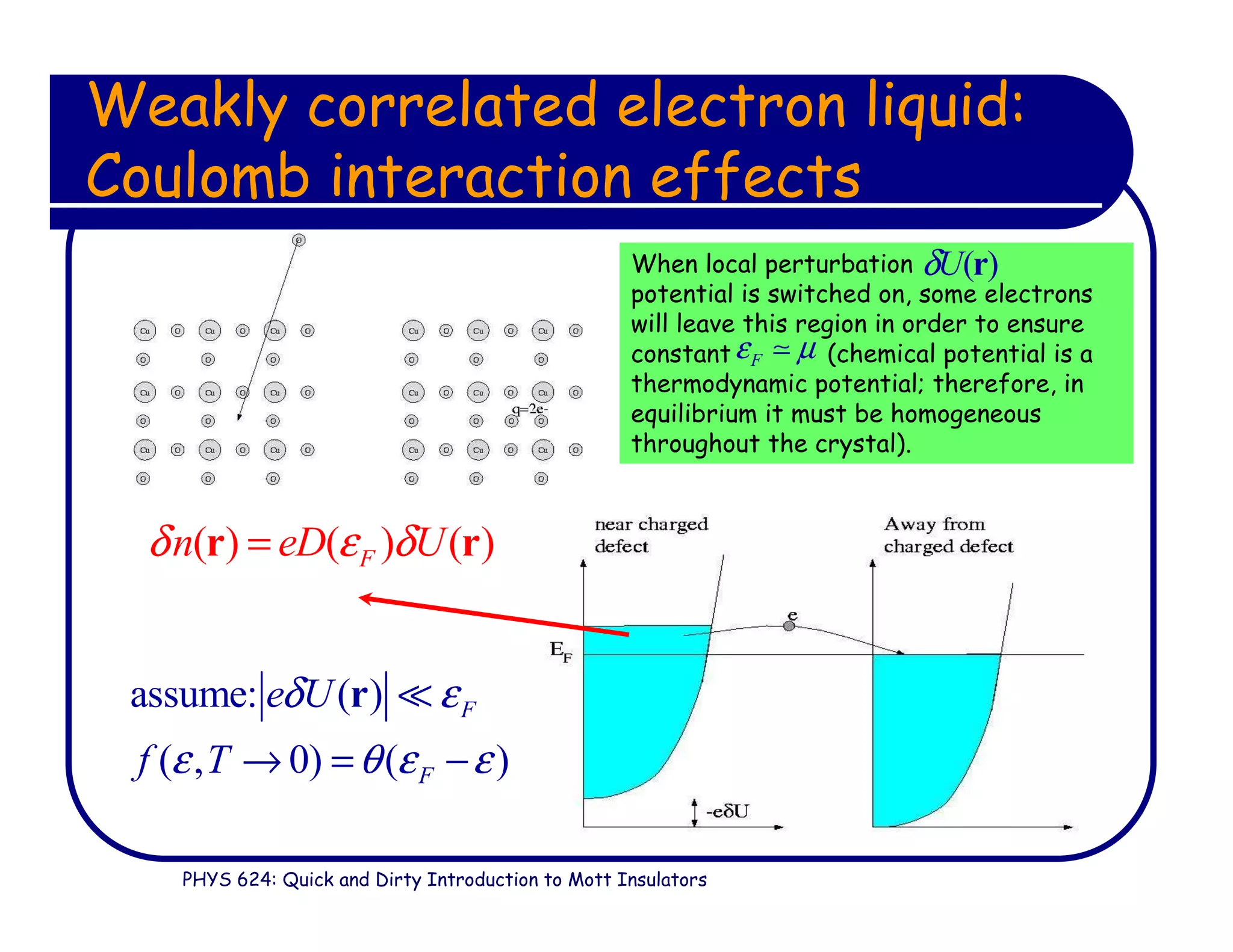
When local perturbation
potential is switched on, some electrons
will leave this region in order to ensure
constant (chemical potential is a
thermodynamic potential; therefore, in
equilibrium it must be homogeneous
throughout the crystal).
( )Uδ r
Fε µ≃
PHYS 624: Quick and Dirty Introduction to Mott Insulators
Thomas –Fermi Screening
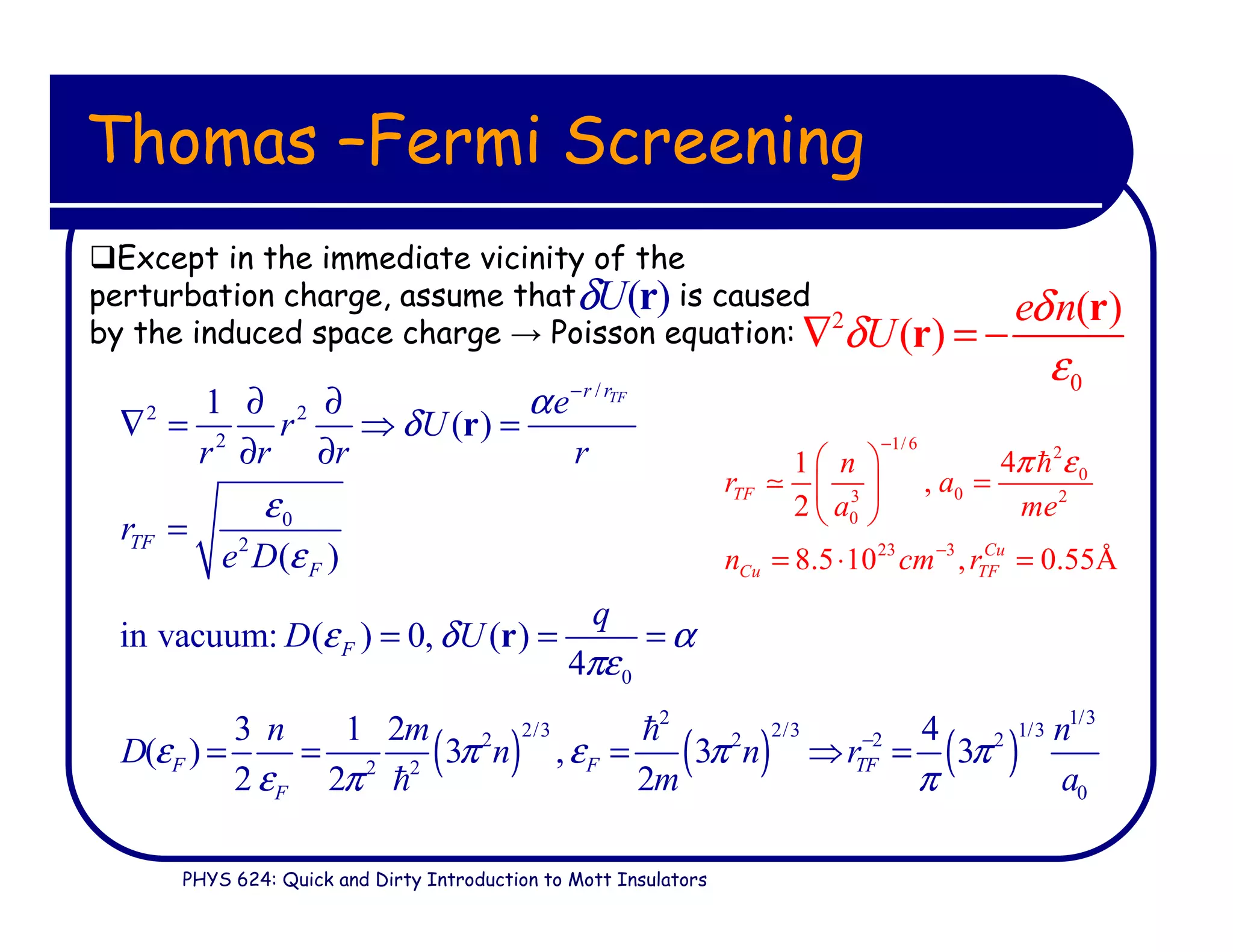
Except in the immediate vicinity of the
perturbation charge, assume that is caused
by the induced space charge → Poisson equation: 2
0
( )
( )
e n
U
δ
δ
ε
∇ = −
r
r
/
2 2
2
0
2
0
1
( )
( )
in vacuum: ( ) 0, ( )
4
TFr r
TF
F
F
e
r U
r r r r
r
e D
q
D U
α
δ
ε
ε
ε δ α
πε
−
∂ ∂
∇ = ⇒ =
∂ ∂
=
= = =
r
r
( ) ( ) ( )
2 1/3
2/3 2/3 1/32 2 2 2
2 2
0
3 1 2 4
( ) 3 , 3 3
2 2 2
F F TF
F
n m n
D n n r
m a
ε π ε π π
ε π π
−
= = = ⇒ =
ℏ
ℏ
1/6
2
0
03 2
0
23 3
41
,
2
8.5 10 , 0.55Å
TF
Cu
Cu TF
n
r a
a me
n cm r
π ε
−
−
 
= 
 
= ⋅ =
ℏ
≃
( )Uδ r
PHYS 624: Quick and Dirty Introduction to Mott Insulators
Mott Metal-Insulator Transition
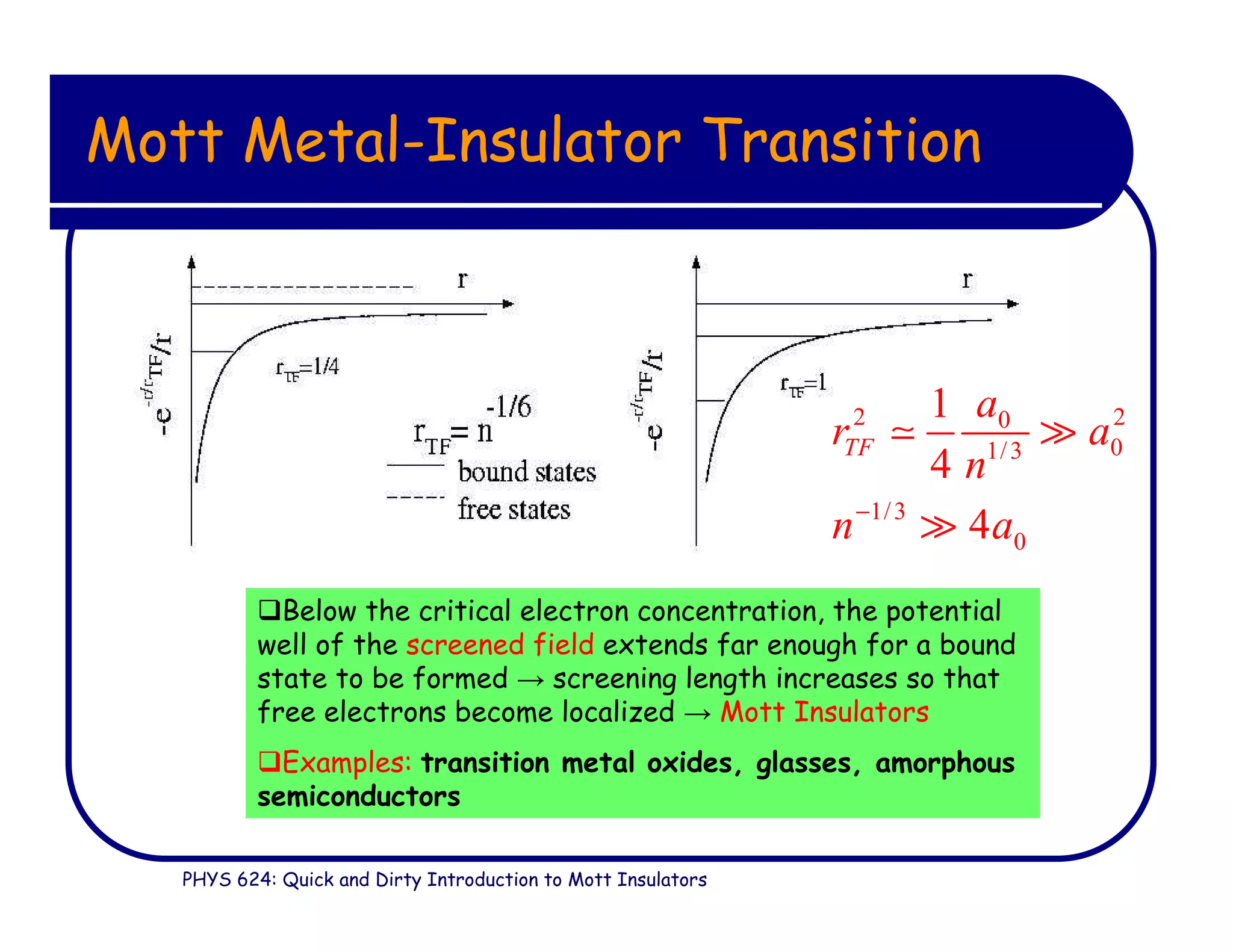
Below the critical electron concentration, the potential
well of the screened field extends far enough for a bound
state to be formed
→
screening length increases so that
free electrons become localized →
Mott Insulators
Examples: transition metal oxides, glasses, amorphous
semiconductors
2 20
01/3
1/3
0
1
4
4
TF
a
r a
n
n a−
≃ ≫
≫
PHYS 624: Quick and Dirty Introduction to Mott Insulators
Metal vs. Insulator: Theory
0 0 | | 0
lim lim lim R e ( , ) 0
T
αβ
ω
σ ω
→ → →
  = q
q
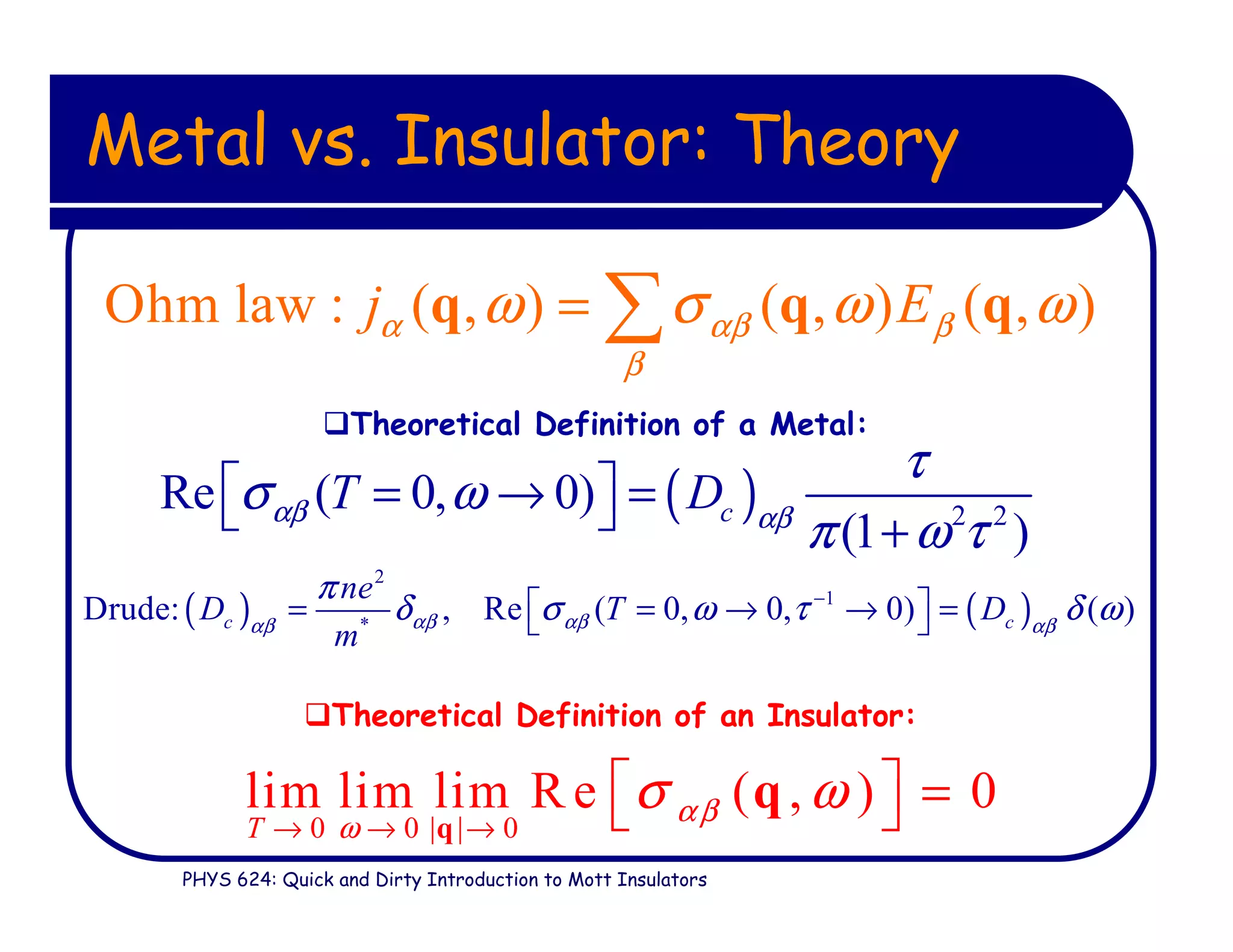
Theoretical Definition of an Insulator:
Theoretical Definition of a Metal:
Ohm law : ( , ) ( , ) ( , )j Eα αβ β
β
ω σ ω ω= ∑q q q
( ) 2 2
Re ( 0, 0)
(1 )
cT Dαβ αβ
τ
σ ω
π ω τ
 = → =  +
( ) ( )
2
1
*
Drude: , Re ( 0, 0, 0) ( )c c
ne
D T D
m
αβ αβαβ αβ
π
δ σ ω τ δ ω−
 = = → → = 
PHYS 624: Quick and Dirty Introduction to Mott Insulators
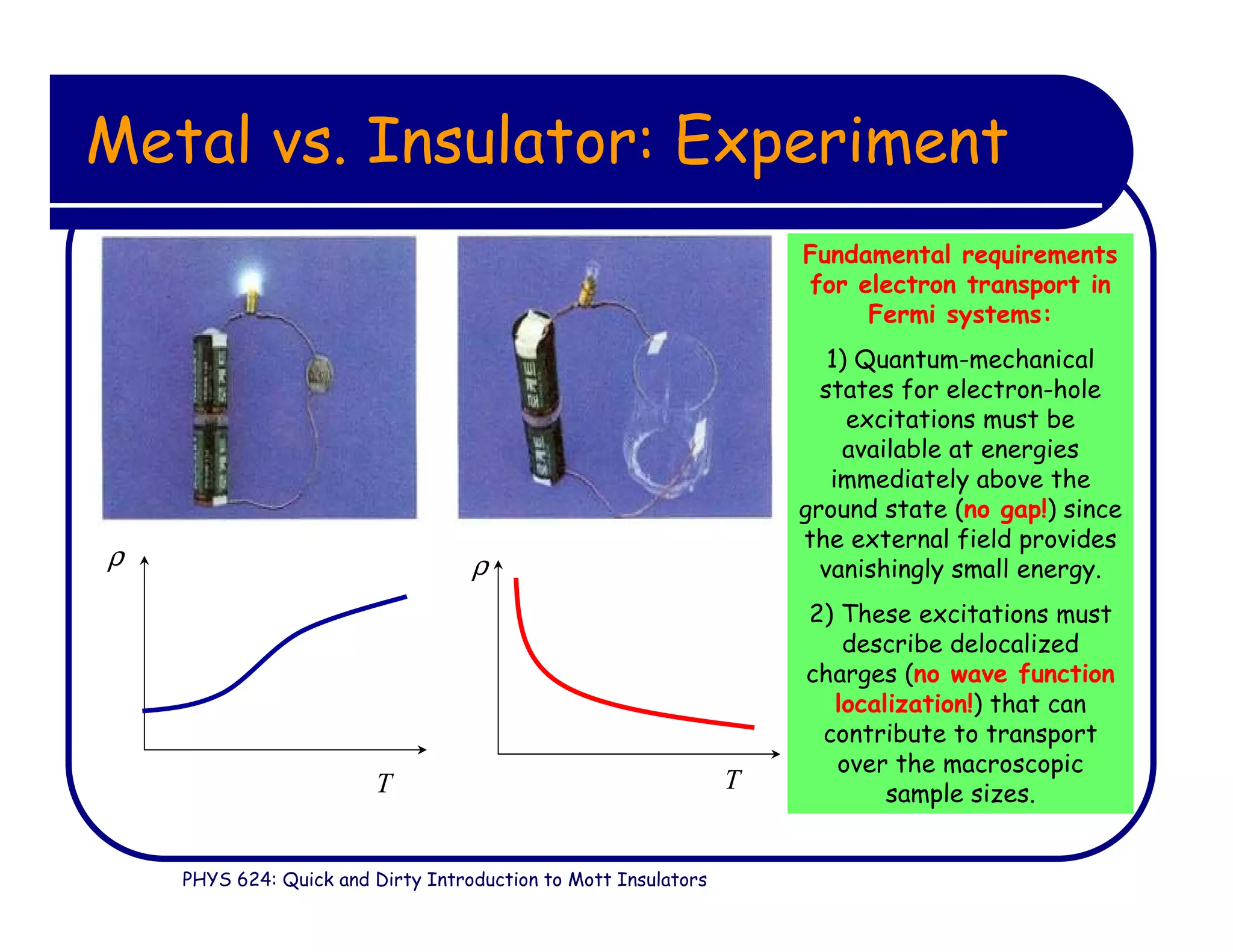
Metal vs. Insulator: Experiment
T
ρ
T
ρ
Fundamental requirements
for electron transport in
Fermi systems:
1) Quantum-mechanical
states for electron-hole
excitations must be
available at energies
immediately above the
ground state (no gap!) since
the external field provides
vanishingly small energy.
2) These excitations must
describe delocalized
charges (no wave function
localization!) that can
contribute to transport
over the macroscopic
sample sizes.
PHYS 624: Quick and Dirty Introduction to Mott Insulators
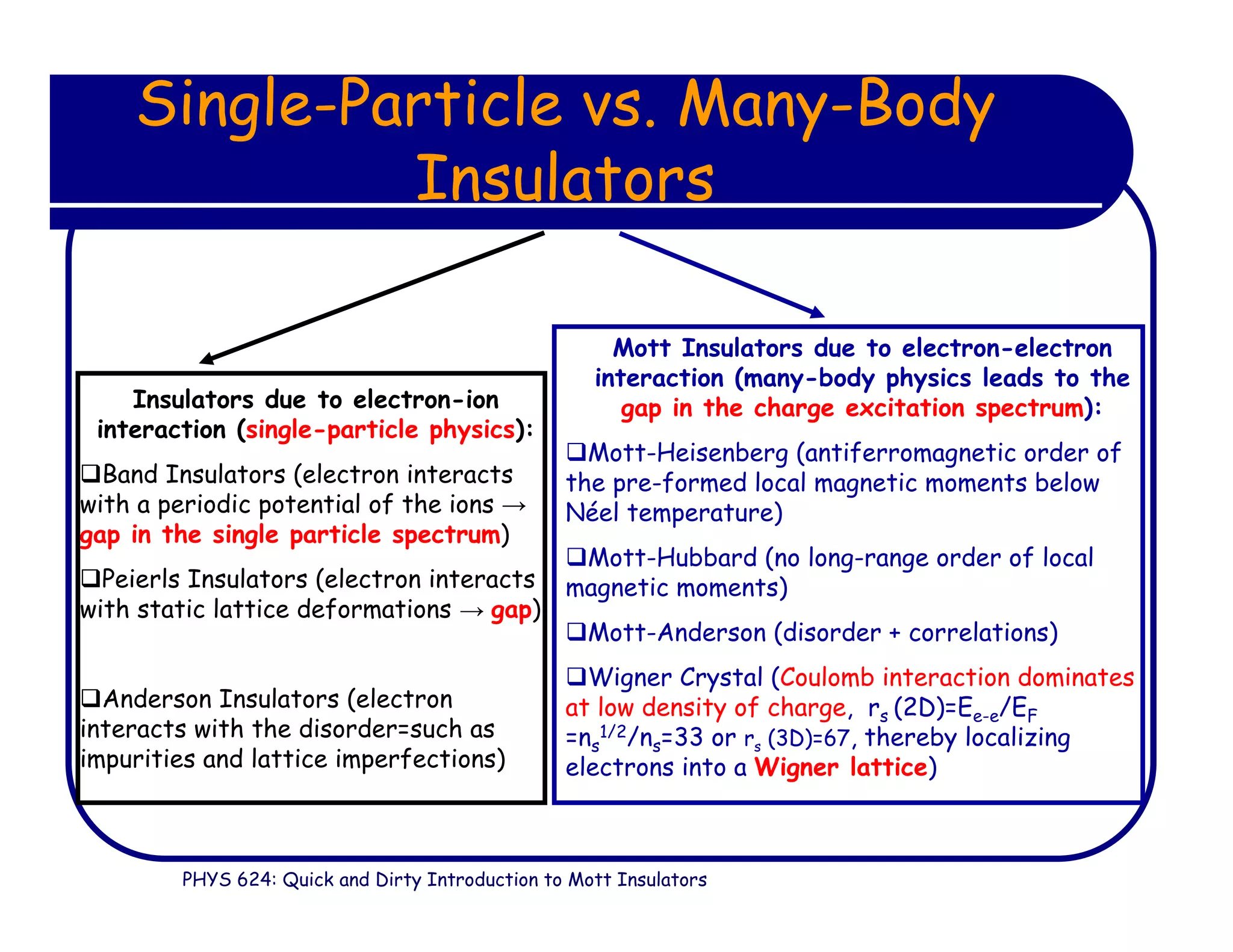
Single-Particle vs. Many-Body
Insulators
Insulators due to electron-ion
interaction (single-particle physics):
Band Insulators (electron interacts
with a periodic potential of the ions →
gap in the single particle spectrum)
Peierls Insulators (electron interacts
with static lattice deformations
→
gap)
Anderson Insulators (electron
interacts with the disorder=such as
impurities and lattice imperfections)
Mott Insulators due to electron-electron
interaction (many-body physics leads to the
gap in the charge excitation spectrum):
Mott-Heisenberg (antiferromagnetic order of
the pre-formed local magnetic moments below
Néel temperature)
Mott-Hubbard (no long-range order of local
magnetic moments)
Mott-Anderson (disorder + correlations)
Wigner Crystal (Coulomb interaction dominates
at low density of charge, rs (2D)=Ee-e/EF
=ns
1/2/ns=33 or rs (3D)=67, thereby localizing
electrons into a Wigner lattice)
PHYS 624: Quick and Dirty Introduction to Mott Insulators
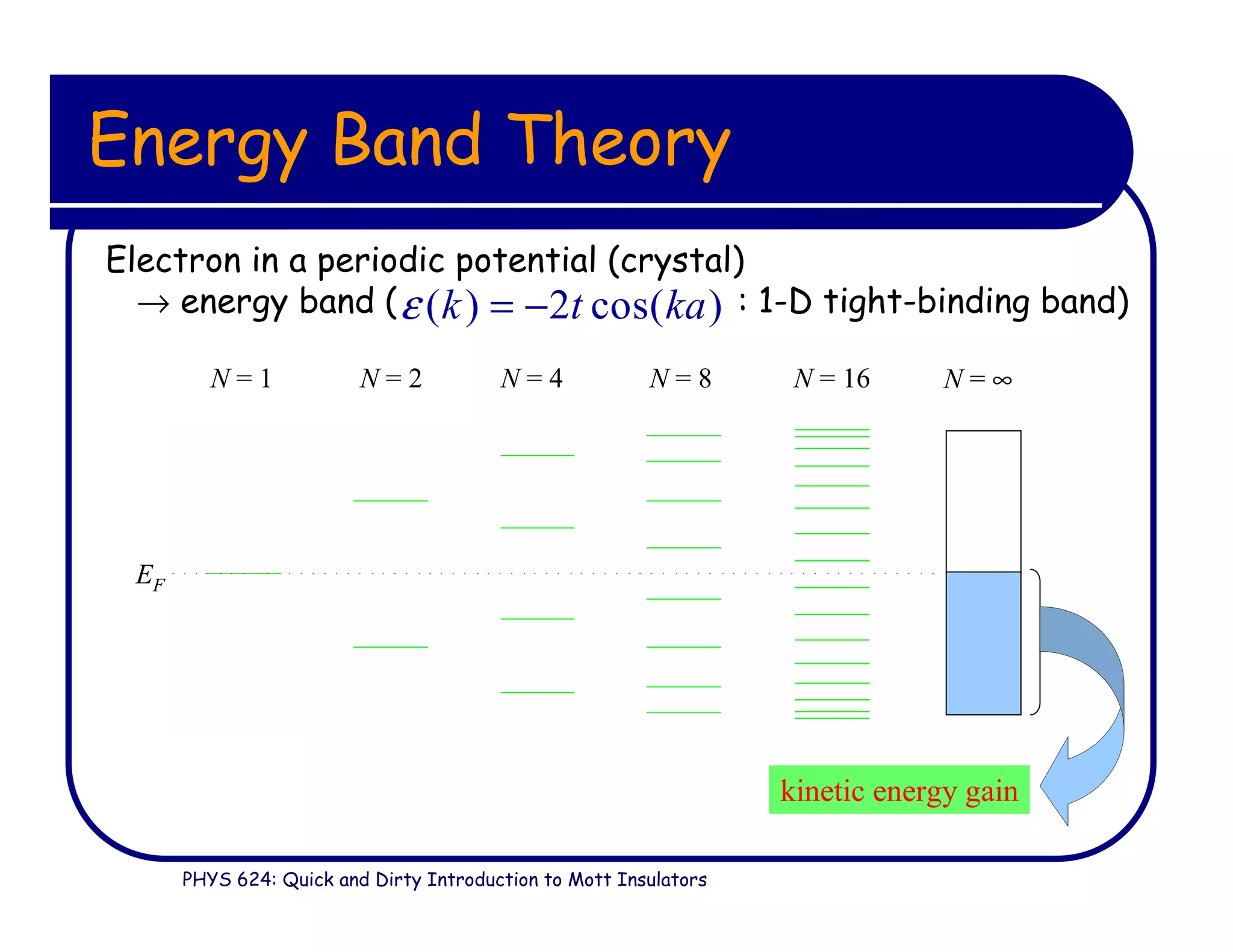
Energy Band Theory
Electron in a periodic potential (crystal)
→ energy band ( : 1-D tight-binding band)
N = 1 N = 2 N = 4 N = 8 N = 16 N = ∞
EF
kinetic energy gain
( ) 2 cos( )k t kaε = −
PHYS 624: Quick and Dirty Introduction to Mott Insulators
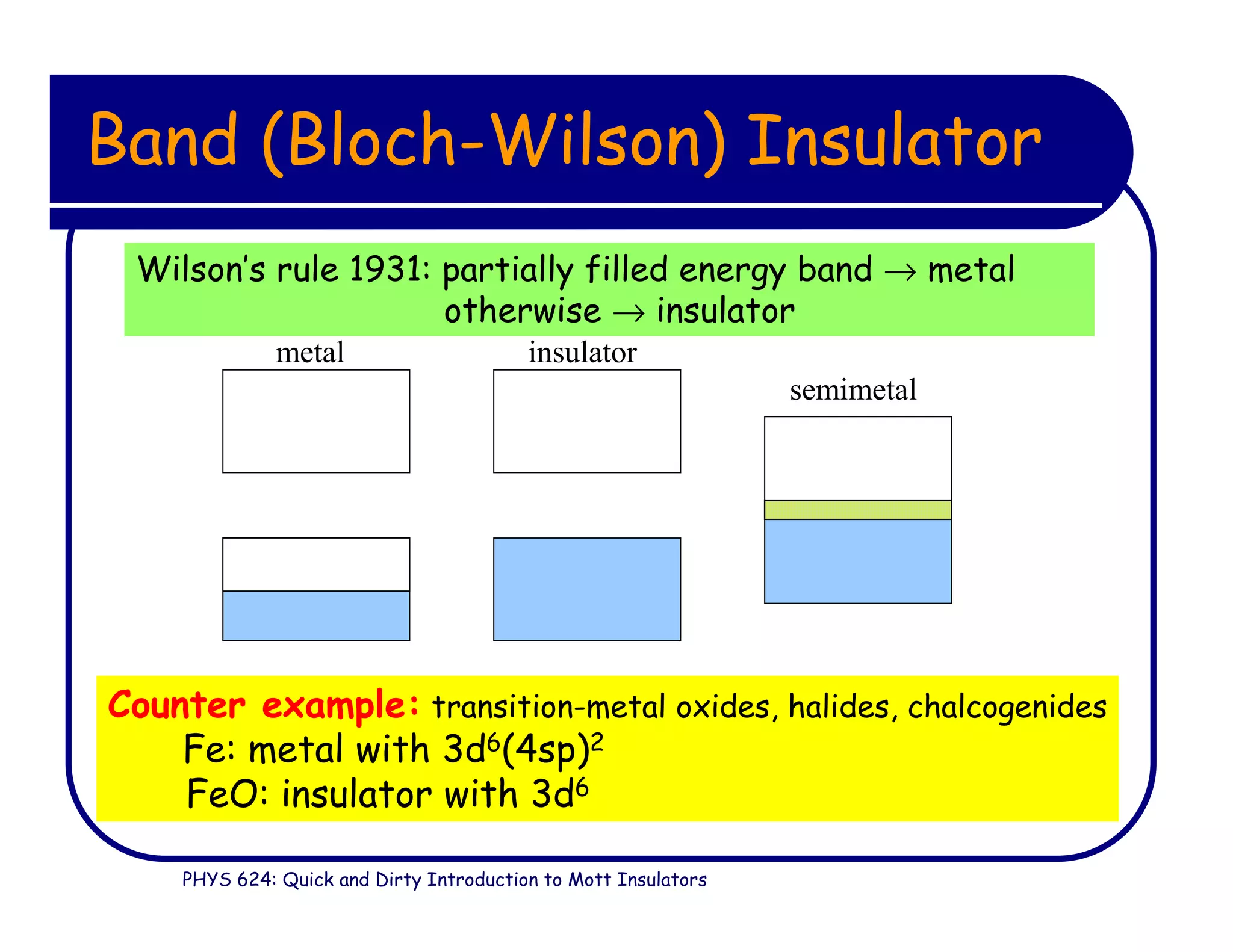
Band (Bloch-Wilson) Insulator
Wilson’s rule 1931: partially filled energy band → metal
otherwise → insulator
metal insulator
semimetal
Counter example: transition-metal oxides, halides, chalcogenides
Fe: metal with 3d6(4sp)2
FeO: insulator with 3d6
PHYS 624: Quick and Dirty Introduction to Mott Insulators
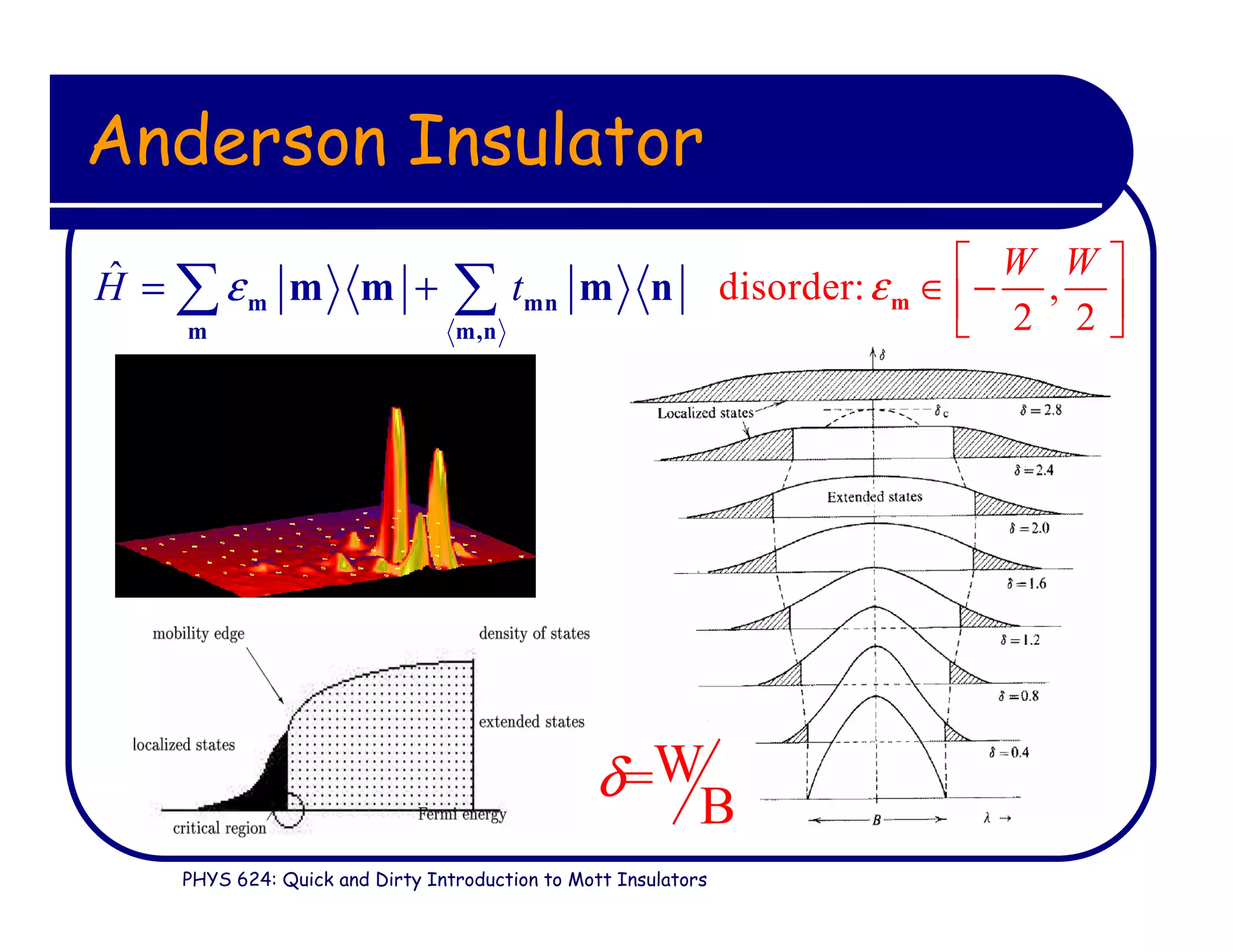
Anderson Insulator
ˆH tε= +∑ ∑m mn
m m,n
m m m n
W=
B
δ
disorder: ,
2 2
W W
ε
 
∈ −  
m
PHYS 624: Quick and Dirty Introduction to Mott Insulators
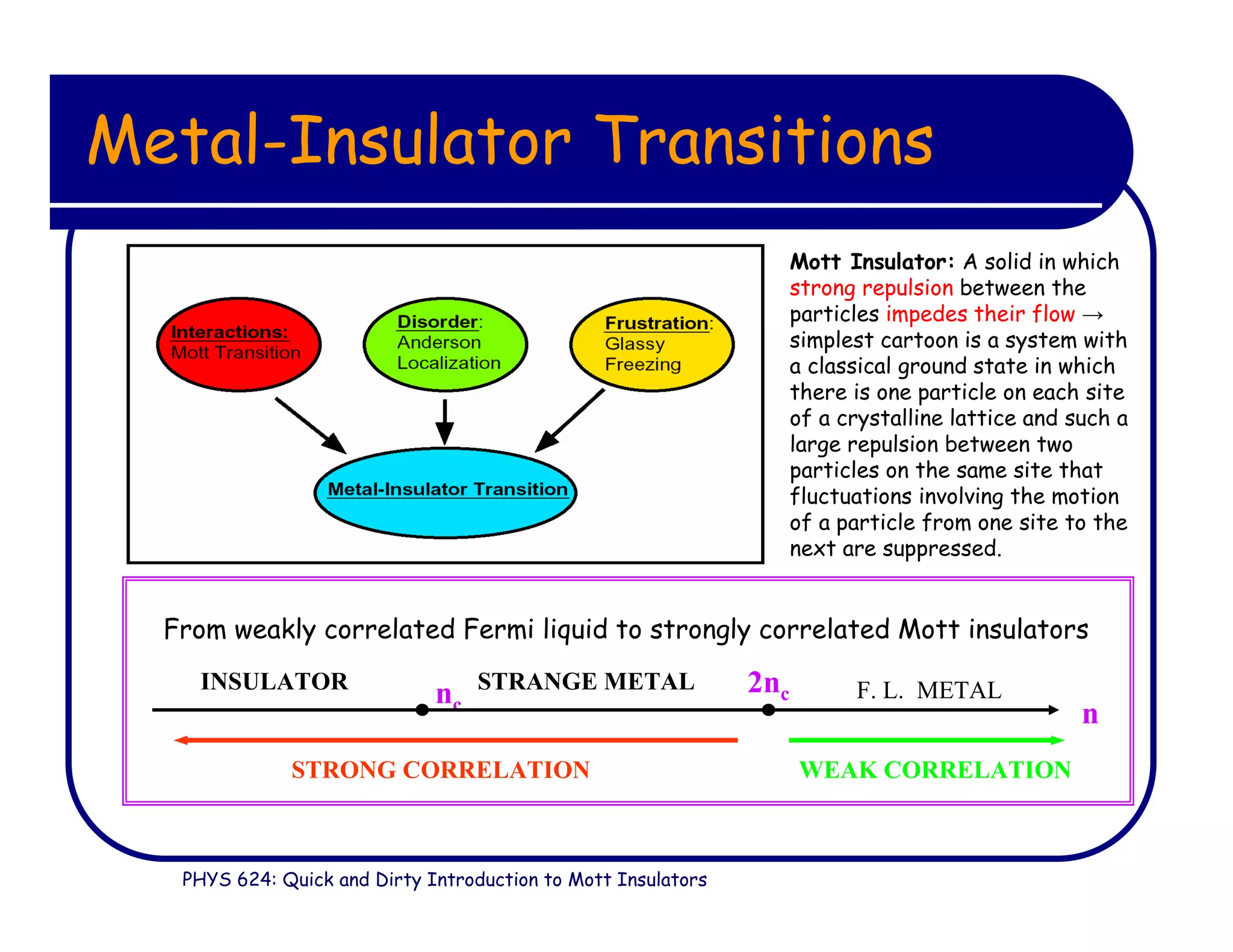
Metal-Insulator Transitions
From weakly correlated Fermi liquid to strongly correlated Mott insulators
nc
2nc
n
STRONG CORRELATION WEAK CORRELATION
INSULATOR STRANGE METAL F. L. METAL
Mott Insulator: A solid in which
strong repulsion between the
particles impedes their flow →
simplest cartoon is a system with
a classical ground state in which
there is one particle on each site
of a crystalline lattice and such a
large repulsion between two
particles on the same site that
fluctuations involving the motion
of a particle from one site to the
next are suppressed.
PHYS 624: Quick and Dirty Introduction to Mott Insulators
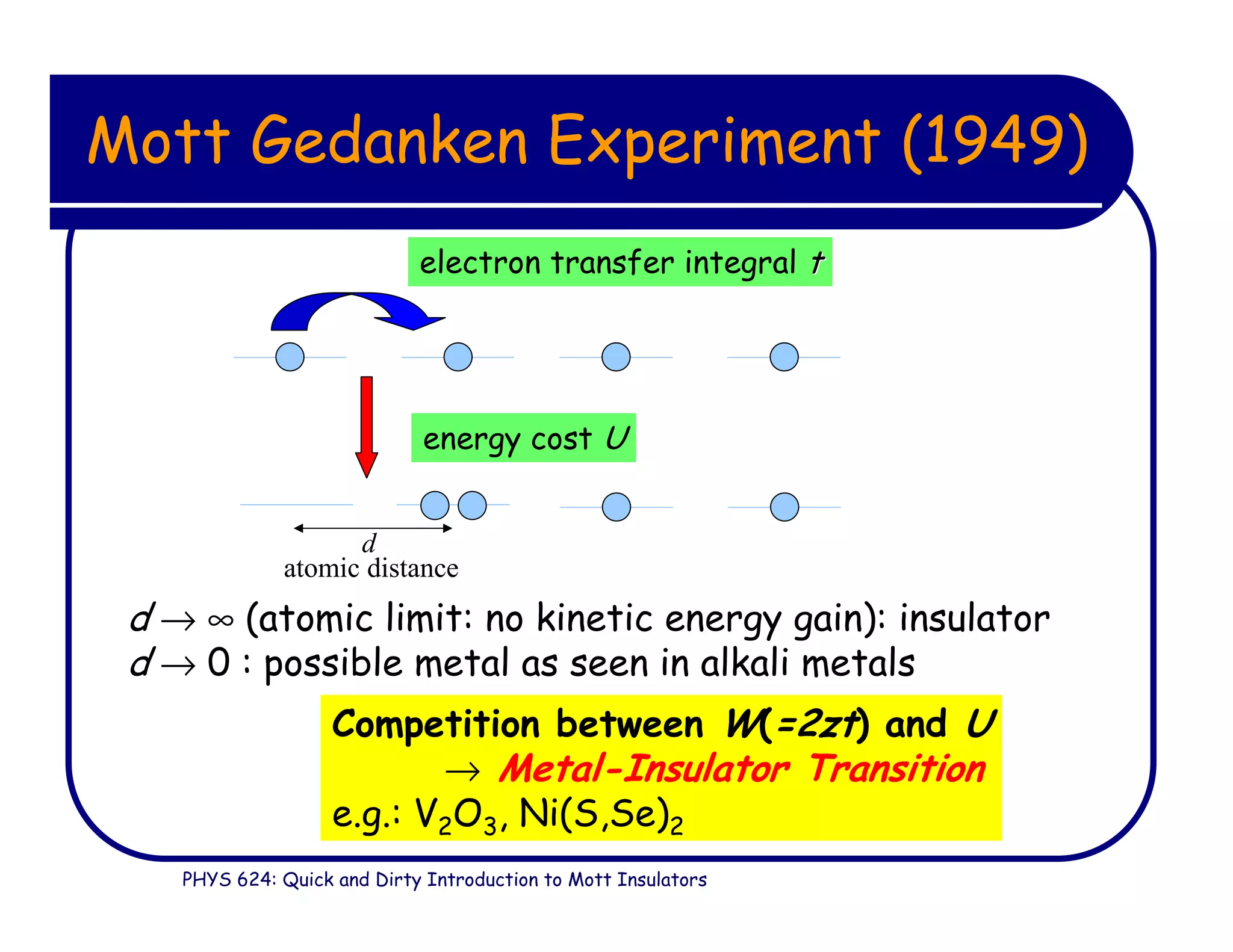
Mott Gedanken Experiment (1949)
energy cost U
electron transfer integral tt
Competition between W(=2zt) and U
→ Metal-Insulator Transition
e.g.: V2O3, Ni(S,Se)2
d
atomic distance
d → ∞ (atomic limit: no kinetic energy gain): insulator
d → 0 : possible metal as seen in alkali metals
PHYS 624: Quick and Dirty Introduction to Mott Insulators
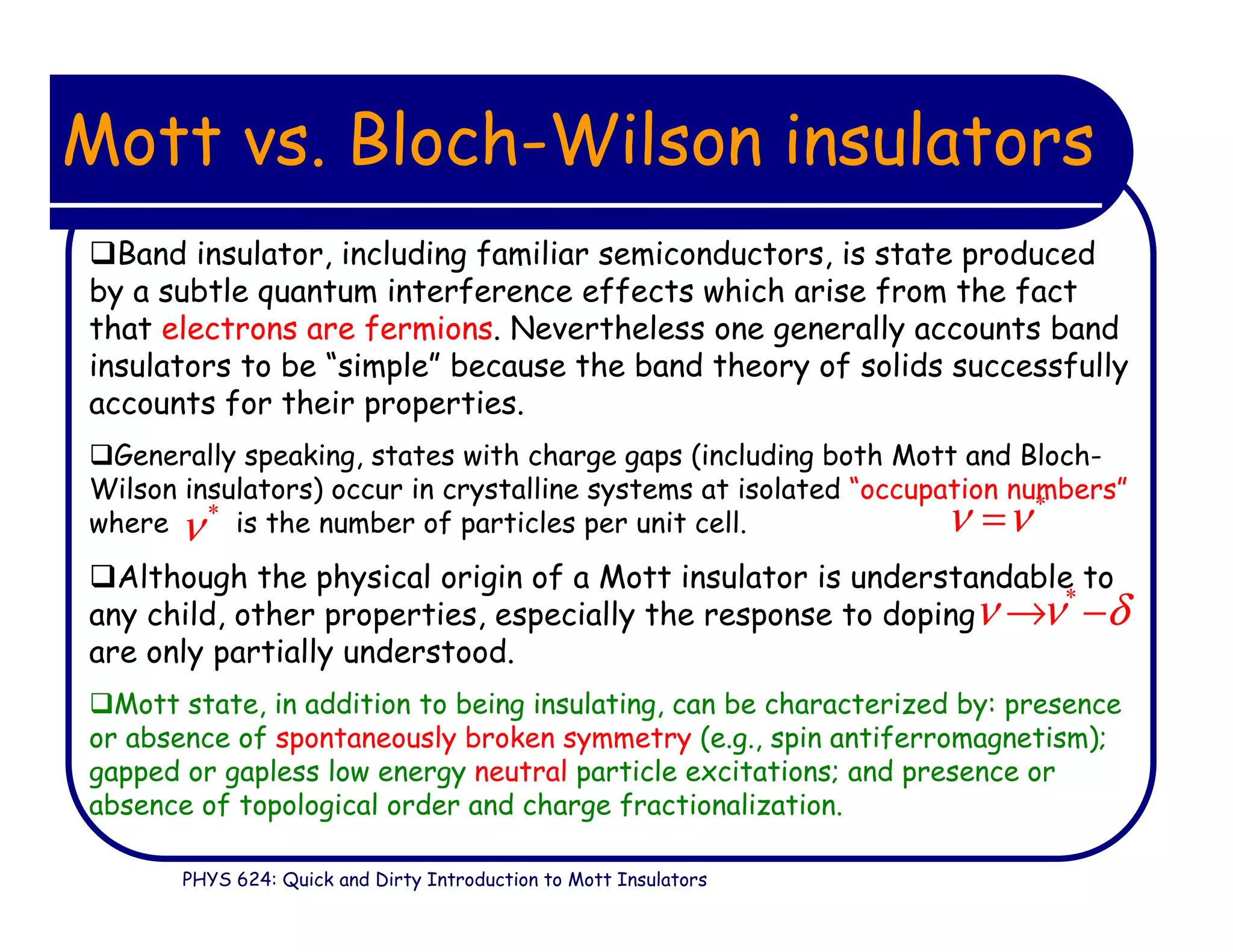
Mott vs. Bloch-Wilson insulators
Band insulator, including familiar semiconductors, is state produced
by a subtle quantum interference effects which arise from the fact
that electrons are fermions. Nevertheless one generally accounts band
insulators to be “simple” because the band theory of solids successfully
accounts for their properties.
Generally speaking, states with charge gaps (including both Mott and Bloch-
Wilson insulators) occur in crystalline systems at isolated “occupation numbers”
where is the number of particles per unit cell.
Although the physical origin of a Mott insulator is understandable to
any child, other properties, especially the response to doping
are only partially understood.
Mott state, in addition to being insulating, can be characterized by: presence
or absence of spontaneously broken symmetry (e.g., spin antiferromagnetism);
gapped or gapless low energy neutral particle excitations; and presence or
absence of topological order and charge fractionalization.
*
ν ν=*
ν
*
ν ν δ→ −
PHYS 624: Quick and Dirty Introduction to Mott Insulators
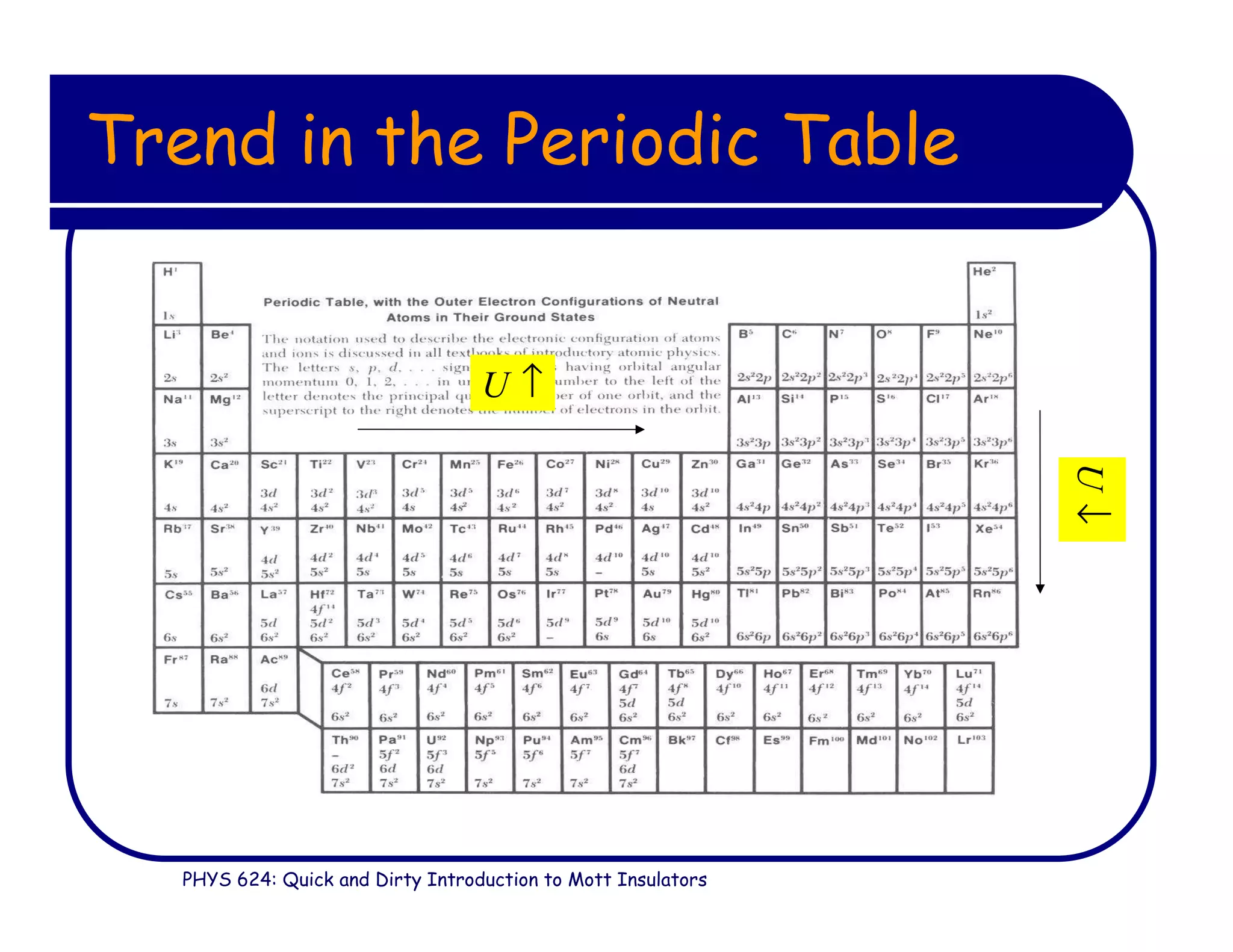
Trend in the Periodic Table
U ↑
U↓
PHYS 624: Quick and Dirty Introduction to Mott Insulators
Theoretical modeling: Hubbard Hamiltonian
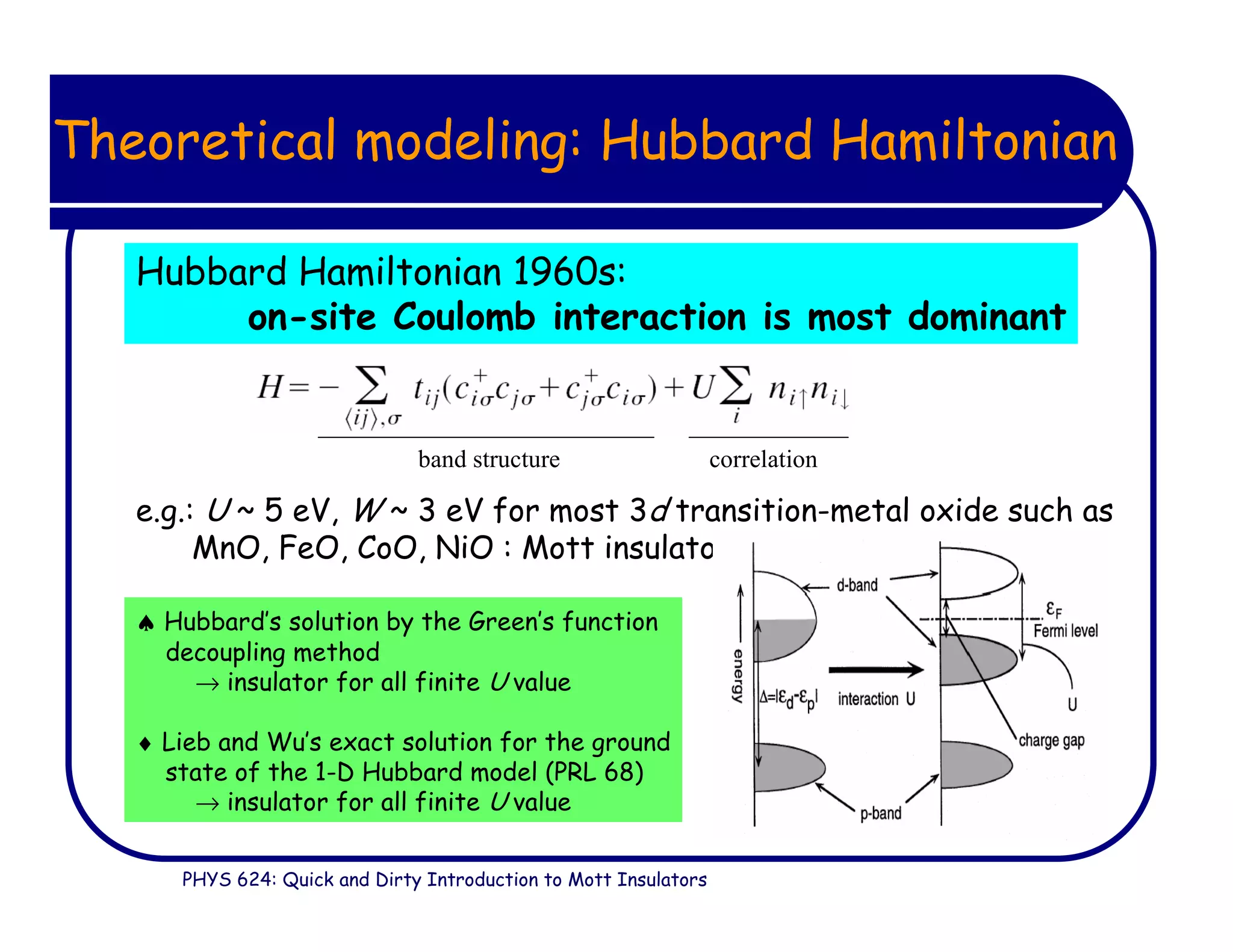
Hubbard Hamiltonian 1960s:
on-site Coulomb interaction is most dominant
♠ Hubbard’s solution by the Green’s function
decoupling method
→ insulator for all finite U value
♦ Lieb and Wu’s exact solution for the ground
state of the 1-D Hubbard model (PRL 68)
→ insulator for all finite U value
e.g.: U ~ 5 eV, W ~ 3 eV for most 3d transition-metal oxide such as
MnO, FeO, CoO, NiO : Mott insulator
band structure correlation
PHYS 624: Quick and Dirty Introduction to Mott Insulators
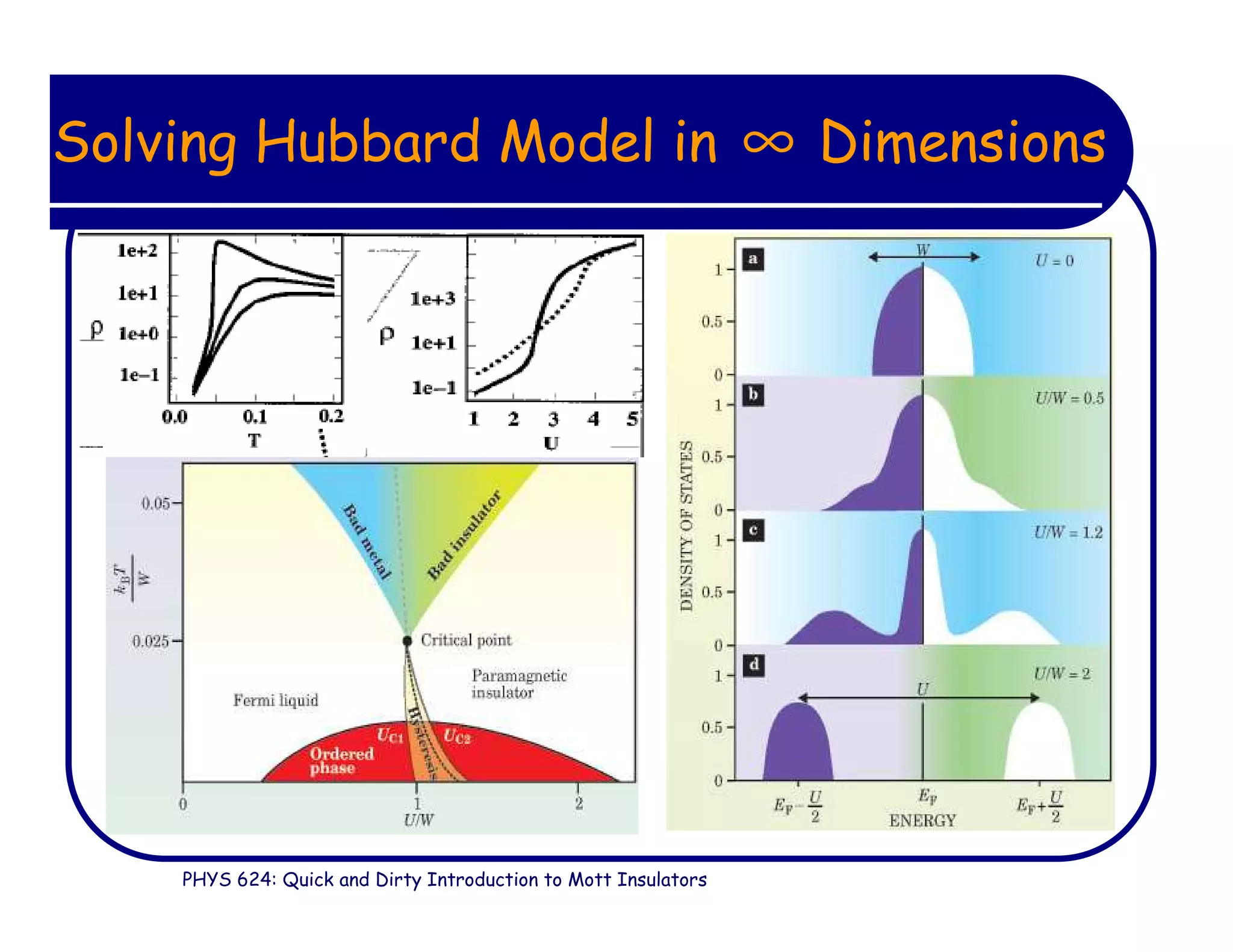
Solving Hubbard Model in Dimensions∞
PHYS 624: Quick and Dirty Introduction to Mott Insulators
Dynamical Mean-Field Theory in Pictures
In ∞-D, spatial fluctuation can be neglected.
→ mean-field solution becomes exact.
Hubbard model → single-impurity Anderson
model in a mean-field bath.
Solve exactly in the time domain
→ “dynamical” mean-field theory
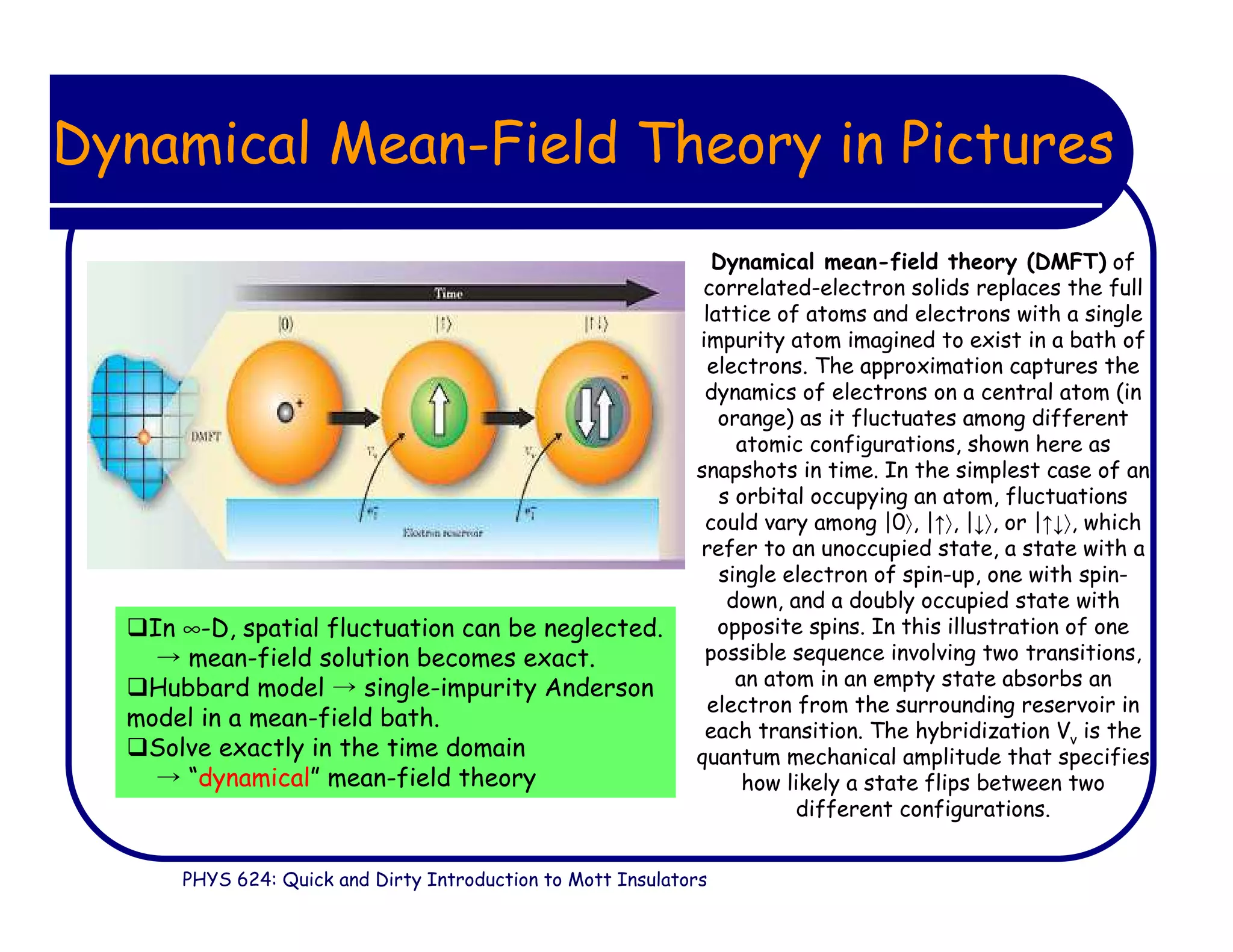
Dynamical mean-field theory (DMFT) of
correlated-electron solids replaces the full
lattice of atoms and electrons with a single
impurity atom imagined to exist in a bath of
electrons. The approximation captures the
dynamics of electrons on a central atom (in
orange) as it fluctuates among different
atomic configurations, shown here as
snapshots in time. In the simplest case of an
s orbital occupying an atom, fluctuations
could vary among |0〉, |
↑
〉, |
↓
〉, or |
↑
↓
〉, which
refer to an unoccupied state, a state with a
single electron of spin-up, one with spin-
down, and a doubly occupied state with
opposite spins. In this illustration of one
possible sequence involving two transitions,
an atom in an empty state absorbs an
electron from the surrounding reservoir in
each transition. The hybridization Vν is the
quantum mechanical amplitude that specifies
how likely a state flips between two
different configurations.
PHYS 624: Quick and Dirty Introduction to Mott Insulators
Static vs. Dynamic
Mean-Field Theory
Static = Hartree-Fock or Density Functional Theory:
Dynamic = Dynamical Mean-Field Theory:
3
2
3 3
[ ( )] [ ( )] ( ) ( )
( ) ( ) ( )1 ( ) ( ) 2[ ( )]
2 | |
kinetic ext
KS i
exchange
E V d
V
md d E
ρ ρ ρ
ερ ρ
ρ
Γ = +
 
⇒ + Ψ = Ψ′  
′+ +  
′− 
∫
∫
r r r r r
r r rr r
r r r
r r
ℏ
23
[ ( )]( )
[ ( )] ( ) , ( ) ( )| ( )|
| | ( )
exchange
KS ext i i
i
E
V V d f
δ ρρ
ρ ρ ε
δρ
′
′= + + = Ψ
′−
∑∫
rr
r r r r r
r r r
[ ]
3
1
3 3
[ ( ), ] [ ( ), ] ( ) ( ) [ ( )] [ ( )]
1 ( ) ( )
[ ( ), ] [ ( )] ( ) 1/ [ ( )]2 | |
kinetic ext
exchange
G E G V d G t
d d E G G
ρ ρ ρ ω ω ω
ρ ρ
ρ ω ω ω ω
−Γ = +  ∆ = − Σ ∆ − 
⇒ ′
′+ +  Σ ∆ ≡ ∆ − ∆ +′− 
∫ ∑
∫
k
k
r r r r r
r r
r r r
r r
PHYS 624: Quick and Dirty Introduction to Mott Insulators
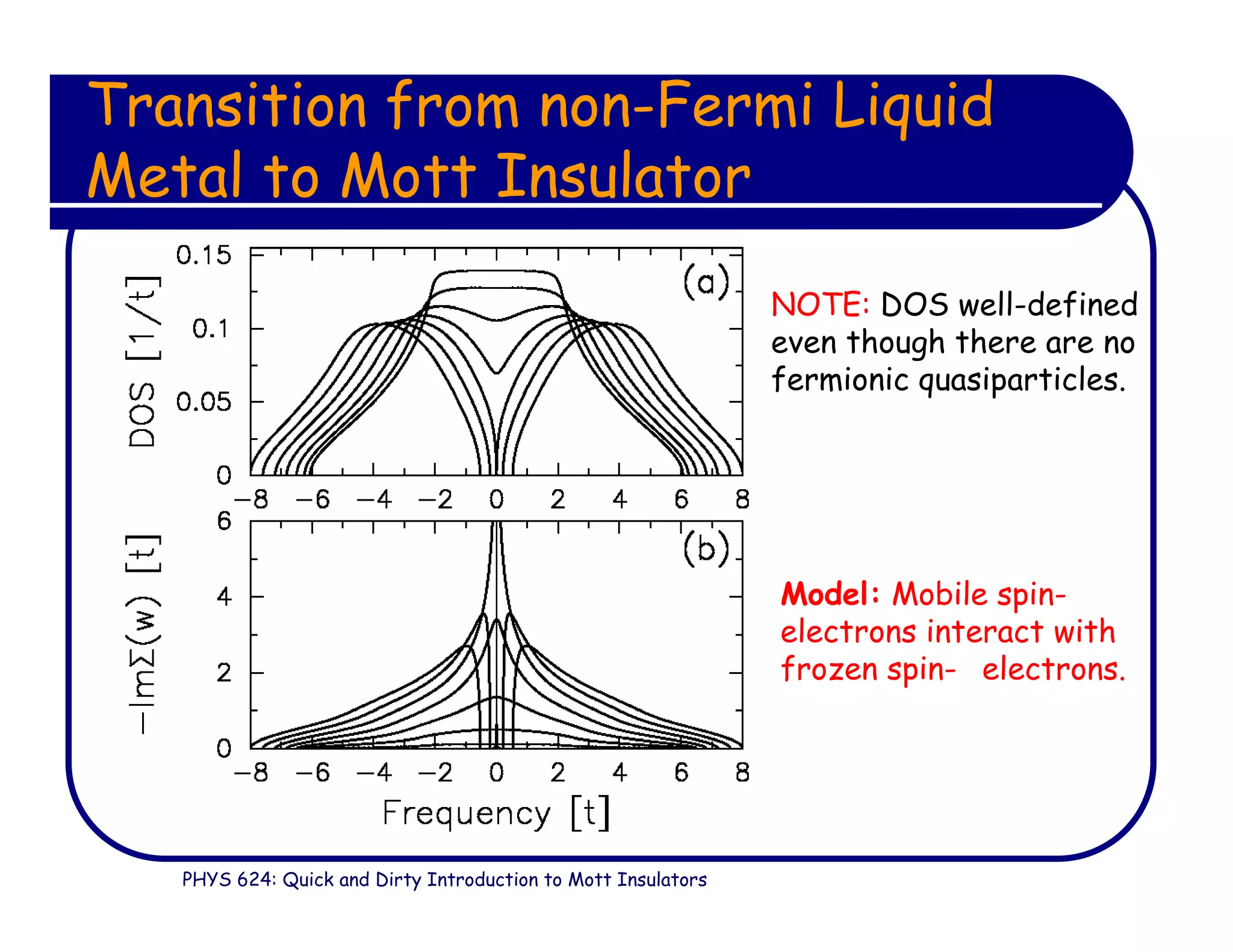
Transition from non-Fermi Liquid
Metal to Mott Insulator
Model: Mobile spin-
↑
electrons interact with
frozen spin-
↓
electrons.
NOTE: DOS well-defined
even though there are no
fermionic quasiparticles.
PHYS 624: Quick and Dirty Introduction to Mott Insulators
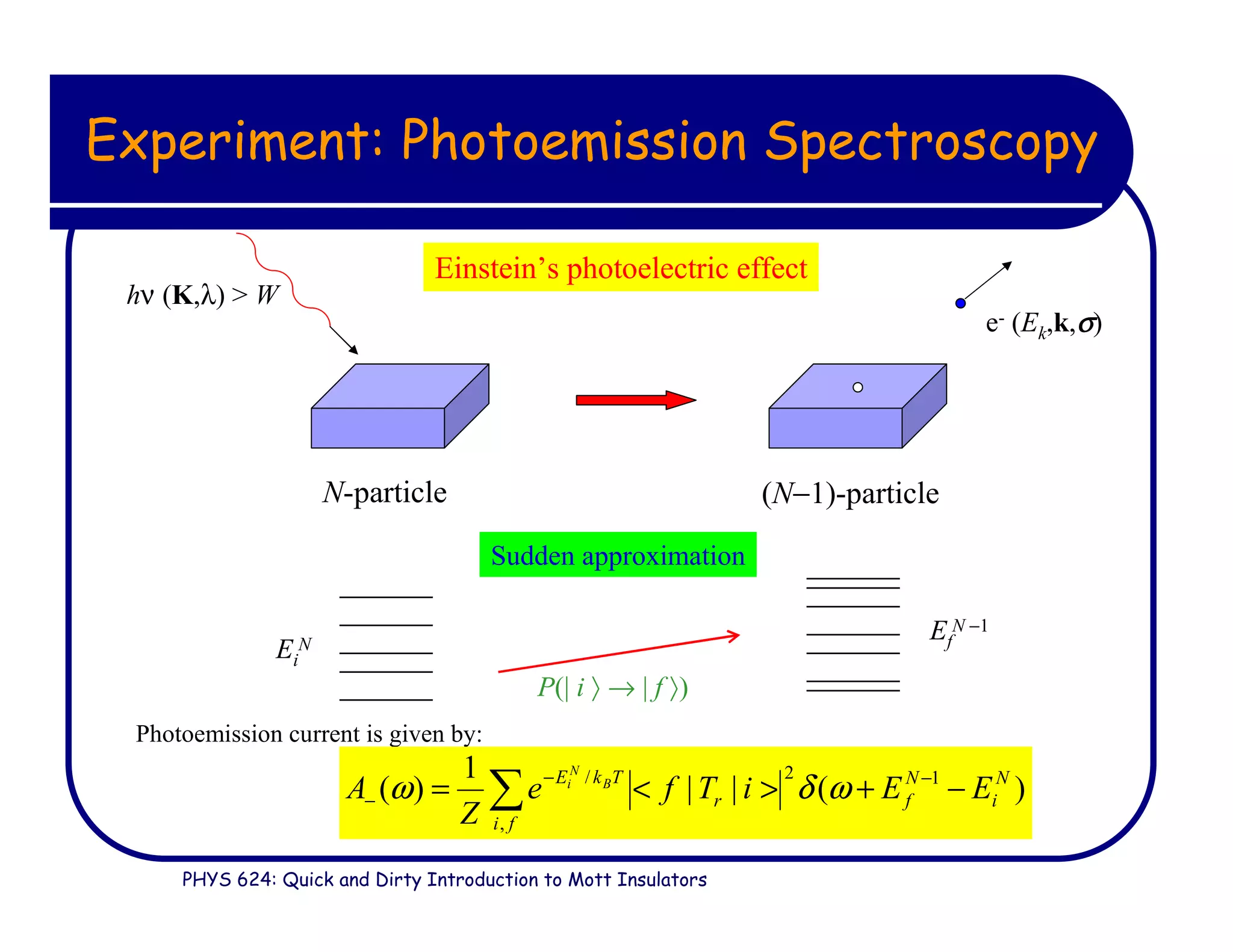
Experiment: Photoemission Spectroscopy
hν (K,λ) > W
e- (Ek,k,σσσσ)
N-particle (N−1)-particle
P(| i 〉 → | f 〉)
Sudden approximation
Einstein’s photoelectric effect
Photoemission current is given by:
Ei
N
Ef
N −1
∑ −+><= −−
−
fi
N
i
N
fr
TkE
EEiTfe
Z
A B
N
i
,
12/
)(||
1
)( ωδω
PHYS 624: Quick and Dirty Introduction to Mott Insulators
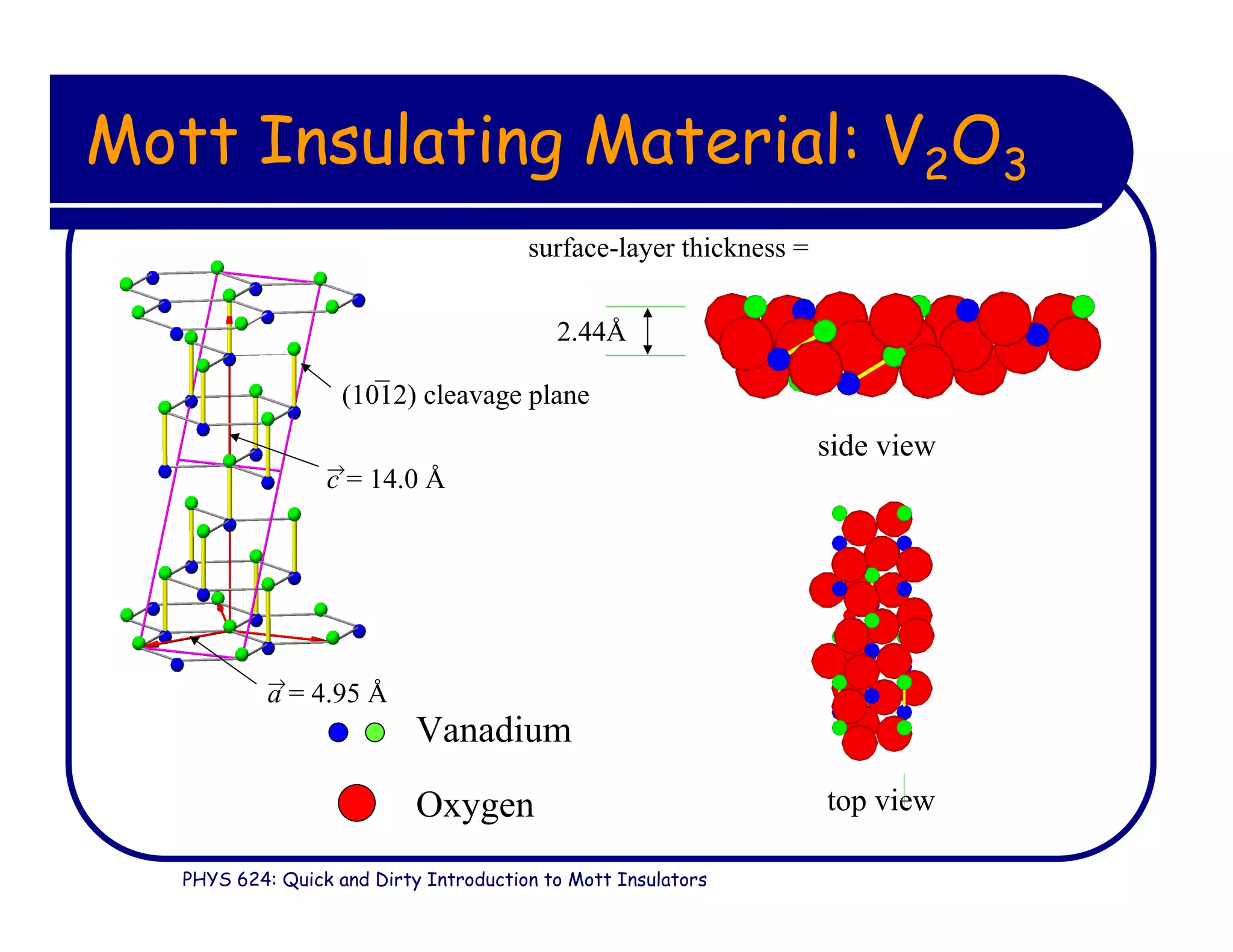
Mott Insulating Material: V2O3
→
a = 4.95 Å
→
c = 14.0 Å
–
(1012) cleavage plane
Vanadium
Oxygen
surface-layer thickness =
side view
2.44Å
top view
PHYS 624: Quick and Dirty Introduction to Mott Insulators
Theory vs. Experiment:
Photoemission Spectroscopy
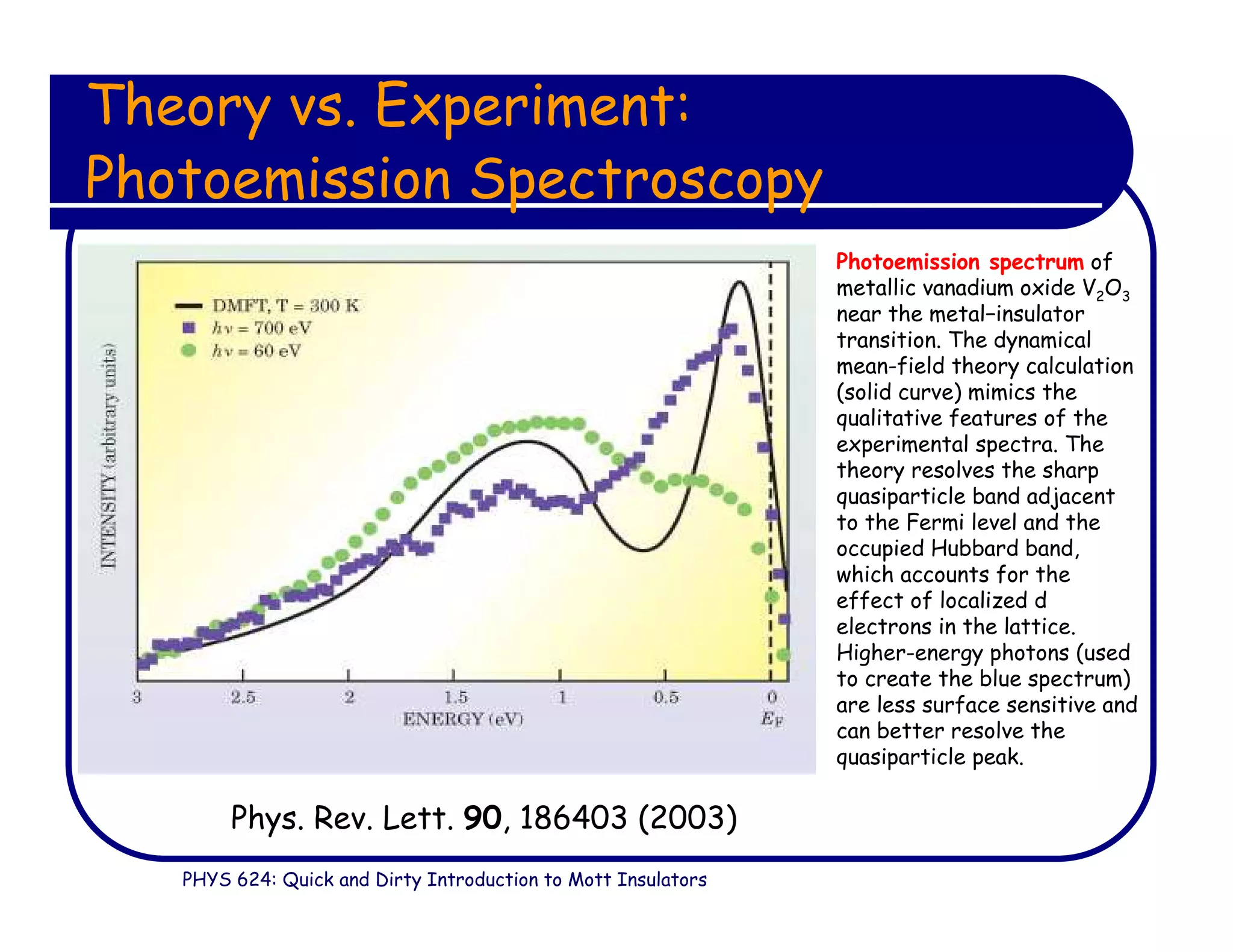
Photoemission spectrum of
metallic vanadium oxide V2O3
near the metal−insulator
transition. The dynamical
mean-field theory calculation
(solid curve) mimics the
qualitative features of the
experimental spectra. The
theory resolves the sharp
quasiparticle band adjacent
to the Fermi level and the
occupied Hubbard band,
which accounts for the
effect of localized d
electrons in the lattice.
Higher-energy photons (used
to create the blue spectrum)
are less surface sensitive and
can better resolve the
quasiparticle peak.
Phys. Rev. Lett. 90, 186403 (2003)
PHYS 624: Quick and Dirty Introduction to Mott Insulators
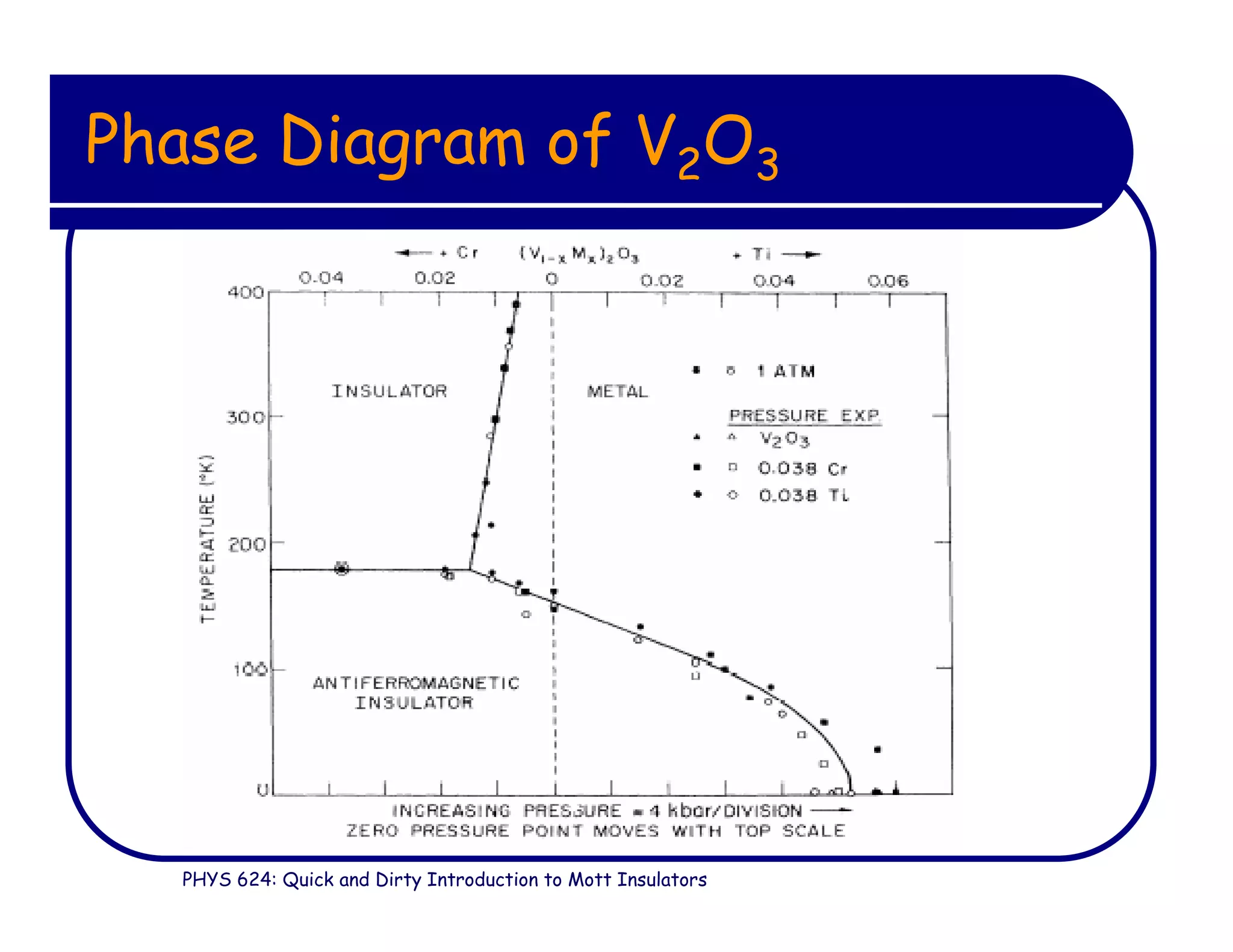
Phase Diagram of V2O3
PHYS 624: Quick and Dirty Introduction to Mott Insulators
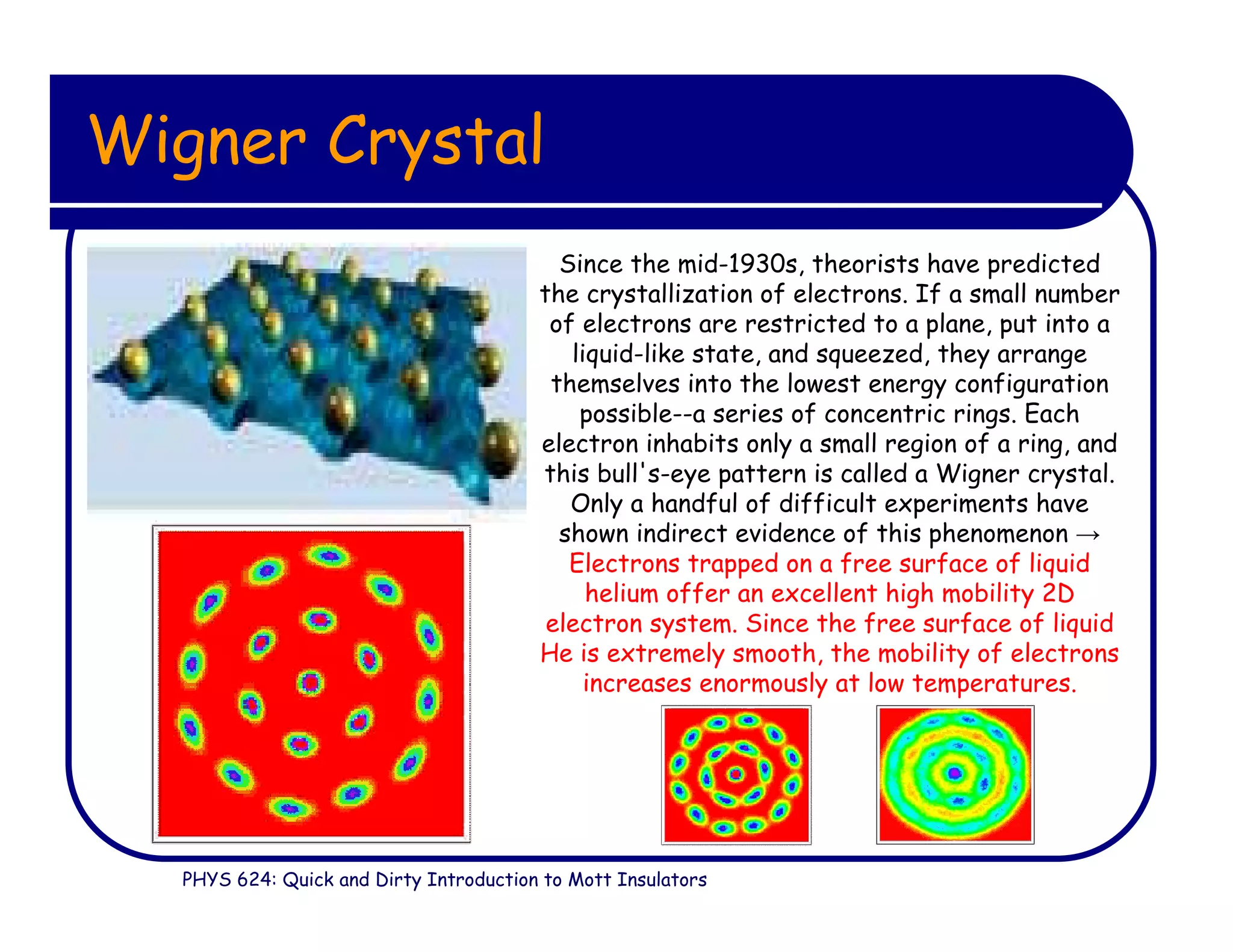
Wigner Crystal
Since the mid-1930s, theorists have predicted
the crystallization of electrons. If a small number
of electrons are restricted to a plane, put into a
liquid-like state, and squeezed, they arrange
themselves into the lowest energy configuration
possible--a series of concentric rings. Each
electron inhabits only a small region of a ring, and
this bull's-eye pattern is called a Wigner crystal.
Only a handful of difficult experiments have
shown indirect evidence of this phenomenon →
Electrons trapped on a free surface of liquid
helium offer an excellent high mobility 2D
electron system. Since the free surface of liquid
He is extremely smooth, the mobility of electrons
increases enormously at low temperatures.
PHYS 624: Quick and Dirty Introduction to Mott Insulators
Beyond Solid State Physics:
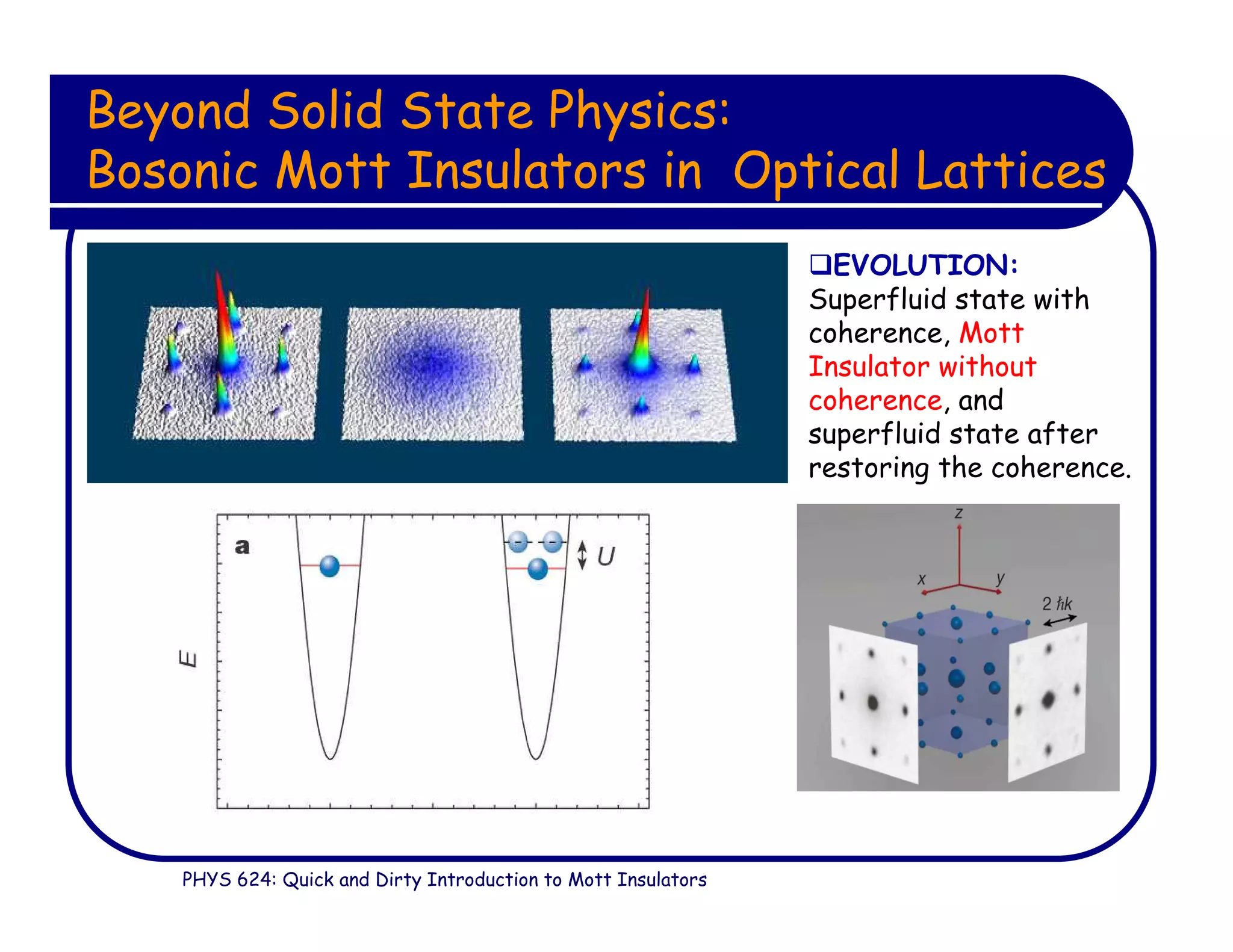
Bosonic Mott Insulators in Optical Lattices
EVOLUTION:
Superfluid state with
coherence, Mott
Insulator without
coherence, and
superfluid state after
restoring the coherence.

Quick and Dirty Introduction to Mott Insulators

  • 1.
    Quick and DirtyIntroduction to Mott Insulators Branislav K. Nikolić Department of Physics and Astronomy, University of Delaware, U.S.A. PHYS 624: Introduction to Solid State Physics http://www.physics.udel.edu/~bnikolic/teaching/phys624/phys624.html
  • 2.
    PHYS 624: Quickand Dirty Introduction to Mott Insulators Weakly correlated electron liquid: Coulomb interaction effects ( ) ( ) ( )Fn eD Uδ ε δ=r r assume: ( ) ( , 0) ( ) F F e U f T δ ε ε θ ε ε→ = − r ≪ When local perturbation potential is switched on, some electrons will leave this region in order to ensure constant (chemical potential is a thermodynamic potential; therefore, in equilibrium it must be homogeneous throughout the crystal). ( )Uδ r Fε µ≃
  • 3.
    PHYS 624: Quickand Dirty Introduction to Mott Insulators Thomas –Fermi Screening Except in the immediate vicinity of the perturbation charge, assume that is caused by the induced space charge → Poisson equation: 2 0 ( ) ( ) e n U δ δ ε ∇ = − r r / 2 2 2 0 2 0 1 ( ) ( ) in vacuum: ( ) 0, ( ) 4 TFr r TF F F e r U r r r r r e D q D U α δ ε ε ε δ α πε − ∂ ∂ ∇ = ⇒ = ∂ ∂ = = = = r r ( ) ( ) ( ) 2 1/3 2/3 2/3 1/32 2 2 2 2 2 0 3 1 2 4 ( ) 3 , 3 3 2 2 2 F F TF F n m n D n n r m a ε π ε π π ε π π − = = = ⇒ = ℏ ℏ 1/6 2 0 03 2 0 23 3 41 , 2 8.5 10 , 0.55Å TF Cu Cu TF n r a a me n cm r π ε − −   =    = ⋅ = ℏ ≃ ( )Uδ r
  • 4.
    PHYS 624: Quickand Dirty Introduction to Mott Insulators Mott Metal-Insulator Transition Below the critical electron concentration, the potential well of the screened field extends far enough for a bound state to be formed → screening length increases so that free electrons become localized → Mott Insulators Examples: transition metal oxides, glasses, amorphous semiconductors 2 20 01/3 1/3 0 1 4 4 TF a r a n n a− ≃ ≫ ≫
  • 5.
    PHYS 624: Quickand Dirty Introduction to Mott Insulators Metal vs. Insulator: Theory 0 0 | | 0 lim lim lim R e ( , ) 0 T αβ ω σ ω → → →   = q q Theoretical Definition of an Insulator: Theoretical Definition of a Metal: Ohm law : ( , ) ( , ) ( , )j Eα αβ β β ω σ ω ω= ∑q q q ( ) 2 2 Re ( 0, 0) (1 ) cT Dαβ αβ τ σ ω π ω τ  = → =  + ( ) ( ) 2 1 * Drude: , Re ( 0, 0, 0) ( )c c ne D T D m αβ αβαβ αβ π δ σ ω τ δ ω−  = = → → = 
  • 6.
    PHYS 624: Quickand Dirty Introduction to Mott Insulators Metal vs. Insulator: Experiment T ρ T ρ Fundamental requirements for electron transport in Fermi systems: 1) Quantum-mechanical states for electron-hole excitations must be available at energies immediately above the ground state (no gap!) since the external field provides vanishingly small energy. 2) These excitations must describe delocalized charges (no wave function localization!) that can contribute to transport over the macroscopic sample sizes.
  • 7.
    PHYS 624: Quickand Dirty Introduction to Mott Insulators Single-Particle vs. Many-Body Insulators Insulators due to electron-ion interaction (single-particle physics): Band Insulators (electron interacts with a periodic potential of the ions → gap in the single particle spectrum) Peierls Insulators (electron interacts with static lattice deformations → gap) Anderson Insulators (electron interacts with the disorder=such as impurities and lattice imperfections) Mott Insulators due to electron-electron interaction (many-body physics leads to the gap in the charge excitation spectrum): Mott-Heisenberg (antiferromagnetic order of the pre-formed local magnetic moments below Néel temperature) Mott-Hubbard (no long-range order of local magnetic moments) Mott-Anderson (disorder + correlations) Wigner Crystal (Coulomb interaction dominates at low density of charge, rs (2D)=Ee-e/EF =ns 1/2/ns=33 or rs (3D)=67, thereby localizing electrons into a Wigner lattice)
  • 8.
    PHYS 624: Quickand Dirty Introduction to Mott Insulators Energy Band Theory Electron in a periodic potential (crystal) → energy band ( : 1-D tight-binding band) N = 1 N = 2 N = 4 N = 8 N = 16 N = ∞ EF kinetic energy gain ( ) 2 cos( )k t kaε = −
  • 9.
    PHYS 624: Quickand Dirty Introduction to Mott Insulators Band (Bloch-Wilson) Insulator Wilson’s rule 1931: partially filled energy band → metal otherwise → insulator metal insulator semimetal Counter example: transition-metal oxides, halides, chalcogenides Fe: metal with 3d6(4sp)2 FeO: insulator with 3d6
  • 10.
    PHYS 624: Quickand Dirty Introduction to Mott Insulators Anderson Insulator ˆH tε= +∑ ∑m mn m m,n m m m n W= B δ disorder: , 2 2 W W ε   ∈ −   m
  • 11.
    PHYS 624: Quickand Dirty Introduction to Mott Insulators Metal-Insulator Transitions From weakly correlated Fermi liquid to strongly correlated Mott insulators nc 2nc n STRONG CORRELATION WEAK CORRELATION INSULATOR STRANGE METAL F. L. METAL Mott Insulator: A solid in which strong repulsion between the particles impedes their flow → simplest cartoon is a system with a classical ground state in which there is one particle on each site of a crystalline lattice and such a large repulsion between two particles on the same site that fluctuations involving the motion of a particle from one site to the next are suppressed.
  • 12.
    PHYS 624: Quickand Dirty Introduction to Mott Insulators Mott Gedanken Experiment (1949) energy cost U electron transfer integral tt Competition between W(=2zt) and U → Metal-Insulator Transition e.g.: V2O3, Ni(S,Se)2 d atomic distance d → ∞ (atomic limit: no kinetic energy gain): insulator d → 0 : possible metal as seen in alkali metals
  • 13.
    PHYS 624: Quickand Dirty Introduction to Mott Insulators Mott vs. Bloch-Wilson insulators Band insulator, including familiar semiconductors, is state produced by a subtle quantum interference effects which arise from the fact that electrons are fermions. Nevertheless one generally accounts band insulators to be “simple” because the band theory of solids successfully accounts for their properties. Generally speaking, states with charge gaps (including both Mott and Bloch- Wilson insulators) occur in crystalline systems at isolated “occupation numbers” where is the number of particles per unit cell. Although the physical origin of a Mott insulator is understandable to any child, other properties, especially the response to doping are only partially understood. Mott state, in addition to being insulating, can be characterized by: presence or absence of spontaneously broken symmetry (e.g., spin antiferromagnetism); gapped or gapless low energy neutral particle excitations; and presence or absence of topological order and charge fractionalization. * ν ν=* ν * ν ν δ→ −
  • 14.
    PHYS 624: Quickand Dirty Introduction to Mott Insulators Trend in the Periodic Table U ↑ U↓
  • 15.
    PHYS 624: Quickand Dirty Introduction to Mott Insulators Theoretical modeling: Hubbard Hamiltonian Hubbard Hamiltonian 1960s: on-site Coulomb interaction is most dominant ♠ Hubbard’s solution by the Green’s function decoupling method → insulator for all finite U value ♦ Lieb and Wu’s exact solution for the ground state of the 1-D Hubbard model (PRL 68) → insulator for all finite U value e.g.: U ~ 5 eV, W ~ 3 eV for most 3d transition-metal oxide such as MnO, FeO, CoO, NiO : Mott insulator band structure correlation
  • 16.
    PHYS 624: Quickand Dirty Introduction to Mott Insulators Solving Hubbard Model in Dimensions∞
  • 17.
    PHYS 624: Quickand Dirty Introduction to Mott Insulators Dynamical Mean-Field Theory in Pictures In ∞-D, spatial fluctuation can be neglected. → mean-field solution becomes exact. Hubbard model → single-impurity Anderson model in a mean-field bath. Solve exactly in the time domain → “dynamical” mean-field theory Dynamical mean-field theory (DMFT) of correlated-electron solids replaces the full lattice of atoms and electrons with a single impurity atom imagined to exist in a bath of electrons. The approximation captures the dynamics of electrons on a central atom (in orange) as it fluctuates among different atomic configurations, shown here as snapshots in time. In the simplest case of an s orbital occupying an atom, fluctuations could vary among |0〉, | ↑ 〉, | ↓ 〉, or | ↑ ↓ 〉, which refer to an unoccupied state, a state with a single electron of spin-up, one with spin- down, and a doubly occupied state with opposite spins. In this illustration of one possible sequence involving two transitions, an atom in an empty state absorbs an electron from the surrounding reservoir in each transition. The hybridization Vν is the quantum mechanical amplitude that specifies how likely a state flips between two different configurations.
  • 18.
    PHYS 624: Quickand Dirty Introduction to Mott Insulators Static vs. Dynamic Mean-Field Theory Static = Hartree-Fock or Density Functional Theory: Dynamic = Dynamical Mean-Field Theory: 3 2 3 3 [ ( )] [ ( )] ( ) ( ) ( ) ( ) ( )1 ( ) ( ) 2[ ( )] 2 | | kinetic ext KS i exchange E V d V md d E ρ ρ ρ ερ ρ ρ Γ = +   ⇒ + Ψ = Ψ′   ′+ +   ′−  ∫ ∫ r r r r r r r rr r r r r r r ℏ 23 [ ( )]( ) [ ( )] ( ) , ( ) ( )| ( )| | | ( ) exchange KS ext i i i E V V d f δ ρρ ρ ρ ε δρ ′ ′= + + = Ψ ′− ∑∫ rr r r r r r r r r [ ] 3 1 3 3 [ ( ), ] [ ( ), ] ( ) ( ) [ ( )] [ ( )] 1 ( ) ( ) [ ( ), ] [ ( )] ( ) 1/ [ ( )]2 | | kinetic ext exchange G E G V d G t d d E G G ρ ρ ρ ω ω ω ρ ρ ρ ω ω ω ω −Γ = +  ∆ = − Σ ∆ −  ⇒ ′ ′+ +  Σ ∆ ≡ ∆ − ∆ +′−  ∫ ∑ ∫ k k r r r r r r r r r r r r
  • 19.
    PHYS 624: Quickand Dirty Introduction to Mott Insulators Transition from non-Fermi Liquid Metal to Mott Insulator Model: Mobile spin- ↑ electrons interact with frozen spin- ↓ electrons. NOTE: DOS well-defined even though there are no fermionic quasiparticles.
  • 20.
    PHYS 624: Quickand Dirty Introduction to Mott Insulators Experiment: Photoemission Spectroscopy hν (K,λ) > W e- (Ek,k,σσσσ) N-particle (N−1)-particle P(| i 〉 → | f 〉) Sudden approximation Einstein’s photoelectric effect Photoemission current is given by: Ei N Ef N −1 ∑ −+><= −− − fi N i N fr TkE EEiTfe Z A B N i , 12/ )(|| 1 )( ωδω
  • 21.
    PHYS 624: Quickand Dirty Introduction to Mott Insulators Mott Insulating Material: V2O3 → a = 4.95 Å → c = 14.0 Å – (1012) cleavage plane Vanadium Oxygen surface-layer thickness = side view 2.44Å top view
  • 22.
    PHYS 624: Quickand Dirty Introduction to Mott Insulators Theory vs. Experiment: Photoemission Spectroscopy Photoemission spectrum of metallic vanadium oxide V2O3 near the metal−insulator transition. The dynamical mean-field theory calculation (solid curve) mimics the qualitative features of the experimental spectra. The theory resolves the sharp quasiparticle band adjacent to the Fermi level and the occupied Hubbard band, which accounts for the effect of localized d electrons in the lattice. Higher-energy photons (used to create the blue spectrum) are less surface sensitive and can better resolve the quasiparticle peak. Phys. Rev. Lett. 90, 186403 (2003)
  • 23.
    PHYS 624: Quickand Dirty Introduction to Mott Insulators Phase Diagram of V2O3
  • 24.
    PHYS 624: Quickand Dirty Introduction to Mott Insulators Wigner Crystal Since the mid-1930s, theorists have predicted the crystallization of electrons. If a small number of electrons are restricted to a plane, put into a liquid-like state, and squeezed, they arrange themselves into the lowest energy configuration possible--a series of concentric rings. Each electron inhabits only a small region of a ring, and this bull's-eye pattern is called a Wigner crystal. Only a handful of difficult experiments have shown indirect evidence of this phenomenon → Electrons trapped on a free surface of liquid helium offer an excellent high mobility 2D electron system. Since the free surface of liquid He is extremely smooth, the mobility of electrons increases enormously at low temperatures.
  • 25.
    PHYS 624: Quickand Dirty Introduction to Mott Insulators Beyond Solid State Physics: Bosonic Mott Insulators in Optical Lattices EVOLUTION: Superfluid state with coherence, Mott Insulator without coherence, and superfluid state after restoring the coherence.