
MOTHERBOARD
The Main Printed Circuit Board
Inside The PC That Contains and
Controls The Components That
Are Responsible For Processing
Data.
WHAT IS MOTHERBOARD?
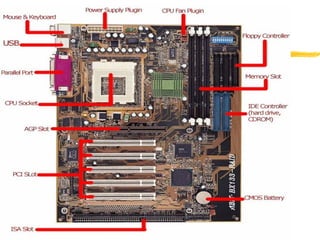
The most important part of a PC is the
motherboard. It holds:
the processor chip
memory chips
chips that handle input/output (I/O)
the expansion slots for connecting peripherals
MOTHERBOARD HOLDS
The Processor
Memory
Expansion Slots
Connects Directly or Indirectly to
Every Part of The PC
MOTHERBOARD IS MADE UP
OF

A Chipset (known as the “glue logic”)
Some Code in ROM
Various Interconnections or Buses
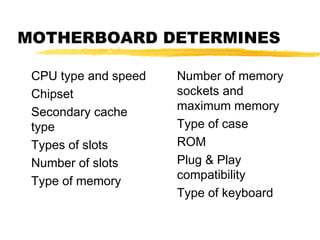
MOTHERBOARD DETERMINES
CPU type and speed
Chipset
Secondary cache
type
Types of slots
Number of slots
Type of memory

Number of memory
sockets and
maximum memory
Type of case
ROM
Plug & Play
compatibility
Type of keyboard
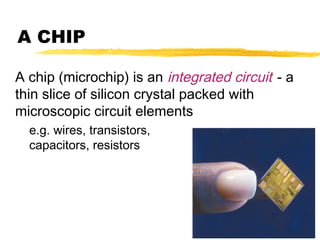
A CHIP
A chip (microchip) is an integrated circuit - a
thin slice of silicon crystal packed with
microscopic circuit elements
e.g. wires, transistors,
capacitors, resistors
MOVING DATAA data bus (a data path): connects the
parts of the motherboard.
RAM

EXPANSION CARDS
RAM
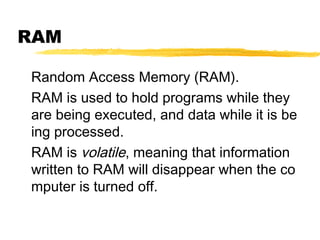
Random Access Memory (RAM).
RAM is used to hold programs while they
are being executed, and data while it is be
ing processed.
RAM is volatile, meaning that information
written to RAM will disappear when the co
mputer is turned off.
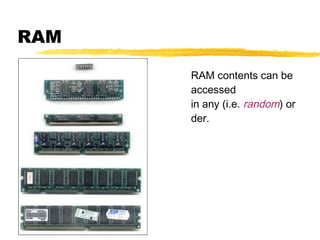
RAM
RAM contents can be
accessed
in any (i.e. random) or
der.
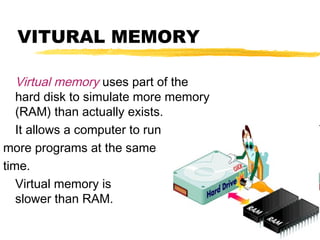
VITURAL MEMORY
Virtual memory uses part of the
hard disk to simulate more memory
(RAM) than actually exists.
It allows a computer to run
more programs at the same
time.
Virtual memory is
slower than RAM.
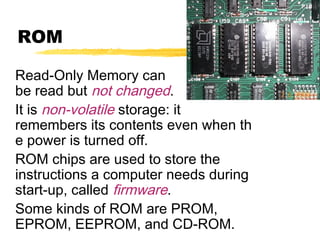
ROM
Read-Only Memory can
be read but not changed.
It is non-volatile storage: it
remembers its contents even when th
e power is turned off.
ROM chips are used to store the
instructions a computer needs during
start-up, called firmware.
Some kinds of ROM are PROM,
EPROM, EEPROM, and CD-ROM.
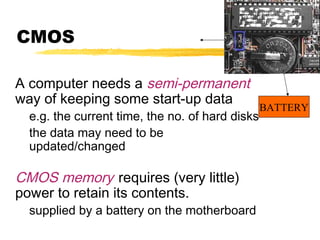
CMOS
A computer needs a semi-permanent
way of keeping some start-up data

e.g. the current time, the no. of hard disks
the data may need to be
updated/changed

CMOS memory requires (very little)
power to retain its contents.

supplied by a battery on the motherboard

BATTERY
THE CPU
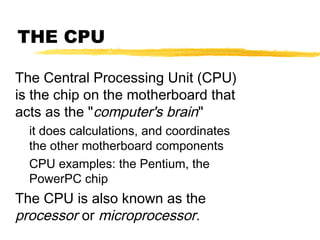
The Central Processing Unit (CPU)
is the chip on the motherboard that
acts as the "computer's brain"
it does calculations, and coordinates
the other motherboard components
CPU examples: the Pentium, the
PowerPC chip

The CPU is also known as the
processor or microprocessor.
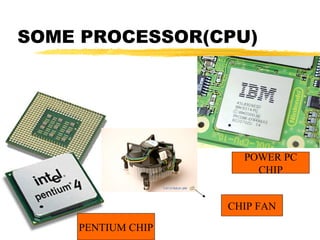
SOME PROCESSOR(CPU)

POWER PC
CHIP
CHIP FAN
PENTIUM CHIP
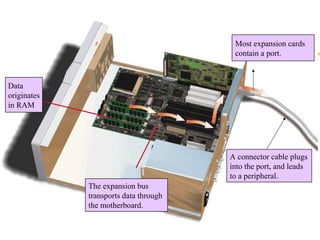
Most expansion cards
contain a port.

Data
originates
in RAM

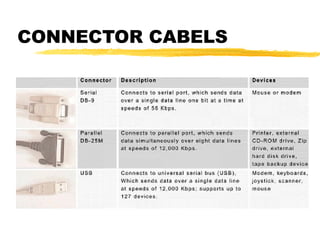
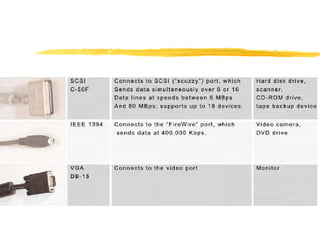
A connector cable plugs
into the port, and leads
to a peripheral.
The expansion bus
transports data through
the motherboard.
Common expansion cards:
graphics card (for connecting to a monitor)
network card (for transmitting data over a
network)
sound card (for connecting to a microphone
and speakers)

Most PCs offer 4-8 expansion slots.
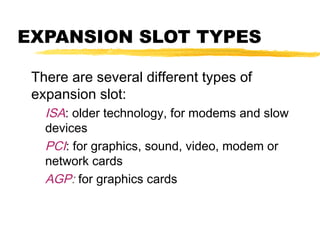
EXPANSION SLOT TYPES
There are several different types of
expansion slot:
ISA: older technology, for modems and slow
devices
PCI: for graphics, sound, video, modem or
network cards
AGP: for graphics cards
CONNECTOR CABELS
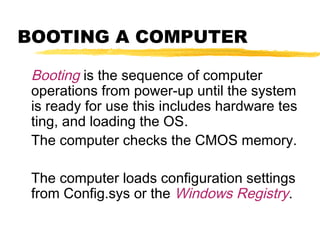
BOOTING A COMPUTER
Booting is the sequence of computer
operations from power-up until the system
is ready for use this includes hardware tes
ting, and loading the OS.
The computer checks the CMOS memory.
The computer loads configuration settings
from Config.sys or the Windows Registry.
Motherboard

Motherboard

  • 1.
    MOTHERBOARD The Main PrintedCircuit Board Inside The PC That Contains and Controls The Components That Are Responsible For Processing Data.
  • 2.
    WHAT IS MOTHERBOARD? Themost important part of a PC is the motherboard. It holds: the processor chip memory chips chips that handle input/output (I/O) the expansion slots for connecting peripherals
  • 3.
    MOTHERBOARD HOLDS The Processor Memory ExpansionSlots Connects Directly or Indirectly to Every Part of The PC
  • 4.
    MOTHERBOARD IS MADEUP OF A Chipset (known as the “glue logic”) Some Code in ROM Various Interconnections or Buses
  • 5.
    MOTHERBOARD DETERMINES CPU typeand speed Chipset Secondary cache type Types of slots Number of slots Type of memory Number of memory sockets and maximum memory Type of case ROM Plug & Play compatibility Type of keyboard
  • 7.
    A CHIP A chip(microchip) is an integrated circuit - a thin slice of silicon crystal packed with microscopic circuit elements e.g. wires, transistors, capacitors, resistors
  • 8.
    MOVING DATAA databus (a data path): connects the parts of the motherboard. RAM EXPANSION CARDS
  • 9.
    RAM Random Access Memory(RAM). RAM is used to hold programs while they are being executed, and data while it is be ing processed. RAM is volatile, meaning that information written to RAM will disappear when the co mputer is turned off.
  • 10.
    RAM RAM contents canbe accessed in any (i.e. random) or der.
  • 11.
    VITURAL MEMORY Virtual memoryuses part of the hard disk to simulate more memory (RAM) than actually exists. It allows a computer to run more programs at the same time. Virtual memory is slower than RAM.
  • 12.
    ROM Read-Only Memory can beread but not changed. It is non-volatile storage: it remembers its contents even when th e power is turned off. ROM chips are used to store the instructions a computer needs during start-up, called firmware. Some kinds of ROM are PROM, EPROM, EEPROM, and CD-ROM.
  • 13.
    CMOS A computer needsa semi-permanent way of keeping some start-up data e.g. the current time, the no. of hard disks the data may need to be updated/changed CMOS memory requires (very little) power to retain its contents. supplied by a battery on the motherboard BATTERY
  • 14.
    THE CPU The CentralProcessing Unit (CPU) is the chip on the motherboard that acts as the "computer's brain" it does calculations, and coordinates the other motherboard components CPU examples: the Pentium, the PowerPC chip The CPU is also known as the processor or microprocessor.
  • 15.
  • 16.
    Most expansion cards containa port. Data originates in RAM A connector cable plugs into the port, and leads to a peripheral. The expansion bus transports data through the motherboard.
  • 17.
    Common expansion cards: graphicscard (for connecting to a monitor) network card (for transmitting data over a network) sound card (for connecting to a microphone and speakers) Most PCs offer 4-8 expansion slots.
  • 18.
    EXPANSION SLOT TYPES Thereare several different types of expansion slot: ISA: older technology, for modems and slow devices PCI: for graphics, sound, video, modem or network cards AGP: for graphics cards
  • 19.
  • 21.
    BOOTING A COMPUTER Bootingis the sequence of computer operations from power-up until the system is ready for use this includes hardware tes ting, and loading the OS. The computer checks the CMOS memory. The computer loads configuration settings from Config.sys or the Windows Registry.