N. DURGADEVI
Introduction
• Why it is called “Motherboard”
– Acts as the main platform.
– Printed circuit board.
• Also known as
– Main board, system board, planar board and a Mobo.
• It holds
– Processor, memory & expansion slots.
• Made up of
– Chipset, some code in ROM and various
interconnections and buses.
N. DURGADEVI
Form Factor
• Motherboards are produced in a variety of
– Sizes and shapes
• Driver selection of
– Power supply, case, CPU, cards.
• Using a matching form factor assures you that:
– The motherboard fits in the case.
– The power supply cords provide the correct voltage, and
the connectors match the connections.
– Wires for switches and lights on the front of the case
match up with connections on the motherboard.
N. DURGADEVI
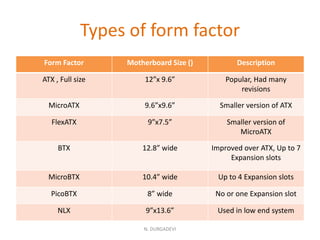
Types of form factor
Form Factor Motherboard Size () Description
ATX , Full size 12”x 9.6” Popular, Had many
revisions
MicroATX 9.6”x9.6” Smaller version of ATX
FlexATX 9”x7.5” Smaller version of
MicroATX
BTX 12.8” wide Improved over ATX, Up to 7
Expansion slots
MicroBTX 10.4” wide Up to 4 Expansion slots
PicoBTX 8” wide No or one Expansion slot
NLX 9”x13.6” Used in low end system
N. DURGADEVI
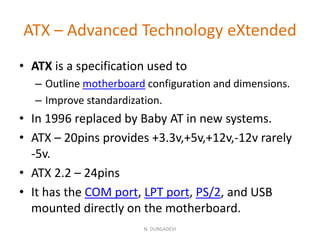
ATX – Advanced Technology eXtended
• ATX is a specification used to
– Outline motherboard configuration and dimensions.
– Improve standardization.
• In 1996 replaced by Baby AT in new systems.
• ATX – 20pins provides +3.3v,+5v,+12v,-12v rarely
-5v.
• ATX 2.2 – 24pins
• It has the COM port, LPT port, PS/2, and USB
mounted directly on the motherboard.
N. DURGADEVI
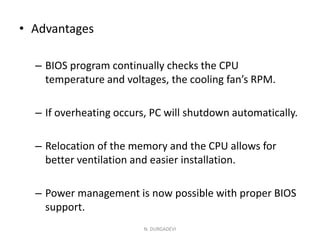
• Advantages
– BIOS program continually checks the CPU
temperature and voltages, the cooling fan’s RPM.
– If overheating occurs, PC will shutdown automatically.
– Relocation of the memory and the CPU allows for
better ventilation and easier installation.
– Power management is now possible with proper BIOS
support.
N. DURGADEVI
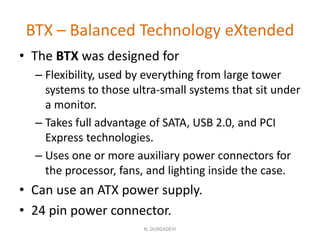
BTX – Balanced Technology eXtended
• The BTX was designed for
– Flexibility, used by everything from large tower
systems to those ultra-small systems that sit under
a monitor.
– Takes full advantage of SATA, USB 2.0, and PCI
Express technologies.
– Uses one or more auxiliary power connectors for
the processor, fans, and lighting inside the case.
• Can use an ATX power supply.
• 24 pin power connector.
N. DURGADEVI
• Advantages
– Focuses on reducing heat with better airflow.
– Improved fans and coolers.
– It also gives better structural support for the
motherboard than does ATX.
• Disadvantages
– Slow adoption rate from developers.
– Do not fit inside ATX cases and vice versa.
– Requires new case and power supplies.
N. DURGADEVI
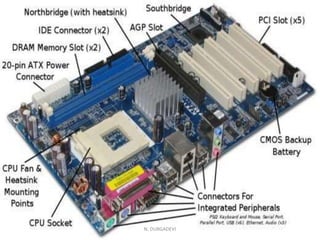
Motherboard Components
• Clock generator
• CPU socket
• Memory socket memory error checking
• ROM BIOS
• CMOS RAM
• Battery
• Chipset
• Expansion slot
• AGP
• IDE ports
• Floppy disk port
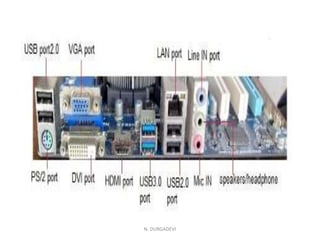
• IO Connectors/ USB ports
N. DURGADEVI
N. DURGADEVI
• CMOS Battery
– Complementary Metal Oxide Semi-Conductor.
– A 3.0 Volts lithium type cell.
– The cell is responsible for storing the information in
BIOS.
• BIOS
– Basic Input Output System.
– In the form of a Chip.
– Contains all the information and settings of the
motherboard.
– Non volatile storage.
– Remembers its contents even when power turned off.
– Startup instructions are stored, called firmware.
N. DURGADEVI
• Expansion Slots
• Industry Standard Architecture(ISA) Slots
– Oldest slots in the history of motherboards.
– Conventional display cards or sound cards were
installed.
– A 16- bit bus.
• Peripheral Component Interconnect/PCI Slots
– Vastly used to install add-on cards .
– 64-bit high-speed bus.
N. DURGADEVI
• PCI express/PCIe Slots
– Latest and the fastest component.
– Supports add-on cards & full duplex serial bus.
• Accelerated graphics port(AGP) slot
– Used to install a latest graphics card.
– Runs on a 32-bit bus and both PCIe and AGP can
be used to install high-end gaming display cards.
N. DURGADEVI
• RAM(memory) slots
• Single In-line Memory Module (SIMM) slots.
– Found in older motherboards.
– The SIMM supports 32-bit bus.
• Double In-line Memory Module (DIMM) slots.
– Latest RAM slots which run on a faster 64-bit bus.
– The DIMM used on Laptop boards are called SO-
DIMM.
N. DURGADEVI
• CPU Socket
– An electronic component that attaches PCB and is
designed to house a CPU.
– Special type of IC socket designed for very high pin
count.
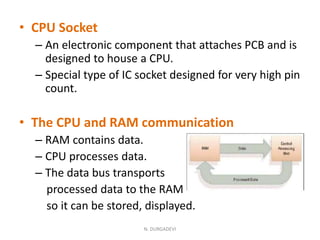
• The CPU and RAM communication
– RAM contains data.
– CPU processes data.
– The data bus transports
processed data to the RAM
so it can be stored, displayed.
N. DURGADEVI
• Power Connectors
– Receives power from SMPS(Switched mode Power
Supply).
• AT connector
– It consists of 2 number of 6 pin male connectors.
– Found on old types of motherboards.
• ATX connector
– They are either 20 or 24 pin female connectors.
– Found in all the latest types of motherboards.
N. DURGADEVI
• Integrated Drive Electronics (IDE) connectors
– Used to interface disk drives.
– The 40-pin male connector - IDE hard disk drives
– The 34-pin male connector - Floppy Disk Drive.
• Serial Advance Technology Attachment(SATA)
connector
– 7-pin connectors to interface SATA hard disks.
– They are much faster than IDE interface.
N. DURGADEVI
• Co-Processor
– Helps the main processor in mathematical
calculations and computer graphics.
• Cabinet connections
– Has many buttons that connect to the
motherboard.
– Some of the common connectors are Power
Switch, Reset Switch, Front USB, Front Audio,
Power indicator(LED) and HDD LED.
N. DURGADEVI
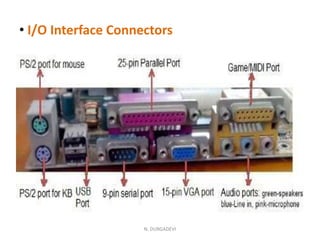
• I/O Interface Connectors
N. DURGADEVI
N. DURGADEVI
For More Details…
• http://techcrazy007.blogspot.in/2013/03/introduction-
about-motherboard.html
• http://www.it4nextgen.com/motherboard-
components
• https://en.wikipedia.org/wiki/Motherboard
• http://www.computerhope.com/jargon
• http://www.slideshare.net/makrandp/introduction-to-
motherboard
N. DURGADEVI

Motherboard

  • 1.
  • 2.
    Introduction • Why itis called “Motherboard” – Acts as the main platform. – Printed circuit board. • Also known as – Main board, system board, planar board and a Mobo. • It holds – Processor, memory & expansion slots. • Made up of – Chipset, some code in ROM and various interconnections and buses. N. DURGADEVI
  • 3.
    Form Factor • Motherboardsare produced in a variety of – Sizes and shapes • Driver selection of – Power supply, case, CPU, cards. • Using a matching form factor assures you that: – The motherboard fits in the case. – The power supply cords provide the correct voltage, and the connectors match the connections. – Wires for switches and lights on the front of the case match up with connections on the motherboard. N. DURGADEVI
  • 4.
    Types of formfactor Form Factor Motherboard Size () Description ATX , Full size 12”x 9.6” Popular, Had many revisions MicroATX 9.6”x9.6” Smaller version of ATX FlexATX 9”x7.5” Smaller version of MicroATX BTX 12.8” wide Improved over ATX, Up to 7 Expansion slots MicroBTX 10.4” wide Up to 4 Expansion slots PicoBTX 8” wide No or one Expansion slot NLX 9”x13.6” Used in low end system N. DURGADEVI
  • 5.
    ATX – AdvancedTechnology eXtended • ATX is a specification used to – Outline motherboard configuration and dimensions. – Improve standardization. • In 1996 replaced by Baby AT in new systems. • ATX – 20pins provides +3.3v,+5v,+12v,-12v rarely -5v. • ATX 2.2 – 24pins • It has the COM port, LPT port, PS/2, and USB mounted directly on the motherboard. N. DURGADEVI
  • 6.
    • Advantages – BIOSprogram continually checks the CPU temperature and voltages, the cooling fan’s RPM. – If overheating occurs, PC will shutdown automatically. – Relocation of the memory and the CPU allows for better ventilation and easier installation. – Power management is now possible with proper BIOS support. N. DURGADEVI
  • 7.
    BTX – BalancedTechnology eXtended • The BTX was designed for – Flexibility, used by everything from large tower systems to those ultra-small systems that sit under a monitor. – Takes full advantage of SATA, USB 2.0, and PCI Express technologies. – Uses one or more auxiliary power connectors for the processor, fans, and lighting inside the case. • Can use an ATX power supply. • 24 pin power connector. N. DURGADEVI
  • 8.
    • Advantages – Focuseson reducing heat with better airflow. – Improved fans and coolers. – It also gives better structural support for the motherboard than does ATX. • Disadvantages – Slow adoption rate from developers. – Do not fit inside ATX cases and vice versa. – Requires new case and power supplies. N. DURGADEVI
  • 9.
    Motherboard Components • Clockgenerator • CPU socket • Memory socket memory error checking • ROM BIOS • CMOS RAM • Battery • Chipset • Expansion slot • AGP • IDE ports • Floppy disk port • IO Connectors/ USB ports N. DURGADEVI
  • 10.
  • 11.
    • CMOS Battery –Complementary Metal Oxide Semi-Conductor. – A 3.0 Volts lithium type cell. – The cell is responsible for storing the information in BIOS. • BIOS – Basic Input Output System. – In the form of a Chip. – Contains all the information and settings of the motherboard. – Non volatile storage. – Remembers its contents even when power turned off. – Startup instructions are stored, called firmware. N. DURGADEVI
  • 12.
    • Expansion Slots •Industry Standard Architecture(ISA) Slots – Oldest slots in the history of motherboards. – Conventional display cards or sound cards were installed. – A 16- bit bus. • Peripheral Component Interconnect/PCI Slots – Vastly used to install add-on cards . – 64-bit high-speed bus. N. DURGADEVI
  • 13.
    • PCI express/PCIeSlots – Latest and the fastest component. – Supports add-on cards & full duplex serial bus. • Accelerated graphics port(AGP) slot – Used to install a latest graphics card. – Runs on a 32-bit bus and both PCIe and AGP can be used to install high-end gaming display cards. N. DURGADEVI
  • 14.
    • RAM(memory) slots •Single In-line Memory Module (SIMM) slots. – Found in older motherboards. – The SIMM supports 32-bit bus. • Double In-line Memory Module (DIMM) slots. – Latest RAM slots which run on a faster 64-bit bus. – The DIMM used on Laptop boards are called SO- DIMM. N. DURGADEVI
  • 15.
    • CPU Socket –An electronic component that attaches PCB and is designed to house a CPU. – Special type of IC socket designed for very high pin count. • The CPU and RAM communication – RAM contains data. – CPU processes data. – The data bus transports processed data to the RAM so it can be stored, displayed. N. DURGADEVI
  • 16.
    • Power Connectors –Receives power from SMPS(Switched mode Power Supply). • AT connector – It consists of 2 number of 6 pin male connectors. – Found on old types of motherboards. • ATX connector – They are either 20 or 24 pin female connectors. – Found in all the latest types of motherboards. N. DURGADEVI
  • 17.
    • Integrated DriveElectronics (IDE) connectors – Used to interface disk drives. – The 40-pin male connector - IDE hard disk drives – The 34-pin male connector - Floppy Disk Drive. • Serial Advance Technology Attachment(SATA) connector – 7-pin connectors to interface SATA hard disks. – They are much faster than IDE interface. N. DURGADEVI
  • 18.
    • Co-Processor – Helpsthe main processor in mathematical calculations and computer graphics. • Cabinet connections – Has many buttons that connect to the motherboard. – Some of the common connectors are Power Switch, Reset Switch, Front USB, Front Audio, Power indicator(LED) and HDD LED. N. DURGADEVI
  • 19.
    • I/O InterfaceConnectors N. DURGADEVI
  • 20.
  • 21.
    For More Details… •http://techcrazy007.blogspot.in/2013/03/introduction- about-motherboard.html • http://www.it4nextgen.com/motherboard- components • https://en.wikipedia.org/wiki/Motherboard • http://www.computerhope.com/jargon • http://www.slideshare.net/makrandp/introduction-to- motherboard N. DURGADEVI