MOTHERBOARD
E D U A R D O
AY E S TA S
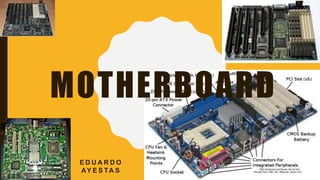
WHAT IS THE MOTHERBOARD?
• Is the main printed circuit board (PCB) found in
general purpose microcomputers and other
expandable systems. It holds and allows
communication between many of the crucial
electronic components of a system, such as the
central processing unit (CPU) and memory, and
provides connectors for other peripherals. Unlike
a backplane, a motherboard usually contains
significant sub-systems such as the central
processor, the chipset's input/output and memory
controllers, interface connectors, and other
components integrated for general purpose use.
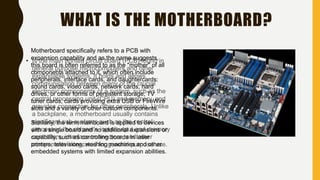
Motherboard specifically refers to a PCB with
expansion capability and as the name suggests,
this board is often referred to as the "mother" of all
components attached to it, which often include
peripherals, interface cards, and daughtercards:
sound cards, video cards, network cards, hard
drives, or other forms of persistent storage; TV
tuner cards, cards providing extra USB or FireWire
slots and a variety of other custom components.
Similarly, the term mainboard is applied to devices
with a single board and no additional expansions or
capability, such as controlling boards in laser
printers, televisions, washing machines and other
embedded systems with limited expansion abilities.
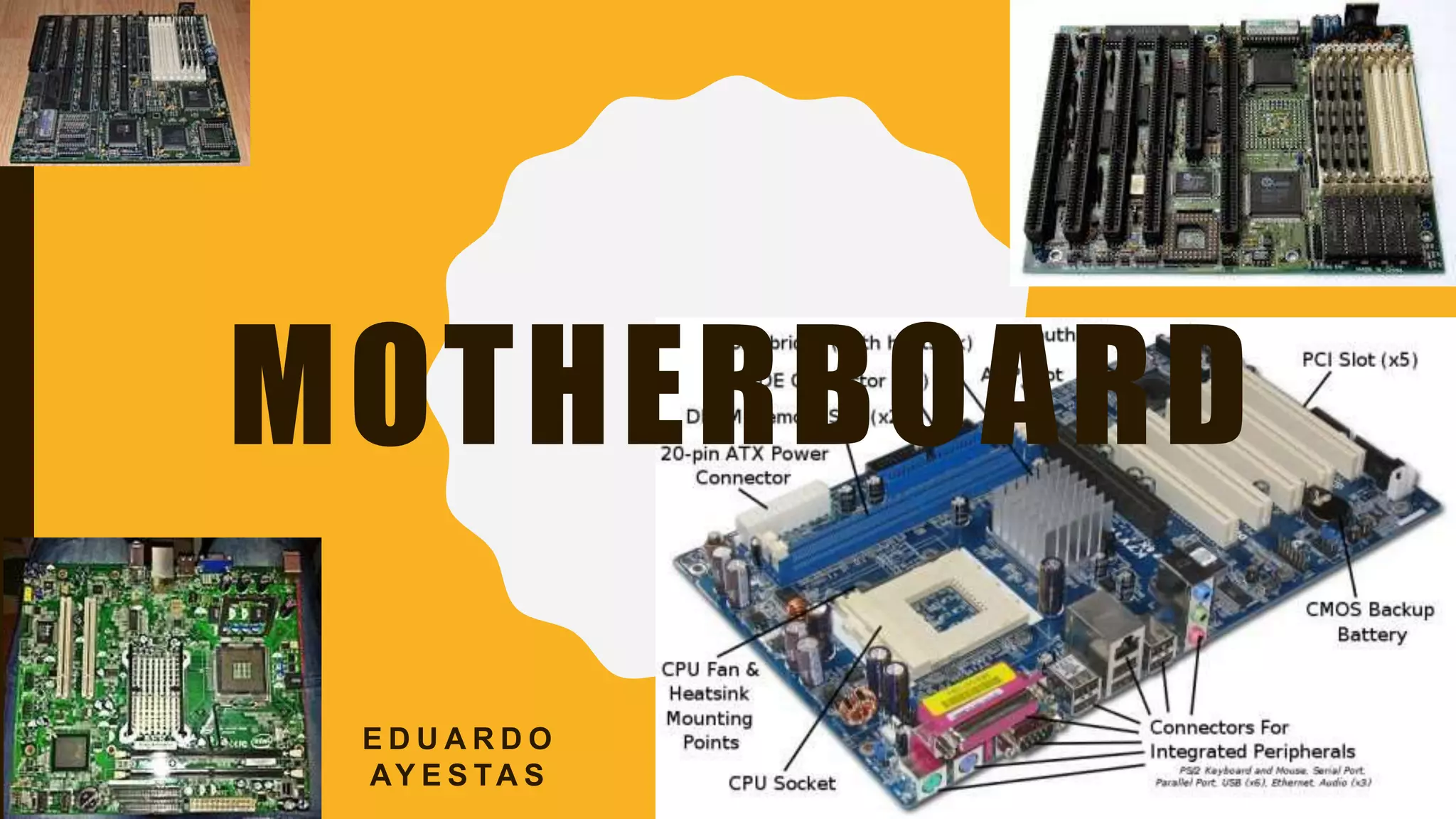
PARTS:
• DIMM (Double Inline Memory Module)
slots, SIMM (Single Inline Memory
Module) and RIMM: Different types of
memory (RAM) can be installed into
these slots.
Chipset-North Bridge: An integrated
circuit that has special duties.
PCI(Peripheral Component Interconnect)Slot:
Supports peripherals like sound
cards, DVD decoders, and
graphic accelerators with 32
bits at 33Mhz capabilities.
There are usually anywhere
from 1 to 6 PCI slots available
on the motherboard.
AGP (Accelerated Graphic Port): This
provides fast bus speed
connectivity along with fast
access to the main memory. It is
designed for video cards that
demand higher bandwidth.
CPU (Central Processing Unit)
Socket: A socket specifically for
connecting your computer
processor.
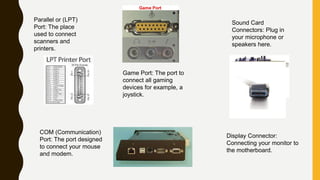
Parallel or (LPT)
Port: The place
used to connect
scanners and
printers.
Game Port: The port to
connect all gaming
devices for example, a
joystick.
Sound Card
Connectors: Plug in
your microphone or
speakers here.
Display Connector:
Connecting your monitor to
the motherboard.
COM (Communication)
Port: The port designed
to connect your mouse
and modem.
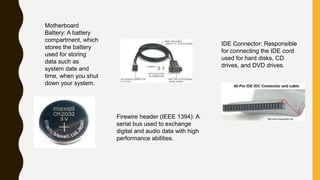
Motherboard
Battery: A battery
compartment, which
stores the battery
used for storing
data such as
system date and
time, when you shut
down your system.
IDE Connector: Responsible
for connecting the IDE cord
used for hard disks, CD
drives, and DVD drives.
Firewire header (IEEE 1394): A
serial bus used to exchange
digital and audio data with high
performance abilities.
THE FOLLOWING LISTED ITEMS ARE PARTS THAT ARE BUILT WITHIN THE
MOTHERBOARD WITH SPECIFIC CONNECTIVE USES SUCH AS KEYBOARDS,
MOUSE, AND PRINTERS:
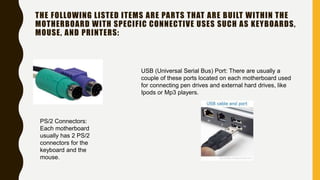
PS/2 Connectors:
Each motherboard
usually has 2 PS/2
connectors for the
keyboard and the
mouse.
USB (Universal Serial Bus) Port: There are usually a
couple of these ports located on each motherboard used
for connecting pen drives and external hard drives, like
Ipods or Mp3 players.
NORTHBRIDGE
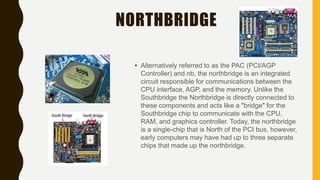
• Alternatively referred to as the PAC (PCI/AGP
Controller) and nb, the northbridge is an integrated
circuit responsible for communications between the
CPU interface, AGP, and the memory. Unlike the
Southbridge the Northbridge is directly connected to
these components and acts like a "bridge" for the
Southbridge chip to communicate with the CPU,
RAM, and graphics controller. Today, the northbridge
is a single-chip that is North of the PCI bus, however,
early computers may have had up to three separate
chips that made up the northbridge.
SOUTH BRIDGE
• The southbridge is an IC on the motherboard responsible
for the hard drive controller, I/O controller and integrated
hardware. Integrated hardware can include the sound card
and video card if on the motherboard, USB, PCI, ISA, IDE,
BIOS, and Ethernet.
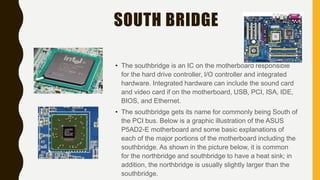
• The southbridge gets its name for commonly being South of
the PCI bus. Below is a graphic illustration of the ASUS
P5AD2-E motherboard and some basic explanations of
each of the major portions of the motherboard including the
southbridge. As shown in the picture below, it is common
for the northbridge and southbridge to have a heat sink; in
addition, the northbridge is usually slightly larger than the
southbridge.
DATA BUS
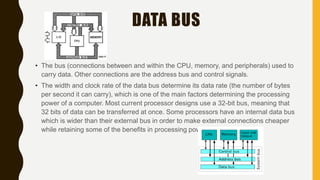
• The bus (connections between and within the CPU, memory, and peripherals) used to
carry data. Other connections are the address bus and control signals.
• The width and clock rate of the data bus determine its data rate (the number of bytes
per second it can carry), which is one of the main factors determining the processing
power of a computer. Most current processor designs use a 32-bit bus, meaning that
32 bits of data can be transferred at once. Some processors have an internal data bus
which is wider than their external bus in order to make external connections cheaper
while retaining some of the benefits in processing power of a wider bus.
Motherboard

Motherboard

  • 1.
    MOTHERBOARD E D UA R D O AY E S TA S
  • 2.
    WHAT IS THEMOTHERBOARD? • Is the main printed circuit board (PCB) found in general purpose microcomputers and other expandable systems. It holds and allows communication between many of the crucial electronic components of a system, such as the central processing unit (CPU) and memory, and provides connectors for other peripherals. Unlike a backplane, a motherboard usually contains significant sub-systems such as the central processor, the chipset's input/output and memory controllers, interface connectors, and other components integrated for general purpose use. Motherboard specifically refers to a PCB with expansion capability and as the name suggests, this board is often referred to as the "mother" of all components attached to it, which often include peripherals, interface cards, and daughtercards: sound cards, video cards, network cards, hard drives, or other forms of persistent storage; TV tuner cards, cards providing extra USB or FireWire slots and a variety of other custom components. Similarly, the term mainboard is applied to devices with a single board and no additional expansions or capability, such as controlling boards in laser printers, televisions, washing machines and other embedded systems with limited expansion abilities.
  • 3.
    PARTS: • DIMM (DoubleInline Memory Module) slots, SIMM (Single Inline Memory Module) and RIMM: Different types of memory (RAM) can be installed into these slots. Chipset-North Bridge: An integrated circuit that has special duties. PCI(Peripheral Component Interconnect)Slot: Supports peripherals like sound cards, DVD decoders, and graphic accelerators with 32 bits at 33Mhz capabilities. There are usually anywhere from 1 to 6 PCI slots available on the motherboard. AGP (Accelerated Graphic Port): This provides fast bus speed connectivity along with fast access to the main memory. It is designed for video cards that demand higher bandwidth. CPU (Central Processing Unit) Socket: A socket specifically for connecting your computer processor.
  • 4.
    Parallel or (LPT) Port:The place used to connect scanners and printers. Game Port: The port to connect all gaming devices for example, a joystick. Sound Card Connectors: Plug in your microphone or speakers here. Display Connector: Connecting your monitor to the motherboard. COM (Communication) Port: The port designed to connect your mouse and modem.
  • 5.
    Motherboard Battery: A battery compartment,which stores the battery used for storing data such as system date and time, when you shut down your system. IDE Connector: Responsible for connecting the IDE cord used for hard disks, CD drives, and DVD drives. Firewire header (IEEE 1394): A serial bus used to exchange digital and audio data with high performance abilities.
  • 6.
    THE FOLLOWING LISTEDITEMS ARE PARTS THAT ARE BUILT WITHIN THE MOTHERBOARD WITH SPECIFIC CONNECTIVE USES SUCH AS KEYBOARDS, MOUSE, AND PRINTERS: PS/2 Connectors: Each motherboard usually has 2 PS/2 connectors for the keyboard and the mouse. USB (Universal Serial Bus) Port: There are usually a couple of these ports located on each motherboard used for connecting pen drives and external hard drives, like Ipods or Mp3 players.
  • 7.
    NORTHBRIDGE • Alternatively referredto as the PAC (PCI/AGP Controller) and nb, the northbridge is an integrated circuit responsible for communications between the CPU interface, AGP, and the memory. Unlike the Southbridge the Northbridge is directly connected to these components and acts like a "bridge" for the Southbridge chip to communicate with the CPU, RAM, and graphics controller. Today, the northbridge is a single-chip that is North of the PCI bus, however, early computers may have had up to three separate chips that made up the northbridge.
  • 8.
    SOUTH BRIDGE • Thesouthbridge is an IC on the motherboard responsible for the hard drive controller, I/O controller and integrated hardware. Integrated hardware can include the sound card and video card if on the motherboard, USB, PCI, ISA, IDE, BIOS, and Ethernet. • The southbridge gets its name for commonly being South of the PCI bus. Below is a graphic illustration of the ASUS P5AD2-E motherboard and some basic explanations of each of the major portions of the motherboard including the southbridge. As shown in the picture below, it is common for the northbridge and southbridge to have a heat sink; in addition, the northbridge is usually slightly larger than the southbridge.
  • 9.
    DATA BUS • Thebus (connections between and within the CPU, memory, and peripherals) used to carry data. Other connections are the address bus and control signals. • The width and clock rate of the data bus determine its data rate (the number of bytes per second it can carry), which is one of the main factors determining the processing power of a computer. Most current processor designs use a 32-bit bus, meaning that 32 bits of data can be transferred at once. Some processors have an internal data bus which is wider than their external bus in order to make external connections cheaper while retaining some of the benefits in processing power of a wider bus.