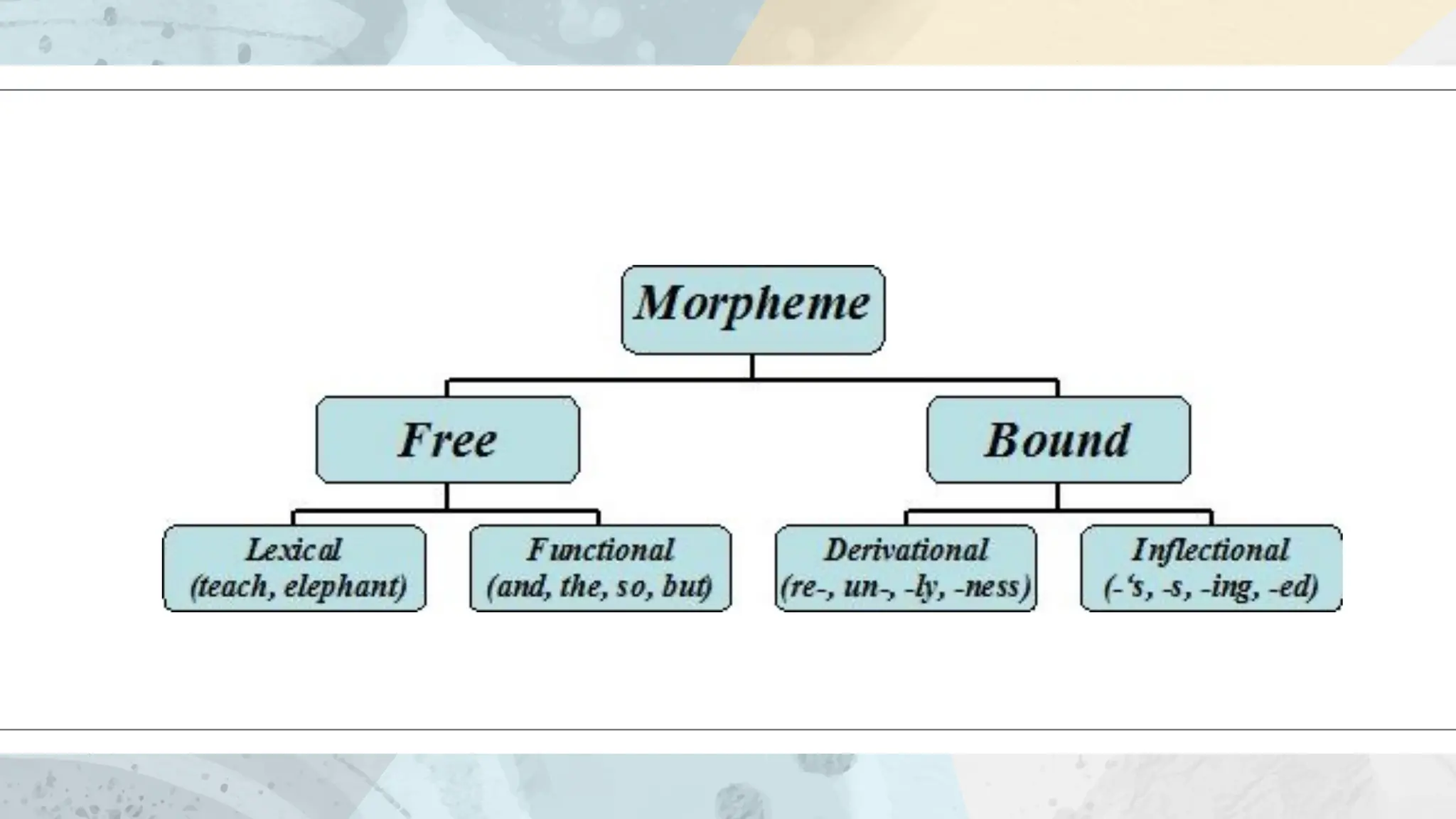
Types of Morphology
Categories of free morphemes
1. Lexical morphemes
Morphemes that carry the content or meaning of the messages that we are
conveying.
In order to identify a lexical morpheme, ask yourself this: “If this morpheme was
deleted, would I not be able to understand the main message of this sentence?” If
the answer is yes, then you have a lexical morpheme.
Examples of lexical morphemes:
follow, type, look, yellow, act, pick, strange
2. Functional morphemes
Morphemes that do not carry the content of a message, but rather help the
grammar of the sentence function.
These free morphemes can be identified by asking yourself this question: “If this
morpheme was deleted, would I still be able to understand the main message of
this sentence?” If the answer is yes, then you have a functional morpheme.
Examples of functional morphemes:
but, when, near, above, in, the, that, them, if
Categories of Bound Morphemes
1. Inflectional Morphemes
An inflectional morpheme is a suffix that’s added to a word to assign a particular
grammatical property to that word, such as its number, mood, tense, or possession.
Inflectional morphology is the study of the processes that distinguish the forms of
words in certain grammatical categories. This includes processes such as affixation
and vowel change, which create inflectional morphemes.
However, an inflectional morphology can never change the grammatical category of
a word. You can add an inflectional morphology to a verb, noun, adjective, or an
adverb.
For example:
• adding a ‘-s’ to the verb plural verb ‘run’ can make this verb singular (runs).
• adding ‘-ed’ to the verb dance creates the past tense of the verb (danced).
• inflectional morphemes usually produce different forms of the same word, instead
of different words.
• In addition, inflection does not generally change the basic meaning of a word as
they only add specifications to a word or emphasize certain aspects of its
meaning.
• Thus, words under inflectional morphology are not found as separate entries in
dictionaries.
Thus,
2. Derivational Morphemes
A derivational morpheme is an affix we add to a word in order to create a new word
or a new form of a word.
Derivational morphology is the study of the formation of new words that differ
either in syntactic category or in meaning from their bases.
Moreover, a derivational morpheme can either change the meaning or the
grammatical category of the word.
For example:
Change in Meaning
• Leaf → Leaflet
• Pure →Impure
Change in Grammatical Category
• Help (verb) → Helper (noun)
• Logic (noun) → Logical (adjective)
• Unlike inflectional affixes, derivational affixes can be both, prefixes or suffixes in
English.
• derivational morphemes change either the meaning or the category of the original
words, forming new words.
• These words are found under new entries in dictionaries.
Thus,
The key difference between inflectional and derivational morphology is that the
inflectional morphology deals with the creation of new forms of the same word
whereasthe derivational morphology deals with the creation of new words.
What is the Difference Between
Inflectional and Derivational Morphology?
Identify the different sub-categories of the given morphemes.
The teacher’s frankness shocked the boy’s parents.
Exercise
The Answer:

Morphology..pdf what's morphology what's morphology

  • 1.
  • 3.
    Categories of freemorphemes 1. Lexical morphemes Morphemes that carry the content or meaning of the messages that we are conveying. In order to identify a lexical morpheme, ask yourself this: “If this morpheme was deleted, would I not be able to understand the main message of this sentence?” If the answer is yes, then you have a lexical morpheme.
  • 4.
    Examples of lexicalmorphemes: follow, type, look, yellow, act, pick, strange
  • 5.
    2. Functional morphemes Morphemesthat do not carry the content of a message, but rather help the grammar of the sentence function. These free morphemes can be identified by asking yourself this question: “If this morpheme was deleted, would I still be able to understand the main message of this sentence?” If the answer is yes, then you have a functional morpheme.
  • 6.
    Examples of functionalmorphemes: but, when, near, above, in, the, that, them, if
  • 7.
    Categories of BoundMorphemes 1. Inflectional Morphemes An inflectional morpheme is a suffix that’s added to a word to assign a particular grammatical property to that word, such as its number, mood, tense, or possession. Inflectional morphology is the study of the processes that distinguish the forms of words in certain grammatical categories. This includes processes such as affixation and vowel change, which create inflectional morphemes.
  • 8.
    However, an inflectionalmorphology can never change the grammatical category of a word. You can add an inflectional morphology to a verb, noun, adjective, or an adverb. For example: • adding a ‘-s’ to the verb plural verb ‘run’ can make this verb singular (runs). • adding ‘-ed’ to the verb dance creates the past tense of the verb (danced).
  • 10.
    • inflectional morphemesusually produce different forms of the same word, instead of different words. • In addition, inflection does not generally change the basic meaning of a word as they only add specifications to a word or emphasize certain aspects of its meaning. • Thus, words under inflectional morphology are not found as separate entries in dictionaries. Thus,
  • 11.
    2. Derivational Morphemes Aderivational morpheme is an affix we add to a word in order to create a new word or a new form of a word. Derivational morphology is the study of the formation of new words that differ either in syntactic category or in meaning from their bases. Moreover, a derivational morpheme can either change the meaning or the grammatical category of the word.
  • 12.
    For example: Change inMeaning • Leaf → Leaflet • Pure →Impure Change in Grammatical Category • Help (verb) → Helper (noun) • Logic (noun) → Logical (adjective)
  • 14.
    • Unlike inflectionalaffixes, derivational affixes can be both, prefixes or suffixes in English. • derivational morphemes change either the meaning or the category of the original words, forming new words. • These words are found under new entries in dictionaries. Thus,
  • 15.
    The key differencebetween inflectional and derivational morphology is that the inflectional morphology deals with the creation of new forms of the same word whereasthe derivational morphology deals with the creation of new words. What is the Difference Between Inflectional and Derivational Morphology?
  • 16.
    Identify the differentsub-categories of the given morphemes. The teacher’s frankness shocked the boy’s parents. Exercise
  • 17.