MORAL DEVELOPMENT
Prepared By:
Orlando A. Pistan, MAEd-GC
Psychology Instructor
Heinz Dilemma
Heinz’s wife was dying from a particular type of cancer. Doctors said a new
drug might save her. The drug had been discovered by a local chemist and
Heinz tried desperately to buy some, but the chemist was charging ten times
the money it cost to make the drug and this was much more than the Heinz
could afford.
Heinz could only raise half the money, even after help from family and
friends. He explained to the chemist that his wife was dying and asked if he
could have the drug cheaper or pay the rest of the money later.
The chemist refused, saying that he had discovered the drug and was going
to make money from it. The husband was desperate to save his wife, so later
that night he broke into the chemist’s and stole the drug.
Decision Making
A.
Heinz should not steal. It is
wrong. If his wife will die of
the disease, it is nature’s
choice. No one can prevent
it.
B.
Heinz must be sent to jail.
Stealing is wrong.
It is against the law.
C.
Heinz did the right thing to
save her wife. The drug is
the only hope. Stealing is
forgivable in that case.
What is Moral?
Refer to the rules which
people use to guide
their behavior and
thinking.
The capability of
distinguishing between
right and wrong.
Lawrence Kohlberg
Born on October 25, 1927 – died
on January 17, 1987
American psychologist and
educator
Bachelor’s degree – University of
Chicago, 1948
Doctoral degree – University of
Chicago, 1958
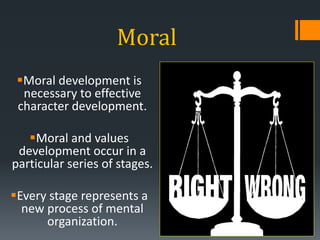
Moral
Moral development is
necessary to effective
character development.
Moral and values
development occur in a
particular series of stages.
Every stage represents a
new process of mental
organization.
Moral
Every stage of moral
development explains the
cause and effect behind
decision, reason, thought,
and judgment.
Moral is directed by social
values and rooted in the
principles of justice.
Stages of Moral Development
Preconventional –
Stages 1 and 2
Conventional – Stages 3
and 4
Postconventional –
Stages 5 and 6
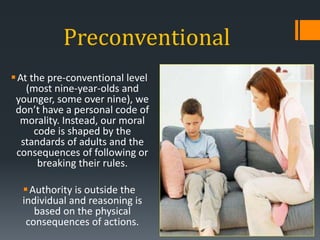
Preconventional
At the pre-conventional level
(most nine-year-olds and
younger, some over nine), we
don’t have a personal code of
morality. Instead, our moral
code is shaped by the
standards of adults and the
consequences of following or
breaking their rules.
Authority is outside the
individual and reasoning is
based on the physical
consequences of actions.
Preconventional Stage 1
Obedience and
Punishment
Orientation.
The child/individual is
good in order to avoid
being punished. If a
person is punished, they
must have done wrong.
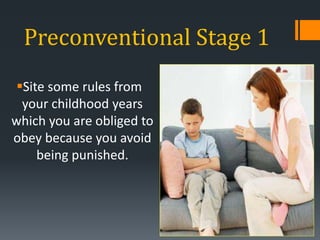
Preconventional Stage 1
Site some rules from
your childhood years
which you are obliged to
obey because you avoid
being punished.
Preconventional Stage 2
 Individualism and Exchange
 At this stage children recognize
that there is not just one right
view that is handed down by the
authorities. Different individuals
have different viewpoints.
 Allowing the child to make
mistakes as long as he can get
away with it leads to making deals
of wrongdoings.
Preconventional Stage 2
Site some instances of
your moral dilemma at
this stage.
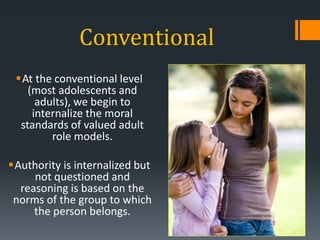
Conventional
At the conventional level
(most adolescents and
adults), we begin to
internalize the moral
standards of valued adult
role models.
Authority is internalized but
not questioned and
reasoning is based on the
norms of the group to which
the person belongs.
Conventional Stage 3
Good Interpersonal
Relationships.
The individual is good in
order to be seen as being a
good person by others.
Therefore, answers relate to
the approval of others.
Conventional Stage 3
Site some situation in which
you act accordingly to gain
others’ approval.
Conventional Stage 4
Maintaining the Social
Order.
The individual becomes
aware of the wider rules of
society so judgments
concern obeying the rules
in order to uphold the law
and to avoid guilt.
Conventional Stage 4
Site some prevailing rules in
your school or workplace
which you willingly obey.
Postconventional
 Individual judgment is based on self-
chosen principles, and moral reasoning
is based on individual rights and
justice. According to Kohlberg this level
of moral reasoning is as far as most
people get.
 Only 10-15% are capable of the kind of
abstract thinking necessary for stage 5
or 6 (post-conventional morality). That
is to say most people take their moral
views from those around them and
only a minority think through ethical
principles for themselves.
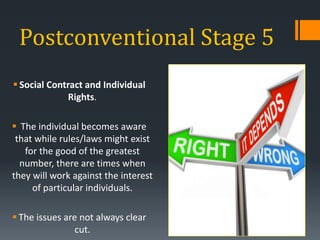
Postconventional Stage 5
 Social Contract and Individual
Rights.
 The individual becomes aware
that while rules/laws might exist
for the good of the greatest
number, there are times when
they will work against the interest
of particular individuals.
 The issues are not always clear
cut.
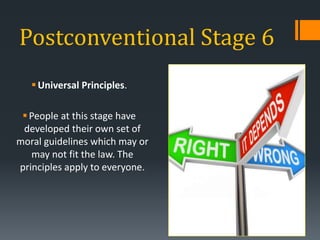
Postconventional Stage 6
Universal Principles.
People at this stage have
developed their own set of
moral guidelines which may or
may not fit the law. The
principles apply to everyone.
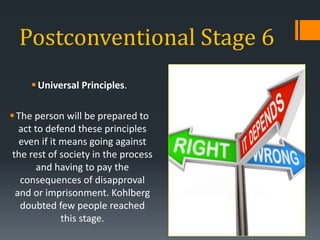
Postconventional Stage 6
Universal Principles.
The person will be prepared to
act to defend these principles
even if it means going against
the rest of society in the process
and having to pay the
consequences of disapproval
and or imprisonment. Kohlberg
doubted few people reached
this stage.
MORAL DEVELOPMENT
Thank You for paying
attention.

Moral Development

  • 1.
    MORAL DEVELOPMENT Prepared By: OrlandoA. Pistan, MAEd-GC Psychology Instructor
  • 2.
    Heinz Dilemma Heinz’s wifewas dying from a particular type of cancer. Doctors said a new drug might save her. The drug had been discovered by a local chemist and Heinz tried desperately to buy some, but the chemist was charging ten times the money it cost to make the drug and this was much more than the Heinz could afford. Heinz could only raise half the money, even after help from family and friends. He explained to the chemist that his wife was dying and asked if he could have the drug cheaper or pay the rest of the money later. The chemist refused, saying that he had discovered the drug and was going to make money from it. The husband was desperate to save his wife, so later that night he broke into the chemist’s and stole the drug.
  • 3.
    Decision Making A. Heinz shouldnot steal. It is wrong. If his wife will die of the disease, it is nature’s choice. No one can prevent it. B. Heinz must be sent to jail. Stealing is wrong. It is against the law. C. Heinz did the right thing to save her wife. The drug is the only hope. Stealing is forgivable in that case.
  • 4.
    What is Moral? Referto the rules which people use to guide their behavior and thinking. The capability of distinguishing between right and wrong.
  • 5.
    Lawrence Kohlberg Born onOctober 25, 1927 – died on January 17, 1987 American psychologist and educator Bachelor’s degree – University of Chicago, 1948 Doctoral degree – University of Chicago, 1958
  • 6.
    Moral Moral development is necessaryto effective character development. Moral and values development occur in a particular series of stages. Every stage represents a new process of mental organization.
  • 7.
    Moral Every stage ofmoral development explains the cause and effect behind decision, reason, thought, and judgment. Moral is directed by social values and rooted in the principles of justice.
  • 8.
    Stages of MoralDevelopment Preconventional – Stages 1 and 2 Conventional – Stages 3 and 4 Postconventional – Stages 5 and 6
  • 9.
    Preconventional At the pre-conventionallevel (most nine-year-olds and younger, some over nine), we don’t have a personal code of morality. Instead, our moral code is shaped by the standards of adults and the consequences of following or breaking their rules. Authority is outside the individual and reasoning is based on the physical consequences of actions.
  • 10.
    Preconventional Stage 1 Obedienceand Punishment Orientation. The child/individual is good in order to avoid being punished. If a person is punished, they must have done wrong.
  • 11.
    Preconventional Stage 1 Sitesome rules from your childhood years which you are obliged to obey because you avoid being punished.
  • 12.
    Preconventional Stage 2 Individualism and Exchange  At this stage children recognize that there is not just one right view that is handed down by the authorities. Different individuals have different viewpoints.  Allowing the child to make mistakes as long as he can get away with it leads to making deals of wrongdoings.
  • 13.
    Preconventional Stage 2 Sitesome instances of your moral dilemma at this stage.
  • 14.
    Conventional At the conventionallevel (most adolescents and adults), we begin to internalize the moral standards of valued adult role models. Authority is internalized but not questioned and reasoning is based on the norms of the group to which the person belongs.
  • 15.
    Conventional Stage 3 GoodInterpersonal Relationships. The individual is good in order to be seen as being a good person by others. Therefore, answers relate to the approval of others.
  • 16.
    Conventional Stage 3 Sitesome situation in which you act accordingly to gain others’ approval.
  • 17.
    Conventional Stage 4 Maintainingthe Social Order. The individual becomes aware of the wider rules of society so judgments concern obeying the rules in order to uphold the law and to avoid guilt.
  • 18.
    Conventional Stage 4 Sitesome prevailing rules in your school or workplace which you willingly obey.
  • 19.
    Postconventional  Individual judgmentis based on self- chosen principles, and moral reasoning is based on individual rights and justice. According to Kohlberg this level of moral reasoning is as far as most people get.  Only 10-15% are capable of the kind of abstract thinking necessary for stage 5 or 6 (post-conventional morality). That is to say most people take their moral views from those around them and only a minority think through ethical principles for themselves.
  • 20.
    Postconventional Stage 5 Social Contract and Individual Rights.  The individual becomes aware that while rules/laws might exist for the good of the greatest number, there are times when they will work against the interest of particular individuals.  The issues are not always clear cut.
  • 21.
    Postconventional Stage 6 UniversalPrinciples. People at this stage have developed their own set of moral guidelines which may or may not fit the law. The principles apply to everyone.
  • 22.
    Postconventional Stage 6 UniversalPrinciples. The person will be prepared to act to defend these principles even if it means going against the rest of society in the process and having to pay the consequences of disapproval and or imprisonment. Kohlberg doubted few people reached this stage.
  • 23.
    MORAL DEVELOPMENT Thank Youfor paying attention.