Lawerence Kohlberg born in 1927
• Grew up in Bronxville, New York
• Died on January 17th, 1987 at the age of 59
• Kohlberg became a professor of education
and social psychology at Harvard in 1968
• His book on moral development is used by
teachers around the world to promote moral
reasoning.
• Lawrence Kohlberg (1958) agreed with Piaget's
(1932) theory of moral development in principle
but wanted to develop his ideas further.
• He used Piaget’s storytelling technique to tell
people stories involving moral dilemmas. In each
case he presented a choice to be considered, for
example, between the rights of some authority and
the needs of some deserving individual who is
being unfairly treated.
• One of the best known of Kohlberg’s (1958) stories
concerns a man called Heinz who lived somewhere
in Europe.
HEINZ
CLARA
HEINZ WIFE
Heinz’s wife was dying from a
particular type of cancer.
the chemist was charging
ten times the money it cost
Heinz could only raise half the money, even
after help from family and friends.
He explained to the chemist that his wife was
dying and asked if he could have the drug
cheaper or pay the rest of the money later.
The chemist refused, saying that he had
discovered the drug and was going to make
money from it
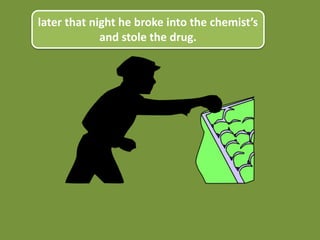
later that night he broke into the chemist’s
and stole the drug.
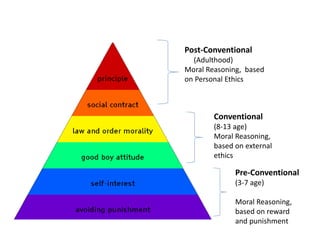
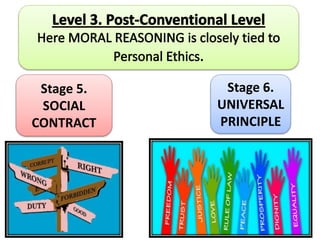
Post-Conventional
(Adulthood)
Moral Reasoning, based
on Personal Ethics
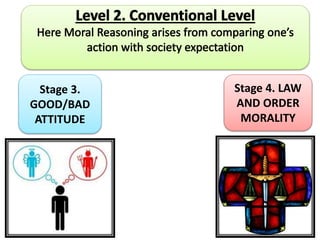
Conventional
(8-13 age)
Moral Reasoning,
based on external
ethics
Pre-Conventional
(3-7 age)
Moral Reasoning,
based on reward
and punishment
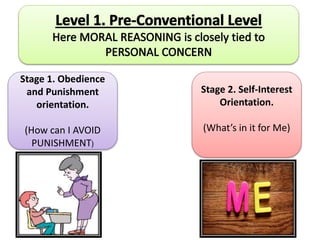
Stage 1. Obedience
and Punishment
orientation.
(How can I AVOID
PUNISHMENT)
Stage 2. Self-Interest
Orientation.
(What’s in it for Me)
Stage 3.
GOOD/BAD
ATTITUDE
Stage 4. LAW
AND ORDER
MORALITY
Stage 5.
SOCIAL
CONTRACT
Stage 6.
UNIVERSAL
PRINCIPLE
LAWRENCE KOHLBERG "MORAL DEVELOPMENT THEORY"

LAWRENCE KOHLBERG "MORAL DEVELOPMENT THEORY"

  • 2.
    Lawerence Kohlberg bornin 1927 • Grew up in Bronxville, New York • Died on January 17th, 1987 at the age of 59 • Kohlberg became a professor of education and social psychology at Harvard in 1968 • His book on moral development is used by teachers around the world to promote moral reasoning.
  • 3.
    • Lawrence Kohlberg(1958) agreed with Piaget's (1932) theory of moral development in principle but wanted to develop his ideas further. • He used Piaget’s storytelling technique to tell people stories involving moral dilemmas. In each case he presented a choice to be considered, for example, between the rights of some authority and the needs of some deserving individual who is being unfairly treated. • One of the best known of Kohlberg’s (1958) stories concerns a man called Heinz who lived somewhere in Europe.
  • 4.
  • 5.
    Heinz’s wife wasdying from a particular type of cancer.
  • 6.
    the chemist wascharging ten times the money it cost
  • 7.
    Heinz could onlyraise half the money, even after help from family and friends.
  • 8.
    He explained tothe chemist that his wife was dying and asked if he could have the drug cheaper or pay the rest of the money later. The chemist refused, saying that he had discovered the drug and was going to make money from it
  • 9.
    later that nighthe broke into the chemist’s and stole the drug.
  • 11.
    Post-Conventional (Adulthood) Moral Reasoning, based onPersonal Ethics Conventional (8-13 age) Moral Reasoning, based on external ethics Pre-Conventional (3-7 age) Moral Reasoning, based on reward and punishment
  • 12.
    Stage 1. Obedience andPunishment orientation. (How can I AVOID PUNISHMENT) Stage 2. Self-Interest Orientation. (What’s in it for Me)
  • 13.
  • 14.