

q
Lawrence Kohlberg
Moral Development Theory
• Lawrence Kohlberg (1958) agreed with
Piaget's (1932) theory of moral development
in principle but wanted to develop his ideas
further.
• He used Piaget’s story-telling technique to tell
people stories involving moral dilemmas. In
each case he presented a choice to be
considered, for example between the rights of
some authority and the needs of some
deserving individual who is being unfairly
treated.
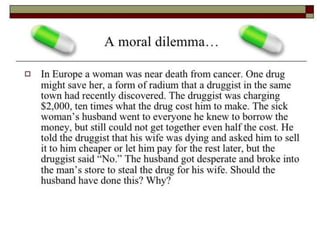
One of the best known of Kohlberg’s (1958) stories
concerns a man called Heinz who lived somewhere in
Europe.
• Heinz’s wife was dying from a
particular type of cancer.
Doctors said a new drug might
save her. The drug had been
discovered by a local chemist
and the Heinz tried desperately
to buy some, but the chemist
was charging ten times the
• Heinz could only raise half the
money, even after help from
family and friends. He
explained to the chemist that
his wife was dying and asked if
he could have the drug cheaper
or pay the rest of the money
later. The chemist refused
saying that he had discovered
the drug and was going to make
money from it. The husband
was desperate to save his wife,
Kohlberg asked a series of questions
such as:
1. Should Heinz have stolen the drug?
2. Would it change anything if Heinz did not love his
wife?
3. What if the person dying was a stranger, would it
make any difference?
4. Should the police arrest the chemist for murder if
the woman died?
• By studying the answers from children
of different ages to these questions
Kohlberg hoped to discover the ways in
which moral reasoning changed as
people grew older. The sample
comprised 72 Chicago boys aged 10–16
years, 58 of whom were followed up at
three-yearly intervals for 20 years
(Kohlberg, 1984).
• Kohlberg told several dilemma stories
and asked many such questions to
discover how people reasoned about
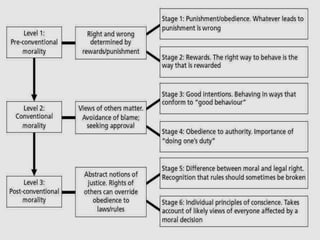
moral issues. He identified three distinct
levels of moral reasoning each with two
sub stages. People can only pass through
these levels in the order listed. Each new
stage replaces the reasoning typical of
the earlier stage. Not everyone achieves
all the stages.
Kohlberg Stages of Moral Development
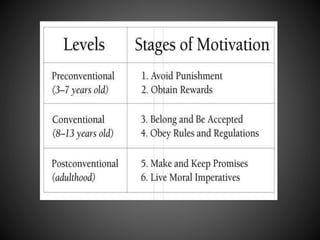
• Level 1 - Pre-conventional morality
• At the pre-conventional level (most nine-year-
olds and younger, some over nine), we don’t have
a personal code of morality. Instead, our moral
code is shaped by the standards of adults and the
consequences of following or breaking their
rules.
• Authority is outside the individual and reasoning
is based on the physical consequences of actions.
• • Stage 1. Obedience and Punishment
Orientation. The child/individual is good
in order to avoid being punished. If a
person is punished they must have done
wrong.
• • Stage 2. Individualism and Exchange.
At this stage children recognize that
there is not just one right view that is
handed down by the authorities.
Different individuals have different
viewpoints.
• Level 2 - Conventional morality
• At the conventional level (most
adolescents and adults), we begin to
internalize the moral standards of valued
adult role models.
• Authority is internalized but not
questioned and reasoning is based on
the norms of the group to which the
person belongs.
• • Stage 3. Good Interpersonal Relationships.
The child/individual is good in order to be
seen as being a good person by others.
Therefore, answers are related to the approval
of others.
• • Stage 4. Maintaining the Social Order. The
child/individual becomes aware of the wider
rules of society so judgments concern obeying
rules in order to uphold the law and to avoid
guilt.
Level 3 - Post-conventional morality
• Individual judgment is based on self-chosen
principles, and moral reasoning is based on
individual rights and justice (10–15% of adults,
not before mid-30s).
• • Stage 5. Social Contract and Individual
Rights. The child/individual becomes aware
that while rules/laws might exist for the good
of the greatest number, there are times when
they will work against the interest of
particular individuals. The issues are not
always clear cut. For example, in Heinz’s
dilemma the protection of life is more
important than breaking the law against
stealing.
• • Stage 6. Universal Principles. People at this
stage have developed their own set of moral
guidelines which may or may not fit the law.
The principles apply to everyone. E.g. human
rights, justice and equality. The person will be
prepared to act to defend these principles
even if it means going against the rest of
society in the process and having to pay the
consequences of disapproval and or
imprisonment. Kohlberg doubted few people
reached this stage.
Lawrence Kohlberg- moral development

Lawrence Kohlberg- moral development

  • 1.
  • 2.
  • 4.
    • Lawrence Kohlberg(1958) agreed with Piaget's (1932) theory of moral development in principle but wanted to develop his ideas further. • He used Piaget’s story-telling technique to tell people stories involving moral dilemmas. In each case he presented a choice to be considered, for example between the rights of some authority and the needs of some deserving individual who is being unfairly treated.
  • 6.
    One of thebest known of Kohlberg’s (1958) stories concerns a man called Heinz who lived somewhere in Europe. • Heinz’s wife was dying from a particular type of cancer. Doctors said a new drug might save her. The drug had been discovered by a local chemist and the Heinz tried desperately to buy some, but the chemist was charging ten times the
  • 7.
    • Heinz couldonly raise half the money, even after help from family and friends. He explained to the chemist that his wife was dying and asked if he could have the drug cheaper or pay the rest of the money later. The chemist refused saying that he had discovered the drug and was going to make money from it. The husband was desperate to save his wife,
  • 8.
    Kohlberg asked aseries of questions such as: 1. Should Heinz have stolen the drug? 2. Would it change anything if Heinz did not love his wife? 3. What if the person dying was a stranger, would it make any difference? 4. Should the police arrest the chemist for murder if the woman died?
  • 9.
    • By studyingthe answers from children of different ages to these questions Kohlberg hoped to discover the ways in which moral reasoning changed as people grew older. The sample comprised 72 Chicago boys aged 10–16 years, 58 of whom were followed up at three-yearly intervals for 20 years (Kohlberg, 1984).
  • 10.
    • Kohlberg toldseveral dilemma stories and asked many such questions to discover how people reasoned about moral issues. He identified three distinct levels of moral reasoning each with two sub stages. People can only pass through these levels in the order listed. Each new stage replaces the reasoning typical of the earlier stage. Not everyone achieves all the stages.
  • 13.
    Kohlberg Stages ofMoral Development • Level 1 - Pre-conventional morality • At the pre-conventional level (most nine-year- olds and younger, some over nine), we don’t have a personal code of morality. Instead, our moral code is shaped by the standards of adults and the consequences of following or breaking their rules. • Authority is outside the individual and reasoning is based on the physical consequences of actions.
  • 14.
    • • Stage1. Obedience and Punishment Orientation. The child/individual is good in order to avoid being punished. If a person is punished they must have done wrong. • • Stage 2. Individualism and Exchange. At this stage children recognize that there is not just one right view that is handed down by the authorities. Different individuals have different viewpoints.
  • 15.
    • Level 2- Conventional morality • At the conventional level (most adolescents and adults), we begin to internalize the moral standards of valued adult role models. • Authority is internalized but not questioned and reasoning is based on the norms of the group to which the person belongs.
  • 16.
    • • Stage3. Good Interpersonal Relationships. The child/individual is good in order to be seen as being a good person by others. Therefore, answers are related to the approval of others. • • Stage 4. Maintaining the Social Order. The child/individual becomes aware of the wider rules of society so judgments concern obeying rules in order to uphold the law and to avoid guilt.
  • 17.
    Level 3 -Post-conventional morality • Individual judgment is based on self-chosen principles, and moral reasoning is based on individual rights and justice (10–15% of adults, not before mid-30s).
  • 18.
    • • Stage5. Social Contract and Individual Rights. The child/individual becomes aware that while rules/laws might exist for the good of the greatest number, there are times when they will work against the interest of particular individuals. The issues are not always clear cut. For example, in Heinz’s dilemma the protection of life is more important than breaking the law against stealing.
  • 19.
    • • Stage6. Universal Principles. People at this stage have developed their own set of moral guidelines which may or may not fit the law. The principles apply to everyone. E.g. human rights, justice and equality. The person will be prepared to act to defend these principles even if it means going against the rest of society in the process and having to pay the consequences of disapproval and or imprisonment. Kohlberg doubted few people reached this stage.