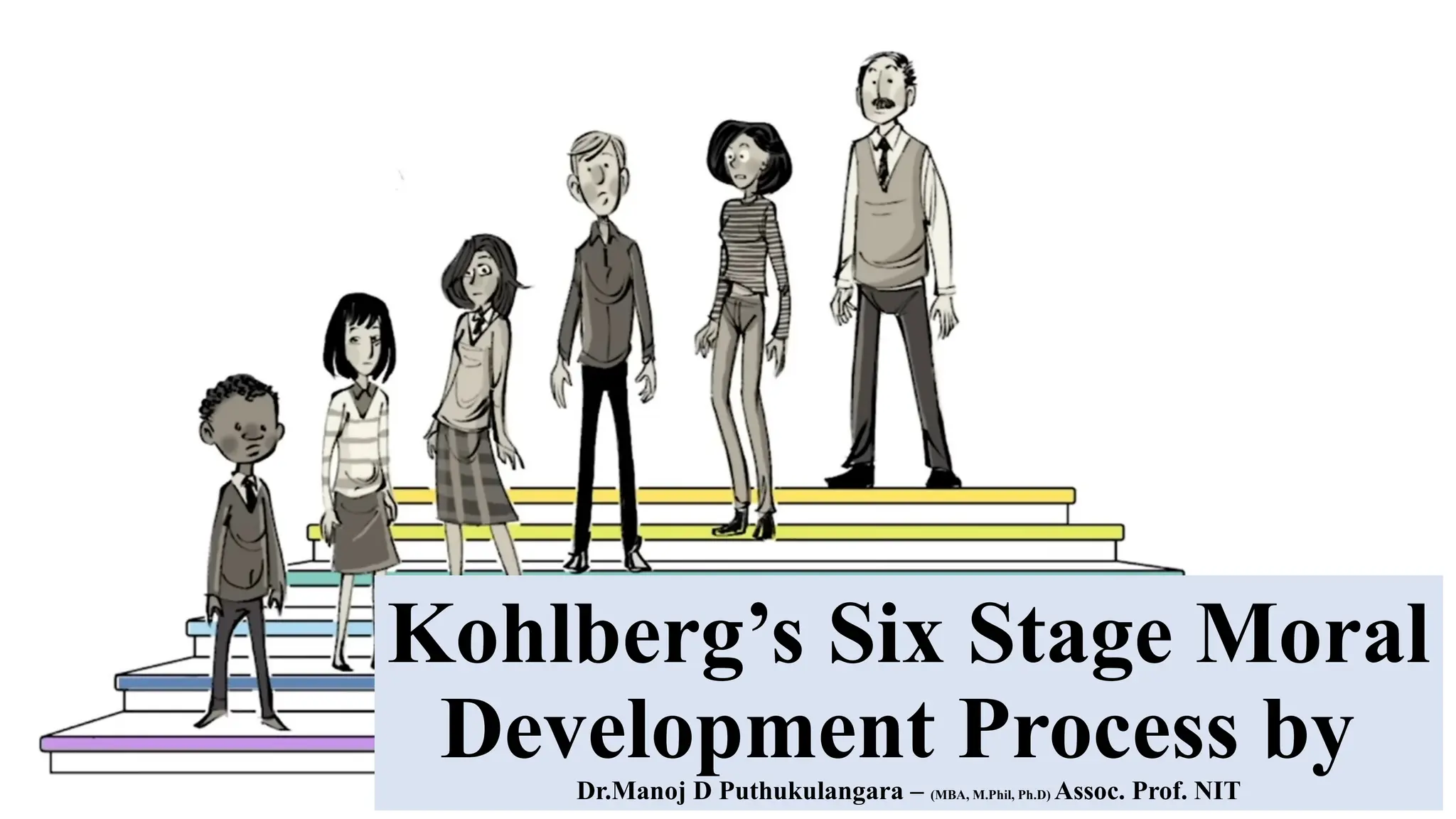
Kohlberg’s Six Stage Moral
Development Process by
Dr.Manoj D Puthukulangara – (MBA, M.Phil, Ph.D) Assoc. Prof. NIT
• Lawrence Kohlberg:
• Was a professor at Harvard University on Education and Social
Psychology.
• He began as a developmental psychologist and subsequently
moved to the field of education
• Inspired by the Swiss psychologist Jean Piaget – who was famous
for his theory on Moral Development of Children.
• Particularly well – known on his theory of moral development
which he developed with his extensive on the topic at the center
for Moral Education at Harvard.
• Kohlberg’s Theory of Moral Development:
• This was derived from his interview with young boys distributed from early
childhood to late adolescence
• In these interviews: Kohlberg asked the participants to respond to hypothetical
ethical deliemmas : a man contemplating on stealing a drug to save his dying wife
because he cannot affort the drug ater exhausting all possibilities to pay for it.
• The result of the interviews showe a pattern of responses which suggested a
progression in moral reasoning.
• Kohlberg developed his theories during a time of significant social and
intellectual change. The 1950s and 1960s saw a growing interest in
developmental psychology, with Jean Piaget’s work on cognitive
development gaining prominence.
• Kohlberg built upon Piaget’s ideas, applying them to moral reasoning
and expanding the scope of developmental psychology (Gibbs, 2019).
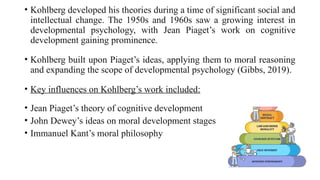
• Key influences on Kohlberg’s work included:
• Jean Piaget’s theory of cognitive development
• John Dewey’s ideas on moral development stages
• Immanuel Kant’s moral philosophy
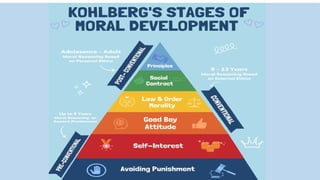
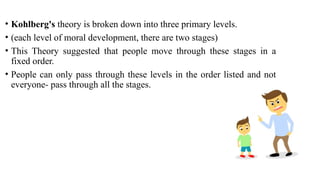
• Kohlberg's theory is broken down into three primary levels.
• (each level of moral development, there are two stages)
• This Theory suggested that people move through these stages in a
fixed order.
• People can only pass through these levels in the order listed and not
everyone- pass through all the stages.
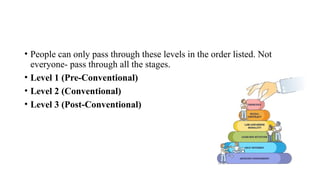
• People can only pass through these levels in the order listed. Not
everyone- pass through all the stages.
• Level 1 (Pre-Conventional)
• Level 2 (Conventional)
• Level 3 (Post-Conventional)
• Pre-conventional Level
• Stage 1: Obedience and Punishment Orientation
• At this stage, children view rules as fixed and absolute. Obedience is valued for its own
sake, and the consequences of breaking rules are not distinguished from their moral
implications. The focus is on avoiding punishment rather than understanding the ethical
basis of rules.
• Example: A four-year-old refrains from touching a hot oven because they’ve been told not
to and fear of getting into trouble, not because they understand the danger of burns.
• Stage 2: Instrumental Relativist Orientation
• Children at this stage recognise that different individuals have different viewpoints. They
begin to consider actions in terms of the human needs they serve but primarily focus on
their own needs. Appropriate behaviour is seen as what’s instrumentally satisfying to the
self.
• Example: A five-year-old shares their toys with a friend, not out of genuine altruism, but
because they expect the friend to share toys in return.
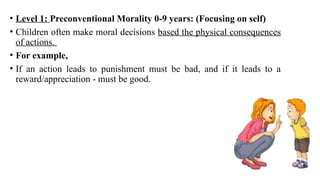
• Level 1: Preconventional Morality 0-9 years: (Focusing on self)
• Children often make moral decisions based the physical consequences
of actions.
• For example,
• If an action leads to punishment must be bad, and if it leads to a
reward/appreciation - must be good.
Stage 1 - Obedience and Punishment
• Common in young children- see rules as fixed and absolute- and they
obeys rules in order to avoid punishment
• Determines a sense of right and wrong based on : what is punished
and what is not punished – obeys superior authority.
• Ex: If Iam not keeping silent in the class the teacher might beat me
and so maintaining silence is a good quality for which Teacher wont
scold me and thus it’s a good quality.
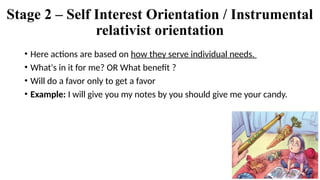
Stage 2 – Self Interest Orientation / Instrumental
relativist orientation
• Here actions are based on how they serve individual needs.
• What's in it for me? OR What benefit ?
• Will do a favor only to get a favor
• Example: I will give you my notes by you should give me your candy.
Level 2:
Conventional Morality 10-15 years
• Characterized by an acceptance of social rules concerning right and
wrong. (Here they in a sense blindly accepts what’s there in the
society).
• Begin to internalize the moral standards of valued adult role models,
(I will also start doing things exactly like this….)
Stage 3-
"good boy-good girl" orientation,
• This stage of moral development is focused on living up to social
expectations.
• Finds peer approval very important
• Begins to put himself/herself in another's shoes and think from
another’s perspective
• EX:
• I will achieve my monthly targets such that my boss will appreciate
me on my performance in the next monthly review meeting.
Stage 4- Law and Social Order (Focus on
others)
• Here people begin to consider society as a whole when making
judgments.
• The focus is on maintaining law and order by following the rules,
doing one's duty, and respecting authority.
• Respects authority and obeys it without question
• Supports the rights of the majority without concern for those in the
minority
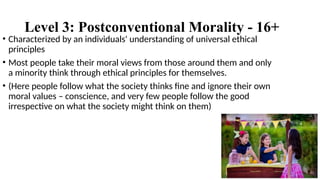
Level 3: Postconventional Morality - 16+
• Characterized by an individuals' understanding of universal ethical
principles
• Most people take their moral views from those around them and only
a minority think through ethical principles for themselves.
• (Here people follow what the society thinks fine and ignore their own
moral values – conscience, and very few people follow the good
irrespective on what the society might think on them)
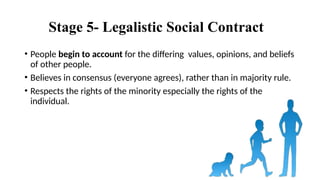
Stage 5- Legalistic Social Contract
• People begin to account for the differing values, opinions, and beliefs
of other people.
• Believes in consensus (everyone agrees), rather than in majority rule.
• Respects the rights of the minority especially the rights of the
individual.
Stage 6- Universal ethical Principles
• People at this stage have developed their own set of moral guidelines
which may or may not fit the law.
• Final level of moral reasoning is based upon universal ethical
principles.
• People follow these internalized principles of justice, even if they
conflict with laws and rules.
• Belives that there are high moral principles than those represented by
social rules
• Ex: Living together:
THANK YOU

Kohlberg’s Six Stage Moral Development Process.pptx

  • 1.
    Kohlberg’s Six StageMoral Development Process by Dr.Manoj D Puthukulangara – (MBA, M.Phil, Ph.D) Assoc. Prof. NIT
  • 2.
    • Lawrence Kohlberg: •Was a professor at Harvard University on Education and Social Psychology. • He began as a developmental psychologist and subsequently moved to the field of education • Inspired by the Swiss psychologist Jean Piaget – who was famous for his theory on Moral Development of Children. • Particularly well – known on his theory of moral development which he developed with his extensive on the topic at the center for Moral Education at Harvard.
  • 3.
    • Kohlberg’s Theoryof Moral Development: • This was derived from his interview with young boys distributed from early childhood to late adolescence • In these interviews: Kohlberg asked the participants to respond to hypothetical ethical deliemmas : a man contemplating on stealing a drug to save his dying wife because he cannot affort the drug ater exhausting all possibilities to pay for it. • The result of the interviews showe a pattern of responses which suggested a progression in moral reasoning.
  • 4.
    • Kohlberg developedhis theories during a time of significant social and intellectual change. The 1950s and 1960s saw a growing interest in developmental psychology, with Jean Piaget’s work on cognitive development gaining prominence. • Kohlberg built upon Piaget’s ideas, applying them to moral reasoning and expanding the scope of developmental psychology (Gibbs, 2019). • Key influences on Kohlberg’s work included: • Jean Piaget’s theory of cognitive development • John Dewey’s ideas on moral development stages • Immanuel Kant’s moral philosophy
  • 6.
    • Kohlberg's theoryis broken down into three primary levels. • (each level of moral development, there are two stages) • This Theory suggested that people move through these stages in a fixed order. • People can only pass through these levels in the order listed and not everyone- pass through all the stages.
  • 7.
    • People canonly pass through these levels in the order listed. Not everyone- pass through all the stages. • Level 1 (Pre-Conventional) • Level 2 (Conventional) • Level 3 (Post-Conventional)
  • 8.
    • Pre-conventional Level •Stage 1: Obedience and Punishment Orientation • At this stage, children view rules as fixed and absolute. Obedience is valued for its own sake, and the consequences of breaking rules are not distinguished from their moral implications. The focus is on avoiding punishment rather than understanding the ethical basis of rules. • Example: A four-year-old refrains from touching a hot oven because they’ve been told not to and fear of getting into trouble, not because they understand the danger of burns. • Stage 2: Instrumental Relativist Orientation • Children at this stage recognise that different individuals have different viewpoints. They begin to consider actions in terms of the human needs they serve but primarily focus on their own needs. Appropriate behaviour is seen as what’s instrumentally satisfying to the self. • Example: A five-year-old shares their toys with a friend, not out of genuine altruism, but because they expect the friend to share toys in return.
  • 9.
    • Level 1:Preconventional Morality 0-9 years: (Focusing on self) • Children often make moral decisions based the physical consequences of actions. • For example, • If an action leads to punishment must be bad, and if it leads to a reward/appreciation - must be good.
  • 10.
    Stage 1 -Obedience and Punishment • Common in young children- see rules as fixed and absolute- and they obeys rules in order to avoid punishment • Determines a sense of right and wrong based on : what is punished and what is not punished – obeys superior authority. • Ex: If Iam not keeping silent in the class the teacher might beat me and so maintaining silence is a good quality for which Teacher wont scold me and thus it’s a good quality.
  • 11.
    Stage 2 –Self Interest Orientation / Instrumental relativist orientation • Here actions are based on how they serve individual needs. • What's in it for me? OR What benefit ? • Will do a favor only to get a favor • Example: I will give you my notes by you should give me your candy.
  • 12.
    Level 2: Conventional Morality10-15 years • Characterized by an acceptance of social rules concerning right and wrong. (Here they in a sense blindly accepts what’s there in the society). • Begin to internalize the moral standards of valued adult role models, (I will also start doing things exactly like this….)
  • 13.
    Stage 3- "good boy-goodgirl" orientation, • This stage of moral development is focused on living up to social expectations. • Finds peer approval very important • Begins to put himself/herself in another's shoes and think from another’s perspective • EX: • I will achieve my monthly targets such that my boss will appreciate me on my performance in the next monthly review meeting.
  • 14.
    Stage 4- Lawand Social Order (Focus on others) • Here people begin to consider society as a whole when making judgments. • The focus is on maintaining law and order by following the rules, doing one's duty, and respecting authority. • Respects authority and obeys it without question • Supports the rights of the majority without concern for those in the minority
  • 15.
    Level 3: PostconventionalMorality - 16+ • Characterized by an individuals' understanding of universal ethical principles • Most people take their moral views from those around them and only a minority think through ethical principles for themselves. • (Here people follow what the society thinks fine and ignore their own moral values – conscience, and very few people follow the good irrespective on what the society might think on them)
  • 16.
    Stage 5- LegalisticSocial Contract • People begin to account for the differing values, opinions, and beliefs of other people. • Believes in consensus (everyone agrees), rather than in majority rule. • Respects the rights of the minority especially the rights of the individual.
  • 17.
    Stage 6- Universalethical Principles • People at this stage have developed their own set of moral guidelines which may or may not fit the law. • Final level of moral reasoning is based upon universal ethical principles. • People follow these internalized principles of justice, even if they conflict with laws and rules. • Belives that there are high moral principles than those represented by social rules • Ex: Living together:
  • 18.