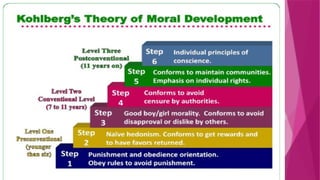
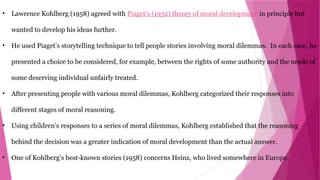
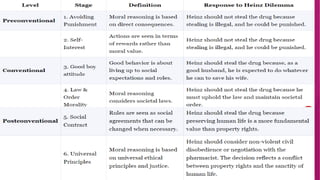
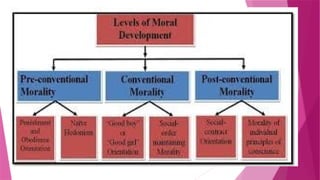
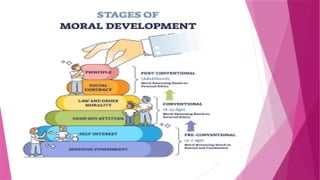
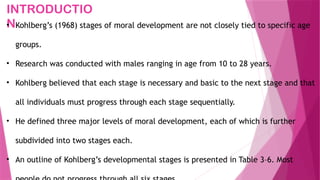
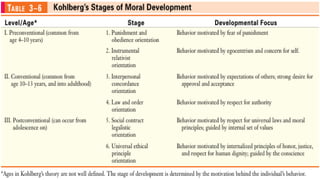
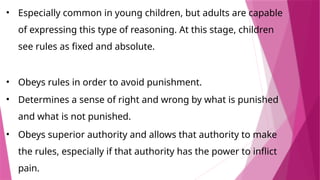
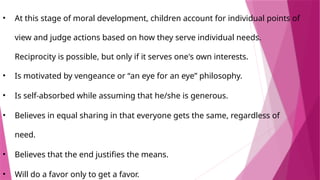
Kohlberg's moral development theory expands on Piaget's ideas, categorizing moral reasoning into three levels: pre-conventional, conventional, and post-conventional, each with two sub-stages. Through storytelling and moral dilemmas, notably the Heinz dilemma, it was found that the reasoning behind decisions is more indicative of moral development than the decisions themselves. Critics of the theory argue that it overemphasizes justice, neglects other emotions like compassion, and may not apply universally across cultures, highlighting its relevance in contexts like psychiatric nursing and moral education reform in China.