Carol Gilligan’s
Moral Development Theory
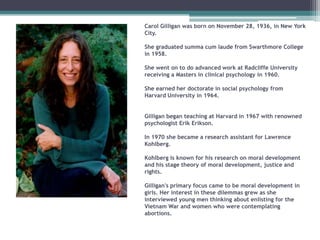
Carol Gilligan was born on November 28, 1936, in New York
City.
She graduated summa cum laude from Swarthmore College
in 1958.
She went on to do advanced work at Radcliffe University
receiving a Masters in clinical psychology in 1960.
She earned her doctorate in social psychology from
Harvard University in 1964.
Gilligan began teaching at Harvard in 1967 with renowned
psychologist Erik Erikson.

In 1970 she became a research assistant for Lawrence
Kohlberg.
Kohlberg is known for his research on moral development
and his stage theory of moral development, justice and
rights.
Gilligan's primary focus came to be moral development in
girls. Her interest in these dilemmas grew as she
interviewed young men thinking about enlisting for the
Vietnam War and women who were contemplating
abortions.
Theory Background
• While teaching at Harvard in 1968, Gilligan worked with
Erik Erikson and Lawrence Kohlberg, two of the leading
theorists in mainstream psychology.
• She criticized both Erikson’s theory of identity due to it
reflecting his own life, and Kohlberg’s ideas about moral
dilemmas which mirrored his own experiences and were
ultimately biased against women.
• She found that Kohlberg's investigations concluded that
women scored lower and less developed than that of
men. Her research found that neither theory represented
women's identity and experience (Medea, 2009).
• Gilligan noticed that approximately fifteen of the
twenty-five women who signed up for Kohlberg’s
class on moral development dropped.
• Only about five out of fifty men that enrolled
were left. Gilligan found that women in the class
posed difficult questions of human suffering that
could not be adequately addressed by moral
theories.
• Her first paper about moral development,“In a
Different Voice—Women’s Conceptions of Self
and Morality,” included interview notes from the
women who left the class about their moral
perspective (Hekman, 1997).
• Her research reflected that women’s
development was set within the context of caring
and relationships, rather than in compliance
with an abstract set of rights or rules (Young,
1999).
She asked four questions about women's voices:
•
•
•
•

who is speaking?
what body?
what story?
what cultural framework is the story presented?
• Gilligan found that a morality of care can serve
in place of the morality of justice and rights
earlier theorized by Kohlberg. She views
morality of care and morality of justice as
distinct yet also connected (Young, 1999).
Gilligan would go on to criticize
Kohlberg's work. This was based on
two things:
• First, he only studied privileged, white men and
boys. She felt that this caused a biased opinion
against women.
• Secondly, in his stage theory of moral
development, the male view of individual rights
and rules was considered a higher stage than
women's point of view of development in terms
of its caring effect on human relationships.
• She outlines three stages of moral
development progressing from selfish, to
social or conventional morality, and finally
to post conventional or principled
morality.

• Carol Gilligan has been instrumental in
research on adolescence, moral
development, women's development and
conflict resolution. As a feminist, scholar,
professor and author, she has helped to
form a new direction for women.
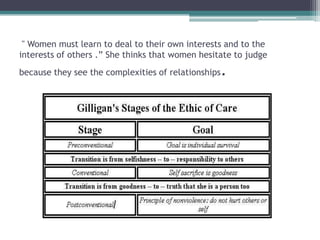
" Women must learn to deal to their own interests and to the
interests of others .” She thinks that women hesitate to judge
because they see the complexities of relationships

.
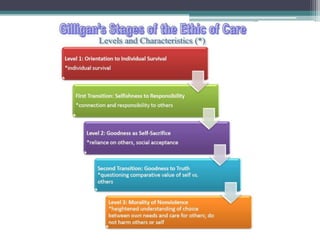
Pre Conventional
-Person only cares for themselves in order to ensure survival
-This is how everyone is as children
In this transitional phase, the person 's attitude is considered
selfish, and the person sees the connection between
themselves and others.
Conventional
-Responsibility
-More care shown for other people.
-Gilligan says this is shown in the role of Mother & Wife
-Situation sometimes carries on to ignoring needs of self.
In this transitional phase, tensions between responsibility of
caring for others and caring for self are faced.

Post Conventional
-Acceptance of the principle of care for self and others is
shown.
-Some people never reach this level.
Sources:
• http://www2.webster.edu/~woolflm/gilligan.ht
ml
• http://humangrowth.tripod.com/id2.html
• http://collegestudentdeveltheory.blogspot.com/
2010/09/gilligans-theory-of-womensmoral.html
• http://adultlearnercharacteristics.wikispaces.co
m/Gilligan's+Moral+Development

Carol gilligan s moral development theory (psychology topic)

  • 1.
  • 2.
    Carol Gilligan wasborn on November 28, 1936, in New York City. She graduated summa cum laude from Swarthmore College in 1958. She went on to do advanced work at Radcliffe University receiving a Masters in clinical psychology in 1960. She earned her doctorate in social psychology from Harvard University in 1964. Gilligan began teaching at Harvard in 1967 with renowned psychologist Erik Erikson. In 1970 she became a research assistant for Lawrence Kohlberg. Kohlberg is known for his research on moral development and his stage theory of moral development, justice and rights. Gilligan's primary focus came to be moral development in girls. Her interest in these dilemmas grew as she interviewed young men thinking about enlisting for the Vietnam War and women who were contemplating abortions.
  • 3.
    Theory Background • Whileteaching at Harvard in 1968, Gilligan worked with Erik Erikson and Lawrence Kohlberg, two of the leading theorists in mainstream psychology. • She criticized both Erikson’s theory of identity due to it reflecting his own life, and Kohlberg’s ideas about moral dilemmas which mirrored his own experiences and were ultimately biased against women. • She found that Kohlberg's investigations concluded that women scored lower and less developed than that of men. Her research found that neither theory represented women's identity and experience (Medea, 2009).
  • 4.
    • Gilligan noticedthat approximately fifteen of the twenty-five women who signed up for Kohlberg’s class on moral development dropped. • Only about five out of fifty men that enrolled were left. Gilligan found that women in the class posed difficult questions of human suffering that could not be adequately addressed by moral theories. • Her first paper about moral development,“In a Different Voice—Women’s Conceptions of Self and Morality,” included interview notes from the women who left the class about their moral perspective (Hekman, 1997).
  • 5.
    • Her researchreflected that women’s development was set within the context of caring and relationships, rather than in compliance with an abstract set of rights or rules (Young, 1999). She asked four questions about women's voices: • • • • who is speaking? what body? what story? what cultural framework is the story presented?
  • 6.
    • Gilligan foundthat a morality of care can serve in place of the morality of justice and rights earlier theorized by Kohlberg. She views morality of care and morality of justice as distinct yet also connected (Young, 1999).
  • 7.
    Gilligan would goon to criticize Kohlberg's work. This was based on two things: • First, he only studied privileged, white men and boys. She felt that this caused a biased opinion against women. • Secondly, in his stage theory of moral development, the male view of individual rights and rules was considered a higher stage than women's point of view of development in terms of its caring effect on human relationships.
  • 8.
    • She outlinesthree stages of moral development progressing from selfish, to social or conventional morality, and finally to post conventional or principled morality. • Carol Gilligan has been instrumental in research on adolescence, moral development, women's development and conflict resolution. As a feminist, scholar, professor and author, she has helped to form a new direction for women.
  • 9.
    " Women mustlearn to deal to their own interests and to the interests of others .” She thinks that women hesitate to judge because they see the complexities of relationships .
  • 10.
    Pre Conventional -Person onlycares for themselves in order to ensure survival -This is how everyone is as children In this transitional phase, the person 's attitude is considered selfish, and the person sees the connection between themselves and others. Conventional -Responsibility -More care shown for other people. -Gilligan says this is shown in the role of Mother & Wife -Situation sometimes carries on to ignoring needs of self. In this transitional phase, tensions between responsibility of caring for others and caring for self are faced. Post Conventional -Acceptance of the principle of care for self and others is shown. -Some people never reach this level.
  • 12.
    Sources: • http://www2.webster.edu/~woolflm/gilligan.ht ml • http://humangrowth.tripod.com/id2.html •http://collegestudentdeveltheory.blogspot.com/ 2010/09/gilligans-theory-of-womensmoral.html • http://adultlearnercharacteristics.wikispaces.co m/Gilligan's+Moral+Development