Neuronal basics of addiction
Werner J. Schmidt
Abt. Neuropharmakologie
Universität Tübingen
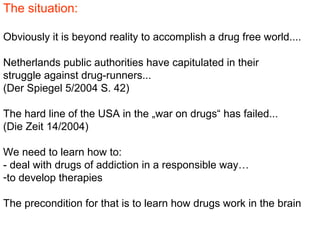
The situation:
Obviously it is beyond reality to accomplish a drug free world....
Netherlands public authorities have capitulated in their
struggle against drug-runners...
(Der Spiegel 5/2004 S. 42)
The hard line of the USA in the „war on drugs“ has failed...
(Die Zeit 14/2004)
We need to learn how to:
- deal with drugs of addiction in a responsible way…
-to develop therapies
The precondition for that is to learn how drugs work in the brain
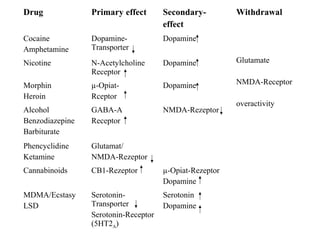
Drug Primary effect Secondary-
effect
Withdrawal
Cocaine
Amphetamine
Dopamine-
Transporter
Dopamine
Glutamate
NMDA-Receptor
overactivity
Nicotine N-Acetylcholine
Receptor
Dopamine
Morphin
Heroin
µ-Opiat-
Rceptor
Dopamine
Alcohol
Benzodiazepine
Barbiturate
GABA-A
Receptor
NMDA-Rezeptor
Phencyclidine
Ketamine
Glutamat/
NMDA-Rezeptor
Cannabinoids CB1-Rezeptor µ-Opiat-Rezeptor
Dopamine
MDMA/Ecstasy
LSD
Serotonin-
Transporter
Serotonin-Receptor
(5HT2A)
Serotonin
Dopamine
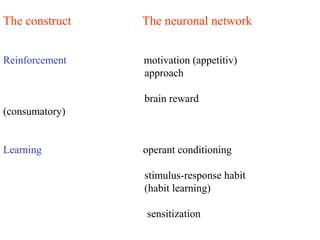
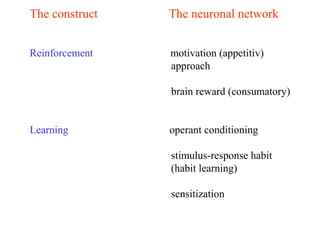
The construct The neuronal network
Reinforcement motivation (appetitiv)
approach
brain reward
(consumatory)
Learning operant conditioning
stimulus-response habit
(habit learning)
sensitization
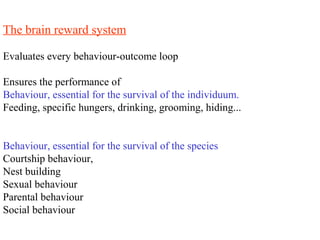
The brain reward system
Evaluates every behaviour-outcome loop
Ensures the performance of
Behaviour, essential for the survival of the individuum.
Feeding, specific hungers, drinking, grooming, hiding...
Behaviour, essential for the survival of the species
Courtship behaviour,
Nest building
Sexual behaviour
Parental behaviour
Social behaviour
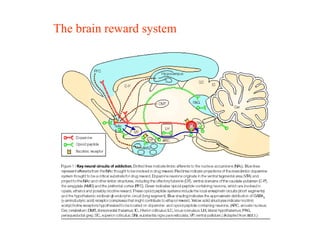
The brain reward system
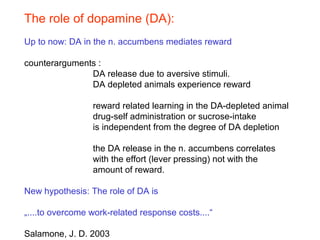
The role of dopamine (DA):
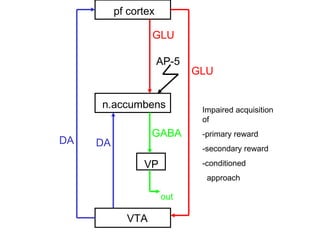
Up to now: DA in the n. accumbens mediates reward
counterarguments :
DA release due to aversive stimuli.
DA depleted animals experience reward
reward related learning in the DA-depleted animal
drug-self administration or sucrose-intake
is independent from the degree of DA depletion
the DA release in the n. accumbens correlates
with the effort (lever pressing) not with the
amount of reward.
New hypothesis: The role of DA is
„....to overcome work-related response costs....“
Salamone, J. D. 2003
pf cortex
n.accumbens
VTA
VP
DA DA
GLU
GLU
out
AP-5
Impaired acquisition
of
-primary reward
-secondary reward
-conditioned
approach
GABA
The role of glutamate
DA
pf cortex
n.accumbens
VTA
VP
DA
GLU
GLU
GABA
out
GABA
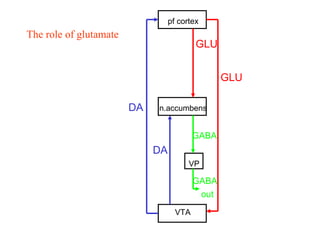
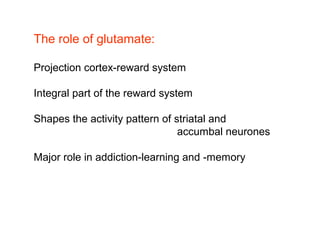
The role of glutamate:
Projection cortex-reward system
Integral part of the reward system
Shapes the activity pattern of striatal and
accumbal neurones
Major role in addiction-learning and -memory
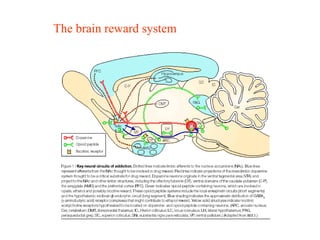
The brain reward system:
- is activated by natural rewards in order
to compensate for biological needs
- is activated by addictive drugs
in the absence of biological needs
- undergoes changes upon chronic drug intake
Behavioural economics hypothesis
Drugs become increasingly attractive during
the development of addiction
because non-drug rewards lose their rewarding value
(Gene Heyman)
Negative reinforcement hypothesis
Drug wanting increases during the development of addiction
because drugs elicit a downward shift in rewarding sensitivity,
causing pervasive anhedonia (George Koob, Michel Le Moal).
The construct The neuronal network
Reinforcement motivation (appetitive phase)
approach
brain reward (consumatory phase)
Learning operant conditioning
stimulus-response habit
(habit learning)
sensitization
Is addiction learning operant conditioning?
Pros:
Drug intake as a neutral behaviour
leads - to reward....
- to strengthening of behaviour, repetition of this behaviour
Cons:
Addiction can not be forgotten (incubation effect))
No extinction -by context/cue exposure
-by punishment (disulfiram)
Therapies based on this learning model have basically failed
The construct The neuronal network
Reinforcement motivation (appetitiv)
approach
brain reward (consumatory)
Learning operant conditioning
stimulus-response habit
(habit learning)
sensitization
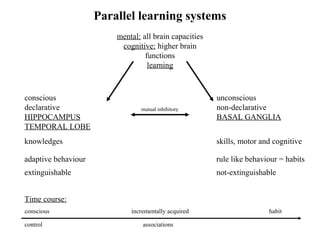
Parallel learning systems
mental: all brain capacities
cognitive: higher brain
functions
learning
conscious
declarative
HIPPOCAMPUS
TEMPORAL LOBE
unconscious
non-declarative
BASAL GANGLIA
mutual inhibitory
knowledges
extinguishable not-extinguishable
skills, motor and cognitive
adaptive behaviour rule like behaviour = habits
Time course:
conscious incrementally acquired habit
control associations
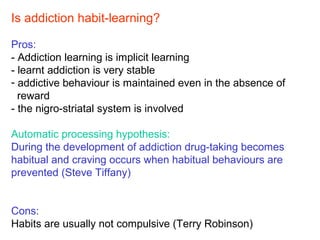
Is addiction habit-learning?
Pros:
- Addiction learning is implicit learning
- learnt addiction is very stable
- addictive behaviour is maintained even in the absence of
reward
- the nigro-striatal system is involved
Automatic processing hypothesis:
During the development of addiction drug-taking becomes
habitual and craving occurs when habitual behaviours are
prevented (Steve Tiffany)
Cons:
Habits are usually not compulsive (Terry Robinson)
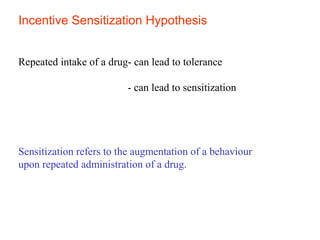
Incentive Sensitization Hypothesis
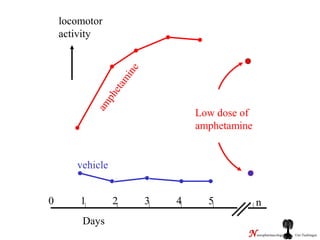
Repeated intake of a drug- can lead to tolerance
- can lead to sensitization
Sensitization refers to the augmentation of a behaviour
upon repeated administration of a drug.
locomotor
activity
Low dose of
amphetamine
amphetamine
0 1 2 3 4 5 n
vehicle
Days
Neuropharmacology Uni-Tuebingen
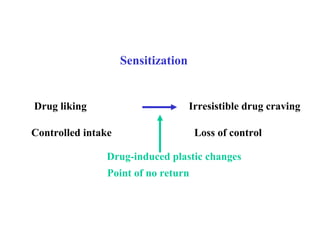
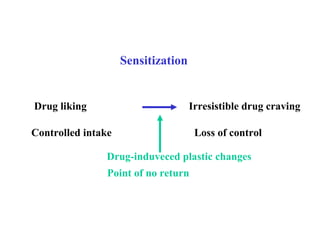
Drug liking
Controlled intake
Irresistible drug craving
Loss of control
Drug-induced plastic changes
Sensitization
Point of no return
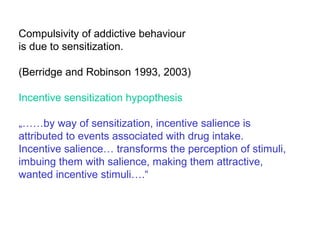
Compulsivity of addictive behaviour
is due to sensitization.
(Berridge and Robinson 1993, 2003)
Incentive sensitization hypopthesis
„……by way of sensitization, incentive salience is
attributed to events associated with drug intake.
Incentive salience… transforms the perception of stimuli,
imbuing them with salience, making them attractive,
wanted incentive stimuli….“
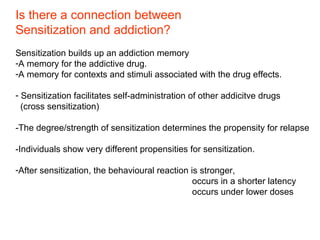
Is there a connection between
Sensitization and addiction?
Sensitization builds up an addiction memory
-A memory for the addictive drug.
-A memory for contexts and stimuli associated with the drug effects.
- Sensitization facilitates self-administration of other addicitve drugs
(cross sensitization)
-The degree/strength of sensitization determines the propensity for relapse
-Individuals show very different propensities for sensitization.
-After sensitization, the behavioural reaction is stronger,
occurs in a shorter latency
occurs under lower doses
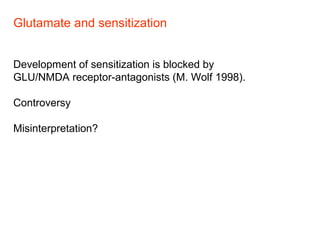
Glutamate and sensitization
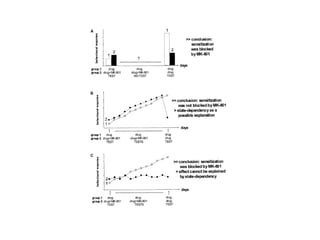
Development of sensitization is blocked by
GLU/NMDA receptor-antagonists (M. Wolf 1998).
Controversy
Misinterpretation?
Drug liking
Controlled intake
Irresistible drug craving
Loss of control
Drug-induveced plastic changes
Sensitization
Point of no return
Relapse
Underlying networks:
-the priming network
-stress relapse network
-cue / context relapse network
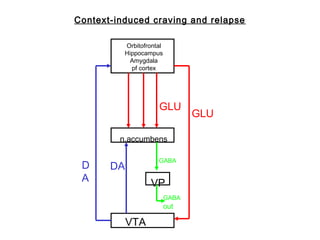
VTA
Orbitofrontal
Hippocampus
Amygdala
pf cortex
n.accumbens
VP
D
A
DA
GABA
GLU
GLU
GABA
out
Context-induced craving and relapse
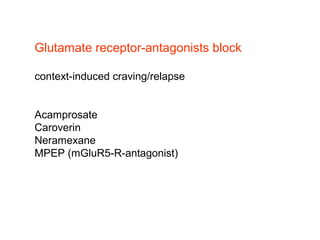
Glutamate receptor-antagonists block
context-induced craving/relapse
Acamprosate
Caroverin
Neramexane
MPEP (mGluR5-R-antagonist)
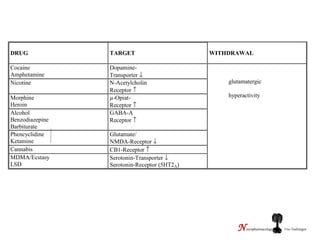
DRUG TARGET WITHDRAWAL
Cocaine
Amphetamine
Dopamine-
Transporter ↓
Nicotine N-Acetylcholin
Receptor ↑
Morphine
Heroin
µ-Opiat-
Receptor ↑
Alcohol
Benzodiazepine
Barbiturate
GABA-A
Receptor ↑
Phencyclidine
Ketamine
Glutamate/
NMDA-Receptor ↓
Cannabis CB1-Receptor ↑
MDMA/Ecstasy
LSD
Serotonin-Transporter ↓
Serotonin-Receptor (5HT2A)
glutamatergic
hyperactivity
Neuropharmacology Uni-Tuebingen
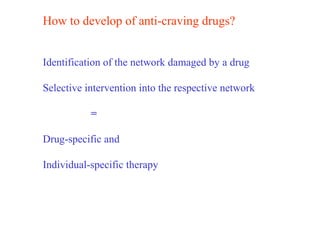
How to develop of anti-craving drugs?
Identification of the network damaged by a drug
Selective intervention into the respective network
=
Drug-specific and
Individual-specific therapy
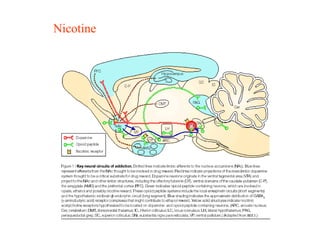
Nicotine
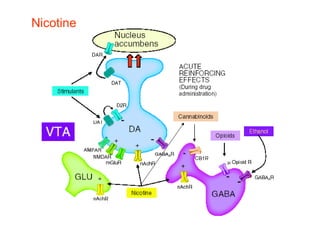
Nicotine
Nicotine
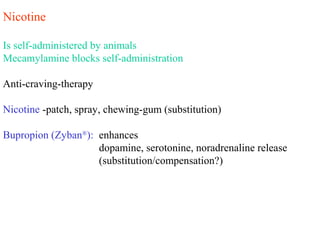
Is self-administered by animals
Mecamylamine blocks self-administration
Anti-craving-therapy
Nicotine -patch, spray, chewing-gum (substitution)
Bupropion (Zyban®
): enhances
dopamine, serotonine, noradrenaline release
(substitution/compensation?)
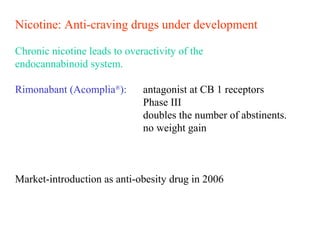
Nicotine: Anti-craving drugs under development
Chronic nicotine leads to overactivity of the
endocannabinoid system.
Rimonabant (Acomplia®
): antagonist at CB 1 receptors
Phase III
doubles the number of abstinents.
no weight gain
Market-introduction as anti-obesity drug in 2006
Nicotine: Future perspectives
Reboxetin (Edronax®
): SNARI
γ-vinyl-GABA=Topiramat (Topomax®
):
strengthens GABA
Vaccination: Antibodies which bind to nicotine
do not cross the BBB
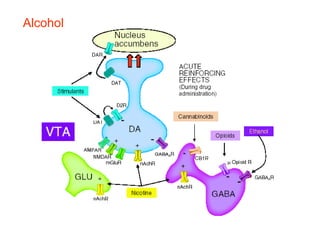
Alcohol
Alcohol: anti-craving-therapy
Naltrexon: blocks μ-opiate receptors
Rebound effect after cessation
of treatment
Acamprosate
Hypothesis:
Chronic GABAergic inhibition leads to glutamatergic overactivty
(like a homeostatic response)
Acamprosat (Campral®
): GLU-receptor-antagonist
Effective against context-induced craving
No rebound effects,
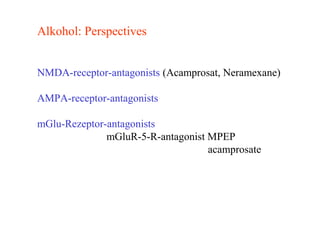
Alkohol: Perspectives
NMDA-receptor-antagonists (Acamprosat, Neramexane)
AMPA-receptor-antagonists
mGlu-Rezeptor-antagonists
mGluR-5-R-antagonist MPEP
acamprosate
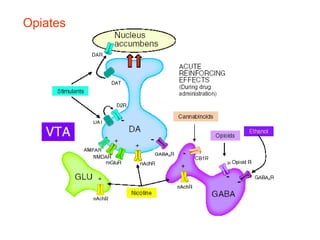
Opiates
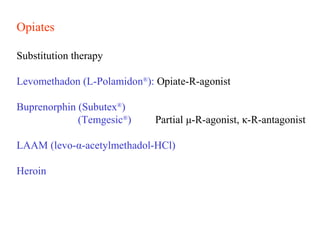
Opiates
Substitution therapy
Levomethadon (L-Polamidon®
): Opiate-R-agonist
Buprenorphin (Subutex®
)
(Temgesic®
) Partial μ-R-agonist, κ-R-antagonist
LAAM (levo-α-acetylmethadol-HCl)
Heroin
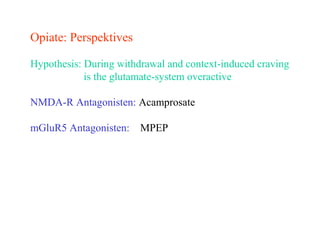
Opiate: Perspektives
Hypothesis: During withdrawal and context-induced craving
is the glutamate-system overactive
NMDA-R Antagonisten: Acamprosate
mGluR5 Antagonisten: MPEP
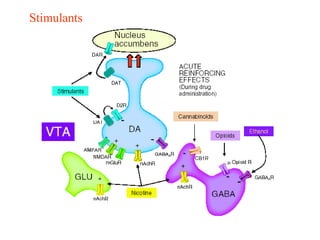
Stimulants
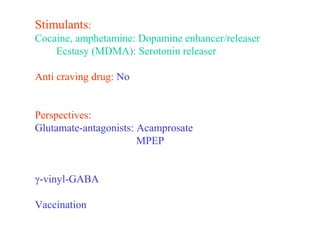
Stimulants:
Cocaine, amphetamine: Dopamine enhancer/releaser
Ecstasy (MDMA): Serotonin releaser
Anti craving drug: No
Perspectives:
Glutamate-antagonists: Acamprosate
MPEP
γ-vinyl-GABA
Vaccination
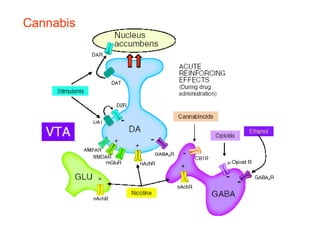
Cannabis
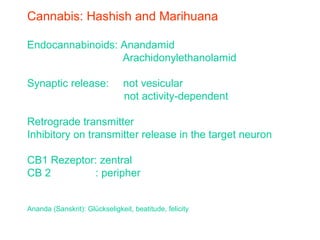
Cannabis: Hashish and Marihuana
Endocannabinoids: Anandamid
Arachidonylethanolamid
Synaptic release: not vesicular
not activity-dependent
Retrograde transmitter
Inhibitory on transmitter release in the target neuron
CB1 Rezeptor: zentral
CB 2 : peripher
Ananda (Sanskrit): Glückseligkeit, beatitude, felicity
Cannabis perspectives
Anti-craving Therapy:
Naltrexon:
Rimonabant (Acomplia®
)
Perspectives for treatment of addiction
Combination of different anti-craving-drugs
Goal of a rational development:
Identification of the drug-induced changes in the respective
neuronal network.
Specific intervention
=
Addiction-specific and individual-specific therapy
The brain reward system

The brain system reward addiction

  • 1.
    Neuronal basics ofaddiction Werner J. Schmidt Abt. Neuropharmakologie Universität Tübingen
  • 2.
    The situation: Obviously itis beyond reality to accomplish a drug free world.... Netherlands public authorities have capitulated in their struggle against drug-runners... (Der Spiegel 5/2004 S. 42) The hard line of the USA in the „war on drugs“ has failed... (Die Zeit 14/2004) We need to learn how to: - deal with drugs of addiction in a responsible way… -to develop therapies The precondition for that is to learn how drugs work in the brain
  • 3.
    Drug Primary effectSecondary- effect Withdrawal Cocaine Amphetamine Dopamine- Transporter Dopamine Glutamate NMDA-Receptor overactivity Nicotine N-Acetylcholine Receptor Dopamine Morphin Heroin µ-Opiat- Rceptor Dopamine Alcohol Benzodiazepine Barbiturate GABA-A Receptor NMDA-Rezeptor Phencyclidine Ketamine Glutamat/ NMDA-Rezeptor Cannabinoids CB1-Rezeptor µ-Opiat-Rezeptor Dopamine MDMA/Ecstasy LSD Serotonin- Transporter Serotonin-Receptor (5HT2A) Serotonin Dopamine
  • 4.
    The construct Theneuronal network Reinforcement motivation (appetitiv) approach brain reward (consumatory) Learning operant conditioning stimulus-response habit (habit learning) sensitization
  • 5.
    The brain rewardsystem Evaluates every behaviour-outcome loop Ensures the performance of Behaviour, essential for the survival of the individuum. Feeding, specific hungers, drinking, grooming, hiding... Behaviour, essential for the survival of the species Courtship behaviour, Nest building Sexual behaviour Parental behaviour Social behaviour
  • 6.
  • 7.
    The role ofdopamine (DA): Up to now: DA in the n. accumbens mediates reward counterarguments : DA release due to aversive stimuli. DA depleted animals experience reward reward related learning in the DA-depleted animal drug-self administration or sucrose-intake is independent from the degree of DA depletion the DA release in the n. accumbens correlates with the effort (lever pressing) not with the amount of reward. New hypothesis: The role of DA is „....to overcome work-related response costs....“ Salamone, J. D. 2003
  • 9.
    pf cortex n.accumbens VTA VP DA DA GLU GLU out AP-5 Impairedacquisition of -primary reward -secondary reward -conditioned approach GABA
  • 10.
    The role ofglutamate DA pf cortex n.accumbens VTA VP DA GLU GLU GABA out GABA
  • 11.
    The role ofglutamate: Projection cortex-reward system Integral part of the reward system Shapes the activity pattern of striatal and accumbal neurones Major role in addiction-learning and -memory
  • 12.
    The brain rewardsystem: - is activated by natural rewards in order to compensate for biological needs - is activated by addictive drugs in the absence of biological needs - undergoes changes upon chronic drug intake
  • 13.
    Behavioural economics hypothesis Drugsbecome increasingly attractive during the development of addiction because non-drug rewards lose their rewarding value (Gene Heyman) Negative reinforcement hypothesis Drug wanting increases during the development of addiction because drugs elicit a downward shift in rewarding sensitivity, causing pervasive anhedonia (George Koob, Michel Le Moal).
  • 14.
    The construct Theneuronal network Reinforcement motivation (appetitive phase) approach brain reward (consumatory phase) Learning operant conditioning stimulus-response habit (habit learning) sensitization
  • 15.
    Is addiction learningoperant conditioning? Pros: Drug intake as a neutral behaviour leads - to reward.... - to strengthening of behaviour, repetition of this behaviour Cons: Addiction can not be forgotten (incubation effect)) No extinction -by context/cue exposure -by punishment (disulfiram) Therapies based on this learning model have basically failed
  • 16.
    The construct Theneuronal network Reinforcement motivation (appetitiv) approach brain reward (consumatory) Learning operant conditioning stimulus-response habit (habit learning) sensitization
  • 17.
    Parallel learning systems mental:all brain capacities cognitive: higher brain functions learning conscious declarative HIPPOCAMPUS TEMPORAL LOBE unconscious non-declarative BASAL GANGLIA mutual inhibitory knowledges extinguishable not-extinguishable skills, motor and cognitive adaptive behaviour rule like behaviour = habits Time course: conscious incrementally acquired habit control associations
  • 18.
    Is addiction habit-learning? Pros: -Addiction learning is implicit learning - learnt addiction is very stable - addictive behaviour is maintained even in the absence of reward - the nigro-striatal system is involved Automatic processing hypothesis: During the development of addiction drug-taking becomes habitual and craving occurs when habitual behaviours are prevented (Steve Tiffany) Cons: Habits are usually not compulsive (Terry Robinson)
  • 19.
    Incentive Sensitization Hypothesis Repeatedintake of a drug- can lead to tolerance - can lead to sensitization Sensitization refers to the augmentation of a behaviour upon repeated administration of a drug.
  • 20.
    locomotor activity Low dose of amphetamine amphetamine 01 2 3 4 5 n vehicle Days Neuropharmacology Uni-Tuebingen
  • 21.
    Drug liking Controlled intake Irresistibledrug craving Loss of control Drug-induced plastic changes Sensitization Point of no return
  • 22.
    Compulsivity of addictivebehaviour is due to sensitization. (Berridge and Robinson 1993, 2003) Incentive sensitization hypopthesis „……by way of sensitization, incentive salience is attributed to events associated with drug intake. Incentive salience… transforms the perception of stimuli, imbuing them with salience, making them attractive, wanted incentive stimuli….“
  • 23.
    Is there aconnection between Sensitization and addiction? Sensitization builds up an addiction memory -A memory for the addictive drug. -A memory for contexts and stimuli associated with the drug effects. - Sensitization facilitates self-administration of other addicitve drugs (cross sensitization) -The degree/strength of sensitization determines the propensity for relapse -Individuals show very different propensities for sensitization. -After sensitization, the behavioural reaction is stronger, occurs in a shorter latency occurs under lower doses
  • 24.
    Glutamate and sensitization Developmentof sensitization is blocked by GLU/NMDA receptor-antagonists (M. Wolf 1998). Controversy Misinterpretation?
  • 26.
    Drug liking Controlled intake Irresistibledrug craving Loss of control Drug-induveced plastic changes Sensitization Point of no return
  • 27.
    Relapse Underlying networks: -the primingnetwork -stress relapse network -cue / context relapse network
  • 28.
  • 29.
    Glutamate receptor-antagonists block context-inducedcraving/relapse Acamprosate Caroverin Neramexane MPEP (mGluR5-R-antagonist)
  • 30.
    DRUG TARGET WITHDRAWAL Cocaine Amphetamine Dopamine- Transporter↓ Nicotine N-Acetylcholin Receptor ↑ Morphine Heroin µ-Opiat- Receptor ↑ Alcohol Benzodiazepine Barbiturate GABA-A Receptor ↑ Phencyclidine Ketamine Glutamate/ NMDA-Receptor ↓ Cannabis CB1-Receptor ↑ MDMA/Ecstasy LSD Serotonin-Transporter ↓ Serotonin-Receptor (5HT2A) glutamatergic hyperactivity Neuropharmacology Uni-Tuebingen
  • 31.
    How to developof anti-craving drugs? Identification of the network damaged by a drug Selective intervention into the respective network = Drug-specific and Individual-specific therapy
  • 32.
  • 33.
  • 34.
    Nicotine Is self-administered byanimals Mecamylamine blocks self-administration Anti-craving-therapy Nicotine -patch, spray, chewing-gum (substitution) Bupropion (Zyban® ): enhances dopamine, serotonine, noradrenaline release (substitution/compensation?)
  • 35.
    Nicotine: Anti-craving drugsunder development Chronic nicotine leads to overactivity of the endocannabinoid system. Rimonabant (Acomplia® ): antagonist at CB 1 receptors Phase III doubles the number of abstinents. no weight gain Market-introduction as anti-obesity drug in 2006
  • 36.
    Nicotine: Future perspectives Reboxetin(Edronax® ): SNARI γ-vinyl-GABA=Topiramat (Topomax® ): strengthens GABA Vaccination: Antibodies which bind to nicotine do not cross the BBB
  • 37.
  • 38.
    Alcohol: anti-craving-therapy Naltrexon: blocksμ-opiate receptors Rebound effect after cessation of treatment
  • 39.
    Acamprosate Hypothesis: Chronic GABAergic inhibitionleads to glutamatergic overactivty (like a homeostatic response) Acamprosat (Campral® ): GLU-receptor-antagonist Effective against context-induced craving No rebound effects,
  • 40.
    Alkohol: Perspectives NMDA-receptor-antagonists (Acamprosat,Neramexane) AMPA-receptor-antagonists mGlu-Rezeptor-antagonists mGluR-5-R-antagonist MPEP acamprosate
  • 41.
  • 42.
    Opiates Substitution therapy Levomethadon (L-Polamidon® ):Opiate-R-agonist Buprenorphin (Subutex® ) (Temgesic® ) Partial μ-R-agonist, κ-R-antagonist LAAM (levo-α-acetylmethadol-HCl) Heroin
  • 43.
    Opiate: Perspektives Hypothesis: Duringwithdrawal and context-induced craving is the glutamate-system overactive NMDA-R Antagonisten: Acamprosate mGluR5 Antagonisten: MPEP
  • 44.
  • 45.
    Stimulants: Cocaine, amphetamine: Dopamineenhancer/releaser Ecstasy (MDMA): Serotonin releaser Anti craving drug: No Perspectives: Glutamate-antagonists: Acamprosate MPEP γ-vinyl-GABA Vaccination
  • 46.
  • 47.
    Cannabis: Hashish andMarihuana Endocannabinoids: Anandamid Arachidonylethanolamid Synaptic release: not vesicular not activity-dependent Retrograde transmitter Inhibitory on transmitter release in the target neuron CB1 Rezeptor: zentral CB 2 : peripher Ananda (Sanskrit): Glückseligkeit, beatitude, felicity
  • 48.
  • 49.
    Perspectives for treatmentof addiction Combination of different anti-craving-drugs Goal of a rational development: Identification of the drug-induced changes in the respective neuronal network. Specific intervention = Addiction-specific and individual-specific therapy
  • 50.

Editor's Notes

  • #3 Offensichtlich ist es realitätsfremd anzunehmen, eine suchtmittelfreie Welt schaffen zu können. Vielleicht ist es besser den Umgang mit Suchtmittel zu lernen, einen Rahmen dafür zu schaffen der auf der Kenntnis der Suchtrelevanten Hirnmechanismen beruht Und wissenschaftlich fundierte Therapiemöglichkeiten zu etablieren.