SOMATIC SYMPTOM AND
RELATED DISORDER
Government college
university Faisalabad
Department of applied
psychology
PSYCHOLOGICAL FACTORS AFFECTING OTHER
MEDICAL CONDITIONS
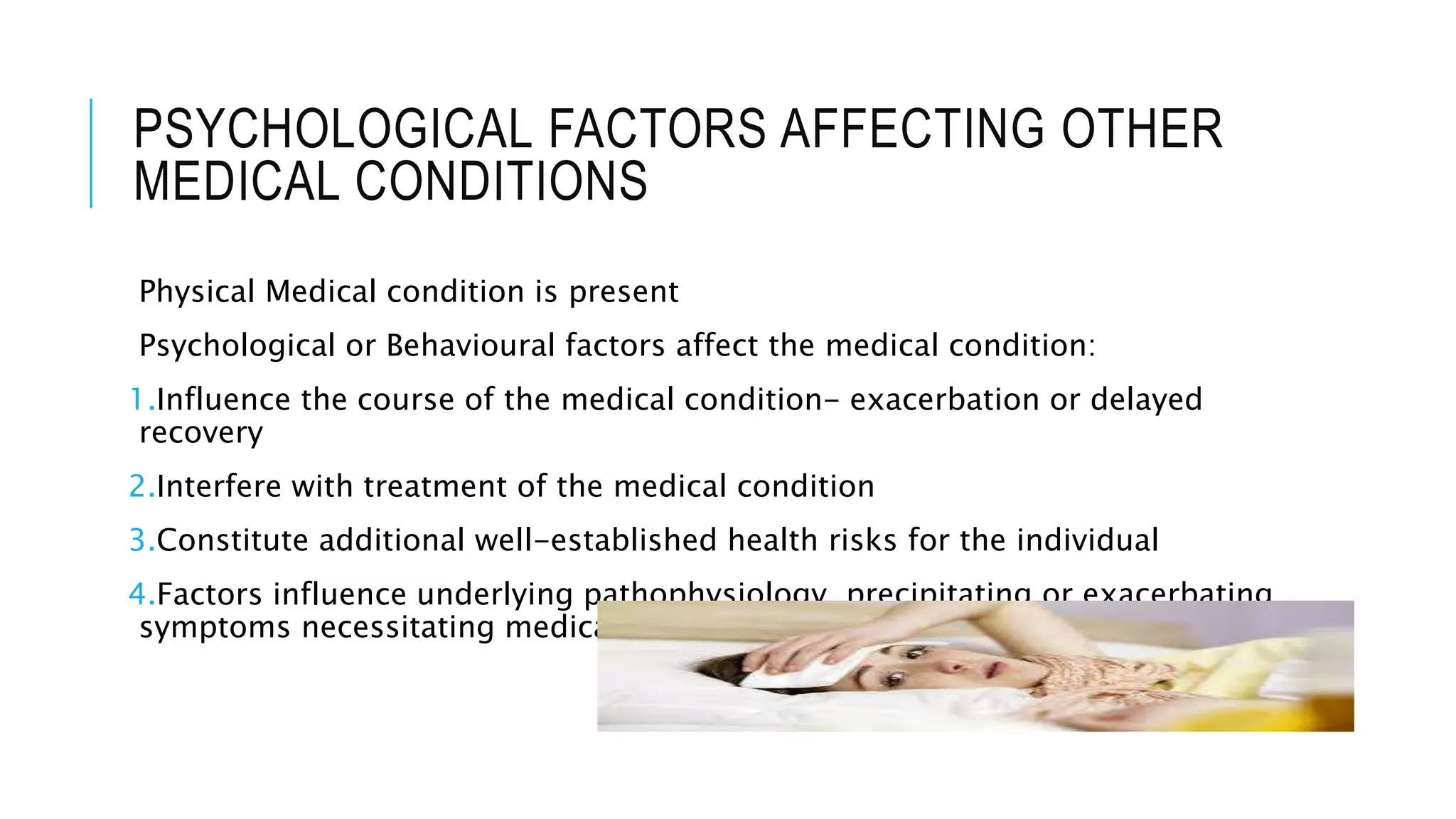
Physical Medical condition is present
Psychological or Behavioural factors affect the medical condition:
1.Influence the course of the medical condition- exacerbation or delayed
recovery
2.Interfere with treatment of the medical condition
3.Constitute additional well-established health risks for the individual
4.Factors influence underlying pathophysiology, precipitating or exacerbating
symptoms necessitating medical attention
QUALIFIERS:
Mild- increased medical risk
Moderate- aggravates underlying medical condition
Severe-results in hospitalisation or ED attendance
Extreme- results in life-threatening risk
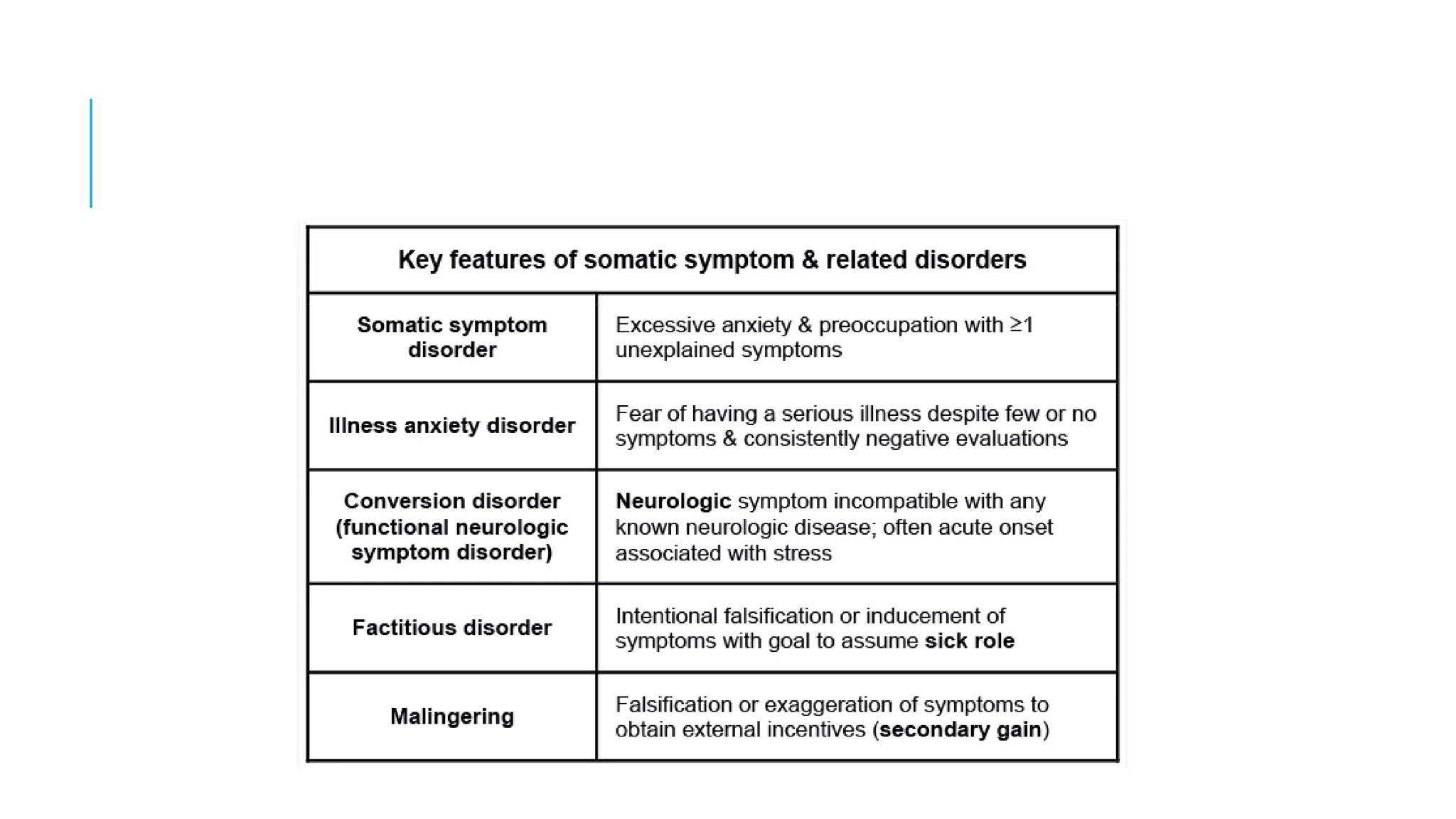
KEY FEATURES
DIFFERENTIAL DIAGNOSIS
Mental disorder due to another medical condition
ADJUSTMENT DISORDER
SOMATIC SYMPTOM DISORDER
ILLNESS ANXIETY DISORDER
FACTITIOUS DISORDERS
1. Imposed on self
2. Imposed on another
Falsification of physical or psychological signs or symptoms
Presents as an ill person
Deception evident even in the absence of obvious external reward
Qualifiers:
Single episode
Recurrent episode
MALINGERING
For personal gain
Conversion
disorder(functional
neurological symptom
disorder)
BORDER LINE PERSONALITY
DISORDER
Co occurrences is possible
MEDICAL CONDITION OR MENTAL
DISORDER NOT ASSOCIATED WITH
INTENTIONAL SYMPTOM
FALSIFICATIONMedical condition affected
UNSPECIFIED SOMATIC SYMPTOM
AND
RELATED DISORDER
This category applies to presentations in which symptoms characteristic of a
somatic
symptom and related disorder that cause clinically significant distress or
impairment in social,
occupational, or other important areas of functioning predominate but do
not meet the
full criteria for any of the disorders in the somatic symptom and related
disorders diagnostic
class. The unspecified somatic symptom and related disorder category
should not be
used unless there are decidedly unusual situations where there is insufficient
information
OTHER SPECIFIED SOMATIC
SYMPTOM AND
RELATED DISORDER
This category applies to presentations in which symptoms
characteristic of a somatic symptom and related disorder that cause
clinically significant distress or impairment in social , occupational, or
other important areas of functioning predominate but do not meet
the full criteria for any of the disorders in the somatic symptom and
related disorders diagnostic class.
EXAMPLES
presentations that can be specified using the “other specified”
designation
include the following:
1. Brief somatic symptom disorder: Duration of symptoms is less than
6 months.
2. Brief illness anxiety disorder: Duration of symptoms is less than 6
months.
3. Illness anxiety disorder without excessive health-related behaviors:
Criterion D
for illness anxiety disorder is not met.
4. Pseudocyesis: A false belief of being pregnant that is associated
PHQ-15 - SCREENING FOR SOMATIC SYMPTOM
PRESENCE AND SEVERITY
Not
bothered at
all
(0)
Bothered
a
little
(1)
Bothered
a
lot (2)
a. Stomach pain   
b. Back pain   
c. Pain in your arms, legs, or joints (knees, hips, etc.)   
d. Menstrual cramps or other problems with your periods   
WOMEN ONLY
e. Headaches   
f. Chest pain   
g. Dizziness   
h. Fainting spells   
i. Feeling your heart pound or race   
j. Shortness of breath   
k. Pain or problems during sexual intercourse   
l. Constipation, loose bowels, or diarrhea   
m. Nausea, gas, or indigestion   
n. Feeling tired or having low energy   
o. Trouble sleeping   
Somatic Symptom Scale – 8 [SSS-8]
ESSENTIAL TREATMENT APPROACHES FOR PATIENTS WITH
SOMATIC SYMPTOM DISORDER
•Schedule time-limited regular appointments (e.g. 4-6
weeks) to address complaints
•Explain that although there may not be a reason for
their symptoms, you will work together to improve
their functioning as much as possible
•Educate patients how psychosocial stressors and
symptoms interact
•Avoid comments like “Your symptoms are all
psychological.” or “There is nothing wrong with you
medical
ESSENTIAL TREATMENT APPROACHES FOR PATIENTS
WITH SOMATIC SYMPTOM DISORDER
•Avoid the temptation to order unnecessary, repetitive,
or invasive investigations
•Educate the patient on how to cope with their
symptoms instead of focusing on a cure
•Evaluate somatic symptom burden
•Collaborate with the patient in setting treatment goals
•Screen for common psychiatric conditions associated
with somatic complaints such as depression and
anxiety
•Treat identified comorbid psychiatric disorders
ESSENTIAL TREATMENT APPROACHES FOR PATIENTS
WITH SOMATIC SYMPTOM DISORDER
• Case management to minimize economic impact
• Medications to treat anxiety and depression (SSRIs)
• Short term use of anxiety meds (dependence is a risk)
• Non-pharmacological treatments
• *CBT – Shows promising evidence
• Psychodynamic therapy
• Integrative therapy
Pharmacotherapy and psychotherapy are each beneficial, and there is no
evidence to indicate one is better than the other.
Patients with somatization often have comorbid depressive and anxiety
disorders. Somatization frequently resolves when these psychiatric
syndromes are appropriately treated.
Cognitive Behavioral Therapy- the evidence supporting CBT is stronger than
it is for any other psychotherapy.
Tell patients that their symptoms are taken seriously
Avoid describing symptoms as entirely psychogenic (“all in your head”)
Avoid further referrals and laboratory tests unless there is a clear indication
of a general medical disorder.
Schedule regular visits.
TREATMENT
TREATMENT
SSRI (NNT:3) : Initial treatment with fluoxetine 20 mg per day.
TCAs : Side effects ?

Somatic symptom and related disorder

  • 1.
    SOMATIC SYMPTOM AND RELATEDDISORDER Government college university Faisalabad Department of applied psychology
  • 2.
    PSYCHOLOGICAL FACTORS AFFECTINGOTHER MEDICAL CONDITIONS Physical Medical condition is present Psychological or Behavioural factors affect the medical condition: 1.Influence the course of the medical condition- exacerbation or delayed recovery 2.Interfere with treatment of the medical condition 3.Constitute additional well-established health risks for the individual 4.Factors influence underlying pathophysiology, precipitating or exacerbating symptoms necessitating medical attention
  • 3.
    QUALIFIERS: Mild- increased medicalrisk Moderate- aggravates underlying medical condition Severe-results in hospitalisation or ED attendance Extreme- results in life-threatening risk
  • 4.
  • 5.
    DIFFERENTIAL DIAGNOSIS Mental disorderdue to another medical condition
  • 6.
  • 7.
  • 8.
  • 9.
    FACTITIOUS DISORDERS 1. Imposedon self 2. Imposed on another Falsification of physical or psychological signs or symptoms Presents as an ill person Deception evident even in the absence of obvious external reward Qualifiers: Single episode Recurrent episode
  • 11.
  • 12.
  • 13.
    BORDER LINE PERSONALITY DISORDER Cooccurrences is possible
  • 14.
    MEDICAL CONDITION ORMENTAL DISORDER NOT ASSOCIATED WITH INTENTIONAL SYMPTOM FALSIFICATIONMedical condition affected
  • 15.
    UNSPECIFIED SOMATIC SYMPTOM AND RELATEDDISORDER This category applies to presentations in which symptoms characteristic of a somatic symptom and related disorder that cause clinically significant distress or impairment in social, occupational, or other important areas of functioning predominate but do not meet the full criteria for any of the disorders in the somatic symptom and related disorders diagnostic class. The unspecified somatic symptom and related disorder category should not be used unless there are decidedly unusual situations where there is insufficient information
  • 16.
    OTHER SPECIFIED SOMATIC SYMPTOMAND RELATED DISORDER This category applies to presentations in which symptoms characteristic of a somatic symptom and related disorder that cause clinically significant distress or impairment in social , occupational, or other important areas of functioning predominate but do not meet the full criteria for any of the disorders in the somatic symptom and related disorders diagnostic class.
  • 17.
    EXAMPLES presentations that canbe specified using the “other specified” designation include the following: 1. Brief somatic symptom disorder: Duration of symptoms is less than 6 months. 2. Brief illness anxiety disorder: Duration of symptoms is less than 6 months. 3. Illness anxiety disorder without excessive health-related behaviors: Criterion D for illness anxiety disorder is not met. 4. Pseudocyesis: A false belief of being pregnant that is associated
  • 18.
    PHQ-15 - SCREENINGFOR SOMATIC SYMPTOM PRESENCE AND SEVERITY Not bothered at all (0) Bothered a little (1) Bothered a lot (2) a. Stomach pain    b. Back pain    c. Pain in your arms, legs, or joints (knees, hips, etc.)    d. Menstrual cramps or other problems with your periods    WOMEN ONLY e. Headaches    f. Chest pain    g. Dizziness    h. Fainting spells    i. Feeling your heart pound or race    j. Shortness of breath    k. Pain or problems during sexual intercourse    l. Constipation, loose bowels, or diarrhea    m. Nausea, gas, or indigestion    n. Feeling tired or having low energy    o. Trouble sleeping   
  • 19.
    Somatic Symptom Scale– 8 [SSS-8]
  • 20.
    ESSENTIAL TREATMENT APPROACHESFOR PATIENTS WITH SOMATIC SYMPTOM DISORDER •Schedule time-limited regular appointments (e.g. 4-6 weeks) to address complaints •Explain that although there may not be a reason for their symptoms, you will work together to improve their functioning as much as possible •Educate patients how psychosocial stressors and symptoms interact •Avoid comments like “Your symptoms are all psychological.” or “There is nothing wrong with you medical
  • 21.
    ESSENTIAL TREATMENT APPROACHESFOR PATIENTS WITH SOMATIC SYMPTOM DISORDER •Avoid the temptation to order unnecessary, repetitive, or invasive investigations •Educate the patient on how to cope with their symptoms instead of focusing on a cure •Evaluate somatic symptom burden •Collaborate with the patient in setting treatment goals •Screen for common psychiatric conditions associated with somatic complaints such as depression and anxiety •Treat identified comorbid psychiatric disorders
  • 22.
    ESSENTIAL TREATMENT APPROACHESFOR PATIENTS WITH SOMATIC SYMPTOM DISORDER • Case management to minimize economic impact • Medications to treat anxiety and depression (SSRIs) • Short term use of anxiety meds (dependence is a risk) • Non-pharmacological treatments • *CBT – Shows promising evidence • Psychodynamic therapy • Integrative therapy
  • 23.
    Pharmacotherapy and psychotherapyare each beneficial, and there is no evidence to indicate one is better than the other. Patients with somatization often have comorbid depressive and anxiety disorders. Somatization frequently resolves when these psychiatric syndromes are appropriately treated. Cognitive Behavioral Therapy- the evidence supporting CBT is stronger than it is for any other psychotherapy. Tell patients that their symptoms are taken seriously Avoid describing symptoms as entirely psychogenic (“all in your head”) Avoid further referrals and laboratory tests unless there is a clear indication of a general medical disorder. Schedule regular visits. TREATMENT
  • 24.
    TREATMENT SSRI (NNT:3) :Initial treatment with fluoxetine 20 mg per day. TCAs : Side effects ?

Editor's Notes

  • #19 Scores 0-2 for each item, making the total 0-30; 5 = low; 10=moderate; and 15 = high somatic symptom severity