Market Structure
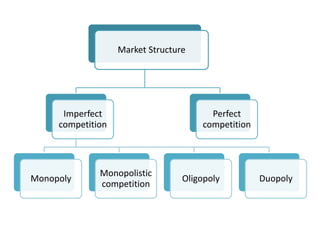
Imperfect
competition
Monopoly
Monopolistic
competition
Oligopoly Duopoly
Perfect
competition
INTRODUCTION
Derived from two Greek words:
“Monos” means single
“Poly” means seller
Monopoly is a term used by economists to refer to the
situation in which there is a single seller of a product (i.e., a
good or service) for which there are no close substitutes.
Monopolies exist because of barriers to entry into the market
that prevents competition.
FEATURES
• Single seller
• No Close Substitutes
• No Entry for New Firms
• Price-discrimination
• Firm is a Price-Maker
CAUSES OF MONOPOLY
1. Natural
2. Technical
3. Legal
4. Large Amount of Capital
5. State
TYPES OF MONOPOLY
1. Private monopoly:
The monopoly firm owned and operate by private individuals is called the private
monopoly. Their main motive is to make profit.
2. Public monopoly:
The monopoly firm owned and operated by public or state government is called
public monopoly.
3. Absolute monopoly:
It is a type of monopoly, where a single seller controls the entire supply of market
without facing competition.
4. Imperfect monopoly:
It is a type of monopoly in which a single seller controls the entire supply of the
market which does not have a close substitute. But there might be remote
substitute for the product available in the market.
5. Simple or single monopoly:
It is a type of monopoly in which a single seller controls the entire market, by
selling the commodity at a single price for all the consumer.
6. Discriminative monopoly:
When a monopoly firm changes different prices for the same goods or services to
different consumers it is known as discriminative monopoly.
7. Legal monopoly:
When a firms enjoys rights like trade mark, copy right, patent right, etc. then it is
known as legal monopoly. Such monopoly rights are approved by the government.
8. Natural monopoly:
When a firms enjoys monopoly right due to natural factors like location reputation
earned etc, it is called as natural monopoly.
9. Technological monopoly:
When a firm enjoys monopoly power due to technical superiority over other products
in the market, then it is called as technological monopoly.
MONOPOLY REVENUE CURVE
Disadvantages of monopoly
1. Poor level of service.
2. No consumer sovereignty. A monopoly market is best known for
consumer exploitation. There are indeed no competing products and as a
result the consumer gets a raw deal in terms of quantity, quality and
pricing.
3. Consumers may be charged high prices for low quality of goods and
services.
4. Lack of competition may lead to low quality and out dated goods and
services.
DIFFERENCE BETWEEN MONOPOLY
AND PERFECT COMPETITION
LESSONS OF MONOPOLY FOR
BUSINESS MANAGERS
1. Risks should be taken early whenever possible.
2. Negotiation and persuasion skills are essential.
3. Diversification is key.
4. Money should be set aside for uncertainties.
5. Always understand ROI.
6. Instant gratification isn’t always what’s best.
Monopoly

Monopoly

  • 2.
  • 3.
    INTRODUCTION Derived from twoGreek words: “Monos” means single “Poly” means seller Monopoly is a term used by economists to refer to the situation in which there is a single seller of a product (i.e., a good or service) for which there are no close substitutes. Monopolies exist because of barriers to entry into the market that prevents competition.
  • 4.
    FEATURES • Single seller •No Close Substitutes • No Entry for New Firms • Price-discrimination • Firm is a Price-Maker
  • 5.
    CAUSES OF MONOPOLY 1.Natural 2. Technical 3. Legal 4. Large Amount of Capital 5. State
  • 6.
    TYPES OF MONOPOLY 1.Private monopoly: The monopoly firm owned and operate by private individuals is called the private monopoly. Their main motive is to make profit. 2. Public monopoly: The monopoly firm owned and operated by public or state government is called public monopoly. 3. Absolute monopoly: It is a type of monopoly, where a single seller controls the entire supply of market without facing competition. 4. Imperfect monopoly: It is a type of monopoly in which a single seller controls the entire supply of the market which does not have a close substitute. But there might be remote substitute for the product available in the market.
  • 7.
    5. Simple orsingle monopoly: It is a type of monopoly in which a single seller controls the entire market, by selling the commodity at a single price for all the consumer. 6. Discriminative monopoly: When a monopoly firm changes different prices for the same goods or services to different consumers it is known as discriminative monopoly. 7. Legal monopoly: When a firms enjoys rights like trade mark, copy right, patent right, etc. then it is known as legal monopoly. Such monopoly rights are approved by the government. 8. Natural monopoly: When a firms enjoys monopoly right due to natural factors like location reputation earned etc, it is called as natural monopoly. 9. Technological monopoly: When a firm enjoys monopoly power due to technical superiority over other products in the market, then it is called as technological monopoly.
  • 8.
  • 9.
    Disadvantages of monopoly 1.Poor level of service. 2. No consumer sovereignty. A monopoly market is best known for consumer exploitation. There are indeed no competing products and as a result the consumer gets a raw deal in terms of quantity, quality and pricing. 3. Consumers may be charged high prices for low quality of goods and services. 4. Lack of competition may lead to low quality and out dated goods and services.
  • 10.
  • 11.
    LESSONS OF MONOPOLYFOR BUSINESS MANAGERS 1. Risks should be taken early whenever possible. 2. Negotiation and persuasion skills are essential. 3. Diversification is key. 4. Money should be set aside for uncertainties. 5. Always understand ROI. 6. Instant gratification isn’t always what’s best.

Editor's Notes

  • #6 Natural:  A monopoly may arise on account of some natural causes. Some minerals are available only in certain regions. For example, South Africa has the monopoly of diamonds; nickel in the world is mostly available in Canada and oil in Middle East. This is natural monopoly. Technical: Monopoly power may be enjoyed due to technical reasons. A firm may have control over raw materials, technical knowledge, special know-how, scientific secrets and formula that enable a monopolist to produce a commodity. e.g., Coco Cola.  Legal: Monopoly power is achieved through patent rights, copyright and trade marks by the producers. This is called legal monopoly. Large Amount of Capital: The manufacture of some goods requires a large amount of capital or lumpiness of capital. All firms cannot enter the field because they cannot afford to invest such a large amount of capital. This may give rise to monopoly. For example, iron and steel industry, railways, etc. State:  Government will have the sole right of producing and selling some goods. They are State monopolies. For example, we have public utilities like electricity and railways. These public utilities are undertaken by the State
  • #12 1. Risks should be taken early whenever possible. In Monopoly, it’s smart to buy as much property as possible from the start to increase your chances of owning at least one full set of the same colored properties before the game is over. Similarly, in business, those who start investing earlier often do better in the long run. 2. Negotiation and persuasion skills are essential. There are times in Monopoly when a trade is necessary to get ahead. However, you may run up against an owner of the property you want who is benefiting from it and doesn’t want to part with it. Your task then becomes convincing the owner that what you have to offer in return will somehow be more beneficial. Seeing both sides and maneuvering around another party’s wants and demands are all skills that come into play in many business settings. 3. Diversification is key. With a large variety of properties, you open yourself up to more streams of revenue and a lesser chance of failing because of one bad investment gone bad. Everyone wants Park Place and Boardwalk, but there’s value in owning more than just the top-notch properties. Likewise, when it comes to investing in anything – whether it’s a product line, a supplier, or, in some cases, employees – the more variety, the better. 4. Money should be set aside for uncertainties. Despite how lucrative an investment may seem, it’s crucial to keep a financial cushion, as you never know how the game, or life, will turn. In Monopoly, there are taxes, penalties, unexpected trips to jail and all sorts of uncertainties that pop up. To play well, you need to keep a good chunk of the colored money at the ready in case your opponents get lucky. Real life business management is no different. You have to keep money set aside for unforeseen expenses. 5. Always understand ROI. Being able to assess the return on investment is essential in the business world and in Monopoly. In the game, buying lots of properties can yield great results, but you should always know at what cost. You shouldn’t make purchases blindly or without have an idea of what your next move will be. Will buying a lesser property give you the funds you need, if you are low on cash, or should you hold out for something more lucrative? Is it worth your to keep track of a property that won’t generate much in earnings? Just the same, when making business decisions, you have to evaluate your probable gain as well as the expense and time needed to get it. 6. Instant gratification isn’t always what’s best. Sometimes, the fastest decisions aren’t the wisest ones. It’s exciting to make progress early in the game, but don’t make bad choices just because you want to feel like a winner. In Monopoly and in business, the true winner is the one whose overall decision-making leads to the best outcome. Those who base their choices on one-upping others just for the sake of it – and for the sake of the business overall – will fail.