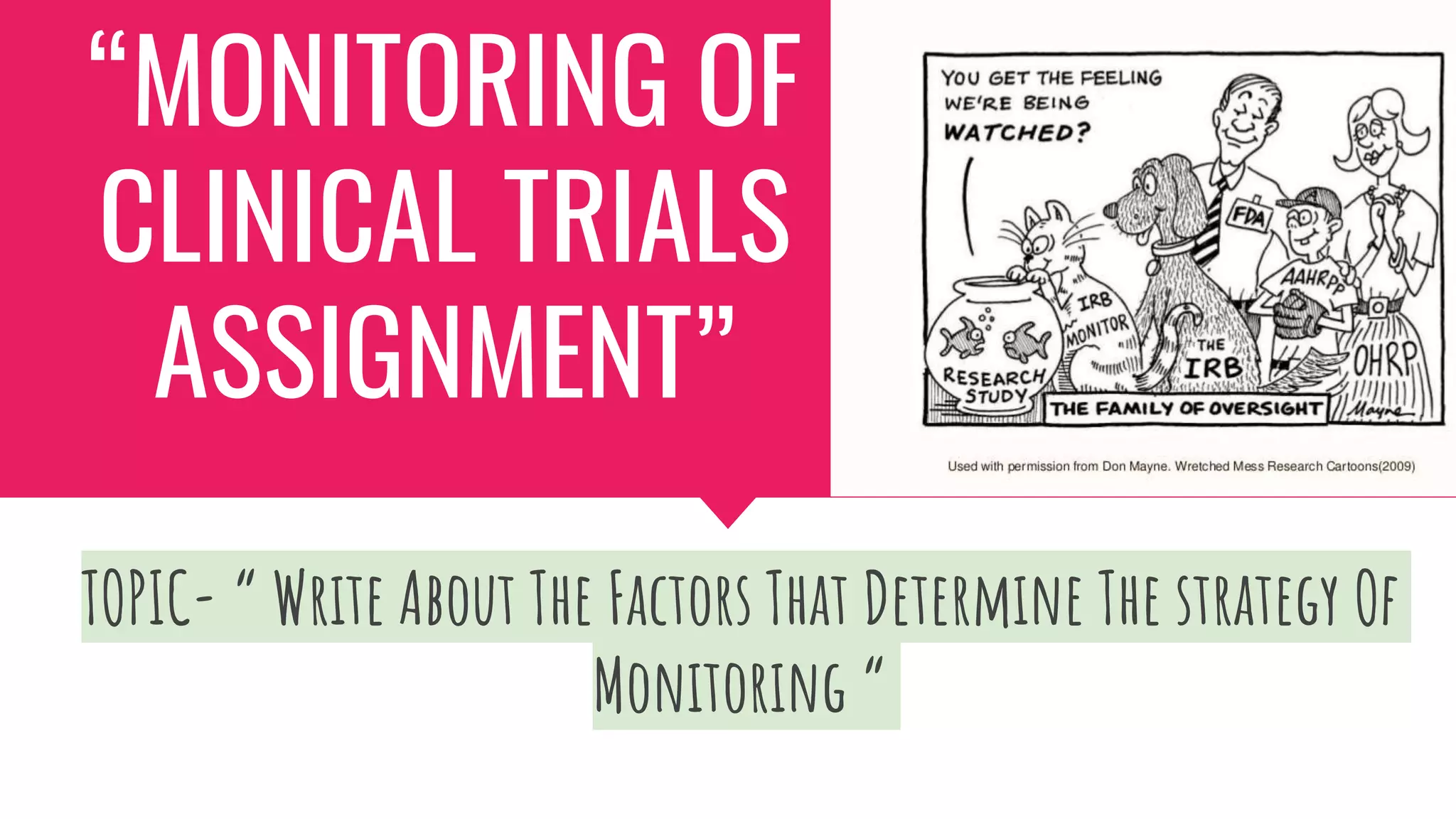
“MONITORING OF
CLINICAL TRIALS
ASSIGNMENT”
TOPIC- “ Write About The Factors That Determine The strategy Of
Monitoring “
“FIRST, WHAT IS
MONITORING
EXACTLY”?? :)
Clinical monitoring is the oversight and administrative efforts
that monitor a participant's health and efficacy of the treatment
during a clinical trial.
EXTENT AND NATURE OF MONITORING:-
The sponsor should ensure that the trials are adequately monitored. The
sponsor should determine the appropriate extent and nature of monitoring
The determination of the extent and nature of monitoring should be based
on considerations such as the objective, purpose, design, complexity,
blinding, size, an endpoints of the trial.
In general there is a need for on-site monitoring, before, during, and after
the trial; however in exceptional circumstances the sponsor determine
that central monitoring in conjunction with investigators’ training and
meetings, and extensive written guidance can assure appropriate conduct
FACTORS TO CONSIDER WHEN DEVELOPING A MONITORING PLAN :-
A monitoring plan ordinarily should focus on
preventing or mitigating important and likely risks,
identified by the risk assessment, to critical data and
processes.
The types (e.g., on-site, centralized), frequency (e.g., early, for
initial assessment and training versus throughout the
study), and extent (comprehensive (100% data verification)
versus targeted or random review of certain data (less than
100% data verification) of monitoring activities will depend to
some degree on a range of factors, considered during the
1) Complexity of the study design :-
More intensive monitoring (e.g., increased
frequency and extent of review) may be necessary
as study design complexity increases. Examples
may include studies with adaptive designs,
stratified designs or complex dose titrations
2) Types of study endpoints -
Endpoints that are more interpretative or
subjective may require on-site visits to
assess the totality of subject records and to
review application of protocol definitions
More objective endpoints (e.g., death, hospitalization, or clinical
laboratory values and standard measurements) may be more
suitable for remote verification.
Endpoints for which inappropriate subject withdrawal or
lack of follow-up may impede study evaluation are likely to
need more intensive monitoring to identify the reason(s)
subjects are withdrawing and to determine whether follow-
up can be improved.
3) Clinical complexity of the study population - A study that involves a
population that is seriously ill or vulnerable may require more
intensive monitoring and consideration of on-site monitoring
visits to be sure appropriate protection is being provided.
Relative experience of the CI and of the sponsor with
the CI
CIs who lack significant experience in conducting
and overseeing investigations, using a novel or
innovative medical device, or with the surgical
procedure associated with medical device use
may benefit from more intensive monitoring and
frequent communication to ensure CI
understanding of responsibilities.
In addition, the relative experience of a
sponsor with the CI may be a factor in
determining an appropriate monitoring plan.
Aspects of monitoring:-
Failure to follow investigation protocol (the
procedures and treatment subjects must
undergo,
as well as the schedule of assessments)
1) Failure to keep adequate and accurate
records
2) Problems with the informed consent form
3) Failure to report adverse events
4) Failure to account for the disposition of
study drugs
Factors that determine the strategy of monitoring:-
1)BACKGROUND :-it is a critical element of the planning process which enables
stakeholders to get feedback about performance and monitors strategy
implementation.
2) Research Methodology :-The study involves the case study research design
because it develops analytic and problem solving skills allows for exploration of
solutions for complex issues and allows the researcher to apply new knowledge and
skills
Monitoring plan :-
For each clinical trial, the sponsor should develop a monitoring plan
that describes the monitoring methods, responsibilities, and
requirements for the trial.
The monitoring plan should include a brief description of the study, its
objectives, and the critical data and study procedures, with particular
attention to data and procedures that are unusual in relation to
clinical routine and require training of study site staff.
The plan should also communicate the specific risks to be addressed
by monitoring and should provide those involved in monitoring with
adequate information to effectively carry out their duties.
The components of a monitoring plan might include the
following :-
1. Description of Monitoring Approaches - A description of each
monitoring method to be employed during the study and how it will
be used to address important risks and ensure the validity of critical
data.
2. Communication of Monitoring Results • Format, content, timing, and
archiving requirements for reports and other documentation of
monitoring activities
3. Management of Noncompliance
4. Ensuring Quality Monitoring
5. Monitoring Plan Amendments
DOCUMENTING MONITORING ACTIVITIES:-
Documentation of monitoring activities should generally include the
following :
• The date of the activity and the individual(s) conducting and participating
in it
• A summary of the data or activities reviewed
• A description of any noncompliance, potential noncompliance, data
irregularities, or other deficiencies identified
• A description of any actions taken, to be taken, or recommended, including
the person responsible for completing actions and the anticipated date o
completion
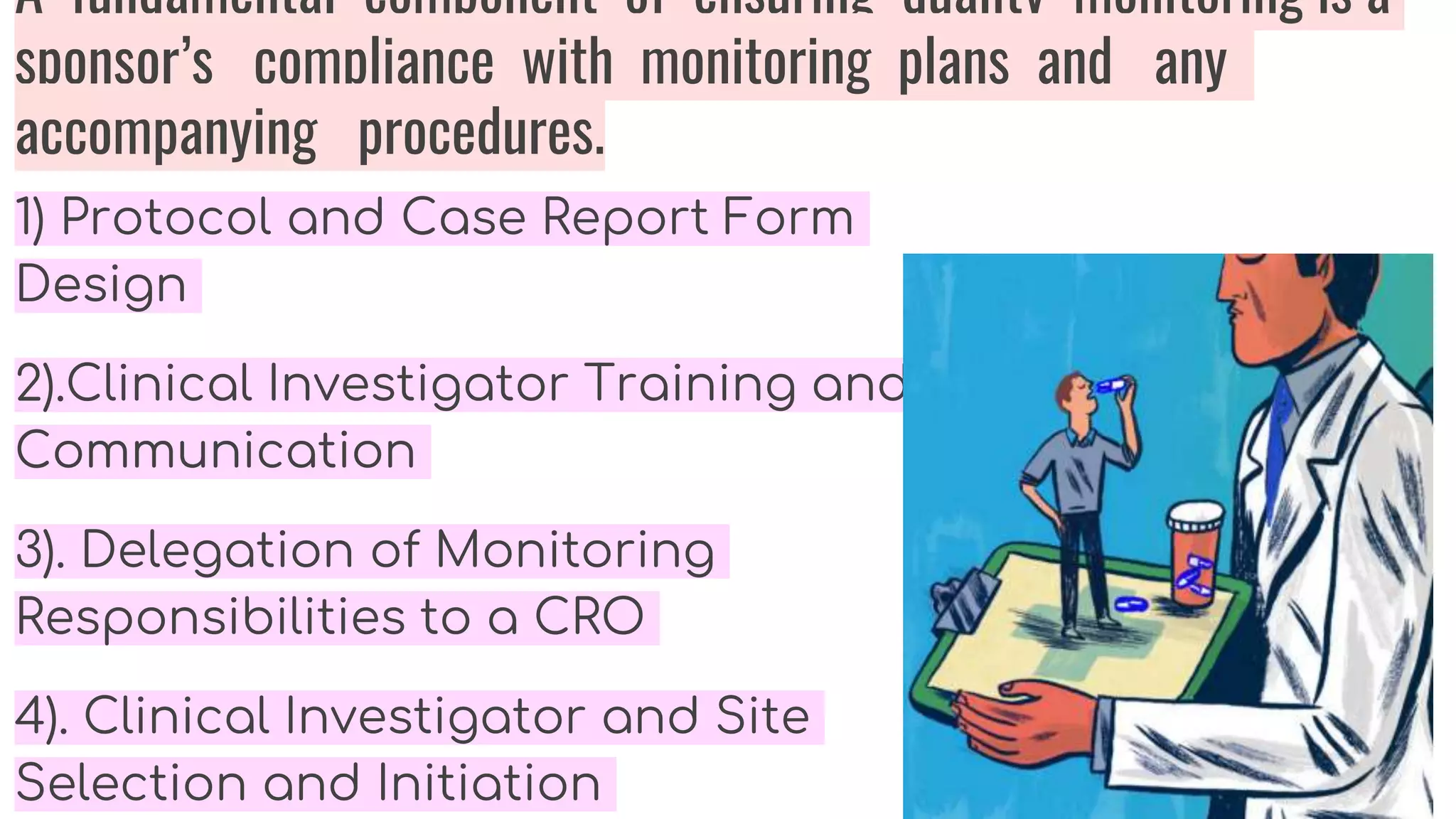
A fundamental component of ensuring quality monitoring is a
sponsor’s compliance with monitoring plans and any
accompanying procedures.
1) Protocol and Case Report Form
Design
2).Clinical Investigator Training and
Communication
3). Delegation of Monitoring
Responsibilities to a CRO
4). Clinical Investigator and Site
Selection and Initiation
MONITORING REPORT :-
(a) The monitor should submit a written report to the sponsor after each
trial-site visit or trial-related communication.
(b) Reports should include the date, site, name of the monitor, and name of the
investigator or other individual(s) contacted.
(c) Reports should include a summary of what the monitor reviewed and the
monitor’s statements concerning the significant findings/facts, deviations and
conclusions, actions taken or to be taken and/or actions recommended to
secure compliance.
(d) The review and follow-up of the monitoring report with the sponsor should
be documented by the sponsor’s designated representative.
REFERENCES:-)https://en.wikipedia.org/wiki/Monitoring_in_clinical_trialshttps://pdfs.semanticscholar.org/c901/00ee816e07c1ede4c78ac6f284e01d90949d.pdf
https://www.google.com/search?q=Factors+that+affect+the+strategy+of+clinical+trial+monitoring&tbm=isch&ved=2ahUKEwiKn5b509_oA
https://www.fda.gov/media/116754/download
https://www.google.com/search?q=Clinical+Trial+Monitoring+cartoons&rlz=1C1SQJL_enIN877IN877&sxsrf=ALeKk03VxGootc_U8qwUM84pc5
Mv9YsVPg:1586583536905&source=lnms&tbm=isch&sa=X&ved=2ahUKEwi-
p_6g1N_oAhWe8HMBHUfUBTAQ_AUoAXoECAsQAw&biw=1455&bih=688#imgrc=Sbq1EhQ09z0eoM
SUBMITTED TO :- DR. NILANJAN SAHA
MADE BY:-) RISHABH SHARMA

(Monitoring Of Clinical Trial Assignment ) " Write about the factors that determine the strategy of Monitoring " ? Monitoring Plans Procedures, Outcomes

  • 1.
    “MONITORING OF CLINICAL TRIALS ASSIGNMENT” TOPIC-“ Write About The Factors That Determine The strategy Of Monitoring “
  • 2.
    “FIRST, WHAT IS MONITORING EXACTLY”??:) Clinical monitoring is the oversight and administrative efforts that monitor a participant's health and efficacy of the treatment during a clinical trial.
  • 3.
    EXTENT AND NATUREOF MONITORING:- The sponsor should ensure that the trials are adequately monitored. The sponsor should determine the appropriate extent and nature of monitoring The determination of the extent and nature of monitoring should be based on considerations such as the objective, purpose, design, complexity, blinding, size, an endpoints of the trial. In general there is a need for on-site monitoring, before, during, and after the trial; however in exceptional circumstances the sponsor determine that central monitoring in conjunction with investigators’ training and meetings, and extensive written guidance can assure appropriate conduct
  • 4.
    FACTORS TO CONSIDERWHEN DEVELOPING A MONITORING PLAN :- A monitoring plan ordinarily should focus on preventing or mitigating important and likely risks, identified by the risk assessment, to critical data and processes. The types (e.g., on-site, centralized), frequency (e.g., early, for initial assessment and training versus throughout the study), and extent (comprehensive (100% data verification) versus targeted or random review of certain data (less than 100% data verification) of monitoring activities will depend to some degree on a range of factors, considered during the
  • 5.
    1) Complexity ofthe study design :- More intensive monitoring (e.g., increased frequency and extent of review) may be necessary as study design complexity increases. Examples may include studies with adaptive designs, stratified designs or complex dose titrations 2) Types of study endpoints - Endpoints that are more interpretative or subjective may require on-site visits to assess the totality of subject records and to review application of protocol definitions
  • 6.
    More objective endpoints(e.g., death, hospitalization, or clinical laboratory values and standard measurements) may be more suitable for remote verification. Endpoints for which inappropriate subject withdrawal or lack of follow-up may impede study evaluation are likely to need more intensive monitoring to identify the reason(s) subjects are withdrawing and to determine whether follow- up can be improved. 3) Clinical complexity of the study population - A study that involves a population that is seriously ill or vulnerable may require more intensive monitoring and consideration of on-site monitoring visits to be sure appropriate protection is being provided.
  • 7.
    Relative experience ofthe CI and of the sponsor with the CI CIs who lack significant experience in conducting and overseeing investigations, using a novel or innovative medical device, or with the surgical procedure associated with medical device use may benefit from more intensive monitoring and frequent communication to ensure CI understanding of responsibilities. In addition, the relative experience of a sponsor with the CI may be a factor in determining an appropriate monitoring plan.
  • 8.
    Aspects of monitoring:- Failureto follow investigation protocol (the procedures and treatment subjects must undergo, as well as the schedule of assessments) 1) Failure to keep adequate and accurate records 2) Problems with the informed consent form 3) Failure to report adverse events 4) Failure to account for the disposition of study drugs
  • 9.
    Factors that determinethe strategy of monitoring:- 1)BACKGROUND :-it is a critical element of the planning process which enables stakeholders to get feedback about performance and monitors strategy implementation. 2) Research Methodology :-The study involves the case study research design because it develops analytic and problem solving skills allows for exploration of solutions for complex issues and allows the researcher to apply new knowledge and skills
  • 11.
    Monitoring plan :- Foreach clinical trial, the sponsor should develop a monitoring plan that describes the monitoring methods, responsibilities, and requirements for the trial. The monitoring plan should include a brief description of the study, its objectives, and the critical data and study procedures, with particular attention to data and procedures that are unusual in relation to clinical routine and require training of study site staff. The plan should also communicate the specific risks to be addressed by monitoring and should provide those involved in monitoring with adequate information to effectively carry out their duties.
  • 12.
    The components ofa monitoring plan might include the following :- 1. Description of Monitoring Approaches - A description of each monitoring method to be employed during the study and how it will be used to address important risks and ensure the validity of critical data. 2. Communication of Monitoring Results • Format, content, timing, and archiving requirements for reports and other documentation of monitoring activities 3. Management of Noncompliance 4. Ensuring Quality Monitoring 5. Monitoring Plan Amendments
  • 13.
    DOCUMENTING MONITORING ACTIVITIES:- Documentationof monitoring activities should generally include the following : • The date of the activity and the individual(s) conducting and participating in it • A summary of the data or activities reviewed • A description of any noncompliance, potential noncompliance, data irregularities, or other deficiencies identified • A description of any actions taken, to be taken, or recommended, including the person responsible for completing actions and the anticipated date o completion
  • 14.
    A fundamental componentof ensuring quality monitoring is a sponsor’s compliance with monitoring plans and any accompanying procedures. 1) Protocol and Case Report Form Design 2).Clinical Investigator Training and Communication 3). Delegation of Monitoring Responsibilities to a CRO 4). Clinical Investigator and Site Selection and Initiation
  • 15.
    MONITORING REPORT :- (a)The monitor should submit a written report to the sponsor after each trial-site visit or trial-related communication. (b) Reports should include the date, site, name of the monitor, and name of the investigator or other individual(s) contacted. (c) Reports should include a summary of what the monitor reviewed and the monitor’s statements concerning the significant findings/facts, deviations and conclusions, actions taken or to be taken and/or actions recommended to secure compliance. (d) The review and follow-up of the monitoring report with the sponsor should be documented by the sponsor’s designated representative.
  • 17.
  • 18.
    SUBMITTED TO :-DR. NILANJAN SAHA MADE BY:-) RISHABH SHARMA