PROSPECTIVE PROCESS
VALIDATION
Smt. Kishoritai Bhoyar College of Pharmacy, Kamptee
Ms. Neha S. Raut
Assistant Professor
Prospective Process Validation
Validation is an essential procedure that demonstrates
that a manufacturing process, operating under defined
standard condition, is capable of consistently producing
a product that meets the established product
specifications.
Validation as a stand-alone item or an afterthought at
the end of the entire product development sequence.
The process can be considered validated if the first two
or three batches of product satisfy specification.
Organization:
 Prospective validation requires a planned program
and organization to carry it to. Successful completion
.
 The organization must have clearly defined areas of
responsibility and authority.
 The structure must be tailored to meet the
requirements in the specific organization, and these
will vary from company to company.
 A defined structure exists, is accepted, and is in
operation.
 An effective project management structure will have
to be established in order to plan, execute, and control
the program.
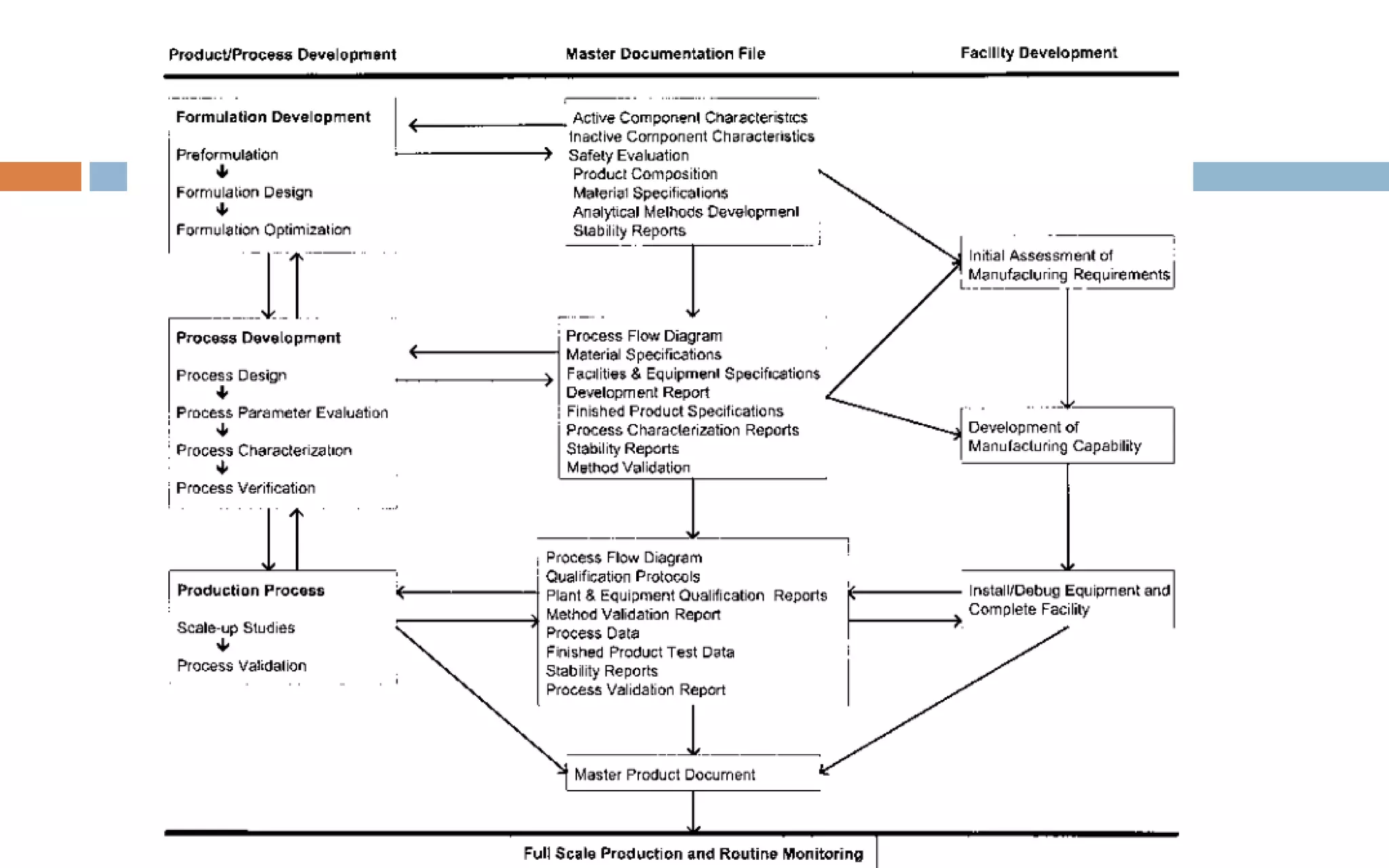
 Documentation: An effective prospective validation program must be
supported by documentation extending from product initiation to full-scale
production. The complete documentation package can be referred to as the
master documentation file.
 Product development:
 Product development usually begins when an active an active chemical entity
has been shown to possess the necessary attribute for a commercial product.
The product development activities for the active chemical entity, formulation,
and process from the foundation upon which the subsequent validation data
are built.
 Generally, product development activities can be subdivided into
formulation development and process development.
Documentation & Product development:
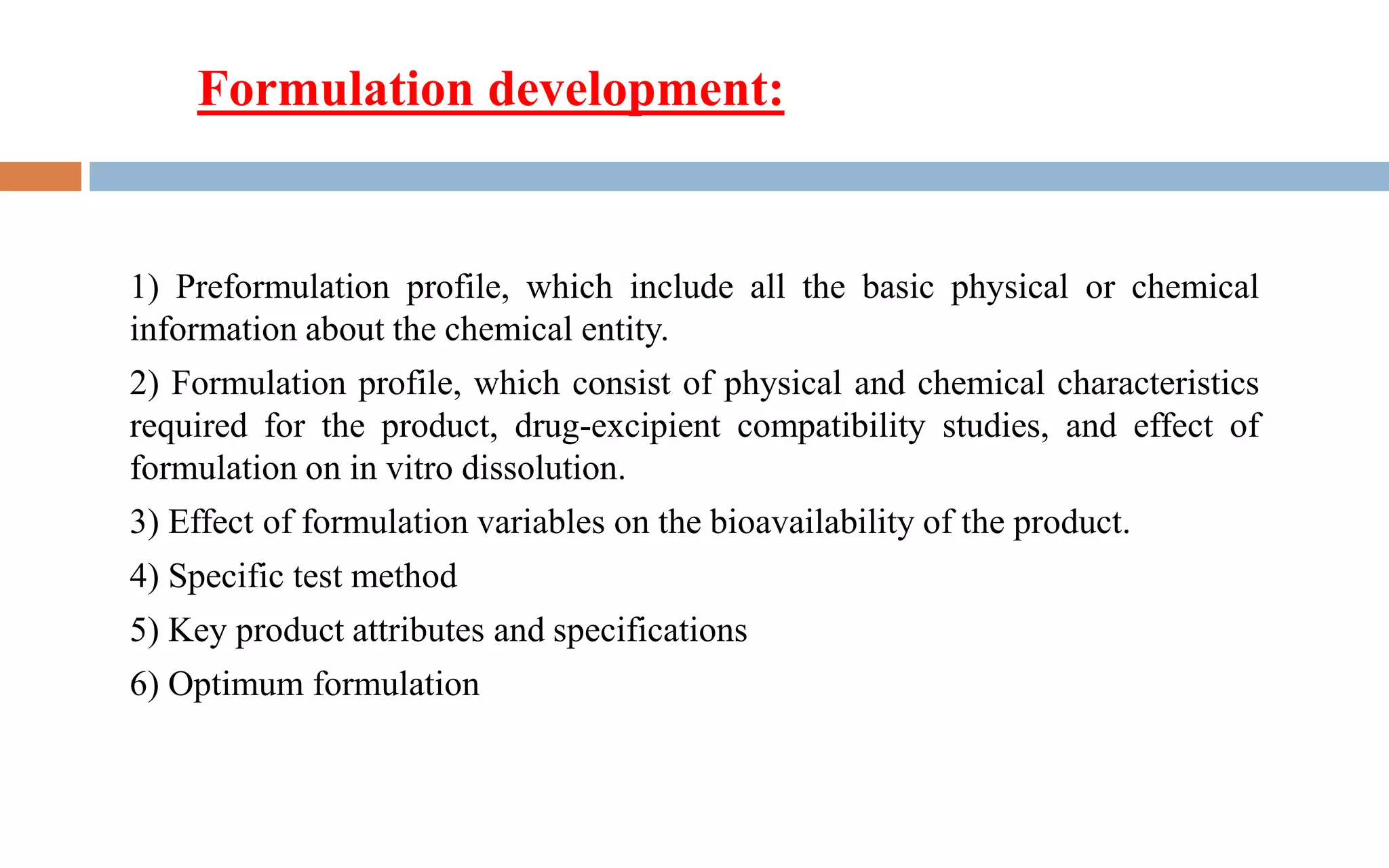
1) Preformulation profile, which include all the basic physical or chemical
information about the chemical entity.
2) Formulation profile, which consist of physical and chemical characteristics
required for the product, drug-excipient compatibility studies, and effect of
formulation on in vitro dissolution.
3) Effect of formulation variables on the bioavailability of the product.
4) Specific test method
5) Key product attributes and specifications
6) Optimum formulation
Formulation development:
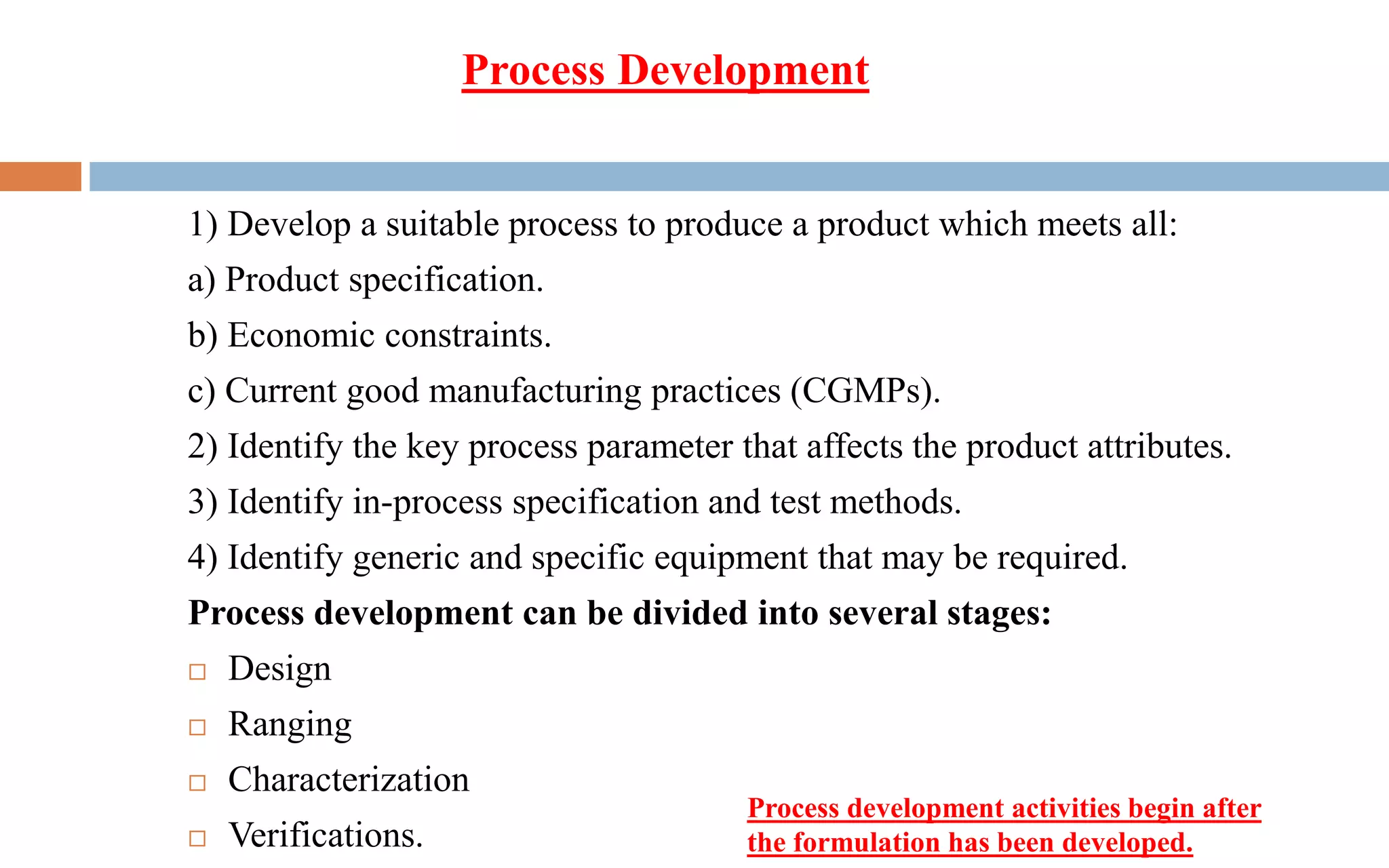
Process Development
1) Develop a suitable process to produce a product which meets all:
a) Product specification.
b) Economic constraints.
c) Current good manufacturing practices (CGMPs).
2) Identify the key process parameter that affects the product attributes.
3) Identify in-process specification and test methods.
4) Identify generic and specific equipment that may be required.
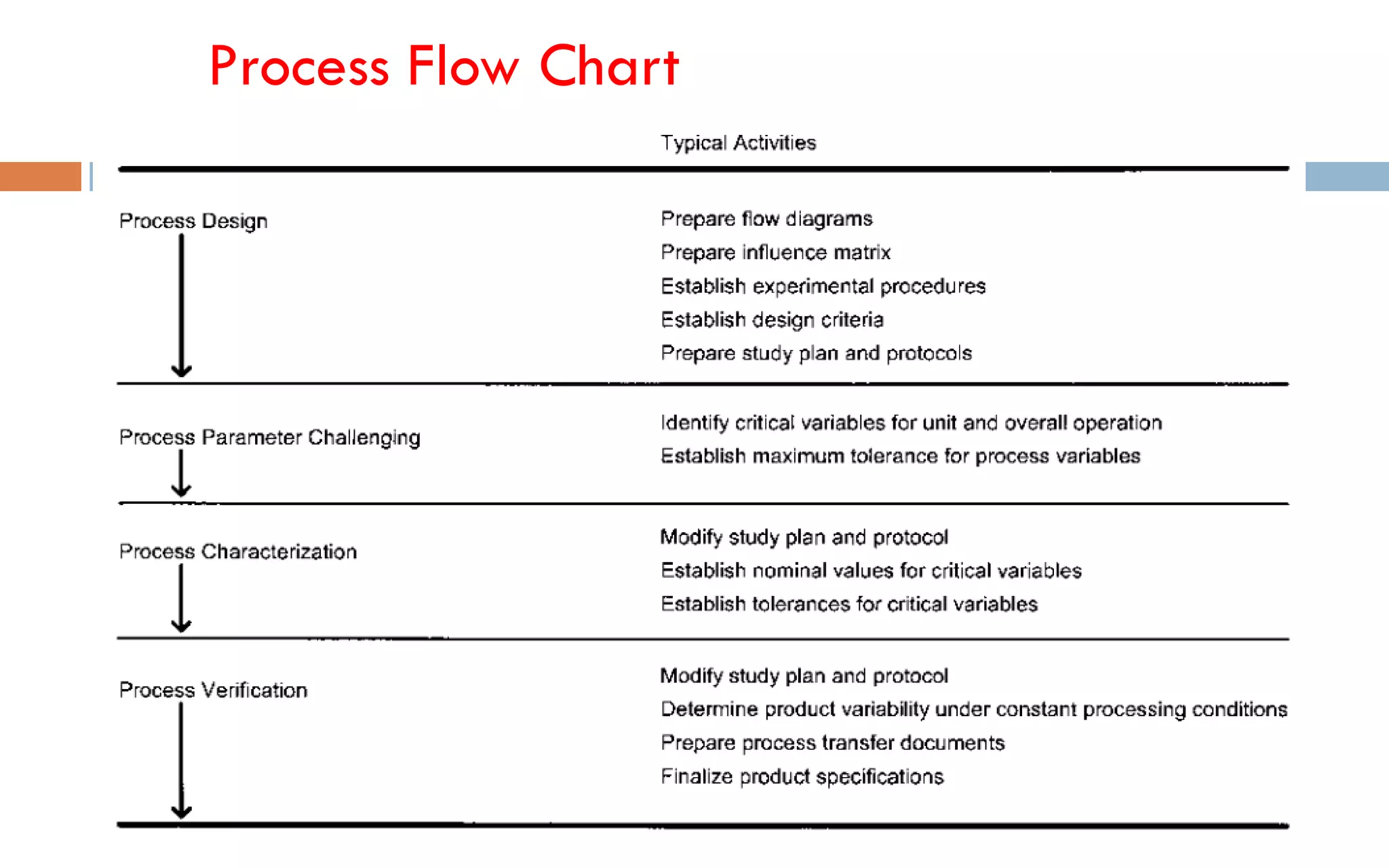
Process development can be divided into several stages:
 Design
 Ranging
 Characterization
 Verifications.
Process development activities begin after
the formulation has been developed.
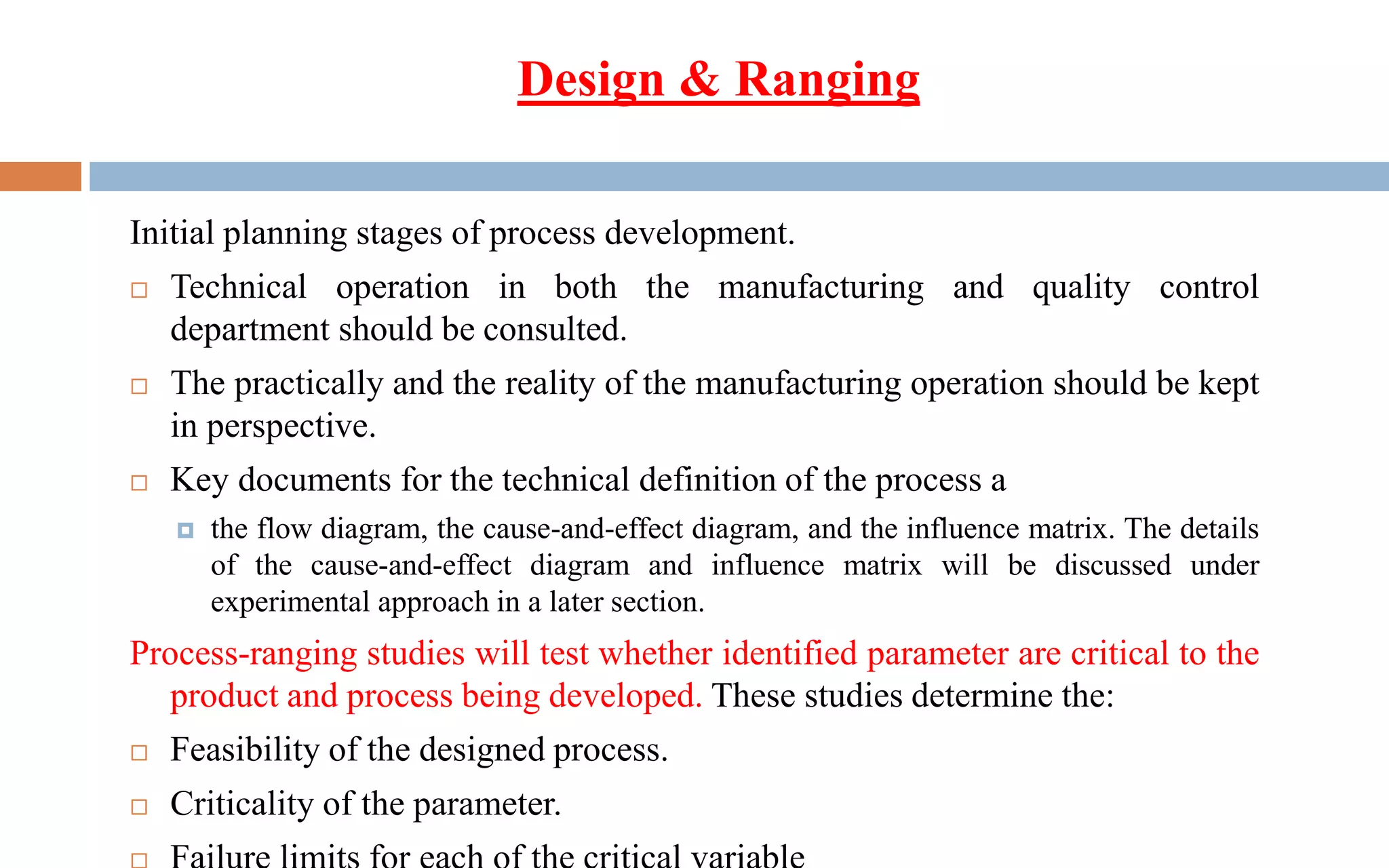
Initial planning stages of process development.
 Technical operation in both the manufacturing and quality control
department should be consulted.
 The practically and the reality of the manufacturing operation should be kept
in perspective.
 Key documents for the technical definition of the process a
 the flow diagram, the cause-and-effect diagram, and the influence matrix. The details
of the cause-and-effect diagram and influence matrix will be discussed under
experimental approach in a later section.
Process-ranging studies will test whether identified parameter are critical to the
product and process being developed. These studies determine the:
 Feasibility of the designed process.
 Criticality of the parameter.
Design & Ranging
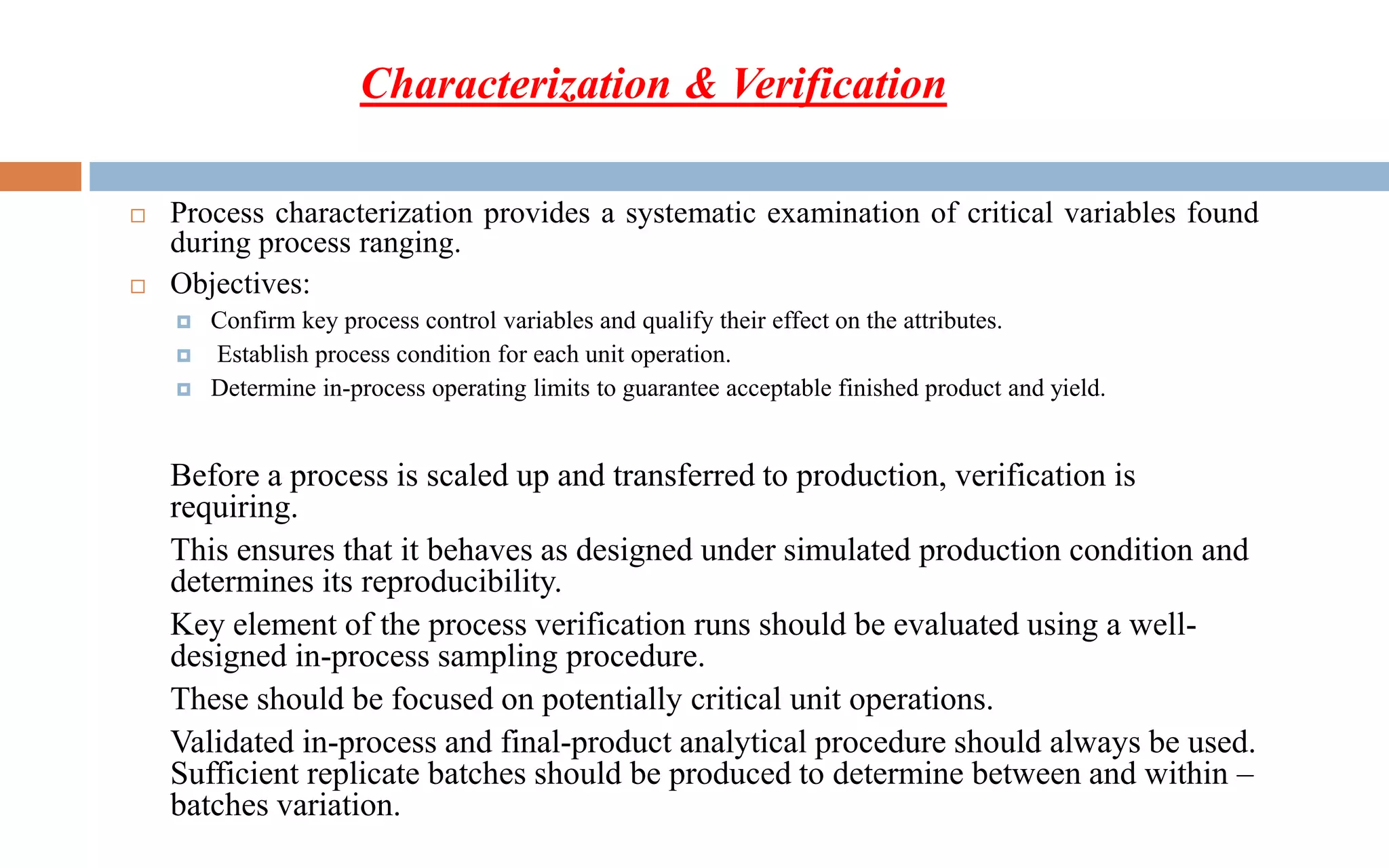
 Process characterization provides a systematic examination of critical variables found
during process ranging.
 Objectives:
 Confirm key process control variables and qualify their effect on the attributes.
 Establish process condition for each unit operation.
 Determine in-process operating limits to guarantee acceptable finished product and yield.
Before a process is scaled up and transferred to production, verification is
requiring.
This ensures that it behaves as designed under simulated production condition and
determines its reproducibility.
Key element of the process verification runs should be evaluated using a well-
designed in-process sampling procedure.
These should be focused on potentially critical unit operations.
Validated in-process and final-product analytical procedure should always be used.
Sufficient replicate batches should be produced to determine between and within –
batches variation.
Characterization & Verification
Process Flow Chart
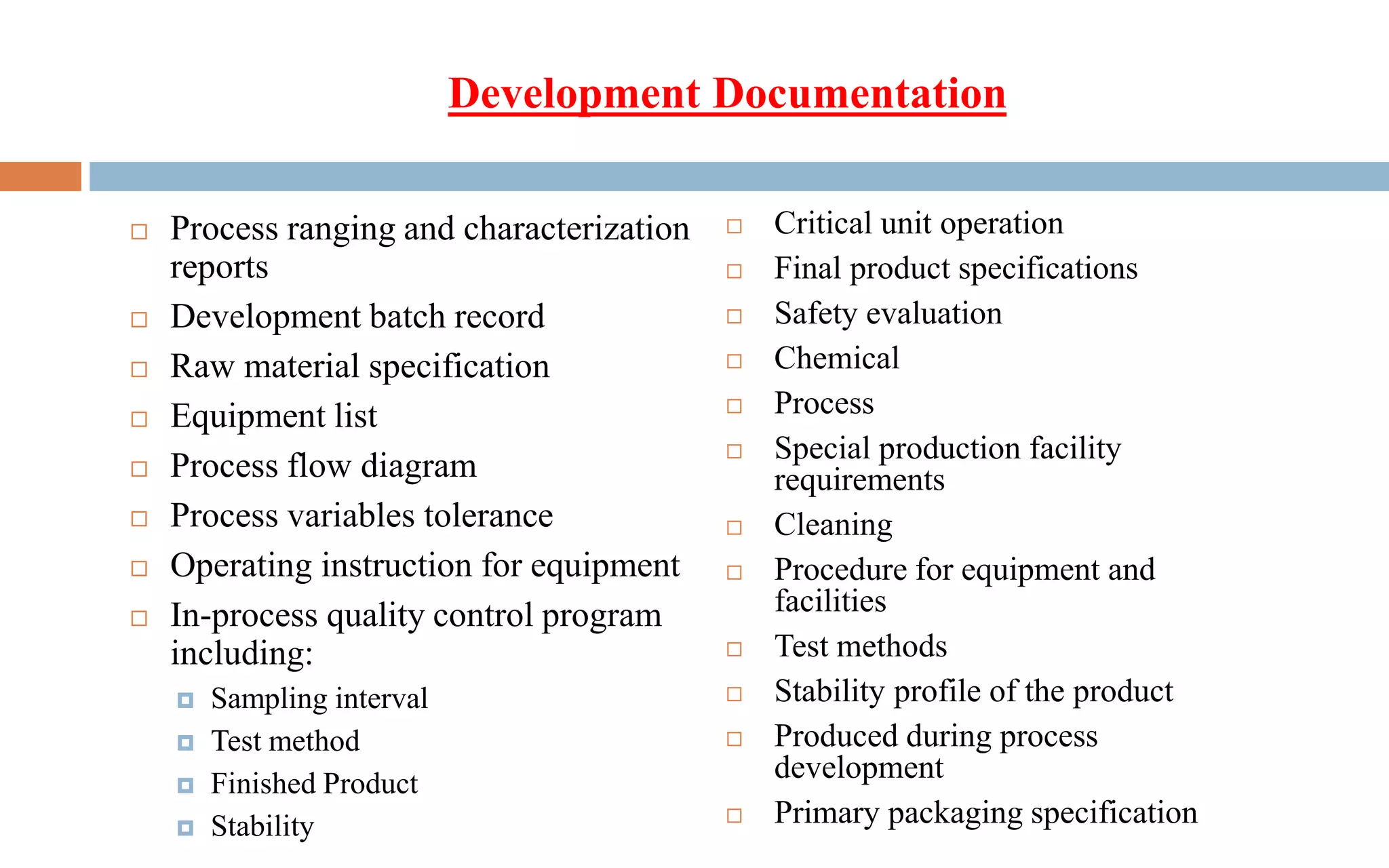
 Process ranging and characterization
reports
 Development batch record
 Raw material specification
 Equipment list
 Process flow diagram
 Process variables tolerance
 Operating instruction for equipment
 In-process quality control program
including:
 Sampling interval
 Test method
 Finished Product
 Stability
Development Documentation
 Critical unit operation
 Final product specifications
 Safety evaluation
 Chemical
 Process
 Special production facility
requirements
 Cleaning
 Procedure for equipment and
facilities
 Test methods
 Stability profile of the product
 Produced during process
development
 Primary packaging specification
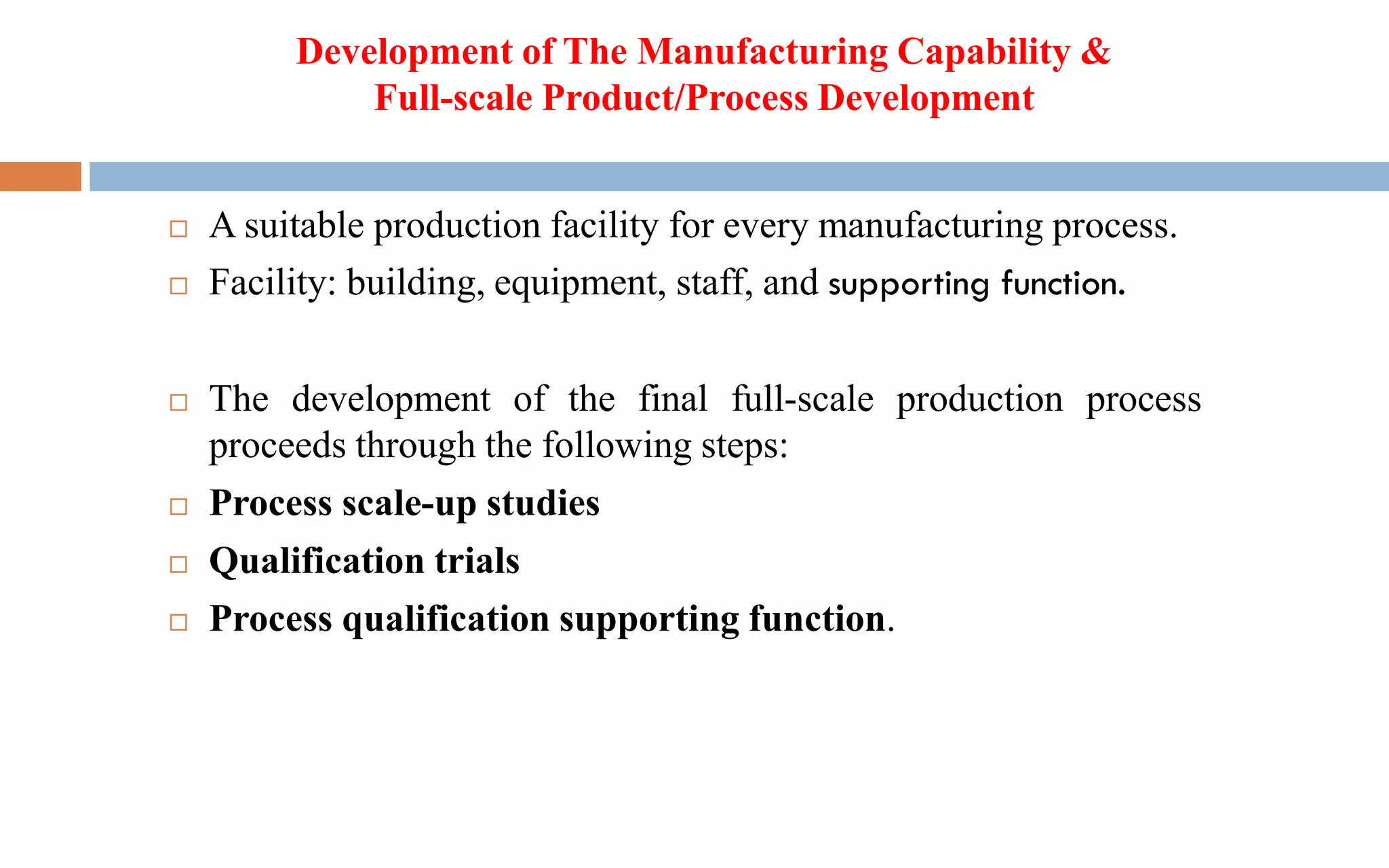
 A suitable production facility for every manufacturing process.
 Facility: building, equipment, staff, and supporting function.
 The development of the final full-scale production process
proceeds through the following steps:
 Process scale-up studies
 Qualification trials
 Process qualification supporting function.
Development of The Manufacturing Capability &
Full-scale Product/Process Development
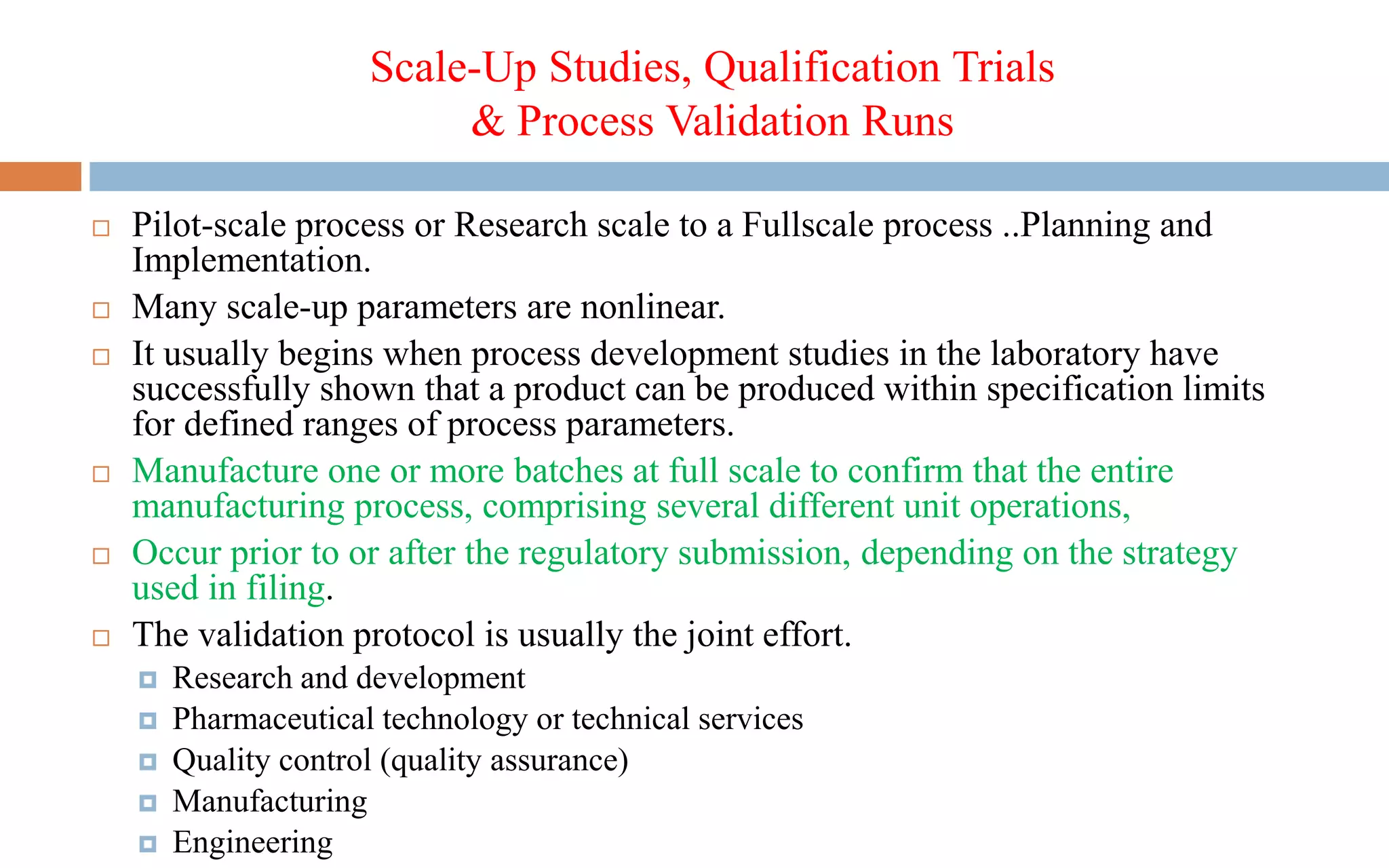
Scale-Up Studies, Qualification Trials
& Process Validation Runs
 Pilot-scale process or Research scale to a Fullscale process ..Planning and
Implementation.
 Many scale-up parameters are nonlinear.
 It usually begins when process development studies in the laboratory have
successfully shown that a product can be produced within specification limits
for defined ranges of process parameters.
 Manufacture one or more batches at full scale to confirm that the entire
manufacturing process, comprising several different unit operations,
 Occur prior to or after the regulatory submission, depending on the strategy
used in filing.
 The validation protocol is usually the joint effort.
 Research and development
 Pharmaceutical technology or technical services
 Quality control (quality assurance)
 Manufacturing
 Engineering
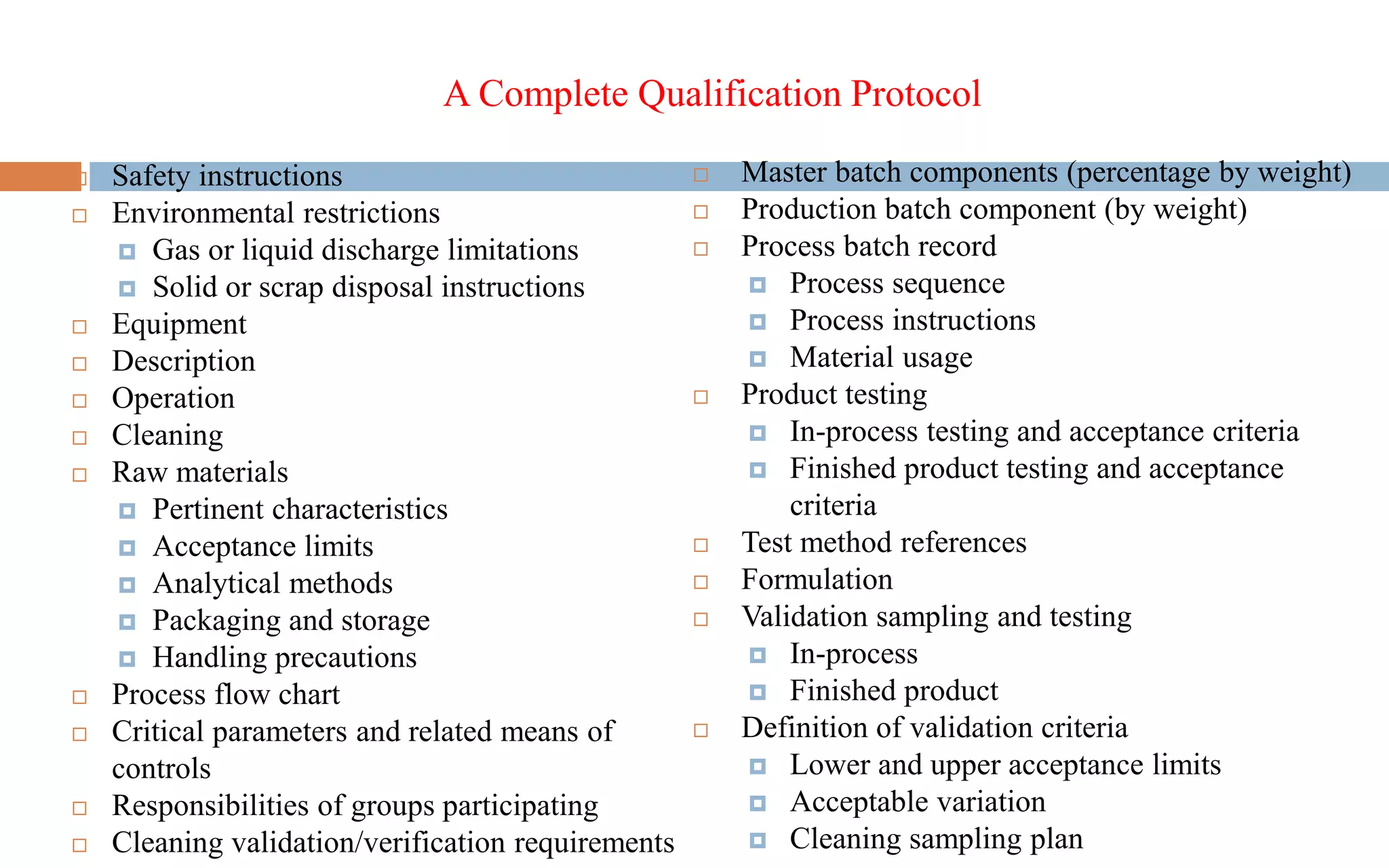
A Complete Qualification Protocol
 Safety instructions
 Environmental restrictions
 Gas or liquid discharge limitations
 Solid or scrap disposal instructions
 Equipment
 Description
 Operation
 Cleaning
 Raw materials
 Pertinent characteristics
 Acceptance limits
 Analytical methods
 Packaging and storage
 Handling precautions
 Process flow chart
 Critical parameters and related means of
controls
 Responsibilities of groups participating
 Cleaning validation/verification requirements
 Master batch components (percentage by weight)
 Production batch component (by weight)
 Process batch record
 Process sequence
 Process instructions
 Material usage
 Product testing
 In-process testing and acceptance criteria
 Finished product testing and acceptance
criteria
 Test method references
 Formulation
 Validation sampling and testing
 In-process
 Finished product
 Definition of validation criteria
 Lower and upper acceptance limits
 Acceptable variation
 Cleaning sampling plan
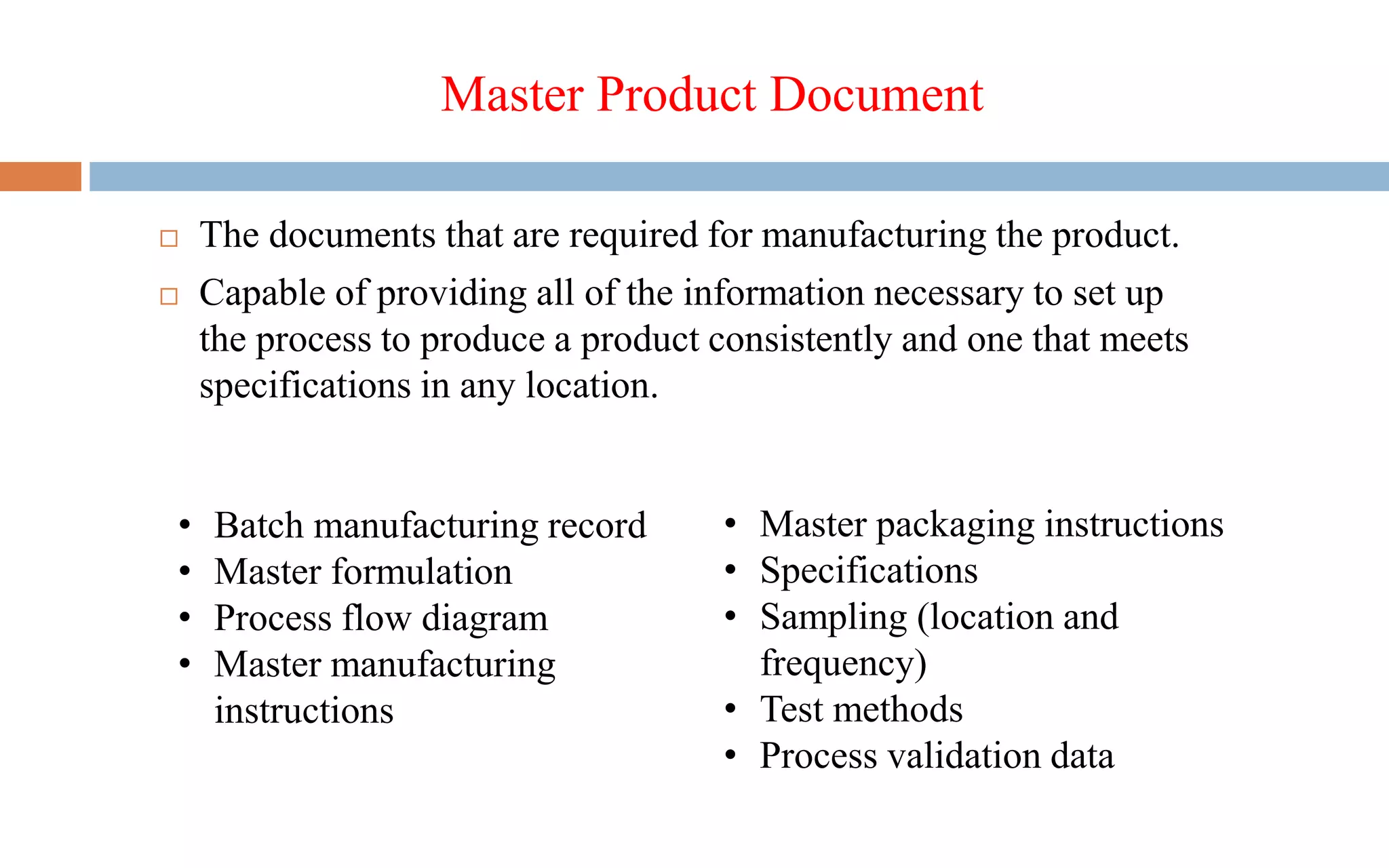
Master Product Document
 The documents that are required for manufacturing the product.
 Capable of providing all of the information necessary to set up
the process to produce a product consistently and one that meets
specifications in any location.
• Batch manufacturing record
• Master formulation
• Process flow diagram
• Master manufacturing
instructions
• Master packaging instructions
• Specifications
• Sampling (location and
frequency)
• Test methods
• Process validation data
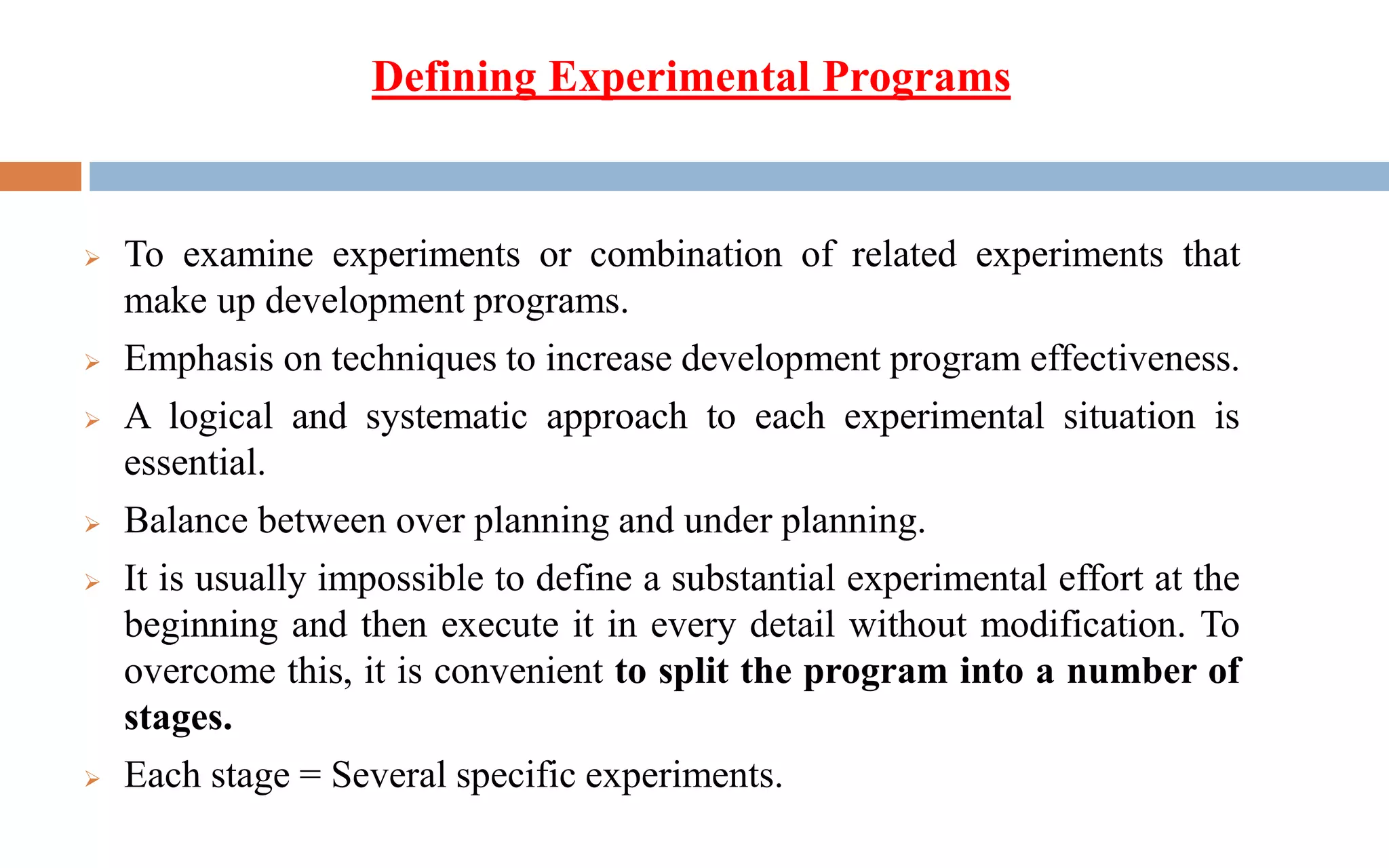
➢ To examine experiments or combination of related experiments that
make up development programs.
➢ Emphasis on techniques to increase development program effectiveness.
➢ A logical and systematic approach to each experimental situation is
essential.
➢ Balance between over planning and under planning.
➢ It is usually impossible to define a substantial experimental effort at the
beginning and then execute it in every detail without modification. To
overcome this, it is convenient to split the program into a number of
stages.
➢ Each stage = Several specific experiments.
Defining Experimental Programs
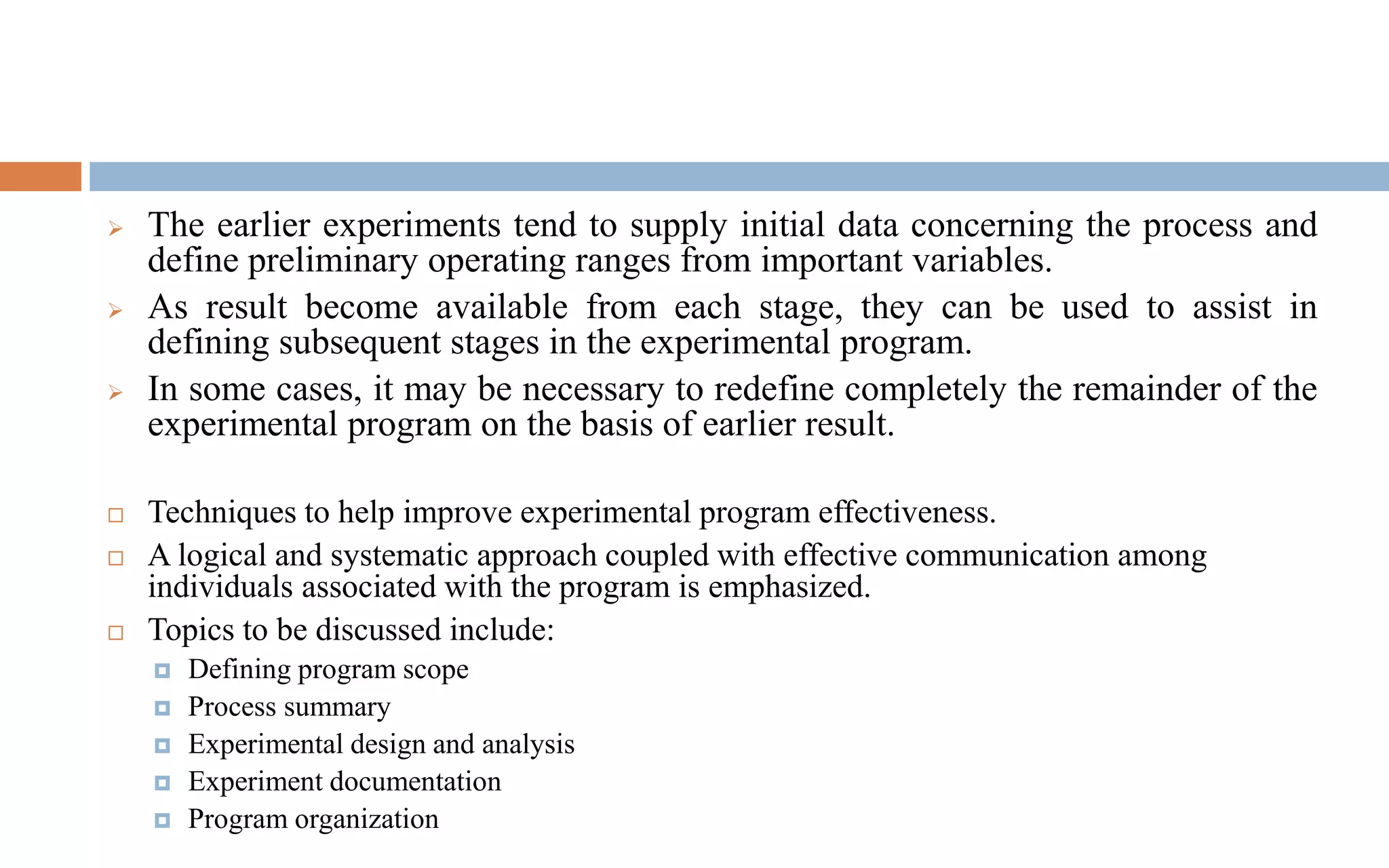
➢ The earlier experiments tend to supply initial data concerning the process and
define preliminary operating ranges from important variables.
➢ As result become available from each stage, they can be used to assist in
defining subsequent stages in the experimental program.
➢ In some cases, it may be necessary to redefine completely the remainder of the
experimental program on the basis of earlier result.
 Techniques to help improve experimental program effectiveness.
 A logical and systematic approach coupled with effective communication among
individuals associated with the program is emphasized.
 Topics to be discussed include:
 Defining program scope
 Process summary
 Experimental design and analysis
 Experiment documentation
 Program organization
Defining a clear and detailed set of objective is a
necessary first step in any experimental program. Some
similarity exists between objectives for different product
and processes using similar existing technology.
Program Scope:
Process summary:
 An initial clear understanding of the formulation and/or
process is important. The following techniques can assist in
summarizing current process knowledge.
1) Flow diagram
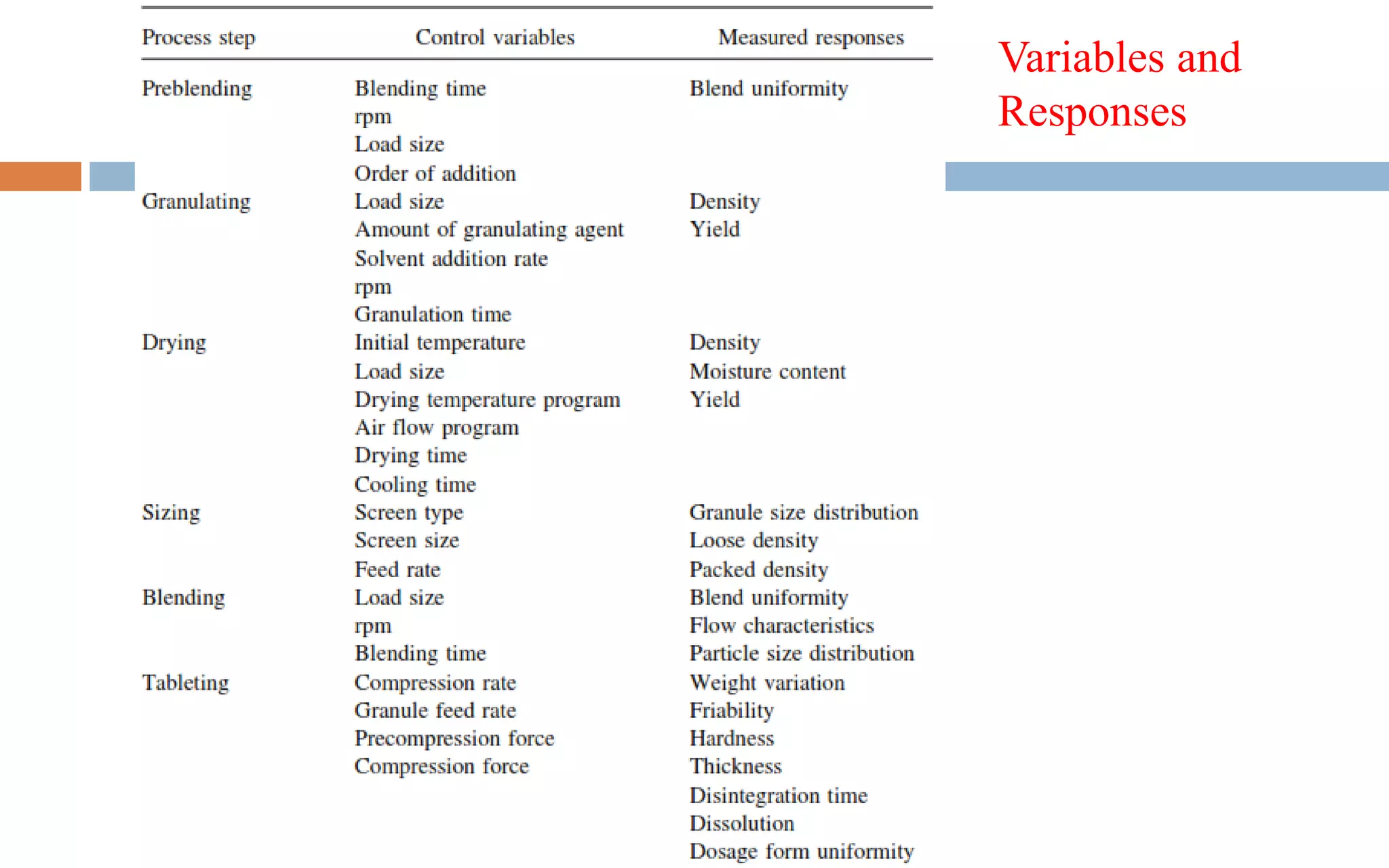
2) Variable and responses
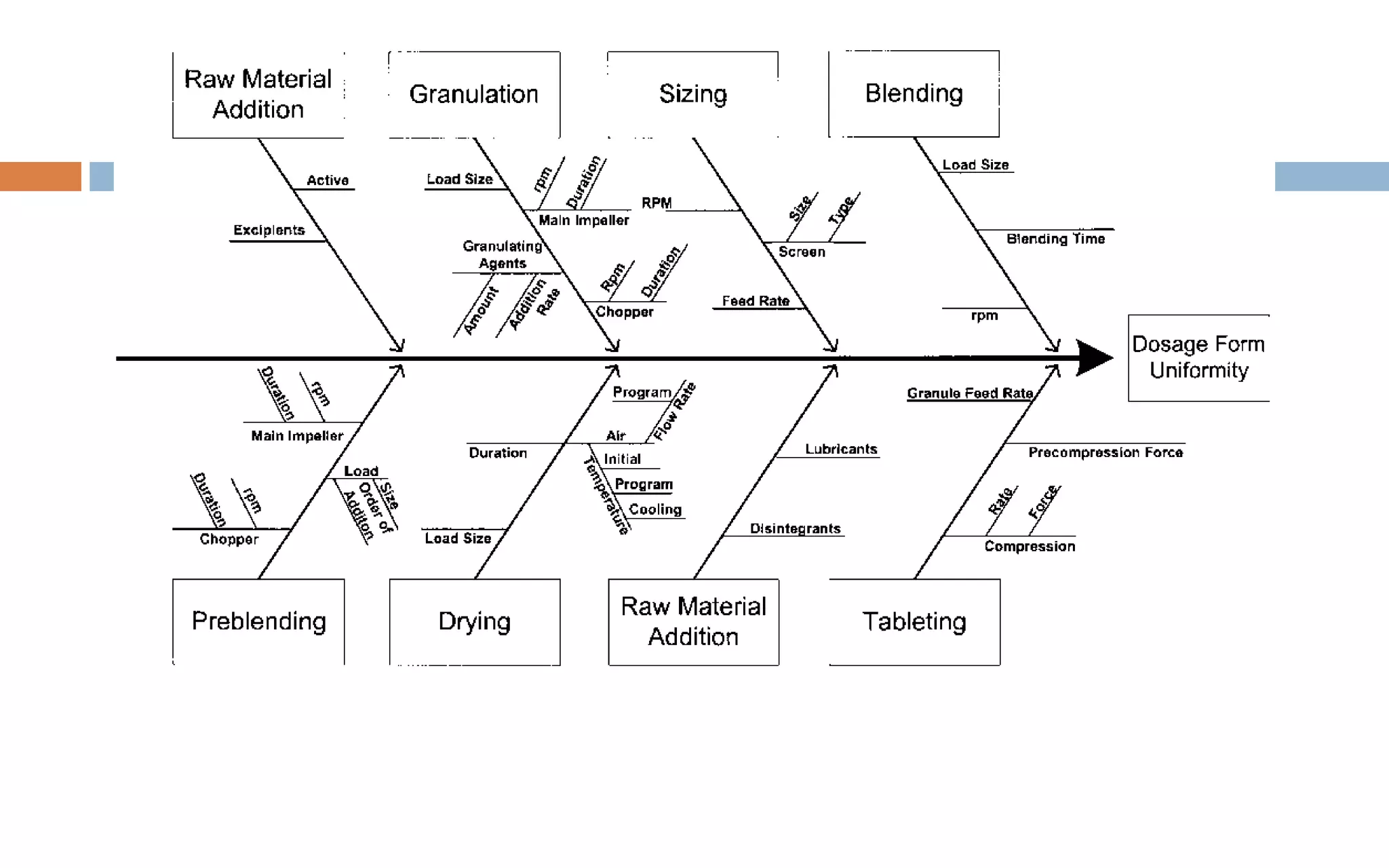
3) Cause-and-effect diagram
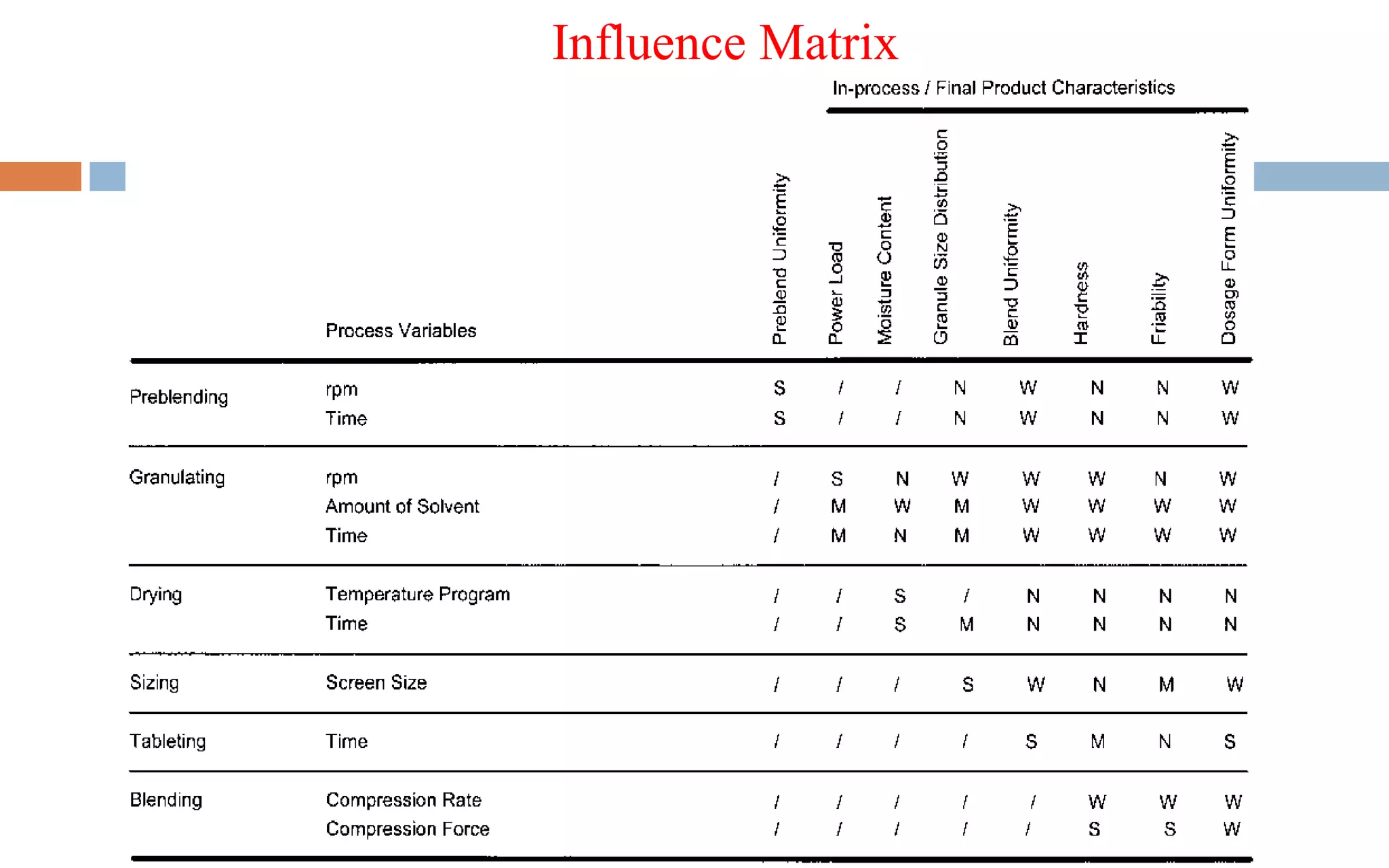
4) Influence matrix
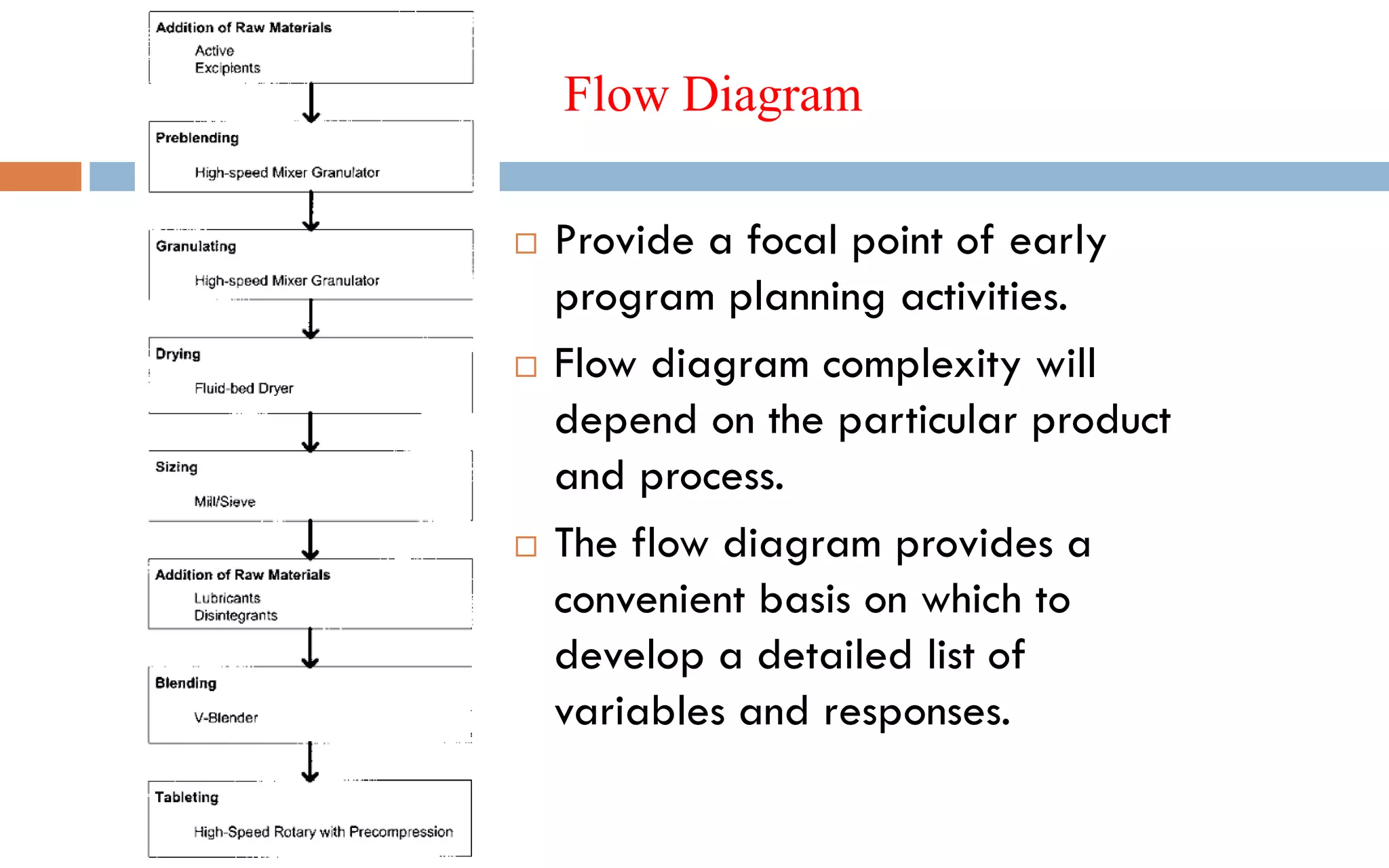
Flow Diagram
 Provide a focal point of early
program planning activities.
 Flow diagram complexity will
depend on the particular product
and process.
 The flow diagram provides a
convenient basis on which to
develop a detailed list of
variables and responses.
Variables and
Responses
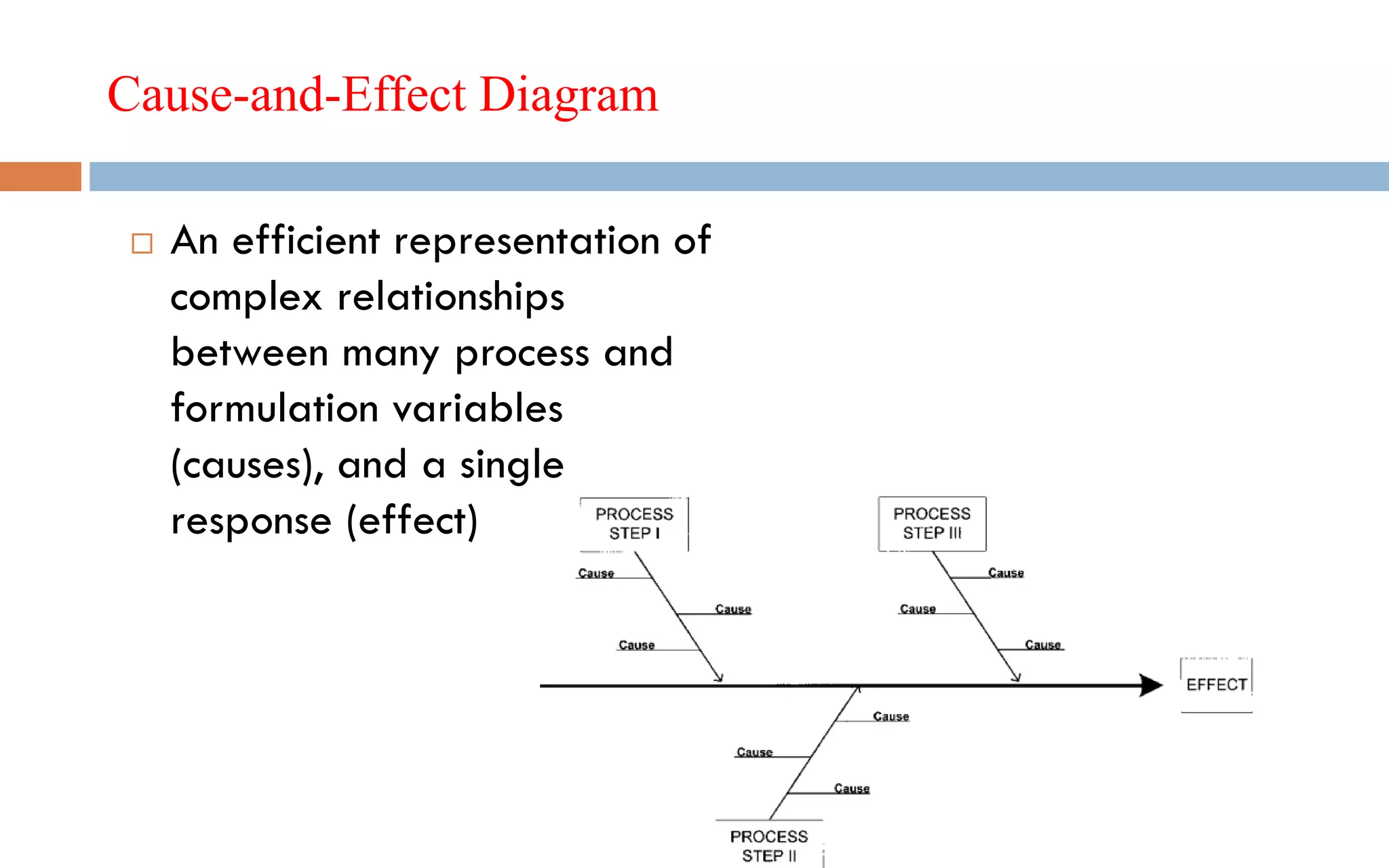
 An efficient representation of
complex relationships
between many process and
formulation variables
(causes), and a single
response (effect)
Cause-and-Effect Diagram
Influence Matrix
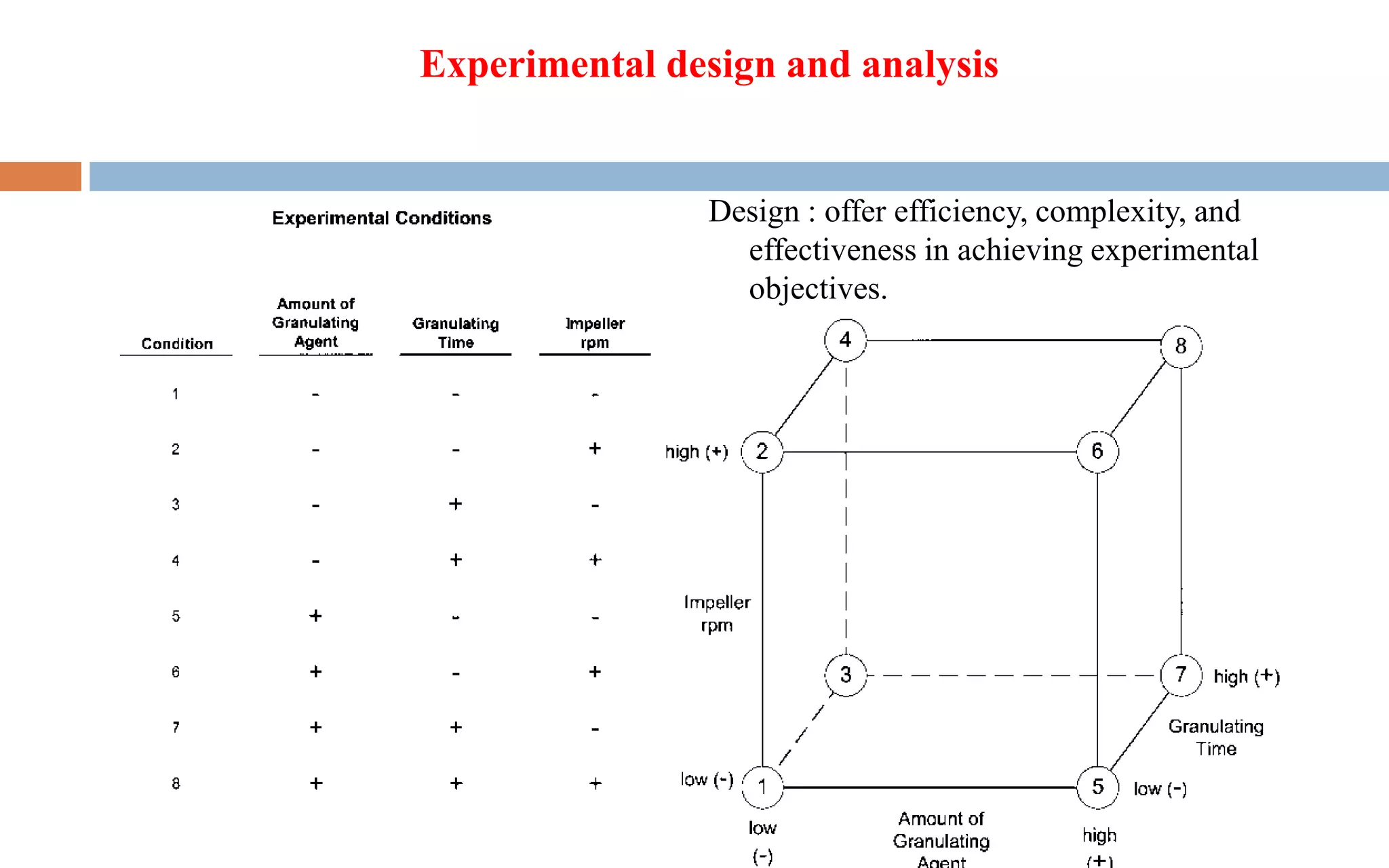
Experimental design and analysis
Design : offer efficiency, complexity, and
effectiveness in achieving experimental
objectives.
Types of design:
The best course of action to examine the
experimental situation carefully, including;
 specific objectives
 available resources
 availability of previous therotical and experimental
result
 relevant variables and responses
 qualification and experience of research team
members
 cost of experimentation
Data Analysis
The appropriate analysis of the experimental result will depend
on the experimental objectives, the design used, and the
characteristics of the data collected during the experiment.
Experiment documentation:
 Objectives
 Experimental design:
 Proposed/alternate test method:
 A list of test methods consistent with the type of experiment being performed
 A detailed description of the steps necessary to obtain a valid measurement
 Documentation supporting the accuracy, precision, sensitivity, and test methods
 Equipment procedures:
 Sampling plans:
 Protocol
 Data record
 Report
Documentation is essential to program planning and coordination, in
addition to the obvious use for the summary of activities and results.
Program Organization:
 Throughout the experimental phases of prospective
validation, it is essential to maintain effective
communication among various team member.
 This is facilated by having one individual with the
necessary technical and managerial skills assume
responsibility for the experimental program, including
procuring resources and informing management of
progress.
 In a large experimental program, the responsible
individual may serve as a project leader or manager
with little or no technical involvement.
 Prospective validation of a production process utilizes information
generated during the entire development sequence that produced the final
process.
 Validation begins at the indication that a final production process will
evolve from a potential product concept.
 As a potential product moves through the various development stages,
information is continually generated and incorporated into a master
documentation file.
 When the qualification runs are planned for the final process, they will be
based on the master documentation file contents.
 The information generated during the qualification runs is usually the last
major item to go into the master documentation file.
 An abstract of the master documentation file is the master product
document. The master product documents is the sourse of all information
required to set up the process at any lacation.
SUMMURY

Prospective Validation NSR.pdf

  • 1.
    PROSPECTIVE PROCESS VALIDATION Smt. KishoritaiBhoyar College of Pharmacy, Kamptee Ms. Neha S. Raut Assistant Professor
  • 2.
    Prospective Process Validation Validationis an essential procedure that demonstrates that a manufacturing process, operating under defined standard condition, is capable of consistently producing a product that meets the established product specifications. Validation as a stand-alone item or an afterthought at the end of the entire product development sequence. The process can be considered validated if the first two or three batches of product satisfy specification.
  • 3.
    Organization:  Prospective validationrequires a planned program and organization to carry it to. Successful completion .  The organization must have clearly defined areas of responsibility and authority.  The structure must be tailored to meet the requirements in the specific organization, and these will vary from company to company.  A defined structure exists, is accepted, and is in operation.  An effective project management structure will have to be established in order to plan, execute, and control the program.
  • 4.
     Documentation: Aneffective prospective validation program must be supported by documentation extending from product initiation to full-scale production. The complete documentation package can be referred to as the master documentation file.  Product development:  Product development usually begins when an active an active chemical entity has been shown to possess the necessary attribute for a commercial product. The product development activities for the active chemical entity, formulation, and process from the foundation upon which the subsequent validation data are built.  Generally, product development activities can be subdivided into formulation development and process development. Documentation & Product development:
  • 5.
    1) Preformulation profile,which include all the basic physical or chemical information about the chemical entity. 2) Formulation profile, which consist of physical and chemical characteristics required for the product, drug-excipient compatibility studies, and effect of formulation on in vitro dissolution. 3) Effect of formulation variables on the bioavailability of the product. 4) Specific test method 5) Key product attributes and specifications 6) Optimum formulation Formulation development:
  • 6.
    Process Development 1) Developa suitable process to produce a product which meets all: a) Product specification. b) Economic constraints. c) Current good manufacturing practices (CGMPs). 2) Identify the key process parameter that affects the product attributes. 3) Identify in-process specification and test methods. 4) Identify generic and specific equipment that may be required. Process development can be divided into several stages:  Design  Ranging  Characterization  Verifications. Process development activities begin after the formulation has been developed.
  • 7.
    Initial planning stagesof process development.  Technical operation in both the manufacturing and quality control department should be consulted.  The practically and the reality of the manufacturing operation should be kept in perspective.  Key documents for the technical definition of the process a  the flow diagram, the cause-and-effect diagram, and the influence matrix. The details of the cause-and-effect diagram and influence matrix will be discussed under experimental approach in a later section. Process-ranging studies will test whether identified parameter are critical to the product and process being developed. These studies determine the:  Feasibility of the designed process.  Criticality of the parameter. Design & Ranging
  • 8.
     Process characterizationprovides a systematic examination of critical variables found during process ranging.  Objectives:  Confirm key process control variables and qualify their effect on the attributes.  Establish process condition for each unit operation.  Determine in-process operating limits to guarantee acceptable finished product and yield. Before a process is scaled up and transferred to production, verification is requiring. This ensures that it behaves as designed under simulated production condition and determines its reproducibility. Key element of the process verification runs should be evaluated using a well- designed in-process sampling procedure. These should be focused on potentially critical unit operations. Validated in-process and final-product analytical procedure should always be used. Sufficient replicate batches should be produced to determine between and within – batches variation. Characterization & Verification
  • 9.
  • 10.
     Process rangingand characterization reports  Development batch record  Raw material specification  Equipment list  Process flow diagram  Process variables tolerance  Operating instruction for equipment  In-process quality control program including:  Sampling interval  Test method  Finished Product  Stability Development Documentation  Critical unit operation  Final product specifications  Safety evaluation  Chemical  Process  Special production facility requirements  Cleaning  Procedure for equipment and facilities  Test methods  Stability profile of the product  Produced during process development  Primary packaging specification
  • 11.
     A suitableproduction facility for every manufacturing process.  Facility: building, equipment, staff, and supporting function.  The development of the final full-scale production process proceeds through the following steps:  Process scale-up studies  Qualification trials  Process qualification supporting function. Development of The Manufacturing Capability & Full-scale Product/Process Development
  • 12.
    Scale-Up Studies, QualificationTrials & Process Validation Runs  Pilot-scale process or Research scale to a Fullscale process ..Planning and Implementation.  Many scale-up parameters are nonlinear.  It usually begins when process development studies in the laboratory have successfully shown that a product can be produced within specification limits for defined ranges of process parameters.  Manufacture one or more batches at full scale to confirm that the entire manufacturing process, comprising several different unit operations,  Occur prior to or after the regulatory submission, depending on the strategy used in filing.  The validation protocol is usually the joint effort.  Research and development  Pharmaceutical technology or technical services  Quality control (quality assurance)  Manufacturing  Engineering
  • 13.
    A Complete QualificationProtocol  Safety instructions  Environmental restrictions  Gas or liquid discharge limitations  Solid or scrap disposal instructions  Equipment  Description  Operation  Cleaning  Raw materials  Pertinent characteristics  Acceptance limits  Analytical methods  Packaging and storage  Handling precautions  Process flow chart  Critical parameters and related means of controls  Responsibilities of groups participating  Cleaning validation/verification requirements  Master batch components (percentage by weight)  Production batch component (by weight)  Process batch record  Process sequence  Process instructions  Material usage  Product testing  In-process testing and acceptance criteria  Finished product testing and acceptance criteria  Test method references  Formulation  Validation sampling and testing  In-process  Finished product  Definition of validation criteria  Lower and upper acceptance limits  Acceptable variation  Cleaning sampling plan
  • 14.
    Master Product Document The documents that are required for manufacturing the product.  Capable of providing all of the information necessary to set up the process to produce a product consistently and one that meets specifications in any location. • Batch manufacturing record • Master formulation • Process flow diagram • Master manufacturing instructions • Master packaging instructions • Specifications • Sampling (location and frequency) • Test methods • Process validation data
  • 15.
    ➢ To examineexperiments or combination of related experiments that make up development programs. ➢ Emphasis on techniques to increase development program effectiveness. ➢ A logical and systematic approach to each experimental situation is essential. ➢ Balance between over planning and under planning. ➢ It is usually impossible to define a substantial experimental effort at the beginning and then execute it in every detail without modification. To overcome this, it is convenient to split the program into a number of stages. ➢ Each stage = Several specific experiments. Defining Experimental Programs
  • 16.
    ➢ The earlierexperiments tend to supply initial data concerning the process and define preliminary operating ranges from important variables. ➢ As result become available from each stage, they can be used to assist in defining subsequent stages in the experimental program. ➢ In some cases, it may be necessary to redefine completely the remainder of the experimental program on the basis of earlier result.  Techniques to help improve experimental program effectiveness.  A logical and systematic approach coupled with effective communication among individuals associated with the program is emphasized.  Topics to be discussed include:  Defining program scope  Process summary  Experimental design and analysis  Experiment documentation  Program organization
  • 18.
    Defining a clearand detailed set of objective is a necessary first step in any experimental program. Some similarity exists between objectives for different product and processes using similar existing technology. Program Scope:
  • 19.
    Process summary:  Aninitial clear understanding of the formulation and/or process is important. The following techniques can assist in summarizing current process knowledge. 1) Flow diagram 2) Variable and responses 3) Cause-and-effect diagram 4) Influence matrix
  • 20.
    Flow Diagram  Providea focal point of early program planning activities.  Flow diagram complexity will depend on the particular product and process.  The flow diagram provides a convenient basis on which to develop a detailed list of variables and responses.
  • 21.
  • 22.
     An efficientrepresentation of complex relationships between many process and formulation variables (causes), and a single response (effect) Cause-and-Effect Diagram
  • 24.
  • 25.
    Experimental design andanalysis Design : offer efficiency, complexity, and effectiveness in achieving experimental objectives.
  • 26.
    Types of design: Thebest course of action to examine the experimental situation carefully, including;  specific objectives  available resources  availability of previous therotical and experimental result  relevant variables and responses  qualification and experience of research team members  cost of experimentation
  • 27.
    Data Analysis The appropriateanalysis of the experimental result will depend on the experimental objectives, the design used, and the characteristics of the data collected during the experiment.
  • 28.
    Experiment documentation:  Objectives Experimental design:  Proposed/alternate test method:  A list of test methods consistent with the type of experiment being performed  A detailed description of the steps necessary to obtain a valid measurement  Documentation supporting the accuracy, precision, sensitivity, and test methods  Equipment procedures:  Sampling plans:  Protocol  Data record  Report Documentation is essential to program planning and coordination, in addition to the obvious use for the summary of activities and results.
  • 29.
    Program Organization:  Throughoutthe experimental phases of prospective validation, it is essential to maintain effective communication among various team member.  This is facilated by having one individual with the necessary technical and managerial skills assume responsibility for the experimental program, including procuring resources and informing management of progress.  In a large experimental program, the responsible individual may serve as a project leader or manager with little or no technical involvement.
  • 30.
     Prospective validationof a production process utilizes information generated during the entire development sequence that produced the final process.  Validation begins at the indication that a final production process will evolve from a potential product concept.  As a potential product moves through the various development stages, information is continually generated and incorporated into a master documentation file.  When the qualification runs are planned for the final process, they will be based on the master documentation file contents.  The information generated during the qualification runs is usually the last major item to go into the master documentation file.  An abstract of the master documentation file is the master product document. The master product documents is the sourse of all information required to set up the process at any lacation. SUMMURY