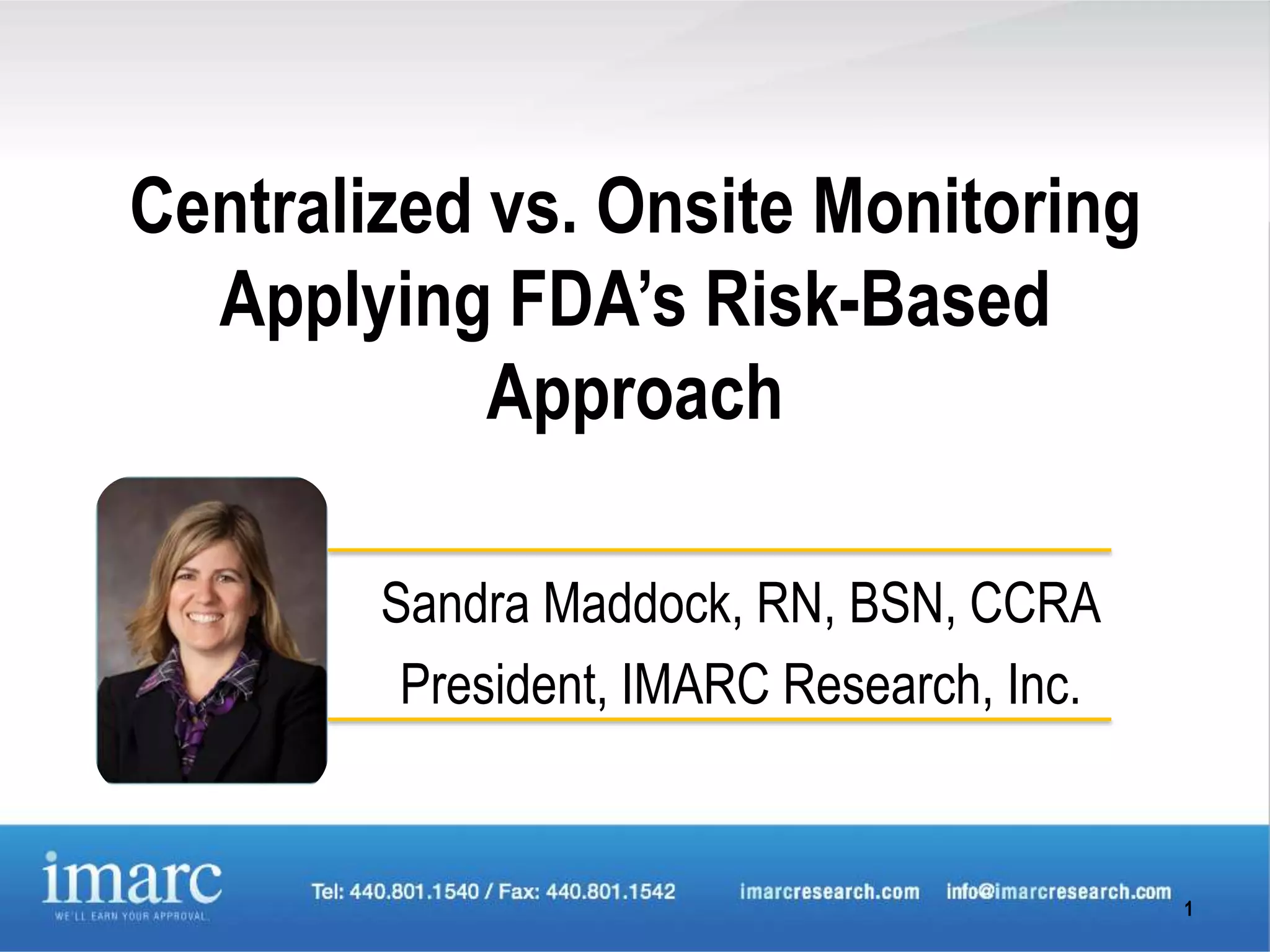
Centralized vs. Onsite Monitoring
  Applying FDA’s Risk-Based
            Approach

        Sandra Maddock, RN, BSN, CCRA
         President, IMARC Research, Inc.


                                           1
Agenda
Overview of Monitoring

Monitoring Regulations/Standards

Current status

FDA’s DRAFT Guidance on Risk-based Monitoring

Application


                                            2
Overview of Monitoring
Definition

   Qualifications

   Purpose of monitoring

   Day in the Life

Who monitors?


                                3
Overview of Monitoring
  Definition
• FDA Regulations
• ICH Guidelines
• ISO 14155:2011 (E)


                                  4
Overview of Monitoring
   Definition
• FDA: 21 CFR 812.3 (j) –
“When used as a noun, means an individual
designated by a sponsor or contract research
organization to oversee the progress of an
investigation.”
“When used as a verb, means to oversee an
investigation.”

                                               5
Overview of Monitoring
   Definition
• ICH GCP: 1.39 –
“The act of overseeing the progress of a clinical trial,
and of ensuring that it is conducted, recorded, and
reported in accordance with the protocol, standard
operating procedures (SOPs) GCP, and the applicable
regulatory requirement(s).”


                                                      6
Overview of Monitoring
   Definition
• ISO 14155 3.29 –
“act of overseeing the progress of a clinical
investigation and to ensure that it is conducted,
recorded, and reported in accordance with the CIP,
written procedures, this International Standard, and
the applicable regulatory requirements.”


                                                       7
Overview of Monitoring
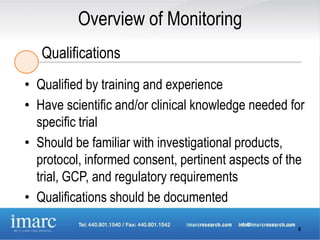
   Qualifications
• Qualified by training and experience
• Have scientific and/or clinical knowledge needed for
  specific trial
• Should be familiar with investigational products,
  protocol, informed consent, pertinent aspects of the
  trial, GCP, and regulatory requirements
• Qualifications should be documented

                                                    8
Overview of Monitoring
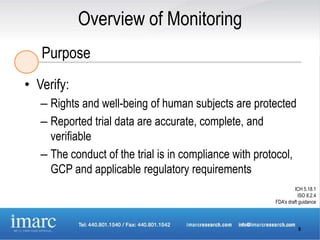
   Purpose
• Verify:
   – Rights and well-being of human subjects are protected
   – Reported trial data are accurate, complete, and
     verifiable
   – The conduct of the trial is in compliance with protocol,
     GCP and applicable regulatory requirements
                                                                 ICH 5.18.1
                                                                   ISO 8.2.4
                                                        FDA’s draft guidance


                                                                   9
Overview of Monitoring
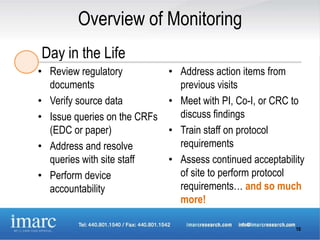
Day in the Life
• Review regulatory           • Address action items from
  documents                     previous visits
• Verify source data          • Meet with PI, Co-I, or CRC to
• Issue queries on the CRFs     discuss findings
  (EDC or paper)              • Train staff on protocol
• Address and resolve           requirements
  queries with site staff     • Assess continued acceptability
• Perform device                of site to perform protocol
  accountability                requirements… and so much
                                more!

                                                           10
Overview of Monitoring
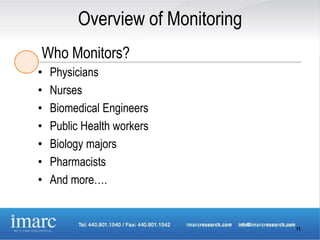
Who Monitors?
•   Physicians
•   Nurses
•   Biomedical Engineers
•   Public Health workers
•   Biology majors
•   Pharmacists
•   And more….


                                  11
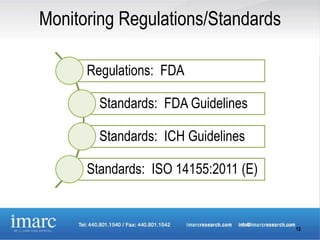
Monitoring Regulations/Standards

      Regulations: FDA

        Standards: FDA Guidelines

        Standards: ICH Guidelines

      Standards: ISO 14155:2011 (E)


                                      12
Monitoring Regulations/Standards
   Regulations: FDA
• Sponsor requirements noted in various places
  throughout 21 CFR 812 & 312:
  – 21 CFR 812.25: Investigational plan shall include the monitoring
    procedures and the name/address of the monitor(s)
  – 21 CFR 812.40: “… ensure proper monitoring of the investigation,
    ensuring that IRB review and approval are obtained, …..”
  – 21 CFR 312.50: “…ensuring proper monitoring of the investigation(s),
    ensuring that the investigation(s) is conducted in accordance with the
    general investigational plan and protocols “


                                                                             13
Monitoring Regulations/Standards
   Regulations: FDA
• Sponsor requirements noted in various places:
  – 21 CFR 312.50- General Responsibilities of Sponsors
  – 21 CFR 812.46 (a) Sponsors shall secure compliance with
     • Investigational Plan
     • Regulations
     • Conditions imposed by IRB or FDA
  – If non-compliance continues
     • Discontinue shipment of investigational product
     • Terminate participation in investigation


                                                              14
Monitoring Regulations/Standards
   Standards: FDA Guidelines
• Guideline for Monitoring Clinical Investigations,
  January 1988
   – Vague in its requirements
   – Effective monitoring requires personal contact between
     the monitor and the investigator throughout the trial


                                                              15
Monitoring Regulations/Standards
   Standards: ICH Guidelines
• April 1996
• Pharmaceutical-focused
• Began laying the groundwork for a risk-based
  approach: extent and nature of monitoring should
  depend on “the objective, purpose, design,
  complexity, blinding, size, and endpoints of the
  trial…”

                                                     16
Monitoring Regulations/Standards
   Standards: ISO Guidelines
• 2011
• Device focused
• Monitoring plan shall take into account “..objective,
  design, complexity, size, critical data points and
  endpoints…”
• However, it also indicates that monitors shall
  conduct “routine on-site monitoring visits…”

                                                          17
Current Status
General Industry Practice

Our Report Card


                            18
Current Practice
General Industry Practice
“Many sponsors have understood these guidances
as contributing to the notion that FDA expects
sponsors to conduct frequent on-site monitoring
and 100% verification for all trials, regardless of
their design and complexity.”


                           -FDA’s DRAFT Risk-Based Monitoring Guidance


                                                                     19
Current Practice
General Industry Practice
• Monitoring of 100% source data
• Monitoring conducted at pre-determined time
  intervals, for example…
  – Every 4-6 weeks
  – Every 5th patient
  – At least once a quarter


                                                20
Current Practice
Our Report Card
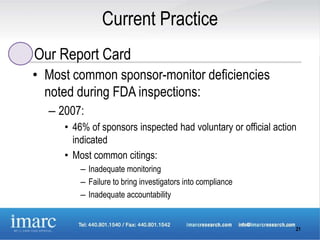
• Most common sponsor-monitor deficiencies
  noted during FDA inspections:
  – 2007:
     • 46% of sponsors inspected had voluntary or official action
       indicated
     • Most common citings:
         – Inadequate monitoring
         – Failure to bring investigators into compliance
         – Inadequate accountability


                                                                21
Current Practice
Our Report Card
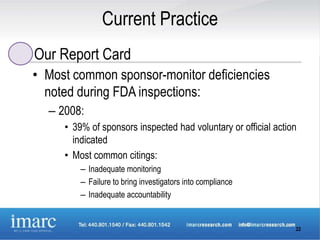
• Most common sponsor-monitor deficiencies
  noted during FDA inspections:
  – 2008:
     • 39% of sponsors inspected had voluntary or official action
       indicated
     • Most common citings:
         – Inadequate monitoring
         – Failure to bring investigators into compliance
         – Inadequate accountability


                                                                22
Current Practice
Our Report Card
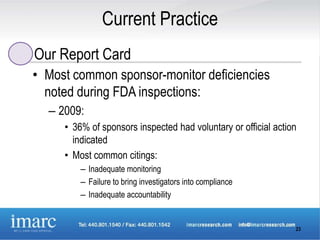
• Most common sponsor-monitor deficiencies
  noted during FDA inspections:
  – 2009:
     • 36% of sponsors inspected had voluntary or official action
       indicated
     • Most common citings:
         – Inadequate monitoring
         – Failure to bring investigators into compliance
         – Inadequate accountability


                                                                23
Current Practice
Our Report Card
• Most common sponsor-monitor deficiencies
  noted during FDA inspections:
  – 2010:
     • 50% of sponsors inspected had voluntary or official action
       indicated
     • Most common citings:
         – Inadequate monitoring
         – Failure to bring investigators into compliance
         – Inadequate accountability


                                                                24
Current Practice
Our Report Card
• Most common sponsor-monitor deficiencies
  noted during FDA inspections:
  – 2011:
     • 45% of sponsors inspected had voluntary or official action
       indicated
     • Most common citings:
         – Inadequate monitoring
         – Failure to bring investigators into compliance
         – Inadequate accountability


                                                                25
Current Practice
Our Report Card

    –Inadequate monitoring
    –Failure to bring investigators into
     compliance
    –Inadequate accountability


                                           26
FDA’s Guidance on Risk-Based
        Monitoring
    Introduction

      Rationale

       General Recommendations

      Monitoring Plan

    Documentation


                                 27
FDA’s Guidance on Risk-Based
           Monitoring
  Introduction
• Assist sponsors in developing monitoring strategies
• Enhance human subject protection
• Enhance the quality of clinical trial data


                 Variety of approaches


                                                   28
FDA’s Guidance on Risk-Based
           Monitoring
  Rationale
• Provide increased ability to protect patients
   – Not caught up in the minute details, but rather focused
     on key data points
• Improve overall study quality
• Monitor more effectively


                                                               29
FDA’s Guidance on Risk-Based
           Monitoring
  Rationale
• Tasks that historically could only be done on-site,
  may now be done remotely due to technology
   – EDC systems
   – Webcasts
   – Email
   – Online Training Modules


                                                        30
FDA’s Guidance on Risk-Based
           Monitoring
 General Recommendations
• No single approach can work for every clinical
  study
• Modify based on risks of the trial
• Include mix of centralized and on-site
• Document intended approach in a monitoring plan


                                                    31
FDA’s Guidance on Risk-Based
           Monitoring
  General Recommendations
• On-site monitoring activities:
   – Source data verification
   – Verification that study documentation exists
   – Assessment of site’s familiarity and compliance with
     protocol
   – Investigational product accountability
   – Get a general sense of how things are going at a site


                                                             32
FDA’s Guidance on Risk-Based
           Monitoring
  General Recommendations
• Centralized monitoring activities:
   – Standard checks (ranges, blanks, unusual data,
     outliers)
   – Identify sites with more errors, dropouts, protocol
     violations
   – Data trends
   – Verify source data remotely (when applicable)

                                                           33
FDA’s Guidance on Risk-Based
           Monitoring
 General Recommendations
• Centralized monitoring can assess:
  – Analyze site characteristics (high screen failure rates,
    eligibility violations, delays in submitting data)
  – Collect – Review – and archive regulatory documents


                                                               34
FDA’s Guidance on Risk-Based
           Monitoring
 General Recommendations
• Use of both types of monitoring is encouraged
• Greater emphasis of on-site monitoring may be
  required earlier in the study


                                                  35
FDA’s Guidance on Risk-Based
           Monitoring
 General Recommendations
• Higher frequency monitoring may be needed to
  assess:
  – Critical study endpoints
  – Safety assessments
  – Documentation surrounding serious adverse
    events/unanticipated adverse device effects
  – Eligibility criteria

                                                  36
FDA’s Guidance on Risk-Based
           Monitoring
 General Recommendations
• Higher frequency monitoring may be needed to
  assess:
  – That study blind is maintained
  – Product accountability


                                                 37
FDA’s Guidance on Risk-Based
           Monitoring
 General Recommendations
• Monitoring plan considerations
   – Complexity of the study design
   – Types of study endpoints
   – Clinical complexity of the study population
   – Geography


                                                   38
FDA’s Guidance on Risk-Based
           Monitoring
 General Recommendations
• Monitoring plan considerations
   – Experience of the clinical investigation site
   – EDC considerations
   – Relative safety of the investigational product
   – Stage of the study
   – Quantity of data


                                                      39
FDA’s Guidance on Risk-Based
          Monitoring
 Monitoring Plan
• What should be included?
  – Description of monitoring methods to be employed
  – Criteria for determining timing, frequency, and intensity of
    monitoring
  – Reference to any tools that will be used (i.e., checklists)
  – Identification of events that may trigger changes
  – Identification of deviations or failures that would be critical to
    study integrity

                                                                         40
FDA’s Guidance on Risk-Based
          Monitoring
Monitoring Plan
• What should be included?
  – When writing your monitoring plan, define the activities you
    will be doing centrally and those that you will be doing on-site
      • i.e., centralized monitoring will consist of remote review of regulatory
        documentation including CVs, licenses, IRB correspondence, etc.
      • i.e., onsite monitoring will consist of review of informed consent
        documents, source data, product accountability, etc.


                                                                                   41
FDA’s Guidance on Risk-Based
          Monitoring
 Monitoring Plan
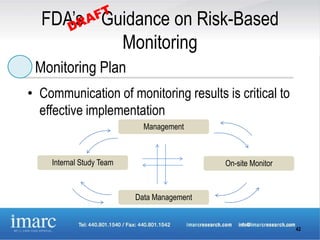
• Communication of monitoring results is critical to
  effective implementation
                            Management


    Internal Study Team                     On-site Monitor


                          Data Management


                                                              42
FDA’s Guidance on Risk-Based
          Monitoring
 Monitoring Plan
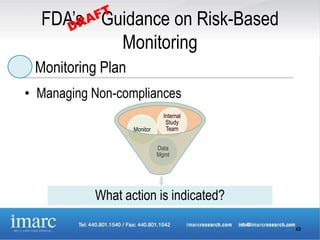
• Managing Non-compliances
                               Internal
                                Study
                   Monitor      Team


                             Data
                             Mgmt


           What action is indicated?

                                          43
FDA’s Guidance on Risk-Based
           Monitoring
 Monitoring Plan
• Special Training Requirements?
  – For on-site monitors?
  – For centralized “monitors”?
• Planned Quality Checks?
• Reference to SOPs


                                   44
FDA’s Guidance on Risk-Based
          Monitoring
 Monitoring Plan
• Amendments to the monitoring plan
  – What “triggers” would require review and revision
  – Consider writing the monitoring plan broadly enough to
    include built-in flexibility


                                                         45
FDA’s Guidance on Risk-Based
           Monitoring
  Documentation
• For on-site  traditional monitoring reports
• For centralized use what works within your
  system
   – Cover sheets, cumulative electronic log of deficiencies,
     centralized “work space” to list study-related issues, etc.
• Incorporate into quality system; note in monitoring
  plan

                                                                   46
Application
    Case Study
• Significant risk implantable device study
• Device is relatively complicated to deploy
• Study conducted at 20 US-based sites
• Both experienced and research-naïve sites
  involved in the trial
• EDC being utilized

                                               47
Application
 Case Study
• Sites are asked to email PDFs of regulatory
  documents
• Screening logs gets faxed every week
• Once every 3 months, the sites are asked to fax
  product accountability logs


                                                    48
Application
 Case Study
Administrative:
• Write monitoring plan to include strategy for
  centralized and on-site monitoring
• Train staff on expectations, including relevant
  procedures, checklists, etc.
• Determine mechanism for communicating

                                                    49
Application
 Case Study
On-site Monitors:
• Conduct site initiation visits
• Monitor each site’s first 3 patients
• Monitor research-naïve sites on regular basis until
  competency determined (define threshold)
• Monitor other sites as needed based on central
  monitoring activity


                                                        50
Application
    Case Study
On-site Monitors:
•   Conduct periodic product accountability
•   Assess site’s continued adequacy for conducting study
•   Conduct focused assessment of regulatory documents
•   Review adverse events
•   Secure compliance (regardless of origin of finding)
•   Report to study team

                                                            51
Application
 Case Study
Centralized “monitors”:
• Review EDC for:
   –   Standard range checks
   –   Consistency of data
   –   Completeness of data
   –   Unusual distribution (i.e., too little variance)
   –   Adverse event assessment
   –   Eligibility criteria

                                                          52
Application
 Case Study
Centralized “monitors”:
• Review regulatory documents
   – Think beyond just logging them in and filing them. Read and
     understand them within each site’s context.
      • CV that hasn’t been updated in 10 years
      • IRB approval letter that lists the wrong study or approves a
        consent form that you do not have on file


                                                                   53
Application
 Case Study
Centralized “monitors”:
• Assess overall site performance
   –   Is data timely?
   –   Are they responsive to query requests?
   –   Are they available?
   –   Can they readily retrieve needed documentation?


                                                         54
Application
    Case Study
Communicate
•   Issues get discussed in a team meeting
•   Deficiencies noted in central electronic “workspace”
•   Monitoring effort re-evaluated regularly
•   Project manager determines that increased or decreased
    frequency for a particular site is appropriate


                                                         55
Application
 Case Study
Result?
• Could be more efficient use of on-site monitors’ time
   – Time spent on critical areas as opposed to administrative areas
• Cost savings due to decreased number of trips and/or
  decreased amount of time needed at sites for each visit
• Sites may appreciate having less on-site monitoring


                                                                  56
4 Main Points
• We’re all “monitors” in some capacity
• Determining the nature and frequency of monitoring
  requires a risk-based assessment
• Documenting all monitoring activity and
  communicating findings is essential to successful
  implementation
• Utilizing central monitors to help direct on-site
  monitoring efforts can increase efficiency and
  decrease cost


                                                       57
Thank You!

QUESTIONS?


             58
References
• FDA Guidance: Risk-Based Approach to Monitoring (2011).
  Retrieved from http://1.usa.gov/rjmVrh
• FDA Guidance: Monitoring of Clinical Investigations (1988).
• Code of Federal Regulations: 21 CFR 812
• Guidance for Industry, E6 Good Clinical Practice
• International Standards ISO 14155:2011 (E)
• FDA’s Annual BIMO Inspection Metrics (2007-2011). Retrieved from
  http://1.usa.gov/HLS1Lt


                                                                 59
More Information for You on


        Download our
         Whitepaper

Centralized vs. Onsite Monitoring

  • 1.
    Centralized vs. OnsiteMonitoring Applying FDA’s Risk-Based Approach Sandra Maddock, RN, BSN, CCRA President, IMARC Research, Inc. 1
  • 2.
    Agenda Overview of Monitoring MonitoringRegulations/Standards Current status FDA’s DRAFT Guidance on Risk-based Monitoring Application 2
  • 3.
    Overview of Monitoring Definition Qualifications Purpose of monitoring Day in the Life Who monitors? 3
  • 4.
    Overview of Monitoring Definition • FDA Regulations • ICH Guidelines • ISO 14155:2011 (E) 4
  • 5.
    Overview of Monitoring Definition • FDA: 21 CFR 812.3 (j) – “When used as a noun, means an individual designated by a sponsor or contract research organization to oversee the progress of an investigation.” “When used as a verb, means to oversee an investigation.” 5
  • 6.
    Overview of Monitoring Definition • ICH GCP: 1.39 – “The act of overseeing the progress of a clinical trial, and of ensuring that it is conducted, recorded, and reported in accordance with the protocol, standard operating procedures (SOPs) GCP, and the applicable regulatory requirement(s).” 6
  • 7.
    Overview of Monitoring Definition • ISO 14155 3.29 – “act of overseeing the progress of a clinical investigation and to ensure that it is conducted, recorded, and reported in accordance with the CIP, written procedures, this International Standard, and the applicable regulatory requirements.” 7
  • 8.
    Overview of Monitoring Qualifications • Qualified by training and experience • Have scientific and/or clinical knowledge needed for specific trial • Should be familiar with investigational products, protocol, informed consent, pertinent aspects of the trial, GCP, and regulatory requirements • Qualifications should be documented 8
  • 9.
    Overview of Monitoring Purpose • Verify: – Rights and well-being of human subjects are protected – Reported trial data are accurate, complete, and verifiable – The conduct of the trial is in compliance with protocol, GCP and applicable regulatory requirements ICH 5.18.1 ISO 8.2.4 FDA’s draft guidance 9
  • 10.
    Overview of Monitoring Dayin the Life • Review regulatory • Address action items from documents previous visits • Verify source data • Meet with PI, Co-I, or CRC to • Issue queries on the CRFs discuss findings (EDC or paper) • Train staff on protocol • Address and resolve requirements queries with site staff • Assess continued acceptability • Perform device of site to perform protocol accountability requirements… and so much more! 10
  • 11.
    Overview of Monitoring WhoMonitors? • Physicians • Nurses • Biomedical Engineers • Public Health workers • Biology majors • Pharmacists • And more…. 11
  • 12.
    Monitoring Regulations/Standards Regulations: FDA Standards: FDA Guidelines Standards: ICH Guidelines Standards: ISO 14155:2011 (E) 12
  • 13.
    Monitoring Regulations/Standards Regulations: FDA • Sponsor requirements noted in various places throughout 21 CFR 812 & 312: – 21 CFR 812.25: Investigational plan shall include the monitoring procedures and the name/address of the monitor(s) – 21 CFR 812.40: “… ensure proper monitoring of the investigation, ensuring that IRB review and approval are obtained, …..” – 21 CFR 312.50: “…ensuring proper monitoring of the investigation(s), ensuring that the investigation(s) is conducted in accordance with the general investigational plan and protocols “ 13
  • 14.
    Monitoring Regulations/Standards Regulations: FDA • Sponsor requirements noted in various places: – 21 CFR 312.50- General Responsibilities of Sponsors – 21 CFR 812.46 (a) Sponsors shall secure compliance with • Investigational Plan • Regulations • Conditions imposed by IRB or FDA – If non-compliance continues • Discontinue shipment of investigational product • Terminate participation in investigation 14
  • 15.
    Monitoring Regulations/Standards Standards: FDA Guidelines • Guideline for Monitoring Clinical Investigations, January 1988 – Vague in its requirements – Effective monitoring requires personal contact between the monitor and the investigator throughout the trial 15
  • 16.
    Monitoring Regulations/Standards Standards: ICH Guidelines • April 1996 • Pharmaceutical-focused • Began laying the groundwork for a risk-based approach: extent and nature of monitoring should depend on “the objective, purpose, design, complexity, blinding, size, and endpoints of the trial…” 16
  • 17.
    Monitoring Regulations/Standards Standards: ISO Guidelines • 2011 • Device focused • Monitoring plan shall take into account “..objective, design, complexity, size, critical data points and endpoints…” • However, it also indicates that monitors shall conduct “routine on-site monitoring visits…” 17
  • 18.
    Current Status General IndustryPractice Our Report Card 18
  • 19.
    Current Practice General IndustryPractice “Many sponsors have understood these guidances as contributing to the notion that FDA expects sponsors to conduct frequent on-site monitoring and 100% verification for all trials, regardless of their design and complexity.” -FDA’s DRAFT Risk-Based Monitoring Guidance 19
  • 20.
    Current Practice General IndustryPractice • Monitoring of 100% source data • Monitoring conducted at pre-determined time intervals, for example… – Every 4-6 weeks – Every 5th patient – At least once a quarter 20
  • 21.
    Current Practice Our ReportCard • Most common sponsor-monitor deficiencies noted during FDA inspections: – 2007: • 46% of sponsors inspected had voluntary or official action indicated • Most common citings: – Inadequate monitoring – Failure to bring investigators into compliance – Inadequate accountability 21
  • 22.
    Current Practice Our ReportCard • Most common sponsor-monitor deficiencies noted during FDA inspections: – 2008: • 39% of sponsors inspected had voluntary or official action indicated • Most common citings: – Inadequate monitoring – Failure to bring investigators into compliance – Inadequate accountability 22
  • 23.
    Current Practice Our ReportCard • Most common sponsor-monitor deficiencies noted during FDA inspections: – 2009: • 36% of sponsors inspected had voluntary or official action indicated • Most common citings: – Inadequate monitoring – Failure to bring investigators into compliance – Inadequate accountability 23
  • 24.
    Current Practice Our ReportCard • Most common sponsor-monitor deficiencies noted during FDA inspections: – 2010: • 50% of sponsors inspected had voluntary or official action indicated • Most common citings: – Inadequate monitoring – Failure to bring investigators into compliance – Inadequate accountability 24
  • 25.
    Current Practice Our ReportCard • Most common sponsor-monitor deficiencies noted during FDA inspections: – 2011: • 45% of sponsors inspected had voluntary or official action indicated • Most common citings: – Inadequate monitoring – Failure to bring investigators into compliance – Inadequate accountability 25
  • 26.
    Current Practice Our ReportCard –Inadequate monitoring –Failure to bring investigators into compliance –Inadequate accountability 26
  • 27.
    FDA’s Guidance onRisk-Based Monitoring Introduction Rationale General Recommendations Monitoring Plan Documentation 27
  • 28.
    FDA’s Guidance onRisk-Based Monitoring Introduction • Assist sponsors in developing monitoring strategies • Enhance human subject protection • Enhance the quality of clinical trial data Variety of approaches 28
  • 29.
    FDA’s Guidance onRisk-Based Monitoring Rationale • Provide increased ability to protect patients – Not caught up in the minute details, but rather focused on key data points • Improve overall study quality • Monitor more effectively 29
  • 30.
    FDA’s Guidance onRisk-Based Monitoring Rationale • Tasks that historically could only be done on-site, may now be done remotely due to technology – EDC systems – Webcasts – Email – Online Training Modules 30
  • 31.
    FDA’s Guidance onRisk-Based Monitoring General Recommendations • No single approach can work for every clinical study • Modify based on risks of the trial • Include mix of centralized and on-site • Document intended approach in a monitoring plan 31
  • 32.
    FDA’s Guidance onRisk-Based Monitoring General Recommendations • On-site monitoring activities: – Source data verification – Verification that study documentation exists – Assessment of site’s familiarity and compliance with protocol – Investigational product accountability – Get a general sense of how things are going at a site 32
  • 33.
    FDA’s Guidance onRisk-Based Monitoring General Recommendations • Centralized monitoring activities: – Standard checks (ranges, blanks, unusual data, outliers) – Identify sites with more errors, dropouts, protocol violations – Data trends – Verify source data remotely (when applicable) 33
  • 34.
    FDA’s Guidance onRisk-Based Monitoring General Recommendations • Centralized monitoring can assess: – Analyze site characteristics (high screen failure rates, eligibility violations, delays in submitting data) – Collect – Review – and archive regulatory documents 34
  • 35.
    FDA’s Guidance onRisk-Based Monitoring General Recommendations • Use of both types of monitoring is encouraged • Greater emphasis of on-site monitoring may be required earlier in the study 35
  • 36.
    FDA’s Guidance onRisk-Based Monitoring General Recommendations • Higher frequency monitoring may be needed to assess: – Critical study endpoints – Safety assessments – Documentation surrounding serious adverse events/unanticipated adverse device effects – Eligibility criteria 36
  • 37.
    FDA’s Guidance onRisk-Based Monitoring General Recommendations • Higher frequency monitoring may be needed to assess: – That study blind is maintained – Product accountability 37
  • 38.
    FDA’s Guidance onRisk-Based Monitoring General Recommendations • Monitoring plan considerations – Complexity of the study design – Types of study endpoints – Clinical complexity of the study population – Geography 38
  • 39.
    FDA’s Guidance onRisk-Based Monitoring General Recommendations • Monitoring plan considerations – Experience of the clinical investigation site – EDC considerations – Relative safety of the investigational product – Stage of the study – Quantity of data 39
  • 40.
    FDA’s Guidance onRisk-Based Monitoring Monitoring Plan • What should be included? – Description of monitoring methods to be employed – Criteria for determining timing, frequency, and intensity of monitoring – Reference to any tools that will be used (i.e., checklists) – Identification of events that may trigger changes – Identification of deviations or failures that would be critical to study integrity 40
  • 41.
    FDA’s Guidance onRisk-Based Monitoring Monitoring Plan • What should be included? – When writing your monitoring plan, define the activities you will be doing centrally and those that you will be doing on-site • i.e., centralized monitoring will consist of remote review of regulatory documentation including CVs, licenses, IRB correspondence, etc. • i.e., onsite monitoring will consist of review of informed consent documents, source data, product accountability, etc. 41
  • 42.
    FDA’s Guidance onRisk-Based Monitoring Monitoring Plan • Communication of monitoring results is critical to effective implementation Management Internal Study Team On-site Monitor Data Management 42
  • 43.
    FDA’s Guidance onRisk-Based Monitoring Monitoring Plan • Managing Non-compliances Internal Study Monitor Team Data Mgmt What action is indicated? 43
  • 44.
    FDA’s Guidance onRisk-Based Monitoring Monitoring Plan • Special Training Requirements? – For on-site monitors? – For centralized “monitors”? • Planned Quality Checks? • Reference to SOPs 44
  • 45.
    FDA’s Guidance onRisk-Based Monitoring Monitoring Plan • Amendments to the monitoring plan – What “triggers” would require review and revision – Consider writing the monitoring plan broadly enough to include built-in flexibility 45
  • 46.
    FDA’s Guidance onRisk-Based Monitoring Documentation • For on-site  traditional monitoring reports • For centralized use what works within your system – Cover sheets, cumulative electronic log of deficiencies, centralized “work space” to list study-related issues, etc. • Incorporate into quality system; note in monitoring plan 46
  • 47.
    Application Case Study • Significant risk implantable device study • Device is relatively complicated to deploy • Study conducted at 20 US-based sites • Both experienced and research-naïve sites involved in the trial • EDC being utilized 47
  • 48.
    Application Case Study •Sites are asked to email PDFs of regulatory documents • Screening logs gets faxed every week • Once every 3 months, the sites are asked to fax product accountability logs 48
  • 49.
    Application Case Study Administrative: •Write monitoring plan to include strategy for centralized and on-site monitoring • Train staff on expectations, including relevant procedures, checklists, etc. • Determine mechanism for communicating 49
  • 50.
    Application Case Study On-siteMonitors: • Conduct site initiation visits • Monitor each site’s first 3 patients • Monitor research-naïve sites on regular basis until competency determined (define threshold) • Monitor other sites as needed based on central monitoring activity 50
  • 51.
    Application Case Study On-site Monitors: • Conduct periodic product accountability • Assess site’s continued adequacy for conducting study • Conduct focused assessment of regulatory documents • Review adverse events • Secure compliance (regardless of origin of finding) • Report to study team 51
  • 52.
    Application Case Study Centralized“monitors”: • Review EDC for: – Standard range checks – Consistency of data – Completeness of data – Unusual distribution (i.e., too little variance) – Adverse event assessment – Eligibility criteria 52
  • 53.
    Application Case Study Centralized“monitors”: • Review regulatory documents – Think beyond just logging them in and filing them. Read and understand them within each site’s context. • CV that hasn’t been updated in 10 years • IRB approval letter that lists the wrong study or approves a consent form that you do not have on file 53
  • 54.
    Application Case Study Centralized“monitors”: • Assess overall site performance – Is data timely? – Are they responsive to query requests? – Are they available? – Can they readily retrieve needed documentation? 54
  • 55.
    Application Case Study Communicate • Issues get discussed in a team meeting • Deficiencies noted in central electronic “workspace” • Monitoring effort re-evaluated regularly • Project manager determines that increased or decreased frequency for a particular site is appropriate 55
  • 56.
    Application Case Study Result? •Could be more efficient use of on-site monitors’ time – Time spent on critical areas as opposed to administrative areas • Cost savings due to decreased number of trips and/or decreased amount of time needed at sites for each visit • Sites may appreciate having less on-site monitoring 56
  • 57.
    4 Main Points •We’re all “monitors” in some capacity • Determining the nature and frequency of monitoring requires a risk-based assessment • Documenting all monitoring activity and communicating findings is essential to successful implementation • Utilizing central monitors to help direct on-site monitoring efforts can increase efficiency and decrease cost 57
  • 58.
  • 59.
    References • FDA Guidance:Risk-Based Approach to Monitoring (2011). Retrieved from http://1.usa.gov/rjmVrh • FDA Guidance: Monitoring of Clinical Investigations (1988). • Code of Federal Regulations: 21 CFR 812 • Guidance for Industry, E6 Good Clinical Practice • International Standards ISO 14155:2011 (E) • FDA’s Annual BIMO Inspection Metrics (2007-2011). Retrieved from http://1.usa.gov/HLS1Lt 59
  • 60.
    More Information forYou on Download our Whitepaper

Editor's Notes

  • #52 ?? assess adequacy of storage conditions