M O L E C U L A R E L E C T R O N I C S -
A N I N V I S I B L E Y E T,
R E V O L U T I O N A RY
T E C H N O L O G Y
Presen ted by
Sukhwin der Sin gh
Directin g Staf f
Asst Pro f M
Priyadharsin i
TO GIVE AN INSIGHT ABOUT USE OF MOLECULAR
TECHNOLOGY IN FIELD OF ELECTRONICS
AIM
 INTRODUCTION
 BRIEF HISTORY
 MTRLS USED IN MOLETRONICS
 MOLECULAR ELEC COMPONENTS
 CHAR OF MOLECULAR DEVICES
 ADV AND ROADBLOCKS
 APPLNS
 FUTURE DEVELOPMENTS
PURVIEW
First computer Latest computer
INTRODUCTION
Moore’s law states that
“The number of transistors per square inch on
integrated circuits will double every year.”
MOORE’S LAW
Different scales of Silicon
Integration Technology
SSI (small
scale
integration)-
1-12 gates
on a single
chip
MSI (medium
scale
integration)-12-
30 gates on a
single chip
LSI (large scale
integration)-30-
300 gates on a
single chip
VLSI (Very large
scale integration)-
300-10000 gates
on a single chip
ULSI (ultra large
scale
integration)-
beyond 10000
gates on a single
chip
 “It is branch of electronics in which
individual molecules perform in
same function as microelectronics
devices such as diode or
transistors.”
OR
 “Moletronics is a subset of
nanotechnology dealing with the
manipulation of molecules so they
work together as electronic circuits.”
MOLETRONICS
BRIEF HISTORY
MTRLS USED IN
MOLETRONICS
MTRLS USED IN MOLETRONICS
ORGANIC POLYMERS
 Discovered in mid 1970’s.
 Polymers are flexible, versatile and easy to process.
 Behave like a conventional inorganic semiconductor.
 Low mobility.
 Absence of band gap of the order of 0.75 to 2 e V.
 Chemical formulae (C6H5) x
 Highly flexible
 Capable of carrying and switching currents.
 Very high current density(~.5 million times of Copper
wires)
 Used as molecular wires and switches.
MTRLS USED IN MOLETRONICS
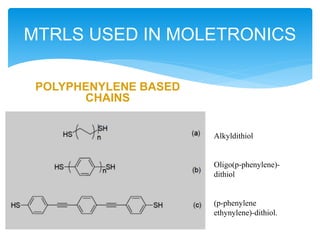
POLYPHENYLENE BASED
CHAINS
MTRLS USED IN MOLETRONICS
POLYPHENYLENE BASED
CHAINS
Alkyldithiol
Oligo(p-phenylene)-
dithiol
(p-phenylene
ethynylene)-dithiol.
 Used as molecular wires or “Bucky
tube”.
 High conductivity when used on micro
patterned semiconductor surface
ranging from excellent conduction to
pretty good insulation..
 Differ in diameters and chirality
 Chemically stable but made only under
extreme conditions
MTRLS USED IN MOLETRONICS
CARBON NANOTUBES
MOLECULAR
ELECTRONIC
COMPONENTS
 Nodes + Atomic
nuclei
 Cannot transport
unimpeded electrical
current
 Acts like resistors
Aliphatic Molecular Insulators
 Consists of 3 benzene rings
 Centre ring has asymmetric fragments
 Great flexibility and can even function when it
is bent.
MOLECULAR TRANSISTORS
 Rectifying Diodes
 Also called molecular rectifier
 Allows ct flow in only one dirn
 Resonant tunneling Diodes(RTDs).
 Ct in both dirns
 Uses electron energy quantization
Molecular Diodes
 Nonlinear I-V Behavior
 Energy Dissipation
 Gain in Molecular Electronic Circuits
 Speed
CHARACTERISTICS OF
MOLECULAR DEVICES
 Size
 Speed
 Assembly
 Low Manufacturing Cost
 Able to integrate large circuit
 Synthetic flexibility/Re-configurable.
 Streochemistry
 Greater memory hold time
Advantages of Molecular
Electronics
Advantages of Molecular
Electronics
COMPARISION WITH BULK ELEC
 Hard experimental verification
 Controlled fabrication within specified tolerances
MOLETRONICS ROADBLOCKS
 Molecular Sensors
 Molecular tweezers
 Molecular Switch
 Molecular Motors
 Logic and memory devices
 Smart Fabrics
APPLNS
FUTURE
DEVELOPMENTS
MEMORY STORAGE APPLNS
 Data storage is done by multiporphyrin
nanostructures into electronic memory.
 The application of a voltage causes the molecules
to oxidize, or give up electrons.
 The molecules then retain their positive charge
after the electric field is removed, producing a
memory effect.
MEMORY HOLD TIME
 Silicon memory devices = 1 mili sec
 Moletronic device = 15 min
 So less power
CONCLUSION
“The Next Big Thing is very, very small. Picture trillions of
transistors, processors so fast their speed is measured in
terahertz, infinite capacity, zero cost. It's the dawn of a new
technological revolution - and the death of silicon.”
 "Large-scale synthesis of carbon nanotubes", T W Ebbesen
and P M Ajayan Nature, vol.358, p220 (1992 published)
 Scientific forum http://www.calmec.com/scientif.htm
 Search http://www.calmec.com/search.htm
 www.ieee.org
 Strategic Technologies for the Military: Breaking New
Frontiers By Ajey Lele
 http://technews.acm.org/articles/2002-4/0805m.html
 http://www.wikipedia.com
REFERENCES

Moletronics or molecular electronics - technical seminar

  • 1.
    M O LE C U L A R E L E C T R O N I C S - A N I N V I S I B L E Y E T, R E V O L U T I O N A RY T E C H N O L O G Y Presen ted by Sukhwin der Sin gh Directin g Staf f Asst Pro f M Priyadharsin i
  • 2.
    TO GIVE ANINSIGHT ABOUT USE OF MOLECULAR TECHNOLOGY IN FIELD OF ELECTRONICS AIM
  • 3.
     INTRODUCTION  BRIEFHISTORY  MTRLS USED IN MOLETRONICS  MOLECULAR ELEC COMPONENTS  CHAR OF MOLECULAR DEVICES  ADV AND ROADBLOCKS  APPLNS  FUTURE DEVELOPMENTS PURVIEW
  • 4.
    First computer Latestcomputer INTRODUCTION
  • 5.
    Moore’s law statesthat “The number of transistors per square inch on integrated circuits will double every year.” MOORE’S LAW
  • 6.
    Different scales ofSilicon Integration Technology SSI (small scale integration)- 1-12 gates on a single chip MSI (medium scale integration)-12- 30 gates on a single chip LSI (large scale integration)-30- 300 gates on a single chip VLSI (Very large scale integration)- 300-10000 gates on a single chip ULSI (ultra large scale integration)- beyond 10000 gates on a single chip
  • 8.
     “It isbranch of electronics in which individual molecules perform in same function as microelectronics devices such as diode or transistors.” OR  “Moletronics is a subset of nanotechnology dealing with the manipulation of molecules so they work together as electronic circuits.” MOLETRONICS
  • 9.
  • 10.
  • 11.
    MTRLS USED INMOLETRONICS ORGANIC POLYMERS  Discovered in mid 1970’s.  Polymers are flexible, versatile and easy to process.  Behave like a conventional inorganic semiconductor.  Low mobility.  Absence of band gap of the order of 0.75 to 2 e V.
  • 12.
     Chemical formulae(C6H5) x  Highly flexible  Capable of carrying and switching currents.  Very high current density(~.5 million times of Copper wires)  Used as molecular wires and switches. MTRLS USED IN MOLETRONICS POLYPHENYLENE BASED CHAINS
  • 13.
    MTRLS USED INMOLETRONICS POLYPHENYLENE BASED CHAINS Alkyldithiol Oligo(p-phenylene)- dithiol (p-phenylene ethynylene)-dithiol.
  • 14.
     Used asmolecular wires or “Bucky tube”.  High conductivity when used on micro patterned semiconductor surface ranging from excellent conduction to pretty good insulation..  Differ in diameters and chirality  Chemically stable but made only under extreme conditions MTRLS USED IN MOLETRONICS CARBON NANOTUBES
  • 15.
  • 16.
     Nodes +Atomic nuclei  Cannot transport unimpeded electrical current  Acts like resistors Aliphatic Molecular Insulators
  • 17.
     Consists of3 benzene rings  Centre ring has asymmetric fragments  Great flexibility and can even function when it is bent. MOLECULAR TRANSISTORS
  • 19.
     Rectifying Diodes Also called molecular rectifier  Allows ct flow in only one dirn  Resonant tunneling Diodes(RTDs).  Ct in both dirns  Uses electron energy quantization Molecular Diodes
  • 20.
     Nonlinear I-VBehavior  Energy Dissipation  Gain in Molecular Electronic Circuits  Speed CHARACTERISTICS OF MOLECULAR DEVICES
  • 21.
     Size  Speed Assembly  Low Manufacturing Cost  Able to integrate large circuit  Synthetic flexibility/Re-configurable.  Streochemistry  Greater memory hold time Advantages of Molecular Electronics
  • 22.
  • 23.
     Hard experimentalverification  Controlled fabrication within specified tolerances MOLETRONICS ROADBLOCKS
  • 24.
     Molecular Sensors Molecular tweezers  Molecular Switch  Molecular Motors  Logic and memory devices  Smart Fabrics APPLNS
  • 25.
  • 26.
    MEMORY STORAGE APPLNS Data storage is done by multiporphyrin nanostructures into electronic memory.  The application of a voltage causes the molecules to oxidize, or give up electrons.  The molecules then retain their positive charge after the electric field is removed, producing a memory effect.
  • 28.
    MEMORY HOLD TIME Silicon memory devices = 1 mili sec  Moletronic device = 15 min  So less power
  • 29.
    CONCLUSION “The Next BigThing is very, very small. Picture trillions of transistors, processors so fast their speed is measured in terahertz, infinite capacity, zero cost. It's the dawn of a new technological revolution - and the death of silicon.”
  • 31.
     "Large-scale synthesisof carbon nanotubes", T W Ebbesen and P M Ajayan Nature, vol.358, p220 (1992 published)  Scientific forum http://www.calmec.com/scientif.htm  Search http://www.calmec.com/search.htm  www.ieee.org  Strategic Technologies for the Military: Breaking New Frontiers By Ajey Lele  http://technews.acm.org/articles/2002-4/0805m.html  http://www.wikipedia.com REFERENCES