MOLETRONICS
Under the guidance of
Dr .Y. SYAMALA
Associate Professor
Department of ECE
Gudlavalleru Engineering College.
By
B N V A SURENDRA BABU
13481D5505
M.Tech -Embedded Systems.
 Introduction
 Substrates used in moletronics
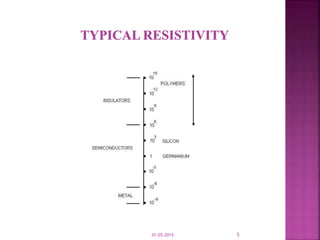
 Typical resistivity
 Molecular wires
 Molecular electronic components
 Realization of basic circuits
 Molecular electronic memory cell
 Advantages of molecular electronics
 Conclusion
 References
01-05-2015 1
o Molecular electronics, also called moletronics, is an
interdisciplinary subject that spans chemistry, physics
and materials science.
o The feature of molecular electronics is the use of
molecular building blocks to fabricate electronic
components, both active (e.g. transistors) and passive
(e.g. resistive wires).
01-05-2015 3
o Polymers are flexible, versatile and easy to process.
o These are behave like a conventional inorganic
semiconductor.
o Does not possess reasonable charge carrier mobility.
Mobility obtained in polymers is low.
o In organic polymers existence of controllable band
gap is present in the order of 0.75 to 2 ev.
01-05-2015 4
01-05-2015 5
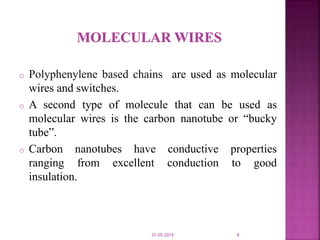
o Polyphenylene based chains are used as molecular
wires and switches.
o A second type of molecule that can be used as
molecular wires is the carbon nanotube or “bucky
tube”.
o Carbon nanotubes have conductive properties
ranging from excellent conduction to good
insulation.
01-05-2015 6
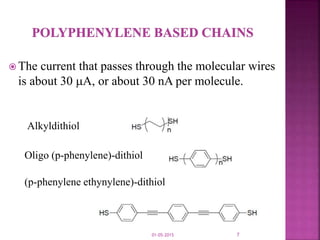
 The current that passes through the molecular wires
is about 30 A, or about 30 nA per molecule.
Alkyldithiol
Oligo (p-phenylene)-dithiol
(p-phenylene ethynylene)-dithiol
01-05-2015 7
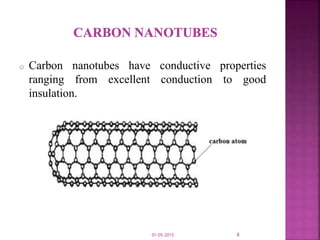
o Carbon nanotubes have conductive properties
ranging from excellent conduction to good
insulation.
01-05-2015 8
 Molecular Transistors
 Molecular Rectifier
 Molecular Switch
01-05-2015 9
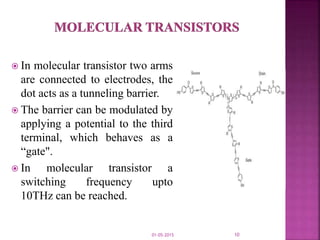
 In molecular transistor two arms
are connected to electrodes, the
dot acts as a tunneling barrier.
 The barrier can be modulated by
applying a potential to the third
terminal, which behaves as a
“gate".
 In molecular transistor a
switching frequency upto
10THz can be reached.
01-05-2015 10
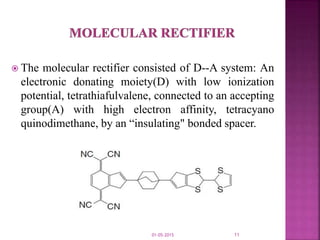
 The molecular rectifier consisted of D--A system: An
electronic donating moiety(D) with low ionization
potential, tetrathiafulvalene, connected to an accepting
group(A) with high electron affinity, tetracyano
quinodimethane, by an “insulating" bonded spacer.
01-05-2015 11
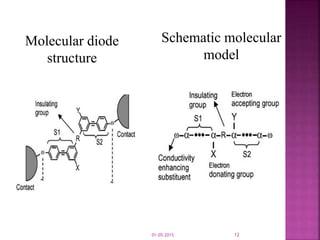
Molecular diode
structure
Schematic molecular
model
01-05-2015 12
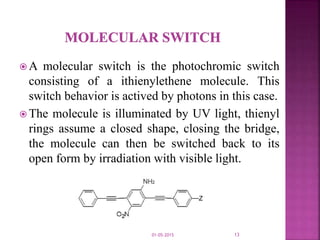
 A molecular switch is the photochromic switch
consisting of a ithienylethene molecule. This
switch behavior is actived by photons in this case.
 The molecule is illuminated by UV light, thienyl
rings assume a closed shape, closing the bridge,
the molecule can then be switched back to its
open form by irradiation with visible light.
01-05-2015 13
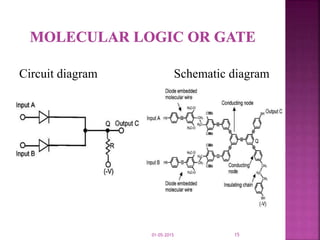
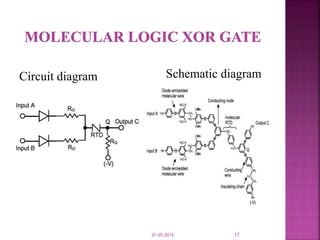
 Molecular logic OR gate
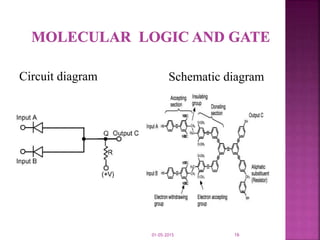
 Molecular logic AND gate
 Molecular logic XOR gate
01-05-2015 14
Circuit diagram Schematic diagram
01-05-2015 15
Circuit diagram Schematic diagram
01-05-2015 16
Circuit diagram Schematic diagram
01-05-2015 17
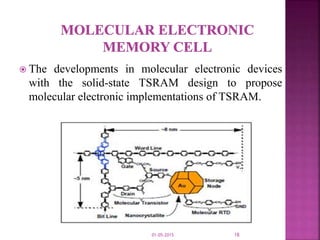
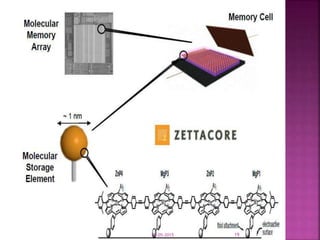
 The developments in molecular electronic devices
with the solid-state TSRAM design to propose
molecular electronic implementations of TSRAM.
01-05-2015 18
01-05-2015 19
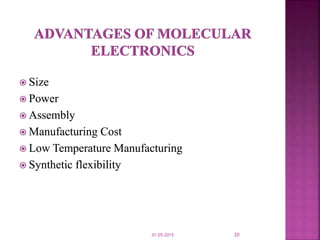
 Size
 Power
 Assembly
 Manufacturing Cost
 Low Temperature Manufacturing
 Synthetic flexibility
01-05-2015 20
 In molecular electronics, or moletronics,
single molecules serve as switches, "quantum
wires" a few atoms thick serve as wiring.
 The hardware is synthesized chemically from
the bottom up approch which is used to reduce
the power consumption.
01-05-2015 21
1) Lorente N. and Joachim C. “Architecture and Design of
Molecule Logic Gate and Atom Circuit", 2013.
2) Gubin S. Petal. “Molecular clusters as building blocks for
nanoelectronics: the first demonstration of a cluster
single-electron tunnelling transistor at room
temperature“, Nanotechnology, 2002.
3) Prasongkit and Jariyanne. “Molecular Electronics - Insight
from An-Initio Transport Simulation", 2011.
4) Heat James R. and Ratner Mark A. “Molecular
Electronics". Physics Today, pp.43 - 49, 2003.
5) Chen J., Lee T., Su J., Wang W., Ratner Mark A and Reed
“Molecular Electronic Devices", pp. 672-687, 2011.
01-05-2015 22
6) Mantooth B.A. and Weiss P.S. “Fabrication, Assembly,
and Characterization of Molecular Electronic
Components". In Proceedings of the IEEE, vol 91, 2003.
7) Wang W., Lee T., and Reed M.A.R. “Electronic Transport
in Molecular Self-Assembled Monolayer Devices". In
Proceedings of the IEEE, volume 93, 2005.
8) Cuniberti G. and Fagas G. Richter K. “Introducing
Molecular Electronics”, vol 680 of Lect. Notes Phys.
Springer, 2005.
9) Reed M. A. “Molecular Electronics - Current Status and
Future Prospects". FED Journal, 2000.
10) Winpenny R.E.P. “Strecht for a moment“, Nature
nanotechnology, 2013.
01-05-2015 23
01-05-2015 24

Moletronics 140201085944-phpapp02

  • 1.
    MOLETRONICS Under the guidanceof Dr .Y. SYAMALA Associate Professor Department of ECE Gudlavalleru Engineering College. By B N V A SURENDRA BABU 13481D5505 M.Tech -Embedded Systems.
  • 2.
     Introduction  Substratesused in moletronics  Typical resistivity  Molecular wires  Molecular electronic components  Realization of basic circuits  Molecular electronic memory cell  Advantages of molecular electronics  Conclusion  References 01-05-2015 1
  • 3.
    o Molecular electronics,also called moletronics, is an interdisciplinary subject that spans chemistry, physics and materials science. o The feature of molecular electronics is the use of molecular building blocks to fabricate electronic components, both active (e.g. transistors) and passive (e.g. resistive wires). 01-05-2015 3
  • 4.
    o Polymers areflexible, versatile and easy to process. o These are behave like a conventional inorganic semiconductor. o Does not possess reasonable charge carrier mobility. Mobility obtained in polymers is low. o In organic polymers existence of controllable band gap is present in the order of 0.75 to 2 ev. 01-05-2015 4
  • 5.
  • 6.
    o Polyphenylene basedchains are used as molecular wires and switches. o A second type of molecule that can be used as molecular wires is the carbon nanotube or “bucky tube”. o Carbon nanotubes have conductive properties ranging from excellent conduction to good insulation. 01-05-2015 6
  • 7.
     The currentthat passes through the molecular wires is about 30 A, or about 30 nA per molecule. Alkyldithiol Oligo (p-phenylene)-dithiol (p-phenylene ethynylene)-dithiol 01-05-2015 7
  • 8.
    o Carbon nanotubeshave conductive properties ranging from excellent conduction to good insulation. 01-05-2015 8
  • 9.
     Molecular Transistors Molecular Rectifier  Molecular Switch 01-05-2015 9
  • 10.
     In moleculartransistor two arms are connected to electrodes, the dot acts as a tunneling barrier.  The barrier can be modulated by applying a potential to the third terminal, which behaves as a “gate".  In molecular transistor a switching frequency upto 10THz can be reached. 01-05-2015 10
  • 11.
     The molecularrectifier consisted of D--A system: An electronic donating moiety(D) with low ionization potential, tetrathiafulvalene, connected to an accepting group(A) with high electron affinity, tetracyano quinodimethane, by an “insulating" bonded spacer. 01-05-2015 11
  • 12.
  • 13.
     A molecularswitch is the photochromic switch consisting of a ithienylethene molecule. This switch behavior is actived by photons in this case.  The molecule is illuminated by UV light, thienyl rings assume a closed shape, closing the bridge, the molecule can then be switched back to its open form by irradiation with visible light. 01-05-2015 13
  • 14.
     Molecular logicOR gate  Molecular logic AND gate  Molecular logic XOR gate 01-05-2015 14
  • 15.
    Circuit diagram Schematicdiagram 01-05-2015 15
  • 16.
    Circuit diagram Schematicdiagram 01-05-2015 16
  • 17.
    Circuit diagram Schematicdiagram 01-05-2015 17
  • 18.
     The developmentsin molecular electronic devices with the solid-state TSRAM design to propose molecular electronic implementations of TSRAM. 01-05-2015 18
  • 19.
  • 20.
     Size  Power Assembly  Manufacturing Cost  Low Temperature Manufacturing  Synthetic flexibility 01-05-2015 20
  • 21.
     In molecularelectronics, or moletronics, single molecules serve as switches, "quantum wires" a few atoms thick serve as wiring.  The hardware is synthesized chemically from the bottom up approch which is used to reduce the power consumption. 01-05-2015 21
  • 22.
    1) Lorente N.and Joachim C. “Architecture and Design of Molecule Logic Gate and Atom Circuit", 2013. 2) Gubin S. Petal. “Molecular clusters as building blocks for nanoelectronics: the first demonstration of a cluster single-electron tunnelling transistor at room temperature“, Nanotechnology, 2002. 3) Prasongkit and Jariyanne. “Molecular Electronics - Insight from An-Initio Transport Simulation", 2011. 4) Heat James R. and Ratner Mark A. “Molecular Electronics". Physics Today, pp.43 - 49, 2003. 5) Chen J., Lee T., Su J., Wang W., Ratner Mark A and Reed “Molecular Electronic Devices", pp. 672-687, 2011. 01-05-2015 22
  • 23.
    6) Mantooth B.A.and Weiss P.S. “Fabrication, Assembly, and Characterization of Molecular Electronic Components". In Proceedings of the IEEE, vol 91, 2003. 7) Wang W., Lee T., and Reed M.A.R. “Electronic Transport in Molecular Self-Assembled Monolayer Devices". In Proceedings of the IEEE, volume 93, 2005. 8) Cuniberti G. and Fagas G. Richter K. “Introducing Molecular Electronics”, vol 680 of Lect. Notes Phys. Springer, 2005. 9) Reed M. A. “Molecular Electronics - Current Status and Future Prospects". FED Journal, 2000. 10) Winpenny R.E.P. “Strecht for a moment“, Nature nanotechnology, 2013. 01-05-2015 23
  • 24.