FETGKV
TECHNOVATIONS
A
Presentation
on
MOLETRONICS-AN INVISIBLE
TECHNOLOGY
Submitted by
Navjyoti Sharma
BTECH II YEAR
Electrical Engineering
Overview
1. What is Molecular Electronics?
2. Advantages of Molecular Electronics
3. Molecular Switch
4. Issues
What is Molecular Electronics?
 Sometimes called moletronics
 Molecular electronics is a branch of applied
physics which aims at using molecules as passive
or active electronic components.
 These molecules will perform the functions
currently performed by semiconductors.
Why use Molecular Electronics?
 Size
 Power
 Speed
 Low Manufacturing Cost
 Easier to Manufacture
Size
 Molecular Electronics is a way to extend Moore’s
Law past the limits of standard semiconductor
Circuits.
 100X smaller than their counterparts
Power / Speed
 Currently Transistors cannot be stacked, which makes
them quite ineffecient!
 Molecular technology will be able to add a 3rd
dimension.
 Femtoseconds switching times.
Manufacturing
 Most designs use either spin coating or Self-
Assembly process.
 Individual Molecules can be made exactly the
same by the Billions.
 Molecular assembly tends to occur at Room
Temperature.
Molecular Switch
 Semiconductor switches can be made on a very
small scale.
 Perform computational functions when placed in
the right combination.
 Molecular switch is orders of magnitude smaller.
Molecular Chiropticene Switch
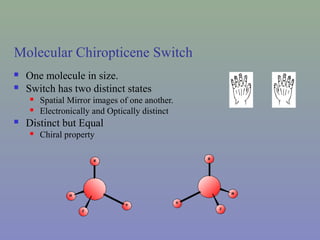
 One molecule in size.
 Switch has two distinct states
 Spatial Mirror images of one another.
 Electronically and Optically distinct
 Distinct but Equal
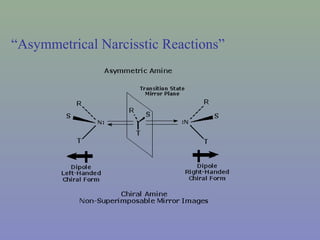
 Chiral property
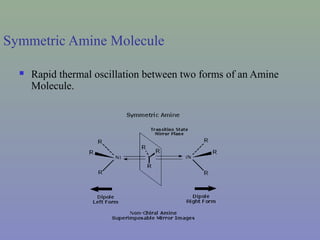
Symmetric Amine Molecule
 Rapid thermal oscillation between two forms of an Amine
Molecule.
“Asymmetrical Narcisstic Reactions”
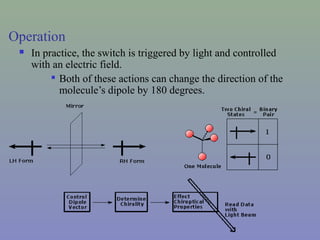
Operation
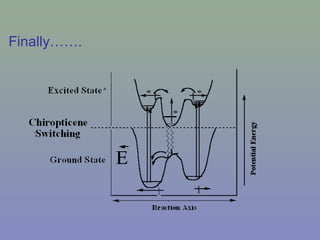
 In practice, the switch is triggered by light and controlled
with an electric field.

Both of these actions can change the direction of the
molecule’s dipole by 180 degrees.
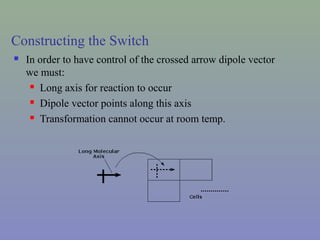
Constructing the Switch
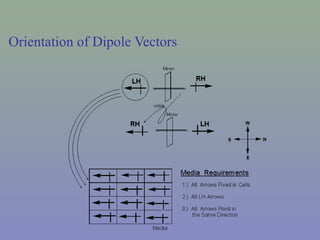
 In order to have control of the crossed arrow dipole vector
we must:
 Long axis for reaction to occur
 Dipole vector points along this axis
 Transformation cannot occur at room temp.
Orientation of Dipole Vectors
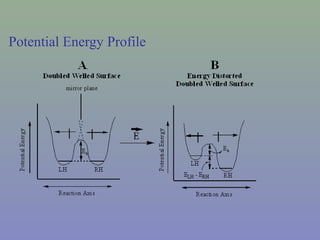
Potential Energy Profile
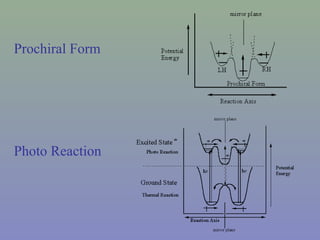
Prochiral Form
Photo Reaction
Finally…….
Switch Properties
 Stability- Two equal but opposite energy states in these molecules
affords stablility as well as reversibility.
 Speed- Femtosecond switching speeds
Applications
 Plastic electronic system
 Biochips
 Economic solar cells
Problems facing Moletronics
 Molecular electronics must still be integrated with
Silicon.
 Among the important issues is the determination
of the resistance of a single molecule (both
theoritical and experimental).
 It is difficult to perform direct characterization
since imaging at the molecular scale is often
impossible in many experimental devices.
Molecular_Electronics (1)

Molecular_Electronics (1)

  • 1.
  • 2.
    Overview 1. What isMolecular Electronics? 2. Advantages of Molecular Electronics 3. Molecular Switch 4. Issues
  • 3.
    What is MolecularElectronics?  Sometimes called moletronics  Molecular electronics is a branch of applied physics which aims at using molecules as passive or active electronic components.  These molecules will perform the functions currently performed by semiconductors.
  • 4.
    Why use MolecularElectronics?  Size  Power  Speed  Low Manufacturing Cost  Easier to Manufacture
  • 5.
    Size  Molecular Electronicsis a way to extend Moore’s Law past the limits of standard semiconductor Circuits.  100X smaller than their counterparts Power / Speed  Currently Transistors cannot be stacked, which makes them quite ineffecient!  Molecular technology will be able to add a 3rd dimension.  Femtoseconds switching times.
  • 6.
    Manufacturing  Most designsuse either spin coating or Self- Assembly process.  Individual Molecules can be made exactly the same by the Billions.  Molecular assembly tends to occur at Room Temperature.
  • 7.
    Molecular Switch  Semiconductorswitches can be made on a very small scale.  Perform computational functions when placed in the right combination.  Molecular switch is orders of magnitude smaller.
  • 8.
    Molecular Chiropticene Switch One molecule in size.  Switch has two distinct states  Spatial Mirror images of one another.  Electronically and Optically distinct  Distinct but Equal  Chiral property
  • 9.
    Symmetric Amine Molecule Rapid thermal oscillation between two forms of an Amine Molecule.
  • 10.
  • 11.
    Operation  In practice,the switch is triggered by light and controlled with an electric field.  Both of these actions can change the direction of the molecule’s dipole by 180 degrees.
  • 12.
    Constructing the Switch In order to have control of the crossed arrow dipole vector we must:  Long axis for reaction to occur  Dipole vector points along this axis  Transformation cannot occur at room temp.
  • 13.
  • 14.
  • 15.
  • 16.
  • 17.
    Switch Properties  Stability-Two equal but opposite energy states in these molecules affords stablility as well as reversibility.  Speed- Femtosecond switching speeds Applications  Plastic electronic system  Biochips  Economic solar cells
  • 18.
    Problems facing Moletronics Molecular electronics must still be integrated with Silicon.  Among the important issues is the determination of the resistance of a single molecule (both theoritical and experimental).  It is difficult to perform direct characterization since imaging at the molecular scale is often impossible in many experimental devices.