 Special thanks to my resident Dr Babar Yasin for preparing the
presentation
 ADAPTED FROM THE ABOVE ARTICLE FROM Seminar in diagnostics
Pathology 30 (2013) 375-381
 Angelo P. Dei Tos, MD
 Department of Pathology, Treviso General
Hospital, Piazza Ospedale,1 31100 Treviso, Italy
The marriage of Molecular
Genetics and soft tissue
Pathology.
 More accurate definition of disease entities
and validation of classification schemes.
 Improved diagnostic accuracy.
 Identification of molecular predictive and
prognostic markers.
 Discovery and validation of therapeutic
molecular targets.
 Nucleic acids (RNA and DNA), either via
hybridization on a slide(i.e., fluorescent in
situ hybridization—FISH)
OR
 On isolated DNA or RNA via polymerase chain
reaction (PCR) techniques (i.e.,reverse
transcriptase PCR and quantitative PCR)It is MANDAOTORY that the results get
interpreted in context with morphology.
 Genetic assessement is an
important ADJUNCT not a
replacement to
conventional
morphological tools.
Soft tissue tumors are heterogeneous group of
neoplasm which can be :
 Benign
 Boderline
 Malignant
Challenge for Pathologists
Diagnostic inaccuracy affects the
treatment and development of new
drugs as clinical trials depend upon
tumor classification.
 Rare group of diseases (< 2% of all cancers)
 Extremely heterogenous. Over 100 subtypes
are being described.
 Usual features of malignancy (?) are not always
applicable to these.
Histologically worrisome leisons may
actually be benign e.g. Nodular fascitis
Cytollogically innocent neoplasm may
behave aggressively e.g. Low-Grade
Fibromyxoid Sarcoma.
 Distinguishing specific subtypes of
sarcomas.
 Supporting diagnosis in non-canonical
clinical presentations.
 Distinguishing sarcomas from benign
mimickers.
 Molecular genetics has proved diagnostically
useful in two relatively large groups of
mesenchymal malignancies: round cell
sarcomas and pleomorphic sarcomas.
Round cell sarcomas include :
 Ewing sarcoma
 Desmo-plastic small round cell tumor
 Alveolar rhabdomyo-sarcoma
 Poorly differentiated round cell synovial
sarcoma
 Mesenchymal chondrosarcoma
 Minority of cases of round cell liposarcoma
Distinction is
crucial because
the therapeutic
approach
differs.
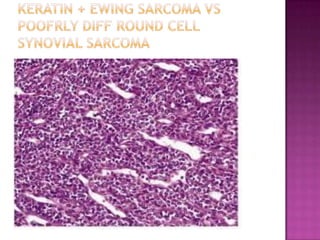
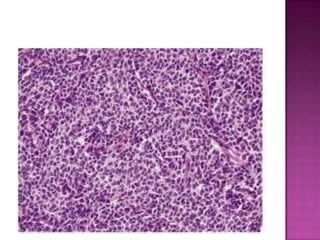
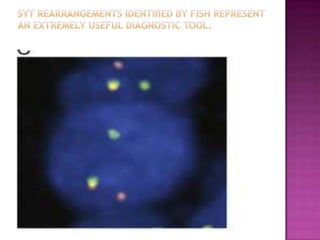
 The demonstration by FISH of
EWSR1,SS18, and FOXO1 rearrangements in
EWS, PDSS, and
ARMS, respectively, or, alternatively, of
specific chimerical transcriptsby PCR-based
techniques is of great help for achieving
acorrect diagnosis.
EWSR1 FISH results need to be
interpreted in context with
morphology and IHC findings.
 Sub classification is very important.
 myogenic differentiation in pleomorphic
sarcomas is associated with a less favorable
outcome.
 Another important point is the
distinction, among retroper-itoneal
sarcomas, of dedifferentiated
liposarcoma (DDLPS) from other
pleomorphic sarcomas, most often
pleomorphic leiomyosarcoma.
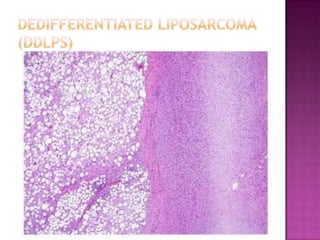
 The recognition of DDLPS is based on the
identification of a well-differentiated
lipogenic component associated with a high-
grade, most often non-lipogenic, sarcoma.
 Core biopsies usedfor diagnostic purposes
may leave the lipogenic component
unsampled.
 DDLPS exhibit better out- comes when
compared to other pleomorphic
sarcomas, and its accurate recognition may
lead to adopt a more aggressive surgical
strategy. (Locally aggressive)
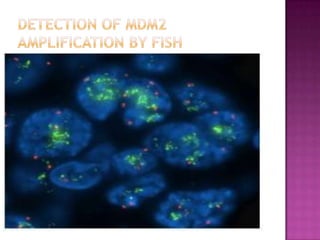
 Detection of MDM2 amplification by FISH or
quantitative RT-PCR certainly represents a useful
diagnostic adjunct.
 The MDM2 gene (as well as CDK4 and HMGA2) maps at
the 13q12–15 chromosome region and is amplified in
both well-differentiated and dedifferentiated
liposarcomas.
 MDM2 testing is also potentially useful in
distinguishing between myxoid liposar-coma (MDM2
negative) and WD/DDPLS with myxoid change.
 The separation of the two conditions again allows
adoption of proper treatment in consideration of the
high sensitivity of myxoid liposarcoma to the marine-
derived alkaloid named trabectedin.
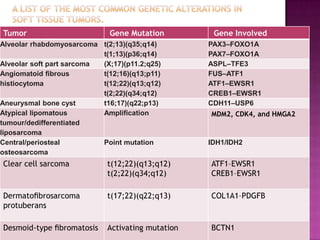
Tumor Gene Mutation Gene Involved
Alveolar rhabdomyosarcoma t(2;13)(q35;q14)
t(1;13)(p36;q14)
PAX3–FOXO1A
PAX7–FOXO1A
Alveolar soft part sarcoma (X;17)(p11.2;q25) ASPL–TFE3
Angiomatoid fibrous
histiocytoma
t(12;16)(q13;p11)
t(12;22)(q13;q12)
t(2;22)(q34;q12)
FUS–ATF1
ATF1–EWSR1
CREB1–EWSR1
Aneurysmal bone cyst t16;17)(q22;p13) CDH11–USP6
Atypical lipomatous
tumour/dedifferentiated
liposarcoma
Amplification MDM2, CDK4, and HMGA2
Central/periosteal
osteosarcoma
Point mutation IDH1/IDH2
Clear cell sarcoma t(12;22)(q13;q12)
t(2;22)(q34;q12)
ATF1–EWSR1
CREB1–EWSR1
Dermatofibrosarcoma
protuberans
t(17;22)(q22;q13) COL1A1–PDGFB
Desmoid-type fibromatosis Activating mutation BCTN1
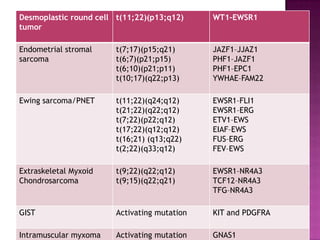
Desmoplastic round cell
tumor
t(11;22)(p13;q12) WT1–EWSR1
Endometrial stromal
sarcoma
t(7;17)(p15;q21)
t(6;7)(p21;p15)
t(6;10)(p21;p11)
t(10;17)(q22;p13)
JAZF1–JJAZ1
PHF1–JAZF1
PHF1–EPC1
YWHAE–FAM22
Ewing sarcoma/PNET t(11;22)(q24;q12)
t(21;22)(q22;q12)
t(7;22)(p22;q12)
t(17;22)(q12;q12)
t(16;21) (q13;q22)
t(2;22)(q33;q12)
EWSR1–FLI1
EWSR1–ERG
ETV1–EWS
EIAF–EWS
FUS–ERG
FEV–EWS
Extraskeletal Myxoid
Chondrosarcoma
t(9;22)(q22;q12)
t(9;15)(q22;q21)
EWSR1–NR4A3
TCF12–NR4A3
TFG–NR4A3
GIST Activating mutation KIT and PDGFRA
Intramuscular myxoma Activating mutation GNAS1
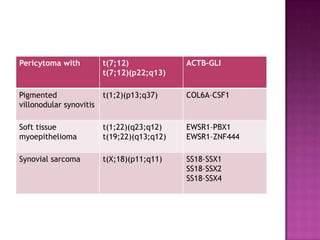
Pericytoma with t(7;12)
t(7;12)(p22;q13)
ACTB–GLI
Pigmented
villonodular synovitis
t(1;2)(p13;q37) COL6A–CSF1
Soft tissue
myoepithelioma
t(1;22)(q23;q12)
t(19;22)(q13;q12)
EWSR1–PBX1
EWSR1–ZNF444
Synovial sarcoma t(X;18)(p11;q11) SS18–SSX1
SS18–SSX2
SS18–SSX4
 The combination of morphological criteria
and genetics validates the recognition of rare

diseases even when arising at non-canonical

anatomic locations.
 This is particularly true for referral centers
wherein challenging cases tend inevitably to
concentrate.
 Molecular genetics has greatly
 Contributed to the identification of primary
Ewing sarcoma of the skin, kidney, and dura
mater, as well as of viscerally located
synovial sarcomas.
 Morphological appearance of mesenchymal
lesions does not always reflect the clinical
behavior.
 The distinction of sarcomas from benign
mimics most often relies on morphology.
 In a minority of cases molecular genetics may
also prove diagnostically helpful.
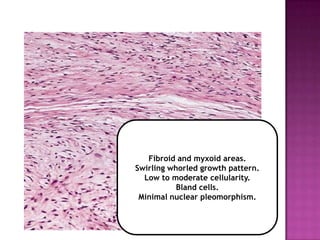
Fibroid and myxoid areas.
Swirling whorled growth pattern.
Low to moderate cellularity.
Bland cells.
Minimal nuclear pleomorphism.
 Deceptively bland-looking spindle cell
mesenchymal malignancY with an aggressive
clinical behavior.
 The differential diagnosis of LGFMS includes
benign lesions such as
perineurioma, neurofibroma, cellular
myxoma, and nodular fasciitis, as well locally
aggressive neoplasms such as desmoid
fibromatosis.
MUC4 expression is
regarded as key
diagnostic feature.
Identification of FUS
rearrangement via FISH
or identification of
FUS-CREB3L2 transcript
via PCR is very useful.
B- Catenin
Several attempts have been made to
determine the prognostic value of
molecular genetic findings.
Focused on Ewing sarcoma, alveolar
rhabdomyosarcoma, and synovial
sarcoma.
 No meaningful molecular prognostic
stratification can be foreseen for
now.
A notable exception is represented by
a molecular signature named
CINSARC, which allows better
separation of grade 2 sarcomas. This
attempt is based on the use of a
complex technique (CGH-array) and
requires availability of fresh
material, which hampers a large scale
clinical application of CINSARC.
 Type of mutations involving both the KIT and
PDGFRA genes are associated with distinctive
outcomes.
 Deletions occurring at the exon 11 of the KIT
gene are associated with more aggressive
disease, whereas mutations of exon 18 of the
PDGFRA gene generally identify a more
indolent clinical course.
 Distinct mutation types in GIST reflect
different objective response rates (greater
for KIT exon 11 mutation and much lower for
so-called wild-type GIST).
 presence of specific mutations in the exon 18
of the PDGFRA gene (D842V) predict primary
resistance to tyrosine kinase inhibitors.
Molecular assessement in GIST
assumes a central role in clinical
decision making.
The identification of the two specific
fusion products of CHOP/DDIT3 gene
with FUS and more rarely with
EWSR1 is extremely helpful in
distinguishing challenging examples
of myxoid liposarcoma from other
myxoid sarcomas and therefore to
apply the adequate therapeutic
regimen.
 Another examples is use of crizotinib in
inflammatory myofibroblastic tumors wherein
assessment of the ALK gene may represent an
important diagnostic confirmatory finding as
well as a key biomarker of prediction.
Molecular Genetics represents the
most valuable tool to identify and
validate new therapeutic targets.
Good examples are represented
by MDM2, amplified in
dedifferentiated liposarcoma
and potentially targetable by
Nutlin-A3, the mTOR pathway in
malignant PEComa and
lymphangioleiomyomatosis, PDG
FB in DFSP, and KDR in
angiosarcoma.
Promiscuity
 Molecular pathology/genetics does not
represent an alternative but a complement
to surgical diagnostic pathology.
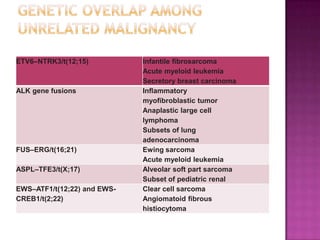
 Considering the degree of molecular
promiscuity of EWSR1 gene aberrations, the
results of FISH analysis need to be
mandatorily evaluated in context with
morphology as EWSR1 aberrations are
described in a variety of unrelated entities.
ETV6–NTRK3/t(12;15) Infantile fibrosarcoma
Acute myeloid leukemia
Secretory breast carcinoma
ALK gene fusions Inflammatory
myofibroblastic tumor
Anaplastic large cell
lymphoma
Subsets of lung
adenocarcinoma
FUS–ERG/t(16;21) Ewing sarcoma
Acute myeloid leukemia
ASPL–TFE3/t(X;17) Alveolar soft part sarcoma
Subset of pediatric renal
EWS–ATF1/t(12;22) and EWS-
CREB1/t(2;22)
Clear cell sarcoma
Angiomatoid fibrous
histiocytoma
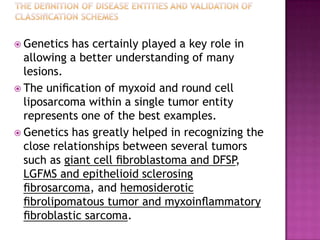
 Genetics has certainly played a key role in
allowing a better understanding of many
lesions.
 The unification of myxoid and round cell
liposarcoma within a single tumor entity
represents one of the best examples.
 Genetics has greatly helped in recognizing the
close relationships between several tumors
such as giant cell fibroblastoma and DFSP,
LGFMS and epithelioid sclerosing
fibrosarcoma, and hemosiderotic
fibrolipomatous tumor and myxoinflammatory
fibroblastic sarcoma.
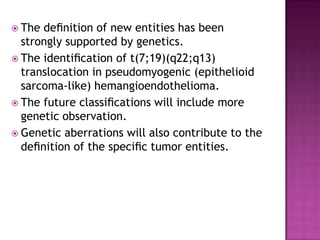
 The definition of new entities has been
strongly supported by genetics.
 The identification of t(7;19)(q22;q13)
translocation in pseudomyogenic (epithelioid
sarcoma-like) hemangioendothelioma.
 The future classifications will include more
genetic observation.
 Genetic aberrations will also contribute to the
definition of the specific tumor entities.
The marriage between
Pathology and Genetics
not only proved to be
fruitful but also to be
stable.
Molecular genetics in soft tissue

Molecular genetics in soft tissue

  • 1.
     Special thanksto my resident Dr Babar Yasin for preparing the presentation  ADAPTED FROM THE ABOVE ARTICLE FROM Seminar in diagnostics Pathology 30 (2013) 375-381  Angelo P. Dei Tos, MD  Department of Pathology, Treviso General Hospital, Piazza Ospedale,1 31100 Treviso, Italy
  • 2.
    The marriage ofMolecular Genetics and soft tissue Pathology.
  • 3.
     More accuratedefinition of disease entities and validation of classification schemes.  Improved diagnostic accuracy.  Identification of molecular predictive and prognostic markers.  Discovery and validation of therapeutic molecular targets.
  • 4.
     Nucleic acids(RNA and DNA), either via hybridization on a slide(i.e., fluorescent in situ hybridization—FISH) OR  On isolated DNA or RNA via polymerase chain reaction (PCR) techniques (i.e.,reverse transcriptase PCR and quantitative PCR)It is MANDAOTORY that the results get interpreted in context with morphology.  Genetic assessement is an important ADJUNCT not a replacement to conventional morphological tools.
  • 5.
    Soft tissue tumorsare heterogeneous group of neoplasm which can be :  Benign  Boderline  Malignant Challenge for Pathologists Diagnostic inaccuracy affects the treatment and development of new drugs as clinical trials depend upon tumor classification.
  • 6.
     Rare groupof diseases (< 2% of all cancers)  Extremely heterogenous. Over 100 subtypes are being described.  Usual features of malignancy (?) are not always applicable to these. Histologically worrisome leisons may actually be benign e.g. Nodular fascitis Cytollogically innocent neoplasm may behave aggressively e.g. Low-Grade Fibromyxoid Sarcoma.
  • 7.
     Distinguishing specificsubtypes of sarcomas.  Supporting diagnosis in non-canonical clinical presentations.  Distinguishing sarcomas from benign mimickers.
  • 8.
     Molecular geneticshas proved diagnostically useful in two relatively large groups of mesenchymal malignancies: round cell sarcomas and pleomorphic sarcomas. Round cell sarcomas include :  Ewing sarcoma  Desmo-plastic small round cell tumor  Alveolar rhabdomyo-sarcoma  Poorly differentiated round cell synovial sarcoma  Mesenchymal chondrosarcoma  Minority of cases of round cell liposarcoma Distinction is crucial because the therapeutic approach differs.
  • 12.
     The demonstrationby FISH of EWSR1,SS18, and FOXO1 rearrangements in EWS, PDSS, and ARMS, respectively, or, alternatively, of specific chimerical transcriptsby PCR-based techniques is of great help for achieving acorrect diagnosis. EWSR1 FISH results need to be interpreted in context with morphology and IHC findings.
  • 13.
     Sub classificationis very important.  myogenic differentiation in pleomorphic sarcomas is associated with a less favorable outcome.  Another important point is the distinction, among retroper-itoneal sarcomas, of dedifferentiated liposarcoma (DDLPS) from other pleomorphic sarcomas, most often pleomorphic leiomyosarcoma.
  • 15.
     The recognitionof DDLPS is based on the identification of a well-differentiated lipogenic component associated with a high- grade, most often non-lipogenic, sarcoma.  Core biopsies usedfor diagnostic purposes may leave the lipogenic component unsampled.  DDLPS exhibit better out- comes when compared to other pleomorphic sarcomas, and its accurate recognition may lead to adopt a more aggressive surgical strategy. (Locally aggressive)
  • 16.
     Detection ofMDM2 amplification by FISH or quantitative RT-PCR certainly represents a useful diagnostic adjunct.  The MDM2 gene (as well as CDK4 and HMGA2) maps at the 13q12–15 chromosome region and is amplified in both well-differentiated and dedifferentiated liposarcomas.  MDM2 testing is also potentially useful in distinguishing between myxoid liposar-coma (MDM2 negative) and WD/DDPLS with myxoid change.  The separation of the two conditions again allows adoption of proper treatment in consideration of the high sensitivity of myxoid liposarcoma to the marine- derived alkaloid named trabectedin.
  • 18.
    Tumor Gene MutationGene Involved Alveolar rhabdomyosarcoma t(2;13)(q35;q14) t(1;13)(p36;q14) PAX3–FOXO1A PAX7–FOXO1A Alveolar soft part sarcoma (X;17)(p11.2;q25) ASPL–TFE3 Angiomatoid fibrous histiocytoma t(12;16)(q13;p11) t(12;22)(q13;q12) t(2;22)(q34;q12) FUS–ATF1 ATF1–EWSR1 CREB1–EWSR1 Aneurysmal bone cyst t16;17)(q22;p13) CDH11–USP6 Atypical lipomatous tumour/dedifferentiated liposarcoma Amplification MDM2, CDK4, and HMGA2 Central/periosteal osteosarcoma Point mutation IDH1/IDH2 Clear cell sarcoma t(12;22)(q13;q12) t(2;22)(q34;q12) ATF1–EWSR1 CREB1–EWSR1 Dermatofibrosarcoma protuberans t(17;22)(q22;q13) COL1A1–PDGFB Desmoid-type fibromatosis Activating mutation BCTN1
  • 19.
    Desmoplastic round cell tumor t(11;22)(p13;q12)WT1–EWSR1 Endometrial stromal sarcoma t(7;17)(p15;q21) t(6;7)(p21;p15) t(6;10)(p21;p11) t(10;17)(q22;p13) JAZF1–JJAZ1 PHF1–JAZF1 PHF1–EPC1 YWHAE–FAM22 Ewing sarcoma/PNET t(11;22)(q24;q12) t(21;22)(q22;q12) t(7;22)(p22;q12) t(17;22)(q12;q12) t(16;21) (q13;q22) t(2;22)(q33;q12) EWSR1–FLI1 EWSR1–ERG ETV1–EWS EIAF–EWS FUS–ERG FEV–EWS Extraskeletal Myxoid Chondrosarcoma t(9;22)(q22;q12) t(9;15)(q22;q21) EWSR1–NR4A3 TCF12–NR4A3 TFG–NR4A3 GIST Activating mutation KIT and PDGFRA Intramuscular myxoma Activating mutation GNAS1
  • 20.
    Pericytoma with t(7;12) t(7;12)(p22;q13) ACTB–GLI Pigmented villonodularsynovitis t(1;2)(p13;q37) COL6A–CSF1 Soft tissue myoepithelioma t(1;22)(q23;q12) t(19;22)(q13;q12) EWSR1–PBX1 EWSR1–ZNF444 Synovial sarcoma t(X;18)(p11;q11) SS18–SSX1 SS18–SSX2 SS18–SSX4
  • 21.
     The combinationof morphological criteria and genetics validates the recognition of rare diseases even when arising at non-canonical anatomic locations.  This is particularly true for referral centers wherein challenging cases tend inevitably to concentrate.  Molecular genetics has greatly  Contributed to the identification of primary Ewing sarcoma of the skin, kidney, and dura mater, as well as of viscerally located synovial sarcomas.
  • 22.
     Morphological appearanceof mesenchymal lesions does not always reflect the clinical behavior.  The distinction of sarcomas from benign mimics most often relies on morphology.  In a minority of cases molecular genetics may also prove diagnostically helpful.
  • 23.
    Fibroid and myxoidareas. Swirling whorled growth pattern. Low to moderate cellularity. Bland cells. Minimal nuclear pleomorphism.
  • 24.
     Deceptively bland-lookingspindle cell mesenchymal malignancY with an aggressive clinical behavior.  The differential diagnosis of LGFMS includes benign lesions such as perineurioma, neurofibroma, cellular myxoma, and nodular fasciitis, as well locally aggressive neoplasms such as desmoid fibromatosis. MUC4 expression is regarded as key diagnostic feature. Identification of FUS rearrangement via FISH or identification of FUS-CREB3L2 transcript via PCR is very useful. B- Catenin
  • 25.
    Several attempts havebeen made to determine the prognostic value of molecular genetic findings. Focused on Ewing sarcoma, alveolar rhabdomyosarcoma, and synovial sarcoma.  No meaningful molecular prognostic stratification can be foreseen for now.
  • 26.
    A notable exceptionis represented by a molecular signature named CINSARC, which allows better separation of grade 2 sarcomas. This attempt is based on the use of a complex technique (CGH-array) and requires availability of fresh material, which hampers a large scale clinical application of CINSARC.
  • 27.
     Type ofmutations involving both the KIT and PDGFRA genes are associated with distinctive outcomes.  Deletions occurring at the exon 11 of the KIT gene are associated with more aggressive disease, whereas mutations of exon 18 of the PDGFRA gene generally identify a more indolent clinical course.
  • 28.
     Distinct mutationtypes in GIST reflect different objective response rates (greater for KIT exon 11 mutation and much lower for so-called wild-type GIST).  presence of specific mutations in the exon 18 of the PDGFRA gene (D842V) predict primary resistance to tyrosine kinase inhibitors. Molecular assessement in GIST assumes a central role in clinical decision making.
  • 29.
    The identification ofthe two specific fusion products of CHOP/DDIT3 gene with FUS and more rarely with EWSR1 is extremely helpful in distinguishing challenging examples of myxoid liposarcoma from other myxoid sarcomas and therefore to apply the adequate therapeutic regimen.
  • 30.
     Another examplesis use of crizotinib in inflammatory myofibroblastic tumors wherein assessment of the ALK gene may represent an important diagnostic confirmatory finding as well as a key biomarker of prediction. Molecular Genetics represents the most valuable tool to identify and validate new therapeutic targets.
  • 31.
    Good examples arerepresented by MDM2, amplified in dedifferentiated liposarcoma and potentially targetable by Nutlin-A3, the mTOR pathway in malignant PEComa and lymphangioleiomyomatosis, PDG FB in DFSP, and KDR in angiosarcoma.
  • 32.
  • 33.
     Molecular pathology/geneticsdoes not represent an alternative but a complement to surgical diagnostic pathology.  Considering the degree of molecular promiscuity of EWSR1 gene aberrations, the results of FISH analysis need to be mandatorily evaluated in context with morphology as EWSR1 aberrations are described in a variety of unrelated entities.
  • 34.
    ETV6–NTRK3/t(12;15) Infantile fibrosarcoma Acutemyeloid leukemia Secretory breast carcinoma ALK gene fusions Inflammatory myofibroblastic tumor Anaplastic large cell lymphoma Subsets of lung adenocarcinoma FUS–ERG/t(16;21) Ewing sarcoma Acute myeloid leukemia ASPL–TFE3/t(X;17) Alveolar soft part sarcoma Subset of pediatric renal EWS–ATF1/t(12;22) and EWS- CREB1/t(2;22) Clear cell sarcoma Angiomatoid fibrous histiocytoma
  • 35.
     Genetics hascertainly played a key role in allowing a better understanding of many lesions.  The unification of myxoid and round cell liposarcoma within a single tumor entity represents one of the best examples.  Genetics has greatly helped in recognizing the close relationships between several tumors such as giant cell fibroblastoma and DFSP, LGFMS and epithelioid sclerosing fibrosarcoma, and hemosiderotic fibrolipomatous tumor and myxoinflammatory fibroblastic sarcoma.
  • 36.
     The definitionof new entities has been strongly supported by genetics.  The identification of t(7;19)(q22;q13) translocation in pseudomyogenic (epithelioid sarcoma-like) hemangioendothelioma.  The future classifications will include more genetic observation.  Genetic aberrations will also contribute to the definition of the specific tumor entities.
  • 37.
    The marriage between Pathologyand Genetics not only proved to be fruitful but also to be stable.