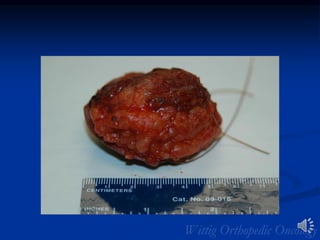
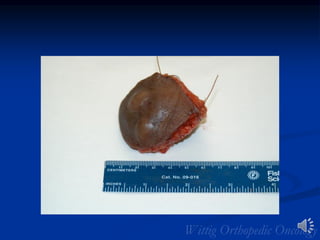
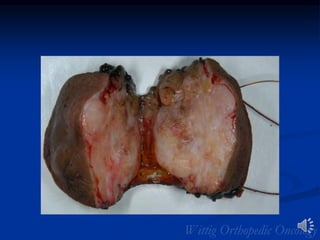
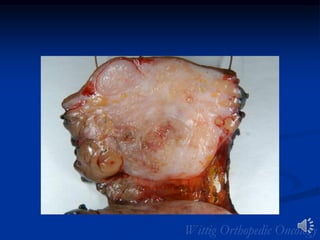
Soft Tissue Sarcomas
Liposarcoma, MFH/UPS, Synovial Sarcoma,
Fibrosarcoma, Rhabdomyosarcoma
Leiomyosarcoma
James C. Wittig, MD
Orthopedic Oncologist
Sarcoma Surgeon
www.TumorSurgery.org
Malignant Soft Tissue Tumors
• MFH #1
• Liposarcoma #2
• Leiomyosarcoma #3
• Synovial Sarcoma
• Fibrosarcoma
• Rhabdomyosarcoma
• Epithelioid Sarcoma
• Malignant Peripheral Nerve Sheath Tumor
• Extraskeletal Osteosarcoma, Ewings, Chondrosarcoma
Malignant Soft Tissue Tumors
• Presenting Ages:
• All soft tissue sarcomas primarily affect adults 40-70
years of age except
• Rhabdomyosarcoma—Children up to 20
• Synovial Sarcoma– young adults and teenagers (15 to
35 years of age
Malignant Soft Tissue Tumors
• Usually Painless mass except synovial sarcoma
• Other painful benign masses:
• Hemangioma
• Fibromatosis mildly painful
• Schwannoma
• Angiolipoma
• MRI Appearance Sarcomas:
• Nonspecific heterogeneous soft tissue mass on T1,
T2 except
• Well Differentiated Liposarcoma
• Myxoid Tumors: Liposarcoma, MFH
Malignant Soft Tissue Tumors
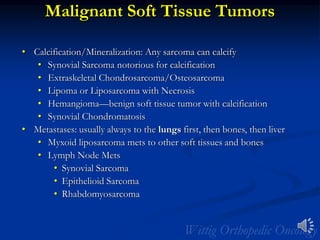
• Calcification/Mineralization: Any sarcoma can calcify
• Synovial Sarcoma notorious for calcification
• Extraskeletal Chondrosarcoma/Osteosarcoma
• Lipoma or Liposarcoma with Necrosis
• Hemangioma—benign soft tissue tumor with calcification
• Synovial Chondromatosis
• Metastases: usually always to the lungs first, then bones, then liver
• Myxoid liposarcoma mets to other soft tissues and bones
• Lymph Node Mets
• Synovial Sarcoma
• Epithelioid Sarcoma
• Rhabdomyosarcoma
Malignant Soft Tissue Tumors
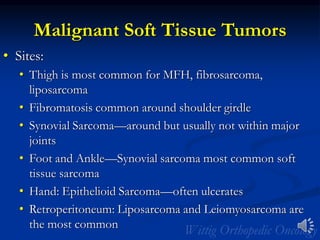
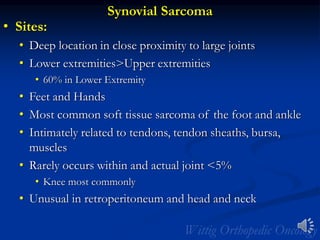
• Sites:
• Thigh is most common for MFH, fibrosarcoma,
liposarcoma
• Fibromatosis common around shoulder girdle
• Synovial Sarcoma—around but usually not within major
joints
• Foot and Ankle—Synovial sarcoma most common soft
tissue sarcoma
• Hand: Epithelioid Sarcoma—often ulcerates
• Retroperitoneum: Liposarcoma and Leiomyosarcoma are
the most common
Malignant Soft Tissue Tumors
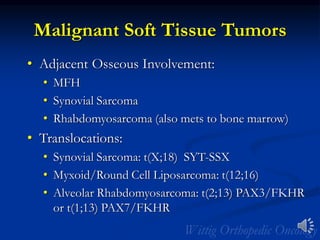
• Adjacent Osseous Involvement:
• MFH
• Synovial Sarcoma
• Rhabdomyosarcoma (also mets to bone marrow)
• Translocations:
• Synovial Sarcoma: t(X;18) SYT-SSX
• Myxoid/Round Cell Liposarcoma: t(12;16)
• Alveolar Rhabdomyosarcoma: t(2;13) PAX3/FKHR
or t(1;13) PAX7/FKHR
Malignant Soft Tissue Tumors
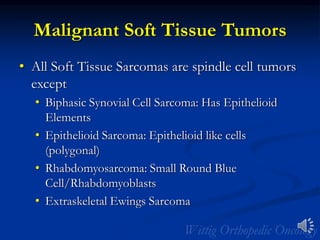
• All Soft Tissue Sarcomas are spindle cell tumors
except
• Biphasic Synovial Cell Sarcoma: Has Epithelioid
Elements
• Epithelioid Sarcoma: Epithelioid like cells
(polygonal)
• Rhabdomyosarcoma: Small Round Blue
Cell/Rhabdomyoblasts
• Extraskeletal Ewings Sarcoma
Malignant Soft Tissue Tumors
• Immunohistochemistry:
• Vimentin: All sarcomas are Vimentin Positive
• Cytokeratin: All Carcinomas are Cytokeratin Positive
• Synovial Sarcoma: Vimentin & Cytokeratin, EMA Pos
• Epithelioid Sarcoma: Vimentin & Cytokeratin, EMA Pos
• MPNST: Diffuse S-100+; Neurofibromatosis; Nerve Origin
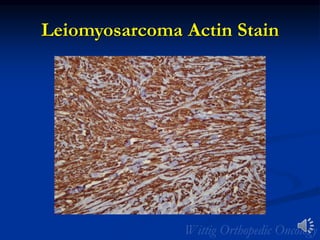
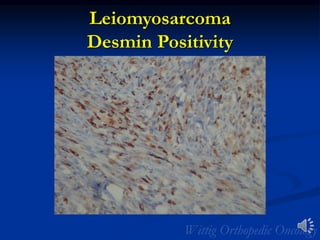
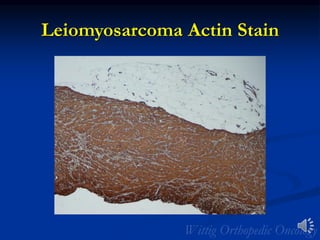
• Leiomyosarcoma: Strong Actin Pos; Desmin Pos also
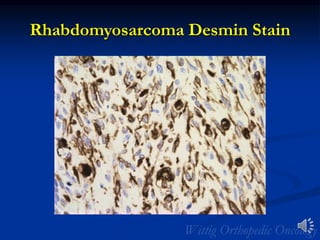
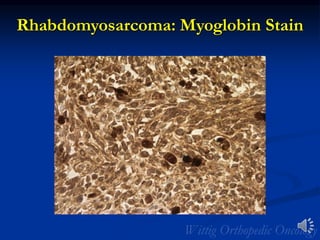
• Rhabdomyosarcoma:+ Desmin, Actin, MyoD1, Myoglobin
• Also translocation, young age, rhabdomyoblasts, cross
striations
• MFH and Fibrosarcoma: No special differentiation
• (myofibroblasts in MFH show scant and scattered Actin+)
Malignant Soft Tissue Tumors
• Most High Grade Sarcomas of an extremity present >5cm
and Deep to Fascia, No mets (stage III AJC classification)
Stage IV is with mets anywhere
• Treatment:
• Wide excision and radiation
• Chemotherapy for Rhabdomyosarcoma in children and
synovial sarcomas in young age groups
• Very General Survival Data:
• 60-65% 5 year survival for nonmetastatic soft tissue
sarcomas
• 15% 5 year survival for pts with resectable mets to lungs
Liposarcoma
• 2nd most common ST sarcoma after MFH
• Adult tumor: 40-70 years of age
• Extremely rare in children/adolescents
• Extremities (thigh)
• Retroperitoneum
• Trunk
Liposarcoma Subtypes
• Well-differentiated (atypical lipoma)
• Myxoid
• Round cell (poorly diff./hypercellular)
• Pleomorphic
• Dedifferentiated
• Well-differentiated liposarcoma demonstrating
an area of poorly differentiated tissue
Liposarcoma Imaging
• Intermuscular location more common
• The more well-differentiated the lesion, the
more fat it will appear to have
• WDLS may have large adipose-containing
regions and thickened, nodular septations
• Fat more difficult to identify within other
variants but small scant amounts often present
Liposarcoma Variants
• Myxoid LS homogeneous and majority of lesion
follows fluid SI on all sequences
• Myxoid LS may be misinterpreted as a cyst
• Round cell/Pleomorphic LS more heterogeneous
• Dedifferentiated LS
• Look for focal nodular area of soft tissue within an
otherwise well-defined fatty mass
Low Grade Well Differentiated
Liposarcoma (Atypical Lipoma)
• Definition: Mature fat cells and almost always fibrous
or myxoid tissue.
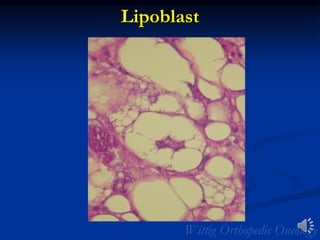
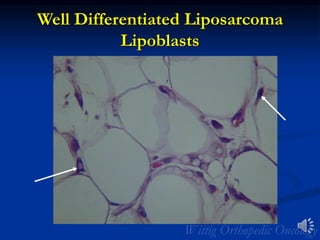
• Lipoblasts: Adipocytes have enlarged, irregular
hyperchromatic nuclei; scattered throughout tumor.
• Low grade malignant lesion
• Do not metastasize
• Grow slowly
• Potential to dedifferentiate into a high grade tumor that
can metastasize
• Higher potential for local recurrence than a lipoma
Lipoblast
Well Differentiated Liposarcoma
(Atypical Lipoma)
• Age: Adults (middle age to older adults)
• Sites:
• Intermuscular/Intermuscular most common
• Thigh: most common
• Arm
• Buttock
• Retroperitoneum
• Subcutaneous: rare
Well Differentiated Liposarcoma
(Atypical Lipoma)
• Clinical:
• Painless mass
• Soft to firm depending on amount of fibrous tissue
• Can grow very large
• Abdominal swelling—retroperitoneal tumors
Lipoma vs. WDLS
• Thickened septae WDLS
• Nodular/irregular/globular areas of nonadipose
tissue
• Associated nonadipose mass
• Total amount of nonadipose tissue >25%
• Marked enhancement of nonadipose portions
• Older patient/large size
Radiology
Well Differentiated Liposarcoma
• CT:
• Nonspecific soft tissue mass with fat and soft tissue
elements
• May enhance with contrast (lipomas do not enhance)
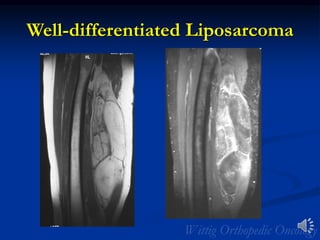
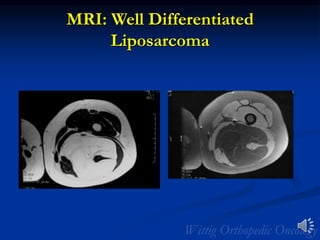
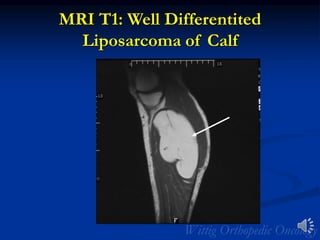
• MRI:
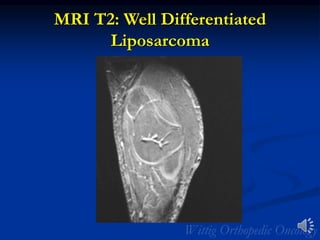
• Predominantly fat on all sequences (T1, T2) with
irregularly thickened linear or nodular septa
• The septa are low signal T1 (similar to muscle) and
high signal T2
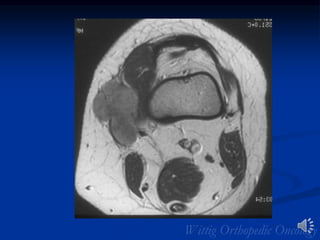
Well-differentiated Liposarcoma
MRI: Well Differentiated
Liposarcoma
Well-differentiated Liposarcoma
MRI T1: Well Differentited
Liposarcoma of Calf
MRI T2: Well Differentiated
Liposarcoma
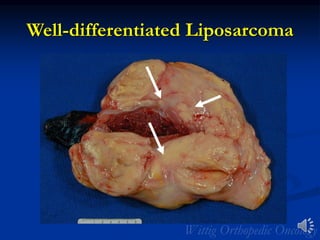
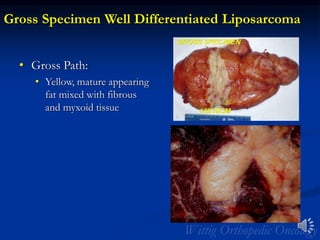
Gross Specimen Well Differentiated Liposarcoma
• Gross Path:
• Yellow, mature appearing
fat mixed with fibrous
and myxoid tissue
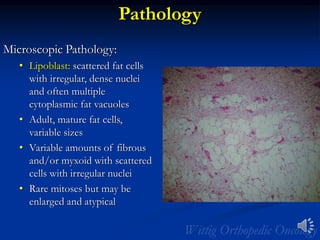
Pathology
Microscopic Pathology:
• Lipoblast: scattered fat cells
with irregular, dense nuclei
and often multiple
cytoplasmic fat vacuoles
• Adult, mature fat cells,
variable sizes
• Variable amounts of fibrous
and/or myxoid with scattered
cells with irregular nuclei
• Rare mitoses but may be
enlarged and atypical
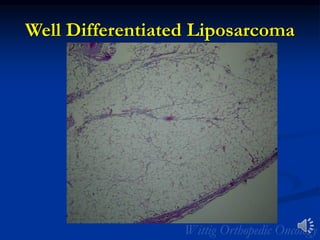
Well Differentiated Liposarcoma
Lipoblasts
Treatment and Prognosis
• Surgery: Wide surgical excision
• Does not metastasize: 100% 5 year survival
• Recurrence occurs 10-20% with intramuscular
tumors
• Recurrence depends on size of tumor and location
• May take years to recur (median time: 42 months)
• Dedifferentiation is a rare event but can occur
with recurrences
• MFH is most common dedifferentiated component
Myxoid Liposarcoma
• Definition: Variably cellular, fatty tumor that
contains small, uniform, “signet ring” lipogenic
tumor cells in a myxoid matrix
• The amount of adipose tissue may be scant
• Also contains small uniform non-fatty cells with
scant cytoplasm
• Arborizing capillaries
Myxoid Liposarcoma
• Myxoid liposarcoma and round cell liposarcoma
are a spectrum of the same type of tumor
• Round cell liposarcoma is a more cellular variant
of myxoid liposarcoma
• Same Chromosomal Translocation
t(12;16)(q13;p11)
• Round cell liposarcoma is high grade and has
greater metastatic potential
• Myxoid liposarcomas can have round cell
components. If greater than 25% higher metastatic
potential
Myxoid Liposarcoma
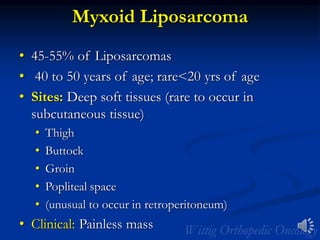
• 45-55% of Liposarcomas
• 40 to 50 years of age; rare<20 yrs of age
• Sites: Deep soft tissues (rare to occur in
subcutaneous tissue)
• Thigh
• Buttock
• Groin
• Popliteal space
• (unusual to occur in retroperitoneum)
• Clinical: Painless mass
Radiology
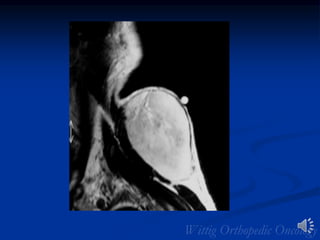
Myxoid Liposarcoma
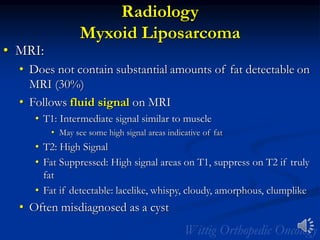
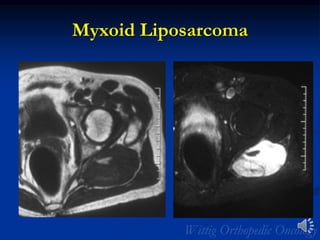
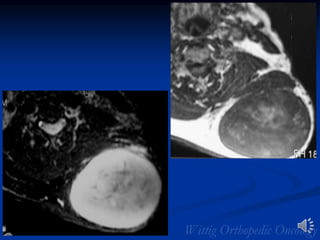
• MRI:
• Does not contain substantial amounts of fat detectable on
MRI (30%)
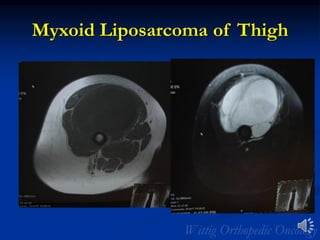
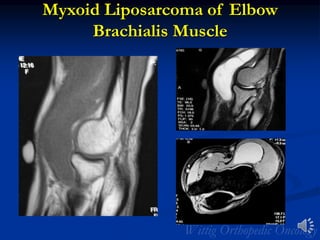
• Follows fluid signal on MRI
• T1: Intermediate signal similar to muscle
• May see some high signal areas indicative of fat
• T2: High Signal
• Fat Suppressed: High signal areas on T1, suppress on T2 if truly
fat
• Fat if detectable: lacelike, whispy, cloudy, amorphous, clumplike
• Often misdiagnosed as a cyst
Myxoid Liposarcoma
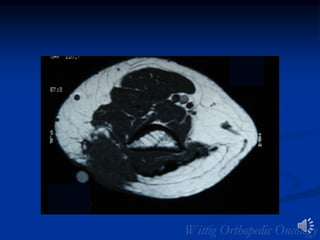
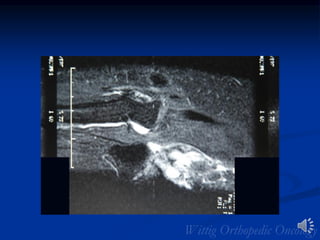
Myxoid Liposarcoma of Thigh
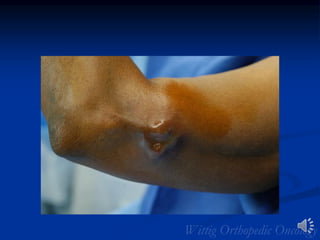
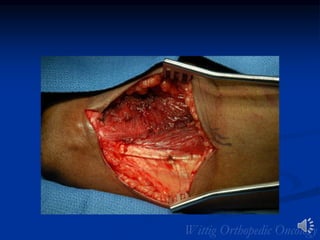
Myxoid Liposarcoma of Elbow
Brachialis Muscle
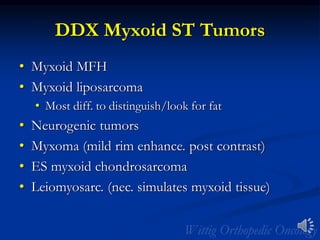
DDX Myxoid ST Tumors
• Myxoid MFH
• Myxoid liposarcoma
• Most diff. to distinguish/look for fat
• Neurogenic tumors
• Myxoma (mild rim enhance. post contrast)
• ES myxoid chondrosarcoma
• Leiomyosarc. (nec. simulates myxoid tissue)
Pathology
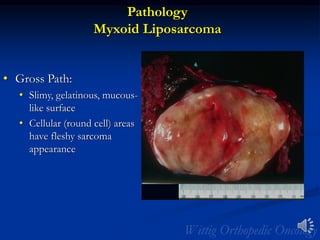
Myxoid Liposarcoma
• Gross Path:
• Slimy, gelatinous, mucous-
like surface
• Cellular (round cell) areas
have fleshy sarcoma
appearance
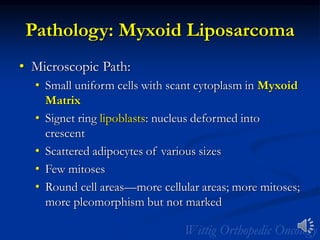
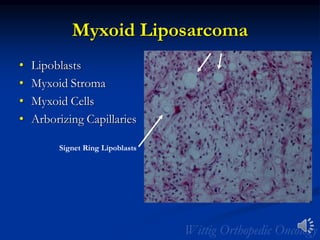
Pathology: Myxoid Liposarcoma
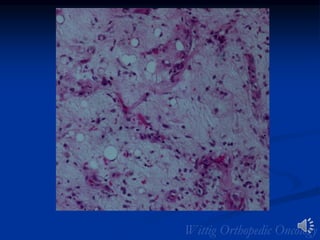
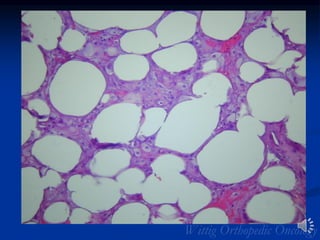
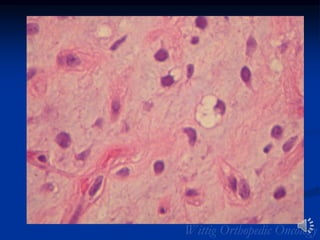
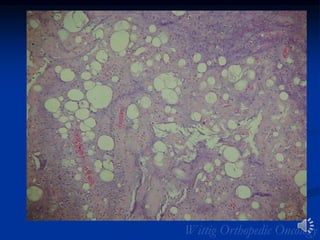
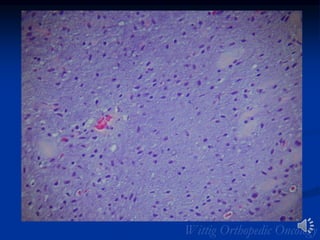
• Microscopic Path:
• Small uniform cells with scant cytoplasm in Myxoid
Matrix
• Signet ring lipoblasts: nucleus deformed into
crescent
• Scattered adipocytes of various sizes
• Few mitoses
• Round cell areas—more cellular areas; more mitoses;
more pleomorphism but not marked
Myxoid Liposarcoma
• Lipoblasts
• Myxoid Stroma
• Myxoid Cells
• Arborizing Capillaries
Signet Ring Lipoblasts
Treatment and Prognosis
• Surgery: Wide resection and postop radiation
• High rate of local recurrence without RT
• Myxoid Liposarcoma is a low to intermediate
grade tumor
• 88% 5 year survival for pure myxoid liposarcoma
• Rate of metastasis is related to proportion of
round cell component
• Unusual pattern of mets
• Distant soft tissues: Retroperitoneum, Mediastinum
• Spine
• Lungs
Malignant Fibrous Histiocytoma
(MFH)
• Definition: Pleomorphic, high grade, anaplastic
sarcoma composed of varying portions of
fibroblasts, myofibroblasts, histiocyte-like cells,
multinucleated giant cells and undifferentiated cells
• May have substantial myxoid components,
inflammatory tissue and giant cell rich areas
• No recognizable line of differentiation such as
smooth muscle, skeletal muscle, bone, cartilage,
fatty differentiation
Malignant Fibrous Histiocytoma
• Most common ST sarcoma (20-30% of all soft
tissue sarcomas)
• 70-75% occur in extremities/15% in RP
• Most common post XRT sarcoma (2/3)
• Occurs at sites of chronic ulcers and scars
• Association with shrapnel/total joint replacements
• Multiple subtypes
• Pleomorphic
• Myxoid
• Giant Cell Variant
• Inflammatory
Malignant Fibrous Histiocytoma
• Usually >50 years of age
• Rare in children
• Sites:
• Deep soft tissue; Intramuscular—most common
• Thigh
• Buttock
• Retroperitoneum
• Shoulder Girdle
• Calf
• Trunk
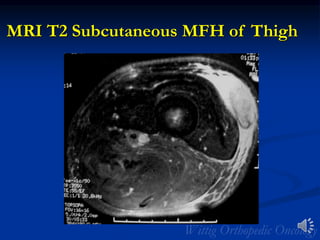
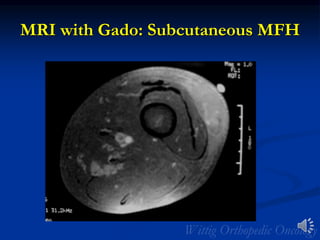
• Subcutaneous
Malignant Fibrous Histiocytoma
(MFH)
• Clinical:
• Painless mass
• Rarely fever, weight loss but very unusual
• Occasional leukocytosis, hypoglycemia and systemic
manifestations
Radiology
Malignant Fibrous Histiocytoma
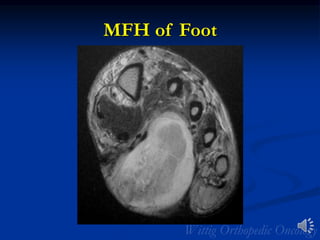
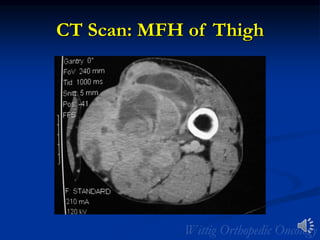
• Deep intramuscular mass (often adjacent to
diaphysis of long bones)
• Osseous involvement can occur (Xray or CT)
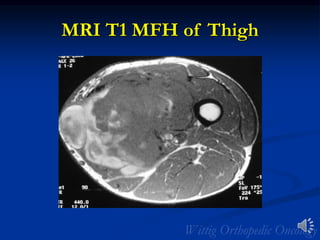
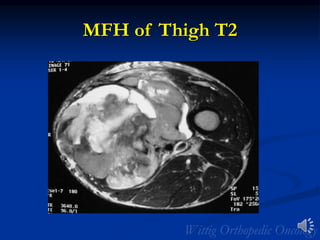
• MRI:
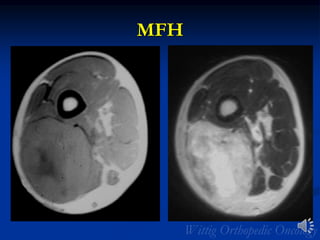
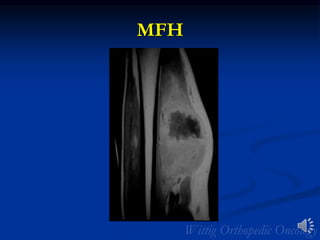
• Heterogeneous T1 and T2/large/lobulated/well-
defined
• Necrosis and hemorrhage
• Intermediate SI on T1
• Predominantly high SI on T2
• Viable areas enhance with contrast
Radiology
Malignant Fibrous Histiocytoma
• Peripheral pseudocapsule misleading
• Circumscribed appearance
• Myxoid variant very high signal on T2
• Myxoid variant may show peripheral and septal
or diffuse enhancement
• Look for fat to r/o liposarcoma
MFH
MFH
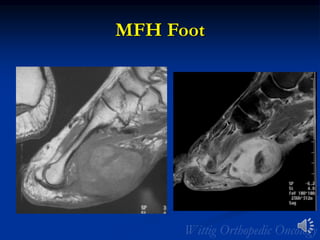
MFH Foot
MFH of Foot
MRI T1 MFH of Thigh
MFH of Thigh T2
CT Scan: MFH of Thigh
MRI T2 Subcutaneous MFH of Thigh
MRI with Gado: Subcutaneous MFH
Pathology
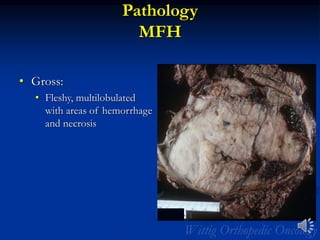
MFH
• Gross:
• Fleshy, multilobulated
with areas of hemorrhage
and necrosis
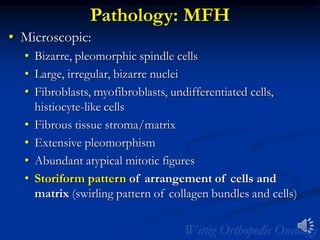
Pathology: MFH
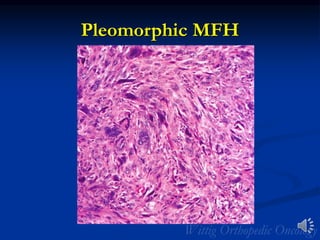
• Microscopic:
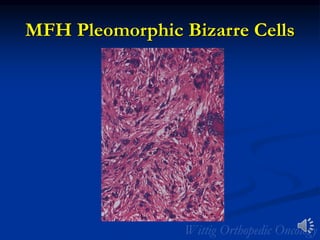
• Bizarre, pleomorphic spindle cells
• Large, irregular, bizarre nuclei
• Fibroblasts, myofibroblasts, undifferentiated cells,
histiocyte-like cells
• Fibrous tissue stroma/matrix
• Extensive pleomorphism
• Abundant atypical mitotic figures
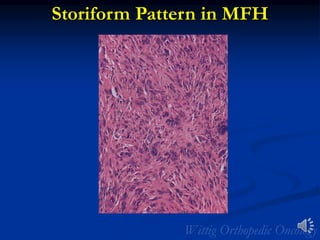
• Storiform pattern of arrangement of cells and
matrix (swirling pattern of collagen bundles and cells)
Pleomorphic MFH
Storiform Pattern in MFH
MFH Pleomorphic Bizarre Cells
Treatment and Prognosis
• Surgery:
• Wide surgical resection and postoperative radiation
whenever feasible
• Amputation for unresectable cases
• Metastases: 35%-45% of patients
• Lung (90%)
• Bone (8%)
• Liver (1%)
• Lymph Nodes (1%)
• Prognosis: Overall 65% 5 year survival
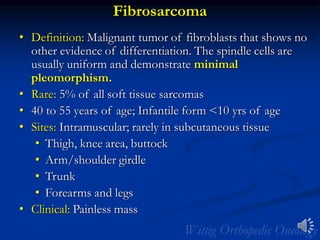
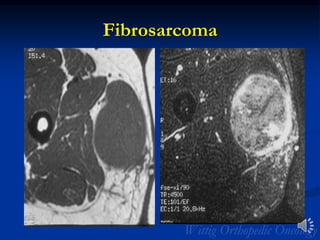
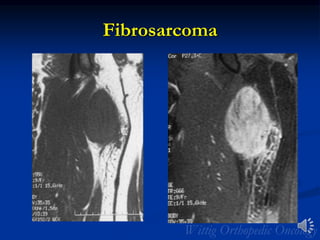
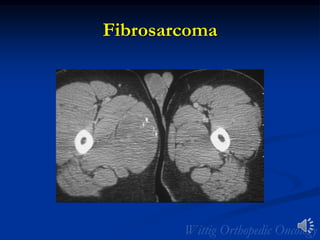
Fibrosarcoma
• Definition: Malignant tumor of fibroblasts that shows no
other evidence of differentiation. The spindle cells are
usually uniform and demonstrate minimal
pleomorphism.
• Rare: 5% of all soft tissue sarcomas
• 40 to 55 years of age; Infantile form <10 yrs of age
• Sites: Intramuscular; rarely in subcutaneous tissue
• Thigh, knee area, buttock
• Arm/shoulder girdle
• Trunk
• Forearms and legs
• Clinical: Painless mass
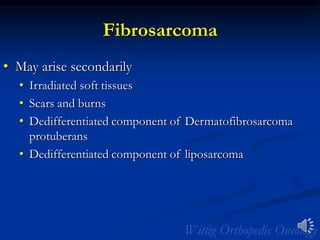
Fibrosarcoma
• May arise secondarily
• Irradiated soft tissues
• Scars and burns
• Dedifferentiated component of Dermatofibrosarcoma
protuberans
• Dedifferentiated component of liposarcoma
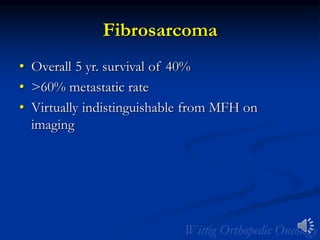
Fibrosarcoma
• Overall 5 yr. survival of 40%
• >60% metastatic rate
• Virtually indistinguishable from MFH on
imaging
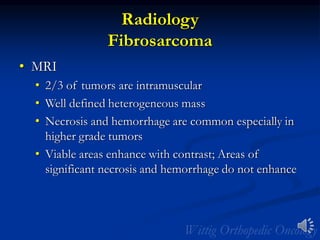
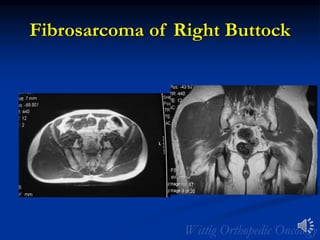
Radiology
Fibrosarcoma
• MRI
• 2/3 of tumors are intramuscular
• Well defined heterogeneous mass
• Necrosis and hemorrhage are common especially in
higher grade tumors
• Viable areas enhance with contrast; Areas of
significant necrosis and hemorrhage do not enhance
Fibrosarcoma
Fibrosarcoma
Fibrosarcoma
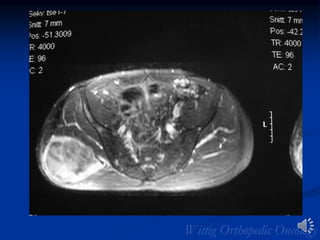
Fibrosarcoma of Right Buttock
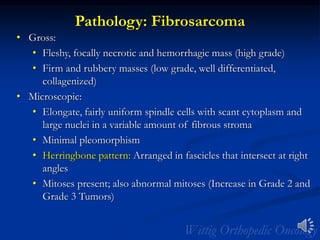
Pathology: Fibrosarcoma
• Gross:
• Fleshy, focally necrotic and hemorrhagic mass (high grade)
• Firm and rubbery masses (low grade, well differentiated,
collagenized)
• Microscopic:
• Elongate, fairly uniform spindle cells with scant cytoplasm and
large nuclei in a variable amount of fibrous stroma
• Minimal pleomorphism
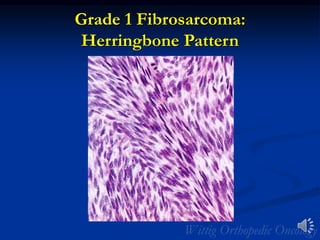
• Herringbone pattern: Arranged in fascicles that intersect at right
angles
• Mitoses present; also abnormal mitoses (Increase in Grade 2 and
Grade 3 Tumors)
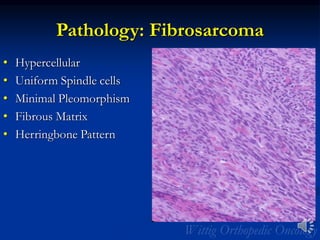
Pathology: Fibrosarcoma
• Hypercellular
• Uniform Spindle cells
• Minimal Pleomorphism
• Fibrous Matrix
• Herringbone Pattern
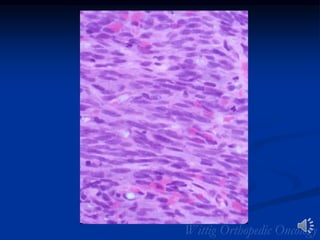
Grade 1 Fibrosarcoma:
Herringbone Pattern
Pathology: Fibrosarcoma
• Differential Diagnosis:
• Monophasic Synovial Sarcoma
• Cytokeratin or EMA (epithelial membrane antigen) positive
• Translocation tX;18 (90% of cases) SYT-SSX
• Leiomyosarcoma: Actin and Desmin Positive
• MPNST: S-100 positive
• Fibromatosis: Morphological features
Treatment and Prognosis
• Treatment: Wide surgical excision and postop
radiation whenever feasible
• Amputation for unresectable cases
• Metastases:
• Lungs
• Bone
• Liver
• Prognosis: 35% to 55% 5 year survival rate
• Related to grade, size and location
• Grade 1: Metastasize rarely
• Grade 2-3: Mets 35-45%
Synovial Sarcoma
• Definition: Typically a biphasic soft tissue
sarcoma with epithelial and spindle cell
components
• Monophasic, spindle cell only varieties, also exist
• Not of synovial origin
• 5-10% of all soft tissue sarcomas
• Young adults and teenagers (15 to 35 years of
age)
Synovial Sarcoma
• Sites:
• Deep location in close proximity to large joints
• Lower extremities>Upper extremities
• 60% in Lower Extremity
• Feet and Hands
• Most common soft tissue sarcoma of the foot and ankle
• Intimately related to tendons, tendon sheaths, bursa,
muscles
• Rarely occurs within and actual joint <5%
• Knee most commonly
• Unusual in retroperitoneum and head and neck
Synovial Sarcoma
• Males: females 1.2:1
• Predilection for white>black
• Clinical:
• Painful mass in greater than 50% of cases
• Slow growing mass
• May grow over a period of 2-4 years
Radiology
Synovial Sarcoma
• Radiographs:
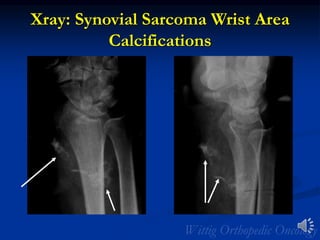
• Calcification in 20% of cases (Stippled or Large
Amounts)
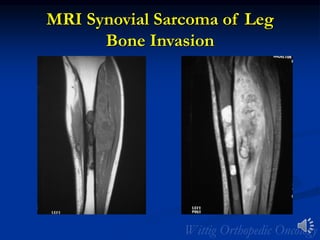
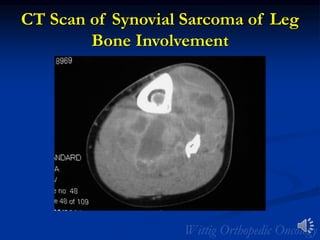
• Underlying bony invasion 10%-20% cases
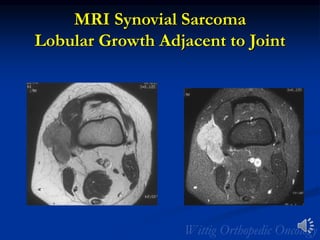
• CT:
• Lobular mass close to a joint
• Heterogeneous mass sometimes with calcification and
underlying bone erosion
• Detect subtle calcification
• MRI: Hemorrhage, necrosis and cystic change are
common
Radiology
Synovial Sarcoma
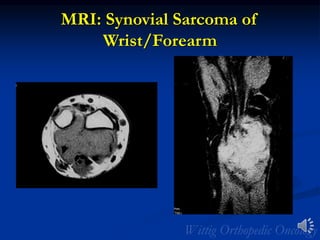
• MRI:
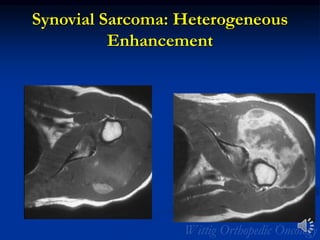
• Highly heterogeneous mass; Enhances heterogeneously
• Hemorrhage, necrosis and cystic change are common
• Lobular growth with internal septations
• T1: Intermediate signal similar to muscle
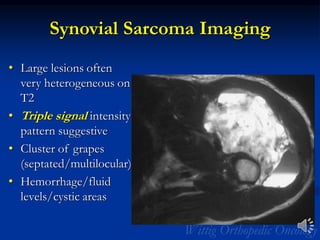
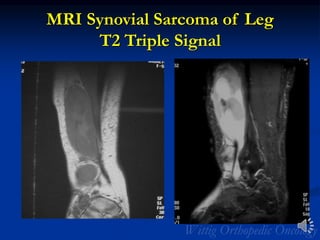
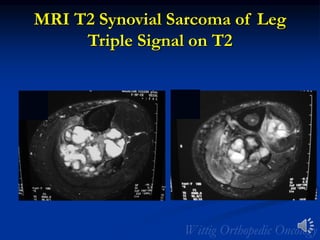
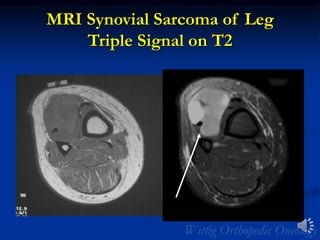
• T2: Triple Signal Intensity
• High, Low and Intermediate Signals
• Cyst, hemorrhage, solid elements, fibrous tissue in same tumor
• Fluid-Fluid levels in 25% of patients
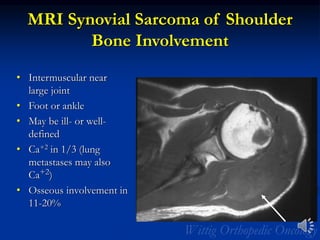
MRI Synovial Sarcoma of Shoulder
Bone Involvement
• Intermuscular near
large joint
• Foot or ankle
• May be ill- or well-
defined
• Ca+2 in 1/3 (lung
metastases may also
Ca+2)
• Osseous involvement in
11-20%
Synovial Sarcoma Imaging
• Large lesions often
very heterogeneous on
T2
• Triple signal intensity
pattern suggestive
• Cluster of grapes
(septated/multilocular)
• Hemorrhage/fluid
levels/cystic areas
Synovial Sarcoma: Heterogeneous
Enhancement
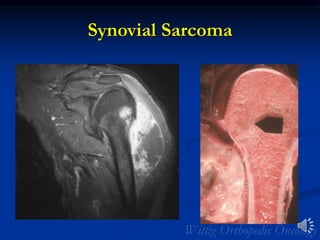
Synovial Sarcoma
Xray: Synovial Sarcoma Wrist Area
Calcifications
MRI: Synovial Sarcoma of
Wrist/Forearm
MRI Synovial Sarcoma of Leg
T2 Triple Signal
MRI Synovial Sarcoma of Leg
Triple Signal on T2
MRI Synovial Sarcoma
Lobular Growth Adjacent to Joint
MRI Synovial Sarcoma of Leg
Bone Invasion
MRI T2 Synovial Sarcoma of Leg
Triple Signal on T2
CT Scan of Synovial Sarcoma of Leg
Bone Involvement
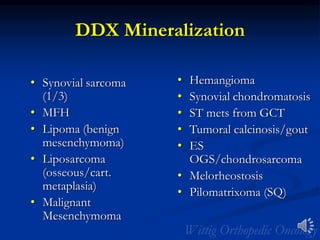
DDX Mineralization
• Hemangioma
• Synovial chondromatosis
• ST mets from GCT
• Tumoral calcinosis/gout
• ES
OGS/chondrosarcoma
• Melorheostosis
• Pilomatrixoma (SQ)
• Synovial sarcoma
(1/3)
• MFH
• Lipoma (benign
mesenchymoma)
• Liposarcoma
(osseous/cart.
metaplasia)
• Malignant
Mesenchymoma
Pathology
Synovial Sarcoma
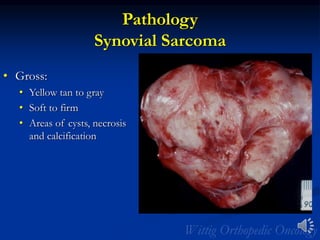
• Gross:
• Yellow tan to gray
• Soft to firm
• Areas of cysts, necrosis
and calcification
Pathology
Synovial Sarcoma
• Special Studies
• Translocation t(X;18) SYT-SSX gene fusion transcript
• 90% of cases
• Immunohistochemistry: Biphasic and Monophasic forms
• Vimentin positive (same as all sarcomas)
• Cytokeratin and EMA (epithelial membrane antigen) positive
• Positive in both biphasic and monophasic forms
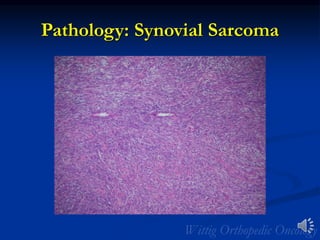
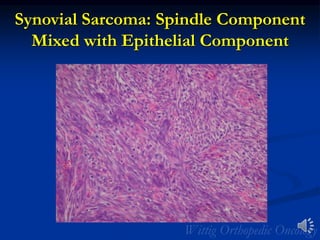
Pathology: Synovial Sarcoma
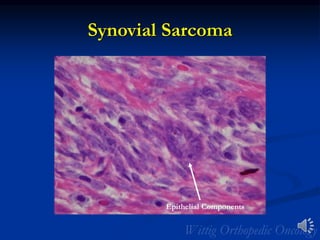
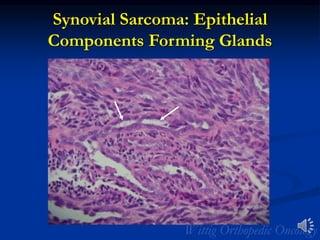
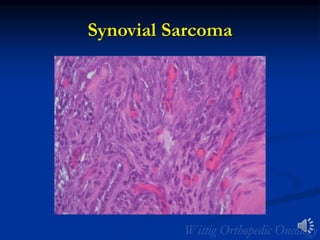
• Microscopic: Biphasic
• Spindle cells intermingled with epithelial
components (cuboidal or columnar cells)
• Epithelial components form nests and glandular or
tubular structures that may contain mucin
Pathology
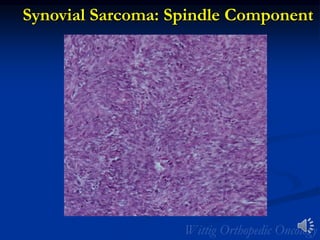
Synovial Sarcoma
• Microscopic: Monophasic Forms
• Spindle cell component only
• No epithelial components
Pathology: Synovial Sarcoma
Synovial Sarcoma: Spindle Component
Mixed with Epithelial Component
Synovial Sarcoma
Epithelial Components
Synovial Sarcoma: Epithelial
Components Forming Glands
Synovial Sarcoma
Differential Diagnosis
• Malignant Peripheral Nerve Sheath Tumor
(MPNST)
• Fibrosarcoma
• Hemangiopericytoma
• Monophasic Synovial Sarcoma
Treatment and Prognosis
• Surgery: Wide Resection and Postoperative
Radiation whenever feasible
• Amputation for unresectable tumors
• Metastases:
• Lungs
• Lymph Nodes
• Bone Marrow
• Survival:
• Overall 5 year survival: approximately 60-65%
• 10 year survival approximately 35%
• High incidence of late metastases
Rhabdomyosarcoma
• Definition: Malignant tumors composed of cells with
light microscopic, electron microscopic or
immunological evidence of skeletal muscle
differentiation.
• Light microscopic features: cross striations within cells
(rhabdomyoblasts)
• Ultrastructurally: sarcomeres
• Immunologically: Must express desmin, myoglobin,
MyoD1 or myogenin
• Presence of fusion genes PAX3-FKHR and PAX7-
FKHR are specific for alveolar rhabdomyosarcoma
Types of Rhabdomyosarcoma
• Embryonal: small round blue cell tumor
• Most Common 70-75%
• Occurs primarily in children
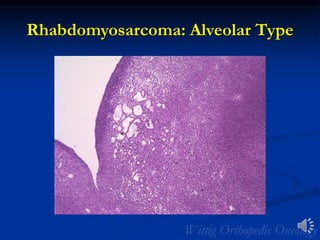
• Alveolar: solid and alveolar growth of cells
• 20-25% of all rhabdomyosarcomas
• Occurs primarily in children and adolescents
• Worse prognosis compared to embryonal
• Pleomorphic: spindle and pleomorphic cells
• Very rare <5% of rhabdomyosarcomas
• Age usually > 40 years
• High grade; Features similar to MFH but stains for
skeletal muscle markers
Rhabdomyosarcoma
• Most common malignant soft tissue tumor in children
• 10% of all childhood neoplasms
• Age: 1st two decades most commonly
• Sites: Embryonal more common in head and neck;
Alveolar more common in extremities
• Head and Neck (most common)
• GU tract
• Lower Extremity>Upper extremity
• Retroperitoneum/Pelvis
• Trunk
• Clinical: Painless or painful mass
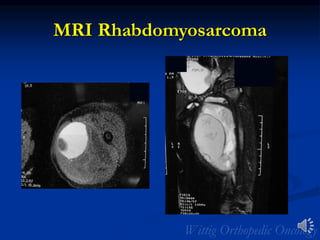
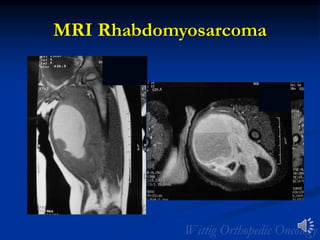
Radiology
Rhabdomyosarcoma
• No specific radiological features
• 24% invade adjacent bone
• MRI: Heterogeneous mass (Does not follow signal
of skeletal muscle)
• T1: Isointense to skeletal muscle (intermediate signal)
• T2: Hyperintense (high signal)
• Often demonstrate prominent vascularity (large flow
voids) with serpentine high flow vessels
• Marked enhancement with gadolinium
• May remain low to intermediate signal on T2 if there is
extensive fibrous tissue within the tumor
MRI Rhabdomyosarcoma
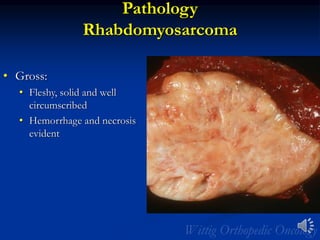
Pathology
Rhabdomyosarcoma
• Gross:
• Fleshy, solid and well
circumscribed
• Hemorrhage and necrosis
evident
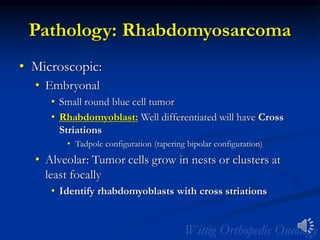
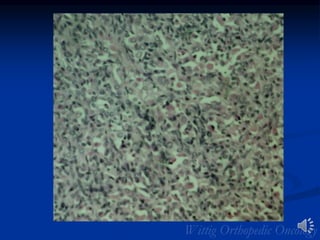
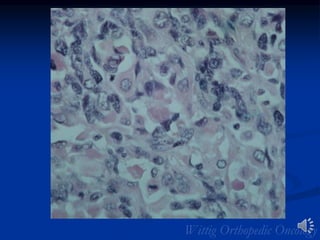
Pathology: Rhabdomyosarcoma
• Microscopic:
• Embryonal
• Small round blue cell tumor
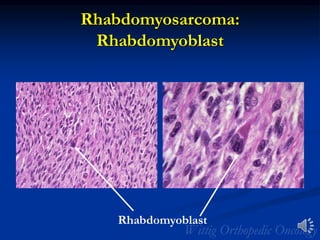
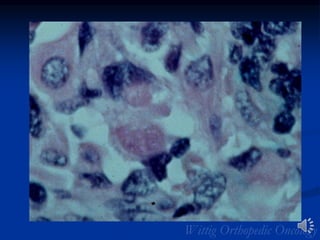
• Rhabdomyoblast: Well differentiated will have Cross
Striations
• Tadpole configuration (tapering bipolar configuration)
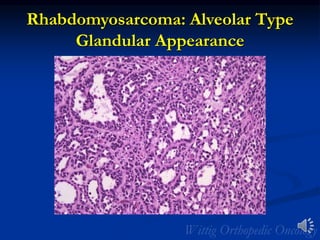
• Alveolar: Tumor cells grow in nests or clusters at
least focally
• Identify rhabdomyoblasts with cross striations
Pathology
Rhabdomyosarcoma
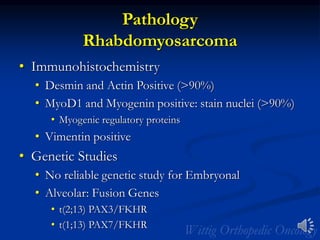
• Immunohistochemistry
• Desmin and Actin Positive (>90%)
• MyoD1 and Myogenin positive: stain nuclei (>90%)
• Myogenic regulatory proteins
• Vimentin positive
• Genetic Studies
• No reliable genetic study for Embryonal
• Alveolar: Fusion Genes
• t(2;13) PAX3/FKHR
• t(1;13) PAX7/FKHR
Rhabdomyosarcoma:
Rhabdomyoblast
Rhabdomyoblast
Rhabdomyosarcoma Desmin Stain
Rhabdomyosarcoma: Myoglobin Stain
Rhabdomyosarcoma: Alveolar Type
Glandular Appearance
Treatment and Prognosis
• Treatment:
• Surgery: Wide Resection, Chemotherapy, possible Radiation
• Metastases:
• Lung
• Lymph Node
• Bone
• Brain
• Liver
• Prognosis:
• Embryonal: 70% DFS at 5 years
• Alveolar: Worse prognosis than Embryonal 56% at 3 years
• Pleomorphic: Worst prognosis—Majority die within 1 year
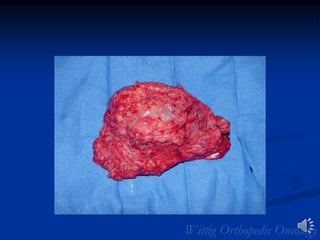
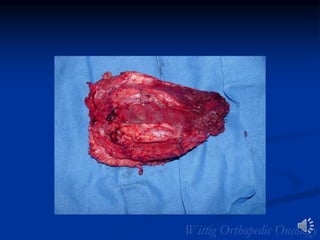
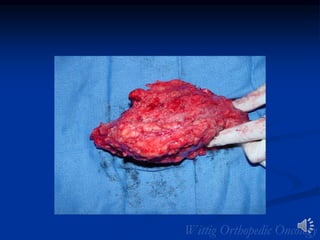
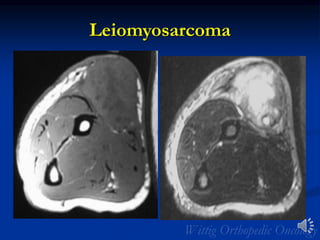
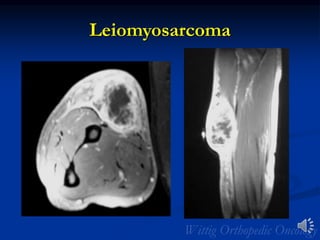
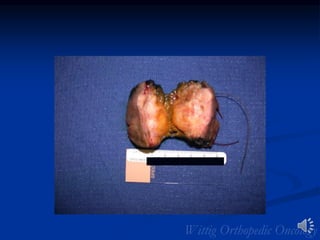
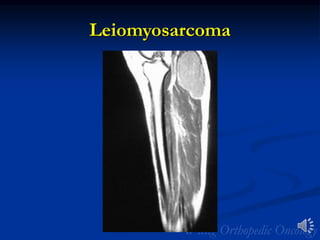
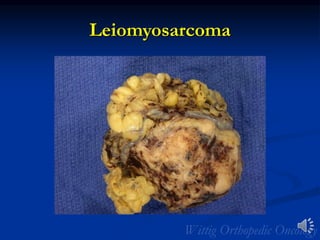
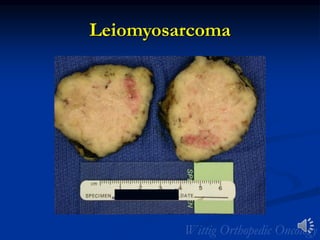
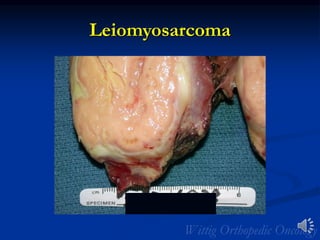
Leiomyosarcoma
• 9% of all soft tissue sarcomas
• Age: Median age 40 to 60 years
• Sites:
• Retroperitoneum—Most common
• Thigh—Second most common
• 6% of subcutaneous sarcomas
• May arise from wall of blood vessel
• Clinical: Painless mass
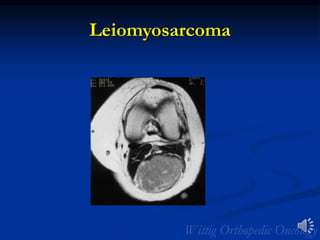
• Radiology: Non specific heterogeneous mass with necrosis
and hemorrhage
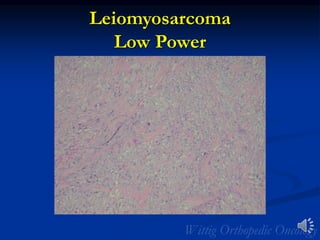
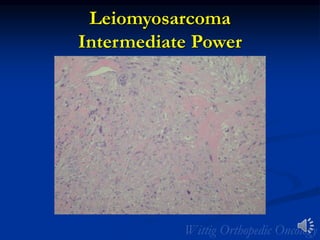
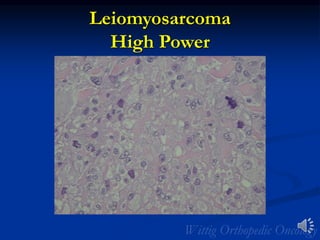
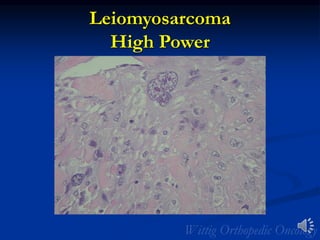
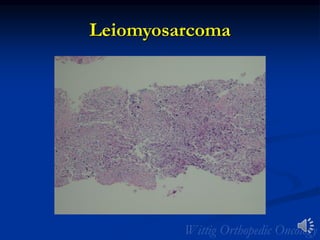
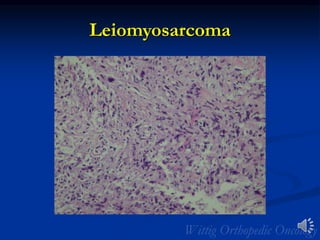
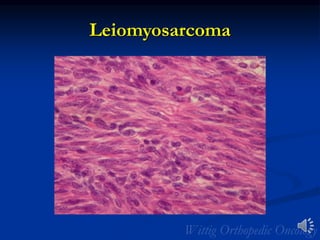
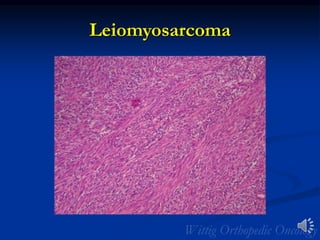
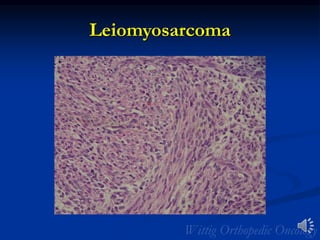
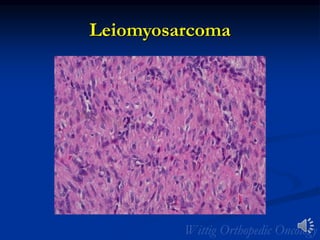
• Pathology: Spindle cell tumor
• Actin and Desmin positive
Leiomyosarcoma
• Treatment:
• Wide excision and postop radiation
• Metastases:
• Lungs
• Liver
• Bone
• Other Soft Tissues
• Lymph Nodes
• Prognosis:
• Extremity Lesions: 50% 5 year survival
• Retroperitoneal Lesions: 25-35% 5 year survival
Leiomyosarcoma
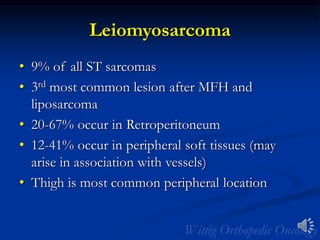
• 9% of all ST sarcomas
• 3rd most common lesion after MFH and
liposarcoma
• 20-67% occur in Retroperitoneum
• 12-41% occur in peripheral soft tissues (may
arise in association with vessels)
• Thigh is most common peripheral location
Leiomyosarcoma
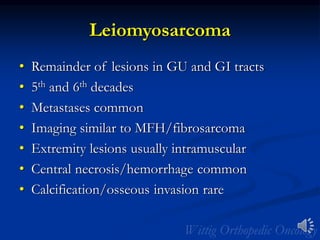
• Remainder of lesions in GU and GI tracts
• 5th and 6th decades
• Metastases common
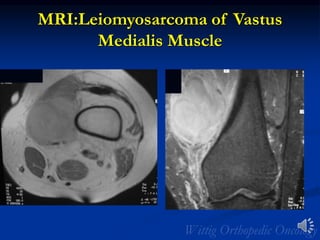
• Imaging similar to MFH/fibrosarcoma
• Extremity lesions usually intramuscular
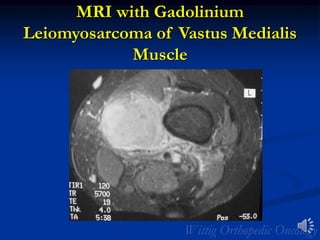
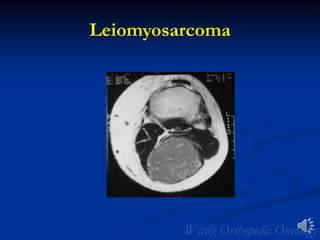
• Central necrosis/hemorrhage common
• Calcification/osseous invasion rare
MRI:Leiomyosarcoma of Vastus
Medialis Muscle
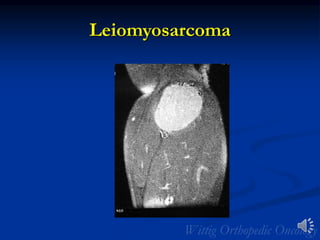
MRI with Gadolinium
Leiomyosarcoma of Vastus Medialis
Muscle
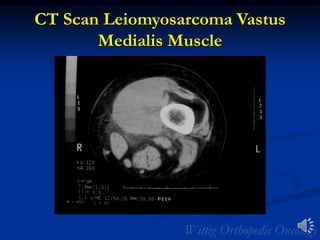
CT Scan Leiomyosarcoma Vastus
Medialis Muscle
Leiomyosarcoma
Leiomyosarcoma
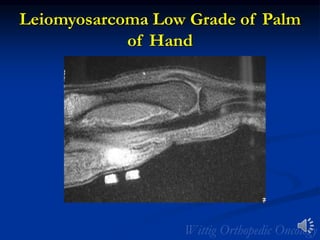
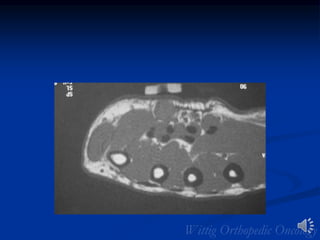
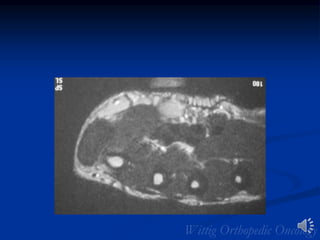
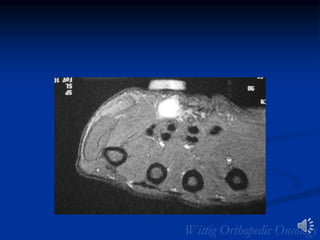
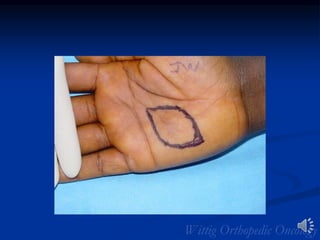
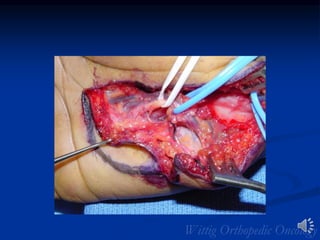
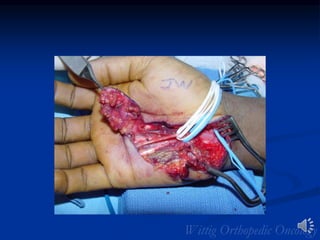
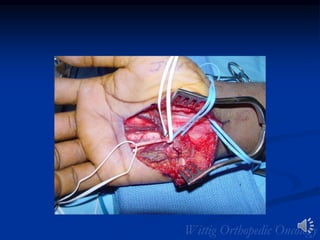
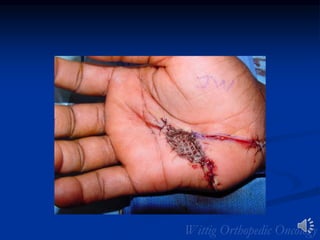
Leiomyosarcoma Low Grade of Palm
of Hand
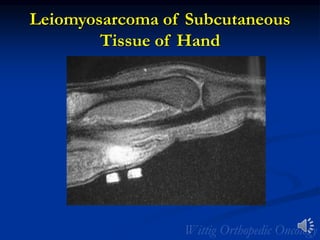
Leiomyosarcoma of Subcutaneous
Tissue of Hand
Leiomyosarcoma
Low Power
Leiomyosarcoma
Intermediate Power
Leiomyosarcoma
High Power
Leiomyosarcoma
High Power
Leiomyosarcoma Actin Stain
Leiomyosarcoma
Desmin Positivity
Leiomyosarcoma
Leiomyosarcoma
Leiomyosarcoma
Leiomyosarcoma
Leiomyosarcoma
Leiomyosarcoma
Leiomyosarcoma
Leiomyosarcoma
Leiomyosarcoma
Leiomyosarcoma
Leiomyosarcoma
Leiomyosarcoma
Leiomyosarcoma
Leiomyosarcoma Actin Stain
Thank You!

soft tissue sarcoma.pdf

  • 1.
    Soft Tissue Sarcomas Liposarcoma,MFH/UPS, Synovial Sarcoma, Fibrosarcoma, Rhabdomyosarcoma Leiomyosarcoma James C. Wittig, MD Orthopedic Oncologist Sarcoma Surgeon www.TumorSurgery.org
  • 2.
    Malignant Soft TissueTumors • MFH #1 • Liposarcoma #2 • Leiomyosarcoma #3 • Synovial Sarcoma • Fibrosarcoma • Rhabdomyosarcoma • Epithelioid Sarcoma • Malignant Peripheral Nerve Sheath Tumor • Extraskeletal Osteosarcoma, Ewings, Chondrosarcoma
  • 3.
    Malignant Soft TissueTumors • Presenting Ages: • All soft tissue sarcomas primarily affect adults 40-70 years of age except • Rhabdomyosarcoma—Children up to 20 • Synovial Sarcoma– young adults and teenagers (15 to 35 years of age
  • 4.
    Malignant Soft TissueTumors • Usually Painless mass except synovial sarcoma • Other painful benign masses: • Hemangioma • Fibromatosis mildly painful • Schwannoma • Angiolipoma • MRI Appearance Sarcomas: • Nonspecific heterogeneous soft tissue mass on T1, T2 except • Well Differentiated Liposarcoma • Myxoid Tumors: Liposarcoma, MFH
  • 5.
    Malignant Soft TissueTumors • Calcification/Mineralization: Any sarcoma can calcify • Synovial Sarcoma notorious for calcification • Extraskeletal Chondrosarcoma/Osteosarcoma • Lipoma or Liposarcoma with Necrosis • Hemangioma—benign soft tissue tumor with calcification • Synovial Chondromatosis • Metastases: usually always to the lungs first, then bones, then liver • Myxoid liposarcoma mets to other soft tissues and bones • Lymph Node Mets • Synovial Sarcoma • Epithelioid Sarcoma • Rhabdomyosarcoma
  • 6.
    Malignant Soft TissueTumors • Sites: • Thigh is most common for MFH, fibrosarcoma, liposarcoma • Fibromatosis common around shoulder girdle • Synovial Sarcoma—around but usually not within major joints • Foot and Ankle—Synovial sarcoma most common soft tissue sarcoma • Hand: Epithelioid Sarcoma—often ulcerates • Retroperitoneum: Liposarcoma and Leiomyosarcoma are the most common
  • 7.
    Malignant Soft TissueTumors • Adjacent Osseous Involvement: • MFH • Synovial Sarcoma • Rhabdomyosarcoma (also mets to bone marrow) • Translocations: • Synovial Sarcoma: t(X;18) SYT-SSX • Myxoid/Round Cell Liposarcoma: t(12;16) • Alveolar Rhabdomyosarcoma: t(2;13) PAX3/FKHR or t(1;13) PAX7/FKHR
  • 8.
    Malignant Soft TissueTumors • All Soft Tissue Sarcomas are spindle cell tumors except • Biphasic Synovial Cell Sarcoma: Has Epithelioid Elements • Epithelioid Sarcoma: Epithelioid like cells (polygonal) • Rhabdomyosarcoma: Small Round Blue Cell/Rhabdomyoblasts • Extraskeletal Ewings Sarcoma
  • 9.
    Malignant Soft TissueTumors • Immunohistochemistry: • Vimentin: All sarcomas are Vimentin Positive • Cytokeratin: All Carcinomas are Cytokeratin Positive • Synovial Sarcoma: Vimentin & Cytokeratin, EMA Pos • Epithelioid Sarcoma: Vimentin & Cytokeratin, EMA Pos • MPNST: Diffuse S-100+; Neurofibromatosis; Nerve Origin • Leiomyosarcoma: Strong Actin Pos; Desmin Pos also • Rhabdomyosarcoma:+ Desmin, Actin, MyoD1, Myoglobin • Also translocation, young age, rhabdomyoblasts, cross striations • MFH and Fibrosarcoma: No special differentiation • (myofibroblasts in MFH show scant and scattered Actin+)
  • 10.
    Malignant Soft TissueTumors • Most High Grade Sarcomas of an extremity present >5cm and Deep to Fascia, No mets (stage III AJC classification) Stage IV is with mets anywhere • Treatment: • Wide excision and radiation • Chemotherapy for Rhabdomyosarcoma in children and synovial sarcomas in young age groups • Very General Survival Data: • 60-65% 5 year survival for nonmetastatic soft tissue sarcomas • 15% 5 year survival for pts with resectable mets to lungs
  • 11.
    Liposarcoma • 2nd mostcommon ST sarcoma after MFH • Adult tumor: 40-70 years of age • Extremely rare in children/adolescents • Extremities (thigh) • Retroperitoneum • Trunk
  • 12.
    Liposarcoma Subtypes • Well-differentiated(atypical lipoma) • Myxoid • Round cell (poorly diff./hypercellular) • Pleomorphic • Dedifferentiated • Well-differentiated liposarcoma demonstrating an area of poorly differentiated tissue
  • 13.
    Liposarcoma Imaging • Intermuscularlocation more common • The more well-differentiated the lesion, the more fat it will appear to have • WDLS may have large adipose-containing regions and thickened, nodular septations • Fat more difficult to identify within other variants but small scant amounts often present
  • 14.
    Liposarcoma Variants • MyxoidLS homogeneous and majority of lesion follows fluid SI on all sequences • Myxoid LS may be misinterpreted as a cyst • Round cell/Pleomorphic LS more heterogeneous • Dedifferentiated LS • Look for focal nodular area of soft tissue within an otherwise well-defined fatty mass
  • 15.
    Low Grade WellDifferentiated Liposarcoma (Atypical Lipoma) • Definition: Mature fat cells and almost always fibrous or myxoid tissue. • Lipoblasts: Adipocytes have enlarged, irregular hyperchromatic nuclei; scattered throughout tumor. • Low grade malignant lesion • Do not metastasize • Grow slowly • Potential to dedifferentiate into a high grade tumor that can metastasize • Higher potential for local recurrence than a lipoma
  • 16.
  • 17.
    Well Differentiated Liposarcoma (AtypicalLipoma) • Age: Adults (middle age to older adults) • Sites: • Intermuscular/Intermuscular most common • Thigh: most common • Arm • Buttock • Retroperitoneum • Subcutaneous: rare
  • 18.
    Well Differentiated Liposarcoma (AtypicalLipoma) • Clinical: • Painless mass • Soft to firm depending on amount of fibrous tissue • Can grow very large • Abdominal swelling—retroperitoneal tumors
  • 19.
    Lipoma vs. WDLS •Thickened septae WDLS • Nodular/irregular/globular areas of nonadipose tissue • Associated nonadipose mass • Total amount of nonadipose tissue >25% • Marked enhancement of nonadipose portions • Older patient/large size
  • 20.
    Radiology Well Differentiated Liposarcoma •CT: • Nonspecific soft tissue mass with fat and soft tissue elements • May enhance with contrast (lipomas do not enhance) • MRI: • Predominantly fat on all sequences (T1, T2) with irregularly thickened linear or nodular septa • The septa are low signal T1 (similar to muscle) and high signal T2
  • 21.
  • 22.
  • 23.
  • 24.
    MRI T1: WellDifferentited Liposarcoma of Calf
  • 25.
    MRI T2: WellDifferentiated Liposarcoma
  • 26.
    Gross Specimen WellDifferentiated Liposarcoma • Gross Path: • Yellow, mature appearing fat mixed with fibrous and myxoid tissue
  • 27.
    Pathology Microscopic Pathology: • Lipoblast:scattered fat cells with irregular, dense nuclei and often multiple cytoplasmic fat vacuoles • Adult, mature fat cells, variable sizes • Variable amounts of fibrous and/or myxoid with scattered cells with irregular nuclei • Rare mitoses but may be enlarged and atypical
  • 28.
  • 29.
  • 30.
    Treatment and Prognosis •Surgery: Wide surgical excision • Does not metastasize: 100% 5 year survival • Recurrence occurs 10-20% with intramuscular tumors • Recurrence depends on size of tumor and location • May take years to recur (median time: 42 months) • Dedifferentiation is a rare event but can occur with recurrences • MFH is most common dedifferentiated component
  • 31.
    Myxoid Liposarcoma • Definition:Variably cellular, fatty tumor that contains small, uniform, “signet ring” lipogenic tumor cells in a myxoid matrix • The amount of adipose tissue may be scant • Also contains small uniform non-fatty cells with scant cytoplasm • Arborizing capillaries
  • 32.
    Myxoid Liposarcoma • Myxoidliposarcoma and round cell liposarcoma are a spectrum of the same type of tumor • Round cell liposarcoma is a more cellular variant of myxoid liposarcoma • Same Chromosomal Translocation t(12;16)(q13;p11) • Round cell liposarcoma is high grade and has greater metastatic potential • Myxoid liposarcomas can have round cell components. If greater than 25% higher metastatic potential
  • 33.
    Myxoid Liposarcoma • 45-55%of Liposarcomas • 40 to 50 years of age; rare<20 yrs of age • Sites: Deep soft tissues (rare to occur in subcutaneous tissue) • Thigh • Buttock • Groin • Popliteal space • (unusual to occur in retroperitoneum) • Clinical: Painless mass
  • 34.
    Radiology Myxoid Liposarcoma • MRI: •Does not contain substantial amounts of fat detectable on MRI (30%) • Follows fluid signal on MRI • T1: Intermediate signal similar to muscle • May see some high signal areas indicative of fat • T2: High Signal • Fat Suppressed: High signal areas on T1, suppress on T2 if truly fat • Fat if detectable: lacelike, whispy, cloudy, amorphous, clumplike • Often misdiagnosed as a cyst
  • 35.
  • 38.
  • 39.
    Myxoid Liposarcoma ofElbow Brachialis Muscle
  • 40.
    DDX Myxoid STTumors • Myxoid MFH • Myxoid liposarcoma • Most diff. to distinguish/look for fat • Neurogenic tumors • Myxoma (mild rim enhance. post contrast) • ES myxoid chondrosarcoma • Leiomyosarc. (nec. simulates myxoid tissue)
  • 41.
    Pathology Myxoid Liposarcoma • GrossPath: • Slimy, gelatinous, mucous- like surface • Cellular (round cell) areas have fleshy sarcoma appearance
  • 42.
    Pathology: Myxoid Liposarcoma •Microscopic Path: • Small uniform cells with scant cytoplasm in Myxoid Matrix • Signet ring lipoblasts: nucleus deformed into crescent • Scattered adipocytes of various sizes • Few mitoses • Round cell areas—more cellular areas; more mitoses; more pleomorphism but not marked
  • 43.
    Myxoid Liposarcoma • Lipoblasts •Myxoid Stroma • Myxoid Cells • Arborizing Capillaries Signet Ring Lipoblasts
  • 49.
    Treatment and Prognosis •Surgery: Wide resection and postop radiation • High rate of local recurrence without RT • Myxoid Liposarcoma is a low to intermediate grade tumor • 88% 5 year survival for pure myxoid liposarcoma • Rate of metastasis is related to proportion of round cell component • Unusual pattern of mets • Distant soft tissues: Retroperitoneum, Mediastinum • Spine • Lungs
  • 50.
    Malignant Fibrous Histiocytoma (MFH) •Definition: Pleomorphic, high grade, anaplastic sarcoma composed of varying portions of fibroblasts, myofibroblasts, histiocyte-like cells, multinucleated giant cells and undifferentiated cells • May have substantial myxoid components, inflammatory tissue and giant cell rich areas • No recognizable line of differentiation such as smooth muscle, skeletal muscle, bone, cartilage, fatty differentiation
  • 51.
    Malignant Fibrous Histiocytoma •Most common ST sarcoma (20-30% of all soft tissue sarcomas) • 70-75% occur in extremities/15% in RP • Most common post XRT sarcoma (2/3) • Occurs at sites of chronic ulcers and scars • Association with shrapnel/total joint replacements • Multiple subtypes • Pleomorphic • Myxoid • Giant Cell Variant • Inflammatory
  • 52.
    Malignant Fibrous Histiocytoma •Usually >50 years of age • Rare in children • Sites: • Deep soft tissue; Intramuscular—most common • Thigh • Buttock • Retroperitoneum • Shoulder Girdle • Calf • Trunk • Subcutaneous
  • 53.
    Malignant Fibrous Histiocytoma (MFH) •Clinical: • Painless mass • Rarely fever, weight loss but very unusual • Occasional leukocytosis, hypoglycemia and systemic manifestations
  • 54.
    Radiology Malignant Fibrous Histiocytoma •Deep intramuscular mass (often adjacent to diaphysis of long bones) • Osseous involvement can occur (Xray or CT) • MRI: • Heterogeneous T1 and T2/large/lobulated/well- defined • Necrosis and hemorrhage • Intermediate SI on T1 • Predominantly high SI on T2 • Viable areas enhance with contrast
  • 55.
    Radiology Malignant Fibrous Histiocytoma •Peripheral pseudocapsule misleading • Circumscribed appearance • Myxoid variant very high signal on T2 • Myxoid variant may show peripheral and septal or diffuse enhancement • Look for fat to r/o liposarcoma
  • 56.
  • 57.
  • 58.
  • 59.
  • 60.
    MRI T1 MFHof Thigh
  • 61.
  • 62.
    CT Scan: MFHof Thigh
  • 63.
    MRI T2 SubcutaneousMFH of Thigh
  • 64.
    MRI with Gado:Subcutaneous MFH
  • 65.
    Pathology MFH • Gross: • Fleshy,multilobulated with areas of hemorrhage and necrosis
  • 66.
    Pathology: MFH • Microscopic: •Bizarre, pleomorphic spindle cells • Large, irregular, bizarre nuclei • Fibroblasts, myofibroblasts, undifferentiated cells, histiocyte-like cells • Fibrous tissue stroma/matrix • Extensive pleomorphism • Abundant atypical mitotic figures • Storiform pattern of arrangement of cells and matrix (swirling pattern of collagen bundles and cells)
  • 67.
  • 68.
  • 69.
  • 70.
    Treatment and Prognosis •Surgery: • Wide surgical resection and postoperative radiation whenever feasible • Amputation for unresectable cases • Metastases: 35%-45% of patients • Lung (90%) • Bone (8%) • Liver (1%) • Lymph Nodes (1%) • Prognosis: Overall 65% 5 year survival
  • 71.
    Fibrosarcoma • Definition: Malignanttumor of fibroblasts that shows no other evidence of differentiation. The spindle cells are usually uniform and demonstrate minimal pleomorphism. • Rare: 5% of all soft tissue sarcomas • 40 to 55 years of age; Infantile form <10 yrs of age • Sites: Intramuscular; rarely in subcutaneous tissue • Thigh, knee area, buttock • Arm/shoulder girdle • Trunk • Forearms and legs • Clinical: Painless mass
  • 72.
    Fibrosarcoma • May arisesecondarily • Irradiated soft tissues • Scars and burns • Dedifferentiated component of Dermatofibrosarcoma protuberans • Dedifferentiated component of liposarcoma
  • 73.
    Fibrosarcoma • Overall 5yr. survival of 40% • >60% metastatic rate • Virtually indistinguishable from MFH on imaging
  • 74.
    Radiology Fibrosarcoma • MRI • 2/3of tumors are intramuscular • Well defined heterogeneous mass • Necrosis and hemorrhage are common especially in higher grade tumors • Viable areas enhance with contrast; Areas of significant necrosis and hemorrhage do not enhance
  • 75.
  • 76.
  • 77.
  • 78.
  • 80.
    Pathology: Fibrosarcoma • Gross: •Fleshy, focally necrotic and hemorrhagic mass (high grade) • Firm and rubbery masses (low grade, well differentiated, collagenized) • Microscopic: • Elongate, fairly uniform spindle cells with scant cytoplasm and large nuclei in a variable amount of fibrous stroma • Minimal pleomorphism • Herringbone pattern: Arranged in fascicles that intersect at right angles • Mitoses present; also abnormal mitoses (Increase in Grade 2 and Grade 3 Tumors)
  • 81.
    Pathology: Fibrosarcoma • Hypercellular •Uniform Spindle cells • Minimal Pleomorphism • Fibrous Matrix • Herringbone Pattern
  • 83.
  • 84.
    Pathology: Fibrosarcoma • DifferentialDiagnosis: • Monophasic Synovial Sarcoma • Cytokeratin or EMA (epithelial membrane antigen) positive • Translocation tX;18 (90% of cases) SYT-SSX • Leiomyosarcoma: Actin and Desmin Positive • MPNST: S-100 positive • Fibromatosis: Morphological features
  • 85.
    Treatment and Prognosis •Treatment: Wide surgical excision and postop radiation whenever feasible • Amputation for unresectable cases • Metastases: • Lungs • Bone • Liver • Prognosis: 35% to 55% 5 year survival rate • Related to grade, size and location • Grade 1: Metastasize rarely • Grade 2-3: Mets 35-45%
  • 86.
    Synovial Sarcoma • Definition:Typically a biphasic soft tissue sarcoma with epithelial and spindle cell components • Monophasic, spindle cell only varieties, also exist • Not of synovial origin • 5-10% of all soft tissue sarcomas • Young adults and teenagers (15 to 35 years of age)
  • 87.
    Synovial Sarcoma • Sites: •Deep location in close proximity to large joints • Lower extremities>Upper extremities • 60% in Lower Extremity • Feet and Hands • Most common soft tissue sarcoma of the foot and ankle • Intimately related to tendons, tendon sheaths, bursa, muscles • Rarely occurs within and actual joint <5% • Knee most commonly • Unusual in retroperitoneum and head and neck
  • 88.
    Synovial Sarcoma • Males:females 1.2:1 • Predilection for white>black • Clinical: • Painful mass in greater than 50% of cases • Slow growing mass • May grow over a period of 2-4 years
  • 89.
    Radiology Synovial Sarcoma • Radiographs: •Calcification in 20% of cases (Stippled or Large Amounts) • Underlying bony invasion 10%-20% cases • CT: • Lobular mass close to a joint • Heterogeneous mass sometimes with calcification and underlying bone erosion • Detect subtle calcification • MRI: Hemorrhage, necrosis and cystic change are common
  • 90.
    Radiology Synovial Sarcoma • MRI: •Highly heterogeneous mass; Enhances heterogeneously • Hemorrhage, necrosis and cystic change are common • Lobular growth with internal septations • T1: Intermediate signal similar to muscle • T2: Triple Signal Intensity • High, Low and Intermediate Signals • Cyst, hemorrhage, solid elements, fibrous tissue in same tumor • Fluid-Fluid levels in 25% of patients
  • 91.
    MRI Synovial Sarcomaof Shoulder Bone Involvement • Intermuscular near large joint • Foot or ankle • May be ill- or well- defined • Ca+2 in 1/3 (lung metastases may also Ca+2) • Osseous involvement in 11-20%
  • 92.
    Synovial Sarcoma Imaging •Large lesions often very heterogeneous on T2 • Triple signal intensity pattern suggestive • Cluster of grapes (septated/multilocular) • Hemorrhage/fluid levels/cystic areas
  • 93.
  • 94.
  • 95.
    Xray: Synovial SarcomaWrist Area Calcifications
  • 96.
    MRI: Synovial Sarcomaof Wrist/Forearm
  • 97.
    MRI Synovial Sarcomaof Leg T2 Triple Signal
  • 98.
    MRI Synovial Sarcomaof Leg Triple Signal on T2
  • 100.
    MRI Synovial Sarcoma LobularGrowth Adjacent to Joint
  • 101.
    MRI Synovial Sarcomaof Leg Bone Invasion
  • 102.
    MRI T2 SynovialSarcoma of Leg Triple Signal on T2
  • 103.
    CT Scan ofSynovial Sarcoma of Leg Bone Involvement
  • 104.
    DDX Mineralization • Hemangioma •Synovial chondromatosis • ST mets from GCT • Tumoral calcinosis/gout • ES OGS/chondrosarcoma • Melorheostosis • Pilomatrixoma (SQ) • Synovial sarcoma (1/3) • MFH • Lipoma (benign mesenchymoma) • Liposarcoma (osseous/cart. metaplasia) • Malignant Mesenchymoma
  • 105.
    Pathology Synovial Sarcoma • Gross: •Yellow tan to gray • Soft to firm • Areas of cysts, necrosis and calcification
  • 106.
    Pathology Synovial Sarcoma • SpecialStudies • Translocation t(X;18) SYT-SSX gene fusion transcript • 90% of cases • Immunohistochemistry: Biphasic and Monophasic forms • Vimentin positive (same as all sarcomas) • Cytokeratin and EMA (epithelial membrane antigen) positive • Positive in both biphasic and monophasic forms
  • 107.
    Pathology: Synovial Sarcoma •Microscopic: Biphasic • Spindle cells intermingled with epithelial components (cuboidal or columnar cells) • Epithelial components form nests and glandular or tubular structures that may contain mucin
  • 108.
    Pathology Synovial Sarcoma • Microscopic:Monophasic Forms • Spindle cell component only • No epithelial components
  • 109.
  • 110.
  • 111.
    Synovial Sarcoma: SpindleComponent Mixed with Epithelial Component
  • 112.
  • 113.
  • 114.
  • 115.
    Differential Diagnosis • MalignantPeripheral Nerve Sheath Tumor (MPNST) • Fibrosarcoma • Hemangiopericytoma • Monophasic Synovial Sarcoma
  • 116.
    Treatment and Prognosis •Surgery: Wide Resection and Postoperative Radiation whenever feasible • Amputation for unresectable tumors • Metastases: • Lungs • Lymph Nodes • Bone Marrow • Survival: • Overall 5 year survival: approximately 60-65% • 10 year survival approximately 35% • High incidence of late metastases
  • 117.
    Rhabdomyosarcoma • Definition: Malignanttumors composed of cells with light microscopic, electron microscopic or immunological evidence of skeletal muscle differentiation. • Light microscopic features: cross striations within cells (rhabdomyoblasts) • Ultrastructurally: sarcomeres • Immunologically: Must express desmin, myoglobin, MyoD1 or myogenin • Presence of fusion genes PAX3-FKHR and PAX7- FKHR are specific for alveolar rhabdomyosarcoma
  • 118.
    Types of Rhabdomyosarcoma •Embryonal: small round blue cell tumor • Most Common 70-75% • Occurs primarily in children • Alveolar: solid and alveolar growth of cells • 20-25% of all rhabdomyosarcomas • Occurs primarily in children and adolescents • Worse prognosis compared to embryonal • Pleomorphic: spindle and pleomorphic cells • Very rare <5% of rhabdomyosarcomas • Age usually > 40 years • High grade; Features similar to MFH but stains for skeletal muscle markers
  • 119.
    Rhabdomyosarcoma • Most commonmalignant soft tissue tumor in children • 10% of all childhood neoplasms • Age: 1st two decades most commonly • Sites: Embryonal more common in head and neck; Alveolar more common in extremities • Head and Neck (most common) • GU tract • Lower Extremity>Upper extremity • Retroperitoneum/Pelvis • Trunk • Clinical: Painless or painful mass
  • 120.
    Radiology Rhabdomyosarcoma • No specificradiological features • 24% invade adjacent bone • MRI: Heterogeneous mass (Does not follow signal of skeletal muscle) • T1: Isointense to skeletal muscle (intermediate signal) • T2: Hyperintense (high signal) • Often demonstrate prominent vascularity (large flow voids) with serpentine high flow vessels • Marked enhancement with gadolinium • May remain low to intermediate signal on T2 if there is extensive fibrous tissue within the tumor
  • 121.
  • 122.
  • 123.
    Pathology Rhabdomyosarcoma • Gross: • Fleshy,solid and well circumscribed • Hemorrhage and necrosis evident
  • 124.
    Pathology: Rhabdomyosarcoma • Microscopic: •Embryonal • Small round blue cell tumor • Rhabdomyoblast: Well differentiated will have Cross Striations • Tadpole configuration (tapering bipolar configuration) • Alveolar: Tumor cells grow in nests or clusters at least focally • Identify rhabdomyoblasts with cross striations
  • 125.
    Pathology Rhabdomyosarcoma • Immunohistochemistry • Desminand Actin Positive (>90%) • MyoD1 and Myogenin positive: stain nuclei (>90%) • Myogenic regulatory proteins • Vimentin positive • Genetic Studies • No reliable genetic study for Embryonal • Alveolar: Fusion Genes • t(2;13) PAX3/FKHR • t(1;13) PAX7/FKHR
  • 128.
  • 130.
  • 131.
  • 132.
  • 133.
  • 134.
    Treatment and Prognosis •Treatment: • Surgery: Wide Resection, Chemotherapy, possible Radiation • Metastases: • Lung • Lymph Node • Bone • Brain • Liver • Prognosis: • Embryonal: 70% DFS at 5 years • Alveolar: Worse prognosis than Embryonal 56% at 3 years • Pleomorphic: Worst prognosis—Majority die within 1 year
  • 135.
    Leiomyosarcoma • 9% ofall soft tissue sarcomas • Age: Median age 40 to 60 years • Sites: • Retroperitoneum—Most common • Thigh—Second most common • 6% of subcutaneous sarcomas • May arise from wall of blood vessel • Clinical: Painless mass • Radiology: Non specific heterogeneous mass with necrosis and hemorrhage • Pathology: Spindle cell tumor • Actin and Desmin positive
  • 136.
    Leiomyosarcoma • Treatment: • Wideexcision and postop radiation • Metastases: • Lungs • Liver • Bone • Other Soft Tissues • Lymph Nodes • Prognosis: • Extremity Lesions: 50% 5 year survival • Retroperitoneal Lesions: 25-35% 5 year survival
  • 137.
    Leiomyosarcoma • 9% ofall ST sarcomas • 3rd most common lesion after MFH and liposarcoma • 20-67% occur in Retroperitoneum • 12-41% occur in peripheral soft tissues (may arise in association with vessels) • Thigh is most common peripheral location
  • 138.
    Leiomyosarcoma • Remainder oflesions in GU and GI tracts • 5th and 6th decades • Metastases common • Imaging similar to MFH/fibrosarcoma • Extremity lesions usually intramuscular • Central necrosis/hemorrhage common • Calcification/osseous invasion rare
  • 139.
  • 140.
    MRI with Gadolinium Leiomyosarcomaof Vastus Medialis Muscle
  • 141.
    CT Scan LeiomyosarcomaVastus Medialis Muscle
  • 145.
  • 146.
  • 147.
    Leiomyosarcoma Low Gradeof Palm of Hand
  • 148.
  • 166.
  • 167.
  • 168.
  • 169.
  • 170.
  • 171.
  • 172.
  • 173.
  • 174.
  • 175.
  • 176.
  • 177.
  • 178.
  • 179.
  • 180.
  • 181.
  • 182.
  • 183.
  • 184.
  • 185.
  • 186.