MOLECULAR BREEDING FOR
QUALITY PROTEIN MAIZE
Ravi nagda
INTRODUCTION
• Name of Crop: Maize
• Botanical Name: Zea mays L.
• Family: Poaceae
• Chromosome No.: 2n = 20
• Center of Origin: Central America (Mexico)
• Mode of pollination : Cross pollination
• Out crossing percentage: 95%
HISTORY
Counti……….
• Two scientists of CIMMYT, Mexico, Dr. S. K. Vasal and Dr. Evangelina
Villegas, for a period of three decades led to development of Quality
Protein Maize (QPM) with hard kernel, good taste and endow the
opaque-2 of the best normal maize with disease and insect
resistance.
• QPM research and development Mexico to Central and South
America, Africa, Europe and Asia.
• Awarded 2000 “World food prize” for path breaking research.
• 1970 -India is one of the first few countries to focus on o2 maize and
released three o2 composites, name- Shakti, Rattan and Protina .
Counti…….
• 1997- modified superior o2 composite ‘Shakti 1’.
• Later, India released eight QPM hybrids, seven of which were
developed from the QPM inbreds of CIMMYT as parental lines and
are of full season maturity.(HQPM1, HQPM5 ,HQPM 7 Vivek QPM 9)
• Achievement in development of “Miracle Maize”
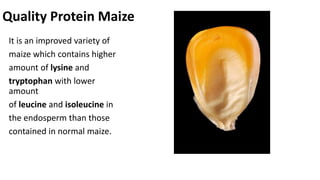
Quality Protein Maize
It is an improved variety of
maize which contains higher
amount of lysine and
tryptophan with lower
amount
of leucine and isoleucine in
the endosperm than those
contained in normal maize.
Nutritional SUPERIORITY of QPM compression
• Lysine content Normal -1.3 g per 100 g endosperm protein.
o2-3.3 to 4.0 g per 100 g of endosperm protein.
• QPM protein contains 55% more tryptophan.
30% more lysine.
38% less leucine than that of normal maize.
• Biological Value Normal maize protein is 45%.
o2 maize is 80%..
• Other nutritional Higher tryptophan and lower leucine content,
benefits Higher calcium and carbohydrate and carotene
Higher niacin
DEVELOPMENT OF QPM INVOLVES THREE
GENETIC SYSTEMS.
• Recessive homozygous allele of the o2 gene
• Modifiers for kernel hardness
• Amino acid modifiers
1. Recessive homozygous allele of the o2 gene
The o2 gene in homozygous condition reduces production of alpha-zeins
and increase in the level of lysine and tryptophan.
o2 gene is a natural mutant. It is not a genetically modified organism
(GMO).
2. Modifiers for kernel hardness - Increased level of the gamma-zein is
likely to contribute to the recovery of hard endosperm.
3. Amino acid modifiers - It also affect the relative level of lysine and
tryptophan content in grain endosperm.
Three genes associated with lysine level have been mapped to
locations on chromosome 2, 4 and 7.
Development of QPM genotypes through
• Conventional Breeding
• Marker Assisted Selection
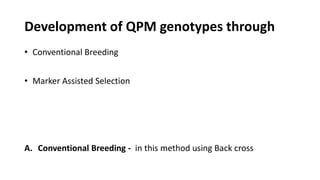
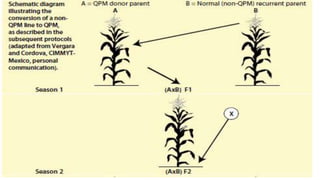
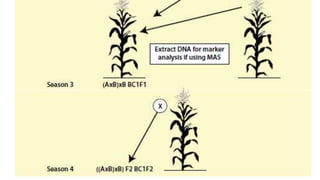
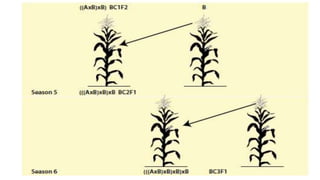
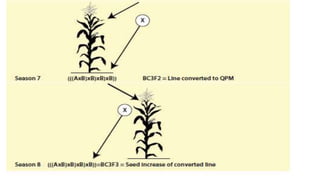
A. Conventional Breeding - in this method using Back cross
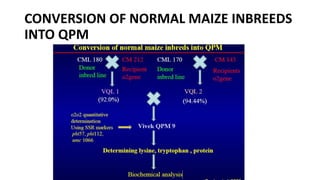
CONVERSION OF NORMAL MAIZE INBREEDS
INTO QPM
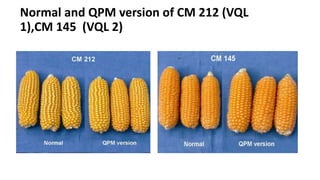
Normal and QPM version of CM 212 (VQL
1),CM 145 (VQL 2)
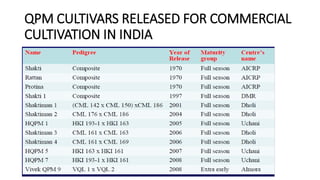
QPM CULTIVARS RELEASED FOR COMMERCIAL
CULTIVATION IN INDIA
Recently developed QPM varieties
• Following this approach, we have now developed another elite QPM hybrid-
FQH 38
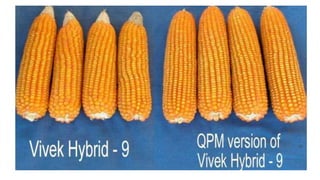
• The QPM version of Vivek Maize Hybrid 21.
• The new QPM hybrid contains more than 72% increase in tryptophan
over Vivek Maize Hybrid 21
• Anand QPM 1- developed from Anand agriculture university.
THANK YOU

Molecular breeding for quality protein maize

  • 1.
    MOLECULAR BREEDING FOR QUALITYPROTEIN MAIZE Ravi nagda
  • 2.
    INTRODUCTION • Name ofCrop: Maize • Botanical Name: Zea mays L. • Family: Poaceae • Chromosome No.: 2n = 20 • Center of Origin: Central America (Mexico) • Mode of pollination : Cross pollination • Out crossing percentage: 95%
  • 3.
  • 4.
    Counti………. • Two scientistsof CIMMYT, Mexico, Dr. S. K. Vasal and Dr. Evangelina Villegas, for a period of three decades led to development of Quality Protein Maize (QPM) with hard kernel, good taste and endow the opaque-2 of the best normal maize with disease and insect resistance. • QPM research and development Mexico to Central and South America, Africa, Europe and Asia. • Awarded 2000 “World food prize” for path breaking research. • 1970 -India is one of the first few countries to focus on o2 maize and released three o2 composites, name- Shakti, Rattan and Protina .
  • 5.
    Counti……. • 1997- modifiedsuperior o2 composite ‘Shakti 1’. • Later, India released eight QPM hybrids, seven of which were developed from the QPM inbreds of CIMMYT as parental lines and are of full season maturity.(HQPM1, HQPM5 ,HQPM 7 Vivek QPM 9) • Achievement in development of “Miracle Maize”
  • 6.
    Quality Protein Maize Itis an improved variety of maize which contains higher amount of lysine and tryptophan with lower amount of leucine and isoleucine in the endosperm than those contained in normal maize.
  • 7.
    Nutritional SUPERIORITY ofQPM compression • Lysine content Normal -1.3 g per 100 g endosperm protein. o2-3.3 to 4.0 g per 100 g of endosperm protein. • QPM protein contains 55% more tryptophan. 30% more lysine. 38% less leucine than that of normal maize. • Biological Value Normal maize protein is 45%. o2 maize is 80%.. • Other nutritional Higher tryptophan and lower leucine content, benefits Higher calcium and carbohydrate and carotene Higher niacin
  • 8.
    DEVELOPMENT OF QPMINVOLVES THREE GENETIC SYSTEMS. • Recessive homozygous allele of the o2 gene • Modifiers for kernel hardness • Amino acid modifiers
  • 9.
    1. Recessive homozygousallele of the o2 gene The o2 gene in homozygous condition reduces production of alpha-zeins and increase in the level of lysine and tryptophan. o2 gene is a natural mutant. It is not a genetically modified organism (GMO). 2. Modifiers for kernel hardness - Increased level of the gamma-zein is likely to contribute to the recovery of hard endosperm. 3. Amino acid modifiers - It also affect the relative level of lysine and tryptophan content in grain endosperm. Three genes associated with lysine level have been mapped to locations on chromosome 2, 4 and 7.
  • 10.
    Development of QPMgenotypes through • Conventional Breeding • Marker Assisted Selection A. Conventional Breeding - in this method using Back cross
  • 15.
    CONVERSION OF NORMALMAIZE INBREEDS INTO QPM
  • 16.
    Normal and QPMversion of CM 212 (VQL 1),CM 145 (VQL 2)
  • 18.
    QPM CULTIVARS RELEASEDFOR COMMERCIAL CULTIVATION IN INDIA
  • 19.
    Recently developed QPMvarieties • Following this approach, we have now developed another elite QPM hybrid- FQH 38 • The QPM version of Vivek Maize Hybrid 21. • The new QPM hybrid contains more than 72% increase in tryptophan over Vivek Maize Hybrid 21 • Anand QPM 1- developed from Anand agriculture university.
  • 20.