Module - 2
Scope, Terms & Conditions and
Objectives
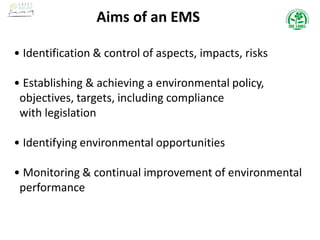
Aims of an EMS
• Identification & control of aspects, impacts, risks
• Establishing & achieving a environmental policy,
objectives, targets, including compliance
with legislation
• Identifying environmental opportunities
• Monitoring & continual improvement of environmental
performance
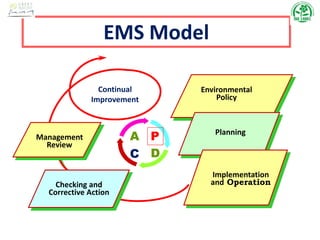
Environmental
Policy
Continual
Improvement
EMS Model
Planning
Implementation
and OperationChecking and
Corrective Action
Management
Review
P
DC
A
Key Definitions (Section 3)
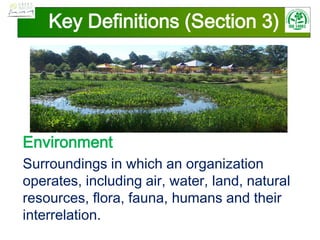
Environment
Surroundings in which an organization
operates, including air, water, land, natural
resources, flora, fauna, humans and their
interrelation.
Environmental Interaction
What can an organization control?
• Can control the generation at the source;
• Can prevent & minimize exposure to the pathway;
• But has no control on the impact to the receptor.
Activities
• ISO 14001 Guidance:
– An organization should identify the various
activities, processes, products or services that are
included in the scope of the EMS
– Distinguishing them in such a way that they are
“large enough for meaningful examination and
small enough to be sufficiently understood.”
Aspects
• ISO 14001 guidance:
– Identify all environmental aspects of activities,
products and services
– Aspect = element of activity, product or service
which can have a beneficial or adverse effect on
the environment
– Include all those that the organization “can control
and over which it can be expected to have an
influence”
Impacts
• ISO 14001 guidance:
– Organization should identify as many as possible
of the actual or potential environmental impacts
associated with each aspect of its activities
– Impact = change which takes place in the
environment as a result of the aspect, either
positive or negative
Aspect and Impacts
Environmental Aspect
Element of an organisation’s activities, products or
services which can interact with the environment.
Environmental Impact
Any change to the environment, whether adverse or
beneficial, wholly or partially resulting from an
organisation’s activities, products or services.
NOTE - A significant environmental aspect is an environmental aspect
which has or can have a significant environmental impact
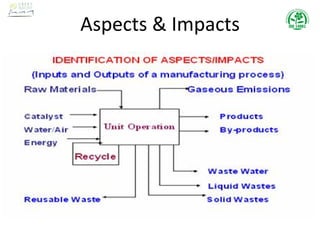
Aspects & Impacts
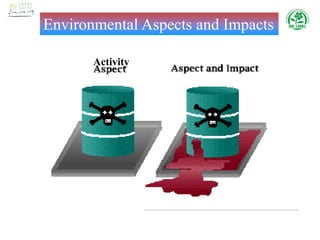
Environmental Aspects and Impacts
Activity
Defining Significance
Rating can be based on:
• Scale
• Occurrence
• Impact
• Control
• Detection
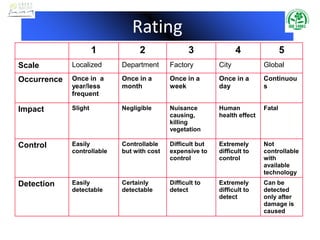
Rating
1 2 3 4 5
Scale Localized Department Factory City Global
Occurrence Once in a
year/less
frequent
Once in a
month
Once in a
week
Once in a
day
Continuou
s
Impact Slight Negligible Nuisance
causing,
killing
vegetation
Human
health effect
Fatal
Control Easily
controllable
Controllable
but with cost
Difficult but
expensive to
control
Extremely
difficult to
control
Not
controllable
with
available
technology
Detection Easily
detectable
Certainly
detectable
Difficult to
detect
Extremely
difficult to
detect
Can be
detected
only after
damage is
caused
Key Definitions (Sections 3)
• System
– Set of interrelated elements
• Management System
– System used to establish policy and objectives
and to achieve those objectives.
– Includes organizational structure, planning
activities, responsibilities, practices, procedures
and resources.
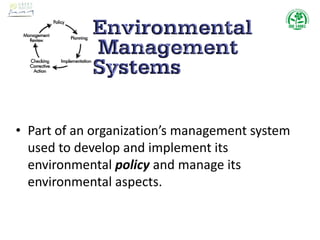
• Part of an organization’s management system
used to develop and implement its
environmental policy and manage its
environmental aspects.
Key Definitions
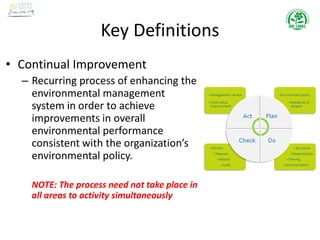
• Continual Improvement
– Recurring process of enhancing the
environmental management
system in order to achieve
improvements in overall
environmental performance
consistent with the organization’s
environmental policy.
NOTE: The process need not take place in
all areas to activity simultaneously
Key Definitions
• Prevention of Pollution
– Use of processes, practices, materials or products
that avoid, reduce or control pollution, which may
include recycling, treatment, process changes,
control mechanisms, efficient use of resources
and material substitution.
NOTE: Prevention of pollution can include source reduction or
elimination, process, product or service changes, efficient use of
resources, material and energy substitution, reuse, recovery,
recycling, reclamation and treatment.
ENVIRONMENTAL POLICY
• Overall intentions and directions of an
organization related to its environmental
performance as formally expressed by top
management.
NOTE:- The environmental [policy provides a
framework for action and for the setting of
environmental objectives and targets.
Key Elements of an EMS
• Environmental Policy
– Develop a statement of your organization’s
commitment to the environment with the
following in mind.
• Continual improvement
• Pollution prevention
• Compliance with relevant laws & regulation
» Keep it simple and understandable
Environmental
Objectives & Targets
Environmental Objective
“Overall environmental goal, arising from the environmental policy, that
an organisation sets itself to achieve, and which is quantified where
practicable.”
Environmental Target
“Detailed performance requirement, quantified where practicable,
applicable to the organisation or parts thereof, that arises from the
environmental objectives and that needs to be set and met in order to
achieve those objectives.”
• “The organization shall establish and maintain (a)
programme(s) for achieving its objectives and targets. It shall
include:
• a) designation of responsibility for achieving objectives and
targets at each relevant function and level of the organization;
• b) the means and time-frame by which they are to be
achieved.
• If a project relates to new developments and new or modified
activities, products or services, programme(s) shall be
amended where relevant to ensure that environmental
management applies to such projects.” (ISO 14001 4.3.4)
Environmental Management
Programmes
•The organization shall establish and maintain documented
procedures to monitor and measure, on a regular basis, the
key characteristics of its operations and activities that can
have a significant impact on the environment. Shall include:
- recording of information to track
performance,
- relevant operational controls, and
- conformance with the organization’s
environmental objectives and targets.
•Monitoring equipment shall
- be calibrated and maintained and
- records of this process be retained according to the
organizations procedures.
• Organization shall establish and maintain a documented
procedure for periodically evaluating compliance with
relevant environmental legislation and regulations.
MONITORING AND MEASUREMENT
• The organization shall
- establish and maintain procedures for defining
responsibility & authority for handling and investigating
non-conformance,
- taking action to mitigate any impacts caused and
- for initiating and completing corrective and preventive
action.
• Any corrective or preventive action taken to eliminate the causes
of actual and potential non conformances shall be appropriate to
the magnitude of problems and commensurate with the
environmental impact encountered.
• The organization shall implement and record any changes in the
documented procedures resulting from corrective and preventive
action.
NON-CONFORMANCE AND CORRECTIVE &
PREVENTIVE ACTION (CAPA)
• The organization shall establish and maintain procedures for
- identification maintenance and
- disposition of environmental records.
• Records shall include training records and the results of audits ad reviews.
• Environmental records shall be
- legible, identifiable and traceable to the activity, product or service
involved;
- stored and maintained in such a way that they are readily retrievable
and protected against damage, deterioration or loss.
• Their retention times shall be
- established and recorded;
- maintained as appropriate to the system and to the organization, to
demonstrate conformance to the requirements of Standards.
RECORDS
The organization shall establish and maintain programm(s) and
procedures for periodic EMS audits to be carried out in order to:
a). Determine whether or not the environmental management
system
1. Conforms to planned arrangements for environmental
management including the requirements of this
International
Standard and
2. Has been properly implemented and maintained and
b). Provide information on the results of audits to
management.
ENVIRONMENTAL MANAGEMENT
SYSTEMS AUDIT
Internal Audit
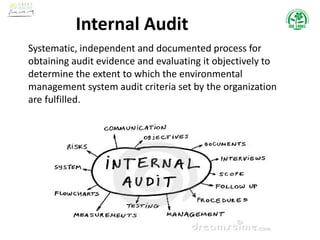
Systematic, independent and documented process for
obtaining audit evidence and evaluating it objectively to
determine the extent to which the environmental
management system audit criteria set by the organization
are fulfilled.
Internal Audit
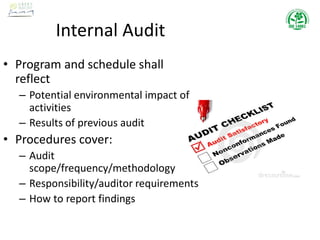
• Program and schedule shall
reflect
– Potential environmental impact of
activities
– Results of previous audit
• Procedures cover:
– Audit
scope/frequency/methodology
– Responsibility/auditor requirements
– How to report findings
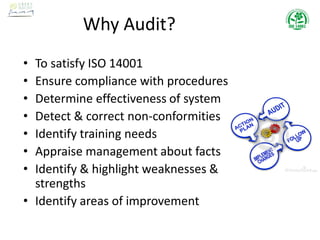
Why Audit?
• To satisfy ISO 14001
• Ensure compliance with procedures
• Determine effectiveness of system
• Detect & correct non-conformities
• Identify training needs
• Appraise management about facts
• Identify & highlight weaknesses &
strengths
• Identify areas of improvement
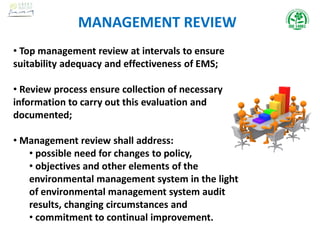
• Top management review at intervals to ensure
suitability adequacy and effectiveness of EMS;
• Review process ensure collection of necessary
information to carry out this evaluation and
documented;
• Management review shall address:
• possible need for changes to policy,
• objectives and other elements of the
environmental management system in the light
of environmental management system audit
results, changing circumstances and
• commitment to continual improvement.
MANAGEMENT REVIEW
Summary
• Objectives and aims of Environment Management System
• Key Definitions
• Explanations of important definitions

Module2

  • 1.
    Module - 2 Scope,Terms & Conditions and Objectives
  • 2.
    Aims of anEMS • Identification & control of aspects, impacts, risks • Establishing & achieving a environmental policy, objectives, targets, including compliance with legislation • Identifying environmental opportunities • Monitoring & continual improvement of environmental performance
  • 3.
  • 4.
    Key Definitions (Section3) Environment Surroundings in which an organization operates, including air, water, land, natural resources, flora, fauna, humans and their interrelation.
  • 5.
    Environmental Interaction What canan organization control? • Can control the generation at the source; • Can prevent & minimize exposure to the pathway; • But has no control on the impact to the receptor.
  • 6.
    Activities • ISO 14001Guidance: – An organization should identify the various activities, processes, products or services that are included in the scope of the EMS – Distinguishing them in such a way that they are “large enough for meaningful examination and small enough to be sufficiently understood.”
  • 7.
    Aspects • ISO 14001guidance: – Identify all environmental aspects of activities, products and services – Aspect = element of activity, product or service which can have a beneficial or adverse effect on the environment – Include all those that the organization “can control and over which it can be expected to have an influence”
  • 8.
    Impacts • ISO 14001guidance: – Organization should identify as many as possible of the actual or potential environmental impacts associated with each aspect of its activities – Impact = change which takes place in the environment as a result of the aspect, either positive or negative
  • 9.
    Aspect and Impacts EnvironmentalAspect Element of an organisation’s activities, products or services which can interact with the environment. Environmental Impact Any change to the environment, whether adverse or beneficial, wholly or partially resulting from an organisation’s activities, products or services. NOTE - A significant environmental aspect is an environmental aspect which has or can have a significant environmental impact
  • 10.
  • 11.
    Environmental Aspects andImpacts Activity
  • 12.
    Defining Significance Rating canbe based on: • Scale • Occurrence • Impact • Control • Detection
  • 13.
    Rating 1 2 34 5 Scale Localized Department Factory City Global Occurrence Once in a year/less frequent Once in a month Once in a week Once in a day Continuou s Impact Slight Negligible Nuisance causing, killing vegetation Human health effect Fatal Control Easily controllable Controllable but with cost Difficult but expensive to control Extremely difficult to control Not controllable with available technology Detection Easily detectable Certainly detectable Difficult to detect Extremely difficult to detect Can be detected only after damage is caused
  • 14.
    Key Definitions (Sections3) • System – Set of interrelated elements • Management System – System used to establish policy and objectives and to achieve those objectives. – Includes organizational structure, planning activities, responsibilities, practices, procedures and resources.
  • 15.
    • Part ofan organization’s management system used to develop and implement its environmental policy and manage its environmental aspects.
  • 16.
    Key Definitions • ContinualImprovement – Recurring process of enhancing the environmental management system in order to achieve improvements in overall environmental performance consistent with the organization’s environmental policy. NOTE: The process need not take place in all areas to activity simultaneously
  • 17.
    Key Definitions • Preventionof Pollution – Use of processes, practices, materials or products that avoid, reduce or control pollution, which may include recycling, treatment, process changes, control mechanisms, efficient use of resources and material substitution. NOTE: Prevention of pollution can include source reduction or elimination, process, product or service changes, efficient use of resources, material and energy substitution, reuse, recovery, recycling, reclamation and treatment.
  • 18.
    ENVIRONMENTAL POLICY • Overallintentions and directions of an organization related to its environmental performance as formally expressed by top management. NOTE:- The environmental [policy provides a framework for action and for the setting of environmental objectives and targets.
  • 19.
    Key Elements ofan EMS • Environmental Policy – Develop a statement of your organization’s commitment to the environment with the following in mind. • Continual improvement • Pollution prevention • Compliance with relevant laws & regulation » Keep it simple and understandable
  • 20.
    Environmental Objectives & Targets EnvironmentalObjective “Overall environmental goal, arising from the environmental policy, that an organisation sets itself to achieve, and which is quantified where practicable.” Environmental Target “Detailed performance requirement, quantified where practicable, applicable to the organisation or parts thereof, that arises from the environmental objectives and that needs to be set and met in order to achieve those objectives.”
  • 21.
    • “The organizationshall establish and maintain (a) programme(s) for achieving its objectives and targets. It shall include: • a) designation of responsibility for achieving objectives and targets at each relevant function and level of the organization; • b) the means and time-frame by which they are to be achieved. • If a project relates to new developments and new or modified activities, products or services, programme(s) shall be amended where relevant to ensure that environmental management applies to such projects.” (ISO 14001 4.3.4) Environmental Management Programmes
  • 22.
    •The organization shallestablish and maintain documented procedures to monitor and measure, on a regular basis, the key characteristics of its operations and activities that can have a significant impact on the environment. Shall include: - recording of information to track performance, - relevant operational controls, and - conformance with the organization’s environmental objectives and targets. •Monitoring equipment shall - be calibrated and maintained and - records of this process be retained according to the organizations procedures. • Organization shall establish and maintain a documented procedure for periodically evaluating compliance with relevant environmental legislation and regulations. MONITORING AND MEASUREMENT
  • 23.
    • The organizationshall - establish and maintain procedures for defining responsibility & authority for handling and investigating non-conformance, - taking action to mitigate any impacts caused and - for initiating and completing corrective and preventive action. • Any corrective or preventive action taken to eliminate the causes of actual and potential non conformances shall be appropriate to the magnitude of problems and commensurate with the environmental impact encountered. • The organization shall implement and record any changes in the documented procedures resulting from corrective and preventive action. NON-CONFORMANCE AND CORRECTIVE & PREVENTIVE ACTION (CAPA)
  • 24.
    • The organizationshall establish and maintain procedures for - identification maintenance and - disposition of environmental records. • Records shall include training records and the results of audits ad reviews. • Environmental records shall be - legible, identifiable and traceable to the activity, product or service involved; - stored and maintained in such a way that they are readily retrievable and protected against damage, deterioration or loss. • Their retention times shall be - established and recorded; - maintained as appropriate to the system and to the organization, to demonstrate conformance to the requirements of Standards. RECORDS
  • 25.
    The organization shallestablish and maintain programm(s) and procedures for periodic EMS audits to be carried out in order to: a). Determine whether or not the environmental management system 1. Conforms to planned arrangements for environmental management including the requirements of this International Standard and 2. Has been properly implemented and maintained and b). Provide information on the results of audits to management. ENVIRONMENTAL MANAGEMENT SYSTEMS AUDIT
  • 26.
    Internal Audit Systematic, independentand documented process for obtaining audit evidence and evaluating it objectively to determine the extent to which the environmental management system audit criteria set by the organization are fulfilled.
  • 27.
    Internal Audit • Programand schedule shall reflect – Potential environmental impact of activities – Results of previous audit • Procedures cover: – Audit scope/frequency/methodology – Responsibility/auditor requirements – How to report findings
  • 28.
    Why Audit? • Tosatisfy ISO 14001 • Ensure compliance with procedures • Determine effectiveness of system • Detect & correct non-conformities • Identify training needs • Appraise management about facts • Identify & highlight weaknesses & strengths • Identify areas of improvement
  • 29.
    • Top managementreview at intervals to ensure suitability adequacy and effectiveness of EMS; • Review process ensure collection of necessary information to carry out this evaluation and documented; • Management review shall address: • possible need for changes to policy, • objectives and other elements of the environmental management system in the light of environmental management system audit results, changing circumstances and • commitment to continual improvement. MANAGEMENT REVIEW
  • 30.
    Summary • Objectives andaims of Environment Management System • Key Definitions • Explanations of important definitions