Immunology

     Cell & Organs
Immune Defense & Response
  Immunologic Disorders
3 Lines of Body Defense
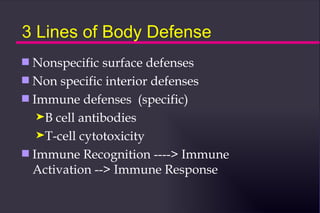
s Nonspecific surface defenses
s Non specific interior defenses
s Immune defenses (specific)
   ®B cell antibodies
   ®T-cell cytotoxicity
s Immune Recognition ----> Immune
  Activation --> Immune Response
Organs & Vessels of Immune
System
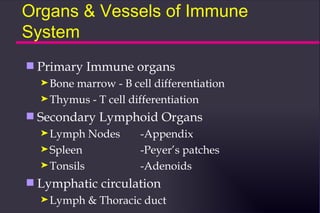
s   Primary Immune organs
    ® Bonemarrow - B cell differentiation
    ® Thymus - T cell differentiation

s   Secondary Lymphoid Organs
    ® Lymph     Nodes     -Appendix
    ® Spleen              -Peyer’s patches
    ® Tonsils             -Adenoids
s   Lymphatic circulation
    ® Lymph     & Thoracic duct
Types of Lymphocytes
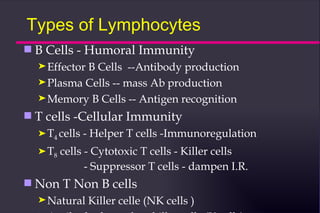
s   B Cells - Humoral Immunity
    ® Effector
             B Cells --Antibody production
    ® Plasma Cells -- mass Ab production
    ® Memory B Cells -- Antigen recognition

s   T cells -Cellular Immunity
    ® T4 cells   - Helper T cells -Immunoregulation
    ® T8   cells - Cytotoxic T cells - Killer cells
                 - Suppressor T cells - dampen I.R.
s   Non T Non B cells
    ® Natural     Killer celle (NK cells )
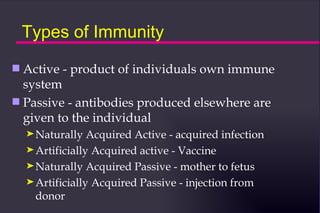
Types of Immunity
s Active - product of individuals own immune
  system
s Passive - antibodies produced elsewhere are
  given to the individual
    ® Naturally   Acquired Active - acquired infection
    ® Artificially Acquired active - Vaccine
    ® Naturally Acquired Passive - mother to fetus
    ® Artificially Acquired Passive - injection from
      donor
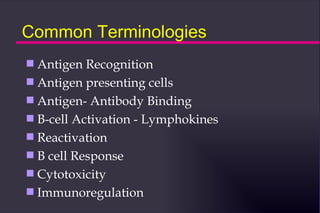
Common Terminologies
s Antigen Recognition
s Antigen presenting cells
s Antigen- Antibody Binding
s B-cell Activation - Lymphokines
s Reactivation
s B cell Response
s Cytotoxicity
s Immunoregulation
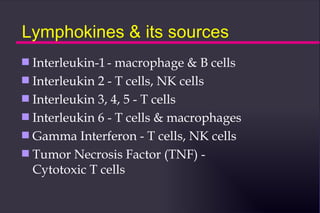
Lymphokines & its sources
s Interleukin-1 - macrophage & B cells
s Interleukin 2 - T cells, NK cells
s Interleukin 3, 4, 5 - T cells
s Interleukin 6 - T cells & macrophages
s Gamma Interferon - T cells, NK cells
s Tumor Necrosis Factor (TNF) -
  Cytotoxic T cells
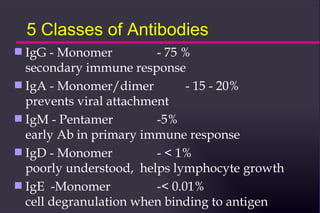
5 Classes of Antibodies
s IgG - Monomer          - 75 %
  secondary immune response
s IgA - Monomer/dimer          - 15 - 20%
  prevents viral attachment
s IgM - Pentamer         -5%
  early Ab in primary immune response
s IgD - Monomer          - < 1%
  poorly understood, helps lymphocyte growth
s IgE -Monomer           -< 0.01%
  cell degranulation when binding to antigen
Immunologic disorders
s   Type 1 -Anaphylactic Hypersensitivity
    ® Insectsting, hay fever, asthma , food allergy
    ® Immediate reaction within 20 minutes
    ® involves IgE
    ® Epinephrine, antihistamine (desensitization)

s   Type 2 - Cytotoxic Hypersensitivity
    ® Transfusion  rxns. Rh disease, Graves disease
    ® variable reaction time
    ® involves IgG, IgM variable treatment
Immunologic Disorders (2)
s   Type 3 - Immune Complex Hypersensitivity
    ® SLE, RA, farmers lung disease, serum sickness
    ® variable reaction time & treatment (steroids)
    ® involves IgG, IgM

s   Type 4 - Cell Mediated hypersensitivity
    ® delayed  type 12 hours to several weeks
    ® organ transplantation, poison ivy, granulomatous
      infection
    ® no Ig involved
Common Immunologic
Problems
s ABO system - transfusion reaction
s Rh system - hemolytic disease of
  newborn
s Crossmatch reactions
s Organ Transplantations
s Tissue Grafting & rejection
    ® Graftversus host
    ® Host versus graft
Types of Grafts
s   Autograft - self
    ® skin   ( no rejection)
s   Isograft - same e.g. twins
    ® bone   marrow (no rejection)
s   Allograft - different
    ® bone   marrow, kidney, heart , lung, cornea
s   Xenograft - foreign
    ® Babboon’s    heart
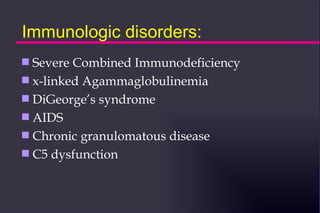
Immunologic disorders:
s Severe Combined Immunodeficiency
s x-linked Agammaglobulinemia
s DiGeorge’s syndrome
s AIDS
s Chronic granulomatous disease
s C5 dysfunction

Module11 immunology-120620071937-phpapp01

  • 1.
    Immunology Cell & Organs Immune Defense & Response Immunologic Disorders
  • 2.
    3 Lines ofBody Defense s Nonspecific surface defenses s Non specific interior defenses s Immune defenses (specific) ®B cell antibodies ®T-cell cytotoxicity s Immune Recognition ----> Immune Activation --> Immune Response
  • 3.
    Organs & Vesselsof Immune System s Primary Immune organs ® Bonemarrow - B cell differentiation ® Thymus - T cell differentiation s Secondary Lymphoid Organs ® Lymph Nodes -Appendix ® Spleen -Peyer’s patches ® Tonsils -Adenoids s Lymphatic circulation ® Lymph & Thoracic duct
  • 4.
    Types of Lymphocytes s B Cells - Humoral Immunity ® Effector B Cells --Antibody production ® Plasma Cells -- mass Ab production ® Memory B Cells -- Antigen recognition s T cells -Cellular Immunity ® T4 cells - Helper T cells -Immunoregulation ® T8 cells - Cytotoxic T cells - Killer cells - Suppressor T cells - dampen I.R. s Non T Non B cells ® Natural Killer celle (NK cells )
  • 5.
    Types of Immunity sActive - product of individuals own immune system s Passive - antibodies produced elsewhere are given to the individual ® Naturally Acquired Active - acquired infection ® Artificially Acquired active - Vaccine ® Naturally Acquired Passive - mother to fetus ® Artificially Acquired Passive - injection from donor
  • 6.
    Common Terminologies s AntigenRecognition s Antigen presenting cells s Antigen- Antibody Binding s B-cell Activation - Lymphokines s Reactivation s B cell Response s Cytotoxicity s Immunoregulation
  • 7.
    Lymphokines & itssources s Interleukin-1 - macrophage & B cells s Interleukin 2 - T cells, NK cells s Interleukin 3, 4, 5 - T cells s Interleukin 6 - T cells & macrophages s Gamma Interferon - T cells, NK cells s Tumor Necrosis Factor (TNF) - Cytotoxic T cells
  • 8.
    5 Classes ofAntibodies s IgG - Monomer - 75 % secondary immune response s IgA - Monomer/dimer - 15 - 20% prevents viral attachment s IgM - Pentamer -5% early Ab in primary immune response s IgD - Monomer - < 1% poorly understood, helps lymphocyte growth s IgE -Monomer -< 0.01% cell degranulation when binding to antigen
  • 9.
    Immunologic disorders s Type 1 -Anaphylactic Hypersensitivity ® Insectsting, hay fever, asthma , food allergy ® Immediate reaction within 20 minutes ® involves IgE ® Epinephrine, antihistamine (desensitization) s Type 2 - Cytotoxic Hypersensitivity ® Transfusion rxns. Rh disease, Graves disease ® variable reaction time ® involves IgG, IgM variable treatment
  • 10.
    Immunologic Disorders (2) s Type 3 - Immune Complex Hypersensitivity ® SLE, RA, farmers lung disease, serum sickness ® variable reaction time & treatment (steroids) ® involves IgG, IgM s Type 4 - Cell Mediated hypersensitivity ® delayed type 12 hours to several weeks ® organ transplantation, poison ivy, granulomatous infection ® no Ig involved
  • 11.
    Common Immunologic Problems s ABOsystem - transfusion reaction s Rh system - hemolytic disease of newborn s Crossmatch reactions s Organ Transplantations s Tissue Grafting & rejection ® Graftversus host ® Host versus graft
  • 12.
    Types of Grafts s Autograft - self ® skin ( no rejection) s Isograft - same e.g. twins ® bone marrow (no rejection) s Allograft - different ® bone marrow, kidney, heart , lung, cornea s Xenograft - foreign ® Babboon’s heart
  • 13.
    Immunologic disorders: s SevereCombined Immunodeficiency s x-linked Agammaglobulinemia s DiGeorge’s syndrome s AIDS s Chronic granulomatous disease s C5 dysfunction