Immunopatology of
autoimmune diseases
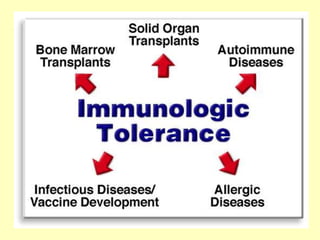
Immunological tolerance
Cellular and molecular mechanisms of the
immunological tolerance
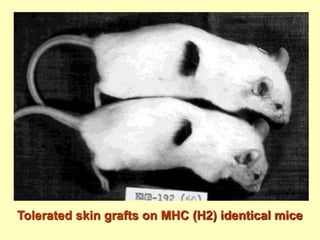
Tolerated skin grafts on MHC (H2) identical mice
TOLERANCE & AUTOIMMUNITY
• Upon encountering an antigen, the immune system
can either develop an immune response or enter a
state of unresponsiveness called tolerance.
• Immunological tolerance is thus the lack of ability to
mount an immune response to epitopes to which an
individual has the potential to respond.
• Targeting type and tolerating type immune
responses composed by the same cellular and
molecular components, the differences are in the
effector phase only.
• Targeting type immune response or tolerance
needs to be carefully regulated since an
inappropriate response –whether it be autoimmune
reaction to self-antigens or tolerance to a potential
pathogen– can have serious and possibly life-
threatening consequences.
TOLERNACE
- PASSIVE
- ACTIVE
AUTOIMMUNITY
- PHYSIOLOGIC REGULATION
- AUTOIMMUNE DISEASES
Passive tolerance
Unresponsiveness: no MHC recognition or
inhibited cellular differentiation.
• Tolerance induced by the nature
of the antigen
• Tolerance induced by the body
Passive tolerance induced by the
nature of the antigen
• chemical nature
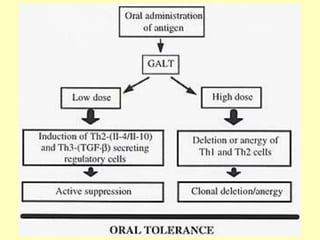
• dose of the antigen
- low dose tolerance (T cell mediated,
long ranging)
- high dose tolerance (B cell mediated,
short ranging)
• mode of the administration
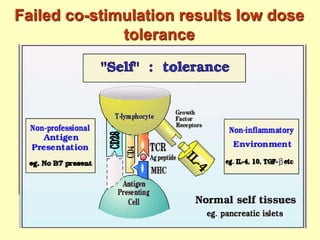
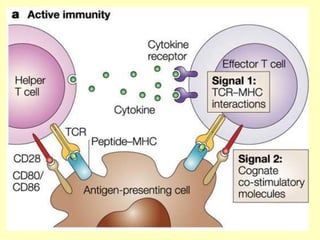
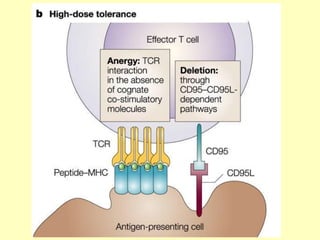
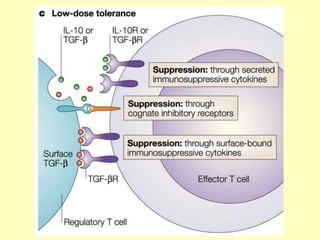
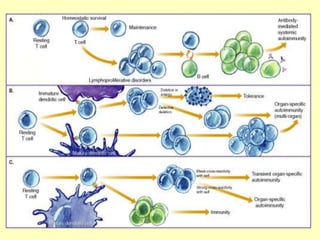
T-cell tolerance
– Central Tolerance (selection in the Thymus)
– Peripheral Tolerance
• Lack of Co-stimulation
• Failure to Encounter Self Antigens
• Receipt of Death Signal
• Control by Regulatory T cells
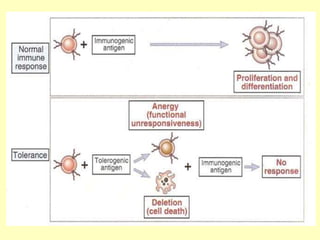
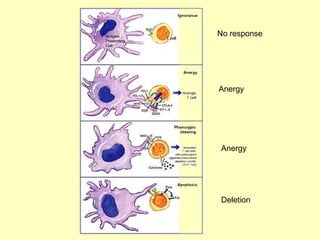
Failed co-stimulation results low dose
tolerance
Anergy
Deletion
Anergy
No response
B-cell Tolerance
- Central tolerance
- Peripheral tolerance
Oral tolerance
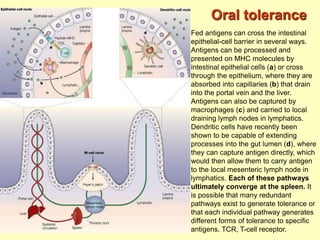
Fed antigens can cross the intestinal
epithelial-cell barrier in several ways.
Antigens can be processed and
presented on MHC molecules by
intestinal epithelial cells (a) or cross
through the epithelium, where they are
absorbed into capillaries (b) that drain
into the portal vein and the liver.
Antigens can also be captured by
macrophages (c) and carried to local
draining lymph nodes in lymphatics.
Dendritic cells have recently been
shown to be capable of extending
processes into the gut lumen (d), where
they can capture antigen directly, which
would then allow them to carry antigen
to the local mesenteric lymph node in
lymphatics. Each of these pathways
ultimately converge at the spleen. It
is possible that many redundant
pathways exist to generate tolerance or
that each individual pathway generates
different forms of tolerance to specific
antigens. TCR, T-cell receptor.
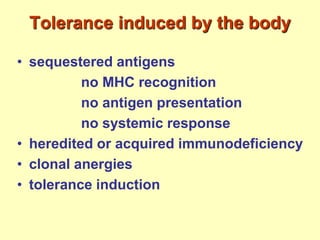
Tolerance induced by the body
• sequestered antigens
no MHC recognition
no antigen presentation
no systemic response
• heredited or acquired immunodeficiency
• clonal anergies
• tolerance induction
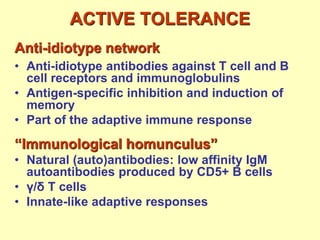
ACTIVE TOLERANCE
Anti-idiotype network
• Anti-idiotype antibodies against T cell and B
cell receptors and immunoglobulins
• Antigen-specific inhibition and induction of
memory
• Part of the adaptive immune response
“Immunological homunculus”
• Natural (auto)antibodies: low affinity IgM
autoantibodies produced by CD5+ B cells
• γ/δ T cells
• Innate-like adaptive responses
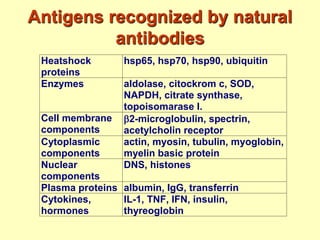
Antigens recognized by natural
antibodies
Heatshock
proteins
hsp65, hsp70, hsp90, ubiquitin
Enzymes aldolase, citockrom c, SOD,
NAPDH, citrate synthase,
topoisomarase I.
Cell membrane
components
2-microglobulin, spectrin,
acetylcholin receptor
Cytoplasmic
components
actin, myosin, tubulin, myoglobin,
myelin basic protein
Nuclear
components
DNS, histones
Plasma proteins albumin, IgG, transferrin
Cytokines,
hormones
IL-1, TNF, IFN, insulin,
thyreoglobin
Immunological tolerance

Immunological tolerance

  • 1.
    Immunopatology of autoimmune diseases Immunologicaltolerance Cellular and molecular mechanisms of the immunological tolerance
  • 2.
    Tolerated skin graftson MHC (H2) identical mice
  • 3.
    TOLERANCE & AUTOIMMUNITY •Upon encountering an antigen, the immune system can either develop an immune response or enter a state of unresponsiveness called tolerance. • Immunological tolerance is thus the lack of ability to mount an immune response to epitopes to which an individual has the potential to respond. • Targeting type and tolerating type immune responses composed by the same cellular and molecular components, the differences are in the effector phase only. • Targeting type immune response or tolerance needs to be carefully regulated since an inappropriate response –whether it be autoimmune reaction to self-antigens or tolerance to a potential pathogen– can have serious and possibly life- threatening consequences.
  • 5.
    TOLERNACE - PASSIVE - ACTIVE AUTOIMMUNITY -PHYSIOLOGIC REGULATION - AUTOIMMUNE DISEASES
  • 6.
    Passive tolerance Unresponsiveness: noMHC recognition or inhibited cellular differentiation. • Tolerance induced by the nature of the antigen • Tolerance induced by the body
  • 7.
    Passive tolerance inducedby the nature of the antigen • chemical nature • dose of the antigen - low dose tolerance (T cell mediated, long ranging) - high dose tolerance (B cell mediated, short ranging) • mode of the administration
  • 8.
    T-cell tolerance – CentralTolerance (selection in the Thymus) – Peripheral Tolerance • Lack of Co-stimulation • Failure to Encounter Self Antigens • Receipt of Death Signal • Control by Regulatory T cells
  • 9.
  • 13.
  • 14.
    B-cell Tolerance - Centraltolerance - Peripheral tolerance
  • 16.
    Oral tolerance Fed antigenscan cross the intestinal epithelial-cell barrier in several ways. Antigens can be processed and presented on MHC molecules by intestinal epithelial cells (a) or cross through the epithelium, where they are absorbed into capillaries (b) that drain into the portal vein and the liver. Antigens can also be captured by macrophages (c) and carried to local draining lymph nodes in lymphatics. Dendritic cells have recently been shown to be capable of extending processes into the gut lumen (d), where they can capture antigen directly, which would then allow them to carry antigen to the local mesenteric lymph node in lymphatics. Each of these pathways ultimately converge at the spleen. It is possible that many redundant pathways exist to generate tolerance or that each individual pathway generates different forms of tolerance to specific antigens. TCR, T-cell receptor.
  • 19.
    Tolerance induced bythe body • sequestered antigens no MHC recognition no antigen presentation no systemic response • heredited or acquired immunodeficiency • clonal anergies • tolerance induction
  • 20.
    ACTIVE TOLERANCE Anti-idiotype network •Anti-idiotype antibodies against T cell and B cell receptors and immunoglobulins • Antigen-specific inhibition and induction of memory • Part of the adaptive immune response “Immunological homunculus” • Natural (auto)antibodies: low affinity IgM autoantibodies produced by CD5+ B cells • γ/δ T cells • Innate-like adaptive responses
  • 21.
    Antigens recognized bynatural antibodies Heatshock proteins hsp65, hsp70, hsp90, ubiquitin Enzymes aldolase, citockrom c, SOD, NAPDH, citrate synthase, topoisomarase I. Cell membrane components 2-microglobulin, spectrin, acetylcholin receptor Cytoplasmic components actin, myosin, tubulin, myoglobin, myelin basic protein Nuclear components DNS, histones Plasma proteins albumin, IgG, transferrin Cytokines, hormones IL-1, TNF, IFN, insulin, thyreoglobin