Chapter 7 
Immunity
Immune System 
 Responsible for body defenses 
 Nonspecific response (defense) 
• Examples: phagocytosis, inflammation 
 Specific response (defense) 
• Production of specific antibodies against foreign 
substances 
•Copyright © 2014, 2011, 2006 by Saunders, an imprint of Elsevier, Inc. •2
Components of the Immune 
System 
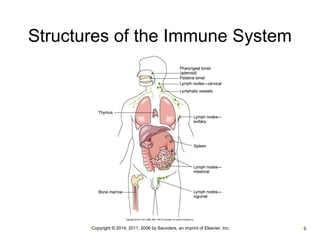
 Lymphoid structures 
 Lymph nodes 
 Spleen 
 Tonsils 
 Intestinal lymphoid tissue 
 Lymphatic circulation 
 Immune cells 
 Lymphocytes 
 Macrophages 
•Copyright © 2014, 2011, 2006 by Saunders, an imprint of Elsevier, Inc. •3
Components of the Immune 
System (Cont.) 
 Tissues—immune cell development 
 Bone marrow 
• Origination of all immune cells 
•Copyright © 2014, 2011, 2006 by Saunders, an imprint of Elsevier, Inc. •4 
 Thymus 
• Maturation of T lymphocytes
Structures of the Immune System 
•Copyright © 2014, 2011, 2006 by Saunders, an imprint of Elsevier, Inc. •5
Elements of the Immune System 
•Copyright © 2014, 2011, 2006 by Saunders, an imprint of Elsevier, Inc. •6 
 Antigens 
 Self 
• HLA proteins label cells of the individual. 
• Immune system ignores self cells. 
 Non-self 
• Immune system recognizes specific nonself antigens as 
foreign. 
• Development of a specific response to that particular 
antigen 
• Memory cells produced to respond quickly to antigen
Antigens (Immunogens) 
 Usually exogenous substances 
 Cell surface antigens 
 Proteins 
 Polysaccharides 
 Glycoproteins 
•Copyright © 2014, 2011, 2006 by Saunders, an imprint of Elsevier, Inc. •7
Cells 
 Macrophages 
 Initiation of immune response 
 Develop from monocytes 
 Part of the mononuclear phagocytotic system 
 Engulf foreign material 
 Display antigens of foreign material 
 Secrete chemicals 
• Examples: monokines, interleukins 
 Present throughout the body 
•Copyright © 2014, 2011, 2006 by Saunders, an imprint of Elsevier, Inc. •8
Cells 
 Lymphocytes 
 T lymphocytes 
• From bone marrow stem cells 
• Further differentiation in thymus 
• Cell-mediated immunity 
• Cytotoxic T killer cells 
• Helper T cells 
• Memory T cells 
•Copyright © 2014, 2011, 2006 by Saunders, an imprint of Elsevier, Inc. •9
Cells (Cont.) 
 Lymphocytes 
 B lymphocytes 
• Responsible for production of antibodies 
• Humoral immunity 
• Mature in bone marrow 
 Proceed to spleen and lymphoid tissue 
• Plasma cells 
 Produce antibodies 
• B memory cells 
 Can quickly form clone of plasma cells 
•Copyright © 2014, 2011, 2006 by Saunders, an imprint of Elsevier, Inc. •10
Types of Immunity 
 Humoral immunity: Antibodies are produced 
to protect the body. 
 Cell-mediated immunity (CMI): Lymphocytes 
are programmed to attack nonself cells to 
protect the body. 
•Copyright © 2014, 2011, 2006 by Saunders, an imprint of Elsevier, Inc. •11
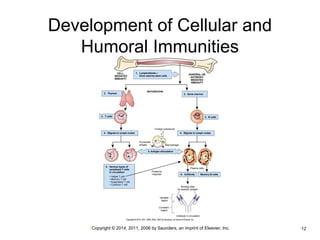
Development of Cellular and 
Humoral Immunities 
•Copyright © 2014, 2011, 2006 by Saunders, an imprint of Elsevier, Inc. •12
Antibodies and Immunoglobulins 
•Copyright © 2014, 2011, 2006 by Saunders, an imprint of Elsevier, Inc. •13 
 IgG 
 Most common in blood 
 IgM 
 First to increase in immune response 
 IgA 
 In secretions 
• Tears 
• Saliva and mucous membranes 
• Colostrum
Antibodies and Immunoglobulins 
(Cont.) 
•Copyright © 2014, 2011, 2006 by Saunders, an imprint of Elsevier, Inc. •14 
 IgE 
 Allergic response 
 Causes release of histamine and other chemicals 
 Results in inflammation 
 IgD 
 Attached to B cells 
 Activates B cells
Review of the Major Components 
of the Immune System 
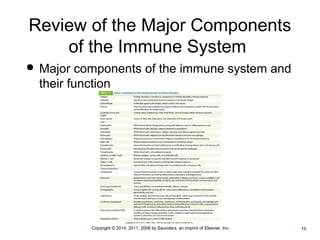
 Major components of the immune system and 
their function 
•Copyright © 2014, 2011, 2006 by Saunders, an imprint of Elsevier, Inc. •15
Complement System 
 Activated during immune reactions with IgG 
or IgM 
 Group of inactive proteins circulating in blood 
 C1 to C9 
 Causes cell damage and further inflammation 
when activated 
•Copyright © 2014, 2011, 2006 by Saunders, an imprint of Elsevier, Inc. •16
Chemical Mediators 
 Involved in inflammation and immune 
reactions 
 Examples: histamine, interleukins 
 Variety of functions 
 Signaling 
 Causing cellular damage 
•Copyright © 2014, 2011, 2006 by Saunders, an imprint of Elsevier, Inc. •17
Diagnostic Tests 
 Titer (titre) 
 Measures levels of serum immunoglobulins 
 Indirect Coombs’ test 
 Detects Rh blood incompatibility 
•Copyright © 2014, 2011, 2006 by Saunders, an imprint of Elsevier, Inc. •18 
 Elisa 
 Detects HIV antibodies 
 Used for a number of other diseases 
 MHC typing 
 Tissue matching before transplantation 
procedures
Immunity 
 Natural immunity 
 Species-specific 
 Innate immunity 
 Gene-specific 
 Related to ethnicity 
•Copyright © 2014, 2011, 2006 by Saunders, an imprint of Elsevier, Inc. •19
Immunity (Cont.) 
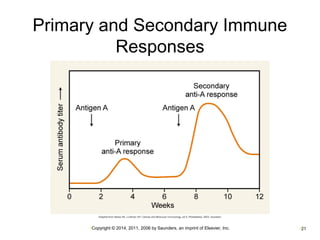
 Primary response 
 First exposure to antigen 
 1 to 2 weeks before antibody titer reaches efficacy 
 Secondary response 
 Repeat exposure to the same antigen 
 More rapid response, with efficacy in 1 to 3 days 
•Copyright © 2014, 2011, 2006 by Saunders, an imprint of Elsevier, Inc. •20
Primary and Secondary Immune 
Responses 
•Copyright © 2014, 2011, 2006 by Saunders, an imprint of Elsevier, Inc. •21
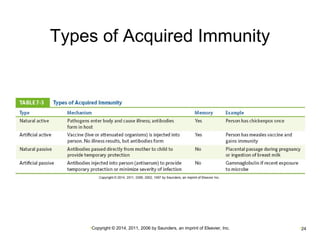
Immunity 
 Active natural immunity 
 Natural exposure to antigen 
 Development of antibodies 
 Active artificial immunity 
 Antigen purposefully introduced to body 
 Stimulation of antibody production 
 Immunization 
 Booster immunization 
•Copyright © 2014, 2011, 2006 by Saunders, an imprint of Elsevier, Inc. •22
Immunity (Cont.) 
 Passive natural immunity 
 IgG transferred from mother to fetus: 
• Across placenta 
• Through breast milk 
 Protection of infant for the first few months of life 
or until weaned 
 Passive artificial immunity 
 Injection of antibodies 
 Short-term protection 
•Copyright © 2014, 2011, 2006 by Saunders, an imprint of Elsevier, Inc. •23
Types of Acquired Immunity 
•Copyright © 2014, 2011, 2006 by Saunders, an imprint of Elsevier, Inc. •24
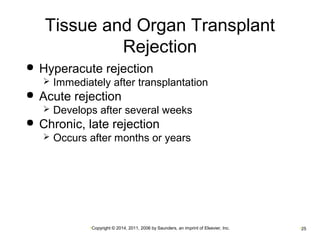
Tissue and Organ Transplant 
Rejection 
 Hyperacute rejection 
 Immediately after transplantation 
 Acute rejection 
 Develops after several weeks 
 Chronic, late rejection 
 Occurs after months or years 
•Copyright © 2014, 2011, 2006 by Saunders, an imprint of Elsevier, Inc. •25
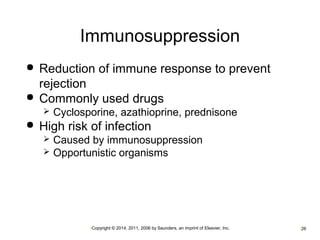
Immunosuppression 
 Reduction of immune response to prevent 
rejection 
 Commonly used drugs 
 Cyclosporine, azathioprine, prednisone 
 High risk of infection 
 Caused by immunosuppression 
 Opportunistic organisms 
•Copyright © 2014, 2011, 2006 by Saunders, an imprint of Elsevier, Inc. •26
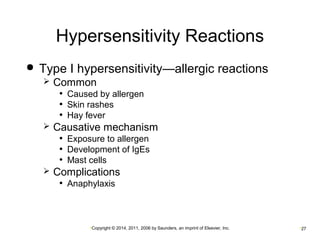
Hypersensitivity Reactions 
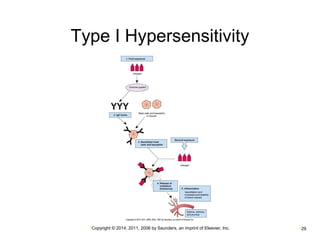
 Type I hypersensitivity—allergic reactions 
 Common 
• Caused by allergen 
• Skin rashes 
• Hay fever 
 Causative mechanism 
• Exposure to allergen 
• Development of IgEs 
• Mast cells 
 Complications 
• Anaphylaxis 
•Copyright © 2014, 2011, 2006 by Saunders, an imprint of Elsevier, Inc. •27
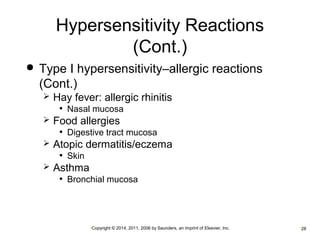
Hypersensitivity Reactions 
(Cont.) 
 Type I hypersensitivity–allergic reactions 
(Cont.) 
 Hay fever: allergic rhinitis 
• Nasal mucosa 
 Food allergies 
• Digestive tract mucosa 
 Atopic dermatitis/eczema 
•Copyright © 2014, 2011, 2006 by Saunders, an imprint of Elsevier, Inc. •28 
• Skin 
 Asthma 
• Bronchial mucosa
Type I Hypersensitivity 
•Copyright © 2014, 2011, 2006 by Saunders, an imprint of Elsevier, Inc. •29
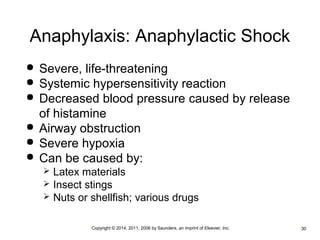
Anaphylaxis: Anaphylactic Shock 
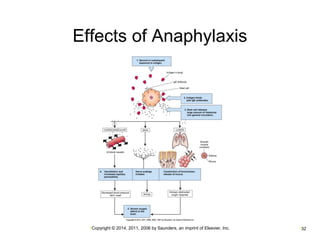
 Severe, life-threatening 
 Systemic hypersensitivity reaction 
 Decreased blood pressure caused by release 
of histamine 
 Airway obstruction 
 Severe hypoxia 
 Can be caused by: 
 Latex materials 
 Insect stings 
 Nuts or shellfish; various drugs 
•Copyright © 2014, 2011, 2006 by Saunders, an imprint of Elsevier, Inc. •30
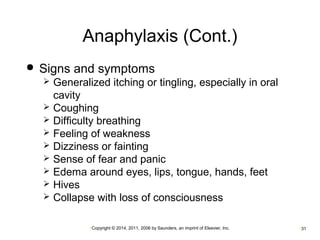
Anaphylaxis (Cont.) 
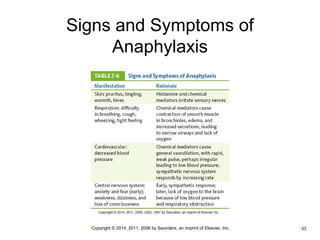
 Signs and symptoms 
 Generalized itching or tingling, especially in oral 
cavity 
 Coughing 
 Difficulty breathing 
 Feeling of weakness 
 Dizziness or fainting 
 Sense of fear and panic 
 Edema around eyes, lips, tongue, hands, feet 
 Hives 
 Collapse with loss of consciousness 
•Copyright © 2014, 2011, 2006 by Saunders, an imprint of Elsevier, Inc. •31
Effects of Anaphylaxis 
•Copyright © 2014, 2011, 2006 by Saunders, an imprint of Elsevier, Inc. •32
Signs and Symptoms of 
Anaphylaxis 
•Copyright © 2014, 2011, 2006 by Saunders, an imprint of Elsevier, Inc. •33
Treatment for Anaphylaxis 
 Requires first aid response: 
 Administer EpiPen if available 
 Call 911 (many paramedics can start drug 
treatment and oxygen) 
 Treatment in emergency department: 
 Epinephrine 
 Glucocorticoids 
 Antihistamines 
 Oxygen 
 Stabilize BP 
•Copyright © 2014, 2011, 2006 by Saunders, an imprint of Elsevier, Inc. •34
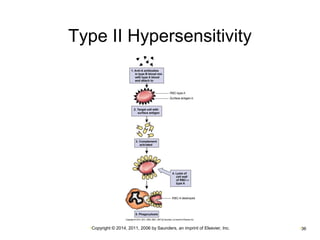
Type II: Cytotoxic Hypersensitivity 
 Antigen is present on cell membrane 
 May be normal body component or exogenous 
 Circulating IgGs react with antigen 
 Destruction by phagocytosis or cytolytic enzymes 
•Copyright © 2014, 2011, 2006 by Saunders, an imprint of Elsevier, Inc. •35 
 Example 
 Response to incompatible blood transfusion
Type II Hypersensitivity 
•Copyright © 2014, 2011, 2006 by Saunders, an imprint of Elsevier, Inc. •36
Type III: Immune Complex 
Hypersensitivity 
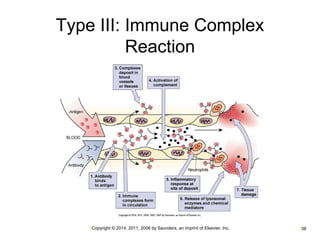
 Antigen combines with antibody 
 Forms immune complexes, deposited in tissue 
 Activation of complement system 
 Process causes inflammation and tissue 
destruction 
 Examples: 
 Glomerulonephritis 
 Rheumatoid arthritis 
•Copyright © 2014, 2011, 2006 by Saunders, an imprint of Elsevier, Inc. •37
Type III: Immune Complex 
Reaction 
•Copyright © 2014, 2011, 2006 by Saunders, an imprint of Elsevier, Inc. •38
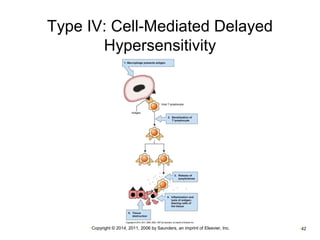
Type IV: Cell-Mediated or 
Delayed Hypersensitivity 
 Delayed response by sensitized T lymphocytes 
 Release of lymphokines 
 Inflammatory response 
 Destruction of the antigen 
 Examples: 
 Tuberculin test 
 Contact dermatitis 
 Allergic skin rash 
•Copyright © 2014, 2011, 2006 by Saunders, an imprint of Elsevier, Inc. •39
Autoimmune Disorders 
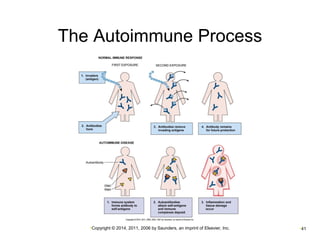
 Development of antibodies against own cells 
or tissues 
 Autoantibodies are antibodies formed against 
self-antigens—loss of self-tolerance. 
 Disorder can affect single organs or tissues 
or can be generalized. 
 Examples: 
 Hashimoto thyroiditis, systemic lupus 
erythematosus, rheumatic fever, myasthenia 
gravis, scleroderma, pernicious anemia 
•Copyright © 2014, 2011, 2006 by Saunders, an imprint of Elsevier, Inc. •40
The Autoimmune Process 
•Copyright © 2014, 2011, 2006 by Saunders, an imprint of Elsevier, Inc. •41
Type IV: Cell-Mediated Delayed 
Hypersensitivity 
•Copyright © 2014, 2011, 2006 by Saunders, an imprint of Elsevier, Inc. •42
Systemic Lupus 
Erythematosus (SLE) 
 Chronic inflammatory disease 
 Affects a number of organ systems 
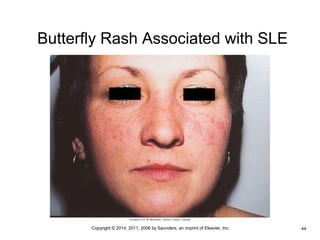
 Characteristic facial rash—“butterfly rash” 
 Affects primarily young women 
 Incidence is higher in African Americans, 
Asians, Hispanics, Native Americans 
•Copyright © 2014, 2011, 2006 by Saunders, an imprint of Elsevier, Inc. •43
Butterfly Rash Associated with SLE 
•Copyright © 2014, 2011, 2006 by Saunders, an imprint of Elsevier, Inc. •44
SLE 
 Large number of circulating autoantibodies 
 Against DNA, platelets, erythrocytes 
 Formation of immune complexes 
 Deposited into tissues 
 Inflammation and necrosis 
 Vasculitis develops in many organs. 
 Impairs blood supply to the tissues 
•Copyright © 2014, 2011, 2006 by Saunders, an imprint of Elsevier, Inc. •45
SLE (Cont.) 
 Sings and symptoms vary because of organ 
involvement but commonly include: 
 Arthralgia, fatigue, malaise 
 Cardiovascular problems 
 Polyuria 
 Diagnostic test 
 Serum antibodies, LE cells, other blood work 
 Treatment 
 Usually treated by a rheumatologist 
 Prednisone (glucocorticoid) 
 Nonsteroidal anti-inflammatory drugs 
•Copyright © 2014, 2011, 2006 by Saunders, an imprint of Elsevier, Inc. •46
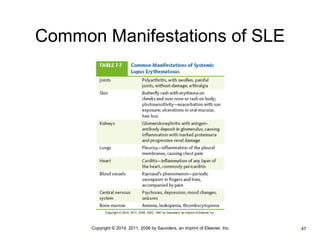
Common Manifestations of SLE 
•Copyright © 2014, 2011, 2006 by Saunders, an imprint of Elsevier, Inc. •47
Immunodeficiency 
 Partial or total loss of one or more immune 
system components 
 Increased risk of infection and cancer 
 Primary deficiencies 
 Basic developmental failure somewhere in the 
system 
 Secondary or acquired immunodeficiencies 
 Loss of the immune response from specific causes 
 Can occur at any time during the life span 
• Infections, splenectomy, malnutrition, liver disease, 
immunosuppressant drugs, radiation, chemotherapy 
(cancer) 
•Copyright © 2014, 2011, 2006 by Saunders, an imprint of Elsevier, Inc. •48
Immunodeficiency (Cont.) 
 Predisposition to the development of 
opportunistic infections 
 Caused by normal flora 
 Usually difficult to treat because of 
immunodeficiency 
 Prophylactic antimicrobial drugs may be used 
prior to invasive procedures. 
•Copyright © 2014, 2011, 2006 by Saunders, an imprint of Elsevier, Inc. •49
Acquired Immunodeficiency 
Syndrome (AIDS) 
 AIDS—chronic infectious disease caused by 
the human immunodeficiency virus (HIV) 
 HIV destroys helper T cells—CD4 
lymphocytes 
 Loss of immune response 
 Increased susceptibility to secondary 
infections and cancer 
 Prolonged latent period 
 Development may be suppressed by 
antivirals 
•Copyright © 2014, 2011, 2006 by Saunders, an imprint of Elsevier, Inc. •50
AIDS (Cont.) 
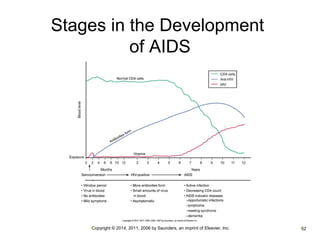
 HIV-positive individual 
 Virus is known to be in the body. 
 No evidence of immunosuppression 
•Copyright © 2014, 2011, 2006 by Saunders, an imprint of Elsevier, Inc. •51 
 AIDS 
 Marked clinical symptoms, multiple complications 
 Individual often identified as HIV-positive 
before development of AIDS 
 Current therapies start if HIV infection is 
diagnosed in the early stages.
Stages in the Development 
of AIDS 
•Copyright © 2014, 2011, 2006 by Saunders, an imprint of Elsevier, Inc. •52
History of AIDS 
 First case recognized in 1979; HIV identified 
in 1984 
 Evidence of earlier sporadic cases 
 Now considered to be a pandemic 
 Occurs in men and women 
 2006, CDC: 1 million cases in North America 
 2007, UN: 33 million cases globally; 22 
million of those in sub-Saharan Africa 
•Copyright © 2014, 2011, 2006 by Saunders, an imprint of Elsevier, Inc. •53

Chapter 007

  • 1.
  • 2.
    Immune System Responsible for body defenses  Nonspecific response (defense) • Examples: phagocytosis, inflammation  Specific response (defense) • Production of specific antibodies against foreign substances •Copyright © 2014, 2011, 2006 by Saunders, an imprint of Elsevier, Inc. •2
  • 3.
    Components of theImmune System  Lymphoid structures  Lymph nodes  Spleen  Tonsils  Intestinal lymphoid tissue  Lymphatic circulation  Immune cells  Lymphocytes  Macrophages •Copyright © 2014, 2011, 2006 by Saunders, an imprint of Elsevier, Inc. •3
  • 4.
    Components of theImmune System (Cont.)  Tissues—immune cell development  Bone marrow • Origination of all immune cells •Copyright © 2014, 2011, 2006 by Saunders, an imprint of Elsevier, Inc. •4  Thymus • Maturation of T lymphocytes
  • 5.
    Structures of theImmune System •Copyright © 2014, 2011, 2006 by Saunders, an imprint of Elsevier, Inc. •5
  • 6.
    Elements of theImmune System •Copyright © 2014, 2011, 2006 by Saunders, an imprint of Elsevier, Inc. •6  Antigens  Self • HLA proteins label cells of the individual. • Immune system ignores self cells.  Non-self • Immune system recognizes specific nonself antigens as foreign. • Development of a specific response to that particular antigen • Memory cells produced to respond quickly to antigen
  • 7.
    Antigens (Immunogens) Usually exogenous substances  Cell surface antigens  Proteins  Polysaccharides  Glycoproteins •Copyright © 2014, 2011, 2006 by Saunders, an imprint of Elsevier, Inc. •7
  • 8.
    Cells  Macrophages  Initiation of immune response  Develop from monocytes  Part of the mononuclear phagocytotic system  Engulf foreign material  Display antigens of foreign material  Secrete chemicals • Examples: monokines, interleukins  Present throughout the body •Copyright © 2014, 2011, 2006 by Saunders, an imprint of Elsevier, Inc. •8
  • 9.
    Cells  Lymphocytes  T lymphocytes • From bone marrow stem cells • Further differentiation in thymus • Cell-mediated immunity • Cytotoxic T killer cells • Helper T cells • Memory T cells •Copyright © 2014, 2011, 2006 by Saunders, an imprint of Elsevier, Inc. •9
  • 10.
    Cells (Cont.) Lymphocytes  B lymphocytes • Responsible for production of antibodies • Humoral immunity • Mature in bone marrow  Proceed to spleen and lymphoid tissue • Plasma cells  Produce antibodies • B memory cells  Can quickly form clone of plasma cells •Copyright © 2014, 2011, 2006 by Saunders, an imprint of Elsevier, Inc. •10
  • 11.
    Types of Immunity  Humoral immunity: Antibodies are produced to protect the body.  Cell-mediated immunity (CMI): Lymphocytes are programmed to attack nonself cells to protect the body. •Copyright © 2014, 2011, 2006 by Saunders, an imprint of Elsevier, Inc. •11
  • 12.
    Development of Cellularand Humoral Immunities •Copyright © 2014, 2011, 2006 by Saunders, an imprint of Elsevier, Inc. •12
  • 13.
    Antibodies and Immunoglobulins •Copyright © 2014, 2011, 2006 by Saunders, an imprint of Elsevier, Inc. •13  IgG  Most common in blood  IgM  First to increase in immune response  IgA  In secretions • Tears • Saliva and mucous membranes • Colostrum
  • 14.
    Antibodies and Immunoglobulins (Cont.) •Copyright © 2014, 2011, 2006 by Saunders, an imprint of Elsevier, Inc. •14  IgE  Allergic response  Causes release of histamine and other chemicals  Results in inflammation  IgD  Attached to B cells  Activates B cells
  • 15.
    Review of theMajor Components of the Immune System  Major components of the immune system and their function •Copyright © 2014, 2011, 2006 by Saunders, an imprint of Elsevier, Inc. •15
  • 16.
    Complement System Activated during immune reactions with IgG or IgM  Group of inactive proteins circulating in blood  C1 to C9  Causes cell damage and further inflammation when activated •Copyright © 2014, 2011, 2006 by Saunders, an imprint of Elsevier, Inc. •16
  • 17.
    Chemical Mediators Involved in inflammation and immune reactions  Examples: histamine, interleukins  Variety of functions  Signaling  Causing cellular damage •Copyright © 2014, 2011, 2006 by Saunders, an imprint of Elsevier, Inc. •17
  • 18.
    Diagnostic Tests Titer (titre)  Measures levels of serum immunoglobulins  Indirect Coombs’ test  Detects Rh blood incompatibility •Copyright © 2014, 2011, 2006 by Saunders, an imprint of Elsevier, Inc. •18  Elisa  Detects HIV antibodies  Used for a number of other diseases  MHC typing  Tissue matching before transplantation procedures
  • 19.
    Immunity  Naturalimmunity  Species-specific  Innate immunity  Gene-specific  Related to ethnicity •Copyright © 2014, 2011, 2006 by Saunders, an imprint of Elsevier, Inc. •19
  • 20.
    Immunity (Cont.) Primary response  First exposure to antigen  1 to 2 weeks before antibody titer reaches efficacy  Secondary response  Repeat exposure to the same antigen  More rapid response, with efficacy in 1 to 3 days •Copyright © 2014, 2011, 2006 by Saunders, an imprint of Elsevier, Inc. •20
  • 21.
    Primary and SecondaryImmune Responses •Copyright © 2014, 2011, 2006 by Saunders, an imprint of Elsevier, Inc. •21
  • 22.
    Immunity  Activenatural immunity  Natural exposure to antigen  Development of antibodies  Active artificial immunity  Antigen purposefully introduced to body  Stimulation of antibody production  Immunization  Booster immunization •Copyright © 2014, 2011, 2006 by Saunders, an imprint of Elsevier, Inc. •22
  • 23.
    Immunity (Cont.) Passive natural immunity  IgG transferred from mother to fetus: • Across placenta • Through breast milk  Protection of infant for the first few months of life or until weaned  Passive artificial immunity  Injection of antibodies  Short-term protection •Copyright © 2014, 2011, 2006 by Saunders, an imprint of Elsevier, Inc. •23
  • 24.
    Types of AcquiredImmunity •Copyright © 2014, 2011, 2006 by Saunders, an imprint of Elsevier, Inc. •24
  • 25.
    Tissue and OrganTransplant Rejection  Hyperacute rejection  Immediately after transplantation  Acute rejection  Develops after several weeks  Chronic, late rejection  Occurs after months or years •Copyright © 2014, 2011, 2006 by Saunders, an imprint of Elsevier, Inc. •25
  • 26.
    Immunosuppression  Reductionof immune response to prevent rejection  Commonly used drugs  Cyclosporine, azathioprine, prednisone  High risk of infection  Caused by immunosuppression  Opportunistic organisms •Copyright © 2014, 2011, 2006 by Saunders, an imprint of Elsevier, Inc. •26
  • 27.
    Hypersensitivity Reactions Type I hypersensitivity—allergic reactions  Common • Caused by allergen • Skin rashes • Hay fever  Causative mechanism • Exposure to allergen • Development of IgEs • Mast cells  Complications • Anaphylaxis •Copyright © 2014, 2011, 2006 by Saunders, an imprint of Elsevier, Inc. •27
  • 28.
    Hypersensitivity Reactions (Cont.)  Type I hypersensitivity–allergic reactions (Cont.)  Hay fever: allergic rhinitis • Nasal mucosa  Food allergies • Digestive tract mucosa  Atopic dermatitis/eczema •Copyright © 2014, 2011, 2006 by Saunders, an imprint of Elsevier, Inc. •28 • Skin  Asthma • Bronchial mucosa
  • 29.
    Type I Hypersensitivity •Copyright © 2014, 2011, 2006 by Saunders, an imprint of Elsevier, Inc. •29
  • 30.
    Anaphylaxis: Anaphylactic Shock  Severe, life-threatening  Systemic hypersensitivity reaction  Decreased blood pressure caused by release of histamine  Airway obstruction  Severe hypoxia  Can be caused by:  Latex materials  Insect stings  Nuts or shellfish; various drugs •Copyright © 2014, 2011, 2006 by Saunders, an imprint of Elsevier, Inc. •30
  • 31.
    Anaphylaxis (Cont.) Signs and symptoms  Generalized itching or tingling, especially in oral cavity  Coughing  Difficulty breathing  Feeling of weakness  Dizziness or fainting  Sense of fear and panic  Edema around eyes, lips, tongue, hands, feet  Hives  Collapse with loss of consciousness •Copyright © 2014, 2011, 2006 by Saunders, an imprint of Elsevier, Inc. •31
  • 32.
    Effects of Anaphylaxis •Copyright © 2014, 2011, 2006 by Saunders, an imprint of Elsevier, Inc. •32
  • 33.
    Signs and Symptomsof Anaphylaxis •Copyright © 2014, 2011, 2006 by Saunders, an imprint of Elsevier, Inc. •33
  • 34.
    Treatment for Anaphylaxis  Requires first aid response:  Administer EpiPen if available  Call 911 (many paramedics can start drug treatment and oxygen)  Treatment in emergency department:  Epinephrine  Glucocorticoids  Antihistamines  Oxygen  Stabilize BP •Copyright © 2014, 2011, 2006 by Saunders, an imprint of Elsevier, Inc. •34
  • 35.
    Type II: CytotoxicHypersensitivity  Antigen is present on cell membrane  May be normal body component or exogenous  Circulating IgGs react with antigen  Destruction by phagocytosis or cytolytic enzymes •Copyright © 2014, 2011, 2006 by Saunders, an imprint of Elsevier, Inc. •35  Example  Response to incompatible blood transfusion
  • 36.
    Type II Hypersensitivity •Copyright © 2014, 2011, 2006 by Saunders, an imprint of Elsevier, Inc. •36
  • 37.
    Type III: ImmuneComplex Hypersensitivity  Antigen combines with antibody  Forms immune complexes, deposited in tissue  Activation of complement system  Process causes inflammation and tissue destruction  Examples:  Glomerulonephritis  Rheumatoid arthritis •Copyright © 2014, 2011, 2006 by Saunders, an imprint of Elsevier, Inc. •37
  • 38.
    Type III: ImmuneComplex Reaction •Copyright © 2014, 2011, 2006 by Saunders, an imprint of Elsevier, Inc. •38
  • 39.
    Type IV: Cell-Mediatedor Delayed Hypersensitivity  Delayed response by sensitized T lymphocytes  Release of lymphokines  Inflammatory response  Destruction of the antigen  Examples:  Tuberculin test  Contact dermatitis  Allergic skin rash •Copyright © 2014, 2011, 2006 by Saunders, an imprint of Elsevier, Inc. •39
  • 40.
    Autoimmune Disorders Development of antibodies against own cells or tissues  Autoantibodies are antibodies formed against self-antigens—loss of self-tolerance.  Disorder can affect single organs or tissues or can be generalized.  Examples:  Hashimoto thyroiditis, systemic lupus erythematosus, rheumatic fever, myasthenia gravis, scleroderma, pernicious anemia •Copyright © 2014, 2011, 2006 by Saunders, an imprint of Elsevier, Inc. •40
  • 41.
    The Autoimmune Process •Copyright © 2014, 2011, 2006 by Saunders, an imprint of Elsevier, Inc. •41
  • 42.
    Type IV: Cell-MediatedDelayed Hypersensitivity •Copyright © 2014, 2011, 2006 by Saunders, an imprint of Elsevier, Inc. •42
  • 43.
    Systemic Lupus Erythematosus(SLE)  Chronic inflammatory disease  Affects a number of organ systems  Characteristic facial rash—“butterfly rash”  Affects primarily young women  Incidence is higher in African Americans, Asians, Hispanics, Native Americans •Copyright © 2014, 2011, 2006 by Saunders, an imprint of Elsevier, Inc. •43
  • 44.
    Butterfly Rash Associatedwith SLE •Copyright © 2014, 2011, 2006 by Saunders, an imprint of Elsevier, Inc. •44
  • 45.
    SLE  Largenumber of circulating autoantibodies  Against DNA, platelets, erythrocytes  Formation of immune complexes  Deposited into tissues  Inflammation and necrosis  Vasculitis develops in many organs.  Impairs blood supply to the tissues •Copyright © 2014, 2011, 2006 by Saunders, an imprint of Elsevier, Inc. •45
  • 46.
    SLE (Cont.) Sings and symptoms vary because of organ involvement but commonly include:  Arthralgia, fatigue, malaise  Cardiovascular problems  Polyuria  Diagnostic test  Serum antibodies, LE cells, other blood work  Treatment  Usually treated by a rheumatologist  Prednisone (glucocorticoid)  Nonsteroidal anti-inflammatory drugs •Copyright © 2014, 2011, 2006 by Saunders, an imprint of Elsevier, Inc. •46
  • 47.
    Common Manifestations ofSLE •Copyright © 2014, 2011, 2006 by Saunders, an imprint of Elsevier, Inc. •47
  • 48.
    Immunodeficiency  Partialor total loss of one or more immune system components  Increased risk of infection and cancer  Primary deficiencies  Basic developmental failure somewhere in the system  Secondary or acquired immunodeficiencies  Loss of the immune response from specific causes  Can occur at any time during the life span • Infections, splenectomy, malnutrition, liver disease, immunosuppressant drugs, radiation, chemotherapy (cancer) •Copyright © 2014, 2011, 2006 by Saunders, an imprint of Elsevier, Inc. •48
  • 49.
    Immunodeficiency (Cont.) Predisposition to the development of opportunistic infections  Caused by normal flora  Usually difficult to treat because of immunodeficiency  Prophylactic antimicrobial drugs may be used prior to invasive procedures. •Copyright © 2014, 2011, 2006 by Saunders, an imprint of Elsevier, Inc. •49
  • 50.
    Acquired Immunodeficiency Syndrome(AIDS)  AIDS—chronic infectious disease caused by the human immunodeficiency virus (HIV)  HIV destroys helper T cells—CD4 lymphocytes  Loss of immune response  Increased susceptibility to secondary infections and cancer  Prolonged latent period  Development may be suppressed by antivirals •Copyright © 2014, 2011, 2006 by Saunders, an imprint of Elsevier, Inc. •50
  • 51.
    AIDS (Cont.) HIV-positive individual  Virus is known to be in the body.  No evidence of immunosuppression •Copyright © 2014, 2011, 2006 by Saunders, an imprint of Elsevier, Inc. •51  AIDS  Marked clinical symptoms, multiple complications  Individual often identified as HIV-positive before development of AIDS  Current therapies start if HIV infection is diagnosed in the early stages.
  • 52.
    Stages in theDevelopment of AIDS •Copyright © 2014, 2011, 2006 by Saunders, an imprint of Elsevier, Inc. •52
  • 53.
    History of AIDS  First case recognized in 1979; HIV identified in 1984  Evidence of earlier sporadic cases  Now considered to be a pandemic  Occurs in men and women  2006, CDC: 1 million cases in North America  2007, UN: 33 million cases globally; 22 million of those in sub-Saharan Africa •Copyright © 2014, 2011, 2006 by Saunders, an imprint of Elsevier, Inc. •53