 Introduction
 Structure of antibody
 Engineering
 Anti body monocolonal and poly
  colonal
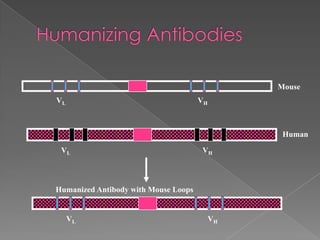
 Humanizing antibody
 Refrence

   Your immune system makes proteins called
    ANTIBODIES

   Antibodies are produced by cells called B-
    lymphocytes

   B lymphocytes are produced when your immune
    system detects a foreign substance that has
    invaded your body
   Polyclonal antibody                  Monoclonal antibody
    › Antigens possess multiple           › Derived from a single
      epitopes                              clone, specific for a single
    › Serum antibodies are                  epitope
      heterogeneous,                      › For most research,
        To increase immune                 diagnostic, and
         protection in vivo                 therapeutic purposes
        To reduces the efficacy of
         antiserum for various in
         vitro uses
    › To response facilitates the
      localization, phagocytosis,
      and complement-
      mediated lysis of antigen
    › To have clear
      advantages for the
      organism in vivo
CLASSES
         
 IgM, IgG, IgD, IgA, IgE


      SUBCLASSES
 IgG1, IgG2, IgG3, IgG4
MONOMER       PENTAMER        MONOMER   DIMER   MONOMER
           MONOMER WHEN
           ACTING AS B-CELL
          RECEPTOR FOR ANTIGEN
Light Chain


 Heavy Chain
                    Fab


               Fc
Mu
                        Mu


     Human


             Chimeric Antibody
Mouse
VL                                    VH


                                                 Human

 VL                                   VH


Humanized Antibody with Mouse Loops


     VL                                    VH
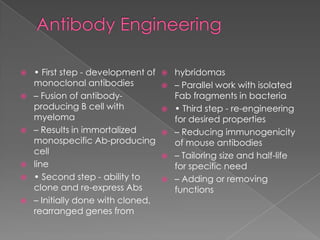
   • First step - development of      hybridomas
    monoclonal antibodies              – Parallel work with isolated
   – Fusion of antibody-               Fab fragments in bacteria
    producing B cell with              • Third step - re-engineering
    myeloma                             for desired properties
   – Results in immortalized          – Reducing immunogenicity
    monospecific Ab-producing           of mouse antibodies
    cell                               – Tailoring size and half-life
   line                                for specific need
   • Second step - ability to         – Adding or removing
    clone and re-express Abs            functions
   – Initially done with cloned,
    rearranged genes from
   1-Berezov A, Zhang HT, Greene MI, Murali R. 2001. Disabling erbB receptors
   with rationally designed exocyclic mimetics of antibodies: Structure-
   function analysis. J Med Chem 44:2565-2574.
   2-Drebin JA, Link VC, Greene MI. 1988. Monoclonal antibodies specific for
   the neu oncogene product directly mediate anti-tumor effects in vivo.
   Oncogene 2:387-394.
    3-Norman C. Peterson Advances in Monoclonal Antibody Technology:
    Genetic Engineering of Mice, Cells, and Immunoglobulins
   4-Sang Jick Kim, Youngwoo Park, and Hyo Jeong Hong-Antibody Engineering
    for the Development of Therapeutic Antibodies(Received August 16, 2005;
    Accepted August 18, 2005)
   5-Roland E KONTERMANN Recombinant bispecific antibodies for cancer
    therapy (2005 Jan)
     6-Harris JM, Chess RB. Effect of pegylation on pharmaceuticals.
   Nat Rev Drug Discov 2003;
 7-M. FRANEK, K. HRUSKA Antibody based methods for environmental
  and food analysis: a review (Czech, 50, 2005)
 8-Laschi S., Franek M., Mascini M. (2000): Screen-printed
 electrochemical immunosensors for PCB detection.
 Electroanalysis,
 9-Zeravik J., Skryjova K., Nevorankova Z., Franek M. (2004):
 Development of direct ELISA for the determination of
 4-nonylphenol and octylphenol. Analytical Chemistry,
Antibody engineering-Abbas Morovvati

Antibody engineering-Abbas Morovvati

  • 3.
     Introduction  Structureof antibody  Engineering  Anti body monocolonal and poly colonal  Humanizing antibody  Refrence 
  • 4.
    Your immune system makes proteins called ANTIBODIES  Antibodies are produced by cells called B- lymphocytes  B lymphocytes are produced when your immune system detects a foreign substance that has invaded your body
  • 7.
    Polyclonal antibody  Monoclonal antibody › Antigens possess multiple › Derived from a single epitopes clone, specific for a single › Serum antibodies are epitope heterogeneous, › For most research,  To increase immune diagnostic, and protection in vivo therapeutic purposes  To reduces the efficacy of antiserum for various in vitro uses › To response facilitates the localization, phagocytosis, and complement- mediated lysis of antigen › To have clear advantages for the organism in vivo
  • 11.
    CLASSES   IgM, IgG, IgD, IgA, IgE  SUBCLASSES  IgG1, IgG2, IgG3, IgG4
  • 12.
    MONOMER PENTAMER MONOMER DIMER MONOMER MONOMER WHEN ACTING AS B-CELL RECEPTOR FOR ANTIGEN
  • 14.
    Light Chain HeavyChain Fab Fc
  • 15.
    Mu Mu Human Chimeric Antibody
  • 20.
    Mouse VL VH Human VL VH Humanized Antibody with Mouse Loops VL VH
  • 21.
    • First step - development of  hybridomas monoclonal antibodies  – Parallel work with isolated  – Fusion of antibody- Fab fragments in bacteria producing B cell with  • Third step - re-engineering myeloma for desired properties  – Results in immortalized  – Reducing immunogenicity monospecific Ab-producing of mouse antibodies cell  – Tailoring size and half-life  line for specific need  • Second step - ability to  – Adding or removing clone and re-express Abs functions  – Initially done with cloned, rearranged genes from
  • 22.
    1-Berezov A, Zhang HT, Greene MI, Murali R. 2001. Disabling erbB receptors  with rationally designed exocyclic mimetics of antibodies: Structure-  function analysis. J Med Chem 44:2565-2574.  2-Drebin JA, Link VC, Greene MI. 1988. Monoclonal antibodies specific for  the neu oncogene product directly mediate anti-tumor effects in vivo.  Oncogene 2:387-394. 3-Norman C. Peterson Advances in Monoclonal Antibody Technology: Genetic Engineering of Mice, Cells, and Immunoglobulins  4-Sang Jick Kim, Youngwoo Park, and Hyo Jeong Hong-Antibody Engineering for the Development of Therapeutic Antibodies(Received August 16, 2005; Accepted August 18, 2005)  5-Roland E KONTERMANN Recombinant bispecific antibodies for cancer therapy (2005 Jan) 6-Harris JM, Chess RB. Effect of pegylation on pharmaceuticals.  Nat Rev Drug Discov 2003;
  • 23.
     7-M. FRANEK,K. HRUSKA Antibody based methods for environmental and food analysis: a review (Czech, 50, 2005)  8-Laschi S., Franek M., Mascini M. (2000): Screen-printed  electrochemical immunosensors for PCB detection.  Electroanalysis,  9-Zeravik J., Skryjova K., Nevorankova Z., Franek M. (2004):  Development of direct ELISA for the determination of  4-nonylphenol and octylphenol. Analytical Chemistry,