1
Module # 01
Acceleration
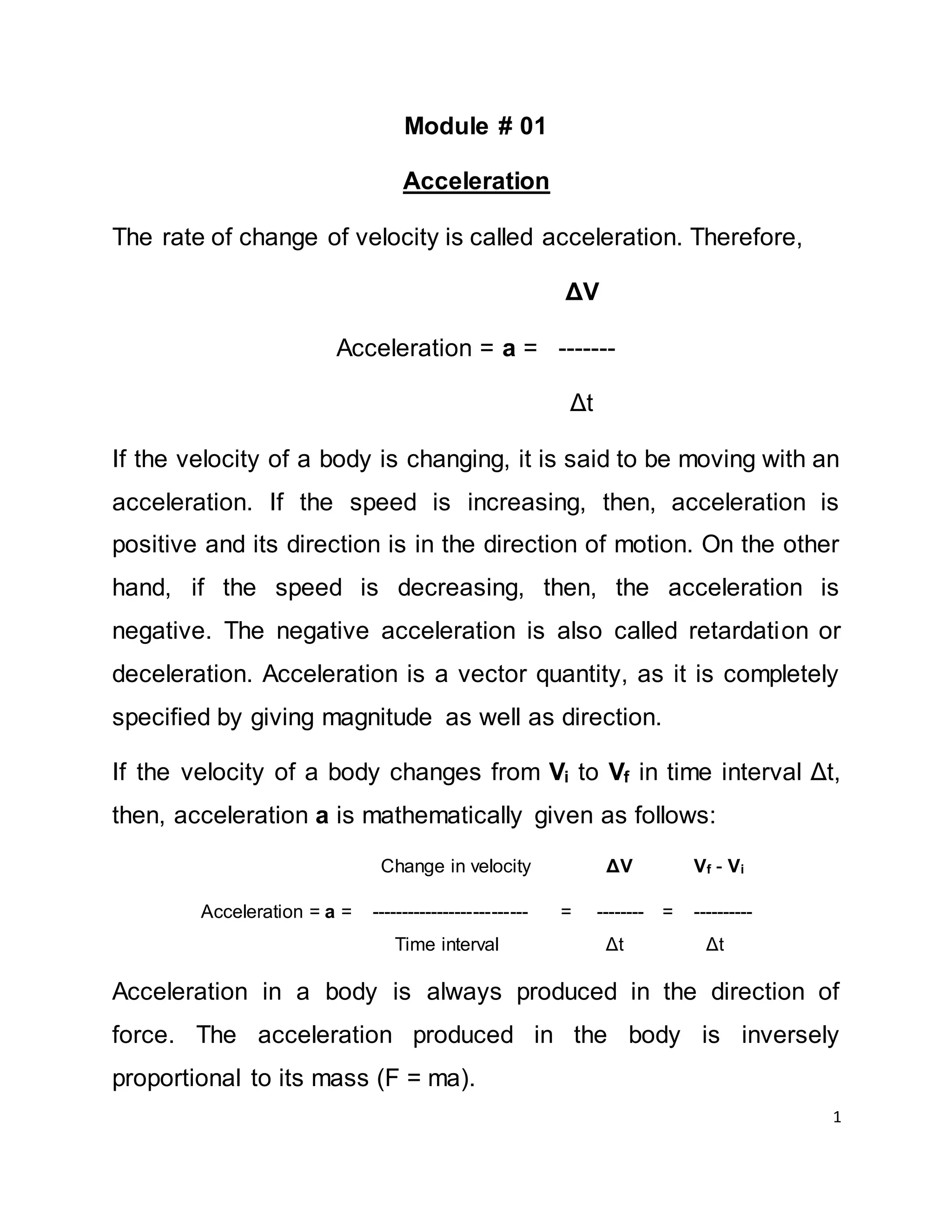
The rate of change of velocity is called acceleration. Therefore,
ΔV
Acceleration = a = -------
Δt
If the velocity of a body is changing, it is said to be moving with an
acceleration. If the speed is increasing, then, acceleration is
positive and its direction is in the direction of motion. On the other
hand, if the speed is decreasing, then, the acceleration is
negative. The negative acceleration is also called retardation or
deceleration. Acceleration is a vector quantity, as it is completely
specified by giving magnitude as well as direction.
If the velocity of a body changes from Vi to Vf in time interval Δt,
then, acceleration a is mathematically given as follows:
Change in velocity ΔV Vf - Vi
Acceleration = a = -------------------------- = -------- = ----------
Time interval Δt Δt
Acceleration in a body is always produced in the direction of
force. The acceleration produced in the body is inversely
proportional to its mass (F = ma).
2
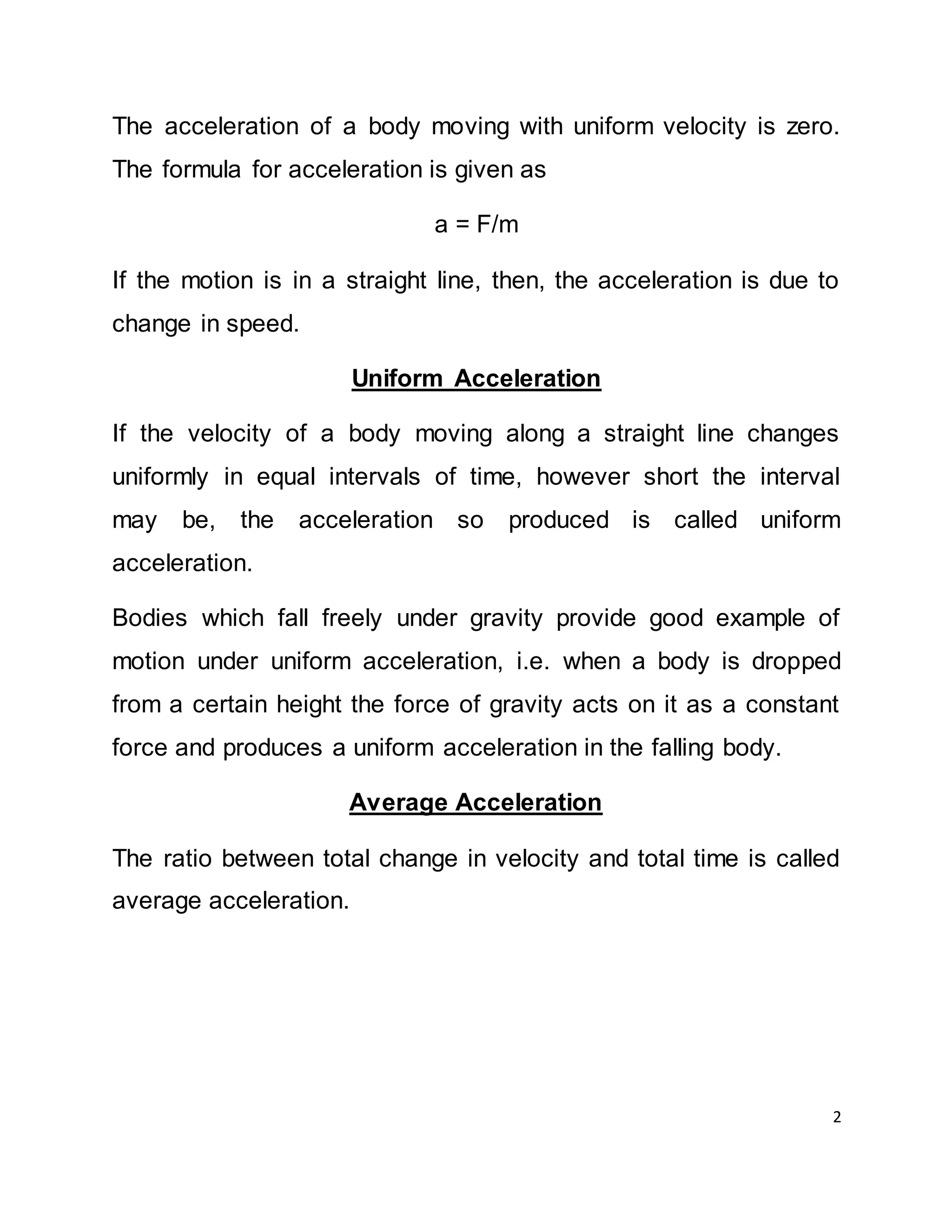
The acceleration of a body moving with uniform velocity is zero.
The formula for acceleration is given as
a = F/m
If the motion is in a straight line, then, the acceleration is due to
change in speed.
Uniform Acceleration
If the velocity of a body moving along a straight line changes
uniformly in equal intervals of time, however short the interval
may be, the acceleration so produced is called uniform
acceleration.
Bodies which fall freely under gravity provide good example of
motion under uniform acceleration, i.e. when a body is dropped
from a certain height the force of gravity acts on it as a constant
force and produces a uniform acceleration in the falling body.
Average Acceleration
The ratio between total change in velocity and total time is called
average acceleration.
3
Angular Acceleration
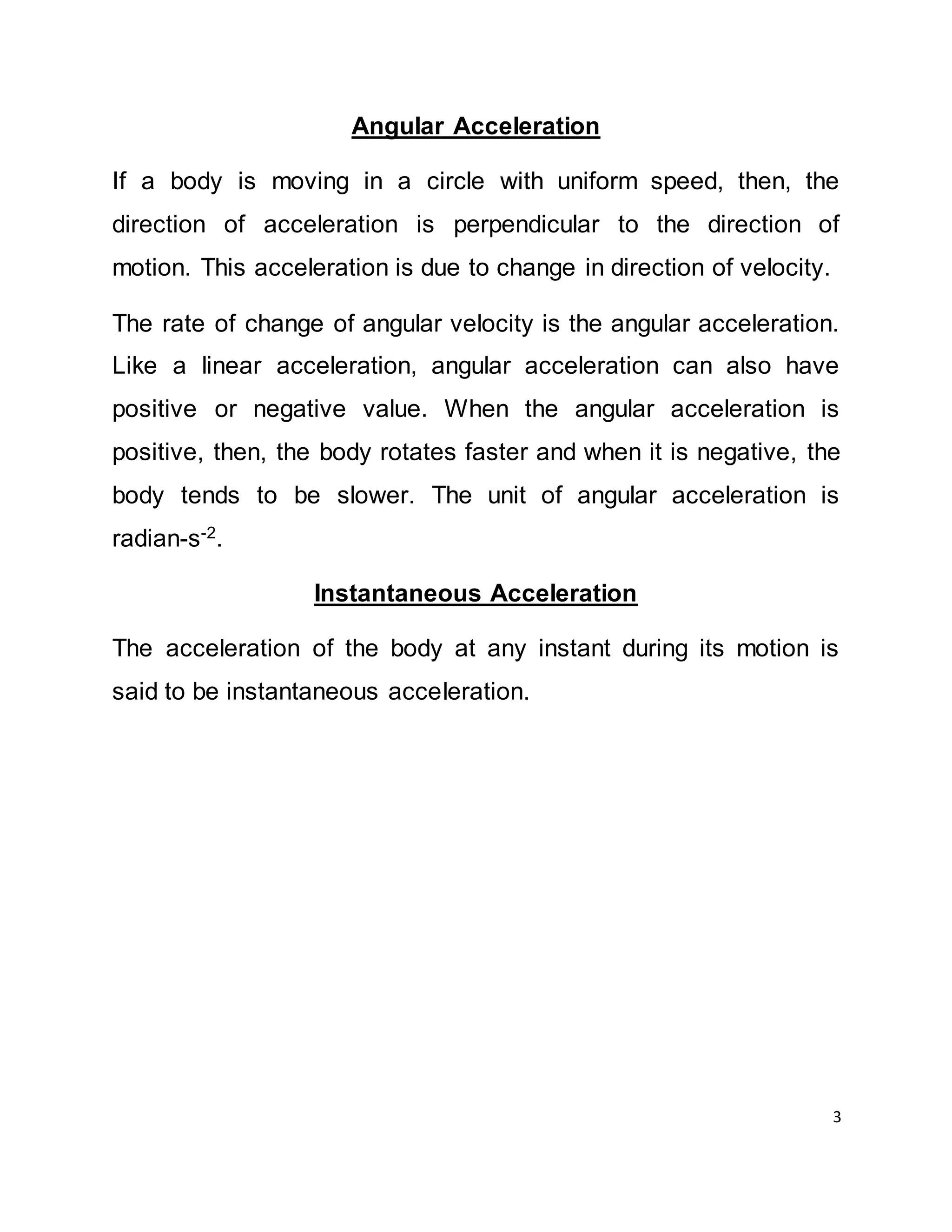
If a body is moving in a circle with uniform speed, then, the
direction of acceleration is perpendicular to the direction of
motion. This acceleration is due to change in direction of velocity.
The rate of change of angular velocity is the angular acceleration.
Like a linear acceleration, angular acceleration can also have
positive or negative value. When the angular acceleration is
positive, then, the body rotates faster and when it is negative, the
body tends to be slower. The unit of angular acceleration is
radian-s-2.
Instantaneous Acceleration
The acceleration of the body at any instant during its motion is
said to be instantaneous acceleration.

Module No. 1

  • 1.
    1 Module # 01 Acceleration Therate of change of velocity is called acceleration. Therefore, ΔV Acceleration = a = ------- Δt If the velocity of a body is changing, it is said to be moving with an acceleration. If the speed is increasing, then, acceleration is positive and its direction is in the direction of motion. On the other hand, if the speed is decreasing, then, the acceleration is negative. The negative acceleration is also called retardation or deceleration. Acceleration is a vector quantity, as it is completely specified by giving magnitude as well as direction. If the velocity of a body changes from Vi to Vf in time interval Δt, then, acceleration a is mathematically given as follows: Change in velocity ΔV Vf - Vi Acceleration = a = -------------------------- = -------- = ---------- Time interval Δt Δt Acceleration in a body is always produced in the direction of force. The acceleration produced in the body is inversely proportional to its mass (F = ma).
  • 2.
    2 The acceleration ofa body moving with uniform velocity is zero. The formula for acceleration is given as a = F/m If the motion is in a straight line, then, the acceleration is due to change in speed. Uniform Acceleration If the velocity of a body moving along a straight line changes uniformly in equal intervals of time, however short the interval may be, the acceleration so produced is called uniform acceleration. Bodies which fall freely under gravity provide good example of motion under uniform acceleration, i.e. when a body is dropped from a certain height the force of gravity acts on it as a constant force and produces a uniform acceleration in the falling body. Average Acceleration The ratio between total change in velocity and total time is called average acceleration.
  • 3.
    3 Angular Acceleration If abody is moving in a circle with uniform speed, then, the direction of acceleration is perpendicular to the direction of motion. This acceleration is due to change in direction of velocity. The rate of change of angular velocity is the angular acceleration. Like a linear acceleration, angular acceleration can also have positive or negative value. When the angular acceleration is positive, then, the body rotates faster and when it is negative, the body tends to be slower. The unit of angular acceleration is radian-s-2. Instantaneous Acceleration The acceleration of the body at any instant during its motion is said to be instantaneous acceleration.