What we havelearned
Motion- A body is said to be in motion when its position
changes continuously with respect to a stationary object.
Distance: path length (scalar), Displacement: shortest path
(Vector)
Uniform motion- A body has a uniform motion if it travels
equal distances in equal intervals of time.
Non-Uniform motion: A body has a non-uniform motion if it
travels unequal distance in equal intervals of time.
3.
Speed =Distance/ time , unit m/s
Uniform speed = equal distances in equal intervals of
time
Average speed= total distance / total time
Velocity : Velocity of a body is the distance travelled
by it
per unit time in a given direction.
Velocity = displacement / time taken, V = s / t , unit is
m/s
4.
Uniform Velocity: A body has a uniform velocity if it travels
in a specified direction in a straight line and moves over
equal distances in equal intervals of time, no matter how
small these time intervals may be
Speed And Velocity Are Not Always Equal In Magnitude
Acceleration of a body is defined as the rate of change of its
velocity with time
a = (v-u) / t , The SI unit of acceleration is meters per second
square
5.
Today’s session ????
Uniform Acceleration
Non- Uniform Acceleration
Positive, negative and zero acceleration
Area under the speed-time graph gives the distance travelled by
the body
The three equations of motion are
v = u + at
s = ut + ½at²
v² = u² + 2as
Derivation of the equations of motion
Circular motion
7.
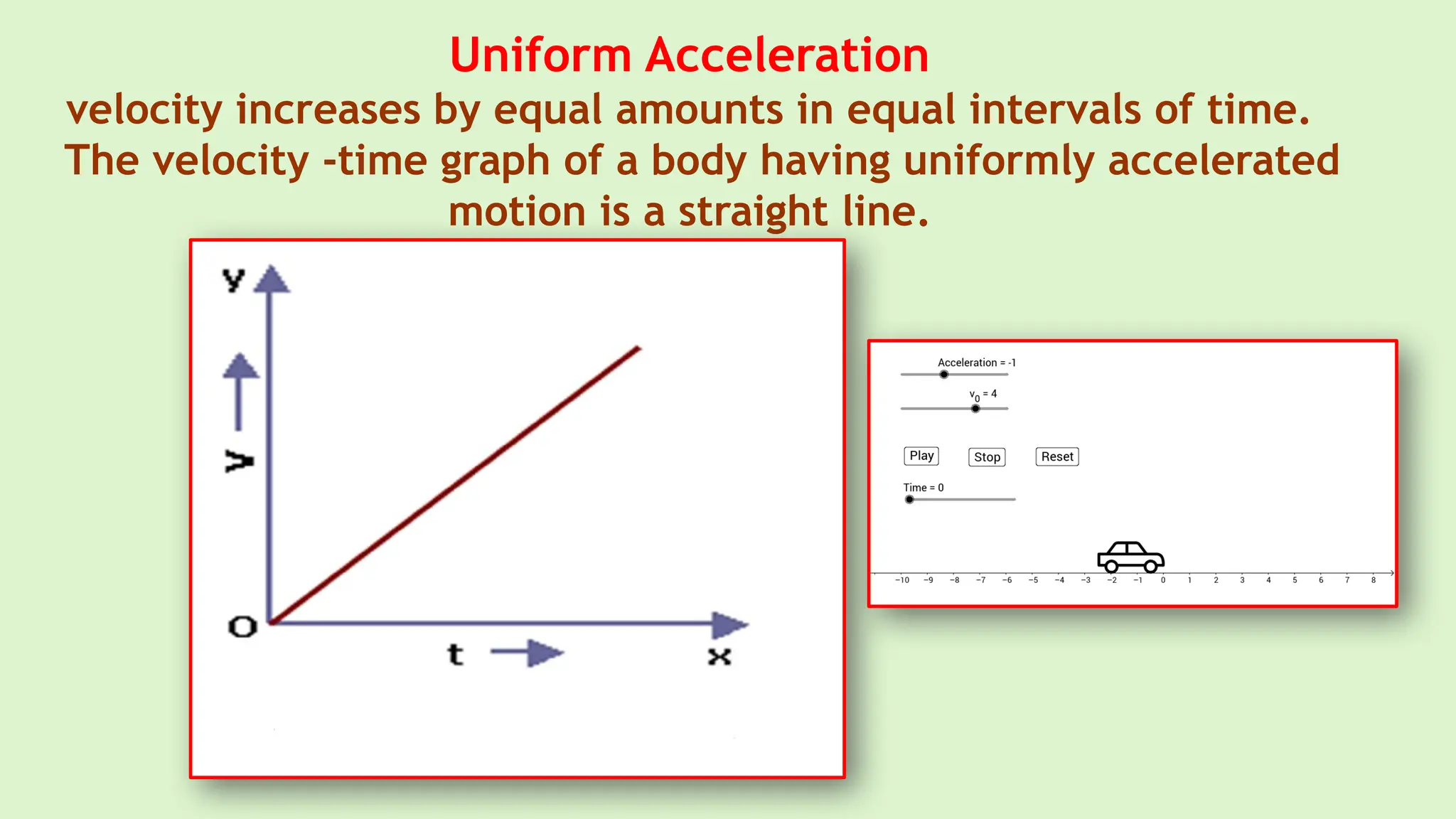
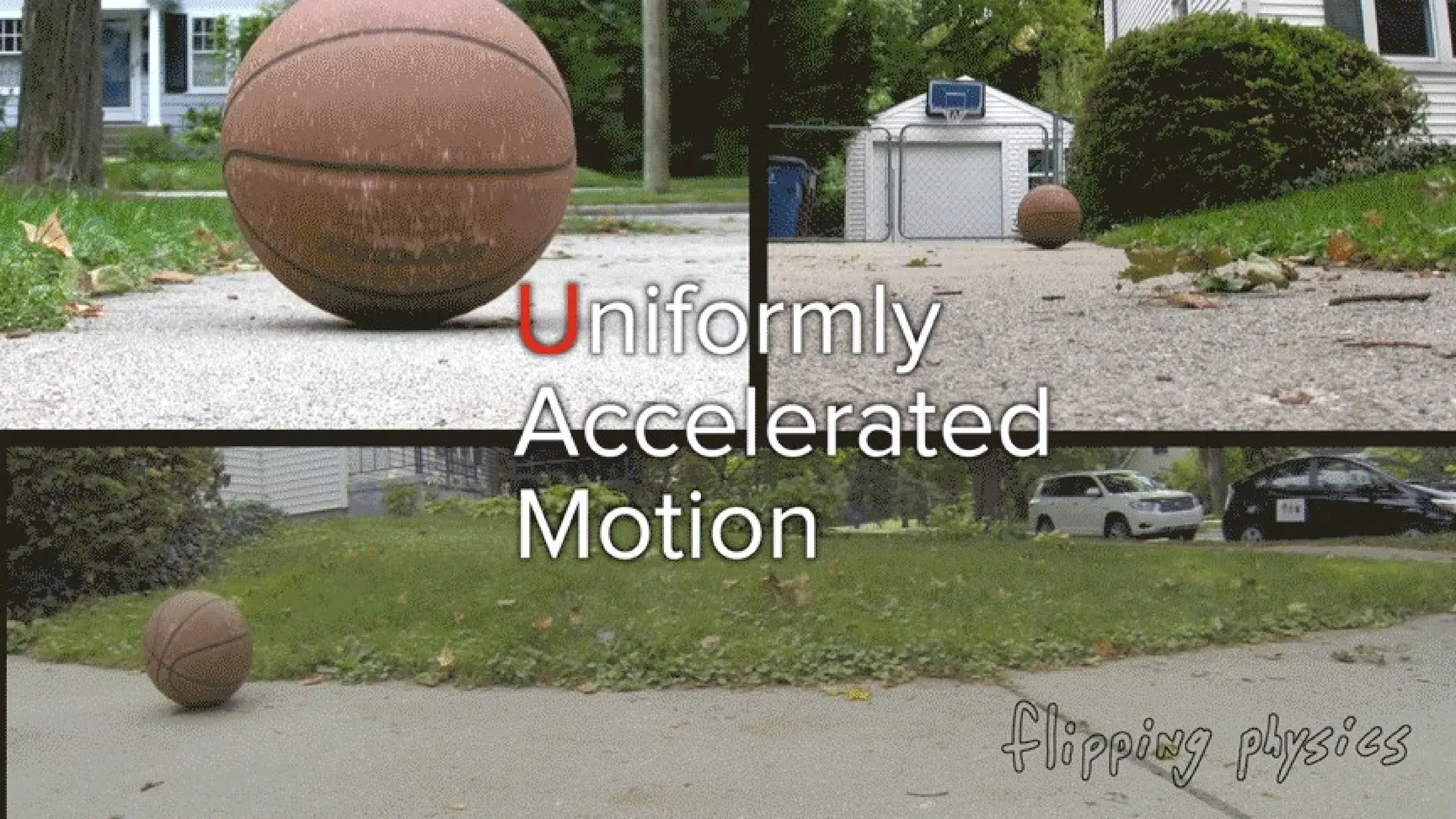
Uniform Acceleration
velocity increasesby equal amounts in equal intervals of time.
The velocity -time graph of a body having uniformly accelerated
motion is a straight line.
9.
Non- Uniform Acceleration
velocityincrease by unequal amounts in equal intervals of time.
The velocity -time graph for a body having non-uniform
acceleration is a curved line.
11.
If the velocityof a body
increases, the acceleration is
positive, and if the velocity of
the body decreases, the
acceleration is negative.
Retardation is measured in
the same way as acceleration.
Retardation is actually
acceleration with the negative
sign .
Retardation ( Deceleration or Negative Acceleration)
12.
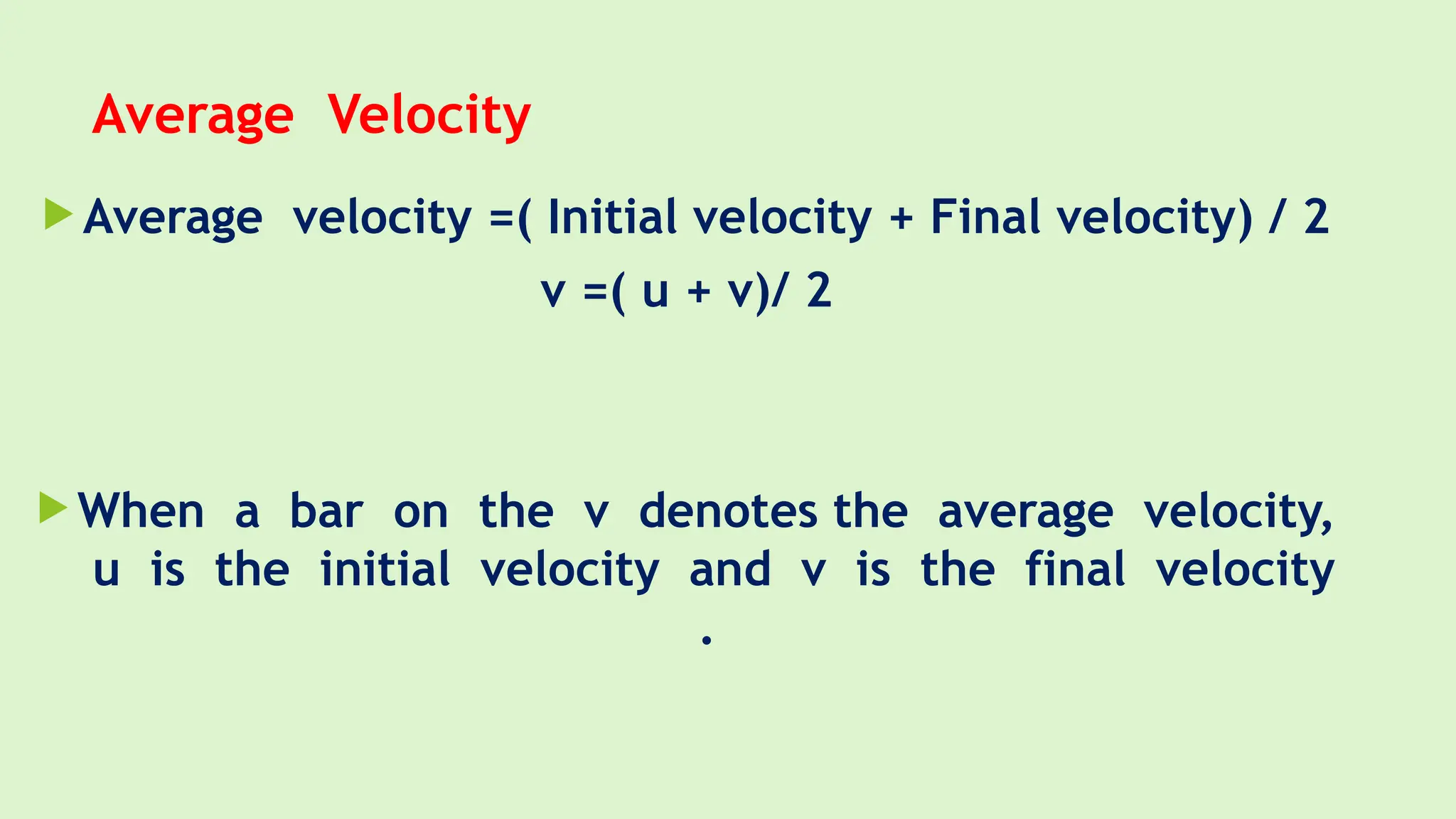
Average Velocity
Averagevelocity =( Initial velocity + Final velocity) / 2
v =( u + v)/ 2
When a bar on the v denotes the average velocity,
u is the initial velocity and v is the final velocity
.
14.
Questions
1. What willbe the shape of velocity-time graph for a
uniformly accelerated body?
2. A stone is dropped from a certain height..What kind of
acceleration it’ll have?
3.Suggest an example for a body, having zero velocity,
but non-zero acceleration.
Ans: Positive acceleration
Ans: when a ball thrown up,
reaches it’s topmost point
Ans: Straight line
In a speed-timegraph,
the area enclosed by the
speed-time curve and
the time axis gives us
the distance travelled by
the body .
Distance travelled = speed
× time .
= Area of rectangle OABC
Speed – Time Graphs When the Speed Remains Constant
If the speed-time graph of a body is a straight line parallel to the time
axis, then the speed of the body is constant .
17.
Speed-Time Graph whenSpeed Changes at a Uniform Rate
The speed-time graph for
a uniformly changing
speed ( or uniform
acceleration ) will be a
straight line. The slope of
a speed-time graph of a
moving body gives its
acceleration .
A straight line sloping
upwards shows uniform
positive acceleration.
19.
Acceleration
We canfind out the value of
acceleration from the speed-time
graph of a moving body. To
calculate the acceleration at a
time corresponding to point Q.
Draw a perpendicular QP from
point Q which touches the
straight line graph at point P .
Acceleration = changes on speed /
time taken
The change in speed is
represented by PQ whereas time
taken is equal to OQ .
Acceleration = PQ / OQ .
20.
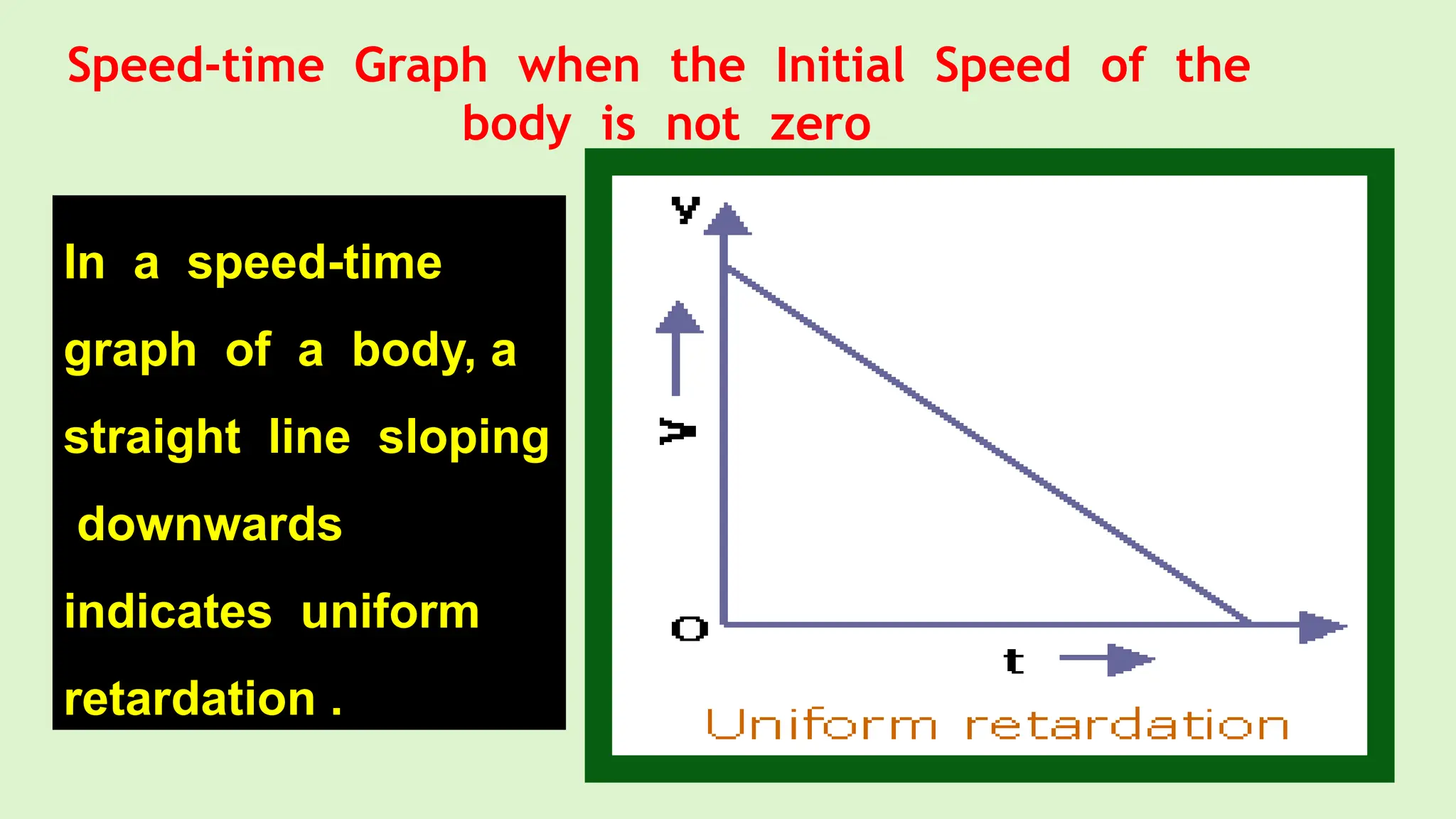
In a speed-time
graphof a body, a
straight line sloping
downwards
indicates uniform
retardation .
Speed-time Graph when the Initial Speed of the
body is not zero
The distancetravelled by
the body in this case is
equal to the area of
trapezium . Now,
Area of trapezium = sum
of two parallel sides ×
height / 2
Here, sum of parallel
sides is OB + AC and
height is OA .
So, distance travelled =
( OB + AC ) × OA / 2
Distance as the area under the speed-time graph
24.
Distance as thearea under the speed-time graph
Calculating distance
Questions
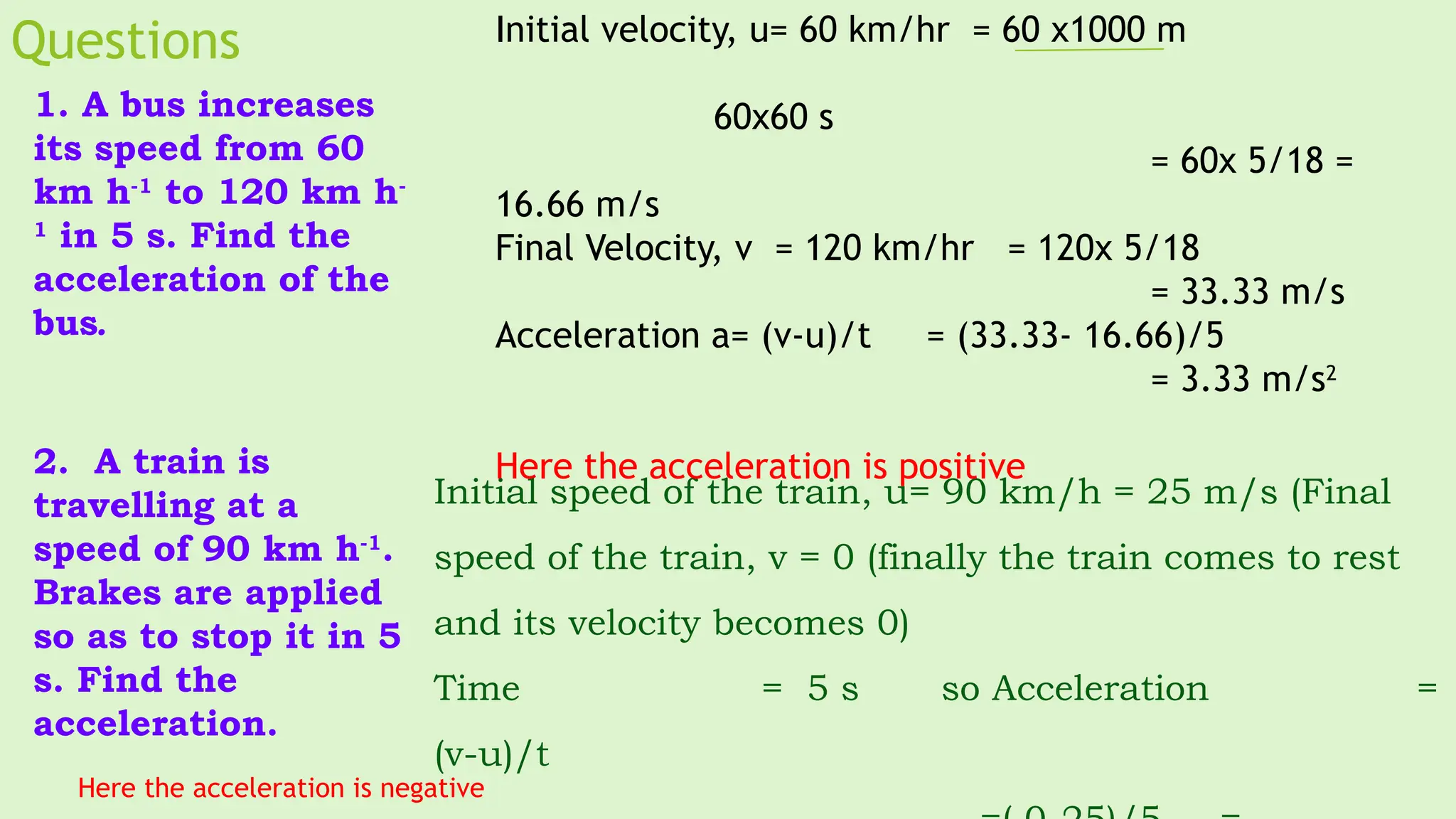
1. A busincreases
its speed from 60
km h-1
to 120 km h-
1
in 5 s. Find the
acceleration of the
bus.
2. A train is
travelling at a
speed of 90 km h-1
.
Brakes are applied
so as to stop it in 5
s. Find the
acceleration.
Initial speed of the train, u= 90 km/h = 25 m/s (Final
speed of the train, v = 0 (finally the train comes to rest
and its velocity becomes 0)
Time = 5 s so Acceleration =
(v-u)/t
Initial velocity, u= 60 km/hr = 60 x1000 m
60x60 s
= 60x 5/18 =
16.66 m/s
Final Velocity, v = 120 km/hr = 120x 5/18
= 33.33 m/s
Acceleration a= (v-u)/t = (33.33- 16.66)/5
= 3.33 m/s2
Here the acceleration is positive
Here the acceleration is negative
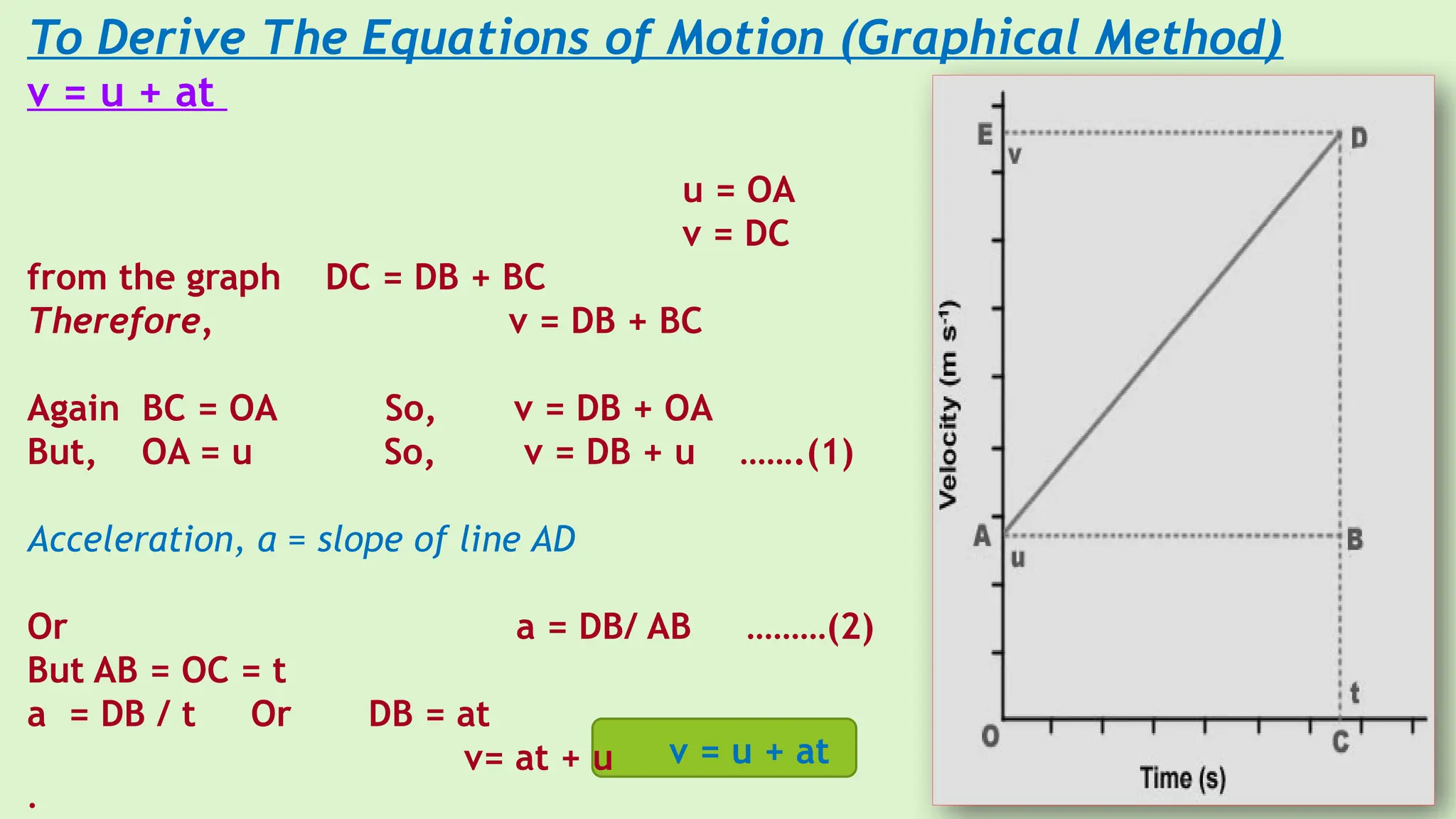
To Derive TheEquations of Motion (Graphical Method)
v = u + at
u = OA
v = DC
from the graph DC = DB + BC
Therefore, v = DB + BC
Again BC = OA So, v = DB + OA
But, OA = u So, v = DB + u …….(1)
Acceleration, a = slope of line AD
Or a = DB/ AB ………(2)
But AB = OC = t
a = DB / t Or DB = at
v= at + u
.
v = u + at
29.
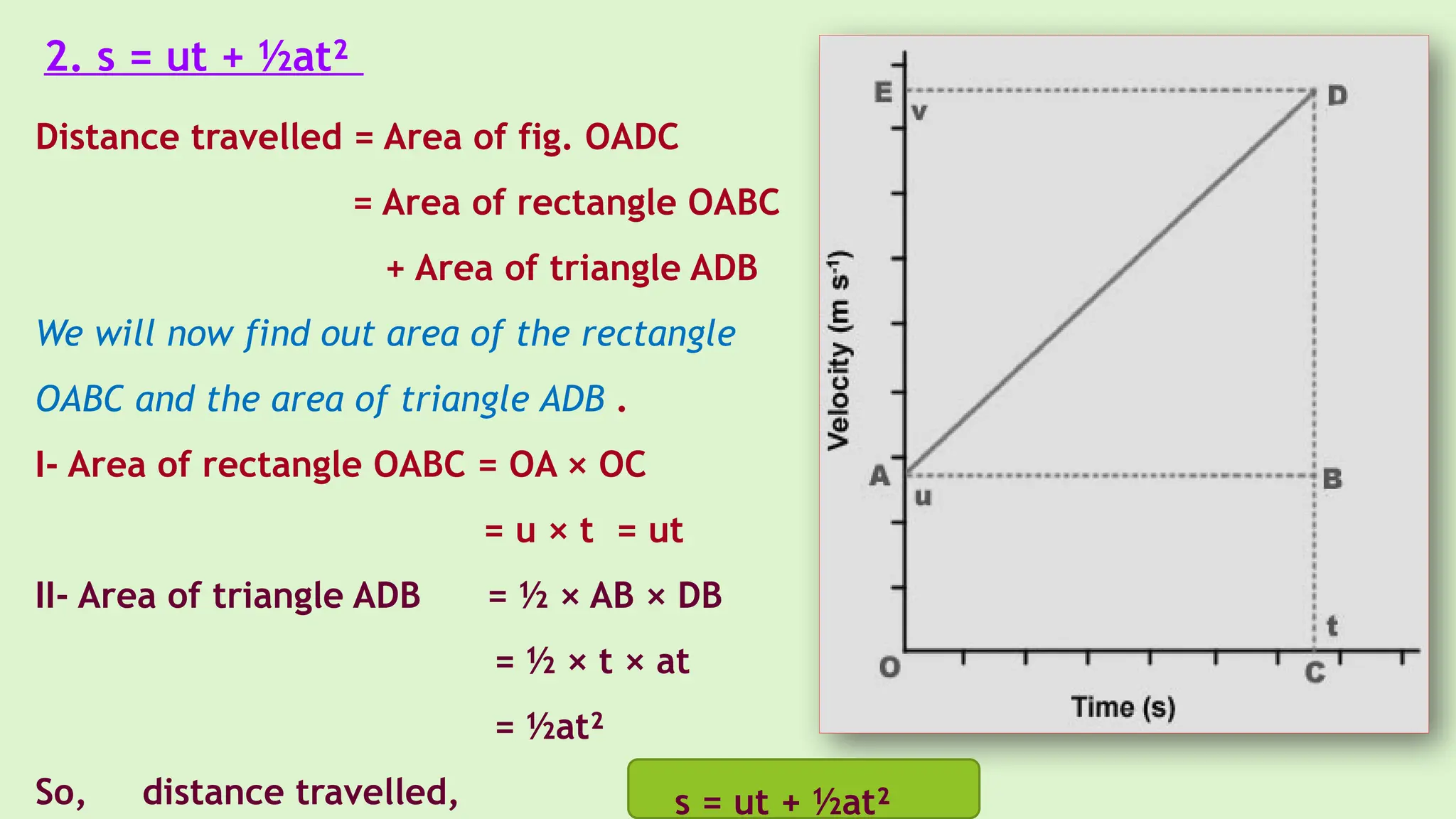
Distance travelled =Area of fig. OADC
= Area of rectangle OABC
+ Area of triangle ADB
We will now find out area of the rectangle
OABC and the area of triangle ADB .
I- Area of rectangle OABC = OA × OC
= u × t = ut
II- Area of triangle ADB = ½ × AB × DB
= ½ × t × at
= ½at²
So, distance travelled,
2. s = ut + ½at²
s = ut + ½at²
30.
3. v² =u² + 2as
Distance travelled , s = Area of trapezium OADC
The s = ( Sum of parallel sides ) ×
Height / 2
Or s = ( OA + CD ) × OC / 2
Now, OA + CD = u + v
And OC = t .
Putting these values in the above relation, we get :
S = ( u + v ) × t / 2
We know that t = ( v – u ) / a
Putting this value of t in equation, we get :
S = ( u + v ) × ( v – u ) / 2a
Or 2as = v² - u²
Or.
v² = u² + 2as
31.
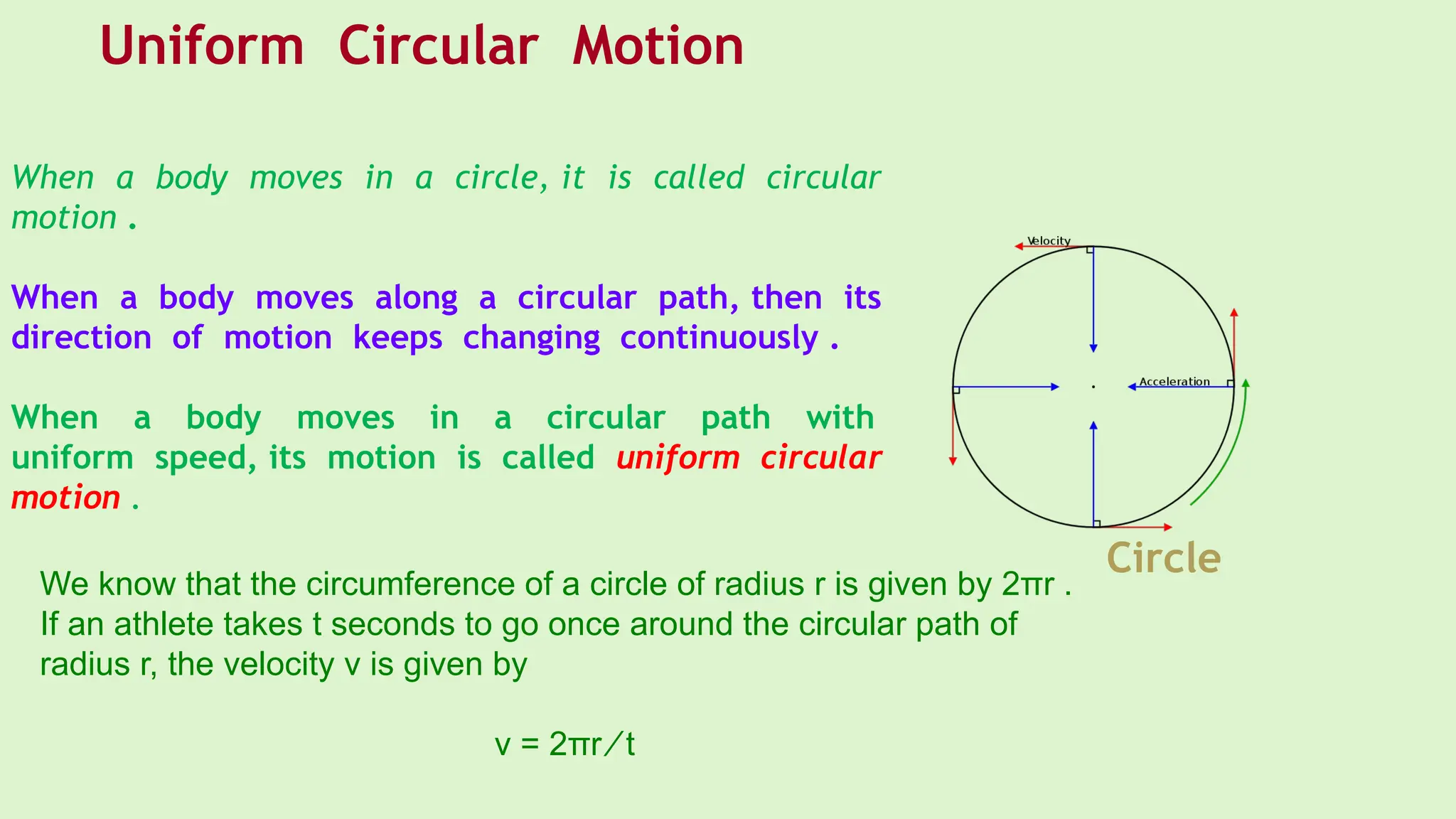
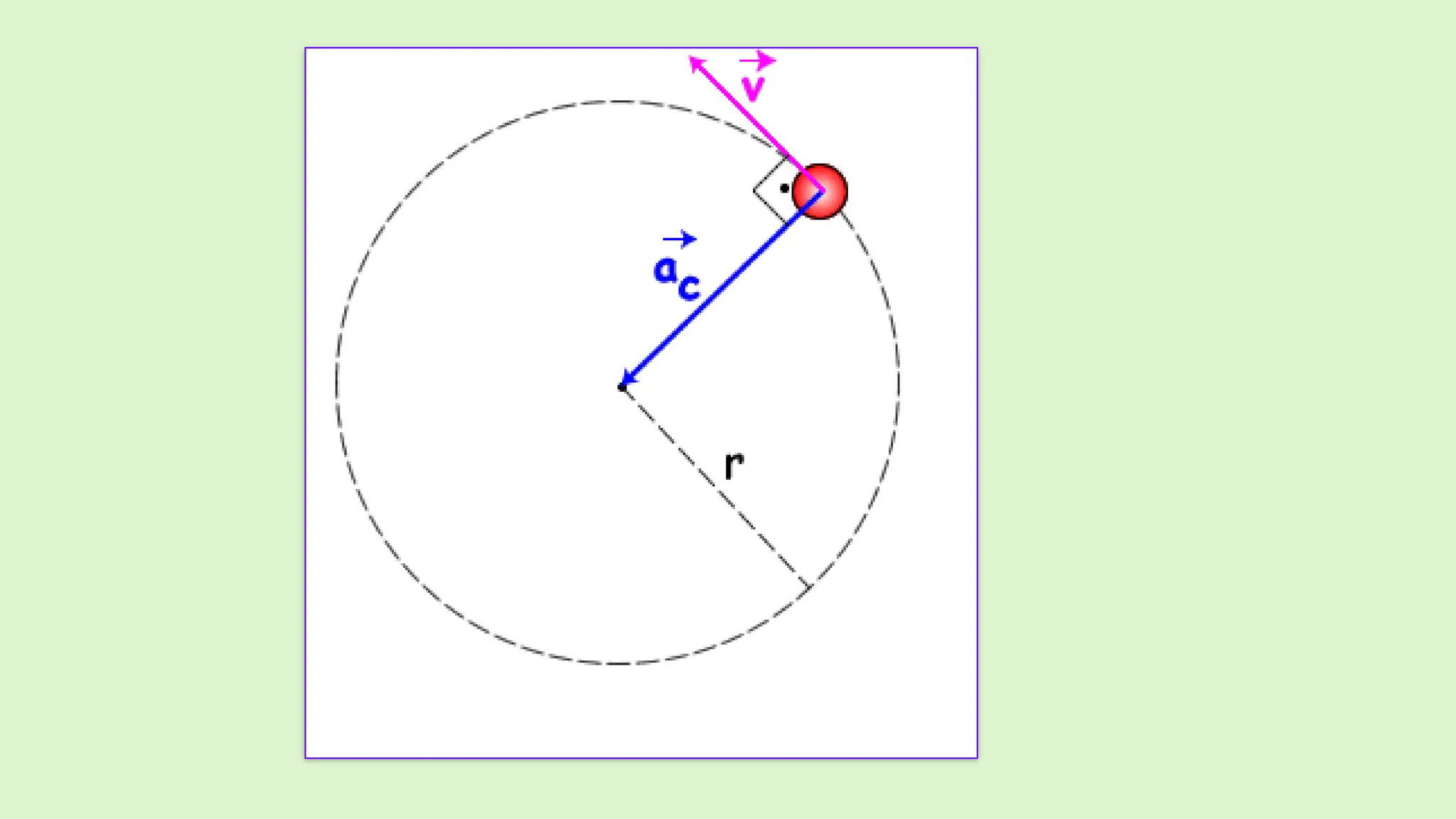
When a bodymoves in a circle, it is called circular
motion .
When a body moves along a circular path, then its
direction of motion keeps changing continuously .
When a body moves in a circular path with
uniform speed, its motion is called uniform circular
motion .
We know that the circumference of a circle of radius r is given by 2πr .
If an athlete takes t seconds to go once around the circular path of
radius r, the velocity v is given by
v = 2πr ⁄ t
Circle
Uniform Circular Motion
34.
Summary
Speed AndVelocity Are Not Always Equal In Magnitude
Acceleration of a body is defined as the rate of change of its velocity with time
a = (v-u) / t , The SI unit of acceleration is meters per second square
Uniform Acceleration: velocity increases by equal amounts in equal intervals of
time.
Non- Uniform Acceleration : velocity increase by unequal amounts in equal intervals
of time.
If the velocity of a body increases, the acceleration is positive, and if the
velocity of the body decreases, the acceleration is negative
Area under the speed-time graph gives the distance travelled by the body
The three equations of motion are
v = u + at
s = ut + ½at²
v² = u² + 2as
assignment
35.
Summary
If abody moves in a circular path, it is called circular
motion
If it is moving with uniform speed in a circular path, then
it is called uniform circular motion
the velocity v is given by v = 2πr ⁄ t
where v is velocity and r is the radius
Assignment















![8motion [autosaved]](https://cdn.slidesharecdn.com/ss_thumbnails/8motionautosaved-150707124342-lva1-app6891-thumbnail.jpg?width=640&height=640&fit=bounds)


