Module 8
Berlin Airlift
Major Conflict
(8.c.4)
V. Berlin Airlift
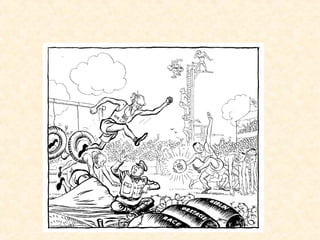
The Berlin Blockade (24 June 1948 – 12 May 1949) was one of the first major international
crises of the Cold War and the first such crisis that resulted in casualties.
The Soviet Union blocked the Western Allies' railway and road access to the sectors of Berlin
under their control. This meant they could get no supplies into West Berlin that the West
controlled from West Germany. The Svoites wanted to force West Berlin to depend on The
Soviets for food and fuel. That way THEY would control ALL of Berlin
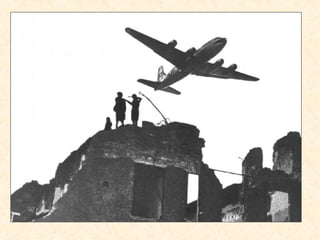
In response, the Western Allies organized the Berlin Airlift to carry supplies to the people in
West Berlin. West Berlin required over 4,000 tons per day .
The United States Air Force, Royal Air Force, and other Western nations flew over 200,000
flights providing 13,000 tons of food daily to Berlin in an operation lasting almost a year.
By the spring of 1949, the effort was clearly succeeding, and by April the airlift was delivering
more cargo than had previously flowed into the city by rail.
The success of the Airlift was humiliating to the Soviets, who had repeatedly claimed it could
never work. When it became clear that it did work, the blockade was lifted in May..
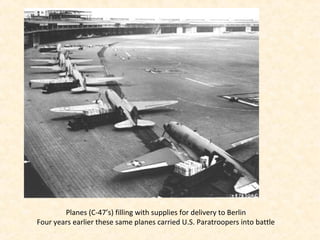
Planes (C-47’s) filling with supplies for delivery to Berlin
Four years earlier these same planes carried U.S. Paratroopers into battle
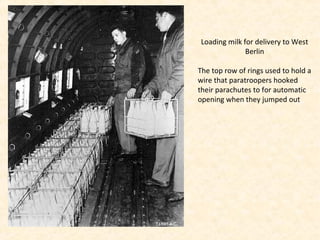
Loading milk for delivery to West
Berlin
The top row of rings used to hold a
wire that paratroopers hooked
their parachutes to for automatic
opening when they jumped out
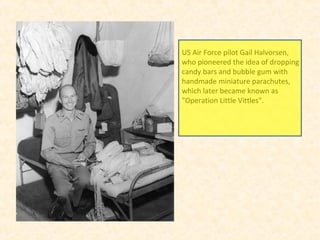
US Air Force pilot Gail Halvorsen,
who pioneered the idea of dropping
candy bars and bubble gum with
handmade miniature parachutes,
which later became known as
"Operation Little Vittles".
Part 2
Korean Conflict
XIII. Korean WarXIII. Korean War
(8.c.3)(8.c.3)
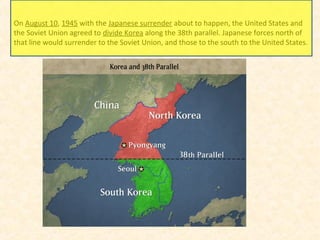
On August 10, 1945 with the Japanese surrender about to happen, the United States and
the Soviet Union agreed to divide Korea along the 38th parallel. Japanese forces north of
that line would surrender to the Soviet Union, and those to the south to the United States.
Thus, without consulting the Korean people, the two major powers divided the
Korean peninsula into two occupation zones, thereby putting into place the
foundation for the civil war.
In mid 1949, the leader on North Korea asked Soviet leader Joseph Stalin if he could attack
South Korea to put ALL Korea together under Communist control.
He needed Soviet support to successfully make this attack.
Stalin as leader of the communist nations refused permission, concerned that the North Korean
armed forces were not ready, and with the chance that the U.S. would get involved.
Once the N. Korean leader got a promise of help from Communist China, he went ahead
The North Korean army struck in the pre-dawn hours of Sunday, June 25, 1950,
crossing the 38th parallel behind a firestorm of artillery barrage. Equipped by the
Soviets with 150 T-34 tanks, the North Korean military began the war with about
180 aircraft, including 40 YAK fighters and 70 attack bombers.
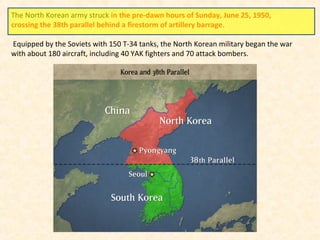
The North Korean army struck in the pre-dawn hours of Sunday, June 25, 1950,
crossing the 38th parallel behind a firestorm of artillery barrage.
Equipped by the Soviets with 150 T-34 tanks, the North Korean military began the war
with about 180 aircraft, including 40 YAK fighters and 70 attack bombers.
The United States and the United Nations stepped in on the side of the South Korean
Government.
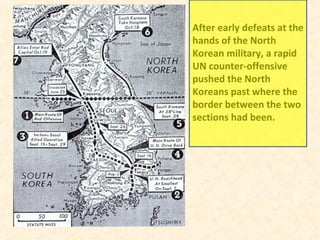
After early defeats at the
hands of the North
Korean military, a rapid
UN counter-offensive
pushed the North
Koreans past where the
border between the two
sections had been.
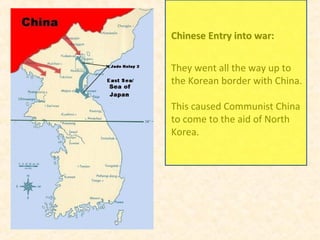
Chinese Entry into war:Chinese Entry into war:
They went all the way up to
the Korean border with China.
This caused Communist China
to come to the aid of North
Korea.
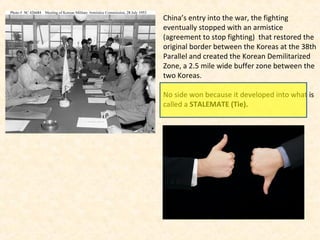
China’s entry into the war, the fighting
eventually stopped with an armistice
(agreement to stop fighting) that restored the
original border between the Koreas at the 38th
Parallel and created the Korean Demilitarized
Zone, a 2.5 mile wide buffer zone between the
two Koreas.
No side won because it developed into what is
called a STALEMATE (Tie).
Bay of Pigs
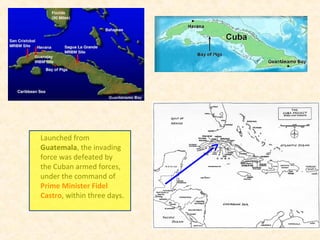
Launched from
Guatemala, the invading
force was defeated by
the Cuban armed forces,
under the command of
Prime Minister Fidel
Castro, within three days.
VI. Berlin WallVI. Berlin Wall
August 13, 1961
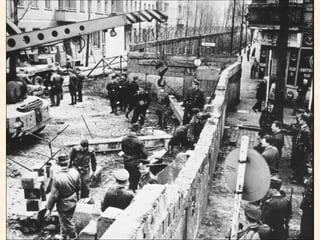
The Berlin Wall was a concrete barrier built by the German Democratic Republic (GDR, East
Germany) [The idea of their masters - The Soviet Union.] that completely enclosed the city of
West Berlin, separating it from East Germany, including East Berlin.
The Wall included guard towers placed along large concrete walls, which surrounded a wide
area (later known as the "death strip") that contained anti-vehicle trenches and other defenses.
Before the Wall's erection, 3.5 million East Germans escaped Esat Germany by walkingt into
West Berlin, then getting on a plane to West Germany.
The goal of the wall was to stop people escaping from Communist control in East Germany.
During its existence from 1961 to 1989, the Wall stopped almost all escapes from East Germany
After it was put up, around 5,000 people attempted to escape over the wall, with estimates of
the resulting death toll varying between around 100 and 200.
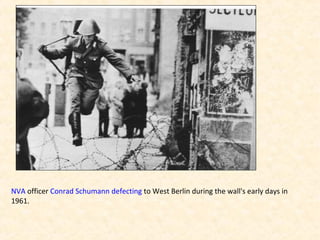
NVA officer Conrad Schumann defecting to West Berlin during the wall's early days in
1961.
XV. Cuban Missile Crisis
(8.c.3)
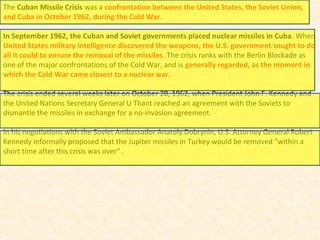
The Cuban Missile Crisis was a confrontation between the United States, the Soviet Union,
and Cuba in October 1962, during the Cold War.
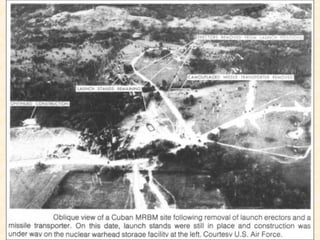
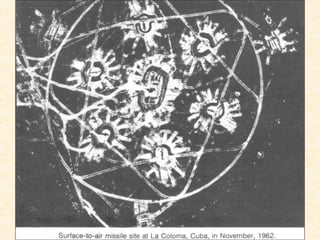
In September 1962, the Cuban and Soviet governments placed nuclear missiles in Cuba. When
United States military intelligence discovered the weapons, the U.S. government sought to do
all it could to ensure the removal of the missiles. The crisis ranks with the Berlin Blockade as
one of the major confrontations of the Cold War, and is generally regarded, as the moment in
which the Cold War came closest to a nuclear war.
The crisis ended several weeks later on October 28, 1962, when President John F. Kennedy and
the United Nations Secretary General U Thant reached an agreement with the Soviets to
dismantle the missiles in exchange for a no-invasion agreement.
In his negotiations with the Soviet Ambassador Anatoly Dobrynin, U.S. Attorney General Robert
Kennedy informally proposed that the Jupiter missiles in Turkey would be removed "within a
short time after this crisis was over“ .
Soviet Missles could have hit every point in Continentel U.S. except far corner of
Washington State.
Distance from:
Cuba to Florida = 90 Miles
Cuba to Washington D.C = 1,130 Miles
Cuba to New York City =1,309 Miles
Cuba to Chicago = 1,326 Miles
Cuba to Los Angeles = 2,299 Miles
The missiles had a 2,400 mile range
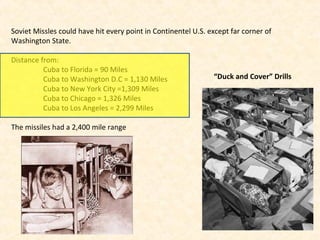
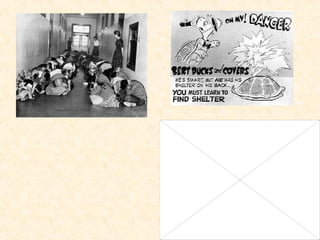
“Duck and Cover” Drills
XVI. Vietnam:XVI. Vietnam:
Domino TheoryDomino Theory
Vietnam War Summary
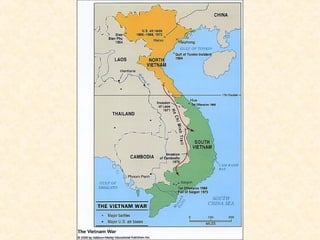
The Vietnam War was a war fought between 1964 and 1975 on the ground in South Vietnam
and bordering areas of Cambodia and Laos, and in bombing runs over North Vietnam.
Fighting on one side was a coalition of forces including the United States, the Republic of
Vietnam, Australia, New Zealand, and South Korea.
Fighting on the other side was a coalition of forces including the Democratic Republic of
Vietnam (North Vietnam) and the National Liberation Front, a communist-led South
Vietnamese guerrilla movement (VC).
The USSR provided military aid to the North Vietnamese and to the NLF, but was not one of
the military combatants.
The goal of the communists in the North, with support from their communist allies
from outside (USSR, China) and inside S. Vietnam (Viet Cong), was to unify Vietnam
under communist rule.
The U.S. got involved because of a fear that if one country in a region fell
to communism, others in the area would do so as well. Thus
theory is callled the Domino Theory.
Where it happenedWhere it happened
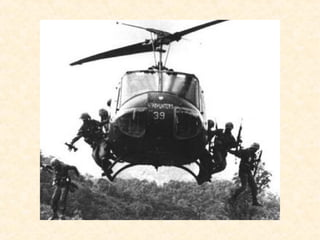
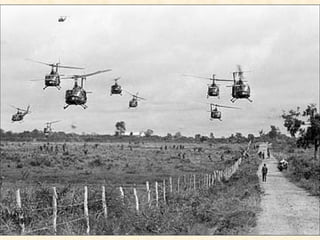
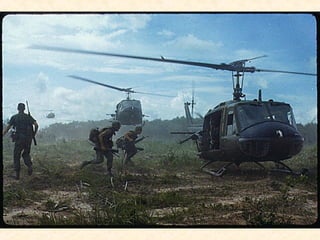
U.S. Soldiers in CombatU.S. Soldiers in Combat
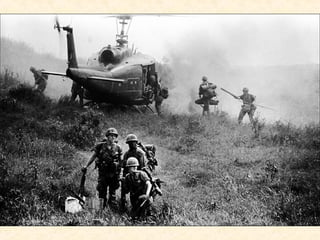
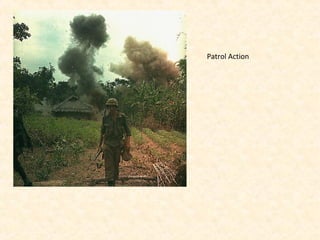
Patrol Action
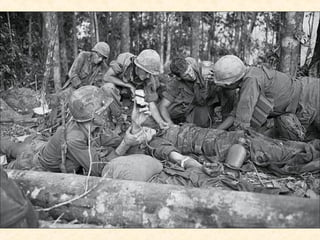
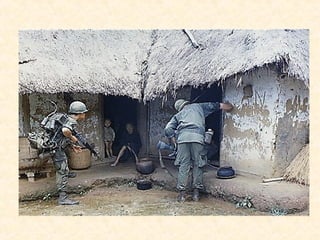
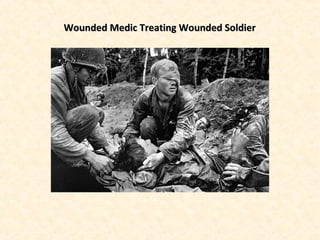
Wounded Medic Treating Wounded SoldierWounded Medic Treating Wounded Soldier

Module 8 - Conflict

  • 1.
  • 2.
  • 3.
    The Berlin Blockade(24 June 1948 – 12 May 1949) was one of the first major international crises of the Cold War and the first such crisis that resulted in casualties. The Soviet Union blocked the Western Allies' railway and road access to the sectors of Berlin under their control. This meant they could get no supplies into West Berlin that the West controlled from West Germany. The Svoites wanted to force West Berlin to depend on The Soviets for food and fuel. That way THEY would control ALL of Berlin In response, the Western Allies organized the Berlin Airlift to carry supplies to the people in West Berlin. West Berlin required over 4,000 tons per day . The United States Air Force, Royal Air Force, and other Western nations flew over 200,000 flights providing 13,000 tons of food daily to Berlin in an operation lasting almost a year. By the spring of 1949, the effort was clearly succeeding, and by April the airlift was delivering more cargo than had previously flowed into the city by rail. The success of the Airlift was humiliating to the Soviets, who had repeatedly claimed it could never work. When it became clear that it did work, the blockade was lifted in May..
  • 5.
    Planes (C-47’s) fillingwith supplies for delivery to Berlin Four years earlier these same planes carried U.S. Paratroopers into battle
  • 6.
    Loading milk fordelivery to West Berlin The top row of rings used to hold a wire that paratroopers hooked their parachutes to for automatic opening when they jumped out
  • 7.
    US Air Forcepilot Gail Halvorsen, who pioneered the idea of dropping candy bars and bubble gum with handmade miniature parachutes, which later became known as "Operation Little Vittles".
  • 9.
  • 10.
    XIII. Korean WarXIII.Korean War (8.c.3)(8.c.3)
  • 11.
    On August 10,1945 with the Japanese surrender about to happen, the United States and the Soviet Union agreed to divide Korea along the 38th parallel. Japanese forces north of that line would surrender to the Soviet Union, and those to the south to the United States.
  • 12.
    Thus, without consultingthe Korean people, the two major powers divided the Korean peninsula into two occupation zones, thereby putting into place the foundation for the civil war.
  • 13.
    In mid 1949,the leader on North Korea asked Soviet leader Joseph Stalin if he could attack South Korea to put ALL Korea together under Communist control. He needed Soviet support to successfully make this attack. Stalin as leader of the communist nations refused permission, concerned that the North Korean armed forces were not ready, and with the chance that the U.S. would get involved. Once the N. Korean leader got a promise of help from Communist China, he went ahead The North Korean army struck in the pre-dawn hours of Sunday, June 25, 1950, crossing the 38th parallel behind a firestorm of artillery barrage. Equipped by the Soviets with 150 T-34 tanks, the North Korean military began the war with about 180 aircraft, including 40 YAK fighters and 70 attack bombers.
  • 14.
    The North Koreanarmy struck in the pre-dawn hours of Sunday, June 25, 1950, crossing the 38th parallel behind a firestorm of artillery barrage. Equipped by the Soviets with 150 T-34 tanks, the North Korean military began the war with about 180 aircraft, including 40 YAK fighters and 70 attack bombers.
  • 15.
    The United Statesand the United Nations stepped in on the side of the South Korean Government.
  • 16.
    After early defeatsat the hands of the North Korean military, a rapid UN counter-offensive pushed the North Koreans past where the border between the two sections had been.
  • 17.
    Chinese Entry intowar:Chinese Entry into war: They went all the way up to the Korean border with China. This caused Communist China to come to the aid of North Korea.
  • 18.
    China’s entry intothe war, the fighting eventually stopped with an armistice (agreement to stop fighting) that restored the original border between the Koreas at the 38th Parallel and created the Korean Demilitarized Zone, a 2.5 mile wide buffer zone between the two Koreas. No side won because it developed into what is called a STALEMATE (Tie).
  • 19.
  • 20.
    Launched from Guatemala, theinvading force was defeated by the Cuban armed forces, under the command of Prime Minister Fidel Castro, within three days.
  • 21.
    VI. Berlin WallVI.Berlin Wall
  • 22.
    August 13, 1961 TheBerlin Wall was a concrete barrier built by the German Democratic Republic (GDR, East Germany) [The idea of their masters - The Soviet Union.] that completely enclosed the city of West Berlin, separating it from East Germany, including East Berlin. The Wall included guard towers placed along large concrete walls, which surrounded a wide area (later known as the "death strip") that contained anti-vehicle trenches and other defenses. Before the Wall's erection, 3.5 million East Germans escaped Esat Germany by walkingt into West Berlin, then getting on a plane to West Germany. The goal of the wall was to stop people escaping from Communist control in East Germany. During its existence from 1961 to 1989, the Wall stopped almost all escapes from East Germany After it was put up, around 5,000 people attempted to escape over the wall, with estimates of the resulting death toll varying between around 100 and 200.
  • 24.
    NVA officer ConradSchumann defecting to West Berlin during the wall's early days in 1961.
  • 25.
    XV. Cuban MissileCrisis (8.c.3)
  • 26.
    The Cuban MissileCrisis was a confrontation between the United States, the Soviet Union, and Cuba in October 1962, during the Cold War. In September 1962, the Cuban and Soviet governments placed nuclear missiles in Cuba. When United States military intelligence discovered the weapons, the U.S. government sought to do all it could to ensure the removal of the missiles. The crisis ranks with the Berlin Blockade as one of the major confrontations of the Cold War, and is generally regarded, as the moment in which the Cold War came closest to a nuclear war. The crisis ended several weeks later on October 28, 1962, when President John F. Kennedy and the United Nations Secretary General U Thant reached an agreement with the Soviets to dismantle the missiles in exchange for a no-invasion agreement. In his negotiations with the Soviet Ambassador Anatoly Dobrynin, U.S. Attorney General Robert Kennedy informally proposed that the Jupiter missiles in Turkey would be removed "within a short time after this crisis was over“ .
  • 27.
    Soviet Missles couldhave hit every point in Continentel U.S. except far corner of Washington State. Distance from: Cuba to Florida = 90 Miles Cuba to Washington D.C = 1,130 Miles Cuba to New York City =1,309 Miles Cuba to Chicago = 1,326 Miles Cuba to Los Angeles = 2,299 Miles The missiles had a 2,400 mile range “Duck and Cover” Drills
  • 33.
  • 34.
    Vietnam War Summary TheVietnam War was a war fought between 1964 and 1975 on the ground in South Vietnam and bordering areas of Cambodia and Laos, and in bombing runs over North Vietnam. Fighting on one side was a coalition of forces including the United States, the Republic of Vietnam, Australia, New Zealand, and South Korea. Fighting on the other side was a coalition of forces including the Democratic Republic of Vietnam (North Vietnam) and the National Liberation Front, a communist-led South Vietnamese guerrilla movement (VC). The USSR provided military aid to the North Vietnamese and to the NLF, but was not one of the military combatants.
  • 35.
    The goal ofthe communists in the North, with support from their communist allies from outside (USSR, China) and inside S. Vietnam (Viet Cong), was to unify Vietnam under communist rule. The U.S. got involved because of a fear that if one country in a region fell to communism, others in the area would do so as well. Thus theory is callled the Domino Theory.
  • 36.
  • 38.
    U.S. Soldiers inCombatU.S. Soldiers in Combat
  • 44.
  • 47.
    Wounded Medic TreatingWounded SoldierWounded Medic Treating Wounded Soldier