“GreenHearts”
I.     Define the meaning and types of Rubrics

III.   Know the Steps and Advantages in developing a
       rubric

V.     Define and Compare Portfolios

VII.   Know the Types, Guidelines and Uses of Portfolios

IX.    Know meaning of Performance Based Assessment
       (PBA)
“Definition of a Rubric”
      “Rubrics” is a scoring scale and instructional
tool to assess the performance of students using a
task-specific set of criteria or “what counts” (for
example, purposes, organizational, details, voice,
and mechanics are often what count. It contains two
essential parts: the criteria for the tasks and levels of
performance for each criterion.
      It provides teachers an effective means of
students-centered feedback and evaluation of the
work of students. It also enables teachers to provide
a detailed and informative evaluation of their
performance.
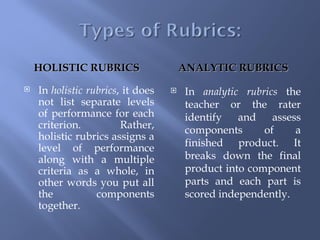
HOLISTIC RUBRICS                   ANALYTIC RUBRICS
   In holistic rubrics, it does      In analytic rubrics the
    not list separate levels           teacher or the rater
    of performance for each            identify   and    assess
    criterion.          Rather,        components      of     a
    holistic rubrics assigns a
    level of performance               finished product. It
    along with a multiple              breaks down the final
    criteria as a whole, in            product into component
    other words you put all            parts and each part is
    the           components           scored independently.
    together.
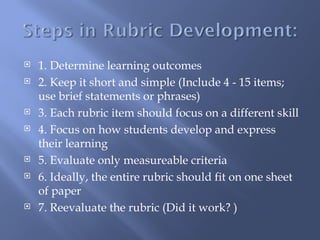
   1. Determine learning outcomes
   2. Keep it short and simple (Include 4 - 15 items;
    use brief statements or phrases)
   3. Each rubric item should focus on a different skill
   4. Focus on how students develop and express
    their learning
   5. Evaluate only measureable criteria
   6. Ideally, the entire rubric should fit on one sheet
    of paper
   7. Reevaluate the rubric (Did it work? )
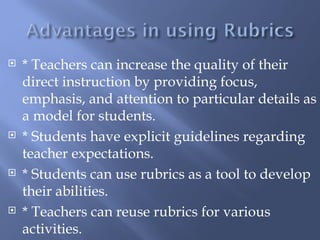
   * Teachers can increase the quality of their
    direct instruction by providing focus,
    emphasis, and attention to particular details as
    a model for students.
   * Students have explicit guidelines regarding
    teacher expectations.
   * Students can use rubrics as a tool to develop
    their abilities.
   * Teachers can reuse rubrics for various
    activities.
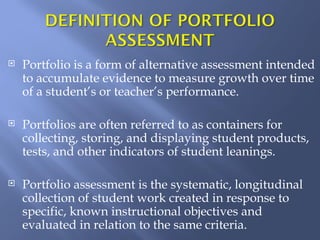
   Portfolio is a form of alternative assessment intended
    to accumulate evidence to measure growth over time
    of a student’s or teacher’s performance.

   Portfolios are often referred to as containers for
    collecting, storing, and displaying student products,
    tests, and other indicators of student leanings.

   Portfolio assessment is the systematic, longitudinal
    collection of student work created in response to
    specific, known instructional objectives and
    evaluated in relation to the same criteria.
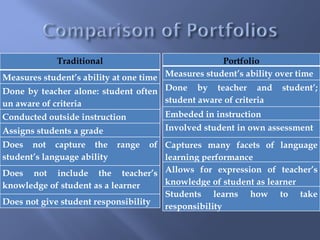
Traditional                            Portfolio
Measures student’s ability at one time Measures student’s ability over time
Done by teacher alone: student often Done by teacher and student’;
un aware of criteria                   student aware of criteria
Conducted outside instruction         Embeded in instruction
Assigns students a grade              Involved student in own assessment
Does not capture the         range  of Captures many facets of language
student’s language ability             learning performance
Does not include the teacher’s Allows for expression of teacher’s
knowledge of student as a learner      knowledge of student as learner
                                       Students learns how to take
Does not give student responsibility
                                       responsibility
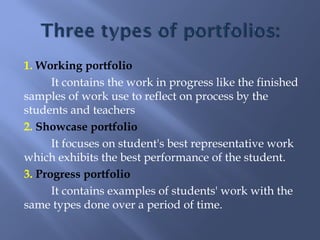
1. Working portfolio
      It contains the work in progress like the finished
samples of work use to reflect on process by the
students and teachers
2. Showcase portfolio
      It focuses on student's best representative work
which exhibits the best performance of the student.
3. Progress portfolio
      It contains examples of students' work with the
same types done over a period of time.
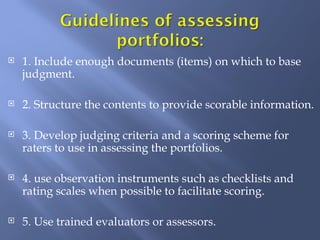
   1. Include enough documents (items) on which to base
    judgment.

   2. Structure the contents to provide scorable information.

   3. Develop judging criteria and a scoring scheme for
    raters to use in assessing the portfolios.

   4. use observation instruments such as checklists and
    rating scales when possible to facilitate scoring.

   5. Use trained evaluators or assessors.
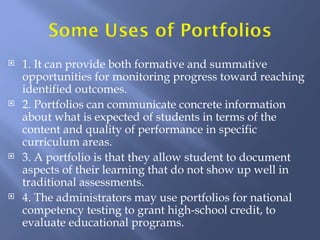
   1. It can provide both formative and summative
    opportunities for monitoring progress toward reaching
    identified outcomes.
   2. Portfolios can communicate concrete information
    about what is expected of students in terms of the
    content and quality of performance in specific
    curriculum areas.
   3. A portfolio is that they allow student to document
    aspects of their learning that do not show up well in
    traditional assessments.
   4. The administrators may use portfolios for national
    competency testing to grant high-school credit, to
    evaluate educational programs.
   Performance Based Assessment is a direct and
    systematic observation of the actual performances of
    the students based from a pre-determined
    performance criteria Zimmaro, 2003 as cited by
    Gabuyo, 2011. It is an alternative form of assessing
    the performance of the students that represent a set
    of strategies for the application of knowledge, skills,
    and work habits through the performance of tasks
    that are meaningful and engaging to students”
    Hibbard, 1996 and Brualdi, 1998 in her article
    “Implementing Performance Assessment in the
    Classroom”.
Module 8 powerpoint

Module 8 powerpoint

  • 1.
  • 2.
    I. Define the meaning and types of Rubrics III. Know the Steps and Advantages in developing a rubric V. Define and Compare Portfolios VII. Know the Types, Guidelines and Uses of Portfolios IX. Know meaning of Performance Based Assessment (PBA)
  • 3.
    “Definition of aRubric” “Rubrics” is a scoring scale and instructional tool to assess the performance of students using a task-specific set of criteria or “what counts” (for example, purposes, organizational, details, voice, and mechanics are often what count. It contains two essential parts: the criteria for the tasks and levels of performance for each criterion. It provides teachers an effective means of students-centered feedback and evaluation of the work of students. It also enables teachers to provide a detailed and informative evaluation of their performance.
  • 4.
    HOLISTIC RUBRICS ANALYTIC RUBRICS  In holistic rubrics, it does  In analytic rubrics the not list separate levels teacher or the rater of performance for each identify and assess criterion. Rather, components of a holistic rubrics assigns a level of performance finished product. It along with a multiple breaks down the final criteria as a whole, in product into component other words you put all parts and each part is the components scored independently. together.
  • 5.
    1. Determine learning outcomes  2. Keep it short and simple (Include 4 - 15 items; use brief statements or phrases)  3. Each rubric item should focus on a different skill  4. Focus on how students develop and express their learning  5. Evaluate only measureable criteria  6. Ideally, the entire rubric should fit on one sheet of paper  7. Reevaluate the rubric (Did it work? )
  • 6.
    * Teachers can increase the quality of their direct instruction by providing focus, emphasis, and attention to particular details as a model for students.  * Students have explicit guidelines regarding teacher expectations.  * Students can use rubrics as a tool to develop their abilities.  * Teachers can reuse rubrics for various activities.
  • 7.
    Portfolio is a form of alternative assessment intended to accumulate evidence to measure growth over time of a student’s or teacher’s performance.  Portfolios are often referred to as containers for collecting, storing, and displaying student products, tests, and other indicators of student leanings.  Portfolio assessment is the systematic, longitudinal collection of student work created in response to specific, known instructional objectives and evaluated in relation to the same criteria.
  • 8.
    Traditional Portfolio Measures student’s ability at one time Measures student’s ability over time Done by teacher alone: student often Done by teacher and student’; un aware of criteria student aware of criteria Conducted outside instruction Embeded in instruction Assigns students a grade Involved student in own assessment Does not capture the range of Captures many facets of language student’s language ability learning performance Does not include the teacher’s Allows for expression of teacher’s knowledge of student as a learner knowledge of student as learner Students learns how to take Does not give student responsibility responsibility
  • 9.
    1. Working portfolio It contains the work in progress like the finished samples of work use to reflect on process by the students and teachers 2. Showcase portfolio It focuses on student's best representative work which exhibits the best performance of the student. 3. Progress portfolio It contains examples of students' work with the same types done over a period of time.
  • 10.
    1. Include enough documents (items) on which to base judgment.  2. Structure the contents to provide scorable information.  3. Develop judging criteria and a scoring scheme for raters to use in assessing the portfolios.  4. use observation instruments such as checklists and rating scales when possible to facilitate scoring.  5. Use trained evaluators or assessors.
  • 11.
    1. It can provide both formative and summative opportunities for monitoring progress toward reaching identified outcomes.  2. Portfolios can communicate concrete information about what is expected of students in terms of the content and quality of performance in specific curriculum areas.  3. A portfolio is that they allow student to document aspects of their learning that do not show up well in traditional assessments.  4. The administrators may use portfolios for national competency testing to grant high-school credit, to evaluate educational programs.
  • 12.
    Performance Based Assessment is a direct and systematic observation of the actual performances of the students based from a pre-determined performance criteria Zimmaro, 2003 as cited by Gabuyo, 2011. It is an alternative form of assessing the performance of the students that represent a set of strategies for the application of knowledge, skills, and work habits through the performance of tasks that are meaningful and engaging to students” Hibbard, 1996 and Brualdi, 1998 in her article “Implementing Performance Assessment in the Classroom”.