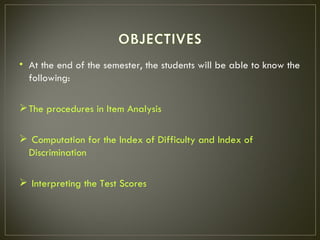
• At the end of the semester, the students will be able to know the
  following:

 The procedures in Item Analysis

 Computation for the Index of Difficulty and Index of
 Discrimination

 Interpreting the Test Scores
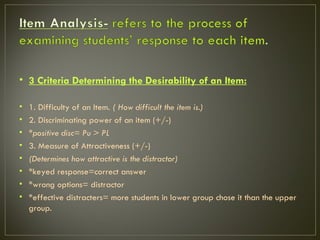
• 3 Criteria Determining the Desirability of an Item:

•   1. Difficulty of an Item. ( How difficult the item is.)
•   2. Discriminating power of an item (+/-)
•   *positive disc= Pu > PL
•   3. Measure of Attractiveness (+/-)
•   (Determines how attractive is the distractor)
•   *keyed response=correct answer
•   *wrong options= distractor
•   *effective distracters= more students in lower group chose it than the upper
    group.
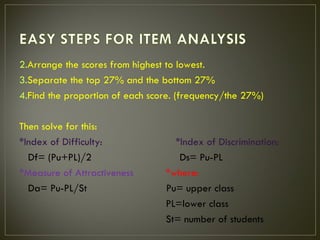
2.Arrange the scores from highest to lowest.
3.Separate the top 27% and the bottom 27%
4.Find the proportion of each score. (frequency/the 27%)

Then solve for this:
*Index of Difficulty:              *Index of Discrimination:
  Df= (Pu+PL)/2                     Ds= Pu-PL
*Measure of Attractiveness       *where:
  Da= Pu-PL/St                   Pu= upper class
                                 PL=lower class
                                 St= number of students
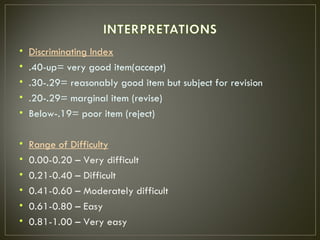
•   Discriminating Index
•   .40-up= very good item(accept)
•   .30-.29= reasonably good item but subject for revision
•   .20-.29= marginal item (revise)
•   Below-.19= poor item (reject)

•   Range of Difficulty
•   0.00-0.20 – Very difficult
•   0.21-0.40 – Difficult
•   0.41-0.60 – Moderately difficult
•   0.61-0.80 – Easy
•   0.81-1.00 – Very easy
Module 6 presentation

Module 6 presentation

  • 2.
    • At theend of the semester, the students will be able to know the following:  The procedures in Item Analysis  Computation for the Index of Difficulty and Index of Discrimination  Interpreting the Test Scores
  • 3.
    • 3 CriteriaDetermining the Desirability of an Item: • 1. Difficulty of an Item. ( How difficult the item is.) • 2. Discriminating power of an item (+/-) • *positive disc= Pu > PL • 3. Measure of Attractiveness (+/-) • (Determines how attractive is the distractor) • *keyed response=correct answer • *wrong options= distractor • *effective distracters= more students in lower group chose it than the upper group.
  • 4.
    2.Arrange the scoresfrom highest to lowest. 3.Separate the top 27% and the bottom 27% 4.Find the proportion of each score. (frequency/the 27%) Then solve for this: *Index of Difficulty: *Index of Discrimination: Df= (Pu+PL)/2 Ds= Pu-PL *Measure of Attractiveness *where: Da= Pu-PL/St Pu= upper class PL=lower class St= number of students
  • 5.
    Discriminating Index • .40-up= very good item(accept) • .30-.29= reasonably good item but subject for revision • .20-.29= marginal item (revise) • Below-.19= poor item (reject) • Range of Difficulty • 0.00-0.20 – Very difficult • 0.21-0.40 – Difficult • 0.41-0.60 – Moderately difficult • 0.61-0.80 – Easy • 0.81-1.00 – Very easy