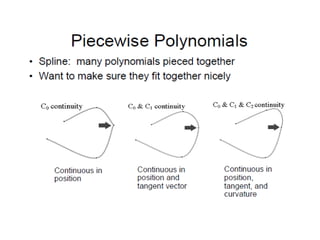
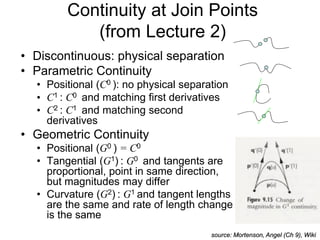
Continuity at Join Points
(from Lecture 2)
• Discontinuous: physical separation
• Parametric Continuity
• Positional (C0 ): no physical separation
• C1 : C0 and matching first derivatives
• C2 : C1 and matching second
derivatives
• Geometric Continuity
• Positional (G0 ) = C0
• Tangential (G1) : G0 and tangents are
proportional, point in same direction,
but magnitudes may differ
• Curvature (G2) : G1 and tangent lengths
are the same and rate of length change
is the same
source: Mortenson, Angel (Ch 9), Wiki
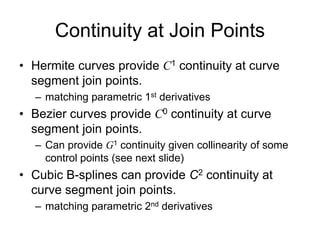
Continuity at Join Points
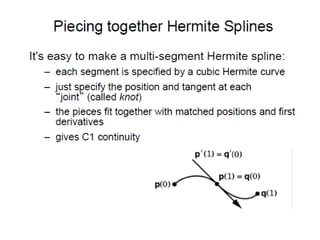
• Hermite curves provide C1 continuity at curve
segment join points.
– matching parametric 1st derivatives
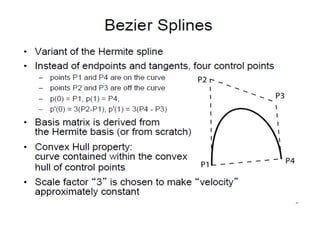
• Bezier curves provide C0 continuity at curve
segment join points.
– Can provide G1 continuity given collinearity of some
control points (see next slide)
• Cubic B-splines can provide C2 continuity at
curve segment join points.
– matching parametric 2nd derivatives
Composite Bezier Curves
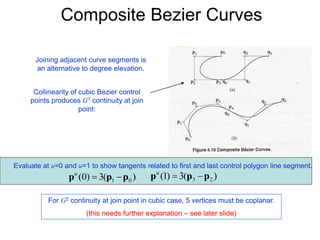
Evaluate at u=0 and u=1 to show tangents related to first and last control polygon line segment.
)
(
3
)
0
( 0
1 p
p
p 

u
)
(
3
)
1
( 2
3 p
p
p 

u
Joining adjacent curve segments is
an alternative to degree elevation.
Collinearity of cubic Bezier control
points produces G1 continuity at join
point:
For G2 continuity at join point in cubic case, 5 vertices must be coplanar.
(this needs further explanation – see later slide)
Composite Bezier Surface
• Bezier surface patches can
provide G1 continuity at patch
boundary curves.
• For common boundary curve
defined by control points p14,
p24, p34, p44, need collinearity
of:
• Two adjacent patches are Cr
across their common boundary
iff all rows of control net
vertices are interpretable as
polygons of Cr piecewise
Bezier curves.
source: Mortenson, Farin
]
4
:
1
[
},
,
,
{ 5
,
4
,
3
, 
i
i
i
i p
p
p
•Cubic B-splines can provide C2 continuity at surface patch boundary curves.
Continuity within a
(Single) Curve Segment
• Parametric Ck Continuity:
– Refers to the parametric curve representation and parametric
derivatives
– Smoothness of motion along the parametric curve
– “A curve P(t) has kth-order parametric continuity everywhere in the
t-interval [a,b] if all derivatives of the curve, up to the kth, exist and
are continuous at all points inside [a,b].”
– A curve with continuous parametric velocity and acceleration has
2nd-order parametric continuity.

 
cos
)
( b
Ke
x 
source: Hill, Ch 10

 
sin
)
( b
Ke
y 
)
)(
)(
(cos
)
sin
)(
(
)
(
' 




 b
b
b
be
Ke
Ke
x 


)
)(
)(
(sin
)
)(cos
(
)
(
' 




 b
b
b
be
Ke
Ke
y 

apply product rule
1st derivatives of parametric expression are
continuous, so spiral has 1st-order (C1) parametric
continuity.
Note that Ck continuity implies Ci
continuity for i < k.
Example
Continuity within a
(Single) Curve Segment (continued)
• Geometric Gk Continuity in interval [a,b] (assume P is curve):
– “Geometric continuity requires that various derivative vectors have
a continuous direction even though they might have discontinuity in
speed.”
– G0 = C0
– G1: P’(c-) = k P’(c+) for some constant k for every c in [a,b] .
• Velocity vector may jump in size, but its direction is continuous.
– G2: P’(c-) = k P’(c+) for some constant k and P’’(c-) = m
P’’(c+) for some constants k and m for every c in [a,b] .
• Both 1st and 2nd derivative directions are continuous.
Note that, for these definitions, Gk continuity implies Gi continuity for i < k.
source: Hill, Ch 10
These definitions suffice for that textbook’s treatment, but there is more to the story…
Reparameterization Relationship
• Curve has Gr continuity if an arc-length
reparameterization exists after which it has Cr
continuity.
• “Two curve segments are Gk geometric
continuous at the joining point if and only if there
exist two parameterizations, one for each curve
segment, such that all ith derivatives, ,
computed with these new parameterizations
agree at the joining point.”
source: Farin, Ch 10
source: cs.mtu.edu
k
i 
Additional Perspective
• “Parametric continuity of order n implies
geometric continuity of order n, but not
vice-versa.”
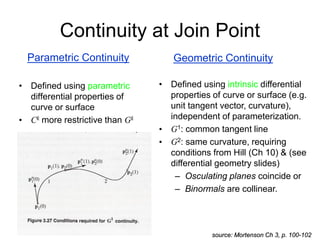
Continuity at Join Point
• Defined using parametric
differential properties of
curve or surface
• Ck more restrictive than Gk
source: Mortenson Ch 3, p. 100-102
• Defined using intrinsic differential
properties of curve or surface (e.g.
unit tangent vector, curvature),
independent of parameterization.
• G1: common tangent line
• G2: same curvature, requiring
conditions from Hill (Ch 10) & (see
differential geometry slides)
– Osculating planes coincide or
– Binormals are collinear.
Parametric Continuity Geometric Continuity
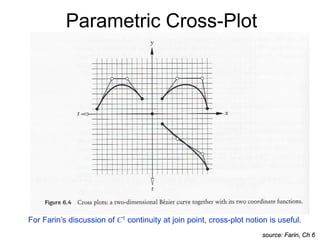
Parametric Cross-Plot
source: Farin, Ch 6
For Farin’s discussion of C1 continuity at join point, cross-plot notion is useful.
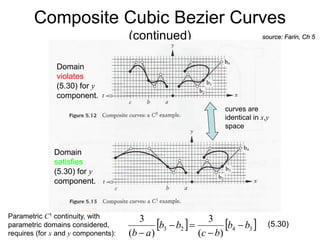
Composite Cubic Bezier Curves
(continued) source: Farin, Ch 5
curves are
identical in x,y
space
   
3
4
2
3
)
(
3
)
(
3
b
b
b
c
b
b
a
b





Parametric C1 continuity, with
parametric domains considered,
requires (for x and y components):
(5.30)
Domain
violates
(5.30) for y
component.
Domain
satisfies
(5.30) for y
component.
Composite Bezier Curves
source: Mortenson, Ch 4, p. 142-143
2
1
0
1
2 ,
,
,
, q
q
q
p
p
p 

 m
m
m
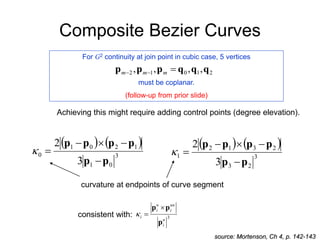
For G2 continuity at join point in cubic case, 5 vertices
must be coplanar.
(follow-up from prior slide)
Achieving this might require adding control points (degree elevation).
   
3
0
1
1
2
0
1
0
3
2
p
p
p
p
p
p






   
3
2
3
2
3
1
2
1
3
2
p
p
p
p
p
p






curvature at endpoints of curve segment
3
u
i
uu
i
u
i
i
p
p
p 


consistent with:
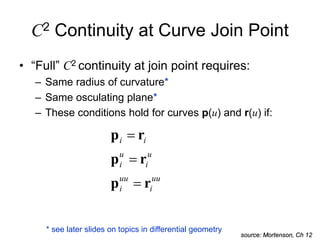
C2 Continuity at Curve Join Point
• “Full” C2 continuity at join point requires:
– Same radius of curvature*
– Same osculating plane*
– These conditions hold for curves p(u) and r(u) if:
source: Mortenson, Ch 12
uu
i
uu
i
u
i
u
i
i
i
r
p
r
p
r
p



* see later slides on topics in differential geometry
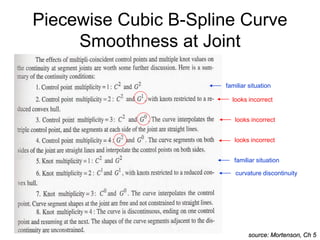
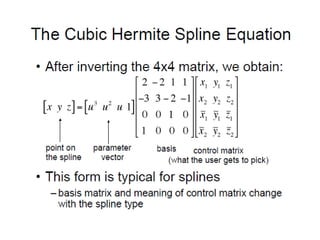
Piecewise Cubic B-Spline Curve
Smoothness at Joint
source: Mortenson, Ch 5
curvature discontinuity
familiar situation
familiar situation
looks incorrect
looks incorrect
looks incorrect
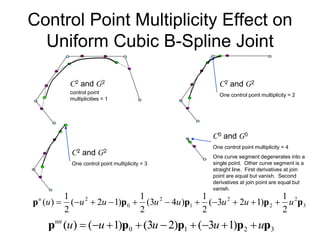
Control Point Multiplicity Effect on
Uniform Cubic B-Spline Joint
C2 and G2
control point
multiplicities = 1
C2 and G2
One control point multiplicity = 2
C2 and G2
One control point multiplicity = 3
3
2
2
2
1
2
0
2
2
1
)
1
2
3
(
2
1
)
4
3
(
2
1
)
1
2
(
2
1
)
( p
p
p
p
p u
u
u
u
u
u
u
u
u











C0 and G0
One control point multiplicity = 4
One curve segment degenerates into a
single point. Other curve segment is a
straight line. First derivatives at join
point are equal but vanish. Second
derivatives at join point are equal but
vanish.
3
2
1
0 )
1
3
(
)
2
3
(
)
1
(
)
( p
p
p
p
p u
u
u
u
u
uu









• If a knot has multiplicity r, then the B-
spline curve of degree n has smoothness
Cn-r at that knot.
Knot Multiplicity Effect on Non-
uniform B-Spline
source: Farin, Ch 8
A Few Differential Geometry
Topics Related to Continuity
Local Curve Topics
• Principal Vectors
– Tangent
– Normal
– Binormal
• Osculating Plane and Circle
• Frenet Frame
• Curvature
• Torsion
• Revisiting the Definition of Geometric Continuity
source: Ch 12 Mortenson
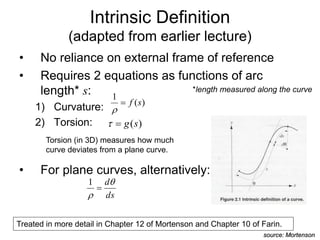
Intrinsic Definition
(adapted from earlier lecture)
• No reliance on external frame of reference
• Requires 2 equations as functions of arc
length* s:
1) Curvature:
2) Torsion:
• For plane curves, alternatively:
)
(
1
s
f


source: Mortenson
)
(s
g


*length measured along the curve
Torsion (in 3D) measures how much
curve deviates from a plane curve.
Treated in more detail in Chapter 12 of Mortenson and Chapter 10 of Farin.
ds
d


1
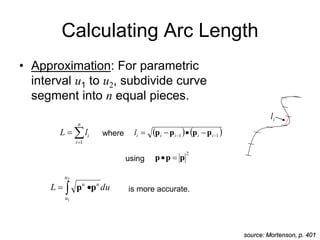
Calculating Arc Length
• Approximation: For parametric
interval u1 to u2, subdivide curve
segment into n equal pieces.



n
i
i
l
L
1
source: Mortenson, p. 401
   
1
1 
 


 i
i
i
i
i
l p
p
p
p
du
L
u
u
u
u
 

2
1
p
p
2
p
p
p 

i
l
where
using
is more accurate.
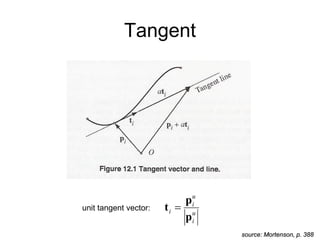
Tangent
u
i
u
i
i
p
p
t 
unit tangent vector:
source: Mortenson, p. 388
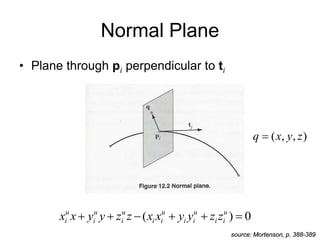
Normal Plane
• Plane through pi perpendicular to ti
0
)
( 




 u
i
i
u
i
i
u
i
i
u
i
u
i
u
i z
z
y
y
x
x
z
z
y
y
x
x
)
,
,
( z
y
x
q 
source: Mortenson, p. 388-389
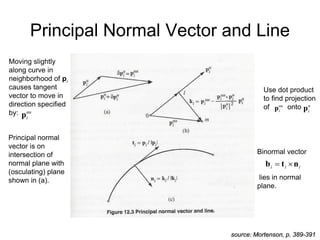
Principal Normal Vector and Line
u
i
p
i
i
i n
t
b 

uu
i
p
Moving slightly
along curve in
neighborhood of pi
causes tangent
vector to move in
direction specified
by:
source: Mortenson, p. 389-391
Principal normal
vector is on
intersection of
normal plane with
(osculating) plane
shown in (a).
Use dot product
to find projection
of onto
Binormal vector
lies in normal
plane.
uu
i
p
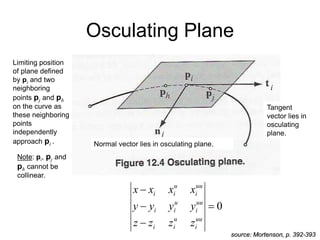
Osculating Plane
Limiting position
of plane defined
by pi and two
neighboring
points pj and ph
on the curve as
these neighboring
points
independently
approach pi .
Note: pi, pj and
ph cannot be
collinear.
Tangent
vector lies in
osculating
plane.
0




uu
i
u
i
i
uu
i
u
i
i
uu
i
u
i
i
z
z
z
z
y
y
y
y
x
x
x
x
i
i
source: Mortenson, p. 392-393
Normal vector lies in osculating plane.
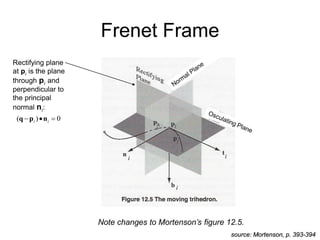
Frenet Frame
Rectifying plane
at pi is the plane
through pi and
perpendicular to
the principal
normal ni:
0
)
( 

 i
i n
p
q
i
i
i
source: Mortenson, p. 393-394
Note changes to Mortenson’s figure 12.5.
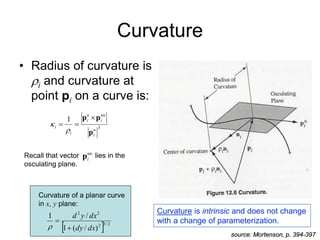
Curvature
• Radius of curvature is
i and curvature at
point pi on a curve is:
3
1
u
i
uu
i
u
i
i
i
p
p
p 




source: Mortenson, p. 394-397
  2
/
3
2
2
2
)
/
(
1
/
1
dx
dy
dx
y
d



Curvature of a planar curve
in x, y plane:
uu
i
p
Recall that vector lies in the
osculating plane.
Curvature is intrinsic and does not change
with a change of parameterization.
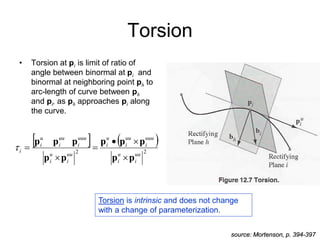
Torsion
• Torsion at pi is limit of ratio of
angle between binormal at pi and
binormal at neighboring point ph to
arc-length of curve between ph
and pi, as ph approaches pi along
the curve.
source: Mortenson, p. 394-397
   
2
2 uu
i
u
i
uuu
i
uu
i
u
i
uu
i
u
i
uuu
i
uu
i
u
i
i
p
p
p
p
p
p
p
p
p
p







Torsion is intrinsic and does not change
with a change of parameterization.
Reparameterization Relationship
• Curve has Gr continuity if an arc-length
reparameterization exists after which it has
Cr continuity.
• This is equivalent to these 2 conditions:
– Cr-2 continuity of curvature
– Cr-3 continuity of torsion
source: Farin, Ch 10, p.189 & Ch 11, p. 200
Local properties torsion and curvature are
intrinsic and uniquely determine a curve.
Local Surface Topics
• Fundamental Forms
• Tangent Plane
• Principal Curvature
• Osculating Paraboloid
source: Ch 12 Mortenson
Local Properties of a Surface
Fundamental Forms
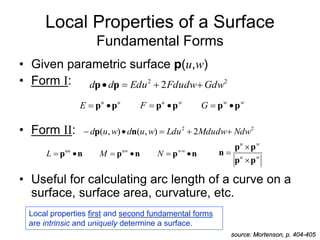
• Given parametric surface p(u,w)
• Form I:
• Form II:
• Useful for calculating arc length of a curve on a
surface, surface area, curvature, etc.
2
2
2 Gdw
Fdudw
Edu
d
d 


 p
p
Local properties first and second fundamental forms
are intrinsic and uniquely determine a surface.
source: Mortenson, p. 404-405
w
w
w
u
u
u
G
F
E p
p
p
p
p
p 





2
2
2
)
,
(
)
,
( Ndw
Mdudw
Ldu
w
u
d
w
u
d 



 n
p
n
p
n
p
n
p 




 ww
uw
uu
N
M
L w
u
w
u
p
p
p
p
n



Local Properties of a Surface
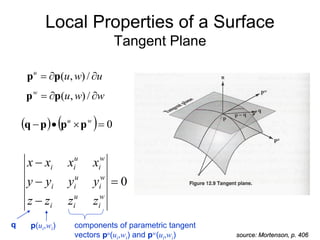
Tangent Plane
    0



 w
u
p
p
p
q
0




w
i
u
i
i
w
i
u
i
i
w
i
u
i
i
z
z
z
z
y
y
y
y
x
x
x
x
source: Mortenson, p. 406
u
w
u
u


 /
)
,
(
p
p
w
w
u
w


 /
)
,
(
p
p
q p(ui,wi) components of parametric tangent
vectors pu(ui,wi) and pw(ui,wi)
Local Properties of a Surface
Principal Curvature
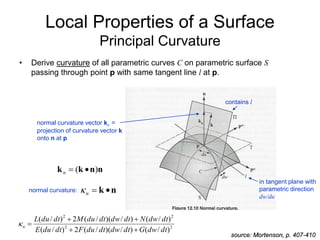
• Derive curvature of all parametric curves C on parametric surface S
passing through point p with same tangent line l at p.
n
n
k
k )
( 

n
source: Mortenson, p. 407-410
in tangent plane with
parametric direction
dw/du
contains l
normal curvature vector kn =
projection of curvature vector k
onto n at p
n
k 

n

normal curvature:
2
2
2
2
)
/
(
)
/
)(
/
(
2
)
/
(
)
/
(
)
/
)(
/
(
2
)
/
(
dt
dw
G
dt
dw
dt
du
F
dt
du
E
dt
dw
N
dt
dw
dt
du
M
dt
du
L
n






Local Properties of a Surface
Principal Curvature (continued)
source: Mortenson, p. 407-410
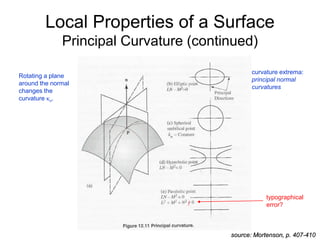
typographical
error?
Rotating a plane
around the normal
changes the
curvature n.
curvature extrema:
principal normal
curvatures
Local Properties of a Surface
Osculating Paraboloid
 







 2
2
2
2
1
Ndw
Mdudw
Ldu
f
d
source: Mortenson, p. 412
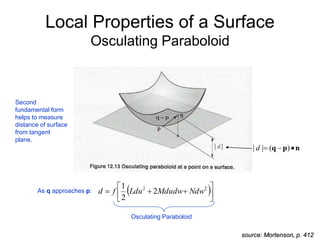
Second
fundamental form
helps to measure
distance of surface
from tangent
plane.
n
p
q 

 )
(
|
| d
As q approaches p:
Osculating Paraboloid
Local Properties of a Surface
Local Surface Characterization
0
) 2

 M
LN
c
0
) 2

 M
LN
b
0
) 2

 M
LN
a
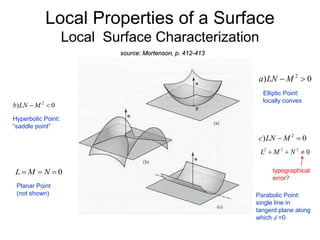
Elliptic Point:
locally convex
Hyperbolic Point:
“saddle point”
0
2
2
2


 N
M
L
source: Mortenson, p. 412-413
typographical
error?
0


 N
M
L
Planar Point
(not shown) Parabolic Point:
single line in
tangent plane along
which d =0

Module 3.pdf

  • 56.
    Continuity at JoinPoints (from Lecture 2) • Discontinuous: physical separation • Parametric Continuity • Positional (C0 ): no physical separation • C1 : C0 and matching first derivatives • C2 : C1 and matching second derivatives • Geometric Continuity • Positional (G0 ) = C0 • Tangential (G1) : G0 and tangents are proportional, point in same direction, but magnitudes may differ • Curvature (G2) : G1 and tangent lengths are the same and rate of length change is the same source: Mortenson, Angel (Ch 9), Wiki
  • 57.
    Continuity at JoinPoints • Hermite curves provide C1 continuity at curve segment join points. – matching parametric 1st derivatives • Bezier curves provide C0 continuity at curve segment join points. – Can provide G1 continuity given collinearity of some control points (see next slide) • Cubic B-splines can provide C2 continuity at curve segment join points. – matching parametric 2nd derivatives
  • 58.
    Composite Bezier Curves Evaluateat u=0 and u=1 to show tangents related to first and last control polygon line segment. ) ( 3 ) 0 ( 0 1 p p p   u ) ( 3 ) 1 ( 2 3 p p p   u Joining adjacent curve segments is an alternative to degree elevation. Collinearity of cubic Bezier control points produces G1 continuity at join point: For G2 continuity at join point in cubic case, 5 vertices must be coplanar. (this needs further explanation – see later slide)
  • 59.
    Composite Bezier Surface •Bezier surface patches can provide G1 continuity at patch boundary curves. • For common boundary curve defined by control points p14, p24, p34, p44, need collinearity of: • Two adjacent patches are Cr across their common boundary iff all rows of control net vertices are interpretable as polygons of Cr piecewise Bezier curves. source: Mortenson, Farin ] 4 : 1 [ }, , , { 5 , 4 , 3 ,  i i i i p p p •Cubic B-splines can provide C2 continuity at surface patch boundary curves.
  • 60.
    Continuity within a (Single)Curve Segment • Parametric Ck Continuity: – Refers to the parametric curve representation and parametric derivatives – Smoothness of motion along the parametric curve – “A curve P(t) has kth-order parametric continuity everywhere in the t-interval [a,b] if all derivatives of the curve, up to the kth, exist and are continuous at all points inside [a,b].” – A curve with continuous parametric velocity and acceleration has 2nd-order parametric continuity.    cos ) ( b Ke x  source: Hill, Ch 10    sin ) ( b Ke y  ) )( )( (cos ) sin )( ( ) ( '       b b b be Ke Ke x    ) )( )( (sin ) )(cos ( ) ( '       b b b be Ke Ke y   apply product rule 1st derivatives of parametric expression are continuous, so spiral has 1st-order (C1) parametric continuity. Note that Ck continuity implies Ci continuity for i < k. Example
  • 61.
    Continuity within a (Single)Curve Segment (continued) • Geometric Gk Continuity in interval [a,b] (assume P is curve): – “Geometric continuity requires that various derivative vectors have a continuous direction even though they might have discontinuity in speed.” – G0 = C0 – G1: P’(c-) = k P’(c+) for some constant k for every c in [a,b] . • Velocity vector may jump in size, but its direction is continuous. – G2: P’(c-) = k P’(c+) for some constant k and P’’(c-) = m P’’(c+) for some constants k and m for every c in [a,b] . • Both 1st and 2nd derivative directions are continuous. Note that, for these definitions, Gk continuity implies Gi continuity for i < k. source: Hill, Ch 10 These definitions suffice for that textbook’s treatment, but there is more to the story…
  • 62.
    Reparameterization Relationship • Curvehas Gr continuity if an arc-length reparameterization exists after which it has Cr continuity. • “Two curve segments are Gk geometric continuous at the joining point if and only if there exist two parameterizations, one for each curve segment, such that all ith derivatives, , computed with these new parameterizations agree at the joining point.” source: Farin, Ch 10 source: cs.mtu.edu k i 
  • 63.
    Additional Perspective • “Parametriccontinuity of order n implies geometric continuity of order n, but not vice-versa.”
  • 64.
    Continuity at JoinPoint • Defined using parametric differential properties of curve or surface • Ck more restrictive than Gk source: Mortenson Ch 3, p. 100-102 • Defined using intrinsic differential properties of curve or surface (e.g. unit tangent vector, curvature), independent of parameterization. • G1: common tangent line • G2: same curvature, requiring conditions from Hill (Ch 10) & (see differential geometry slides) – Osculating planes coincide or – Binormals are collinear. Parametric Continuity Geometric Continuity
  • 65.
    Parametric Cross-Plot source: Farin,Ch 6 For Farin’s discussion of C1 continuity at join point, cross-plot notion is useful.
  • 66.
    Composite Cubic BezierCurves (continued) source: Farin, Ch 5 curves are identical in x,y space     3 4 2 3 ) ( 3 ) ( 3 b b b c b b a b      Parametric C1 continuity, with parametric domains considered, requires (for x and y components): (5.30) Domain violates (5.30) for y component. Domain satisfies (5.30) for y component.
  • 67.
    Composite Bezier Curves source:Mortenson, Ch 4, p. 142-143 2 1 0 1 2 , , , , q q q p p p    m m m For G2 continuity at join point in cubic case, 5 vertices must be coplanar. (follow-up from prior slide) Achieving this might require adding control points (degree elevation).     3 0 1 1 2 0 1 0 3 2 p p p p p p           3 2 3 2 3 1 2 1 3 2 p p p p p p       curvature at endpoints of curve segment 3 u i uu i u i i p p p    consistent with:
  • 68.
    C2 Continuity atCurve Join Point • “Full” C2 continuity at join point requires: – Same radius of curvature* – Same osculating plane* – These conditions hold for curves p(u) and r(u) if: source: Mortenson, Ch 12 uu i uu i u i u i i i r p r p r p    * see later slides on topics in differential geometry
  • 69.
    Piecewise Cubic B-SplineCurve Smoothness at Joint source: Mortenson, Ch 5 curvature discontinuity familiar situation familiar situation looks incorrect looks incorrect looks incorrect
  • 70.
    Control Point MultiplicityEffect on Uniform Cubic B-Spline Joint C2 and G2 control point multiplicities = 1 C2 and G2 One control point multiplicity = 2 C2 and G2 One control point multiplicity = 3 3 2 2 2 1 2 0 2 2 1 ) 1 2 3 ( 2 1 ) 4 3 ( 2 1 ) 1 2 ( 2 1 ) ( p p p p p u u u u u u u u u            C0 and G0 One control point multiplicity = 4 One curve segment degenerates into a single point. Other curve segment is a straight line. First derivatives at join point are equal but vanish. Second derivatives at join point are equal but vanish. 3 2 1 0 ) 1 3 ( ) 2 3 ( ) 1 ( ) ( p p p p p u u u u u uu         
  • 71.
    • If aknot has multiplicity r, then the B- spline curve of degree n has smoothness Cn-r at that knot. Knot Multiplicity Effect on Non- uniform B-Spline source: Farin, Ch 8
  • 72.
    A Few DifferentialGeometry Topics Related to Continuity
  • 73.
    Local Curve Topics •Principal Vectors – Tangent – Normal – Binormal • Osculating Plane and Circle • Frenet Frame • Curvature • Torsion • Revisiting the Definition of Geometric Continuity source: Ch 12 Mortenson
  • 74.
    Intrinsic Definition (adapted fromearlier lecture) • No reliance on external frame of reference • Requires 2 equations as functions of arc length* s: 1) Curvature: 2) Torsion: • For plane curves, alternatively: ) ( 1 s f   source: Mortenson ) (s g   *length measured along the curve Torsion (in 3D) measures how much curve deviates from a plane curve. Treated in more detail in Chapter 12 of Mortenson and Chapter 10 of Farin. ds d   1
  • 75.
    Calculating Arc Length •Approximation: For parametric interval u1 to u2, subdivide curve segment into n equal pieces.    n i i l L 1 source: Mortenson, p. 401     1 1       i i i i i l p p p p du L u u u u    2 1 p p 2 p p p   i l where using is more accurate.
  • 76.
    Tangent u i u i i p p t  unit tangentvector: source: Mortenson, p. 388
  • 77.
    Normal Plane • Planethrough pi perpendicular to ti 0 ) (       u i i u i i u i i u i u i u i z z y y x x z z y y x x ) , , ( z y x q  source: Mortenson, p. 388-389
  • 78.
    Principal Normal Vectorand Line u i p i i i n t b   uu i p Moving slightly along curve in neighborhood of pi causes tangent vector to move in direction specified by: source: Mortenson, p. 389-391 Principal normal vector is on intersection of normal plane with (osculating) plane shown in (a). Use dot product to find projection of onto Binormal vector lies in normal plane. uu i p
  • 79.
    Osculating Plane Limiting position ofplane defined by pi and two neighboring points pj and ph on the curve as these neighboring points independently approach pi . Note: pi, pj and ph cannot be collinear. Tangent vector lies in osculating plane. 0     uu i u i i uu i u i i uu i u i i z z z z y y y y x x x x i i source: Mortenson, p. 392-393 Normal vector lies in osculating plane.
  • 80.
    Frenet Frame Rectifying plane atpi is the plane through pi and perpendicular to the principal normal ni: 0 ) (    i i n p q i i i source: Mortenson, p. 393-394 Note changes to Mortenson’s figure 12.5.
  • 81.
    Curvature • Radius ofcurvature is i and curvature at point pi on a curve is: 3 1 u i uu i u i i i p p p      source: Mortenson, p. 394-397   2 / 3 2 2 2 ) / ( 1 / 1 dx dy dx y d    Curvature of a planar curve in x, y plane: uu i p Recall that vector lies in the osculating plane. Curvature is intrinsic and does not change with a change of parameterization.
  • 82.
    Torsion • Torsion atpi is limit of ratio of angle between binormal at pi and binormal at neighboring point ph to arc-length of curve between ph and pi, as ph approaches pi along the curve. source: Mortenson, p. 394-397     2 2 uu i u i uuu i uu i u i uu i u i uuu i uu i u i i p p p p p p p p p p        Torsion is intrinsic and does not change with a change of parameterization.
  • 83.
    Reparameterization Relationship • Curvehas Gr continuity if an arc-length reparameterization exists after which it has Cr continuity. • This is equivalent to these 2 conditions: – Cr-2 continuity of curvature – Cr-3 continuity of torsion source: Farin, Ch 10, p.189 & Ch 11, p. 200 Local properties torsion and curvature are intrinsic and uniquely determine a curve.
  • 84.
    Local Surface Topics •Fundamental Forms • Tangent Plane • Principal Curvature • Osculating Paraboloid source: Ch 12 Mortenson
  • 85.
    Local Properties ofa Surface Fundamental Forms • Given parametric surface p(u,w) • Form I: • Form II: • Useful for calculating arc length of a curve on a surface, surface area, curvature, etc. 2 2 2 Gdw Fdudw Edu d d     p p Local properties first and second fundamental forms are intrinsic and uniquely determine a surface. source: Mortenson, p. 404-405 w w w u u u G F E p p p p p p       2 2 2 ) , ( ) , ( Ndw Mdudw Ldu w u d w u d      n p n p n p n p       ww uw uu N M L w u w u p p p p n   
  • 86.
    Local Properties ofa Surface Tangent Plane     0     w u p p p q 0     w i u i i w i u i i w i u i i z z z z y y y y x x x x source: Mortenson, p. 406 u w u u    / ) , ( p p w w u w    / ) , ( p p q p(ui,wi) components of parametric tangent vectors pu(ui,wi) and pw(ui,wi)
  • 87.
    Local Properties ofa Surface Principal Curvature • Derive curvature of all parametric curves C on parametric surface S passing through point p with same tangent line l at p. n n k k ) (   n source: Mortenson, p. 407-410 in tangent plane with parametric direction dw/du contains l normal curvature vector kn = projection of curvature vector k onto n at p n k   n  normal curvature: 2 2 2 2 ) / ( ) / )( / ( 2 ) / ( ) / ( ) / )( / ( 2 ) / ( dt dw G dt dw dt du F dt du E dt dw N dt dw dt du M dt du L n      
  • 88.
    Local Properties ofa Surface Principal Curvature (continued) source: Mortenson, p. 407-410 typographical error? Rotating a plane around the normal changes the curvature n. curvature extrema: principal normal curvatures
  • 89.
    Local Properties ofa Surface Osculating Paraboloid           2 2 2 2 1 Ndw Mdudw Ldu f d source: Mortenson, p. 412 Second fundamental form helps to measure distance of surface from tangent plane. n p q    ) ( | | d As q approaches p: Osculating Paraboloid
  • 90.
    Local Properties ofa Surface Local Surface Characterization 0 ) 2   M LN c 0 ) 2   M LN b 0 ) 2   M LN a Elliptic Point: locally convex Hyperbolic Point: “saddle point” 0 2 2 2    N M L source: Mortenson, p. 412-413 typographical error? 0    N M L Planar Point (not shown) Parabolic Point: single line in tangent plane along which d =0