MAE 3340 INSTRUMENTATION SYSTEMS	

 1
	

Section 1.1: Basic Concepts of Measurements
and Methods
(Chapter 1: Beckwith Chaps. 1-2)	

• Encyclopedia Encarta
In classical physics and engineering, measurement generally refers to the
process of estimating or determining the ratio of a magnitude of a quantitative
property or relation to a unit of the same type of quantitative property or
relation.
Process of measurement involves the comparison of physical quantities of
objects or phenomena …
MAE 3340 INSTRUMENTATION SYSTEMS	

 2
	

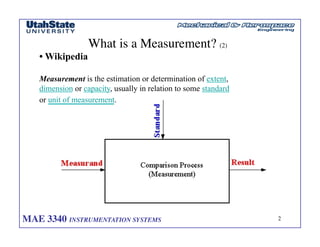
What is a Measurement? (2)	

• Wikipedia
Measurement is the estimation or determination of extent,
dimension or capacity, usually in relation to some standard
or unit of measurement.
MAE 3340 INSTRUMENTATION SYSTEMS	

 3
	

Comparison to a Standard (Metrology)	

• Metrology is the study of measurement. 	

-In general, a metric is a scale of measurement defined in terms of a 	

standard: i.e. in terms of well-defined unit. 	

- If one says I am 5, that person is indicating a measurement without 	

supplying an applicable standard. 	

-They could mean I am 5 years old or I am 5 feet high.	

-Measurements are at best ambiguous, or at worst, meaningless, with out units!
MAE 3340 INSTRUMENTATION SYSTEMS	

 4
	

Units of Measure	

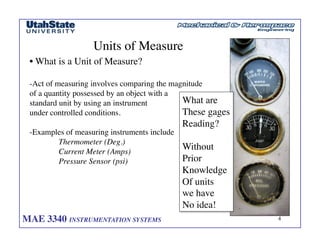
• What is a Unit of Measure? 	

-Act of measuring involves comparing the magnitude 	

of a quantity possessed by an object with a 	

standard unit by using an instrument 	

under controlled conditions. 	

-Examples of measuring instruments include 	


Thermometer (Deg.)	


Current Meter (Amps)	


Pressure Sensor (psi)	

What are	

These gages	

Reading?	

Without	

Prior 	

Knowledge	

Of units 	

we have	

No idea!
MAE 3340 INSTRUMENTATION SYSTEMS	

 5
	

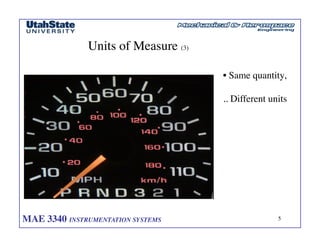
Units of Measure (3)	

• Same quantity,	

.. Different units
MAE 3340 INSTRUMENTATION SYSTEMS	

 6
	

Units of Measure (4)	

• Systems of Units	

Imperial (English)	

• Before SI units were widely adopted around the world, the British
systems of English units and later Imperial units were used in Britain,
the Commonwealth and the United States. The system came to be known
as U.S. customary units in the United States.
• Sometimes called foot-pound-second systems after
the Imperial units for distance, weight (mass), and time.
MAE 3340 INSTRUMENTATION SYSTEMS	

 7
	

Units of Measure (5)	

• Systems of Units	

Metric (MKS)	

• The metric system is a decimalised system of measurement based on the
Meter (M), kilogram (K), and second (S).
• The main advantage of the metric system is that is has a single base unit for
each physical quantity. All other units are powers of ten or multiples of ten
of this base unit.
• Unit conversions are always simple because they will be in the ratio of ten,
one hundred, one thousand, etc.
• Also referred to as Systeme International (SI) Units
MAE 3340 INSTRUMENTATION SYSTEMS	

 8
	

Fundamental Units of Measure	

• A system of measurement is a set of units which can be used
to specify anything which can be measured. Some quantities
are designated as fundamental units meaning all other needed
units can be derived from them.
• Historically a wide range of units were used for the same
quantity; for example, in several cultural settings, length was
measured in inches, feet, yards, fathoms, rods, chains, furlongs,
miles, nautical miles, leagues, with conversion factors which
are not simple powers of ten or even always simple fractions.
MAE 3340 INSTRUMENTATION SYSTEMS	

 9
	

Fundamental Units of Measure (2)	

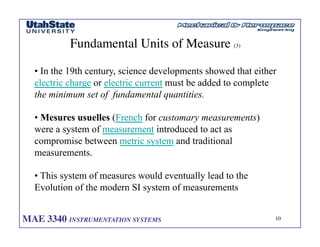
• This disagreement of units had serious military, cultural, and
Fiscal impacts and eventually the British Royal Society headed by
Michael Faraday adopted 3 fundamental Units,
distance (ft), weight (lb), and time (sec).
• Later (1824) it was determined to be more
fundamental to substitute Mass (slug) for weight
(lb) as a fundamental unit of measure
MAE 3340 INSTRUMENTATION SYSTEMS	

 10
	

Fundamental Units of Measure (3)	

• In the 19th century, science developments showed that either
electric charge or electric current must be added to complete
the minimum set of fundamental quantities.
• Mesures usuelles (French for customary measurements)
were a system of measurement introduced to act as
compromise between metric system and traditional
measurements.
• This system of measures would eventually lead to the
Evolution of the modern SI system of measurements
MAE 3340 INSTRUMENTATION SYSTEMS	

 11
	

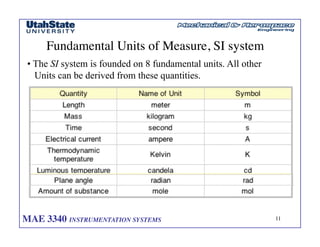
Fundamental Units of Measure, SI system	

• The SI system is founded on 8 fundamental units. All other
Units can be derived from these quantities.
MAE 3340 INSTRUMENTATION SYSTEMS	

 12
	

Derived Units of Measure, SI system	

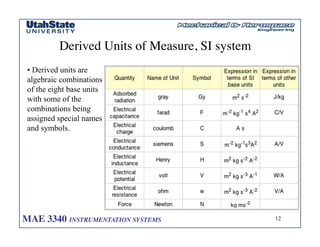
• Derived units are
algebraic combinations
of the eight base units
with some of the
combinations being
assigned special names
and symbols.
MAE 3340 INSTRUMENTATION SYSTEMS	

 13
	

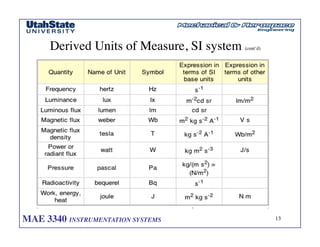
Derived Units of Measure, SI system (cont’d)
MAE 3340 INSTRUMENTATION SYSTEMS	

 14
	

Conversion of Units of Measure	

• Although the Imperial System of units is gradually being 	

Replaced by SI system, these units are still in common use	

Amongst U.S. defense contractors , and NASA! 	

• This use of the Imperial system is especially prevalent	

For mechanical units like distance, force, moments of	

inertia, pressure, and volume.	

• Accurate conversion from one system to another is	

Essential!
MAE 3340 INSTRUMENTATION SYSTEMS	

 15
	

Conversion of Units of Measure (1)	

• Not Important?!	

The Mars Climate Orbiter (1998) was
destroyed when a navigation error caused the
spacecraft to miss its intended 150 km
altitude above Mars during orbit insertion.
Instead the spacecraft entered the Martian
atmosphere at about 57 km altitude.
The spacecraft was destroyed by
atmospheric stresses and friction at
this low altitude.
MAE 3340 INSTRUMENTATION SYSTEMS	

 16
	

Conversion of Units of Measure (2)	

• Not Important?!	

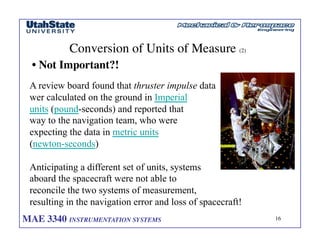
A review board found that thruster impulse data
wer calculated on the ground in Imperial
units (pound-seconds) and reported that
way to the navigation team, who were
expecting the data in metric units
(newton-seconds)
Anticipating a different set of units, systems
aboard the spacecraft were not able to
reconcile the two systems of measurement,
resulting in the navigation error and loss of spacecraft!
MAE 3340 INSTRUMENTATION SYSTEMS	

 17
	

Conversion of Units of Measure (3)	

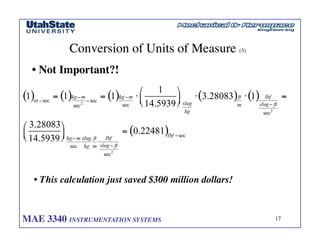
• Not Important?!	

• This calculation just saved $300 million dollars!
MAE 3340 INSTRUMENTATION SYSTEMS	

 18
	

Conversion of Units of Measure (4)	

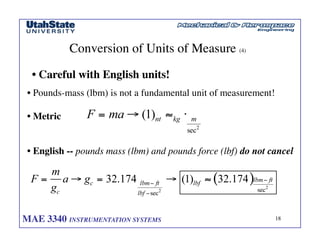
• Careful with English units!	

• Pounds-mass (lbm) is not a fundamental unit of measurement!	

• Metric 	

• English -- pounds mass (lbm) and pounds force (lbf) do not cancel
MAE 3340 INSTRUMENTATION SYSTEMS	

 19
	

Dimensional Analysis	

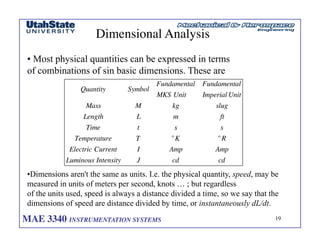
• Most physical quantities can be expressed in terms
of combinations of sin basic dimensions. These are
•Dimensions aren't the same as units. I.e. the physical quantity, speed, may be
measured in units of meters per second, knots … ; but regardless
of the units used, speed is always a distance divided a time, so we say that the
dimensions of speed are distance divided by time, or instantaneously dL/dt.
Quantity Symbol
Fundamental
MKS Unit
Fundamental
Imperial Unit
Mass M kg slug
Length L m ft
Time t s s
Temperature T o
K o
R
Electric Current I Amp Amp
Luminous Intensity J cd cd
MAE 3340 INSTRUMENTATION SYSTEMS	

 20
	

Dimensional Analysis (2)	

• In same manner, dimensions of area are D2 …. area can
always be calculated as a distance in one direction times a
Perpendicular direction
…. area of a circle -- πr2 is really a result of the integral
[1/2 Length of arc] x [height of triangle]
MAE 3340 INSTRUMENTATION SYSTEMS	

 21
	

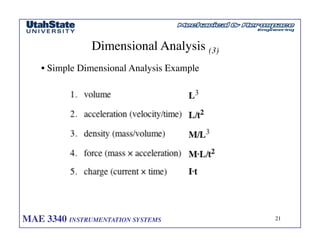
Dimensional Analysis (3)	

• Simple Dimensional Analysis Example
MAE 3340 INSTRUMENTATION SYSTEMS	

 22
	

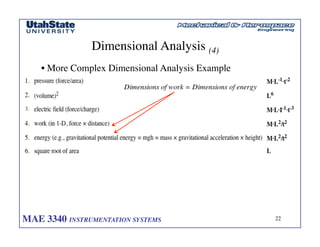
Dimensional Analysis (4)	

• More Complex Dimensional Analysis Example
MAE 3340 INSTRUMENTATION SYSTEMS	

 23
	

Dimensional Analysis (5)	

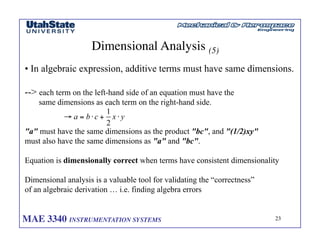
• In algebraic expression, additive terms must have same dimensions.
-- each term on the left-hand side of an equation must have the
same dimensions as each term on the right-hand side.
a must have the same dimensions as the product bc, and (1/2)xy
must also have the same dimensions as a and bc.
Equation is dimensionally correct when terms have consistent dimensionality
Dimensional analysis is a valuable tool for validating the “correctness”
of an algebraic derivation … i.e. finding algebra errors
MAE 3340 INSTRUMENTATION SYSTEMS	

 24
	

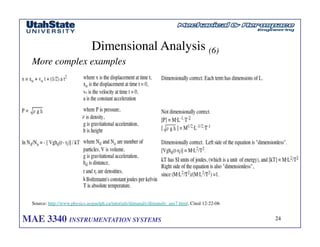
Dimensional Analysis (6)	

Source: http://www.physics.uoguelph.ca/tutorials/dimanaly/dimanaly_ans7.html, Cited 12-22-06	

More complex examples
MAE 3340 INSTRUMENTATION SYSTEMS	

 25
	

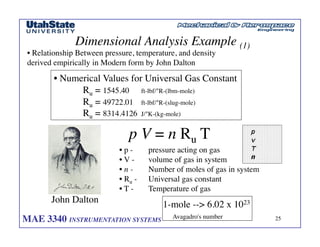
Dimensional Analysis Example (1)	

• Relationship Between pressure, temperature, and density	

derived empirically in Modern form by John Dalton	

John Dalton	

p V = n Ru T	

• p - 	

pressure acting on gas	

• V - 	

volume of gas in system	

• n - 	

Number of moles of gas in system	

• Ru - 	

Universal gas constant	

• T - 	

Temperature of gas	

1-mole -- 6.02 x 10²³	

Avagadro's number	

• Numerical Values for Universal Gas Constant	


Ru = 1545.40 	

ft-lbf/°R-(lbm-mole)	


Ru = 49722.01 	

ft-lbf/°R-(slug-mole)	


Ru = 8314.4126 	

J/°K-(kg-mole)
MAE 3340 INSTRUMENTATION SYSTEMS	

 26
	

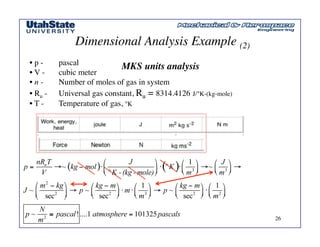
Dimensional Analysis Example (2)	

• p - 	

pascal	

• V - 	

cubic meter	

• n - 	

Number of moles of gas in system	

• Ru - 	

Universal gas constant, Ru = 8314.4126 J/°K-(kg-mole)	

• T - 	

Temperature of gas, °K	

MKS units analysis
MAE 3340 INSTRUMENTATION SYSTEMS	

 27
	

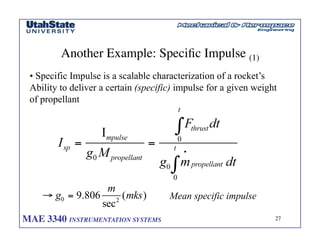
Another Example: Specific Impulse (1)	

• Specific Impulse is a scalable characterization of a rocket’s
Ability to deliver a certain (specific) impulse for a given weight
of propellant
Mean specific impulse
MAE 3340 INSTRUMENTATION SYSTEMS	

 28
	

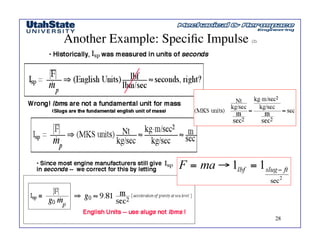
Another Example: Specific Impulse (2)
MAE 3340 INSTRUMENTATION SYSTEMS	

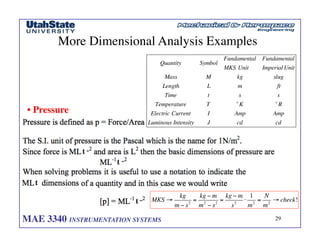
More Dimensional Analysis Examples
	

29
	

MKS →
kg
m − s2
=
kg − m
m2
− s2
=
kg − m
s2
⋅
1
m2
=
N
m2
→ check!
• Pressure 	

Quantity Symbol
Fundamental
MKS Unit
Fundamental
Imperial Unit
Mass M kg slug
Length L m ft
Time t s s
Temperature T o
K o
R
Electric Current I Amp Amp
Luminous Intensity J cd cd
MAE 3340 INSTRUMENTATION SYSTEMS	

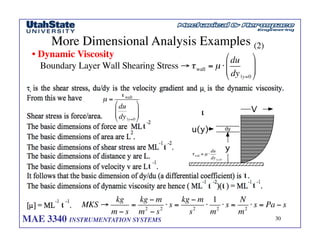
More Dimensional Analysis Examples (2)
	

30
	

V
u(y)
y
dy
τwall = µ ⋅
du
dy|y=0
Boundary Layer Wall Shearing Stress → τwall = µ ⋅
du
dy|y=0
⎛
⎝
⎜
⎜
⎞
⎠
⎟
⎟
µ =
τwall
du
dy|y=0
⎛
⎝
⎜
⎜
⎞
⎠
⎟
⎟
• Dynamic Viscosity	

MKS →
kg
m − s
=
kg − m
m2
− s2
⋅ s =
kg − m
s2
⋅
1
m2
⋅ s =
N
m2
⋅ s = Pa − s
MAE 3340 INSTRUMENTATION SYSTEMS	

 31
	

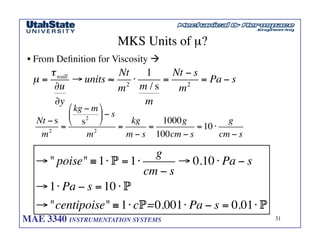
MKS Units of µ?	

• From Definition for Viscosity !	

Nt − s
m2
=
kg − m
s2
⎛
⎝
⎜
⎞
⎠
⎟− s
m2
=
kg
m − s
=
1000g
100cm − s
=10 ⋅
g
cm − s
µ =
τwall
∂u
∂y
→ units ≈
Nt
m2
⋅
1
m / s
m
=
Nt − s
m2
= Pa − s
→ poise ≡1⋅ P =1⋅
g
cm − s
→ 0.10 ⋅ Pa − s
→1⋅ Pa − s =10 ⋅ P
→centipoise ≡1⋅ cP=0.001⋅ Pa − s = 0.01⋅ P
MAE 3340 INSTRUMENTATION SYSTEMS	

 32
	

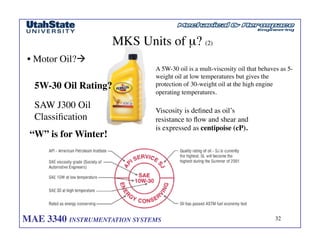
MKS Units of µ? (2)	

• Motor Oil?!	

5W-30 Oil Rating?	

SAW J300 Oil
Classification	

A 5W-30 oil is a mult-viscosity oil that behaves as 5-
weight oil at low temperatures but gives the
protection of 30-weight oil at the high engine
operating temperatures.	

Viscosity is defined as oil’s
resistance to flow and shear and
is expressed as centipoise (cP). 	

“W” is for Winter!
MAE 3340 INSTRUMENTATION SYSTEMS	

 33
	

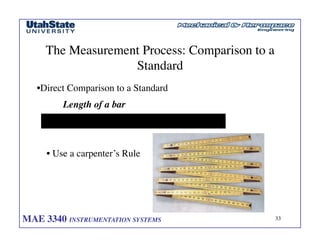
The Measurement Process: Comparison to a
Standard	

•Direct Comparison to a Standard	

Length of a bar	

• Use a carpenter’s Rule
MAE 3340 INSTRUMENTATION SYSTEMS	

 34
	

Standards	

Any time you measure anything, you are comparing it to something whose value
you think you know. You assume your ruler is 1 ft long. But who says what a foot
is?	

A combination of several international agencies are responsible for maintaining the
primary standard measures of various quantities. The standard kilogram and the
standard second are maintained by the French. Others are kept elsewhere. It
extremely important that these standards do not change with time, even over
hundreds of years.	

The National Institute of Standards and Technology in Maryland is responsible for
keeping standards for the US. 	

http://www.nist.gov/public_affairs/standards.htm
MAE 3340 INSTRUMENTATION SYSTEMS	

 35
	

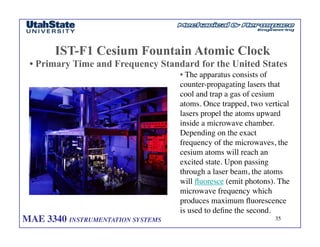
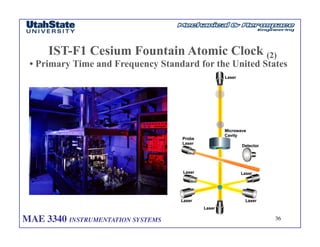
IST-F1 Cesium Fountain Atomic Clock
• Primary Time and Frequency Standard for the United States
• The apparatus consists of
counter-propagating lasers that
cool and trap a gas of cesium
atoms. Once trapped, two vertical
lasers propel the atoms upward
inside a microwave chamber.
Depending on the exact
frequency of the microwaves, the
cesium atoms will reach an
excited state. Upon passing
through a laser beam, the atoms
will fluoresce (emit photons). The
microwave frequency which
produces maximum fluorescence
is used to define the second.
MAE 3340 INSTRUMENTATION SYSTEMS	

 36
	

IST-F1 Cesium Fountain Atomic Clock (2)
• Primary Time and Frequency Standard for the United States
MAE 3340 INSTRUMENTATION SYSTEMS	

 37
	

Hierarchy of Standards	

• The hierarchy of measurement standards starts from the
international standard at the apex, which is known with the highest
precision and goes all the way down to working standards.
• International measurement standards are standards recognized by an
international agreement to serve internationally as the basis for
assigning values to other standards of the quantity concerned.
• The oldest standard in use today is the
International Prototype of the Kilogram, kept at the Bureau
International des Poids et Mesures (BIPM) in Sevres.
MAE 3340 INSTRUMENTATION SYSTEMS	

 38
	

Hierarchy of Standards (cont’d)	

These primary standards can’t be
passed around to any entity that
wants to take some measurements…	

if we expect them to maintain their
values, so secondary standards are
kept which may be somewhat less
accurate, but much more accessible. 	

These are calibrated against the
primary standards. In this manner, a
hierarchy of standards exist.
MAE 3340 INSTRUMENTATION SYSTEMS	

 39
	

Hierarchy of Standards (cont’d)	

A primary standard is designated or widely acknowledged as having the
highest metrological qualities and whose value is accepted without
reference to other standards of the same quantity.
Secondary standards are standards whose value is assigned by comparison
to a primary standard of the same quantity. Primary standards are usually used
to calibrate secondary standards. A working standard is a standard that is used
routinely to calibrate or check material measures, measuring instruments or
reference materials. A working standard is usually calibrated with reference
to a secondary standard, and may be used to ensure that routine measurements
are being carried out correctly - a check standard.
A reference standard is a standard generally having the highest
metrological quality available at a given location or in a given organization
from which the measurements made at that location are derived.
Calibration laboratories maintain reference standards for calibrating their
working standards.

section1.1.pdf

  • 1.
    MAE 3340 INSTRUMENTATIONSYSTEMS 1 Section 1.1: Basic Concepts of Measurements and Methods (Chapter 1: Beckwith Chaps. 1-2) • Encyclopedia Encarta In classical physics and engineering, measurement generally refers to the process of estimating or determining the ratio of a magnitude of a quantitative property or relation to a unit of the same type of quantitative property or relation. Process of measurement involves the comparison of physical quantities of objects or phenomena …
  • 2.
    MAE 3340 INSTRUMENTATIONSYSTEMS 2 What is a Measurement? (2) • Wikipedia Measurement is the estimation or determination of extent, dimension or capacity, usually in relation to some standard or unit of measurement.
  • 3.
    MAE 3340 INSTRUMENTATIONSYSTEMS 3 Comparison to a Standard (Metrology) • Metrology is the study of measurement. -In general, a metric is a scale of measurement defined in terms of a standard: i.e. in terms of well-defined unit. - If one says I am 5, that person is indicating a measurement without supplying an applicable standard. -They could mean I am 5 years old or I am 5 feet high. -Measurements are at best ambiguous, or at worst, meaningless, with out units!
  • 4.
    MAE 3340 INSTRUMENTATIONSYSTEMS 4 Units of Measure • What is a Unit of Measure? -Act of measuring involves comparing the magnitude of a quantity possessed by an object with a standard unit by using an instrument under controlled conditions. -Examples of measuring instruments include Thermometer (Deg.) Current Meter (Amps) Pressure Sensor (psi) What are These gages Reading? Without Prior Knowledge Of units we have No idea!
  • 5.
    MAE 3340 INSTRUMENTATIONSYSTEMS 5 Units of Measure (3) • Same quantity, .. Different units
  • 6.
    MAE 3340 INSTRUMENTATIONSYSTEMS 6 Units of Measure (4) • Systems of Units Imperial (English) • Before SI units were widely adopted around the world, the British systems of English units and later Imperial units were used in Britain, the Commonwealth and the United States. The system came to be known as U.S. customary units in the United States. • Sometimes called foot-pound-second systems after the Imperial units for distance, weight (mass), and time.
  • 7.
    MAE 3340 INSTRUMENTATIONSYSTEMS 7 Units of Measure (5) • Systems of Units Metric (MKS) • The metric system is a decimalised system of measurement based on the Meter (M), kilogram (K), and second (S). • The main advantage of the metric system is that is has a single base unit for each physical quantity. All other units are powers of ten or multiples of ten of this base unit. • Unit conversions are always simple because they will be in the ratio of ten, one hundred, one thousand, etc. • Also referred to as Systeme International (SI) Units
  • 8.
    MAE 3340 INSTRUMENTATIONSYSTEMS 8 Fundamental Units of Measure • A system of measurement is a set of units which can be used to specify anything which can be measured. Some quantities are designated as fundamental units meaning all other needed units can be derived from them. • Historically a wide range of units were used for the same quantity; for example, in several cultural settings, length was measured in inches, feet, yards, fathoms, rods, chains, furlongs, miles, nautical miles, leagues, with conversion factors which are not simple powers of ten or even always simple fractions.
  • 9.
    MAE 3340 INSTRUMENTATIONSYSTEMS 9 Fundamental Units of Measure (2) • This disagreement of units had serious military, cultural, and Fiscal impacts and eventually the British Royal Society headed by Michael Faraday adopted 3 fundamental Units, distance (ft), weight (lb), and time (sec). • Later (1824) it was determined to be more fundamental to substitute Mass (slug) for weight (lb) as a fundamental unit of measure
  • 10.
    MAE 3340 INSTRUMENTATIONSYSTEMS 10 Fundamental Units of Measure (3) • In the 19th century, science developments showed that either electric charge or electric current must be added to complete the minimum set of fundamental quantities. • Mesures usuelles (French for customary measurements) were a system of measurement introduced to act as compromise between metric system and traditional measurements. • This system of measures would eventually lead to the Evolution of the modern SI system of measurements
  • 11.
    MAE 3340 INSTRUMENTATIONSYSTEMS 11 Fundamental Units of Measure, SI system • The SI system is founded on 8 fundamental units. All other Units can be derived from these quantities.
  • 12.
    MAE 3340 INSTRUMENTATIONSYSTEMS 12 Derived Units of Measure, SI system • Derived units are algebraic combinations of the eight base units with some of the combinations being assigned special names and symbols.
  • 13.
    MAE 3340 INSTRUMENTATIONSYSTEMS 13 Derived Units of Measure, SI system (cont’d)
  • 14.
    MAE 3340 INSTRUMENTATIONSYSTEMS 14 Conversion of Units of Measure • Although the Imperial System of units is gradually being Replaced by SI system, these units are still in common use Amongst U.S. defense contractors , and NASA! • This use of the Imperial system is especially prevalent For mechanical units like distance, force, moments of inertia, pressure, and volume. • Accurate conversion from one system to another is Essential!
  • 15.
    MAE 3340 INSTRUMENTATIONSYSTEMS 15 Conversion of Units of Measure (1) • Not Important?! The Mars Climate Orbiter (1998) was destroyed when a navigation error caused the spacecraft to miss its intended 150 km altitude above Mars during orbit insertion. Instead the spacecraft entered the Martian atmosphere at about 57 km altitude. The spacecraft was destroyed by atmospheric stresses and friction at this low altitude.
  • 16.
    MAE 3340 INSTRUMENTATIONSYSTEMS 16 Conversion of Units of Measure (2) • Not Important?! A review board found that thruster impulse data wer calculated on the ground in Imperial units (pound-seconds) and reported that way to the navigation team, who were expecting the data in metric units (newton-seconds) Anticipating a different set of units, systems aboard the spacecraft were not able to reconcile the two systems of measurement, resulting in the navigation error and loss of spacecraft!
  • 17.
    MAE 3340 INSTRUMENTATIONSYSTEMS 17 Conversion of Units of Measure (3) • Not Important?! • This calculation just saved $300 million dollars!
  • 18.
    MAE 3340 INSTRUMENTATIONSYSTEMS 18 Conversion of Units of Measure (4) • Careful with English units! • Pounds-mass (lbm) is not a fundamental unit of measurement! • Metric • English -- pounds mass (lbm) and pounds force (lbf) do not cancel
  • 19.
    MAE 3340 INSTRUMENTATIONSYSTEMS 19 Dimensional Analysis • Most physical quantities can be expressed in terms of combinations of sin basic dimensions. These are •Dimensions aren't the same as units. I.e. the physical quantity, speed, may be measured in units of meters per second, knots … ; but regardless of the units used, speed is always a distance divided a time, so we say that the dimensions of speed are distance divided by time, or instantaneously dL/dt. Quantity Symbol Fundamental MKS Unit Fundamental Imperial Unit Mass M kg slug Length L m ft Time t s s Temperature T o K o R Electric Current I Amp Amp Luminous Intensity J cd cd
  • 20.
    MAE 3340 INSTRUMENTATIONSYSTEMS 20 Dimensional Analysis (2) • In same manner, dimensions of area are D2 …. area can always be calculated as a distance in one direction times a Perpendicular direction …. area of a circle -- πr2 is really a result of the integral [1/2 Length of arc] x [height of triangle]
  • 21.
    MAE 3340 INSTRUMENTATIONSYSTEMS 21 Dimensional Analysis (3) • Simple Dimensional Analysis Example
  • 22.
    MAE 3340 INSTRUMENTATIONSYSTEMS 22 Dimensional Analysis (4) • More Complex Dimensional Analysis Example
  • 23.
    MAE 3340 INSTRUMENTATIONSYSTEMS 23 Dimensional Analysis (5) • In algebraic expression, additive terms must have same dimensions. -- each term on the left-hand side of an equation must have the same dimensions as each term on the right-hand side. a must have the same dimensions as the product bc, and (1/2)xy must also have the same dimensions as a and bc. Equation is dimensionally correct when terms have consistent dimensionality Dimensional analysis is a valuable tool for validating the “correctness” of an algebraic derivation … i.e. finding algebra errors
  • 24.
    MAE 3340 INSTRUMENTATIONSYSTEMS 24 Dimensional Analysis (6) Source: http://www.physics.uoguelph.ca/tutorials/dimanaly/dimanaly_ans7.html, Cited 12-22-06 More complex examples
  • 25.
    MAE 3340 INSTRUMENTATIONSYSTEMS 25 Dimensional Analysis Example (1) • Relationship Between pressure, temperature, and density derived empirically in Modern form by John Dalton John Dalton p V = n Ru T • p - pressure acting on gas • V - volume of gas in system • n - Number of moles of gas in system • Ru - Universal gas constant • T - Temperature of gas 1-mole -- 6.02 x 10²³ Avagadro's number • Numerical Values for Universal Gas Constant Ru = 1545.40 ft-lbf/°R-(lbm-mole) Ru = 49722.01 ft-lbf/°R-(slug-mole) Ru = 8314.4126 J/°K-(kg-mole)
  • 26.
    MAE 3340 INSTRUMENTATIONSYSTEMS 26 Dimensional Analysis Example (2) • p - pascal • V - cubic meter • n - Number of moles of gas in system • Ru - Universal gas constant, Ru = 8314.4126 J/°K-(kg-mole) • T - Temperature of gas, °K MKS units analysis
  • 27.
    MAE 3340 INSTRUMENTATIONSYSTEMS 27 Another Example: Specific Impulse (1) • Specific Impulse is a scalable characterization of a rocket’s Ability to deliver a certain (specific) impulse for a given weight of propellant Mean specific impulse
  • 28.
    MAE 3340 INSTRUMENTATIONSYSTEMS 28 Another Example: Specific Impulse (2)
  • 29.
    MAE 3340 INSTRUMENTATIONSYSTEMS More Dimensional Analysis Examples 29 MKS → kg m − s2 = kg − m m2 − s2 = kg − m s2 ⋅ 1 m2 = N m2 → check! • Pressure Quantity Symbol Fundamental MKS Unit Fundamental Imperial Unit Mass M kg slug Length L m ft Time t s s Temperature T o K o R Electric Current I Amp Amp Luminous Intensity J cd cd
  • 30.
    MAE 3340 INSTRUMENTATIONSYSTEMS More Dimensional Analysis Examples (2) 30 V u(y) y dy τwall = µ ⋅ du dy|y=0 Boundary Layer Wall Shearing Stress → τwall = µ ⋅ du dy|y=0 ⎛ ⎝ ⎜ ⎜ ⎞ ⎠ ⎟ ⎟ µ = τwall du dy|y=0 ⎛ ⎝ ⎜ ⎜ ⎞ ⎠ ⎟ ⎟ • Dynamic Viscosity MKS → kg m − s = kg − m m2 − s2 ⋅ s = kg − m s2 ⋅ 1 m2 ⋅ s = N m2 ⋅ s = Pa − s
  • 31.
    MAE 3340 INSTRUMENTATIONSYSTEMS 31 MKS Units of µ? • From Definition for Viscosity ! Nt − s m2 = kg − m s2 ⎛ ⎝ ⎜ ⎞ ⎠ ⎟− s m2 = kg m − s = 1000g 100cm − s =10 ⋅ g cm − s µ = τwall ∂u ∂y → units ≈ Nt m2 ⋅ 1 m / s m = Nt − s m2 = Pa − s → poise ≡1⋅ P =1⋅ g cm − s → 0.10 ⋅ Pa − s →1⋅ Pa − s =10 ⋅ P →centipoise ≡1⋅ cP=0.001⋅ Pa − s = 0.01⋅ P
  • 32.
    MAE 3340 INSTRUMENTATIONSYSTEMS 32 MKS Units of µ? (2) • Motor Oil?! 5W-30 Oil Rating? SAW J300 Oil Classification A 5W-30 oil is a mult-viscosity oil that behaves as 5- weight oil at low temperatures but gives the protection of 30-weight oil at the high engine operating temperatures. Viscosity is defined as oil’s resistance to flow and shear and is expressed as centipoise (cP). “W” is for Winter!
  • 33.
    MAE 3340 INSTRUMENTATIONSYSTEMS 33 The Measurement Process: Comparison to a Standard •Direct Comparison to a Standard Length of a bar • Use a carpenter’s Rule
  • 34.
    MAE 3340 INSTRUMENTATIONSYSTEMS 34 Standards Any time you measure anything, you are comparing it to something whose value you think you know. You assume your ruler is 1 ft long. But who says what a foot is? A combination of several international agencies are responsible for maintaining the primary standard measures of various quantities. The standard kilogram and the standard second are maintained by the French. Others are kept elsewhere. It extremely important that these standards do not change with time, even over hundreds of years. The National Institute of Standards and Technology in Maryland is responsible for keeping standards for the US. http://www.nist.gov/public_affairs/standards.htm
  • 35.
    MAE 3340 INSTRUMENTATIONSYSTEMS 35 IST-F1 Cesium Fountain Atomic Clock • Primary Time and Frequency Standard for the United States • The apparatus consists of counter-propagating lasers that cool and trap a gas of cesium atoms. Once trapped, two vertical lasers propel the atoms upward inside a microwave chamber. Depending on the exact frequency of the microwaves, the cesium atoms will reach an excited state. Upon passing through a laser beam, the atoms will fluoresce (emit photons). The microwave frequency which produces maximum fluorescence is used to define the second.
  • 36.
    MAE 3340 INSTRUMENTATIONSYSTEMS 36 IST-F1 Cesium Fountain Atomic Clock (2) • Primary Time and Frequency Standard for the United States
  • 37.
    MAE 3340 INSTRUMENTATIONSYSTEMS 37 Hierarchy of Standards • The hierarchy of measurement standards starts from the international standard at the apex, which is known with the highest precision and goes all the way down to working standards. • International measurement standards are standards recognized by an international agreement to serve internationally as the basis for assigning values to other standards of the quantity concerned. • The oldest standard in use today is the International Prototype of the Kilogram, kept at the Bureau International des Poids et Mesures (BIPM) in Sevres.
  • 38.
    MAE 3340 INSTRUMENTATIONSYSTEMS 38 Hierarchy of Standards (cont’d) These primary standards can’t be passed around to any entity that wants to take some measurements… if we expect them to maintain their values, so secondary standards are kept which may be somewhat less accurate, but much more accessible. These are calibrated against the primary standards. In this manner, a hierarchy of standards exist.
  • 39.
    MAE 3340 INSTRUMENTATIONSYSTEMS 39 Hierarchy of Standards (cont’d) A primary standard is designated or widely acknowledged as having the highest metrological qualities and whose value is accepted without reference to other standards of the same quantity. Secondary standards are standards whose value is assigned by comparison to a primary standard of the same quantity. Primary standards are usually used to calibrate secondary standards. A working standard is a standard that is used routinely to calibrate or check material measures, measuring instruments or reference materials. A working standard is usually calibrated with reference to a secondary standard, and may be used to ensure that routine measurements are being carried out correctly - a check standard. A reference standard is a standard generally having the highest metrological quality available at a given location or in a given organization from which the measurements made at that location are derived. Calibration laboratories maintain reference standards for calibrating their working standards.