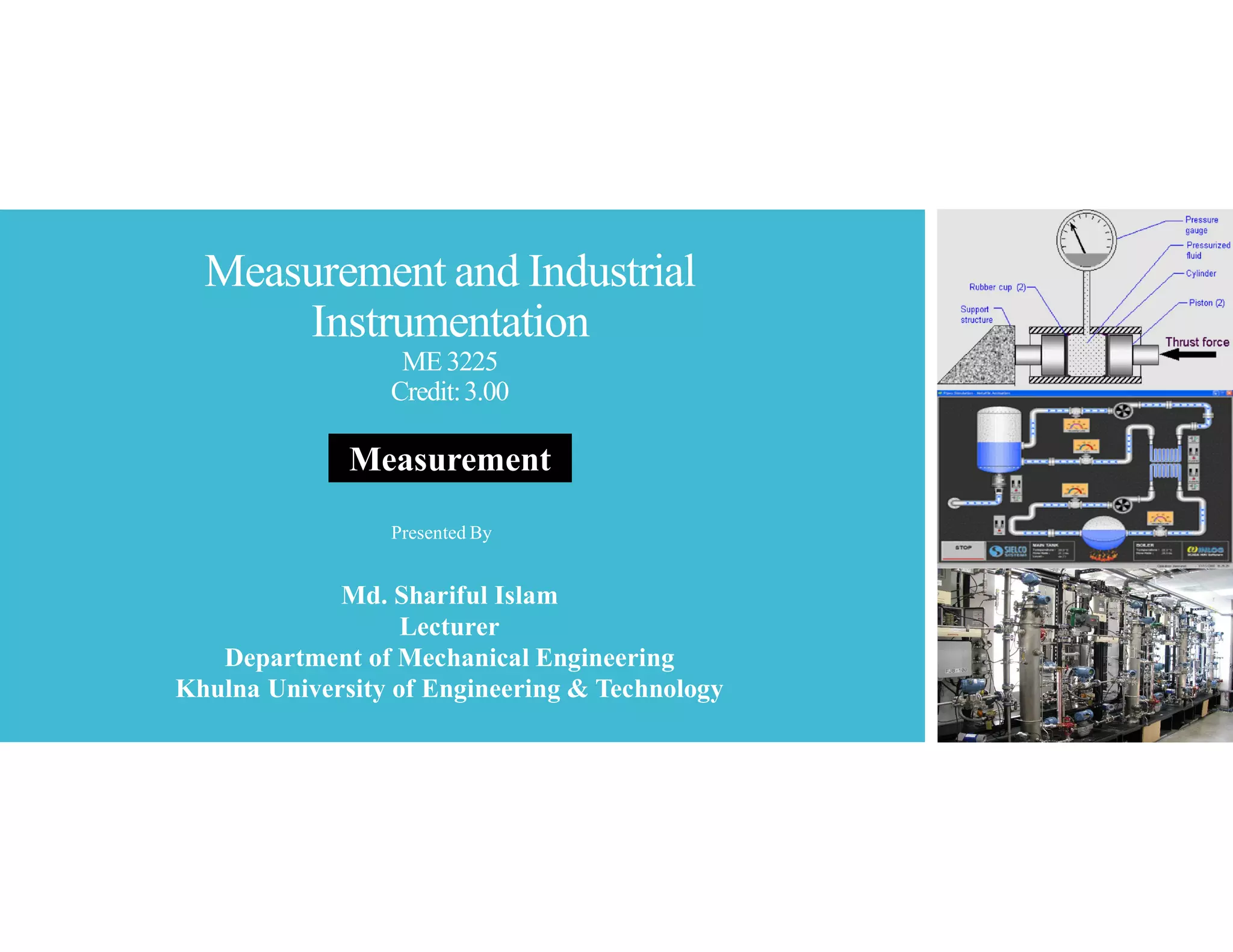
Measurement and Industrial
Instrumentation
ME3225
Credit:3.00
Md. Shariful Islam
Lecturer
Department of Mechanical Engineering
Khulna University of Engineering & Technology
Presented By
Measurement
Measurement
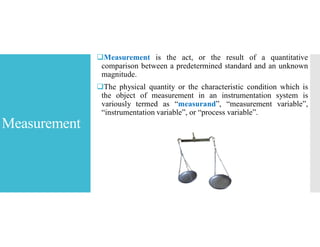
Measurement is the act, or the result of a quantitative
comparison between a predetermined standard and an unknown
magnitude.
The physical quantity or the characteristic condition which is
the object of measurement in an instrumentation system is
variously termed as “measurand”, “measurement variable”,
“instrumentation variable”, or “process variable”.
Basic
Requirements For
A Meaningful
Measurement
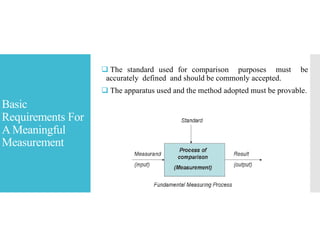
 The standard used for comparison purposes must be
accurately defined and should be commonly accepted.
 The apparatus used and the method adopted must be provable.
Instrument &
Instrumentation
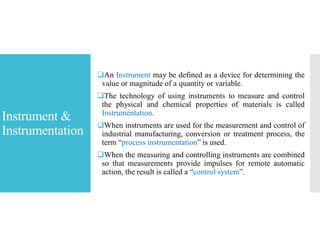
An Instrument may be defined as a device for determining the
value or magnitude of a quantity or variable.
The technology of using instruments to measure and control
the physical and chemical properties of materials is called
Instrumentation.
When instruments are used for the measurement and control of
industrial manufacturing, conversion or treatment process, the
term “process instrumentation” is used.
When the measuring and controlling instruments are combined
so that measurements provide impulses for remote automatic
action, the result is called a “control system”.
Why
Measurements?
Measurements play a very significant role in every branch of
scientific research and engineering process which include the
following:
Control system
Process instrumentation
To acquire data or information
In the case of process industries and industrial manufacturing
To improve the quality of the product
To improve the efficiency of production
To maintain the proper operation
Importance of Measurement is simply and eloquently
expressed in the following statement of famous physicist Lord
Kelvin: ”I often say that when you can measure what you are
speaking about and can express it in numbers, you know
something about it; when you cannot express in it numbers your
knowledge is of meager and unsatisfactory kind”
Methods of
Measurement
Direct Methods: In these methods, the unknown quantity
(called the measurand ) is directly compared against a standard.
Indirect Methods: Measurements by direct methods are not
always possible, feasible and practicable. In engineering
applications measurement systems are used which require need
of indirect method for measurement purposes.
Absolute/Fundamental method
Comparative method
Transposition method
Coincidence method
Deflection method
Complementary method
Contact method
Contactless method etc.
Types of
Instruments
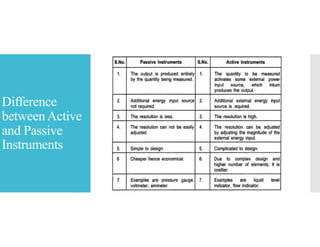
Instruments are divided as active or passive instrument.
In Passive Instruments the instrument output is entirely
produced by the quantity being measured.
In Active Instruments the quantity being measured simply
modulates the magnitude of some external power source.
”Active” means is that some component inside requires power,
either a battery or an external voltage source for working.
“Passive” just means that no components inside need to be
powered.
Understanding
Active and
Passive
Instruments
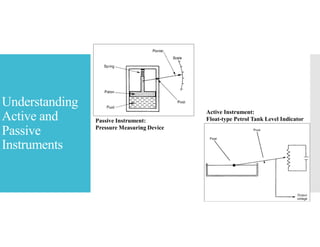
Passive Instrument:
Pressure Measuring Device
Active Instrument:
Float-type Petrol Tank Level Indicator
Understanding
Active and Passive
Instruments
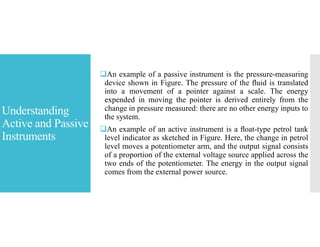
An example of a passive instrument is the pressure-measuring
device shown in Figure. The pressure of the fluid is translated
into a movement of a pointer against a scale. The energy
expended in moving the pointer is derived entirely from the
change in pressure measured: there are no other energy inputs to
the system.
An example of an active instrument is a float-type petrol tank
level indicator as sketched in Figure. Here, the change in petrol
level moves a potentiometer arm, and the output signal consists
of a proportion of the external voltage source applied across the
two ends of the potentiometer. The energy in the output signal
comes from the external power source.
Difference
between Active
and Passive
Instruments
Standard
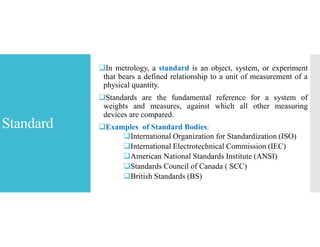
In metrology, a standard is an object, system, or experiment
that bears a defined relationship to a unit of measurement of a
physical quantity.
Standards are the fundamental reference for a system of
weights and measures, against which all other measuring
devices are compared.
Examples of Standard Bodies:
International Organization for Standardization (ISO)
International Electrotechnical Commission (IEC)
American National Standards Institute (ANSI)
Standards Council of Canada ( SCC)
British Standards (BS)
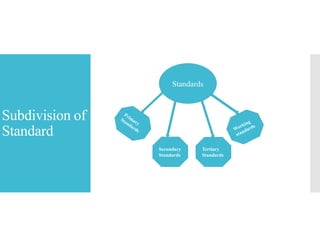
Subdivision of
Standard
Standards
Secondary
Standards
Tertiary
Standards
Primary
Standard
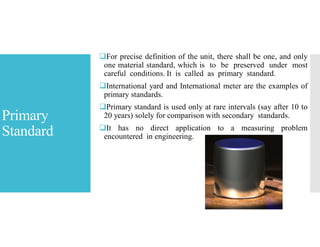
For precise definition of the unit, there shall be one, and only
one material standard, which is to be preserved under most
careful conditions. It is called as primary standard.
International yard and International meter are the examples of
primary standards.
Primary standard is used only at rare intervals (say after 10 to
20 years) solely for comparison with secondary standards.
It has no direct application to a measuring problem
encountered in engineering.
Secondary
Standards
Secondary standards are made as nearly as possible exactly
similar to primary standards as regards design, material and
length.
They are compared with primary standards after long
intervals and the records of deviation are noted.
These standards are kept at number of places for safe
custody.
They are used for occasional comparison with tertiary
standards whenever required.
Tertiary
Standards
The primary and secondary standards are applicable only as
ultimate control.
Tertiary standards are the first standard to be used for
reference purposes in laboratories and workshops.
They are made as true copy of the secondary standards.
They are used for comparison at intervals with working
standards.
Working
Standards
Working standards are used more frequently in
laboratories and workshops.
They are usually made of low grade of material as
compared to primary, secondary and tertiary standards, for
the sake of economy.
They are derived from fundamental standards.
Errors in
Measurement
Measurement Error is the difference between
a measured value of a quantity and its true value.
In statistics, an error is not a "mistake". Variability is an
inherent part of the results of measurements and of the
measurement process.
It is not possible to completely eliminate error in a
measurement.
Measurement errors can be divided into two
components:
Systematic Error and
Random Error
Systematic
Error
Systematic error is predictable and typically constant or
proportional to the true value.
If the cause of the systematic error can be identified, then it
usually can be eliminated.
Systematic errors are caused by imperfect calibration of
measurement instruments or imperfect methods of observation
Incorrect zeroing of an instrument leading to a zero error is an
example of systematic error in instrumentation.
Random Error
Random error is always present in a measurement.
It is caused by inherently unpredictable fluctuations in the
readings of a measurement apparatus or in the experimenter's
interpretation of the instrumental reading.
Random errors show up as different results for ostensibly the
same repeated measurement.
They can be estimated by comparing multiple measurements,
and reduced by averaging multiple measurements.
Effect of
Alignment:
Abbe’s
Alignment
Principle
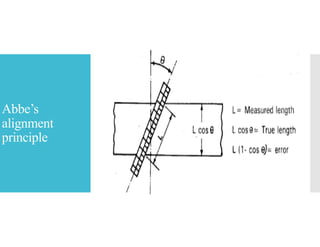
It states that "the axis or line of measurement should
coincide with the axis of measuring instrument or line of the
measuring scale.“
If while measuring the length of a work piece the measuring
scale is inclined to the true line of the dimension being
measured there will be an error in the measurement. The length
recorded will be more than the true length. This error is called
"Cosine error". In many cases the angle θ is very small and the
error will be negligible.
Abbe’s
alignment
principle
Problem
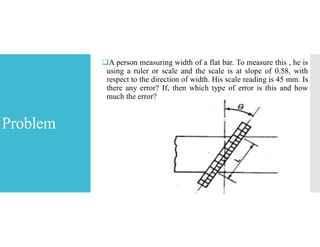
A person measuring width of a flat bar. To measure this , he is
using a ruler or scale and the scale is at slope of 0.58, with
respect to the direction of width. His scale reading is 45 mm. Is
there any error? If, then which type of error is this and how
much the error?
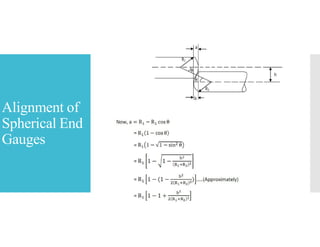
Alignment of
Spherical End
Gauges
Alignment of
Spherical End
Gauges
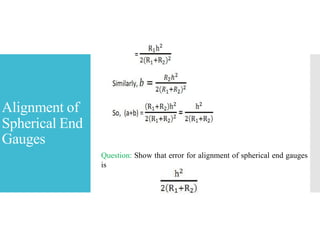
Question: Show that error for alignment of spherical end gauges
is
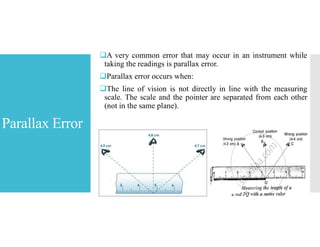
Parallax Error
A very common error that may occur in an instrument while
taking the readings is parallax error.
Parallax error occurs when:
The line of vision is not directly in line with the measuring
scale. The scale and the pointer are separated from each other
(not in the same plane).
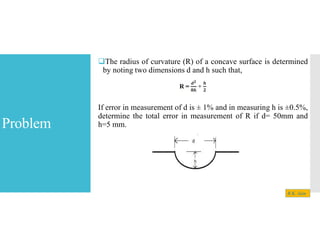
Problem
The radius of curvature (R) of a concave surface is determined
by noting two dimensions d and h such that,
If error in measurement of d is ± 1% and in measuring h is ±0.5%,
determine the total error in measurement of R if d= 50mm and
h=5 mm.
R.K. Jain
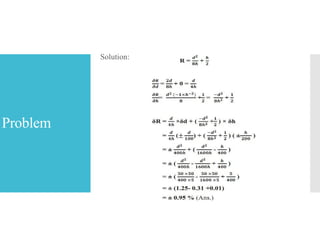
Problem
Solution:
Other Errors
Effect of temperature
Effect of support
Contact Pressure
Error due to presence of Dust
Error due to vibration
Error due to poor contact
Error due to wear in gauge
See: Book: Practical Engineering Metrology by K W B Sharp
Engineering Metrology by R. K. Jain
& Internet
Thank You
9/26/2019 Md. Shariful Islam, Lecturer, Department of Mechanical Engineering, KUET 29
To get updated lecture notes, browse:
http://www.kuet.ac.bd/me/sharifulmekuet/index.php?pg=student_corner

15694598371.Measurment.pdf

  • 1.
    Measurement and Industrial Instrumentation ME3225 Credit:3.00 Md.Shariful Islam Lecturer Department of Mechanical Engineering Khulna University of Engineering & Technology Presented By Measurement
  • 2.
    Measurement Measurement is theact, or the result of a quantitative comparison between a predetermined standard and an unknown magnitude. The physical quantity or the characteristic condition which is the object of measurement in an instrumentation system is variously termed as “measurand”, “measurement variable”, “instrumentation variable”, or “process variable”.
  • 3.
    Basic Requirements For A Meaningful Measurement The standard used for comparison purposes must be accurately defined and should be commonly accepted.  The apparatus used and the method adopted must be provable.
  • 4.
    Instrument & Instrumentation An Instrumentmay be defined as a device for determining the value or magnitude of a quantity or variable. The technology of using instruments to measure and control the physical and chemical properties of materials is called Instrumentation. When instruments are used for the measurement and control of industrial manufacturing, conversion or treatment process, the term “process instrumentation” is used. When the measuring and controlling instruments are combined so that measurements provide impulses for remote automatic action, the result is called a “control system”.
  • 5.
    Why Measurements? Measurements play avery significant role in every branch of scientific research and engineering process which include the following: Control system Process instrumentation To acquire data or information In the case of process industries and industrial manufacturing To improve the quality of the product To improve the efficiency of production To maintain the proper operation Importance of Measurement is simply and eloquently expressed in the following statement of famous physicist Lord Kelvin: ”I often say that when you can measure what you are speaking about and can express it in numbers, you know something about it; when you cannot express in it numbers your knowledge is of meager and unsatisfactory kind”
  • 6.
    Methods of Measurement Direct Methods:In these methods, the unknown quantity (called the measurand ) is directly compared against a standard. Indirect Methods: Measurements by direct methods are not always possible, feasible and practicable. In engineering applications measurement systems are used which require need of indirect method for measurement purposes. Absolute/Fundamental method Comparative method Transposition method Coincidence method Deflection method Complementary method Contact method Contactless method etc.
  • 7.
    Types of Instruments Instruments aredivided as active or passive instrument. In Passive Instruments the instrument output is entirely produced by the quantity being measured. In Active Instruments the quantity being measured simply modulates the magnitude of some external power source. ”Active” means is that some component inside requires power, either a battery or an external voltage source for working. “Passive” just means that no components inside need to be powered.
  • 8.
    Understanding Active and Passive Instruments Passive Instrument: PressureMeasuring Device Active Instrument: Float-type Petrol Tank Level Indicator
  • 9.
    Understanding Active and Passive Instruments Anexample of a passive instrument is the pressure-measuring device shown in Figure. The pressure of the fluid is translated into a movement of a pointer against a scale. The energy expended in moving the pointer is derived entirely from the change in pressure measured: there are no other energy inputs to the system. An example of an active instrument is a float-type petrol tank level indicator as sketched in Figure. Here, the change in petrol level moves a potentiometer arm, and the output signal consists of a proportion of the external voltage source applied across the two ends of the potentiometer. The energy in the output signal comes from the external power source.
  • 10.
  • 11.
    Standard In metrology, astandard is an object, system, or experiment that bears a defined relationship to a unit of measurement of a physical quantity. Standards are the fundamental reference for a system of weights and measures, against which all other measuring devices are compared. Examples of Standard Bodies: International Organization for Standardization (ISO) International Electrotechnical Commission (IEC) American National Standards Institute (ANSI) Standards Council of Canada ( SCC) British Standards (BS)
  • 12.
  • 13.
    Primary Standard For precise definitionof the unit, there shall be one, and only one material standard, which is to be preserved under most careful conditions. It is called as primary standard. International yard and International meter are the examples of primary standards. Primary standard is used only at rare intervals (say after 10 to 20 years) solely for comparison with secondary standards. It has no direct application to a measuring problem encountered in engineering.
  • 14.
    Secondary Standards Secondary standards aremade as nearly as possible exactly similar to primary standards as regards design, material and length. They are compared with primary standards after long intervals and the records of deviation are noted. These standards are kept at number of places for safe custody. They are used for occasional comparison with tertiary standards whenever required.
  • 15.
    Tertiary Standards The primary andsecondary standards are applicable only as ultimate control. Tertiary standards are the first standard to be used for reference purposes in laboratories and workshops. They are made as true copy of the secondary standards. They are used for comparison at intervals with working standards.
  • 16.
    Working Standards Working standards areused more frequently in laboratories and workshops. They are usually made of low grade of material as compared to primary, secondary and tertiary standards, for the sake of economy. They are derived from fundamental standards.
  • 17.
    Errors in Measurement Measurement Erroris the difference between a measured value of a quantity and its true value. In statistics, an error is not a "mistake". Variability is an inherent part of the results of measurements and of the measurement process. It is not possible to completely eliminate error in a measurement. Measurement errors can be divided into two components: Systematic Error and Random Error
  • 18.
    Systematic Error Systematic error ispredictable and typically constant or proportional to the true value. If the cause of the systematic error can be identified, then it usually can be eliminated. Systematic errors are caused by imperfect calibration of measurement instruments or imperfect methods of observation Incorrect zeroing of an instrument leading to a zero error is an example of systematic error in instrumentation.
  • 19.
    Random Error Random erroris always present in a measurement. It is caused by inherently unpredictable fluctuations in the readings of a measurement apparatus or in the experimenter's interpretation of the instrumental reading. Random errors show up as different results for ostensibly the same repeated measurement. They can be estimated by comparing multiple measurements, and reduced by averaging multiple measurements.
  • 20.
    Effect of Alignment: Abbe’s Alignment Principle It statesthat "the axis or line of measurement should coincide with the axis of measuring instrument or line of the measuring scale.“ If while measuring the length of a work piece the measuring scale is inclined to the true line of the dimension being measured there will be an error in the measurement. The length recorded will be more than the true length. This error is called "Cosine error". In many cases the angle θ is very small and the error will be negligible.
  • 21.
  • 22.
    Problem A person measuringwidth of a flat bar. To measure this , he is using a ruler or scale and the scale is at slope of 0.58, with respect to the direction of width. His scale reading is 45 mm. Is there any error? If, then which type of error is this and how much the error?
  • 23.
  • 24.
    Alignment of Spherical End Gauges Question:Show that error for alignment of spherical end gauges is
  • 25.
    Parallax Error A verycommon error that may occur in an instrument while taking the readings is parallax error. Parallax error occurs when: The line of vision is not directly in line with the measuring scale. The scale and the pointer are separated from each other (not in the same plane).
  • 26.
    Problem The radius ofcurvature (R) of a concave surface is determined by noting two dimensions d and h such that, If error in measurement of d is ± 1% and in measuring h is ±0.5%, determine the total error in measurement of R if d= 50mm and h=5 mm. R.K. Jain
  • 27.
  • 28.
    Other Errors Effect oftemperature Effect of support Contact Pressure Error due to presence of Dust Error due to vibration Error due to poor contact Error due to wear in gauge See: Book: Practical Engineering Metrology by K W B Sharp Engineering Metrology by R. K. Jain & Internet
  • 29.
    Thank You 9/26/2019 Md.Shariful Islam, Lecturer, Department of Mechanical Engineering, KUET 29 To get updated lecture notes, browse: http://www.kuet.ac.bd/me/sharifulmekuet/index.php?pg=student_corner