1. What is Manufacturing?
2. Materials in Manufacturing
3. Manufacturing Processes
4. Production Systems
5. Manufacturing Economics
6. Recent Developments in Manufacturing
©2012 John Wiley & Sons, Inc. M P Groover, Fundamentals of Modern Manufacturing 5/e
INTRODUCTION AND
OVERVIEW OF MANUFACTURING
Manufacturing is Important
▪ Making things has been an essential human activity
since before recorded history
▪ Today, the term manufacturing is used for this
activity
▪ Manufacturing is important to the United States and
most other developed and developing nations
▪ Technologically
▪ Economically
©2012 John Wiley & Sons, Inc. M P Groover, Fundamentals of Modern Manufacturing 5/e
Technological Importance
▪ Technology - the application of science to provide
society and its members with those things that are
needed or desired
▪ Technology affects our daily lives, directly and
indirectly, in many ways
▪ Technology provides the products that help our
society and its members live better
©2012 John Wiley & Sons, Inc. M P Groover, Fundamentals of Modern Manufacturing 5/e
Technological Importance
▪ What do these products have in common?
▪ They are all manufactured
▪ They would not be available to our society if they
could not be manufactured
▪ Manufacturing is the essential factor that makes
technology possible
©2012 John Wiley & Sons, Inc. M P Groover, Fundamentals of Modern Manufacturing 5/e
Economic Importance
U.S. Economy
Sector: %GDP
Agriculture and natural resources 5
Construction and public utilities 5
Manufacturing 12
Service industries* 78
100
* includes retail, transportation, banking,
communication, education, and government
©2012 John Wiley & Sons, Inc. M P Groover, Fundamentals of Modern Manufacturing 5/e
What is Manufacturing?
▪ The word manufacture is derived from two Latin
words manus (hand) and factus (make); the
combination means “made by hand”
▪ “Made by hand” described the fabrication methods
that were used when the English word
“manufacture” was first coined around 1567 A.D.
▪ Most modern manufacturing operations are
accomplished by mechanized and automated
equipment that is supervised by human workers
©2012 John Wiley & Sons, Inc. M P Groover, Fundamentals of Modern Manufacturing 5/e
Manufacturing - Technological
▪ Application of physical and chemical processes to
alter the geometry, properties, and/or appearance of
a starting material to make parts or products
©2012 John Wiley & Sons, Inc. M P Groover, Fundamentals of Modern Manufacturing 5/e
Manufacturing - Economic
▪ Transformation of materials into items of greater value
by one or more processing and/or assembly operations
©2012 John Wiley & Sons, Inc. M P Groover, Fundamentals of Modern Manufacturing 5/e
Manufacturing Example:
Artificial Heart Valve
©2012 John Wiley & Sons, Inc. M P Groover, Fundamentals of Modern Manufacturing 5/e
Left: Heart valve Right: Starting titanium billet
©2012 John Wiley & Sons, Inc. M P Groover, Fundamentals of Modern Manufacturing 5/e
Manufacturing Industries
▪ Industry consists of enterprises and organizations that
produce or supply goods and services
▪ Industries can be classified as:
1. Primary industries - cultivate and exploit natural
resources, e.g., agriculture, mining
2. Secondary industries - take the outputs of primary
industries and convert them into consumer and
capital goods
3. Tertiary industries - service sector
Specific Industries in Each
Category
©2012 John Wiley & Sons, Inc. M P Groover, Fundamentals of Modern Manufacturing 5/e
Manufacturing Industries -
continued
▪ Secondary industries include manufacturing,
construction, and electric power generation
▪ Manufacturing includes several industries whose
products are not covered in this book; e.g., apparel,
beverages, chemicals, and food processing
▪ For our purposes, manufacturing means production of
hardware
▪ Nuts and bolts, forgings, cars, airplanes, digital
computers, plastic parts, and ceramic products
©2012 John Wiley & Sons, Inc. M P Groover, Fundamentals of Modern Manufacturing 5/e
Manufactured Products
▪ Final products divide into two major classes:
1. Consumer goods - products purchased directly by
consumers
▪ Cars, clothes, TVs, tennis rackets
2. Capital goods - those purchased by companies to
produce goods and/or provide services
▪ Aircraft, computers, communication
equipment, medical apparatus, trucks,
machine tools, construction equipment
©2012 John Wiley & Sons, Inc. M P Groover, Fundamentals of Modern Manufacturing 5/e
Production Quantity Q
▪ The quantity of products Q made by a factory has an
important influence on the way its people, facilities, and
procedures are organized
▪ Annual quantities can be classified into three ranges:
Production range Annual Quantity Q
Low production 1 to 100 units
Medium production 100 to 10,000 units
High production 10,000 to millions of units
©2012 John Wiley & Sons, Inc. M P Groover, Fundamentals of Modern Manufacturing 5/e
Product Variety P
▪ Product variety P refers to different product types or
models produced in the plant
▪ Different products have different features
▪ They are intended for different markets
▪ Some have more parts than others
▪ The number of different product types made each
year in a factory can be counted
▪ When the number of product types made in the
factory is high, this indicates high product variety
©2012 John Wiley & Sons, Inc. M P Groover, Fundamentals of Modern Manufacturing 5/e
P vs Q in Factory Operations
©2012 John Wiley & Sons, Inc. M P Groover, Fundamentals of Modern Manufacturing 5/e
More About Product Variety
▪ Although P is quantitative, it is much less exact than Q
because details on how much the designs differ is not
captured simply by the number of different designs
▪ Soft product variety - small differences between
products, e.g., between car models made on the same
production line, with many common parts
▪ Hard product variety - products differ substantially, e.g.,
between a small car and a large truck, with few
common parts (if any)
©2012 John Wiley & Sons, Inc. M P Groover, Fundamentals of Modern Manufacturing 5/e
Manufacturing Capability
▪ A manufacturing plant consists of processes and
systems (and people) to transform a certain limited
range of materials into products of increased value
▪ The three building blocks - materials, processes, and
systems - are the subject of modern manufacturing
▪ Manufacturing capability includes:
1. Technological processing capability
2. Physical product limitations
3. Production capacity
©2012 John Wiley & Sons, Inc. M P Groover, Fundamentals of Modern Manufacturing 5/e
1. Technological Processing
Capability
▪ The set of available manufacturing processes in the
plant (or company)
▪ Certain manufacturing processes are suited to certain
materials, so by specializing in certain processes, the
plant is also specializing in certain materials
▪ Includes not only the physical processes, but also the
expertise of the plant personnel
▪ A machine shop cannot roll steel
▪ A steel mill cannot build cars
©2012 John Wiley & Sons, Inc. M P Groover, Fundamentals of Modern Manufacturing 5/e
2. Physical Product Limitations
▪ Given a plant with a certain set of processes, there are
size and weight limitations on the parts or products that
can be made in the plant
▪ Product size and weight affect:
▪ Production equipment
▪ Material handling equipment
▪ Production, material handling equipment, and plant
size must be planned for products that lie within a
certain size and weight range
©2012 John Wiley & Sons, Inc. M P Groover, Fundamentals of Modern Manufacturing 5/e
3. Production Capacity
▪ Defined as the maximum quantity that a plant can
produce in a given time period (e.g., month or year)
under assumed operating conditions
▪ Operating conditions refer to number of shifts
per week, hours per shift, direct labor manning
levels in the plant, and so on
▪ Usually measured in terms of output units, e.g.,
tons of steel or number of cars produced
▪ Also called plant capacity
©2012 John Wiley & Sons, Inc. M P Groover, Fundamentals of Modern Manufacturing 5/e
Materials in Manufacturing
©2012 John Wiley & Sons, Inc. M P Groover, Fundamentals of Modern Manufacturing 5/e
▪ Most engineering materials can be classified into one of
three basic categories:
1. Metals
2. Ceramics
3. Polymers
▪ Their chemistries are different, and their mechanical and
physical properties are different
▪ In addition, there is a fourth category:
4. Composites
©2012 John Wiley & Sons, Inc. M P Groover, Fundamentals of Modern Manufacturing 5/e
Classification of
engineering
materials
1. Metals
▪ Usually alloys, which are composed of two or more
elements, at least one of which is metallic. Two basic
groups:
1. Ferrous metals - based on iron, comprises about
75% of metal tonnage in the world:
▪ Steel and cast iron
2. Nonferrous metals - all other metallic elements
and their alloys:
▪ Aluminum, copper, nickel, silver, tin, etc.
©2012 John Wiley & Sons, Inc. M P Groover, Fundamentals of Modern Manufacturing 5/e
2. Ceramics
▪ Compounds containing metallic (or semi-metallic) and
nonmetallic elements.
▪ Typical nonmetallic elements are oxygen, nitrogen,
and carbon
▪ For processing, ceramics divide into:
1. Crystalline ceramics – includes traditional
ceramics, such as clay, and modern ceramics,
such as alumina (Al2O3)
2. Glasses – mostly based on silica (SiO2)
©2012 John Wiley & Sons, Inc. M P Groover, Fundamentals of Modern Manufacturing 5/e
3. Polymers
▪ Compound formed of repeating structural units called
mers, whose atoms share electrons to form very large
molecules. Three categories:
1. Thermoplastic polymers - can be subjected to
multiple heating and cooling cycles without
altering molecular structure
2. Thermosetting polymers - molecules chemically
transform into a rigid structure – cannot reheat
3. Elastomers - shows significant elastic behavior
©2012 John Wiley & Sons, Inc. M P Groover, Fundamentals of Modern Manufacturing 5/e
4. Composites
▪ Material consisting of two or more phases that are
processed separately and then bonded together to
achieve properties superior to its constituents
▪ Phase - homogeneous material, such as grains of
identical unit cell structure in a solid metal
▪ Usual structure consists of particles or fibers of
one phase mixed in a second phase
▪ Properties depend on components, physical
shapes of components, and the way they are
combined to form the final material
©2012 John Wiley & Sons, Inc. M P Groover, Fundamentals of Modern Manufacturing 5/e
Manufacturing Processes:
Two Basic Types
1. Processing operations - transform a work material
from one state of completion to a more advanced
state
▪ Operations that change the geometry, properties,
or appearance of the starting material
2. Assembly operations - join two or more components to
create a new entity
©2012 John Wiley & Sons, Inc. M P Groover, Fundamentals of Modern Manufacturing 5/e
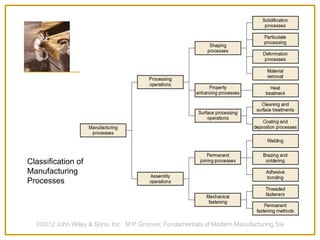
Classification of
Manufacturing
Processes
Processing Operations
▪ Alters a material’s shape, physical properties, or
appearance in order to add value
▪ Three categories of processing operations:
1. Shaping operations - alter the geometry of the
starting work material
2. Property-enhancing operations - improve
physical properties without changing shape
3. Surface processing operations - clean, treat,
coat, or deposit material on surface of work
©2012 John Wiley & Sons, Inc. M P Groover, Fundamentals of Modern Manufacturing 5/e
Four Categories of
Shaping Processes
1. Solidification processes - starting material is a heated
liquid or semifluid
2. Particulate processing - starting material consists of
powders
3. Deformation processes - starting material is a ductile
solid (commonly metal)
4. Material removal processes - starting material is a
ductile or brittle solid
©2012 John Wiley & Sons, Inc. M P Groover, Fundamentals of Modern Manufacturing 5/e
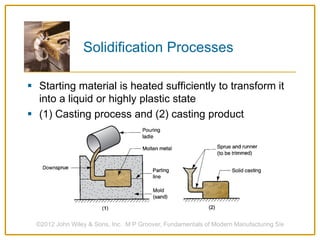
Solidification Processes
▪ Starting material is heated sufficiently to transform it
into a liquid or highly plastic state
▪ (1) Casting process and (2) casting product
©2012 John Wiley & Sons, Inc. M P Groover, Fundamentals of Modern Manufacturing 5/e
Particulate Processing
▪ (1) Starting materials are metal or ceramic powders,
which are (2) pressed and (3) sintered
©2012 John Wiley & Sons, Inc. M P Groover, Fundamentals of Modern Manufacturing 5/e
Deformation Processes
▪ Starting workpart is shaped by application of forces
that exceed the yield strength of the material
▪ Examples: (a) forging and (b) extrusion
©2012 John Wiley & Sons, Inc. M P Groover, Fundamentals of Modern Manufacturing 5/e
Material Removal Processes
▪ Excess material removed from the starting piece so what
remains is the desired geometry
▪ Examples: (a) turning, (b) drilling, and (c) milling
©2012 John Wiley & Sons, Inc. M P Groover, Fundamentals of Modern Manufacturing 5/e
Waste in Shaping Processes
▪ It is desirable to minimize waste in part shaping
▪ Material removal processes are wasteful in the unit
operations, but molding and particulate processing
operations waste little material
▪ Terminology for minimum waste processes:
▪ Net shape processes - little or no waste of the
starting material and no machining is required
▪ Near net shape processes - when minimum
machining is required
©2012 John Wiley & Sons, Inc. M P Groover, Fundamentals of Modern Manufacturing 5/e
Property-Enhancing Processes
▪ Processes that improve mechanical or physical
properties of work material
▪ Examples:
▪ Heat treatment of metals and glasses
▪ Sintering of powdered metals and ceramics
▪ Part shape is not altered, except unintentionally
▪ Example: unintentional warping of a heat treated
part
©2012 John Wiley & Sons, Inc. M P Groover, Fundamentals of Modern Manufacturing 5/e
Surface Processing Operations
▪ Cleaning - chemical and mechanical processes to
remove dirt, oil, and other surface contaminants
▪ Surface treatments - mechanical working such as
sand blasting, and physical processes like diffusion
▪ Coating and thin film deposition - coating exterior
surface of the workpart
▪ Examples:
▪ Electroplating
▪ Painting
©2012 John Wiley & Sons, Inc. M P Groover, Fundamentals of Modern Manufacturing 5/e
Assembly Operations
▪ Two or more separate parts are joined to form a new
entity
▪ Types of assembly operations:
1. Joining processes – create a permanent joint
▪ Welding, brazing, soldering, adhesive bonding
2. Mechanical assembly – fastening by mechanical
methods
▪ Threaded fasteners (screws, bolts and nuts);
press fitting, expansion fits
©2012 John Wiley & Sons, Inc. M P Groover, Fundamentals of Modern Manufacturing 5/e
Production Machines and
Tooling
▪ Manufacturing operations are accomplished using
machinery and tooling (and people)
▪ Types of production machines:
▪ Machine tools - power-driven machines used to
operate cutting tools previously operated manually
▪ Other production equipment:
▪ Presses
▪ Forge hammers,
▪ Plastic injection molding machines
©2012 John Wiley & Sons, Inc. M P Groover, Fundamentals of Modern Manufacturing 5/e
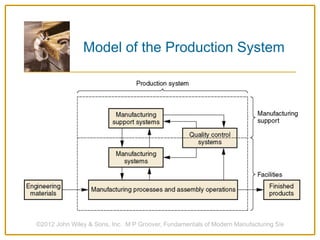
Production Systems
▪ People, equipment, and procedures used for the
materials and processes that constitute a firm's
manufacturing operations
▪ A manufacturing firm must have systems and
procedures to efficiently accomplish its production
▪ Two categories of production systems:
▪ Production facilities
▪ Manufacturing support systems
▪ People make the systems work
©2012 John Wiley & Sons, Inc. M P Groover, Fundamentals of Modern Manufacturing 5/e
Model of the Production System
©2012 John Wiley & Sons, Inc. M P Groover, Fundamentals of Modern Manufacturing 5/e
Production Facilities
▪ The factory, production equipment, and material
handling systems
▪ Includes the plant layout
▪ Equipment usually organized into logical groupings,
called manufacturing systems
▪ Examples:
▪ Automated production line
▪ Machine cell consisting of three machine tools
▪ Production facilities "touch" the product
©2012 John Wiley & Sons, Inc. M P Groover, Fundamentals of Modern Manufacturing 5/e
Facilities vs Product Quantities
▪ A company designs its manufacturing systems and
organizes its factories to serve the particular mission
of each plant
▪ Certain types of production facilities are recognized as
most appropriate for a given type of manufacturing:
1. Low production – 1 to 100
2. Medium production – 100 to 10,000
3. High production – 10,000 to >1,000,000
©2012 John Wiley & Sons, Inc. M P Groover, Fundamentals of Modern Manufacturing 5/e
Low Production
▪ Job shop is the term used for this type of production
facility
▪ A job shop makes low quantities of specialized and
customized products
▪ Products are typically complex, e.g., space
capsules, prototype aircraft, special machinery
▪ Equipment in a job shop is general purpose
▪ Labor force is highly skilled
▪ Designed for maximum flexibility
©2012 John Wiley & Sons, Inc. M P Groover, Fundamentals of Modern Manufacturing 5/e
Fixed-Position Plant Layout
©2012 John Wiley & Sons, Inc. M P Groover, Fundamentals of Modern Manufacturing 5/e
Medium Production
▪ Two different types of facility, depending on product
variety:
▪ Batch production
▪ Suited to medium and hard product variety
▪ Setups required between batches
▪ Cellular manufacturing
▪ Suited to soft product variety
▪ Worker cells organized to process parts without
setups between different part styles
©2012 John Wiley & Sons, Inc. M P Groover, Fundamentals of Modern Manufacturing 5/e
Process Plant Layout
©2012 John Wiley & Sons, Inc. M P Groover, Fundamentals of Modern Manufacturing 5/e
Cellular Plant Layout
©2012 John Wiley & Sons, Inc. M P Groover, Fundamentals of Modern Manufacturing 5/e
High Production
▪ Often referred to as mass production
▪ High demand for product
▪ Manufacturing system dedicated to the
production of that product
▪ Two categories of mass production:
1. Quantity production
2. Flow line production
©2012 John Wiley & Sons, Inc. M P Groover, Fundamentals of Modern Manufacturing 5/e
Quantity Production
▪ Mass production of single parts on single machine or
small numbers of machines
▪ Typically involves standard machines equipped
with special tooling
▪ Equipment is dedicated full-time to the production
of one part or product type
▪ Typical layouts used in quantity production are
process layout and cellular layout
©2012 John Wiley & Sons, Inc. M P Groover, Fundamentals of Modern Manufacturing 5/e
Flow Line Production
▪ Multiple machines or workstations arranged in
sequence, as in a production line
▪ Product is complex - requires multiple processing
and/or assembly operations
▪ Work units are physically moved through the
sequence to complete the product
▪ Workstations and equipment are designed
specifically for the product to maximize efficiency
©2012 John Wiley & Sons, Inc. M P Groover, Fundamentals of Modern Manufacturing 5/e
Product Plant Layout
©2012 John Wiley & Sons, Inc. M P Groover, Fundamentals of Modern Manufacturing 5/e
Manufacturing Support Systems
▪ A company must organize itself to design the
processes and equipment, plan and control
production, and satisfy product quality requirements
▪ Accomplished by manufacturing support systems
▪ The people and procedures by which a
company manages its production operations
▪ Typical departments:
▪ Manufacturing engineering, Production
planning and control, Quality control
©2012 John Wiley & Sons, Inc. M P Groover, Fundamentals of Modern Manufacturing 5/e
Typical Cost Breakdown for a
Manufactured Product
©2012 John Wiley & Sons, Inc. M P Groover, Fundamentals of Modern Manufacturing 5/e
Recent Developments
in Manufacturing
▪ Microelectronics
▪ Computerization in manufacturing
▪ Flexible manufacturing
▪ Microfabrication and Nanotechnology
▪ Lean production and Six Sigma
▪ Globalization and outsourcing
▪ Environmentally conscious manufacturing
©2012 John Wiley & Sons, Inc. M P Groover, Fundamentals of Modern Manufacturing 5/e
Microelectronics
▪ Electronic devices that are fabricated on a
microscopic scale: Integrated circuits (ICs)
▪ Today’s fabrication technologies permit billions of
components to be included in a single IC
▪ A large proportion of the products manufactured
today are based on microelectronics technology
▪ About 2/3 of the products in Table 1.1 are either
electronics products or their function and
operation depend on electronics
©2012 John Wiley & Sons, Inc. M P Groover, Fundamentals of Modern Manufacturing 5/e
Computerization of
Manufacturing
▪ Direct Numerical Control (DNC) was one of the first
applications of computers in manufacturing (1960s)
▪ Mainframe computer remotely controlling multiple
machine tools
▪ Enabled by advances in microelectronics, the cost of
computers and data processing has been reduced,
leading to the widespread use of personal computers
▪ To control individual production machines
▪ To manage the entire enterprise
©2012 John Wiley & Sons, Inc. M P Groover, Fundamentals of Modern Manufacturing 5/e
Flexible Manufacturing
▪ Although mass production is widely used throughout
the world, computerization has enabled the
development of manufacturing systems that can
cope with product variety
▪ Examples:
▪ Cellular manufacturing
▪ Mixed-model assembly lines
▪ Flexible manufacturing systems
©2012 John Wiley & Sons, Inc. M P Groover, Fundamentals of Modern Manufacturing 5/e
Microfabrication and
Nanotechnology
▪ Microfabrication
▪ Processes that make parts and products whose
feature sizes are in the micron range (10-6 m)
▪ Examples: Ink-jet printing heads, compact disks,
microsensors used in automobiles
▪ Nanotechnology
▪ Materials and products whose feature sizes are in
the nanometer range (10-9 m)
▪ Examples: Coatings for catalytic converters, flat
screen TV monitors
©2012 John Wiley & Sons, Inc. M P Groover, Fundamentals of Modern Manufacturing 5/e
Lean Production and Six Sigma
▪ Lean production
▪ Doing more work with fewer resources, yet
achieving higher quality in the final product
▪ Underlying objective: elimination of waste in
manufacturing
▪ Six Sigma
▪ Quality-focused program that utilizes worker
teams to accomplish projects aimed at improving
an organization’s organizational performance
©2012 John Wiley & Sons, Inc. M P Groover, Fundamentals of Modern Manufacturing 5/e
Globalization
▪ The recognition that we have an international economy
in which barriers once established by national
boundaries have been reduced
▪ This has enabled the freer flow of goods and
services, capital, technology, and people among
regions and countries
▪ Once underdeveloped countries such as China,
India, and Mexico have now developed their
manufacturing infrastructures and technologies to
become important producers in the global economy
©2012 John Wiley & Sons, Inc. M P Groover, Fundamentals of Modern Manufacturing 5/e
Outsourcing
▪ Use of outside contractors to perform work that was
traditionally accomplished in-house
▪ Local outsourcing
▪ Jobs remain in the U.S.
▪ Outsourcing to foreign countries
▪ Offshore outsourcing - production in China and
other overseas locations
▪ Near-shore outsourcing - production in Canada,
Mexico, and Central America
©2012 John Wiley & Sons, Inc. M P Groover, Fundamentals of Modern Manufacturing 5/e
Environmentally Conscious
Manufacturing
▪ Determining the most efficient use of materials and
natural resources in production, and minimizing the
negative consequences on the environment
▪ Associated terms: green manufacturing, cleaner
production, sustainable manufacturing
▪ Basic approaches:
1. Design products that minimize environmental
impact
2. Design processes that are environmentally
friendly
©2012 John Wiley & Sons, Inc. M P Groover, Fundamentals of Modern Manufacturing 5/e

ch01.pdf

  • 1.
    1. What isManufacturing? 2. Materials in Manufacturing 3. Manufacturing Processes 4. Production Systems 5. Manufacturing Economics 6. Recent Developments in Manufacturing ©2012 John Wiley & Sons, Inc. M P Groover, Fundamentals of Modern Manufacturing 5/e INTRODUCTION AND OVERVIEW OF MANUFACTURING
  • 2.
    Manufacturing is Important ▪Making things has been an essential human activity since before recorded history ▪ Today, the term manufacturing is used for this activity ▪ Manufacturing is important to the United States and most other developed and developing nations ▪ Technologically ▪ Economically ©2012 John Wiley & Sons, Inc. M P Groover, Fundamentals of Modern Manufacturing 5/e
  • 3.
    Technological Importance ▪ Technology- the application of science to provide society and its members with those things that are needed or desired ▪ Technology affects our daily lives, directly and indirectly, in many ways ▪ Technology provides the products that help our society and its members live better ©2012 John Wiley & Sons, Inc. M P Groover, Fundamentals of Modern Manufacturing 5/e
  • 4.
    Technological Importance ▪ Whatdo these products have in common? ▪ They are all manufactured ▪ They would not be available to our society if they could not be manufactured ▪ Manufacturing is the essential factor that makes technology possible ©2012 John Wiley & Sons, Inc. M P Groover, Fundamentals of Modern Manufacturing 5/e
  • 5.
    Economic Importance U.S. Economy Sector:%GDP Agriculture and natural resources 5 Construction and public utilities 5 Manufacturing 12 Service industries* 78 100 * includes retail, transportation, banking, communication, education, and government ©2012 John Wiley & Sons, Inc. M P Groover, Fundamentals of Modern Manufacturing 5/e
  • 6.
    What is Manufacturing? ▪The word manufacture is derived from two Latin words manus (hand) and factus (make); the combination means “made by hand” ▪ “Made by hand” described the fabrication methods that were used when the English word “manufacture” was first coined around 1567 A.D. ▪ Most modern manufacturing operations are accomplished by mechanized and automated equipment that is supervised by human workers ©2012 John Wiley & Sons, Inc. M P Groover, Fundamentals of Modern Manufacturing 5/e
  • 7.
    Manufacturing - Technological ▪Application of physical and chemical processes to alter the geometry, properties, and/or appearance of a starting material to make parts or products ©2012 John Wiley & Sons, Inc. M P Groover, Fundamentals of Modern Manufacturing 5/e
  • 8.
    Manufacturing - Economic ▪Transformation of materials into items of greater value by one or more processing and/or assembly operations ©2012 John Wiley & Sons, Inc. M P Groover, Fundamentals of Modern Manufacturing 5/e
  • 9.
    Manufacturing Example: Artificial HeartValve ©2012 John Wiley & Sons, Inc. M P Groover, Fundamentals of Modern Manufacturing 5/e Left: Heart valve Right: Starting titanium billet
  • 10.
    ©2012 John Wiley& Sons, Inc. M P Groover, Fundamentals of Modern Manufacturing 5/e Manufacturing Industries ▪ Industry consists of enterprises and organizations that produce or supply goods and services ▪ Industries can be classified as: 1. Primary industries - cultivate and exploit natural resources, e.g., agriculture, mining 2. Secondary industries - take the outputs of primary industries and convert them into consumer and capital goods 3. Tertiary industries - service sector
  • 11.
    Specific Industries inEach Category ©2012 John Wiley & Sons, Inc. M P Groover, Fundamentals of Modern Manufacturing 5/e
  • 12.
    Manufacturing Industries - continued ▪Secondary industries include manufacturing, construction, and electric power generation ▪ Manufacturing includes several industries whose products are not covered in this book; e.g., apparel, beverages, chemicals, and food processing ▪ For our purposes, manufacturing means production of hardware ▪ Nuts and bolts, forgings, cars, airplanes, digital computers, plastic parts, and ceramic products ©2012 John Wiley & Sons, Inc. M P Groover, Fundamentals of Modern Manufacturing 5/e
  • 13.
    Manufactured Products ▪ Finalproducts divide into two major classes: 1. Consumer goods - products purchased directly by consumers ▪ Cars, clothes, TVs, tennis rackets 2. Capital goods - those purchased by companies to produce goods and/or provide services ▪ Aircraft, computers, communication equipment, medical apparatus, trucks, machine tools, construction equipment ©2012 John Wiley & Sons, Inc. M P Groover, Fundamentals of Modern Manufacturing 5/e
  • 14.
    Production Quantity Q ▪The quantity of products Q made by a factory has an important influence on the way its people, facilities, and procedures are organized ▪ Annual quantities can be classified into three ranges: Production range Annual Quantity Q Low production 1 to 100 units Medium production 100 to 10,000 units High production 10,000 to millions of units ©2012 John Wiley & Sons, Inc. M P Groover, Fundamentals of Modern Manufacturing 5/e
  • 15.
    Product Variety P ▪Product variety P refers to different product types or models produced in the plant ▪ Different products have different features ▪ They are intended for different markets ▪ Some have more parts than others ▪ The number of different product types made each year in a factory can be counted ▪ When the number of product types made in the factory is high, this indicates high product variety ©2012 John Wiley & Sons, Inc. M P Groover, Fundamentals of Modern Manufacturing 5/e
  • 16.
    P vs Qin Factory Operations ©2012 John Wiley & Sons, Inc. M P Groover, Fundamentals of Modern Manufacturing 5/e
  • 17.
    More About ProductVariety ▪ Although P is quantitative, it is much less exact than Q because details on how much the designs differ is not captured simply by the number of different designs ▪ Soft product variety - small differences between products, e.g., between car models made on the same production line, with many common parts ▪ Hard product variety - products differ substantially, e.g., between a small car and a large truck, with few common parts (if any) ©2012 John Wiley & Sons, Inc. M P Groover, Fundamentals of Modern Manufacturing 5/e
  • 18.
    Manufacturing Capability ▪ Amanufacturing plant consists of processes and systems (and people) to transform a certain limited range of materials into products of increased value ▪ The three building blocks - materials, processes, and systems - are the subject of modern manufacturing ▪ Manufacturing capability includes: 1. Technological processing capability 2. Physical product limitations 3. Production capacity ©2012 John Wiley & Sons, Inc. M P Groover, Fundamentals of Modern Manufacturing 5/e
  • 19.
    1. Technological Processing Capability ▪The set of available manufacturing processes in the plant (or company) ▪ Certain manufacturing processes are suited to certain materials, so by specializing in certain processes, the plant is also specializing in certain materials ▪ Includes not only the physical processes, but also the expertise of the plant personnel ▪ A machine shop cannot roll steel ▪ A steel mill cannot build cars ©2012 John Wiley & Sons, Inc. M P Groover, Fundamentals of Modern Manufacturing 5/e
  • 20.
    2. Physical ProductLimitations ▪ Given a plant with a certain set of processes, there are size and weight limitations on the parts or products that can be made in the plant ▪ Product size and weight affect: ▪ Production equipment ▪ Material handling equipment ▪ Production, material handling equipment, and plant size must be planned for products that lie within a certain size and weight range ©2012 John Wiley & Sons, Inc. M P Groover, Fundamentals of Modern Manufacturing 5/e
  • 21.
    3. Production Capacity ▪Defined as the maximum quantity that a plant can produce in a given time period (e.g., month or year) under assumed operating conditions ▪ Operating conditions refer to number of shifts per week, hours per shift, direct labor manning levels in the plant, and so on ▪ Usually measured in terms of output units, e.g., tons of steel or number of cars produced ▪ Also called plant capacity ©2012 John Wiley & Sons, Inc. M P Groover, Fundamentals of Modern Manufacturing 5/e
  • 22.
    Materials in Manufacturing ©2012John Wiley & Sons, Inc. M P Groover, Fundamentals of Modern Manufacturing 5/e ▪ Most engineering materials can be classified into one of three basic categories: 1. Metals 2. Ceramics 3. Polymers ▪ Their chemistries are different, and their mechanical and physical properties are different ▪ In addition, there is a fourth category: 4. Composites
  • 23.
    ©2012 John Wiley& Sons, Inc. M P Groover, Fundamentals of Modern Manufacturing 5/e Classification of engineering materials
  • 24.
    1. Metals ▪ Usuallyalloys, which are composed of two or more elements, at least one of which is metallic. Two basic groups: 1. Ferrous metals - based on iron, comprises about 75% of metal tonnage in the world: ▪ Steel and cast iron 2. Nonferrous metals - all other metallic elements and their alloys: ▪ Aluminum, copper, nickel, silver, tin, etc. ©2012 John Wiley & Sons, Inc. M P Groover, Fundamentals of Modern Manufacturing 5/e
  • 25.
    2. Ceramics ▪ Compoundscontaining metallic (or semi-metallic) and nonmetallic elements. ▪ Typical nonmetallic elements are oxygen, nitrogen, and carbon ▪ For processing, ceramics divide into: 1. Crystalline ceramics – includes traditional ceramics, such as clay, and modern ceramics, such as alumina (Al2O3) 2. Glasses – mostly based on silica (SiO2) ©2012 John Wiley & Sons, Inc. M P Groover, Fundamentals of Modern Manufacturing 5/e
  • 26.
    3. Polymers ▪ Compoundformed of repeating structural units called mers, whose atoms share electrons to form very large molecules. Three categories: 1. Thermoplastic polymers - can be subjected to multiple heating and cooling cycles without altering molecular structure 2. Thermosetting polymers - molecules chemically transform into a rigid structure – cannot reheat 3. Elastomers - shows significant elastic behavior ©2012 John Wiley & Sons, Inc. M P Groover, Fundamentals of Modern Manufacturing 5/e
  • 27.
    4. Composites ▪ Materialconsisting of two or more phases that are processed separately and then bonded together to achieve properties superior to its constituents ▪ Phase - homogeneous material, such as grains of identical unit cell structure in a solid metal ▪ Usual structure consists of particles or fibers of one phase mixed in a second phase ▪ Properties depend on components, physical shapes of components, and the way they are combined to form the final material ©2012 John Wiley & Sons, Inc. M P Groover, Fundamentals of Modern Manufacturing 5/e
  • 28.
    Manufacturing Processes: Two BasicTypes 1. Processing operations - transform a work material from one state of completion to a more advanced state ▪ Operations that change the geometry, properties, or appearance of the starting material 2. Assembly operations - join two or more components to create a new entity ©2012 John Wiley & Sons, Inc. M P Groover, Fundamentals of Modern Manufacturing 5/e
  • 29.
    ©2012 John Wiley& Sons, Inc. M P Groover, Fundamentals of Modern Manufacturing 5/e Classification of Manufacturing Processes
  • 30.
    Processing Operations ▪ Altersa material’s shape, physical properties, or appearance in order to add value ▪ Three categories of processing operations: 1. Shaping operations - alter the geometry of the starting work material 2. Property-enhancing operations - improve physical properties without changing shape 3. Surface processing operations - clean, treat, coat, or deposit material on surface of work ©2012 John Wiley & Sons, Inc. M P Groover, Fundamentals of Modern Manufacturing 5/e
  • 31.
    Four Categories of ShapingProcesses 1. Solidification processes - starting material is a heated liquid or semifluid 2. Particulate processing - starting material consists of powders 3. Deformation processes - starting material is a ductile solid (commonly metal) 4. Material removal processes - starting material is a ductile or brittle solid ©2012 John Wiley & Sons, Inc. M P Groover, Fundamentals of Modern Manufacturing 5/e
  • 32.
    Solidification Processes ▪ Startingmaterial is heated sufficiently to transform it into a liquid or highly plastic state ▪ (1) Casting process and (2) casting product ©2012 John Wiley & Sons, Inc. M P Groover, Fundamentals of Modern Manufacturing 5/e
  • 33.
    Particulate Processing ▪ (1)Starting materials are metal or ceramic powders, which are (2) pressed and (3) sintered ©2012 John Wiley & Sons, Inc. M P Groover, Fundamentals of Modern Manufacturing 5/e
  • 34.
    Deformation Processes ▪ Startingworkpart is shaped by application of forces that exceed the yield strength of the material ▪ Examples: (a) forging and (b) extrusion ©2012 John Wiley & Sons, Inc. M P Groover, Fundamentals of Modern Manufacturing 5/e
  • 35.
    Material Removal Processes ▪Excess material removed from the starting piece so what remains is the desired geometry ▪ Examples: (a) turning, (b) drilling, and (c) milling ©2012 John Wiley & Sons, Inc. M P Groover, Fundamentals of Modern Manufacturing 5/e
  • 36.
    Waste in ShapingProcesses ▪ It is desirable to minimize waste in part shaping ▪ Material removal processes are wasteful in the unit operations, but molding and particulate processing operations waste little material ▪ Terminology for minimum waste processes: ▪ Net shape processes - little or no waste of the starting material and no machining is required ▪ Near net shape processes - when minimum machining is required ©2012 John Wiley & Sons, Inc. M P Groover, Fundamentals of Modern Manufacturing 5/e
  • 37.
    Property-Enhancing Processes ▪ Processesthat improve mechanical or physical properties of work material ▪ Examples: ▪ Heat treatment of metals and glasses ▪ Sintering of powdered metals and ceramics ▪ Part shape is not altered, except unintentionally ▪ Example: unintentional warping of a heat treated part ©2012 John Wiley & Sons, Inc. M P Groover, Fundamentals of Modern Manufacturing 5/e
  • 38.
    Surface Processing Operations ▪Cleaning - chemical and mechanical processes to remove dirt, oil, and other surface contaminants ▪ Surface treatments - mechanical working such as sand blasting, and physical processes like diffusion ▪ Coating and thin film deposition - coating exterior surface of the workpart ▪ Examples: ▪ Electroplating ▪ Painting ©2012 John Wiley & Sons, Inc. M P Groover, Fundamentals of Modern Manufacturing 5/e
  • 39.
    Assembly Operations ▪ Twoor more separate parts are joined to form a new entity ▪ Types of assembly operations: 1. Joining processes – create a permanent joint ▪ Welding, brazing, soldering, adhesive bonding 2. Mechanical assembly – fastening by mechanical methods ▪ Threaded fasteners (screws, bolts and nuts); press fitting, expansion fits ©2012 John Wiley & Sons, Inc. M P Groover, Fundamentals of Modern Manufacturing 5/e
  • 40.
    Production Machines and Tooling ▪Manufacturing operations are accomplished using machinery and tooling (and people) ▪ Types of production machines: ▪ Machine tools - power-driven machines used to operate cutting tools previously operated manually ▪ Other production equipment: ▪ Presses ▪ Forge hammers, ▪ Plastic injection molding machines ©2012 John Wiley & Sons, Inc. M P Groover, Fundamentals of Modern Manufacturing 5/e
  • 41.
    Production Systems ▪ People,equipment, and procedures used for the materials and processes that constitute a firm's manufacturing operations ▪ A manufacturing firm must have systems and procedures to efficiently accomplish its production ▪ Two categories of production systems: ▪ Production facilities ▪ Manufacturing support systems ▪ People make the systems work ©2012 John Wiley & Sons, Inc. M P Groover, Fundamentals of Modern Manufacturing 5/e
  • 42.
    Model of theProduction System ©2012 John Wiley & Sons, Inc. M P Groover, Fundamentals of Modern Manufacturing 5/e
  • 43.
    Production Facilities ▪ Thefactory, production equipment, and material handling systems ▪ Includes the plant layout ▪ Equipment usually organized into logical groupings, called manufacturing systems ▪ Examples: ▪ Automated production line ▪ Machine cell consisting of three machine tools ▪ Production facilities "touch" the product ©2012 John Wiley & Sons, Inc. M P Groover, Fundamentals of Modern Manufacturing 5/e
  • 44.
    Facilities vs ProductQuantities ▪ A company designs its manufacturing systems and organizes its factories to serve the particular mission of each plant ▪ Certain types of production facilities are recognized as most appropriate for a given type of manufacturing: 1. Low production – 1 to 100 2. Medium production – 100 to 10,000 3. High production – 10,000 to >1,000,000 ©2012 John Wiley & Sons, Inc. M P Groover, Fundamentals of Modern Manufacturing 5/e
  • 45.
    Low Production ▪ Jobshop is the term used for this type of production facility ▪ A job shop makes low quantities of specialized and customized products ▪ Products are typically complex, e.g., space capsules, prototype aircraft, special machinery ▪ Equipment in a job shop is general purpose ▪ Labor force is highly skilled ▪ Designed for maximum flexibility ©2012 John Wiley & Sons, Inc. M P Groover, Fundamentals of Modern Manufacturing 5/e
  • 46.
    Fixed-Position Plant Layout ©2012John Wiley & Sons, Inc. M P Groover, Fundamentals of Modern Manufacturing 5/e
  • 47.
    Medium Production ▪ Twodifferent types of facility, depending on product variety: ▪ Batch production ▪ Suited to medium and hard product variety ▪ Setups required between batches ▪ Cellular manufacturing ▪ Suited to soft product variety ▪ Worker cells organized to process parts without setups between different part styles ©2012 John Wiley & Sons, Inc. M P Groover, Fundamentals of Modern Manufacturing 5/e
  • 48.
    Process Plant Layout ©2012John Wiley & Sons, Inc. M P Groover, Fundamentals of Modern Manufacturing 5/e
  • 49.
    Cellular Plant Layout ©2012John Wiley & Sons, Inc. M P Groover, Fundamentals of Modern Manufacturing 5/e
  • 50.
    High Production ▪ Oftenreferred to as mass production ▪ High demand for product ▪ Manufacturing system dedicated to the production of that product ▪ Two categories of mass production: 1. Quantity production 2. Flow line production ©2012 John Wiley & Sons, Inc. M P Groover, Fundamentals of Modern Manufacturing 5/e
  • 51.
    Quantity Production ▪ Massproduction of single parts on single machine or small numbers of machines ▪ Typically involves standard machines equipped with special tooling ▪ Equipment is dedicated full-time to the production of one part or product type ▪ Typical layouts used in quantity production are process layout and cellular layout ©2012 John Wiley & Sons, Inc. M P Groover, Fundamentals of Modern Manufacturing 5/e
  • 52.
    Flow Line Production ▪Multiple machines or workstations arranged in sequence, as in a production line ▪ Product is complex - requires multiple processing and/or assembly operations ▪ Work units are physically moved through the sequence to complete the product ▪ Workstations and equipment are designed specifically for the product to maximize efficiency ©2012 John Wiley & Sons, Inc. M P Groover, Fundamentals of Modern Manufacturing 5/e
  • 53.
    Product Plant Layout ©2012John Wiley & Sons, Inc. M P Groover, Fundamentals of Modern Manufacturing 5/e
  • 54.
    Manufacturing Support Systems ▪A company must organize itself to design the processes and equipment, plan and control production, and satisfy product quality requirements ▪ Accomplished by manufacturing support systems ▪ The people and procedures by which a company manages its production operations ▪ Typical departments: ▪ Manufacturing engineering, Production planning and control, Quality control ©2012 John Wiley & Sons, Inc. M P Groover, Fundamentals of Modern Manufacturing 5/e
  • 55.
    Typical Cost Breakdownfor a Manufactured Product ©2012 John Wiley & Sons, Inc. M P Groover, Fundamentals of Modern Manufacturing 5/e
  • 56.
    Recent Developments in Manufacturing ▪Microelectronics ▪ Computerization in manufacturing ▪ Flexible manufacturing ▪ Microfabrication and Nanotechnology ▪ Lean production and Six Sigma ▪ Globalization and outsourcing ▪ Environmentally conscious manufacturing ©2012 John Wiley & Sons, Inc. M P Groover, Fundamentals of Modern Manufacturing 5/e
  • 57.
    Microelectronics ▪ Electronic devicesthat are fabricated on a microscopic scale: Integrated circuits (ICs) ▪ Today’s fabrication technologies permit billions of components to be included in a single IC ▪ A large proportion of the products manufactured today are based on microelectronics technology ▪ About 2/3 of the products in Table 1.1 are either electronics products or their function and operation depend on electronics ©2012 John Wiley & Sons, Inc. M P Groover, Fundamentals of Modern Manufacturing 5/e
  • 58.
    Computerization of Manufacturing ▪ DirectNumerical Control (DNC) was one of the first applications of computers in manufacturing (1960s) ▪ Mainframe computer remotely controlling multiple machine tools ▪ Enabled by advances in microelectronics, the cost of computers and data processing has been reduced, leading to the widespread use of personal computers ▪ To control individual production machines ▪ To manage the entire enterprise ©2012 John Wiley & Sons, Inc. M P Groover, Fundamentals of Modern Manufacturing 5/e
  • 59.
    Flexible Manufacturing ▪ Althoughmass production is widely used throughout the world, computerization has enabled the development of manufacturing systems that can cope with product variety ▪ Examples: ▪ Cellular manufacturing ▪ Mixed-model assembly lines ▪ Flexible manufacturing systems ©2012 John Wiley & Sons, Inc. M P Groover, Fundamentals of Modern Manufacturing 5/e
  • 60.
    Microfabrication and Nanotechnology ▪ Microfabrication ▪Processes that make parts and products whose feature sizes are in the micron range (10-6 m) ▪ Examples: Ink-jet printing heads, compact disks, microsensors used in automobiles ▪ Nanotechnology ▪ Materials and products whose feature sizes are in the nanometer range (10-9 m) ▪ Examples: Coatings for catalytic converters, flat screen TV monitors ©2012 John Wiley & Sons, Inc. M P Groover, Fundamentals of Modern Manufacturing 5/e
  • 61.
    Lean Production andSix Sigma ▪ Lean production ▪ Doing more work with fewer resources, yet achieving higher quality in the final product ▪ Underlying objective: elimination of waste in manufacturing ▪ Six Sigma ▪ Quality-focused program that utilizes worker teams to accomplish projects aimed at improving an organization’s organizational performance ©2012 John Wiley & Sons, Inc. M P Groover, Fundamentals of Modern Manufacturing 5/e
  • 62.
    Globalization ▪ The recognitionthat we have an international economy in which barriers once established by national boundaries have been reduced ▪ This has enabled the freer flow of goods and services, capital, technology, and people among regions and countries ▪ Once underdeveloped countries such as China, India, and Mexico have now developed their manufacturing infrastructures and technologies to become important producers in the global economy ©2012 John Wiley & Sons, Inc. M P Groover, Fundamentals of Modern Manufacturing 5/e
  • 63.
    Outsourcing ▪ Use ofoutside contractors to perform work that was traditionally accomplished in-house ▪ Local outsourcing ▪ Jobs remain in the U.S. ▪ Outsourcing to foreign countries ▪ Offshore outsourcing - production in China and other overseas locations ▪ Near-shore outsourcing - production in Canada, Mexico, and Central America ©2012 John Wiley & Sons, Inc. M P Groover, Fundamentals of Modern Manufacturing 5/e
  • 64.
    Environmentally Conscious Manufacturing ▪ Determiningthe most efficient use of materials and natural resources in production, and minimizing the negative consequences on the environment ▪ Associated terms: green manufacturing, cleaner production, sustainable manufacturing ▪ Basic approaches: 1. Design products that minimize environmental impact 2. Design processes that are environmentally friendly ©2012 John Wiley & Sons, Inc. M P Groover, Fundamentals of Modern Manufacturing 5/e