1. BASIC REQUIREMENTSAND CHARACTERISTICS OF AN IDEAL
CULTURE MEDIUM
Author; Dr. Jagroop Singh
Definition
A culture medium is a nutrient preparation used to grow, isolate, and identify
microorganisms under laboratory conditions.
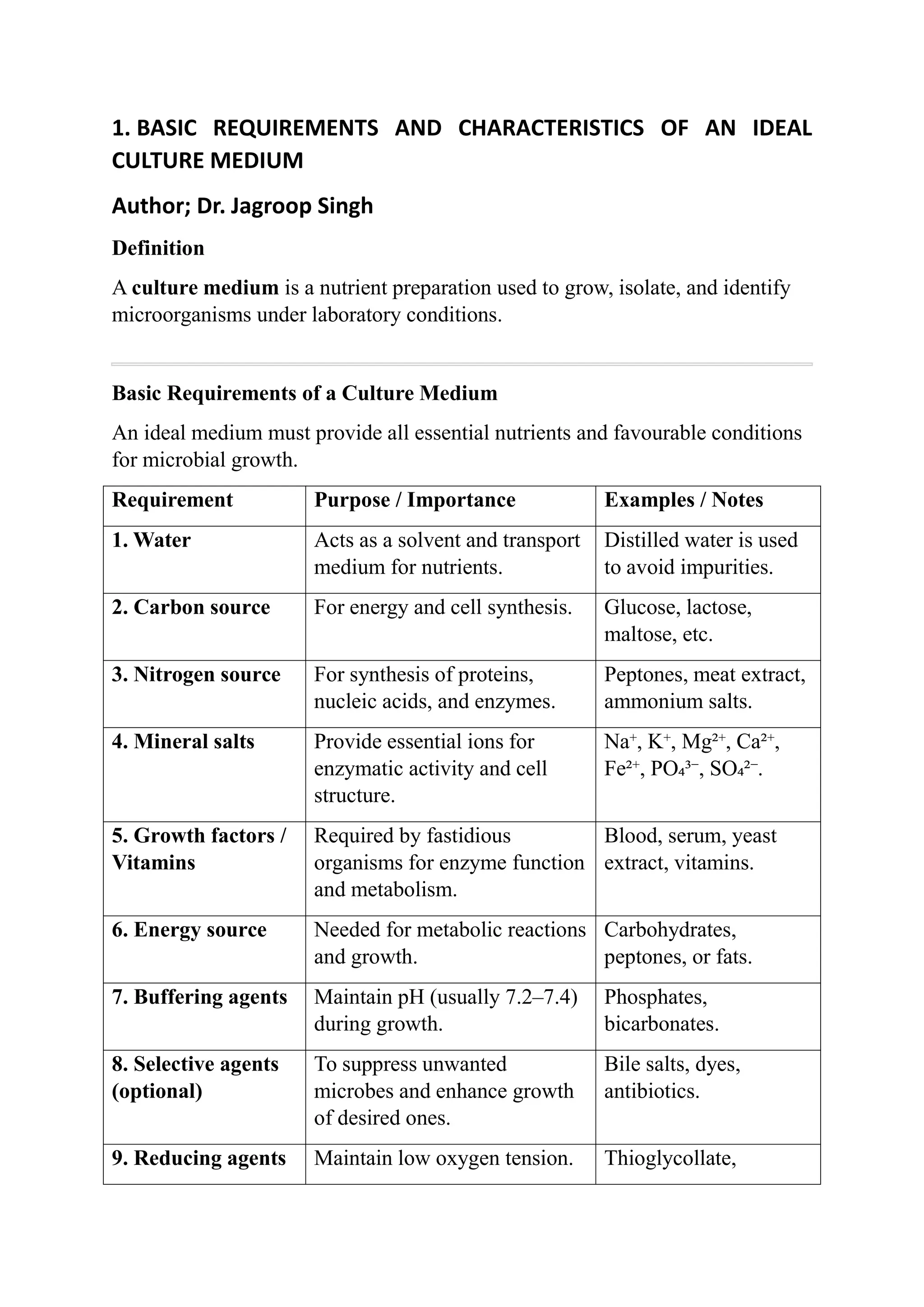
Basic Requirements of a Culture Medium
An ideal medium must provide all essential nutrients and favourable conditions
for microbial growth.
Requirement Purpose / Importance Examples / Notes
1. Water Acts as a solvent and transport
medium for nutrients.
Distilled water is used
to avoid impurities.
2. Carbon source For energy and cell synthesis. Glucose, lactose,
maltose, etc.
3. Nitrogen source For synthesis of proteins,
nucleic acids, and enzymes.
Peptones, meat extract,
ammonium salts.
4. Mineral salts Provide essential ions for
enzymatic activity and cell
structure.
Na⁺, K⁺, Mg²⁺, Ca²⁺,
Fe²⁺, PO₄³⁻, SO₄²⁻.
5. Growth factors /
Vitamins
Required by fastidious
organisms for enzyme function
and metabolism.
Blood, serum, yeast
extract, vitamins.
6. Energy source Needed for metabolic reactions
and growth.
Carbohydrates,
peptones, or fats.
7. Buffering agents Maintain pH (usually 7.2–7.4)
during growth.
Phosphates,
bicarbonates.
8. Selective agents
(optional)
To suppress unwanted
microbes and enhance growth
of desired ones.
Bile salts, dyes,
antibiotics.
9. Reducing agents Maintain low oxygen tension. Thioglycollate,
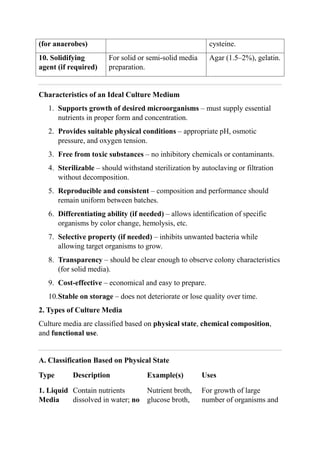
2.
(for anaerobes) cysteine.
10.Solidifying
agent (if required)
For solid or semi-solid media
preparation.
Agar (1.5–2%), gelatin.
Characteristics of an Ideal Culture Medium
1. Supports growth of desired microorganisms – must supply essential
nutrients in proper form and concentration.
2. Provides suitable physical conditions – appropriate pH, osmotic
pressure, and oxygen tension.
3. Free from toxic substances – no inhibitory chemicals or contaminants.
4. Sterilizable – should withstand sterilization by autoclaving or filtration
without decomposition.
5. Reproducible and consistent – composition and performance should
remain uniform between batches.
6. Differentiating ability (if needed) – allows identification of specific
organisms by color change, hemolysis, etc.
7. Selective property (if needed) – inhibits unwanted bacteria while
allowing target organisms to grow.
8. Transparency – should be clear enough to observe colony characteristics
(for solid media).
9. Cost-effective – economical and easy to prepare.
10.Stable on storage – does not deteriorate or lose quality over time.
2. Types of Culture Media
Culture media are classified based on physical state, chemical composition,
and functional use.
A. Classification Based on Physical State
Type Description Example(s) Uses
1. Liquid
Media
Contain nutrients
dissolved in water; no
Nutrient broth,
glucose broth,
For growth of large
number of organisms and
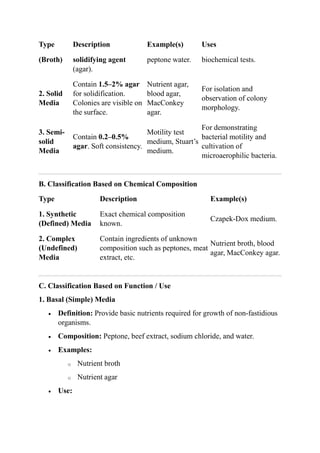
3.
Type Description Example(s)Uses
(Broth) solidifying agent
(agar).
peptone water. biochemical tests.
2. Solid
Media
Contain 1.5–2% agar
for solidification.
Colonies are visible on
the surface.
Nutrient agar,
blood agar,
MacConkey
agar.
For isolation and
observation of colony
morphology.
3. Semi-
solid
Media
Contain 0.2–0.5%
agar. Soft consistency.
Motility test
medium, Stuart’s
medium.
For demonstrating
bacterial motility and
cultivation of
microaerophilic bacteria.
B. Classification Based on Chemical Composition
Type Description Example(s)
1. Synthetic
(Defined) Media
Exact chemical composition
known.
Czapek-Dox medium.
2. Complex
(Undefined)
Media
Contain ingredients of unknown
composition such as peptones, meat
extract, etc.
Nutrient broth, blood
agar, MacConkey agar.
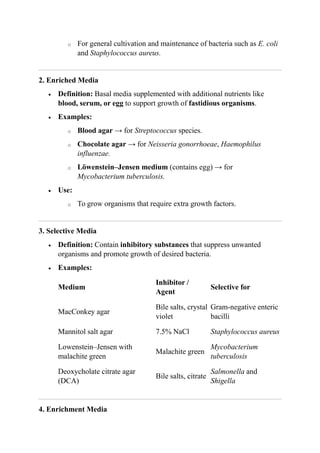
C. Classification Based on Function / Use
1. Basal (Simple) Media
Definition: Provide basic nutrients required for growth of non-fastidious
organisms.
Composition: Peptone, beef extract, sodium chloride, and water.
Examples:
o Nutrient broth
o Nutrient agar
Use:
4.
o For generalcultivation and maintenance of bacteria such as E. coli
and Staphylococcus aureus.
2. Enriched Media
Definition: Basal media supplemented with additional nutrients like
blood, serum, or egg to support growth of fastidious organisms.
Examples:
o Blood agar → for Streptococcus species.
o Chocolate agar → for Neisseria gonorrhoeae, Haemophilus
influenzae.
o Löwenstein–Jensen medium (contains egg) → for
Mycobacterium tuberculosis.
Use:
o To grow organisms that require extra growth factors.
3. Selective Media
Definition: Contain inhibitory substances that suppress unwanted
organisms and promote growth of desired bacteria.
Examples:
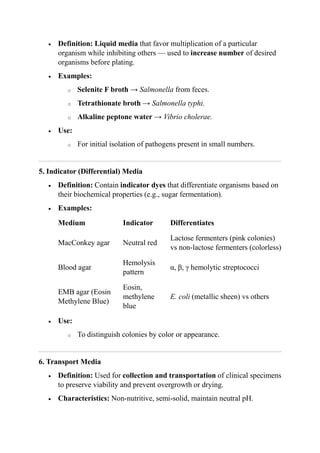
Medium
Inhibitor /
Agent
Selective for
MacConkey agar
Bile salts, crystal
violet
Gram-negative enteric
bacilli
Mannitol salt agar 7.5% NaCl Staphylococcus aureus
Lowenstein–Jensen with
malachite green
Malachite green
Mycobacterium
tuberculosis
Deoxycholate citrate agar
(DCA)
Bile salts, citrate
Salmonella and
Shigella
4. Enrichment Media
5.
Definition: Liquidmedia that favor multiplication of a particular
organism while inhibiting others — used to increase number of desired
organisms before plating.
Examples:
o Selenite F broth → Salmonella from feces.
o Tetrathionate broth → Salmonella typhi.
o Alkaline peptone water → Vibrio cholerae.
Use:
o For initial isolation of pathogens present in small numbers.
5. Indicator (Differential) Media
Definition: Contain indicator dyes that differentiate organisms based on
their biochemical properties (e.g., sugar fermentation).
Examples:
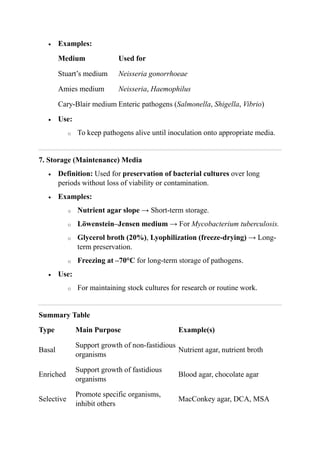
Medium Indicator Differentiates
MacConkey agar Neutral red
Lactose fermenters (pink colonies)
vs non-lactose fermenters (colorless)
Blood agar
Hemolysis
pattern
α, β, γ hemolytic streptococci
EMB agar (Eosin
Methylene Blue)
Eosin,
methylene
blue
E. coli (metallic sheen) vs others
Use:
o To distinguish colonies by color or appearance.
6. Transport Media
Definition: Used for collection and transportation of clinical specimens
to preserve viability and prevent overgrowth or drying.
Characteristics: Non-nutritive, semi-solid, maintain neutral pH.
6.
Examples:
Medium Usedfor
Stuart’s medium Neisseria gonorrhoeae
Amies medium Neisseria, Haemophilus
Cary-Blair medium Enteric pathogens (Salmonella, Shigella, Vibrio)
Use:
o To keep pathogens alive until inoculation onto appropriate media.
7. Storage (Maintenance) Media
Definition: Used for preservation of bacterial cultures over long
periods without loss of viability or contamination.
Examples:
o Nutrient agar slope → Short-term storage.
o Löwenstein–Jensen medium → For Mycobacterium tuberculosis.
o Glycerol broth (20%), Lyophilization (freeze-drying) → Long-
term preservation.
o Freezing at –70°C for long-term storage of pathogens.
Use:
o For maintaining stock cultures for research or routine work.
Summary Table
Type Main Purpose Example(s)
Basal
Support growth of non-fastidious
organisms
Nutrient agar, nutrient broth
Enriched
Support growth of fastidious
organisms
Blood agar, chocolate agar
Selective
Promote specific organisms,
inhibit others
MacConkey agar, DCA, MSA
7.
Type Main PurposeExample(s)
Enrichment
Increase number of target
organism in sample
Selenite F broth, tetrathionate
broth
Indicator
Differentiate colonies by
biochemical activity
MacConkey agar, EMB, blood
agar
Transport
Preserve viability during
transport
Stuart’s, Amies, Cary-Blair
Storage Maintain stock cultures
Agar slant, glycerol broth,
lyophilized cultures
3. Inoculation of Culture Media and Types of Bacterial Culture
A. Inoculation of Culture Media
Definition
Inoculation is the process of introducing microorganisms (inoculum) into
sterile culture media under aseptic conditions to allow growth and
multiplication.
Aims of Inoculation
1. To grow microorganisms for study and identification.
2. To isolate pure colonies.
3. To maintain stock cultures for future use.
4. To test biochemical or antibiotic sensitivity.
Aseptic Precautions
Work near a flame or in a biosafety cabinet.
Sterilize inoculating loop or needle until red hot before and after use.
Avoid talking or breathing over open cultures.
Flame the mouth of test tubes or flasks before and after inoculation.
Close plates quickly to prevent contamination.
B. Types of Bacterial Culture
8.
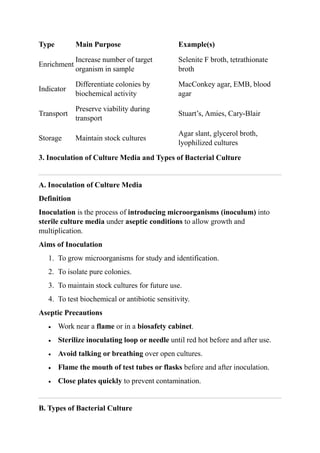
Type Description Use/ Example
1. Broth
Culture
Organisms grown in liquid
medium (nutrient broth). Growth
appears as turbidity.
Used for biochemical tests
or to prepare inoculum.
2. Slant
Culture
Organisms grown on the surface
of solidified agar slant in a test
tube.
Used for stock maintenance
or observation of growth
pattern.
3. Plate
Culture
Organisms grown on the surface
of agar plates.
Used for colony isolation,
purity check, or antibiotic
sensitivity.
4. Stab (Deep)
Culture
Inoculation made by stabbing
with a needle into semi-solid
medium.
Used for studying motility
and oxygen requirements.
5. Lawn
Culture
Surface of agar plate completely
covered with bacterial growth by
swabbing.
Used for antibiotic
sensitivity testing (Kirby-
Bauer method).
6. Liquid
Culture with
Shaking
Provides continuous aeration for
aerobic bacteria.
Used in large-scale bacterial
growth or biochemical
production.
C. Culture Techniques
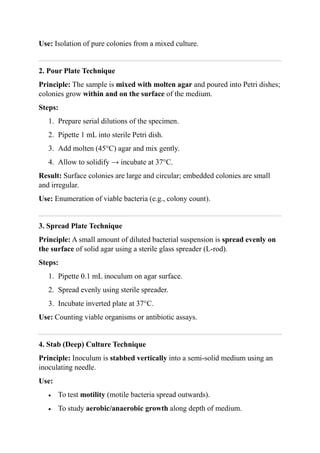
1. Streak Plate Technique
Principle: The inoculum is spread (streaked) over the surface of solid agar
using a sterile loop to dilute bacteria and obtain isolated colonies.
Steps:
1. Sterilize inoculating loop → cool.
2. Take a loopful of culture.
3. Streak over one quadrant of the agar plate.
4. Reflame loop → streak from first quadrant into second, and so on
(usually 4 quadrants).
5. Incubate plate inverted at 37°C for 18–24 hours.
9.
Use: Isolation ofpure colonies from a mixed culture.
2. Pour Plate Technique
Principle: The sample is mixed with molten agar and poured into Petri dishes;
colonies grow within and on the surface of the medium.
Steps:
1. Prepare serial dilutions of the specimen.
2. Pipette 1 mL into sterile Petri dish.
3. Add molten (45°C) agar and mix gently.
4. Allow to solidify → incubate at 37°C.
Result: Surface colonies are large and circular; embedded colonies are small
and irregular.
Use: Enumeration of viable bacteria (e.g., colony count).
3. Spread Plate Technique
Principle: A small amount of diluted bacterial suspension is spread evenly on
the surface of solid agar using a sterile glass spreader (L-rod).
Steps:
1. Pipette 0.1 mL inoculum on agar surface.
2. Spread evenly using sterile spreader.
3. Incubate inverted plate at 37°C.
Use: Counting viable organisms or antibiotic assays.
4. Stab (Deep) Culture Technique
Principle: Inoculum is stabbed vertically into a semi-solid medium using an
inoculating needle.
Use:
To test motility (motile bacteria spread outwards).
To study aerobic/anaerobic growth along depth of medium.
10.
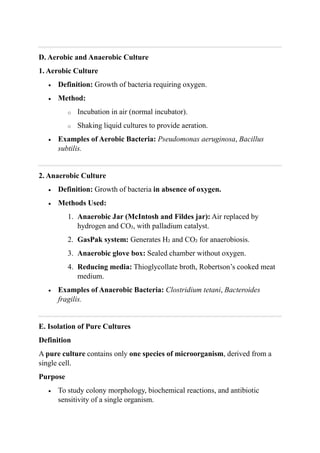
D. Aerobic andAnaerobic Culture
1. Aerobic Culture
Definition: Growth of bacteria requiring oxygen.
Method:
o Incubation in air (normal incubator).
o Shaking liquid cultures to provide aeration.
Examples of Aerobic Bacteria: Pseudomonas aeruginosa, Bacillus
subtilis.
2. Anaerobic Culture
Definition: Growth of bacteria in absence of oxygen.
Methods Used:
1. Anaerobic Jar (McIntosh and Fildes jar): Air replaced by
hydrogen and CO₂, with palladium catalyst.
2. GasPak system: Generates H₂ and CO₂ for anaerobiosis.
3. Anaerobic glove box: Sealed chamber without oxygen.
4. Reducing media: Thioglycollate broth, Robertson’s cooked meat
medium.
Examples of Anaerobic Bacteria: Clostridium tetani, Bacteroides
fragilis.
E. Isolation of Pure Cultures
Definition
A pure culture contains only one species of microorganism, derived from a
single cell.
Purpose
To study colony morphology, biochemical reactions, and antibiotic
sensitivity of a single organism.
11.
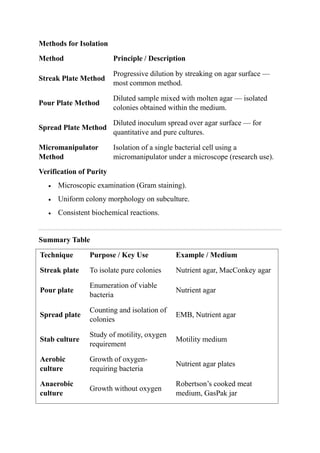
Methods for Isolation
MethodPrinciple / Description
Streak Plate Method
Progressive dilution by streaking on agar surface —
most common method.
Pour Plate Method
Diluted sample mixed with molten agar — isolated
colonies obtained within the medium.
Spread Plate Method
Diluted inoculum spread over agar surface — for
quantitative and pure cultures.
Micromanipulator
Method
Isolation of a single bacterial cell using a
micromanipulator under a microscope (research use).
Verification of Purity
Microscopic examination (Gram staining).
Uniform colony morphology on subculture.
Consistent biochemical reactions.
Summary Table
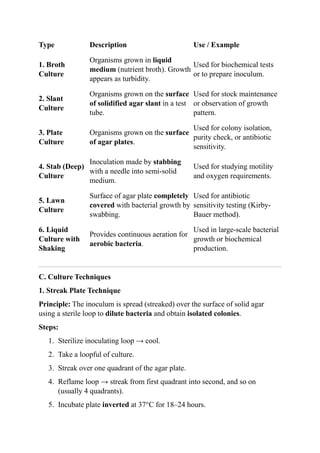
Technique Purpose / Key Use Example / Medium
Streak plate To isolate pure colonies Nutrient agar, MacConkey agar
Pour plate
Enumeration of viable
bacteria
Nutrient agar
Spread plate
Counting and isolation of
colonies
EMB, Nutrient agar
Stab culture
Study of motility, oxygen
requirement
Motility medium
Aerobic
culture
Growth of oxygen-
requiring bacteria
Nutrient agar plates
Anaerobic
culture
Growth without oxygen
Robertson’s cooked meat
medium, GasPak jar




![ONFH[AVN HIP] -TRIPLE REGIME -A NOVAL SURGICAL CONCEPT .pptx](https://cdn.slidesharecdn.com/ss_thumbnails/onfhavnhip2026koaconcalicutdrgokuldevdrmashraf-260210064517-213ec005-thumbnail.jpg?width=640&height=640&fit=bounds)


