TRAINING ON THE
MATATAG CURRICULUM
Venue:
Date:
1
EPP 4
MATATAG Curriculum Training | 2024
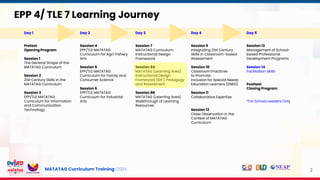
EPP 4/ TLE 7 Learning Journey
2
Day 1
Pretest
Opening Program
Session 1
The General Shape of the
MATATAG Curriculum
Session 2
21st Century Skills in the
MATATAG Curriculum
Session 3
EPP/TLE MATATAG
Curriculum for Information
and Communication
Technology
Day 2
Session 4
EPP/TLE MATATAG
Curriculum for Agri-Fishery
Arts
Session 5
EPP/TLE MATATAG
Curriculum for Family and
Consumer Science
Session 6
EPP/TLE MATATAG
Curriculum for Industrial
Arts
Day 3
Session 7
MATATAG Curriculum:
Instructional Design
Framework
Session 8A
MATATAG (Learning Area)
Instructional Design
Framework (IDF): Pedagogy
and Assessment
Session 8B
MATATAG (Learning Area)
Walkthrough of Learning
Resources
Day 4
Session 9
Integrating 21st Century
Skills in Classroom-based
Assessment
Session 10
Classroom Practices
to Promote
Inclusion for Special Needs
Education Learners (SNED)
Session 11
Collaborative Expertise
Session 12
Class Observation in the
Context of MATATAG
Curriculum
Day 5
Session 13
Management of School-
based Professional
Development Programs
Session 14
Facilitation Skills
Posttest
Closing Program
*For School Leaders Only
MATATAG Curriculum Training | 2024
MATATAG EPP 4 Instructional Design
Framework (IDF): Pedagogy and
Assessment
Session 8A
Resource Person
MATATAG Curriculum Training | 2024 4
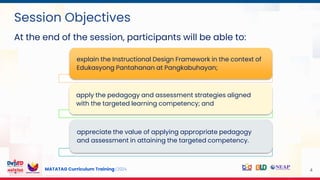
Session Objectives
explain the Instructional Design Framework in the context of
Edukasyong Pantahanan at Pangkabuhayan;
apply the pedagogy and assessment strategies aligned
with the targeted learning competency; and
appreciate the value of applying appropriate pedagogy
and assessment in attaining the targeted competency.
At the end of the session, participants will be able to:
MATATAG Curriculum Training | 2024
Professional Standards Addressed:
PPST 1: Content Knowledge and Pedagogy
● 1.2. Research-based knowledge and principles of teaching and learning
● 1.5. Strategies for developing critical and creative thinking, as well as
other higher-order thinking skills
PPST 2: Learning Environment
● 2.3. Management of classroom structure and activities
● 2.4. Support for learner participation
● 2.5. Promotion of purposive learning
MATATAG Curriculum Training | 2024
Professional Standards Addressed:
PPST 4: Curriculum and Planning
● 4.1. Planning and management of teaching and learning process
● 4.2. Learning outcomes aligned with learning competencies
PPSSH 3.2. Teaching standards and pedagogies
PPSS 3.1. Support for instructional leadership
MATATAG Curriculum Training | 2024
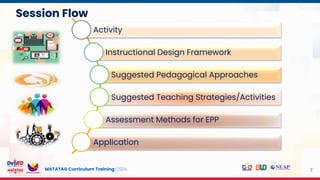
Session Flow
7
Activity
Instructional Design Framework
Suggested Pedagogical Approaches
Suggested Teaching Strategies/Activities
Assessment Methods for EPP
Application
MATATAG Curriculum Training | 2024 9
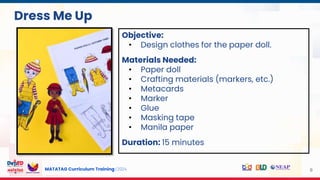
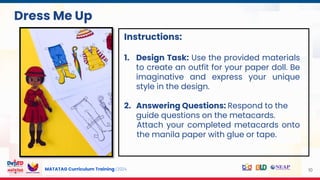
Dress Me Up
Objective:
• Design clothes for the paper doll.
Materials Needed:
• Paper doll
• Crafting materials (markers, etc.)
• Metacards
• Marker
• Glue
• Masking tape
• Manila paper
Duration: 15 minutes
MATATAG Curriculum Training | 2024 10
Instructions:
1. Design Task: Use the provided materials
to create an outfit for your paper doll. Be
imaginative and express your unique
style in the design.
2. Answering Questions: Respond to the
guide questions on the metacards.
Attach your completed metacards onto
the manila paper with glue or tape.
Dress Me Up
MATATAG Curriculum Training | 2024 11
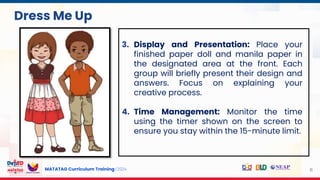
3. Display and Presentation: Place your
finished paper doll and manila paper in
the designated area at the front. Each
group will briefly present their design and
answers. Focus on explaining your
creative process.
4. Time Management: Monitor the time
using the timer shown on the screen to
ensure you stay within the 15-minute limit.
Dress Me Up
MATATAG Curriculum Training | 2024 12
Guide Questions:
1. How did you produce the design
of the paper doll dress?
2. Which of the materials used is
considered the most important
in dressing the doll?
3. What is the importance of
accessories in making the
paper doll dress?
MATATAG Curriculum Training | 2024 13
Guide Questions:
1. How did you produce the design of the
paper doll dress?
2. Which of the materials used is
considered the most important in
dressing the doll?
3. What is the importance of accessories in
making the paper doll dress?
MATATAG Curriculum Training | 2024 14
What is the primary consideration
teachers need to look at, in
designing instruction?
MATATAG Curriculum Training | 2024 15
LEARNER
MATATAG Curriculum Training | 2024 16
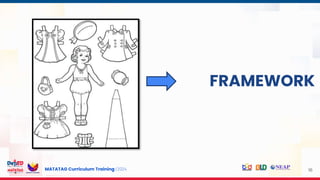
FRAMEWORK
MATATAG Curriculum Training | 2024 17
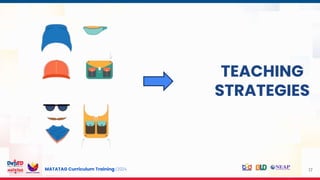
TEACHING
STRATEGIES
MATATAG Curriculum Training | 2024 18
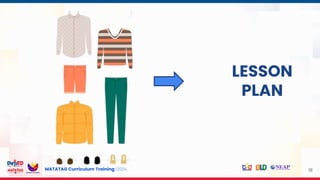
LESSON
PLAN
MATATAG Curriculum Training | 2024
19
The Curriculum Framework
and the K to 10 Instructional
Design Framework
MATATAG Curriculum Training | 2024
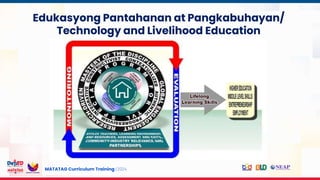
Edukasyong Pantahanan at Pangkabuhayan/
Technology and Livelihood Education
MATATAG Curriculum Training | 2024
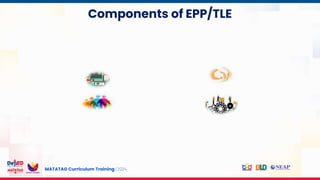
Components of EPP/TLE
MATATAG Curriculum Training | 2024
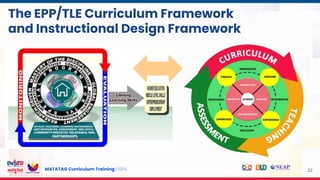
The EPP/TLE Curriculum Framework
and Instructional Design Framework
22
MATATAG Curriculum Training | 2024
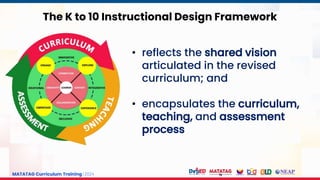
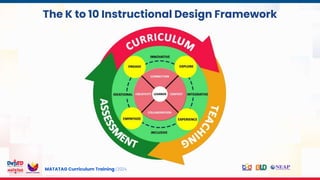
The K to 10 Instructional Design Framework
• reflects the shared vision
articulated in the revised
curriculum; and
• encapsulates the curriculum,
teaching, and assessment
process
MATATAG Curriculum Training | 2024
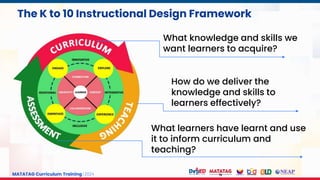
The K to 10 Instructional Design Framework
What knowledge and skills we
want learners to acquire?
What learners have learnt and use
it to inform curriculum and
teaching?
How do we deliver the
knowledge and skills to
learners effectively?
MATATAG Curriculum Training | 2024
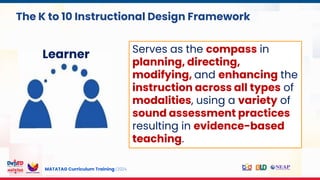
Serves as the compass in
planning, directing,
modifying, and enhancing the
instruction across all types of
modalities, using a variety of
sound assessment practices
resulting in evidence-based
teaching.
The K to 10 Instructional Design Framework
Learner
MATATAG Curriculum Training | 2024
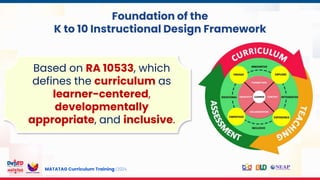
Foundation of the
K to 10 Instructional Design Framework
Based on RA 10533, which
defines the curriculum as
learner-centered,
developmentally
appropriate, and inclusive.
MATATAG Curriculum Training | 2024
Elements of the
K to 10 Instructional Design
Framework
MATATAG Curriculum Training | 2024
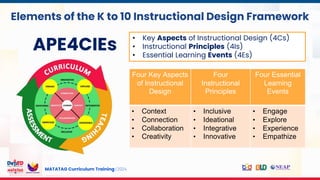
Elements of the K to 10 Instructional Design Framework
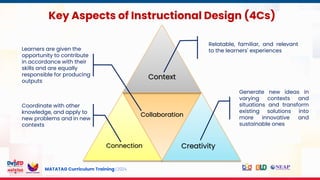
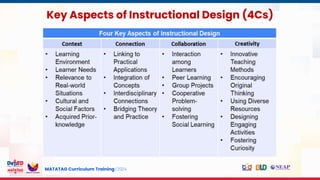
• Key Aspects of Instructional Design (4Cs)
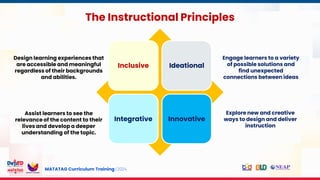
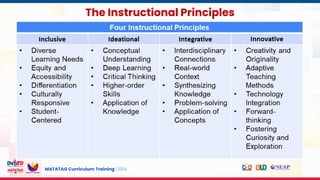
• Instructional Principles (4Is)
• Essential Learning Events (4Es)
Four Key Aspects
of Instructional
Design
Four
Instructional
Principles
Four Essential
Learning
Events
• Context
• Connection
• Collaboration
• Creativity
• Inclusive
• Ideational
• Integrative
• Innovative
• Engage
• Explore
• Experience
• Empathize
APE4CIEs
MATATAG Curriculum Training | 2024
Key Aspects of Instructional Design (4Cs)
Relatable, familiar, and relevant
to the learners' experiences
Generate new ideas in
varying contexts and
situations and transform
existing solutions into
more innovative and
sustainable ones
Collaboration
Connection Creativity
Context
Learners are given the
opportunity to contribute
in accordance with their
skills and are equally
responsible for producing
outputs
Coordinate with other
knowledge, and apply to
new problems and in new
contexts
MATATAG Curriculum Training | 2024
Key Aspects of Instructional Design (4Cs)
MATATAG Curriculum Training | 2024
The Instructional Principles
Inclusive Ideational
Integrative Innovative
Design learning experiences that
are accessible and meaningful
regardless of their backgrounds
and abilities.
Assist learners to see the
relevance of the content to their
lives and develop a deeper
understanding of the topic.
Explore new and creative
ways to design and deliver
instruction
Engage learners to a variety
of possible solutions and
find unexpected
connections between ideas
MATATAG Curriculum Training | 2024
The Instructional Principles
MATATAG Curriculum Training | 2024
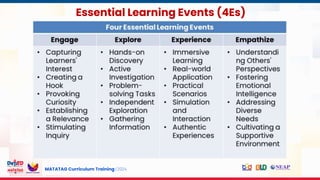
Essential Learning Events (4Es)
Engage Experience
Emphathize
Explore
Capture the learner's attention
and generate interest in the
learning process
Allow learners the opportunity
to apply their knowledge, skills,
abilities, and attitudes in a
real-world context
Provide opportunities for
learners to experiment/
discover, solve problems, or
ask questions Enable learners to step
into someone else’s
shoes and see the world
from their perspective.
MATATAG Curriculum Training | 2024
Essential Learning Events (4Es)
MATATAG Curriculum Training | 2024
The K to 10 Instructional Design Framework
MATATAG Curriculum Training | 2024 36
PEDAGOGY
MATATAG Curriculum Training | 2024
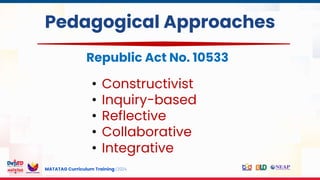
Pedagogical Approaches
Republic Act No. 10533
• Constructivist
• Inquiry-based
• Reflective
• Collaborative
• Integrative
MATATAG Curriculum Training | 2024
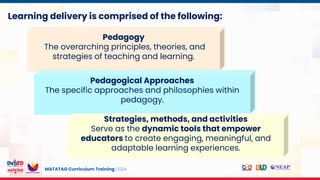
Learning delivery is comprised of the following:
Pedagogy
The overarching principles, theories, and
strategies of teaching and learning.
Pedagogical Approaches
The specific approaches and philosophies within
pedagogy.
Strategies, methods, and activities
Serve as the dynamic tools that empower
educators to create engaging, meaningful, and
adaptable learning experiences.
MATATAG Curriculum Training | 2024
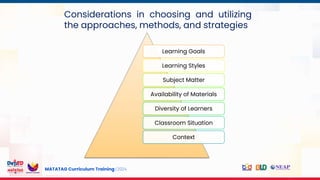
Learning Goals
Learning Styles
Subject Matter
Availability of Materials
Diversity of Learners
Classroom Situation
Context
Considerations in choosing and utilizing
the approaches, methods, and strategies
MATATAG Curriculum Training | 2024
EPP/TLE/TVL
Pedagogical Approaches
MATATAG Curriculum Training | 2024
What pedagogical approaches or
teaching strategies did you utilize
while handling the teaching position?
MATATAG Curriculum Training | 2024
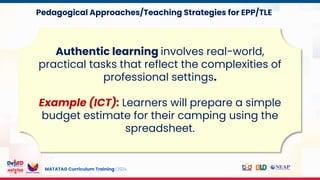
Authentic learning involves real-world,
practical tasks that reflect the complexities of
professional settings.
Example (ICT): Learners will prepare a simple
budget estimate for their camping using the
spreadsheet.
Pedagogical Approaches/Teaching Strategies for EPP/TLE
MATATAG Curriculum Training | 2024
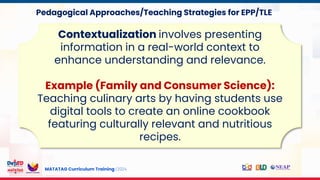
Contextualization involves presenting
information in a real-world context to
enhance understanding and relevance.
Example (Family and Consumer Science):
Teaching culinary arts by having students use
digital tools to create an online cookbook
featuring culturally relevant and nutritious
recipes.
Pedagogical Approaches/Teaching Strategies for EPP/TLE
MATATAG Curriculum Training | 2024
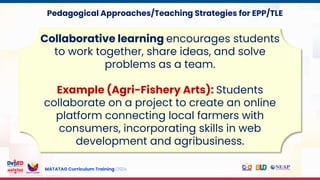
Collaborative learning encourages students
to work together, share ideas, and solve
problems as a team.
Example (Agri-Fishery Arts): Students
collaborate on a project to create an online
platform connecting local farmers with
consumers, incorporating skills in web
development and agribusiness.
Pedagogical Approaches/Teaching Strategies for EPP/TLE
MATATAG Curriculum Training | 2024
Culture-based instruction incorporates
cultural elements into the learning process,
recognizing and valuing diverse perspectives.
Example (ICT): Exploring how technology is
used to preserve and promote cultural
practices, such as developing a multimedia
presentation on traditional storytelling.
Pedagogical Approaches/Teaching Strategies for EPP/TLE
MATATAG Curriculum Training | 2024
Differentiated instruction tailors teaching
methods and content to accommodate
diverse learning styles and abilities.
Example (Agri-Fishery Arts): In a fisheries
class, providing various project options, such
as designing a fish farming system or
creating a marketing plan for a seafood
business.
Pedagogical Approaches/Teaching Strategies for EPP/TLE
MATATAG Curriculum Training | 2024
Entrepreneurial learning involves teaching
students to think and act like entrepreneurs,
emphasizing creativity, innovation, and problem-
solving.
Example (Industrial Arts): Students develop and
pitch a business plan for a custom metal
fabrication workshop, integrating entrepreneurial
skills with metalworking expertise.
Pedagogical Approaches/Teaching Strategies for EPP/TLE
MATATAG Curriculum Training | 2024
Experiential learning emphasizes learning
through direct experiences, reflection, and
application of knowledge.
Example (Family and Consumer Science):
Students gain hands-on experience in textile
design by creating and sewing garments
using digital design tools.
Pedagogical Approaches/Teaching Strategies for EPP/TLE
MATATAG Curriculum Training | 2024
The Explicit teaching approach involves
clearly and directly instructing students in a
systematic manner.
Example (ICT): In a networking class,
providing step-by-step instructions and
guided practice for configuring and securing
computer networks.
Pedagogical Approaches/Teaching Strategies for EPP/TLE
MATATAG Curriculum Training | 2024
Integrative learning combines various
subjects or skills into a cohesive educational
experience.
Example (Agri-Fishery Arts): Students
integrate agricultural knowledge with digital
marketing skills to develop a comprehensive
understanding of running a modern farm
business.
Pedagogical Approaches/Teaching Strategies for EPP/TLE
MATATAG Curriculum Training | 2024
Problem-based learning presents students
with a real-world problem to solve, fostering
critical thinking and problem-solving skills.
Example (Industrial Arts): Students in an
automotive class work on a project to design
and build an energy-efficient vehicle
prototype, addressing a current
environmental challenge.
Pedagogical Approaches/Teaching Strategies for EPP/TLE
MATATAG Curriculum Training | 2024
Project-based learning centers around
students completing an extended project that
involves solving a real-world problem or
answering a complex question.
Example (Family and Consumer Science):
Students collaborate on a project to design a
smart kitchen, incorporating technology to
enhance food preparation and nutrition.
Pedagogical Approaches/Teaching Strategies for EPP/TLE
MATATAG Curriculum Training | 2024
Constructivist learning emphasizes active
participation, exploration, and the creation of
meaning through hands-on experiences.
Example (Industrial Arts): Students construct
their understanding of metalworking by
designing and creating functional metal
objects through welding and fabrication.
Pedagogical Approaches/Teaching Strategies for EPP/TLE
MATATAG Curriculum Training | 2024
Technology-enhanced instruction integrates
digital tools and resources to enhance the
learning experience.
Example (Agri-Fishery Arts): Using technology
in searching methods/strategies in applying
appropriate agricultural technology needed for
producing, growing and improving varieties of
crop.
Pedagogical Approaches/Teaching Strategies for EPP/TLE
MATATAG Curriculum Training | 2024
Self-directed learning empowers students
to take responsibility for their own learning,
setting goals and managing their progress.
Example (ICT): Providing resources and
guidance for students to explore a specific
technology topic of interest, such as mobile
app development, and present their findings
to the class.
Pedagogical Approaches/Teaching Strategies for EPP/TLE
MATATAG Curriculum Training | 2024
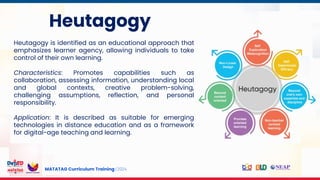
Heutagogy
Heutagogy is identified as an educational approach that
emphasizes learner agency, allowing individuals to take
control of their own learning.
Characteristics: Promotes capabilities such as
collaboration, assessing information, understanding local
and global contexts, creative problem-solving,
challenging assumptions, reflection, and personal
responsibility.
Application: It is described as suitable for emerging
technologies in distance education and as a framework
for digital-age teaching and learning.
MATATAG Curriculum Training | 2024
Non-linear
• flexible and adaptable
to the needs and
interests of the learner.
• learners have the
freedom to explore
topics and concepts in
various directions and
at their own pace
Self-Determined Efficacy
• learners are encouraged
to take control of their
learning process.
The teacher's role is
described as that of a
guide-on-the-side,
facilitating teaching and
learning rather than being
the central source of
information.

MATATAG Curriculum Training | 2024
Flipped Classroom
https://ctl.utexas.edu/instructional-
strategies/flipped-classroom
MATATAG Curriculum Training | 2024
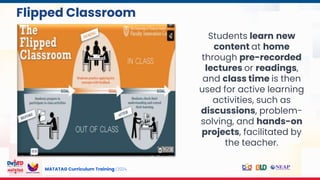
Flipped Classroom
Students learn new
content at home
through pre-recorded
lectures or readings,
and class time is then
used for active learning
activities, such as
discussions, problem-
solving, and hands-on
projects, facilitated by
the teacher.
MATATAG Curriculum Training | 2024
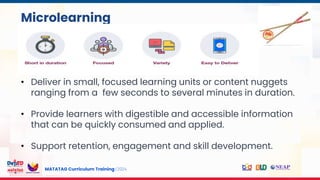
Microlearning
• Deliver in small, focused learning units or content nuggets
ranging from a few seconds to several minutes in duration.
• Provide learners with digestible and accessible information
that can be quickly consumed and applied.
• Support retention, engagement and skill development.
MATATAG Curriculum Training | 2024
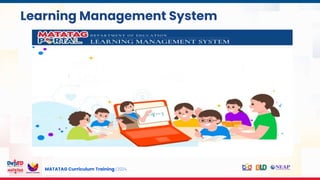
Learning Management System
MATATAG Curriculum Training | 2024
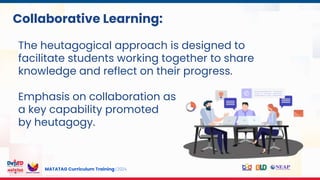
Collaborative Learning:
The heutagogical approach is designed to
facilitate students working together to share
knowledge and reflect on their progress.
Emphasis on collaboration as
a key capability promoted
by heutagogy.
MATATAG Curriculum Training | 2024
Adaptation to Emerging Technologies:
The heutagogical approach is noted
as being applicable to emerging
technologies in distance education.
It is presented as a way to bring about a shift in distance education
environments, aligning with the nature of self-directed learning.
MATATAG Curriculum Training | 2024
How is artificial intelligence changes the teaching and learning process?
MATATAG Curriculum Training | 2024
Suggested Activities
for EPP/TLE/TVL
MATATAG Curriculum Training | 2024
s
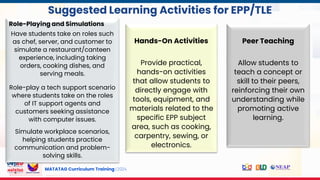
Suggested Learning Activities for EPP/TLE
Hands-On Activities
Provide practical,
hands-on activities
that allow students to
directly engage with
tools, equipment, and
materials related to the
specific EPP subject
area, such as cooking,
carpentry, sewing, or
electronics.
Role-Playing and Simulations
Have students take on roles such
as chef, server, and customer to
simulate a restaurant/canteen
experience, including taking
orders, cooking dishes, and
serving meals.
Role-play a tech support scenario
where students take on the roles
of IT support agents and
customers seeking assistance
with computer issues.
Simulate workplace scenarios,
helping students practice
communication and problem-
solving skills.
Peer Teaching
Allow students to
teach a concept or
skill to their peers,
reinforcing their own
understanding while
promoting active
learning.
MATATAG Curriculum Training | 2024
s
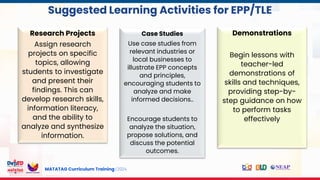
Research Projects
Assign research
projects on specific
topics, allowing
students to investigate
and present their
findings. This can
develop research skills,
information literacy,
and the ability to
analyze and synthesize
information.
Case Studies
Use case studies from
relevant industries or
local businesses to
illustrate EPP concepts
and principles,
encouraging students to
analyze and make
informed decisions..
Encourage students to
analyze the situation,
propose solutions, and
discuss the potential
outcomes.
Demonstrations
Begin lessons with
teacher-led
demonstrations of
skills and techniques,
providing step-by-
step guidance on how
to perform tasks
effectively
Suggested Learning Activities for EPP/TLE
MATATAG Curriculum Training | 2024
s
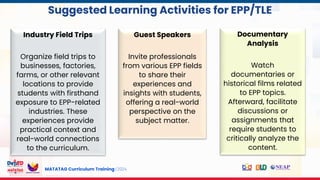
Industry Field Trips
Organize field trips to
businesses, factories,
farms, or other relevant
locations to provide
students with firsthand
exposure to EPP-related
industries. These
experiences provide
practical context and
real-world connections
to the curriculum.
Guest Speakers
Invite professionals
from various EPP fields
to share their
experiences and
insights with students,
offering a real-world
perspective on the
subject matter.
Documentary
Analysis
Watch
documentaries or
historical films related
to EPP topics.
Afterward, facilitate
discussions or
assignments that
require students to
critically analyze the
content.
Suggested Learning Activities for EPP/TLE
MATATAG Curriculum Training | 2024
s
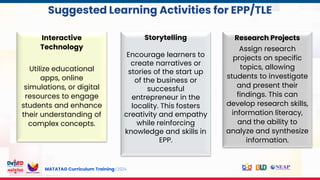
Interactive
Technology
Utilize educational
apps, online
simulations, or digital
resources to engage
students and enhance
their understanding of
complex concepts.
Storytelling
Encourage learners to
create narratives or
stories of the start up
of the business or
successful
entrepreneur in the
locality. This fosters
creativity and empathy
while reinforcing
knowledge and skills in
EPP.
Research Projects
Assign research
projects on specific
topics, allowing
students to investigate
and present their
findings. This can
develop research skills,
information literacy,
and the ability to
analyze and synthesize
information.
Suggested Learning Activities for EPP/TLE
MATATAG Curriculum Training | 2024
s
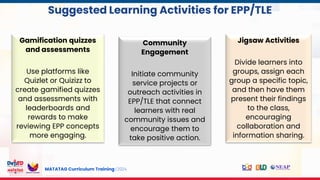
Community
Engagement
Initiate community
service projects or
outreach activities in
EPP/TLE that connect
learners with real
community issues and
encourage them to
take positive action.
Jigsaw Activities
Divide learners into
groups, assign each
group a specific topic,
and then have them
present their findings
to the class,
encouraging
collaboration and
information sharing.
Gamification quizzes
and assessments
Use platforms like
Quizlet or Quizizz to
create gamified quizzes
and assessments with
leaderboards and
rewards to make
reviewing EPP concepts
more engaging.
Suggested Learning Activities for EPP/TLE
MATATAG Curriculum Training | 2024
s
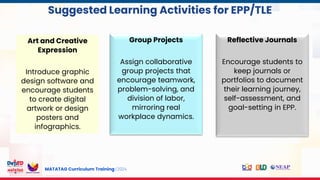
Art and Creative
Expression
Introduce graphic
design software and
encourage students
to create digital
artwork or design
posters and
infographics.
Group Projects
Assign collaborative
group projects that
encourage teamwork,
problem-solving, and
division of labor,
mirroring real
workplace dynamics.
Reflective Journals
Encourage students to
keep journals or
portfolios to document
their learning journey,
self-assessment, and
goal-setting in EPP.
Suggested Learning Activities for EPP/TLE
MATATAG Curriculum Training | 2024
s
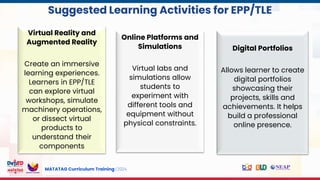
Virtual Reality and
Augmented Reality
Create an immersive
learning experiences.
Learners in EPP/TLE
can explore virtual
workshops, simulate
machinery operations,
or dissect virtual
products to
understand their
components
Online Platforms and
Simulations
Virtual labs and
simulations allow
students to
experiment with
different tools and
equipment without
physical constraints.
Digital Portfolios
Allows learner to create
digital portfolios
showcasing their
projects, skills and
achievements. It helps
build a professional
online presence.
Suggested Learning Activities for EPP/TLE
MATATAG Curriculum Training | 2024
s
Learning Activities for EPP/TLE
Tailoring activities to the specific grade level,
curriculum objectives and learning needs and
styles of the learners can create a more
inclusive and engaging EPP learning experience.
Adapting to learners' diverse learning needs and
situations makes learning more enjoyable,
relevant, and memorable.
MATATAG Curriculum Training | 2024
s
What should be done in order to
determine whether the learners
understand the lesson?
MATATAG Curriculum Training | 2024 75
ASSESSMENT METHODS
MATATAG Curriculum Training | 2024
Assessment
Assessment is a process to determine a learner’s achievement of expected
learning outcomes including a range of written/oral methods and practical
demonstration. (TVET Glossary TVET Sector Support Program, GIZ, October 2019)
Competency Assessment, as used in TESDA, is the term that refers to the process of
collecting evidence and making judgments on whether competency has been
achieved. (Implementing Guidelines on PTQCS)
MATATAG Curriculum Training | 2024
Assessment
Competency-Based Assessment is the process of
gathering and interpreting evidence to make a
judgment about a learner’s achievement against the
required competencies in a qualification or part
qualification. (TVET Glossary TVET Sector Support
Program, GIZ, October 2019)
MATATAG Curriculum Training | 2024
Assessment
Assessment is conducted through:
• classroom-based assessment; or
• systems assessments which may be national
or international.
MATATAG Curriculum Training | 2024
Classroom-based assessment is composed of
formative and summative assessments
administered by teachers in their classrooms.
National Assessment is a large-scale assessment
that is administered to learners at a specific time
as prescribed by the DO. 55s. of 2016.
Assessment
MATATAG Curriculum Training | 2024
Assessment
For the EPP/TLE Grades 4 to 10, only
classroom-based assessment is being
conducted and for TVL, learners may
obtain National Certification Assessment
conducted by TESDA based on the
Qualification/Specialization that they have
completed after Senior high school.
MATATAG Curriculum Training | 2024 81
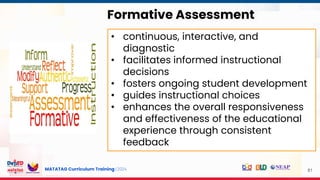
Formative Assessment
• continuous, interactive, and
diagnostic
• facilitates informed instructional
decisions
• fosters ongoing student development
• guides instructional choices
• enhances the overall responsiveness
and effectiveness of the educational
experience through consistent
feedback
MATATAG Curriculum Training | 2024 82
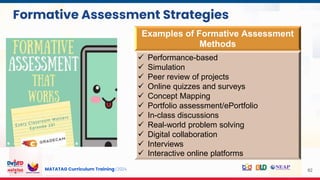
Formative Assessment Strategies
Examples of Formative Assessment
Methods
 Performance-based
 Simulation
 Peer review of projects
 Online quizzes and surveys
 Concept Mapping
 Portfolio assessment/ePortfolio
 In-class discussions
 Real-world problem solving
 Digital collaboration
 Interviews
 Interactive online platforms
MATATAG Curriculum Training | 2024
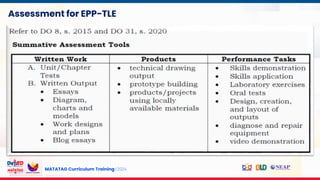
Assessment for EPP-TLE
MATATAG Curriculum Training | 2024
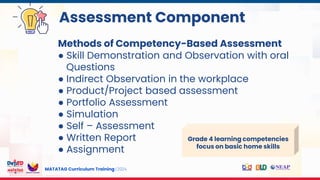
Assessment Component
Methods of Competency-Based Assessment
● Skill Demonstration and Observation with oral
Questions
● Indirect Observation in the workplace
● Product/Project based assessment
● Portfolio Assessment
● Simulation
● Self – Assessment
● Written Report
● Assignment
Grade 4 learning competencies
focus on basic home skills
MATATAG Curriculum Training | 2024
Sample Rubric
https://rubric-maker.com/
https://www.quickrubric.com/
https://www.teach-nology.com/
MATATAG Curriculum Training | 2024
Activity 2: “e-Shopedagohiya”
86
Instructions:
1. For 10 minutes, analyze which pedagogical approaches, teaching
strategy/ies, and assessment methods is/are applicable to the
given learning competency including the IDF features. Used the
unpacked competencies.
2. Write your answers in the metacards.
3. Post your metacards on the manila paper.
http://tinyurl.com/SessionDocuments
MATATAG Curriculum Training | 2024 87
MATATAG Curriculum Training | 2024 88
How important is aligning
pedagogy and assessment
strategies to the targeted learning
competency?
MATATAG Curriculum Training | 2024 89
Session Objectives
explain the Instructional Design Framework in the context of
Edukasyong Pantahanan at Pangkabuhayan;
apply the pedagogy and assessment strategies aligned
with the targeted learning competency; and
appreciate the value of applying appropriate pedagogy
and assessment in attaining the targeted competency.
At the end of the session, participants will be able to:
MATATAG Curriculum Training | 2024 91
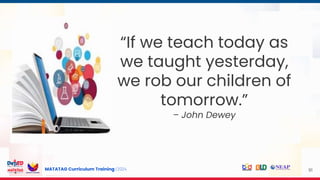
“If we teach today as
we taught yesterday,
we rob our children of
tomorrow.”
– John Dewey
MATATAG Curriculum Training | 2024
Program Management Team
Curriculum and Teaching Strand
Bureau of Curriculum Development
Bureau of Learning Delivery
Bureau of Education Assessment
Bureau of Alternative Education
Bureau of Learning Resources
Human Resources and Organizational Development
Strand
National Educators Academy of the Philippines
(NEAP)
Professional Development Division
Quality Assurance Division
Session Guide and Presentation
Deck Developer/s
BLD
Glenda M. Granadozin
MATATAG CURRICULUM TRAINING RESOURCE PACKAGE
MARAMING SALAMAT!
93

Final_SD_EPP8A_Granadozin_matatag24.pptx

  • 1.
    TRAINING ON THE MATATAGCURRICULUM Venue: Date: 1 EPP 4
  • 2.
    MATATAG Curriculum Training| 2024 EPP 4/ TLE 7 Learning Journey 2 Day 1 Pretest Opening Program Session 1 The General Shape of the MATATAG Curriculum Session 2 21st Century Skills in the MATATAG Curriculum Session 3 EPP/TLE MATATAG Curriculum for Information and Communication Technology Day 2 Session 4 EPP/TLE MATATAG Curriculum for Agri-Fishery Arts Session 5 EPP/TLE MATATAG Curriculum for Family and Consumer Science Session 6 EPP/TLE MATATAG Curriculum for Industrial Arts Day 3 Session 7 MATATAG Curriculum: Instructional Design Framework Session 8A MATATAG (Learning Area) Instructional Design Framework (IDF): Pedagogy and Assessment Session 8B MATATAG (Learning Area) Walkthrough of Learning Resources Day 4 Session 9 Integrating 21st Century Skills in Classroom-based Assessment Session 10 Classroom Practices to Promote Inclusion for Special Needs Education Learners (SNED) Session 11 Collaborative Expertise Session 12 Class Observation in the Context of MATATAG Curriculum Day 5 Session 13 Management of School- based Professional Development Programs Session 14 Facilitation Skills Posttest Closing Program *For School Leaders Only
  • 3.
    MATATAG Curriculum Training| 2024 MATATAG EPP 4 Instructional Design Framework (IDF): Pedagogy and Assessment Session 8A Resource Person
  • 4.
    MATATAG Curriculum Training| 2024 4 Session Objectives explain the Instructional Design Framework in the context of Edukasyong Pantahanan at Pangkabuhayan; apply the pedagogy and assessment strategies aligned with the targeted learning competency; and appreciate the value of applying appropriate pedagogy and assessment in attaining the targeted competency. At the end of the session, participants will be able to:
  • 5.
    MATATAG Curriculum Training| 2024 Professional Standards Addressed: PPST 1: Content Knowledge and Pedagogy ● 1.2. Research-based knowledge and principles of teaching and learning ● 1.5. Strategies for developing critical and creative thinking, as well as other higher-order thinking skills PPST 2: Learning Environment ● 2.3. Management of classroom structure and activities ● 2.4. Support for learner participation ● 2.5. Promotion of purposive learning
  • 6.
    MATATAG Curriculum Training| 2024 Professional Standards Addressed: PPST 4: Curriculum and Planning ● 4.1. Planning and management of teaching and learning process ● 4.2. Learning outcomes aligned with learning competencies PPSSH 3.2. Teaching standards and pedagogies PPSS 3.1. Support for instructional leadership
  • 7.
    MATATAG Curriculum Training| 2024 Session Flow 7 Activity Instructional Design Framework Suggested Pedagogical Approaches Suggested Teaching Strategies/Activities Assessment Methods for EPP Application
  • 8.
    MATATAG Curriculum Training| 2024 9 Dress Me Up Objective: • Design clothes for the paper doll. Materials Needed: • Paper doll • Crafting materials (markers, etc.) • Metacards • Marker • Glue • Masking tape • Manila paper Duration: 15 minutes
  • 9.
    MATATAG Curriculum Training| 2024 10 Instructions: 1. Design Task: Use the provided materials to create an outfit for your paper doll. Be imaginative and express your unique style in the design. 2. Answering Questions: Respond to the guide questions on the metacards. Attach your completed metacards onto the manila paper with glue or tape. Dress Me Up
  • 10.
    MATATAG Curriculum Training| 2024 11 3. Display and Presentation: Place your finished paper doll and manila paper in the designated area at the front. Each group will briefly present their design and answers. Focus on explaining your creative process. 4. Time Management: Monitor the time using the timer shown on the screen to ensure you stay within the 15-minute limit. Dress Me Up
  • 11.
    MATATAG Curriculum Training| 2024 12 Guide Questions: 1. How did you produce the design of the paper doll dress? 2. Which of the materials used is considered the most important in dressing the doll? 3. What is the importance of accessories in making the paper doll dress?
  • 12.
    MATATAG Curriculum Training| 2024 13 Guide Questions: 1. How did you produce the design of the paper doll dress? 2. Which of the materials used is considered the most important in dressing the doll? 3. What is the importance of accessories in making the paper doll dress?
  • 13.
    MATATAG Curriculum Training| 2024 14 What is the primary consideration teachers need to look at, in designing instruction?
  • 14.
    MATATAG Curriculum Training| 2024 15 LEARNER
  • 15.
    MATATAG Curriculum Training| 2024 16 FRAMEWORK
  • 16.
    MATATAG Curriculum Training| 2024 17 TEACHING STRATEGIES
  • 17.
    MATATAG Curriculum Training| 2024 18 LESSON PLAN
  • 18.
    MATATAG Curriculum Training| 2024 19 The Curriculum Framework and the K to 10 Instructional Design Framework
  • 19.
    MATATAG Curriculum Training| 2024 Edukasyong Pantahanan at Pangkabuhayan/ Technology and Livelihood Education
  • 20.
    MATATAG Curriculum Training| 2024 Components of EPP/TLE
  • 21.
    MATATAG Curriculum Training| 2024 The EPP/TLE Curriculum Framework and Instructional Design Framework 22
  • 22.
    MATATAG Curriculum Training| 2024 The K to 10 Instructional Design Framework • reflects the shared vision articulated in the revised curriculum; and • encapsulates the curriculum, teaching, and assessment process
  • 23.
    MATATAG Curriculum Training| 2024 The K to 10 Instructional Design Framework What knowledge and skills we want learners to acquire? What learners have learnt and use it to inform curriculum and teaching? How do we deliver the knowledge and skills to learners effectively?
  • 24.
    MATATAG Curriculum Training| 2024 Serves as the compass in planning, directing, modifying, and enhancing the instruction across all types of modalities, using a variety of sound assessment practices resulting in evidence-based teaching. The K to 10 Instructional Design Framework Learner
  • 25.
    MATATAG Curriculum Training| 2024 Foundation of the K to 10 Instructional Design Framework Based on RA 10533, which defines the curriculum as learner-centered, developmentally appropriate, and inclusive.
  • 26.
    MATATAG Curriculum Training| 2024 Elements of the K to 10 Instructional Design Framework
  • 27.
    MATATAG Curriculum Training| 2024 Elements of the K to 10 Instructional Design Framework • Key Aspects of Instructional Design (4Cs) • Instructional Principles (4Is) • Essential Learning Events (4Es) Four Key Aspects of Instructional Design Four Instructional Principles Four Essential Learning Events • Context • Connection • Collaboration • Creativity • Inclusive • Ideational • Integrative • Innovative • Engage • Explore • Experience • Empathize APE4CIEs
  • 28.
    MATATAG Curriculum Training| 2024 Key Aspects of Instructional Design (4Cs) Relatable, familiar, and relevant to the learners' experiences Generate new ideas in varying contexts and situations and transform existing solutions into more innovative and sustainable ones Collaboration Connection Creativity Context Learners are given the opportunity to contribute in accordance with their skills and are equally responsible for producing outputs Coordinate with other knowledge, and apply to new problems and in new contexts
  • 29.
    MATATAG Curriculum Training| 2024 Key Aspects of Instructional Design (4Cs)
  • 30.
    MATATAG Curriculum Training| 2024 The Instructional Principles Inclusive Ideational Integrative Innovative Design learning experiences that are accessible and meaningful regardless of their backgrounds and abilities. Assist learners to see the relevance of the content to their lives and develop a deeper understanding of the topic. Explore new and creative ways to design and deliver instruction Engage learners to a variety of possible solutions and find unexpected connections between ideas
  • 31.
    MATATAG Curriculum Training| 2024 The Instructional Principles
  • 32.
    MATATAG Curriculum Training| 2024 Essential Learning Events (4Es) Engage Experience Emphathize Explore Capture the learner's attention and generate interest in the learning process Allow learners the opportunity to apply their knowledge, skills, abilities, and attitudes in a real-world context Provide opportunities for learners to experiment/ discover, solve problems, or ask questions Enable learners to step into someone else’s shoes and see the world from their perspective.
  • 33.
    MATATAG Curriculum Training| 2024 Essential Learning Events (4Es)
  • 34.
    MATATAG Curriculum Training| 2024 The K to 10 Instructional Design Framework
  • 35.
    MATATAG Curriculum Training| 2024 36 PEDAGOGY
  • 36.
    MATATAG Curriculum Training| 2024 Pedagogical Approaches Republic Act No. 10533 • Constructivist • Inquiry-based • Reflective • Collaborative • Integrative
  • 37.
    MATATAG Curriculum Training| 2024 Learning delivery is comprised of the following: Pedagogy The overarching principles, theories, and strategies of teaching and learning. Pedagogical Approaches The specific approaches and philosophies within pedagogy. Strategies, methods, and activities Serve as the dynamic tools that empower educators to create engaging, meaningful, and adaptable learning experiences.
  • 38.
    MATATAG Curriculum Training| 2024 Learning Goals Learning Styles Subject Matter Availability of Materials Diversity of Learners Classroom Situation Context Considerations in choosing and utilizing the approaches, methods, and strategies
  • 39.
    MATATAG Curriculum Training| 2024 EPP/TLE/TVL Pedagogical Approaches
  • 40.
    MATATAG Curriculum Training| 2024 What pedagogical approaches or teaching strategies did you utilize while handling the teaching position?
  • 41.
    MATATAG Curriculum Training| 2024 Authentic learning involves real-world, practical tasks that reflect the complexities of professional settings. Example (ICT): Learners will prepare a simple budget estimate for their camping using the spreadsheet. Pedagogical Approaches/Teaching Strategies for EPP/TLE
  • 42.
    MATATAG Curriculum Training| 2024 Contextualization involves presenting information in a real-world context to enhance understanding and relevance. Example (Family and Consumer Science): Teaching culinary arts by having students use digital tools to create an online cookbook featuring culturally relevant and nutritious recipes. Pedagogical Approaches/Teaching Strategies for EPP/TLE
  • 43.
    MATATAG Curriculum Training| 2024 Collaborative learning encourages students to work together, share ideas, and solve problems as a team. Example (Agri-Fishery Arts): Students collaborate on a project to create an online platform connecting local farmers with consumers, incorporating skills in web development and agribusiness. Pedagogical Approaches/Teaching Strategies for EPP/TLE
  • 44.
    MATATAG Curriculum Training| 2024 Culture-based instruction incorporates cultural elements into the learning process, recognizing and valuing diverse perspectives. Example (ICT): Exploring how technology is used to preserve and promote cultural practices, such as developing a multimedia presentation on traditional storytelling. Pedagogical Approaches/Teaching Strategies for EPP/TLE
  • 45.
    MATATAG Curriculum Training| 2024 Differentiated instruction tailors teaching methods and content to accommodate diverse learning styles and abilities. Example (Agri-Fishery Arts): In a fisheries class, providing various project options, such as designing a fish farming system or creating a marketing plan for a seafood business. Pedagogical Approaches/Teaching Strategies for EPP/TLE
  • 46.
    MATATAG Curriculum Training| 2024 Entrepreneurial learning involves teaching students to think and act like entrepreneurs, emphasizing creativity, innovation, and problem- solving. Example (Industrial Arts): Students develop and pitch a business plan for a custom metal fabrication workshop, integrating entrepreneurial skills with metalworking expertise. Pedagogical Approaches/Teaching Strategies for EPP/TLE
  • 47.
    MATATAG Curriculum Training| 2024 Experiential learning emphasizes learning through direct experiences, reflection, and application of knowledge. Example (Family and Consumer Science): Students gain hands-on experience in textile design by creating and sewing garments using digital design tools. Pedagogical Approaches/Teaching Strategies for EPP/TLE
  • 48.
    MATATAG Curriculum Training| 2024 The Explicit teaching approach involves clearly and directly instructing students in a systematic manner. Example (ICT): In a networking class, providing step-by-step instructions and guided practice for configuring and securing computer networks. Pedagogical Approaches/Teaching Strategies for EPP/TLE
  • 49.
    MATATAG Curriculum Training| 2024 Integrative learning combines various subjects or skills into a cohesive educational experience. Example (Agri-Fishery Arts): Students integrate agricultural knowledge with digital marketing skills to develop a comprehensive understanding of running a modern farm business. Pedagogical Approaches/Teaching Strategies for EPP/TLE
  • 50.
    MATATAG Curriculum Training| 2024 Problem-based learning presents students with a real-world problem to solve, fostering critical thinking and problem-solving skills. Example (Industrial Arts): Students in an automotive class work on a project to design and build an energy-efficient vehicle prototype, addressing a current environmental challenge. Pedagogical Approaches/Teaching Strategies for EPP/TLE
  • 51.
    MATATAG Curriculum Training| 2024 Project-based learning centers around students completing an extended project that involves solving a real-world problem or answering a complex question. Example (Family and Consumer Science): Students collaborate on a project to design a smart kitchen, incorporating technology to enhance food preparation and nutrition. Pedagogical Approaches/Teaching Strategies for EPP/TLE
  • 52.
    MATATAG Curriculum Training| 2024 Constructivist learning emphasizes active participation, exploration, and the creation of meaning through hands-on experiences. Example (Industrial Arts): Students construct their understanding of metalworking by designing and creating functional metal objects through welding and fabrication. Pedagogical Approaches/Teaching Strategies for EPP/TLE
  • 53.
    MATATAG Curriculum Training| 2024 Technology-enhanced instruction integrates digital tools and resources to enhance the learning experience. Example (Agri-Fishery Arts): Using technology in searching methods/strategies in applying appropriate agricultural technology needed for producing, growing and improving varieties of crop. Pedagogical Approaches/Teaching Strategies for EPP/TLE
  • 54.
    MATATAG Curriculum Training| 2024 Self-directed learning empowers students to take responsibility for their own learning, setting goals and managing their progress. Example (ICT): Providing resources and guidance for students to explore a specific technology topic of interest, such as mobile app development, and present their findings to the class. Pedagogical Approaches/Teaching Strategies for EPP/TLE
  • 55.
    MATATAG Curriculum Training| 2024 Heutagogy Heutagogy is identified as an educational approach that emphasizes learner agency, allowing individuals to take control of their own learning. Characteristics: Promotes capabilities such as collaboration, assessing information, understanding local and global contexts, creative problem-solving, challenging assumptions, reflection, and personal responsibility. Application: It is described as suitable for emerging technologies in distance education and as a framework for digital-age teaching and learning.
  • 56.
    MATATAG Curriculum Training| 2024 Non-linear • flexible and adaptable to the needs and interests of the learner. • learners have the freedom to explore topics and concepts in various directions and at their own pace Self-Determined Efficacy • learners are encouraged to take control of their learning process. The teacher's role is described as that of a guide-on-the-side, facilitating teaching and learning rather than being the central source of information.
  • 57.
    MATATAG Curriculum Training| 2024 Flipped Classroom https://ctl.utexas.edu/instructional- strategies/flipped-classroom
  • 58.
    MATATAG Curriculum Training| 2024 Flipped Classroom Students learn new content at home through pre-recorded lectures or readings, and class time is then used for active learning activities, such as discussions, problem- solving, and hands-on projects, facilitated by the teacher.
  • 59.
    MATATAG Curriculum Training| 2024 Microlearning • Deliver in small, focused learning units or content nuggets ranging from a few seconds to several minutes in duration. • Provide learners with digestible and accessible information that can be quickly consumed and applied. • Support retention, engagement and skill development.
  • 60.
    MATATAG Curriculum Training| 2024 Learning Management System
  • 61.
    MATATAG Curriculum Training| 2024 Collaborative Learning: The heutagogical approach is designed to facilitate students working together to share knowledge and reflect on their progress. Emphasis on collaboration as a key capability promoted by heutagogy.
  • 62.
    MATATAG Curriculum Training| 2024 Adaptation to Emerging Technologies: The heutagogical approach is noted as being applicable to emerging technologies in distance education. It is presented as a way to bring about a shift in distance education environments, aligning with the nature of self-directed learning.
  • 63.
    MATATAG Curriculum Training| 2024 How is artificial intelligence changes the teaching and learning process?
  • 64.
    MATATAG Curriculum Training| 2024 Suggested Activities for EPP/TLE/TVL
  • 65.
    MATATAG Curriculum Training| 2024 s Suggested Learning Activities for EPP/TLE Hands-On Activities Provide practical, hands-on activities that allow students to directly engage with tools, equipment, and materials related to the specific EPP subject area, such as cooking, carpentry, sewing, or electronics. Role-Playing and Simulations Have students take on roles such as chef, server, and customer to simulate a restaurant/canteen experience, including taking orders, cooking dishes, and serving meals. Role-play a tech support scenario where students take on the roles of IT support agents and customers seeking assistance with computer issues. Simulate workplace scenarios, helping students practice communication and problem- solving skills. Peer Teaching Allow students to teach a concept or skill to their peers, reinforcing their own understanding while promoting active learning.
  • 66.
    MATATAG Curriculum Training| 2024 s Research Projects Assign research projects on specific topics, allowing students to investigate and present their findings. This can develop research skills, information literacy, and the ability to analyze and synthesize information. Case Studies Use case studies from relevant industries or local businesses to illustrate EPP concepts and principles, encouraging students to analyze and make informed decisions.. Encourage students to analyze the situation, propose solutions, and discuss the potential outcomes. Demonstrations Begin lessons with teacher-led demonstrations of skills and techniques, providing step-by- step guidance on how to perform tasks effectively Suggested Learning Activities for EPP/TLE
  • 67.
    MATATAG Curriculum Training| 2024 s Industry Field Trips Organize field trips to businesses, factories, farms, or other relevant locations to provide students with firsthand exposure to EPP-related industries. These experiences provide practical context and real-world connections to the curriculum. Guest Speakers Invite professionals from various EPP fields to share their experiences and insights with students, offering a real-world perspective on the subject matter. Documentary Analysis Watch documentaries or historical films related to EPP topics. Afterward, facilitate discussions or assignments that require students to critically analyze the content. Suggested Learning Activities for EPP/TLE
  • 68.
    MATATAG Curriculum Training| 2024 s Interactive Technology Utilize educational apps, online simulations, or digital resources to engage students and enhance their understanding of complex concepts. Storytelling Encourage learners to create narratives or stories of the start up of the business or successful entrepreneur in the locality. This fosters creativity and empathy while reinforcing knowledge and skills in EPP. Research Projects Assign research projects on specific topics, allowing students to investigate and present their findings. This can develop research skills, information literacy, and the ability to analyze and synthesize information. Suggested Learning Activities for EPP/TLE
  • 69.
    MATATAG Curriculum Training| 2024 s Community Engagement Initiate community service projects or outreach activities in EPP/TLE that connect learners with real community issues and encourage them to take positive action. Jigsaw Activities Divide learners into groups, assign each group a specific topic, and then have them present their findings to the class, encouraging collaboration and information sharing. Gamification quizzes and assessments Use platforms like Quizlet or Quizizz to create gamified quizzes and assessments with leaderboards and rewards to make reviewing EPP concepts more engaging. Suggested Learning Activities for EPP/TLE
  • 70.
    MATATAG Curriculum Training| 2024 s Art and Creative Expression Introduce graphic design software and encourage students to create digital artwork or design posters and infographics. Group Projects Assign collaborative group projects that encourage teamwork, problem-solving, and division of labor, mirroring real workplace dynamics. Reflective Journals Encourage students to keep journals or portfolios to document their learning journey, self-assessment, and goal-setting in EPP. Suggested Learning Activities for EPP/TLE
  • 71.
    MATATAG Curriculum Training| 2024 s Virtual Reality and Augmented Reality Create an immersive learning experiences. Learners in EPP/TLE can explore virtual workshops, simulate machinery operations, or dissect virtual products to understand their components Online Platforms and Simulations Virtual labs and simulations allow students to experiment with different tools and equipment without physical constraints. Digital Portfolios Allows learner to create digital portfolios showcasing their projects, skills and achievements. It helps build a professional online presence. Suggested Learning Activities for EPP/TLE
  • 72.
    MATATAG Curriculum Training| 2024 s Learning Activities for EPP/TLE Tailoring activities to the specific grade level, curriculum objectives and learning needs and styles of the learners can create a more inclusive and engaging EPP learning experience. Adapting to learners' diverse learning needs and situations makes learning more enjoyable, relevant, and memorable.
  • 73.
    MATATAG Curriculum Training| 2024 s What should be done in order to determine whether the learners understand the lesson?
  • 74.
    MATATAG Curriculum Training| 2024 75 ASSESSMENT METHODS
  • 75.
    MATATAG Curriculum Training| 2024 Assessment Assessment is a process to determine a learner’s achievement of expected learning outcomes including a range of written/oral methods and practical demonstration. (TVET Glossary TVET Sector Support Program, GIZ, October 2019) Competency Assessment, as used in TESDA, is the term that refers to the process of collecting evidence and making judgments on whether competency has been achieved. (Implementing Guidelines on PTQCS)
  • 76.
    MATATAG Curriculum Training| 2024 Assessment Competency-Based Assessment is the process of gathering and interpreting evidence to make a judgment about a learner’s achievement against the required competencies in a qualification or part qualification. (TVET Glossary TVET Sector Support Program, GIZ, October 2019)
  • 77.
    MATATAG Curriculum Training| 2024 Assessment Assessment is conducted through: • classroom-based assessment; or • systems assessments which may be national or international.
  • 78.
    MATATAG Curriculum Training| 2024 Classroom-based assessment is composed of formative and summative assessments administered by teachers in their classrooms. National Assessment is a large-scale assessment that is administered to learners at a specific time as prescribed by the DO. 55s. of 2016. Assessment
  • 79.
    MATATAG Curriculum Training| 2024 Assessment For the EPP/TLE Grades 4 to 10, only classroom-based assessment is being conducted and for TVL, learners may obtain National Certification Assessment conducted by TESDA based on the Qualification/Specialization that they have completed after Senior high school.
  • 80.
    MATATAG Curriculum Training| 2024 81 Formative Assessment • continuous, interactive, and diagnostic • facilitates informed instructional decisions • fosters ongoing student development • guides instructional choices • enhances the overall responsiveness and effectiveness of the educational experience through consistent feedback
  • 81.
    MATATAG Curriculum Training| 2024 82 Formative Assessment Strategies Examples of Formative Assessment Methods  Performance-based  Simulation  Peer review of projects  Online quizzes and surveys  Concept Mapping  Portfolio assessment/ePortfolio  In-class discussions  Real-world problem solving  Digital collaboration  Interviews  Interactive online platforms
  • 82.
    MATATAG Curriculum Training| 2024 Assessment for EPP-TLE
  • 83.
    MATATAG Curriculum Training| 2024 Assessment Component Methods of Competency-Based Assessment ● Skill Demonstration and Observation with oral Questions ● Indirect Observation in the workplace ● Product/Project based assessment ● Portfolio Assessment ● Simulation ● Self – Assessment ● Written Report ● Assignment Grade 4 learning competencies focus on basic home skills
  • 84.
    MATATAG Curriculum Training| 2024 Sample Rubric https://rubric-maker.com/ https://www.quickrubric.com/ https://www.teach-nology.com/
  • 85.
    MATATAG Curriculum Training| 2024 Activity 2: “e-Shopedagohiya” 86 Instructions: 1. For 10 minutes, analyze which pedagogical approaches, teaching strategy/ies, and assessment methods is/are applicable to the given learning competency including the IDF features. Used the unpacked competencies. 2. Write your answers in the metacards. 3. Post your metacards on the manila paper. http://tinyurl.com/SessionDocuments
  • 86.
  • 87.
    MATATAG Curriculum Training| 2024 88 How important is aligning pedagogy and assessment strategies to the targeted learning competency?
  • 88.
    MATATAG Curriculum Training| 2024 89 Session Objectives explain the Instructional Design Framework in the context of Edukasyong Pantahanan at Pangkabuhayan; apply the pedagogy and assessment strategies aligned with the targeted learning competency; and appreciate the value of applying appropriate pedagogy and assessment in attaining the targeted competency. At the end of the session, participants will be able to:
  • 89.
    MATATAG Curriculum Training| 2024 91 “If we teach today as we taught yesterday, we rob our children of tomorrow.” – John Dewey
  • 90.
    MATATAG Curriculum Training| 2024 Program Management Team Curriculum and Teaching Strand Bureau of Curriculum Development Bureau of Learning Delivery Bureau of Education Assessment Bureau of Alternative Education Bureau of Learning Resources Human Resources and Organizational Development Strand National Educators Academy of the Philippines (NEAP) Professional Development Division Quality Assurance Division Session Guide and Presentation Deck Developer/s BLD Glenda M. Granadozin MATATAG CURRICULUM TRAINING RESOURCE PACKAGE
  • 91.

Editor's Notes

  • #2 Purpose of the slide: To show the title of the training.
  • #3 Purpose of the Slide: to give an overview of the sessions Say: To refresh your memory, there are X sessions for this training--. What session are we now? Other Notes: Replace it with the next slide if this will be used for a school leaders’ training.
  • #5 “Today, we will share you the K to 10 Instructional Design Framework, within the context of EPP/TLE. Throughout this session, you'll gain insights in three main areas. First, we'll explore the fundamental principles, aspects, and facets of the Instructional Design Framework (IDF), offering a clear understanding of its importance in the teaching and learning process.   Next, we'll focus on identifying the suggested pedagogies and assessment strategies that correspond with the targeted learning competencies.   Then, we'll highlight the significance of aligning our pedagogies and assessment strategies with the intended learning outcomes, a key factor in boosting learner engagement and educational effectiveness.
  • #6 Narito ang mga Saklaw na Pama Propesyonal (professional standards that this PD addresses)
  • #8 “Before we dive into the session, I'd like to check if everyone is ready and comfortable to proceed."
  • #9 Are you ready! Give me thumbs up! Clap twice!! (Participants responded) Transition to intro: In the era of A1, we are continuously challenged by innovative and more relevant teaching methods to capture the attention of students while shaping their abilities and strengthening a patriotic spirit. These three points should be considered by teachers, who serve as guardians of education. It is crucial for each teacher to have a deep understanding of the students' conditions, the skills and abilities they need to acquire, and the country they come from. In this task, we will test our awareness of our students and how we can design and adapt them as learners in the A1 era with sufficient skills and profound knowledge of their nation. Filipino version: Sa panahon ng A1, patuloy tayong hinahamon ng mga makabago at higit na naaangkop na paraan ng pagtuturo upang mapukaw ang atensiyon ng mga mag-aaral habang hinuhubog ang kanilang kakayahan at pinatatag ang diwang makabansa. Ang tatlong puntong ito ang dapat ikonsidera ng mga guro na siyang kawal ng edukasyon. Mahalagang may malalim na kamalayan ang bawat guro sa estado ng mga mag-aaral, sa mga kasanayan at kakayahan na dapat nilang tamuhin at sa bansang kanilang pinagmulan. Sa gawaing ito, susubukin natin ang ating kamalayan sa ating mga mag-aaral at kung paano natin sila ididisenyo at iaangkop bilang mag-aaral sa panahon ng A1 na may sapat na kakayahan at may malalim na kaalamang makabansa. Now, let’s start our activity. Handa na ba kayo?
  • #13 In the context of designing instruction, what symbolizes each of the following? paper doll c. dress pattern d. Accessories Describe how each symbolism applies in designing instruction in EPP4.
  • #14 In the context of designing instruction, what symbolizes each of the following? paper doll c. dress pattern d. Accessories Describe how each symbolism applies in designing instruction in TLE 7.
  • #21  Develop creative and critical thinking skills, entrepreneurial skills, desirable personal values, work values, and lifelong learning skills. Provide learners with essential knowledge and transferable skills that are applicable to their personal lives and success in learning life and work. Focus on technological proficiency and mastery of skills and processes. Provide learners with basic skills (Grades 4-10) that will help raise their family economics as well as contribute to the national economic goals.
  • #22 These are the components of the EPP/TLE
  • #23  An instructional framework provides a cohesive structure made up of proven components, but it is adaptable so as to work with varying teaching styles, content areas, and student needs (while maintaining the core structure of the framework). Teachers can unleash their creativity with confidence that their students are going to be successful.
  • #24 outlines the fundamental yet flexible and descriptive approach for teachers in designing learning opportunities
  • #25 As the K to 10 Basic Education Curriculum is revised, the Instructional Design Framework, being a systematic and iterative approach to developing effective and efficient instruction, is imperatively needed to establish an enabling structure of ensuring the effective teaching and learning delivery.
  • #26 Recognizing the uniqueness, strengths, and full potential of all learners regardless of their background, the learner serve as the compass in planning, directing, modifying, and enhancing the instruction across all types of modalities, using a variety of sound assessment practices resulting in evidence-based teaching.
  • #29 Anchored on four instructional principles that learning must be inclusive, ideational, integrative, and innovative, teachers then must be able to discern and demonstrate how various pedagogical approaches in the curriculum will reflect the design of learning activities. Essential in the design process of planning and delivering the instruction are the context, connection, collaboration, and creativity that will emanate   as learners take charge of their own learning while teachers are responsive to learners' needs. Creating an optimal learning environment entails learners to engage, explore, experience and empathize at any point in the lesson through appropriate and judicious selection of strategies, support and resources. Generally, instruction in the Kto10 program is designed to prepare all learners to achieve high standards and become lifelong learners equipped with 21st century skills.
  • #36 Since we are teaching learners, our next topic is pedagogy and pedagogical approaches applicable to EPP.
  • #38 The curriculum shall use pedagogical approaches that are constructivist, inquiry-based, reflective, collaborative, and integrative.
  • #39 Pedagogy is the broader concept that encompasses the theory and practice of education, pedagogical approaches are the specific methods used by teachers, and teaching strategies are the practical techniques employed to achieve educational objectives within those approaches. Pedagogy. It provides a framework for effective instruction. Strategies, methods, and activities. fostering deeper understanding and skill acquisition.
  • #40 Choosing and utilizing the developmentally appropriate pedagogical approach is crucial to the success of learning, so teachers need to be very prudent in choosing which approach to use.
  • #42 Ask: What pedagogical approaches or teaching strategies did you utilize while handling the teaching position? Call 1 or 2 participants to response. Then, transition. Run through the different pedagogical approaches of EPP. Note: The presenter may opt to change the example provided.
  • #43 Authentic learning refers to educational experiences that are grounded in real-world contexts and tasks, rather than solely focusing on abstract or artificial scenarios. In authentic learning, students engage in activities that mimic the challenges and complexities they may encounter outside the classroom, allowing them to apply their knowledge and skills in practical, meaningful ways.
  • #56 Self-Directed Learning ---- use of technology like LMS
  • #57 Heutagogy is a learner-centered approach that emphasizes self-directed learning, where learners take an active and autonomous role in their educational experiences. The term "heutagogy" is derived from the Greek word "heutos," meaning "self," heutagogy represents a learner-centered and self-directed approach to education, emphasizing the importance of empowering individuals to take control of their own learning and development. educational approach centered around learner autonomy, where individuals are empowered to direct and manage their own learning journey. MOOC LMS Micro learning videos
  • #58  Sample…..look for videos such recipe
  • #59 In EPP, our subject delved more on procedures, steps…reinforce learning in the classroom…provide some video clips on the related topic like in ICT : provide microlearning video on nakagagawa ng word document….video about the menu of the word document environment.. sort of familiriazation This is also possible especially during disturbance of classes…..like what happened before….transport strike…etc.
  • #60 In EPP, our subject dwelve more on procedures, steps…reinforce learning in the classroom…provide some video clips on the related topic like in ICT : provide microlearning video on nakagagawa ng word document….video about the menu of the word document environment..sort of familiriazation This is also possible especially during disturbance of classes…..like what happened before….transport strike…etc. You may ask possible …paano po ang mga walang computer….
  • #61 Retention…..deliberate practice… Short attention span….. Hands-on Learning: Microlearning allows for hands-on, experiential learning experiences that are particularly effective for grade 4 students. Interactive activities, simulations, and experiments can be incorporated into microlearning modules to reinforce concepts and encourage exploration.
  • #62 Available e-class ---- blended learning…..situation like transport strike………
  • #64 Connect Industry 4.0 to Education 1.0 or Education 3.0 – 4.0--- Launch of Digital Rise now DigiEd Existing LMS from TESDA and other agencies….
  • #65 Video on artificial intelligence Say: Watch this video. What is the impact of artificial intelligence in teaching and learning? How is artificial intelligence changes the teaching and learning process? Call 1 or 2 participants. Unlock word “Vintage innovation”. Vintage innovation" refers to the practice of revitalizing or reimagining traditional or older ideas, methods, or products in a way that brings them into contemporary relevance or introduces them to new audiences. It involves taking inspiration from the past while incorporating modern technologies, design principles, or market insights to create something innovative and appealing. This approach combines elements of nostalgia with forward-thinking creativity to produce unique and potentially disruptive innovations. AI will not replace teacher. AI, as emerging technology facilitate and assist teaching and learning process. Transition. Walkthrough of the suggested activities in EPP. (Note to the presenter. Presenter may opt to change
  • #66 Say, with the inception of AI in teaching and learning, what do you think are the possible activities that we will utilize to deliver the EPP competencies? Call 1 or 2 participants. Then, present the suggested activities for EPP
  • #74 No one fits all
  • #75 Call volunteer 1 participant. Then, transition. Present the assessment methods that is applicable to EPP. After discussing the suggested activities, let’s discuss what are the assessment methods that is applicable in EPP/TLE
  • #76 Say: In order for the teachers to determine whether those competencies and activities were
  • #79 As DO 8, s. 2015 provides that formative assessment must provide learners with immediate feedback on how well they are learning throughout the teaching-learning process so that teachers can provide appropriate recommendations on how learners can improve themselves and make their own decisions to direct learning. A primary objective of formative assessment and feedback is to help learners become independent learners capable of monitoring and managing their own learning, which is a manifestation of reflection.  
  • #80 As DO 8, s. 2015 provides that formative assessment must provide learners with immediate feedback on how well they are learning throughout the teaching-learning process so that teachers can provide appropriate recommendations on how learners can improve themselves and make their own decisions to direct learning. A primary objective of formative assessment and feedback is to help learners become independent learners capable of monitoring and managing their own learning, which is a manifestation of reflection.  
  • #82 We have two types of classroom assessment: formative and summative Varied Methods: It can take various forms, including quizzes, polls, observations, discussions, exit tickets, homework assignments, peer reviews, and more. Immediate Feedback: Students receive feedback in real-time, allowing them to correct mistakes and deepen their understanding promptly. Benefits: Motivation: The focus on improvement rather than grades can motivate students to actively engage in the learning process. Individualized Instruction: Teachers can tailor their instruction based on the specific needs of each student.
  • #83 Purpose of the Slide: To give the objective/aim of the session Say: In this session, you will be ___________. At the end of the session, you will also be ____________. Below are the strands of the professional standards that this PD addresses. Other Notes:
  • #86 Tool for Self Assessment Providing a rubric forehand makes students aware of the expected standard of work. This awareness leads to students using the rubric for self-assessing their work before submission and using it as a guide while producing their work. https://www.teach-nology.com/web_tools/rubrics/general/
  • #89 What is the significance of ensuring that teaching methods and evaluation approaches are in harmony with the intended learning outcomes?
  • #90 Did we cover all these objectives? Runthrough the objectives.
  • #92 Emphasizes the importance of adapting teaching methods to meet the evolving needs of each generation. encourages educators to embrace progressive and innovative teaching methods that consider the changing landscape of knowledge, technology, and society. Sticking to traditional teaching methods that were suitable in the past may hinder students' ability to navigate and thrive in the dynamic world they will encounter.