
WHAT IS DATA?
CATEGORIES OF DATA
BASIC TERMINOLOGIES IN STATISTICS
SAMPLING TECHNIQUES
DESCRIPTIVE STATISTICS
TYPES OF STATISTICS
www.edureka.co/data-science
WHAT IS STATISTICS?
PROBABILITY
INFERENTIAL STATISTICS
WHAT IS DATA?
www.edureka.co/data-science
Data refers to facts and statistics collected together for reference or analysis.
Collected and Stored
Measured
Analyzed
Visualized
Data
CATEGORIES OF DATA
www.edureka.co/data-science
Types Of Data
www.edureka.co/data-science
Data
Qualitative Quantitative
Nominal Ordinal Discrete Continuous
www.edureka.co/data-science
Qualitative data deals with characteristics and descriptors that can't be easily measured, but
can be observed subjectively.
Nominal Data Ordinal Data
Data with no inherent order or ranking such as gender or race,
such kind of data is called Nominal data
Data with an ordered series, such as shown in the table, such
kind of data is called Ordinal data
Gender
Male
Female
Male
Male
Customer ID Rating
001 Good
002 Average
003 Average
004 Bad
www.edureka.co/data-science
Quantitative data deals with numbers and things you can measure objectively.
Discrete Data Continuous Data
Also known as categorical data, it can hold finite number of
possible values.
Data that can hold infinite number of possible values.
Example: Number of students in a class Example: Weight of a person
WHAT IS STATISTICS?
www.edureka.co/data-science
https://www.kaspersky.com/blog/tip-of-the-week-how-to-get-rid-of-unwanted-emails/3005/
www.edureka.co/data-science
WHAT IS STATISTICS?
Statistics is an area of applied mathematics concerned with the data
collection, analysis, interpretation and presentation.
Your company has created a new drug that may cure cancer.
How would you conduct a test to confirm the drug's
effectiveness?
https://www.kaspersky.com/blog/tip-of-the-week-how-to-get-rid-of-unwanted-emails/3005/
www.edureka.co/data-science
WHAT IS STATISTICS?
Statistics is an area of applied mathematics concerned with the data
collection, analysis, interpretation and presentation.
You and a friend are at a baseball game, and out of the blue he
offers you a bet that neither team will hit a home run in that
game. Should you take the bet?
https://www.kaspersky.com/blog/tip-of-the-week-how-to-get-rid-of-unwanted-emails/3005/
www.edureka.co/data-science
WHAT IS STATISTICS?
Statistics is an area of applied mathematics concerned with the data
collection, analysis, interpretation and presentation.
The latest sales data have just come in, and your boss wants
you to prepare a report for management on places where the
company could improve its business. What should you look
for? What should you not look for?
BASIC TERMINOLOGIES IN STATISTICS
www.edureka.co/data-science
Population: A collection or set of individuals or objects or events whose properties are to be analyzed.
Sample: A subset of population is called ‘Sample’. A well chosen sample will contain most of the information
about a particular population parameter
Statistics Terminologies
www.edureka.co/data-science
Population Sample
SAMPLING TECHNIQUES
www.edureka.co/data-science
Sampling
Probability Non-probability
Random Stratified Snowball Convenience
Systematic
Judgement
Quota
www.edureka.co/data-science
Random Sampling
Systematic Sampling
Stratified Sampling
Each member of the population has equal chance of being
selected in the sample.
www.edureka.co/data-science
Random Sampling
Systematic Sampling
Stratified Sampling
In Systematic sampling every nth record is chosen from the population to
be a part of the sample.
1 2 3
4 5 6
2 4 6
Everynthrecordischosen
Every2nd recordischosen
www.edureka.co/data-science
Random Sampling
Systematic Sampling
Stratified Sampling
• A stratum is a subset of the population that shares at least one common
characteristic, in this case it’s gender.
• Random sampling is used to select a sufficient number of subjects from
each stratum.
Malesubset
Femalesubset
Chosensample
TYPES OF STATISTICS
www.edureka.co/data-science
https://www.kaspersky.com/blog/tip-of-the-week-how-to-get-rid-of-unwanted-emails/3005/
www.edureka.co/data-science
DESCRIPTIVE
STATISTICS
Descriptive statistics uses the data to provide descriptions of the
population, either through numerical calculations or graphs or tables.
Maximum
Average
Minimum
Descriptive Statistics is mainly focused upon the main characteristics of data. It
provides graphical summary of the data.
https://www.kaspersky.com/blog/tip-of-the-week-how-to-get-rid-of-unwanted-emails/3005/
www.edureka.co/data-science
INFERENTIAL
STATISTICS
Inferential statistics makes inferences and predictions about a population based
on a sample of data taken from the population in question.
Large
Medium
Small
Inferential statistics, generalizes a large dataset and applies probability to draw a
conclusion. It allows us to infer data parameters based on a statistical model
using a sample data.
DESCRIPTIVE STATISTICS
www.edureka.co/data-science
Descriptive statistics is a method used to describe and understand the features of a specific data set by giving short summaries
about the sample and measures of the data.
Descriptive statistics is broken down into two categories:
• Measures of central tendency
• Measures of variability (spread)
www.edureka.co/data-science
Descriptive statistics is a method used to describe and understand the features of a specific data set by giving short summaries
about the sample and measures of the data.
Descriptive statistics are broken down into two categories:
• Measures of Central tendency
• Measures of Variability (spread)
Measures of Centre
Mean ModeMedian
www.edureka.co/data-science
Descriptive statistics is a method used to describe and understand the features of a specific data set by giving short summaries
about the sample and measures of the data.
Descriptive statistics are broken down into two categories:
• Measures of Central tendency
• Measures of Variability (spread)
Measures of Spread
Range Standard DeviationInter Quartile Range Variance
MEASURES OF CENTRE
www.edureka.co/data-science
Measure of average of all the values in a sample is called Mean.
Mean
www.edureka.co/data-science
Cars mpg cyl disp hp drat
MazdaRX4 21 6 160 110 3.9
MazdaRX4_
WAG 21 6 160 110 3.9
Datsun_710 22.8 4 108 93 3.85
Alto 21.3 6 108 96 3
WagonR 23 4 150 90 4
Toyata_ 11 23 6 108 110 3.9
Honda_12 23 4 160 110 3.9
Ford_11 23 6 160 110 3.9
Here is a sample dataset of cars containing the
variables:
• Cars,
• Mileage per Gallon(mpg)
• Cylinder Type (cyl)
• Displacement (disp)
• Horse Power(hp)
• Real Axle Ratio(drat)
To find out the average horsepower of the cars among the population of cars, we will check and calculate the
average of all values:
Mean
www.edureka.co/data-science
Cars mpg cyl disp hp drat
MazdaRX4 21 6 160 110 3.9
MazdaRX4_
WAG 21 6 160 110 3.9
Datsun_710 22.8 4 108 93 3.85
Alto 21.3 6 108 96 3
WagonR 23 4 150 90 4
Toyata_ 11 23 6 108 110 3.9
Honda_12 23 4 160 110 3.9
Ford_11 23 6 160 110 3.9
110 + 110 + 93 + 96 + 90 + 110 + 110 + 110
8
= 103.625
Here is a sample dataset of cars containing the
variables:
• Cars,
• Mileage per Gallon(mpg)
• Cylinder Type (cyl)
• Displacement (disp)
• Horse Power(hp)
• Real Axle Ratio(drat)
Measure of the central value of the sample set is called Median.
Median
www.edureka.co/data-science
Cars mpg cyl disp hp drat
MazdaRX4 21 6 160 110 3.9
MazdaRX4_
WAG 21 6 160 110 3.9
Datsun_710 22.8 4 108 93 3.85
Alto 21.3 6 108 96 3
WagonR 23 4 150 90 4
Toyata_ 11 23 6 108 110 3.9
Honda_12 23 4 160 110 3.9
Ford_11 23 6 160 110 3.9
Here is a sample dataset of cars containing the
variables:
• Cars,
• Mileage per Gallon(mpg)
• Cylinder Type (cyl)
• Displacement (disp)
• Horse Power(hp)
• Real Axle Ratio(drat)
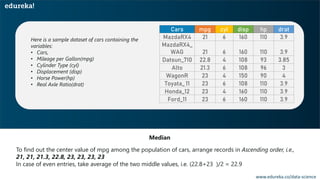
To find out the center value of mpg among the population of cars, arrange records in Ascending order, i.e.,
21, 21, 21.3, 22.8, 23, 23, 23, 23
In case of even entries, take average of the two middle values, i.e. (22.8+23 )/2 = 22.9
Median
www.edureka.co/data-science
Cars mpg cyl disp hp drat
MazdaRX4 21 6 160 110 3.9
MazdaRX4_
WAG 21 6 160 110 3.9
Datsun_710 22.8 4 108 93 3.85
Alto 21.3 6 108 96 3
WagonR 23 4 150 90 4
Toyata_ 11 23 6 108 110 3.9
Honda_12 23 4 160 110 3.9
Ford_11 23 6 160 110 3.9
Here is a sample dataset of cars containing the
variables:
• Cars,
• Mileage per Gallon(mpg)
• Cylinder Type (cyl)
• Displacement (disp)
• Horse Power(hp)
• Real Axle Ratio(drat)
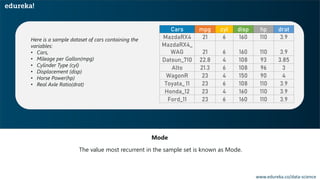
The value most recurrent in the sample set is known as Mode.
Mode
www.edureka.co/data-science
Cars mpg cyl disp hp drat
MazdaRX4 21 6 160 110 3.9
MazdaRX4_
WAG 21 6 160 110 3.9
Datsun_710 22.8 4 108 93 3.85
Alto 21.3 6 108 96 3
WagonR 23 4 150 90 4
Toyata_ 11 23 6 108 110 3.9
Honda_12 23 4 160 110 3.9
Ford_11 23 6 160 110 3.9
Here is a sample dataset of cars containing the
variables:
• Cars,
• Mileage per Gallon(mpg)
• Cylinder Type (cyl)
• Displacement (disp)
• Horse Power(hp)
• Real Axle Ratio(drat)
To find the most common type of cylinder among the population of cars, check the value which is repeated
most number of times, i.e., cylinder type 6
Mode
www.edureka.co/data-science
Cars mpg cyl disp hp drat
MazdaRX4 21 6 160 110 3.9
MazdaRX4_
WAG 21 6 160 110 3.9
Datsun_710 22.8 4 108 93 3.85
Alto 21.3 6 108 96 3
WagonR 23 4 150 90 4
Toyata_ 11 23 6 108 110 3.9
Honda_12 23 4 160 110 3.9
Ford_11 23 6 160 110 3.9
Here is a sample dataset of cars containing the
variables:
• Cars,
• Mileage per Gallon(mpg)
• Cylinder Type (cyl)
• Displacement (disp)
• Horse Power(hp)
• Real Axle Ratio(drat)
MEASURES OF SPREAD
www.edureka.co/data-science
A measure of spread, sometimes also called a measure of dispersion, is used to describe the variability in a
sample or population.
Range Standard DeviationInter Quartile Range Variance
Range is the given measure of how spread apart the values in a dataset are.
Range = Max(𝑥𝑖) - Min(𝑥𝑖)
www.edureka.co/data-science
Quartiles tell us about the spread of a data set by breaking the data set into quarters, just like the
median breaks it in half.
1 2 3 4 5 6 7 8
Q1 Q2 Q3
A measure of spread, sometimes also called a measure of dispersion, is used to describe the variability in a
sample or population.
Range Standard DeviationInter Quartile Range Variance
www.edureka.co/data-science
Inter Quartile Range(IQR) is the measure of variability, based on dividing a dataset into quartiles.
• Quartiles divide a rank-ordered data set into four equal parts, denoted by Q1, Q2, and Q3,
respectively
• The interquartile range is equal to Q3 minus Q1, i.e.. IQR = Q3 - Q1
A measure of spread, sometimes also called a measure of dispersion, is used to describe the variability in a
sample or population.
Range Standard DeviationInter Quartile Range Variance
www.edureka.co/data-science
A measure of spread, sometimes also called a measure of dispersion, is used to describe the variability in a
sample or population.
Range Standard DeviationInter Quartile Range Variance
www.edureka.co/data-science
Variance describes how much a random variable differs from its expected value.
It entails computing squares of deviations.
x : Individual data points
n : Total number of data points
x̅ : Mean of data points
A measure of spread, sometimes also called a measure of dispersion, is used to describe the variability in a
sample or population.
Range Standard DeviationInter Quartile Range Variance
www.edureka.co/data-science
Deviation is the difference between each element from the mean.
Deviation = (𝑥𝑖-µ)
A measure of spread, sometimes also called a measure of dispersion, is used to describe the variability in a
sample or population.
Range Standard DeviationInter Quartile Range Variance
www.edureka.co/data-science
Population Variance is the average of squared deviations.
෍
𝑖=1
𝑁
= (𝑥𝑖−𝜇)²
1
𝑁
σ² =
A measure of spread, sometimes also called a measure of dispersion, is used to describe the variability in a
sample or population.
Range Standard DeviationInter Quartile Range Variance
www.edureka.co/data-science
Sample Variance is the average of squared differences from the mean.
෍
𝑖=1
𝑁
= (𝑥𝑖− ҧ𝑥)²
1
(𝑛 − 1)
s² =
A measure of spread, sometimes also called a measure of dispersion, is used to describe the variability in a
sample or population.
Range Standard DeviationInter Quartile Range Variance
www.edureka.co/data-science
Standard Deviation is the measure of the dispersion of a set of data from its mean.
𝜎 =
1
𝑁
෍
𝑖=1
𝑁
𝑥𝑖 − 𝜇 2
A measure of spread, sometimes also called a measure of dispersion, is used to describe the variability in a
sample or population.
Range Standard DeviationInter Quartile Range Variance
www.edureka.co/data-science
Standard Deviation Use Case: Daenerys has 20 Dragons. They have the numbers 9, 2, 5, 4, 12, 7, 8, 11, 9, 3, 7, 4, 12,
5, 4, 10, 9, 6, 9, 4. Work out the Standard Deviation.
Find out the
mean for your sample
set.
STEP 1
The Mean is:
9+2+5+4+12+7+8+11+9+3+7+4+12+5+4+10+9+6+9+4
20
⸫µ=7
www.edureka.co/data-science
Standard Deviation Use Case: Daenerys has 20 Dragons. They have the numbers 9, 2, 5, 4, 12, 7, 8, 11, 9, 3, 7, 4, 12,
5, 4, 10, 9, 6, 9, 4. Work out the Standard Deviation.
Then for each number,
subtract the Mean and
square the result.
STEP 2
(𝑥𝑖−𝜇)²
(9-7)²= 2²=4
(2-7)²= (-5)²=25
(5-7)²= (-2)²=4
And so on…
⸫ We get the following results:
4, 25, 4, 9, 25, 0, 1, 16, 4, 16, 0, 9, 25, 4, 9, 9, 4, 1, 4, 9
www.edureka.co/data-science
Standard Deviation Use Case: Daenerys has 20 Dragons. They have the numbers 9, 2, 5, 4, 12, 7, 8, 11, 9, 3, 7, 4, 12,
5, 4, 10, 9, 6, 9, 4. Work out the Standard Deviation.
Then work out the
mean of those squared
differences.
STEP 3
4+25+4+9+25+0+1+16+4+16+0+9+25+4+9+9+4+1+4+9
20
⸫ σ² = 8.9
෍
𝑖=1
𝑁
=(𝑥𝑖−𝜇)²
1
𝑁
σ =
www.edureka.co/data-science
Standard Deviation Use Case: Daenerys has 20 Dragons. They have the numbers 9, 2, 5, 4, 12, 7, 8, 11, 9, 3, 7, 4, 12,
5, 4, 10, 9, 6, 9, 4. Work out the Standard Deviation.
Take square root of
σ².
STEP 4
⸫ σ = 2.983
෍
𝑖=1
𝑁
=(𝑥𝑖−𝜇)²
1
𝑁
σ =
INFORMATION GAIN & ENTROPY
www.edureka.co/data-science
Entropy Information Gain (IG)
Entropy measures the impurity or uncertainty present in the
data.
where:
• S – set of all instances in the dataset
• N – number of distinct class values
• pi – event probability
IG indicates how much “information” a particular feature/
variable gives us about the final outcome.
where:
H(S) – entropy of the whole dataset S
• |Sj| – number of instance with j value of an attribute A
• |S| – total number of instances in dataset S
• v – set of distinct values of an attribute A
• H(Sj) – entropy of subset of instances for attribute A
• H(A, S) – entropy of an attribute A
USE CASE
www.edureka.co/data-science
Forecast whether the match
will be played or not
according to weather
conditions
www.edureka.co/data-science
Outlook
Sunny Overcast Rain
Yes – 2
No – 3
Yes – 3
No – 2
Yes – 4
No – 0
Yes – 9
No – 5
www.edureka.co/data-science
From the total of 14 instances we have:
• 9 instances “yes”
• 5 instances “no”
The Entropy is:
www.edureka.co/data-science
Selecting the root variable
www.edureka.co/data-science
Information Gain of attribute “windy”
From the total of 14 instances we have:
• 6 instances “true”
• 8 instances “false”
www.edureka.co/data-science
Information Gain of attribute “outlook”
From the total of 14 instances we have:
• 5 instances “sunny”
• 4 instances “overcast”
• 5 instances “rainy”
www.edureka.co/data-science
Information Gain of attribute “humidity”
From the total of 14 instances we have:
• 7 instances “high”
• 7 instances “normal”
www.edureka.co/data-science
Information Gain of attribute “temperature”
From the total of 14 instances we have:
• 4 instances “hot”
• 6 instances “mild”
• 4 instances “cool”
The variable with the highest IG is used to split the data at the root node.
www.edureka.co/data-science
Gain = 0.247 Gain = 0.048 Gain = 0.151 Gain = 0.029
www.edureka.co/data-science
Gain = 0.247 Gain = 0.048 Gain = 0.151 Gain = 0.029
The variable with the highest IG is used to split the data at the root node. The ‘Outlook’ variable has the highest IG, therefore
it can be assigned to the root node.
CONFUSION MATRIX
www.edureka.co/data-science
A confusion matrix is a table that is often used to describe the performance of a classification model (or "classifier")
on a set of test data for which the true values are known.
Confusion Matrix represents a tabular representation of Actual vs Predicted values
You can calculate the accuracy of your model with:
www.edureka.co/data-science
• There are two possible predicted classes: "yes" and "no”
• The classifier made a total of 165 predictions
• Out of those 165 cases, the classifier predicted "yes" 110 times, and "no" 55 times
• In reality, 105 patients in the sample have the disease, and 60 patients do not
www.edureka.co/data-science
PROBABILITY
www.edureka.co/data-science
• Probability is the ratio of desired outcomes to total outcomes:
(desired outcomes) / (total outcomes)
• Probabilities of all outcomes always sums to 1
Example:
• On rolling a dice, you get 6 possible outcomes
• Each possibility only has one outcome, so each has a probability of 1/6
• For example, the probability of getting a number ‘2’ on the dice is 1/6
Probability is the measure of how likely an event will occur.
TERMINOLOGIES IN PROBABILITY
www.edureka.co/data-science
Disjoint Events do not have any common outcomes.
• The outcome of a ball delivered cannot be a sixer and a wicket
• A single card drawn from a deck cannot be a king and a queen
• A man cannot be dead and alive
Non-Disjoint Events can have common outcomes
• A student can get 100 marks in statistics and 100 marks in probability
• The outcome of a ball delivered can be a no ball and a six
PROBABILITY DISTRIBUTION
www.edureka.co/data-science
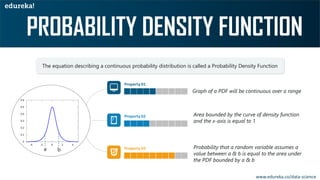
Graph of a PDF will be continuous over a range
Area bounded by the curve of density function
and the x-axis is equal to 1
Probability that a random variable assumes a
value between a & b is equal to the area under
the PDF bounded by a & b
The equation describing a continuous probability distribution is called a Probability Density Function
a b
www.edureka.co/data-science
The Normal Distribution is a probability distribution that associates the normal random variable X with a
cumulative probability
Y = [ 1/σ * sqrt(2π) ] * e -(x - μ)2/2σ2
Where,
•X is a normal random variable
•μ is the mean and
•σ is the standard deviation
Note: Normal Random variable is variable with mean at 0 and variance equal to 1
www.edureka.co/data-science
The graph of the Normal Distribution depends on two factors: the Mean and the Standard Deviation
• Mean: Determines the location of center of the graph
• Standard Deviation: Determines the height of the graph
If the standard deviation is large,
the curve is short and wide.
If the standard deviation is small, the
curve is tall and narrow.
www.edureka.co/data-science
The Central Limit Theorem states that the sampling distribution of the mean of any independent,
random variable will be normal or nearly normal, if the sample size is large enough
TYPES OF PROBABILITY
www.edureka.co/data-science
Marginal Probability is the probability of occurrence of a single event.
Marginal Probability = 13
52
It can be expressed as: P (A) = σ𝑖=1
𝑘
𝑃( 𝑥𝑖 )
www.edureka.co/data-science
Joint Probability is a measure of two events happening at the same time
Example: The probability that a card is an Ace of hearts = P (Ace of hearts)
(There are 13 heart cards in a deck of 52 and out of them one in the Ace of hearts)
www.edureka.co/data-science
• Probability of an event or outcome based on the occurrence of a previous event or outcome
• Conditional Probability of an event B is the probability that the event will occur given that an event A has
already occurred
If A and B are dependent events then the
expression for conditional probability is given by:
P (B|A) = P (A and B) / P (A)
If A and B are independent events then the
expression for conditional probability is given by:
P(B|A) = P (B)
USE CASE
www.edureka.co/data-science
Finding the probability that a candidate has undergone Edureka’s training
www.edureka.co/data-science
The probability that a candidate has undergone Edureka’s training
P(Edu.Training ) = 45 /105 ≈ 0.42
www.edureka.co/data-science
Finding the probability that a candidate has attended Edureka’s training and also has good package.
www.edureka.co/data-science
P (Good Package & Edu.Training ) =
30 /105 ≈ 0.28
Salary Training
www.edureka.co/data-science
Finding the probability that a candidate has a good package given that he has not undergone training
www.edureka.co/data-science
P (Good Package | Without Edureka) = 5 / 60 ≈ 0.08
BAYES’ THEOREM
www.edureka.co/data-science
Shows the relation between one conditional probability and its inverse
P (B|A) is referred to as likelihood ratio which
measures the probability (given event A) of
occurrence of B
P (A) is referred to as Prior which
represents the actual probability
distribution of A
P (A|B) = P (B|A) P (A) P (B)
P (A|B) is referred to as posterior which
means the probability of occurrence of A
given B
www.edureka.co/data-science
“ Consider 3 bowls. Bowl A contains 2 blue balls and 4 red balls; Bowl B contains 8 blue balls and 4 red balls,
Bowl C contains 1 blue ball and 3 red balls. We draw 1 ball from each bowl. What is the probability to draw a
blue ball from Bowl A if we know that we drew exactly a total of 2 blue balls? ”
Bowl A Bowl B Bowl C
www.edureka.co/data-science
• Let A be the event of picking a blue ball from bag A, and let X be the event of picking exactly
two blue balls
• We want Probability(A∣X), i.e. probability of occurrence of event A given X
By the definition of Conditional Probability,
• We need to find the two probabilities on the right-side of equal to symbolop
P𝑟 𝐴 𝑋 = 𝑃𝑟 (𝐴 ∩ X)
Pr (X)
www.edureka.co/data-science
Steps to execute the problem
First find Pr(X). This can happen in three ways:
(i) white from A, white from B, red from C
(ii) white from A, red from B, white from C
(iii) red from A, white from B, white from C
Next we find Pr(A∩X).
This is the sum of terms (i) and (ii) above
Step 1:
Step 2:
INFERENTIAL STATISTICS
www.edureka.co/data-science
POINT ESTIMATION
www.edureka.co/data-science
Point Estimation is concerned with the use of the sample data to measure a single value which serves as an
approximate value or the best estimate of an unknown population parameter.
Population Sample
Random
Estimate
ҧ𝑥𝜇
Mean of
Population
Sample Mean
Point Estimation is concerned with the use of the sample data to measure a single value which serves as an
approximate value or the best estimate of an unknown population parameter.
www.edureka.co/data-science
Method of Moments
Estimates are found out by equating the first k sample
moments to the corresponding k population moments
Maximum of Likelihood
Uses a model and the values in the model to maximize a
likelihood function. This results in the most likely
parameter for the inputs selected
Bayes’ Estimators
Minimizes the average risk (an expectation of random
variables)
Best Unbiased Estimators
Several unbiased estimators can be used to approximate a
parameter (which one is “best” depends on what parameter
you are trying to find)
www.edureka.co/data-science
There are two important
statistical parameters to
determine how well the point
estimates generalise the entire
population. Let’s explore them
too
INTERVAL ESTIMATION
www.edureka.co/data-science
An Interval, or range of values, used to estimate a population parameter is called Interval Estimate.
www.edureka.co/data-science
03
01
02
Confidence Interval is the measure of your confidence, that the interval
estimate contains the population mean, 𝜇
Statisticians use a confidence interval to describe the amount of uncertainty
associated with a sample estimate of a population parameter
Technically, a range of values so constructed that there is a specified probability
of including the true value of a parameter within it
www.edureka.co/data-science
• Difference between the point estimate and the actual population parameter value is called the Sampling Error
• When 𝜇 is estimated, the sampling error is the difference 𝜇 - ҧ𝑥
Margin of Error E, for a given level of confidence is the greatest possible distance between the
point estimate and the value of the parameter it is estimating
ESTIMATING LEVEL OF CONFIDENCE
www.edureka.co/data-science
The level of confidence c, is the probability that the interval estimate contains the population parameter.
C is the area beneath the normal curve between the critical values
Corresponding Z score can be calculated using the standard normal table
www.edureka.co/data-science
If the level of confidence is 90%, this means that you are 90% confident that the interval contains
the population mean, 𝜇.
The Corresponding Z – scores are ± 1.645
USE CASE
www.edureka.co/data-science
A random sample of 32 textbook prices is taken from a local college bookstore. The mean of the sample is 𝑥 ̅ = 74.22, and
the sample standard deviation is S = 23.44. Use a 95% confidence level and find the margin of error for the mean price of all
textbooks in the bookstore
www.edureka.co/data-science
You know by formula,
E = 1.96 * (23.44/√32) ≈ 8.12
A random sample of 32 textbook prices is taken from a local college bookstore. The mean of the sample is 𝑥 ̅ = 74.22, and
the sample standard deviation is S = 23.44. Use a 95% confidence level and find the margin of error for the mean price of all
textbooks in the bookstore
HYPOTHESIS TESTING
www.edureka.co/data-science
Statisticians use hypothesis testing to formally check whether the hypothesis is
accepted or rejected.
Hypothesis testing is conducted in the following manner:
❖ State the Hypotheses – This stage involves stating the null and alternative hypotheses.
❖ Formulate an Analysis Plan – This stage involves the construction of an analysis plan.
❖ Analyse Sample Data – This stage involves the calculation and interpretation of the test statistic as
described in the analysis plan.
❖ Interpret Results – This stage involves the application of the decision rule described in the analysis plan.
UNDERSTANDING HYPOTHESIS TESTING
www.edureka.co/data-science
Nick John Bob Harry
Assume the event is free of bias.
So, what is the probability of John not cheating?
www.edureka.co/data-science
P(John not picked for a day) =
3
4
P(John not picked for 3 days) =
3
4
×
3
4
×
3
4
= 0.42 (approx)
P(John not picked for 12 days) = (
3
4
) 12 = 0.032 < 𝟎. 𝟎𝟓
Nick John Bob Harry
www.edureka.co/data-science
Null Hypothesis (𝑯 𝟎) : Result is no different from assumption.
Alternate Hypothesis (𝑯 𝒂) : Result disproves the assumption.
Probability of Event < 𝟎. 𝟎𝟓 (5%)
Nick John Bob Harry
Copyright © 2017, edureka and/or its affiliates. All rights reserved.
www.edureka.co
Statistics And Probability Tutorial | Statistics And Probability for Data Science | Edureka

Statistics And Probability Tutorial | Statistics And Probability for Data Science | Edureka

  • 2.
    WHAT IS DATA? CATEGORIESOF DATA BASIC TERMINOLOGIES IN STATISTICS SAMPLING TECHNIQUES DESCRIPTIVE STATISTICS TYPES OF STATISTICS www.edureka.co/data-science WHAT IS STATISTICS? PROBABILITY INFERENTIAL STATISTICS
  • 3.
  • 4.
    www.edureka.co/data-science Data refers tofacts and statistics collected together for reference or analysis. Collected and Stored Measured Analyzed Visualized Data
  • 5.
  • 6.
    Types Of Data www.edureka.co/data-science Data QualitativeQuantitative Nominal Ordinal Discrete Continuous
  • 7.
    www.edureka.co/data-science Qualitative data dealswith characteristics and descriptors that can't be easily measured, but can be observed subjectively. Nominal Data Ordinal Data Data with no inherent order or ranking such as gender or race, such kind of data is called Nominal data Data with an ordered series, such as shown in the table, such kind of data is called Ordinal data Gender Male Female Male Male Customer ID Rating 001 Good 002 Average 003 Average 004 Bad
  • 8.
    www.edureka.co/data-science Quantitative data dealswith numbers and things you can measure objectively. Discrete Data Continuous Data Also known as categorical data, it can hold finite number of possible values. Data that can hold infinite number of possible values. Example: Number of students in a class Example: Weight of a person
  • 9.
  • 10.
    https://www.kaspersky.com/blog/tip-of-the-week-how-to-get-rid-of-unwanted-emails/3005/ www.edureka.co/data-science WHAT IS STATISTICS? Statisticsis an area of applied mathematics concerned with the data collection, analysis, interpretation and presentation. Your company has created a new drug that may cure cancer. How would you conduct a test to confirm the drug's effectiveness?
  • 11.
    https://www.kaspersky.com/blog/tip-of-the-week-how-to-get-rid-of-unwanted-emails/3005/ www.edureka.co/data-science WHAT IS STATISTICS? Statisticsis an area of applied mathematics concerned with the data collection, analysis, interpretation and presentation. You and a friend are at a baseball game, and out of the blue he offers you a bet that neither team will hit a home run in that game. Should you take the bet?
  • 12.
    https://www.kaspersky.com/blog/tip-of-the-week-how-to-get-rid-of-unwanted-emails/3005/ www.edureka.co/data-science WHAT IS STATISTICS? Statisticsis an area of applied mathematics concerned with the data collection, analysis, interpretation and presentation. The latest sales data have just come in, and your boss wants you to prepare a report for management on places where the company could improve its business. What should you look for? What should you not look for?
  • 13.
    BASIC TERMINOLOGIES INSTATISTICS www.edureka.co/data-science
  • 14.
    Population: A collectionor set of individuals or objects or events whose properties are to be analyzed. Sample: A subset of population is called ‘Sample’. A well chosen sample will contain most of the information about a particular population parameter Statistics Terminologies www.edureka.co/data-science Population Sample
  • 15.
  • 16.
  • 17.
    www.edureka.co/data-science Random Sampling Systematic Sampling StratifiedSampling Each member of the population has equal chance of being selected in the sample.
  • 18.
    www.edureka.co/data-science Random Sampling Systematic Sampling StratifiedSampling In Systematic sampling every nth record is chosen from the population to be a part of the sample. 1 2 3 4 5 6 2 4 6 Everynthrecordischosen Every2nd recordischosen
  • 19.
    www.edureka.co/data-science Random Sampling Systematic Sampling StratifiedSampling • A stratum is a subset of the population that shares at least one common characteristic, in this case it’s gender. • Random sampling is used to select a sufficient number of subjects from each stratum. Malesubset Femalesubset Chosensample
  • 20.
  • 21.
    https://www.kaspersky.com/blog/tip-of-the-week-how-to-get-rid-of-unwanted-emails/3005/ www.edureka.co/data-science DESCRIPTIVE STATISTICS Descriptive statistics usesthe data to provide descriptions of the population, either through numerical calculations or graphs or tables. Maximum Average Minimum Descriptive Statistics is mainly focused upon the main characteristics of data. It provides graphical summary of the data.
  • 22.
    https://www.kaspersky.com/blog/tip-of-the-week-how-to-get-rid-of-unwanted-emails/3005/ www.edureka.co/data-science INFERENTIAL STATISTICS Inferential statistics makesinferences and predictions about a population based on a sample of data taken from the population in question. Large Medium Small Inferential statistics, generalizes a large dataset and applies probability to draw a conclusion. It allows us to infer data parameters based on a statistical model using a sample data.
  • 23.
  • 24.
    www.edureka.co/data-science Descriptive statistics isa method used to describe and understand the features of a specific data set by giving short summaries about the sample and measures of the data. Descriptive statistics is broken down into two categories: • Measures of central tendency • Measures of variability (spread)
  • 25.
    www.edureka.co/data-science Descriptive statistics isa method used to describe and understand the features of a specific data set by giving short summaries about the sample and measures of the data. Descriptive statistics are broken down into two categories: • Measures of Central tendency • Measures of Variability (spread) Measures of Centre Mean ModeMedian
  • 26.
    www.edureka.co/data-science Descriptive statistics isa method used to describe and understand the features of a specific data set by giving short summaries about the sample and measures of the data. Descriptive statistics are broken down into two categories: • Measures of Central tendency • Measures of Variability (spread) Measures of Spread Range Standard DeviationInter Quartile Range Variance
  • 27.
  • 28.
    Measure of averageof all the values in a sample is called Mean. Mean www.edureka.co/data-science Cars mpg cyl disp hp drat MazdaRX4 21 6 160 110 3.9 MazdaRX4_ WAG 21 6 160 110 3.9 Datsun_710 22.8 4 108 93 3.85 Alto 21.3 6 108 96 3 WagonR 23 4 150 90 4 Toyata_ 11 23 6 108 110 3.9 Honda_12 23 4 160 110 3.9 Ford_11 23 6 160 110 3.9 Here is a sample dataset of cars containing the variables: • Cars, • Mileage per Gallon(mpg) • Cylinder Type (cyl) • Displacement (disp) • Horse Power(hp) • Real Axle Ratio(drat)
  • 29.
    To find outthe average horsepower of the cars among the population of cars, we will check and calculate the average of all values: Mean www.edureka.co/data-science Cars mpg cyl disp hp drat MazdaRX4 21 6 160 110 3.9 MazdaRX4_ WAG 21 6 160 110 3.9 Datsun_710 22.8 4 108 93 3.85 Alto 21.3 6 108 96 3 WagonR 23 4 150 90 4 Toyata_ 11 23 6 108 110 3.9 Honda_12 23 4 160 110 3.9 Ford_11 23 6 160 110 3.9 110 + 110 + 93 + 96 + 90 + 110 + 110 + 110 8 = 103.625 Here is a sample dataset of cars containing the variables: • Cars, • Mileage per Gallon(mpg) • Cylinder Type (cyl) • Displacement (disp) • Horse Power(hp) • Real Axle Ratio(drat)
  • 30.
    Measure of thecentral value of the sample set is called Median. Median www.edureka.co/data-science Cars mpg cyl disp hp drat MazdaRX4 21 6 160 110 3.9 MazdaRX4_ WAG 21 6 160 110 3.9 Datsun_710 22.8 4 108 93 3.85 Alto 21.3 6 108 96 3 WagonR 23 4 150 90 4 Toyata_ 11 23 6 108 110 3.9 Honda_12 23 4 160 110 3.9 Ford_11 23 6 160 110 3.9 Here is a sample dataset of cars containing the variables: • Cars, • Mileage per Gallon(mpg) • Cylinder Type (cyl) • Displacement (disp) • Horse Power(hp) • Real Axle Ratio(drat)
  • 31.
    To find outthe center value of mpg among the population of cars, arrange records in Ascending order, i.e., 21, 21, 21.3, 22.8, 23, 23, 23, 23 In case of even entries, take average of the two middle values, i.e. (22.8+23 )/2 = 22.9 Median www.edureka.co/data-science Cars mpg cyl disp hp drat MazdaRX4 21 6 160 110 3.9 MazdaRX4_ WAG 21 6 160 110 3.9 Datsun_710 22.8 4 108 93 3.85 Alto 21.3 6 108 96 3 WagonR 23 4 150 90 4 Toyata_ 11 23 6 108 110 3.9 Honda_12 23 4 160 110 3.9 Ford_11 23 6 160 110 3.9 Here is a sample dataset of cars containing the variables: • Cars, • Mileage per Gallon(mpg) • Cylinder Type (cyl) • Displacement (disp) • Horse Power(hp) • Real Axle Ratio(drat)
  • 32.
    The value mostrecurrent in the sample set is known as Mode. Mode www.edureka.co/data-science Cars mpg cyl disp hp drat MazdaRX4 21 6 160 110 3.9 MazdaRX4_ WAG 21 6 160 110 3.9 Datsun_710 22.8 4 108 93 3.85 Alto 21.3 6 108 96 3 WagonR 23 4 150 90 4 Toyata_ 11 23 6 108 110 3.9 Honda_12 23 4 160 110 3.9 Ford_11 23 6 160 110 3.9 Here is a sample dataset of cars containing the variables: • Cars, • Mileage per Gallon(mpg) • Cylinder Type (cyl) • Displacement (disp) • Horse Power(hp) • Real Axle Ratio(drat)
  • 33.
    To find themost common type of cylinder among the population of cars, check the value which is repeated most number of times, i.e., cylinder type 6 Mode www.edureka.co/data-science Cars mpg cyl disp hp drat MazdaRX4 21 6 160 110 3.9 MazdaRX4_ WAG 21 6 160 110 3.9 Datsun_710 22.8 4 108 93 3.85 Alto 21.3 6 108 96 3 WagonR 23 4 150 90 4 Toyata_ 11 23 6 108 110 3.9 Honda_12 23 4 160 110 3.9 Ford_11 23 6 160 110 3.9 Here is a sample dataset of cars containing the variables: • Cars, • Mileage per Gallon(mpg) • Cylinder Type (cyl) • Displacement (disp) • Horse Power(hp) • Real Axle Ratio(drat)
  • 34.
  • 35.
    www.edureka.co/data-science A measure ofspread, sometimes also called a measure of dispersion, is used to describe the variability in a sample or population. Range Standard DeviationInter Quartile Range Variance Range is the given measure of how spread apart the values in a dataset are. Range = Max(𝑥𝑖) - Min(𝑥𝑖)
  • 36.
    www.edureka.co/data-science Quartiles tell usabout the spread of a data set by breaking the data set into quarters, just like the median breaks it in half. 1 2 3 4 5 6 7 8 Q1 Q2 Q3 A measure of spread, sometimes also called a measure of dispersion, is used to describe the variability in a sample or population. Range Standard DeviationInter Quartile Range Variance
  • 37.
  • 38.
    www.edureka.co/data-science Inter Quartile Range(IQR)is the measure of variability, based on dividing a dataset into quartiles. • Quartiles divide a rank-ordered data set into four equal parts, denoted by Q1, Q2, and Q3, respectively • The interquartile range is equal to Q3 minus Q1, i.e.. IQR = Q3 - Q1 A measure of spread, sometimes also called a measure of dispersion, is used to describe the variability in a sample or population. Range Standard DeviationInter Quartile Range Variance
  • 39.
    www.edureka.co/data-science A measure ofspread, sometimes also called a measure of dispersion, is used to describe the variability in a sample or population. Range Standard DeviationInter Quartile Range Variance
  • 40.
    www.edureka.co/data-science Variance describes howmuch a random variable differs from its expected value. It entails computing squares of deviations. x : Individual data points n : Total number of data points x̅ : Mean of data points A measure of spread, sometimes also called a measure of dispersion, is used to describe the variability in a sample or population. Range Standard DeviationInter Quartile Range Variance
  • 41.
    www.edureka.co/data-science Deviation is thedifference between each element from the mean. Deviation = (𝑥𝑖-µ) A measure of spread, sometimes also called a measure of dispersion, is used to describe the variability in a sample or population. Range Standard DeviationInter Quartile Range Variance
  • 42.
    www.edureka.co/data-science Population Variance isthe average of squared deviations. ෍ 𝑖=1 𝑁 = (𝑥𝑖−𝜇)² 1 𝑁 σ² = A measure of spread, sometimes also called a measure of dispersion, is used to describe the variability in a sample or population. Range Standard DeviationInter Quartile Range Variance
  • 43.
    www.edureka.co/data-science Sample Variance isthe average of squared differences from the mean. ෍ 𝑖=1 𝑁 = (𝑥𝑖− ҧ𝑥)² 1 (𝑛 − 1) s² = A measure of spread, sometimes also called a measure of dispersion, is used to describe the variability in a sample or population. Range Standard DeviationInter Quartile Range Variance
  • 44.
    www.edureka.co/data-science Standard Deviation isthe measure of the dispersion of a set of data from its mean. 𝜎 = 1 𝑁 ෍ 𝑖=1 𝑁 𝑥𝑖 − 𝜇 2 A measure of spread, sometimes also called a measure of dispersion, is used to describe the variability in a sample or population. Range Standard DeviationInter Quartile Range Variance
  • 45.
    www.edureka.co/data-science Standard Deviation UseCase: Daenerys has 20 Dragons. They have the numbers 9, 2, 5, 4, 12, 7, 8, 11, 9, 3, 7, 4, 12, 5, 4, 10, 9, 6, 9, 4. Work out the Standard Deviation. Find out the mean for your sample set. STEP 1 The Mean is: 9+2+5+4+12+7+8+11+9+3+7+4+12+5+4+10+9+6+9+4 20 ⸫µ=7
  • 46.
    www.edureka.co/data-science Standard Deviation UseCase: Daenerys has 20 Dragons. They have the numbers 9, 2, 5, 4, 12, 7, 8, 11, 9, 3, 7, 4, 12, 5, 4, 10, 9, 6, 9, 4. Work out the Standard Deviation. Then for each number, subtract the Mean and square the result. STEP 2 (𝑥𝑖−𝜇)² (9-7)²= 2²=4 (2-7)²= (-5)²=25 (5-7)²= (-2)²=4 And so on… ⸫ We get the following results: 4, 25, 4, 9, 25, 0, 1, 16, 4, 16, 0, 9, 25, 4, 9, 9, 4, 1, 4, 9
  • 47.
    www.edureka.co/data-science Standard Deviation UseCase: Daenerys has 20 Dragons. They have the numbers 9, 2, 5, 4, 12, 7, 8, 11, 9, 3, 7, 4, 12, 5, 4, 10, 9, 6, 9, 4. Work out the Standard Deviation. Then work out the mean of those squared differences. STEP 3 4+25+4+9+25+0+1+16+4+16+0+9+25+4+9+9+4+1+4+9 20 ⸫ σ² = 8.9 ෍ 𝑖=1 𝑁 =(𝑥𝑖−𝜇)² 1 𝑁 σ =
  • 48.
    www.edureka.co/data-science Standard Deviation UseCase: Daenerys has 20 Dragons. They have the numbers 9, 2, 5, 4, 12, 7, 8, 11, 9, 3, 7, 4, 12, 5, 4, 10, 9, 6, 9, 4. Work out the Standard Deviation. Take square root of σ². STEP 4 ⸫ σ = 2.983 ෍ 𝑖=1 𝑁 =(𝑥𝑖−𝜇)² 1 𝑁 σ =
  • 49.
    INFORMATION GAIN &ENTROPY www.edureka.co/data-science
  • 50.
    www.edureka.co/data-science Entropy Information Gain(IG) Entropy measures the impurity or uncertainty present in the data. where: • S – set of all instances in the dataset • N – number of distinct class values • pi – event probability IG indicates how much “information” a particular feature/ variable gives us about the final outcome. where: H(S) – entropy of the whole dataset S • |Sj| – number of instance with j value of an attribute A • |S| – total number of instances in dataset S • v – set of distinct values of an attribute A • H(Sj) – entropy of subset of instances for attribute A • H(A, S) – entropy of an attribute A
  • 51.
  • 52.
    www.edureka.co/data-science Forecast whether thematch will be played or not according to weather conditions
  • 53.
    www.edureka.co/data-science Outlook Sunny Overcast Rain Yes– 2 No – 3 Yes – 3 No – 2 Yes – 4 No – 0 Yes – 9 No – 5
  • 54.
    www.edureka.co/data-science From the totalof 14 instances we have: • 9 instances “yes” • 5 instances “no” The Entropy is:
  • 55.
  • 56.
    www.edureka.co/data-science Information Gain ofattribute “windy” From the total of 14 instances we have: • 6 instances “true” • 8 instances “false”
  • 57.
    www.edureka.co/data-science Information Gain ofattribute “outlook” From the total of 14 instances we have: • 5 instances “sunny” • 4 instances “overcast” • 5 instances “rainy”
  • 58.
    www.edureka.co/data-science Information Gain ofattribute “humidity” From the total of 14 instances we have: • 7 instances “high” • 7 instances “normal”
  • 59.
    www.edureka.co/data-science Information Gain ofattribute “temperature” From the total of 14 instances we have: • 4 instances “hot” • 6 instances “mild” • 4 instances “cool”
  • 60.
    The variable withthe highest IG is used to split the data at the root node. www.edureka.co/data-science Gain = 0.247 Gain = 0.048 Gain = 0.151 Gain = 0.029
  • 61.
    www.edureka.co/data-science Gain = 0.247Gain = 0.048 Gain = 0.151 Gain = 0.029 The variable with the highest IG is used to split the data at the root node. The ‘Outlook’ variable has the highest IG, therefore it can be assigned to the root node.
  • 62.
  • 63.
    www.edureka.co/data-science A confusion matrixis a table that is often used to describe the performance of a classification model (or "classifier") on a set of test data for which the true values are known. Confusion Matrix represents a tabular representation of Actual vs Predicted values You can calculate the accuracy of your model with:
  • 64.
    www.edureka.co/data-science • There aretwo possible predicted classes: "yes" and "no” • The classifier made a total of 165 predictions • Out of those 165 cases, the classifier predicted "yes" 110 times, and "no" 55 times • In reality, 105 patients in the sample have the disease, and 60 patients do not
  • 65.
  • 66.
  • 67.
    www.edureka.co/data-science • Probability isthe ratio of desired outcomes to total outcomes: (desired outcomes) / (total outcomes) • Probabilities of all outcomes always sums to 1 Example: • On rolling a dice, you get 6 possible outcomes • Each possibility only has one outcome, so each has a probability of 1/6 • For example, the probability of getting a number ‘2’ on the dice is 1/6 Probability is the measure of how likely an event will occur.
  • 68.
  • 69.
  • 70.
    www.edureka.co/data-science Disjoint Events donot have any common outcomes. • The outcome of a ball delivered cannot be a sixer and a wicket • A single card drawn from a deck cannot be a king and a queen • A man cannot be dead and alive Non-Disjoint Events can have common outcomes • A student can get 100 marks in statistics and 100 marks in probability • The outcome of a ball delivered can be a no ball and a six
  • 71.
  • 72.
  • 73.
    www.edureka.co/data-science Graph of aPDF will be continuous over a range Area bounded by the curve of density function and the x-axis is equal to 1 Probability that a random variable assumes a value between a & b is equal to the area under the PDF bounded by a & b The equation describing a continuous probability distribution is called a Probability Density Function a b
  • 74.
    www.edureka.co/data-science The Normal Distributionis a probability distribution that associates the normal random variable X with a cumulative probability Y = [ 1/σ * sqrt(2π) ] * e -(x - μ)2/2σ2 Where, •X is a normal random variable •μ is the mean and •σ is the standard deviation Note: Normal Random variable is variable with mean at 0 and variance equal to 1
  • 75.
    www.edureka.co/data-science The graph ofthe Normal Distribution depends on two factors: the Mean and the Standard Deviation • Mean: Determines the location of center of the graph • Standard Deviation: Determines the height of the graph If the standard deviation is large, the curve is short and wide. If the standard deviation is small, the curve is tall and narrow.
  • 76.
    www.edureka.co/data-science The Central LimitTheorem states that the sampling distribution of the mean of any independent, random variable will be normal or nearly normal, if the sample size is large enough
  • 77.
  • 78.
  • 79.
    www.edureka.co/data-science Marginal Probability isthe probability of occurrence of a single event. Marginal Probability = 13 52 It can be expressed as: P (A) = σ𝑖=1 𝑘 𝑃( 𝑥𝑖 )
  • 80.
    www.edureka.co/data-science Joint Probability isa measure of two events happening at the same time Example: The probability that a card is an Ace of hearts = P (Ace of hearts) (There are 13 heart cards in a deck of 52 and out of them one in the Ace of hearts)
  • 81.
    www.edureka.co/data-science • Probability ofan event or outcome based on the occurrence of a previous event or outcome • Conditional Probability of an event B is the probability that the event will occur given that an event A has already occurred If A and B are dependent events then the expression for conditional probability is given by: P (B|A) = P (A and B) / P (A) If A and B are independent events then the expression for conditional probability is given by: P(B|A) = P (B)
  • 82.
  • 83.
  • 84.
  • 85.
    www.edureka.co/data-science Finding the probabilitythat a candidate has undergone Edureka’s training
  • 86.
    www.edureka.co/data-science The probability thata candidate has undergone Edureka’s training P(Edu.Training ) = 45 /105 ≈ 0.42
  • 87.
    www.edureka.co/data-science Finding the probabilitythat a candidate has attended Edureka’s training and also has good package.
  • 88.
    www.edureka.co/data-science P (Good Package& Edu.Training ) = 30 /105 ≈ 0.28 Salary Training
  • 89.
    www.edureka.co/data-science Finding the probabilitythat a candidate has a good package given that he has not undergone training
  • 90.
    www.edureka.co/data-science P (Good Package| Without Edureka) = 5 / 60 ≈ 0.08
  • 91.
  • 92.
    www.edureka.co/data-science Shows the relationbetween one conditional probability and its inverse P (B|A) is referred to as likelihood ratio which measures the probability (given event A) of occurrence of B P (A) is referred to as Prior which represents the actual probability distribution of A P (A|B) = P (B|A) P (A) P (B) P (A|B) is referred to as posterior which means the probability of occurrence of A given B
  • 93.
    www.edureka.co/data-science “ Consider 3bowls. Bowl A contains 2 blue balls and 4 red balls; Bowl B contains 8 blue balls and 4 red balls, Bowl C contains 1 blue ball and 3 red balls. We draw 1 ball from each bowl. What is the probability to draw a blue ball from Bowl A if we know that we drew exactly a total of 2 blue balls? ” Bowl A Bowl B Bowl C
  • 94.
    www.edureka.co/data-science • Let Abe the event of picking a blue ball from bag A, and let X be the event of picking exactly two blue balls • We want Probability(A∣X), i.e. probability of occurrence of event A given X By the definition of Conditional Probability, • We need to find the two probabilities on the right-side of equal to symbolop P𝑟 𝐴 𝑋 = 𝑃𝑟 (𝐴 ∩ X) Pr (X)
  • 95.
    www.edureka.co/data-science Steps to executethe problem First find Pr(X). This can happen in three ways: (i) white from A, white from B, red from C (ii) white from A, red from B, white from C (iii) red from A, white from B, white from C Next we find Pr(A∩X). This is the sum of terms (i) and (ii) above Step 1: Step 2:
  • 96.
  • 97.
  • 98.
    www.edureka.co/data-science Point Estimation isconcerned with the use of the sample data to measure a single value which serves as an approximate value or the best estimate of an unknown population parameter. Population Sample Random Estimate ҧ𝑥𝜇 Mean of Population Sample Mean Point Estimation is concerned with the use of the sample data to measure a single value which serves as an approximate value or the best estimate of an unknown population parameter.
  • 99.
    www.edureka.co/data-science Method of Moments Estimatesare found out by equating the first k sample moments to the corresponding k population moments Maximum of Likelihood Uses a model and the values in the model to maximize a likelihood function. This results in the most likely parameter for the inputs selected Bayes’ Estimators Minimizes the average risk (an expectation of random variables) Best Unbiased Estimators Several unbiased estimators can be used to approximate a parameter (which one is “best” depends on what parameter you are trying to find)
  • 100.
    www.edureka.co/data-science There are twoimportant statistical parameters to determine how well the point estimates generalise the entire population. Let’s explore them too
  • 101.
  • 102.
    www.edureka.co/data-science An Interval, orrange of values, used to estimate a population parameter is called Interval Estimate.
  • 103.
    www.edureka.co/data-science 03 01 02 Confidence Interval isthe measure of your confidence, that the interval estimate contains the population mean, 𝜇 Statisticians use a confidence interval to describe the amount of uncertainty associated with a sample estimate of a population parameter Technically, a range of values so constructed that there is a specified probability of including the true value of a parameter within it
  • 104.
    www.edureka.co/data-science • Difference betweenthe point estimate and the actual population parameter value is called the Sampling Error • When 𝜇 is estimated, the sampling error is the difference 𝜇 - ҧ𝑥 Margin of Error E, for a given level of confidence is the greatest possible distance between the point estimate and the value of the parameter it is estimating
  • 105.
    ESTIMATING LEVEL OFCONFIDENCE www.edureka.co/data-science
  • 106.
    www.edureka.co/data-science The level ofconfidence c, is the probability that the interval estimate contains the population parameter. C is the area beneath the normal curve between the critical values Corresponding Z score can be calculated using the standard normal table
  • 107.
    www.edureka.co/data-science If the levelof confidence is 90%, this means that you are 90% confident that the interval contains the population mean, 𝜇. The Corresponding Z – scores are ± 1.645
  • 108.
  • 109.
    www.edureka.co/data-science A random sampleof 32 textbook prices is taken from a local college bookstore. The mean of the sample is 𝑥 ̅ = 74.22, and the sample standard deviation is S = 23.44. Use a 95% confidence level and find the margin of error for the mean price of all textbooks in the bookstore
  • 110.
    www.edureka.co/data-science You know byformula, E = 1.96 * (23.44/√32) ≈ 8.12 A random sample of 32 textbook prices is taken from a local college bookstore. The mean of the sample is 𝑥 ̅ = 74.22, and the sample standard deviation is S = 23.44. Use a 95% confidence level and find the margin of error for the mean price of all textbooks in the bookstore
  • 111.
  • 112.
    www.edureka.co/data-science Statisticians use hypothesistesting to formally check whether the hypothesis is accepted or rejected. Hypothesis testing is conducted in the following manner: ❖ State the Hypotheses – This stage involves stating the null and alternative hypotheses. ❖ Formulate an Analysis Plan – This stage involves the construction of an analysis plan. ❖ Analyse Sample Data – This stage involves the calculation and interpretation of the test statistic as described in the analysis plan. ❖ Interpret Results – This stage involves the application of the decision rule described in the analysis plan.
  • 113.
  • 114.
    www.edureka.co/data-science Nick John BobHarry Assume the event is free of bias. So, what is the probability of John not cheating?
  • 115.
    www.edureka.co/data-science P(John not pickedfor a day) = 3 4 P(John not picked for 3 days) = 3 4 × 3 4 × 3 4 = 0.42 (approx) P(John not picked for 12 days) = ( 3 4 ) 12 = 0.032 < 𝟎. 𝟎𝟓 Nick John Bob Harry
  • 116.
    www.edureka.co/data-science Null Hypothesis (𝑯𝟎) : Result is no different from assumption. Alternate Hypothesis (𝑯 𝒂) : Result disproves the assumption. Probability of Event < 𝟎. 𝟎𝟓 (5%) Nick John Bob Harry
  • 117.
    Copyright © 2017,edureka and/or its affiliates. All rights reserved. www.edureka.co