Text mining
michel.bruley@teradata.com

Extract from various presentations: Temis, URI-INIST-CNRS, Aster
Data …
www.decideo.fr/bruley
Information context
Big amount of information is available in
textual form in databases and online
sources
In this context, manual analysis and
effective extraction of useful information
are not possible
It is relevant to provide automatic tools
for analyzing large textual collections
www.decideo.fr/bruley
Text mining definition
The objective of Text Mining is to exploit
information contained in textual documents
in various ways, including … discovery of
patterns and trends in data, associations
among entities, predictive rules, etc.
The results can be important both for:
the analysis of the collection, and
providing intelligent navigation and
browsing methods
www.decideo.fr/bruley
Text mining pipeline
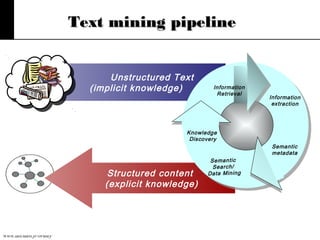
Unstructured Text
(implicit knowledge)

Information
Retrieval

Information
extraction

Knowledge
Discovery

Structured content
(explicit knowledge)

www.decideo.fr/bruley

Sem ant ic
Sea rch /
Dat a Min ing

Semantic
metadata
Text mining process
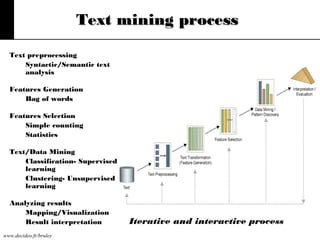
Text preprocessing
Syntactic/Semantic text
analysis
Features Generation
Bag of words
Features Selection
Simple counting
Statistics
Text/Data Mining
Classification- Supervised
learning
Clustering- Unsupervised
learning
Analyzing results
Mapping/Visualization
Result interpretation
www.decideo.fr/bruley

Iterative and interactive process
Text mining actors
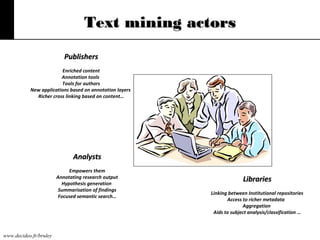
Publishers
Enriched content
Annotation tools
Tools for authors
New applications based on annotation layers
Richer cross linking based on content…

Analysts
Empowers them
Annotating research output
Hypothesis generation
Summarisation of findings
Focused semantic search…

www.decideo.fr/bruley

Libraries
Linking between Institutional repositories
Access to richer metadata
Aggregation
Aids to subject analysis/classification …
Challenges in text mining
Data collection is “free text”, is not well-organized (Semistructured or unstructured)
No uniform access over all sources, each source has
separate storage and algebra, examples: email, databases,
applications, web
A quintuple heterogeneity: semantic, linguistic, structure,
format, size of unit information
Learning techniques for processing text typically need
annotated training
XML as the common model, it allows:
– Manipulation data with standards
– Mining becomes more data mining
– RDF emerging as a complementary model
The more structure you can explore the better you can do
mining
www.decideo.fr/bruley
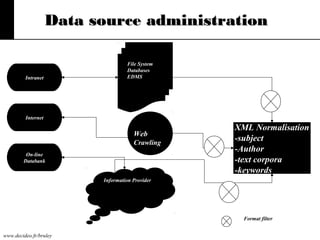
Data source administration

Intranet

File System
Databases
EDMS

Internet

Web
Crawling
On-line
Databank

XML Normalisation
-subject
-Author
-text corpora
-keywords

Information Provider

Format filter
www.decideo.fr/bruley
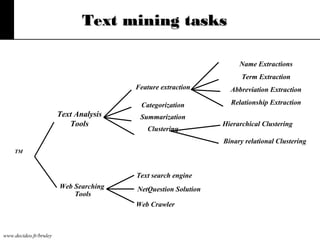
Text mining tasks
Name Extractions
Term Extraction
Feature extraction
Categorization

Text Analysis
Tools

Abbreviation Extraction
Relationship Extraction

Summarization
Clustering

Hierarchical Clustering
Binary relational Clustering

TM

Text search engine
Web Searching
Tools

NetQuestion Solution
Web Crawler

www.decideo.fr/bruley
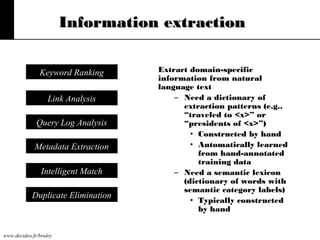
Information extraction
Keyword Ranking
Link Analysis
Query Log Analysis
Metadata Extraction
Intelligent Match
Duplicate Elimination

www.decideo.fr/bruley

Extract domain-specific
information from natural
language text
– Need a dictionary of
extraction patterns (e.g.,
“traveled to <x>” or
“presidents of <x>”)
• Constructed by hand
• Automatically learned
from hand-annotated
training data
– Need a semantic lexicon
(dictionary of words with
semantic category labels)
• Typically constructed
by hand
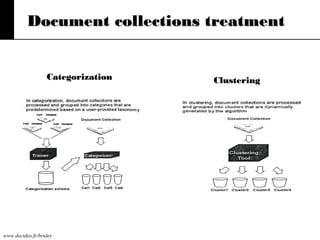
Document collections treatment

Categorization

www.decideo.fr/bruley

Clustering
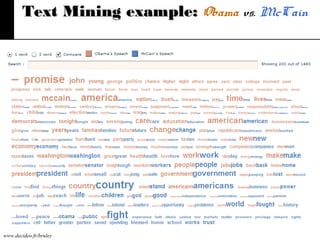
Text Mining example: Obama vs. McCain

www.decideo.fr/bruley
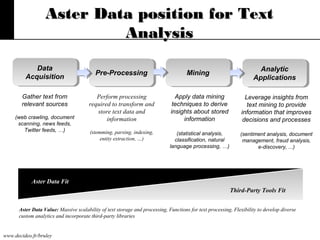
Aster Data position for Text
Analysis
Data
Data
Acquisition
Acquisition
Gather text from
relevant sources
(web crawling, document
scanning, news feeds,
Twitter feeds, …)

Pre-Processing
Pre-Processing

Mining
Mining

Analytic
Analytic
Applications
Applications

Perform processing
required to transform and
store text data and
information

Apply data mining
techniques to derive
insights about stored
information

Leverage insights from
text mining to provide
information that improves
decisions and processes

(stemming, parsing, indexing,
entity extraction, …)

(statistical analysis,
classification, natural
language processing, …)

(sentiment analysis, document
management, fraud analysis,
e-discovery, ...)

Aster Data Fit
Third-Party Tools Fit
Aster Data Value: Massive scalability of text storage and processing, Functions for text processing, Flexibility to develop diverse
custom analytics and incorporate third-party libraries

www.decideo.fr/bruley
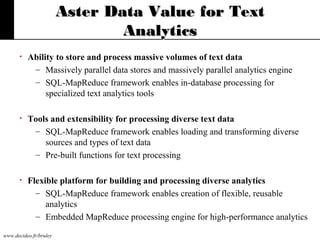
Aster Data Value for Text
Analytics
•

Ability to store and process massive volumes of text data
– Massively parallel data stores and massively parallel analytics engine
– SQL-MapReduce framework enables in-database processing for
specialized text analytics tools

•

Tools and extensibility for processing diverse text data
– SQL-MapReduce framework enables loading and transforming diverse
sources and types of text data
– Pre-built functions for text processing

•

Flexible platform for building and processing diverse analytics
– SQL-MapReduce framework enables creation of flexible, reusable
analytics
– Embedded MapReduce processing engine for high-performance analytics

www.decideo.fr/bruley
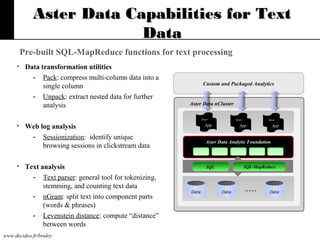
Aster Data Capabilities for Text
Data
Pre-built SQL-MapReduce functions for text processing
•

•

•

Data transformation utilities
- Pack: compress multi-column data into a
single column
- Unpack: extract nested data for further
analysis

Custom and Packaged Analytics

Aster Data nCluster
App
App

Web log analysis
- Sessionization: identify unique
browsing sessions in clickstream data
Text analysis
- Text parser: general tool for tokenizing,
stemming, and counting text data
- nGram: split text into component parts
(words & phrases)
- Levenstein distance: compute “distance”
between words

www.decideo.fr/bruley

App
App

App
App

Aster Data Analytic Foundation

SQL-MapReduce

SQL

Data

Data

Data

Big Data & Text Mining

  • 1.
    Text mining michel.bruley@teradata.com Extract fromvarious presentations: Temis, URI-INIST-CNRS, Aster Data … www.decideo.fr/bruley
  • 2.
    Information context Big amountof information is available in textual form in databases and online sources In this context, manual analysis and effective extraction of useful information are not possible It is relevant to provide automatic tools for analyzing large textual collections www.decideo.fr/bruley
  • 3.
    Text mining definition Theobjective of Text Mining is to exploit information contained in textual documents in various ways, including … discovery of patterns and trends in data, associations among entities, predictive rules, etc. The results can be important both for: the analysis of the collection, and providing intelligent navigation and browsing methods www.decideo.fr/bruley
  • 4.
    Text mining pipeline UnstructuredText (implicit knowledge) Information Retrieval Information extraction Knowledge Discovery Structured content (explicit knowledge) www.decideo.fr/bruley Sem ant ic Sea rch / Dat a Min ing Semantic metadata
  • 5.
    Text mining process Textpreprocessing Syntactic/Semantic text analysis Features Generation Bag of words Features Selection Simple counting Statistics Text/Data Mining Classification- Supervised learning Clustering- Unsupervised learning Analyzing results Mapping/Visualization Result interpretation www.decideo.fr/bruley Iterative and interactive process
  • 6.
    Text mining actors Publishers Enrichedcontent Annotation tools Tools for authors New applications based on annotation layers Richer cross linking based on content… Analysts Empowers them Annotating research output Hypothesis generation Summarisation of findings Focused semantic search… www.decideo.fr/bruley Libraries Linking between Institutional repositories Access to richer metadata Aggregation Aids to subject analysis/classification …
  • 7.
    Challenges in textmining Data collection is “free text”, is not well-organized (Semistructured or unstructured) No uniform access over all sources, each source has separate storage and algebra, examples: email, databases, applications, web A quintuple heterogeneity: semantic, linguistic, structure, format, size of unit information Learning techniques for processing text typically need annotated training XML as the common model, it allows: – Manipulation data with standards – Mining becomes more data mining – RDF emerging as a complementary model The more structure you can explore the better you can do mining www.decideo.fr/bruley
  • 8.
    Data source administration Intranet FileSystem Databases EDMS Internet Web Crawling On-line Databank XML Normalisation -subject -Author -text corpora -keywords Information Provider Format filter www.decideo.fr/bruley
  • 9.
    Text mining tasks NameExtractions Term Extraction Feature extraction Categorization Text Analysis Tools Abbreviation Extraction Relationship Extraction Summarization Clustering Hierarchical Clustering Binary relational Clustering TM Text search engine Web Searching Tools NetQuestion Solution Web Crawler www.decideo.fr/bruley
  • 10.
    Information extraction Keyword Ranking LinkAnalysis Query Log Analysis Metadata Extraction Intelligent Match Duplicate Elimination www.decideo.fr/bruley Extract domain-specific information from natural language text – Need a dictionary of extraction patterns (e.g., “traveled to <x>” or “presidents of <x>”) • Constructed by hand • Automatically learned from hand-annotated training data – Need a semantic lexicon (dictionary of words with semantic category labels) • Typically constructed by hand
  • 11.
  • 12.
    Text Mining example:Obama vs. McCain www.decideo.fr/bruley
  • 13.
    Aster Data positionfor Text Analysis Data Data Acquisition Acquisition Gather text from relevant sources (web crawling, document scanning, news feeds, Twitter feeds, …) Pre-Processing Pre-Processing Mining Mining Analytic Analytic Applications Applications Perform processing required to transform and store text data and information Apply data mining techniques to derive insights about stored information Leverage insights from text mining to provide information that improves decisions and processes (stemming, parsing, indexing, entity extraction, …) (statistical analysis, classification, natural language processing, …) (sentiment analysis, document management, fraud analysis, e-discovery, ...) Aster Data Fit Third-Party Tools Fit Aster Data Value: Massive scalability of text storage and processing, Functions for text processing, Flexibility to develop diverse custom analytics and incorporate third-party libraries www.decideo.fr/bruley
  • 14.
    Aster Data Valuefor Text Analytics • Ability to store and process massive volumes of text data – Massively parallel data stores and massively parallel analytics engine – SQL-MapReduce framework enables in-database processing for specialized text analytics tools • Tools and extensibility for processing diverse text data – SQL-MapReduce framework enables loading and transforming diverse sources and types of text data – Pre-built functions for text processing • Flexible platform for building and processing diverse analytics – SQL-MapReduce framework enables creation of flexible, reusable analytics – Embedded MapReduce processing engine for high-performance analytics www.decideo.fr/bruley
  • 15.
    Aster Data Capabilitiesfor Text Data Pre-built SQL-MapReduce functions for text processing • • • Data transformation utilities - Pack: compress multi-column data into a single column - Unpack: extract nested data for further analysis Custom and Packaged Analytics Aster Data nCluster App App Web log analysis - Sessionization: identify unique browsing sessions in clickstream data Text analysis - Text parser: general tool for tokenizing, stemming, and counting text data - nGram: split text into component parts (words & phrases) - Levenstein distance: compute “distance” between words www.decideo.fr/bruley App App App App Aster Data Analytic Foundation SQL-MapReduce SQL Data Data Data

Editor's Notes

  • #9 Input Data System: This part of the system is related to the collection of the data. -Getting data from the internet with a crawler -Getting data from Online vendors -Getting data from the internal data banks Regarding the input format (physical and logical), data are physicaly reformated into html format and then it&apos;s loaded into an XML format
  • #10 Feature extraction tools It recognizes significant vocabulary items in documents, and measures their importance to the document content. 2. Clustering tools Clustering is used to segment a document collection into subsets, called clusters. 3. Summarization tool Summarization is the process of condensing a source text into a shorter version preserving its information content. 4. Categorization tool Categorization is used to assign objects to predefined categories, or classes from a taxonomy.
  • #13 http://services.alphaworks.ibm.com/manyeyes/view/SWhH8QsOtha6qL3F~y5HQ2~