Md. Abul Kalam Azad
ID: 1403EEE00041
Content:
 Modulation
 Digital Modulation
 Pulse Code Modulation(PCM)
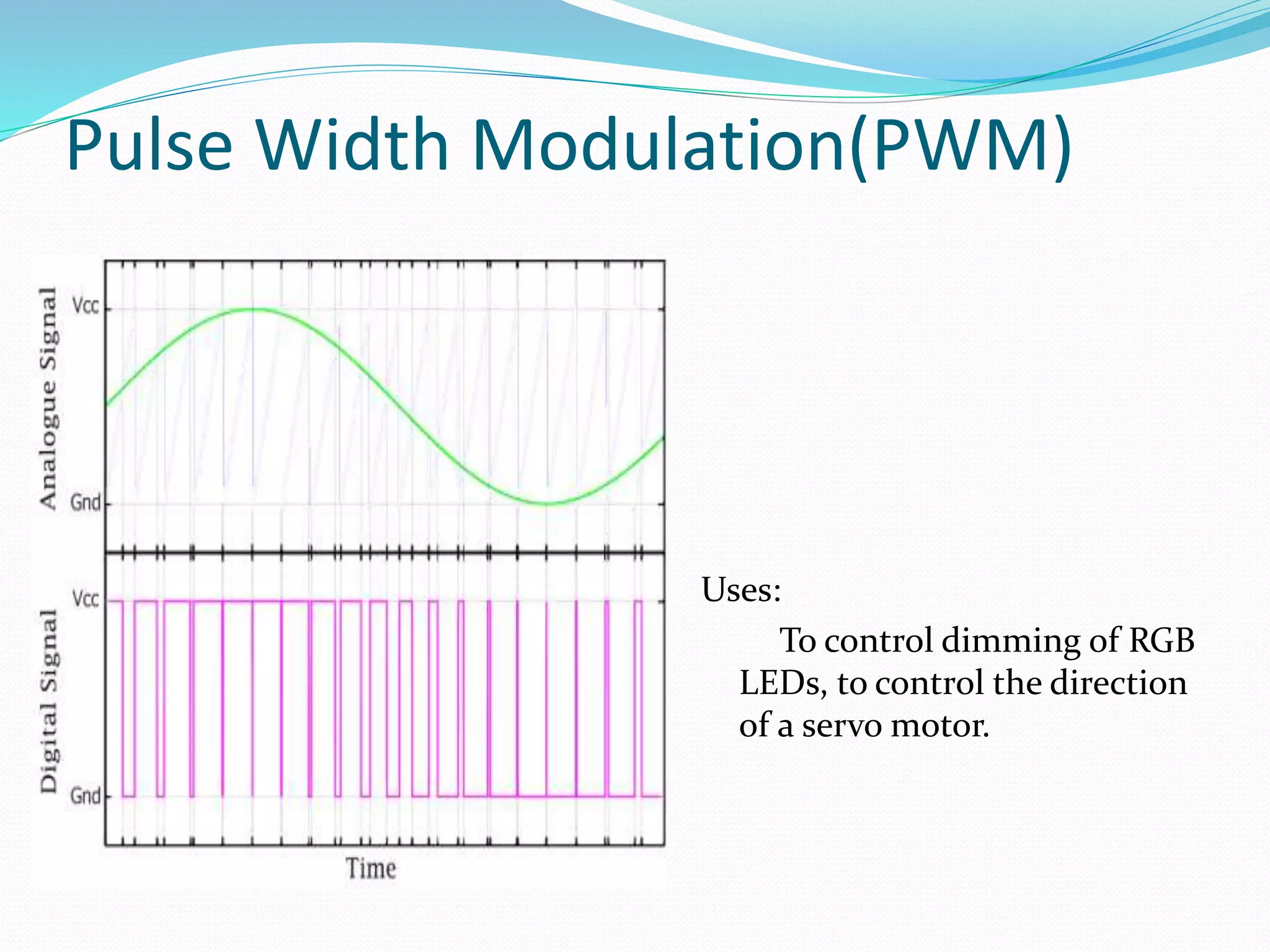
 Pulse Width Modulation(PWM)
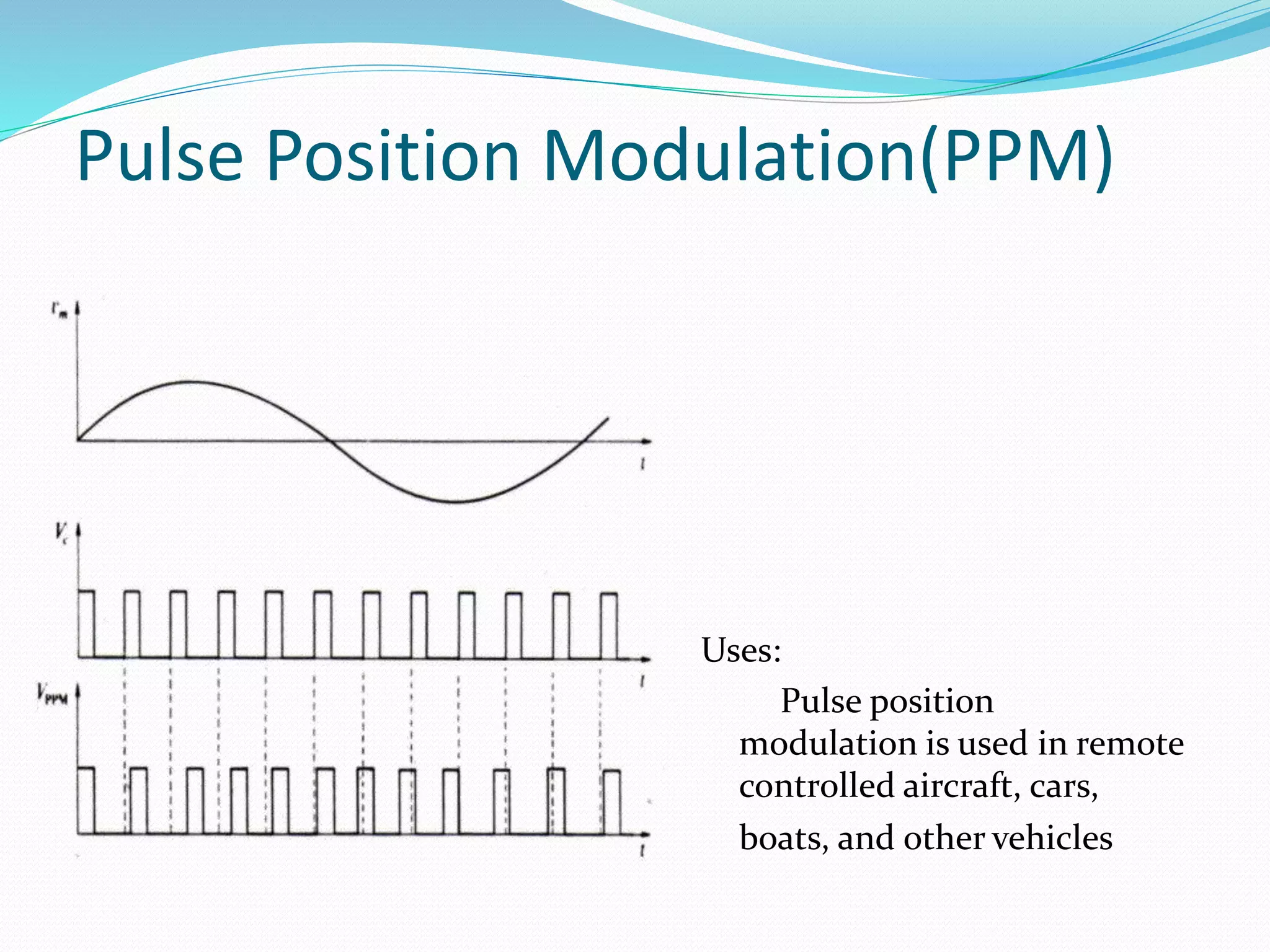
 Pulse Position Modulation(PPM)
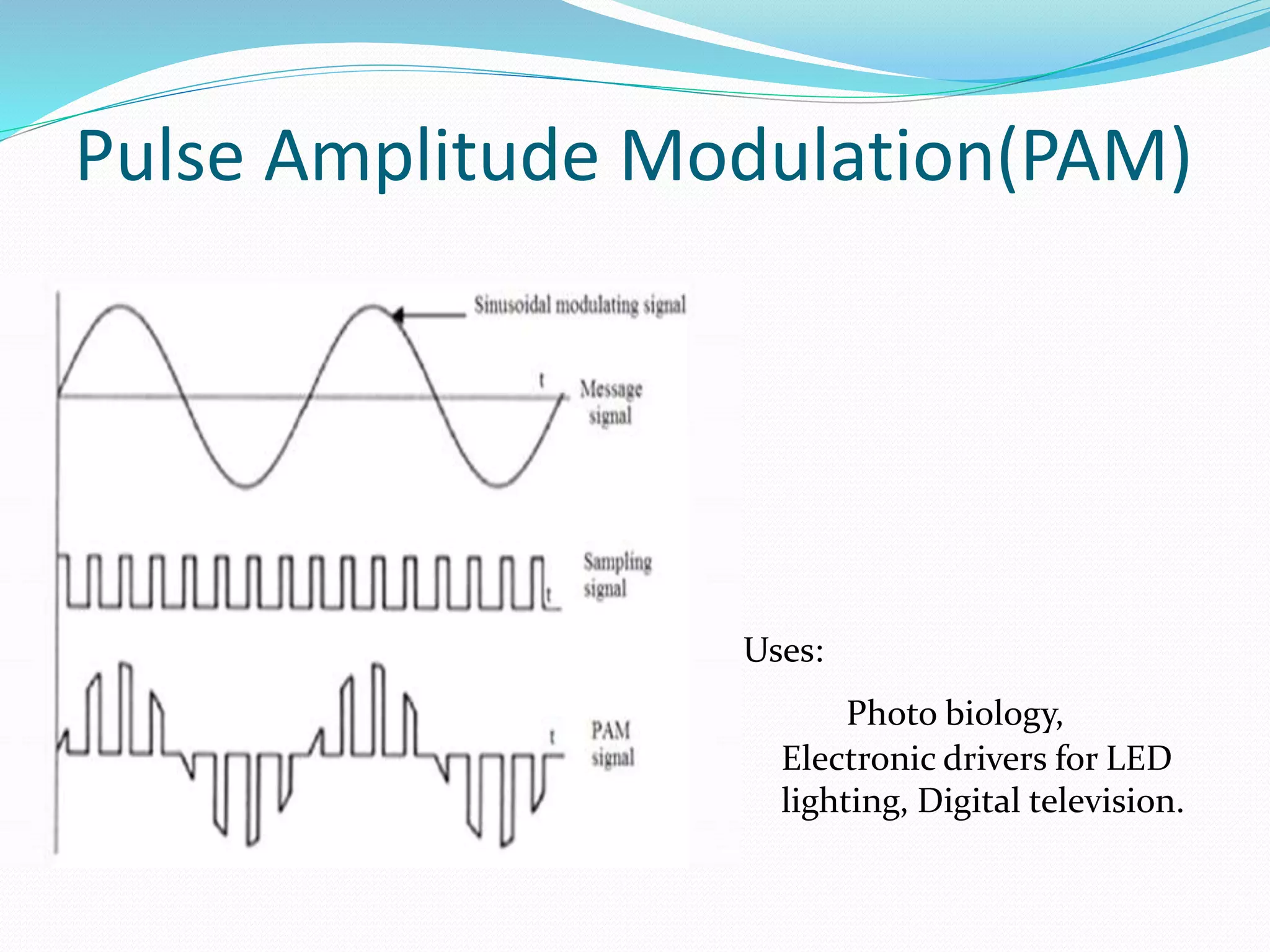
 Pulse Amplitude Modulation(PAM)
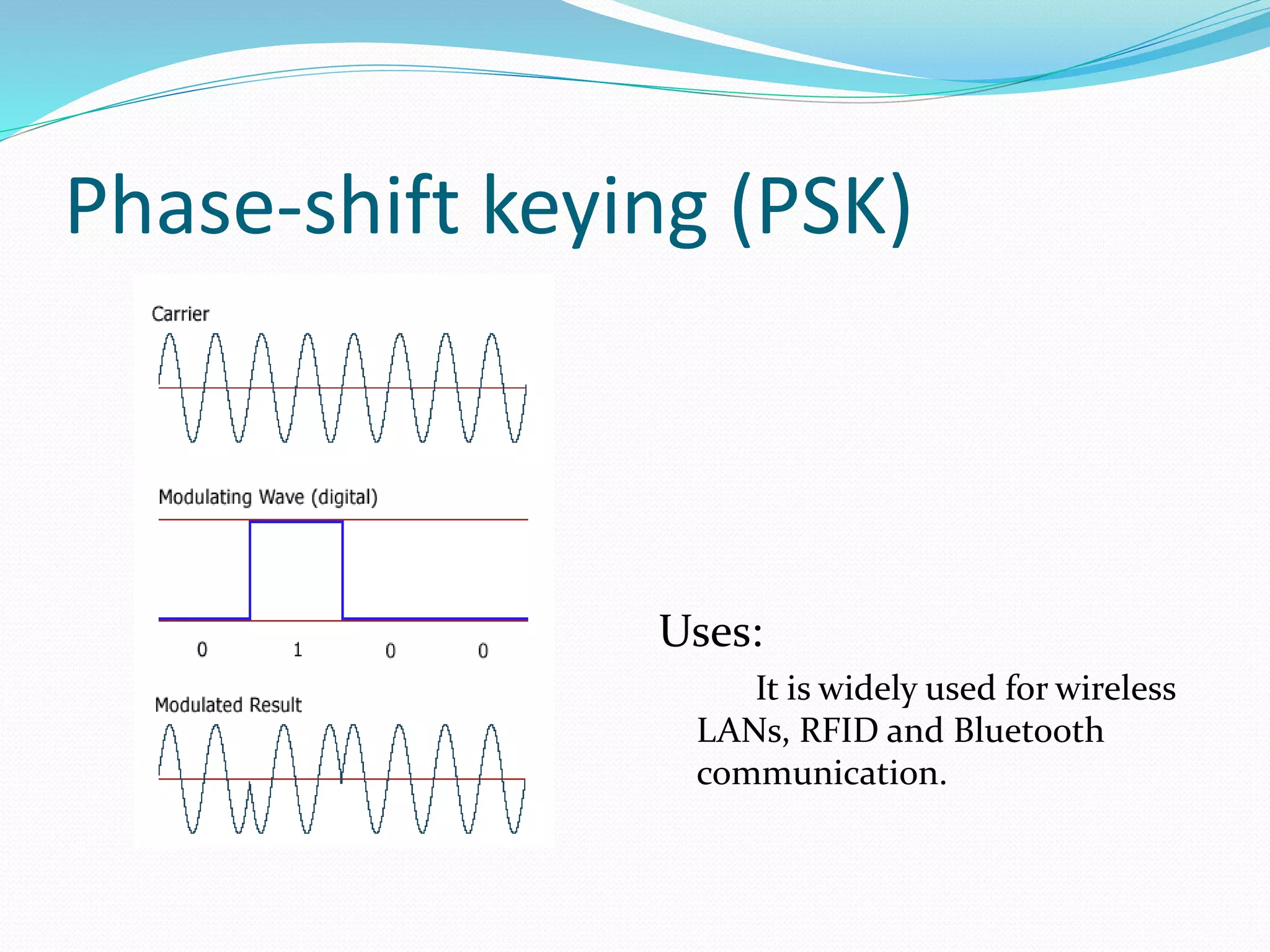
 Phase-shift keying (PSK)
 Amplitude-shift keying (ASK)
 Frequency-shift keying (FSK)
Modulation:
Modulation is a process to change the
property ( pulse, frequency , amplitude) of high frequency
signal(carrier) with respect to the low frequency signal (message).
Digital Modulation:
Analog to Digital:
Analog data, such as voice and video, are
often digitized to be able to use digital transmission facilities.
Digital to Digital:
The simplest form of digital encoding of
digital data is to assign one voltage level to binary one and another to
binary zero. More complex encoding schemes are used to improve
performance, by altering the spectrum of the signal and providing
synchronization capability.
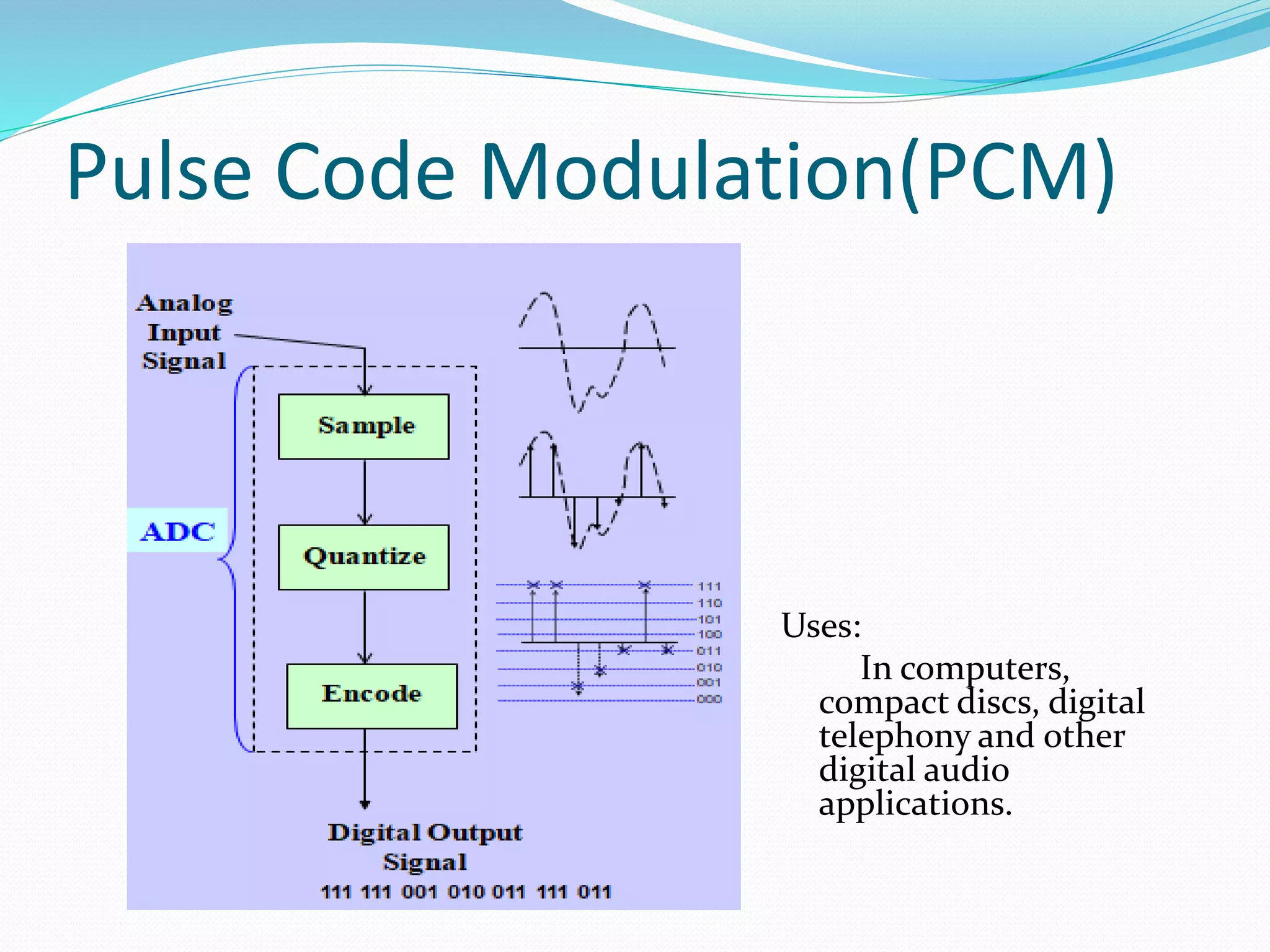
Pulse Code Modulation(PCM)
Uses:
In computers,
compact discs, digital
telephony and other
digital audio
applications.
Pulse Width Modulation(PWM)
Uses:
To control dimming of RGB
LEDs, to control the direction
of a servo motor.
Pulse Position Modulation(PPM)
Uses:
Pulse position
modulation is used in remote
controlled aircraft, cars,
boats, and other vehicles
Pulse Amplitude Modulation(PAM)
Uses:
Photo biology,
Electronic drivers for LED
lighting, Digital television.
Phase-shift keying (PSK)
Uses:
It is widely used for wireless
LANs, RFID and Bluetooth
communication.
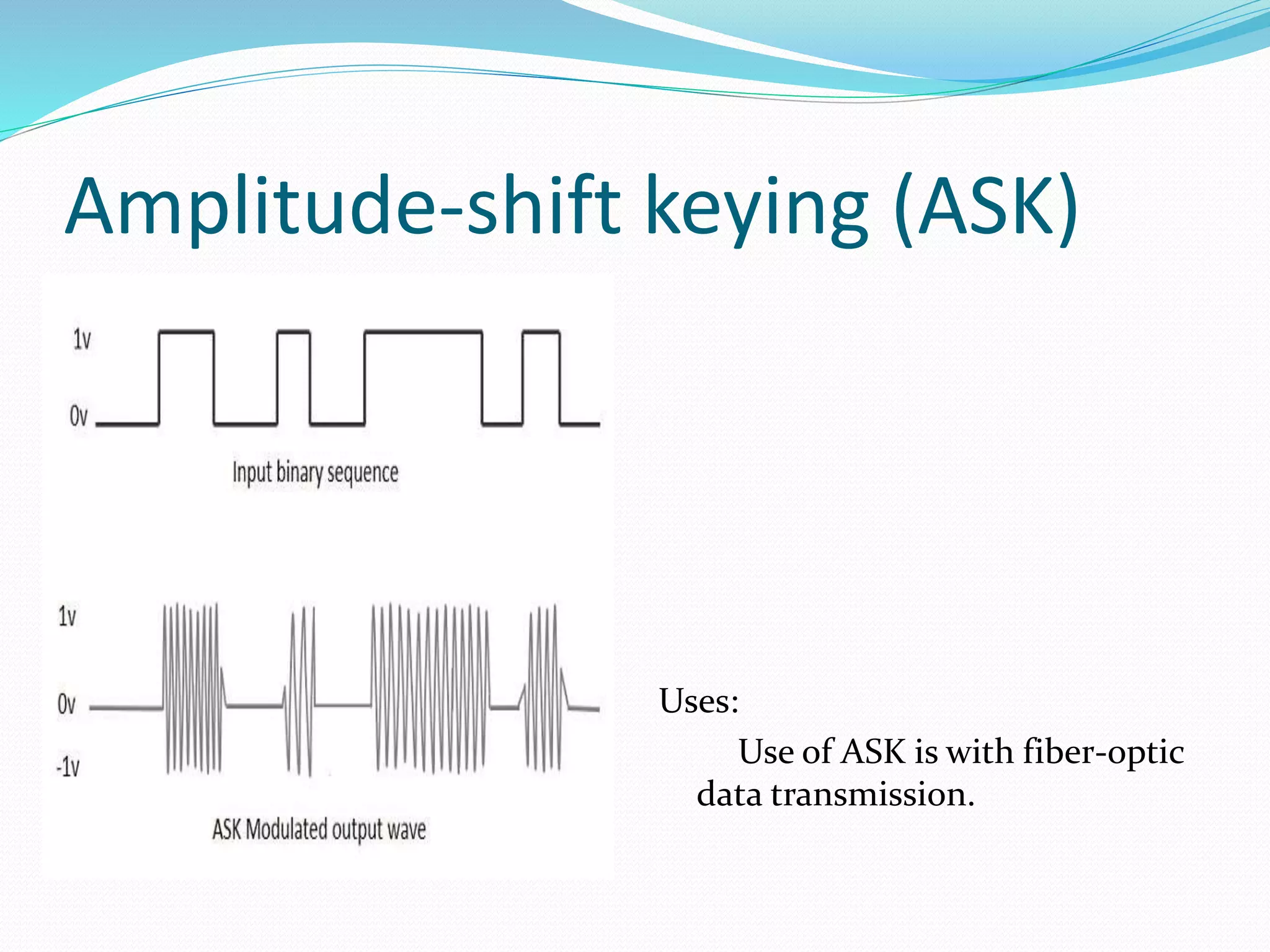
Amplitude-shift keying (ASK)
Uses:
Use of ASK is with fiber-optic
data transmission.
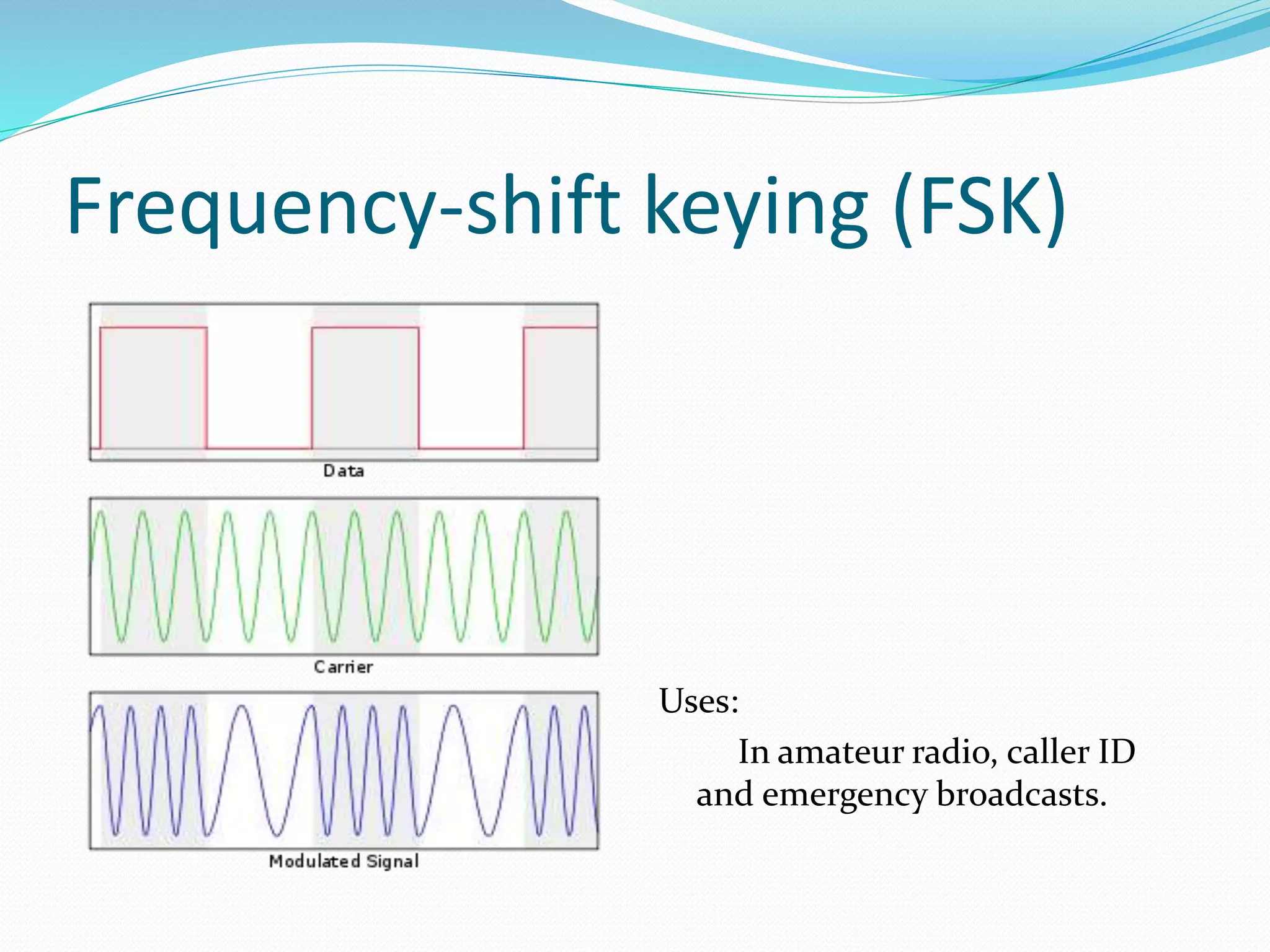
Frequency-shift keying (FSK)
Uses:
In amateur radio, caller ID
and emergency broadcasts.
Any Question?
Thank You.

Modulation